

- Industry Size (2026)
- USD 1.3 Bn
- Forecast (2036)
- USD 2.1 Bn
- CAGR (2026 to 2036)
- 5.0%
Automotive Wheel Speed Sensor Tone Ring Market Size, Market Forecast and Outlook By FMI
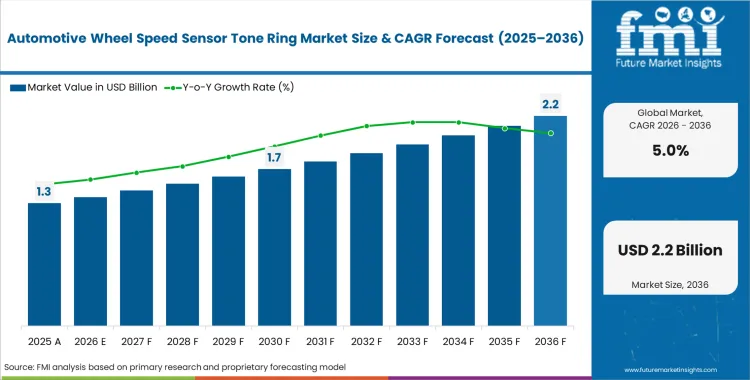
The automotive wheel speed sensor tone ring market surpassed a valuation of USD 1.2 billion in 2025. Revenue is projected to reach USD 1.3 billion in 2026 and grow to USD 2.1 billion by 2036, registering a CAGR of 5.0% during the forecast period.
Summary of Automotive Wheel Speed Sensor Tone Ring Market
- The market is forecast to reach USD 2.1 billion by 2036.
- The market is expected to grow at a CAGR of 5.0% from 2026 to 2036.
- The market was estimated at USD 1.2 billion in 2025.
- The forecast period represents an incremental opportunity of USD 0.9 billion.
- The market is projected to reach USD 1.3 billion in 2026.
- Magnetic rings lead the type segment with a 58.0% share, driven by adoption of active sensor architectures.
- Wheel bearings dominate the mounting location segment with a 36.0% share, reflecting integration into compact wheel-end systems.
- Passenger cars account for 69.0% share, aligned with global vehicle production trends.
- OEM sales channel leads with a 72.0% share, supported by platform-level validation requirements.
- Magnetic elastomer leads the material segment with a 41.0% share, due to its use in encoder-ring designs.
- Key companies in the market include Bosch, Continental (Aumovio), Schaeffler, NTN, and NSK.
Growth is driven by tightening emission regulations and the need for improved vehicle aerodynamics, as automakers increasingly deploy active airflow management systems to enhance fuel efficiency and thermal control.
Manufacturers are facing tighter performance expectations at the wheel end, where sensing accuracy must improve without adding unnecessary unsprung mass. Higher-pole-count tone ring designs are helping address this requirement, though weak stamping precision and uneven magnetic consistency can still distort signal quality and reduce wheel-slip interpretation accuracy. Conventional passive iron rotors are gradually losing fit in this setting because modern ABS pump and modulator systems increasingly require zero-speed detection and finer rotational resolution. Multi-pole magnetic architectures are gaining preference for that reason, as they support more stable signal output during low-speed operation and transitional braking events. Qualification standards are becoming stricter as dimensional consistency, sealing integrity, and active sensor compatibility carry more weight in component selection.
Stronger adoption is expected as integrated sensor-bearing hub assemblies move into higher production volumes. Tone ring design is becoming more closely tied to hub and bearing engineering because sealed wheel-end modules allow less flexibility for separate component choices. Validation work is increasingly being handled across sensing, bearing, and packaging functions together so that durability and signal accuracy are resolved within a common wheel-end design framework. This integration trend is likely to support longer-term demand for more advanced wheel speed sensor tone ring systems.
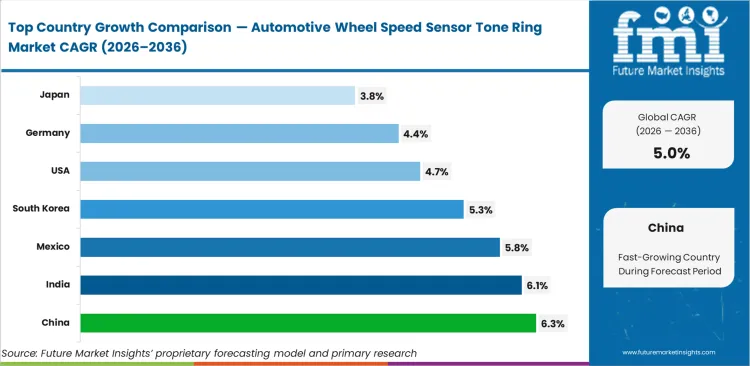
China is projected to expand at a CAGR of 6.3% during 2026 to 2036, supported by faster domestic scaling and rising electronic braking content across vehicle production. Demand in India is estimated to rise at a 6.1% CAGR over the 2026-2036 period, helped by strong vehicle output and wider fitment of electronically managed braking systems. Mexico is also expected to see steady growth through 2036 as North American manufacturing networks continue shifting toward regional sourcing patterns. South Korea is likely to register a CAGR of 5.3% during 2026-2036, supported by vehicle platforms that already carry relatively high electronic control content. More moderate expansion is anticipated in the United States and Germany, where replacement demand and incremental content upgrades are expected to shape a larger share of market activity. Japan is projected to remain the slowest-growing market among this group through 2036, as ABS penetration is already mature and the installed base leaves less room for rapid volume acceleration.
Segmental Analysis
Automotive Wheel Speed Sensor Tone Ring Market Analysis by Type
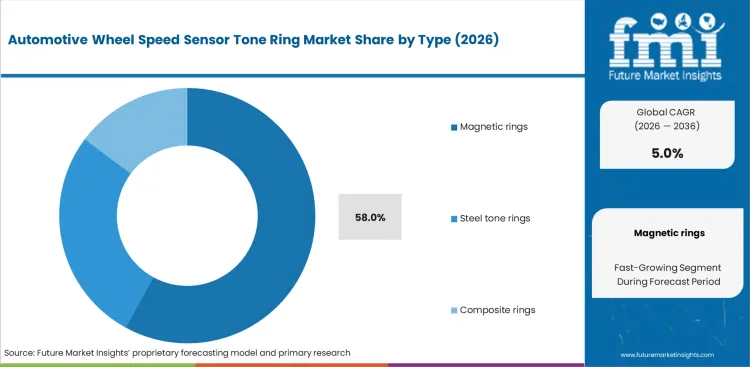
Magnetic rings are estimated to account for 58.0% share in 2026. Low-speed detection requirements are pushing wheel-speed sensing away from legacy passive steel designs, which struggle to deliver reliable signals at very low vehicle speeds. Active magnetic poles allow Hall-effect sensors to read fine rotational movement with much greater accuracy, making this format better aligned with current control requirements. Engineers also depend on this architecture when laying out the broader automotive brake system in electric vehicles and other electronically managed platforms. Installation discipline remains critical because improper handling can demagnetize elastomer-based tracks without leaving visible damage. Service operations shifting to integrated magnetic rings therefore need tighter process control during bearing replacement and wheel-end repair.
- Initial specification: Zero-speed detection requirements push engineers toward multi-pole magnetic targets that can maintain signal accuracy during crawl-speed operation.
- Qualification hurdle: Thermal shock testing must confirm elastomer adhesion remains stable without delamination under repeated temperature cycling.
- Renewal condition: Lower warranty incidence supports long-term supplier retention where vulcanization consistency remains defect-free.
Automotive Wheel Speed Sensor Tone Ring Market Analysis by Mounting Location
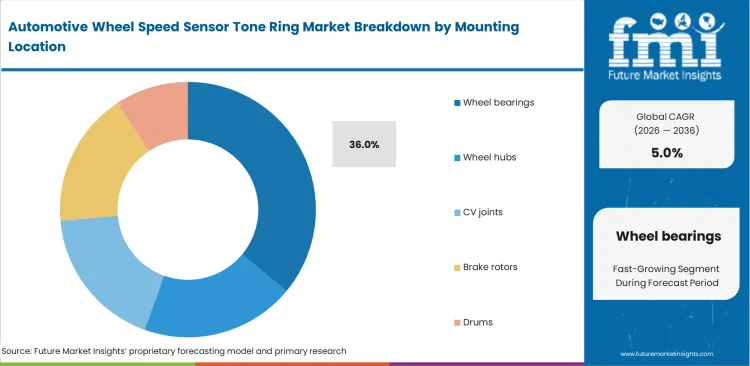
Pre-calibrated hub units remove the need for manual air-gap setting, which improves consistency on fast production lines. Wheel-bearing-mounted solutions are poised to garner 36.0% share in 2026 as integrated layouts continue replacing discrete installation methods. Consolidation of sensor bearings into sealed units also changes the service model because a minor signal fault can force replacement of the full bearing assembly. That shift raises repair cost and weakens demand for standalone replacement rings outside older vehicle platforms. As more manufacturers standardize integrated wheel-end modules, replacement economics continue moving away from individual ring sales.
- Assembly integration: Unified hub modules reduce manual adjustment steps and allow faster installation on assembly lines.
- Operational consequence: Small sensor faults can require complete hub replacement, increasing both part and labor cost for vehicle owners.
- Lifecycle cost: Higher replacement values are increasingly weighed against the assembly efficiency gained from integrated designs.
Automotive Wheel Speed Sensor Tone Ring Market Analysis by Vehicle Type
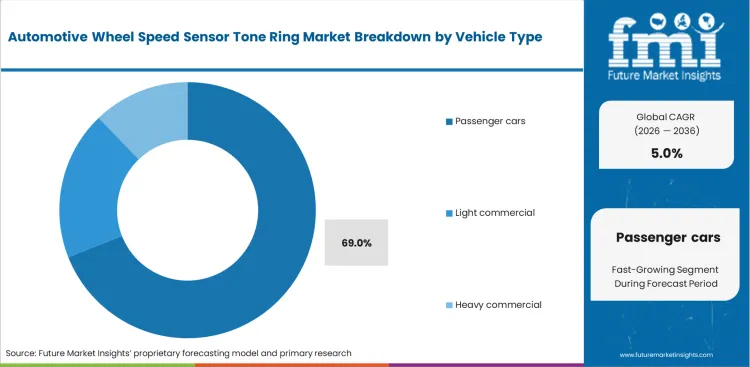
Safety legislation continues to make wheel speed sensing standard across light-vehicle platforms. High-volume passenger vehicle production also allows manufacturers to optimize frequency standards and component dimensions around a narrow range of mainstream applications. Passenger cars are set to represent 69.0% share in 2026 because electronic stability and braking control systems require four-wheel monitoring across nearly all new sedan and crossover programs. Integration of speed sensor hub bearings is helping wheel-end packaging shrink, but it also increases demands on dimensional precision and material integrity. Compact vehicle layouts leave little room for oversized components, which pushes suppliers toward thinner and more tightly controlled ring construction. Manufacturers lacking precision forming capability usually struggle to qualify for this segment.
- Failure prevention: Stable high-resolution signals help control systems prevent unintended wheel lockup and preserve directional stability.
- Residual risk: Magnetic poles can still lose effectiveness when ferrous debris accumulates and interferes with signal clarity.
- Full capture: Control software must be calibrated closely to each ring’s pole count to achieve full system performance.
Automotive Wheel Speed Sensor Tone Ring Market Analysis by Sales Channel
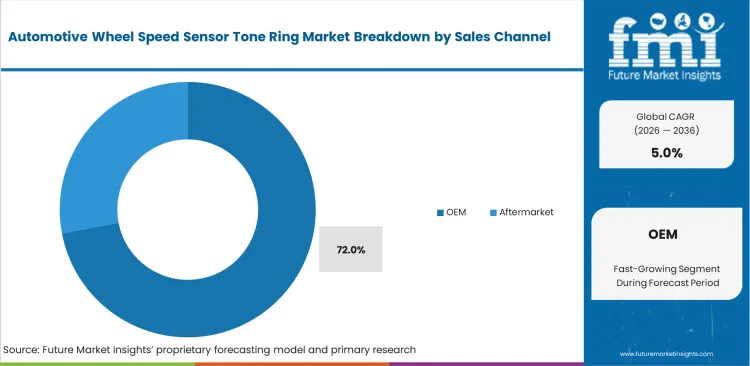
Service life for tone rings generally aligns with overall vehicle life unless corrosion, debris exposure, or installation damage leads to failure. Multi-year sourcing arrangements are also expected to favor the OEM channel, especially where tone rings are closely tied to wider automotive brake actuation system programs. Replacement parts face a narrower path because installation outside factory conditions creates greater risk of geometric distortion and immediate signal loss. Factory-installed supply is estimated to account for 72.0% share in 2026, reflecting the fact that most components are fitted once and remain in service without routine replacement. Independent repair channels still address localized requirements, though performance often depends on installer accuracy and clear handling practices. As sealed hub designs become more widely used, aftermarket demand is likely to narrow further.
- Production consolidation: Large OEM contracts are expected to support tighter tolerance control and more consistent output.
- Supply constraint: Specialized vulcanization equipment is likely to limit how quickly suppliers can expand production capacity.
- 2036 landscape: Distribution networks are projected to shift further toward complete hub assemblies rather than separate replacement rings.
Automotive Wheel Speed Sensor Tone Ring Market Analysis by Material
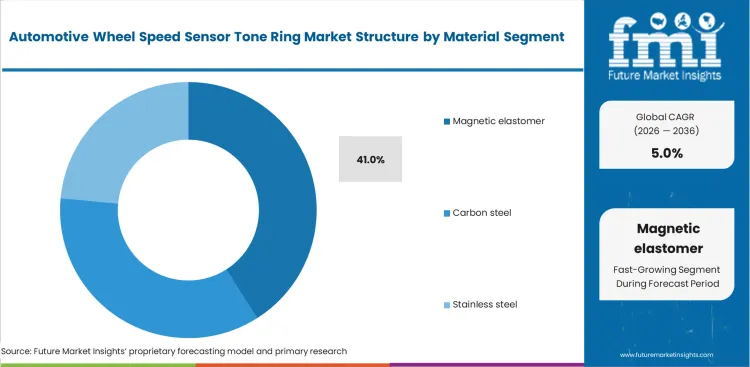
High-frequency wheel-speed sensing increasingly depends on magnetic behavior rather than conventional toothed-metal geometry. Bonded elastomer materials help generate the clean square-wave signals needed for modern control systems. Material selection is particularly important where automotive ABS and ESC functions rely on accurate low-speed and reverse-roll detection. Long-term field exposure still creates a point of weakness because aggressive wheel-cleaning chemicals can gradually degrade elastomer compounds. Magnetic elastomer is estimated to account for 41.0% share in 2026. Material developers must therefore balance chemical resistance, magnetic permeability, and thermal durability within the same formulation. Lower-grade rubber systems often lose qualification once field performance starts weakening under harsh service conditions.
- Excess performance: Advanced elastomer compounds can retain magnetic strength through severe temperature swings and repeated wheel-end heat exposure.
- Edge condition gap: Low-temperature brittleness can introduce micro-cracking risk in certain elastomer blends.
- Acceptability standard: OEM specifications require tightly controlled magnetic flux density across every pole before approval is granted.
Automotive Wheel Speed Sensor Tone Ring Market Drivers, Restraints, and Opportunities
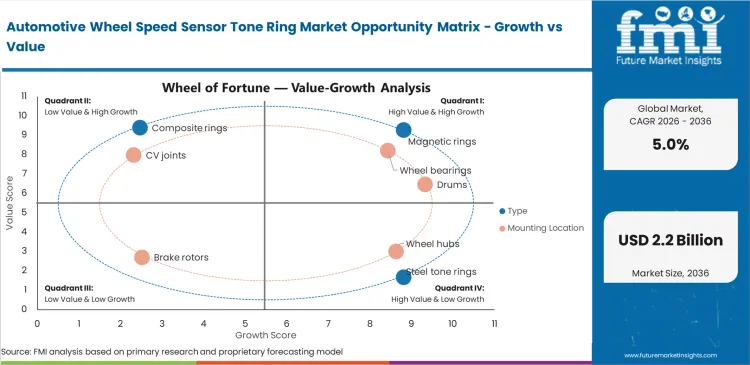
Advanced driver assistance functions require continuous wheel-position data, especially where low-speed control accuracy affects feature reliability. Autonomous driving and assisted parking systems lose effectiveness when signal generation weakens near zero speed. Chassis engineers are therefore under greater pressure to specify multi-pole magnetic targets that support zero-speed detection and finer signal continuity. Delayed migration toward these designs can restrict vehicle platforms from supporting higher-value self-parking and highway-assist packages. Active targets are gaining preference because they provide stronger resolution, reducing the relevance of legacy steel gear configurations in advanced braking and motion-control architectures.
Packaging constraints remain a major challenge because wheel-hub cavities continue to shrink while surrounding brake hardware grows larger. Suspension layouts leave limited room for larger targets, particularly in vehicle platforms carrying heavier brake packages and tighter wheel-end integration. Current modular bearing solutions help address available space constraints, though they also raise replacement cost at the assembly level. Efforts to reduce standalone ring size further are constrained by physical magnetic flux limits, leaving suppliers with a narrow path between compact packaging and signal integrity. That tradeoff is likely to remain a central design pressure in future wheel-end development.
Opportunities in the Automotive Wheel Speed Sensor Tone Ring Market
- Debris-resistant formulations: Material scientists capture premium margins by developing passenger car hub bearings encoders that repel ferrous brake dust effectively.
- Thermal isolation designs: EV contracts are secured by insulating magnetic targets from high regenerative braking heat.
- Aftermarket modularity: Integrated hub assemblies priced competitively against discrete dealer components help strengthen customer loyalty across distribution channels.
Regional Analysis
Based on regional analysis, automotive wheel speed sensor tone ring market is segmented into North America, Latin America, Europe, East Asia, South Asia, and Middle East & Africa across 40 plus countries.
.webp "Top Country Growth Comparison Automotive Wheel Speed Sensor Tone Ring Market Cagr (2026 2036)")
| Country | CAGR (2026 to 2036) |
|---|---|
| China | 6.3% |
| India | 6.1% |
| Mexico | 5.8% |
| South Korea | 5.3% |
| United States | 4.7% |
| Germany | 4.4% |
| Japan | 3.8% |
Source: Future Market Insights (FMI) analysis, based on proprietary forecasting model and primary research
East Asia Automotive Wheel Speed Sensor Tone Ring Market Analysis
Rapid component localization defines East Asian manufacturing strategies. Automakers aggressively transition away from imported sensor targets toward domestic suppliers capable of matching severe cost constraints. Assembly hubs demand integrated bearing solutions to accelerate factory throughput. FMI's analysis indicates local stampers quickly acquired advanced vulcanization capabilities, closing technical gaps with global competitors. Manufacturers prioritize vendors offering unified sensor-bearing modules, eliminating calibration steps entirely.
- China: Local supplier scaling outpaces mature production centers significantly. Demand within the automotive wheel speed sensor tone ring industry in China is anticipated to rise at a CAGR of 6.3% through 2036. Automakers leverage massive domestic capacity to push component prices downward across vehicle assembly lines. Domestic suppliers capturing high-volume contracts gain immediate scale advantages against international competitors, solidifying regional dominance.
- South Korea: Concentration in electronically sophisticated vehicle platforms dictates component sourcing requirements across the region. Sales of tone rings in South Korea are expected to increase at a CAGR of 5.3% during the forecast period. Manufacturers specify high-pole-count active encoders to support advanced highway-assist features seamlessly. Consistent growth reflects a clear shift toward adopting ultra-precise magnetic elastomers for next-generation mobility platforms.
- Japan: Sales within the automotive wheel speed sensor tone ring segment in Japan are poised to expand at a CAGR of 3.8% through 2036. High domestic saturation naturally restricts rapid volume expansion within existing supply chains. Manufacturers focus entirely on quality consistency and zero-defect delivery rather than chasing massive capacity upgrades. Strict quality adherence forces local suppliers to optimize existing production lines relentlessly over volume scaling.
South Asia Automotive Wheel Speed Sensor Tone Ring Market Analysis
Surging domestic vehicle output forces localized component manufacturing across the region. Regional automakers previously reliant on basic ABS hardware now specify complex stability control targets to meet updated safety legislation. FMI's analysis indicates this sudden regulatory shift creates immediate capacity shortages for specialized magnetic encoders. Manufacturers actively scramble to qualify new stamping facilities capable of meeting strict precision tolerances.
- India: Universal ABS mandates push adoption rates higher across all vehicle classes. Automakers abandon simple passive gears for sophisticated active targets to ensure compliance. Growth within the automotive wheel speed sensor tone ring segment in India is anticipated to gain momentum, with demand rising at a CAGR of 6.1% over the forecast period. Acting decisively allows manufacturers to secure limited high-quality supplier allocations early.
North America Automotive Wheel Speed Sensor Tone Ring Market Analysis
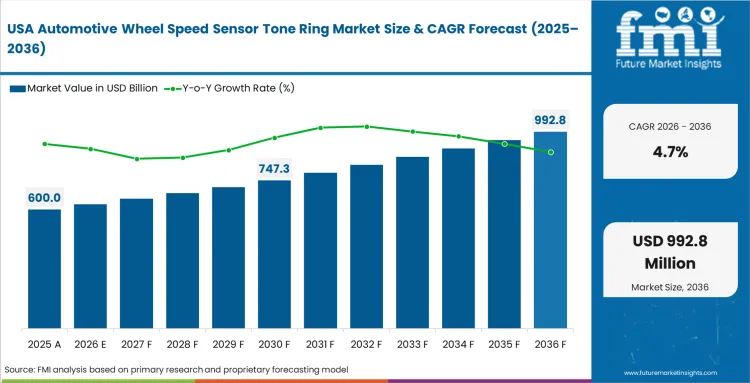
Supply chain realignments dominate North American component sourcing. Manufacturers actively shift production footprints southward to capture labor arbitrage while maintaining regional content compliance. Assembly plants demand flawlessly integrated automotive ADAS market sensor hardware. FMI analysts note automakers constantly struggle balancing aggressive cost reduction initiatives against strict demands for pristine signal fidelity under severe winter operating conditions.
- Mexico: Mexico is set to record a CAGR of 5.8% in tone ring sales during the assessment period. Export-oriented assembly leads to high component consumption across the country. Manufacturers actively relocate sub-assembly operations near major vehicle manufacturing hubs to streamline complex logistics. Facilities established locally quickly dominate regional supply channels, fulfilling high-volume contracts for adjacent automotive markets with high efficiency.
- United States: Replacement and content upgrades create opportunity inside a fully mature ABS landscape. Sales in the automotive wheel speed sensor tone ring industry in the United States are poised to grow at a CAGR of 4.7% during the assessment period. Distributors continuously transition inventory toward complete hub assemblies to match shifts. Sealed bearing adoption forces expensive module replacements, elevating overall maintenance costs.
Europe Automotive Wheel Speed Sensor Tone Ring Market Analysis
Strict autonomous driving safety standards compel adoption of zero-tolerance magnetic targets. Regional regulators continuously tighten stopping distance requirements, forcing automakers to upgrade wheel-end sensors. FMI's assessment indicates manufacturers mandate highly specific elastomer blends capable of surviving extreme speeds without demagnetization.
- Germany: Premium automakers dictate extreme technical specifications across domestic production lines. Manufacturers integrate precision encoders directly into complex multi-link hub structures to meet performance targets. Demand across the automotive wheel speed sensor tone ring segment in Germany is expected to register a CAGR of 4.4% through 2036. Stringent component engineering standards established locally eventually become mandatory baseline requirements for global automotive platforms.
FMI's report includes United Kingdom, France, Italy, Brazil, and ASEAN nations. Emerging regulatory frameworks across Latin America quietly force local assemblers toward active magnetic targets, shifting baseline component requirements.
Competitive Aligners for Market Players
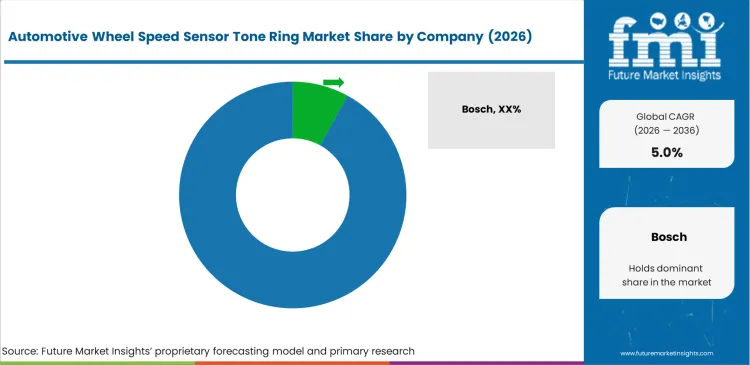
Wheel-end integration capability gives larger Tier-1 suppliers a clear advantage in this market. OEMs usually prefer validated sensor, bearing, and hub packages because signal accuracy depends on how the full assembly performs, not on the ring alone. Managing air-gap tolerance across multiple vendors adds unnecessary risk, especially when braking and stability functions rely on consistent data from the wheel end. Suppliers that can validate performance from target to control unit are better placed to secure volume programs.
Material performance creates another barrier for smaller entrants. Magnetic elastomer compounds must retain flux stability after long exposure to salt, moisture, heat, and road chemicals, and that requires more than basic processing capability. Field validation matters because laboratory acceptance alone does not prove durability across full service life. Supplier approval tends to favor companies with deeper records in compound behavior, thermal cycling, and long-run wheel-end reliability.
Buyer preference still limits full dependence on one source. Standardized sensor communication requirements and fixed hub dimensions leave room for interchangeability at the system level, even when validation standards stay tight. That structure keeps many smaller ring manufacturers in supporting roles, where participation is tied more to component supply than to ownership of the complete wheel-end package. Competitive strength in this market comes from proven integration, material durability, and repeatable validation performance.
Key Players in Automotive Wheel Speed Sensor Tone Ring Market
- Bosch
- Continental / Aumovio
- Schaeffler
- NTN
- NSK
Scope of the Report
| Metric | Value |
|---|---|
| Quantitative Units | USD 548.0 million to USD 909.8 million, at a CAGR of 5.2% |
| Market Definition | Precision rotational targets generate alternating magnetic or inductive pulses when read by fixed sensors. They enable dynamic vehicle stability control by translating physical wheel rotation into high-frequency digital signals. |
| Segmentation | Type, Mounting Location, Vehicle Type, Sales Channel, Material, and Region |
| Regions Covered | North America, Latin America, Europe, East Asia, South Asia, Middle East & Africa |
| Countries Covered | China, India, Mexico, South Korea, United States, Germany, Japan |
| Key Companies Profiled | Bosch, Continental / Aumovio, Schaeffler, NTN, NSK |
| Forecast Period | 2026 to 2036 |
| Approach | Baseline established via annual light vehicle production volumes crossed with ABS integration rates. |
Source: Future Market Insights (FMI) analysis, based on proprietary forecasting model and primary research
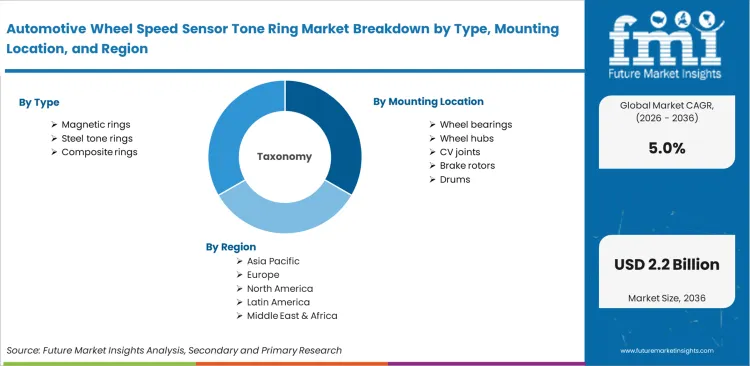
Automotive Wheel Speed Sensor Tone Ring Market Analysis by Segments
Type:
- Magnetic rings
- Steel tone rings
- Composite rings
Mounting Location:
- Wheel bearings
- Wheel hubs
- CV joints
- Brake rotors
- Drums
Vehicle Type:
- Passenger cars
- Light commercial
- Heavy commercial
Sales Channel:
- OEM
- Aftermarket
Material:
- Magnetic elastomer
- Carbon steel
- Stainless steel
Region:
- North America
- United States
- Canada
- Europe
- Germany
- United Kingdom
- France
- Italy
- Spain
- Asia Pacific
- China
- Japan
- South Korea
- Taiwan
- Singapore
- Latin America
- Brazil
- Mexico
- Argentina
- Middle East & Africa
- GCC Countries
- South Africa
Bibliography
- Ragab, H., Givigi, S., & Noureldin, A. (2024). Automotive speed estimation: Sensor types and error characteristics from OBD-II to ADAS. arXiv.
- Lin, S.-L. (2025). Advancements in noise reduction for wheel speed sensing using enhanced LSTM models. Scientific Reports, 15, Article 21190.
- National Highway Traffic Safety Administration. (2025). ABS/TCS/Stability/Brake warning indicators displayed on drivers information center (DIC), DTC C0500 or C0501, C0506 or C0507, C050C or C050D, and/or C0512 or C0513 set (Bulletin No. 25-NA-019).
- Dixit, C., Gaurkar, P., Ramakrishnan, R., Shankar Ram, C., Vivekanandan, G., & Sivaram, S. (2024). Calibration of an inertial measurement unit and its impact on antilock braking system performance. SAE Technical Paper 2024-26-0014.
- Zhou, H., Liu, W., Wang, R., Ding, R., Guo, Z., Ye, Q., Meng, X., Sun, D., & Liu, W. (2025, March 6). Anti-lock braking system performance optimization based on fitted-curve road-surface recognition and sliding-mode variable-structure control. World Electric Vehicle Journal, 16(3), 156.
This bibliography is provided for reader reference. The full FMI report contains the complete reference list with primary source documentation.
This Report Addresses
- Chassis engineer specification initiates favoring magnetic elastomer active targets.
- Independent repair shop labor cost escalations due to integrated sensor-bearing modules.
- Tier-1 hub assembler integration strategies eliminating manual air gap calibration requirements.
- Quality audit rejection rates for Tier-2 stampers lacking precision blanking press capabilities.
- Formulation chemist challenges balancing thermal resilience against optimal magnetic permeability.
- Structured maintenance protocols help combat ferrous debris accumulation on magnetic poles.
- Large-volume contract negotiations are contributing to more stable component pricing across North American manufacturing hubs.
- Powertrain software programmer requirements driving zero-speed detection capabilities for automatic braking systems.
Frequently Asked Questions
Explain the automotive wheel speed sensor tone ring market forecast for 2036?
Sector valuation is poised to reach USD 1.3 billion in 2026. This figure indicates steady volume requirements as regulatory safety mandates enforce universal installation across new passenger vehicle platforms globally.
How big is the automotive wheel speed sensor tone ring forecast by 2036?
Demand is projected to cross USD 2.1 billion by 2036. Consistent expansion relies heavily on transition toward high-resolution magnetic active targets demanded by autonomous navigation and electric vehicle architectures.
What CAGR does the automotive wheel speed sensor tone ring market record?
Sales are forecast to register a 5.2% CAGR from 2026 to 2036. Electrification accelerates adoption of complex sensor-bearing modules, elevating average component pricing significantly compared to legacy passive steel gear designs.
What is an ABS tone ring?
Precision rotational targets generate alternating magnetic or inductive pulses when read by fixed sensors. They enable dynamic vehicle stability control by translating physical wheel rotation into high-frequency digital signals for the electronic control unit.
What does a wheel speed sensor tone ring do?
Component design specific to rotational speed measurement acts as an essential target. Metallic teeth or magnetic poles alternate rapidly during wheel rotation, inducing electrical pulses analyzed by electronic control units for antilock braking precision.
Where is the ABS tone ring located?
Engineers mount these targets directly on rotating unsprung mass components. Common installation points include wheel bearings, wheel hubs, constant velocity joints, brake rotors, and brake drums depending on the specific vehicle architecture.
Are magnetic encoder rings replacing steel tone rings?
Powertrain programmers demand zero-speed detection capabilities for automatic parking systems. Magnetic poles allow Hall-effect sensors to register minute rotational changes, forcing a phase-out of older inductive sensors reading passive steel teeth.
What is the difference in an ABS tone ring vs wheel speed sensor?
The tone ring serves as the rotating physical target, while the speed sensor acts as the stationary reading device. The sensor detects the alternating magnetic fields or metallic gaps passing by the ring, translating that movement into electrical data.
What drives demand for wheel speed sensor tone rings in EVs?
Instantaneous torque delivery pushes suspension designers to isolate signal targets from severe electromagnetic interference. Regenerative braking optimization also requires powertrain programmers to track absolute zero-speed conditions accurately, demanding high-resolution active targets.
Which companies make automotive ABS tone rings?
Major Tier-1 automotive suppliers dominate production due to tight integration requirements. Key automotive ABS tone ring market suppliers include Bosch, Continental, Schaeffler, NTN, and NSK.
Why do magnetic rings dominate component specifications?
Powertrain programmers demand zero-speed detection capabilities for automatic parking systems. Magnetic poles allow Hall-effect sensors to register minute rotational changes, unlike older inductive sensors reading passive steel teeth.
How does wheel bearing integration alter aftermarket economics?
Modular sealed hub assemblies eliminate air gap calibration errors during factory production. Minor signal failures now force technicians to replace entire bearings, drastically escalating repair costs for vehicle owners.
Why do passenger cars command massive volume share?
Electronic stability control legislation requires universal four-wheel sensor installation across all new sedans. High production volumes allow component manufacturers to optimize stamping, and vulcanization runs exclusively for this segment.
What specific threat challenges magnetic elastomer adoption?
Ferrous debris accumulation in harsh environments blinds sensitive magnetic poles. Service technicians also routinely demagnetize fragile tracks during improper installation using standard steel drifts instead of specialized pressing tools.
Why does China outpace global growth rates?
Local supplier scaling outpaces mature production centers significantly. Massive domestic manufacturing capacity allows companies to secure integrated bearing assemblies at highly competitive prices compared to imported components.
How do South Korean buyers differ from Japanese counterparts?
South Korean engineering firms aggressively specify high-pole-count active encoders to support advanced highway-assist platforms. Japanese companies focus strictly on quality consistency, and zero-defect delivery across existing mature vehicle lines.
What vulnerability exists within chemical formulations?
Certain aggressive commercial wheel cleaners dissolve specific rubber blends over time. Chemists must formulate compounds capable of surviving brutal chemical exposure without sacrificing essential magnetic flux density characteristics.
Why do Tier-1 suppliers dominate OEM contracts?
Companies award entire wheel-end packages to single suppliers. Companies delivering fully verified sensor-bearing-hub ecosystems eliminate calibration headaches and scattered tolerance issues for assembly plant supervisors.
What limitation restricts smaller manufacturers?
New entrants lack proprietary databases detailing long-term field survivability of magnetic compounds. Supplying raw stamped rings requires minimal investment, but proving vulcanized elastomer survives decade-long salt spray environments requires empirical data.
How do electric vehicles impact component design?
Instantaneous torque delivery pushes suspension designers to isolate signal targets from severe electromagnetic interference. Massive regenerative brake calipers also consume unsprung space, forcing engineers to shrink tone ring dimensions drastically.
Why does Mexican manufacturing expand rapidly?
Export-oriented assembly leads to component consumption across localized North American supply chains. Facilities established near major vehicle manufacturing hubs dominate regional volume distribution while fulfilling strict content compliance regulations.
What forces independent retailers toward integrated hub inventory?
Factory installation strongly favors sealed bearing modules over discrete rings. Distribution networks must pivot cataloging strategies to stock complete assemblies, as standalone ring demand shrinks exclusively to legacy applications.
How do thermal spikes affect component longevity?
Extreme cold embrittles specific elastomer blends, risking micro-cracking. Conversely, high regenerative braking heat degrades magnetic strength, forcing material scientists to push thermal boundaries constantly during product development.
What defines acceptable magnetic flux density?
OEM quality manuals dictate precise polarity strength requirements. Metrology technicians verify flux uniformity across every manufactured pole, rejecting entire batches if microscopic delamination disrupts signal fidelity during thermal shock testing.
Preview the report firsthand - request a free sample
Get SampleGet the brochure for pricing and purchase details.
Get PDFTable of Content
- Executive Summary
- Global Market Outlook
- Demand-side Trends
- Supply-side Trends
- Technology Roadmap Analysis
- Analysis and Recommendations
- Market Overview
- Market Coverage / Taxonomy
- Market Definition / Scope / Limitations
- Research Methodology
- Chapter Orientation
- Analytical Lens and Working Hypotheses
- Market Structure, Signals, and Trend Drivers
- Benchmarking and Cross-market Comparability
- Market Sizing, Forecasting, and Opportunity Mapping
- Research Design and Evidence Framework
- Desk Research Programme (Secondary Evidence)
- Company Annual and Sustainability Reports
- Peer-reviewed Journals and Academic Literature
- Corporate Websites, Product Literature, and Technical Notes
- Earnings Decks and Investor Briefings
- Statutory Filings and Regulatory Disclosures
- Technical White Papers and Standards Notes
- Trade Journals, Industry Magazines, and Analyst Briefs
- Conference Proceedings, Webinars, and Seminar Materials
- Government Statistics Portals and Public Data Releases
- Press Releases and Reputable Media Coverage
- Specialist Newsletters and Curated Briefings
- Sector Databases and Reference Repositories
- FMI Internal Proprietary Databases and Historical Market Datasets
- Subscription Datasets and Paid Sources
- Social Channels, Communities, and Digital Listening Inputs
- Additional Desk Sources
- Expert Input and Fieldwork (Primary Evidence)
- Primary Modes
- Qualitative Interviews and Expert Elicitation
- Quantitative Surveys and Structured Data Capture
- Blended Approach
- Why Primary Evidence is Used
- Field Techniques
- Interviews
- Surveys
- Focus Groups
- Observational and In-context Research
- Social and Community Interactions
- Stakeholder Universe Engaged
- C-suite Leaders
- Board Members
- Presidents and Vice Presidents
- R&D and Innovation Heads
- Technical Specialists
- Domain Subject-matter Experts
- Scientists
- Physicians and Other Healthcare Professionals
- Governance, Ethics, and Data Stewardship
- Research Ethics
- Data Integrity and Handling
- Primary Modes
- Tooling, Models, and Reference Databases
- Desk Research Programme (Secondary Evidence)
- Data Engineering and Model Build
- Data Acquisition and Ingestion
- Cleaning, Normalisation, and Verification
- Synthesis, Triangulation, and Analysis
- Quality Assurance and Audit Trail
- Market Background
- Market Dynamics
- Drivers
- Restraints
- Opportunity
- Trends
- Scenario Forecast
- Demand in Optimistic Scenario
- Demand in Likely Scenario
- Demand in Conservative Scenario
- Opportunity Map Analysis
- Product Life Cycle Analysis
- Supply Chain Analysis
- Investment Feasibility Matrix
- Value Chain Analysis
- PESTLE and Porter’s Analysis
- Regulatory Landscape
- Regional Parent Market Outlook
- Production and Consumption Statistics
- Import and Export Statistics
- Market Dynamics
- Global Market Analysis 2021 to 2025 and Forecast, 2026 to 2036
- Historical Market Size Value (USD Million) Analysis, 2021 to 2025
- Current and Future Market Size Value (USD Million) Projections, 2026 to 2036
- Y-o-Y Growth Trend Analysis
- Absolute $ Opportunity Analysis
- Global Market Pricing Analysis 2021 to 2025 and Forecast 2026 to 2036
- Global Market Analysis 2021 to 2025 and Forecast 2026 to 2036, By Type
- Introduction / Key Findings
- Historical Market Size Value (USD Million) Analysis By Type , 2021 to 2025
- Current and Future Market Size Value (USD Million) Analysis and Forecast By Type , 2026 to 2036
- Magnetic rings
- Steel tone rings
- Composite rings
- Magnetic rings
- Y-o-Y Growth Trend Analysis By Type , 2021 to 2025
- Absolute $ Opportunity Analysis By Type , 2026 to 2036
- Global Market Analysis 2021 to 2025 and Forecast 2026 to 2036, By Mounting Location
- Introduction / Key Findings
- Historical Market Size Value (USD Million) Analysis By Mounting Location, 2021 to 2025
- Current and Future Market Size Value (USD Million) Analysis and Forecast By Mounting Location, 2026 to 2036
- Wheel bearings
- Wheel hubs
- CV joints
- Brake rotors
- Drums
- Wheel bearings
- Y-o-Y Growth Trend Analysis By Mounting Location, 2021 to 2025
- Absolute $ Opportunity Analysis By Mounting Location, 2026 to 2036
- Global Market Analysis 2021 to 2025 and Forecast 2026 to 2036, By Vehicle Type
- Introduction / Key Findings
- Historical Market Size Value (USD Million) Analysis By Vehicle Type, 2021 to 2025
- Current and Future Market Size Value (USD Million) Analysis and Forecast By Vehicle Type, 2026 to 2036
- Passenger cars
- Light commercial
- Heavy commercial
- Passenger cars
- Y-o-Y Growth Trend Analysis By Vehicle Type, 2021 to 2025
- Absolute $ Opportunity Analysis By Vehicle Type, 2026 to 2036
- Global Market Analysis 2021 to 2025 and Forecast 2026 to 2036, By Sales Channel
- Introduction / Key Findings
- Historical Market Size Value (USD Million) Analysis By Sales Channel, 2021 to 2025
- Current and Future Market Size Value (USD Million) Analysis and Forecast By Sales Channel, 2026 to 2036
- OEM
- Aftermarket
- OEM
- Y-o-Y Growth Trend Analysis By Sales Channel, 2021 to 2025
- Absolute $ Opportunity Analysis By Sales Channel, 2026 to 2036
- Global Market Analysis 2021 to 2025 and Forecast 2026 to 2036, By Material
- Introduction / Key Findings
- Historical Market Size Value (USD Million) Analysis By Material, 2021 to 2025
- Current and Future Market Size Value (USD Million) Analysis and Forecast By Material, 2026 to 2036
- Magnetic elastomer
- Carbon steel
- Stainless steel
- Magnetic elastomer
- Y-o-Y Growth Trend Analysis By Material, 2021 to 2025
- Absolute $ Opportunity Analysis By Material, 2026 to 2036
- Global Market Analysis 2021 to 2025 and Forecast 2026 to 2036, By Region
- Introduction
- Historical Market Size Value (USD Million) Analysis By Region, 2021 to 2025
- Current Market Size Value (USD Million) Analysis and Forecast By Region, 2026 to 2036
- North America
- Latin America
- Western Europe
- Eastern Europe
- East Asia
- South Asia and Pacific
- Middle East & Africa
- Market Attractiveness Analysis By Region
- North America Market Analysis 2021 to 2025 and Forecast 2026 to 2036, By Country
- Historical Market Size Value (USD Million) Trend Analysis By Market Taxonomy, 2021 to 2025
- Market Size Value (USD Million) Forecast By Market Taxonomy, 2026 to 2036
- By Country
- USA
- Canada
- Mexico
- By Type
- By Mounting Location
- By Vehicle Type
- By Sales Channel
- By Material
- By Country
- Market Attractiveness Analysis
- By Country
- By Type
- By Mounting Location
- By Vehicle Type
- By Sales Channel
- By Material
- Key Takeaways
- Latin America Market Analysis 2021 to 2025 and Forecast 2026 to 2036, By Country
- Historical Market Size Value (USD Million) Trend Analysis By Market Taxonomy, 2021 to 2025
- Market Size Value (USD Million) Forecast By Market Taxonomy, 2026 to 2036
- By Country
- Brazil
- Chile
- Rest of Latin America
- By Type
- By Mounting Location
- By Vehicle Type
- By Sales Channel
- By Material
- By Country
- Market Attractiveness Analysis
- By Country
- By Type
- By Mounting Location
- By Vehicle Type
- By Sales Channel
- By Material
- Key Takeaways
- Western Europe Market Analysis 2021 to 2025 and Forecast 2026 to 2036, By Country
- Historical Market Size Value (USD Million) Trend Analysis By Market Taxonomy, 2021 to 2025
- Market Size Value (USD Million) Forecast By Market Taxonomy, 2026 to 2036
- By Country
- Germany
- UK
- Italy
- Spain
- France
- Nordic
- BENELUX
- Rest of Western Europe
- By Type
- By Mounting Location
- By Vehicle Type
- By Sales Channel
- By Material
- By Country
- Market Attractiveness Analysis
- By Country
- By Type
- By Mounting Location
- By Vehicle Type
- By Sales Channel
- By Material
- Key Takeaways
- Eastern Europe Market Analysis 2021 to 2025 and Forecast 2026 to 2036, By Country
- Historical Market Size Value (USD Million) Trend Analysis By Market Taxonomy, 2021 to 2025
- Market Size Value (USD Million) Forecast By Market Taxonomy, 2026 to 2036
- By Country
- Russia
- Poland
- Hungary
- Balkan & Baltic
- Rest of Eastern Europe
- By Type
- By Mounting Location
- By Vehicle Type
- By Sales Channel
- By Material
- By Country
- Market Attractiveness Analysis
- By Country
- By Type
- By Mounting Location
- By Vehicle Type
- By Sales Channel
- By Material
- Key Takeaways
- East Asia Market Analysis 2021 to 2025 and Forecast 2026 to 2036, By Country
- Historical Market Size Value (USD Million) Trend Analysis By Market Taxonomy, 2021 to 2025
- Market Size Value (USD Million) Forecast By Market Taxonomy, 2026 to 2036
- By Country
- China
- Japan
- South Korea
- By Type
- By Mounting Location
- By Vehicle Type
- By Sales Channel
- By Material
- By Country
- Market Attractiveness Analysis
- By Country
- By Type
- By Mounting Location
- By Vehicle Type
- By Sales Channel
- By Material
- Key Takeaways
- South Asia and Pacific Market Analysis 2021 to 2025 and Forecast 2026 to 2036, By Country
- Historical Market Size Value (USD Million) Trend Analysis By Market Taxonomy, 2021 to 2025
- Market Size Value (USD Million) Forecast By Market Taxonomy, 2026 to 2036
- By Country
- India
- ASEAN
- Australia & New Zealand
- Rest of South Asia and Pacific
- By Type
- By Mounting Location
- By Vehicle Type
- By Sales Channel
- By Material
- By Country
- Market Attractiveness Analysis
- By Country
- By Type
- By Mounting Location
- By Vehicle Type
- By Sales Channel
- By Material
- Key Takeaways
- Middle East & Africa Market Analysis 2021 to 2025 and Forecast 2026 to 2036, By Country
- Historical Market Size Value (USD Million) Trend Analysis By Market Taxonomy, 2021 to 2025
- Market Size Value (USD Million) Forecast By Market Taxonomy, 2026 to 2036
- By Country
- Kingdom of Saudi Arabia
- Other GCC Countries
- Turkiye
- South Africa
- Other African Union
- Rest of Middle East & Africa
- By Type
- By Mounting Location
- By Vehicle Type
- By Sales Channel
- By Material
- By Country
- Market Attractiveness Analysis
- By Country
- By Type
- By Mounting Location
- By Vehicle Type
- By Sales Channel
- By Material
- Key Takeaways
- Key Countries Market Analysis
- USA
- Pricing Analysis
- Market Share Analysis, 2025
- By Type
- By Mounting Location
- By Vehicle Type
- By Sales Channel
- By Material
- Canada
- Pricing Analysis
- Market Share Analysis, 2025
- By Type
- By Mounting Location
- By Vehicle Type
- By Sales Channel
- By Material
- Mexico
- Pricing Analysis
- Market Share Analysis, 2025
- By Type
- By Mounting Location
- By Vehicle Type
- By Sales Channel
- By Material
- Brazil
- Pricing Analysis
- Market Share Analysis, 2025
- By Type
- By Mounting Location
- By Vehicle Type
- By Sales Channel
- By Material
- Chile
- Pricing Analysis
- Market Share Analysis, 2025
- By Type
- By Mounting Location
- By Vehicle Type
- By Sales Channel
- By Material
- Germany
- Pricing Analysis
- Market Share Analysis, 2025
- By Type
- By Mounting Location
- By Vehicle Type
- By Sales Channel
- By Material
- UK
- Pricing Analysis
- Market Share Analysis, 2025
- By Type
- By Mounting Location
- By Vehicle Type
- By Sales Channel
- By Material
- Italy
- Pricing Analysis
- Market Share Analysis, 2025
- By Type
- By Mounting Location
- By Vehicle Type
- By Sales Channel
- By Material
- Spain
- Pricing Analysis
- Market Share Analysis, 2025
- By Type
- By Mounting Location
- By Vehicle Type
- By Sales Channel
- By Material
- France
- Pricing Analysis
- Market Share Analysis, 2025
- By Type
- By Mounting Location
- By Vehicle Type
- By Sales Channel
- By Material
- India
- Pricing Analysis
- Market Share Analysis, 2025
- By Type
- By Mounting Location
- By Vehicle Type
- By Sales Channel
- By Material
- ASEAN
- Pricing Analysis
- Market Share Analysis, 2025
- By Type
- By Mounting Location
- By Vehicle Type
- By Sales Channel
- By Material
- Australia & New Zealand
- Pricing Analysis
- Market Share Analysis, 2025
- By Type
- By Mounting Location
- By Vehicle Type
- By Sales Channel
- By Material
- China
- Pricing Analysis
- Market Share Analysis, 2025
- By Type
- By Mounting Location
- By Vehicle Type
- By Sales Channel
- By Material
- Japan
- Pricing Analysis
- Market Share Analysis, 2025
- By Type
- By Mounting Location
- By Vehicle Type
- By Sales Channel
- By Material
- South Korea
- Pricing Analysis
- Market Share Analysis, 2025
- By Type
- By Mounting Location
- By Vehicle Type
- By Sales Channel
- By Material
- Russia
- Pricing Analysis
- Market Share Analysis, 2025
- By Type
- By Mounting Location
- By Vehicle Type
- By Sales Channel
- By Material
- Poland
- Pricing Analysis
- Market Share Analysis, 2025
- By Type
- By Mounting Location
- By Vehicle Type
- By Sales Channel
- By Material
- Hungary
- Pricing Analysis
- Market Share Analysis, 2025
- By Type
- By Mounting Location
- By Vehicle Type
- By Sales Channel
- By Material
- Kingdom of Saudi Arabia
- Pricing Analysis
- Market Share Analysis, 2025
- By Type
- By Mounting Location
- By Vehicle Type
- By Sales Channel
- By Material
- Turkiye
- Pricing Analysis
- Market Share Analysis, 2025
- By Type
- By Mounting Location
- By Vehicle Type
- By Sales Channel
- By Material
- South Africa
- Pricing Analysis
- Market Share Analysis, 2025
- By Type
- By Mounting Location
- By Vehicle Type
- By Sales Channel
- By Material
- USA
- Market Structure Analysis
- Competition Dashboard
- Competition Benchmarking
- Market Share Analysis of Top Players
- By Region
- By Type
- By Mounting Location
- By Vehicle Type
- By Sales Channel
- By Material
- Competition Analysis
- Competition Deep Dive
- Bosch
- Overview
- Product Portfolio
- Profitability by Market Segments (Product/Age /Sales Channel/Region)
- Sales Footprint
- Strategy Overview
- Marketing Strategy
- Product Strategy
- Channel Strategy
- Continental / Aumovio
- Schaeffler
- NTN
- NSK
- Bosch
- Competition Deep Dive
- Assumptions & Acronyms Used


