

- Industry Size (2026)
- USD 690.0 Mn
- Forecast (2036)
- USD 1332.0 Mn
- CAGR (2026 to 2036)
- 6.8%
High-Speed Wheel Hub Bearings Market Forecast and Outlook 2026 to 2036
The global high-speed wheel hub bearings market is expected to grow from USD 690.0 million in 2026 to USD 1,332.0 million by 2036, at a CAGR of 6.8%. This growth is driven by the increasing demand for high-performance bearings in vehicles designed for high rotational speeds, such as sports cars, performance SUVs, and electric vehicles (EVs). These bearings are essential for managing dynamic forces, minimizing friction, and ensuring stability during rapid acceleration and deceleration. They also help optimize performance for advanced driver assistance systems (ADAS) and stability control.
The demand for these bearings is further supported by advancements in bearing technologies, such as low-friction geometry, which enhance vehicle efficiency by reducing friction and wear. The rise in electric vehicle adoption, particularly in passenger cars, continues to drive the need for bearings that support high-speed operations while ensuring energy efficiency and long-term performance. As vehicle performance expectations increase, high-speed wheel hub bearings are becoming increasingly vital to meet the demands of modern, performance-oriented vehicles.
Quick Stats for High-Speed Wheel Hub Bearings Market
- High-Speed Wheel Hub Bearings Market Value (2026): USD 690.0 million
- High-Speed Wheel Hub Bearings Market Forecast Value (2036): USD 1,332.0 million
- High-Speed Wheel Hub Bearings Market Forecast CAGR 2026 to 2036: 6.8%
- Leading Speed Class by Demand Share: 12k to 18k RPM
- Fastest-Growing Countries: China, India, South Korea, Vietnam, Mexico
- Top Players in Global Demand: NSK, SKF, NTN, Schaeffler, JTEKT (Koyo)
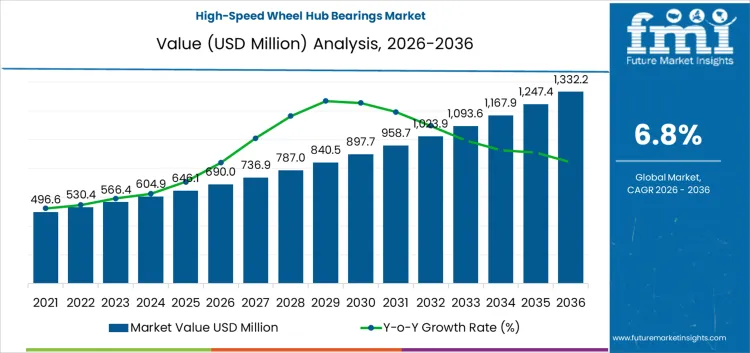
High-Speed Wheel Hub Bearings Market Key Takeaways
| Metric | Value |
|---|---|
| Market Value (2026) | USD 690.0 million |
| Market Forecast Value (2036) | USD 1,332.0 million |
| Forecast CAGR (2026 to 2036) | 6.8% |
Why is the Demand for High-Speed Wheel Hub Bearings Market Growing?
Demand for high-speed wheel hub bearings is rising as automotive OEMs develop performance oriented platforms that operate reliably at elevated rotational speeds and under torque intense conditions. Sports sedans, performance SUVs, and high output electric vehicles generate dynamic wheel forces that require bearings with precise internal geometry and optimized raceway finishes to minimize friction and heat generation. These units support stability control and advanced driver assistance systems by maintaining consistent wheel rotation feedback to electronic control modules.
Brake system designers integrate high-speed bearings to ensure compatibility with larger calipers and ventilated rotors that demand tight tolerances at rapid deceleration rates. Manufacturers calibrate preload and material hardness to support extended endurance life without compromising road feel or steering precision during aggressive driving cycles.
Service and replacement patterns also influence market uptake as vehicle parc containing high performance models expands in key markets. Aftermarket suppliers offer high-speed specific hub bearings tailored to match the original rotational specifications and vibration characteristics of premium vehicle lineups. Engineering teams focus on advanced seal designs that resist contamination while enabling proper grease flow at high rpms, supporting durability under diverse operating environments. Test regimes simulate prolonged high speed usage to validate life expectancy and resistance to fatigue cracking. Fleet operators of performance fleets prioritize these bearings to maintain reliability across track and road use scenarios.
How Are the Segments Classified in the High-Speed Wheel Hub Bearings Market?
The high-speed wheel hub bearings market is driven by the growing demand for performance and efficiency in vehicles with higher RPM requirements, such as passenger electric vehicles (EVs), performance cars, and hybrids. These bearings are essential for ensuring smooth rotation, reducing friction, and supporting high speeds, particularly in applications where precision and durability are critical. As vehicles continue to evolve with faster speeds and more advanced powertrains, high-speed wheel hub bearings are becoming crucial components for maintaining vehicle performance and longevity.
Which speed class holds the largest share of demand?
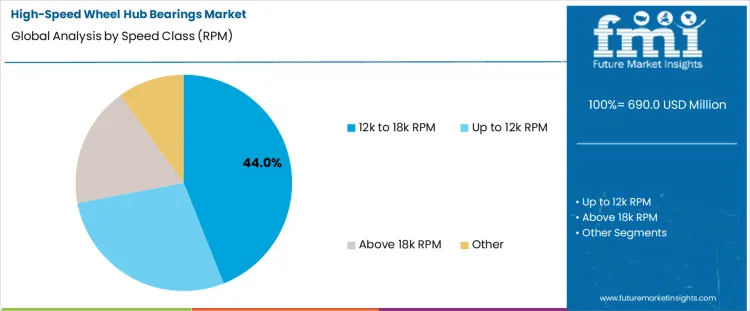
The 12k to 18k RPM speed class leads with a 44.0% share, reflecting its widespread use in high-performance passenger vehicles, including electric vehicles (EVs) and hybrids. This RPM range is ideal for vehicles requiring both high-speed stability and durability, providing a balance between performance and efficiency. Bearings in this range are designed to handle the demands of modern drivetrains, where higher speeds are necessary for achieving optimal performance without compromising safety or vehicle stability. This makes the 12k to 18k RPM range the most common for high-speed hub bearing applications.
Key Points:
- Ideal for vehicles requiring high-speed stability and durability
- Common in EVs and hybrids with advanced powertrains
- Provides a balance of performance and efficiency for modern drivetrains
Which vehicle segment represents the largest share of demand?
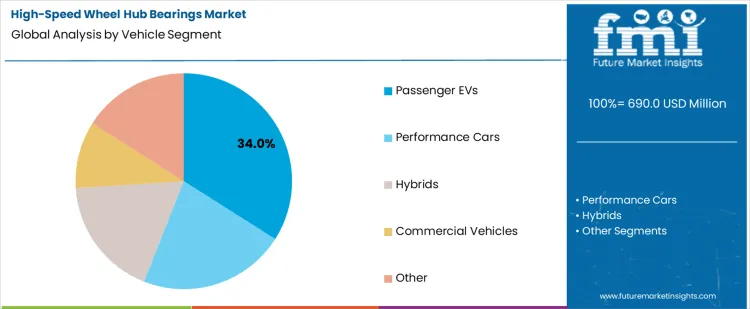
Passenger EVs represent the largest share of demand in the high-speed wheel hub bearings market, accounting for 34.0%. As the demand for electric vehicles grows, the need for high-speed hub bearings that can handle the unique requirements of EV powertrains becomes more critical. EVs require bearings that can support high speeds, ensure efficient energy use, and minimize friction, all while maintaining vehicle safety and performance. This growing segment in the automotive market continues to drive the adoption of high-speed wheel hub bearings designed for optimal EV performance.
Key Points:
- Dominates due to the rapid adoption of electric vehicles globally
- Requires bearings that support high speeds and energy efficiency
- Vital for ensuring smooth and efficient operation of EV powertrains
Which technology package holds the largest share of demand?
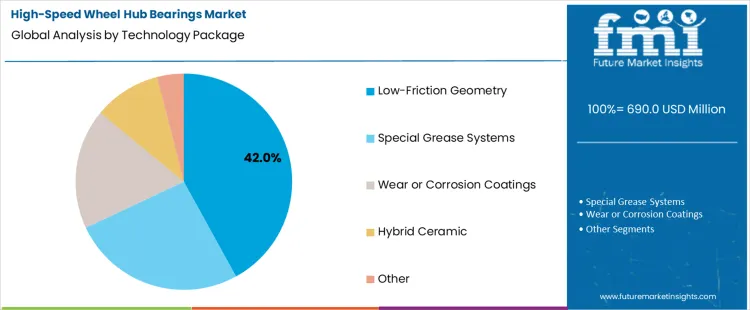
Low-friction geometry technology leads with 42.0% of the market, driven by its ability to reduce friction and improve overall vehicle performance. By minimizing energy loss and heat generation, low-friction geometry bearings enhance vehicle efficiency, particularly in high-speed applications where smooth operation is essential. These bearings are especially important in performance vehicles, EVs, and hybrids, where optimal performance and battery efficiency are key factors. The demand for low-friction bearings in this segment is strong as manufacturers focus on enhancing the longevity and efficiency of high-speed wheel hub systems.
Key Points:
- Minimizes friction, improving vehicle efficiency and performance
- Essential for high-speed, energy-efficient applications in EVs and performance cars
- Enhances bearing longevity and reduces heat generation in high-performance systems
What are the Key Dynamics in the high-speed wheel hub bearings market?
Demand in the high-speed wheel hub bearings market is concentrated on automotive and high-performance vehicle sectors where rotational speeds, precision, and reliability are critical. Market activity is shaped by requirements for reduced vibration, improved handling stability, and endurance at elevated rotational velocities typical of sports cars, performance sedans, and some premium electric vehicles. Value is defined by bearing rigidity, precision manufacturing, and capability to maintain performance under repeated high-speed cycles. Procurement decisions reflect performance validation in stability control systems, braking dynamics, and drivetrain integration.
How do vehicle dynamics and performance calibration influence demand?
Demand for high-speed wheel hub bearings increases where vehicle designs emphasize dynamic responsiveness and stability at speed. These bearings must withstand lateral forces and centrifugal loads encountered during performance driving without sacrificing frictional efficiency. Automotive engineers specify high-precision bearings with optimized internal geometry and surface finish to maintain running accuracy and reduce heat generation during sustained high RPM operation. In electric vehicles designed for rapid torque delivery, bearings face unique stress profiles that require enhanced material strength and lubrication systems tailored to high-speed regimes. Racing and performance divisions of OEMs apply rigorous testing protocols to ensure load capacity, thermal management, and noise, vibration, and harshness (NVH) performance meet stringent benchmarks.
How do material science demands and validation requirements influence market scalability?
Scalability in the high-speed wheel hub bearings market is affected by material science demands and extensive validation requirements. Bearings capable of sustained high rotational speeds rely on advanced steel alloys, ceramics, and hybrid material combinations that offer enhanced fatigue resistance and low thermal expansion. These specialized materials increase manufacturing cost and require precise heat treatment and quality control to ensure consistency. Lubrication systems tailored to high-speed operation add further design complexity, as grease formulation must manage temperature and shear characteristics without compromising service life. Engineering validation in high-speed applications involves exhaustive test cycles under simulated real-world stresses, extending time-to-market for new bearing designs. These factors influence adoption in segments where performance justification outweighs cost sensitivity, affecting penetration in broader passenger vehicle categories.
How Is Demand for the High-Speed Wheel Hub Bearings Market Evolving Globally?
Global demand for high-speed wheel hub bearings is increasing as the automotive industry focuses on improving vehicle speed, safety, and performance. Growth reflects the need for more efficient components that can withstand higher rotational speeds while reducing friction and wear. Demand is driven by advancements in automotive engineering, particularly in the development of electric vehicles (EVs) and high-performance sports cars, as well as the rise in global automotive production. China records 8.5% CAGR, India records 8.0% CAGR, South Korea records 7.2% CAGR, Vietnam records 6.8% CAGR, and Mexico records 6.3% CAGR. Adoption is propelled by performance enhancements and the growing emphasis on vehicle reliability and efficiency.
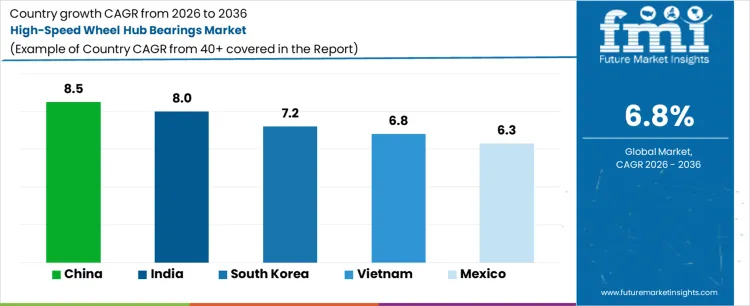
| Country | CAGR (%) |
|---|---|
| China | 8.5% |
| India | 8.0% |
| South Korea | 7.2% |
| Vietnam | 6.8% |
| Mexico | 6.3% |
What is driving demand for high-speed wheel hub bearings in China?
Demand for high-speed wheel hub bearings in China is growing as the country becomes a leader in both electric vehicle production and high-performance automotive engineering. Growth at 8.5% CAGR is driven by increasing consumer demand for high-performance vehicles, particularly electric vehicles (EVs) and sports cars. As China’s automotive sector expands and shifts toward more sophisticated, high-speed vehicles, the need for efficient and durable wheel hub bearings to support higher speeds and reduce friction increases. The country’s commitment to modernizing its manufacturing capabilities, coupled with government incentives for EV adoption, further contributes to market growth.
- Growth of high-performance and electric vehicle production
- Increasing consumer demand for faster, more efficient vehicles
- Government incentives supporting EV adoption
- Focus on reducing friction and improving vehicle performance
What factors are shaping high-speed wheel hub bearings demand in India?
High-speed wheel hub bearings demand in India is increasing as the country’s automotive market continues to expand. With an 8.0% CAGR, India’s automotive industry is seeing rising demand for faster, more efficient vehicles, particularly in urban areas where vehicles are expected to perform at higher speeds in traffic. The adoption of electric vehicles, alongside increased interest in performance cars, further drives the need for advanced bearing solutions. Manufacturers are focusing on producing bearings that support high-speed stability, enhanced performance, and improved energy efficiency. India’s growing automotive infrastructure also supports the need for components that contribute to long-lasting, high-speed vehicle performance.
- Expansion of the automotive market in India
- Rising demand for electric and performance vehicles
- Focus on high-speed vehicle stability and efficiency
- Growing automotive manufacturing and infrastructure
What is driving sales of high-speed wheel hub bearings in South Korea?
Sales of high-speed wheel hub bearings in South Korea are increasing due to the country’s focus on high-performance vehicles and cutting-edge automotive technology. With a 7.2% CAGR, South Korea’s automotive sector is advancing towards greater emphasis on speed, efficiency, and vehicle durability. The growing production of electric vehicles and high-performance cars, such as those manufactured by local companies, drives demand for bearings capable of supporting high rotational speeds while maintaining durability. Manufacturers are investing in developing high-performance components that meet international standards, further driving demand for specialized bearings that optimize vehicle performance.
- Focus on high-performance vehicle manufacturing
- Rising demand for electric vehicles and sports cars
- Investment in cutting-edge automotive technology
- Strong domestic automotive market and export potential
How is high-speed wheel hub bearings demand evolving in Vietnam?
High-speed wheel hub bearings demand in Vietnam is growing as the country’s automotive market expands alongside industrial growth. With a 6.8% CAGR, demand is driven by increasing vehicle production and the growing focus on high-speed vehicles, particularly in the electric vehicle sector. As automotive manufacturing scales up in Vietnam, there is a growing need for advanced components that improve vehicle performance, reduce friction, and provide long-term reliability. With the global shift toward cleaner transportation and more energy-efficient vehicles, the demand for high-speed wheel hub bearings in the Vietnamese market is expected to grow steadily.
- Expansion of vehicle manufacturing and production
- Growth in electric vehicle adoption
- Need for improved vehicle performance and energy efficiency
- Increased focus on sustainable transportation solutions
What factors are shaping high-speed wheel hub bearings demand in Mexico?
High-speed wheel hub bearings demand in Mexico is increasing as the country continues to serve as a manufacturing hub for North America’s automotive industry. With a 6.3% CAGR, Mexico is seeing rising demand for high-performance vehicles, including electric and sports cars, which require specialized components such as high-speed hub bearings. Mexico’s strong export market, along with local manufacturing for both domestic and international markets, is driving the need for durable and efficient automotive parts. The automotive industry’s growing focus on performance, fuel efficiency, and reducing vehicle emissions further contributes to the demand for high-speed bearings in Mexico.
- Mexico’s role as an automotive manufacturing hub
- Growing demand for electric and high-performance vehicles
- Focus on reducing vehicle emissions and improving fuel efficiency
- Expansion of the export market for automotive components
What is the competitive landscape of demand for the high-speed wheel hub bearings market globally?
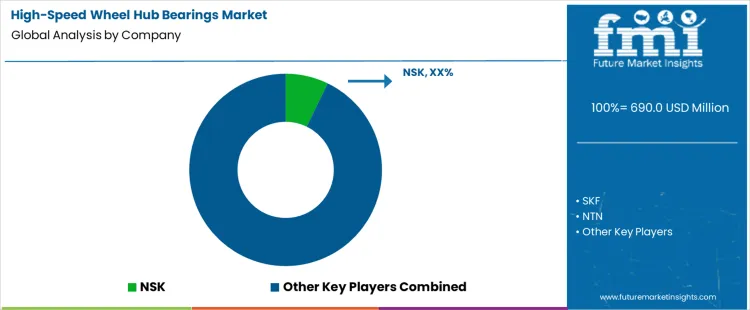
Demand for high-speed wheel hub bearings is driven by the growing need for enhanced performance in high-speed applications, including motorsport, performance vehicles, and electric vehicles (EVs). Buyers evaluate bearing precision, high-speed durability, heat resistance, low friction, and smooth rotation. Procurement behavior prioritizes suppliers offering bearings that can maintain high reliability under high radial and axial loads while operating at elevated speeds. Purchasing decisions emphasize the need for long-lasting, high-performance solutions that reduce heat generation and enhance vehicle handling. Trend in the market reflects increasing adoption of advanced materials and design optimizations aimed at improving efficiency, reducing friction, and ensuring smooth high-speed operations in various vehicle segments.
NSK leads competitive positioning with its precision-engineered high-speed wheel hub bearings, offering reduced friction, high durability, and low heat generation for performance vehicles and EVs. SKF competes by providing high-performance bearing solutions designed for high-speed stability, focusing on low friction and long service life. NTN supports demand with high-speed wheel hub bearings optimized for performance vehicles, offering smooth, efficient operation at elevated speeds. Schaeffler participates by offering high-speed bearings with a focus on precision, noise reduction, and vibration damping for advanced vehicle platforms. JTEKT (Koyo) delivers high-performance bearings with superior speed and load handling capabilities, ensuring reliability in demanding automotive applications.
Key Players in the High-Speed Wheel Hub Bearings Market
- NSK
- SKF
- NTN
- Schaeffler
- JTEKT (Koyo)
- Timken
- ILJIN
- C&U Group
- ZWZ
- Nachi-Fujikoshi
Scope of the Report
| Items | Values |
|---|---|
| Quantitative Units | USD million |
| Speed Class (RPM) | 12k to 18k RPM; Up to 12k RPM; Above 18k RPM; Other |
| Vehicle Segment | Passenger EVs; Performance Cars; Hybrids; Commercial Vehicles; Other |
| Technology Package | Low-Friction Geometry; Special Grease Systems; Wear or Corrosion Coatings; Hybrid Ceramic; Other |
| Sales Channel | OEM or Line-Fit; Aftermarket Replacement; Other |
| Regions Covered | Asia Pacific, Europe, North America, Latin America, Middle East & Africa |
| Countries Covered | China, India, South Korea, Vietnam, Mexico, and 40+ countries |
| Key Companies Profiled | NSK; SKF; NTN; Schaeffler; JTEKT (Koyo); Timken; ILJIN; C&U Group; ZWZ; Nachi-Fujikoshi |
| Additional Attributes | Dollar sales by speed class, vehicle segment, technology package, and sales channel; bearing durability, speed stability, and thermal management across low-friction geometry, special grease, and hybrid ceramic designs; performance in high-speed applications for passenger EVs, performance cars, and hybrids; procurement patterns driven by OEM supply agreements, aftermarket replacement needs, and commercial vehicle integration. |
High-Speed Wheel Hub Bearings Market by Segment
Speed Class (RPM):
- 12k to 18k RPM
- Up to 12k RPM
- Above 18k RPM
- Other
Vehicle Segment:
- Passenger EVs
- Performance Cars
- Hybrids
- Commercial Vehicles
- Other
Technology Package:
- Low-Friction Geometry
- Special Grease Systems
- Wear or Corrosion Coatings
- Hybrid Ceramic
- Other
Sales Channel:
- OEM or Line-Fit
- Aftermarket Replacement
- Other
Region:
- Asia Pacific
- China
- Japan
- South Korea
- India
- Australia & New Zealand
- ASEAN
- Rest of Asia Pacific
- Europe
- Germany
- United Kingdom
- France
- Italy
- Spain
- Nordic
- BENELUX
- Rest of Europe
- North America
- United States
- Canada
- Mexico
- Latin America
- Brazil
- Chile
- Rest of Latin America
- Middle East & Africa
- Kingdom of Saudi Arabia
- Other GCC Countries
- Turkey
- South Africa
- Other African Union
- Rest of Middle East & Africa
Bibliography
- International Organization for Standardization. (2023). Rolling bearings-Tolerance classes and running accuracy (ISO 492:2023). ISO.
- European Commission. (2023). General Safety Regulation (EU) 2019/2144: Phased implementation affecting braking systems, wheel assemblies, and high-speed vehicle stability. Official Journal of the European Union.
- United Nations Economic Commission for Europe. (2023). UNECE WP.29 framework on vehicle braking, stability control, and wheel-end durability requirements. United Nations.
- International Energy Agency. (2024). Global EV outlook 2024: High-speed electric drivetrains, efficiency losses, and component durability. IEA.
- Organisation for Economic Co-operation and Development. (2023). Automotive performance, energy efficiency, and lifecycle durability of vehicle components. OECD Publishing.
Frequently Asked Questions
How big is the high-speed wheel hub bearings market in 2026?
The global high-speed wheel hub bearings market is estimated to be valued at USD 690.0 million in 2026.
What will be the size of high-speed wheel hub bearings market in 2036?
The market size for the high-speed wheel hub bearings market is projected to reach USD 1,332.2 million by 2036.
How much will be the high-speed wheel hub bearings market growth between 2026 and 2036?
The high-speed wheel hub bearings market is expected to grow at a 6.8% CAGR between 2026 and 2036.
What are the key product types in the high-speed wheel hub bearings market?
The key product types in high-speed wheel hub bearings market are 12k to 18k rpm, up to 12k rpm, above 18k rpm and other.
Which vehicle segment segment to contribute significant share in the high-speed wheel hub bearings market in 2026?
In terms of vehicle segment, passenger evs segment to command 34.0% share in the high-speed wheel hub bearings market in 2026.
Preview the report firsthand - request a free sample
Get SampleGet the brochure for pricing and purchase details.
Get PDFTable of Content
- Executive Summary
- Global Market Outlook
- Demand-side Trends
- Supply-side Trends
- Technology Roadmap Analysis
- Analysis and Recommendations
- Market Overview
- Market Coverage / Taxonomy
- Market Definition / Scope / Limitations
- Market Background
- Market Dynamics
- Drivers
- Restraints
- Opportunity
- Trends
- Scenario Forecast
- Demand in Optimistic Scenario
- Demand in Likely Scenario
- Demand in Conservative Scenario
- Opportunity Map Analysis
- Product Life Cycle Analysis
- Supply Chain Analysis
- Investment Feasibility Matrix
- Value Chain Analysis
- PESTLE and Porter’s Analysis
- Regulatory Landscape
- Regional Parent Market Outlook
- Production and Consumption Statistics
- Import and Export Statistics
- Market Dynamics
- Global Market Analysis 2021 to 2025 and Forecast, 2026 to 2036
- Historical Market Size Value (USD Million) Analysis, 2021 to 2025
- Current and Future Market Size Value (USD Million) Projections, 2026 to 2036
- Y-o-Y Growth Trend Analysis
- Absolute $ Opportunity Analysis
- Global Market Pricing Analysis 2021 to 2025 and Forecast 2026 to 2036
- Global Market Analysis 2021 to 2025 and Forecast 2026 to 2036, By Speed Class (RPM)
- Introduction / Key Findings
- Historical Market Size Value (USD Million) Analysis By Speed Class (RPM) , 2021 to 2025
- Current and Future Market Size Value (USD Million) Analysis and Forecast By Speed Class (RPM) , 2026 to 2036
- 12k to 18k RPM
- Up to 12k RPM
- Above 18k RPM
- Other
- 12k to 18k RPM
- Y-o-Y Growth Trend Analysis By Speed Class (RPM) , 2021 to 2025
- Absolute $ Opportunity Analysis By Speed Class (RPM) , 2026 to 2036
- Global Market Analysis 2021 to 2025 and Forecast 2026 to 2036, By Vehicle Segment
- Introduction / Key Findings
- Historical Market Size Value (USD Million) Analysis By Vehicle Segment, 2021 to 2025
- Current and Future Market Size Value (USD Million) Analysis and Forecast By Vehicle Segment, 2026 to 2036
- Passenger EVs
- Performance Cars
- Hybrids
- Commercial Vehicles
- Other
- Passenger EVs
- Y-o-Y Growth Trend Analysis By Vehicle Segment, 2021 to 2025
- Absolute $ Opportunity Analysis By Vehicle Segment, 2026 to 2036
- Global Market Analysis 2021 to 2025 and Forecast 2026 to 2036, By Technology Package
- Introduction / Key Findings
- Historical Market Size Value (USD Million) Analysis By Technology Package, 2021 to 2025
- Current and Future Market Size Value (USD Million) Analysis and Forecast By Technology Package, 2026 to 2036
- Low-Friction Geometry
- Special Grease Systems
- Wear or Corrosion Coatings
- Hybrid Ceramic
- Other
- Low-Friction Geometry
- Y-o-Y Growth Trend Analysis By Technology Package, 2021 to 2025
- Absolute $ Opportunity Analysis By Technology Package, 2026 to 2036
- Global Market Analysis 2021 to 2025 and Forecast 2026 to 2036, By Sales Channel
- Introduction / Key Findings
- Historical Market Size Value (USD Million) Analysis By Sales Channel, 2021 to 2025
- Current and Future Market Size Value (USD Million) Analysis and Forecast By Sales Channel, 2026 to 2036
- OEM or Line-Fit
- Aftermarket Replacement
- Other
- OEM or Line-Fit
- Y-o-Y Growth Trend Analysis By Sales Channel, 2021 to 2025
- Absolute $ Opportunity Analysis By Sales Channel, 2026 to 2036
- Global Market Analysis 2021 to 2025 and Forecast 2026 to 2036, By Region
- Introduction
- Historical Market Size Value (USD Million) Analysis By Region, 2021 to 2025
- Current Market Size Value (USD Million) Analysis and Forecast By Region, 2026 to 2036
- North America
- Latin America
- Western Europe
- Eastern Europe
- East Asia
- South Asia and Pacific
- Middle East & Africa
- Market Attractiveness Analysis By Region
- North America Market Analysis 2021 to 2025 and Forecast 2026 to 2036, By Country
- Historical Market Size Value (USD Million) Trend Analysis By Market Taxonomy, 2021 to 2025
- Market Size Value (USD Million) Forecast By Market Taxonomy, 2026 to 2036
- By Country
- USA
- Canada
- Mexico
- By Speed Class (RPM)
- By Vehicle Segment
- By Technology Package
- By Sales Channel
- By Country
- Market Attractiveness Analysis
- By Country
- By Speed Class (RPM)
- By Vehicle Segment
- By Technology Package
- By Sales Channel
- Key Takeaways
- Latin America Market Analysis 2021 to 2025 and Forecast 2026 to 2036, By Country
- Historical Market Size Value (USD Million) Trend Analysis By Market Taxonomy, 2021 to 2025
- Market Size Value (USD Million) Forecast By Market Taxonomy, 2026 to 2036
- By Country
- Brazil
- Chile
- Rest of Latin America
- By Speed Class (RPM)
- By Vehicle Segment
- By Technology Package
- By Sales Channel
- By Country
- Market Attractiveness Analysis
- By Country
- By Speed Class (RPM)
- By Vehicle Segment
- By Technology Package
- By Sales Channel
- Key Takeaways
- Western Europe Market Analysis 2021 to 2025 and Forecast 2026 to 2036, By Country
- Historical Market Size Value (USD Million) Trend Analysis By Market Taxonomy, 2021 to 2025
- Market Size Value (USD Million) Forecast By Market Taxonomy, 2026 to 2036
- By Country
- Germany
- UK
- Italy
- Spain
- France
- Nordic
- BENELUX
- Rest of Western Europe
- By Speed Class (RPM)
- By Vehicle Segment
- By Technology Package
- By Sales Channel
- By Country
- Market Attractiveness Analysis
- By Country
- By Speed Class (RPM)
- By Vehicle Segment
- By Technology Package
- By Sales Channel
- Key Takeaways
- Eastern Europe Market Analysis 2021 to 2025 and Forecast 2026 to 2036, By Country
- Historical Market Size Value (USD Million) Trend Analysis By Market Taxonomy, 2021 to 2025
- Market Size Value (USD Million) Forecast By Market Taxonomy, 2026 to 2036
- By Country
- Russia
- Poland
- Hungary
- Balkan & Baltic
- Rest of Eastern Europe
- By Speed Class (RPM)
- By Vehicle Segment
- By Technology Package
- By Sales Channel
- By Country
- Market Attractiveness Analysis
- By Country
- By Speed Class (RPM)
- By Vehicle Segment
- By Technology Package
- By Sales Channel
- Key Takeaways
- East Asia Market Analysis 2021 to 2025 and Forecast 2026 to 2036, By Country
- Historical Market Size Value (USD Million) Trend Analysis By Market Taxonomy, 2021 to 2025
- Market Size Value (USD Million) Forecast By Market Taxonomy, 2026 to 2036
- By Country
- China
- Japan
- South Korea
- By Speed Class (RPM)
- By Vehicle Segment
- By Technology Package
- By Sales Channel
- By Country
- Market Attractiveness Analysis
- By Country
- By Speed Class (RPM)
- By Vehicle Segment
- By Technology Package
- By Sales Channel
- Key Takeaways
- South Asia and Pacific Market Analysis 2021 to 2025 and Forecast 2026 to 2036, By Country
- Historical Market Size Value (USD Million) Trend Analysis By Market Taxonomy, 2021 to 2025
- Market Size Value (USD Million) Forecast By Market Taxonomy, 2026 to 2036
- By Country
- India
- ASEAN
- Australia & New Zealand
- Rest of South Asia and Pacific
- By Speed Class (RPM)
- By Vehicle Segment
- By Technology Package
- By Sales Channel
- By Country
- Market Attractiveness Analysis
- By Country
- By Speed Class (RPM)
- By Vehicle Segment
- By Technology Package
- By Sales Channel
- Key Takeaways
- Middle East & Africa Market Analysis 2021 to 2025 and Forecast 2026 to 2036, By Country
- Historical Market Size Value (USD Million) Trend Analysis By Market Taxonomy, 2021 to 2025
- Market Size Value (USD Million) Forecast By Market Taxonomy, 2026 to 2036
- By Country
- Kingdom of Saudi Arabia
- Other GCC Countries
- Turkiye
- South Africa
- Other African Union
- Rest of Middle East & Africa
- By Speed Class (RPM)
- By Vehicle Segment
- By Technology Package
- By Sales Channel
- By Country
- Market Attractiveness Analysis
- By Country
- By Speed Class (RPM)
- By Vehicle Segment
- By Technology Package
- By Sales Channel
- Key Takeaways
- Key Countries Market Analysis
- USA
- Pricing Analysis
- Market Share Analysis, 2025
- By Speed Class (RPM)
- By Vehicle Segment
- By Technology Package
- By Sales Channel
- Canada
- Pricing Analysis
- Market Share Analysis, 2025
- By Speed Class (RPM)
- By Vehicle Segment
- By Technology Package
- By Sales Channel
- Mexico
- Pricing Analysis
- Market Share Analysis, 2025
- By Speed Class (RPM)
- By Vehicle Segment
- By Technology Package
- By Sales Channel
- Brazil
- Pricing Analysis
- Market Share Analysis, 2025
- By Speed Class (RPM)
- By Vehicle Segment
- By Technology Package
- By Sales Channel
- Chile
- Pricing Analysis
- Market Share Analysis, 2025
- By Speed Class (RPM)
- By Vehicle Segment
- By Technology Package
- By Sales Channel
- Germany
- Pricing Analysis
- Market Share Analysis, 2025
- By Speed Class (RPM)
- By Vehicle Segment
- By Technology Package
- By Sales Channel
- UK
- Pricing Analysis
- Market Share Analysis, 2025
- By Speed Class (RPM)
- By Vehicle Segment
- By Technology Package
- By Sales Channel
- Italy
- Pricing Analysis
- Market Share Analysis, 2025
- By Speed Class (RPM)
- By Vehicle Segment
- By Technology Package
- By Sales Channel
- Spain
- Pricing Analysis
- Market Share Analysis, 2025
- By Speed Class (RPM)
- By Vehicle Segment
- By Technology Package
- By Sales Channel
- France
- Pricing Analysis
- Market Share Analysis, 2025
- By Speed Class (RPM)
- By Vehicle Segment
- By Technology Package
- By Sales Channel
- India
- Pricing Analysis
- Market Share Analysis, 2025
- By Speed Class (RPM)
- By Vehicle Segment
- By Technology Package
- By Sales Channel
- ASEAN
- Pricing Analysis
- Market Share Analysis, 2025
- By Speed Class (RPM)
- By Vehicle Segment
- By Technology Package
- By Sales Channel
- Australia & New Zealand
- Pricing Analysis
- Market Share Analysis, 2025
- By Speed Class (RPM)
- By Vehicle Segment
- By Technology Package
- By Sales Channel
- China
- Pricing Analysis
- Market Share Analysis, 2025
- By Speed Class (RPM)
- By Vehicle Segment
- By Technology Package
- By Sales Channel
- Japan
- Pricing Analysis
- Market Share Analysis, 2025
- By Speed Class (RPM)
- By Vehicle Segment
- By Technology Package
- By Sales Channel
- South Korea
- Pricing Analysis
- Market Share Analysis, 2025
- By Speed Class (RPM)
- By Vehicle Segment
- By Technology Package
- By Sales Channel
- Russia
- Pricing Analysis
- Market Share Analysis, 2025
- By Speed Class (RPM)
- By Vehicle Segment
- By Technology Package
- By Sales Channel
- Poland
- Pricing Analysis
- Market Share Analysis, 2025
- By Speed Class (RPM)
- By Vehicle Segment
- By Technology Package
- By Sales Channel
- Hungary
- Pricing Analysis
- Market Share Analysis, 2025
- By Speed Class (RPM)
- By Vehicle Segment
- By Technology Package
- By Sales Channel
- Kingdom of Saudi Arabia
- Pricing Analysis
- Market Share Analysis, 2025
- By Speed Class (RPM)
- By Vehicle Segment
- By Technology Package
- By Sales Channel
- Turkiye
- Pricing Analysis
- Market Share Analysis, 2025
- By Speed Class (RPM)
- By Vehicle Segment
- By Technology Package
- By Sales Channel
- South Africa
- Pricing Analysis
- Market Share Analysis, 2025
- By Speed Class (RPM)
- By Vehicle Segment
- By Technology Package
- By Sales Channel
- USA
- Market Structure Analysis
- Competition Dashboard
- Competition Benchmarking
- Market Share Analysis of Top Players
- By Regional
- By Speed Class (RPM)
- By Vehicle Segment
- By Technology Package
- By Sales Channel
- Competition Analysis
- Competition Deep Dive
- NSK
- Overview
- Product Portfolio
- Profitability by Market Segments (Product/Age /Sales Channel/Region)
- Sales Footprint
- Strategy Overview
- Marketing Strategy
- Product Strategy
- Channel Strategy
- SKF
- NTN
- Schaeffler
- JTEKT (Koyo)
- Timken
- ILJIN
- C&U Group
- ZWZ
- Nachi-Fujikoshi
- NSK
- Competition Deep Dive
- Assumptions & Acronyms Used
- Research Methodology


