

- Industry Size (2026)
- USD 410.0 Mn
- Forecast (2036)
- USD 655.2 Mn
- CAGR (2026 to 2036)
- 4.8%
Automotive Wheel Locks Market Forecast and Outlook 2026 to 2036
The automotive wheel locks market is likely to be valued at USD 410.0 million in 2026, and reach USD 655.2 million by 2036, at 4.8% CAGR. Value behavior reflects aftermarket-driven purchasing anchored in theft exposure rather than discretionary styling upgrades. Demand concentrates in urban parking environments where wheel assemblies remain unattended for extended periods. Purchasing decisions emphasize fit precision, key uniqueness, and material hardness to ensure removability during service without compromising security. OEM participation remains selective, while dealer-installed and retail channels account for most volume through bundled sales and replacement purchases.
Quick Stats for Automotive Wheel Locks Market
- Automotive Wheel Locks Market Value (2026): USD 410.0 million
- Automotive Wheel Locks Market Forecast Value (2036): USD 655.2 million
- Automotive Wheel Locks Market Forecast CAGR 2026 to 2036: 4.8%
- Leading Product Type by Demand Share: Locking Lug Nuts
- Fastest-Growing Countries: India, Mexico, Brazil, Indonesia, USA
- Top Players in Global Demand: McGard, Gorilla Automotive Products, Farad, Advanced Wheel Locks, RAD Security
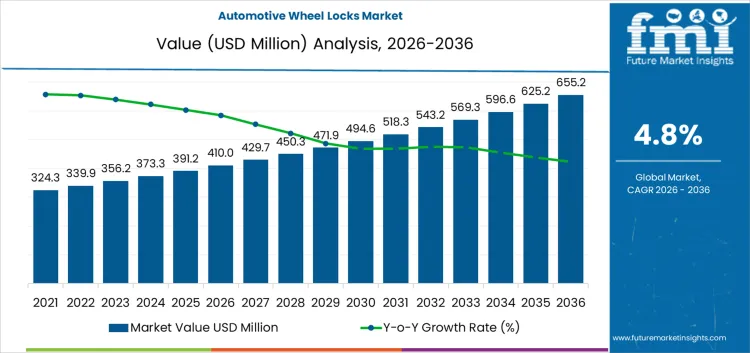
Scale expansion is constrained by platform variability across lug geometries, seat types, and torque specifications that limit standardization. Price sensitivity persists in mass vehicle segments, capping premium feature penetration. Lost-key risk and corrosion exposure influence replacement frequency and user acceptance. Competitive intensity remains fragmented due to low certification thresholds and ease of design replication. Volume growth follows vehicle parc stability and alloy wheel penetration trends rather than acceleration in theft incidence. Replacement cycles, insurance guidance, and dealer programs sustain baseline demand across mature and emerging passenger vehicle populations. Fleet adoption remains limited, yet contributes incremental volume where standardized maintenance policies and centralized parking elevate exposure risks consistently effectively.
Automotive Wheel Locks Market Key Takeaways
| Metric | Value |
|---|---|
| Market Value (2026) | USD 410.0 million |
| Market Forecast Value (2036) | USD 655.2 million |
| Forecast CAGR (2026 to 2036) | 4.8% |
Why is the Demand for Automotive Wheel Locks Growing?
Demand for automotive wheel locks is increasing as vehicle owners and fleet managers prioritize theft prevention and asset protection for alloy wheels and premium tire assemblies. Wheel locks replace one standard lug nut with a keyed locking nut, which reduces risk of unauthorized removal of wheels that represent significant replacement cost. Insurance policies and vehicle safety programs often encourage specification of anti-theft hardware because secure wheels reduce claim frequency and deter opportunistic theft in urban and high traffic areas. Procurement decisions focus on material hardness, precision machining, and key pattern uniqueness to ensure reliable engagement and resistance to tampering. Vehicle manufacturers and aftermarket suppliers offer wheel lock sets that align with varied bolt patterns and wheel diameters, which supports consistent fitment across passenger cars, SUVs, and light trucks.
Growth in premium wheel adoption, high value vehicle segments, and increased public awareness of tire and wheel theft reinforces uptake of automotive wheel locks that align with overall vehicle security strategies. Fleet operators incorporate wheel locks into standard equipment lists to protect rolling assets across delivery, rideshare, and service fleets facing diverse roadside environments. Technical considerations such as resistance to corrosion and performance under repeated torque applications influence selection criteria because fastener integrity affects both theft resistance and wheel assembly reliability. Service networks and retailers maintain inventories of compatible wheel lock sets and key patterns to support installation and replacement needs during scheduled maintenance operations. These security and operational factors are contributing to sustained demand growth in the automotive wheel locks market.
How Are the Segments Classified in the Automotive Wheel Locks Market?
Demand for automotive wheel locks is shaped by theft deterrence needs, rising wheel replacement costs, and increased vehicle ownership density. Owners prioritize protective accessories that secure wheels during parking in public or unsecured locations. Adoption aligns with urbanization, aftermarket customization, and broader awareness of component theft risks. Product selection emphasizes fit compatibility, tamper resistance, and ease of installation. Segment classification reflects differentiation by lock configuration, vehicle segment alignment, and price positioning, influencing adoption intensity, replacement cycles, and purchasing behavior across diverse vehicle ownership profiles.
Which Product Type Represents the Largest Share of Demand?
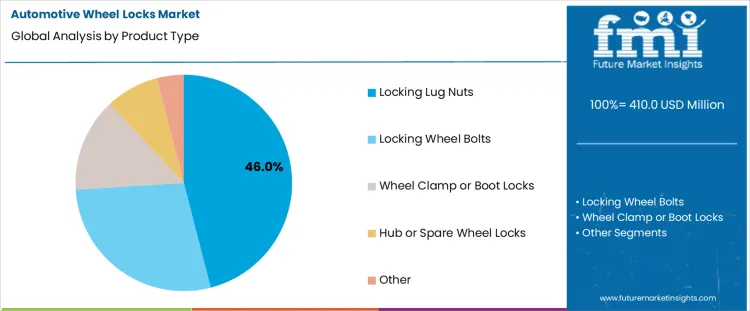
Locking lug nuts hold 46.0%, representing the largest share among product types due to direct compatibility with standard wheel mounting systems. These locks replace conventional lug nuts, maintaining original wheel fitment while adding theft deterrence. Simple installation supports widespread adoption across passenger and utility vehicles. Universal design standards enable compatibility with common wheel specifications. Locking wheel bolts serve vehicles using bolt-based hubs with narrower applicability. Wheel clamp or boot locks provide visible deterrence with bulkier form factors. Hub or spare wheel locks address secondary protection needs. Product type segmentation reflects preference for integrated solutions balancing security, convenience, and broad vehicle compatibility.
Key Points
- Locking lug nuts integrate directly with existing wheel hardware.
- Simple installation supports broad aftermarket adoption.
- Other types address visibility or specialized wheel configurations.
Which Vehicle Segment Accounts for the Highest Share of Demand?
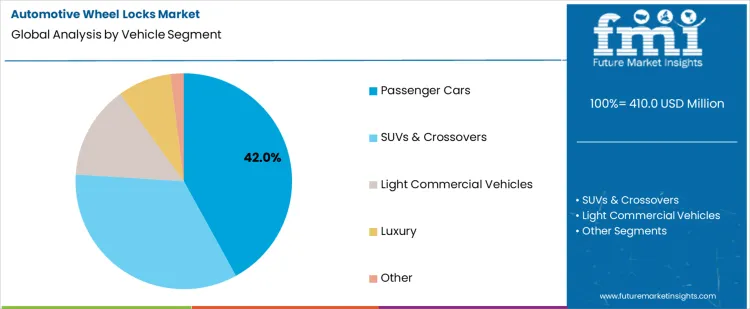
Passenger cars hold 42.0%, representing the largest share among vehicle segments due to high population density. Urban parking exposure increases vulnerability to wheel theft for daily-use vehicles. Standard wheel configurations simplify lock compatibility and purchasing decisions. Cost sensitivity encourages adoption of preventive accessories. SUVs and crossovers follow closely with increased wheel size and aftermarket customization. Light commercial vehicles apply locks selectively based on usage patterns. Luxury vehicles adopt higher-end solutions with lower volume. Vehicle segment segmentation reflects concentration where vehicle count, parking exposure, and standardized fitment drive consistent demand.
Key Points
- Passenger cars dominate vehicle population in urban environments.
- Frequent public parking increases theft exposure.
- Other segments apply locks based on usage and customization.
Which Price Tier Drives the Largest Share of Demand?
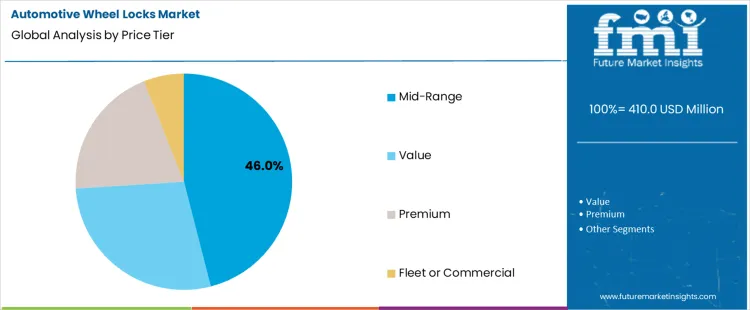
Mid-range products hold 46.0%, representing the largest share among price tiers due to balanced value. These offerings combine adequate security features with accessible pricing for mass adoption. Material quality and locking mechanisms meet typical user expectations without premium cost. Broad retail availability supports purchasing convenience. Value-tier products address basic protection needs with simpler designs. Premium offerings target enhanced security features and brand positioning. Fleet or commercial options serve bulk procurement with standardized specifications. Price tier segmentation reflects preference for solutions delivering reliable protection without elevated cost barriers.
Key Points
- Mid-range locks balance security performance and affordability.
- Accessible pricing supports widespread consumer adoption.
- Other tiers address basic, premium, or fleet-specific needs.
What are the Key Dynamics in the Automotive Wheel Locks Market?
Demand for automotive wheel locks reflects security requirements to prevent unauthorized wheel and tire removal from passenger vehicles and light commercial vehicles. Adoption concentrates across OEM fitment and aftermarket channels for sedans, SUVs, and pickup trucks. Global scope aligns with vehicle theft exposure, wheel upgrade prevalence, and parking environment risk. Usage centers on keyed lug nuts or bolts engineered to deter removal without specialized matching tools.
How do wheel theft risk and vehicle customization patterns shape adoption?
Wheel and tire assemblies represent high-value, easily removable components, increasing theft risk in unattended parking environments. Demand increases where alloy wheels, premium tires, and seasonal wheel sets raise replacement cost. OEMs offer wheel locks as factory or dealer-installed accessories to address buyer security expectations. Aftermarket adoption grows with customization trends involving larger diameter wheels and low-profile tires. Fleet operators use wheel locks to reduce loss across shared parking locations. Design emphasis focuses on unique key patterns, hardened materials, and corrosion resistance to maintain removability over time. Compatibility with torque specifications and service tools influences acceptance. Adoption reflects practical asset protection needs linked to wheel value and exposure duration.
How do usability constraints and price sensitivity influence market scalability?
Wheel locks introduce dependency on a unique key, creating service inconvenience if lost or damaged. Demand sensitivity rises where roadside tire service accessibility remains a concern. Lower-cost designs face higher risk of key pattern duplication and tool defeat. Corrosion and debris ingress affect long-term removability, increasing warranty claims. Installation torque accuracy affects wheel service outcomes, raising liability concerns. Standardization limits persist across vehicle platforms using different lug geometries and seat types. Aftermarket price competition compresses margins and quality consistency. Replacement demand fluctuates with vehicle sales and wheel upgrade cycles, constraining steady volume expansion.
How Is Demand for Automotive Wheel Locks Evolving Globally?
Demand for automotive wheel locks is expanding globally due to vehicle theft deterrence requirements, rising alloy wheel penetration, and insurance-driven security practices. Adoption aligns with passenger cars and utility vehicles where removable wheels increase theft exposure. Urban density and parking patterns elevate risk, reinforcing accessory installation at point of sale and aftermarket channels. Replacement demand follows vehicle turnover and accessory upgrades. Growth rates in India at 6.5%, Mexico at 5.6%, Brazil at 5.2%, Indonesia at 5.0%, and USA at 3.6% indicate steady expansion driven by security awareness, vehicle mix changes, and compliance-led purchasing rather than discretionary styling upgrades.
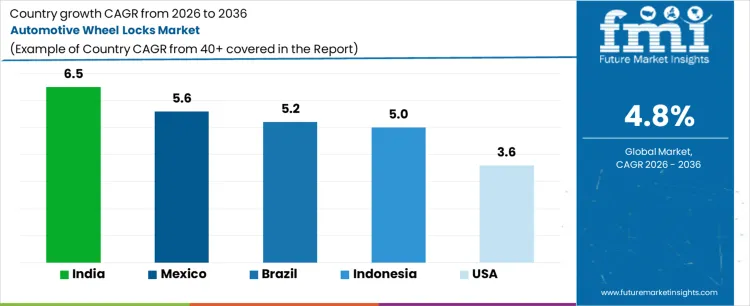
| Country | CAGR (%) |
|---|---|
| India | 6.5% |
| Mexico | 5.6% |
| Brazil | 5.2% |
| Indonesia | 5.0% |
| USA | 3.6% |
What Is Driving Expansion of Automotive Wheel Lock Demand in India?
Demand for automotive wheel locks in India is growing at a CAGR of 6.5%, supported by rising passenger vehicle ownership and alloy wheel adoption. Urban parking constraints increase exposure to wheel theft in residential and commercial areas. Dealerships bundle wheel locks with new vehicle sales to address buyer security concerns. Insurance advisory practices reinforce preventive accessory usage. Growth of organized aftermarket retail improves product availability and fitment quality. Demand growth reflects theft risk mitigation and vehicle value protection rather than widespread commercial fleet requirements.
- Rising alloy wheel penetration in passenger vehicles
- Urban parking exposure increasing theft risk
- Dealer-led bundling at point of sale
- Insurance-driven security awareness
Why Is Mexico Seeing Strong Growth in Automotive Wheel Lock Adoption?
Automotive wheel lock demand in Mexico is expanding at a CAGR of 5.6%, driven by vehicle theft deterrence and pickup truck usage. Urban and border regions experience higher theft incidence, influencing accessory adoption. Fleet operators install wheel locks to reduce asset loss during overnight parking. Compatibility with North American vehicle platforms supports standardized products. Aftermarket channels emphasize security accessories alongside alarms. Growth reflects theft prevention priorities and fleet discipline rather than expansion of premium vehicle segments.
- Elevated theft risk in urban and border regions
- Fleet adoption for asset protection
- Compatibility with North American vehicle designs
- Strong aftermarket focus on security accessories
How Are Automotive Wheel Lock Sales Shaping Up in Brazil?
Sales of automotive wheel locks in Brazil are growing at a CAGR of 5.2%, shaped by urban crime patterns and high vehicle density. Passenger cars with alloy wheels remain primary targets for theft. Consumers adopt mechanical deterrents to complement electronic security systems. Dealerships and accessory installers promote wheel locks during vehicle delivery. Economic considerations favor cost-effective physical security solutions. Growth reflects risk management behavior and urban usage patterns rather than luxury vehicle growth.
- Urban vehicle density increasing theft exposure
- Preference for mechanical deterrents
- Dealer and installer promotion at delivery
- Cost-effective security solution demand
What Factors Support Automotive Wheel Lock Demand in Indonesia?
Automotive wheel lock demand in Indonesia is expanding at a CAGR of 5.0%, influenced by growing passenger vehicle parc and parking practices. Street and open-lot parking increase vulnerability to wheel theft. Alloy wheel upgrades raise replacement costs, supporting preventive accessory use. Local aftermarket retailers offer vehicle-specific lock kits. Consumer awareness of theft risk increases in metropolitan areas. Growth reflects practical security needs tied to parking conditions rather than fleet-scale procurement.
- Open parking conditions elevating theft risk
- Rising alloy wheel upgrade adoption
- Availability of vehicle-specific lock kits
- Increasing urban consumer security awareness
Why Is the United States Experiencing Measured Growth in Automotive Wheel Locks?
Automotive wheel lock demand in the United States is growing at a CAGR of 3.6%, supported by replacement demand and selective security upgrades. Mature vehicle security systems moderate incremental accessory adoption. Owners of high-value wheels and performance vehicles continue to specify wheel locks. Dealership-installed accessories contribute steady volume. Growth remains measured, reflecting established security practices and stable vehicle ownership patterns rather than rising theft incidence across all segments.
- Mature electronic vehicle security adoption
- Continued demand for high-value wheel protection
- Dealer-installed accessory programs
- Replacement and upgrade-led purchases
What is the competitive landscape of demand for the automotive wheel locks market globally?
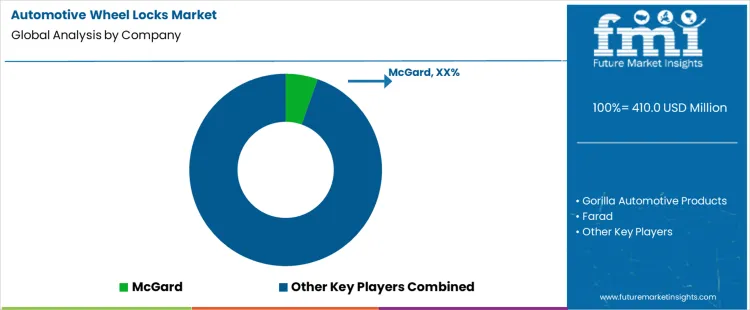
Demand for automotive wheel locks is driven by increasing vehicle theft concerns, the rising value of aftermarket wheels, and the need for enhanced vehicle security. Buyers evaluate the strength of the locking mechanism, ease of installation, corrosion resistance, and compatibility with a wide range of wheel designs. Procurement behavior emphasizes security, durability, and the ability to provide protection against theft while being user-friendly for vehicle owners. Purchasing decisions prioritize brands known for their reliable locking systems, strong market reputation, and customer support. Trend in the market reflects growing awareness of wheel theft and an increasing focus on security products that are both effective and discreet.
McGard leads the competitive landscape with its long-standing reputation for producing high-quality, durable automotive wheel locks, offering strong anti-theft solutions for a variety of vehicles. Gorilla Automotive Products competes by offering a wide range of wheel locks designed for both security and ease of use, with an emphasis on fitment flexibility. Farad offers reliable and practical wheel locks, focusing on quality materials and user-friendly designs. Advanced Wheel Locks participates with a focus on providing customizable security solutions, catering to both personal and commercial vehicles. RAD Security offers specialized wheel locking products, emphasizing high-security features and premium construction for diverse vehicle types.
Key Players in the Automotive Wheel Locks Market
- McGard
- Gorilla Automotive Products
- Farad
- Advanced Wheel Locks
- RAD Security
- HUF Group
- Würth
- Sparco
Scope of the Report
| Items | Values |
|---|---|
| Quantitative Units | USD million |
| Product Type | Locking Lug Nuts; Locking Wheel Bolts; Wheel Clamp or Boot Locks; Hub or Spare Wheel Locks; Other |
| Vehicle Segment | Passenger Cars; SUVs & Crossovers; Light Commercial Vehicles; Luxury; Other |
| Price Tier | Mid-Range; Value; Premium; Fleet or Commercial |
| Sales Channel | Auto Parts Retail; Online Retail; OEM or Dealer Accessories; Wholesale or Distributors |
| Regions Covered | Asia Pacific, Europe, North America, Latin America, Middle East & Africa |
| Countries Covered | India, Mexico, Brazil, Indonesia, USA, and 40+ countries |
| Key Companies Profiled | McGard; Gorilla Automotive Products; Farad; Advanced Wheel Locks; RAD Security; HUF Group; Würth; Sparco |
| Additional Attributes | Dollar sales by product type, vehicle segment, price tier, and sales channel; locking strength, material durability, and anti-theft performance across lug nuts, wheel bolts, clamps, and spare wheel locks; market dynamics driven by passenger cars, SUVs, light commercial vehicles, and luxury vehicle segments; price tier influence on consumer purchase behavior and procurement patterns via auto parts retail, online channels, and OEM accessory integration. |
Automotive Wheel Locks Market by Segment
Product Type:
- Locking Lug Nuts
- Locking Wheel Bolts
- Wheel Clamp or Boot Locks
- Hub or Spare Wheel Locks
- Other
Vehicle Segment:
- Passenger Cars
- SUVs & Crossovers
- Light Commercial Vehicles
- Luxury
- Other
Price Tier:
- Mid-Range
- Value
- Premium
- Fleet or Commercial
Sales Channel:
- Auto Parts Retail
- Online Retail
- OEM or Dealer Accessories
- Wholesale or Distributors
Region:
- Asia Pacific
- China
- Japan
- South Korea
- India
- Australia & New Zealand
- ASEAN
- Rest of Asia Pacific
- Europe
- Germany
- United Kingdom
- France
- Italy
- Spain
- Nordic
- BENELUX
- Rest of Europe
- North America
- United States
- Canada
- Mexico
- Latin America
- Brazil
- Chile
- Rest of Latin America
- Middle East & Africa
- Kingdom of Saudi Arabia
- Other GCC Countries
- Turkey
- South Africa
- Other African Union
- Rest of Middle East & Africa
Bibliography
- International Organization for Standardization. (2024). Corrosion protection of fasteners used in automotive exterior applications (ISO 12944-9:2024). ISO.
- United Nations Economic Commission for Europe. (2023). UN Regulation No. 124—Uniform provisions concerning the approval of wheels and wheel fastening interfaces: Amendments affecting anti-theft fasteners. United Nations.
- European Commission. (2023). Regulation (EU) 2019/2144—General safety requirements for motor vehicles: Phased implementation impacting wheel assemblies, fastening integrity, and theft-prevention accessories. Official Journal of the European Union.
Frequently Asked Questions
How big is the automotive wheel locks market in 2026?
The global automotive wheel locks market is estimated to be valued at USD 410.0 million in 2026.
What will be the size of automotive wheel locks market in 2036?
The market size for the automotive wheel locks market is projected to reach USD 655.2 million by 2036.
How much will be the automotive wheel locks market growth between 2026 and 2036?
The automotive wheel locks market is expected to grow at a 4.8% CAGR between 2026 and 2036.
What are the key product types in the automotive wheel locks market?
The key product types in automotive wheel locks market are locking lug nuts, locking wheel bolts, wheel clamp or boot locks, hub or spare wheel locks and other.
Which vehicle segment segment to contribute significant share in the automotive wheel locks market in 2026?
In terms of vehicle segment, passenger cars segment to command 42.0% share in the automotive wheel locks market in 2026.
Preview the report firsthand - request a free sample
Get SampleGet the brochure for pricing and purchase details.
Get PDFTable of Content
- Executive Summary
- Global Market Outlook
- Demand-side Trends
- Supply-side Trends
- Technology Roadmap Analysis
- Analysis and Recommendations
- Market Overview
- Market Coverage / Taxonomy
- Market Definition / Scope / Limitations
- Market Background
- Market Dynamics
- Drivers
- Restraints
- Opportunity
- Trends
- Scenario Forecast
- Demand in Optimistic Scenario
- Demand in Likely Scenario
- Demand in Conservative Scenario
- Opportunity Map Analysis
- Product Life Cycle Analysis
- Supply Chain Analysis
- Investment Feasibility Matrix
- Value Chain Analysis
- PESTLE and Porter’s Analysis
- Regulatory Landscape
- Regional Parent Market Outlook
- Production and Consumption Statistics
- Import and Export Statistics
- Market Dynamics
- Global Market Analysis 2021 to 2025 and Forecast, 2026 to 2036
- Historical Market Size Value (USD Million) Analysis, 2021 to 2025
- Current and Future Market Size Value (USD Million) Projections, 2026 to 2036
- Y-o-Y Growth Trend Analysis
- Absolute $ Opportunity Analysis
- Global Market Pricing Analysis 2021 to 2025 and Forecast 2026 to 2036
- Global Market Analysis 2021 to 2025 and Forecast 2026 to 2036, By Product Type
- Introduction / Key Findings
- Historical Market Size Value (USD Million) Analysis By Product Type , 2021 to 2025
- Current and Future Market Size Value (USD Million) Analysis and Forecast By Product Type , 2026 to 2036
- Locking Lug Nuts
- Locking Wheel Bolts
- Wheel Clamp or Boot Locks
- Hub or Spare Wheel Locks
- Other
- Locking Lug Nuts
- Y-o-Y Growth Trend Analysis By Product Type , 2021 to 2025
- Absolute $ Opportunity Analysis By Product Type , 2026 to 2036
- Global Market Analysis 2021 to 2025 and Forecast 2026 to 2036, By Vehicle Segment
- Introduction / Key Findings
- Historical Market Size Value (USD Million) Analysis By Vehicle Segment, 2021 to 2025
- Current and Future Market Size Value (USD Million) Analysis and Forecast By Vehicle Segment, 2026 to 2036
- Passenger Cars
- SUVs & Crossovers
- Light Commercial Vehicles
- Luxury
- Other
- Passenger Cars
- Y-o-Y Growth Trend Analysis By Vehicle Segment, 2021 to 2025
- Absolute $ Opportunity Analysis By Vehicle Segment, 2026 to 2036
- Global Market Analysis 2021 to 2025 and Forecast 2026 to 2036, By Price Tier
- Introduction / Key Findings
- Historical Market Size Value (USD Million) Analysis By Price Tier, 2021 to 2025
- Current and Future Market Size Value (USD Million) Analysis and Forecast By Price Tier, 2026 to 2036
- Mid-Range
- Value
- Premium
- Fleet or Commercial
- Mid-Range
- Y-o-Y Growth Trend Analysis By Price Tier, 2021 to 2025
- Absolute $ Opportunity Analysis By Price Tier, 2026 to 2036
- Global Market Analysis 2021 to 2025 and Forecast 2026 to 2036, By Sales Channel
- Introduction / Key Findings
- Historical Market Size Value (USD Million) Analysis By Sales Channel, 2021 to 2025
- Current and Future Market Size Value (USD Million) Analysis and Forecast By Sales Channel, 2026 to 2036
- Auto Parts Retail
- Online Retail
- OEM or Dealer Accessories
- Wholesale or Distributors
- Auto Parts Retail
- Y-o-Y Growth Trend Analysis By Sales Channel, 2021 to 2025
- Absolute $ Opportunity Analysis By Sales Channel, 2026 to 2036
- Global Market Analysis 2021 to 2025 and Forecast 2026 to 2036, By Region
- Introduction
- Historical Market Size Value (USD Million) Analysis By Region, 2021 to 2025
- Current Market Size Value (USD Million) Analysis and Forecast By Region, 2026 to 2036
- North America
- Latin America
- Western Europe
- Eastern Europe
- East Asia
- South Asia and Pacific
- Middle East & Africa
- Market Attractiveness Analysis By Region
- North America Market Analysis 2021 to 2025 and Forecast 2026 to 2036, By Country
- Historical Market Size Value (USD Million) Trend Analysis By Market Taxonomy, 2021 to 2025
- Market Size Value (USD Million) Forecast By Market Taxonomy, 2026 to 2036
- By Country
- USA
- Canada
- Mexico
- By Product Type
- By Vehicle Segment
- By Price Tier
- By Sales Channel
- By Country
- Market Attractiveness Analysis
- By Country
- By Product Type
- By Vehicle Segment
- By Price Tier
- By Sales Channel
- Key Takeaways
- Latin America Market Analysis 2021 to 2025 and Forecast 2026 to 2036, By Country
- Historical Market Size Value (USD Million) Trend Analysis By Market Taxonomy, 2021 to 2025
- Market Size Value (USD Million) Forecast By Market Taxonomy, 2026 to 2036
- By Country
- Brazil
- Chile
- Rest of Latin America
- By Product Type
- By Vehicle Segment
- By Price Tier
- By Sales Channel
- By Country
- Market Attractiveness Analysis
- By Country
- By Product Type
- By Vehicle Segment
- By Price Tier
- By Sales Channel
- Key Takeaways
- Western Europe Market Analysis 2021 to 2025 and Forecast 2026 to 2036, By Country
- Historical Market Size Value (USD Million) Trend Analysis By Market Taxonomy, 2021 to 2025
- Market Size Value (USD Million) Forecast By Market Taxonomy, 2026 to 2036
- By Country
- Germany
- UK
- Italy
- Spain
- France
- Nordic
- BENELUX
- Rest of Western Europe
- By Product Type
- By Vehicle Segment
- By Price Tier
- By Sales Channel
- By Country
- Market Attractiveness Analysis
- By Country
- By Product Type
- By Vehicle Segment
- By Price Tier
- By Sales Channel
- Key Takeaways
- Eastern Europe Market Analysis 2021 to 2025 and Forecast 2026 to 2036, By Country
- Historical Market Size Value (USD Million) Trend Analysis By Market Taxonomy, 2021 to 2025
- Market Size Value (USD Million) Forecast By Market Taxonomy, 2026 to 2036
- By Country
- Russia
- Poland
- Hungary
- Balkan & Baltic
- Rest of Eastern Europe
- By Product Type
- By Vehicle Segment
- By Price Tier
- By Sales Channel
- By Country
- Market Attractiveness Analysis
- By Country
- By Product Type
- By Vehicle Segment
- By Price Tier
- By Sales Channel
- Key Takeaways
- East Asia Market Analysis 2021 to 2025 and Forecast 2026 to 2036, By Country
- Historical Market Size Value (USD Million) Trend Analysis By Market Taxonomy, 2021 to 2025
- Market Size Value (USD Million) Forecast By Market Taxonomy, 2026 to 2036
- By Country
- China
- Japan
- South Korea
- By Product Type
- By Vehicle Segment
- By Price Tier
- By Sales Channel
- By Country
- Market Attractiveness Analysis
- By Country
- By Product Type
- By Vehicle Segment
- By Price Tier
- By Sales Channel
- Key Takeaways
- South Asia and Pacific Market Analysis 2021 to 2025 and Forecast 2026 to 2036, By Country
- Historical Market Size Value (USD Million) Trend Analysis By Market Taxonomy, 2021 to 2025
- Market Size Value (USD Million) Forecast By Market Taxonomy, 2026 to 2036
- By Country
- India
- ASEAN
- Australia & New Zealand
- Rest of South Asia and Pacific
- By Product Type
- By Vehicle Segment
- By Price Tier
- By Sales Channel
- By Country
- Market Attractiveness Analysis
- By Country
- By Product Type
- By Vehicle Segment
- By Price Tier
- By Sales Channel
- Key Takeaways
- Middle East & Africa Market Analysis 2021 to 2025 and Forecast 2026 to 2036, By Country
- Historical Market Size Value (USD Million) Trend Analysis By Market Taxonomy, 2021 to 2025
- Market Size Value (USD Million) Forecast By Market Taxonomy, 2026 to 2036
- By Country
- Kingdom of Saudi Arabia
- Other GCC Countries
- Turkiye
- South Africa
- Other African Union
- Rest of Middle East & Africa
- By Product Type
- By Vehicle Segment
- By Price Tier
- By Sales Channel
- By Country
- Market Attractiveness Analysis
- By Country
- By Product Type
- By Vehicle Segment
- By Price Tier
- By Sales Channel
- Key Takeaways
- Key Countries Market Analysis
- USA
- Pricing Analysis
- Market Share Analysis, 2025
- By Product Type
- By Vehicle Segment
- By Price Tier
- By Sales Channel
- Canada
- Pricing Analysis
- Market Share Analysis, 2025
- By Product Type
- By Vehicle Segment
- By Price Tier
- By Sales Channel
- Mexico
- Pricing Analysis
- Market Share Analysis, 2025
- By Product Type
- By Vehicle Segment
- By Price Tier
- By Sales Channel
- Brazil
- Pricing Analysis
- Market Share Analysis, 2025
- By Product Type
- By Vehicle Segment
- By Price Tier
- By Sales Channel
- Chile
- Pricing Analysis
- Market Share Analysis, 2025
- By Product Type
- By Vehicle Segment
- By Price Tier
- By Sales Channel
- Germany
- Pricing Analysis
- Market Share Analysis, 2025
- By Product Type
- By Vehicle Segment
- By Price Tier
- By Sales Channel
- UK
- Pricing Analysis
- Market Share Analysis, 2025
- By Product Type
- By Vehicle Segment
- By Price Tier
- By Sales Channel
- Italy
- Pricing Analysis
- Market Share Analysis, 2025
- By Product Type
- By Vehicle Segment
- By Price Tier
- By Sales Channel
- Spain
- Pricing Analysis
- Market Share Analysis, 2025
- By Product Type
- By Vehicle Segment
- By Price Tier
- By Sales Channel
- France
- Pricing Analysis
- Market Share Analysis, 2025
- By Product Type
- By Vehicle Segment
- By Price Tier
- By Sales Channel
- India
- Pricing Analysis
- Market Share Analysis, 2025
- By Product Type
- By Vehicle Segment
- By Price Tier
- By Sales Channel
- ASEAN
- Pricing Analysis
- Market Share Analysis, 2025
- By Product Type
- By Vehicle Segment
- By Price Tier
- By Sales Channel
- Australia & New Zealand
- Pricing Analysis
- Market Share Analysis, 2025
- By Product Type
- By Vehicle Segment
- By Price Tier
- By Sales Channel
- China
- Pricing Analysis
- Market Share Analysis, 2025
- By Product Type
- By Vehicle Segment
- By Price Tier
- By Sales Channel
- Japan
- Pricing Analysis
- Market Share Analysis, 2025
- By Product Type
- By Vehicle Segment
- By Price Tier
- By Sales Channel
- South Korea
- Pricing Analysis
- Market Share Analysis, 2025
- By Product Type
- By Vehicle Segment
- By Price Tier
- By Sales Channel
- Russia
- Pricing Analysis
- Market Share Analysis, 2025
- By Product Type
- By Vehicle Segment
- By Price Tier
- By Sales Channel
- Poland
- Pricing Analysis
- Market Share Analysis, 2025
- By Product Type
- By Vehicle Segment
- By Price Tier
- By Sales Channel
- Hungary
- Pricing Analysis
- Market Share Analysis, 2025
- By Product Type
- By Vehicle Segment
- By Price Tier
- By Sales Channel
- Kingdom of Saudi Arabia
- Pricing Analysis
- Market Share Analysis, 2025
- By Product Type
- By Vehicle Segment
- By Price Tier
- By Sales Channel
- Turkiye
- Pricing Analysis
- Market Share Analysis, 2025
- By Product Type
- By Vehicle Segment
- By Price Tier
- By Sales Channel
- South Africa
- Pricing Analysis
- Market Share Analysis, 2025
- By Product Type
- By Vehicle Segment
- By Price Tier
- By Sales Channel
- USA
- Market Structure Analysis
- Competition Dashboard
- Competition Benchmarking
- Market Share Analysis of Top Players
- By Regional
- By Product Type
- By Vehicle Segment
- By Price Tier
- By Sales Channel
- Competition Analysis
- Competition Deep Dive
- McGard
- Overview
- Product Portfolio
- Profitability by Market Segments (Product/Age /Sales Channel/Region)
- Sales Footprint
- Strategy Overview
- Marketing Strategy
- Product Strategy
- Channel Strategy
- Gorilla Automotive Products
- Farad
- Advanced Wheel Locks
- RAD Security
- HUF Group
- Würth
- Sparco
- OEM Genuine Wheel Lock Programs
- McGard
- Competition Deep Dive
- Assumptions & Acronyms Used
- Research Methodology


