

- Industry Size (2026)
- USD 217.6 Mn
- Forecast (2036)
- USD 652.1 Mn
- CAGR (2026 to 2036)
- 11.6%
Automotive Pyrofuse Market Size, Market Forecast and Outlook By FMI
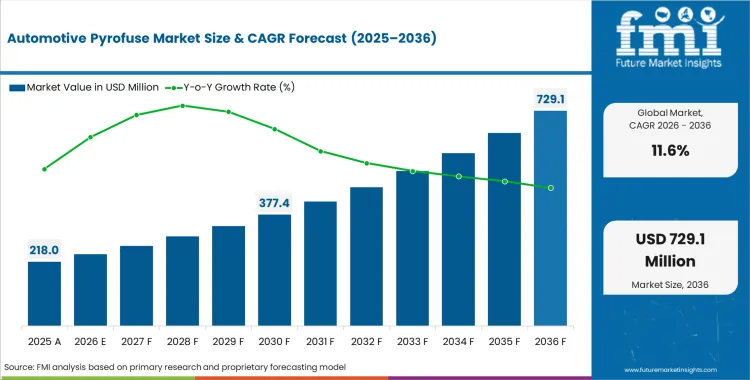
The automotive pyrofuse market surpassed a value of USD 195.0 million in 2025. Sales are expected to cross USD 217.6 million in 2026 at an anticipated CAGR of 11.6% during the forecast period. Consistent investment propels the industry to scale USD 652.1 million through 2036 as battery thermal runaway regulations force automakers to abandon traditional melting fuses for an instantaneous pyrotechnic battery disconnect.
Summary of Automotive Pyrofuse Market
- The market is forecast to reach USD 652.1 million by 2036.
- The market is expected to grow at a CAGR of 11.6% from 2026 to 2036.
- The market was estimated at USD 195.0 million in 2025.
- The forecast period represents an incremental opportunity of USD 434 million.
- The market is projected to cross USD 217.6 million in 2026.
- Active trigger systems lead the segment with a 57.0% share, driven by fast-response safety integration with vehicle electronics.
- 400-800V systems dominate with a 63.0% share, reflecting standard high-voltage EV architectures.
- Battery electric vehicles (BEVs) account for 68.0% share, supported by higher high-voltage safety requirements.
- BDU/PDU mounting leads with a 52.0% share, as it ensures effective power isolation at central distribution points.
- OEM-installed systems dominate with 88.0% share, due to strict safety and certification requirements.
- Key companies in the market include Autoliv, Eaton, Sensata Technologies, Daicel, Joyson Safety Systems, SCHURTER, and Mersen.
Automakers need battery isolation systems that can stop current flow almost instantly after a high-voltage fault. Legacy protection parts are proving too slow for newer electric vehicle architectures, especially where delayed interruption raises fire risk inside dense battery packs. Current platform requirements increasingly favor systems capable of physically breaking the circuit in under one millisecond once crash detection is triggered. Safety expectations are tightening because slow-response fuse-based protection no longer fits high-power battery designs.
Migration toward 800-volt vehicle systems is making conventional melting fuses less effective in severe fault conditions. At higher voltage levels, interruption speed becomes critical because delayed clearing increases the risk of sustained arcing across the circuit. Active battery disconnect devices are gaining importance for this reason, as newer platforms need faster physical separation of the power path during crash events or short-circuit conditions. Demand is being shaped by electrical architecture limits as much as by compliance pressure.
India is anticipated to record a 15.2% CAGR for demand growth in this market during 2026 to 2036, supported by rising domestic electric vehicle production. China is projected to expand at a 12.8% CAGR over the same period as export-oriented vehicle programs move toward more advanced high-voltage safety systems. Germany is likely to grow at an 11.1% CAGR during 2026 to 2036, reflecting continued emphasis on premium vehicle safety performance. Demand in the United States is expected to rise at a 10.4% CAGR through 2036, while South Korea is estimated to register 10.1% CAGR growth across the forecast period. France and Japan are also expected to maintain steady momentum, with demand projected to grow at CAGRs of 10.0% and 9.1% respectively during 2026 to 2036. Regional demand patterns remain split between early adopters and slower-moving markets, with battery safety requirements playing a central role in that divide.
Segmental Analysis
Automotive Pyrofuse Market Analysis by Trigger Type
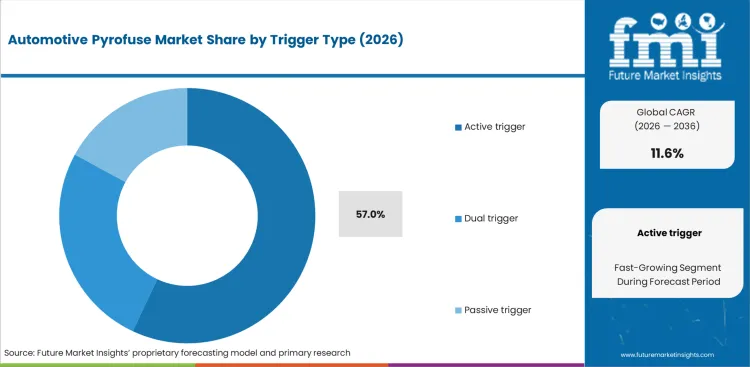
Active triggers address the delay associated with older passive fuses during crash events. Traditional fuse elements require time to melt under fault conditions, which is why the active trigger segment is estimated to account for a 57.0% share in 2026 as automakers move toward faster high-voltage power isolation. Connecting these systems directly to the airbag control network allows high-voltage lines to be disconnected before physical damage reaches critical battery pathways. Combining EV battery safety vents with simultaneous electrical disconnection also supports better management of sudden thermal stress and electrical instability during severe collisions.
- Crash Signal Integration: Active systems are integrated directly with the airbag deployment network. Engineers can initiate circuit severance before impact damage reaches high-voltage lines.
- Arc Suppression Speed: Pyrotechnic or mechanically forced cut-off systems are expected to interrupt the busbar in less than one millisecond. Faster separation reduces the arcing risk associated with slower melting fuse designs.
- Homologation Necessity: Preemptive electrical isolation is increasingly treated as a core requirement in high-voltage vehicle safety design. Automakers are expected to standardize active triggers across new platforms to align shutdown performance with evolving safety expectations.
Automotive Pyrofuse Market Analysis by Voltage Class
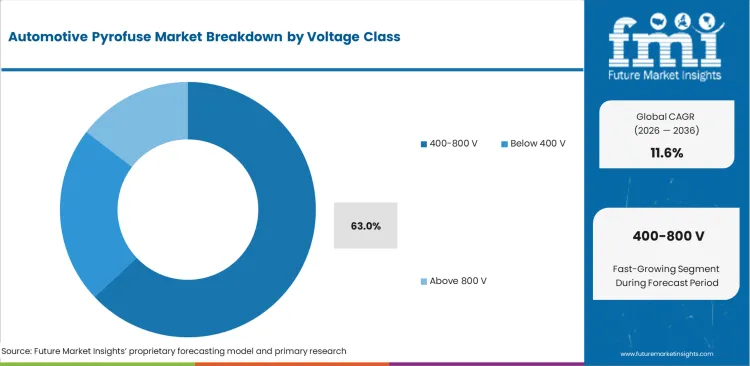
Pushing electric cars to charge faster requires much higher system voltages, making an instant physical disconnect practically mandatory for modern architectures. Controlling a massive short-circuit at these power levels requires physical separation distances that older safety parts simply cannot achieve in small spaces. Because high power pushes engineers toward explosive disconnects to stop sustained plasma arcs from starting fires, the 400-800 V category is poised to garner 63.0% share in 2026 as this voltage range becomes the industry baseline. Upgrading to explosive separation protects delicate EV power module networks from grid-side surges and guarantees compliance with strict new fire safety protocols
- Packaging Efficiency: Pyrofuses achieve high-voltage separation in a very compact footprint. Engineers save critical space inside the battery disconnect unit.
- Current Interruption Capability: Explosive force cleanly severs thick copper busbars carrying massive fault currents. Manufacturers prevent catastrophic thermal events during severe short circuits.
- Fast Charging Compatibility: Ultra-fast charging infrastructure pushes vehicle systems to higher voltages. Automakers rely on explosive disconnects to protect upgraded EV power module networks from grid-side surges.
Automotive Pyrofuse Market Analysis by Vehicle Type
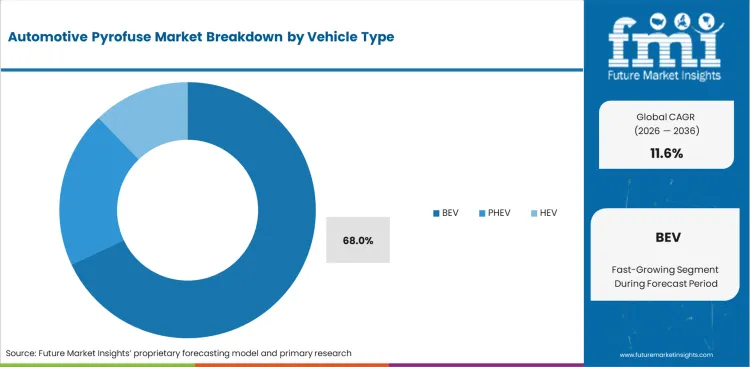
Pure battery electric vehicles are estimated to account for a 68.0% share of the market in 2026 because they rely fully on electrical protection systems without the fallback structures seen in hybrid layouts. With crash safety concentrated around the main disconnect function, manufacturers must control far larger volumes of stored energy during impact events. Delayed shutdown in fully electric platforms raises the risk of thermal escalation inside dense battery packs. Fast-acting isolation devices are therefore expected to hold stronger relevance than conventional melting hardware in platforms where immediate current interruption is critical to passenger protection.
- Energy Density Risk: High-capacity battery packs require immediate isolation after impact. Manufacturers are expected to use fast-acting disconnect devices to reduce fire risk linked to high stored energy.
- Platform Standardization: Skateboard vehicle architectures align battery layout and disconnect hardware within a common platform structure. Automakers are likely to use the same pyrofuse design across multiple EV battery pack configurations to simplify integration.
- Thermal Propagation Limits: Safety design increasingly depends on slowing heat transfer after a fault event. Instant circuit severance is expected to support compliance by giving occupants more time before thermal conditions intensify.
Automotive Pyrofuse Market Analysis by Mounting Location
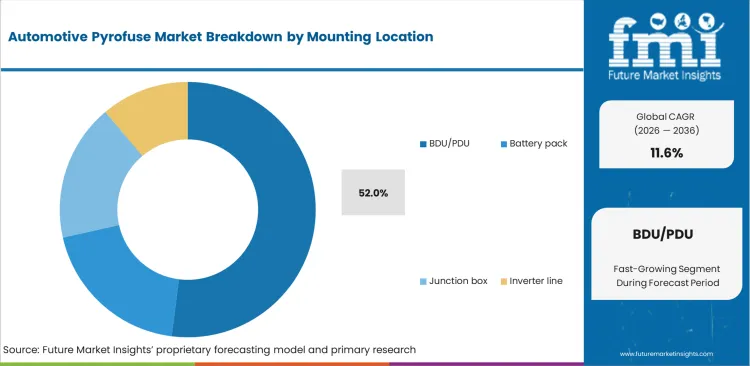
Placement inside the vehicle has a direct influence on how effectively a safety switch can isolate the main power source during a crash event. Mounting disconnect components within the BDU/PDU assembly provides faster separation between the battery and the rest of the vehicle, which is why the BDU/PDU mounting segment is estimated to account for a 52.0% share in 2026. Positioning the disconnect close to the battery also reduces the length of energized high-voltage cables routed through the cabin structure. Longer live cable paths raise crash-exposure risk and can force more complex layout changes during validation, while centralized packaging alongside standard automotive relays and fuses supports a cleaner and more controlled safety architecture.
- Centralized Isolation: The battery disconnect unit is expected to retain importance because it houses the main contactors and fuses within one location. Manufacturers simplify high-voltage architecture by grouping critical protection components in a centralized assembly.
- Harness Protection: Disconnecting power at the source helps protect the full downstream wiring network. Automakers are likely to reduce arc-fault risk in cables routed through the passenger compartment by limiting how far energized lines extend from the battery.
- Serviceability Access: Integrating a pyrofuse for power distribution unit assemblies is expected to support safer maintenance access after a crash event. Spent units can be replaced more efficiently when disconnect hardware is packaged alongside standard automotive relays and fuses.
Automotive Pyrofuse Market Analysis by Sales Channel
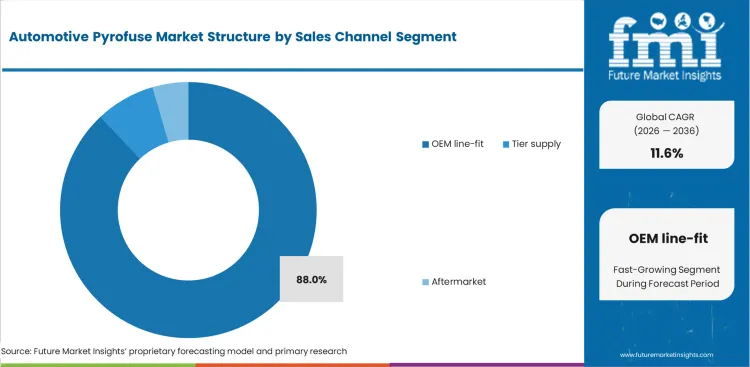
Safety-critical components are usually installed through factory channels because they must work seamlessly with the vehicle’s crash-response systems and core electrical architecture. OEM line-fit is expected to account for an 88.0% share in 2026, as manufacturers prefer to keep this level of integration under direct production control. Aftermarket installation creates a higher risk of mismatch between the disconnect device and the vehicle’s native crash-sensor logic, which makes validation more difficult. Factory fitment also supports the calibration accuracy needed for immediate activation during a collision. Strong OEM presence in this segment reflects how closely performance depends on precise vehicle-level integration.
- Factory Calibration: Pyrofuses are expected to remain closely linked with native crash-sensor systems. Assembly-line installation supports the software and hardware coordination needed for reliable response timing.
- Liability Control: Manufacturers are likely to keep installation of these components within approved factory processes. Controlled fitment helps maintain consistency across safety systems designed for specific vehicle platforms.
- Lifecycle Tracking: Serialized installation is expected to improve traceability across the production cycle. Quality teams can identify each high-voltage vehicle safety component by batch and build record more effectively.
Automotive Pyrofuse Market Drivers, Restraints, and Opportunities
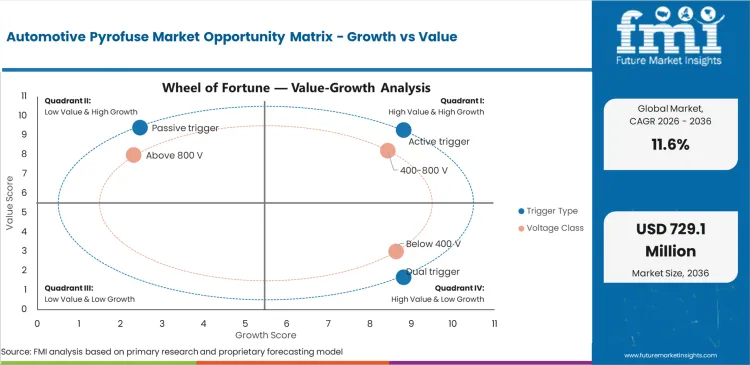
Strict fire safety rules force car companies to change how they handle power shut-offs after a crash. Old-style safety parts take too much time to melt when a short circuit happens. Explosive switches solve this delay by physically cutting the power connection in less than a millisecond. Fast electrical separation stops dangerous sparks from starting battery fires. Automakers now build these active disconnects into every new electric vehicle battery design to pass mandatory crash tests.
Shipping and storing explosive materials creates major supply bottlenecks for parts builders. Chemical triggers inside the fuses lose their strength over time and require specialized hazard handling. Factory suppliers struggle to keep large inventories on hand without risking expiration before final assembly. Short shelf lives slow down mass production, especially in regions lacking established chemical transport networks. Creating a more stable chemical mix remains a top priority for component designers.
Opportunities in the Automotive Pyrofuse Market
- Dual-Trigger Backups: Safety designers are testing switches that combine an electronic crash signal with a secondary heat trigger. Having a physical backup guarantees the battery disconnects even if the car's main computer loses power during an accident.
- Reset Capabilities: Low-speed collisions sometimes activate permanent safety disconnects, leading to expensive towing and repair bills. Building manual reset options into advanced electrical fuses helps drivers avoid complete module replacements after minor bumps.
- Built-In Power Sensors: Moving current measurement tools directly into the main safety switch housing frees up valuable physical space. Vehicle engineers prefer parts that do two jobs at once to keep the main battery box simple and easy to assemble.
Regional Analysis
Strict safety rules and the high cost of moving explosive components force car makers to build their supply chains closer to home. This geographic shift creates a clear divide between established high-volume manufacturing centers and fast-growing electric vehicle hubs.
.webp "Top Country Growth Comparison Automotive Pyrofuse Market Cagr (2026 2036)")
| Country | CAGR (2026 to 2036) |
|---|---|
| India | 15.2% |
| China | 12.8% |
| Germany | 11.1% |
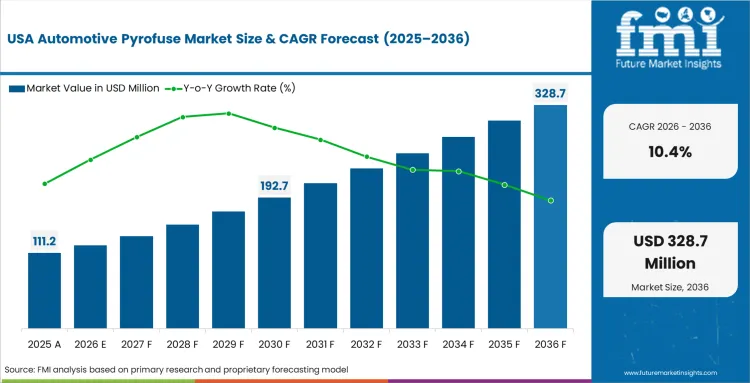
| United States | 10.4% |
| South Korea | 10.1% |
| France | 10.0% |
| Japan | 9.1% |
Source: Future Market Insights (FMI) analysis, based on proprietary forecasting model and primary research
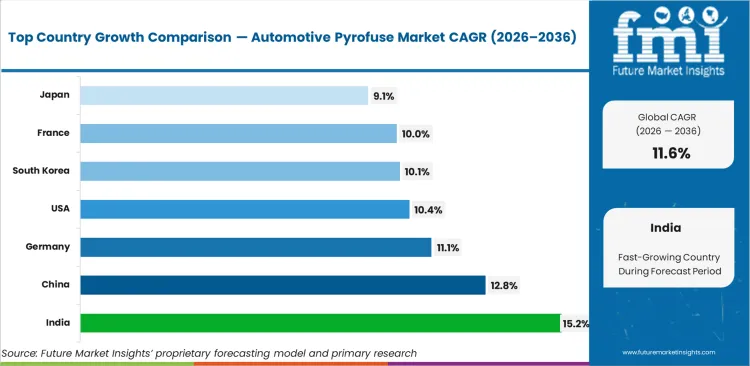
Asia-Pacific Automotive Pyrofuse Market
Local vehicle production scales quickly as domestic brands move toward fully electrified platforms across the continent. Export strategies and new local safety rules push manufacturers to use the best active disconnects available rather than relying on older passive technologies.
- India: Local battery pack builders face much tougher rules regarding fire safety, pushing India to witness a projected 15.2% CAGR in the market through 2036, as engineers scramble to pass revised crash homologation tests. Using explosive disconnects is now the only way for these domestic brands to get their new cars certified for the road.
- China: Companies exporting vehicles must meet very specific battery isolation rules, meaning China is anticipated to see adoption grow at a forecasted CAGR of 12.8% over the forecast period to guarantee their cars are allowed in premium international markets. This heavy focus on exports keeps the local manufacturing base technically ahead of domestic-only producers.
- South Korea: Demand in South Korea is projected to expand at a CAGR of 10.1% during 2026 to 2036, supported by continued focus on faster charging capability in newer electric vehicle platforms. As ultra-fast charging systems become more common, manufacturers are expected to require stronger protection against sudden power surges and fault events. Active disconnect systems are likely to gain from this shift because they provide faster and more controlled isolation in high-voltage architectures.
- Japan: A long history of careful engineering is slowly moving toward active systems, making the market for disconnects in Japan expected to grow at a predicted CAGR of 9.1% during the study period, especially as new solid-state battery designs come into play. These new electric vehicle battery platforms need even faster shut-off speeds than current liquid-cell packs to remain safe during a crash.
FMI observes, the technical strength of Asian suppliers ensures they remain the primary source for safety components globally. High-volume manufacturing combined with expert engineering continues to define this massive regional landscape.
Europe Automotive Pyrofuse Market
Luxury car brands lead the way by using safety systems that have multiple backups built right in. Very strict environmental and safety laws mean only a few companies are allowed to handle the chemical triggers used in these specific parts.
- Germany: Premium car makers are moving their entire fleets to 800-volt power systems, which is why the market in Germany is poised to expand at an anticipated CAGR of 11.1% through 2036 since standard fuses cannot handle these extreme energy levels safely. The country remains the main driver for high-performance safety standards across the continent.
- France: France is projected to register a 10.0% CAGR during 2026 to 2036, supported by continued efforts to balance vehicle safety upgrades with tighter cost control in mass-market electric vehicle production. Manufacturers are expected to optimize fuse placement within the power distribution unit to improve packaging efficiency and manage assembly costs while remaining aligned with EU safety requirements.
FMI reports, Europe's market is defined by a mix of high-end luxury requirements and strict government mandates. Such a combination keeps advanced safety technology at the forefront of local automotive design.
North America & Latin America Automotive Pyrofuse Market
Large electric trucks and SUVs require very big batteries, increasing the risk of a major electrical short during a crash. Regional safety rules focus heavily on how much time people have to get out of a car if a battery fire starts, making instant power shut-off a top priority.
- United States: Federal safety agencies are closely watching how big electric vehicles behave in high-speed impacts, leading United States adoption likely to advance at a CAGR of an estimated 10.4% by 2036, as automakers deploy explosive disconnects to avoid bad safety ratings. Protecting the brand's reputation from costly recalls is just as important as protecting the driver in this highly competitive space.
FMI assesses, the shift toward larger, heavier electric vehicles in the Americas is the main factor pushing for better battery isolation. Fast acting safety switches are becoming a key selling point for the next generation of electric trucks.
Competitive Aligners for Market Players
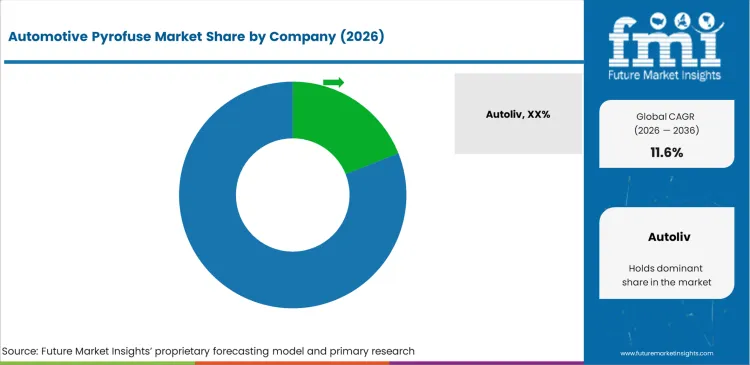
Handling explosive materials requires strict safety certifications, which limits production to a small group of experienced companies. Leading automotive pyrofuse suppliers use their long history of making airbag triggers to build early leads in the EV battery disconnect fuse space. Automakers trust proven crash safety records over new technology concepts, making it highly difficult for standard electrical startups to enter the category. Car brands only partner with suppliers that can prove their assembly lines make zero mistakes with these sensitive parts.
Guaranteeing a reliable flow of chemical materials gives older companies a major edge when bidding on an automotive pyrofuse RFQ. Setting up factories to safely build explosive parts costs a massive amount of money and takes years of safety approvals. New companies simply cannot build these specialized facilities fast enough to meet current assembly schedules. The ability to ship explosive components without delays is the primary reason why major car brands choose specific pyrotechnic battery disconnect vendors for high-volume vehicle platforms.
Car makers refuse to depend on just one factory for essential electrical fuses and crash safety hardware. Vehicle designers intentionally split their orders for a pyrofuse for junction box by making sure parts from different suppliers share the exact same physical size and voltage triggers. This shared sizing prevents car brands from getting stuck with one supplier and forces the biggest vendors to keep their prices low. Building a single housing that includes both an active explosive trigger and a regular passive melting fuse is the next major focus for companies trying to improve safety backups.
Key Players in Automotive Pyrofuse Market
- Autoliv
- Eaton
- Sensata Technologies (GIGAVAC)
- Daicel
- Joyson Safety Systemsx
- SCHURTER
- Mersen
Scope of the Report
| Metric | Value |
|---|---|
| Quantitative Units | USD 217.6 million to USD 652.1 million, at a CAGR of 11.6% |
| Market Definition | Automotive pyrofuses operate as explosive safety disconnects designed to sever high-voltage battery circuits during a vehicle crash. Engineers rely on a chemical initiator to physically cut the busbar, stopping current flow instantly and replacing passive thermal protection in advanced electric architectures. |
| Segmentation | Trigger Type, Voltage Class, Vehicle Type, Mounting Location, Sales Channel |
| Regions Covered | North America, Latin America, Europe, East Asia, South Asia & Pacific, Middle East & Africa |
| Countries Covered | United States, Canada, Brazil, Mexico, Germany, United Kingdom, France, Spain, Italy, China, Japan, South Korea, India, GCC Countries, South Africa |
| Key Companies Profiled | Autoliv, Eaton, Sensata Technologies (GIGAVAC), Daicel, Joyson Safety Systems, SCHURTER, Mersen |
| Forecast Period | 2026 to 2036 |
| Approach | Top-down and bottom-up methodology utilizing high-voltage platform production volumes and battery pack assembly targets. |
Source: Future Market Insights (FMI) analysis, based on proprietary forecasting model and primary research
Segments
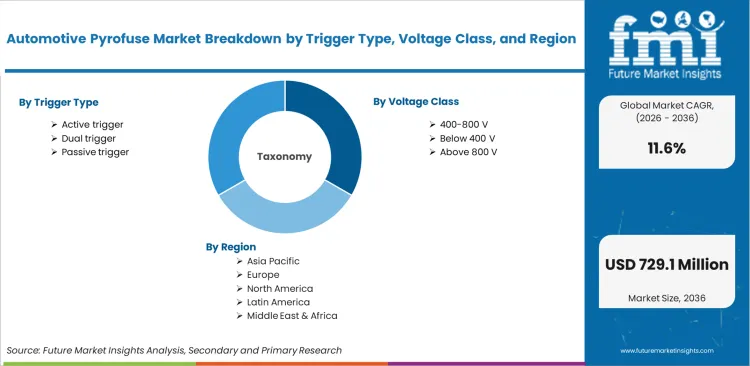
By Trigger Type:
- Active trigger
- Dual trigger
- Passive trigger
By Voltage Class:
- 400-800 V
- Below 400 V
- Above 800 V
By Vehicle Type:
- BEV
- PHEV
- HEV
By Mounting Location:
- BDU/PDU
- Battery pack
- Junction box
- Inverter line
By Sales Channel:
- OEM line-fit
- Tier supply
- Aftermarket
Regions:
- Asia Pacific
- India
- China
- Japan
- South Korea
- Indonesia
- Australia
- New Zealand
- ASEAN
- Rest of Asia Pacific
- Europe
- Germany
- Italy
- France
- United Kingdom
- Spain
- Benelux
- Nordics
- Central & Eastern Europe
- Rest of Europe
- North America
- United States
- Canada
- Mexico
- Latin America
- Brazil
- Argentina
- Chile
- Rest of Latin America
- Middle East & Africa
- Kingdom of Saudi Arabia
- United Arab Emirates
- South Africa
- Turkey
- Rest of Middle East & Africa
Bibliography
- Goodall, N. J. (2026). Emergency management strategies for electric vehicles. Virginia Transportation Research Council.
- Makan, O., & Birke, K.-P. (2026). Analyzing the impact of charging profiles on the reliability and failure rate of HV-battery fuses in electric vehicles using a novel β-flexible Weibull approach. Journal of Power Sources, 667, 239268.
- Schöberl, J., Ank, M., Schreiber, M., Wassiliadis, N., & Lienkamp, M. (2024). Thermal runaway propagation in automotive lithium-ion batteries with NMC-811 and LFP cathodes: Safety requirements and impact on system integration. eTransportation, 19, 100305.
- United Nations Economic Commission for Europe. (2025). Addendum 99: Regulation No. 100 Revision 3- Amendment 4.
- Zhang, B., Tanim, T. R., & Black, D. (2025). A software/hardware framework for efficient and safe emergency response in post-crash scenarios of battery electric vehicles. Batteries, 11(2), 80.
This bibliography is provided for reader reference. The full FMI report contains the complete reference list with primary source documentation.
This Report Addresses
- Active trigger configuration dominance across the modern EV battery safety hardware ecosystem.
- High-voltage component spacing constraints and pyrotechnic disconnect EV requirements.
- Crash signal integration variables for factory-installed safety mechanisms.
- Production scaling timelines for specialized hazardous material chemical initiators.
- Arc suppression necessity in contemporary 800-volt electric vehicle platforms.
- Safety certification criteria dictating EV battery disconnection safety standard thresholds.
- Dual trigger pyrofuse supplier deployment strategies among global Tier-1 integrators.
- Battery disconnect unit pyrofuse integration techniques for centralized power isolation.
Frequently Asked Questions
What is an automotive pyrofuse?
It operates as a pyrotechnic battery disconnect that instantly severs high-voltage circuits during collisions to prevent thermal runaway.
How does a pyrofuse work in an EV?
The component uses a chemical initiator tied to the airbag control unit to physically cut the busbar and stop current flow.
When does a pyrofuse trigger?
Actuation occurs milliseconds after a severe collision is detected, preemptively isolating the battery before mechanical deformation compromises the high-voltage lines.
Pyrofuse vs thermal fuse in EV setups: what is the difference?
Thermal fuses rely on heat buildup to melt and break the circuit slowly, whereas pyrotechnic devices use explosive charges to sever connections instantly.
Is a pyrofuse reusable?
No, the explosive physical severance destroys the internal busbar, requiring complete unit replacement after deployment.
Where is a pyrofuse installed in an EV?
Engineers typically mount these devices inside the battery disconnect unit or high-voltage junction box to isolate power directly at the source.
Pyrofuse vs contactor: how do they compare?
Contactors handle routine switching of high-voltage loads during normal operation, while pyrotechnic devices serve strictly as irreversible emergency crash disconnects.
Pyrofuse vs fuse and contactor configurations: why change?
Replacing traditional setups with explosive disconnects eliminates the latency and arc-flash risks inherent in standard mechanical separation under massive fault currents.
Why are pyrofuses used in EV battery disconnect units?
Centralized placement minimizes the length of unprotected high-voltage cable, ensuring the entire downstream vehicle architecture remains safe after a crash.
Which EV architectures need pyrofuses most?
High-capacity battery electric vehicles operating at elevated voltages require immediate severance to manage massive stored energy densities.
Are pyrofuses mainly used in 400V or 800V systems?
While present in 400V setups, they are practically mandatory for 800V platforms where fault currents easily sustain dangerous plasma arcs across traditional air gaps.
What are the leading automotive pyrofuse companies?
Key EV pyrofuse manufacturers include Autoliv, Eaton, Sensata Technologies, Daicel, and Joyson Safety Systems.
Is the pyrotechnic battery disconnect sector part of the BDU industry?
Yes, these components are highly specialized sub-systems integrated directly into the broader battery disconnect unit architecture.
What are common pyrofuse failure modes in EVs?
Primary risks involve chemical initiator degradation over time or software hand-shake failures with the native crash sensing network.
How fast does a pyrofuse disconnect a battery?
Explosive actuation typically severs the thick copper busbar in less than one millisecond, far exceeding mechanical alternatives.
What dictates the EV battery disconnection safety standard?
Frameworks like UNECE R100 and FMVSS 305 regulate post-crash battery isolation EV requirements, mandating strict thermal propagation limits.
Who are the main dual trigger pyrofuse suppliers?
Companies like Eaton develop redundant architectures that combine active electronic signals with passive thermal overrides for ultimate fail-safe reliability.
How do purchasing officers manage an automotive pyrofuse RFQ?
Buyers prioritize suppliers with proven hazardous material handling capabilities and existing homologation data for specific high-voltage vehicle platforms.
What drives demand for these components in China?
Aggressive export strategies force local automakers to adopt premium pyrotechnic disconnects to meet stringent European crash test protocols.
How does India impact the overall supply chain?
Rapid domestic EV localization forces global safety vendors to establish regional production hubs to supply compliant high-voltage isolation hardware.
How is Germany shaping European demand?
Luxury automakers across the country standardize 800-volt architectures, dictating the baseline performance requirements for next-generation explosive disconnects.
What characterizes the United States adoption landscape?
Heavy electric truck platforms require massive battery capacities, amplifying short-circuit risks and pushing designers toward immediate active severance.
Preview the report firsthand - request a free sample
Get SampleGet the brochure for pricing and purchase details.
Get PDFTable of Content
- Executive Summary
- Global Market Outlook
- Demand-side Trends
- Supply-side Trends
- Technology Roadmap Analysis
- Analysis and Recommendations
- Market Overview
- Market Coverage / Taxonomy
- Market Definition / Scope / Limitations
- Research Methodology
- Chapter Orientation
- Analytical Lens and Working Hypotheses
- Market Structure, Signals, and Trend Drivers
- Benchmarking and Cross-market Comparability
- Market Sizing, Forecasting, and Opportunity Mapping
- Research Design and Evidence Framework
- Desk Research Programme (Secondary Evidence)
- Company Annual and Sustainability Reports
- Peer-reviewed Journals and Academic Literature
- Corporate Websites, Product Literature, and Technical Notes
- Earnings Decks and Investor Briefings
- Statutory Filings and Regulatory Disclosures
- Technical White Papers and Standards Notes
- Trade Journals, Industry Magazines, and Analyst Briefs
- Conference Proceedings, Webinars, and Seminar Materials
- Government Statistics Portals and Public Data Releases
- Press Releases and Reputable Media Coverage
- Specialist Newsletters and Curated Briefings
- Sector Databases and Reference Repositories
- FMI Internal Proprietary Databases and Historical Market Datasets
- Subscription Datasets and Paid Sources
- Social Channels, Communities, and Digital Listening Inputs
- Additional Desk Sources
- Expert Input and Fieldwork (Primary Evidence)
- Primary Modes
- Qualitative Interviews and Expert Elicitation
- Quantitative Surveys and Structured Data Capture
- Blended Approach
- Why Primary Evidence is Used
- Field Techniques
- Interviews
- Surveys
- Focus Groups
- Observational and In-context Research
- Social and Community Interactions
- Stakeholder Universe Engaged
- C-suite Leaders
- Board Members
- Presidents and Vice Presidents
- R&D and Innovation Heads
- Technical Specialists
- Domain Subject-matter Experts
- Scientists
- Physicians and Other Healthcare Professionals
- Governance, Ethics, and Data Stewardship
- Research Ethics
- Data Integrity and Handling
- Primary Modes
- Tooling, Models, and Reference Databases
- Desk Research Programme (Secondary Evidence)
- Data Engineering and Model Build
- Data Acquisition and Ingestion
- Cleaning, Normalisation, and Verification
- Synthesis, Triangulation, and Analysis
- Quality Assurance and Audit Trail
- Market Background
- Market Dynamics
- Drivers
- Restraints
- Opportunity
- Trends
- Scenario Forecast
- Demand in Optimistic Scenario
- Demand in Likely Scenario
- Demand in Conservative Scenario
- Opportunity Map Analysis
- Product Life Cycle Analysis
- Supply Chain Analysis
- Investment Feasibility Matrix
- Value Chain Analysis
- PESTLE and Porter’s Analysis
- Regulatory Landscape
- Regional Parent Market Outlook
- Production and Consumption Statistics
- Import and Export Statistics
- Market Dynamics
- Global Market Analysis 2021 to 2025 and Forecast, 2026 to 2036
- Historical Market Size Value (USD Million) Analysis, 2021 to 2025
- Current and Future Market Size Value (USD Million) Projections, 2026 to 2036
- Y-o-Y Growth Trend Analysis
- Absolute $ Opportunity Analysis
- Global Market Pricing Analysis 2021 to 2025 and Forecast 2026 to 2036
- Global Market Analysis 2021 to 2025 and Forecast 2026 to 2036, By Trigger Type
- Introduction / Key Findings
- Historical Market Size Value (USD Million) Analysis By Trigger Type , 2021 to 2025
- Current and Future Market Size Value (USD Million) Analysis and Forecast By Trigger Type , 2026 to 2036
- Active trigger
- Dual trigger
- Passive trigger
- Active trigger
- Y-o-Y Growth Trend Analysis By Trigger Type , 2021 to 2025
- Absolute $ Opportunity Analysis By Trigger Type , 2026 to 2036
- Global Market Analysis 2021 to 2025 and Forecast 2026 to 2036, By Voltage Class
- Introduction / Key Findings
- Historical Market Size Value (USD Million) Analysis By Voltage Class, 2021 to 2025
- Current and Future Market Size Value (USD Million) Analysis and Forecast By Voltage Class, 2026 to 2036
- 400-800 V
- Below 400 V
- Above 800 V
- 400-800 V
- Y-o-Y Growth Trend Analysis By Voltage Class, 2021 to 2025
- Absolute $ Opportunity Analysis By Voltage Class, 2026 to 2036
- Global Market Analysis 2021 to 2025 and Forecast 2026 to 2036, By Vehicle Type
- Introduction / Key Findings
- Historical Market Size Value (USD Million) Analysis By Vehicle Type, 2021 to 2025
- Current and Future Market Size Value (USD Million) Analysis and Forecast By Vehicle Type, 2026 to 2036
- BEV
- PHEV
- HEV
- BEV
- Y-o-Y Growth Trend Analysis By Vehicle Type, 2021 to 2025
- Absolute $ Opportunity Analysis By Vehicle Type, 2026 to 2036
- Global Market Analysis 2021 to 2025 and Forecast 2026 to 2036, By Mounting Location
- Introduction / Key Findings
- Historical Market Size Value (USD Million) Analysis By Mounting Location, 2021 to 2025
- Current and Future Market Size Value (USD Million) Analysis and Forecast By Mounting Location, 2026 to 2036
- BDU/PDU
- Battery pack
- Junction box
- Inverter line
- BDU/PDU
- Y-o-Y Growth Trend Analysis By Mounting Location, 2021 to 2025
- Absolute $ Opportunity Analysis By Mounting Location, 2026 to 2036
- Global Market Analysis 2021 to 2025 and Forecast 2026 to 2036, By Sales Channel
- Introduction / Key Findings
- Historical Market Size Value (USD Million) Analysis By Sales Channel, 2021 to 2025
- Current and Future Market Size Value (USD Million) Analysis and Forecast By Sales Channel, 2026 to 2036
- OEM line-fit
- Tier supply
- Aftermarket
- OEM line-fit
- Y-o-Y Growth Trend Analysis By Sales Channel, 2021 to 2025
- Absolute $ Opportunity Analysis By Sales Channel, 2026 to 2036
- Global Market Analysis 2021 to 2025 and Forecast 2026 to 2036, By Region
- Introduction
- Historical Market Size Value (USD Million) Analysis By Region, 2021 to 2025
- Current Market Size Value (USD Million) Analysis and Forecast By Region, 2026 to 2036
- North America
- Latin America
- Western Europe
- Eastern Europe
- East Asia
- South Asia and Pacific
- Middle East & Africa
- Market Attractiveness Analysis By Region
- North America Market Analysis 2021 to 2025 and Forecast 2026 to 2036, By Country
- Historical Market Size Value (USD Million) Trend Analysis By Market Taxonomy, 2021 to 2025
- Market Size Value (USD Million) Forecast By Market Taxonomy, 2026 to 2036
- By Country
- USA
- Canada
- Mexico
- By Trigger Type
- By Voltage Class
- By Vehicle Type
- By Mounting Location
- By Sales Channel
- By Country
- Market Attractiveness Analysis
- By Country
- By Trigger Type
- By Voltage Class
- By Vehicle Type
- By Mounting Location
- By Sales Channel
- Key Takeaways
- Latin America Market Analysis 2021 to 2025 and Forecast 2026 to 2036, By Country
- Historical Market Size Value (USD Million) Trend Analysis By Market Taxonomy, 2021 to 2025
- Market Size Value (USD Million) Forecast By Market Taxonomy, 2026 to 2036
- By Country
- Brazil
- Chile
- Rest of Latin America
- By Trigger Type
- By Voltage Class
- By Vehicle Type
- By Mounting Location
- By Sales Channel
- By Country
- Market Attractiveness Analysis
- By Country
- By Trigger Type
- By Voltage Class
- By Vehicle Type
- By Mounting Location
- By Sales Channel
- Key Takeaways
- Western Europe Market Analysis 2021 to 2025 and Forecast 2026 to 2036, By Country
- Historical Market Size Value (USD Million) Trend Analysis By Market Taxonomy, 2021 to 2025
- Market Size Value (USD Million) Forecast By Market Taxonomy, 2026 to 2036
- By Country
- Germany
- UK
- Italy
- Spain
- France
- Nordic
- BENELUX
- Rest of Western Europe
- By Trigger Type
- By Voltage Class
- By Vehicle Type
- By Mounting Location
- By Sales Channel
- By Country
- Market Attractiveness Analysis
- By Country
- By Trigger Type
- By Voltage Class
- By Vehicle Type
- By Mounting Location
- By Sales Channel
- Key Takeaways
- Eastern Europe Market Analysis 2021 to 2025 and Forecast 2026 to 2036, By Country
- Historical Market Size Value (USD Million) Trend Analysis By Market Taxonomy, 2021 to 2025
- Market Size Value (USD Million) Forecast By Market Taxonomy, 2026 to 2036
- By Country
- Russia
- Poland
- Hungary
- Balkan & Baltic
- Rest of Eastern Europe
- By Trigger Type
- By Voltage Class
- By Vehicle Type
- By Mounting Location
- By Sales Channel
- By Country
- Market Attractiveness Analysis
- By Country
- By Trigger Type
- By Voltage Class
- By Vehicle Type
- By Mounting Location
- By Sales Channel
- Key Takeaways
- East Asia Market Analysis 2021 to 2025 and Forecast 2026 to 2036, By Country
- Historical Market Size Value (USD Million) Trend Analysis By Market Taxonomy, 2021 to 2025
- Market Size Value (USD Million) Forecast By Market Taxonomy, 2026 to 2036
- By Country
- China
- Japan
- South Korea
- By Trigger Type
- By Voltage Class
- By Vehicle Type
- By Mounting Location
- By Sales Channel
- By Country
- Market Attractiveness Analysis
- By Country
- By Trigger Type
- By Voltage Class
- By Vehicle Type
- By Mounting Location
- By Sales Channel
- Key Takeaways
- South Asia and Pacific Market Analysis 2021 to 2025 and Forecast 2026 to 2036, By Country
- Historical Market Size Value (USD Million) Trend Analysis By Market Taxonomy, 2021 to 2025
- Market Size Value (USD Million) Forecast By Market Taxonomy, 2026 to 2036
- By Country
- India
- ASEAN
- Australia & New Zealand
- Rest of South Asia and Pacific
- By Trigger Type
- By Voltage Class
- By Vehicle Type
- By Mounting Location
- By Sales Channel
- By Country
- Market Attractiveness Analysis
- By Country
- By Trigger Type
- By Voltage Class
- By Vehicle Type
- By Mounting Location
- By Sales Channel
- Key Takeaways
- Middle East & Africa Market Analysis 2021 to 2025 and Forecast 2026 to 2036, By Country
- Historical Market Size Value (USD Million) Trend Analysis By Market Taxonomy, 2021 to 2025
- Market Size Value (USD Million) Forecast By Market Taxonomy, 2026 to 2036
- By Country
- Kingdom of Saudi Arabia
- Other GCC Countries
- Turkiye
- South Africa
- Other African Union
- Rest of Middle East & Africa
- By Trigger Type
- By Voltage Class
- By Vehicle Type
- By Mounting Location
- By Sales Channel
- By Country
- Market Attractiveness Analysis
- By Country
- By Trigger Type
- By Voltage Class
- By Vehicle Type
- By Mounting Location
- By Sales Channel
- Key Takeaways
- Key Countries Market Analysis
- USA
- Pricing Analysis
- Market Share Analysis, 2025
- By Trigger Type
- By Voltage Class
- By Vehicle Type
- By Mounting Location
- By Sales Channel
- Canada
- Pricing Analysis
- Market Share Analysis, 2025
- By Trigger Type
- By Voltage Class
- By Vehicle Type
- By Mounting Location
- By Sales Channel
- Mexico
- Pricing Analysis
- Market Share Analysis, 2025
- By Trigger Type
- By Voltage Class
- By Vehicle Type
- By Mounting Location
- By Sales Channel
- Brazil
- Pricing Analysis
- Market Share Analysis, 2025
- By Trigger Type
- By Voltage Class
- By Vehicle Type
- By Mounting Location
- By Sales Channel
- Chile
- Pricing Analysis
- Market Share Analysis, 2025
- By Trigger Type
- By Voltage Class
- By Vehicle Type
- By Mounting Location
- By Sales Channel
- Germany
- Pricing Analysis
- Market Share Analysis, 2025
- By Trigger Type
- By Voltage Class
- By Vehicle Type
- By Mounting Location
- By Sales Channel
- UK
- Pricing Analysis
- Market Share Analysis, 2025
- By Trigger Type
- By Voltage Class
- By Vehicle Type
- By Mounting Location
- By Sales Channel
- Italy
- Pricing Analysis
- Market Share Analysis, 2025
- By Trigger Type
- By Voltage Class
- By Vehicle Type
- By Mounting Location
- By Sales Channel
- Spain
- Pricing Analysis
- Market Share Analysis, 2025
- By Trigger Type
- By Voltage Class
- By Vehicle Type
- By Mounting Location
- By Sales Channel
- France
- Pricing Analysis
- Market Share Analysis, 2025
- By Trigger Type
- By Voltage Class
- By Vehicle Type
- By Mounting Location
- By Sales Channel
- India
- Pricing Analysis
- Market Share Analysis, 2025
- By Trigger Type
- By Voltage Class
- By Vehicle Type
- By Mounting Location
- By Sales Channel
- ASEAN
- Pricing Analysis
- Market Share Analysis, 2025
- By Trigger Type
- By Voltage Class
- By Vehicle Type
- By Mounting Location
- By Sales Channel
- Australia & New Zealand
- Pricing Analysis
- Market Share Analysis, 2025
- By Trigger Type
- By Voltage Class
- By Vehicle Type
- By Mounting Location
- By Sales Channel
- China
- Pricing Analysis
- Market Share Analysis, 2025
- By Trigger Type
- By Voltage Class
- By Vehicle Type
- By Mounting Location
- By Sales Channel
- Japan
- Pricing Analysis
- Market Share Analysis, 2025
- By Trigger Type
- By Voltage Class
- By Vehicle Type
- By Mounting Location
- By Sales Channel
- South Korea
- Pricing Analysis
- Market Share Analysis, 2025
- By Trigger Type
- By Voltage Class
- By Vehicle Type
- By Mounting Location
- By Sales Channel
- Russia
- Pricing Analysis
- Market Share Analysis, 2025
- By Trigger Type
- By Voltage Class
- By Vehicle Type
- By Mounting Location
- By Sales Channel
- Poland
- Pricing Analysis
- Market Share Analysis, 2025
- By Trigger Type
- By Voltage Class
- By Vehicle Type
- By Mounting Location
- By Sales Channel
- Hungary
- Pricing Analysis
- Market Share Analysis, 2025
- By Trigger Type
- By Voltage Class
- By Vehicle Type
- By Mounting Location
- By Sales Channel
- Kingdom of Saudi Arabia
- Pricing Analysis
- Market Share Analysis, 2025
- By Trigger Type
- By Voltage Class
- By Vehicle Type
- By Mounting Location
- By Sales Channel
- Turkiye
- Pricing Analysis
- Market Share Analysis, 2025
- By Trigger Type
- By Voltage Class
- By Vehicle Type
- By Mounting Location
- By Sales Channel
- South Africa
- Pricing Analysis
- Market Share Analysis, 2025
- By Trigger Type
- By Voltage Class
- By Vehicle Type
- By Mounting Location
- By Sales Channel
- USA
- Market Structure Analysis
- Competition Dashboard
- Competition Benchmarking
- Market Share Analysis of Top Players
- By Region
- By Trigger Type
- By Voltage Class
- By Vehicle Type
- By Mounting Location
- By Sales Channel
- Competition Analysis
- Competition Deep Dive
- Autoliv
- Overview
- Product Portfolio
- Profitability by Market Segments (Product/Age /Sales Channel/Region)
- Sales Footprint
- Strategy Overview
- Marketing Strategy
- Product Strategy
- Channel Strategy
- Eaton
- Sensata Technologies (GIGAVAC)
- Daicel
- Joyson Safety Systemsx
- SCHURTER
- Mersen
- Autoliv
- Competition Deep Dive
- Assumptions & Acronyms Used


