

- Industry Size (2026)
- USD 705.3 Mn
- Forecast (2036)
- USD 1594.7 Mn
- CAGR (2026 to 2036)
- 8.5%
EV Battery Safety Vents Market Forecast and Outlook 2026 to 2036
The EV battery safety vents market is projected to expand from USD 705.3 million in 2026 to USD 1,594.7 million by 2036, registering a CAGR of 8.5%. Procurement decisions in this market are being shaped by risk mitigation priorities rather than cost optimization alone. Safety vents are treated as non-negotiable components within battery packs, leading to strong buyer aversion toward unproven designs or suppliers without extensive validation histories. Preference is given to vendors that can demonstrate consistent performance under extreme thermal and pressure conditions through documented testing and automotive-grade qualification.
As battery platforms are standardized across vehicle models and regions, long-term sourcing agreements are increasingly favored to reduce validation repetition and supply uncertainty. This behavior reinforces vendor lock-in, particularly where vent designs are customized for specific pack architectures or integrated into broader sealing systems. Switching costs remain high due to revalidation requirements, tooling changes, and potential impact on safety certifications. As a result, purchasing outcomes are influenced more by reliability assurance, traceability, and continuity of supply than by short-term pricing advantages.
Quick Stats for EV Battery Safety Vents Market
- EV Battery Safety Vents Market Value (2026): USD 705.3 Million
- EV Battery Safety Vents Market Forecast Value (2036): USD 1,594.7 Million
- EV Battery Safety Vents Market Forecast CAGR 2026 to 2036: 8.5%
- Leading Vent Technology in EV Battery Safety Vents Market: Burst Disc / Rupture Foil Vents (dominant adoption due to precise pressure-release behavior)
- Key Growth Regions in EV Battery Safety Vents Market: Asia Pacific, Europe, North America, Latin America, Middle East & Africa
- Top Key Players in EV Battery Safety Vents Market: Cellguard, Victrex (Vent Films), Donaldson, Freudenberg Sealing, Saint-Gobain, SGL Carbon, PPG, Henkel, Nitto Denko, MANN+HUMMEL
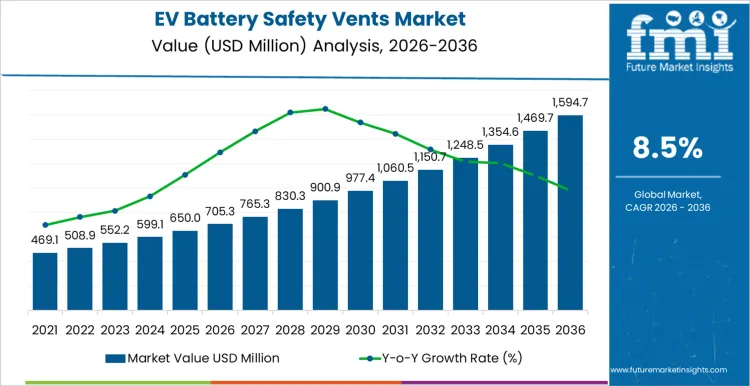
EV Battery Safety Vents Market Key Takeaways
| Metric | Value |
|---|---|
| EV Battery Safety Vents Market Value (2026) | USD 705.3 Million |
| EV Battery Safety Vents Market Forecast Value (2036) | USD 1,594.7 Million |
| EV Battery Safety Vents Market Forecast CAGR 2026 to 2036 | 8.5% |
How are Pack-Level Safety Architectures and Validation Standards Driving the EV Battery Safety Vents Market?
The EV battery safety vents market is expanding as automakers adopt more robust pack-level safety architectures to manage thermal runaway risk. As energy density increases and cell formats diversify, controlled pressure relief has become a mandatory design requirement rather than a contingency feature. Cell-level choices such as high thermal stability separator polymers are being reviewed alongside vents because they change the onset conditions and gas generation profile during abuse events. Safety vents are now engineered to deliver predictable opening pressures, directional gas release, and compatibility with pack enclosures-making them a critical interface between cell failure modes and vehicle safety systems. Design reviews increasingly evaluate vent placement relative to EV battery housing geometry to ensure discharge paths do not compromise structural members or sealing zones.
Supplier selection is increasingly driven by validation depth and integration capability. Battery pack OEMs and Tier-1s require vents that perform consistently across wide temperature ranges, rapid pressure spikes, and long service lives. This has elevated demand for vents with precise burst characteristics, corrosion-resistant materials, and proven sealing under vibration and environmental exposure. Vendors that can support DFMEA, PPAP, and accelerated life testing while tailoring designs to prismatic, cylindrical, or pouch cell packs-are gaining preferred status during platform awards.
Manufacturing scalability and standardization are shaping long-term contracts. High-volume EV programs require vents that can be produced with tight tolerances at automotive scale, with traceability and process capability built in. Supplier qualification often expands into third-party battery testing inspection and certification to document burst pressure repeatability and seal integrity across lots. As platforms globalize, OEMs are also prioritizing suppliers with multi-region production and consistent quality systems. Pack integrity specs increasingly connect vent performance with EV battery pack structural fasteners because clamp load and joint stiffness can affect sealing behavior under pressure events. For manufacturers and component suppliers, competitive advantage increasingly depends on safety performance validation, design-for-manufacture expertise, and close collaboration with pack architects positioning EV battery safety vents as a core, safety-critical component in next-generation electric vehicles.
How is the EV Battery Safety Vents Market Structured by Vent Technology and End Customer?
The eV battery safety vents market is segmented by vent technology and end customer, reflecting how pressure management requirements and battery deployment scale influence vent design selection. By vent technology, burst disc or rupture foil systems lead adoption, as they provide fast, passive pressure release during thermal runaway events. Other technologies include one-way relief valves, flame-arrestor-integrated vents, and additional safety features designed for controlled gas discharge and fire mitigation. By end customer, passenger electric vehicles represent the largest demand segment, followed by commercial electric vehicles and stationary energy storage systems, each with distinct safety, space, and regulatory considerations.
Why Do Burst Disc or Rupture Foil Systems Lead Vent Technology Adoption in the EV Battery Safety Vents Market?
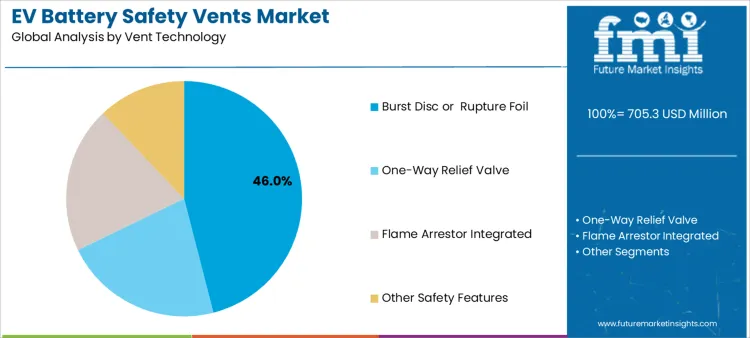
Burst disc or rupture foil systems account for 46% share of the eV battery safety vents market because they offer a simple, highly reliable mechanism for rapid pressure relief. These vents activate instantly at predefined pressure thresholds without reliance on moving parts or external power. Battery manufacturers favor this technology for its predictable performance during thermal runaway and gas generation events. The compact form factor supports integration into densely packed battery modules and packs. Low unit cost and ease of validation further support large-scale deployment. These reliability, response speed, and integration advantages explain why burst disc and rupture foil systems remain the dominant vent technology.
Why Do Passenger Electric Vehicles Dominate End-Customer Demand In The EV Battery Safety Vents Market?
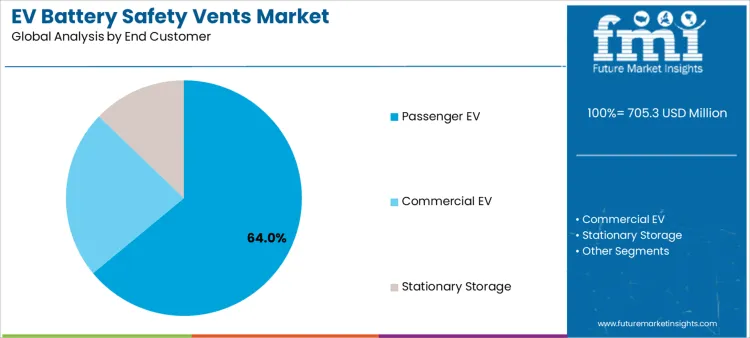
Passenger electric vehicles account for 64% share of the eV battery safety vents market because they represent the largest installed base of lithium-ion battery packs. High production volumes amplify demand for standardized safety components across vehicle platforms. Automotive OEMs prioritize vent solutions that meet stringent safety regulations while fitting within compact battery enclosures. Passenger EVs require vents that perform consistently across a wide range of operating conditions, including fast charging and high thermal loads. Platform standardization enables repeat sourcing and long-term supply agreements. These scale, regulatory, and manufacturing factors explain why passenger electric vehicles remain the leading end-customer segment.
What Are The Key Dynamics Of The EV Battery Safety Vents Market?
The EV battery safety vents market is driven by increasing demand for reliable, high-performance safety components in electric vehicle (EV) battery systems that protect against overpressure, thermal runaway, and gas buildup. Safety vents are designed to release internal cell pressure in a controlled manner during cell failure events, preventing catastrophic rupture or fire escalation. As EV adoption accelerates across passenger vehicles, commercial fleets, and electric mobility platforms, battery module and pack manufacturers prioritize vent design, consistency of activation, material compatibility, and integration with overall thermal management systems. For component suppliers and OEMs, manufacturing quality, scalability, and robust supply chain partnerships are central to market competitiveness. Venting strategy is being co-designed with battery thermal plates layouts to manage heat flux near likely failure locations and control gas routing.
How Are Technology And Vehicle Design Trends Shaping This Market?
Technology and vehicle design trends are shaping the EV battery safety vents market through advances in materials, activation mechanisms, and integration with battery management systems (BMS). High-performance polymers, engineered metal alloys, and precision stamping techniques improve vent reliability under repeated thermal stress. Material selection is increasingly aligned with thermal management materials for EV batteries to avoid degradation under cycling, electrolyte exposure, and pack condensation. Designs that incorporate predictable venting behavior and controlled gas direction support safer module and pack layouts. Increasing adoption of prismatic, pouch, and cylindrical cell formats influences vent geometry and placement strategies. Integration with BMS and thermal runaway detection systems enhances overall safety architecture. Pack teams are tightening requirements for event logging in the battery management system (BMS) so vent activation can be linked to diagnostic and warranty workflows. For suppliers, providing vents that meet evolving cell chemistry requirements (lithium-ion, solid-state, high-nickel formulations) strengthens relevance with battery manufacturers.
Why Do Testing, Standards, And Cost Constraints Restrain Market Growth?
Testing, standards, and cost constraints restrain growth in the EV battery safety vents market due to the stringent performance validation and certification required for automotive safety components. Safety vents must reliably activate under precise pressure and temperature thresholds, necessitating rigorous laboratory testing, simulation, and long-term reliability studies. Regulatory frameworks and industry safety standards set by organizations such as SAE, ISO, and regional automotive authorities require comprehensive documentation and validation before adoption in production vehicles. High precision manufacturing and specialized materials add to production cost, which can temper adoption in cost-sensitive segments or early-stage EV programs.
What is The Country-Wise Growth Outlook for the EV Battery Safety Vents Market?
The EV battery safety vents market is expanding rapidly as electric vehicle manufacturers prioritize thermal management, pressure regulation, and failure mitigation in high-energy battery packs. Safety vents play a critical role in releasing excess gas and pressure during abnormal events, helping prevent casing rupture and secondary damage. Growth varies by country based on EV production scale, battery manufacturing capacity, regulatory safety requirements, and pace of electrification. High-growth markets are driven by large-scale battery cell manufacturing and aggressive EV rollout, while mature automotive regions see demand tied to technology upgrades and next-generation battery platforms.
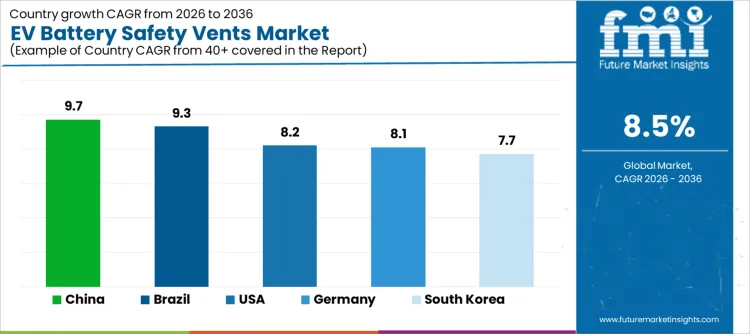
| Country | CAGR (%) |
|---|---|
| China | 9.7% |
| Brazil | 9.3% |
| United States | 8.2% |
| Germany | 8.1% |
| South Korea | 7.7% |
Why Is China Leading Growth In The EV Battery Safety Vents Market?
China’s EV battery safety vents market is expanding at a CAGR of 9.7% during 2026 to 2036, driven by the country’s dominant position in electric vehicle production and lithium-ion battery manufacturing. Large-scale deployment of EVs across passenger cars, buses, and commercial fleets has intensified focus on battery pack safety and thermal event mitigation. Battery safety vents are increasingly integrated into prismatic, pouch, and cylindrical cell designs to manage internal pressure during abnormal operating conditions. Buyers prioritize fast response time, repeatable venting behavior, and compatibility with high-energy-density chemistries. Adoption is strongly influenced by evolving national safety standards and OEM-driven validation protocols. Procurement decisions favor suppliers with proven manufacturing consistency, material reliability, and ability to support high-volume cell production. China represents a scale-driven market where supplier success depends on production capacity, precision engineering, and close collaboration with battery cell manufacturers and EV OEMs.
Why Is Brazil Emerging As A High-Growth Market For EV Battery Safety Vents?
Brazil’s EV battery safety vents market is growing at a CAGR of 9.3% during 2026 to 2036, supported by accelerating electrification of passenger vehicles and urban transport fleets. While local battery cell manufacturing is still developing, increasing assembly of EV battery packs has elevated attention to safety components. OEMs and integrators emphasize pressure relief reliability, environmental resistance, and cost efficiency. Battery safety vents are increasingly specified in imported cell modules and locally assembled packs to meet evolving safety expectations. Procurement decisions are influenced by pricing, availability, and compatibility with diverse battery designs sourced from global suppliers. Brazil represents an emerging market where supplier success depends on flexible sourcing models, regional distribution capability, and ability to support mixed battery architectures during early-stage market development.
How Is The United States Driving Innovation In EV Battery Safety Vent Design?
The United States EV battery safety vents market is expanding at a CAGR of 8.2% during 2026 to 2036, driven by growth in domestic EV manufacturing and large-scale battery gigafactory investments. Safety engineering is a key focus area, with OEMs emphasizing battery pack integrity under extreme operating and failure scenarios. Buyers prioritize vent precision, controlled gas release, and integration with advanced thermal management systems. Adoption is closely tied to compliance with rigorous automotive safety testing and certification requirements. Procurement decisions favor suppliers with strong engineering support, testing capabilities, and proven performance in high-energy battery platforms. Market value is driven by innovation-led demand, next-generation battery development, and increasing emphasis on vehicle safety differentiation. The USA. represents a technology-driven market where success depends on advanced design expertise, regulatory alignment, and collaboration with OEMs during early-stage battery platform development.
How Germany Integrating Battery Safety Is Vents Into Advanced EV Platforms?
Germany’s EV battery safety vents market is growing at a CAGR of 8.1% during 2026 to 2036, shaped by the country’s strong automotive engineering base and premium EV manufacturing. Battery safety components are treated as critical elements of overall vehicle safety architecture. Buyers emphasize engineering precision, material quality, and long-term reliability under repeated thermal cycling. Safety vents are carefully integrated into modular battery platforms designed for multiple vehicle models. Procurement decisions involve extensive validation, simulation, and testing cycles. Market value is driven by premium vehicle production, stringent safety requirements, and continuous refinement of battery pack designs. Germany represents a quality-driven market where supplier success depends on engineering credibility, documentation strength, and ability to meet exacting OEM specifications.
Why Is South Korea Advancing EV Battery Safety Vent Adoption?
South Korea’s EV battery safety vents market is expanding at a CAGR of 7.7% during 2026 to 2036, supported by its global leadership in lithium-ion battery manufacturing. Battery safety vents are increasingly optimized to support high-energy cells used by major global EV OEMs. Buyers prioritize vent durability, response accuracy, and compatibility with compact battery pack designs. Adoption is driven by continuous battery performance improvement and global supply commitments. Procurement decisions favor suppliers with deep materials expertise and close integration into battery cell production lines. Market value is driven by export-oriented battery manufacturing and ongoing technology advancement. South Korea represents a performance-focused market where supplier success depends on precision manufacturing, innovation capability, and long-term collaboration with battery producers.
How Are Material and Component Suppliers Competing in the EV Battery Safety Vents Market?
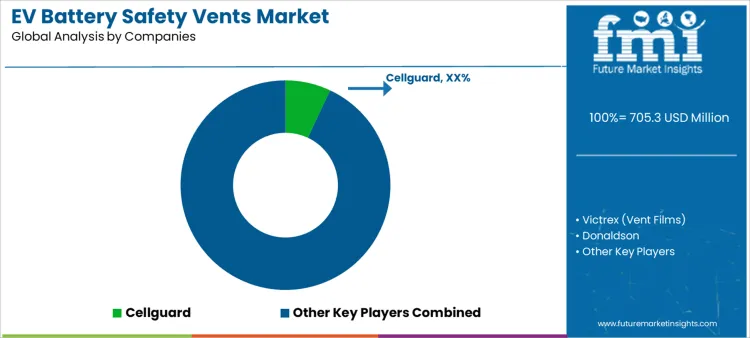
Competition in the EV battery safety vents market is defined by pressure-relief reliability, thermal stability, and the ability to manage gas release without compromising ingress protection in lithium-ion battery packs. Cellguard positions itself through dedicated venting solutions engineered for rapid pressure equalization during thermal runaway events. Product designs emphasize controlled rupture behavior, electrolyte resistance, and compatibility with cylindrical, prismatic, and pouch cell architectures. Victrex, via vent films, competes on high-temperature polymer membranes that maintain mechanical integrity under extreme thermal loads, appealing to premium EV OEMs focused on safety margins and long service life.
Filtration and sealing specialists bring cross-industry expertise into battery applications. Donaldson and MANN+HUMMEL differentiate through venting technologies adapted from automotive and industrial filtration, with emphasis on particle exclusion, moisture resistance, and consistent airflow rates. Freudenberg Sealing focuses on integrated vent-seal assemblies, highlighting elastomer compatibility, long-term aging performance, and robust sealing under vibration and pressure cycling.
Advanced materials suppliers strengthen competitive positioning through chemistry and surface engineering. Saint-Gobain and SGL Carbon emphasize high-performance membranes and composite structures designed to withstand aggressive gases and elevated temperatures. PPG and Henkel compete through functional films and vent-compatible coatings that support bonding, sealing, and durability requirements in battery modules. Nitto Denko differentiates with precision membrane technologies and adhesive integration.
Key players in EV Battery Safety Vents Market
- Cellguard
- Victrex (Vent Films)
- Donaldson
- Freudenberg Sealing
- Saint‑Gobain
- SGL Carbon
- PPG (special films)
- Henkel (vent materials)
- Nitto Denko
- MANN+HUMMEL
Scope of Report
| Attribute | Details |
|---|---|
| Market Size Unit | USD Million |
| Vent Technology Covered | Burst Disc or Rupture Foil, One-Way Relief Valve, Flame Arrestor Integrated, Other Safety Features |
| End Customer Covered | Passenger EV, Commercial EV, Stationary Energy Storage |
| Countries Covered | China, Japan, South Korea, India, Australia & New Zealand, ASEAN, Rest of Asia Pacific, Germany, United Kingdom, France, Italy, Spain, Nordic, BENELUX, Rest of Europe, United States, Canada, Mexico, Brazil, Chile, Rest of Latin America, Kingdom of Saudi Arabia, Other GCC Countries, Turkey, South Africa, Other African Union, Rest of Middle East & Africa |
| Regions Covered | Asia Pacific, Europe, North America, Latin America, Middle East & Africa |
| Key Companies Profiled | Cellguard, Victrex (Vent Films), Donaldson, Freudenberg Sealing, Saint-Gobain, SGL Carbon, PPG, Henkel, Nitto Denko, MANN+HUMMEL |
| Additional Attributes | Dollar sales by vent technology and end customer are assessed across electric vehicle and energy storage applications. The scope examines thermal runaway mitigation, pressure equalization performance, flame-blocking capability, material durability, and compliance with battery safety standards. Country-level analysis reflects EV production growth, battery pack localization, and adoption of advanced battery safety architectures. |
EV Battery Safety Vents Market by Key Segments
Vent Technology:
- Burst Disc or Rupture Foil
- One‑Way Relief Valve
- Flame Arrestor Integrated
- Other Safety Features
End Customer
- Passenger EV
- Commercial EV
- Stationary Storage
Region:
- Asia Pacific
- China
- Japan
- South Korea
- India
- Australia & New Zealand
- ASEAN
- Rest of Asia Pacific
- Europe
- Germany
- United Kingdom
- France
- Italy
- Spain
- Nordic
- BENELUX
- Rest of Europe
- North America
- United States
- Canada
- Mexico
- Latin America
- Brazil
- Chile
- Rest of Latin America
- Middle East & Africa
- Kingdom of Saudi Arabia
- Other GCC Countries
- Turkey
- South Africa
- Other African Union
- Rest of Middle East & Africa
Bibliography
- International Electrotechnical Commission. (2023). IEC 62660‑2:2018/AMD 1:2023 – Secondary lithium‑ion cells for the propulsion of electric road vehicles — Part 2: Reliability and abuse testing. IEC.
- European Commission, Joint Research Centre. (2024). Overview of battery safety tests in standards for stationary batteries and battery electric vehicles. Publications Office of the European Union.
- National Renewable Energy Laboratory. (2024). Battery failure databank: Identifying and quantifying battery failure modes relevant to safety performance in electrified systems. U.S. Department of Energy.
Frequently Asked Questions
How big is the ev battery safety vents market in 2026?
The global ev battery safety vents market is estimated to be valued at USD 705.3 million in 2026.
What will be the size of ev battery safety vents market in 2036?
The market size for the ev battery safety vents market is projected to reach USD 1,594.7 million by 2036.
How much will be the ev battery safety vents market growth between 2026 and 2036?
The ev battery safety vents market is expected to grow at a 8.5% CAGR between 2026 and 2036.
What are the key product types in the ev battery safety vents market?
The key product types in ev battery safety vents market are burst disc or rupture foil, one‑way relief valve, flame arrestor integrated and other safety features.
Which end customer segment to contribute significant share in the ev battery safety vents market in 2026?
In terms of end customer, passenger ev segment to command 64.0% share in the ev battery safety vents market in 2026.
Preview the report firsthand - request a free sample
Get SampleGet the brochure for pricing and purchase details.
Get PDFTable of Content
- Executive Summary
- Global Market Outlook
- Demand-side Trends
- Supply-side Trends
- Technology Roadmap Analysis
- Analysis and Recommendations
- Market Overview
- Market Coverage / Taxonomy
- Market Definition / Scope / Limitations
- Market Background
- Market Dynamics
- Drivers
- Restraints
- Opportunity
- Trends
- Scenario Forecast
- Demand in Optimistic Scenario
- Demand in Likely Scenario
- Demand in Conservative Scenario
- Opportunity Map Analysis
- Product Life Cycle Analysis
- Supply Chain Analysis
- Investment Feasibility Matrix
- Value Chain Analysis
- PESTLE and Porter’s Analysis
- Regulatory Landscape
- Regional Parent Market Outlook
- Production and Consumption Statistics
- Import and Export Statistics
- Market Dynamics
- Global Market Analysis 2021 to 2025 and Forecast, 2026 to 2036
- Historical Market Size Value (USD Million) Analysis, 2021 to 2025
- Current and Future Market Size Value (USD Million) Projections, 2026 to 2036
- Y-o-Y Growth Trend Analysis
- Absolute $ Opportunity Analysis
- Global Market Pricing Analysis 2021 to 2025 and Forecast 2026 to 2036
- Global Market Analysis 2021 to 2025 and Forecast 2026 to 2036, By Vent Technology
- Introduction / Key Findings
- Historical Market Size Value (USD Million) Analysis By Vent Technology , 2021 to 2025
- Current and Future Market Size Value (USD Million) Analysis and Forecast By Vent Technology , 2026 to 2036
- Burst Disc or Rupture Foil
- One‑Way Relief Valve
- Flame Arrestor Integrated
- Other Safety Features
- Burst Disc or Rupture Foil
- Y-o-Y Growth Trend Analysis By Vent Technology , 2021 to 2025
- Absolute $ Opportunity Analysis By Vent Technology , 2026 to 2036
- Global Market Analysis 2021 to 2025 and Forecast 2026 to 2036, By End Customer
- Introduction / Key Findings
- Historical Market Size Value (USD Million) Analysis By End Customer, 2021 to 2025
- Current and Future Market Size Value (USD Million) Analysis and Forecast By End Customer, 2026 to 2036
- Passenger EV
- Commercial EV
- Stationary Storage
- Passenger EV
- Y-o-Y Growth Trend Analysis By End Customer, 2021 to 2025
- Absolute $ Opportunity Analysis By End Customer, 2026 to 2036
- Global Market Analysis 2021 to 2025 and Forecast 2026 to 2036, By Region
- Introduction
- Historical Market Size Value (USD Million) Analysis By Region, 2021 to 2025
- Current Market Size Value (USD Million) Analysis and Forecast By Region, 2026 to 2036
- North America
- Latin America
- Western Europe
- Eastern Europe
- East Asia
- South Asia and Pacific
- Middle East & Africa
- Market Attractiveness Analysis By Region
- North America Market Analysis 2021 to 2025 and Forecast 2026 to 2036, By Country
- Historical Market Size Value (USD Million) Trend Analysis By Market Taxonomy, 2021 to 2025
- Market Size Value (USD Million) Forecast By Market Taxonomy, 2026 to 2036
- By Country
- USA
- Canada
- Mexico
- By Vent Technology
- By End Customer
- By Country
- Market Attractiveness Analysis
- By Country
- By Vent Technology
- By End Customer
- Key Takeaways
- Latin America Market Analysis 2021 to 2025 and Forecast 2026 to 2036, By Country
- Historical Market Size Value (USD Million) Trend Analysis By Market Taxonomy, 2021 to 2025
- Market Size Value (USD Million) Forecast By Market Taxonomy, 2026 to 2036
- By Country
- Brazil
- Chile
- Rest of Latin America
- By Vent Technology
- By End Customer
- By Country
- Market Attractiveness Analysis
- By Country
- By Vent Technology
- By End Customer
- Key Takeaways
- Western Europe Market Analysis 2021 to 2025 and Forecast 2026 to 2036, By Country
- Historical Market Size Value (USD Million) Trend Analysis By Market Taxonomy, 2021 to 2025
- Market Size Value (USD Million) Forecast By Market Taxonomy, 2026 to 2036
- By Country
- Germany
- UK
- Italy
- Spain
- France
- Nordic
- BENELUX
- Rest of Western Europe
- By Vent Technology
- By End Customer
- By Country
- Market Attractiveness Analysis
- By Country
- By Vent Technology
- By End Customer
- Key Takeaways
- Eastern Europe Market Analysis 2021 to 2025 and Forecast 2026 to 2036, By Country
- Historical Market Size Value (USD Million) Trend Analysis By Market Taxonomy, 2021 to 2025
- Market Size Value (USD Million) Forecast By Market Taxonomy, 2026 to 2036
- By Country
- Russia
- Poland
- Hungary
- Balkan & Baltic
- Rest of Eastern Europe
- By Vent Technology
- By End Customer
- By Country
- Market Attractiveness Analysis
- By Country
- By Vent Technology
- By End Customer
- Key Takeaways
- East Asia Market Analysis 2021 to 2025 and Forecast 2026 to 2036, By Country
- Historical Market Size Value (USD Million) Trend Analysis By Market Taxonomy, 2021 to 2025
- Market Size Value (USD Million) Forecast By Market Taxonomy, 2026 to 2036
- By Country
- China
- Japan
- South Korea
- By Vent Technology
- By End Customer
- By Country
- Market Attractiveness Analysis
- By Country
- By Vent Technology
- By End Customer
- Key Takeaways
- South Asia and Pacific Market Analysis 2021 to 2025 and Forecast 2026 to 2036, By Country
- Historical Market Size Value (USD Million) Trend Analysis By Market Taxonomy, 2021 to 2025
- Market Size Value (USD Million) Forecast By Market Taxonomy, 2026 to 2036
- By Country
- India
- ASEAN
- Australia & New Zealand
- Rest of South Asia and Pacific
- By Vent Technology
- By End Customer
- By Country
- Market Attractiveness Analysis
- By Country
- By Vent Technology
- By End Customer
- Key Takeaways
- Middle East & Africa Market Analysis 2021 to 2025 and Forecast 2026 to 2036, By Country
- Historical Market Size Value (USD Million) Trend Analysis By Market Taxonomy, 2021 to 2025
- Market Size Value (USD Million) Forecast By Market Taxonomy, 2026 to 2036
- By Country
- Kingdom of Saudi Arabia
- Other GCC Countries
- Turkiye
- South Africa
- Other African Union
- Rest of Middle East & Africa
- By Vent Technology
- By End Customer
- By Country
- Market Attractiveness Analysis
- By Country
- By Vent Technology
- By End Customer
- Key Takeaways
- Key Countries Market Analysis
- USA
- Pricing Analysis
- Market Share Analysis, 2025
- By Vent Technology
- By End Customer
- Canada
- Pricing Analysis
- Market Share Analysis, 2025
- By Vent Technology
- By End Customer
- Mexico
- Pricing Analysis
- Market Share Analysis, 2025
- By Vent Technology
- By End Customer
- Brazil
- Pricing Analysis
- Market Share Analysis, 2025
- By Vent Technology
- By End Customer
- Chile
- Pricing Analysis
- Market Share Analysis, 2025
- By Vent Technology
- By End Customer
- Germany
- Pricing Analysis
- Market Share Analysis, 2025
- By Vent Technology
- By End Customer
- UK
- Pricing Analysis
- Market Share Analysis, 2025
- By Vent Technology
- By End Customer
- Italy
- Pricing Analysis
- Market Share Analysis, 2025
- By Vent Technology
- By End Customer
- Spain
- Pricing Analysis
- Market Share Analysis, 2025
- By Vent Technology
- By End Customer
- France
- Pricing Analysis
- Market Share Analysis, 2025
- By Vent Technology
- By End Customer
- India
- Pricing Analysis
- Market Share Analysis, 2025
- By Vent Technology
- By End Customer
- ASEAN
- Pricing Analysis
- Market Share Analysis, 2025
- By Vent Technology
- By End Customer
- Australia & New Zealand
- Pricing Analysis
- Market Share Analysis, 2025
- By Vent Technology
- By End Customer
- China
- Pricing Analysis
- Market Share Analysis, 2025
- By Vent Technology
- By End Customer
- Japan
- Pricing Analysis
- Market Share Analysis, 2025
- By Vent Technology
- By End Customer
- South Korea
- Pricing Analysis
- Market Share Analysis, 2025
- By Vent Technology
- By End Customer
- Russia
- Pricing Analysis
- Market Share Analysis, 2025
- By Vent Technology
- By End Customer
- Poland
- Pricing Analysis
- Market Share Analysis, 2025
- By Vent Technology
- By End Customer
- Hungary
- Pricing Analysis
- Market Share Analysis, 2025
- By Vent Technology
- By End Customer
- Kingdom of Saudi Arabia
- Pricing Analysis
- Market Share Analysis, 2025
- By Vent Technology
- By End Customer
- Turkiye
- Pricing Analysis
- Market Share Analysis, 2025
- By Vent Technology
- By End Customer
- South Africa
- Pricing Analysis
- Market Share Analysis, 2025
- By Vent Technology
- By End Customer
- USA
- Market Structure Analysis
- Competition Dashboard
- Competition Benchmarking
- Market Share Analysis of Top Players
- By Regional
- By Vent Technology
- By End Customer
- Competition Analysis
- Competition Deep Dive
- Cellguard
- Overview
- Product Portfolio
- Profitability by Market Segments (Product/Age /Sales Channel/Region)
- Sales Footprint
- Strategy Overview
- Marketing Strategy
- Product Strategy
- Channel Strategy
- Victrex (Vent Films)
- Donaldson
- Freudenberg Sealing
- Saint‑Gobain
- SGL Carbon
- PPG (special films)
- Henkel (vent materials)
- Nitto Denko
- MANN+HUMMEL
- Cellguard
- Competition Deep Dive
- Assumptions & Acronyms Used
- Research Methodology


