

- Industry Size (2026)
- USD 0.9 Bn
- Forecast (2036)
- USD 2.4 Bn
- CAGR (2026 to 2036)
- 10.3%
Sodium Ion EV Battery Market Size, Market Forecast and Outlook By FMI
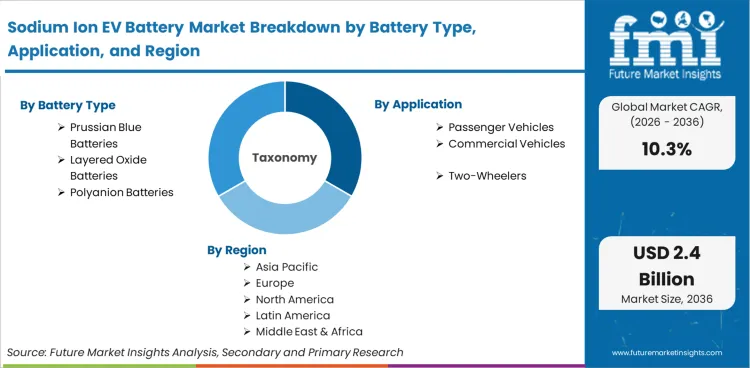
The sodium ion EV battery market accounted for USD 0.8 billion in 2025. Market valuation is projected to reach USD 0.9 billion in 2026 and rise to USD 2.4 billion by 2036. Growth across the forecast period stands at a CAGR of 10.3%.
Rising pressure on the electric vehicle supply chain is pushing manufacturers to diversify battery chemistries, driving interest in sodium ion EV batteries. Lithium price volatility, mining concentration risks, and geopolitical exposure around lithium, cobalt, and nickel sourcing are encouraging automotive companies to explore alternatives that rely on more abundant materials. Sodium is widely available and extracted from common mineral deposits and seawater, supporting lower raw material costs and improved supply stability. Battery developers are scaling sodium ion chemistry to support cost-sensitive vehicle segments, particularly entry-level electric vehicles and urban mobility platforms where energy density requirements remain moderate and affordability drives purchasing decisions. [1]
Summary of Sodium Ion EV Battery Market
- Sodium Ion EV Battery Market Definition
- The market covers sodium-based battery cell technologies deployed for electric vehicle propulsion in passenger vehicles, commercial trucks, two-wheelers, and electric buses.
- Demand Drivers in the Market
- Constraints in lithium availability encourage automotive and battery manufacturers to pursue alternative chemistry development programs.
- Pressure to lower battery pack costs supports adoption of chemistries using widely available raw materials.
- Advancements in thermal management performance reduce cooling system complexity without compromising safety certification requirements.
- Key Segments Analyzed in the Report
- Battery Type: Prussian Blue Batteries (38%) versus layered oxide chemistries and specialized formulations.
- Application: Passenger Vehicles (45%) versus commercial trucks and two-wheeler platforms.
- Geography: High-growth China versus established North American and European automotive markets.
- Analyst Opinion at FMI
- Nikhil Kaitwade, Senior Consultant for Automotive at Future Market Insights, notes, "In the updated Sodium Ion EV Battery Market Report for 2026 to 2036, our analysis examines how energy density limitations influence vehicle platform design decisions across multiple driving range categories. The findings indicate that manufacturers must balance performance specifications with cost and safety parameters. Vehicle integration requirements, particularly around thermal management and battery packaging, may delay adoption among premium electric vehicle segments seeking higher range and performance standards."
- Strategic Implications/Executive Takeaways
- Promote transition from single-chemistry lithium strategies toward broader battery technology portfolios.
- Emphasize diversified raw material sourcing to reduce exposure to supply chain disruptions.
- Advance gigafactory-scale production facilities to lower battery pack costs and improve market competitiveness.
- Methodology
- Validated through direct manufacturer capacity data and automotive integration announcements.
- Zero reliance on speculative battery technology trend forecasting.
- Based on verifiable production timelines and verified supply agreements.
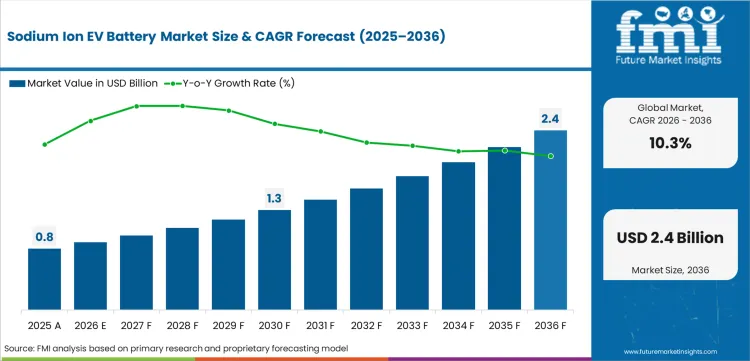
Sodium Ion EV Battery Market Key Takeaways
| Metric | Value |
|---|---|
| Market Value (2026) | USD 0.9 billion |
| Market Forecast Value (2036) | USD 2.4 billion |
| Forecast CAGR (2026-2036) | 10.3% |
Source: FMI analysis based on proprietary forecasting model and primary research
Advances in cathode and electrolyte technologies are improving the performance profile of sodium ion batteries, strengthening their commercial viability for EV applications. Research teams are refining Prussian blue and layered oxide cathodes that improve cycle stability and power output, enabling sodium ion cells to support daily vehicle usage patterns. Manufacturers are aligning sodium ion battery designs with existing lithium-ion manufacturing infrastructure, enabling production lines to transition without significant capital replacement. This compatibility lowers investment barriers for battery producers and accelerates commercialization timelines. As EV production volumes rise globally, sodium ion systems offer an additional chemistry pathway that complements lithium-based batteries across diversified vehicle platforms.
Government initiatives supporting localized battery manufacturing and resilient supply chains are also expanding the sodium ion EV battery ecosystem. Policymakers in major automotive markets are encouraging battery innovation through funding programs, industrial incentives, and domestic production mandates. Sodium ion batteries align with these goals due to their reliance on readily available materials and simplified supply chains. Automakers view this chemistry as a strategic hedge against material shortages while maintaining competitive EV pricing. Pilot deployments and early commercial models are validating real-world performance, encouraging battery manufacturers and automotive companies to accelerate partnerships that scale sodium ion battery production for future electric mobility demand.
Market players are focusing on launching innovative capabilities of products to increase their reach. [2]
Sodium Ion EV Battery Market Definition
Sodium ion batteries represent an emerging alternative battery chemistry used for electric vehicle propulsion, covering energy storage systems deployed across passenger and commercial vehicle segments. The sodium ion EV battery market includes global research, manufacturing, and supply of sodium-based electrochemical cells that utilize non-lithium chemistries, integrated thermal management systems, and optimized charge cycle technologies designed for electric mobility platforms.
Sodium Ion EV Battery Market Inclusions
The report provides a detailed assessment of market dynamics, including global and regional market size analysis in both volume and value terms, along with a ten-year forecast covering 2026 to 2036. The study evaluates market segmentation by battery type such as Prussian blue batteries, layered oxide batteries, polyanion batteries, and organic batteries. It also analyzes applications across passenger vehicles, commercial vehicles, two-wheelers, and electric buses, along with end users including original equipment manufacturers, battery manufacturers, and aftermarket service providers.
Sodium Ion EV Battery Market Exclusions
The report does not cover stationary energy storage solutions, portable electronics batteries, industrial backup systems, and grid-level storage deployments. Upstream activities such as mineral extraction, electrode material supply, and battery recycling services are not included in the scope. The assessment concentrates on automotive-grade sodium ion battery cells developed for direct electric vehicle integration. Hybrid battery configurations and prototype research initiatives with insignificant commercial use are not considered in the analysis.
Sodium Ion EV Battery Market Research Methodology
- Primary Research: Interviews were conducted with battery manufacturers, automotive OEM representatives, materials science researchers, production equipment suppliers, and vehicle testing organizations across major markets. Battery technology consultants clarified performance specifications and integration requirements.
- Desk Research: Production capacity data from battery manufacturer announcements, vehicle platform adoption rates from automotive industry reports, and import/export statistics from trade organizations supported market benchmarking.
- Market-Sizing and Forecasting: A hybrid top-down and bottom-up model was developed. Demand was reconstructed from manufacturer capacity announcements, vehicle integration timelines, and production ramp schedules, then validated against raw material availability projections and automotive electrification targets.
- Data Validation and Update Cycle: Outputs undergo variance checks across automotive and battery industry datasets, cross-verification with materials research publications, and structured expert review prior to release.
Segmental Analysis
Sodium Ion EV Battery Market Analysis by Battery Type
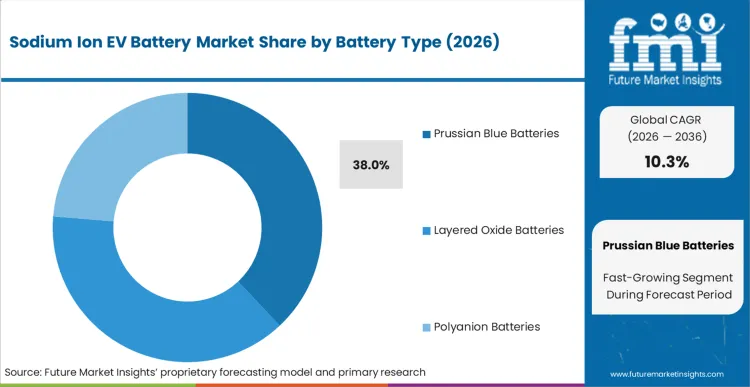
The Prussian blue batteries segment is anticipated to register 38% share in 2026. Prussian blue sodium ion batteries are gaining strong demand because the cathode material offers stable crystal structures that enable efficient sodium ion movement during charging and discharging. This structural stability supports long cycle life and reliable battery performance, which are key priorities for electric vehicle manufacturers targeting large scale deployment. Prussian blue compounds allow faster ion diffusion compared with many alternative cathode materials used in sodium based batteries.
- Material Availability Advantage: Prussian blue cathodes rely on iron based compounds and widely available raw materials. This structure reduces dependence on lithium, cobalt, and nickel supply chains, enabling battery manufacturers to secure stable sourcing while maintaining lower material costs for large scale electric vehicle battery production.
- Fast Ion Transport Performance: The open framework structure of Prussian blue materials allows rapid sodium ion movement during charge and discharge cycles. This property improves charge efficiency, thermal stability, and operational durability, making the chemistry suitable for electric vehicles requiring consistent daily charging and reliable battery performance.
Sodium Ion EV Battery Market Analysis by Application
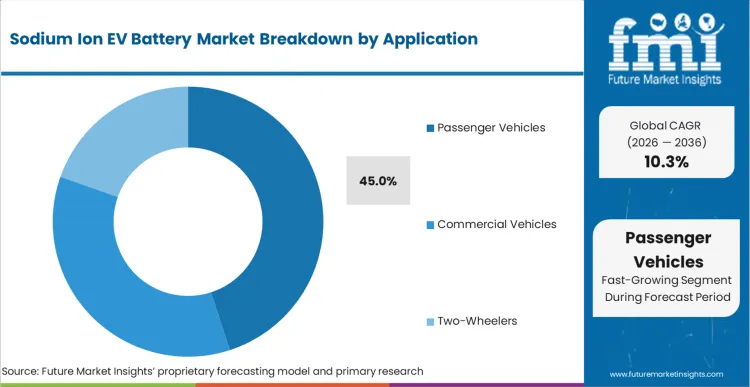
The passenger vehicles segment is poised to occupy a 45% market share in 2026. Urban mobility patterns are strengthening the suitability of sodium ion batteries for passenger vehicles. Many passenger EVs operate within predictable driving ranges, daily commuting distances, and controlled charging cycles. Sodium ion battery systems provide sufficient energy density for these usage patterns, particularly in compact cars, city vehicles, and short distance passenger transport segments. Vehicle manufacturers recognize that not every passenger vehicle requires the highest energy density battery chemistry.
- Cost Efficient Battery Packs: Passenger vehicle manufacturers are adopting sodium ion batteries to lower battery pack costs. The chemistry uses widely available materials, enabling automakers to develop affordable electric cars targeted at mass market consumers and price sensitive urban mobility segments.
- Suitable for Urban Driving Patterns: Sodium ion batteries deliver stable power output and long cycle durability for daily commuting distances. Passenger vehicles operating in city environments benefit from this chemistry since moderate energy density is sufficient for short range travel and frequent charging routines.
Sodium Ion EV Battery Market Drivers, Restraints, and Opportunities
Growing electric vehicle production is creating strong demand for alternative battery chemistries, positioning sodium ion technology as a practical solution for cost focused mobility segments. Battery manufacturers are prioritizing sodium ion systems because raw materials such as sodium, iron, and aluminum are widely available and geographically diversified. This availability lowers supply risk compared with lithium based batteries that rely on limited mining regions. Automotive companies developing entry level electric vehicles are exploring sodium ion batteries to maintain competitive pricing. Expansion of EV manufacturing capacity across Asia and Europe is encouraging battery producers to accelerate research, pilot production, and commercialization of sodium ion battery systems.
Lower energy density compared with lithium ion batteries remains a significant challenge for sodium ion electric vehicle battery deployment. Electric vehicles designed for long driving ranges require batteries capable of storing high amounts of energy within compact battery packs. Sodium ion chemistry currently delivers lower energy density, which can increase battery size and weight in certain vehicle platforms. Automakers focusing on premium electric vehicles or long distance driving applications continue to rely on lithium ion technology for this reason. Performance limitations related to temperature sensitivity and cycle optimization also require further research before sodium ion batteries can compete across all electric vehicle segments.
Expansion of low cost electric mobility programs is creating new opportunities for sodium ion battery adoption. Governments and automotive companies are promoting affordable electric passenger vehicles, two wheelers, and urban delivery vehicles to accelerate clean transportation adoption. Sodium ion batteries align well with these programs because they reduce battery material costs and support localized manufacturing strategies. Battery producers are forming partnerships with automotive companies to develop sodium ion cells tailored for compact electric vehicles and fleet transportation platforms. Growing investment in battery research, pilot production lines, and regional supply chain development is expected to strengthen commercialization opportunities for sodium ion EV batteries.
Regional Analysis
Based on regional analysis, the sodium ion EV battery market is segmented into North America, Latin America, Europe, East Asia, South Asia, Oceania and Middle East & Africa across 40 countries. The full report also offers market attractiveness analysis based on regional trends.
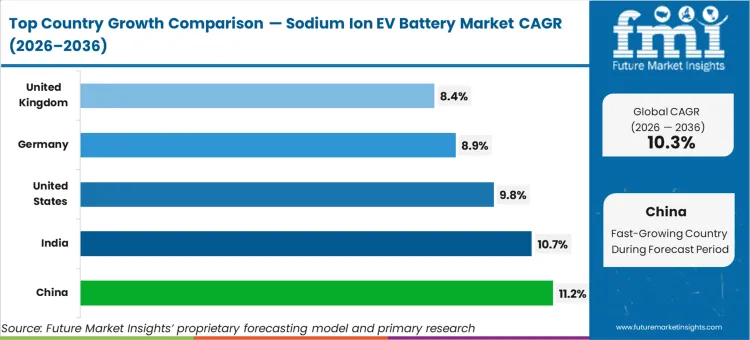
.webp "Top Country Growth Comparison Sodium Ion Ev Battery Market Cagr (2026 2036)")
| Country | CAGR (2026 to 2036) |
|---|---|
| United States | 9.8% |
| Germany | 8.9% |
| China | 11.2% |
| India | 10.7% |
| United Kingdom | 8.4% |
Source: Market analysis based on proprietary forecasting model and primary research
North America Sodium Ion EV Battery Market Analysis
North America Sodium Ion EV Battery Market is expanding as electric vehicle manufacturers seek alternatives that reduce dependence on lithium supply chains. Automakers in the United States and Canada are increasing EV production to meet emission reduction targets and expanding consumer demand for electric mobility. Sodium ion batteries provide an attractive option because they rely on widely available materials that support more stable supply conditions. Battery developers are investing in research programs that focus on improving sodium ion battery performance for automotive use. As EV production volumes rise across North America, manufacturers are exploring diversified battery chemistries to maintain long term supply security and competitive vehicle pricing.
- United States: Sales of sodium ion EV batteries in the United States are projected to expand at 9.8% CAGR from 2026 to 2036. Government support for domestic battery manufacturing is strengthening the development of sodium ion battery technologies in the United States. Federal initiatives promoting electric mobility, advanced battery research, and localized supply chains are encouraging investments in alternative battery chemistries. Research institutions and battery manufacturers are receiving funding to improve sodium ion battery performance and accelerate commercialization. These programs aim to reduce reliance on imported battery materials while strengthening the domestic EV manufacturing ecosystem.
The study provides comprehensive analysis of the North American market with country-specific insights for the United States and Canada. It examines vehicle electrification momentum, evolving battery chemistry preferences, and industry growth shaped by technology development and production strategy approaches.
Asia Pacific Sodium Ion EV Battery Market Analysis
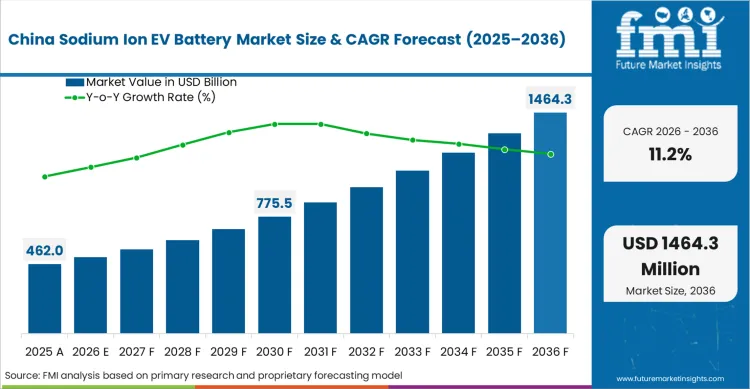
Rapid growth of affordable electric mobility in Asia Pacific is strengthening demand for sodium ion EV batteries. Many countries in the region are focusing on small passenger vehicles, compact cars, and urban transportation platforms where moderate battery energy density is sufficient for daily travel. Sodium ion battery systems provide stable performance for short range electric vehicles that dominate urban mobility markets. Automotive companies are exploring sodium ion technology to develop entry level electric cars that remain competitively priced for middle income consumers.
- China: The Chinese sodium ion EV battery market is estimated to grow at 11.2% CAGR during the study period. The market is expanding as the country strengthens its leadership in electric vehicle production and battery manufacturing. China hosts one of the largest EV markets globally, with strong consumer adoption supported by government incentives and emission reduction policies. Automotive manufacturers are exploring sodium ion battery technologies to diversify battery supply chains and reduce reliance on lithium based materials.
- India: The demand for sodium ion EV battery in India is slated to grow at 10.7% CAGR from 2026 to 2036. The market is expanding as the country accelerates electric mobility adoption and seeks cost efficient battery technologies suited for price sensitive vehicle segments. [3] Electric passenger vehicles, two wheelers, and small commercial EVs dominate the Indian mobility landscape, creating demand for batteries that balance affordability and operational reliability. Sodium ion batteries rely on abundant materials that can reduce battery costs compared with lithium based chemistries.
The study assesses the sodium ion EV battery market across East and South Asia during the period 2021 to 2036. It reviews vehicle electrification developments, battery chemistry innovation, and production capacity growth in China, Japan, South Korea, India, and Australia. The report identifies cost reduction initiatives supporting wider regional market adoption.
Europe Sodium Ion EV Battery Market Analysis
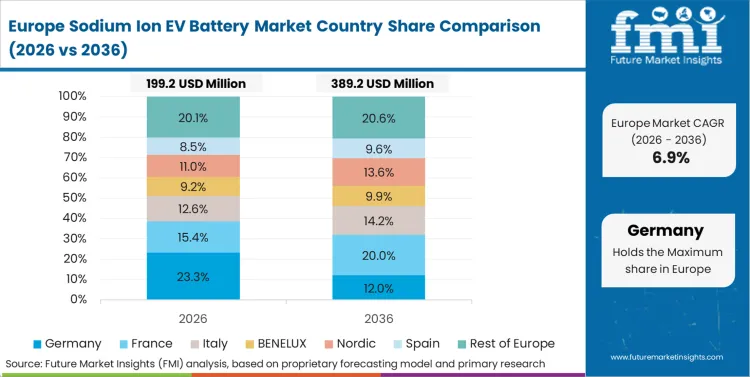
Electric vehicle adoption is increasing pressure on power systems to support large volumes of charging demand. Sodium ion batteries offer stable thermal behavior and strong cycle durability, making them suitable for vehicles operating with frequent charging patterns. Automotive manufacturers and energy planners are evaluating sodium ion battery systems that can integrate with smart charging networks and energy storage infrastructure. This compatibility supports balanced energy management across EV charging ecosystems while enabling battery technologies that rely on widely available materials and simplified supply chains.
- Germany: Demand for sodium ion EV batteries in Germany is anticipated to grow at 8.9% CAGR during the study period. Germany’s strong research and industrial infrastructure is supporting the development of sodium ion battery technology. The country hosts advanced battery research institutes, engineering centers, and automotive technology clusters that focus on next generation energy storage systems. Universities, battery startups, and automotive manufacturers are collaborating to improve sodium ion battery performance, including energy density, charging efficiency, and operational durability.
- UK: The UK sodium ion EV batteries market is set to expand at 8.4% CAGR during the forecast period. Growing research investment in next generation battery technologies is supporting sodium ion battery development across the UK Universities, technology institutes, and battery startups are actively working on improving sodium ion battery materials, including cathode chemistry and electrolyte performance. These research initiatives aim to enhance battery efficiency, cycle durability, and production scalability. Collaborative projects between research institutions and automotive companies are helping accelerate innovation in battery systems that can support electric vehicles and energy storage applications.
The European sodium ion EV battery market assessment includes country-specific analysis across the United Kingdom, Germany, France, Italy, Spain, and the Netherlands. Readers gain insights into vehicle platform integration strategies and emerging battery technology adoption trends across Europe.
Competitive Landscape for Sodium Ion EV Battery Market Players
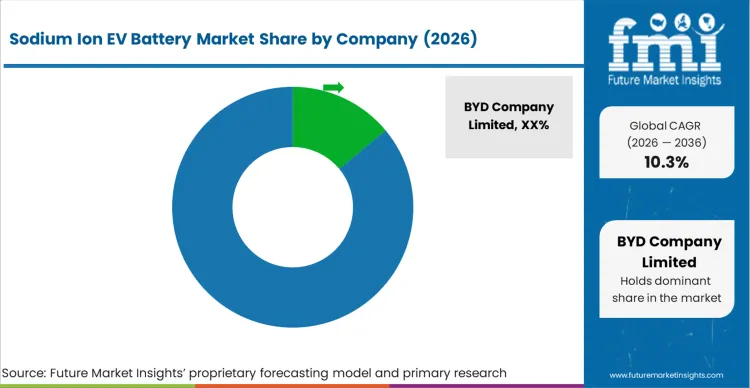
The sodium ion EV battery market is characterized by strong technology development efforts, strategic partnerships, and pilot production initiatives among battery manufacturers, automotive companies, and research institutions. Market participants are focusing on improving cathode materials, electrolyte chemistry, and cell design to enhance energy density, charging efficiency, and cycle stability. Companies are investing in sodium ion battery research to position themselves in emerging EV battery segments that prioritize cost efficiency and supply chain stability. Collaboration between battery developers and automotive manufacturers is becoming common as both sectors evaluate sodium ion batteries for integration in compact electric vehicles and urban mobility platforms.
Several battery producers are adapting existing lithium ion production infrastructure to manufacture sodium ion cells, enabling faster commercialization without major capital replacement. Industry participants are establishing demonstration projects and pilot production lines to validate large scale manufacturing capabilities and real world battery performance. Strategic alliances between battery startups, technology companies, and automakers are accelerating innovation and expanding commercialization pathways. Competitive activity also includes investment in advanced cathode materials such as Prussian blue and layered oxide compounds that improve sodium ion battery efficiency. As electric vehicle demand continues to expand globally, companies are positioning sodium ion battery technology as a complementary chemistry within the evolving EV battery ecosystem.
Key Players in Sodium Ion EV Battery Market
- Contemporary Amperex Technology Co. Limited
- BYD Company Limited
- Northvolt AB
- Altris AB
- Natron Energy Inc.
- Faradion Limited
- HiNa Battery Technology Co., Ltd.
- Tiamat Energy
- Aquion Energy
Scope of the Report
| Metric | Value |
|---|---|
| Quantitative Units | USD 0.9 billion (2026) to USD 2.4 billion (2036), at a CAGR of 10.3% |
| Market Definition | The sodium ion EV battery market comprises the global development, production, and distribution of sodium-based electrochemical cells for electric vehicle propulsion including passenger cars, commercial vehicles, and two-wheelers designed for automotive applications across regional markets. |
| Battery Type Segmentation | Prussian Blue Batteries, Layered Oxide Batteries, Polyanion Batteries, Organic Batteries |
| Application Coverage | Passenger Vehicles, Commercial Vehicles, Two-Wheelers, Electric Buses |
| End User Segmentation | Original Equipment Manufacturers, Battery Manufacturers, Aftermarket Services |
| Regions Covered | North America, Latin America, Europe, East Asia, South Asia, Oceania, Middle East and Africa |
| Countries Covered | United States, Canada, United Kingdom, Germany, France, China, Japan, India, South Korea, Australia and 40 countries |
| Key Companies Profiled | CATL, BYD Company Limited, Northvolt AB, Altris AB, Natron Energy Inc., Faradion Limited, HiNa Battery Technology Co. Ltd., Tiamat Energy, Aquion Energy |
| Forecast Period | 2026 to 2036 |
| Approach | Hybrid top down and bottom up market modeling validated through manufacturer capacity tracking and automotive integration announcements, supported by production timeline verification and technology readiness assessment |
Sodium Ion EV Battery Market Analysis by Segments
Battery Type:
- Prussian Blue Batteries
- Layered Oxide Batteries
- Polyanion Batteries
- Organic Batteries
Application:
- Passenger Vehicles
- Commercial Vehicles
- Two-Wheelers
- Electric Buses
End User:
- Original Equipment Manufacturers
- Battery Manufacturers
- Aftermarket Services
- Others (research institutions, testing laboratories)
Region:
- Asia Pacific
- China
- Japan
- South Korea
- India
- Australia
- Thailand
- Rest of Asia Pacific
- Europe
- United Kingdom
- Germany
- France
- Italy
- Spain
- Netherlands
- Sweden
- Switzerland
- Rest of Europe
- North America
- United States
- Canada
- Latin America
- Brazil
- Mexico
- Argentina
- Rest of Latin America
- Middle East & Africa
- United Arab Emirates
- Saudi Arabia
- South Africa
- Israel
- Rest of Middle East & Africa
Bibliography
- [1] Eurostat. (2025, July 30). 1.45 million new battery-only electric cars in 2024. European Commission.
- [2] Contemporary Amperex Technology Co., Limited (CATL). (2024). CATL news release.
- [3] Press Information Bureau. (2024). Government initiatives related to advanced chemistry cell battery manufacturing. Government of India.
This bibliography is provided for reader reference and is not exhaustive. The full report contains the complete reference list and detailed citations.
This Report Addresses
- Market intelligence to enable strategic decision making across established and emerging electric vehicle markets
- Market size estimation and 10-year revenue forecasts from 2026 to 2036, supported by validated production capacity data and automotive integration announcements
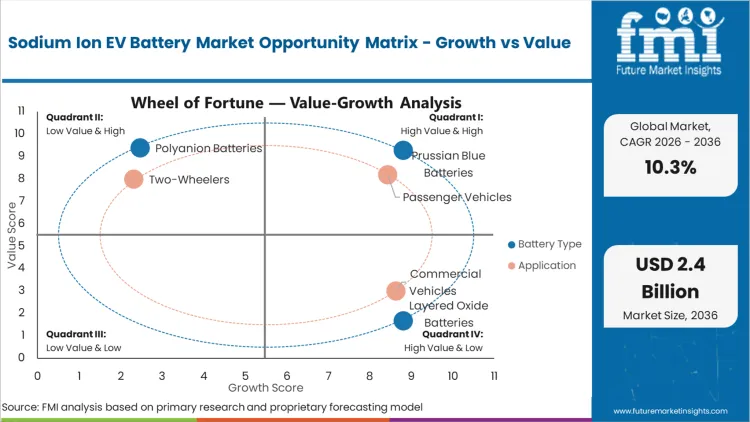
- Growth opportunity mapping across battery types and application segments with emphasis on cost optimization
- Segment and regional revenue forecasts covering Prussian blue batteries, layered oxide chemistries, polyanion formulations, and automotive integration networks
- Competition strategy assessment including OEM partnership requirements, production scale positioning, and chemistry performance optimization
- Product development tracking including electrode material innovations, electrolyte formulation trends, and thermal management capabilities
- Market access analysis covering automotive partnerships, technology licensing agreements, and regional production programs
- Market report delivery in PDF, Excel, PPT, and interactive dashboard formats for executive and operational use
Frequently Asked Questions
How large is the demand for Sodium Ion EV Batteries in the global market in 2026?
Demand for Sodium Ion EV Batteries in the global market is estimated to be valued at USD 0.9 billion in 2026.
What will be the market size of Sodium Ion EV Batteries in the global market by 2036?
Market size for Sodium Ion EV Batteries is projected to reach USD 2.4 billion by 2036.
What is the expected demand growth for Sodium Ion EV Batteries in the global market between 2026 and 2036?
Demand for Sodium Ion EV Batteries in the global market is expected to grow at a CAGR of 10.3% between 2026 and 2036.
Which Battery Type is poised to lead global sales by 2026?
Prussian Blue Batteries is expected to be the dominant battery type, capturing approximately 38.0% of global market share in 2026 due to structural stability characteristics and manufacturing cost advantages.
How significant is the role of Passenger Vehicles in driving Sodium Ion EV Battery adoption in 2026?
Passenger vehicles represent a primary application segment, projected to hold approximately 45% share of the total market in 2026 as cost-performance optimization and urban mobility targeting maintain automotive segment relevance.
What is Driving Sodium Ion EV Battery Demand in the United States?
Domestic battery manufacturing incentives and increased technology diversification requirements across automotive production facilities are driving growth.
What Industry Trends are Referenced for the United States?
Battery chemistry diversification patterns and supply chain resilience programs are referenced as key industry development shifts.
What is the United States Growth Outlook in this Report?
The United States is projected to grow at a CAGR of 9.8% during 2026 to 2036.
Why is Europe described as Important for Battery Development in this Report?
Growth is driven by automotive industry partnerships and battery technology research programs that establish alternative chemistry evaluation frameworks.
What Type of Product Development Dominates in Europe?
Alternative chemistry batteries with automotive integration compatibility and supply chain diversification capabilities dominate regional market segments.
What is Germany Growth Outlook in this Report?
Germany is projected to expand at a CAGR of 8.9% during 2026 to 2036.
Does the Report Cover China in its Regional Analysis?
China is included within East Asia under the regional scope of analysis.
What are the Sources referred to for analyzing the Market in China?
Production capacity data, government electric vehicle targets, and battery manufacturer announcements covering technology development, cost reduction analysis, and commercialization timeline evolution are cited as primary reference sources.
What is the Main Development Theme Linked to China in Asia Coverage?
Asia Pacific development is associated with domestic battery capacity expansion enabling production scale-up across automotive supply chains.
Does the Report Cover India in its Regional Analysis?
India is included within South Asia under the regional coverage framework.
What is the Main India Related Development Theme in Asia Coverage?
Two-wheeler electrification programs creating foundation for sodium ion adoption and local assembly using cost-effective manufacturing methods is emphasized.
Which Market Entry Strategies are Strategically Important for Asia Pacific Market Development?
Automotive partnerships and regional production facilities are prioritized for cost-effective technology commercialization across regional markets.
What is Sodium Ion EV Battery and What is It Mainly Used For?
Sodium ion EV batteries involve sodium-based electrochemical cells primarily used for electric vehicle propulsion including passenger cars, commercial vehicles, and two-wheeler applications.
What does Sodium Ion EV Battery Market Mean in this Report?
Sodium ion EV battery market refers to global development, manufacturing, and automotive integration of sodium-based battery cells across various vehicle categories and regional segments.
What is Included in the Scope of this Sodium Ion EV Battery Market Report?
Scope covers batteries by chemistry type, key application segments such as passenger vehicles and commercial trucks, and end user categories including OEMs, battery manufacturers, and aftermarket services.
What is Excluded from the Scope of this Report?
Stationary energy storage systems, portable consumer electronics batteries, industrial backup power equipment, and grid-scale storage installations are excluded unless part of automotive battery product offerings.
What does Market Forecast Mean on this Page?
Market forecast represents model-based projections built on production capacity trends and automotive integration assumptions for strategic planning purposes.
How is the Sodium Ion EV Battery Market Forecast Built and Validated?
Forecast is developed using hybrid modeling validated through manufacturer capacity announcements, automotive integration timelines, and technology readiness verification.
What does Zero Reliance on Speculative Third Party Market Research Mean Here?
Market analysis is based on verifiable production data, automotive partnership announcements, and battery technology specifications rather than speculative chemistry trend predictions.
Preview the report firsthand - request a free sample
Get SampleGet the brochure for pricing and purchase details.
Get PDFTable of Content
- Executive Summary
- Global Market Outlook
- Demand-side Trends
- Supply-side Trends
- Technology Roadmap Analysis
- Analysis and Recommendations
- Market Overview
- Market Coverage / Taxonomy
- Market Definition / Scope / Limitations
- Research Methodology
- Chapter Orientation
- Analytical Lens and Working Hypotheses
- Market Structure, Signals, and Trend Drivers
- Benchmarking and Cross-market Comparability
- Market Sizing, Forecasting, and Opportunity Mapping
- Research Design and Evidence Framework
- Desk Research Programme (Secondary Evidence)
- Company Annual and Sustainability Reports
- Peer-reviewed Journals and Academic Literature
- Corporate Websites, Product Literature, and Technical Notes
- Earnings Decks and Investor Briefings
- Statutory Filings and Regulatory Disclosures
- Technical White Papers and Standards Notes
- Trade Journals, Industry Magazines, and Analyst Briefs
- Conference Proceedings, Webinars, and Seminar Materials
- Government Statistics Portals and Public Data Releases
- Press Releases and Reputable Media Coverage
- Specialist Newsletters and Curated Briefings
- Sector Databases and Reference Repositories
- FMI Internal Proprietary Databases and Historical Market Datasets
- Subscription Datasets and Paid Sources
- Social Channels, Communities, and Digital Listening Inputs
- Additional Desk Sources
- Expert Input and Fieldwork (Primary Evidence)
- Primary Modes
- Qualitative Interviews and Expert Elicitation
- Quantitative Surveys and Structured Data Capture
- Blended Approach
- Why Primary Evidence is Used
- Field Techniques
- Interviews
- Surveys
- Focus Groups
- Observational and In-context Research
- Social and Community Interactions
- Stakeholder Universe Engaged
- C-suite Leaders
- Board Members
- Presidents and Vice Presidents
- R&D and Innovation Heads
- Technical Specialists
- Domain Subject-matter Experts
- Scientists
- Physicians and Other Healthcare Professionals
- Governance, Ethics, and Data Stewardship
- Research Ethics
- Data Integrity and Handling
- Primary Modes
- Tooling, Models, and Reference Databases
- Desk Research Programme (Secondary Evidence)
- Data Engineering and Model Build
- Data Acquisition and Ingestion
- Cleaning, Normalisation, and Verification
- Synthesis, Triangulation, and Analysis
- Quality Assurance and Audit Trail
- Market Background
- Market Dynamics
- Drivers
- Restraints
- Opportunity
- Trends
- Scenario Forecast
- Demand in Optimistic Scenario
- Demand in Likely Scenario
- Demand in Conservative Scenario
- Opportunity Map Analysis
- Product Life Cycle Analysis
- Supply Chain Analysis
- Investment Feasibility Matrix
- Value Chain Analysis
- PESTLE and Porter’s Analysis
- Regulatory Landscape
- Regional Parent Market Outlook
- Production and Consumption Statistics
- Import and Export Statistics
- Market Dynamics
- Global Market Analysis 2021 to 2025 and Forecast, 2026 to 2036
- Historical Market Size Value (USD Million) Analysis, 2021 to 2025
- Current and Future Market Size Value (USD Million) Projections, 2026 to 2036
- Y-o-Y Growth Trend Analysis
- Absolute $ Opportunity Analysis
- Global Market Pricing Analysis 2021 to 2025 and Forecast 2026 to 2036
- Global Market Analysis 2021 to 2025 and Forecast 2026 to 2036, By Battery Type
- Introduction / Key Findings
- Historical Market Size Value (USD Million) Analysis By Battery Type , 2021 to 2025
- Current and Future Market Size Value (USD Million) Analysis and Forecast By Battery Type , 2026 to 2036
- Prussian Blue Batteries
- Layered Oxide Batteries
- Polyanion Batteries
- Prussian Blue Batteries
- Y-o-Y Growth Trend Analysis By Battery Type , 2021 to 2025
- Absolute $ Opportunity Analysis By Battery Type , 2026 to 2036
- Global Market Analysis 2021 to 2025 and Forecast 2026 to 2036, By Application
- Introduction / Key Findings
- Historical Market Size Value (USD Million) Analysis By Application, 2021 to 2025
- Current and Future Market Size Value (USD Million) Analysis and Forecast By Application, 2026 to 2036
- Passenger Vehicles
- Commercial Vehicles
- Two-Wheelers
- Passenger Vehicles
- Y-o-Y Growth Trend Analysis By Application, 2021 to 2025
- Absolute $ Opportunity Analysis By Application, 2026 to 2036
- Global Market Analysis 2021 to 2025 and Forecast 2026 to 2036, By Region
- Introduction
- Historical Market Size Value (USD Million) Analysis By Region, 2021 to 2025
- Current Market Size Value (USD Million) Analysis and Forecast By Region, 2026 to 2036
- North America
- Latin America
- Western Europe
- Eastern Europe
- East Asia
- South Asia and Pacific
- Middle East & Africa
- Market Attractiveness Analysis By Region
- North America Market Analysis 2021 to 2025 and Forecast 2026 to 2036, By Country
- Historical Market Size Value (USD Million) Trend Analysis By Market Taxonomy, 2021 to 2025
- Market Size Value (USD Million) Forecast By Market Taxonomy, 2026 to 2036
- By Country
- USA
- Canada
- Mexico
- By Battery Type
- By Application
- By Country
- Market Attractiveness Analysis
- By Country
- By Battery Type
- By Application
- Key Takeaways
- Latin America Market Analysis 2021 to 2025 and Forecast 2026 to 2036, By Country
- Historical Market Size Value (USD Million) Trend Analysis By Market Taxonomy, 2021 to 2025
- Market Size Value (USD Million) Forecast By Market Taxonomy, 2026 to 2036
- By Country
- Brazil
- Chile
- Rest of Latin America
- By Battery Type
- By Application
- By Country
- Market Attractiveness Analysis
- By Country
- By Battery Type
- By Application
- Key Takeaways
- Western Europe Market Analysis 2021 to 2025 and Forecast 2026 to 2036, By Country
- Historical Market Size Value (USD Million) Trend Analysis By Market Taxonomy, 2021 to 2025
- Market Size Value (USD Million) Forecast By Market Taxonomy, 2026 to 2036
- By Country
- Germany
- UK
- Italy
- Spain
- France
- Nordic
- BENELUX
- Rest of Western Europe
- By Battery Type
- By Application
- By Country
- Market Attractiveness Analysis
- By Country
- By Battery Type
- By Application
- Key Takeaways
- Eastern Europe Market Analysis 2021 to 2025 and Forecast 2026 to 2036, By Country
- Historical Market Size Value (USD Million) Trend Analysis By Market Taxonomy, 2021 to 2025
- Market Size Value (USD Million) Forecast By Market Taxonomy, 2026 to 2036
- By Country
- Russia
- Poland
- Hungary
- Balkan & Baltic
- Rest of Eastern Europe
- By Battery Type
- By Application
- By Country
- Market Attractiveness Analysis
- By Country
- By Battery Type
- By Application
- Key Takeaways
- East Asia Market Analysis 2021 to 2025 and Forecast 2026 to 2036, By Country
- Historical Market Size Value (USD Million) Trend Analysis By Market Taxonomy, 2021 to 2025
- Market Size Value (USD Million) Forecast By Market Taxonomy, 2026 to 2036
- By Country
- China
- Japan
- South Korea
- By Battery Type
- By Application
- By Country
- Market Attractiveness Analysis
- By Country
- By Battery Type
- By Application
- Key Takeaways
- South Asia and Pacific Market Analysis 2021 to 2025 and Forecast 2026 to 2036, By Country
- Historical Market Size Value (USD Million) Trend Analysis By Market Taxonomy, 2021 to 2025
- Market Size Value (USD Million) Forecast By Market Taxonomy, 2026 to 2036
- By Country
- India
- ASEAN
- Australia & New Zealand
- Rest of South Asia and Pacific
- By Battery Type
- By Application
- By Country
- Market Attractiveness Analysis
- By Country
- By Battery Type
- By Application
- Key Takeaways
- Middle East & Africa Market Analysis 2021 to 2025 and Forecast 2026 to 2036, By Country
- Historical Market Size Value (USD Million) Trend Analysis By Market Taxonomy, 2021 to 2025
- Market Size Value (USD Million) Forecast By Market Taxonomy, 2026 to 2036
- By Country
- Kingdom of Saudi Arabia
- Other GCC Countries
- Turkiye
- South Africa
- Other African Union
- Rest of Middle East & Africa
- By Battery Type
- By Application
- By Country
- Market Attractiveness Analysis
- By Country
- By Battery Type
- By Application
- Key Takeaways
- Key Countries Market Analysis
- USA
- Pricing Analysis
- Market Share Analysis, 2025
- By Battery Type
- By Application
- Canada
- Pricing Analysis
- Market Share Analysis, 2025
- By Battery Type
- By Application
- Mexico
- Pricing Analysis
- Market Share Analysis, 2025
- By Battery Type
- By Application
- Brazil
- Pricing Analysis
- Market Share Analysis, 2025
- By Battery Type
- By Application
- Chile
- Pricing Analysis
- Market Share Analysis, 2025
- By Battery Type
- By Application
- Germany
- Pricing Analysis
- Market Share Analysis, 2025
- By Battery Type
- By Application
- UK
- Pricing Analysis
- Market Share Analysis, 2025
- By Battery Type
- By Application
- Italy
- Pricing Analysis
- Market Share Analysis, 2025
- By Battery Type
- By Application
- Spain
- Pricing Analysis
- Market Share Analysis, 2025
- By Battery Type
- By Application
- France
- Pricing Analysis
- Market Share Analysis, 2025
- By Battery Type
- By Application
- India
- Pricing Analysis
- Market Share Analysis, 2025
- By Battery Type
- By Application
- ASEAN
- Pricing Analysis
- Market Share Analysis, 2025
- By Battery Type
- By Application
- Australia & New Zealand
- Pricing Analysis
- Market Share Analysis, 2025
- By Battery Type
- By Application
- China
- Pricing Analysis
- Market Share Analysis, 2025
- By Battery Type
- By Application
- Japan
- Pricing Analysis
- Market Share Analysis, 2025
- By Battery Type
- By Application
- South Korea
- Pricing Analysis
- Market Share Analysis, 2025
- By Battery Type
- By Application
- Russia
- Pricing Analysis
- Market Share Analysis, 2025
- By Battery Type
- By Application
- Poland
- Pricing Analysis
- Market Share Analysis, 2025
- By Battery Type
- By Application
- Hungary
- Pricing Analysis
- Market Share Analysis, 2025
- By Battery Type
- By Application
- Kingdom of Saudi Arabia
- Pricing Analysis
- Market Share Analysis, 2025
- By Battery Type
- By Application
- Turkiye
- Pricing Analysis
- Market Share Analysis, 2025
- By Battery Type
- By Application
- South Africa
- Pricing Analysis
- Market Share Analysis, 2025
- By Battery Type
- By Application
- USA
- Market Structure Analysis
- Competition Dashboard
- Competition Benchmarking
- Market Share Analysis of Top Players
- By Regional
- By Battery Type
- By Application
- Competition Analysis
- Competition Deep Dive
- BYD Company Limited
- Overview
- Product Portfolio
- Profitability by Market Segments (Product/Age /Sales Channel/Region)
- Sales Footprint
- Strategy Overview
- Marketing Strategy
- Product Strategy
- Channel Strategy
- Northvolt AB
- Altris AB
- Natron Energy Inc.
- Faradion Limited
- HiNa Battery Technology Co., Ltd.
- Tiamat Energy
- BYD Company Limited
- Competition Deep Dive
- Assumptions & Acronyms Used


