

- Industry Size (2026)
- USD 90.0 Mn
- Forecast (2036)
- USD 305.5 Mn
- CAGR (2026 to 2036)
- 13.0%
EV Battery Module and Cell Disassembly Automation Systems Industry Size in EU, Forecast and Outlook By FMI
The Demand Analysis of EV Battery Module and Cell Disassembly Automation Systems in Europe was valued at USD 79.6 million in 2025. Sales outlook points to USD 90.0 million in 2026, advancing at a 13.0% CAGR. Capital deployment carries total spending to USD 305.5 million through 2036 as recycling plant managers replace manual teardown benches with automated EV battery module disassembly lines to handle unpredictable cell chemistries safely.
Summary of EV Battery Module and Cell Disassembly Automation Systems Market in Europe
- The market is estimated at USD 79.6 million in 2025.
- The market is projected to reach USD 305.5 million by 2036.
- The market is expected to grow at a CAGR of 13.0% from 2026 to 2036.
- The forecast period represents an incremental opportunity of USD 215.5 million.
- Module disassembly leads the automation scope segment with a 31% share.
- Articulated robots dominate the system type segment with a 42% share.
- Pack-to-module systems lead the battery level segment with a 46% share.
- Recyclers dominate the end-user segment with a 48% share.
- Vision AI leads the software layer segment with a 36% share.
- Germany (13.8%), France (13.1%), and the Netherlands (12.8%) are among the fastest-growing markets.
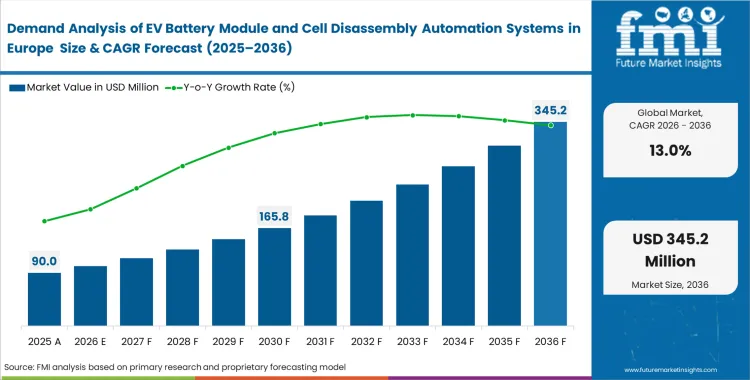
Key Takeaways from EV Battery Module and Cell Disassembly Automation Systems in the EU
| Metric | Details |
|---|---|
| Industry Size (2026) | USD 90.0 million |
| Industry Value (2036) | USD 305.5 million |
| CAGR (2026 to 2036) | 13.0% |
Source: Future Market Insights (FMI) analysis, based on proprietary forecasting model and primary research
Plant managers are dealing with immediate throughput constraints as incoming battery packs arrive with wide variation in condition, geometry, and residual safety risk. Manual processing becomes difficult to scale when each pallet carries a different thermal runaway profile and a different level of adhesive degradation. Mechanized separation setups increasingly determine whether facilities can maintain daily processing targets while keeping handling conditions controlled. AI vision battery disassembly automation is becoming central because unreadable geometries and damaged pack surfaces can slow or interrupt the line.
Vision software is gaining commercial relevance when it can classify deformed casings and damaged modules with a high level of confidence. Reliable identification of swollen cells without constant manual intervention improves line speed and reduces stoppages during inspection and separation. This operating advantage is pushing facilities toward full robotic EV battery disassembly systems rather than isolated robotic arms that solve only one step of the workflow.
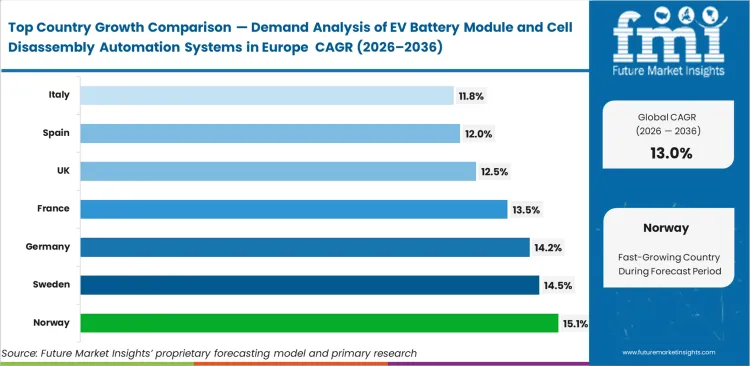
Germany is projected to expand at a CAGR of 14.2% through 2036, supported by proximity to major automakers and a stronger base of battery-related industrial activity. Norway is likely to rise at 15.1% CAGR as software-intensive setups help offset high labor costs. France is anticipated to register 13.5% CAGR, supported by domestic gigafactory construction and related ecosystem buildout. Sweden is expected to advance at 14.5% CAGR as second-life module recovery becomes a more important part of processing economics. The United Kingdom is set to record 12.5% CAGR as operators continue balancing manual teardown costs against automation investment.
Spain is projected to see 12.0% CAGR, with reverse logistics capability becoming more relevant to line utilization. Italy is likely to expand at 11.8% CAGR as legacy scrap-yard infrastructure is upgraded for more controlled battery handling. Variation across EV Battery Module and Cell Disassembly Automation Systems industry reflects differences in local recovery requirements, processing economics, and the extent to which regulation favors full material recovery over partial shredding.
Segmental Analysis
Industry Analysis of EV Battery Module and Cell Disassembly Automation Systems in the EU by Automation scope
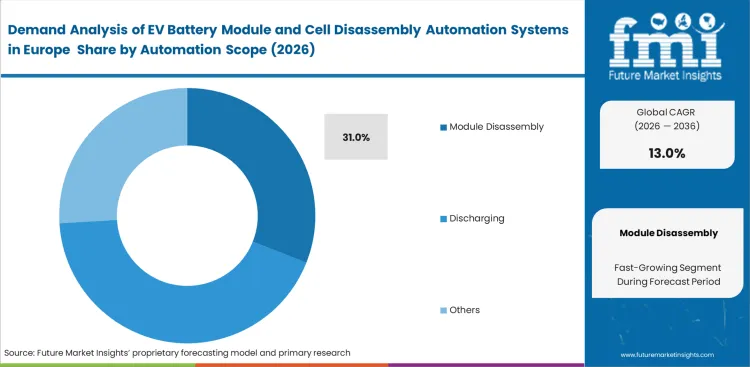
Plant managers are placing early emphasis on isolating smaller functional clusters from heavy outer casings because this step reduces handling risk while keeping thermal exposure under tighter control. Module disassembly is estimated to account for 31.0% share in 2026, as removal of mid-tier components allows facilities to assess second-life viability before material enters irreversible downstream processing. Module extraction stations increasingly function as the main sorting gate inside modern battery handling lines, where technical evaluation and safety control start to converge. Mechanical extraction also reduces direct human contact with hazardous assemblies during one of the most sensitive stages of the workflow.
Adhesive intensity remains a major operating constraint that headline automation share figures often understate. Modern pack designs use bonding systems that make clean separation more difficult, especially when lines encounter heavily glued assemblies from specific vehicle platforms. Equipment performance weakens quickly in such cases if force control, tooling precision, and detection logic are not calibrated for adhesive-heavy architectures. Facilities still relying on outdated hydraulic shearing can damage viable cells during separation, which reduces recovery quality and limits secondary value creation from reusable modules.
- Decision triggers: Operations teams move toward EV battery module disassembly automation when manual handling risk and injury exposure rise beyond acceptable operating limits. Mechanized jaws improve separation control while reducing direct contact with bonded units.
- Validation steps: Safety teams test robotic torque limits against heavily glued automotive packs to confirm that pressure stops just before casing rupture becomes likely. This step is central to line qualification in adhesive-intensive workflows.
- Renewal drivers: Plant operators upgrade end-of-arm tooling as newer battery formats enter the return stream with different casing textures and grip requirements. Legacy grippers lose effectiveness on smoother housings and reduce line reliability.
Industry Analysis of EV Battery Module and Cell Disassembly Automation Systems in the EU by Robot type
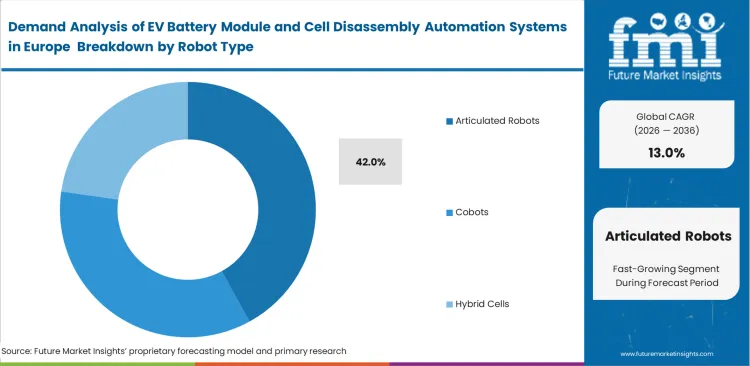
Complex battery geometries require motion systems that can reach around internal cooling channels, busbars, and confined pack sections without losing cutting precision. This advantage becomes more important as disassembly lines process a wider mix of battery formats, including damaged units that no longer follow ideal handling conditions, and articulated robots are expected to account for 42.0% share in 2026 because six-axis flexibility gives operators better access to tight pack corners and irregular internal layouts. Real-time vision feedback also allows robotic arms to adjust cutting angles during operation, which improves accuracy when housings, fasteners, or internal cell positions differ from the programmed baseline.
Articulated systems are especially relevant when deformed cylindrical cells require twisting and angled extraction rather than simple linear pulling. Payload limits still affect how far this segment can extend across all battery formats, particularly when heavier clusters move beyond the lifting range of standard agile robots. Multi-arm collaborative routines are gaining importance in such cases because integrators need to balance reach, force control, and payload handling across more complex pack architectures. Facilities that stay with more rigid setups may reduce initial capital outlay, but they lose flexibility when newer curved and densely packaged battery designs enter the processing stream.
- Cost centers: Operations budgets allocate a meaningful share to specialized end-of-arm tooling because grippers must maintain precision while withstanding repeated exposure to corrosive electrolyte residue. Tooling durability has a direct effect on line consistency.
- Hidden expenses: Maintenance teams replace protective robot covers and joint shielding more often than many early cost models assume. Flying debris and chemical spray can wear down standard synthetic seals quickly in battery dismantling environments.
- Lifecycle analysis: Finance teams assess battery disassembly automation ROI through lower downtime, fewer safety interruptions, and more stable hazardous-unit handling. Articulated arms improve operating continuity by removing difficult units with greater precision during sensitive disassembly stages.
Industry Analysis of EV Battery Module and Cell Disassembly Automation Systems in the EU by Battery level
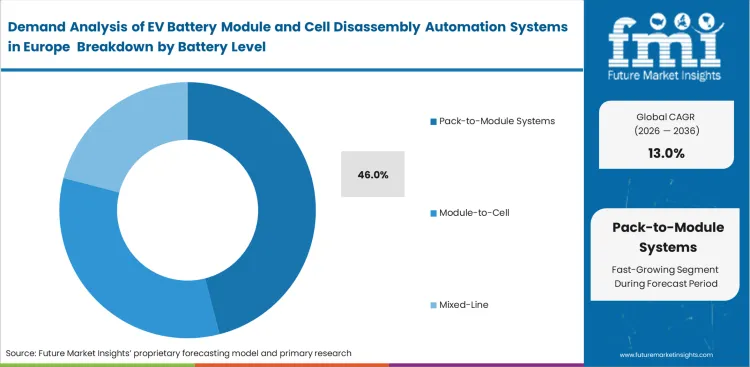
Removing heavy outer protective shells remains one of the most physically demanding stages in battery teardown operations. Lid-removal cells are becoming more important where rusted bolts, sealed covers, and warped housings make manual opening difficult and less predictable, and pack-to-module systems are projected to account for 46.0% share in 2026 because they replace slow manual unscrewing and improve consistency at the front end of the line. Facilities usually position these larger robotic cells at the beginning of the process so pack access can be established before downstream sorting, extraction, and inspection begin.
Mechanized screwdrivers and plasma-based cutting systems help open sealed containers while preserving internal components for the next stage of handling. Residual electrical charge remains a major operating constraint that headline share figures do not fully show. Cutting paths that drift even slightly can bridge positive and negative terminals during mechanical opening, turning a routine step into a source of batch loss and equipment damage. Precise path planning, discharge control, and process verification therefore remain central to reliable pack-opening performance.
- Hazard prevention: Pack opening cells maintain negative air pressure so gases released during lid removal can be directed safely into filtration networks. This improves containment during early-stage teardown.
- Residual risks: Robotic plasma cutters can ignite internal plastic components if process settings drift outside safe operating limits. Fire suppression systems need to be integrated directly into cutting-cell control logic.
- Full capture: Operations teams enforce strict discharging protocols before packs enter automated high-voltage battery dismantling cells because partially charged units can arc against metal cutting tools. This step remains essential to safe line execution.
Industry Analysis of EV Battery Module and Cell Disassembly Automation Systems in the EU by End user
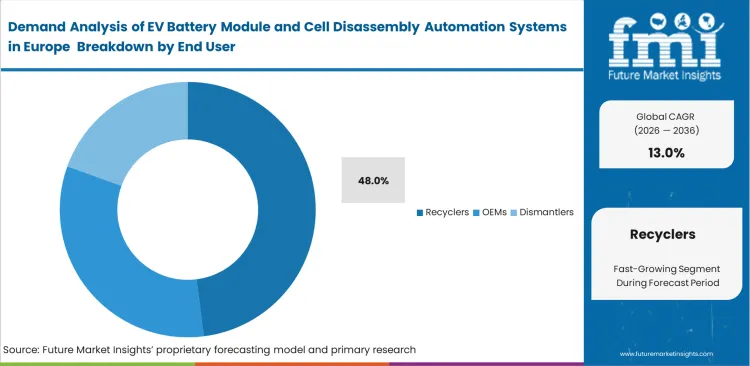
Handling high volumes of mixed automotive brands places heavy pressure on recycling operations because incoming batteries arrive with wide variation in size, pack design, fastening methods, and residual condition. Recyclers are expected to account for 48.0% share in 2026, as they remain the main endpoint for end-of-life electric vehicle battery flows and therefore carry the strongest need for scalable preprocessing capacity. Operating economics in this segment depend on flexible sorting and disassembly lines that can keep throughput stable even when consecutive pallets contain entirely different battery architectures. Automated discharging and separation are becoming more important because facilities working on tight margins need controlled throughput, lower handling risk, and more consistent material recovery.
Proprietary pack design remains a major operating constraint within this segment. Unique glues, fasteners, and enclosure formats make third-party access more difficult and add complexity to robotic extraction routines. Independent dismantling sites that rely on basic tools lose efficiency quickly when they encounter locked or adhesive-intensive pack designs that were not built for easy removal. Line flexibility, tooling adaptability, and format recognition therefore carry more weight in recycler investment decisions than simple equipment speed alone.
- First adopters: Well-funded national recycling hubs move earlier on flexible multi-robot cells because high daily battery volumes support higher battery recycling line automation costs. Scale improves the case for advanced line investment.
- Follower shifts: Mid-tier scrap yards are inclining toward specialized discharging racks as safe energy removal becomes the entry point for processing more advanced battery components. This step improves readiness for broader automation.
- Late arrivals: Regional dismantling yards adopt automated openers once labor costs move above equipment leasing economics. Manual teardown loses viability when volume complexity and handling risk rise together.
Industry Analysis of EV Battery Module and Cell Disassembly Automation Systems in the EU by Software layer
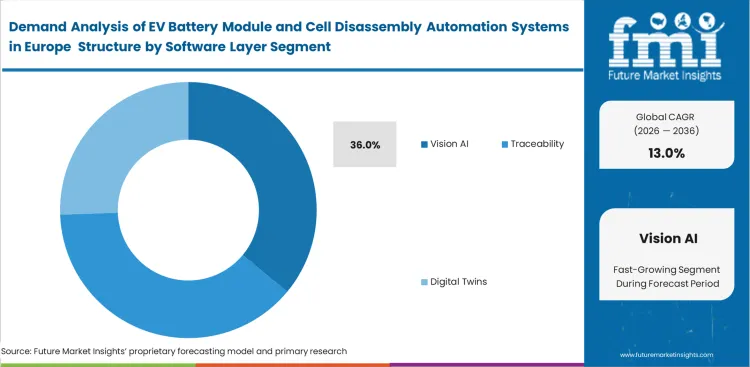
Identifying rusted fasteners, swollen casings, and damaged surfaces determines whether a robot can engage a battery pack safely and continue the cut path without interruption. Facilities with stronger optical recognition models are better positioned to keep automated disassembly stable, while weaker systems face more stoppages, tool misalignment, and collision risk, which is why Vision AI is projected to account for 36.0% share in 2026. Camera-led recognition converts pack imagery into usable gripping, cutting, and separation coordinates. Software teams are training models on large image libraries of damaged batteries so the system can respond more reliably when warped cooling fins, casing deformation, or surface damage alter the original geometry.
Real-time angle correction is becoming more important as incoming battery packs arrive in conditions that rarely match ideal reference images. Vision-led recalculation helps the robot adjust gripping positions and cutting direction when deformation changes the expected access path. Data ownership remains a less visible but commercially important issue within this segment. Robotics integrators and facility operators often disagree over control of the training data generated during daily dismantling, even though that data directly affects how quickly the system improves. Sites without timely access to updated vision models are more likely to see error rates rise as newer vehicle designs begin entering the scrap stream.
- Expected performance: Camera arrays identify standard bolt locations quickly, allowing robots to remove covers with minimal hesitation when pack surfaces remain clean and readable. This improves line consistency on routine units.
- Edge gaps: Reflective thermal paste can confuse depth sensors and distort distance interpretation during approach. Misread geometry increases the risk of tool contact with live cells if the correction logic is weak.
- Acceptability thresholds: Safety teams require very high identification accuracy for high-voltage components before automated engagement is allowed. Lower-confidence detections trigger manual review and slow the line, but they remain essential to controlled operation.
Drivers, Restraints, and Opportunities in EV Battery Module and Cell Disassembly Automation Systems in the EU
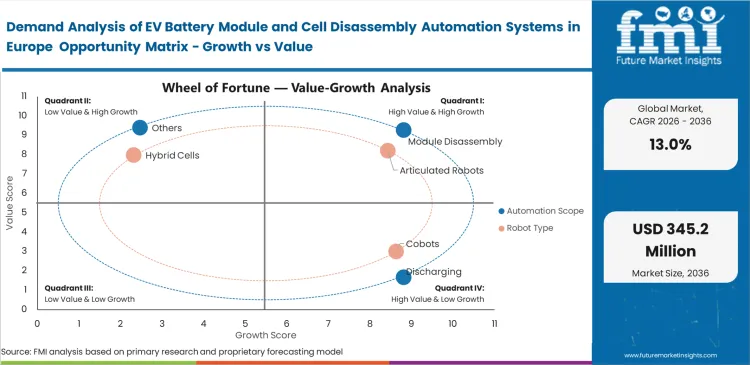
Unpredictable physical degradation in used batteries is pushing facilities away from manual processing because operators cannot assess internal cell stability quickly enough from external casing condition alone. Warped housings, impact damage, and inconsistent aging patterns make visual judgment less reliable when chemically unstable cells may still be enclosed inside the pack. Mechanized lines equipped with thermal scanning arrays improve both processing speed and operating control by screening units before deeper disassembly begins. Delays in battery cell disassembly automation upgrades leave recycling centers exposed to avoidable safety interruptions, including fire events that can shut down line activity and disrupt throughput for extended periods.
Robotic discharging stations are becoming more important as facilities handle a wider mix of battery chemistries and state-of-charge conditions. Managing thousands of incoming units each day requires systems that can adjust electrical draw dynamically according to internal resistance, residual charge, and pack condition. This capability improves discharge consistency at scale and reduces the handling burden on manual teams. Automation is therefore moving beyond simple labor replacement and becoming a core requirement for stable front-end battery processing.
Adhesive variation remains one of the most difficult technical barriers in robotic cell separation. Proprietary bonding materials are often engineered to resist both mechanical pulling and solvent exposure over long service lives, which makes clean separation harder once batteries enter end-of-life processing. Grippers lose effectiveness when cells are fixed with high-strength thermal epoxies or similar long-life compounds that resist controlled removal. Current limitations are pushing integrators toward hybrid stations that combine robotic handling with manual intervention at the most adhesive-intensive stages. Until pack designs become easier to separate, some vehicle models will continue to require technician support where machines cannot complete the operation reliably on their own.
Opportunities in EV Battery Module and Cell Disassembly Automation Systems in the EU
- Acoustic monitoring integration: Sound sensors can detect micro-cracking inside casings before visible failure signs appear, giving equipment designers a stronger basis for adding audio analysis to standard vision suites. This improves early fault detection in damaged units.
- Adaptive discharging racks: Intelligent circuits can drain different battery chemistries in parallel while controlling heat build-up more precisely. This creates room for electronics-focused suppliers to expand in faster and more controlled energy-bleeding hardware.
- Tool-changing ecosystems: Standardized robotic wrists allow rapid switching between cutting torches, gripping tools, and gentler suction-based handlers. Plant operators benefit from faster mechanical transitions as battery formats become more varied.
Demand Analysis of Lithium, Nickel and Cobalt Recovery from EV Batteries under Batteries Regulation in EU
Proximity to major automotive manufacturing centers shapes deployment strategy across the DACH region. Facilities in this zone favor integrated robotic cells designed around specific domestic battery architectures because format familiarity improves line speed, tool accuracy, and safe pack handling. High labor costs and tight environmental controls are pushing operators to reduce direct human exposure to damaged battery materials as much as possible.
Teardown lines are increasingly configured to feed downstream recovery processes with cleaner material streams, which raises the value of precise separation between plastics, metals, and active components. Automation investment remains concentrated around industrial clusters near Munich and Stuttgart, where technical support, vehicle supply, and recycling infrastructure are already well established. Facilities processing domestic battery packs also tend to achieve higher automation rates because local format knowledge reduces uncertainty in fastener access, casing behavior, and disassembly path planning.
Based on regional analysis, Demand Analysis of EV Battery Module and Cell Disassembly Automation Systems in Europe is segmented into DACH, Western Europe, and Nordics across 40 plus countries.
.webp "Top Country Growth Comparison Demand Analysis Of Ev Battery Module And Cell Disassembly Automation Systems In Europe Cagr (2026 2036)")
| Country | CAGR (2026 to 2036) |
|---|---|
| Norway | 15.1% |
| Sweden | 14.5% |
| Germany | 14.2% |
| France | 13.5% |
| UK | 12.5% |
| Spain | 12.0% |
| Italy | 11.8% |
| Finland | 11.5% |
Source: Future Market Insights (FMI) analysis, based on proprietary forecasting model and primary research
Demand Analysis of Lithium, Nickel and Cobalt Recovery from EV Batteries under Batteries Regulation in EU
Proximity to major automotive manufacturing centers shapes deployment strategy across the DACH region. Facilities in this zone favor integrated robotic cells designed around specific domestic battery architectures because format familiarity improves line speed, tool accuracy, and safe pack handling. High labor costs and tight environmental controls are pushing operators to reduce direct human exposure to damaged battery materials as much as possible.
Teardown lines are increasingly configured to feed downstream recovery processes with cleaner material streams, which raises the value of precise separation between plastics, metals, and active components. Automation investment remains concentrated around industrial clusters near Munich and Stuttgart, where technical support, vehicle supply, and recycling infrastructure are already well established. Facilities processing domestic battery packs also tend to achieve higher automation rates because local format knowledge reduces uncertainty in fastener access, casing behavior, and disassembly path planning.
- Germany: Demand for EV battery module and cell disassembly automation systems in Germany is projected to rise at a CAGR of 14.2% through 2036, supported by high domestic vehicle production and a larger installed base of battery-related industrial activity. Facilities are investing in heavy robotic lifting and pack-opening systems that can handle dense automotive battery assemblies with tighter safety control. Stronger access to domestic battery streams also improves line utilization and supports larger-scale automation economics.
- Italy: EV battery module and cell disassembly automation systems demand in Italy is likely to advance at a CAGR of 11.8% through 2036 as older sorting infrastructure is upgraded with more controlled mechanical opening and automated screw-removal systems. Entry-level automation is gaining relevance where facilities want to reduce repetitive manual strain without moving immediately to fully integrated robotic cells. A slower modernization pace reflects a more fragmented collection and preprocessing network.
- Spain: Sales of EV battery module and cell disassembly automation systems in Spain are expected to increase at a CAGR of 12.0% during the forecast period, with reverse-logistics hubs giving more attention to cell testing and early-stage automation before mechanical destruction is approved. Facilities are placing more value on evaluating secondary-use potential before material enters irreversible recovery steps. This supports a more selective approach to dismantling and discharge operations.
FMI report includes Austria and Switzerland. Cross-border scrap battery transport regulations heavily influence where new mechanized dismantling centers open.
Demand Analysis of Lithium, Nickel and Cobalt Recovery from EV Batteries under Batteries Regulation in Western Europe
Gigafactory construction across Western Europe is creating localized requirements for battery scrap processing and controlled disassembly. Facilities in this region are deploying modular equipment that can expand in line with production scrap volumes rather than relying only on end-of-life vehicle returns. Much of the workflow is centered on fresh manufacturing rejects, which require different gripping pressure, discharge handling, and separation logic than aged automotive packs.
End-of-arm tooling is being adapted for cleaner but still electrically active defective cells, where visual condition may look stable even though handling risk remains high. Port-linked facilities also process imported defective modules, which raises the need for vision systems that can identify non-European battery formats quickly and accurately. Fast recognition of unfamiliar cell layouts reduces the chance of processing errors and improves line stability.
- France: EV battery module and cell disassembly automation systems demand across France is set to rise at 13.5% CAGR through 2036 as gigafactory defect processing and localized battery manufacturing increase the need for automated discharging and dismantling capacity. Facilities are routing failed modules into controlled preprocessing systems earlier in the workflow to keep valuable materials within domestic recovery networks. This is strengthening the case for modular automation close to battery production sites.
- UK: Tighter waste-transport conditions are making local dismantling capacity more relevant across the United Kingdom. Facilities are favoring flexible robotic systems that can handle mixed import brands and variable pack layouts with less dependence on manual intervention. Sales of EV battery module and cell disassembly automation systems in the UK are poised to grow at a CAGR of 12.5% during the assessment period. Localized processing also reduces operational complexity linked to moving damaged batteries over longer distances.
FMI report includes Portugal and Benelux. Port-adjacent processing sites across this region require more adaptable sorting and recognition systems because international battery inflows are less standardized.
Nordics Demand Analysis of EV Battery Module and Cell Disassembly Automation Systems in Europe Analysis
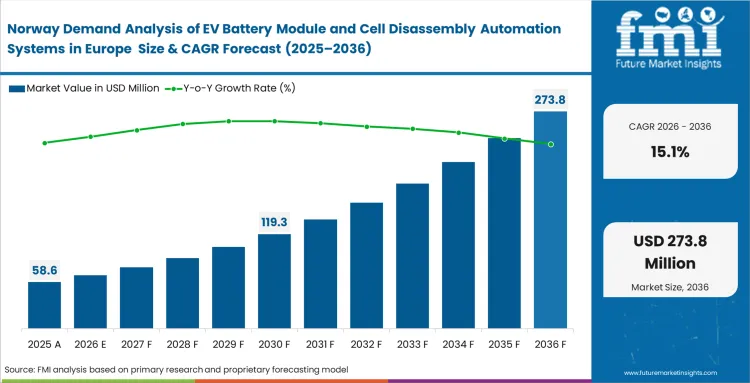
High electric vehicle penetration across the Nordics is creating a steady return stream of aged batteries, which keeps disassembly and discharge infrastructure on a positive trend. Facilities in this region give more weight to software intelligence and condition recognition because incoming packs often arrive with weather-related deformation, impact damage, or casing irregularities. Winter exposure adds another layer of complexity, since warped housings and bent cooling channels make fixed disassembly routines less reliable.
Advanced optical recognition and adaptive motion control are therefore becoming central to safe tool guidance and pack access. Processing economics also depend heavily on identifying modules suitable for second-life use before material enters full recovery, which makes non-destructive testing more commercially relevant. Equipment design in this region is increasingly combining physical separation with capacity assessment and condition screening.
- Norway: Facilities are relying more heavily on AI-led visual inspection and automated handling to reduce manual teardown in a high-wage operating environment. Early electric vehicle adoption is now feeding a larger stream of batteries into end-of-life processing, which keeps the industry outlook for EV battery module and cell disassembly automation systems in Norway on an accelerating path. Norway is expected to expand at a CAGR of 15.1% through 2036. Automation economics are therefore stronger here than in many lower-cost markets.
- Sweden: EV battery module and cell disassembly automation systems demand in Sweden is projected to witness 14.5% CAGR through 2036 as second-life module recovery becomes more important to processing economics. Facilities are using carefully controlled extraction systems to remove viable units without damaging connectors or casing integrity. Repurposing potential gives more value to precision-led disassembly than to immediate full destruction.
- Finland: Refining-linked operations in Finland are placing more emphasis on well-separated input streams before material enters downstream recovery. Precise robotic cutting and controlled dismantling improve feed purity and reduce contamination risk in subsequent processing stages. Industry demand for EV battery module and cell disassembly automation systems in Finland is likely to record 11.5% CAGR during the forecast period. This keeps automation relevant even where the wider facility model is tied closely to materials recovery.
FMI report includes Denmark and Iceland. Maritime transport restrictions for damaged batteries encourage localized, smaller-scale automated discharging stations.
Competitive Aligners for Market Players
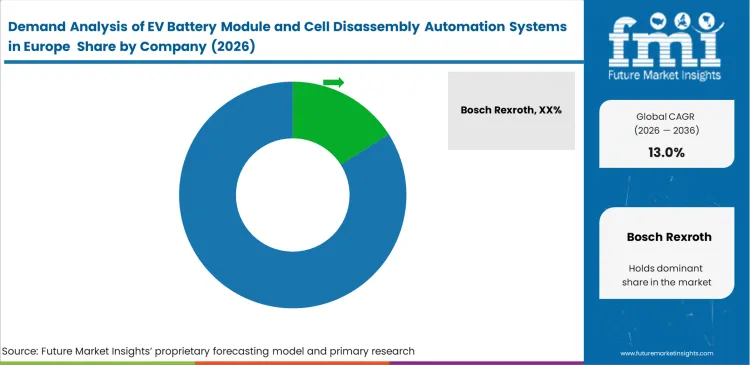
Dangerous chemical variation is pushing EV battery disassembly automation suppliers in Europe to compete more on safety integration than on raw line speed. KUKA and Bosch Rexroth remain well positioned because chemical-resistant sealing, controlled shutdown logic, and safer operating envelopes matter more when facilities face electrolyte exposure and unstable pack conditions. Vendor evaluation increasingly centers on how well equipment maintains operating integrity during abnormal events such as temperature spikes or chemical spray. Systems that can contain disruption, protect critical components, and resume operation with less damage are more likely to remain strong in repeat orders and renewal cycles.
Established equipment providers also benefit from deeper libraries of battery CAD models and design references. Access to this information improves cutting-path calculation before robotic motion begins, reducing uncertainty during pack opening and component separation. Comau’s automotive exposure gives it an advantage in keeping software logic aligned with newer vehicle designs entering the processing stream. Challengers without the same dimensional depth depend more heavily on real-time vision inference to locate fasteners and guide tool paths, which can slow execution when pack geometry is difficult to interpret.
Large recycling groups are also pushing back against vendor lock-in by developing parts of the software stack around their own operating requirements. Bare robotic hardware combined with custom control layers is becoming more relevant where facilities want tighter control over machine vision logic, workflow design, and future upgrades. R3 Robotics is operating in a market where open communication protocols and flexible API access carry increasing weight in vendor selection. Equipment suppliers that keep their systems too closed lose ground when operators want automation platforms that can be adapted to site-specific workflows without depending on expensive manufacturer-led updates.
Key Players in EV Battery Module and Cell Disassembly Automation Systems Industry in EU
- Bosch Rexroth
- Comau
- Liebherr-Verzahntechnik
- KUKA
- R3 Robotics
- Eurecat
- Battery Lifecycle Company
Scope of the Report
| Metric | Value |
|---|---|
| Quantitative Units | USD 90.0 million to USD 305.5 million, at a CAGR of 13.0% |
| Market Definition | Mechanized hardware designed for separating, discharging, and categorizing electric vehicle power units represent this sector. Core components include robotics, computer vision, and discharge circuits functioning together safely dismantling high-voltage packs. Hardware handles mechanical variation and chemical hazards simultaneously. |
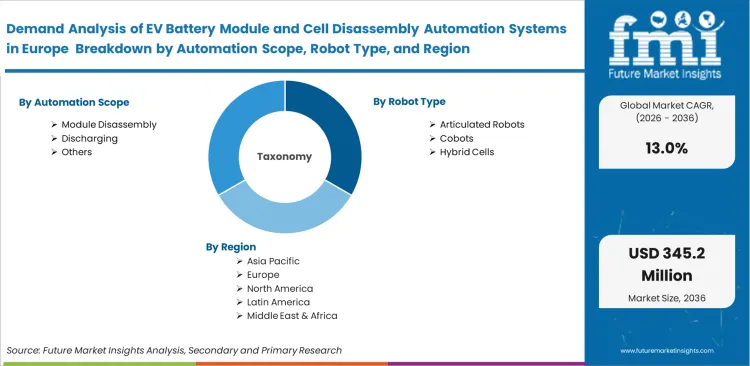
| Segmentation | Automation scope, Robot type, Battery level, End user, Software layer |
| Regions Covered | North America, Latin America, Europe, East Asia, South Asia & Pacific, Middle East and Africa |
| Countries Covered | Germany, France, Italy, Spain, UK, Norway, Sweden, Finland |
| Key Companies Profiled | Bosch Rexroth, Comau, Liebherr-Verzahntechnik, KUKA, R3 Robotics, Eurecat, Battery Lifecycle Company |
| Forecast Period | 2026 to 2036 |
| Approach | Mechanized disassembly cell installation counts across European recycling hubs. |
Source: Future Market Insights (FMI) analysis, based on proprietary forecasting model and primary research
EV Battery Module and Cell Disassembly Automation Systems Industry in EU Analysis by Segments
Automation scope
- Module disassembly
- Pack opening
- Cell separation
- Discharging
- Sorting inspection
Robot type
- Articulated robots
- Cobots
- Gantry systems
- Cartesian cells
- Hybrid cells
Battery level
- Pack-to-module
- Module-to-cell
- Cell component
- Mixed-line
End user
- Recyclers
- OEMs
- Second-life integrators
- Dismantlers
- Research centers
Software layer
- Vision AI
- Motion control
- Traceability
- Safety software
- Digital twins
Countries
- Norway
- Sweden
- Germany
- France
- UK
- Spain
- Italy
- Finland
Bibliography
- Advanced Engineering Informatics. (2025, October 03). An experimental robotic cell for the disassembly of electric vehicle battery modules. Springer Nature.
- Ai, Z., et al. (2024, September 24). Artificial Intelligence in Electric Vehicle Battery Disassembly. Batteries, 5(4), 28.
- European Automobile Manufacturers’ Association. (2026, January 27). New car registrations: +1.8% in 2025; battery-electric 17.4% market share.
- European Commission. (2025, July 4). New rules to boost recycling efficiency from waste batteries.
- European Environment Agency / Eurostat. (2025, November). Waste statistics - recycling of batteries and accumulators.
This bibliography is provided for reader reference. The full FMI report contains the complete reference list with primary source documentation.
This Report Addresses
- Mechanical limits affecting robotic grippers during thermal runaway events.
- Vision AI accuracy variations when scanning crushed or deformed pack casings.
- Discharging speed variations across different lithium-ion chemistries.
- Tool-changing frequency data mapping multi-axis dismantling arms.
- Capital depreciation curves tracking pack-opening Cartesian cells.
- Facility layout impacts caused by automated sorting conveyors.
- Software ownership battles between equipment integrators and recycling plants.
- Regional divergence covering automated line deployments across DACH and Nordics.
Frequently Asked Questions
What is baseline valuation for this sector?
Revenues sit at USD 90.0 million in 2026. This metric captures direct spending on mechanized tearing.
What value is projected for 2036?
Capital deployment pushes spending to USD 305.5 million by 2036. This expansion reflects mandatory robotic upgrades.
What is growth rate?
Spending grows at 13.0% annually through 2036. This speed matches rising end-of-life electric vehicle volumes.
Why does module disassembly lead automation scope?
Isolating mid-tier components allows operators testing viability for second-life applications before full destruction.
How do articulated robots maintain their position?
Complex battery geometries demand motion systems capable of reaching around internal cooling channels perfectly.
What role does pack-to-module processing play?
Removing heavy outer protective shells represents physically demanding steps. Mechanized lid removers tackle rusted bolts efficiently.
Why do recyclers dominate purchasing?
Handling high volumes of mixed automotive brands creates immense logistical pressure requiring automated separation.
How does Vision AI separate itself?
Identifying rusted fasteners and swollen casings dictates whether robots safely engage targets without sparking.
What slows down widespread adoption?
Adhesive variety creates severe friction for robotic systems. Proprietary glues frequently break automated grippers.
How do DACH facilities operate differently?
Proximity to major automotive manufacturers dictates technology deployment strategies. Engineers design teardown lines feeding recovery vats.
What defines Western European approaches?
Operations managers deploy modular disassembly equipment scaling alongside battery production volumes handling manufacturing rejects.
How do Nordic processors handle incoming units?
Winter conditions frequently damage external vehicle casings. Facilities rely heavily on advanced optical recognition guiding cutters.
What is primary technical limitation for Cartesian cells?
Rigid setups lack angles necessary extracting curved modules. Purchasing departments save upfront capital but lose flexibility.
How do automated discharging racks function?
Managing thousands of incoming units daily requires machines capable of adjusting electrical draw dynamically.
What happens when thermal pastes confuse sensors?
Reflective surfaces alter depth perception. Algorithms miscalculate distances, occasionally driving robotic tools directly into live cells.
Why do independent dismantlers struggle?
Automakers use unique glues and fasteners deterring third-party access. Processing locked designs causes extreme efficiency drops.
How do safety managers evaluate equipment?
Testers push robotic torque limits against heavily glued automotive packs preventing casing ruptures.
What is reality regarding robotic payload limits?
Heavy battery clusters often exceed lifting capacities of standard agile arms requiring collaborative multi-robot lifting routines.
How do maintenance teams handle chemical exposure?
Flying debris and electrolyte spray degrade standard synthetic joint seals rapidly requiring frequent robot cover replacements.
Why are acoustic sensors gaining traction?
Sound detectors identify micro-cracking inside casings before thermal runaway occurs, improving safety margins.
What happens to partially charged units?
Robotic plasma cutters sometimes ignite internal plastics. Operations leads enforce strict discharging protocols before cutting.
How do incumbents maintain their lead?
Vast libraries of proprietary battery CAD models allow software calculating optimal cutting paths instantly.
What do large recycling firms demand?
Purchasing directors actively resist vendor lock-in by demanding open-source communication protocols and bare hardware.
How do regulations affect equipment design?
Local mandates dictating complete material recovery force engineers building machines separating plastics from metals precisely.
Preview the report firsthand - request a free sample
Get SampleGet the brochure for pricing and purchase details.
Get PDFTable of Content
- Executive Summary
- Global Market Outlook
- Demand-side Trends
- Supply-side Trends
- Technology Roadmap Analysis
- Analysis and Recommendations
- Market Overview
- Market Coverage / Taxonomy
- Market Definition / Scope / Limitations
- Research Methodology
- Chapter Orientation
- Analytical Lens and Working Hypotheses
- Market Structure, Signals, and Trend Drivers
- Benchmarking and Cross-market Comparability
- Market Sizing, Forecasting, and Opportunity Mapping
- Research Design and Evidence Framework
- Desk Research Programme (Secondary Evidence)
- Company Annual and Sustainability Reports
- Peer-reviewed Journals and Academic Literature
- Corporate Websites, Product Literature, and Technical Notes
- Earnings Decks and Investor Briefings
- Statutory Filings and Regulatory Disclosures
- Technical White Papers and Standards Notes
- Trade Journals, Industry Magazines, and Analyst Briefs
- Conference Proceedings, Webinars, and Seminar Materials
- Government Statistics Portals and Public Data Releases
- Press Releases and Reputable Media Coverage
- Specialist Newsletters and Curated Briefings
- Sector Databases and Reference Repositories
- FMI Internal Proprietary Databases and Historical Market Datasets
- Subscription Datasets and Paid Sources
- Social Channels, Communities, and Digital Listening Inputs
- Additional Desk Sources
- Expert Input and Fieldwork (Primary Evidence)
- Primary Modes
- Qualitative Interviews and Expert Elicitation
- Quantitative Surveys and Structured Data Capture
- Blended Approach
- Why Primary Evidence is Used
- Field Techniques
- Interviews
- Surveys
- Focus Groups
- Observational and In-context Research
- Social and Community Interactions
- Stakeholder Universe Engaged
- C-suite Leaders
- Board Members
- Presidents and Vice Presidents
- R&D and Innovation Heads
- Technical Specialists
- Domain Subject-matter Experts
- Scientists
- Physicians and Other Healthcare Professionals
- Governance, Ethics, and Data Stewardship
- Research Ethics
- Data Integrity and Handling
- Primary Modes
- Tooling, Models, and Reference Databases
- Desk Research Programme (Secondary Evidence)
- Data Engineering and Model Build
- Data Acquisition and Ingestion
- Cleaning, Normalisation, and Verification
- Synthesis, Triangulation, and Analysis
- Quality Assurance and Audit Trail
- Market Background
- Market Dynamics
- Drivers
- Restraints
- Opportunity
- Trends
- Scenario Forecast
- Demand in Optimistic Scenario
- Demand in Likely Scenario
- Demand in Conservative Scenario
- Opportunity Map Analysis
- Product Life Cycle Analysis
- Supply Chain Analysis
- Investment Feasibility Matrix
- Value Chain Analysis
- PESTLE and Porter’s Analysis
- Regulatory Landscape
- Regional Parent Market Outlook
- Production and Consumption Statistics
- Import and Export Statistics
- Market Dynamics
- Global Market Analysis 2021 to 2025 and Forecast, 2026 to 2036
- Historical Market Size Value (USD Million) Analysis, 2021 to 2025
- Current and Future Market Size Value (USD Million) Projections, 2026 to 2036
- Y-o-Y Growth Trend Analysis
- Absolute $ Opportunity Analysis
- Global Market Pricing Analysis 2021 to 2025 and Forecast 2026 to 2036
- Global Market Analysis 2021 to 2025 and Forecast 2026 to 2036, By Automation Scope
- Introduction / Key Findings
- Historical Market Size Value (USD Million) Analysis By Automation Scope , 2021 to 2025
- Current and Future Market Size Value (USD Million) Analysis and Forecast By Automation Scope , 2026 to 2036
- Module Disassembly
- Discharging
- Others
- Module Disassembly
- Y-o-Y Growth Trend Analysis By Automation Scope , 2021 to 2025
- Absolute $ Opportunity Analysis By Automation Scope , 2026 to 2036
- Global Market Analysis 2021 to 2025 and Forecast 2026 to 2036, By Robot Type
- Introduction / Key Findings
- Historical Market Size Value (USD Million) Analysis By Robot Type, 2021 to 2025
- Current and Future Market Size Value (USD Million) Analysis and Forecast By Robot Type, 2026 to 2036
- Articulated Robots
- Cobots
- Hybrid Cells
- Articulated Robots
- Y-o-Y Growth Trend Analysis By Robot Type, 2021 to 2025
- Absolute $ Opportunity Analysis By Robot Type, 2026 to 2036
- Global Market Analysis 2021 to 2025 and Forecast 2026 to 2036, By Battery Level
- Introduction / Key Findings
- Historical Market Size Value (USD Million) Analysis By Battery Level, 2021 to 2025
- Current and Future Market Size Value (USD Million) Analysis and Forecast By Battery Level, 2026 to 2036
- Pack-to-Module Systems
- Module-to-Cell
- Mixed-Line
- Pack-to-Module Systems
- Y-o-Y Growth Trend Analysis By Battery Level, 2021 to 2025
- Absolute $ Opportunity Analysis By Battery Level, 2026 to 2036
- Global Market Analysis 2021 to 2025 and Forecast 2026 to 2036, By End User
- Introduction / Key Findings
- Historical Market Size Value (USD Million) Analysis By End User, 2021 to 2025
- Current and Future Market Size Value (USD Million) Analysis and Forecast By End User, 2026 to 2036
- Recyclers
- OEMs
- Dismantlers
- Recyclers
- Y-o-Y Growth Trend Analysis By End User, 2021 to 2025
- Absolute $ Opportunity Analysis By End User, 2026 to 2036
- Global Market Analysis 2021 to 2025 and Forecast 2026 to 2036, By Software Layer
- Introduction / Key Findings
- Historical Market Size Value (USD Million) Analysis By Software Layer, 2021 to 2025
- Current and Future Market Size Value (USD Million) Analysis and Forecast By Software Layer, 2026 to 2036
- Vision AI
- Traceability
- Digital Twins
- Vision AI
- Y-o-Y Growth Trend Analysis By Software Layer, 2021 to 2025
- Absolute $ Opportunity Analysis By Software Layer, 2026 to 2036
- Global Market Analysis 2021 to 2025 and Forecast 2026 to 2036, By Region
- Introduction
- Historical Market Size Value (USD Million) Analysis By Region, 2021 to 2025
- Current Market Size Value (USD Million) Analysis and Forecast By Region, 2026 to 2036
- North America
- Latin America
- Western Europe
- Eastern Europe
- East Asia
- South Asia and Pacific
- Middle East & Africa
- Market Attractiveness Analysis By Region
- North America Market Analysis 2021 to 2025 and Forecast 2026 to 2036, By Country
- Historical Market Size Value (USD Million) Trend Analysis By Market Taxonomy, 2021 to 2025
- Market Size Value (USD Million) Forecast By Market Taxonomy, 2026 to 2036
- By Country
- USA
- Canada
- Mexico
- By Automation Scope
- By Robot Type
- By Battery Level
- By End User
- By Software Layer
- By Country
- Market Attractiveness Analysis
- By Country
- By Automation Scope
- By Robot Type
- By Battery Level
- By End User
- By Software Layer
- Key Takeaways
- Latin America Market Analysis 2021 to 2025 and Forecast 2026 to 2036, By Country
- Historical Market Size Value (USD Million) Trend Analysis By Market Taxonomy, 2021 to 2025
- Market Size Value (USD Million) Forecast By Market Taxonomy, 2026 to 2036
- By Country
- Brazil
- Chile
- Rest of Latin America
- By Automation Scope
- By Robot Type
- By Battery Level
- By End User
- By Software Layer
- By Country
- Market Attractiveness Analysis
- By Country
- By Automation Scope
- By Robot Type
- By Battery Level
- By End User
- By Software Layer
- Key Takeaways
- Western Europe Market Analysis 2021 to 2025 and Forecast 2026 to 2036, By Country
- Historical Market Size Value (USD Million) Trend Analysis By Market Taxonomy, 2021 to 2025
- Market Size Value (USD Million) Forecast By Market Taxonomy, 2026 to 2036
- By Country
- Germany
- UK
- Italy
- Spain
- France
- Nordic
- BENELUX
- Rest of Western Europe
- By Automation Scope
- By Robot Type
- By Battery Level
- By End User
- By Software Layer
- By Country
- Market Attractiveness Analysis
- By Country
- By Automation Scope
- By Robot Type
- By Battery Level
- By End User
- By Software Layer
- Key Takeaways
- Eastern Europe Market Analysis 2021 to 2025 and Forecast 2026 to 2036, By Country
- Historical Market Size Value (USD Million) Trend Analysis By Market Taxonomy, 2021 to 2025
- Market Size Value (USD Million) Forecast By Market Taxonomy, 2026 to 2036
- By Country
- Russia
- Poland
- Hungary
- Balkan & Baltic
- Rest of Eastern Europe
- By Automation Scope
- By Robot Type
- By Battery Level
- By End User
- By Software Layer
- By Country
- Market Attractiveness Analysis
- By Country
- By Automation Scope
- By Robot Type
- By Battery Level
- By End User
- By Software Layer
- Key Takeaways
- East Asia Market Analysis 2021 to 2025 and Forecast 2026 to 2036, By Country
- Historical Market Size Value (USD Million) Trend Analysis By Market Taxonomy, 2021 to 2025
- Market Size Value (USD Million) Forecast By Market Taxonomy, 2026 to 2036
- By Country
- China
- Japan
- South Korea
- By Automation Scope
- By Robot Type
- By Battery Level
- By End User
- By Software Layer
- By Country
- Market Attractiveness Analysis
- By Country
- By Automation Scope
- By Robot Type
- By Battery Level
- By End User
- By Software Layer
- Key Takeaways
- South Asia and Pacific Market Analysis 2021 to 2025 and Forecast 2026 to 2036, By Country
- Historical Market Size Value (USD Million) Trend Analysis By Market Taxonomy, 2021 to 2025
- Market Size Value (USD Million) Forecast By Market Taxonomy, 2026 to 2036
- By Country
- India
- ASEAN
- Australia & New Zealand
- Rest of South Asia and Pacific
- By Automation Scope
- By Robot Type
- By Battery Level
- By End User
- By Software Layer
- By Country
- Market Attractiveness Analysis
- By Country
- By Automation Scope
- By Robot Type
- By Battery Level
- By End User
- By Software Layer
- Key Takeaways
- Middle East & Africa Market Analysis 2021 to 2025 and Forecast 2026 to 2036, By Country
- Historical Market Size Value (USD Million) Trend Analysis By Market Taxonomy, 2021 to 2025
- Market Size Value (USD Million) Forecast By Market Taxonomy, 2026 to 2036
- By Country
- Kingdom of Saudi Arabia
- Other GCC Countries
- Turkiye
- South Africa
- Other African Union
- Rest of Middle East & Africa
- By Automation Scope
- By Robot Type
- By Battery Level
- By End User
- By Software Layer
- By Country
- Market Attractiveness Analysis
- By Country
- By Automation Scope
- By Robot Type
- By Battery Level
- By End User
- By Software Layer
- Key Takeaways
- Key Countries Market Analysis
- USA
- Pricing Analysis
- Market Share Analysis, 2025
- By Automation Scope
- By Robot Type
- By Battery Level
- By End User
- By Software Layer
- Canada
- Pricing Analysis
- Market Share Analysis, 2025
- By Automation Scope
- By Robot Type
- By Battery Level
- By End User
- By Software Layer
- Mexico
- Pricing Analysis
- Market Share Analysis, 2025
- By Automation Scope
- By Robot Type
- By Battery Level
- By End User
- By Software Layer
- Brazil
- Pricing Analysis
- Market Share Analysis, 2025
- By Automation Scope
- By Robot Type
- By Battery Level
- By End User
- By Software Layer
- Chile
- Pricing Analysis
- Market Share Analysis, 2025
- By Automation Scope
- By Robot Type
- By Battery Level
- By End User
- By Software Layer
- Germany
- Pricing Analysis
- Market Share Analysis, 2025
- By Automation Scope
- By Robot Type
- By Battery Level
- By End User
- By Software Layer
- UK
- Pricing Analysis
- Market Share Analysis, 2025
- By Automation Scope
- By Robot Type
- By Battery Level
- By End User
- By Software Layer
- Italy
- Pricing Analysis
- Market Share Analysis, 2025
- By Automation Scope
- By Robot Type
- By Battery Level
- By End User
- By Software Layer
- Spain
- Pricing Analysis
- Market Share Analysis, 2025
- By Automation Scope
- By Robot Type
- By Battery Level
- By End User
- By Software Layer
- France
- Pricing Analysis
- Market Share Analysis, 2025
- By Automation Scope
- By Robot Type
- By Battery Level
- By End User
- By Software Layer
- India
- Pricing Analysis
- Market Share Analysis, 2025
- By Automation Scope
- By Robot Type
- By Battery Level
- By End User
- By Software Layer
- ASEAN
- Pricing Analysis
- Market Share Analysis, 2025
- By Automation Scope
- By Robot Type
- By Battery Level
- By End User
- By Software Layer
- Australia & New Zealand
- Pricing Analysis
- Market Share Analysis, 2025
- By Automation Scope
- By Robot Type
- By Battery Level
- By End User
- By Software Layer
- China
- Pricing Analysis
- Market Share Analysis, 2025
- By Automation Scope
- By Robot Type
- By Battery Level
- By End User
- By Software Layer
- Japan
- Pricing Analysis
- Market Share Analysis, 2025
- By Automation Scope
- By Robot Type
- By Battery Level
- By End User
- By Software Layer
- South Korea
- Pricing Analysis
- Market Share Analysis, 2025
- By Automation Scope
- By Robot Type
- By Battery Level
- By End User
- By Software Layer
- Russia
- Pricing Analysis
- Market Share Analysis, 2025
- By Automation Scope
- By Robot Type
- By Battery Level
- By End User
- By Software Layer
- Poland
- Pricing Analysis
- Market Share Analysis, 2025
- By Automation Scope
- By Robot Type
- By Battery Level
- By End User
- By Software Layer
- Hungary
- Pricing Analysis
- Market Share Analysis, 2025
- By Automation Scope
- By Robot Type
- By Battery Level
- By End User
- By Software Layer
- Kingdom of Saudi Arabia
- Pricing Analysis
- Market Share Analysis, 2025
- By Automation Scope
- By Robot Type
- By Battery Level
- By End User
- By Software Layer
- Turkiye
- Pricing Analysis
- Market Share Analysis, 2025
- By Automation Scope
- By Robot Type
- By Battery Level
- By End User
- By Software Layer
- South Africa
- Pricing Analysis
- Market Share Analysis, 2025
- By Automation Scope
- By Robot Type
- By Battery Level
- By End User
- By Software Layer
- USA
- Market Structure Analysis
- Competition Dashboard
- Competition Benchmarking
- Market Share Analysis of Top Players
- By Region
- By Automation Scope
- By Robot Type
- By Battery Level
- By End User
- By Software Layer
- Competition Analysis
- Competition Deep Dive
- Bosch Rexroth
- Overview
- Product Portfolio
- Profitability by Market Segments (Product/Age /Sales Channel/Region)
- Sales Footprint
- Strategy Overview
- Marketing Strategy
- Product Strategy
- Channel Strategy
- Comau
- Liebherr-Verzahntechnik
- KUKA
- R3 Robotics
- Bosch Rexroth
- Competition Deep Dive
- Assumptions & Acronyms Used


