

- Market Size (2026)
- USD 0.98 Bn
- Forecast (2036)
- USD 3.04 Bn
- CAGR (2026 to 2036)
- 12.0%
Cold-Climate Optimized EV Battery Systems Market Size, Market Forecast and Outlook by FMI
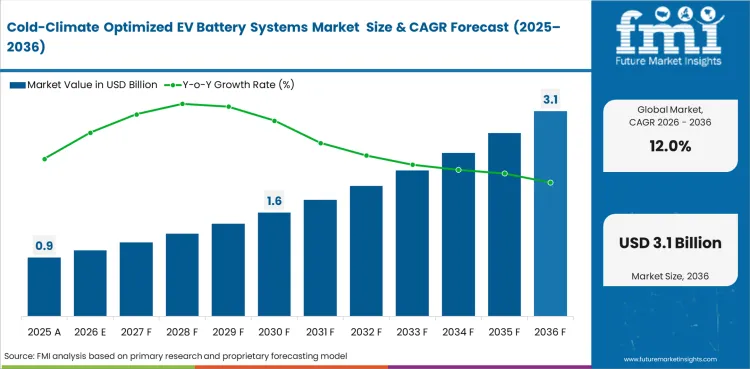
Cold-climate optimized EV battery systems market was valued at USD 0.88 billion in 2025 and is projected to total USD 0.98 billion in 2026 before reaching USD 3.04 billion by 2036. This implies a forecast CAGR of 12.0% and an incremental opportunity of USD 2.06 billion.
Summary of Cold-Climate Optimized EV Battery Systems Market
- The industry is estimated to be worth USD 0.98 billion in 2026 and is forecast to reach USD 3.04 billion by 2036.
- The market is predicted to expand at 12.0% CAGR for 2026 to 2036, supported by higher EV adoption in northern driving conditions.
- The market size was USD 0.88 billion in 2025, reflecting early platform spending before wider fleet-scale line fit adoption.
- Incremental opportunity over the study period is USD 2.06 billion, driven by heating and pack integration upgrades.
- Liquid-cooled systems are projected to lead thermal architecture demand with 56% share in 2026.
- Passenger EVs are expected to remain the largest application with 62% share in 2026.
- OEM line-fit programs are anticipated to lead sales format demand with 71% share in 2026.
- NMC batteries are estimated to hold 38% of chemistry demand in 2026 in cold-sensitive vehicle programs.
Key Takeaways, Market Size, and Forecast
- Cold-Climate Optimized EV Battery Systems Market is projected to grow from USD 0.98 billion in 2026 to USD 3.04 billion by 2036, at a CAGR of 12.0%.
- The cold-climate optimized EV battery systems market was valued at USD 0.88 billion in 2025.
- By 2036, the Cold-Climate Optimized EV Battery Systems Market is expected to be worth USD 3.04 billion.
- From 2026 to 2036, the market is anticipated to expand at a CAGR of 12.0%.
- The market is predicted to create an incremental opportunity of USD 2.06 billion between 2026 and 2036.
- In 2026, Liquid-cooled Systems are expected to account for 56.0% of the thermal architecture segment.
- Canada (12.6%) and China (12.0%) are projected to be two of the fastest growing markets.
Cold-Climate Optimized EV Battery Systems Market Key Takeaways
| Parameter | Details |
|---|---|
| Market value (2026) | USD 0.98 billion |
| Forecast value (2036) | USD 3.04 billion |
| CAGR (2026 to 2036) | 12.0% |
| Estimated market value (2025) | USD 0.88 billion |
| Incremental opportunity | USD 2.06 billion |
| Leading chemistry | NMC (38%) |
| Leading thermal architecture | Liquid-cooled systems (56%) |
| Leading application | Passenger EVs (62%) |
| Leading sales channel | OEM line-fit (71%) |
| Key players | CATL, LG Energy Solution, Samsung SDI, Panasonic Energy, BorgWarner, Gentherm, Hanon Systems |
Source: Future Market Insights, 2026
The market outlook is supported by demand for electric vehicle batteries with the growing concentration of EV adoption in seasonally and cold regions. Growth is reinforced by the incremental system value created when OEMs enhance platforms with advanced thermal systems and integrated battery heating systems. Untapped opportunity is strongest in fleet-oriented cold geographies where winter downtime and charging delay have a visible operating cost. Passenger EVs provide the largest revenue base but municipal vehicles and light commercial fleets are where winter capability is easiest to justify during procurement. Adjacent FMI coverage on thermal plates and zonal heat pump HVAC shows why thermal content is becoming more integrated across electrified platforms.
Canada is estimated to expand at 12.6% CAGR through 2036 because harsh winters and broader EV use are increasing demand for heating and control refinement. China is projected at 12.0% CAGR as large EV production volumes accelerate cold-weather pack development. The United States is expected to rise at 11.4% CAGR, while Japan is anticipated at 9.4% CAGR from a smaller EV base.
Cold-Climate Optimized EV Battery Systems Market Definition
This market covers battery systems designed or calibrated for dependable electric vehicle operation in freezing and sub-zero environments. It includes cells, modules, packs, thermal plates, heaters, control electronics, battery management software, and supporting materials that improve low-temperature charging, discharge, and durability.
Cold-Climate Optimized EV Battery Systems Market Inclusions
Included in scope are pack-level heating elements, liquid and air thermal circuits, insulation layers, low-temperature battery management controls, cold-start charge support, and integrated systems specified by OEMs or fleet vehicle manufacturers.
Cold-Climate Optimized EV Battery Systems Market Exclusions
Excluded from scope are generic lithium-ion cells sold without cold-weather design adaptation, stationary storage batteries, conventional engine heating hardware, public charging equipment sold as standalone infrastructure, and aftermarket accessories without battery-system integration.
Cold-Climate Optimized EV Battery Systems Market Research Methodology
- Primary Research: Inputs from company disclosures, official technology releases, public policy documents, and industry association updates were used to understand winter-performance design priorities and commercial direction.
- Desk Research: Non-commercial sources from IEA, DOE, NREL, national statistics offices, and automotive associations were used to map EV adoption, battery demand, and country-specific cold-climate conditions.
- Market Sizing and Forecasting: Revenue was modelled from cold-region EV sales exposure and the added value of thermal hardware, controls, and pack integration over standard battery configurations.
- Data Validation and Update Cycle: Revenue outputs were cross-checked against adoption patterns, public charging growth, company program launches, and the addressable share of broader EV battery and thermal system demand.
Why Is the Cold-Climate Optimized EV Battery Systems Market Growing?
- Winter range loss and slower charging are pushing vehicle makers to add better thermal control at the pack level.
- Cold-region EV fleets need fewer weather-related uptime losses, which increases interest in pre-conditioning and battery heating hardware.
- Policy support for zero-emission transport in northern countries is expanding the installed base that needs reliable sub-zero operation.
Global EV demand is still widening the addressable base for cold-weather battery systems. According to the IEA, electric car sales exceeded 17 million in 2024, while EV battery demand reached about 1 TWh and is expected to move above 3 TWh by 2030. More vehicles on the road do not automatically create this niche, yet the cold-climate segment benefits as EV deployment spreads across northern countries where battery temperature control is harder to manage. Vehicle makers therefore assign more engineering budget to pack heating, thermal routing, and low-temperature calibration during program development. FMI coverage on thermal plates and ultra-fast charging batteries shows how hardware selection increasingly links charging performance with reliability over a longer duty cycle.
Cold-weather operation is shaping system design in a more measurable way. The USA Department of Energy notes that current battery electric vehicles remain more sensitive to ambient temperature than conventional vehicles, even after average BEV range improved to roughly 300 miles in 2022. That gap keeps battery heating, pre-conditioning, and cabin-energy coordination high on the engineering agenda, especially for vans, buses, and municipal fleets. CATL's April 2025 launch of the Naxtra passenger EV battery, which the company said retains 90% usable power at -40°C, also shows that suppliers are competing on winter performance rather than energy density alone.
Segmental Analysis
- Liquid-cooled systems are expected to account for 56% of thermal architecture demand in 2026 as higher-power vehicles need tighter pack temperature control.
- Passenger EVs are projected to represent 62% of application demand in 2026 because private and corporate car fleets still dominate cold-region electric volumes.
- OEM line-fit supply is anticipated to contribute 71% of sales channel demand in 2026 as winter-ready packs are usually specified during vehicle development.
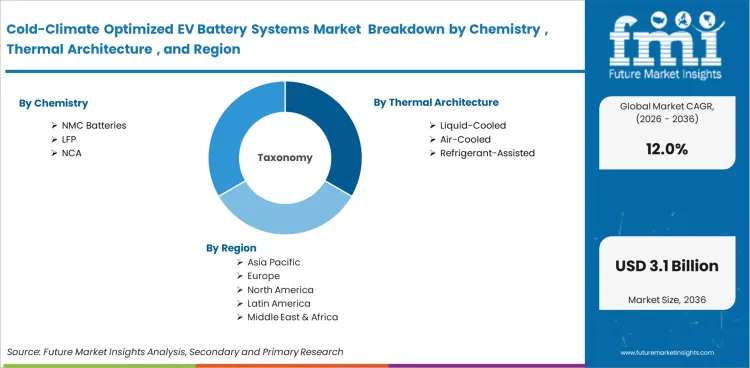
The segmentation outlook for the cold‑climate optimized EV battery systems market spans chemistry, thermal architecture, vehicle class, integration format, and sales channel, reflecting how winter performance is engineered at multiple levels. By chemistry, the market covers NMC, LFP, NCA, and sodium‑ion batteries, each offering different low‑temperature power and cost trade‑offs. Thermal architecture segmentation includes liquid‑cooled, air‑cooled, refrigerant‑assisted, and phase‑change systems that govern heat transfer and charging stability in freezing conditions. By vehicle class, demand is distributed across passenger EVs, light commercial vehicles, buses, and specialty fleets, while integration pathways range from pack‑level, module‑level, to cell‑level solutions.
Insights into the Chemistry Segment
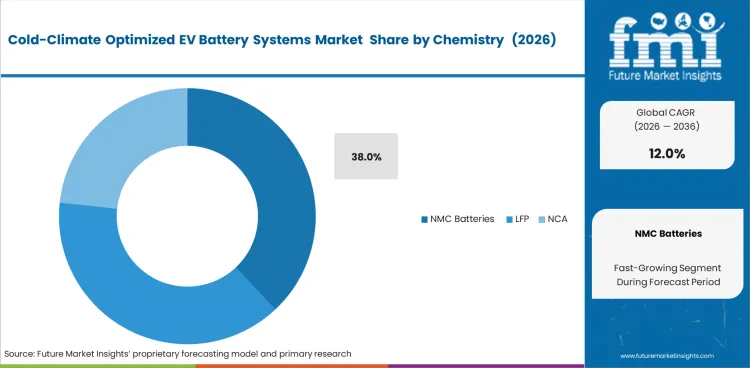
NMC batteries are expected to account for 38% share in 2026 because many cold-region programs still favor strong low-temperature power output and established passenger EV validation. LFP improvement for winter use is progressing, yet many premium and performance-oriented platforms remain tied to nickel-rich chemistries where drivability matters more than the lowest pack cost. IEA data show China sold over 11 million electric cars in 2024, which helps scale chemistry improvement across global programs. Interest in precursor-free cathodes and solid-state cathodes shows that future gains will come from material innovation as much as pack hardware.
Insights into the Thermal Architecture Segment
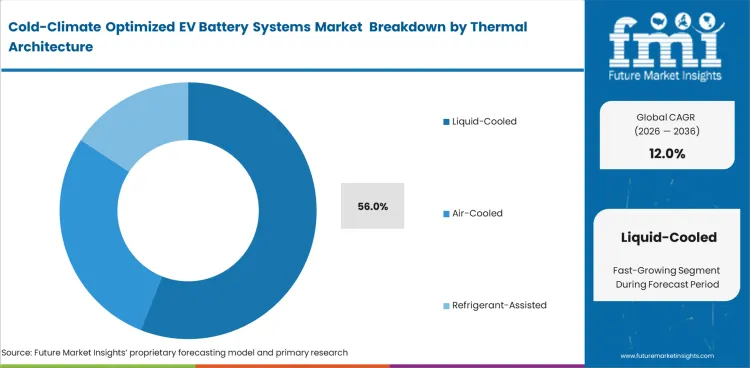
Liquid-cooled systems are projected to contribute 56% of segment demand in 2026. Cold-climate vehicle programs use liquid circuits more often because heat transfer is steadier during fast charging, hill driving, and repeat cold starts. The architecture also supports closer coordination between battery temperature control and cabin HVAC. The IEA says more than 1.3 million public charging points were added worldwide in 2024, which strengthens demand for packs that can charge efficiently in freezing weather.
Insights into the Vehicle Class Segment
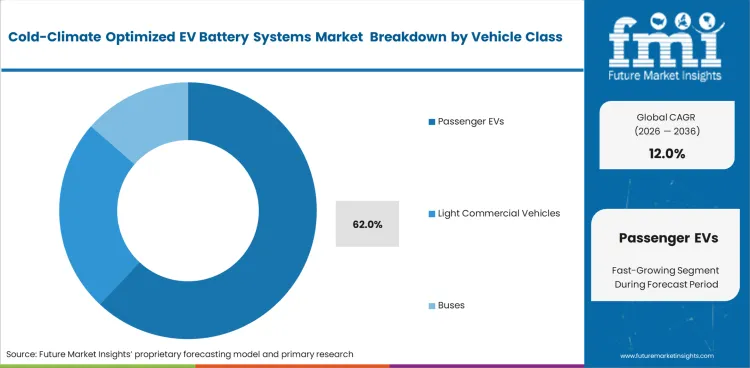
Passenger EVs are likely to secure 62% share in 2026 as private vehicles and company cars remain the main volume base for winter-ready battery packs. Commercial fleets are growing faster in some cold territories, yet car programs still account for a larger number of platforms needing low-temperature refinement. The IEA estimates electric light commercial vehicle sales exceeded 600,000 in 2024, which supports future demand from vans and service fleets. Continued design interest in battery housings and lithium-sulfur cells is tied to the need for lighter packs and newer cell formats that protect winter driving range.
Insights into the Integration Format Segment
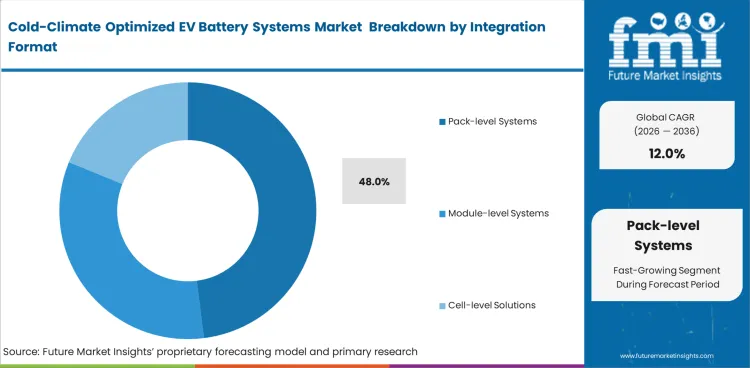
Pack-level systems are set to make up 48% of the market in 2026 because engineering teams increasingly solve winter reliability at pack level instead of buying separate heater and control pieces. A pack-level approach helps thermal plates, insulation, coolant routing, sensing, and software work as one validated assembly. Samsung SDI's 2025 work around 46-series cells and cell-to-pack design points in the same direction. Interest in battery platforms and pack TIM shows why thermal materials and platform design are being specified earlier in vehicle development.
Insights into the Sales Channel Segment
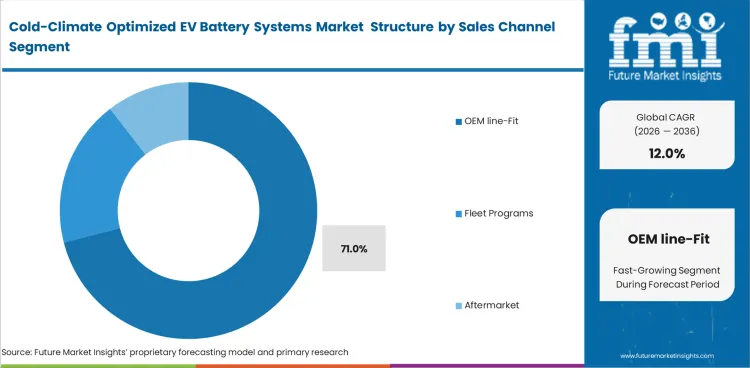
OEM line-fit programs are expected to reach 71% of segment demand in 2026 because vehicle makers usually want winter capability validated before launch. Aftermarket retrofits remain relevant for buses and delivery vans, but most revenue is generated with platform-level sourcing. BorgWarner's January 2025 showcase of high-energy LFP battery systems and thermal management innovations for electric commercial vehicles underlines the way suppliers position these systems as original-fit assemblies.
What Are the Drivers, Restraints, and Key Trends in the Cold-Climate Optimized EV Battery Systems Market
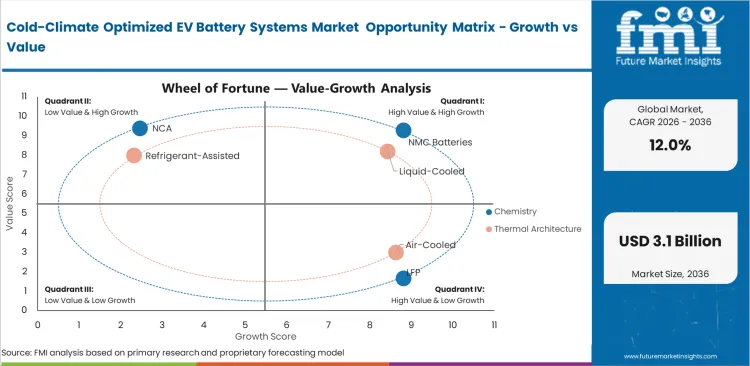
- Growing EV penetration in cold regions is expanding demand for batteries that charge and discharge more smoothly below freezing.
- Added heating hardware and validation work increase cost, weight, and development time for new vehicle programs.
- Suppliers are tying winter readiness to software and HVAC integration rather than isolated battery upgrades.
Demand is rising from a clear performance gap in low-temperature use. Some vehicle makers can absorb the added system cost in premium programs, while cost-sensitive fleets need clear savings in uptime or charging behavior before a winter package is approved. That makes this category more selective than the wider EV battery business.
Input Cost Pressure
Cold-ready battery systems add heaters, plates, software work, insulation, valves, and validation time, which raises program cost. Panasonic Energy's July 2025 start of mass production at its Kansas plant with planned annual capacity of 32 GWh should help North American sourcing depth, yet specialized cold-weather content still adds a premium over standard packs. The extra cost can be justified in larger vehicles or colder geographies, but smaller platforms remain price-sensitive.
Testing and Validation Needs
Low-temperature performance requires more than bench-level confirmation because charging, pre-conditioning, state of charge, and cabin use interact under real driving conditions. NREL's Fairbanks study notes that range impacts vary by chemistry, battery thermal management system and driver behavior. That wide spread forces vehicle makers to validate systems across route, climate, and charging cases before release. This supports demand for integrated solutions instead of patchwork component sourcing.
Analysis of Cold-Climate Optimized EV Battery Systems Market by Key Countries
- Canada is projected to record 12.6% CAGR through 2036 as commercial fleets and consumer EV demand expand across harsh winter conditions.
- China is expected to register 12.0% CAGR by 2036 because scale in EV production helps diffuse winter-ready battery design faster.
- The United States is likely to post 11.4% CAGR through 2036 as northern fleets and pickup-oriented EV programs keep winter performance in focus.
- Japan is anticipated to grow at 9.4% CAGR through 2036 as EV adoption starts from a lower base and thermal refinement remains selective.
.webp "Top Country Growth Comparison Cold Climate Optimized Ev Battery Systems Market Cagr (2026 2036)")
| Country | CAGR |
|---|---|
| Canada | 12.6% |
| Norway | 10.8% |
| United States | 11.4% |
| China | 12.0% |
| Sweden | 10.6% |
| Finland | 10.2% |
| Japan | 9.4% |
Source: FMI analysis based on primary research and proprietary forecasting model
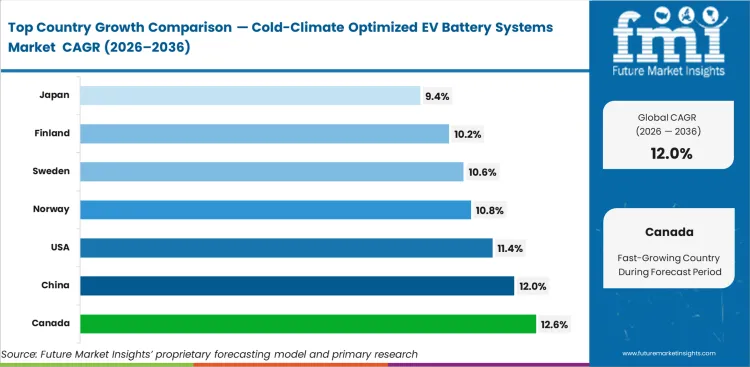
Country performance is shaped by EV volume in cold or seasonally cold areas and by the willingness of buyers and policymakers to pay for better winter usability. Canada and China are witnessing above the global average for different reasons, because Canada faces direct winter pressure while China brings manufacturing scale. Norway, Sweden, and Finland remain smaller in revenue terms, yet they stay commercially important because actual winter use provides early proof of product performance.
Cold-Climate Optimized EV Battery Systems Market Analysis in Canada
Demand for cold-climate optimized EV battery systems market in Canada is expected to rise at a CAGR of 12.6% through 2036. Statistics Canada reported 45,366 new zero-emission vehicle registrations in the third quarter of 2025, equal to 9.4% of all new registrations, and the fourth quarter rose to 11.2%. Those shares are modest beside Norway, however, Canadian driving conditions create a stronger need for battery heating, pre-conditioning, and software that limits winter range loss. Commercial fleets in provinces with long winters are especially exposed because charging speed and route predictability both weaken in freezing weather.
- Quebec and British Columbia remain two of the strongest zero-emission demand centers in the country.
- Urban delivery fleets are testing pre-conditioning routines to protect route consistency during winter mornings.
- Public policy still matters because registration shares fell year over year before improving in late 2025.
Cold-Climate Optimized EV Battery Systems Market Analysis in Norway
Norway is projected to record a CAGR of 10.8% in cold-climate optimized EV battery systems market during the forecast period. National policy remains a strong demand anchor because the Norwegian Public Roads Administration states that all new passenger cars, light vans, and city buses are to be zero-emission by 2025. Statistics Norway also shows high monthly private-car registrations for electric and zero-emission vehicles through 2025, confirming that winter-ready performance is now a mainstream rather than niche requirement. Revenue potential is smaller than China or the United States, though Norway is one of the most useful proving grounds for winter reliability.
- Northern counties remain a useful test zone for winter range and charging performance.
- Zero-emission policy coverage extends beyond passenger cars to light vans and city buses.
- High EV penetration makes software calibration and thermal efficiency more visible to end users.
Cold-Climate Optimized EV Battery Systems Market Analysis in United States
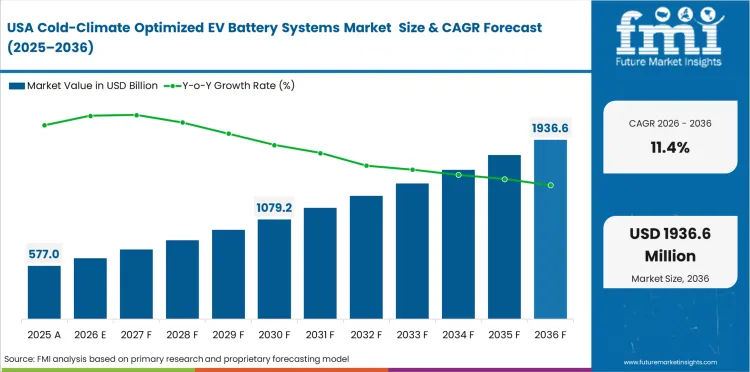
Sales of cold-climate optimized EV battery systems market in the United States are likely to increase at a CAGR of 11.4% through 2036. Argonne National Laboratory states that more than 1.5 million EVs were sold in the country in 2024 and more than 5.7 million are already on the road. That installed base spans many climates, but snow-belt states and fleet use cases keep winter charging and range consistency near the top of product-development discussions. DOE work published in 2024 also highlights continued battery-electric sensitivity to ambient temperature, which supports spending on better heating and energy-management controls.
- Northern fleet operators focus on route reliability and cold-start charging time.
- Pickup trucks and delivery vans raise the value of stable low-temperature power output.
- Domestic battery manufacturing expansion supports closer regional sourcing for pack programs.
Cold-Climate Optimized EV Battery Systems Market Analysis in China
Cold-climate optimized ev battery systems market in China is set to expand at a CAGR of 12.0% over the assessment period. The IEA said China sold more than 11 million electric cars in 2024 and produced 12.4 million electric cars in the same year, keeping the country at the center of global EV manufacturing. Cold-weather demand is not spread evenly across the country, yet northern provinces and long-distance fleet routes create a large technical test bed for winter-ready batteries. Chinese suppliers can scale chemistry changes, pack heaters, and control software faster than most peers because domestic production volume is so large.
- Northern provinces create real demand for winter charging stability in high-volume EV fleets.
- Domestic production scale helps suppliers spread thermal upgrades across many vehicle programs.
- Cost reduction is helped by deep local supply chains in cells, pack parts, and controls.
Cold-Climate Optimized EV Battery Systems Market Analysis in Sweden
Sweden is forecast to post 10.6% cagr in cold-climate optimized ev battery systems market through 2036. Mobility Sweden's 2025 forecast put electric cars at 36% of new passenger-car registrations, while the European Alternative Fuels Observatory reported that battery-electric cars reached 35% share in April 2025. Sweden combines high EV acceptance with winter operating conditions that make battery heating and thermal efficiency commercially relevant. Corporate fleets also account for a large portion of registrations, which matters because fleet operators are quicker to compare route reliability and winter charging time.
- Corporate registrations account for a large share of new electric cars.
- Cold-weather usability matters for commuter vehicles and light commercial fleets alike.
- High EV adoption raises the visibility of battery-heating efficiency during daily use.
Cold-Climate Optimized EV Battery Systems Market Analysis in Finland
Finland is likely to see cold-climate optimized ev battery systems market advance at a CAGR of 10.2% through 2036. The European Alternative Fuels Observatory said nearly 60% of Finland's new passenger-car market was rechargeable in 2025, with 71,888 new passenger cars registered during the year. Finland does not match Norway in total electrification share, but winter intensity and long travel distances make low-temperature energy use a practical design issue. Vehicle makers selling into Finland must deal with consumer attention on cabin comfort, charging readiness, and usable range during freezing mornings.
- Long winter trips increase consumer attention on charging readiness and usable range.
- Rechargeable vehicle penetration gives suppliers a growing platform base for winter-ready packs.
- Cold-start performance remains a visible selling point in a smaller but demanding vehicle base.
Cold-Climate Optimized EV Battery Systems Market Analysis in Japan
Japan is expected to register 9.4% CAGR in cold-climate optimized ev battery systems market through 2036. The IEA says Japan's electric light-duty vehicle sales accounted for 3% of total sales in 2024 and could reach 20% by 2030 under stated policies. That lower starting point keeps current revenue below the larger northern EV markets, yet it also leaves room for selective growth in winter-capable battery platforms. Japanese vehicle makers have strong engineering depth in battery controls and quality assurance, which should support targeted program spending where cold-weather performance can improve buyer acceptance.
- Growth starts from a lower EV base than in Europe or China.
- Vehicle makers can apply strong battery-control capabilities to selective winter-capable models.
- Premium and high-quality applications are likely to adopt cold-weather refinement first.
Competitive Landscape of Cold-Climate Optimized EV Battery Systems Market
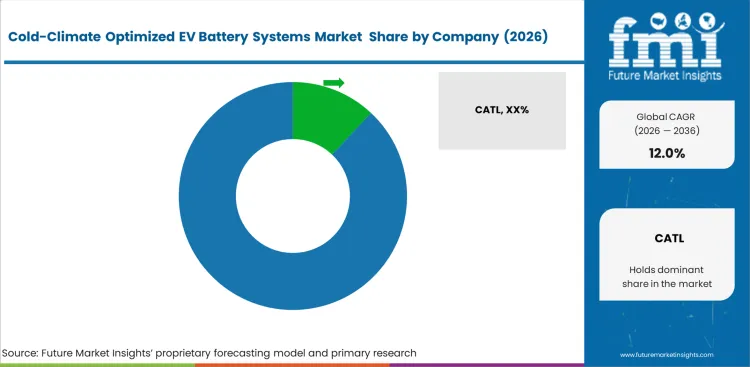
- The competitive structure is moderately concentrated because scale, validation capability, and pack integration experience still matter more than small-component supply.
- Large battery suppliers hold an edge in chemistry depth and manufacturing reach, while thermal specialists win where OEMs need heating and control support.
- Entry remains difficult because winter validation, safety compliance, and platform integration need long development cycles and close automaker collaboration.
Competition centers on who can improve winter usability without adding too much cost or weight. Large cell and pack suppliers such as CATL, LG Energy Solution, Samsung SDI, and Panasonic Energy have an advantage because they can adjust chemistry, pack design, and battery software together. Thermal specialists such as Gentherm, BorgWarner, and Hanon Systems remain important because winter performance is not solved by chemistry alone.
Recent company actions underline that shift. LG Energy Solution announced SoC-based battery management diagnostic solutions in December 2024 and later launched the B.once battery evaluation service in November 2025. CATL's Naxtra launch added an explicit low-temperature performance message, while Panasonic Energy began mass production at its Kansas factory in July 2025 with planned annual capacity of 32 GWh. FMI analysis on electric vehicle batteries, battery management systems, and automotive BMS also points to the way battery supervision and thermal control are moving closer together.
Specialists can still win where automakers need targeted help. Gentherm focuses on battery performance solutions, while BorgWarner and Hanon Systems offer broader electrification modules that connect heating, cooling, and power electronics. A supplier does not need the largest cell output to gain business if it can shorten winter validation time or reduce energy loss from heating loads. Related coverage on thermal systems and thermal interface materials shows how broader thermal and battery categories are also rewarding suppliers that can integrate adjacent functions.
Major Industry Players
Industry participation spans global battery manufacturers, automotive thermal specialists, and focused integration suppliers.
- Global Player: CATL, LG Energy Solution, Samsung SDI, and Panasonic Energy combine large-scale battery output with active work in pack design, software integration, or regional manufacturing support.
- Regional Player: BorgWarner, Hanon Systems, and Gentherm fit here because their strength exists in heaters and engineering support linked to electric vehicle programs.
- Emerging Players: Webasto and Modine represent focused participants where thermal packaging, pre-conditioning hardware, and fleet-oriented applications create room for narrower portfolios.
Competitive Benchmarking: Cold-Climate Optimized EV Battery Systems Market
| Company | Low-Temperature Battery Design | Thermal Integration Depth | OEM Program Support | Geographic Footprint |
|---|---|---|---|---|
| CATL | High | High | Strong | Global |
| LG Energy Solution | High | High | Strong | Global |
| Samsung SDI | High | Medium | Strong | Global |
| Panasonic Energy | Medium | Medium | Strong | Global |
| BorgWarner | Medium | High | Moderate | Multi-region |
| Gentherm | Medium | High | Moderate | Multi-region |
| Hanon Systems | Medium | High | Moderate | Global |
| Webasto | Low | High | Moderate | Multi-region |
| Modine | Low | Medium | Low | Regional |
| Dana TM4 | Low | Medium | Low | Multi-region |
Source: Future Market Insights competitive analysis, 2026. Ratings reflect relative positioning based on low-temperature battery design, thermal integration depth, OEM program support, and geographic evidence.
Key Developments in Cold-Climate Optimized EV Battery Systems Market
- In April 2025, CATL launched the Naxtra passenger EV battery and said it retains 90% usable power at -40°C, which sharpened competition around winter-ready chemistry.
- In December 2024, LG Energy Solution announced SoC-based BMS diagnostic solutions on Qualcomm's Snapdragon Digital Chassis, adding stronger software monitoring to EV battery programs.
- In July 2025, Panasonic Energy began mass production at its Kansas automotive battery factory with planned annual capacity of 32 GWh, supporting regionalized EV battery supply.
- In January 2025, Hankook & Company Group completed its acquisition of Hanon Systems, reinforcing access to thermal energy management capabilities used in electric vehicle battery performance.
Key Players in the Cold-Climate Optimized EV Battery Systems Market
Major Global Players
- CATL
- LG Energy Solution
- Samsung SDI
- Panasonic Energy
- BorgWarner
Key Emerging Players/Startups
- Gentherm
- Hanon Systems
- Webasto
- Modine
Scope of the Report
| Metric | Value |
|---|---|
| Quantitative Units | USD 0.98 billion to USD 3.04 billion, at a CAGR of 12.0% |
| Market Definition | Battery systems and supporting thermal-control content built for dependable EV charging, discharge, and usable range in freezing or seasonally cold climates. |
| Segmentation |
|
| Regions Covered | North America, Europe, East Asia |
| Countries Covered | Canada, Norway, United States, China, Sweden, Finland, Japan |
| Key Companies Profiled | CATL, LG Energy Solution, Samsung SDI, Panasonic Energy, BorgWarner, Gentherm, Hanon Systems |
| Forecast Period | 2026 to 2036 |
| Approach | Bottom-up demand modelling using EV adoption, cold-region exposure, and the added value of thermal hardware, controls, and integrated pack content. |
Cold-Climate Optimized EV Battery Systems Market by Segments
Cold-Climate Optimized EV Battery Systems Market Segmented as Chemistry
- NMC
- LFP
- NCA
- Sodium-ion
Cold-Climate Optimized EV Battery Systems Market Classified by Thermal Architecture
- Liquid-cooled
- Air-cooled
- Refrigerant-assisted
- Phase-change
Cold-Climate Optimized EV Battery Systems Market Analysed by Vehicle Class
- Passenger EVs
- Light Commercial
- Buses
- Specialty Fleets
Cold-Climate Optimized EV Battery Systems Market Classified by Integration Format
- Pack-level Systems
- Module-level Systems
- Cell-level Solutions
Cold-Climate Optimized EV Battery Systems Market by Region and Country
- North America
- USA
- Canada
- Mexico
- Latin America
- Brazil
- Chile
- Rest of Latin America
- Western Europe
- Germany
- UK
- Italy
- Spain
- France
- Nordic
- BENELUX
- Rest of Western Europe
- Eastern Europe
- Russia
- Poland
- Hungary
- Balkan & Baltic
- Rest of Eastern Europe
- East Asia
- China
- Japan
- South Korea
- South Asia and Pacific
- India
- ASEAN
- Australia & New Zealand
- Rest of South Asia and Pacific
- Middle East & Africa
- Kingdom of Saudi Arabia
- Other GCC Countries
- Turkiye
- South Africa
- Other African Union
- Rest of Middle East & Africa
Bibliography
- International Energy Agency. (2025). Global EV Outlook 2025: Electric vehicle batteries.
- International Energy Agency. (2025). Global EV Outlook 2025: Trends in electric car markets.
- USA Department of Energy. (2024). Impact of cold ambient temperatures and extreme weather on battery electric vehicle performance.
- National Renewable Energy Laboratory. (2025). Electric vehicle and charging infrastructure assessment in cold-weather climates: A case study of Fairbanks, Alaska.
- European Automobile Manufacturers' Association. (2026). New car registrations: +1.8% in 2025; battery-electric 17.4% market share.
- Statistics Canada. (2025). New motor vehicle registrations, third quarter 2025.
- Statistics Canada. (2026). New motor vehicle registrations, fourth quarter 2025.
- Norwegian Public Roads Administration. (2026). Zero-emission targets.
- Statistics Norway. (2026). First time registered vehicles, by type of registration and type of fuel
- Argonne National Laboratory. (2026). EV model availability and sales
- Mobility Sweden. (2025). Local automotive market.
- European Alternative Fuels Observatory. (2025). Sweden: BEVs reach 35% share in April 2025.
- European Alternative Fuels Observatory. (2026). Nearly 60% of Finland's new car market was rechargeable in 2025.
- CATL. (2025). Naxtra battery breakthrough & dual-power architecture.
This bibliography is provided for reader reference and is not exhaustive. The full report contains the complete reference list and detailed citations.
This Report Addresses
- Market sizing and revenue forecasting for Cold-Climate Optimized EV Battery Systems Market from 2026 to 2036.
- Segmentation analysis across chemistry, thermal architecture, vehicle class, integration format, and sales channel.
- Country-level comparison across major cold-region EV demand centers.
- Assessment of thermal management, battery software, and pack integration priorities.
- Competitive benchmarking covering battery manufacturers and thermal specialists.
- Review of policy and adoption factors that influence winter-ready EV battery demand.
- Tracking of recent company actions tied to battery performance and supply expansion.
- Scope mapping from cell choice to pack-level thermal and control content.
Frequently Asked Questions
How large will the industry be in 2026?
The industry is estimated to reach USD 0.98 billion in 2026 as winter-ready pack and thermal upgrades move into more EV programs.
What is the forecast value by 2036?
Revenue is projected to reach USD 3.04 billion by 2036 as cold-region EV penetration and platform-level thermal refinement expand.
What CAGR is expected from 2026 to 2036?
The industry is expected to grow at a CAGR of 12.0% over the forecast period.
Which chemistry segment leads in 2026?
NMC is projected to lead chemistry demand in 2026 with 38% share because many winter-sensitive platforms still favor strong low-temperature output.
Which application segment leads in 2026?
Passenger EVs lead application demand with 62% share in 2026 as private and corporate car fleets still provide the largest platform base.
Which country is growing fastest?
Canada posts the highest CAGR at 12.6% through 2036 as winter operating pressure and EV adoption widen the need for battery optimization.
What does this industry include?
It includes cells, packs, heaters, thermal controls, insulation, and software designed to improve EV charging and range performance in cold climates.
How were the forecasts prepared?
Forecasts were built from EV adoption trends, cold-region exposure, policy support, and the added value of thermal hardware and control integration.
Preview the report firsthand - request a free sample
Get SampleGet the brochure for pricing and purchase details.
Get PDFTable of Content
- Executive Summary
- Global Market Outlook
- Demand-side Trends
- Supply-side Trends
- Technology Roadmap Analysis
- Analysis and Recommendations
- Market Overview
- Market Coverage / Taxonomy
- Market Definition / Scope / Limitations
- Research Methodology
- Chapter Orientation
- Analytical Lens and Working Hypotheses
- Market Structure, Signals, and Trend Drivers
- Benchmarking and Cross-market Comparability
- Market Sizing, Forecasting, and Opportunity Mapping
- Research Design and Evidence Framework
- Desk Research Programme (Secondary Evidence)
- Company Annual and Sustainability Reports
- Peer-reviewed Journals and Academic Literature
- Corporate Websites, Product Literature, and Technical Notes
- Earnings Decks and Investor Briefings
- Statutory Filings and Regulatory Disclosures
- Technical White Papers and Standards Notes
- Trade Journals, Industry Magazines, and Analyst Briefs
- Conference Proceedings, Webinars, and Seminar Materials
- Government Statistics Portals and Public Data Releases
- Press Releases and Reputable Media Coverage
- Specialist Newsletters and Curated Briefings
- Sector Databases and Reference Repositories
- FMI Internal Proprietary Databases and Historical Market Datasets
- Subscription Datasets and Paid Sources
- Social Channels, Communities, and Digital Listening Inputs
- Additional Desk Sources
- Expert Input and Fieldwork (Primary Evidence)
- Primary Modes
- Qualitative Interviews and Expert Elicitation
- Quantitative Surveys and Structured Data Capture
- Blended Approach
- Why Primary Evidence is Used
- Field Techniques
- Interviews
- Surveys
- Focus Groups
- Observational and In-context Research
- Social and Community Interactions
- Stakeholder Universe Engaged
- C-suite Leaders
- Board Members
- Presidents and Vice Presidents
- R&D and Innovation Heads
- Technical Specialists
- Domain Subject-matter Experts
- Scientists
- Physicians and Other Healthcare Professionals
- Governance, Ethics, and Data Stewardship
- Research Ethics
- Data Integrity and Handling
- Primary Modes
- Tooling, Models, and Reference Databases
- Desk Research Programme (Secondary Evidence)
- Data Engineering and Model Build
- Data Acquisition and Ingestion
- Cleaning, Normalisation, and Verification
- Synthesis, Triangulation, and Analysis
- Quality Assurance and Audit Trail
- Market Background
- Market Dynamics
- Drivers
- Restraints
- Opportunity
- Trends
- Scenario Forecast
- Demand in Optimistic Scenario
- Demand in Likely Scenario
- Demand in Conservative Scenario
- Opportunity Map Analysis
- Product Life Cycle Analysis
- Supply Chain Analysis
- Investment Feasibility Matrix
- Value Chain Analysis
- PESTLE and Porter’s Analysis
- Regulatory Landscape
- Regional Parent Market Outlook
- Production and Consumption Statistics
- Import and Export Statistics
- Market Dynamics
- Global Market Analysis 2021 to 2025 and Forecast, 2026 to 2036
- Historical Market Size Value (USD Million) Analysis, 2021 to 2025
- Current and Future Market Size Value (USD Million) Projections, 2026 to 2036
- Y-o-Y Growth Trend Analysis
- Absolute $ Opportunity Analysis
- Global Market Pricing Analysis 2021 to 2025 and Forecast 2026 to 2036
- Global Market Analysis 2021 to 2025 and Forecast 2026 to 2036, By Chemistry
- Introduction / Key Findings
- Historical Market Size Value (USD Million) Analysis By Chemistry , 2021 to 2025
- Current and Future Market Size Value (USD Million) Analysis and Forecast By Chemistry , 2026 to 2036
- NMC Batteries
- LFP
- NCA
- NMC Batteries
- Y-o-Y Growth Trend Analysis By Chemistry , 2021 to 2025
- Absolute $ Opportunity Analysis By Chemistry , 2026 to 2036
- Global Market Analysis 2021 to 2025 and Forecast 2026 to 2036, By Thermal Architecture
- Introduction / Key Findings
- Historical Market Size Value (USD Million) Analysis By Thermal Architecture, 2021 to 2025
- Current and Future Market Size Value (USD Million) Analysis and Forecast By Thermal Architecture, 2026 to 2036
- Liquid-Cooled
- Air‑Cooled
- Refrigerant‑Assisted
- Liquid-Cooled
- Y-o-Y Growth Trend Analysis By Thermal Architecture, 2021 to 2025
- Absolute $ Opportunity Analysis By Thermal Architecture, 2026 to 2036
- Global Market Analysis 2021 to 2025 and Forecast 2026 to 2036, By Vehicle Class
- Introduction / Key Findings
- Historical Market Size Value (USD Million) Analysis By Vehicle Class, 2021 to 2025
- Current and Future Market Size Value (USD Million) Analysis and Forecast By Vehicle Class, 2026 to 2036
- Passenger EVs
- Light Commercial Vehicles
- Buses
- Passenger EVs
- Y-o-Y Growth Trend Analysis By Vehicle Class, 2021 to 2025
- Absolute $ Opportunity Analysis By Vehicle Class, 2026 to 2036
- Global Market Analysis 2021 to 2025 and Forecast 2026 to 2036, By Integration Format
- Introduction / Key Findings
- Historical Market Size Value (USD Million) Analysis By Integration Format, 2021 to 2025
- Current and Future Market Size Value (USD Million) Analysis and Forecast By Integration Format, 2026 to 2036
- Pack-level Systems
- Module‑level Systems
- Cell‑level Solutions
- Pack-level Systems
- Y-o-Y Growth Trend Analysis By Integration Format, 2021 to 2025
- Absolute $ Opportunity Analysis By Integration Format, 2026 to 2036
- Global Market Analysis 2021 to 2025 and Forecast 2026 to 2036, By Sales Channel
- Introduction / Key Findings
- Historical Market Size Value (USD Million) Analysis By Sales Channel, 2021 to 2025
- Current and Future Market Size Value (USD Million) Analysis and Forecast By Sales Channel, 2026 to 2036
- OEM line-Fit
- Fleet Programs
- Aftermarket
- OEM line-Fit
- Y-o-Y Growth Trend Analysis By Sales Channel, 2021 to 2025
- Absolute $ Opportunity Analysis By Sales Channel, 2026 to 2036
- Global Market Analysis 2021 to 2025 and Forecast 2026 to 2036, By Region
- Introduction
- Historical Market Size Value (USD Million) Analysis By Region, 2021 to 2025
- Current Market Size Value (USD Million) Analysis and Forecast By Region, 2026 to 2036
- North America
- Latin America
- Western Europe
- Eastern Europe
- East Asia
- South Asia and Pacific
- Middle East & Africa
- Market Attractiveness Analysis By Region
- North America Market Analysis 2021 to 2025 and Forecast 2026 to 2036, By Country
- Historical Market Size Value (USD Million) Trend Analysis By Market Taxonomy, 2021 to 2025
- Market Size Value (USD Million) Forecast By Market Taxonomy, 2026 to 2036
- By Country
- USA
- Canada
- Mexico
- By Chemistry
- By Thermal Architecture
- By Vehicle Class
- By Integration Format
- By Sales Channel
- By Country
- Market Attractiveness Analysis
- By Country
- By Chemistry
- By Thermal Architecture
- By Vehicle Class
- By Integration Format
- By Sales Channel
- Key Takeaways
- Latin America Market Analysis 2021 to 2025 and Forecast 2026 to 2036, By Country
- Historical Market Size Value (USD Million) Trend Analysis By Market Taxonomy, 2021 to 2025
- Market Size Value (USD Million) Forecast By Market Taxonomy, 2026 to 2036
- By Country
- Brazil
- Chile
- Rest of Latin America
- By Chemistry
- By Thermal Architecture
- By Vehicle Class
- By Integration Format
- By Sales Channel
- By Country
- Market Attractiveness Analysis
- By Country
- By Chemistry
- By Thermal Architecture
- By Vehicle Class
- By Integration Format
- By Sales Channel
- Key Takeaways
- Western Europe Market Analysis 2021 to 2025 and Forecast 2026 to 2036, By Country
- Historical Market Size Value (USD Million) Trend Analysis By Market Taxonomy, 2021 to 2025
- Market Size Value (USD Million) Forecast By Market Taxonomy, 2026 to 2036
- By Country
- Germany
- UK
- Italy
- Spain
- France
- Nordic
- BENELUX
- Rest of Western Europe
- By Chemistry
- By Thermal Architecture
- By Vehicle Class
- By Integration Format
- By Sales Channel
- By Country
- Market Attractiveness Analysis
- By Country
- By Chemistry
- By Thermal Architecture
- By Vehicle Class
- By Integration Format
- By Sales Channel
- Key Takeaways
- Eastern Europe Market Analysis 2021 to 2025 and Forecast 2026 to 2036, By Country
- Historical Market Size Value (USD Million) Trend Analysis By Market Taxonomy, 2021 to 2025
- Market Size Value (USD Million) Forecast By Market Taxonomy, 2026 to 2036
- By Country
- Russia
- Poland
- Hungary
- Balkan & Baltic
- Rest of Eastern Europe
- By Chemistry
- By Thermal Architecture
- By Vehicle Class
- By Integration Format
- By Sales Channel
- By Country
- Market Attractiveness Analysis
- By Country
- By Chemistry
- By Thermal Architecture
- By Vehicle Class
- By Integration Format
- By Sales Channel
- Key Takeaways
- East Asia Market Analysis 2021 to 2025 and Forecast 2026 to 2036, By Country
- Historical Market Size Value (USD Million) Trend Analysis By Market Taxonomy, 2021 to 2025
- Market Size Value (USD Million) Forecast By Market Taxonomy, 2026 to 2036
- By Country
- China
- Japan
- South Korea
- By Chemistry
- By Thermal Architecture
- By Vehicle Class
- By Integration Format
- By Sales Channel
- By Country
- Market Attractiveness Analysis
- By Country
- By Chemistry
- By Thermal Architecture
- By Vehicle Class
- By Integration Format
- By Sales Channel
- Key Takeaways
- South Asia and Pacific Market Analysis 2021 to 2025 and Forecast 2026 to 2036, By Country
- Historical Market Size Value (USD Million) Trend Analysis By Market Taxonomy, 2021 to 2025
- Market Size Value (USD Million) Forecast By Market Taxonomy, 2026 to 2036
- By Country
- India
- ASEAN
- Australia & New Zealand
- Rest of South Asia and Pacific
- By Chemistry
- By Thermal Architecture
- By Vehicle Class
- By Integration Format
- By Sales Channel
- By Country
- Market Attractiveness Analysis
- By Country
- By Chemistry
- By Thermal Architecture
- By Vehicle Class
- By Integration Format
- By Sales Channel
- Key Takeaways
- Middle East & Africa Market Analysis 2021 to 2025 and Forecast 2026 to 2036, By Country
- Historical Market Size Value (USD Million) Trend Analysis By Market Taxonomy, 2021 to 2025
- Market Size Value (USD Million) Forecast By Market Taxonomy, 2026 to 2036
- By Country
- Kingdom of Saudi Arabia
- Other GCC Countries
- Turkiye
- South Africa
- Other African Union
- Rest of Middle East & Africa
- By Chemistry
- By Thermal Architecture
- By Vehicle Class
- By Integration Format
- By Sales Channel
- By Country
- Market Attractiveness Analysis
- By Country
- By Chemistry
- By Thermal Architecture
- By Vehicle Class
- By Integration Format
- By Sales Channel
- Key Takeaways
- Key Countries Market Analysis
- USA
- Pricing Analysis
- Market Share Analysis, 2025
- By Chemistry
- By Thermal Architecture
- By Vehicle Class
- By Integration Format
- By Sales Channel
- Canada
- Pricing Analysis
- Market Share Analysis, 2025
- By Chemistry
- By Thermal Architecture
- By Vehicle Class
- By Integration Format
- By Sales Channel
- Mexico
- Pricing Analysis
- Market Share Analysis, 2025
- By Chemistry
- By Thermal Architecture
- By Vehicle Class
- By Integration Format
- By Sales Channel
- Brazil
- Pricing Analysis
- Market Share Analysis, 2025
- By Chemistry
- By Thermal Architecture
- By Vehicle Class
- By Integration Format
- By Sales Channel
- Chile
- Pricing Analysis
- Market Share Analysis, 2025
- By Chemistry
- By Thermal Architecture
- By Vehicle Class
- By Integration Format
- By Sales Channel
- Germany
- Pricing Analysis
- Market Share Analysis, 2025
- By Chemistry
- By Thermal Architecture
- By Vehicle Class
- By Integration Format
- By Sales Channel
- UK
- Pricing Analysis
- Market Share Analysis, 2025
- By Chemistry
- By Thermal Architecture
- By Vehicle Class
- By Integration Format
- By Sales Channel
- Italy
- Pricing Analysis
- Market Share Analysis, 2025
- By Chemistry
- By Thermal Architecture
- By Vehicle Class
- By Integration Format
- By Sales Channel
- Spain
- Pricing Analysis
- Market Share Analysis, 2025
- By Chemistry
- By Thermal Architecture
- By Vehicle Class
- By Integration Format
- By Sales Channel
- France
- Pricing Analysis
- Market Share Analysis, 2025
- By Chemistry
- By Thermal Architecture
- By Vehicle Class
- By Integration Format
- By Sales Channel
- India
- Pricing Analysis
- Market Share Analysis, 2025
- By Chemistry
- By Thermal Architecture
- By Vehicle Class
- By Integration Format
- By Sales Channel
- ASEAN
- Pricing Analysis
- Market Share Analysis, 2025
- By Chemistry
- By Thermal Architecture
- By Vehicle Class
- By Integration Format
- By Sales Channel
- Australia & New Zealand
- Pricing Analysis
- Market Share Analysis, 2025
- By Chemistry
- By Thermal Architecture
- By Vehicle Class
- By Integration Format
- By Sales Channel
- China
- Pricing Analysis
- Market Share Analysis, 2025
- By Chemistry
- By Thermal Architecture
- By Vehicle Class
- By Integration Format
- By Sales Channel
- Japan
- Pricing Analysis
- Market Share Analysis, 2025
- By Chemistry
- By Thermal Architecture
- By Vehicle Class
- By Integration Format
- By Sales Channel
- South Korea
- Pricing Analysis
- Market Share Analysis, 2025
- By Chemistry
- By Thermal Architecture
- By Vehicle Class
- By Integration Format
- By Sales Channel
- Russia
- Pricing Analysis
- Market Share Analysis, 2025
- By Chemistry
- By Thermal Architecture
- By Vehicle Class
- By Integration Format
- By Sales Channel
- Poland
- Pricing Analysis
- Market Share Analysis, 2025
- By Chemistry
- By Thermal Architecture
- By Vehicle Class
- By Integration Format
- By Sales Channel
- Hungary
- Pricing Analysis
- Market Share Analysis, 2025
- By Chemistry
- By Thermal Architecture
- By Vehicle Class
- By Integration Format
- By Sales Channel
- Kingdom of Saudi Arabia
- Pricing Analysis
- Market Share Analysis, 2025
- By Chemistry
- By Thermal Architecture
- By Vehicle Class
- By Integration Format
- By Sales Channel
- Turkiye
- Pricing Analysis
- Market Share Analysis, 2025
- By Chemistry
- By Thermal Architecture
- By Vehicle Class
- By Integration Format
- By Sales Channel
- South Africa
- Pricing Analysis
- Market Share Analysis, 2025
- By Chemistry
- By Thermal Architecture
- By Vehicle Class
- By Integration Format
- By Sales Channel
- USA
- Market Structure Analysis
- Competition Dashboard
- Competition Benchmarking
- Market Share Analysis of Top Players
- By Regional
- By Chemistry
- By Thermal Architecture
- By Vehicle Class
- By Integration Format
- By Sales Channel
- Competition Analysis
- Competition Deep Dive
- CATL
- Overview
- Product Portfolio
- Profitability by Market Segments (Product/Age /Sales Channel/Region)
- Sales Footprint
- Strategy Overview
- Marketing Strategy
- Product Strategy
- Channel Strategy
- LG Energy Solution
- Samsung SDI
- Panasonic Energy
- BorgWarner
- Gentherm
- Hanon Systems
- CATL
- Competition Deep Dive
- Assumptions & Acronyms Used


