

- Industry Size (2026)
- USD 2.8 Bn
- Forecast (2036)
- USD 6.7 Bn
- CAGR (2026 to 2036)
- 9.10%
EV Battery Recycled Plastic Casings Market Forecast and Outlook 2026 to 2036
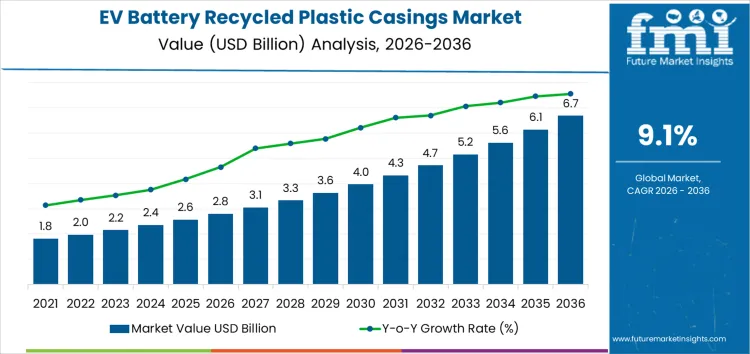
The global EV battery recycled plastic casings market is valued at USD 2.8 billion in 2026 and is projected to reach USD 6.7 billion by 2036, growing at a CAGR of 9.10%. Regulatory oversight and compliance cost are significant factors influencing the adoption of recycled plastics in battery casings. As governments worldwide tighten emissions regulations, automotive manufacturers face increasing pressure to adopt eco-friendly solutions. Certification complexity adds another layer of challenge, with vendors needing to meet stringent automotive industry standards.
These factors impact both the production costs and market entry barriers for new players. Established vendors like BASF and SABIC are leveraging their experience in meeting regulatory requirements to position themselves as preferred suppliers for EV manufacturers. As the market for electric vehicles grows, vendors that invest in ensuring compliance with evolving regulations will hold a competitive advantage, while those who fail to align with the regulatory environment may struggle with market penetration.
Quick Stats for EV Battery Recycled Plastic Casings Market
- EV Battery Recycled Plastic Casings Market Value (2026): USD 2.8 Billion
- EV Battery Recycled Plastic Casings Market Forecast Value (2036): USD 6.7 Billion
- EV Battery Recycled Plastic Casings Market Forecast CAGR 2026 to 2036: 9.10%
- Leading Battery Type in EV Battery Recycled Plastic Casings Market: Lithium-Ion (Li-ion) Batteries
- Key Growth Regions in EV Battery Recycled Plastic Casings Market: Asia Pacific, North America
- Top Key Players in EV Battery Recycled Plastic Casings Market: BASF SE, Plastipak Holdings, Inc., LyondellBasell, SABIC, PolyOne (Avient Corporation)
EV Battery Recycled Plastic Casings Market Key Takeaways
| Metric | Value |
|---|---|
| Industry Value (2026) | USD 2.8 Billion |
| Forecast Value (2036) | USD 6.7 Billion |
| Forecast CAGR 2026 to 2036 | 9.10% |
How Is the Global EV Battery Recycled Plastic Casings Market Advancing?
The global EV battery recycled plastic casings market is experiencing robust growth, driven by the increasing demand for electric vehicles (EVs) and the growing focus on renewability in the automotive and energy sectors. Recycled plastic casings are an essential component in the production of EV batteries, providing durable and lightweight protection for battery cells. The use of recycled plastics in battery casings not only reduces the environmental footprint of EVs but also helps mitigate the challenges associated with plastic waste and resource scarcity.
A major driver for the market is the rise in EV adoption and the automotive industry’s commitment to reducing carbon emissions. As governments around the world introduce stricter emissions regulations and provide incentives for EV adoption, the demand for EV batteries, and consequently for battery casings, is increasing. Recycled plastic casings offer an eco-friendly alternative to traditional plastic, aligning with the industry’s focus on using eco-friendlier materials in EV production. Moreover, the growing trend of circular economy practices is driving manufacturers to incorporate recycled materials into their products, further boosting the demand for recycled plastic casings.
Technological advancements in recycling processes and material innovation are also contributing to the growth of the market. Advances in plastic recycling technologies allow for the production of high-quality recycled plastic materials suitable for use in EV battery casings. The development of lightweight, high-strength, and fire-resistant recycled plastics is improving the performance and safety of EV batteries. As the demand for electric vehicles continues to rise, the market for EV battery recycled plastic casings is expected to expand significantly, offering an eco-friendly solution to the growing demand for EV battery production.
What Is the Segment-Wise Analysis for the EV Battery Recycled Plastic Casings Market?
The EV battery recycled plastic casings market is segmented by battery type and application. Lithium-ion (Li-ion) batteries lead the battery type segment with a 72% share, followed by solid-state batteries, other emerging battery types, and other types. Li-ion batteries are the most commonly used in electric vehicles due to their high energy density, long lifespan, and established manufacturing processes. In terms of application, passenger electric vehicles account for 57% of the market, followed by commercial electric vehicles, two-wheelers & light EVs, and other applications.
Why Do Lithium-Ion Batteries Lead the EV Battery Recycled Plastic Casings Market?
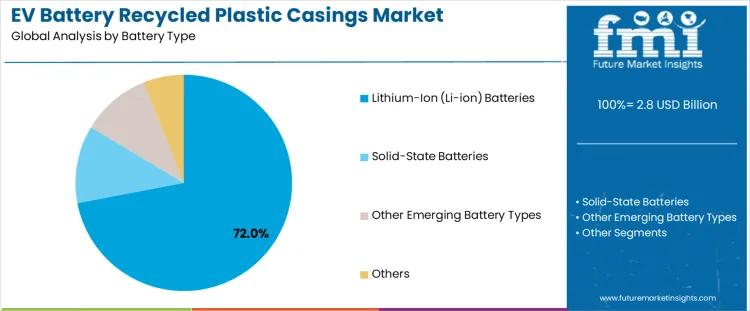
Lithium-Ion (Li-ion) batteries lead the EV battery recycled plastic casings market with a 72% share due to their widespread use in electric vehicles. Li-ion batteries are favored for their high energy density, long cycle life, and lightweight nature, making them ideal for EV applications. The increasing adoption of electric vehicles across the passenger, commercial, and two-wheeler segments further drives the demand for Li-ion batteries. As the automotive industry transitions to greener technologies, the need for eco-friendly materials, such as recycled plastic casings, becomes more pronounced. Li-ion battery casings made from recycled plastic contribute to reducing the environmental impact of battery production, making them a preferred choice in the market.
How Do Passenger Electric Vehicles Contribute to the EV Battery Recycled Plastic Casings Market?
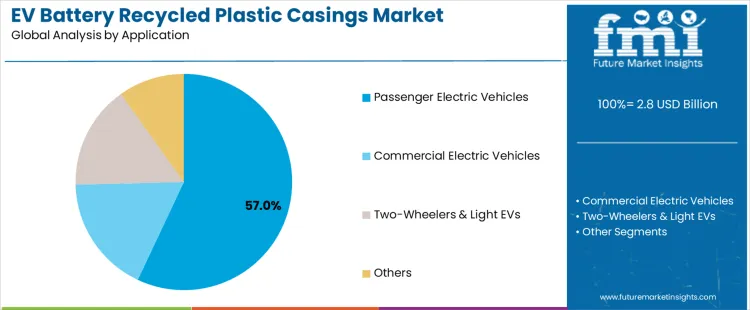
Passenger electric vehicles account for 57% of the application segment in the EV battery recycled plastic casings market. The growing demand for eco-friendly transportation solutions, combined with stricter emissions regulations, has accelerated the adoption of electric vehicles. As a result, the demand for eco-friendly materials, including recycled plastic casings for Li-ion batteries, is rising in the passenger EV sector. Recycled plastic casings are an eco-friendly alternative to traditional materials, helping reduce the environmental impact of battery production while maintaining the durability and performance required in EVs. As the market for passenger electric vehicles continues to expand, the demand for EV battery recycled plastic casings is expected to grow significantly.
What Are the Key Dynamics for the EV Battery Recycled Plastic Casings Market?
The EV battery recycled plastic casings market is driven by the increasing demand for electric vehicles (EVs) and the need for eco-friendly, eco-friendly materials in the automotive industry. Recycled plastic casings are gaining traction in EV battery manufacturing as they offer both environmental and economic benefits. The use of recycled plastics helps reduce waste and the reliance on virgin plastic, which is vital in achieving renewability goals in the growing EV market. The push for reducing the carbon footprint of battery production, along with regulatory pressures for recycling, is driving the adoption of recycled plastic materials in EV battery casings.
Why Is the EV Battery Recycled Plastic Casings Market Growing?
The market for EV battery recycled plastic casings is growing due to the increasing adoption of electric vehicles and the automotive industry's focus on renewability. As EV sales rise, the demand for cost-effective, lightweight, and durable battery casings has surged. Recycled plastic offers an environmentally friendly solution by reducing plastic waste and carbon emissions compared to conventional materials. Regulatory pressures on reducing plastic waste and improving recyclability, combined with the growing trend of circular economy practices in the automotive sector, are also fueling the market for recycled plastic casings in EV batteries.
How Are the Key Drivers Shaping the EV Battery Recycled Plastic Casings Market?
Key drivers shaping the EV battery recycled plastic casings market include the rapid growth of the electric vehicle market, which requires innovative and eco-friendly materials for battery components. The shift towards circular economy practices, focusing on recycling and reusing materials, is encouraging automakers to adopt recycled plastics in EV battery casings. The increasing regulatory pressure for reducing waste and enhancing renewability in automotive manufacturing is promoting the use of recycled plastics. Technological advancements in recycling processes are improving the quality and cost-effectiveness of recycled plastics, making them more competitive with virgin plastic materials in EV battery casing production.
What is the Growth Outlook for the EV Battery Recycled Plastic Casings Market by Country?
| Country | CAGR (%) |
|---|---|
| China | 10.3% |
| United States | 9.8% |
| South Korea | 9.2% |
| Germany | 8.9% |
| Japan | 8.7% |
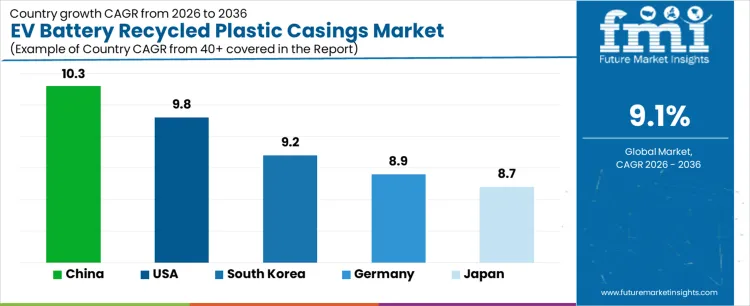
The EV battery recycled plastic casings market is expanding across key regions, with China leading at 10.3%, driven by its dominance in the EV sector and commitment to renewability. The United States grows at 9.8%, supported by government incentives for eco-friendly manufacturing and growing EV adoption. South Korea’s market expands at 9.2%, fueled by its leadership in EV and battery production, as well as innovation in recycling technologies. Germany’s market grows at 8.9%, driven by strong environmental policies and the push for circular economy practices. Japan grows at 8.7%, supported by a focus on green manufacturing and eco-friendly materials in the automotive sector.
What is Driving the Growth of the EV Battery Recycled Plastic Casings Market in China?
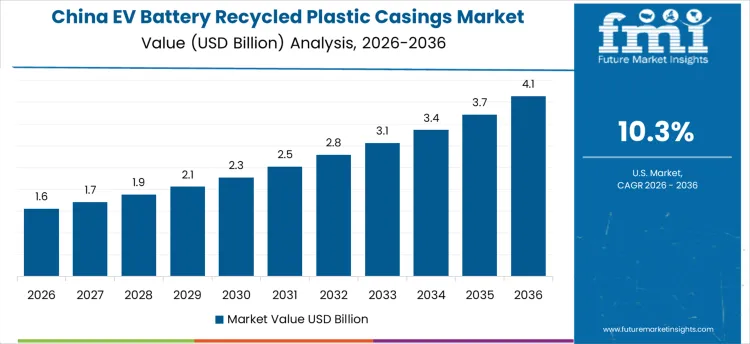
China’s EV battery recycled plastic casings market is growing at 10.3%, driven by the country’s dominance in the electric vehicle (EV) market and its focus on renewability. As the world’s largest producer and consumer of EVs, China has a growing demand for recycled plastic casings for EV batteries, in line with its commitment to reducing carbon emissions and environmental impact. The Chinese government has introduced policies to promote the use of recycled materials in manufacturing, including the automotive industry. As electric vehicle adoption continues to rise, so does the demand for environmentally friendly solutions like recycled plastic casings. Furthermore, the growing focus on circular economy practices, renewability, and reducing plastic waste is driving the market’s expansion in China, ensuring steady growth in the coming years.
How is the EV Battery Recycled Plastic Casings Market Expanding in the United States?
The EV battery recycled plastic casings market in the United States is growing at 9.8%, supported by the country’s increasing focus on renewability and green manufacturing practices. As the U.S. continues to push for higher adoption rates of electric vehicles, there is rising demand for eco-friendly materials, including recycled plastic, in battery production. The U.S. government’s push for stricter environmental regulations and incentives for eco-friendly manufacturing is accelerating the transition to using recycled materials. With EV battery production growing in line with the increasing EV market, the need for affordable and eco-friendly materials like recycled plastic casings is becoming crucial. As the demand for cleaner energy solutions rises, the market for EV battery recycled plastic casings in the USA will continue to grow, supported by innovation in recycling technologies and materials.
How is the EV Battery Recycled Plastic Casings Market Expanding in South Korea?
South Korea’s EV battery recycled plastic casings market is growing at 9.2%, driven by the country’s strong push for green technologies and eco-friendly manufacturing practices in the electric vehicle sector. South Korea is a key player in the global EV market, with significant investments in EV production and battery manufacturing. As the country works to meet its renewability goals and reduce plastic waste, the adoption of recycled plastic in EV battery casings is on the rise. The country’s leading automakers and battery producers are increasingly turning to recycled materials to improve the environmental footprint of their products. South Korea’s innovative recycling technologies, combined with government incentives for green manufacturing, are fueling market growth. As the demand for EVs continues to grow, the market for EV battery recycled plastic casings in South Korea is expected to continue expanding.
What is Driving the Growth of the EV Battery Recycled Plastic Casings Market in Germany?
Germany’s EV battery recycled plastic casings market is growing at 8.9%, driven by its leadership in the electric vehicle and automotive sectors. Germany is committed to renewability and has implemented various initiatives to promote the use of recycled materials, including plastics, in manufacturing. As electric vehicle production accelerates, there is a rising demand for recycled plastic casings for EV batteries. The German government’s strict environmental policies and regulations encouraging the use of recycled materials are pushing the adoption of eco-friendly solutions in the automotive sector. Germany’s strong emphasis on circular economy principles, eco-friendly manufacturing, and innovation in battery technology is contributing to market growth. As Germany continues to advance its green energy and automotive sectors, the demand for EV battery recycled plastic casings is expected to increase.
How is the EV Battery Recycled Plastic Casings Market Expanding in Japan?
Japan’s EV battery recycled plastic casings market is growing at 8.7%, supported by the country’s commitment to environmental renewability and innovation in the electric vehicle industry. As Japan accelerates its transition to electric vehicles, the demand for eco-friendly and cost-effective materials for battery production is rising. Recycled plastic casings are seen as a viable solution to reduce the environmental impact of battery manufacturing. Japan’s automotive and electronics sectors are major contributors to the market, with key companies prioritizing renewability in their production processes. Government regulations and incentives promoting the use of recycled materials, alongside consumer demand for eco-friendlier products, are further driving the growth of the market. As Japan continues to invest in green technologies and the EV market grows, the demand for EV battery recycled plastic casings is expected to rise steadily.
How Are Companies Competing in the EV Battery Recycled Plastic Casings Market?
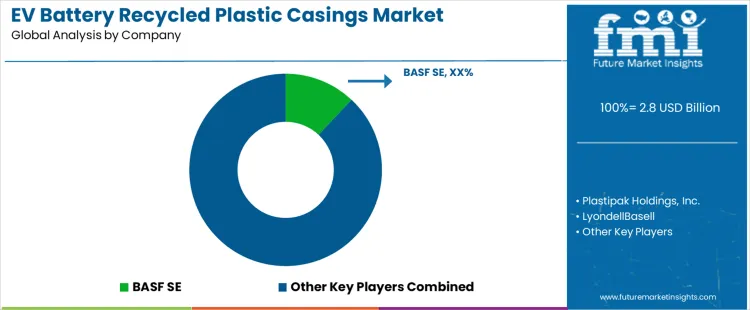
Competition in the EV Battery Recycled Plastic Casings Market is driven by material performance (impact resistance, flame retardance), recycled content quality, processability, cost competitiveness, and alignment with automotive OEM standards. BASF SE positions its offerings with advanced polymer blends that combine high recycled content with mechanical robustness suitable for rugged EV battery environments. Its product materials emphasize consistent quality, compliance with automotive specifications, and support for large-scale molding processes that help manufacturers meet safety and performance targets.
Plastipak Holdings, Inc. competes with tailored recycled plastic solutions engineered for battery enclosures, emphasizing optimized processing behavior and dimensional stability. Its brochures highlight custom resin formulation support and integration with high-volume injection molding lines. LyondellBasell and SABIC differentiate through broad recycled polymer portfolios that deliver good impact strength, thermal performance, and fit with existing recycling streams, marketed for ease of adoption into existing supply chains and tooling setups. Their documentation stresses drop-in compatibility and performance consistency that align with automotive OEM qualification requirements.
PolyOne (Avient Corporation) brings specialized recycled resin systems with enhanced surface quality and durability that support both structural and aesthetic casing needs, with collateral focused on formulation flexibility and color/finishing support. Others in the market contribute with niche recycled plastic grades and targeted compounding services for specific battery form factors or regional material sources. Across all vendors, product literature underscores mechanical performance, recycled content reliability, processing ease, and adherence to automotive quality standards as key differentiators that help EV manufacturers adopt recycled plastic casings without compromising structural integrity or production efficiency.
Key Players in EV Battery Recycled Plastic Casings Market
- BASF SE
- Plastipak Holdings, Inc.
- LyondellBasell
- SABIC
- PolyOne (Avient Corporation)
- Others
Scope of Report
| Attributes | Description |
|---|---|
| Quantitative Unit (2026) | USD Billion |
| Battery Type | Lithium-Ion (Li-ion) Batteries, Solid-State Batteries, Other Emerging Battery Types, Others |
| Application | Passenger Electric Vehicles, Commercial Electric Vehicles, Two-Wheelers & Light EVs, Others |
| Regions Covered | Asia Pacific, Europe, North America, Latin America, Middle East & Africa |
| Countries Covered | China, Japan, South Korea, India, Australia & New Zealand, ASEAN, Germany, United Kingdom, France, Italy, Spain, Nordic, BENELUX, United States, Canada, Mexico, Brazil, Chile, Turkey, South Africa, Other GCC Countries |
| Key Companies Profiled | BASF SE, Plastipak Holdings, Inc., LyondellBasell, SABIC, PolyOne (Avient Corporation), Others |
| Additional Attributes | Dollar sales by battery type and application; regional CAGR and growth outlook for the EV battery recycled plastic casings market. |
EV Battery Recycled Plastic Casings Market by Key Segments
Battery Type
- Lithium‑Ion (Li‑ion) Batteries
- Solid‑State Batteries
- Other Emerging Battery Types
- Others
Application
- Passenger Electric Vehicles
- Commercial Electric Vehicles
- Two‑Wheelers & Light EVs
- Others
Region:
- Asia Pacific
- China
- Japan
- South Korea
- India
- Australia & New Zealand
- ASEAN
- Rest of Asia Pacific
- Europe
- Germany
- United Kingdom
- France
- Italy
- Spain
- Nordic
- BENELUX
- Rest of Europe
- North America
- United States
- Canada
- Mexico
- Latin America
- Brazil
- Chile
- Rest of Latin America
- Middle East & Africa
- Kingdom of Saudi Arabia
- Other GCC Countries
- Turkey
- South Africa
- Other African Union
- Rest of Middle East & Africa
Bibliography
- European Commission Joint Research Centre. (2024). Plastics circularity in automotive and battery systems: recycled polymer applications and safety requirements. Publications Office of the European Union.
- International Energy Agency. (2024). Electric vehicle supply chains, battery materials, and circular economy pathways. IEA Publications.
- United Nations Environment Programme. (2025). Plastics recycling, circular materials, and sustainability in electric mobility systems. UNEP Chemicals and Health Branch.
- Organisation for Economic Co-operation and Development. (2024). Circular economy policies for plastics in automotive and battery manufacturing. OECD Environment, Health and Safety Programme.
- European Chemicals Agency. (2024). Safety assessment of recycled polymer materials used in automotive and battery casings under REACH. European Chemicals Agency.
Frequently Asked Questions
How big is the ev battery recycled plastic casings market in 2026?
The global ev battery recycled plastic casings market is estimated to be valued at USD 2.8 billion in 2026.
What will be the size of ev battery recycled plastic casings market in 2036?
The market size for the ev battery recycled plastic casings market is projected to reach USD 6.7 billion by 2036.
How much will be the ev battery recycled plastic casings market growth between 2026 and 2036?
The ev battery recycled plastic casings market is expected to grow at a 9.1% CAGR between 2026 and 2036.
What are the key product types in the ev battery recycled plastic casings market?
The key product types in ev battery recycled plastic casings market are lithium‑ion (li‑ion) batteries, solid‑state batteries, other emerging battery types and others.
Which application segment to contribute significant share in the ev battery recycled plastic casings market in 2026?
In terms of application, passenger electric vehicles segment to command 57.0% share in the ev battery recycled plastic casings market in 2026.
Preview the report firsthand - request a free sample
Get SampleGet the brochure for pricing and purchase details.
Get PDFTable of Content
- Executive Summary
- Global Market Outlook
- Demand-side Trends
- Supply-side Trends
- Technology Roadmap Analysis
- Analysis and Recommendations
- Market Overview
- Market Coverage / Taxonomy
- Market Definition / Scope / Limitations
- Market Background
- Market Dynamics
- Drivers
- Restraints
- Opportunity
- Trends
- Scenario Forecast
- Demand in Optimistic Scenario
- Demand in Likely Scenario
- Demand in Conservative Scenario
- Opportunity Map Analysis
- Product Life Cycle Analysis
- Supply Chain Analysis
- Investment Feasibility Matrix
- Value Chain Analysis
- PESTLE and Porter’s Analysis
- Regulatory Landscape
- Regional Parent Market Outlook
- Production and Consumption Statistics
- Import and Export Statistics
- Market Dynamics
- Global Market Analysis 2021 to 2025 and Forecast, 2026 to 2036
- Historical Market Size Value (USD Million) Analysis, 2021 to 2025
- Current and Future Market Size Value (USD Million) Projections, 2026 to 2036
- Y-o-Y Growth Trend Analysis
- Absolute $ Opportunity Analysis
- Global Market Pricing Analysis 2021 to 2025 and Forecast 2026 to 2036
- Global Market Analysis 2021 to 2025 and Forecast 2026 to 2036, By Battery Type
- Introduction / Key Findings
- Historical Market Size Value (USD Million) Analysis By Battery Type , 2021 to 2025
- Current and Future Market Size Value (USD Million) Analysis and Forecast By Battery Type , 2026 to 2036
- Lithium‑Ion (Li‑ion) Batteries
- Solid‑State Batteries
- Other Emerging Battery Types
- Others
- Lithium‑Ion (Li‑ion) Batteries
- Y-o-Y Growth Trend Analysis By Battery Type , 2021 to 2025
- Absolute $ Opportunity Analysis By Battery Type , 2026 to 2036
- Global Market Analysis 2021 to 2025 and Forecast 2026 to 2036, By Application
- Introduction / Key Findings
- Historical Market Size Value (USD Million) Analysis By Application, 2021 to 2025
- Current and Future Market Size Value (USD Million) Analysis and Forecast By Application, 2026 to 2036
- Passenger Electric Vehicles
- Commercial Electric Vehicles
- Two‑Wheelers & Light EVs
- Others
- Passenger Electric Vehicles
- Y-o-Y Growth Trend Analysis By Application, 2021 to 2025
- Absolute $ Opportunity Analysis By Application, 2026 to 2036
- Global Market Analysis 2021 to 2025 and Forecast 2026 to 2036, By Region
- Introduction
- Historical Market Size Value (USD Million) Analysis By Region, 2021 to 2025
- Current Market Size Value (USD Million) Analysis and Forecast By Region, 2026 to 2036
- North America
- Latin America
- Western Europe
- Eastern Europe
- East Asia
- South Asia and Pacific
- Middle East & Africa
- Market Attractiveness Analysis By Region
- North America Market Analysis 2021 to 2025 and Forecast 2026 to 2036, By Country
- Historical Market Size Value (USD Million) Trend Analysis By Market Taxonomy, 2021 to 2025
- Market Size Value (USD Million) Forecast By Market Taxonomy, 2026 to 2036
- By Country
- USA
- Canada
- Mexico
- By Battery Type
- By Application
- By Country
- Market Attractiveness Analysis
- By Country
- By Battery Type
- By Application
- Key Takeaways
- Latin America Market Analysis 2021 to 2025 and Forecast 2026 to 2036, By Country
- Historical Market Size Value (USD Million) Trend Analysis By Market Taxonomy, 2021 to 2025
- Market Size Value (USD Million) Forecast By Market Taxonomy, 2026 to 2036
- By Country
- Brazil
- Chile
- Rest of Latin America
- By Battery Type
- By Application
- By Country
- Market Attractiveness Analysis
- By Country
- By Battery Type
- By Application
- Key Takeaways
- Western Europe Market Analysis 2021 to 2025 and Forecast 2026 to 2036, By Country
- Historical Market Size Value (USD Million) Trend Analysis By Market Taxonomy, 2021 to 2025
- Market Size Value (USD Million) Forecast By Market Taxonomy, 2026 to 2036
- By Country
- Germany
- UK
- Italy
- Spain
- France
- Nordic
- BENELUX
- Rest of Western Europe
- By Battery Type
- By Application
- By Country
- Market Attractiveness Analysis
- By Country
- By Battery Type
- By Application
- Key Takeaways
- Eastern Europe Market Analysis 2021 to 2025 and Forecast 2026 to 2036, By Country
- Historical Market Size Value (USD Million) Trend Analysis By Market Taxonomy, 2021 to 2025
- Market Size Value (USD Million) Forecast By Market Taxonomy, 2026 to 2036
- By Country
- Russia
- Poland
- Hungary
- Balkan & Baltic
- Rest of Eastern Europe
- By Battery Type
- By Application
- By Country
- Market Attractiveness Analysis
- By Country
- By Battery Type
- By Application
- Key Takeaways
- East Asia Market Analysis 2021 to 2025 and Forecast 2026 to 2036, By Country
- Historical Market Size Value (USD Million) Trend Analysis By Market Taxonomy, 2021 to 2025
- Market Size Value (USD Million) Forecast By Market Taxonomy, 2026 to 2036
- By Country
- China
- Japan
- South Korea
- By Battery Type
- By Application
- By Country
- Market Attractiveness Analysis
- By Country
- By Battery Type
- By Application
- Key Takeaways
- South Asia and Pacific Market Analysis 2021 to 2025 and Forecast 2026 to 2036, By Country
- Historical Market Size Value (USD Million) Trend Analysis By Market Taxonomy, 2021 to 2025
- Market Size Value (USD Million) Forecast By Market Taxonomy, 2026 to 2036
- By Country
- India
- ASEAN
- Australia & New Zealand
- Rest of South Asia and Pacific
- By Battery Type
- By Application
- By Country
- Market Attractiveness Analysis
- By Country
- By Battery Type
- By Application
- Key Takeaways
- Middle East & Africa Market Analysis 2021 to 2025 and Forecast 2026 to 2036, By Country
- Historical Market Size Value (USD Million) Trend Analysis By Market Taxonomy, 2021 to 2025
- Market Size Value (USD Million) Forecast By Market Taxonomy, 2026 to 2036
- By Country
- Kingdom of Saudi Arabia
- Other GCC Countries
- Turkiye
- South Africa
- Other African Union
- Rest of Middle East & Africa
- By Battery Type
- By Application
- By Country
- Market Attractiveness Analysis
- By Country
- By Battery Type
- By Application
- Key Takeaways
- Key Countries Market Analysis
- USA
- Pricing Analysis
- Market Share Analysis, 2025
- By Battery Type
- By Application
- Canada
- Pricing Analysis
- Market Share Analysis, 2025
- By Battery Type
- By Application
- Mexico
- Pricing Analysis
- Market Share Analysis, 2025
- By Battery Type
- By Application
- Brazil
- Pricing Analysis
- Market Share Analysis, 2025
- By Battery Type
- By Application
- Chile
- Pricing Analysis
- Market Share Analysis, 2025
- By Battery Type
- By Application
- Germany
- Pricing Analysis
- Market Share Analysis, 2025
- By Battery Type
- By Application
- UK
- Pricing Analysis
- Market Share Analysis, 2025
- By Battery Type
- By Application
- Italy
- Pricing Analysis
- Market Share Analysis, 2025
- By Battery Type
- By Application
- Spain
- Pricing Analysis
- Market Share Analysis, 2025
- By Battery Type
- By Application
- France
- Pricing Analysis
- Market Share Analysis, 2025
- By Battery Type
- By Application
- India
- Pricing Analysis
- Market Share Analysis, 2025
- By Battery Type
- By Application
- ASEAN
- Pricing Analysis
- Market Share Analysis, 2025
- By Battery Type
- By Application
- Australia & New Zealand
- Pricing Analysis
- Market Share Analysis, 2025
- By Battery Type
- By Application
- China
- Pricing Analysis
- Market Share Analysis, 2025
- By Battery Type
- By Application
- Japan
- Pricing Analysis
- Market Share Analysis, 2025
- By Battery Type
- By Application
- South Korea
- Pricing Analysis
- Market Share Analysis, 2025
- By Battery Type
- By Application
- Russia
- Pricing Analysis
- Market Share Analysis, 2025
- By Battery Type
- By Application
- Poland
- Pricing Analysis
- Market Share Analysis, 2025
- By Battery Type
- By Application
- Hungary
- Pricing Analysis
- Market Share Analysis, 2025
- By Battery Type
- By Application
- Kingdom of Saudi Arabia
- Pricing Analysis
- Market Share Analysis, 2025
- By Battery Type
- By Application
- Turkiye
- Pricing Analysis
- Market Share Analysis, 2025
- By Battery Type
- By Application
- South Africa
- Pricing Analysis
- Market Share Analysis, 2025
- By Battery Type
- By Application
- USA
- Market Structure Analysis
- Competition Dashboard
- Competition Benchmarking
- Market Share Analysis of Top Players
- By Regional
- By Battery Type
- By Application
- Competition Analysis
- Competition Deep Dive
- BASF SE
- Overview
- Product Portfolio
- Profitability by Market Segments (Product/Age /Sales Channel/Region)
- Sales Footprint
- Strategy Overview
- Marketing Strategy
- Product Strategy
- Channel Strategy
- Plastipak Holdings, Inc.
- LyondellBasell
- SABIC
- PolyOne (Avient Corporation)
- Others
- BASF SE
- Competition Deep Dive
- Assumptions & Acronyms Used
- Research Methodology


