

- Industry Size (2026)
- USD 1480.0 Mn
- Forecast (2036)
- USD 4920.0 Mn
- CAGR (2026 to 2036)
- 12.80%
Battery Device Enclosure Market Using PCR Plastics Forecast and Outlook 2026 to 2036
The battery device enclosure market using PCR plastics is likely to be valued at USD 1,480.0 million in 2026, is set to reach USD 4,920.0 million by 2036, and is expected to expand at a 12.8% CAGR. Growth is being driven by battery makers and enclosure suppliers qualifying PCR-based polypropylene, ABS, and engineered blends for enclosure parts where mechanical protection, electrical insulation, and dimensional stability are non-negotiable.
Material substitution is being accelerated in high-volume enclosure components such as housings and frames, because these parts offer meaningful polymer throughput while remaining manufacturable via standardized injection-molding processes. Supply strategies are shifting toward direct sourcing and long-term arrangements with compounders and recyclers to reduce feedstock variability, stabilize properties, and maintain consistent color and surface finish for consumer-facing devices. Market adoption is being reinforced by advances in compounding, reinforcement, and flame-retardant formulations that improve thermal cycling performance and impact resistance under operating stress.
Quick Stats for Battery Device Enclosure Market Using PCR Plastics
- Battery Device Enclosure Market Using PCR Plastics Market Value (2026): USD 1,480.0 Million
- Battery Device Enclosure Market Using PCR Plastics Market Forecast Value (2036): USD 4,920.0 Million
- Battery Device Enclosure Market Using PCR Plastics Market Forecast CAGR 2026 to 2036: 12.80%
- Leading Enclosure Type in Battery Device Enclosure Market Using PCR Plastics: Battery Housings & Frames
- Key Growth Regions in Battery Device Enclosure Market Using PCR Plastics: Asia Pacific, Europe, North America
- Top Key Players in Battery Device Enclosure Market Using PCR Plastics: LG Chem Ltd., SABIC, Wanhua Chemical Group, Covestro AG, LANXESS AG, Avient Corporation, Teknor Apex Company, Mitsubishi Chemical Group Corporation
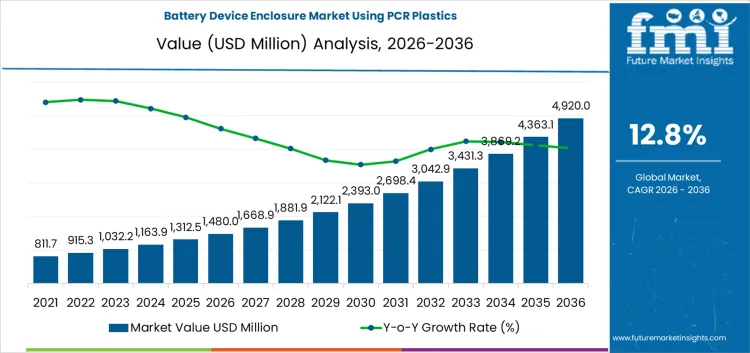
Battery Device Enclosure Market Using PCR Plastics Key Takeaways
| Metric | Value |
|---|---|
| Industry Value (2026) | USD 1,480.0 Million |
| Forecast Value (2036) | USD 4,920.0 Million |
| Forecast CAGR 2026 to 2036 | 12.80% |
How Is the Global Battery Device Enclosure Market Using PCR Plastics Advancing?
The global battery device enclosure market using PCR plastics is advancing rapidly, driven by rising adoption of recycled polymer materials in battery systems across electric vehicles, energy storage units, and electronic devices. Battery enclosures serve critical functions such as mechanical protection, electrical insulation, and thermal stability, making material performance a key consideration in enclosure design and manufacturing.
A key driver supporting market growth is the increasing qualification of PCR plastics for use in safety-critical enclosure components. Manufacturers are integrating PCR-based polypropylene, ABS, and engineering plastic blends into battery housings, covers, and structural frames to reduce dependence on virgin plastics while meeting strength, impact resistance, and dimensional stability requirements. This shift is particularly evident in EV battery packs and stationary energy storage systems, where enclosure volumes are large and material efficiency is a priority.
Expansion of global battery manufacturing capacity is further contributing to market demand. As battery production scales, enclosure suppliers are forming direct sourcing arrangements with recyclers and compounders to secure consistent PCR material quality and supply reliability. These arrangements help manage feedstock variability and support high-volume production requirements.
Technological advancements are strengthening market adoption. Improvements in PCR compounding processes, material reinforcement techniques, and flame-retardant formulations are enhancing enclosure performance under thermal and mechanical stress. As battery manufacturers continue to increase PCR content in non-cell components, the battery device enclosure market using PCR plastics is expected to experience strong growth over the forecast period.
What Is the Segment-Wise Overview of the Battery Device Enclosure Market Using PCR Plastics?
The battery device enclosure market using PCR plastics is driven by lightweighting needs, circular material adoption, and rising battery integration across consumer and industrial devices. Consumer electronics batteries lead the end-use segment with a 45% share, as smartphones, laptops, wearables, and portable electronics increasingly incorporate PCR plastics to meet regulatory and brand-level recycled content targets. These applications demand consistent aesthetics and mechanical integrity. By enclosure type, battery housings and frames dominate with a 50% share, reflecting their critical role in structural protection, thermal stability, and component integration. Together, these segments highlight a market focused on high-volume electronics, standardized enclosure formats, and scalable use of PCR plastics without compromising safety or performance.
Why Do Consumer Electronics Batteries Lead the Battery Device Enclosure Market Using PCR Plastics?
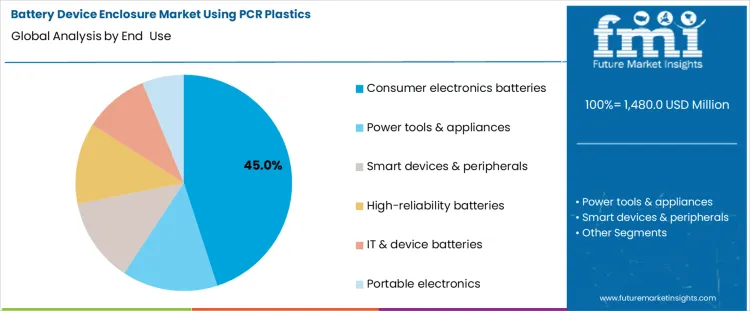
Consumer electronics batteries account for 45% of market demand because of the massive production volumes and strong recycled-content commitments from global device brands. Smartphones, laptops, tablets, and wearables require compact, lightweight enclosures with consistent surface finish and dimensional accuracy. PCR plastics are increasingly qualified for these applications as material processing and compounding quality improves. OEMs favor PCR-based enclosures to reduce virgin plastic use while maintaining drop resistance, heat tolerance, and aesthetic standards. Consumer electronics also face higher regulatory and consumer scrutiny, accelerating adoption of recycled materials in visible components. As device refresh cycles remain short and sustainability targets tighten, consumer electronics batteries continue to drive the largest share of PCR plastic enclosure demand.
How Do Battery Housings and Frames Drive Adoption in the PCR Plastic Enclosure Market?
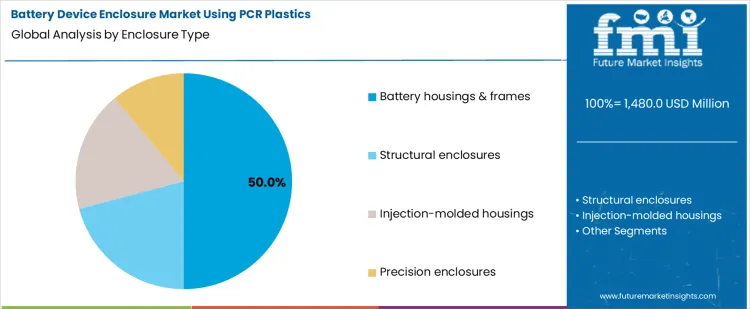
Battery housings and frames represent 50% of enclosure type demand, making them the dominant structural format in the battery device enclosure market using PCR plastics. These components provide mechanical protection, alignment, and mounting support for battery cells within devices. PCR plastics are well suited for housings and frames because they can be injection molded at scale while meeting strength, impact resistance, and dimensional stability requirements. OEMs prioritize these enclosure types for PCR integration as they offer high material volumes and standardized geometries, simplifying qualification. As batteries are embedded across more device categories, demand for robust, PCR-based housings and frames continues to rise, reinforcing their leadership in enclosure design.
What Are the Key Dynamics for the Battery Device Enclosure Market Using PCR Plastics Market?
The battery device enclosure market using PCR plastics market is driven by the need to reduce virgin plastic usage in battery housings while meeting safety, durability, and thermal performance requirements. Battery enclosures protect cells and modules from mechanical impact, heat exposure, moisture, and electrical interference across applications such as consumer electronics, electric mobility, and stationary energy storage. Key market dynamics include rising battery production volumes, regulatory pressure to increase recycled content, and OEM focus on circular material integration. Use of post-consumer recycled plastics requires controlled material sourcing, consistent compounding, and compliance with enclosure performance standards. As battery manufacturers redesign enclosures to align with material efficiency goals, demand for PCR-compatible enclosure solutions continues to strengthen.
Why Is the Battery Device Enclosure Market Using PCR Plastics Market Growing?
The battery device enclosure market using PCR plastics market is growing as global demand for batteries accelerates across electronics, electric vehicles, power tools, and energy storage systems. OEMs are seeking material strategies that lower environmental impact without compromising enclosure integrity or safety certifications. Regulatory recycled-content targets and corporate sustainability commitments are accelerating adoption of PCR plastics in non-load-bearing and semi-structural enclosure components. Advances in polymer purification and compounding are improving consistency of PCR materials used in enclosures. Volatility in virgin engineering plastic prices is also encouraging alternative sourcing. As battery manufacturing scales, enclosures represent a high-volume component where PCR plastics can be integrated with minimal disruption to performance requirements.
How Are the Key Drivers Shaping the Battery Device Enclosure Market Using PCR Plastics Market?
Key drivers shaping the battery device enclosure market using PCR plastics market include material innovation, regulatory compliance demands, and OEM-driven design optimization. Battery enclosure manufacturers are qualifying PCR plastic grades that meet flame-retardant, impact resistance, and heat deflection requirements. Collaboration between recyclers, compounders, and battery OEMs is enabling customized PCR formulations suited for injection molding and enclosure geometries. Design standardization and thickness optimization are supporting higher PCR incorporation without increasing failure risk. Digital traceability and material certification systems are influencing supplier selection and procurement models. These drivers are shifting enclosure sourcing decisions toward structured approaches that balance recycled content targets with safety, reliability, and manufacturability.
What Is the Growth Outlook for the Battery Device Enclosure Market Using PCR Plastic by Country?
| Country | CAGR (%) |
|---|---|
| China | 14.0% |
| India | 12.6% |
| Germany | 11.0% |
| USA | 10.4% |
| South Korea | 10.0% |
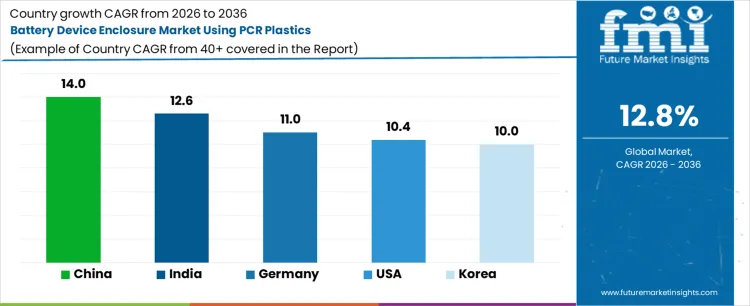
The battery device enclosure market using PCR plastic is expanding as OEMs align battery manufacturing with recycled-content goals. China leads with a 14.0% CAGR, driven by scale and integrated recycling. India follows at 12.6%, supported by expanding battery assembly and policy alignment. Germany grows at 11.0%, reflecting quality-led adoption. The USA records 10.4% growth, driven by EV and energy storage expansion. South Korea expands at 10.0%, supported by cautious, performance-focused integration. As battery markets scale globally, PCR plastic is becoming an increasingly important enclosure material.
Why Is the Battery Device Enclosure Market Using PCR Plastic Expanding Rapidly in China?
Demand for battery device enclosure market using PCR plastic in China is expanding at a CAGR of 14.0%. Rapid expansion of electric vehicles, stationary energy storage systems, and consumer electronics is generating high-volume demand for battery enclosures. OEMs are integrating PCR plastic into enclosure designs to meet recycled-content targets while maintaining mechanical strength and thermal stability. China’s vertically integrated battery ecosystem enables faster material qualification and scale-up. Closed-loop recycling programs linked to battery manufacturing improve PCR plastic availability and consistency. Export-oriented manufacturers favor PCR plastic to align with global compliance and customer expectations. Strong domestic recycling capacity supports reliable sourcing. As battery production continues to grow across mobility and energy storage segments, adoption of PCR plastic for device enclosures is expected to accelerate in China.
Why Is the Battery Device Enclosure Market Using PCR Plastic Gaining Momentum in India?
Demand for battery device enclosure market using PCR plastic in India is expanding at a CAGR of 12.6%. Growth in electric mobility, renewable energy storage, and portable electronics is increasing enclosure requirements. OEMs are adopting PCR plastic to align with regulatory expectations and internal material transition strategies. Battery enclosures require durability, impact resistance, and flame-retardant performance, which is driving qualification of higher-grade PCR plastic. Expansion of domestic battery assembly and recycling infrastructure is improving material confidence. Manufacturers value PCR plastic for its cost efficiency and compliance alignment. Integration with organized recycling networks supports supply stability. As India’s battery manufacturing ecosystem matures, use of PCR plastic in enclosure applications is expected to rise steadily.
What Is Supporting Growth of the Battery Device Enclosure Market Using PCR Plastic in Germany?
Sales for battery device enclosure market using PCR plastic in Germany is growing at a CAGR of 11.0%. Automotive electrification and industrial battery deployment are driving demand for advanced enclosure materials. German OEMs emphasize traceability, documentation, and performance consistency when integrating PCR plastic. Battery enclosures must meet strict safety and thermal regulations, encouraging structured qualification processes. Alignment with European recycling and reporting frameworks supports adoption. OEMs prioritize PCR plastic that fits lifecycle assessment and compliance requirements. Growth is driven mainly by material substitution rather than volume expansion. As Germany advances circular material strategies within battery manufacturing, adoption of PCR plastic for device enclosures continues to increase.
Why Is the Battery Device Enclosure Market Using PCR Plastic Advancing in the USA?
Demand for battery device enclosure market using PCR plastic in the USA is expanding at a CAGR of 10.4%. Expansion of EV production, grid-scale energy storage, and consumer electronics is increasing enclosure demand. OEMs are incorporating PCR plastic to support sustainability commitments and disclosure requirements. Battery enclosures benefit from PCR plastic grades qualified for mechanical strength and fire resistance. Integration of PCR sourcing with supplier audits and compliance systems supports adoption. Manufacturers seek stable supply and predictable material performance. Adoption is strongest among large OEMs with established qualification protocols. As battery deployment expands across sectors, demand for PCR plastic in enclosure manufacturing is expected to grow steadily in the USA.
Why Is the Battery Device Enclosure Market Using PCR Plastic Developing at a Measured Pace in South Korea?
Demand for battery device enclosure market using PCR plastic in South Korea is expanding at a CAGR of 10.0%. Strong battery cell and electronics manufacturing capacity supports enclosure demand. OEMs are cautiously integrating PCR plastic while maintaining strict safety and performance benchmarks. Battery enclosure applications require precise material control, leading to gradual PCR adoption. Export-oriented manufacturer’s value PCR plastic aligned with international compliance standards. Integration with internal testing and validation workflows supports controlled scaling. Recyclers capable of meeting specification requirements benefit from long-term partnerships. As South Korea continues to expand battery production, adoption of PCR plastic for enclosure applications is expected to grow steadily.
How Are Material Suppliers Competing in the Battery Device Enclosure Market Using PCR Plastics?
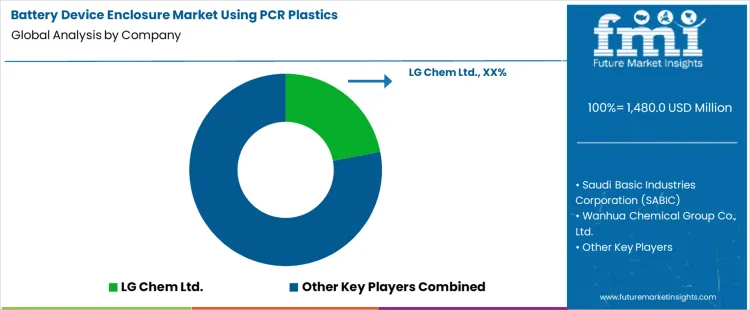
Competition in the battery device enclosure market using PCR plastics is being shaped by how effectively recycled polymers are engineered to meet thermal stability, flame retardancy, and mechanical integrity requirements. LG Chem Ltd. and Saudi Basic Industries Corporation (SABIC) are positioning PCR-based compounds as drop-in solutions for battery housings, as reflected in product brochures that emphasize consistency, safety compliance, and scalable supply. PCR content is being embedded into established resin families rather than introduced as niche grades, allowing adoption without major redesign. Wanhua Chemical Group Co., Ltd. and Covestro AG are competing through formulation science, with brochures highlighting impact-modified, heat-resistant, and electrically insulating PCR blends tailored for battery modules and packs.
LANXESS AG and Mitsubishi Chemical Group Corporation are competing through high-performance engineering plastics. Their product materials stress reinforced PCR polyamides, polycarbonates, and blends designed to maintain dimensional stability under thermal cycling and vibration. Emphasis is being placed on qualification support, long-term property retention, and compatibility with automated molding processes. Avient Corporation and Teknor Apex Company are positioned as specialist compounders. Their brochures focus on custom color, flame-retardant systems, and application-specific tuning of PCR content to meet OEM enclosure specifications. Flexibility and rapid formulation adjustment are being presented as competitive strengths, particularly for emerging battery formats and localized production needs.
Across the market, PCR plastics for battery enclosures are being positioned as engineered materials rather than recycled substitutes. Supplier strategies are being aligned around early-stage collaboration with battery and device manufacturers, enabling PCR grades to be validated alongside enclosure design and safety testing. Competitive advantage is being defined by the ability to balance recycled content with performance assurance, regulatory compliance, and supply reliability. As battery safety scrutiny intensifies, materials that deliver predictable behavior, documented traceability, and scalable PCR integration are being favored, positioning advanced compounders and resin producers at the center of enclosure material selection decisions.
Key Players in Battery Device Enclosure Market Using PCR Plastics
- LG Chem Ltd.
- Saudi Basic Industries Corporation (SABIC)
- Wanhua Chemical Group Co., Ltd.
- Covestro AG
- LANXESS AG
- Avient Corporation
- Teknor Apex Company
- Mitsubishi Chemical Group Corporation
Scope of Report
| Attributes | Description |
|---|---|
| Quantitative Unit (2026) | USD Million |
| End-use | Consumer Electronics Batteries, Power Tools & Appliances, Smart Devices & Peripherals, High-Reliability Batteries, IT & Device Batteries, Portable Electronics |
| Enclosure Type | Battery Housings & Frames, Structural Enclosures, Injection-Molded Housings, Precision Enclosures |
| Regions Covered | Asia Pacific, Europe, North America, Latin America, Middle East & Africa |
| Countries Covered | China, Japan, South Korea, India, Australia & New Zealand, ASEAN, Rest of Asia Pacific, Germany, United Kingdom, France, Italy, Spain, Nordic, BENELUX, Rest of Europe, United States, Canada, Mexico, Brazil, Chile, Rest of Latin America, Kingdom of Saudi Arabia, Other GCC Countries, Turkey, South Africa, Other African Union, Rest of Middle East & Africa |
| Key Companies Profiled | LG Chem Ltd., Saudi Basic Industries Corporation (SABIC), Wanhua Chemical Group Co., Ltd., Covestro AG, LANXESS AG, Avient Corporation, Teknor Apex Company, Mitsubishi Chemical Group Corporation |
| Additional Attributes | Dollar sales by end-use and enclosure type; regional market size and forecast analysis; growth outlook across major regions; adoption trends for PCR-based battery enclosure materials; assessment of mechanical strength, thermal resistance, regulatory compliance, and demand patterns across consumer electronics, IT devices, and high-reliability battery applications. |
Battery Device Enclosure Market Using PCR Plastics by Key Segments
End Use
- Consumer electronics batteries
- Power tools & appliances
- Smart devices & peripherals
- High-reliability batteries
- IT & device batteries
- Portable electronics
Enclosure Type
- Battery housings & frames
- Structural enclosures
- Injection-molded housings
- Precision enclosures
Region
- Asia Pacific
- China
- Japan
- South Korea
- India
- Australia & New Zealand
- ASEAN
- Rest of Asia Pacific
- Europe
- Germany
- United Kingdom
- France
- Italy
- Spain
- Nordic
- BENELUX
- Rest of Europe
- North America
- United States
- Canada
- Mexico
- Latin America
- Brazil
- Chile
- Rest of Latin America
- Middle East & Africa
- Kingdom of Saudi Arabia
- Other GCC Countries
- Turkey
- South Africa
- Other African Union
- Rest of Middle East & Africa
Bibliography
- Ministry of Environment, Forest and Climate Change (MoEFCC), Government of India. (2024, March 14). Battery Waste Management (Amendment) Rules, 2024 (Official Gazette PDF).
- Central Pollution Control Board (CPCB), Government of India. (2025, March 12). Battery Waste Management Rules (rules index page linking 2023/2024/2025 updates).
- Central Pollution Control Board (CPCB), Government of India. (2024, September 11). SOPs - Environmental Compensation (EC) guidelines under Battery Waste Management Rules, 2022 (updated SOP page used for compliance enforcement framing).
- USA Department of Energy (DOE). (2024, October). Circularity for Secure, Sustainable Products & Materials (report PDF; circularity pathways and design/recycling linkages relevant to PCR adoption).
- National Institute of Standards and Technology (NIST). (2024, October). The USA Plastics Recycling Economy: Current State, Challenges, and Opportunities
Frequently Asked Questions
How big is the battery device enclosure market using pcr plastics in 2026?
The global battery device enclosure market using pcr plastics is estimated to be valued at USD 1,480.0 million in 2026.
What will be the size of battery device enclosure market using pcr plastics in 2036?
The market size for the battery device enclosure market using pcr plastics is projected to reach USD 4,920.0 million by 2036.
How much will be the battery device enclosure market using pcr plastics growth between 2026 and 2036?
The battery device enclosure market using pcr plastics is expected to grow at a 12.8% CAGR between 2026 and 2036.
What are the key product types in the battery device enclosure market using pcr plastics?
The key product types in battery device enclosure market using pcr plastics are consumer electronics batteries, power tools & appliances, smart devices & peripherals, high-reliability batteries, it & device batteries and portable electronics.
Which enclosure type segment to contribute significant share in the battery device enclosure market using pcr plastics in 2026?
In terms of enclosure type, battery housings & frames segment to command 50.0% share in the battery device enclosure market using pcr plastics in 2026.
Preview the report firsthand - request a free sample
Get SampleGet the brochure for pricing and purchase details.
Get PDFTable of Content
- Executive Summary
- Global Market Outlook
- Demand-side Trends
- Supply-side Trends
- Technology Roadmap Analysis
- Analysis and Recommendations
- Market Overview
- Market Coverage / Taxonomy
- Market Definition / Scope / Limitations
- Market Background
- Market Dynamics
- Drivers
- Restraints
- Opportunity
- Trends
- Scenario Forecast
- Demand in Optimistic Scenario
- Demand in Likely Scenario
- Demand in Conservative Scenario
- Opportunity Map Analysis
- Product Life Cycle Analysis
- Supply Chain Analysis
- Investment Feasibility Matrix
- Value Chain Analysis
- PESTLE and Porter’s Analysis
- Regulatory Landscape
- Regional Parent Market Outlook
- Production and Consumption Statistics
- Import and Export Statistics
- Market Dynamics
- Global Market Analysis 2021 to 2025 and Forecast, 2026 to 2036
- Historical Market Size Value (USD Million) Analysis, 2021 to 2025
- Current and Future Market Size Value (USD Million) Projections, 2026 to 2036
- Y-o-Y Growth Trend Analysis
- Absolute $ Opportunity Analysis
- Global Market Pricing Analysis 2021 to 2025 and Forecast 2026 to 2036
- Global Market Analysis 2021 to 2025 and Forecast 2026 to 2036, By End Use
- Introduction / Key Findings
- Historical Market Size Value (USD Million) Analysis By End Use, 2021 to 2025
- Current and Future Market Size Value (USD Million) Analysis and Forecast By End Use, 2026 to 2036
- Consumer electronics batteries
- Power tools & appliances
- Smart devices & peripherals
- High-reliability batteries
- IT & device batteries
- Portable electronics
- Consumer electronics batteries
- Y-o-Y Growth Trend Analysis By End Use, 2021 to 2025
- Absolute $ Opportunity Analysis By End Use, 2026 to 2036
- Global Market Analysis 2021 to 2025 and Forecast 2026 to 2036, By Enclosure Type
- Introduction / Key Findings
- Historical Market Size Value (USD Million) Analysis By Enclosure Type, 2021 to 2025
- Current and Future Market Size Value (USD Million) Analysis and Forecast By Enclosure Type, 2026 to 2036
- Battery housings & frames
- Structural enclosures
- Injection-molded housings
- Precision enclosures
- Battery housings & frames
- Y-o-Y Growth Trend Analysis By Enclosure Type, 2021 to 2025
- Absolute $ Opportunity Analysis By Enclosure Type, 2026 to 2036
- Global Market Analysis 2021 to 2025 and Forecast 2026 to 2036, By Region
- Introduction
- Historical Market Size Value (USD Million) Analysis By Region, 2021 to 2025
- Current Market Size Value (USD Million) Analysis and Forecast By Region, 2026 to 2036
- North America
- Latin America
- Western Europe
- Eastern Europe
- East Asia
- South Asia and Pacific
- Middle East & Africa
- Market Attractiveness Analysis By Region
- North America Market Analysis 2021 to 2025 and Forecast 2026 to 2036, By Country
- Historical Market Size Value (USD Million) Trend Analysis By Market Taxonomy, 2021 to 2025
- Market Size Value (USD Million) Forecast By Market Taxonomy, 2026 to 2036
- By Country
- USA
- Canada
- Mexico
- By End Use
- By Enclosure Type
- By Country
- Market Attractiveness Analysis
- By Country
- By End Use
- By Enclosure Type
- Key Takeaways
- Latin America Market Analysis 2021 to 2025 and Forecast 2026 to 2036, By Country
- Historical Market Size Value (USD Million) Trend Analysis By Market Taxonomy, 2021 to 2025
- Market Size Value (USD Million) Forecast By Market Taxonomy, 2026 to 2036
- By Country
- Brazil
- Chile
- Rest of Latin America
- By End Use
- By Enclosure Type
- By Country
- Market Attractiveness Analysis
- By Country
- By End Use
- By Enclosure Type
- Key Takeaways
- Western Europe Market Analysis 2021 to 2025 and Forecast 2026 to 2036, By Country
- Historical Market Size Value (USD Million) Trend Analysis By Market Taxonomy, 2021 to 2025
- Market Size Value (USD Million) Forecast By Market Taxonomy, 2026 to 2036
- By Country
- Germany
- UK
- Italy
- Spain
- France
- Nordic
- BENELUX
- Rest of Western Europe
- By End Use
- By Enclosure Type
- By Country
- Market Attractiveness Analysis
- By Country
- By End Use
- By Enclosure Type
- Key Takeaways
- Eastern Europe Market Analysis 2021 to 2025 and Forecast 2026 to 2036, By Country
- Historical Market Size Value (USD Million) Trend Analysis By Market Taxonomy, 2021 to 2025
- Market Size Value (USD Million) Forecast By Market Taxonomy, 2026 to 2036
- By Country
- Russia
- Poland
- Hungary
- Balkan & Baltic
- Rest of Eastern Europe
- By End Use
- By Enclosure Type
- By Country
- Market Attractiveness Analysis
- By Country
- By End Use
- By Enclosure Type
- Key Takeaways
- East Asia Market Analysis 2021 to 2025 and Forecast 2026 to 2036, By Country
- Historical Market Size Value (USD Million) Trend Analysis By Market Taxonomy, 2021 to 2025
- Market Size Value (USD Million) Forecast By Market Taxonomy, 2026 to 2036
- By Country
- China
- Japan
- South Korea
- By End Use
- By Enclosure Type
- By Country
- Market Attractiveness Analysis
- By Country
- By End Use
- By Enclosure Type
- Key Takeaways
- South Asia and Pacific Market Analysis 2021 to 2025 and Forecast 2026 to 2036, By Country
- Historical Market Size Value (USD Million) Trend Analysis By Market Taxonomy, 2021 to 2025
- Market Size Value (USD Million) Forecast By Market Taxonomy, 2026 to 2036
- By Country
- India
- ASEAN
- Australia & New Zealand
- Rest of South Asia and Pacific
- By End Use
- By Enclosure Type
- By Country
- Market Attractiveness Analysis
- By Country
- By End Use
- By Enclosure Type
- Key Takeaways
- Middle East & Africa Market Analysis 2021 to 2025 and Forecast 2026 to 2036, By Country
- Historical Market Size Value (USD Million) Trend Analysis By Market Taxonomy, 2021 to 2025
- Market Size Value (USD Million) Forecast By Market Taxonomy, 2026 to 2036
- By Country
- Kingdom of Saudi Arabia
- Other GCC Countries
- Turkiye
- South Africa
- Other African Union
- Rest of Middle East & Africa
- By End Use
- By Enclosure Type
- By Country
- Market Attractiveness Analysis
- By Country
- By End Use
- By Enclosure Type
- Key Takeaways
- Key Countries Market Analysis
- USA
- Pricing Analysis
- Market Share Analysis, 2025
- By End Use
- By Enclosure Type
- Canada
- Pricing Analysis
- Market Share Analysis, 2025
- By End Use
- By Enclosure Type
- Mexico
- Pricing Analysis
- Market Share Analysis, 2025
- By End Use
- By Enclosure Type
- Brazil
- Pricing Analysis
- Market Share Analysis, 2025
- By End Use
- By Enclosure Type
- Chile
- Pricing Analysis
- Market Share Analysis, 2025
- By End Use
- By Enclosure Type
- Germany
- Pricing Analysis
- Market Share Analysis, 2025
- By End Use
- By Enclosure Type
- UK
- Pricing Analysis
- Market Share Analysis, 2025
- By End Use
- By Enclosure Type
- Italy
- Pricing Analysis
- Market Share Analysis, 2025
- By End Use
- By Enclosure Type
- Spain
- Pricing Analysis
- Market Share Analysis, 2025
- By End Use
- By Enclosure Type
- France
- Pricing Analysis
- Market Share Analysis, 2025
- By End Use
- By Enclosure Type
- India
- Pricing Analysis
- Market Share Analysis, 2025
- By End Use
- By Enclosure Type
- ASEAN
- Pricing Analysis
- Market Share Analysis, 2025
- By End Use
- By Enclosure Type
- Australia & New Zealand
- Pricing Analysis
- Market Share Analysis, 2025
- By End Use
- By Enclosure Type
- China
- Pricing Analysis
- Market Share Analysis, 2025
- By End Use
- By Enclosure Type
- Japan
- Pricing Analysis
- Market Share Analysis, 2025
- By End Use
- By Enclosure Type
- South Korea
- Pricing Analysis
- Market Share Analysis, 2025
- By End Use
- By Enclosure Type
- Russia
- Pricing Analysis
- Market Share Analysis, 2025
- By End Use
- By Enclosure Type
- Poland
- Pricing Analysis
- Market Share Analysis, 2025
- By End Use
- By Enclosure Type
- Hungary
- Pricing Analysis
- Market Share Analysis, 2025
- By End Use
- By Enclosure Type
- Kingdom of Saudi Arabia
- Pricing Analysis
- Market Share Analysis, 2025
- By End Use
- By Enclosure Type
- Turkiye
- Pricing Analysis
- Market Share Analysis, 2025
- By End Use
- By Enclosure Type
- South Africa
- Pricing Analysis
- Market Share Analysis, 2025
- By End Use
- By Enclosure Type
- USA
- Market Structure Analysis
- Competition Dashboard
- Competition Benchmarking
- Market Share Analysis of Top Players
- By Regional
- By End Use
- By Enclosure Type
- Competition Analysis
- Competition Deep Dive
- LG Chem Ltd.
- Overview
- Product Portfolio
- Profitability by Market Segments (Product/Age /Sales Channel/Region)
- Sales Footprint
- Strategy Overview
- Marketing Strategy
- Product Strategy
- Channel Strategy
- Saudi Basic Industries Corporation (SABIC)
- Wanhua Chemical Group Co., Ltd.
- Covestro AG
- LANXESS AG
- Avient Corporation
- Teknor Apex Company
- Mitsubishi Chemical Group Corporation
- LG Chem Ltd.
- Competition Deep Dive
- Assumptions & Acronyms Used
- Research Methodology


