

- Industry Size (2026)
- USD 1360 Mn
- Forecast (2036)
- USD 4820 Mn
- CAGR (2026 to 2036)
- 13.5%
Surface Enhancement Technologies for PCR Plastics Market Forecast and Outlook 2026 to 2036
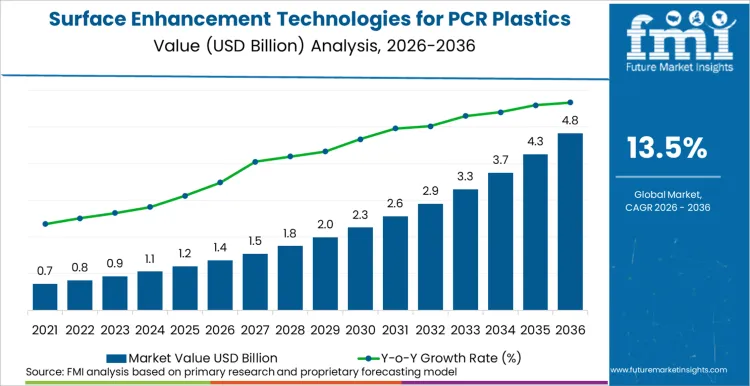
The surface enhancement technologies for PCR plastics market revenue is projected to total USD 1,360 million in 2026, increasing to USD 4,820 million by 2036, at a CAGR of 13.5%. FMI analysis indicates the market is undergoing a fundamental shift from applying generic, often performance-limiting coatings to developing chemically tailored surface systems that bond molecularly with PCR substrates.
The 2026-2027 period will be defined by the industrialization of low-temperature plasma and UV-LED curing processes that functionalize PCR surfaces without degrading the underlying polymer, crucial for thin-walled packaging and electronics housings.
Growth is anchored in the non-negotiable push to increase PCR use in premium and contact-sensitive applications while maintaining uncompromising safety and performance thresholds. Rather than a Q4 2025 amendment to EU cosmetics rules, the more defensible inflection point is industry-led safety standardization.
The CosPaTox voluntary guideline of April 2024 sets out a structured approach for the safety assessment of recycled PE/PP/LDPE used in cosmetic and home care packaging, explicitly noting that food-contact approvals cannot simply be assumed for these applications and that dedicated assessment is required. This has the practical effect of stimulating R&D into surface-compatible chemistries, functional coatings, and controlled finishing methods that reduce risk from contaminants while protecting product integrity.
AkzoNobel’s most verifiable recent development in this space is not a newly opened PCR surface center, but the launch of a professional-grade coatings series designed specifically for products made with post-consumer recycled plastics, positioned to make the use of recycled polymers more reliable and effective in demanding end-use environments such as consumer electronics. The signal here is important for your market: as PCR variability increases coatings engineered for adhesion stability and durability become an enabling layer for premium aesthetics and long-life performance.
Technical innovation is centered on compatibilization and adhesion promotion-especially where recycled substrates and multilayer structures historically failed recyclability screens. A concrete reference point is BASF’s September 2024 disclosure that studies with the cyclos-HTP Institute supported the classification of certain high-barrier PE/PA/EVOH and PE/PA structures as recyclable when adhesion and compatibility promoters are used. This is directly relevant to “surface enhancement for PCR plastics” because it validates a real-world pathway where interface engineering is treated as the key lever to maintain function without breaking recyclability
Barrier enhancement is simultaneously moving toward ultra-thin deposited layers and plasma-applied coatings that improve gas barrier while maintaining recyclability. Sidel’s Actis plasma coating received APR Design® for Recyclability Recognition reported in 2024-2025 coverage, reinforcing that plasma barrier approaches can be compatible with recycling expectations while delivering shelf-life benefits. KHS has publicly described the role of SiOx internal coatings in reducing gas permeation in PET bottles, evidencing the market’s push toward thin-film barrier solutions rather than heavy multilayer laminations.
On the supplier expansion side, a verifiable development from DIC is the establishment of a new sustainable production facility for coatings for direct food contact materials in Indonesia announced in August 2025. Complementing this direction, DIC has also publicly described ongoing work on oxygen barrier coatings and direct food contact coatings, aligning with the market’s focus on surface layers that compensate for performance variability in recycled substrates.
Summary of Surface Enhancement Technologies for PCR Plastics Market
What is the Long-Term Growth Outlook?
FMI projects the global market to expand from USD 1,360 million in 2026 to USD 4,820 million by 2036, registering a 13.5% CAGR. Market expansion reflects the indispensable role of surface engineering in unlocking the functional and aesthetic potential of PCR plastics for demanding applications. These technologies are no longer a cosmetic afterthought but are integral, value-adding processes that define the performance ceiling of recycled materials.
FMI Research Approach: This projection is derived from FMI's proprietary forecasting framework integrating analysis of brand material mandates, PCR quality benchmarking studies, regulatory shifts on chemical use in coatings, and primary interviews with surface treatment applicators and OEM design engineers.
How do FMI Analysts Expect the Market to Evolve Structurally?
FMI analysts anticipate a transition from a market defined by standalone coating suppliers to one dominated by integrated surface solution providers. These entities will combine expertise in polymer science, coating chemistry, and precision application physics. The market will fragment into high-precision segments for microelectronics, high-speed segments for packaging, and high-durability segments for automotive and durable goods.
FMI Research Approach: Insights are informed by analysis of patent filings in nano-coatings and plasma physics, technology roadmaps from OEMs in automotive and electronics, and material validation data from joint development projects between chemical companies and PCR compounders.
Which Geographies Command the Largest Share?
India leads in growth rate, advancing at an estimated 15.6% CAGR, driven by its booming domestic electronics manufacturing and packaging sectors rapidly adopting PCR with basic protective coatings. China follows with a 14.8% CAGR, supported by its massive scale in consumer goods production and aggressive investment in high-throughput, automated coating lines. The United States shows a 12.4% CAGR, propelled by innovation in low-VOC, sustainable coating systems for regulated markets and premium brands.
Germany and Japan represent high-value, precision-engineering markets, expanding at 12.0% and 10.6% CAGR, respectively. The automotive, luxury packaging, and precision device sectors fuel growth, where surface quality defines brand perception and technical performance.
FMI Research Approach: Country-level forecasts are built using analysis of regional manufacturing strengths (e.g., electronics in Korea, packaging in China), stringency of VOC and chemical regulations, and primary interviews with regional technical directors at coating applicator networks.
What are some Globally Distinct Trends Shaping the Market?
Globally, the dual forces of deep sustainability and digital manufacturing are shaping the market. The demand for coatings free from solvents, PFAS, and other chemicals of concern is driving a shift to UV, electron-beam, and plasma-based technologies. Simultaneously, the rise of Industry 4.0 allows for real-time, adaptive surface treatment where coating parameters are adjusted based on the spectral signature of the incoming PCR substrate, ensuring consistent results from variable feedstocks.
Furthermore, the functional integration of surfaces is a key trend. Coatings are expected to do more than protect and beautify; they must provide antimicrobial properties, static dissipation, or even integrated capacitive touch functionality for PCR components in smart devices and appliances.
FMI Research Approach: Trend analysis is informed by regulatory tracking of chemical frameworks (REACH, TSCA), technology roadmaps from industrial coating machinery manufacturers, and sustainability reports from global electronics and automotive OEMs.
Surface Enhancement Technologies for PCR Plastics Market Key Takeaways
| Metrics | Values |
|---|---|
| Expected Value (2026E) | USD 1,360 million |
| Projected Value (2036F) | USD 4,820 million |
| CAGR (2026-2036) | 13.5% |
Source: Future Market Insights (FMI) analysis, based on proprietary forecasting model and primary research
Why is the Surface Enhancement Technologies for PCR Plastics Market Growing?
The core driver is the severe technical mismatch between the growing mandate to use PCR and the performance requirements of end markets. PCR plastics typically suffer from reduced surface energy, making adhesion for printing and secondary assembly difficult. They often have inconsistent pigmentation, visible contaminants, and lower resistance to chemicals and abrasion. Surface enhancement technologies are the essential bridge to overcome these flaws. A 2026 study by the Society of Plastics Engineers found that a properly selected and applied surface treatment could improve the market value of a PCR-PET component by 40-300%, depending on the application, by enabling its use in a more demanding and higher-margin segment.
Furthermore, regulatory pressure is expanding from recycled content to full lifecycle impact, including chemical emissions. This is forcing a shift away from traditional solvent-based coatings towards advanced, low-environmental-impact technologies like plasma and UV curing. The total cost of ownership for these advanced technologies is falling as they become more energy-efficient and integrated into production lines, making them economically viable for mass markets like consumer packaging. Brands are now factoring the cost of mandatory surface enhancement into the business case for using PCR, viewing it not as an extra expense but as a necessary cost of compliance and quality assurance.
How is Surface Enhancement Technologies for PCR Plastics Market Segmented?
The market segmentation reflects the diverse performance needs across industries, from pure aesthetics to rigorous functional protection, and the technologies deployed to meet them.
How is the Cosmetic & Premium Packaging Segment Driving High-Value Innovation?
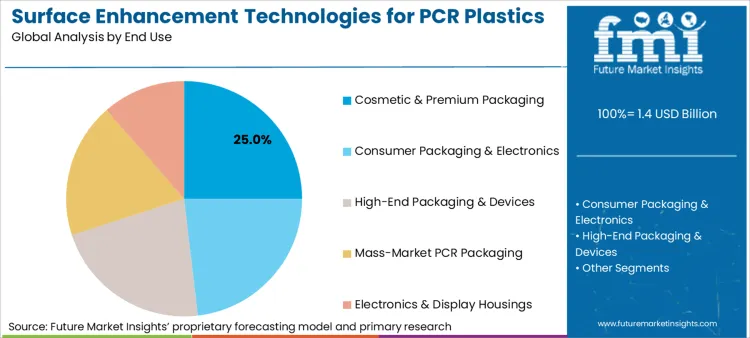
The cosmetic & premium packaging end-use segment commands a leading 25% value share and sets the benchmark for aesthetic excellence. This segment drives demand for coatings & surface texturing that can deliver flawless matte, soft-touch, or high-gloss finishes on PCR containers, often with complex curves.
In January 2026, a leading French perfume brand launched a bottle made from 100% PCR-PET, finished with a proprietary interferential coating by AkzoNobel that created a deep, color-shifting iridescence, completely masking the base resin's slight yellowness and elevating it to a luxury objet d'art.
Which Surface Technology Category is the Most Versatile and Widely Adopted?
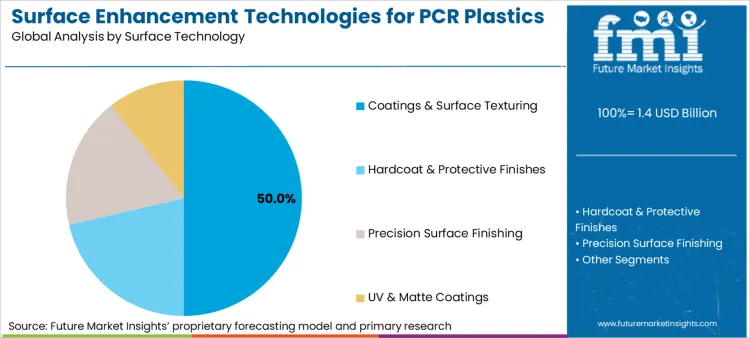
Coatings & surface texturing holds a dominant 50% share. This broad category includes liquid-applied coatings (paints, lacquers) and physical texturing methods (laser etching, molded-in texture). Its dominance is due to versatility; it can address both aesthetics and basic protection.
BASF's 2026 launch of its Texture-on-Demand laser system allows a single injection mold to produce PCR-PP parts with digitally variable textures from linen to leather grain by simply changing the laser program, offering mass customization for brand differentiation without new tooling costs.
What Substrate Blends Represent the Primary Challenge and Opportunity?
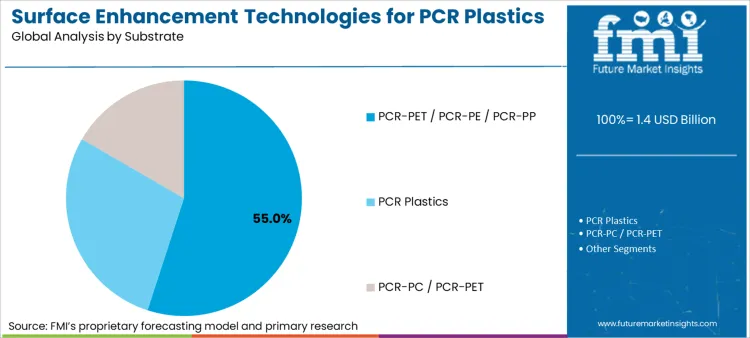
PCR-PET / PCR-PE / PCR-PP blends lead the substrate segment with a 55% share. This triad represents the most common and challenging stream of mixed polyolefins and polyester. The key innovation is in universal priming and coupling agents.
Sherwin-Williams' 2025 introduction of its EcoPrime silane-based primer creates a uniform, high-energy surface on these heterogeneous blends, enabling subsequent functional or decorative coatings to adhere with virgin-like reliability, a breakthrough for automotive interior trim and tool housings made from recycled streams.
Which Process Technology is Enabling Scalable, High-Performance Results?
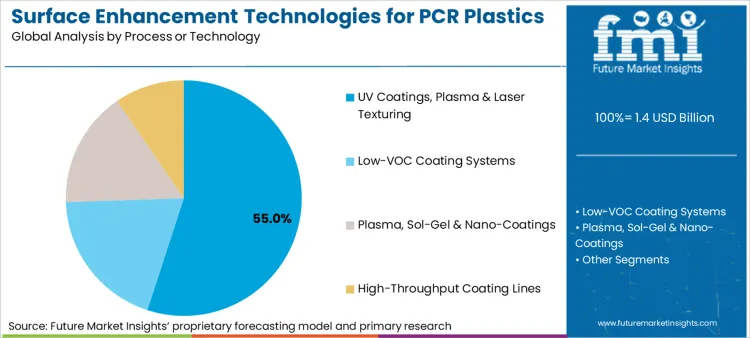
UV coatings, plasma & laser texturing is the pivotal process segment, accounting for 55% of focus. UV-curable coatings offer instant cure, low VOC, and excellent chemical resistance. Plasma treatment (corona, atmospheric) cleans and functionalizes the PCR surface at a molecular level, dramatically improving wettability and adhesion for inks and adhesives. Laser texturing provides permanent, precise aesthetic and functional patterns.
Together, they form a toolkit for inline, high-speed enhancement. Companies like Plasmatreat GmbH are leading with integrated systems that combine plasma pre-treatment with immediate UV coating application in a single pass, a solution critical for the high-volume production of PCR packaging and consumer goods.
What Drivers, Restraints, Opportunities, and Trends Prevail in the Market?
Market expansion is critically supported by brand owners' need for a consistent ‘brand feel’ across all materials, including PCR. The tactile and visual qualities of a product are key brand identifiers. In October 2025, Samsung Electronics mandated that all PCR-PC used in its device housings must achieve a specific haptic smoothness and gloss level, standardized by a proprietary laser scattering measurement. This drove its coating suppliers to develop new, ultra-thin UV-hard coats that could meet this spec on variable PCR substrates, creating a captive, high-value market segment.
While demand is robust, the industry faces significant technical restraints in treating complex PCR streams. The presence of unknown contaminants, polymer degradation products, and inconsistent additive packages in PCR can interfere with coating chemistry, leading to curing defects, hazing, or delamination. This necessitates extensive and costly pre-qualification testing for each new PCR source, acting as a brake on rapid feedstock switching and innovation.
Technical innovation is defined by multi-functional, ‘smart’ surfaces. PPG’s 2026 R&D showcase featured a transparent conductive oxide coating applied via low-temperature plasma to PCR-PET film. This coating provides both a gas barrier for flexible food packaging and enables integrated capacitive touch functionality, turning a simple recycled film into an interactive surface for smart packaging applications.
The shift toward digital and additive surface engineering represents a disruptive trend. The use of inkjet printing to apply functional coatings in precise, variable patterns such as localized release coatings or conductive traces eliminates waste and enables complex designs impossible with traditional spraying or dipping. This trend is opening new applications for PCR plastics in medical devices and wearable electronics, where precision and material sustainability are paramount.
Analysis of Surface Enhancement Technologies for PCR Plastics Market by Key Countries
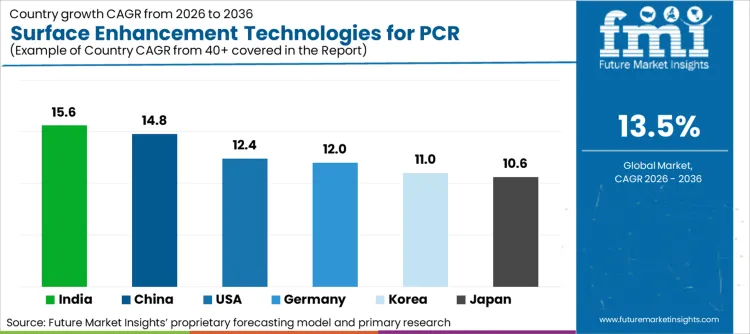
| Country | CAGR (2026–2036) |
|---|---|
| India | 15.6% |
| China | 14.8% |
| USA | 12.4% |
| Germany | 12.0% |
| Korea | 11.0% |
| Japan | 10.6% |
Source: Future Market Insights (FMI) analysis, based on proprietary forecasting model and primary research
How is India's Manufacturing Boom Driving Demand for Basic Protection?
India is projected to expand at a leading 15.6% CAGR through 2036, driven by its explosive growth in domestic electronics assembly, automotive component manufacturing, and FMCG packaging. The market focuses on cost-effective, high-throughput coating lines for mass-market PCR packaging.
Demand is for basic protective and aesthetic coatings that allow locally sourced, lower-cost PCR to be used in smartphones, small appliances, and household product packaging without appearing cheap, fueling growth for regional paint companies and applicators.
What Drives China's Scale and Automation in Surface Treatment?
China's 14.8% CAGR growth is fueled by its position as the world's factory for consumer goods and electronics. The focus is on automating surface enhancement to keep pace with vast production volumes.
Chinese equipment manufacturers like Sanzo are innovating in high-throughput, roll-to-roll plasma treatment lines and UV curing tunnels specifically calibrated for the high filler content and variable surface energy of domestic PCR-PP and PCR-ABS streams used in toys, electronics housings, and export packaging.
How do USA’s Regulations and Premium Brands Shape Coating Chemistry?
USA, growing at a 12.4% CAGR, is heavily influenced by VOC regulations (CARB, EPA) and the sustainability demands of premium brands. This environment demands low-VOC coating systems (20% process share). Companies like Sherwin-Williams and PPG are leaders in developing high-performance, waterborne acrylic and UV-cure polyurethane coatings for PCR plastics that meet both stringent emission standards and the durability requirements of outdoor equipment, sporting goods, and premium consumer packaging.
Why is Germany the European Hub for Precision and R&D?
Leadership in high-precision engineering for the automotive, machinery, and luxury packaging sectors underpins Germany’s 12.0% CAGR. The market demands precision surface finishing and advanced processes like plasma and sol-gel coatings.
German firms and research institutes like the Fraunhofer Society are at the forefront of developing nanoscale coatings that provide wear resistance, anti-fingerprint properties, and specific friction coefficients for PCR components in luxury cars and high-end appliances.
How is South Korea's Electronics Supremacy Directing Functional Surface Innovation?
South Korea's 11.0% CAGR is directly tied to its global dominance in consumer electronics and displays. The market for electronics & display housings is small in share but extremely high in value and technical demand.
South Korean companies like LG Chem and partners like Nippon Paint are pioneering functional hardcoats and anti-reflective, anti-static surface treatments for PCR-PC and PCR-PMMA used in TV bezels, laptop chassis, and smartphone structural components, where flawless finish and durability are non-negotiable.
What Factors Underpin Japan's Focus on Ultra-High Quality Finishes?
Japan's steady 10.6% CAGR reflects its uncompromising standards in high-end packaging, precision devices, and automotive interiors. Japanese chemical giants like DIC Corporation excel in precision surface finishing technologies.
Their focus is on flawless application, ultra-smooth or exquisitely textured finishes, and coatings that enhance the perceived quality and tactile experience of PCR components, ensuring they meet the meticulous quality expectations of Japanese consumers and industries.
What is the Competition Outlook for Surface Enhancement Technologies for PCR Plastics?
Competitive intensity reflects the need to master a complex value chain: understanding variable PCR substrates, formulating advanced chemistry, and mastering precision application physics. The landscape is bifurcating into Global Chemistry Integrators (e.g., BASF, AkzoNobel) who provide formulated solutions and Specialist Technology Providers (e.g., plasma equipment makers, laser texturing firms) who enable the application.
Strategic moves prior to 2025 involved building application labs and technical service teams dedicated to PCR challenges. Suppliers focused on building libraries of pre-qualified coating/primer combinations for major PCR streams from leading recyclers.
The observable strategic direction for 2026 and beyond is the formation of Surface Enhancement Alliances. Coating suppliers, PCR compounders, and OEMs are entering three-way development agreements. For example, a carmaker, a PCR compounder, and a coatings company jointly own the IP for a specific, qualified surface system for a dashboard component, sharing development cost and securing supply.
Strategic leadership is shifting toward providing Digital Surface Twins. In early 2026, a consortium led by BASF Coatings and a simulation software firm launched a digital platform that models how a specific coating will perform on a virtual PCR substrate with defined contaminants and morphology. This allows for virtual prototyping and drastically reduces the physical testing needed to qualify a new surface system, accelerating time-to-market for sustainable products.
Key Developments
- AkzoNobel continued advancing design-for-recycling coating concepts during 2024-2025, focusing on surface treatments and inks engineered to minimize interference with mechanical recycling processes. These developments support the use of coated PCR plastic packaging by emphasizing wash-off compatibility, reduced pigment loading, and chemical compositions aligned with established recycling streams.
- PPG Industries expanded its sustainable coatings portfolio in 2024-2025 by developing barrier and protective coating technologies intended to improve durability and functional performance of plastic packaging substrates, including recycled-content materials. Public disclosures emphasize material health, regulatory compliance, and compatibility with circular packaging objectives rather than product-specific Cradle to Cradle certifications for PCR food trays.
- DIC Corporation continued commercial development of functional coating and additive technologies aimed at enhancing barrier performance in plastic packaging during 2024-2025. These solutions, including oxygen-management and shelf-life extension systems, are positioned to support higher recycled content in PET packaging by mitigating performance variability associated with post-consumer resins.
Key Players Profiled
- AkzoNobel N.V.
- BASF SE (Coatings Division)
- PPG Industries, Inc.
- The Sherwin-Williams Company
- DIC Corporation
- Nippon Paint Holdings Co., Ltd.
- Kansai Paint Co., Ltd.
- Axalta Coating Systems Ltd.
- Plasmatreat GmbH
- Sanzo (Shanghai) Precision Machinery Co., Ltd.
Market Definition
The surface enhancement technologies for PCR plastics market comprises revenue generated from specialty chemicals, equipment, and related services used to modify the surface properties of Post-Consumer Recycled (PCR) plastic components and packaging. This includes functional coatings (protective, barrier, conductive), aesthetic finishes (paints, textures), and physical/chemical surface treatments (plasma, corona, laser) specifically engineered to address the deficiencies and variability of PCR substrates.
The market encompasses the value of the chemicals, application machinery, process technology licensing, and associated technical consultancy required to achieve performance parity with or exceed virgin plastic surfaces. The scope is limited to treatments applied to molded, extruded, or formed PCR plastic items, excluding bulk compounding additives.
Scope of Report
| Items | Values |
|---|---|
| Quantitative Units | USD 1,360 million (2026) |
| End Use | Cosmetic & Premium Packaging, Consumer Packaging & Electronics, High-End Packaging & Devices, Mass-Market PCR Packaging, Electronics & Display Housings, Others |
| Surface Technology | Coatings & Surface Texturing, Hardcoat & Protective Finishes, Precision Surface Finishing, UV & Matte Coatings, Others |
| Substrate | PCR-PET / PCR-PE / PCR-PP, PCR Plastics, PCR-PC / PCR-PET, Others |
| Process / Technology | UV Coatings, Plasma & Laser Texturing, Low-VOC Coating Systems, Plasma, Sol-Gel & Nano-Coatings, High-Throughput Coating Lines, Others |
| Regions Covered | North America, Western Europe, Eastern Europe, East Asia, South Asia & Pacific, Latin America, Middle East & Africa |
| Countries | Germany, USA, Japan, China, Korea, India and 40+ countries |
| Key Companies | AkzoNobel, BASF Coatings, PPG Industries, Sherwin-Williams, DIC Corporation, Nippon Paint, Kansai Paint, Axalta, Plasmatreat, Sanzo |
Source: Future Market Insights (FMI) analysis, based on proprietary forecasting model and primary research
Surface Enhancement Technologies for PCR Plastics Market Key Segments
By End Use:
- Cosmetic & Premium Packaging
- Consumer Packaging & Electronics
- High-End Packaging & Devices
- Mass-Market PCR Packaging
- Electronics & Display Housings
By Surface Technology:
- Coatings & Surface Texturing
- Hardcoat & Protective Finishes
- Precision Surface Finishing
- UV & Matte Coatings
By Substrate:
- PCR-PET / PCR-PE / PCR-PP
- PCR Plastics
- PCR-PC / PCR-PET
- Others
By Process or Technology:
- UV Coatings, Plasma & Laser Texturing
- Low-VOC Coating Systems
- Plasma, Sol-Gel & Nano-Coatings
- High-Throughput Coating Lines
- Others
By Region:
- North America
- Western Europe
- Eastern Europe
- East Asia
- South Asia & Pacific
- Latin America
- Middle East & Africa
Bibliography
- European Chemicals Agency (ECHA). (2025). Guidance on the Assessment of Coatings for Food Contact Materials Containing PCR.
- AkzoNobel. (2026). Sustainability Report: Surface Science for the Circular Economy.
- BASF SE. (2025). Innovation Report: Coatings Division – Advanced Materials for PCR.
- Society of Plastics Engineers (SPE). (2026). Technical White Paper: Surface Treatment Solutions for Post-Consumer Resins.
- PPG Industries. (2026). Strategic Update: Applied Surface Technologies and Functional Coatings.
- Fraunhofer Institute for Process Engineering and Packaging IVV. (2026). Study on the Performance of Enhanced PCR Surfaces in Barrier Applications.
Frequently Asked Questions
How big is the surface enhancement technologies for pcr plastics market in 2026?
The global surface enhancement technologies for pcr plastics market is estimated to be valued at USD 1.4 billion in 2026.
What will be the size of surface enhancement technologies for pcr plastics market in 2036?
The market size for the surface enhancement technologies for pcr plastics market is projected to reach USD 4.8 billion by 2036.
How much will be the surface enhancement technologies for pcr plastics market growth between 2026 and 2036?
The surface enhancement technologies for pcr plastics market is expected to grow at a 13.5% CAGR between 2026 and 2036.
What are the key product types in the surface enhancement technologies for pcr plastics market?
The key product types in surface enhancement technologies for pcr plastics market are cosmetic & premium packaging , consumer packaging & electronics, high-end packaging & devices, mass-market pcr packaging and electronics & display housings.
Which surface technology segment to contribute significant share in the surface enhancement technologies for pcr plastics market in 2026?
In terms of surface technology, coatings & surface texturing segment to command 50.0% share in the surface enhancement technologies for pcr plastics market in 2026.
Preview the report firsthand - request a free sample
Get SampleGet the brochure for pricing and purchase details.
Get PDFTable of Content
- Executive Summary
- Global Market Outlook
- Demand-side Trends
- Supply-side Trends
- Technology Roadmap Analysis
- Analysis and Recommendations
- Market Overview
- Market Coverage / Taxonomy
- Market Definition / Scope / Limitations
- Research Methodology
- Chapter Orientation
- Analytical Lens and Working Hypotheses
- Market Structure, Signals, and Trend Drivers
- Benchmarking and Cross-market Comparability
- Market Sizing, Forecasting, and Opportunity Mapping
- Research Design and Evidence Framework
- Desk Research Programme (Secondary Evidence)
- Company Annual and Sustainability Reports
- Peer-reviewed Journals and Academic Literature
- Corporate Websites, Product Literature, and Technical Notes
- Earnings Decks and Investor Briefings
- Statutory Filings and Regulatory Disclosures
- Technical White Papers and Standards Notes
- Trade Journals, Industry Magazines, and Analyst Briefs
- Conference Proceedings, Webinars, and Seminar Materials
- Government Statistics Portals and Public Data Releases
- Press Releases and Reputable Media Coverage
- Specialist Newsletters and Curated Briefings
- Sector Databases and Reference Repositories
- FMI Internal Proprietary Databases and Historical Market Datasets
- Subscription Datasets and Paid Sources
- Social Channels, Communities, and Digital Listening Inputs
- Additional Desk Sources
- Expert Input and Fieldwork (Primary Evidence)
- Primary Modes
- Qualitative Interviews and Expert Elicitation
- Quantitative Surveys and Structured Data Capture
- Blended Approach
- Why Primary Evidence is Used
- Field Techniques
- Interviews
- Surveys
- Focus Groups
- Observational and In-context Research
- Social and Community Interactions
- Stakeholder Universe Engaged
- C-suite Leaders
- Board Members
- Presidents and Vice Presidents
- R&D and Innovation Heads
- Technical Specialists
- Domain Subject-matter Experts
- Scientists
- Physicians and Other Healthcare Professionals
- Governance, Ethics, and Data Stewardship
- Research Ethics
- Data Integrity and Handling
- Primary Modes
- Tooling, Models, and Reference Databases
- Desk Research Programme (Secondary Evidence)
- Data Engineering and Model Build
- Data Acquisition and Ingestion
- Cleaning, Normalisation, and Verification
- Synthesis, Triangulation, and Analysis
- Quality Assurance and Audit Trail
- Market Background
- Market Dynamics
- Drivers
- Restraints
- Opportunity
- Trends
- Scenario Forecast
- Demand in Optimistic Scenario
- Demand in Likely Scenario
- Demand in Conservative Scenario
- Opportunity Map Analysis
- Product Life Cycle Analysis
- Supply Chain Analysis
- Investment Feasibility Matrix
- Value Chain Analysis
- PESTLE and Porter’s Analysis
- Regulatory Landscape
- Regional Parent Market Outlook
- Production and Consumption Statistics
- Import and Export Statistics
- Market Dynamics
- Global Market Analysis 2021 to 2025 and Forecast, 2026 to 2036
- Historical Market Size Value (USD Million) Analysis, 2021 to 2025
- Current and Future Market Size Value (USD Million) Projections, 2026 to 2036
- Y-o-Y Growth Trend Analysis
- Absolute $ Opportunity Analysis
- Global Market Pricing Analysis 2021 to 2025 and Forecast 2026 to 2036
- Global Market Analysis 2021 to 2025 and Forecast 2026 to 2036, By End Use
- Introduction / Key Findings
- Historical Market Size Value (USD Million) Analysis By End Use , 2021 to 2025
- Current and Future Market Size Value (USD Million) Analysis and Forecast By End Use , 2026 to 2036
- Cosmetic & Premium Packaging
- Consumer Packaging & Electronics
- High-End Packaging & Devices
- Mass-Market PCR Packaging
- Electronics & Display Housings
- Cosmetic & Premium Packaging
- Y-o-Y Growth Trend Analysis By End Use , 2021 to 2025
- Absolute $ Opportunity Analysis By End Use , 2026 to 2036
- Global Market Analysis 2021 to 2025 and Forecast 2026 to 2036, By Surface Technology
- Introduction / Key Findings
- Historical Market Size Value (USD Million) Analysis By Surface Technology, 2021 to 2025
- Current and Future Market Size Value (USD Million) Analysis and Forecast By Surface Technology, 2026 to 2036
- Coatings & Surface Texturing
- Hardcoat & Protective Finishes
- Precision Surface Finishing
- UV & Matte Coatings
- Coatings & Surface Texturing
- Y-o-Y Growth Trend Analysis By Surface Technology, 2021 to 2025
- Absolute $ Opportunity Analysis By Surface Technology, 2026 to 2036
- Global Market Analysis 2021 to 2025 and Forecast 2026 to 2036, By Substrate
- Introduction / Key Findings
- Historical Market Size Value (USD Million) Analysis By Substrate, 2021 to 2025
- Current and Future Market Size Value (USD Million) Analysis and Forecast By Substrate, 2026 to 2036
- PCR-PET / PCR-PE / PCR-PP
- PCR Plastics
- PCR-PC / PCR-PET
- PCR-PET / PCR-PE / PCR-PP
- Y-o-Y Growth Trend Analysis By Substrate, 2021 to 2025
- Absolute $ Opportunity Analysis By Substrate, 2026 to 2036
- Global Market Analysis 2021 to 2025 and Forecast 2026 to 2036, By Process or Technology
- Introduction / Key Findings
- Historical Market Size Value (USD Million) Analysis By Process or Technology, 2021 to 2025
- Current and Future Market Size Value (USD Million) Analysis and Forecast By Process or Technology, 2026 to 2036
- UV Coatings, Plasma & Laser Texturing
- Low-VOC Coating Systems
- Plasma, Sol-Gel & Nano-Coatings
- High-Throughput Coating Lines
- UV Coatings, Plasma & Laser Texturing
- Y-o-Y Growth Trend Analysis By Process or Technology, 2021 to 2025
- Absolute $ Opportunity Analysis By Process or Technology, 2026 to 2036
- Global Market Analysis 2021 to 2025 and Forecast 2026 to 2036, By Region
- Introduction
- Historical Market Size Value (USD Million) Analysis By Region, 2021 to 2025
- Current Market Size Value (USD Million) Analysis and Forecast By Region, 2026 to 2036
- North America
- Latin America
- Western Europe
- Eastern Europe
- East Asia
- South Asia and Pacific
- Middle East & Africa
- Market Attractiveness Analysis By Region
- North America Market Analysis 2021 to 2025 and Forecast 2026 to 2036, By Country
- Historical Market Size Value (USD Million) Trend Analysis By Market Taxonomy, 2021 to 2025
- Market Size Value (USD Million) Forecast By Market Taxonomy, 2026 to 2036
- By Country
- USA
- Canada
- Mexico
- By End Use
- By Surface Technology
- By Substrate
- By Process or Technology
- By Country
- Market Attractiveness Analysis
- By Country
- By End Use
- By Surface Technology
- By Substrate
- By Process or Technology
- Key Takeaways
- Latin America Market Analysis 2021 to 2025 and Forecast 2026 to 2036, By Country
- Historical Market Size Value (USD Million) Trend Analysis By Market Taxonomy, 2021 to 2025
- Market Size Value (USD Million) Forecast By Market Taxonomy, 2026 to 2036
- By Country
- Brazil
- Chile
- Rest of Latin America
- By End Use
- By Surface Technology
- By Substrate
- By Process or Technology
- By Country
- Market Attractiveness Analysis
- By Country
- By End Use
- By Surface Technology
- By Substrate
- By Process or Technology
- Key Takeaways
- Western Europe Market Analysis 2021 to 2025 and Forecast 2026 to 2036, By Country
- Historical Market Size Value (USD Million) Trend Analysis By Market Taxonomy, 2021 to 2025
- Market Size Value (USD Million) Forecast By Market Taxonomy, 2026 to 2036
- By Country
- Germany
- UK
- Italy
- Spain
- France
- Nordic
- BENELUX
- Rest of Western Europe
- By End Use
- By Surface Technology
- By Substrate
- By Process or Technology
- By Country
- Market Attractiveness Analysis
- By Country
- By End Use
- By Surface Technology
- By Substrate
- By Process or Technology
- Key Takeaways
- Eastern Europe Market Analysis 2021 to 2025 and Forecast 2026 to 2036, By Country
- Historical Market Size Value (USD Million) Trend Analysis By Market Taxonomy, 2021 to 2025
- Market Size Value (USD Million) Forecast By Market Taxonomy, 2026 to 2036
- By Country
- Russia
- Poland
- Hungary
- Balkan & Baltic
- Rest of Eastern Europe
- By End Use
- By Surface Technology
- By Substrate
- By Process or Technology
- By Country
- Market Attractiveness Analysis
- By Country
- By End Use
- By Surface Technology
- By Substrate
- By Process or Technology
- Key Takeaways
- East Asia Market Analysis 2021 to 2025 and Forecast 2026 to 2036, By Country
- Historical Market Size Value (USD Million) Trend Analysis By Market Taxonomy, 2021 to 2025
- Market Size Value (USD Million) Forecast By Market Taxonomy, 2026 to 2036
- By Country
- China
- Japan
- South Korea
- By End Use
- By Surface Technology
- By Substrate
- By Process or Technology
- By Country
- Market Attractiveness Analysis
- By Country
- By End Use
- By Surface Technology
- By Substrate
- By Process or Technology
- Key Takeaways
- South Asia and Pacific Market Analysis 2021 to 2025 and Forecast 2026 to 2036, By Country
- Historical Market Size Value (USD Million) Trend Analysis By Market Taxonomy, 2021 to 2025
- Market Size Value (USD Million) Forecast By Market Taxonomy, 2026 to 2036
- By Country
- India
- ASEAN
- Australia & New Zealand
- Rest of South Asia and Pacific
- By End Use
- By Surface Technology
- By Substrate
- By Process or Technology
- By Country
- Market Attractiveness Analysis
- By Country
- By End Use
- By Surface Technology
- By Substrate
- By Process or Technology
- Key Takeaways
- Middle East & Africa Market Analysis 2021 to 2025 and Forecast 2026 to 2036, By Country
- Historical Market Size Value (USD Million) Trend Analysis By Market Taxonomy, 2021 to 2025
- Market Size Value (USD Million) Forecast By Market Taxonomy, 2026 to 2036
- By Country
- Kingdom of Saudi Arabia
- Other GCC Countries
- Turkiye
- South Africa
- Other African Union
- Rest of Middle East & Africa
- By End Use
- By Surface Technology
- By Substrate
- By Process or Technology
- By Country
- Market Attractiveness Analysis
- By Country
- By End Use
- By Surface Technology
- By Substrate
- By Process or Technology
- Key Takeaways
- Key Countries Market Analysis
- USA
- Pricing Analysis
- Market Share Analysis, 2025
- By End Use
- By Surface Technology
- By Substrate
- By Process or Technology
- Canada
- Pricing Analysis
- Market Share Analysis, 2025
- By End Use
- By Surface Technology
- By Substrate
- By Process or Technology
- Mexico
- Pricing Analysis
- Market Share Analysis, 2025
- By End Use
- By Surface Technology
- By Substrate
- By Process or Technology
- Brazil
- Pricing Analysis
- Market Share Analysis, 2025
- By End Use
- By Surface Technology
- By Substrate
- By Process or Technology
- Chile
- Pricing Analysis
- Market Share Analysis, 2025
- By End Use
- By Surface Technology
- By Substrate
- By Process or Technology
- Germany
- Pricing Analysis
- Market Share Analysis, 2025
- By End Use
- By Surface Technology
- By Substrate
- By Process or Technology
- UK
- Pricing Analysis
- Market Share Analysis, 2025
- By End Use
- By Surface Technology
- By Substrate
- By Process or Technology
- Italy
- Pricing Analysis
- Market Share Analysis, 2025
- By End Use
- By Surface Technology
- By Substrate
- By Process or Technology
- Spain
- Pricing Analysis
- Market Share Analysis, 2025
- By End Use
- By Surface Technology
- By Substrate
- By Process or Technology
- France
- Pricing Analysis
- Market Share Analysis, 2025
- By End Use
- By Surface Technology
- By Substrate
- By Process or Technology
- India
- Pricing Analysis
- Market Share Analysis, 2025
- By End Use
- By Surface Technology
- By Substrate
- By Process or Technology
- ASEAN
- Pricing Analysis
- Market Share Analysis, 2025
- By End Use
- By Surface Technology
- By Substrate
- By Process or Technology
- Australia & New Zealand
- Pricing Analysis
- Market Share Analysis, 2025
- By End Use
- By Surface Technology
- By Substrate
- By Process or Technology
- China
- Pricing Analysis
- Market Share Analysis, 2025
- By End Use
- By Surface Technology
- By Substrate
- By Process or Technology
- Japan
- Pricing Analysis
- Market Share Analysis, 2025
- By End Use
- By Surface Technology
- By Substrate
- By Process or Technology
- South Korea
- Pricing Analysis
- Market Share Analysis, 2025
- By End Use
- By Surface Technology
- By Substrate
- By Process or Technology
- Russia
- Pricing Analysis
- Market Share Analysis, 2025
- By End Use
- By Surface Technology
- By Substrate
- By Process or Technology
- Poland
- Pricing Analysis
- Market Share Analysis, 2025
- By End Use
- By Surface Technology
- By Substrate
- By Process or Technology
- Hungary
- Pricing Analysis
- Market Share Analysis, 2025
- By End Use
- By Surface Technology
- By Substrate
- By Process or Technology
- Kingdom of Saudi Arabia
- Pricing Analysis
- Market Share Analysis, 2025
- By End Use
- By Surface Technology
- By Substrate
- By Process or Technology
- Turkiye
- Pricing Analysis
- Market Share Analysis, 2025
- By End Use
- By Surface Technology
- By Substrate
- By Process or Technology
- South Africa
- Pricing Analysis
- Market Share Analysis, 2025
- By End Use
- By Surface Technology
- By Substrate
- By Process or Technology
- USA
- Market Structure Analysis
- Competition Dashboard
- Competition Benchmarking
- Market Share Analysis of Top Players
- By Regional
- By End Use
- By Surface Technology
- By Substrate
- By Process or Technology
- Competition Analysis
- Competition Deep Dive
- Competition Deep Dive
- Assumptions & Acronyms Used


