

- Industry Size (2026)
- USD 165.0 Mn
- Forecast (2036)
- USD 520.0 Mn
- CAGR (2026 to 2036)
- 11.8%
Food-Grade PCR Plastics Compliance Services Market Size, Market Forecast and Outlook By FMI
In 2025, Food-Grade PCR Plastics Compliance Services measured USD 145.0 million. Projections of USD 165.0 million for 2026 and USD 520.0 million by 2036 imply an 11.8% CAGR as compliance gates narrow procurement options.
As regulatory thresholds increase, minimum qualification standards for secondary material suppliers continue to tighten. During 2024 and 2025, authorities issued favorable opinions on more than 400 food-contact recycling processes, requiring buyers to conduct mandatory analytical audits [1]. Procurement is now concentrated within pre-approved windows, rewarding testing and validation providers that can deliver faster technical reviews and documented material verification.
Summary of Food-Grade PCR Plastics Compliance Services
- Food-Grade PCR Plastics Compliance Services Market Definition:
- Verification frameworks validate recycled polymer safety for consumer ingestion boundaries.
- Demand Drivers in the Market:
- Regulatory bodies imposing minimum recycled content mandates.
- Brand commitments accelerating traceability requirements.
- Complex contamination profiles in post-consumer streams demanding advanced analytics.
- Key Segments Analyzed in the FMI Report:
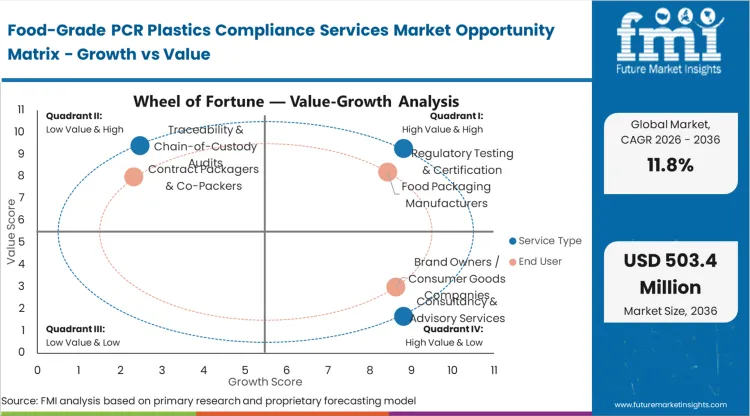
- Service Type: Regulatory testing & certification (38%) versus consultancy, traceability audits, and QA analytics.
- End User Segment: Food packaging manufacturers (46% of total demand) versus brand owners, recyclers, and co-packers.
- Geography: High-growth North America and Europe (United States 14.1%, Germany 13.3%) versus expanding Asia-Pacific (China 12.7%, India 11.5%).
- Analyst Opinion at FMI:
- Ismail Sutaria, Principal Consultant for Packaging at Future Market Insights, opines, “Through our recent evaluation, we observed that ESG reporting requirements are accelerating demand for independent compliance verification. Food manufacturers must substantiate recycled content claims without compromising safety standards. Service providers that integrate lifecycle assessment support, documentation management, and regulatory alignment will define competitive differentiation in this evolving compliance ecosystem.”
- Strategic Implications/Executive Takeaways:
- Embed analytical validation early in polymer recovery cycles.
- Align testing regimens with stringent regional food safety decrees.
- Secure long-term laboratory partnerships to stabilize compliance costs.
- Methodology:
- Validated through first-hand corporate production and capacity data.
- Zero reliance on speculative third-party market research reports.
- Based on verifiable industrial benchmarks and verified sources.
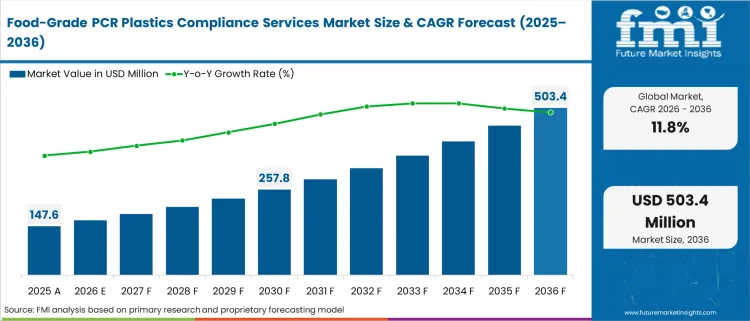
Traceability verification directly alters commercialization timelines. As per Edward Kosior, President of NextLooPP Americas, "This marks a defining moment for food-grade recycled polypropylene. It validates the scientific rigor of our technology and provides brand owners and converters with complete confidence to use NextLooPP rPP in direct food-contact packaging with all food types over a very wide range of usage conditions." [2] Protocol updates shift internal committees from optional to required capability, allowing vendors with certified migration data to progress rapidly.
Country dispersion skews toward regulatory corridors, where testing protocols align with strict packaging mandates. Regional procurement clusters around framework agreements favoring accredited providers verifying food grade PCR resin safety standards.
Food-Grade PCR Plastics Compliance Services Market Key Takeaways
| Metric | Details |
|---|---|
| Industry Size (2026) | USD 165.0 Million |
| Industry Value (2036) | USD 520.0 Million |
| CAGR (2026 to 2036) | 11.8% |
Food-Grade PCR Plastics Compliance Services Market Definition
Compliance verification includes outsourced testing and certification services required to validate post-consumer recycled (PCR) resins for use in direct food contact applications. Providers perform migration analysis, supply chain audits, and safety evaluations according to regional health frameworks. These services assess contamination levels and ensure the molecular integrity of the recycled resins before mass commercialization.
Food-Grade PCR Plastics Compliance Services Market Inclusions
Revenue modeling incorporates third-party laboratory testing, continuous batch monitoring, and traceability consulting specific to food-contact recycled plastics. Valuations also include chain-of-custody audits executed for brands using secondary materials in their supply networks. Migration testing protocols for volatile organic compounds (VOCs) and heavy metals are part of the scope, ensuring compliance with safety standards.
Food-Grade PCR Plastics Compliance Services Market Exclusions
The market projections exclude testing services related to virgin polymer safety assessments or applications of industrial-grade recycled materials. Internal quality control budgets spent by manufacturers on proprietary laboratory equipment are not included. Additionally, software licenses for generic compliance tracking systems, which are not linked to specific resin audits, fall outside the defined parameters of this market.
Food-Grade PCR Plastics Compliance Services Market Research Methodology
- Primary Research: Analysts conducted structured interviews with laboratory directors and regulatory affairs managers to ascertain compliance bottleneck impacts.
- Desk Research: Statutory updates from food safety authorities guided historical volume benchmarking and baseline testing frequency.
- Market-Sizing and Forecasting: Top-down deployment models mapped total recycled resin production against mandatory analytical testing ratios.
- Data Validation and Update Cycle: Findings underwent variance screening against reported corporate certification expenditures to confirm projected spend totals.
Segmental Analysis
Food-Grade PCR Plastics Compliance Services Market Analysis by Service Type
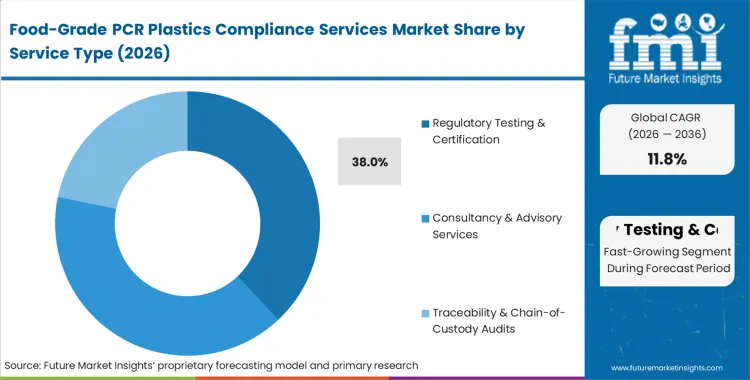
Analytical laboratories are witnessing rising demand as brand owners expand secondary material usage across core packaging portfolios, with Regulatory Testing & Certification accounting for 38% of global volume in 2026. Around 54% of plastic packaging governed by specific national pact members reached reusable, recyclable, or compostable status, necessitating continuous batch validation [3]. Verification delays directly stall commercialization for unverified recycled polyolefin compounds for food packaging. Migration analysis remains indispensable for clearing strict governmental safety gateways.
- Procurement trigger: Contamination risks force brands into continuous batch testing. Signatories eliminated 775,000 tonnes of problematic packaging, accelerating shifts toward highly tested pure streams and pre-approved laboratory partnerships [4].
- Regulatory signal: Agencies demand granular trace-level chemical reporting. Processors initiated solvent-based pilot evaluations to satisfy rigorous European clearance paths before commercial scaling [5].
- Supply-side move: Chemical recyclers partner with accredited auditors. Verification platforms integrate advanced chromatography to detect non-intentionally added substances, generating premium pricing potential across supply chains.
Food-Grade PCR Plastics Compliance Services Market Analysis by End User Segment
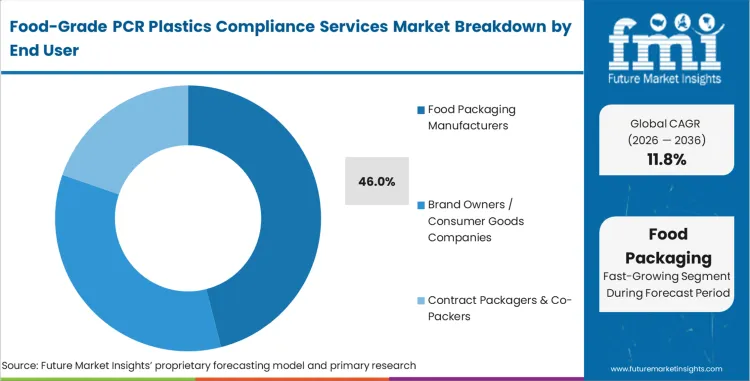
Food Packaging Manufacturers dictate 46% share entering 2026. Converters absorb direct liability for material safety, driving intense scrutiny of incoming secondary feedstocks. As per FMI's projection, average incorporation rates doubled to 10.7% among monitored corporate entities, multiplying required analytical interventions [6]. Manufacturers prioritize laboratories offering rapid turnaround times to prevent production line stoppages involving PCR in dairy bottle and lid applications. Securing verified clean-flake supplies protects converter margins against costly downstream product recalls.
- Liability shift: Heightened recall risks are driving packaging manufacturers, brand owners, and recyclers to increase reliance on third-party testing, migration analysis, and batch validation services, strengthening demand across end-user segments within food-grade PCR plastics compliance services.
- Capacity constraint: Limited in-house laboratory capabilities are pushing resin producers, packaging converters, and consumer brands toward specialized third-party compliance providers, increasing outsourcing of advanced analytical testing, high-throughput screening, and certification services to meet food-contact regulatory requirements.
- Buyer priority: Manufacturers demand continuous chain-of-custody verification. Southern California operations scaled output following critical safety validations, reducing inventory holding costs for integrated processors [9].
Food-Grade PCR Plastics Compliance Services Market Drivers, Restraints, and Opportunities
Mandatory minimum recycled content policies construct absolute demand floors for analytical testing. Governments globally enforce strict incorporation ratios, compelling consumer brands to source immense volumes of secondary polymers. FMI analysts opine that recycler signatories produced nearly 2 million metric tonnes of secondary plastics globally, amplifying mandatory auditing and documentation requirements [10]. Laboratories scale high-throughput chromatography to clear incoming bales for immediate extrusion. Certified EFSA compliant food grade rHDPA for FMCG packaging commands price premiums, offsetting extensive verification expenses. Continuous regulatory pressure guarantees long-term revenue visibility for accredited analytical service providers.
Severe analytical capacity bottlenecks restrict rapid supply chain scaling. Specialized laboratories equipped to detect trace-level volatile compounds face immense backlogs. Prolonged testing delays paralyze inventory flow, forcing recovery facilities to hold unverified stock for extended periods. Forecasts indicate regional outputs will fall short of operational goals without major mechanical and advanced processing infrastructure increases [11]. Brands mitigate delays by concentrating supplier networks and co-funding dedicated laboratory lines. Structural testing deficits slow industrial transitions from virgin polymer reliance.
- Capacity optimization: Laboratories expanding automated screening capture immediate validation contracts. Massive recovery pipelines spanning 170 projects scale high-quality food grade PCR polypropylene capacities, demanding proportional testing expansions [12].
- Digital traceability: Blockchain deployment connects physical test results to specific polymer batches. Embedded verification technology ensures secondary materials meet compliance thresholds across highly fragmented vendor networks.
- Regional expansion: Emerging markets present untapped testing revenue potential. Developing manufacturing hubs attract entirely new localized compliance support structures to maintain export competitiveness.
Regional Analysis
Based on the regional analysis, the Food-Grade PCR Plastics Compliance Services market is segmented into North America, Latin America, Europe, East Asia, South Asia, Oceania and Middle East & Africa across 40+ countries. The full report also offers market attractiveness analysis based on regional trends.
.webp "Top Country Growth Comparison Food Grade Pcr Plastics Compliance Services Market Cagr (2026 2036)")
| Country | CAGR (2026 to 2036) |
|---|---|
| United States | 14.1% |
| Germany | 13.3% |
| China | 12.7% |
| United Kingdom | 11.9% |
| India | 11.5% |
| Brazil | 10.8% |
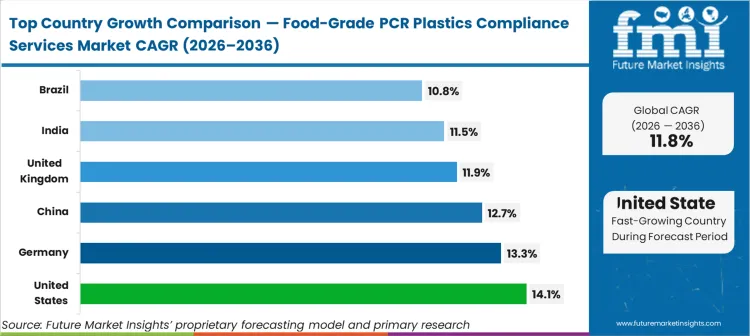
Source: Future Market Insights (FMI) analysis, based on proprietary forecasting model and primary research
North America Food-Grade PCR Plastics Compliance Services Analysis
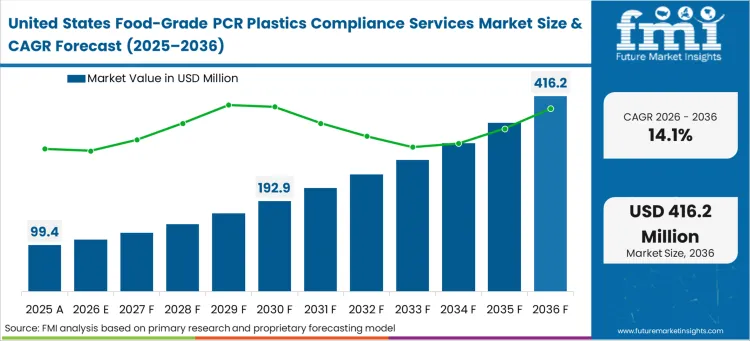
North American demand accelerates via strict state-level minimum content mandates. Laboratories face immense pressure to clear secondary polymers for sensitive consumer applications. Regional sourcing teams lock in long-term certification contracts to avoid catastrophic production delays. Accredited providers capturing early volume agreements dominate regional analytical spend.
- United States: Demand for testing in United States is set to grow at 14.1% CAGR through 2036, supported by federal guidance updates before procurement cycles translate into higher deployment volumes. Authorities issued over 50 specific clearance letters in a single year, signaling shifting regulatory pathways requiring continuous sampling [13].
According to FMI's estimates, regional packaging converters track evolving cross-border safety protocols affecting post consumer recycled plastic packaging clearance timelines. Canadian operations exhibit intense alignment with strict documentation mandates. Procurement teams monitor Mexican facility expansions seeking verified secondary inputs.
Europe Food-Grade PCR Plastics Compliance Services Analysis
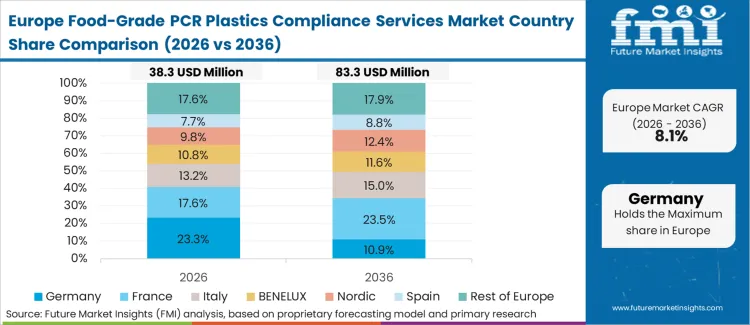
European frameworks dictate exhaustive safety parameters. Regional guidelines require granular molecular characterization prior to commercialization. FMI analysts opine that high barrier-to-entry testing protocols shield established laboratories from sudden disruption. Compliance execution remains a central competitive differentiator for resin producers.
- Germany: Testing sales in Germany are projected to rise at 13.3% CAGR from 2026 to 2036 as circular economy laws enforce strict material tracking, creating a clearer pathway from policy intent to purchase orders. Over 40% of monitored governmental bodies introduced minimum incorporation thresholds, escalating domestic verification requirements [14].
- United Kingdom: In the United Kingdom, testing activity is accelerating as fiscal measures on virgin plastics push manufacturers toward greater recycled content integration. This shift increases reliance on laboratory validation and compliance certification, particularly among national brands adopting rigorously tested material streams, supporting expansion at an 11.9% CAGR between 2026 and 2036.
As per FMI's projection, France and Italy represent vital enforcement nodes demanding strict supply chain audits for food grade packaging. Regional authorities monitor evolving mandates affecting sustainable material clearance timelines. Testing platforms align with impending regulatory shifts.
East Asia Food-Grade PCR Plastics Compliance Services Analysis
East Asian production networks rapidly upgrade chemical recycling analytics. Export-driven economies adopt Western safety standards to maintain vital international trade flows. Analytical investments support massive scaled manufacturing hubs targeting global FMCG brands. Harmonized compliance data secures uninterrupted cross-border material movements.
- China: China is expected to record 12.7% CAGR in testing demand over 2026 to 2036 as export requirements mandate rigorous safety data, tightening the link between operational constraints and adoption-led investment. Massive localized capacities require continuous automated molecular screening.
Regional testing networks adapt to changing export mandates for impact modified PCR plastics for packaging. South Korean chemical conglomerates push boundaries in secondary material analytics. Japanese frameworks enforce distinct domestic ingestion safety protocols.
South Asia Food-Grade PCR Plastics Compliance Services Analysis
South Asian capacity scaling introduces vast new compliance requirements. Domestic brands increasingly face regulatory pressure to incorporate safe secondary materials. Infrastructure expansions attract intensive localized auditing programs to verify input stream integrity. Reliable data generation prevents contaminated batches from destroying converter margins.
- India: In India, compliance activity is strengthening as domestic waste management policies translate into structured budget allocations and formal oversight mechanisms. The commissioning of new processing facilities is increasing the need for independent third-party certification and validation services across regions, supporting expansion at an 11.5% CAGR through 2036.
Domestic brands increasingly face regulatory pressure to incorporate safe sustainable plastic packaging. Sri Lankan export sectors align auditing parameters with global ingestion specifications. Bangladeshi operations monitor shifting regional safety protocols.
Latin America Food-Grade PCR Plastics Compliance Services Analysis
Latin American verification programs scale alongside massive mechanical recycling investments. Export competitiveness relies entirely on matching stringent North American safety thresholds. Supply chain transparency initiatives demand independent chain-of-custody documentation. Certified output integrates seamlessly into multinational beverage supply chains.
- Brazil: In Brazil, testing demand is strengthening as regional brands raise product safety benchmarks and suppliers refine positioning to match evolving procurement priorities. Major recyclers have expanded output to 86,000 tonnes annually, increasing the need for robust contamination screening and laboratory validation [15], supporting growth at a 10.8% CAGR over the forecast period.
Operations integrate seamlessly into multinational beverage supply chains relying on united states PCR films. Mexican integration nodes match northern clearance parameters. Chilean packaging taxes stimulate deep investments in local verification capabilities.
Competitive Aligners for Market Players
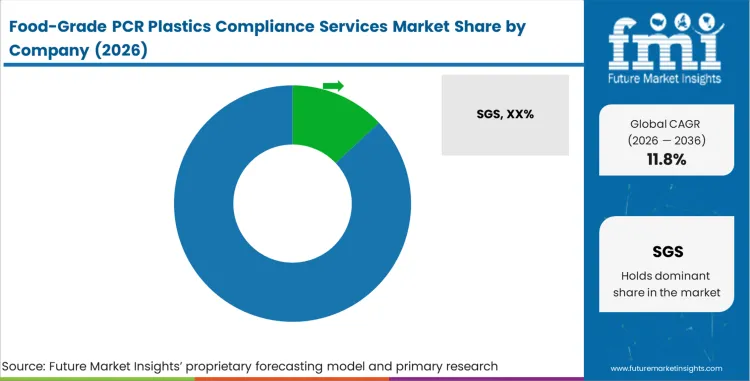
Consolidation among analytical laboratories continues to shape competitive positioning across the sector. Large global testing groups are acquiring specialized regional facilities to secure localized approval volumes and strengthen their presence in high-growth areas. This geographic expansion enables uninterrupted service for multinational packaging converters while integrated networks provide centralized data systems capable of managing compliance requirements across multiple jurisdictions.
Technology adoption increasingly distinguishes premium providers from routine auditing firms. Automated chromatography and advanced analytical systems are accelerating batch clearance timelines, allowing resin producers to move inventory faster and lower holding costs. Faster turnaround times and higher analytical precision support premium pricing for long-term service contracts.
Strategic alignment with regulatory bodies dictates long-term viability. Service providers actively participate in standard-setting committees to anticipate impending safety threshold shifts. Early insight enables rapid methodology adjustments before formal mandates take effect. Proactive methodology updates shield testing firms from sudden regulatory obsolescence.
Recent Developments:
The report includes full coverage of key trends from competitive benchmarking. Some of the recent developments covered in the reports:
- In December 2025, Origin Materials partnered with Matrix Bottling Group to scale recyclable PET bottlecaps, initiating bottling trials and advancing commercialization plans for 2026. [7]
- In February 2026, NOVA Chemicals commercialized SYNDIGO rPE-IN3 and rPE-IN4 recycled polyethylene grades for non-food applications across North America under its SYNDIGO portfolio. [8]
Key Players in Food-Grade PCR Plastics Compliance Services Market
- SGS
- TÜV SÜD
- Corpseed
- JB Ecotex
- Srichakra Polyplast
- RiBotl Solutions
Scope of the Report
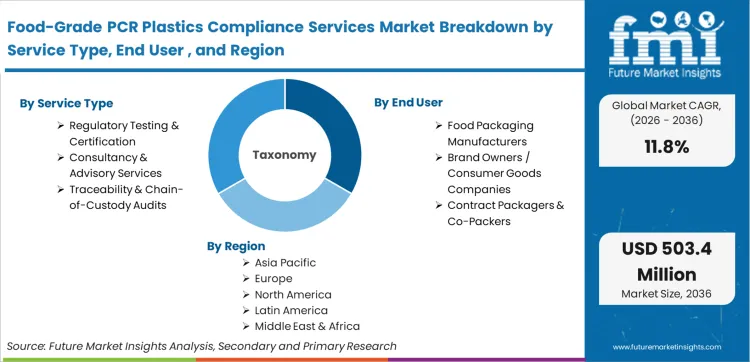
| Metric | Value |
|---|---|
| Quantitative Units | USD 165.0 Million (2026) to USD 520.0 Million (2036), at a CAGR of 11.8% |
| Market Definition | Compliance verification encompasses outsourced testing and certification activities required to validate post-consumer recycled resins for direct food contact. |
| Service Type Segmentation | Regulatory Testing & Certification, Consultancy & Advisory Services, Traceability & Chain-of-Custody Audits, Quality Assurance & Analytics, Training & Documentation Support |
| End User Segment Segmentation | Food Packaging Manufacturers, Brand Owners / Consumer Goods Companies, Contract Packagers & Co-Packers, Recyclers / Resin Producers, Regulatory Bodies & NGOs |
| Regions Covered | North America, Latin America, Europe, East Asia, South Asia, Oceania, Middle East and Africa |
| Countries Covered | United States, Germany, China, United Kingdom, India, Brazil and 40 plus countries |
| Key Companies Profiled | SGS, TÜV SÜD, Corpseed, JB Ecotex, Srichakra Polyplast, RiBotl Solutions |
| Forecast Period | 2026 to 2036 |
| Approach | Hybrid top-down and bottom-up market modeling, validated through primary interviews with compliance service providers and plastic recyclers, supported by trade data benchmarking and regulatory compliance assessments across key markets |
Food-Grade PCR Plastics Compliance Services Market Analysis by Segments
Service Type:
- Regulatory Testing & Certification
- Consultancy & Advisory Services
- Traceability & Chain-of-Custody Audits
- Quality Assurance & Analytics
- Training & Documentation Support
End User Segment:
- Food Packaging Manufacturers
- Brand Owners / Consumer Goods Companies
- Contract Packagers & Co-Packers
- Recyclers / Resin Producers
- Regulatory Bodies & NGOs
Region:
- Asia Pacific
- India
- China
- Japan
- South Korea
- Indonesia
- Australia & New Zealand
- ASEAN
- Rest of Asia Pacific
- Europe
- Germany
- Italy
- France
- United Kingdom
- Spain
- Benelux
- Nordics
- Central & Eastern Europe
- Rest of Europe
- North America
- United States
- Canada
- Mexico
- Latin America
- Brazil
- Argentina
- Chile
- Rest of Latin America
- Middle East & Africa
- Kingdom of Saudi Arabia
- United Arab Emirates
- South Africa
- Turkey
- Rest of Middle East & Africa
Bibliography
- [1] FDA .gov. FDA issued favorable opinions on >400 PCR processes for food-contact.
- [2] NextLooPP Americas, Sep 2025. FDA okay for 100% food-grade recycled polypropylene.
- [3] US Plastics Pact .org, 2024-25 impact report. 54% of plastic packaging is reusable/recyclable/compostable.
- [4] Ellen MacArthur Foundation .org, 2025 Progress Report. Signatories eliminated 775,000 tonnes of problematic packaging.
- [5] ALPLA. ALPLA secures grant and set new recycling company pioneering food.
- [6] AMERIPEN .org report, Apr 2025. Average PCR content in USA plastic packaging doubled to 10.7%.
- [7] Origin Materials. Partnership to bring 100% PCR food-grade recyclable PET bottle caps.
- [8] NOVA Chemicals. NOVA Chemicals commercializes two new recycled polyethylene grades.
- [9] Blue Polymers. Starts food-grade rPET pellet production in Southern California.
- [10] Ellen MacArthur Foundation .org. Recycler signatories produced nearly 2 million metric tonnes of recycled plastics in 2024.
- [11] AMERIPEN .org, Apr 2025. USA will fall short of 2025 plastics PCR goals without major increases.
- [12] PureCycle Technologies. PureCycle outlines 2026 commercial scale-up with 170+ project pipeline.
- [13] Beyond Plastics .org. Over 50 FDA Letters of No Objection for recycled plastics in 2024.
- [14] Ellen MacArthur Foundation .org. Over 40% of government signatories introduced minimum PCR thresholds.
- [15] PetStar. Largest food-grade PET recycler scales to 86k t/a.
- This bibliography is provided for reader reference and is not exhaustive. The full report contains the complete reference list and detailed citations.
This bibliography is provided for reader reference and is not exhaustive. The full report contains the complete reference list and detailed citations.
This Report Addresses
- Market size estimation and 10-year revenue forecasts for compliance testing and certification from 2026 to 2036.
- Growth opportunity mapping across regulatory testing, traceability audits, and advisory services.
- Segment revenue forecasts covering food packaging manufacturers, brand owners, and recyclers.
- Competition strategy assessment including in-house laboratory integration and outsourced third-party testing models.
- Regulatory impact analysis covering FDA Letters of No Objection (LNO), EFSA clearance mandates, and regional migration thresholds.
- Supply chain auditing protocols and digital traceability platform adoption trends across emerging economies.
- Executive takeaways for navigating analytical testing bottlenecks and securing pre-qualified recycled resin supplies.
Frequently Asked Questions
How large is the demand for Food-Grade PCR Plastics Compliance Services in the global market in 2026?
Demand reaches USD 165.0 million in 2026.
What will be the market size of Food-Grade PCR Plastics Compliance Services in the global market by 2036?
Market value is expected to reach USD 520.0 million by 2036.
What is the expected demand growth for Food-Grade PCR Plastics Compliance Services in the global market between 2026 and 2036?
Demand grows at an 11.8% CAGR over the forecast period.
Which Service Type is poised to lead global sales by 2026?
Regulatory Testing & Certification captures 38% share in 2026 as mandates drive continuous verification.
How significant is the role of Food Packaging Manufacturers in driving Food-Grade PCR Plastics Compliance Services adoption in 2026?
They dictate 46% share as converters secure supply lines against contamination risks.
What is driving demand in United States?
Federal guidance updates and capacity surges enforce rigorous batch analytics.
What compliance standards or regulations are referenced for United States?
FDA Letters of No Objection define absolute commercial viability.
What is the United States growth outlook in this report?
United States expands at a 14.1% CAGR.
Why is Europe described as a priority region in this report?
Extensive EFSA rules demand deep chemical tracking before commercialization.
What type of demand dominates in Europe?
Replacement demand seeking heavily certified secondary polymer supplies.
What is Germany growth outlook in this report?
Germany testing volume grows at a 13.3% CAGR.
Does the report cover China in its regional analysis?
Yes, China is assessed within the East Asia region.
What are the sources referred to for analyzing China?
Corporate expansion bulletins and regional export directives form the analytical baseline.
What is the main demand theme linked to China in its region coverage?
Export alignment to match stringent Western contamination thresholds.
Does the report cover United Kingdom in its regional analysis?
Yes, United Kingdom is profiled under European market parameters.
What is the main United Kingdom related demand theme in its region coverage?
Packaging taxes penalizing virgin material use shift spend toward verified alternatives.
Which product formats or configurations are strategically important for North America supply chains?
Rapid automated sampling systems processing massive mechanical outputs.
What is Food-Grade PCR Plastics Compliance Services and what is it mainly used for?
It encompasses analytical verification protocols ensuring secondary polymers remain safe for ingestion.
What does Food-Grade PCR Plastics Compliance Services mean in this report?
It means outsourced or internalized laboratory testing auditing post-consumer resins.
What is included in the scope of this Food-Grade PCR Plastics Compliance Services report?
Third-party testing, continuous batch monitoring, and traceability consulting.
What is excluded from the scope of this report?
General sustainability consulting lacking direct analytical testing components.
What does market forecast mean on this page?
It projects future testing expenditure based on enacted statutory mandates.
How does FMI build and validate the Food-Grade PCR Plastics Compliance Services forecast?
Top-down models map physical recycling volumes against mandatory testing frequency.
What does zero reliance on speculative third party market research mean here?
Estimates leverage primary interviews and confirmed governmental compliance data exclusively.
What does zero reliance on speculative third party market research mean here?
Estimates leverage primary interviews and confirmed governmental compliance data exclusively.
Preview the report firsthand - request a free sample
Get SampleGet the brochure for pricing and purchase details.
Get PDFTable of Content
- Executive Summary
- Global Market Outlook
- Demand-side Trends
- Supply-side Trends
- Technology Roadmap Analysis
- Analysis and Recommendations
- Market Overview
- Market Coverage / Taxonomy
- Market Definition / Scope / Limitations
- Research Methodology
- Chapter Orientation
- Analytical Lens and Working Hypotheses
- Market Structure, Signals, and Trend Drivers
- Benchmarking and Cross-market Comparability
- Market Sizing, Forecasting, and Opportunity Mapping
- Research Design and Evidence Framework
- Desk Research Programme (Secondary Evidence)
- Company Annual and Sustainability Reports
- Peer-reviewed Journals and Academic Literature
- Corporate Websites, Product Literature, and Technical Notes
- Earnings Decks and Investor Briefings
- Statutory Filings and Regulatory Disclosures
- Technical White Papers and Standards Notes
- Trade Journals, Industry Magazines, and Analyst Briefs
- Conference Proceedings, Webinars, and Seminar Materials
- Government Statistics Portals and Public Data Releases
- Press Releases and Reputable Media Coverage
- Specialist Newsletters and Curated Briefings
- Sector Databases and Reference Repositories
- FMI Internal Proprietary Databases and Historical Market Datasets
- Subscription Datasets and Paid Sources
- Social Channels, Communities, and Digital Listening Inputs
- Additional Desk Sources
- Expert Input and Fieldwork (Primary Evidence)
- Primary Modes
- Qualitative Interviews and Expert Elicitation
- Quantitative Surveys and Structured Data Capture
- Blended Approach
- Why Primary Evidence is Used
- Field Techniques
- Interviews
- Surveys
- Focus Groups
- Observational and In-context Research
- Social and Community Interactions
- Stakeholder Universe Engaged
- C-suite Leaders
- Board Members
- Presidents and Vice Presidents
- R&D and Innovation Heads
- Technical Specialists
- Domain Subject-matter Experts
- Scientists
- Physicians and Other Healthcare Professionals
- Governance, Ethics, and Data Stewardship
- Research Ethics
- Data Integrity and Handling
- Primary Modes
- Tooling, Models, and Reference Databases
- Desk Research Programme (Secondary Evidence)
- Data Engineering and Model Build
- Data Acquisition and Ingestion
- Cleaning, Normalisation, and Verification
- Synthesis, Triangulation, and Analysis
- Quality Assurance and Audit Trail
- Market Background
- Market Dynamics
- Drivers
- Restraints
- Opportunity
- Trends
- Scenario Forecast
- Demand in Optimistic Scenario
- Demand in Likely Scenario
- Demand in Conservative Scenario
- Opportunity Map Analysis
- Product Life Cycle Analysis
- Supply Chain Analysis
- Investment Feasibility Matrix
- Value Chain Analysis
- PESTLE and Porter’s Analysis
- Regulatory Landscape
- Regional Parent Market Outlook
- Production and Consumption Statistics
- Import and Export Statistics
- Market Dynamics
- Global Market Analysis 2021 to 2025 and Forecast, 2026 to 2036
- Historical Market Size Value (USD Million) Analysis, 2021 to 2025
- Current and Future Market Size Value (USD Million) Projections, 2026 to 2036
- Y-o-Y Growth Trend Analysis
- Absolute $ Opportunity Analysis
- Global Market Pricing Analysis 2021 to 2025 and Forecast 2026 to 2036
- Global Market Analysis 2021 to 2025 and Forecast 2026 to 2036, By Service Type
- Introduction / Key Findings
- Historical Market Size Value (USD Million) Analysis By Service Type , 2021 to 2025
- Current and Future Market Size Value (USD Million) Analysis and Forecast By Service Type , 2026 to 2036
- Regulatory Testing & Certification
- Consultancy & Advisory Services
- Traceability & Chain-of-Custody Audits
- Regulatory Testing & Certification
- Y-o-Y Growth Trend Analysis By Service Type , 2021 to 2025
- Absolute $ Opportunity Analysis By Service Type , 2026 to 2036
- Global Market Analysis 2021 to 2025 and Forecast 2026 to 2036, By End User
- Introduction / Key Findings
- Historical Market Size Value (USD Million) Analysis By End User, 2021 to 2025
- Current and Future Market Size Value (USD Million) Analysis and Forecast By End User, 2026 to 2036
- Food Packaging Manufacturers
- Brand Owners / Consumer Goods Companies
- Contract Packagers & Co-Packers
- Food Packaging Manufacturers
- Y-o-Y Growth Trend Analysis By End User, 2021 to 2025
- Absolute $ Opportunity Analysis By End User, 2026 to 2036
- Global Market Analysis 2021 to 2025 and Forecast 2026 to 2036, By Region
- Introduction
- Historical Market Size Value (USD Million) Analysis By Region, 2021 to 2025
- Current Market Size Value (USD Million) Analysis and Forecast By Region, 2026 to 2036
- North America
- Latin America
- Western Europe
- Eastern Europe
- East Asia
- South Asia and Pacific
- Middle East & Africa
- Market Attractiveness Analysis By Region
- North America Market Analysis 2021 to 2025 and Forecast 2026 to 2036, By Country
- Historical Market Size Value (USD Million) Trend Analysis By Market Taxonomy, 2021 to 2025
- Market Size Value (USD Million) Forecast By Market Taxonomy, 2026 to 2036
- By Country
- USA
- Canada
- Mexico
- By Service Type
- By End User
- By Country
- Market Attractiveness Analysis
- By Country
- By Service Type
- By End User
- Key Takeaways
- Latin America Market Analysis 2021 to 2025 and Forecast 2026 to 2036, By Country
- Historical Market Size Value (USD Million) Trend Analysis By Market Taxonomy, 2021 to 2025
- Market Size Value (USD Million) Forecast By Market Taxonomy, 2026 to 2036
- By Country
- Brazil
- Chile
- Rest of Latin America
- By Service Type
- By End User
- By Country
- Market Attractiveness Analysis
- By Country
- By Service Type
- By End User
- Key Takeaways
- Western Europe Market Analysis 2021 to 2025 and Forecast 2026 to 2036, By Country
- Historical Market Size Value (USD Million) Trend Analysis By Market Taxonomy, 2021 to 2025
- Market Size Value (USD Million) Forecast By Market Taxonomy, 2026 to 2036
- By Country
- Germany
- UK
- Italy
- Spain
- France
- Nordic
- BENELUX
- Rest of Western Europe
- By Service Type
- By End User
- By Country
- Market Attractiveness Analysis
- By Country
- By Service Type
- By End User
- Key Takeaways
- Eastern Europe Market Analysis 2021 to 2025 and Forecast 2026 to 2036, By Country
- Historical Market Size Value (USD Million) Trend Analysis By Market Taxonomy, 2021 to 2025
- Market Size Value (USD Million) Forecast By Market Taxonomy, 2026 to 2036
- By Country
- Russia
- Poland
- Hungary
- Balkan & Baltic
- Rest of Eastern Europe
- By Service Type
- By End User
- By Country
- Market Attractiveness Analysis
- By Country
- By Service Type
- By End User
- Key Takeaways
- East Asia Market Analysis 2021 to 2025 and Forecast 2026 to 2036, By Country
- Historical Market Size Value (USD Million) Trend Analysis By Market Taxonomy, 2021 to 2025
- Market Size Value (USD Million) Forecast By Market Taxonomy, 2026 to 2036
- By Country
- China
- Japan
- South Korea
- By Service Type
- By End User
- By Country
- Market Attractiveness Analysis
- By Country
- By Service Type
- By End User
- Key Takeaways
- South Asia and Pacific Market Analysis 2021 to 2025 and Forecast 2026 to 2036, By Country
- Historical Market Size Value (USD Million) Trend Analysis By Market Taxonomy, 2021 to 2025
- Market Size Value (USD Million) Forecast By Market Taxonomy, 2026 to 2036
- By Country
- India
- ASEAN
- Australia & New Zealand
- Rest of South Asia and Pacific
- By Service Type
- By End User
- By Country
- Market Attractiveness Analysis
- By Country
- By Service Type
- By End User
- Key Takeaways
- Middle East & Africa Market Analysis 2021 to 2025 and Forecast 2026 to 2036, By Country
- Historical Market Size Value (USD Million) Trend Analysis By Market Taxonomy, 2021 to 2025
- Market Size Value (USD Million) Forecast By Market Taxonomy, 2026 to 2036
- By Country
- Kingdom of Saudi Arabia
- Other GCC Countries
- Turkiye
- South Africa
- Other African Union
- Rest of Middle East & Africa
- By Service Type
- By End User
- By Country
- Market Attractiveness Analysis
- By Country
- By Service Type
- By End User
- Key Takeaways
- Key Countries Market Analysis
- USA
- Pricing Analysis
- Market Share Analysis, 2025
- By Service Type
- By End User
- Canada
- Pricing Analysis
- Market Share Analysis, 2025
- By Service Type
- By End User
- Mexico
- Pricing Analysis
- Market Share Analysis, 2025
- By Service Type
- By End User
- Brazil
- Pricing Analysis
- Market Share Analysis, 2025
- By Service Type
- By End User
- Chile
- Pricing Analysis
- Market Share Analysis, 2025
- By Service Type
- By End User
- Germany
- Pricing Analysis
- Market Share Analysis, 2025
- By Service Type
- By End User
- UK
- Pricing Analysis
- Market Share Analysis, 2025
- By Service Type
- By End User
- Italy
- Pricing Analysis
- Market Share Analysis, 2025
- By Service Type
- By End User
- Spain
- Pricing Analysis
- Market Share Analysis, 2025
- By Service Type
- By End User
- France
- Pricing Analysis
- Market Share Analysis, 2025
- By Service Type
- By End User
- India
- Pricing Analysis
- Market Share Analysis, 2025
- By Service Type
- By End User
- ASEAN
- Pricing Analysis
- Market Share Analysis, 2025
- By Service Type
- By End User
- Australia & New Zealand
- Pricing Analysis
- Market Share Analysis, 2025
- By Service Type
- By End User
- China
- Pricing Analysis
- Market Share Analysis, 2025
- By Service Type
- By End User
- Japan
- Pricing Analysis
- Market Share Analysis, 2025
- By Service Type
- By End User
- South Korea
- Pricing Analysis
- Market Share Analysis, 2025
- By Service Type
- By End User
- Russia
- Pricing Analysis
- Market Share Analysis, 2025
- By Service Type
- By End User
- Poland
- Pricing Analysis
- Market Share Analysis, 2025
- By Service Type
- By End User
- Hungary
- Pricing Analysis
- Market Share Analysis, 2025
- By Service Type
- By End User
- Kingdom of Saudi Arabia
- Pricing Analysis
- Market Share Analysis, 2025
- By Service Type
- By End User
- Turkiye
- Pricing Analysis
- Market Share Analysis, 2025
- By Service Type
- By End User
- South Africa
- Pricing Analysis
- Market Share Analysis, 2025
- By Service Type
- By End User
- USA
- Market Structure Analysis
- Competition Dashboard
- Competition Benchmarking
- Market Share Analysis of Top Players
- By Regional
- By Service Type
- By End User
- Competition Analysis
- Competition Deep Dive
- SGS
- Overview
- Product Portfolio
- Profitability by Market Segments (Product/Age /Sales Channel/Region)
- Sales Footprint
- Strategy Overview
- Marketing Strategy
- Product Strategy
- Channel Strategy
- TÜV SÜD
- Corpseed
- JB Ecotex
- Srichakra Polyplast
- RiBotl Solutions
- SGS
- Competition Deep Dive
- Assumptions & Acronyms Used


