

- Industry Size (2026)
- USD 952 Mn
- Forecast (2036)
- USD 2484 Mn
- CAGR (2026 to 2036)
- 10.1%
Food-Grade PCR Polypropylene Market Forecast and Outlook 2026 to 2036
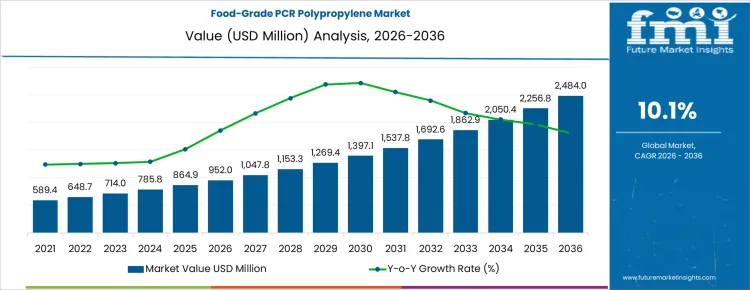
The food-grade PCR polypropylene market is projected to expand from USD 952 million in 2026 to USD 2,484 million by 2036, representing a CAGR of 10.1%. Rising demand for high-quality recycled content in food packaging and stricter regulatory compliance for EFSA and FDA-approved materials are driving growth. Super-clean recycling processes, advanced melt filtration, and decontamination technologies are increasingly applied to ensure food safety and product purity.
Key applications include food containers, closures, dairy and ready meal packs, and value food packaging. Tubs, lids, and thermoformed containers dominate the format share, while food-grade PCR-PP and high-purity rPP lead material adoption. Companies such as PureCycle, ALPLA, Kingfa, and Manjushree are advancing production capacity and refining processing technologies to meet growing demand from FMCG, foodservice, and premium food packaging sectors.
Quick Stats of the Food-Grade PCR Polypropylene Market:
- Food-Grade PCR Polypropylene Market Value (2026): USD 952 million
- Food-Grade PCR Polypropylene Market Forecast Value (2036): USD 2,484 million
- Food-Grade PCR Polypropylene Market Forecast CAGR (2026 to 2036): 10.1%
- Leading Packaging Format in the Market: Tubs, Lids, Caps (45%)
- Key Growth Regions in the Market: India, China, USA, Brazil, Germany
- Top Players in the Market: PureCycle, ALPLA, Kingfa, Manjushree, Braskem, Mitsui Chemicals, Berry Global, Borealis
What is the Growth Forecast for the Food-Grade PCR Polypropylene Market through 2036?
From 2026 to 2031, the food-grade PCR polypropylene market grows from USD 952 million to approximately USD 1,428 million, representing the early adoption phase. Annual value additions increase from USD 57 million in 2026 to USD 112 million in 2031. Growth is driven by adoption in food and beverage packaging, medical devices, and consumer products, where recycled polypropylene must meet stringent regulatory and safety standards. Early adoption is concentrated in North America and Europe, accounting for roughly 65% of market value, with pilot programs validating optical clarity, barrier properties, and compatibility with thermoforming, injection molding, and blow-molding processes.
Between 2031 and 2036, the market expands from roughly USD 1,428 million to USD 2,484 million, illustrating the late adoption curve characterized by structural scaling and global commercialization. Annual increments rise from USD 112 million to USD 174 million, driven by multi-SKU deployment, repeat procurement, and widespread adoption across mass-market food packaging, medical, and consumer product lines. Growth is reinforced by regulatory mandates for recycled content, portfolio-wide integration, and operational standardization of food-grade PCR polypropylene. Early growth relied on selective pilot adoption, while later expansion is driven by global penetration and normalized implementation across production facilities.
Food Grade PCR Polypropylene Market Key Takeaways
| Metric | Value |
|---|---|
| Market Value (2026) | USD 952 million |
| Forecast Value (2036) | USD 2,484 million |
| Forecast CAGR (2026–2036) | 10.1% |
What Is Changing Demand for Food-Grade PCR Polypropylene?
Early use of post-consumer recycled (PCR) polypropylene in food contact applications was constrained by quality, safety, and regulatory issues rather than by material availability. Recycled streams often contained residual contaminants and variable polymer characteristics that challenged food safety standards. Even when PCR PP met basic mechanical specifications, uncertainty about prior use history and potential chemical residues limited acceptance in food packaging, closures, and direct contact food components. Processors relied on rigorous washing, sorting, and sometimes blending with virgin resin to approach compliance, but this was uneven and often costly. Historical demand was driven by isolated trials and pilot programmes in markets with early recycled content policies rather than systematic specification across food supply chains.
Future demand for food-grade PCR polypropylene is being shaped by structured regulatory expectations, documented safety criteria, and formal recycled content targets rather than ad hoc corrective measures. Food safety authorities in multiple jurisdictions are specifying clear compliance pathways for recycled plastics used in direct contact applications, including defined decontamination procedures, traceability requirements, and performance testing. Compounders are developing protocols that consistently meet these criteria, enabling PCR PP to achieve food-grade status without excessive reliance on virgin blending. Demand will expand where procurement standards mandate recycled content, and brand owners seek to document circular material use while ensuring consumer safety.
What Factors Are Affecting the Demand for Food Grade PCR Polypropylene Market in Terms of End Use Application and Packaging Format and Type?
Demand for food grade PCR polypropylene is segmented by end use application and packaging format and type across regulated food contact packaging. Food containers and closures account for about 42% of total demand, making this the leading end use segment. Dairy and ready meals, FMCG food packaging, value food packaging, foodservice packaging, and premium food packs represent additional applications without disclosed share splits. These segments differ in food safety requirements, shelf life expectations, and tolerance for visual variation. Packaging format and type influence resin selection and compliance performance. Tubs, lids, and caps account for about 45% of demand, followed by thermoformed containers, rigid food packs, small containers, and other formats. Together, these segments explain demand formation shaped by regulatory compliance and functional performance rather than overall food packaging volumes.
What Drives Demand by End Use Application in the Food Grade PCR Polypropylene Market?
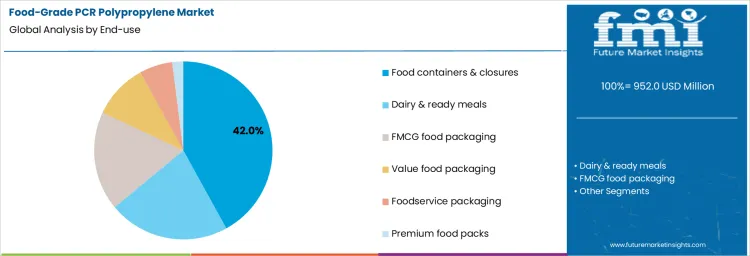
Food containers and closures lead demand with a 42% share because they represent high volume applications with direct food contact and repeat use. These formats require consistent material quality and traceability to meet food safety standards. Dairy and ready meal packaging adopts food grade PCR PP where barrier and hygiene requirements can be maintained. FMCG food packaging applies selectively based on branding and appearance thresholds. Value food packaging balances recycled content targets with cost sensitivity. Foodservice packaging applies PCR PP where short use cycles limit risk. Premium food packs maintain stricter specifications and slower adoption. End use demand therefore reflects risk tolerance and regulatory assurance rather than packaging category size.
Application driven demand remains stable because food contact approvals are embedded in material specifications. Producers qualify PCR PP grades over extended validation cycles. Dairy and ready meal segments adopt cautiously. FMCG food brands scale gradually to manage appearance consistency. Foodservice applications remain pragmatic. These patterns limit short term volatility. End use segmentation highlights dependence on compliance certainty and consumer trust rather than rapid expansion of recycled content across all food packaging.
How Does Packaging Format and Type Shape Demand for Food Grade PCR Polypropylene Market?
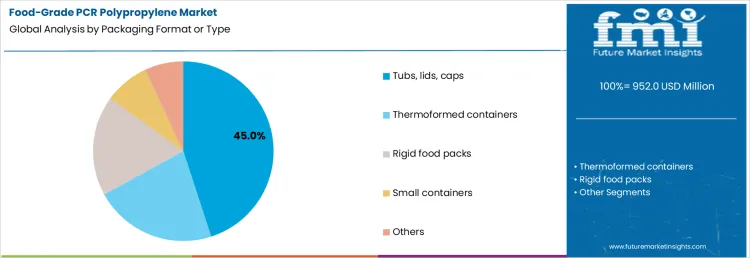
Tubs, lids, and caps account for about 45% of total demand, making them the leading packaging format. Their dominance reflects widespread use in dairy, spreads, and prepared foods. Thermoformed containers adopt food grade PCR PP where thickness control and clarity are achievable. Rigid food packs support packaged foods with moderate appearance sensitivity. Small containers apply PCR selectively due to tighter cost and performance limits. Other formats address niche foodservice or specialty uses. Packaging format selection depends on wall thickness, sealing performance, and migration compliance. Demand follows functional suitability and approval status rather than innovation in packaging design.
Tubs and closures maintain leadership due to established tooling and high turnover. Thermoformed formats scale gradually with process control improvements. Smaller formats face stricter cost constraints. Producers avoid altering formats once food safety validation is complete. This stabilizes format driven demand. Packaging format and type therefore reinforces concentration in common food packaging components suitable for food grade PCR polypropylene.
How Is Food-Grade PCR Polypropylene Being Applied Across Packaging and Consumer Goods?
Use appears in applications requiring both recycled content and compliance with food contact regulations. Beverage, dairy, and personal care brands adopt food-grade PCR polypropylene (PP) for bottles, closures, tubs, and trays to maintain product safety while meeting sustainability targets. Snack packaging, portion cups, and condiment containers incorporate treated PCR PP to ensure barrier properties, mechanical strength, and clarity. These applications reflect operational and regulatory priorities rather than aesthetic purposes, with adoption driven by recyclate integration, compliance with EFSA and FDA standards, and consistent performance in food-contact applications.
What Operational and Material Conditions Support Adoption of Food-Grade PCR Polypropylene?
Selection aligns with PCR feedstocks that meet stringent contamination limits and have consistent melt flow and color. Processing lines are optimized for extrusion, injection molding, and thermoforming without compromising clarity, mechanical properties, or barrier performance. Additives and stabilizers are carefully selected to maintain compliance with food safety regulations while preserving recyclate integrity. Brand owners rely on food-grade PCR PP to achieve recycled content targets without affecting shelf appeal or functional performance. These conditions emerge from operational reliability, regulatory adherence, and material consistency priorities in structured production workflows.
Which Practical Considerations Limit Wider Use of Food-Grade PCR Polypropylene?
Feedstock variability, residual contaminants, and inconsistent melt flow can affect processability and clarity. Costs are often higher than virgin PP, especially for FDA or EFSA-certified streams. Additive compatibility, including UV stabilizers or barrier enhancers, must be verified. Regulatory certification and traceability are required for each batch to ensure compliance. Batch-to-batch variability necessitates rigorous quality control to maintain consistent food-contact performance. These factors result in selective deployment where recyclate utilization, regulatory compliance, and operational feasibility justify incremental cost and careful process management.
What is the Demand for Food Grade PCR Polypropylene by Country?
| Country | CAGR (%) |
|---|---|
| USA | 8.6% |
| Germany | 7.8% |
| China | 11.5% |
| India | 12.5% |
| Brazil | 8.0% |
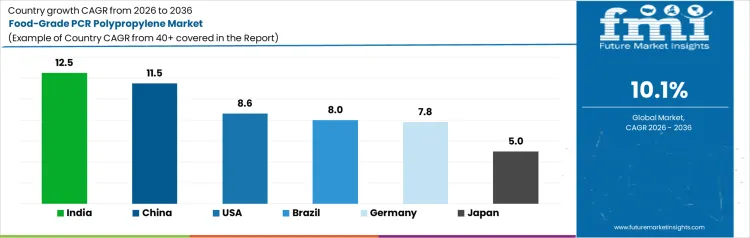
The demand for food grade PCR polypropylene varies across countries, driven by recycled plastic adoption, food packaging requirements, and regulatory compliance for safe materials. India leads with a 12.5% CAGR, supported by growing use of recycled plastics in food and beverage packaging, expanding urban consumption, and sustainability initiatives. China follows at 11.5%, driven by large scale food packaging production and integration of PCR polypropylene in consumer goods. The USA grows at 8.6%, reflecting steady adoption in food packaging and retail applications. Brazil records 8.0%, shaped by organized packaging sectors and recycling initiatives. Germany posts 7.8%, supported by compliance with food safety standards, while Japan grows at 5.0%, reflecting mature packaging markets.
How Is Food-Grade PCR Polypropylene Driving Growth in the United States?
In the United States, revenue from the Food-Grade PCR Polypropylene Market is expanding at a CAGR of 8.6% through 2036, driven by adoption of post-consumer recycled polypropylene that meets regulatory standards for direct food contact. Manufacturers are integrating food-grade PCR polypropylene in packaging, containers, and consumer goods to improve sustainability while maintaining performance and safety. Demand is concentrated in food and beverage packaging, household products, and industrial applications. Domestic suppliers provide high-quality, processing-compatible PCR polypropylene suitable for extrusion, injection molding, and thermoforming. Regulatory compliance, recycling programs, and recurring PCR polymer processing are sustaining predictable procurement nationwide.
- Food and beverage packaging, household products, and industrial applications drive adoption
- PCR polypropylene meets food-grade safety and performance standards
- Domestic suppliers provide processing-compatible, high-quality PCR polypropylene
- Recurring PCR polymer processing sustains predictable procurement
How Are Recycling and Food Safety Standards Supporting Growth in Germany?
Germany continues to record steady growth in the Food-Grade PCR Polypropylene Market at a CAGR of 7.8% through 2036, supported by strict food-contact regulations and recycling quality standards. Manufacturers are adopting food-grade PCR polypropylene to produce packaging, containers, and consumer products that comply with safety and sustainability requirements. Demand is concentrated in food and beverage packaging, household goods, and industrial applications. Domestic suppliers provide additives and polymers compatible with extrusion, injection molding, and thermoforming processes. Compliance with food safety standards and recurring PCR recycling operations are sustaining measured adoption nationwide.
- Food and beverage packaging, household goods, and industrial applications anchor demand
- PCR polypropylene meets strict food-contact and safety regulations
- Domestic suppliers provide processing-compatible, high-quality polymers
- Recurring PCR recycling sustains steady adoption
How Is Industrial and Consumer Recycling Expansion Accelerating Adoption in China?
In China, revenue from the Food-Grade PCR Polypropylene Market is growing at a CAGR of 11.5% through 2036, driven by rapid adoption of post-consumer recycled polymers in food-grade packaging and consumer products. Manufacturers are integrating food-grade PCR polypropylene to improve sustainability, reduce environmental impact, and maintain material performance. Demand is strong across food and beverage packaging, household products, and industrial goods. Domestic suppliers are scaling production of high-performance, processing-compatible PCR polypropylene suitable for extrusion, injection molding, and thermoforming. Expanding recycling infrastructure and structured food-grade PCR operations are sustaining rapid adoption nationwide.
- Food and beverage packaging, household products, and industrial goods drive adoption
- PCR polypropylene ensures sustainability and regulatory compliance
- Domestic suppliers scale high-performance, processing-compatible polymers
- Recycling infrastructure sustains consistent adoption
How Is Food-Grade Recycling and Industrial Application Supporting Growth in India?
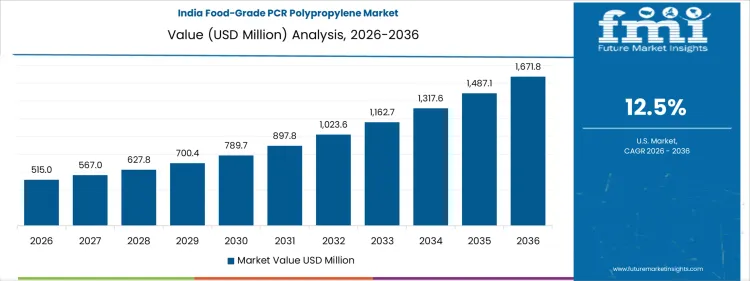
In India, revenue from the Food-Grade PCR Polypropylene Market is expanding at a CAGR of 12.5% through 2036, supported by increasing adoption of recycled polymers in food-contact packaging and consumer goods. Manufacturers are adopting food-grade PCR polypropylene to maintain safety, performance, and sustainability standards. Demand is concentrated in food and beverage packaging, household products, and industrial applications. Domestic suppliers provide high-performance, extrusion- and molding-compatible PCR polypropylene. Growth in recycling infrastructure, recurring PCR operations, and food safety compliance are sustaining robust adoption nationwide.
- Food and beverage packaging, household products, and industrial applications drive adoption
- PCR polypropylene maintains safety, performance, and sustainability standards
- Domestic suppliers provide processing-compatible, high-performance polymers
- Recurring PCR operations sustain robust adoption
How Is Recycling and Food Packaging Expansion Supporting Adoption in Brazil?
Brazil is seeing strong growth in the Food-Grade PCR Polypropylene Market at a CAGR of 8.0% through 2036, supported by increased use of food-grade PCR polymers in packaging, consumer goods, and industrial applications. Manufacturers are integrating recycled polypropylene to improve sustainability while meeting regulatory requirements for food contact. Demand is concentrated in food and beverage packaging, household products, and industrial goods. Domestic suppliers are expanding production of high-performance, processing-compatible PCR polypropylene suitable for extrusion, injection molding, and thermoforming. Growth in recycling operations and recurring PCR processing are sustaining robust procurement nationwide.
- Food and beverage packaging, household products, and industrial goods drive adoption
- PCR polypropylene ensures food safety and environmental sustainability
- Domestic suppliers expand processing-compatible, high-performance polymers
- Recurring PCR processing sustains robust procurement
How Is Industrial and Consumer Food-Grade Recycling Driving Growth in Japan?
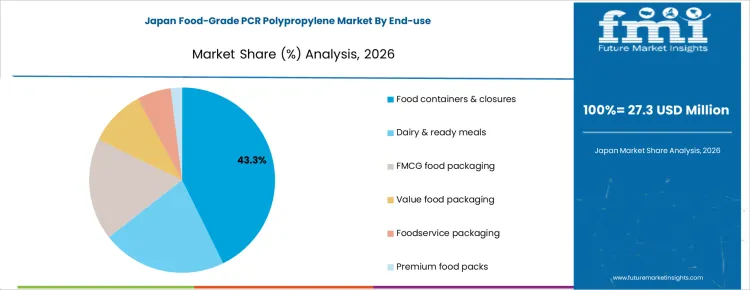
Japan is witnessing growth in the Food-Grade PCR Polypropylene Market at a CAGR of 5% through 2036, driven by adoption of recycled polypropylene in food-contact packaging, consumer products, and industrial applications. Manufacturers are integrating food-grade PCR polypropylene to maintain safety, performance, and regulatory compliance. Demand is concentrated in food and beverage packaging, household goods, and industrial products. Domestic suppliers provide high-performance, processing-compatible polymers suitable for extrusion, injection molding, and thermoforming. Recurring PCR operations, recycling compliance, and food safety standards are sustaining predictable procurement nationwide.
- Food and beverage packaging, household goods, and industrial products anchor demand
- PCR polypropylene ensures safety, performance, and compliance
- Domestic suppliers provide high-performance, processing-compatible polymers
- Recurring PCR operations sustain predictable procurement
Which Companies Shape Competition in The Food Grade PCR Polypropylene Market Through Regulatory Pathways and Feedstock Control?
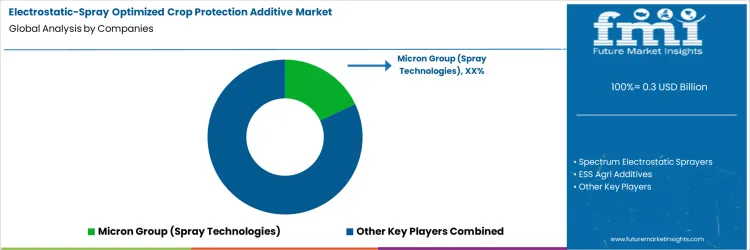
Competition in the Food Grade PCR Polypropylene Market is defined first by regulatory acceptance rather than processing scale. PureCycle occupies a distinct position because its purification based recycling approach enables food contact approvals where conventional mechanical recycling remains constrained. Mitsui Chemicals and Borealis influence the market through polymer science, additive compatibility, and support for food grade specifications rather than direct recycled resin volume alone. Braskem participates through circular polymer initiatives that combine recycled content with controlled material properties suitable for sensitive packaging uses. Material selection in this segment is driven by migration control, odor neutrality, and consistency across production lots, with brand owners prioritizing regulatory clarity and long term supply assurance over short term availability.
Packaging producers and integrated converters shape downstream execution. ALPLA and Berry Global influence adoption by qualifying food grade PCR polypropylene within rigid packaging programs for beverages, dairy, and personal care. Kingfa plays a significant role by integrating sorting, decontamination, and compounding to deliver recycled polypropylene grades aligned with food contact expectations in Asia. Manjushree supports demand through container manufacturing programs where recycled content is validated at the finished package level rather than resin alone. Competitive positioning depends on traceability of feedstock, audit readiness, and coordination across the value chain. Market dynamics are governed by approval timelines, customer qualification processes, and risk management practices rather than pricing leverage or scale expansion.
Key Players in the Food Grade PCR Polypropylene Market
- PureCycle
- ALPLA
- Kingfa
- Manjushree
- Braskem
- Mitsui Chemicals
- Berry Global
- Borealis
Scope of the Report
| Items | Values |
|---|---|
| Quantitative Units (2026) | USD million |
| End-use / Application | Food containers & closures, Dairy & ready meals, FMCG food packaging, Value food packaging, Foodservice packaging, Premium food packs |
| Packaging Format / Type | Tubs, lids, caps, Thermoformed containers, Rigid food packs, Small containers, Others |
| Material | Food-grade PCR-PP, High-purity rPP, PCR-PP blends, PCR-PP, Others |
| Technology | Super-clean recycling & decontamination, EFSA-compliant purification, Advanced melt filtration, Cost-optimised food-grade upgrading, Others |
| Region | Asia Pacific (China, Japan, South Korea, India, Australia & New Zealand, ASEAN, Rest of Asia Pacific), Europe (Germany, United Kingdom, France, Italy, Spain, Nordic, BENELUX, Rest of Europe), North America (United States, Canada, Mexico), Latin America (Brazil, Chile, Rest of Latin America), Middle East & Africa (KSA, Other GCC Countries, Turkey, South Africa, Other African Union, Rest of Middle East & Africa) |
| Key Companies Profiled | PureCycle, ALPLA, Kingfa, Manjushree, Braskem, Mitsui Chemicals, Berry Global, Borealis |
| Additional Attributes | Dollar by sales by end-use and packaging format, Dollar by sales by material type, Dollar by sales by technology adoption, Dollar by sales by region, Regulatory compliance adoption patterns, Recurring procurement trends, Operational implementation in packaging lines, Food safety and traceability integration, Efficiency in melt filtration and decontamination, Portfolio-wide deployment strategies |
Food Grade PCR Polypropylene Market Segmentation
End-use / Application:
- Food containers & closures
- Dairy & ready meals
- FMCG food packaging
- Value food packaging
- Foodservice packaging
- Premium food packs
Packaging Format / Type:
- Tubs, lids, caps
- Thermoformed containers
- Rigid food packs
- Small containers
- Others
Material:
- Food-grade PCR-PP
- High-purity rPP
- PCR-PP blends
- PCR-PP
- Others
Technology:
- Super-clean recycling & decontamination
- EFSA-compliant purification
- Advanced melt filtration
- Cost-optimised food-grade upgrading
- Others
Region
- Asia Pacific
- China
- Japan
- South Korea
- India
- Australia & New Zealand
- ASEAN
- Rest of Asia Pacific
- Europe
- Germany
- United Kingdom
- France
- Italy
- Spain
- Nordic
- BENELUX
- Rest of Europe
- North America
- United States
- Canada
- Mexico
- Latin America
- Brazil
- Chile
- Rest of Latin America
- Middle East & Africa
- Kingdom of Saudi Arabia
- Other GCC Countries
- Turkey
- South Africa
- Other African Union
- Rest of Middle East & Africa
Bibliography
- International Organization for Standardization. (2023). Plastics - Determination of food contact compliance and testing methods for polymer materials. ISO Standards Publications.
- United States Food and Drug Administration. (2023). Food contact substance notification and compliance guidance for food-grade polypropylene and recycled plastics. FDA Regulatory and Guidance Publications.
- European Food Safety Authority. (2023). Scientific opinions on recycled plastics and food contact materials including polypropylene. EFSA Scientific and Technical Reports.
- American Society for Testing and Materials. (2023). ASTM standards for PCR polypropylene performance, safety, and evaluation in food packaging applications. ASTM Standards Publications.
Frequently Asked Questions
How big is the food-grade pcr polypropylene market in 2026?
The global food-grade pcr polypropylene market is estimated to be valued at USD 952.0 million in 2026.
What will be the size of food-grade pcr polypropylene market in 2036?
The market size for the food-grade pcr polypropylene market is projected to reach USD 2,484.0 million by 2036.
How much will be the food-grade pcr polypropylene market growth between 2026 and 2036?
The food-grade pcr polypropylene market is expected to grow at a 10.1% CAGR between 2026 and 2036.
What are the key product types in the food-grade pcr polypropylene market?
The key product types in food-grade pcr polypropylene market are food containers & closures, dairy & ready meals, fmcg food packaging, value food packaging, foodservice packaging and premium food packs.
Which packaging format or type segment to contribute significant share in the food-grade pcr polypropylene market in 2026?
In terms of packaging format or type, tubs, lids, caps segment to command 45.0% share in the food-grade pcr polypropylene market in 2026.
Preview the report firsthand - request a free sample
Get SampleGet the brochure for pricing and purchase details.
Get PDFTable of Content
- Executive Summary
- Global Market Outlook
- Demand-side Trends
- Supply-side Trends
- Technology Roadmap Analysis
- Analysis and Recommendations
- Market Overview
- Market Coverage / Taxonomy
- Market Definition / Scope / Limitations
- Market Background
- Market Dynamics
- Drivers
- Restraints
- Opportunity
- Trends
- Scenario Forecast
- Demand in Optimistic Scenario
- Demand in Likely Scenario
- Demand in Conservative Scenario
- Opportunity Map Analysis
- Product Life Cycle Analysis
- Supply Chain Analysis
- Investment Feasibility Matrix
- Value Chain Analysis
- PESTLE and Porter’s Analysis
- Regulatory Landscape
- Regional Parent Market Outlook
- Production and Consumption Statistics
- Import and Export Statistics
- Market Dynamics
- Global Market Analysis 2021 to 2025 and Forecast, 2026 to 2036
- Historical Market Size Value (USD Million) Analysis, 2021 to 2025
- Current and Future Market Size Value (USD Million) Projections, 2026 to 2036
- Y-o-Y Growth Trend Analysis
- Absolute $ Opportunity Analysis
- Global Market Pricing Analysis 2021 to 2025 and Forecast 2026 to 2036
- Global Market Analysis 2021 to 2025 and Forecast 2026 to 2036, By End-use
- Introduction / Key Findings
- Historical Market Size Value (USD Million) Analysis By End-use , 2021 to 2025
- Current and Future Market Size Value (USD Million) Analysis and Forecast By End-use , 2026 to 2036
- Food containers & closures
- Dairy & ready meals
- FMCG food packaging
- Value food packaging
- Foodservice packaging
- Premium food packs
- Y-o-Y Growth Trend Analysis By End-use , 2021 to 2025
- Absolute $ Opportunity Analysis By End-use , 2026 to 2036
- Global Market Analysis 2021 to 2025 and Forecast 2026 to 2036, By Packaging Format or Type
- Introduction / Key Findings
- Historical Market Size Value (USD Million) Analysis By Packaging Format or Type, 2021 to 2025
- Current and Future Market Size Value (USD Million) Analysis and Forecast By Packaging Format or Type, 2026 to 2036
- Tubs, lids, caps
- Thermoformed containers
- Rigid food packs
- Small containers
- Others
- Y-o-Y Growth Trend Analysis By Packaging Format or Type, 2021 to 2025
- Absolute $ Opportunity Analysis By Packaging Format or Type, 2026 to 2036
- Global Market Analysis 2021 to 2025 and Forecast 2026 to 2036, By Material
- Introduction / Key Findings
- Historical Market Size Value (USD Million) Analysis By Material, 2021 to 2025
- Current and Future Market Size Value (USD Million) Analysis and Forecast By Material, 2026 to 2036
- Food-grade PCR-PP
- High-purity rPP
- PCR-PP blends
- PCR-PP
- Others
- Y-o-Y Growth Trend Analysis By Material, 2021 to 2025
- Absolute $ Opportunity Analysis By Material, 2026 to 2036
- Global Market Analysis 2021 to 2025 and Forecast 2026 to 2036, By Technology
- Introduction / Key Findings
- Historical Market Size Value (USD Million) Analysis By Technology, 2021 to 2025
- Current and Future Market Size Value (USD Million) Analysis and Forecast By Technology, 2026 to 2036
- Super-clean recycling & decontamination
- EFSA-compliant purification
- Advanced melt filtration
- Cost-optimised food-grade upgrading
- Others
- Y-o-Y Growth Trend Analysis By Technology, 2021 to 2025
- Absolute $ Opportunity Analysis By Technology, 2026 to 2036
- Global Market Analysis 2021 to 2025 and Forecast 2026 to 2036, By Region
- Introduction
- Historical Market Size Value (USD Million) Analysis By Region, 2021 to 2025
- Current Market Size Value (USD Million) Analysis and Forecast By Region, 2026 to 2036
- North America
- Latin America
- Western Europe
- Eastern Europe
- East Asia
- South Asia and Pacific
- Middle East & Africa
- Market Attractiveness Analysis By Region
- North America Market Analysis 2021 to 2025 and Forecast 2026 to 2036, By Country
- Historical Market Size Value (USD Million) Trend Analysis By Market Taxonomy, 2021 to 2025
- Market Size Value (USD Million) Forecast By Market Taxonomy, 2026 to 2036
- By Country
- USA
- Canada
- Mexico
- By End-use
- By Packaging Format or Type
- By Material
- By Technology
- By Country
- Market Attractiveness Analysis
- By Country
- By End-use
- By Packaging Format or Type
- By Material
- By Technology
- Key Takeaways
- Latin America Market Analysis 2021 to 2025 and Forecast 2026 to 2036, By Country
- Historical Market Size Value (USD Million) Trend Analysis By Market Taxonomy, 2021 to 2025
- Market Size Value (USD Million) Forecast By Market Taxonomy, 2026 to 2036
- By Country
- Brazil
- Chile
- Rest of Latin America
- By End-use
- By Packaging Format or Type
- By Material
- By Technology
- By Country
- Market Attractiveness Analysis
- By Country
- By End-use
- By Packaging Format or Type
- By Material
- By Technology
- Key Takeaways
- Western Europe Market Analysis 2021 to 2025 and Forecast 2026 to 2036, By Country
- Historical Market Size Value (USD Million) Trend Analysis By Market Taxonomy, 2021 to 2025
- Market Size Value (USD Million) Forecast By Market Taxonomy, 2026 to 2036
- By Country
- Germany
- UK
- Italy
- Spain
- France
- Nordic
- BENELUX
- Rest of Western Europe
- By End-use
- By Packaging Format or Type
- By Material
- By Technology
- By Country
- Market Attractiveness Analysis
- By Country
- By End-use
- By Packaging Format or Type
- By Material
- By Technology
- Key Takeaways
- Eastern Europe Market Analysis 2021 to 2025 and Forecast 2026 to 2036, By Country
- Historical Market Size Value (USD Million) Trend Analysis By Market Taxonomy, 2021 to 2025
- Market Size Value (USD Million) Forecast By Market Taxonomy, 2026 to 2036
- By Country
- Russia
- Poland
- Hungary
- Balkan & Baltic
- Rest of Eastern Europe
- By End-use
- By Packaging Format or Type
- By Material
- By Technology
- By Country
- Market Attractiveness Analysis
- By Country
- By End-use
- By Packaging Format or Type
- By Material
- By Technology
- Key Takeaways
- East Asia Market Analysis 2021 to 2025 and Forecast 2026 to 2036, By Country
- Historical Market Size Value (USD Million) Trend Analysis By Market Taxonomy, 2021 to 2025
- Market Size Value (USD Million) Forecast By Market Taxonomy, 2026 to 2036
- By Country
- China
- Japan
- South Korea
- By End-use
- By Packaging Format or Type
- By Material
- By Technology
- By Country
- Market Attractiveness Analysis
- By Country
- By End-use
- By Packaging Format or Type
- By Material
- By Technology
- Key Takeaways
- South Asia and Pacific Market Analysis 2021 to 2025 and Forecast 2026 to 2036, By Country
- Historical Market Size Value (USD Million) Trend Analysis By Market Taxonomy, 2021 to 2025
- Market Size Value (USD Million) Forecast By Market Taxonomy, 2026 to 2036
- By Country
- India
- ASEAN
- Australia & New Zealand
- Rest of South Asia and Pacific
- By End-use
- By Packaging Format or Type
- By Material
- By Technology
- By Country
- Market Attractiveness Analysis
- By Country
- By End-use
- By Packaging Format or Type
- By Material
- By Technology
- Key Takeaways
- Middle East & Africa Market Analysis 2021 to 2025 and Forecast 2026 to 2036, By Country
- Historical Market Size Value (USD Million) Trend Analysis By Market Taxonomy, 2021 to 2025
- Market Size Value (USD Million) Forecast By Market Taxonomy, 2026 to 2036
- By Country
- Kingdom of Saudi Arabia
- Other GCC Countries
- Turkiye
- South Africa
- Other African Union
- Rest of Middle East & Africa
- By End-use
- By Packaging Format or Type
- By Material
- By Technology
- By Country
- Market Attractiveness Analysis
- By Country
- By End-use
- By Packaging Format or Type
- By Material
- By Technology
- Key Takeaways
- Key Countries Market Analysis
- USA
- Pricing Analysis
- Market Share Analysis, 2025
- By End-use
- By Packaging Format or Type
- By Material
- By Technology
- Canada
- Pricing Analysis
- Market Share Analysis, 2025
- By End-use
- By Packaging Format or Type
- By Material
- By Technology
- Mexico
- Pricing Analysis
- Market Share Analysis, 2025
- By End-use
- By Packaging Format or Type
- By Material
- By Technology
- Brazil
- Pricing Analysis
- Market Share Analysis, 2025
- By End-use
- By Packaging Format or Type
- By Material
- By Technology
- Chile
- Pricing Analysis
- Market Share Analysis, 2025
- By End-use
- By Packaging Format or Type
- By Material
- By Technology
- Germany
- Pricing Analysis
- Market Share Analysis, 2025
- By End-use
- By Packaging Format or Type
- By Material
- By Technology
- UK
- Pricing Analysis
- Market Share Analysis, 2025
- By End-use
- By Packaging Format or Type
- By Material
- By Technology
- Italy
- Pricing Analysis
- Market Share Analysis, 2025
- By End-use
- By Packaging Format or Type
- By Material
- By Technology
- Spain
- Pricing Analysis
- Market Share Analysis, 2025
- By End-use
- By Packaging Format or Type
- By Material
- By Technology
- France
- Pricing Analysis
- Market Share Analysis, 2025
- By End-use
- By Packaging Format or Type
- By Material
- By Technology
- India
- Pricing Analysis
- Market Share Analysis, 2025
- By End-use
- By Packaging Format or Type
- By Material
- By Technology
- ASEAN
- Pricing Analysis
- Market Share Analysis, 2025
- By End-use
- By Packaging Format or Type
- By Material
- By Technology
- Australia & New Zealand
- Pricing Analysis
- Market Share Analysis, 2025
- By End-use
- By Packaging Format or Type
- By Material
- By Technology
- China
- Pricing Analysis
- Market Share Analysis, 2025
- By End-use
- By Packaging Format or Type
- By Material
- By Technology
- Japan
- Pricing Analysis
- Market Share Analysis, 2025
- By End-use
- By Packaging Format or Type
- By Material
- By Technology
- South Korea
- Pricing Analysis
- Market Share Analysis, 2025
- By End-use
- By Packaging Format or Type
- By Material
- By Technology
- Russia
- Pricing Analysis
- Market Share Analysis, 2025
- By End-use
- By Packaging Format or Type
- By Material
- By Technology
- Poland
- Pricing Analysis
- Market Share Analysis, 2025
- By End-use
- By Packaging Format or Type
- By Material
- By Technology
- Hungary
- Pricing Analysis
- Market Share Analysis, 2025
- By End-use
- By Packaging Format or Type
- By Material
- By Technology
- Kingdom of Saudi Arabia
- Pricing Analysis
- Market Share Analysis, 2025
- By End-use
- By Packaging Format or Type
- By Material
- By Technology
- Turkiye
- Pricing Analysis
- Market Share Analysis, 2025
- By End-use
- By Packaging Format or Type
- By Material
- By Technology
- South Africa
- Pricing Analysis
- Market Share Analysis, 2025
- By End-use
- By Packaging Format or Type
- By Material
- By Technology
- USA
- Market Structure Analysis
- Competition Dashboard
- Competition Benchmarking
- Market Share Analysis of Top Players
- By Regional
- By End-use
- By Packaging Format or Type
- By Material
- By Technology
- Competition Analysis
- Competition Deep Dive
- PureCycle
- Overview
- Product Portfolio
- Profitability by Market Segments (Product/Age /Sales Channel/Region)
- Sales Footprint
- Strategy Overview
- Marketing Strategy
- Product Strategy
- Channel Strategy
- ALPLA
- Kingfa
- Manjushree
- Braskem
- Mitsui Chemicals
- Berry Global
- Borealis
- PureCycle
- Competition Deep Dive
- Assumptions & Acronyms Used
- Research Methodology


