

- Industry Size (2026)
- USD 1.3 Bn
- Forecast (2036)
- USD 4.6 Bn
- CAGR (2026 to 2036)
- 13.5%
PCR Compliance Market Forecast and Outlook 2026 to 2036
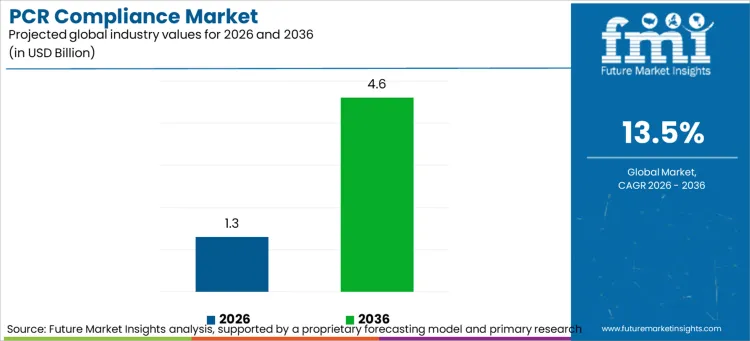
Spending associated with PCR compliance reaches USD 1.3 billion in 2026 and is projected to increase to USD 4.6 billion by 2036 at a 13.50% CAGR. Demand is created by mandatory recycled content targets, audit obligations, and disclosure rules applied to packaging, consumer goods, and selected industrial products. Brand owners and material users define compliance scope through percentage thresholds, documentation formats, and verification cycles during portfolio planning. Once a product family is placed under a compliance regime, later material changes affect certification status, reporting files, and market access permissions. Growth follows expansion of regulatory coverage and the spread of retailer and brand sourcing requirements tied to verified post-consumer recycled content.
Participation in the PCR compliance market depends on acceptance within recognized verification schemes, approved auditor networks, and standardized reporting platforms. Entry requires documented chain of custody, mass balance or physical segregation evidence, and consistency of declared content across production runs. Compliance frameworks remain stable across multi-year periods because legal filings and public commitments reference defined methodologies. Supplier changes occur during framework renewals or scope expansions rather than routine sourcing cycles. Revenue development reflects the number of product portfolios brought under mandatory or voluntary PCR disclosure programs. Competitive position depends on credibility with regulators and auditors and continued acceptance within formal compliance infrastructures.
PCR Compliance Market Quick Stats
- PCR Compliance Market Value (2026): USD 1.3 billion
- PCR Compliance Market Forecast Value (2036): USD 4.6 billion
- PCR Compliance Market Forecast CAGR 2026 to 2036: 13.5%
- Leading End Use in PCR Compliance Market: FMCG and packaging
- Leading Compliance Service in PCR Compliance Market: Certification and audit services
- Key Growth Regions in PCR Compliance Market: India, China, USA, Germany, Japan
- Top Players in PCR Compliance Market: TÜV SÜD, DIN CERTCO, UL Solutions, Intertek, SGS, CTI, JQA
What is the Growth Forecast for the PCR Compliance Market through 2036?
Audit frameworks, material declarations, and chain of custody records define how spending enters this segment. The PCR compliance market in 2026 stands near USD 1.3 billion, rising from USD 0.7 billion in 2021 as packaging and consumer goods programs bind recycled content targets to verified evidence. Buyers assess providers on data integrity, scope coverage, sampling rules, and the ability to reconcile plant level balances. Acceptance work sits with quality, legal, and packaging engineering groups rather than with sourcing desks. The value path reaches USD 2.2 billion in 2030 and USD 3.2 billion in 2033. The move to USD 4.6 billion in 2036 matches a 13.50% growth profile linked to wider mandate coverage and tighter verification depth across portfolios.
Governance design sets commercial behavior in the PCR compliance market. Volumes move under multi year agreements tied to brand policies, retailer requirements, and regulatory filings. Stock exposure remains minimal since value concentrates in systems, audits, and reporting workflows. Cost structure reflects field audits, mass balance checks, data platforms, and legal review. Operating teams track nonconformance rates, correction cycle time, and audit pass frequency. Annual values pass USD 2.8 billion in 2032 and USD 4.1 billion in 2035 as more categories adopt evidence based content claims. The approach to USD 4.6 billion in 2036 comes from broader category coverage, higher verification frequency, and longer contracts that embed compliance services into standard packaging and product governance routines.
PCR Compliance Market Key Takeaways
| Metric | Value |
|---|---|
| Market Value (2026) | USD 1.3 billion |
| Forecast Value (2036) | USD 4.6 billion |
| Forecast CAGR 2026 to 2036 | 13.5% |
Source: Future Market Insights’ proprietary forecasting model and primary research
How Is the PCR Compliance Market Being Used to Control Sourcing Governance, Content Verification, and Release Approval in Packaging and Product Supply Chains?
Companies treat the PCR compliance market as a control layer for material governance rather than as a reporting exercise. Programs specify post-consumer recycled resin certification schemes and recycled content verification services to ensure declared percentages remain defensible under audit. Qualification teams rely on chain of custody tracking systems for recycled materials and mass balance accounting frameworks for PCR content to prevent mixing errors and overstatement of claims. Engineering groups evaluate PCR material qualification protocols and recycled polymer contamination testing methods to keep processing stability and appearance within tolerance. The focus stays on traceability, documentation completeness, and lot segregation because a product that performs well but fails content verification creates regulatory exposure and forced relabeling risk.
Release governance places recycled content compliance documentation frameworks inside shipment approval rather than inside marketing review. Selection criteria for PCR material suppliers include feedstock governance, sorting discipline, and consistency of declaration methods. Audit readiness for recycled content claims defines acceptance gates and surveillance frequency. Waste stream attribution rules for PCR sourcing influence material choice because misattributed streams invalidate downstream claims. Regulatory reporting requirements for recycled content packaging shape data structure and retention policies. Third party verification for PCR compliance anchors external credibility and dispute resolution. This makes PCR compliance a supply chain control and risk management function rather than a cost driven procurement or branding decision.
How Do Regulatory Disclosure Mandates and Claim Verification Risk Shape Demand in the PCR Compliance Market by End Use and Compliance Service in 2026?
In the PCR Compliance Market, purchasing decisions are driven by documentation exposure, customer audit pressure, and enforcement risk rather than by testing cost alone. Companies managing FMCG packaging portfolios, electronics supply chains, and export compliance programs require proof systems that confirm recycled content claims while surviving third-party scrutiny across jurisdictions. By end use, demand spans FMCG and packaging, electronics and retail, export compliance, high-precision compliance programs, emerging regulation, and other uses. By compliance service, activity covers certification and audit services, regulatory testing, PCR verification, certification testing, and other services. Portfolio structure reflects evidence durability, turnaround time, and acceptance by regulators and downstream customers.
Why Does FMCG and Packaging Anchor Most Compliance Activity?
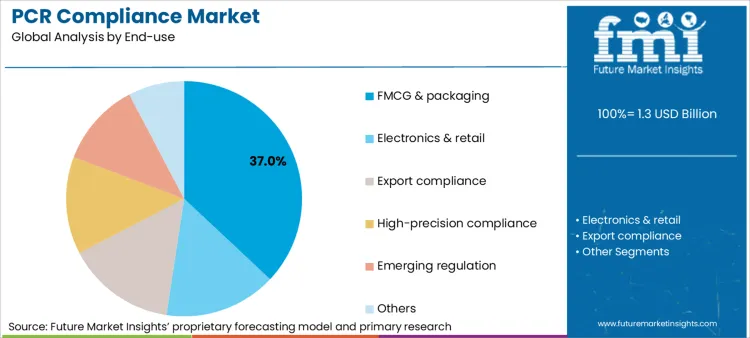
FMCG and packaging represent about 37% share, placing this segment at the center of most PCR claim verification work. High product turnover, visible on-pack statements, and retailer scorecards create constant audit exposure. Electronics and retail follow, driven by product passports and cross-border disclosure rules. Export compliance focuses on documentation acceptance at customs and trade lanes. High-precision compliance programs serve applications where material composition tolerances remain tight. Emerging regulation remains fragmented. Quality teams evaluate end uses through claim defensibility and complaint risk. Legal teams evaluate through enforcement exposure. Operations teams evaluate through sample flow and retest frequency.
End-use focus fixes sampling plans, test frequency, and documentation depth. Entering a new application class requires revised evidence frameworks and updated acceptance criteria. Procurement aligns contracts to secure continuity of approved laboratories and auditors. Internal governance systems and customer disclosure templates follow the same mapping. Commercial planning expands volumes within the same end-use class rather than rotating categories. Demand therefore concentrates in FMCG and packaging flows where public claims, retailer oversight, and regulatory visibility converge.
Why Do Certification and Audit Services Dominate Service Demand?
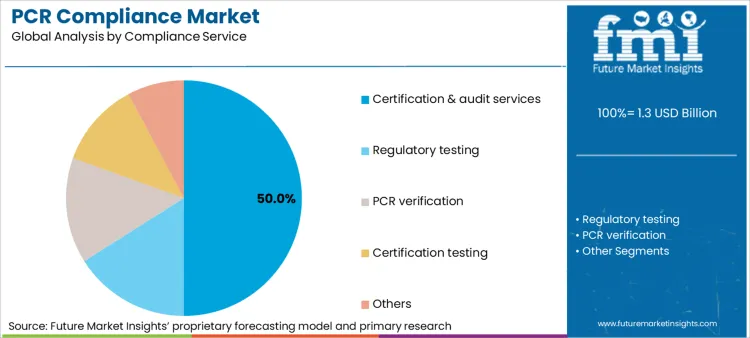
Certification and audit services account for about 50% share, reflecting their role as the primary mechanism for claim acceptance across brand owners, retailers, and regulators. This service category establishes chain-of-custody, validates mass balance, and maintains ongoing surveillance. Regulatory testing supports specific jurisdictional rules, while PCR verification addresses batch-level or supplier-level checks. Certification testing serves programs with defined technical thresholds. Other services remain situational. Compliance teams evaluate services through acceptance rate and dispute resolution speed. Legal teams evaluate through defensibility in enforcement actions. Operations teams evaluate through turnaround time and data integration.
Service model choice fixes reporting formats, data retention rules, and escalation procedures. A change in service mix requires new contracts, new internal workflows, and revised audit calendars. Planning then aligns product launch schedules and customer disclosures to the chosen compliance pathway. Supplier onboarding and material approval processes also follow. Field issue management and recall response plans assume the same evidence structure. Growth occurs by extending the same service framework to more products and regions rather than switching compliance models. Demand therefore concentrates in certification and audit services that provide durable, widely accepted proof of PCR claims.
Why Are Packaging Sourcing Rules and Audit Requirements Driving PCR Compliance Programs?
Across packaging and consumer goods supply chains, purchasing decisions are increasingly shaped by how recycled material sourcing programs interact with brand procurement standards and retail acceptance criteria. Packaging teams must prove not only that recycled content is used, but also that volumes, grades, and origins are documented through the supply chain. At the same time, certification bodies and material verification frameworks require evidence that PCR claims match physical material flows. These pressures converge at the compliance layer, where documentation, mass balance tracking, and supplier declarations become as important as material performance. Demand grows because companies need defensible proof systems rather than informal supplier assurances.
What Is Preventing Uniform Implementation of PCR Compliance Across Supply Chains?
Differences in collection systems, sorting infrastructure, and reprocessing operations create wide variation in how recycled content is produced and documented. Some suppliers can provide detailed batch level traceability, while others rely on aggregated or averaged reporting. Converter quality systems and brand audit processes also vary in depth and format, which makes standard reporting difficult to reuse across customers. Approval must often pass through third party auditors and internal governance teams, which extends timelines. These dependencies keep PCR compliance programs fragmented, increase administrative workload, and limit the ability to deploy one single compliance model across regions and product categories.
How Are Data Systems and Supplier Management Models Changing PCR Compliance Execution?
Compliance programs are moving toward tighter integration between supplier management platforms, material tracking systems, and internal reporting tools. Instead of collecting documents after the fact, procurement and packaging teams are pushing for continuous data capture from recyclers, compounders, and converters. Testing and verification partners are being involved earlier to define acceptable evidence formats and audit trails. Development is shifting toward repeatable compliance templates supported by shared data definitions and standardized workflows. Competitive advantage comes from being able to demonstrate PCR content claims quickly, consistently, and across multiple product lines without rebuilding the compliance process for each customer or region.
What is the Demand for PCR Compliance by Country?
| Country | CAGR (%) |
|---|---|
| Germany | 12.4% |
| USA | 12.8% |
| China | 15.0% |
| Japan | 10.6% |
| India | 16.2% |
Source: Future Market Insights’ proprietary forecasting model and primary research
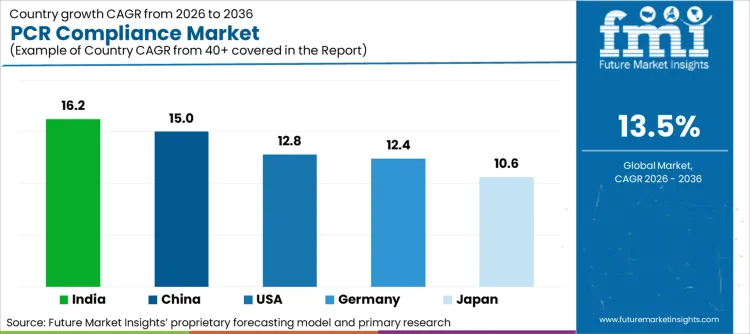
The demand for PCR compliance is increasing across packaging, consumer goods, and industrial sectors where regulatory adherence, recycled content verification, and sustainability reporting are critical. India leads at 16.2% CAGR, supported by rapid expansion in packaged goods, government mandates on recycled content, and adoption of PCR compliance standards by domestic manufacturers. China follows at 15.0%, driven by large scale production, regulatory oversight, and brand initiatives to incorporate post-consumer recycled content. The USA grows at 12.8%, shaped by corporate sustainability programs and consumer preference for verified recycled content. Germany records 12.4%, reflecting strict environmental regulations and strong adoption of compliance frameworks. Japan posts 10.6%, within a mature market emphasizing quality, traceability, and verified PCR integration.
How Manufacturing and Waste Management Practices Influence the PCR Compliance Market in Germany
PCR compliance market in Germany is expanding at a 12.4% CAGR as manufacturers implement processes to integrate post-consumer recycled materials into packaging. Materials are evaluated for purity, barrier retention, and compatibility with automated processing lines. Technical teams assess dimensional stability, thermal tolerance, and performance after repeated recycling cycles. Once validated, materials are deployed across multiple production lines and product categories. Volume growth corresponds with adoption by retail chains, foodservice programs, and industrial packaging initiatives. Supplier participation depends on certification verification, audit compliance, and technical support. Commercial success relies on reproducible material performance, operational reliability, and consistent integration across facilities.
How Packaging Volume and Sustainability Programs Drive the PCR Compliance Market in the USA
In the United States, the PCR compliance market is growing at a 12.8% CAGR due to high-volume packaging production and corporate sustainability initiatives. Selection focuses on recycled material purity, barrier efficiency, mechanical strength, and compatibility with high-speed automated laminating and filling lines. Engineers evaluate seal integrity, dimensional stability, and processing reliability. Once validated, materials are deployed across multiple production lines and packaging formats. Supplier access requires certification documentation, audit compliance, and integration support. Volume growth tracks e-commerce expansion, retail adoption, and institutional sustainability programs. Commercial success relies on consistent material performance, reproducibility, and operational reliability across production environments.
How Urban E-Commerce and Logistics Expansion Influence the PCR Compliance Market in China
Urban e-commerce growth and high-volume logistics operations are driving the PCR compliance market in China at a 15% CAGR. Materials are evaluated for mechanical performance, barrier protection, and purity after multiple recycling cycles. Technical teams assess seal reliability, dimensional consistency, and compatibility with automated laminating and filling systems. Once validated, materials are applied across multiple production lines and product categories. Supplier participation depends on audit compliance, certification documentation, and technical support. Volume growth follows fleet expansion, platform adoption, and institutional packaging programs. Commercial advantage relies on reproducible performance, operational reliability, and consistent integration across production facilities.
How Regulatory Standards and Quality Assurance Guide the PCR Compliance Market in Japan
In Japan, the PCR compliance market is growing at a 10.6% CAGR due to strict standards for material purity, safety, and barrier performance. Materials are selected for mechanical integrity, thermal stability, and compatibility with automated packaging lines. Engineers evaluate seal strength, dimensional stability, and recyclability performance. Once validated, materials are implemented across multiple production lines for retail, foodservice, and industrial packaging applications. Supplier access requires certification verification, audit compliance, and technical support. Volume growth follows adoption by packaged goods companies, institutional programs, and retail chains. Commercial success relies on reproducible material performance, operational reliability, and process consistency across production facilities.
How Platform Scaling and Production Volume Drive the PCR Compliance Market in India
PCR compliance market is expanding in India at a 16.2% CAGR due to increasing high-volume packaging production and large-scale adoption of sustainable materials. Materials are assessed for mechanical strength, barrier performance, and purity after recycling. Technical teams evaluate seal reliability, dimensional stability, and compatibility with automated laminating and filling equipment. Once validated, materials are deployed across multiple production lines and packaging programs. Supplier participation depends on certification documentation, audit compliance, and technical support. Volume growth is tied to e-commerce, retail platform expansion, and institutional packaging programs. Commercial advantage relies on reproducible material performance, operational reliability, and process integration across manufacturing facilities.
How Are Companies Addressing Compliance in the PCR Compliance Market?
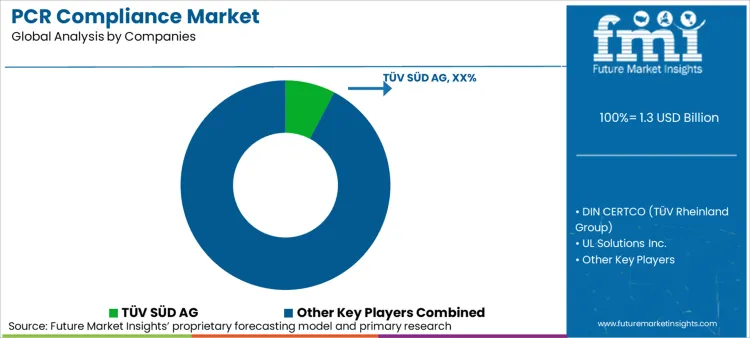
Certification expertise, testing accuracy, and regulatory alignment drive adoption in the PCR Compliance Market. TÜV SÜD, DIN CERTCO, UL Solutions, Intertek, SGS, CTI, and JQA compete during material testing, process audits, and certification validation. Once programs are implemented, verified recycled content, traceable documentation, and adherence to regional standards anchor supplier selection. TÜV SÜD emphasizes comprehensive testing and certification services for polymer recyclates. DIN CERTCO focuses on European compliance verification. UL Solutions provides global testing protocols and mark certification. Intertek delivers quality and regulatory assurance across industrial and consumer applications. SGS supports material performance and recycled content verification. CTI targets the Chinese market with local testing and certification. JQA provides certification and auditing services for Japanese regulatory compliance.
Testing reliability, audit reproducibility, and technical support shape competitive positioning in the PCR Compliance Market. Engineers and quality teams evaluate material verification, procedural accuracy, and regulatory alignment during validation. Suppliers capable of consistent certification, scalable audit capacity, and technical guidance gain preference. TÜV SÜD secures adoption through comprehensive global programs. DIN CERTCO maintains share in European certification workflows. UL Solutions captures adoption in cross-border industrial and consumer applications. Intertek supports multi-regional compliance verification. SGS holds positions in industrial-scale certification and testing. CTI provides localized services for China. JQA ensures adherence to Japanese regulations. Market positions vary by certification type, regional regulatory framework, material category, and audit scale.
Key Players in PCR Compliance Market
- TÜV SÜD AG
- DIN CERTCO (TÜV Rheinland Group)
- UL Solutions Inc.
- Intertek Group plc
- SGS SA
- Centre Testing International Group Co., Ltd. (CTI)
- Japan Quality Assurance Organization (JQA)
Scope of the Report
| Items | Values |
|---|---|
| Quantitative Units (2026) | USD billion |
| End-use | FMCG and packaging, electronics and retail, export compliance, high-precision compliance programs, emerging regulation, others |
| Compliance Service | Certification and audit services, regulatory testing, PCR verification, certification testing, others |
| Regulation Scope | EU PPWR or Digital Product Passport (DPP), FDA or FTC, trade standards, JIS standards, others |
| Verification Technology | Chain-of-custody and mass balance systems, lab validation and digital reporting, digital certificates, high-accuracy laboratories, others |
| Regions Covered | Asia Pacific, Europe, North America, Latin America, Middle East & Africa |
| Countries Covered | United States, Canada, Mexico, Germany, United Kingdom, France, Italy, Spain, Nordics, BENELUX, China, Japan, South Korea, India, Australia & New Zealand, ASEAN, Brazil, Chile, Saudi Arabia, Turkey, South Africa, and other regional markets |
| Key Companies Profiled | TÜV SÜD, DIN CERTCO, UL Solutions, Intertek, SGS, Centre Testing International Group (CTI), Japan Quality Assurance Organization (JQA) |
| Additional Attributes | Dollar value of compliance services by end-use, service type, regulation scope, and verification technology, chain-of-custody and mass-balance governance frameworks, audit frequency and nonconformance management, documentation and digital reporting systems, regulatory disclosure and market access controls, multi-year compliance service contracts, third-party verification workflows, enforcement risk management, and regional adoption patterns across packaging, consumer goods, electronics, and export-oriented industries |
PCR Compliance Market Segmentation
End-use:
- FMCG & packaging
- Electronics & retail
- Export compliance
- High-precision compliance
- Emerging regulation
- Others
Compliance Service:
- Certification & audit services
- Regulatory testing
- PCR verification
- Certification testing
- Others
Regulation Scope:
- EU PPWR or DPP
- FDA or FTC
- Trade standards
- JIS standards
- Others
Verification Technology:
- Chain-of-custody & mass balance
- Lab validation & digital reporting
- Digital certificates
- High-accuracy labs
- Others
Region
- Asia Pacific
- China
- Japan
- South Korea
- India
- Australia & New Zealand
- ASEAN
- Rest of Asia Pacific
- Europe
- Germany
- United Kingdom
- France
- Italy
- Spain
- Nordic
- BENELUX
- Rest of Europe
- North America
- United States
- Canada
- Mexico
- Latin America
- Brazil
- Chile
- Rest of Latin America
- Middle East & Africa
- Kingdom of Saudi Arabia
- Other GCC Countries
- Turkey
- South Africa
- Other African Union
- Rest of Middle East & Africa
Bibliography
- European Commission, Joint Research Centre. (2023). Plastics recycling and recycled plastics in the circular economy. Publications Office of the European Union.
- European Environment Agency. (2023). Plastics, the circular economy and Europe’s environment. European Environment Agency.
- Organisation for Economic Co-operation and Development. (2024). Plastics recycled content requirements: Overview of policy approaches and implications. OECD Publishing.
- United Nations Environment Programme. (2023). Turning off the tap: How the world can end plastic pollution and create a circular economy. UNEP.
Frequently Asked Questions
How big is the pcr compliance market in 2026?
The global pcr compliance market is estimated to be valued at USD 1.3 billion in 2026.
What will be the size of pcr compliance market in 2036?
The market size for the pcr compliance market is projected to reach USD 4.6 billion by 2036.
How much will be the pcr compliance market growth between 2026 and 2036?
The pcr compliance market is expected to grow at a 13.5% CAGR between 2026 and 2036.
What are the key product types in the pcr compliance market?
The key product types in pcr compliance market are fmcg & packaging, electronics & retail, export compliance, high-precision compliance, emerging regulation and others.
Which compliance service segment to contribute significant share in the pcr compliance market in 2026?
In terms of compliance service, certification & audit services segment to command 50.0% share in the pcr compliance market in 2026.
Preview the report firsthand - request a free sample
Get SampleGet the brochure for pricing and purchase details.
Get PDFTable of Content
- Executive Summary
- Global Market Outlook
- Demand-side Trends
- Supply-side Trends
- Technology Roadmap Analysis
- Analysis and Recommendations
- Market Overview
- Market Coverage / Taxonomy
- Market Definition / Scope / Limitations
- Market Background
- Market Dynamics
- Drivers
- Restraints
- Opportunity
- Trends
- Scenario Forecast
- Demand in Optimistic Scenario
- Demand in Likely Scenario
- Demand in Conservative Scenario
- Opportunity Map Analysis
- Product Life Cycle Analysis
- Supply Chain Analysis
- Investment Feasibility Matrix
- Value Chain Analysis
- PESTLE and Porter’s Analysis
- Regulatory Landscape
- Regional Parent Market Outlook
- Production and Consumption Statistics
- Import and Export Statistics
- Market Dynamics
- Global Market Analysis 2021 to 2025 and Forecast, 2026 to 2036
- Historical Market Size Value (USD Million) Analysis, 2021 to 2025
- Current and Future Market Size Value (USD Million) Projections, 2026 to 2036
- Y-o-Y Growth Trend Analysis
- Absolute $ Opportunity Analysis
- Global Market Pricing Analysis 2021 to 2025 and Forecast 2026 to 2036
- Global Market Analysis 2021 to 2025 and Forecast 2026 to 2036, By End-use
- Introduction / Key Findings
- Historical Market Size Value (USD Million) Analysis By End-use , 2021 to 2025
- Current and Future Market Size Value (USD Million) Analysis and Forecast By End-use , 2026 to 2036
- FMCG & packaging
- Electronics & retail
- Export compliance
- High-precision compliance
- Emerging regulation
- Others
- FMCG & packaging
- Y-o-Y Growth Trend Analysis By End-use , 2021 to 2025
- Absolute $ Opportunity Analysis By End-use , 2026 to 2036
- Global Market Analysis 2021 to 2025 and Forecast 2026 to 2036, By Compliance Service
- Introduction / Key Findings
- Historical Market Size Value (USD Million) Analysis By Compliance Service, 2021 to 2025
- Current and Future Market Size Value (USD Million) Analysis and Forecast By Compliance Service, 2026 to 2036
- Certification & audit services
- Regulatory testing
- PCR verification
- Certification testing
- Others
- Certification & audit services
- Y-o-Y Growth Trend Analysis By Compliance Service, 2021 to 2025
- Absolute $ Opportunity Analysis By Compliance Service, 2026 to 2036
- Global Market Analysis 2021 to 2025 and Forecast 2026 to 2036, By Regulation Scope
- Introduction / Key Findings
- Historical Market Size Value (USD Million) Analysis By Regulation Scope, 2021 to 2025
- Current and Future Market Size Value (USD Million) Analysis and Forecast By Regulation Scope, 2026 to 2036
- EU PPWR or DPP
- FDA or FTC
- Trade standards
- JIS standards
- Others
- EU PPWR or DPP
- Y-o-Y Growth Trend Analysis By Regulation Scope, 2021 to 2025
- Absolute $ Opportunity Analysis By Regulation Scope, 2026 to 2036
- Global Market Analysis 2021 to 2025 and Forecast 2026 to 2036, By Verification Technology
- Introduction / Key Findings
- Historical Market Size Value (USD Million) Analysis By Verification Technology, 2021 to 2025
- Current and Future Market Size Value (USD Million) Analysis and Forecast By Verification Technology, 2026 to 2036
- Chain-of-custody & mass balance
- Lab validation & digital reporting
- Digital certificates
- High-accuracy labs
- Others
- Chain-of-custody & mass balance
- Y-o-Y Growth Trend Analysis By Verification Technology, 2021 to 2025
- Absolute $ Opportunity Analysis By Verification Technology, 2026 to 2036
- Global Market Analysis 2021 to 2025 and Forecast 2026 to 2036, By Region
- Introduction
- Historical Market Size Value (USD Million) Analysis By Region, 2021 to 2025
- Current Market Size Value (USD Million) Analysis and Forecast By Region, 2026 to 2036
- North America
- Latin America
- Western Europe
- Eastern Europe
- East Asia
- South Asia and Pacific
- Middle East & Africa
- Market Attractiveness Analysis By Region
- North America Market Analysis 2021 to 2025 and Forecast 2026 to 2036, By Country
- Historical Market Size Value (USD Million) Trend Analysis By Market Taxonomy, 2021 to 2025
- Market Size Value (USD Million) Forecast By Market Taxonomy, 2026 to 2036
- By Country
- USA
- Canada
- Mexico
- By End-use
- By Compliance Service
- By Regulation Scope
- By Verification Technology
- By Country
- Market Attractiveness Analysis
- By Country
- By End-use
- By Compliance Service
- By Regulation Scope
- By Verification Technology
- Key Takeaways
- Latin America Market Analysis 2021 to 2025 and Forecast 2026 to 2036, By Country
- Historical Market Size Value (USD Million) Trend Analysis By Market Taxonomy, 2021 to 2025
- Market Size Value (USD Million) Forecast By Market Taxonomy, 2026 to 2036
- By Country
- Brazil
- Chile
- Rest of Latin America
- By End-use
- By Compliance Service
- By Regulation Scope
- By Verification Technology
- By Country
- Market Attractiveness Analysis
- By Country
- By End-use
- By Compliance Service
- By Regulation Scope
- By Verification Technology
- Key Takeaways
- Western Europe Market Analysis 2021 to 2025 and Forecast 2026 to 2036, By Country
- Historical Market Size Value (USD Million) Trend Analysis By Market Taxonomy, 2021 to 2025
- Market Size Value (USD Million) Forecast By Market Taxonomy, 2026 to 2036
- By Country
- Germany
- UK
- Italy
- Spain
- France
- Nordic
- BENELUX
- Rest of Western Europe
- By End-use
- By Compliance Service
- By Regulation Scope
- By Verification Technology
- By Country
- Market Attractiveness Analysis
- By Country
- By End-use
- By Compliance Service
- By Regulation Scope
- By Verification Technology
- Key Takeaways
- Eastern Europe Market Analysis 2021 to 2025 and Forecast 2026 to 2036, By Country
- Historical Market Size Value (USD Million) Trend Analysis By Market Taxonomy, 2021 to 2025
- Market Size Value (USD Million) Forecast By Market Taxonomy, 2026 to 2036
- By Country
- Russia
- Poland
- Hungary
- Balkan & Baltic
- Rest of Eastern Europe
- By End-use
- By Compliance Service
- By Regulation Scope
- By Verification Technology
- By Country
- Market Attractiveness Analysis
- By Country
- By End-use
- By Compliance Service
- By Regulation Scope
- By Verification Technology
- Key Takeaways
- East Asia Market Analysis 2021 to 2025 and Forecast 2026 to 2036, By Country
- Historical Market Size Value (USD Million) Trend Analysis By Market Taxonomy, 2021 to 2025
- Market Size Value (USD Million) Forecast By Market Taxonomy, 2026 to 2036
- By Country
- China
- Japan
- South Korea
- By End-use
- By Compliance Service
- By Regulation Scope
- By Verification Technology
- By Country
- Market Attractiveness Analysis
- By Country
- By End-use
- By Compliance Service
- By Regulation Scope
- By Verification Technology
- Key Takeaways
- South Asia and Pacific Market Analysis 2021 to 2025 and Forecast 2026 to 2036, By Country
- Historical Market Size Value (USD Million) Trend Analysis By Market Taxonomy, 2021 to 2025
- Market Size Value (USD Million) Forecast By Market Taxonomy, 2026 to 2036
- By Country
- India
- ASEAN
- Australia & New Zealand
- Rest of South Asia and Pacific
- By End-use
- By Compliance Service
- By Regulation Scope
- By Verification Technology
- By Country
- Market Attractiveness Analysis
- By Country
- By End-use
- By Compliance Service
- By Regulation Scope
- By Verification Technology
- Key Takeaways
- Middle East & Africa Market Analysis 2021 to 2025 and Forecast 2026 to 2036, By Country
- Historical Market Size Value (USD Million) Trend Analysis By Market Taxonomy, 2021 to 2025
- Market Size Value (USD Million) Forecast By Market Taxonomy, 2026 to 2036
- By Country
- Kingdom of Saudi Arabia
- Other GCC Countries
- Turkiye
- South Africa
- Other African Union
- Rest of Middle East & Africa
- By End-use
- By Compliance Service
- By Regulation Scope
- By Verification Technology
- By Country
- Market Attractiveness Analysis
- By Country
- By End-use
- By Compliance Service
- By Regulation Scope
- By Verification Technology
- Key Takeaways
- Key Countries Market Analysis
- USA
- Pricing Analysis
- Market Share Analysis, 2025
- By End-use
- By Compliance Service
- By Regulation Scope
- By Verification Technology
- Canada
- Pricing Analysis
- Market Share Analysis, 2025
- By End-use
- By Compliance Service
- By Regulation Scope
- By Verification Technology
- Mexico
- Pricing Analysis
- Market Share Analysis, 2025
- By End-use
- By Compliance Service
- By Regulation Scope
- By Verification Technology
- Brazil
- Pricing Analysis
- Market Share Analysis, 2025
- By End-use
- By Compliance Service
- By Regulation Scope
- By Verification Technology
- Chile
- Pricing Analysis
- Market Share Analysis, 2025
- By End-use
- By Compliance Service
- By Regulation Scope
- By Verification Technology
- Germany
- Pricing Analysis
- Market Share Analysis, 2025
- By End-use
- By Compliance Service
- By Regulation Scope
- By Verification Technology
- UK
- Pricing Analysis
- Market Share Analysis, 2025
- By End-use
- By Compliance Service
- By Regulation Scope
- By Verification Technology
- Italy
- Pricing Analysis
- Market Share Analysis, 2025
- By End-use
- By Compliance Service
- By Regulation Scope
- By Verification Technology
- Spain
- Pricing Analysis
- Market Share Analysis, 2025
- By End-use
- By Compliance Service
- By Regulation Scope
- By Verification Technology
- France
- Pricing Analysis
- Market Share Analysis, 2025
- By End-use
- By Compliance Service
- By Regulation Scope
- By Verification Technology
- India
- Pricing Analysis
- Market Share Analysis, 2025
- By End-use
- By Compliance Service
- By Regulation Scope
- By Verification Technology
- ASEAN
- Pricing Analysis
- Market Share Analysis, 2025
- By End-use
- By Compliance Service
- By Regulation Scope
- By Verification Technology
- Australia & New Zealand
- Pricing Analysis
- Market Share Analysis, 2025
- By End-use
- By Compliance Service
- By Regulation Scope
- By Verification Technology
- China
- Pricing Analysis
- Market Share Analysis, 2025
- By End-use
- By Compliance Service
- By Regulation Scope
- By Verification Technology
- Japan
- Pricing Analysis
- Market Share Analysis, 2025
- By End-use
- By Compliance Service
- By Regulation Scope
- By Verification Technology
- South Korea
- Pricing Analysis
- Market Share Analysis, 2025
- By End-use
- By Compliance Service
- By Regulation Scope
- By Verification Technology
- Russia
- Pricing Analysis
- Market Share Analysis, 2025
- By End-use
- By Compliance Service
- By Regulation Scope
- By Verification Technology
- Poland
- Pricing Analysis
- Market Share Analysis, 2025
- By End-use
- By Compliance Service
- By Regulation Scope
- By Verification Technology
- Hungary
- Pricing Analysis
- Market Share Analysis, 2025
- By End-use
- By Compliance Service
- By Regulation Scope
- By Verification Technology
- Kingdom of Saudi Arabia
- Pricing Analysis
- Market Share Analysis, 2025
- By End-use
- By Compliance Service
- By Regulation Scope
- By Verification Technology
- Turkiye
- Pricing Analysis
- Market Share Analysis, 2025
- By End-use
- By Compliance Service
- By Regulation Scope
- By Verification Technology
- South Africa
- Pricing Analysis
- Market Share Analysis, 2025
- By End-use
- By Compliance Service
- By Regulation Scope
- By Verification Technology
- USA
- Market Structure Analysis
- Competition Dashboard
- Competition Benchmarking
- Market Share Analysis of Top Players
- By Regional
- By End-use
- By Compliance Service
- By Regulation Scope
- By Verification Technology
- Competition Analysis
- Competition Deep Dive
- TÜV SÜD AG
- Overview
- Product Portfolio
- Profitability by Market Segments (Product/Age /Sales Channel/Region)
- Sales Footprint
- Strategy Overview
- Marketing Strategy
- Product Strategy
- Channel Strategy
- DIN CERTCO (TÜV Rheinland Group)
- UL Solutions Inc.
- Intertek Group plc
- SGS SA
- Centre Testing International Group Co., Ltd. (CTI)
- Japan Quality Assurance Organization (JQA)
- TÜV SÜD AG
- Competition Deep Dive
- Assumptions & Acronyms Used
- Research Methodology


