

- Industry Size (2026)
- USD 3.1 Bn
- Forecast (2036)
- USD 6.0 Bn
- CAGR (2026 to 2036)
- 6.9%
PCR Laminates Market Size, Market Forecast and Outlook By FMI
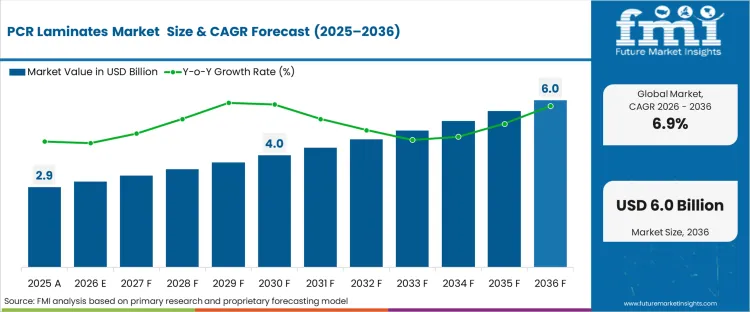
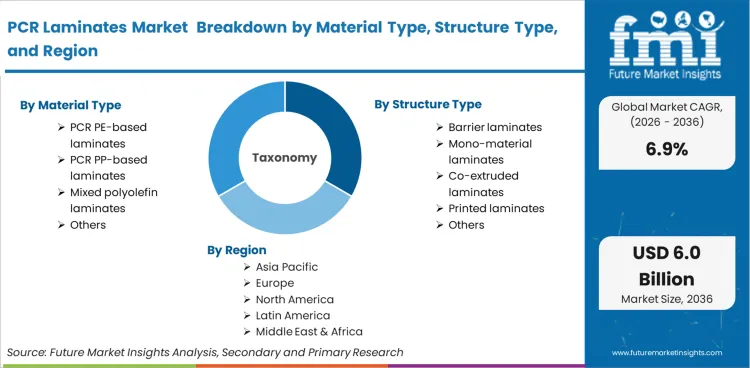
The PCR laminates market was valued at USD 2.9 billion in 2025. The market is projected to reach USD 3.1 billion in 2026 and USD 6.0 billion by 2036, expanding at a CAGR of 6.9% during the forecast period. PCR PE-based laminates are expected to lead material type with a 43.7% share in 2026. Barrier laminates are projected to remain the leading structure type with a 36.5% share in 2026. Food is expected to lead end-use industry demand with a 39.4% share in 2026.
Summary of PCR Laminates Market
- Key Drivers
- Recyclability Pressure: Brands are redesigning legacy mixed-material packs into structures that can absorb recycled content and still fit circularity targets.
- Barrier Retention: Demand is rising for laminates that preserve moisture and oxygen protection while reducing virgin polymer dependence.
- Converter Innovation: Improvements in PE and PP film engineering are making recycled-content laminates more practical on existing lines.
- Key Segments Analyzed in the Report
- Material Type: PCR PE-based laminates, PCR PP-based laminates, mixed polyolefin laminates, and others
- Structure Type: mono-material laminates, co-extruded laminates, barrier laminates, printed laminates, and others
- End Use Industry: food, home and personal care, healthcare, industrial, and others
- Region: North America, Latin America, Western Europe, Eastern Europe, East Asia, South Asia Pacific, and Middle East and Africa
- Analyst Opinion
- Ismail Sutaria, Senior Consultant at FMI says, "The economic winner in laminates is the supplier that can preserve barrier performance while reducing structural complexity. Recycled content matters, but only when it survives the realities of converting and filling lines."
PCR Laminates Market Definition
The market covers multi-layer or mono-material flexible structures that incorporate post-consumer recycled resin and are sold as laminates for packaging conversion. It includes PE-based laminates, PP-based laminates, mixed polyolefin laminates, barrier laminates, and printed laminate structures. These products serve food, personal care, healthcare, and industrial packaging applications that require sealability, graphics performance, toughness, and selected barrier properties within a more circular material design.
PCR Laminates Market Inclusions
- Revenue from recycled-content flexible laminate structures sold in reel or converted-packaging form.
- Mono-material, co-extruded, barrier, and printed laminate demand tied to packaging conversion.
- Commercial demand across food, personal care, healthcare, industrial, and related packaging uses.
PCR Laminates Market Exclusions
- Flexible paper structures with no recycled plastic laminate content.
- Finished packed product revenue in food, healthcare, or personal care.
- General converting or printing services not tied to laminate sales.
PCR Laminates Market Research Methodology
This study evaluates the market across key segments and regions for the base year 2025 and the forecast period 2026 to 2036. All market values are presented in USD billion. The analysis is built on a review of regulatory references, company disclosures, product and technology developments, trade literature, and industry documentation relevant to the value chain. Market estimates are derived through triangulation of demand-side trends, supply-side positioning, pricing dynamics, application intensity, and regional adoption patterns to establish current market size and forecast potential.
Key Drivers, Restraints, and Trends in PCR Laminates Market
Drivers
Demand is being driven by the need to redesign legacy flexible packs that were optimized for performance but not for circularity. Brand owners want structures that cut virgin resin use, meet recyclability expectations, and still protect shelf life. That requirement raises demand for laminated films that can incorporate recycled content while remaining machineable and visually acceptable. Growth is strongest where polyethylene and polypropylene structures can replace harder-to-recycle combinations. The market also benefits from the broader strategic shift toward mono-material or near-mono-material packaging systems.
Restraints
Barrier performance still limits how far simplification can go in some food and healthcare applications. Recycled-content laminates can also face haze, odor, sealing, and stiffness trade-offs that complicate line qualification. Converter changeovers are not trivial because one structural change can affect print, lamination, sealing, and filling performance at the same time. Brands with long validation cycles tend to move cautiously. These constraints keep adoption real, but uneven.
Trends
Suppliers are moving from general-purpose laminate claims to application-specific structures with clear recyclability and performance positioning. More innovation is centered on PE-based and PP-based families that can fit emerging recycling pathways. Barrier solutions are being reengineered so that sustainability gains do not require a full sacrifice in shelf-life protection. Competitive advantage is increasingly tied to who can simplify structure design while keeping commercial functionality intact.
Segmental Analysis
PCR Laminates Analysis by Material Type
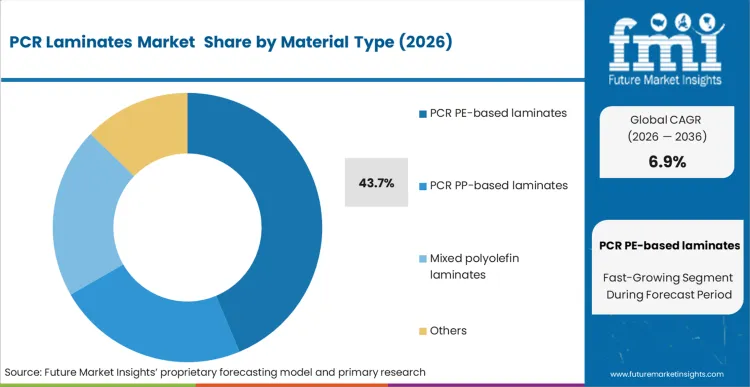
PCR PE-based laminates are projected to account for 43.7% of revenue in 2026 because polyethylene remains the most commercially adaptable route for flexible packaging structures that need both processability and improving recyclability. The current transition is not just from virgin to recycled resin. It is also from mixed-material legacy laminates toward PE-rich constructions that can carry recycled content while staying compatible with established film-recycling streams. Amcor's AmPrima portfolio captures that direction. The company states that its PE formats can include up to 50% post-consumer recycled content while remaining recycle ready, which materially strengthens the case for PE-led laminate demand.
PCR Laminates Analysis by Structure Type
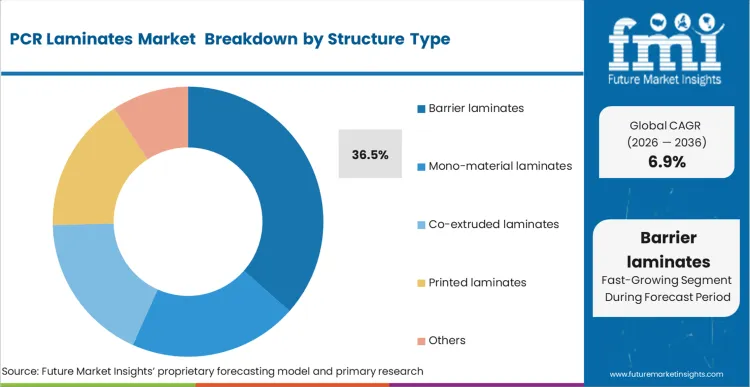
Barrier laminates are projected to hold a 36.5% share in 2026 because oxygen, aroma, and moisture protection still determine which flexible formats can scale in food, healthcare, and personal care. The challenge is that barrier performance has historically relied on complex multi-material structures. That is now being reworked around recyclable PE or PP-rich designs that can still protect shelf life. CEFLEX has pushed this transition by promoting quality-recycling pathways for PE and PP flexible packaging, while Amcor in 2025 introduced recycle-ready high-shield medical laminates as a lower-impact alternative to traditional foil-based structures.
Competitive Aligners for Market Players
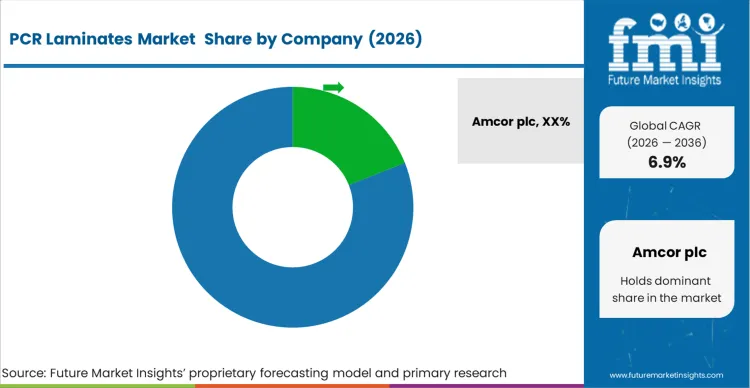
Competitive strength in PCR laminates is built around execution. Buyers are looking for structures that run well on real packaging lines and still meet performance expectations once the pack reaches the shelf. A laminate may look strong on paper, but commercial acceptance depends on whether it can hold seals, protect the product, and run without creating waste or stoppages during conversion and filling. This is where many suppliers get separated. Recycled-content loading is only one part of the job. Converters also have to manage barrier performance, seal reliability, and machine runnability within the same structure. In food, personal care, and home care applications, that balance becomes especially important because even small weaknesses can affect shelf life, appearance, or line efficiency.
Buyers are therefore judging laminate suppliers on whether they can deliver a workable pack, not just a recycled-content percentage. Technical support has become a real differentiator. Brand owners and retailers want help with structure selection, trial runs, and qualification. They also want clearer answers on recyclability claims and compliance positioning. That has pushed leading companies to move beyond standard film selling and toward application-led development. In practice, this means designing laminates around what a pouch, sachet, or flexible pack actually needs to do in use. Amcor’s recycle-ready laminate work, including its AmPrima platform, reflects that shift. The company is positioning laminates as purpose-built systems for specific packaging needs rather than as interchangeable film layers. That matters because performance requirements vary widely across dry foods, liquids, and personal care products. A structure that works in one category may fail commercially in another if seal behavior, stiffness, or barrier profile is off.
Industry guidance is also shaping competition. CEFLEX has helped bring more clarity to polyethylene and polypropylene recycling pathways in Europe. That guidance does not solve every technical problem, but it does raise the standard for what buyers now expect from laminate design. Suppliers increasingly need to show how a structure fits into an accepted collection, sorting, and recycling logic. General sustainability language is losing force where buyers want evidence that a laminate can work within a real recovery pathway. As a result, leadership in PCR laminates is forming around companies that can make recycled-content structures usable at scale. That includes converters with formulation depth, resin partners with consistent recycled feedstock, and technical teams that can support qualification from pilot stage through commercialization. The market is moving toward suppliers that reduce adoption risk for the customer. That is often what decides the account. Buyers can tolerate complexity during development, but they do not want surprises once a pack is commercialized.
Key Players in PCR Laminates Market
- Amcor plc
- Mondi plc
- Constantia Flexibles Group GmbH
- Coveris Holdings S.A.
- ProAmpac LLC
- Berry Global Group, Inc.
- Huhtamaki Oyj
- Sonoco Products Company
- Winpak Ltd.
- UFlex Limited
Strategic Outlook by FMI on PCR Laminates Market
The market is moving from sustainability pilots to specification-driven laminate redesign. The next decade will reward suppliers that can hold barrier performance while simplifying material structures and incorporating Post-Consumer Recycled (PCR) content at commercial scale. Companies with strong converting capabilities, testing infrastructure, and close brand-owner development cycles will define the premium end of this market.
Scope of the Report
| Metric | Value |
|---|---|
| Market Value | USD 2.9 billion in 2025 to USD 6.0 billion by 2036 |
| CAGR | 6.9% from 2026 to 2036 |
| Base Year | 2025 |
| Forecast Period | 2026 to 2036 |
| Primary Segmentation | Material type | PCR PE-based laminates, PCR PP-based laminates, mixed polyolefin laminates, and others |
| Secondary Segmentation | Structure type | mono-material laminates, co-extruded laminates, barrier laminates, printed laminates, and others |
| End Use Segmentation | End use industry | food, home and personal care, healthcare, industrial, and others |
| Regions Covered | North America, Latin America, Western Europe, Eastern Europe, East Asia, South Asia Pacific, and Middle East and Africa |
Bibliography
- OECD. 2022. Global Plastics Outlook: Economic Drivers, Environmental Impacts and Policy Options.
- European Commission. 2025. Packaging Waste.
- European Union. 2025. Regulation (EU) 2025/40 of the European Parliament and of the Council of 19 December 2024 on packaging and packaging waste.
- CEFLEX. 2022. CEFLEX Quality Recycling Process.
- CEFLEX. 2022. Closing the Loop on Household Flexible Packaging at K-2022.
- Amcor plc. 2025. New Recycle-Ready, High-Barrier Laminates for Medical Devices.
- Amcor plc. n.d. AmPrima Recycle Ready Solutions in North America.
Frequently Asked Questions
What is the projected market size of the PCR laminates market by 2036?
The PCR laminates market is projected to reach USD 6.0 billion by 2036, expanding at a CAGR of 6.9% from 2026 to 2036.
Which material type leads the PCR laminates market share in 2026?
PCR PE-based laminates are expected to dominate the material type segment with a 43.7% share in 2026 due to their processability and compatibility with established film-recycling streams.
Why do barrier laminates hold the largest structure type share in the PCR laminates market?
Barrier laminates are projected to hold a 36.5% share in 2026 because oxygen, aroma, and moisture protection remain critical requirements across food, healthcare, and personal care packaging applications.
Which end use industry drives the highest demand for PCR laminates?
The food industry leads end-use demand with a 39.4% share in 2026, driven by the need for flexible packaging that combines recycled content with reliable shelf-life protection.
What are the key growth drivers of the post-consumer recycled laminates market?
The market is primarily driven by brand owner pressure to redesign legacy flexible packs toward circular, recyclable structures that reduce virgin polymer dependence without compromising barrier performance.
Preview the report firsthand - request a free sample
Get SampleGet the brochure for pricing and purchase details.
Get PDFTable of Content
- Executive Summary
- Global Market Outlook
- Demand-side Trends
- Supply-side Trends
- Technology Roadmap Analysis
- Analysis and Recommendations
- Market Overview
- Market Coverage / Taxonomy
- Market Definition / Scope / Limitations
- Research Methodology
- Chapter Orientation
- Analytical Lens and Working Hypotheses
- Market Structure, Signals, and Trend Drivers
- Benchmarking and Cross-market Comparability
- Market Sizing, Forecasting, and Opportunity Mapping
- Research Design and Evidence Framework
- Desk Research Programme (Secondary Evidence)
- Company Annual and Sustainability Reports
- Peer-reviewed Journals and Academic Literature
- Corporate Websites, Product Literature, and Technical Notes
- Earnings Decks and Investor Briefings
- Statutory Filings and Regulatory Disclosures
- Technical White Papers and Standards Notes
- Trade Journals, Industry Magazines, and Analyst Briefs
- Conference Proceedings, Webinars, and Seminar Materials
- Government Statistics Portals and Public Data Releases
- Press Releases and Reputable Media Coverage
- Specialist Newsletters and Curated Briefings
- Sector Databases and Reference Repositories
- FMI Internal Proprietary Databases and Historical Market Datasets
- Subscription Datasets and Paid Sources
- Social Channels, Communities, and Digital Listening Inputs
- Additional Desk Sources
- Expert Input and Fieldwork (Primary Evidence)
- Primary Modes
- Qualitative Interviews and Expert Elicitation
- Quantitative Surveys and Structured Data Capture
- Blended Approach
- Why Primary Evidence is Used
- Field Techniques
- Interviews
- Surveys
- Focus Groups
- Observational and In-context Research
- Social and Community Interactions
- Stakeholder Universe Engaged
- C-suite Leaders
- Board Members
- Presidents and Vice Presidents
- R&D and Innovation Heads
- Technical Specialists
- Domain Subject-matter Experts
- Scientists
- Physicians and Other Healthcare Professionals
- Governance, Ethics, and Data Stewardship
- Research Ethics
- Data Integrity and Handling
- Primary Modes
- Tooling, Models, and Reference Databases
- Desk Research Programme (Secondary Evidence)
- Data Engineering and Model Build
- Data Acquisition and Ingestion
- Cleaning, Normalisation, and Verification
- Synthesis, Triangulation, and Analysis
- Quality Assurance and Audit Trail
- Market Background
- Market Dynamics
- Drivers
- Restraints
- Opportunity
- Trends
- Scenario Forecast
- Demand in Optimistic Scenario
- Demand in Likely Scenario
- Demand in Conservative Scenario
- Opportunity Map Analysis
- Product Life Cycle Analysis
- Supply Chain Analysis
- Investment Feasibility Matrix
- Value Chain Analysis
- PESTLE and Porter’s Analysis
- Regulatory Landscape
- Regional Parent Market Outlook
- Production and Consumption Statistics
- Import and Export Statistics
- Market Dynamics
- Global Market Analysis 2021 to 2025 and Forecast, 2026 to 2036
- Historical Market Size Value (USD Million) Analysis, 2021 to 2025
- Current and Future Market Size Value (USD Million) Projections, 2026 to 2036
- Y-o-Y Growth Trend Analysis
- Absolute $ Opportunity Analysis
- Global Market Pricing Analysis 2021 to 2025 and Forecast 2026 to 2036
- Global Market Analysis 2021 to 2025 and Forecast 2026 to 2036, By Material Type
- Introduction / Key Findings
- Historical Market Size Value (USD Million) Analysis By Material Type , 2021 to 2025
- Current and Future Market Size Value (USD Million) Analysis and Forecast By Material Type , 2026 to 2036
- PCR PE-based laminates
- PCR PP-based laminates
- Mixed polyolefin laminates
- Others
- PCR PE-based laminates
- Y-o-Y Growth Trend Analysis By Material Type , 2021 to 2025
- Absolute $ Opportunity Analysis By Material Type , 2026 to 2036
- Global Market Analysis 2021 to 2025 and Forecast 2026 to 2036, By Structure Type
- Introduction / Key Findings
- Historical Market Size Value (USD Million) Analysis By Structure Type, 2021 to 2025
- Current and Future Market Size Value (USD Million) Analysis and Forecast By Structure Type, 2026 to 2036
- Barrier laminates
- Mono-material laminates
- Co-extruded laminates
- Printed laminates
- Others
- Barrier laminates
- Y-o-Y Growth Trend Analysis By Structure Type, 2021 to 2025
- Absolute $ Opportunity Analysis By Structure Type, 2026 to 2036
- Global Market Analysis 2021 to 2025 and Forecast 2026 to 2036, By Region
- Introduction
- Historical Market Size Value (USD Million) Analysis By Region, 2021 to 2025
- Current Market Size Value (USD Million) Analysis and Forecast By Region, 2026 to 2036
- North America
- Latin America
- Western Europe
- Eastern Europe
- East Asia
- South Asia and Pacific
- Middle East & Africa
- Market Attractiveness Analysis By Region
- North America Market Analysis 2021 to 2025 and Forecast 2026 to 2036, By Country
- Historical Market Size Value (USD Million) Trend Analysis By Market Taxonomy, 2021 to 2025
- Market Size Value (USD Million) Forecast By Market Taxonomy, 2026 to 2036
- By Country
- USA
- Canada
- Mexico
- By Material Type
- By Structure Type
- By Country
- Market Attractiveness Analysis
- By Country
- By Material Type
- By Structure Type
- Key Takeaways
- Latin America Market Analysis 2021 to 2025 and Forecast 2026 to 2036, By Country
- Historical Market Size Value (USD Million) Trend Analysis By Market Taxonomy, 2021 to 2025
- Market Size Value (USD Million) Forecast By Market Taxonomy, 2026 to 2036
- By Country
- Brazil
- Chile
- Rest of Latin America
- By Material Type
- By Structure Type
- By Country
- Market Attractiveness Analysis
- By Country
- By Material Type
- By Structure Type
- Key Takeaways
- Western Europe Market Analysis 2021 to 2025 and Forecast 2026 to 2036, By Country
- Historical Market Size Value (USD Million) Trend Analysis By Market Taxonomy, 2021 to 2025
- Market Size Value (USD Million) Forecast By Market Taxonomy, 2026 to 2036
- By Country
- Germany
- UK
- Italy
- Spain
- France
- Nordic
- BENELUX
- Rest of Western Europe
- By Material Type
- By Structure Type
- By Country
- Market Attractiveness Analysis
- By Country
- By Material Type
- By Structure Type
- Key Takeaways
- Eastern Europe Market Analysis 2021 to 2025 and Forecast 2026 to 2036, By Country
- Historical Market Size Value (USD Million) Trend Analysis By Market Taxonomy, 2021 to 2025
- Market Size Value (USD Million) Forecast By Market Taxonomy, 2026 to 2036
- By Country
- Russia
- Poland
- Hungary
- Balkan & Baltic
- Rest of Eastern Europe
- By Material Type
- By Structure Type
- By Country
- Market Attractiveness Analysis
- By Country
- By Material Type
- By Structure Type
- Key Takeaways
- East Asia Market Analysis 2021 to 2025 and Forecast 2026 to 2036, By Country
- Historical Market Size Value (USD Million) Trend Analysis By Market Taxonomy, 2021 to 2025
- Market Size Value (USD Million) Forecast By Market Taxonomy, 2026 to 2036
- By Country
- China
- Japan
- South Korea
- By Material Type
- By Structure Type
- By Country
- Market Attractiveness Analysis
- By Country
- By Material Type
- By Structure Type
- Key Takeaways
- South Asia and Pacific Market Analysis 2021 to 2025 and Forecast 2026 to 2036, By Country
- Historical Market Size Value (USD Million) Trend Analysis By Market Taxonomy, 2021 to 2025
- Market Size Value (USD Million) Forecast By Market Taxonomy, 2026 to 2036
- By Country
- India
- ASEAN
- Australia & New Zealand
- Rest of South Asia and Pacific
- By Material Type
- By Structure Type
- By Country
- Market Attractiveness Analysis
- By Country
- By Material Type
- By Structure Type
- Key Takeaways
- Middle East & Africa Market Analysis 2021 to 2025 and Forecast 2026 to 2036, By Country
- Historical Market Size Value (USD Million) Trend Analysis By Market Taxonomy, 2021 to 2025
- Market Size Value (USD Million) Forecast By Market Taxonomy, 2026 to 2036
- By Country
- Kingdom of Saudi Arabia
- Other GCC Countries
- Turkiye
- South Africa
- Other African Union
- Rest of Middle East & Africa
- By Material Type
- By Structure Type
- By Country
- Market Attractiveness Analysis
- By Country
- By Material Type
- By Structure Type
- Key Takeaways
- Key Countries Market Analysis
- USA
- Pricing Analysis
- Market Share Analysis, 2025
- By Material Type
- By Structure Type
- Canada
- Pricing Analysis
- Market Share Analysis, 2025
- By Material Type
- By Structure Type
- Mexico
- Pricing Analysis
- Market Share Analysis, 2025
- By Material Type
- By Structure Type
- Brazil
- Pricing Analysis
- Market Share Analysis, 2025
- By Material Type
- By Structure Type
- Chile
- Pricing Analysis
- Market Share Analysis, 2025
- By Material Type
- By Structure Type
- Germany
- Pricing Analysis
- Market Share Analysis, 2025
- By Material Type
- By Structure Type
- UK
- Pricing Analysis
- Market Share Analysis, 2025
- By Material Type
- By Structure Type
- Italy
- Pricing Analysis
- Market Share Analysis, 2025
- By Material Type
- By Structure Type
- Spain
- Pricing Analysis
- Market Share Analysis, 2025
- By Material Type
- By Structure Type
- France
- Pricing Analysis
- Market Share Analysis, 2025
- By Material Type
- By Structure Type
- India
- Pricing Analysis
- Market Share Analysis, 2025
- By Material Type
- By Structure Type
- ASEAN
- Pricing Analysis
- Market Share Analysis, 2025
- By Material Type
- By Structure Type
- Australia & New Zealand
- Pricing Analysis
- Market Share Analysis, 2025
- By Material Type
- By Structure Type
- China
- Pricing Analysis
- Market Share Analysis, 2025
- By Material Type
- By Structure Type
- Japan
- Pricing Analysis
- Market Share Analysis, 2025
- By Material Type
- By Structure Type
- South Korea
- Pricing Analysis
- Market Share Analysis, 2025
- By Material Type
- By Structure Type
- Russia
- Pricing Analysis
- Market Share Analysis, 2025
- By Material Type
- By Structure Type
- Poland
- Pricing Analysis
- Market Share Analysis, 2025
- By Material Type
- By Structure Type
- Hungary
- Pricing Analysis
- Market Share Analysis, 2025
- By Material Type
- By Structure Type
- Kingdom of Saudi Arabia
- Pricing Analysis
- Market Share Analysis, 2025
- By Material Type
- By Structure Type
- Turkiye
- Pricing Analysis
- Market Share Analysis, 2025
- By Material Type
- By Structure Type
- South Africa
- Pricing Analysis
- Market Share Analysis, 2025
- By Material Type
- By Structure Type
- USA
- Market Structure Analysis
- Competition Dashboard
- Competition Benchmarking
- Market Share Analysis of Top Players
- By Regional
- By Material Type
- By Structure Type
- Competition Analysis
- Competition Deep Dive
- Amcor plc
- Overview
- Product Portfolio
- Profitability by Market Segments (Product/Age /Sales Channel/Region)
- Sales Footprint
- Strategy Overview
- Marketing Strategy
- Product Strategy
- Channel Strategy
- Mondi plc
- Constantia Flexibles Group GmbH
- Coveris Holdings S.A.
- ProAmpac LLC
- Berry Global Group, Inc.
- Huhtamaki Oyj
- Sonoco Products Company
- Winpak Ltd.
- UFlex Limited
- Amcor plc
- Competition Deep Dive
- Assumptions & Acronyms Used


