

- Industry Size (2026)
- USD 4.1 Bn
- Forecast (2036)
- USD 9.1 Bn
- CAGR (2026 to 2036)
- 8.3%
Mono-Material Pouches Market Size, Market Forecast and Outlook By FMI
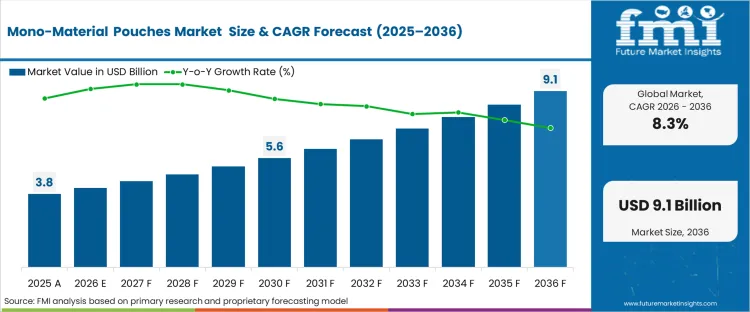
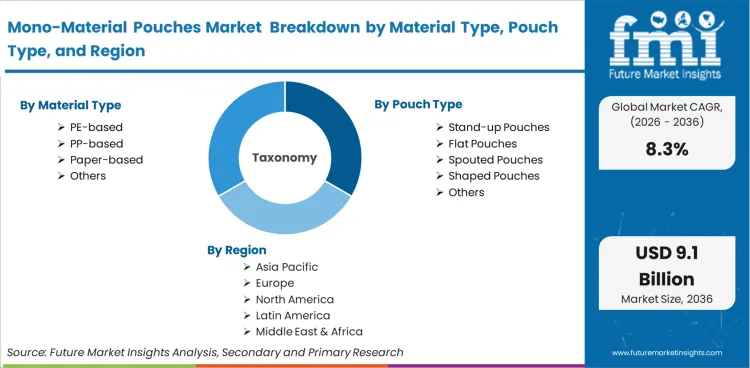
The mono-material pouches market was valued at USD 3.8 billion in 2025. The market is projected to reach USD 4.1 billion in 2026 and USD 9.1 billion by 2036, expanding at a CAGR of 8.3% during the forecast period. The PE-based segment leads material type with a 46.2% share in 2026. The Stand-up Pouches segment is projected to remain the leading pouch type segment with a 39.5% share in 2026. The Food & Beverage segment is expected to lead end-use demand with a 52.8% share in 2026.
Summary of Mono-Material Pouches Market
- Key Drivers
- Pouch circularity focus: Flexible pouches are under strong pressure to prove a more credible end-of-life story.
- Format persistence: Brands still want lightweight pouches because they reduce material use and logistics burden compared with many rigid packs.
- Approval-led adoption: Recyclability approvals and case studies are making mono-material pouch conversion less speculative for large brands.
- Key Segments Analyzed in the Report
- Material Type: PE-based, PP-based, Paper-based, and Others
- Pouch Type: Stand-up Pouches, Flat Pouches, Spouted Pouches, Shaped Pouches, and Others
- End Use Industry: Food & Beverage, Home Care, Personal Care, Pet Food, and Others
- Region: North America, Latin America, Europe, Asia Pacific, and Middle East & Africa
- Analyst Opinion
- Ismail Sutaria, Senior Consultant at Future Market Insights says, "Mono-material pouches are where flexible packaging circularity gets tested in the real world. The winners are not the packs with the simplest claim. They are the packs that protect the product, survive logistics, and still enter a credible recovery stream without redesigning the whole supply chain around them."
- Mono-Material Pouches Market Definition
- The mono-material pouches market comprises pouch packaging formats built predominantly from one material family, typically polyethylene or polypropylene, to improve recyclability relative to mixed-material alternatives. It includes stand-up, flat, spouted, and shaped pouches used in food, home care, personal care, and pet-food markets. These formats are designed to preserve the lightweight, printable, and convenience advantages of flexible pouches while aligning more closely with existing recycling pathways and circular-packaging requirements.
- Mono-Material Pouches Market Inclusions
- Mono-material pouch structures sold as pre-made pouches or rollstock for pouch conversion.
- Revenue from food, home care, personal care, pet food, and related pouch-packaging uses.
- Demand across North America, Latin America, Europe, Asia Pacific, and the Middle East & Africa.
- Mono-Material Pouches Market Exclusions
- Multi-material pouches where one material family does not clearly dominate the structure.
- Finished consumer goods packaged in pouches.
- Non-pouch flexible packaging formats such as labels, shrink sleeves, or industrial sacks.
- Mono-Material Pouches Market Research Methodology
- This study evaluates the mono-material pouches market across material type, pouch type, end use industry, and region, using 2025 as the base year and 2026 to 2036 as the forecast period. Market value is expressed in USD billion. Evidence inputs include recyclability approvals, brand case studies, CEFLEX design guidance, APR criteria, and first-party mono-material pouch product announcements. Triangulation combines end-use demand, pack conversion intensity, barrier-function value density, material substitution rates, and supplier positioning to derive the segment and regional estimates.
Key Drivers, Restraints, and Trends in Mono-Material Pouches Market
Drivers
Mono-material pouches are growing because the pouch format is too valuable to abandon, yet too exposed to circularity criticism to remain unchanged. Brands still rely on pouches for low transport weight, shelf impact, and convenience. The redesign challenge is therefore to retain those advantages while moving closer to an identifiable recycling stream. PE-based and PP-based mono-material structures answer that need in foods, detergents, pet care, and personal care. Adoption is accelerating as more pouches gain recyclability approvals, slider and spout compatibility improves, and value-chain partners show that mono-material design can work beyond a narrow set of dry goods.
Restraints
The pouch remains one of the hardest formats to simplify without trade-offs. Closures, spouts, zippers, inks, and barrier needs can all undermine a mono-material claim. Mechanical properties must survive filling, transport, and consumer use. Some liquid and retort uses still push designers back toward more complex constructions. Cost is another restraint because mono-material pouch redesign often requires repeated trials across machinery, graphics, and pack behaviour. Collection and recycling realities also vary widely by geography.
Trends
The market is shifting from generic stand-up pouch replacement to application-specific design. Spouted and shaped pouches are becoming more important because they test whether mono-material logic can survive higher functional complexity. Commercial evidence is also getting stronger, with brands increasingly asking for third-party recyclability validation. At the same time, suppliers are paying more attention to removable elements, closure compatibility, and panel design so that pouch circularity depends less on a theoretical material claim and more on the whole pack system.
Segmental Analysis
Mono-Material Pouches Analysis by Material Type
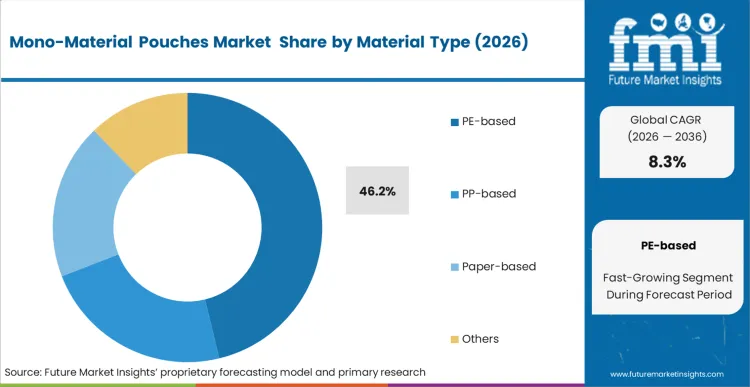
The PE-based segment is expected to lead the material type segment with a 46.2% share in 2026. PE-based pouches lead because polyethylene offers the broadest installed base in flexible packaging and the clearest fit with many current recycle-ready design pathways. It also supports good seal performance and toughness in demanding pouch applications. Mondi's mono-material spouted and shaped pouch offerings show how PE-based structures remain the primary route for turning pouch circularity concepts into commercial packs.
Mono-Material Pouches Analysis by Pouch Type
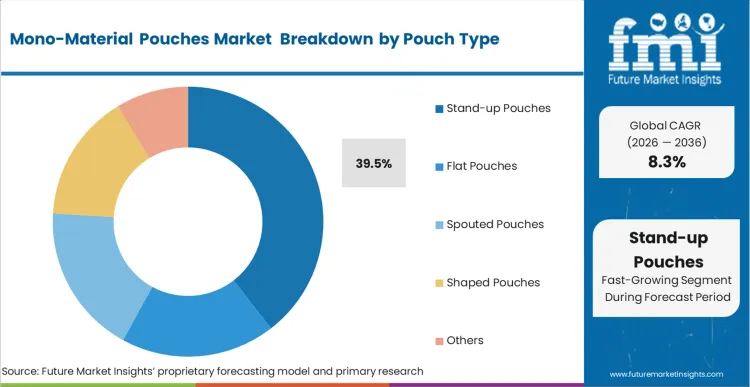
The Stand-up Pouches segment is expected to lead the pouch type segment with a 39.5% share in 2026. Stand-up pouches lead because they dominate pouch-format consumption across food and household products and offer the biggest visible replacement opportunity for mixed-material laminates. Their retail importance also makes them the first format brands want to redesign. Mondi's re/cycle ShapedPouch and mono-material pouch developments, along with Amcor's broader recycle-ready pouch work, confirm that stand-up pouch architecture remains the centre of market activity.
Competitive Aligners for Market Players
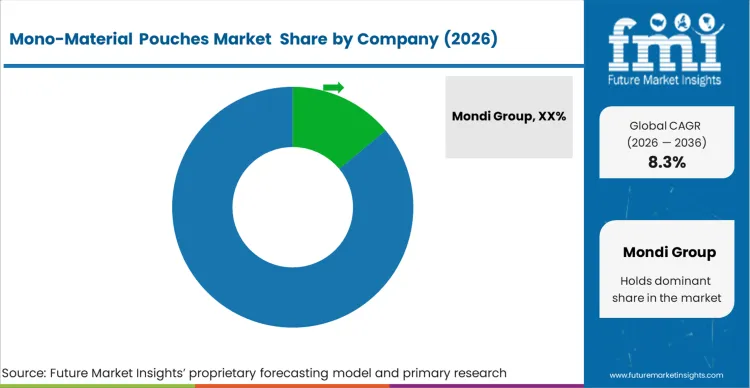
Competition in mono-material pouches is shifting from materials marketing to systems execution.The old pitch was simple: fewer materials, easier recycling story, cleaner sustainability language. That is no longer enough. Buyers have moved past the label. They now care about whether the pouch actually works in the real world. That shift is changing who wins. The strongest players are the ones turning mono-material pouches into usable packaging infrastructure.
Mondi has expanded its portfolio into shaped, spouted, and removable-panel formats, which matters because it shows the category is moving beyond basic replacement logic and into use-case-specific design. Amcor is pushing recycle-ready pouch and film platforms across both food and non-food applications, which signals that scale adoption depends on repeatable commercial systems, not one-off technical demos. RecyClass approvals for PE-based pouches add another layer: validation is becoming part of the product. The implication is straightforward. This market is being organized around who can remove friction for the converter, the filler, and the brand owner.
Key Players in Mono-Material Pouches Market
- Mondi Group
- Amcor
- Berry Global
- Coveris
- Constantia Flexibles
- Sealed Air
- ProAmpac
- Guala Pack
- Borealis
- Dow
Strategic Outlook by FMI on Mono-Material Pouches Market
FMI expects mono-material pouches to stay one of the fastest-moving areas in flexible packaging because they address a structural tension between lightweight packaging and circularity. Growth will come from formats that prove mechanical reliability, barrier adequacy, and credible recyclability in large-volume categories. Suppliers that can integrate material, closure, and approval strategy into one commercial offer will outperform the rest of the market.
Scope of the Report
| Metric | Value |
|---|---|
| Market Value | USD 3.8 billion in 2025 to USD 9.1 billion by 2036 |
| CAGR | 8.3% from 2026 to 2036 |
| Base Year | 2025 |
| Forecast Period | 2026 to 2036 |
| Material Type Segmentation | PE-based, PP-based, Paper-based, Others |
| Pouch Type Segmentation | Stand-up Pouches, Flat Pouches, Spouted Pouches, Shaped Pouches, Others |
| End Use Industry Segmentation | Food & Beverage, Home Care, Personal Care, Pet Food, Others |
| Regions Covered | North America, Latin America, Europe, Asia Pacific, Middle East & Africa |
Bibliography
- CEFLEX. 2022. CEFLEX Quality Recycling Process.
- Mondi Group. Mono-material spouted pouches.
- Mondi Group. Mono-material pouch with removable panels.
- Mondi Group. Mono-material shaped pouches.
- RecyClass. Single Unit Dose laundry pouch pack by Procter & Gamble approved by RecyClass.
Frequently Asked Questions
What is the projected size of the Mono-Material Pouches market by 2036?
The mono-material pouches market is projected to reach USD 9.1 billion by 2036.
What is the CAGR of the Mono-Material Pouches market from 2026 to 2036?
The mono-material pouches market is projected to expand at a CAGR of 8.3% from 2026 to 2036.
Which material type segment leads the Mono-Material Pouches market?
The PE-based segment leads the mono-material pouches market with a 46.2% share in 2026.
Which pouch type segment dominates the Mono-Material Pouches market?
The Stand-up Pouches segment holds the leading position in the mono-material pouches market with a 39.5% share in 2026.
Which end use industry leads the Mono-Material Pouches market?
The Food & Beverage segment is expected to account for the largest share of the mono-material pouches market at 52.8% in 2026.
Who are the key companies in the Mono-Material Pouches market?
Key companies active in the mono-material pouches market include Mondi Group, Amcor, Berry Global, Coveris, Constantia Flexibles, and other packaging-material and converter specialists.
What is driving demand in the Mono-Material Pouches market?
Demand in the mono-material pouches market is being driven by packaging redesign toward better recyclability, stronger barrier performance, and improved line economics.
Preview the report firsthand - request a free sample
Get SampleGet the brochure for pricing and purchase details.
Get PDFTable of Content
- Executive Summary
- Global Market Outlook
- Demand-side Trends
- Supply-side Trends
- Technology Roadmap Analysis
- Analysis and Recommendations
- Market Overview
- Market Coverage / Taxonomy
- Market Definition / Scope / Limitations
- Research Methodology
- Chapter Orientation
- Analytical Lens and Working Hypotheses
- Market Structure, Signals, and Trend Drivers
- Benchmarking and Cross-market Comparability
- Market Sizing, Forecasting, and Opportunity Mapping
- Research Design and Evidence Framework
- Desk Research Programme (Secondary Evidence)
- Company Annual and Sustainability Reports
- Peer-reviewed Journals and Academic Literature
- Corporate Websites, Product Literature, and Technical Notes
- Earnings Decks and Investor Briefings
- Statutory Filings and Regulatory Disclosures
- Technical White Papers and Standards Notes
- Trade Journals, Industry Magazines, and Analyst Briefs
- Conference Proceedings, Webinars, and Seminar Materials
- Government Statistics Portals and Public Data Releases
- Press Releases and Reputable Media Coverage
- Specialist Newsletters and Curated Briefings
- Sector Databases and Reference Repositories
- FMI Internal Proprietary Databases and Historical Market Datasets
- Subscription Datasets and Paid Sources
- Social Channels, Communities, and Digital Listening Inputs
- Additional Desk Sources
- Expert Input and Fieldwork (Primary Evidence)
- Primary Modes
- Qualitative Interviews and Expert Elicitation
- Quantitative Surveys and Structured Data Capture
- Blended Approach
- Why Primary Evidence is Used
- Field Techniques
- Interviews
- Surveys
- Focus Groups
- Observational and In-context Research
- Social and Community Interactions
- Stakeholder Universe Engaged
- C-suite Leaders
- Board Members
- Presidents and Vice Presidents
- R&D and Innovation Heads
- Technical Specialists
- Domain Subject-matter Experts
- Scientists
- Physicians and Other Healthcare Professionals
- Governance, Ethics, and Data Stewardship
- Research Ethics
- Data Integrity and Handling
- Primary Modes
- Tooling, Models, and Reference Databases
- Desk Research Programme (Secondary Evidence)
- Data Engineering and Model Build
- Data Acquisition and Ingestion
- Cleaning, Normalisation, and Verification
- Synthesis, Triangulation, and Analysis
- Quality Assurance and Audit Trail
- Market Background
- Market Dynamics
- Drivers
- Restraints
- Opportunity
- Trends
- Scenario Forecast
- Demand in Optimistic Scenario
- Demand in Likely Scenario
- Demand in Conservative Scenario
- Opportunity Map Analysis
- Product Life Cycle Analysis
- Supply Chain Analysis
- Investment Feasibility Matrix
- Value Chain Analysis
- PESTLE and Porter’s Analysis
- Regulatory Landscape
- Regional Parent Market Outlook
- Production and Consumption Statistics
- Import and Export Statistics
- Market Dynamics
- Global Market Analysis 2021 to 2025 and Forecast, 2026 to 2036
- Historical Market Size Value (USD Million) Analysis, 2021 to 2025
- Current and Future Market Size Value (USD Million) Projections, 2026 to 2036
- Y-o-Y Growth Trend Analysis
- Absolute $ Opportunity Analysis
- Global Market Pricing Analysis 2021 to 2025 and Forecast 2026 to 2036
- Global Market Analysis 2021 to 2025 and Forecast 2026 to 2036, By Material Type
- Introduction / Key Findings
- Historical Market Size Value (USD Million) Analysis By Material Type , 2021 to 2025
- Current and Future Market Size Value (USD Million) Analysis and Forecast By Material Type , 2026 to 2036
- PE-based
- PP-based
- Paper-based
- Others
- PE-based
- Y-o-Y Growth Trend Analysis By Material Type , 2021 to 2025
- Absolute $ Opportunity Analysis By Material Type , 2026 to 2036
- Global Market Analysis 2021 to 2025 and Forecast 2026 to 2036, By Pouch Type
- Introduction / Key Findings
- Historical Market Size Value (USD Million) Analysis By Pouch Type, 2021 to 2025
- Current and Future Market Size Value (USD Million) Analysis and Forecast By Pouch Type, 2026 to 2036
- Stand-up Pouches
- Flat Pouches
- Spouted Pouches
- Shaped Pouches
- Others
- Stand-up Pouches
- Y-o-Y Growth Trend Analysis By Pouch Type, 2021 to 2025
- Absolute $ Opportunity Analysis By Pouch Type, 2026 to 2036
- Global Market Analysis 2021 to 2025 and Forecast 2026 to 2036, By Region
- Introduction
- Historical Market Size Value (USD Million) Analysis By Region, 2021 to 2025
- Current Market Size Value (USD Million) Analysis and Forecast By Region, 2026 to 2036
- North America
- Latin America
- Western Europe
- Eastern Europe
- East Asia
- South Asia and Pacific
- Middle East & Africa
- Market Attractiveness Analysis By Region
- North America Market Analysis 2021 to 2025 and Forecast 2026 to 2036, By Country
- Historical Market Size Value (USD Million) Trend Analysis By Market Taxonomy, 2021 to 2025
- Market Size Value (USD Million) Forecast By Market Taxonomy, 2026 to 2036
- By Country
- USA
- Canada
- Mexico
- By Material Type
- By Pouch Type
- By Country
- Market Attractiveness Analysis
- By Country
- By Material Type
- By Pouch Type
- Key Takeaways
- Latin America Market Analysis 2021 to 2025 and Forecast 2026 to 2036, By Country
- Historical Market Size Value (USD Million) Trend Analysis By Market Taxonomy, 2021 to 2025
- Market Size Value (USD Million) Forecast By Market Taxonomy, 2026 to 2036
- By Country
- Brazil
- Chile
- Rest of Latin America
- By Material Type
- By Pouch Type
- By Country
- Market Attractiveness Analysis
- By Country
- By Material Type
- By Pouch Type
- Key Takeaways
- Western Europe Market Analysis 2021 to 2025 and Forecast 2026 to 2036, By Country
- Historical Market Size Value (USD Million) Trend Analysis By Market Taxonomy, 2021 to 2025
- Market Size Value (USD Million) Forecast By Market Taxonomy, 2026 to 2036
- By Country
- Germany
- UK
- Italy
- Spain
- France
- Nordic
- BENELUX
- Rest of Western Europe
- By Material Type
- By Pouch Type
- By Country
- Market Attractiveness Analysis
- By Country
- By Material Type
- By Pouch Type
- Key Takeaways
- Eastern Europe Market Analysis 2021 to 2025 and Forecast 2026 to 2036, By Country
- Historical Market Size Value (USD Million) Trend Analysis By Market Taxonomy, 2021 to 2025
- Market Size Value (USD Million) Forecast By Market Taxonomy, 2026 to 2036
- By Country
- Russia
- Poland
- Hungary
- Balkan & Baltic
- Rest of Eastern Europe
- By Material Type
- By Pouch Type
- By Country
- Market Attractiveness Analysis
- By Country
- By Material Type
- By Pouch Type
- Key Takeaways
- East Asia Market Analysis 2021 to 2025 and Forecast 2026 to 2036, By Country
- Historical Market Size Value (USD Million) Trend Analysis By Market Taxonomy, 2021 to 2025
- Market Size Value (USD Million) Forecast By Market Taxonomy, 2026 to 2036
- By Country
- China
- Japan
- South Korea
- By Material Type
- By Pouch Type
- By Country
- Market Attractiveness Analysis
- By Country
- By Material Type
- By Pouch Type
- Key Takeaways
- South Asia and Pacific Market Analysis 2021 to 2025 and Forecast 2026 to 2036, By Country
- Historical Market Size Value (USD Million) Trend Analysis By Market Taxonomy, 2021 to 2025
- Market Size Value (USD Million) Forecast By Market Taxonomy, 2026 to 2036
- By Country
- India
- ASEAN
- Australia & New Zealand
- Rest of South Asia and Pacific
- By Material Type
- By Pouch Type
- By Country
- Market Attractiveness Analysis
- By Country
- By Material Type
- By Pouch Type
- Key Takeaways
- Middle East & Africa Market Analysis 2021 to 2025 and Forecast 2026 to 2036, By Country
- Historical Market Size Value (USD Million) Trend Analysis By Market Taxonomy, 2021 to 2025
- Market Size Value (USD Million) Forecast By Market Taxonomy, 2026 to 2036
- By Country
- Kingdom of Saudi Arabia
- Other GCC Countries
- Turkiye
- South Africa
- Other African Union
- Rest of Middle East & Africa
- By Material Type
- By Pouch Type
- By Country
- Market Attractiveness Analysis
- By Country
- By Material Type
- By Pouch Type
- Key Takeaways
- Key Countries Market Analysis
- USA
- Pricing Analysis
- Market Share Analysis, 2025
- By Material Type
- By Pouch Type
- Canada
- Pricing Analysis
- Market Share Analysis, 2025
- By Material Type
- By Pouch Type
- Mexico
- Pricing Analysis
- Market Share Analysis, 2025
- By Material Type
- By Pouch Type
- Brazil
- Pricing Analysis
- Market Share Analysis, 2025
- By Material Type
- By Pouch Type
- Chile
- Pricing Analysis
- Market Share Analysis, 2025
- By Material Type
- By Pouch Type
- Germany
- Pricing Analysis
- Market Share Analysis, 2025
- By Material Type
- By Pouch Type
- UK
- Pricing Analysis
- Market Share Analysis, 2025
- By Material Type
- By Pouch Type
- Italy
- Pricing Analysis
- Market Share Analysis, 2025
- By Material Type
- By Pouch Type
- Spain
- Pricing Analysis
- Market Share Analysis, 2025
- By Material Type
- By Pouch Type
- France
- Pricing Analysis
- Market Share Analysis, 2025
- By Material Type
- By Pouch Type
- India
- Pricing Analysis
- Market Share Analysis, 2025
- By Material Type
- By Pouch Type
- ASEAN
- Pricing Analysis
- Market Share Analysis, 2025
- By Material Type
- By Pouch Type
- Australia & New Zealand
- Pricing Analysis
- Market Share Analysis, 2025
- By Material Type
- By Pouch Type
- China
- Pricing Analysis
- Market Share Analysis, 2025
- By Material Type
- By Pouch Type
- Japan
- Pricing Analysis
- Market Share Analysis, 2025
- By Material Type
- By Pouch Type
- South Korea
- Pricing Analysis
- Market Share Analysis, 2025
- By Material Type
- By Pouch Type
- Russia
- Pricing Analysis
- Market Share Analysis, 2025
- By Material Type
- By Pouch Type
- Poland
- Pricing Analysis
- Market Share Analysis, 2025
- By Material Type
- By Pouch Type
- Hungary
- Pricing Analysis
- Market Share Analysis, 2025
- By Material Type
- By Pouch Type
- Kingdom of Saudi Arabia
- Pricing Analysis
- Market Share Analysis, 2025
- By Material Type
- By Pouch Type
- Turkiye
- Pricing Analysis
- Market Share Analysis, 2025
- By Material Type
- By Pouch Type
- South Africa
- Pricing Analysis
- Market Share Analysis, 2025
- By Material Type
- By Pouch Type
- USA
- Market Structure Analysis
- Competition Dashboard
- Competition Benchmarking
- Market Share Analysis of Top Players
- By Regional
- By Material Type
- By Pouch Type
- Competition Analysis
- Competition Deep Dive
- Mondi Group
- Overview
- Product Portfolio
- Profitability by Market Segments (Product/Age /Sales Channel/Region)
- Sales Footprint
- Strategy Overview
- Marketing Strategy
- Product Strategy
- Channel Strategy
- Amcor
- Berry Global
- Coveris
- Constantia Flexibles
- Sealed Air
- ProAmpac
- Guala Pack
- Borealis
- Dow
- Mondi Group
- Competition Deep Dive
- Assumptions & Acronyms Used


