

- Industry Size (2025)
- USD 1.6 Bn
- Forecast (2035)
- USD 7.8 Bn
- CAGR (2025 to 2035)
- 17.2%
Monomaterial PE Recyclable Cheese and Meat Flowpack Film Market Forecast and Outlook 2026 to 2036
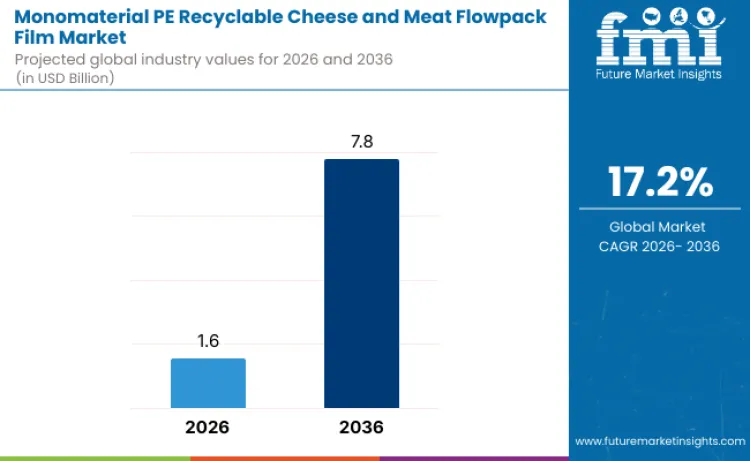
The monomaterial PE recyclable cheese and meat flowpack film market is valued at USD 1.6 billion in 2026 and is projected to reach USD 7.8 billion by 2036, reflecting a CAGR of 17.2%. Demand strengthens as food brands transition from multi-material laminates to recyclable mono-PE structures to meet circular packaging commitments and regulatory pressure targeting flexible film recyclability. Adoption increases in chilled cheese, deli meats, and protein packaging where high barrier and seal performance remain essential.
Mono-PE MDO films lead material usage as machine-direction orientation improves stiffness, clarity, and puncture resistance while maintaining compatibility with PE recycling streams. Barrier coatings and EVOH integration delivered in recyclable PE architectures enhance oxygen protection for perishable foods. Heat-seal improvements, downgauging potential, and high-speed form-fill-seal compatibility support broader commercial deployment.
Quick Stats for Monomaterial PE Recyclable Cheese and Meat Flowpack Film Market
- Market Value (2026): USD 1.6 billion
- Market Forecast Value (2036): USD 7.8 billion
- Forecast CAGR (2026 to 2036): 17.2%
- Leading Material Type in Global Demand: Mono-PE MDO films
- Key Growth Regions in Global Demand: China, India, USA, Japan
- Top Players in Global Demand: Amcor, Coveris, Berry Global, Mondi Group, Sealed Air
China, India, USA, and Japan act as key growth regions due to expanded flexible packaging capacity and strong sustainability initiatives across protein processors and converters. Amcor, Coveris, Berry Global, Mondi Group, and Sealed Air shape competitive momentum through advanced MDO film platforms, recyclable barrier solutions, and close collaboration with food producers to certify mono-PE flowpack formats for chilled cheese and meat applications.
Monomaterial PE Recyclable Cheese and Meat Flowpack Film Market Key Takeaways
| Metric | Value |
|---|---|
| Market Value (2026) | USD 1.6 billion |
| Market Forecast Value (2036) | USD 7.8 billion |
| Forecast CAGR (2026-2036) | 17.2% |
How Are the Segments Classified in the Monomaterial PE Recyclable Cheese and Meat Flowpack Film Market?
Demand for monomaterial PE flowpack films is shaped by PPWR-compliant recyclability goals, the shift away from mixed-material laminates, and requirements for high-barrier performance in chilled cheese, meat, and deli packaging. Buyers evaluate orientation technology, seal integrity, oxygen-barrier capability, and compatibility with existing flow-wrapping machinery. Adoption patterns reflect strong interest in mono-PE structures that maintain product freshness while enabling high-yield mechanical recycling streams.
Which Material Type Accounts for the Largest Share of Global Demand?
Mono-PE MDO films hold 46.4%, making them the leading material-type segment globally. MDO technology enhances stiffness, clarity, and barrier performance, enabling replacement of traditional PET or PA layers in flowpack structures. Mono-PE BOPE films support balanced orientation properties and improved puncture resistance for demanding proteins. Cast PE flowpack films serve applications requiring softness, conformability, and strong sealing. Recyclable PE/PE laminates combine MDO, BOPE, or sealant layers to achieve optimized barrier and machinability. Material-type distribution reflects transition toward oriented mono-PE formats that meet functional and recyclability targets.
Key Points:
- MDO films provide enhanced stiffness and barrier improvements.
- BOPE films support puncture resistance for protein packs.
- Cast PE offers conformability and sealing performance.
- Laminated PE/PE structures balance recyclability and functional needs.
Which Application Represents the Largest Share of Global Demand?
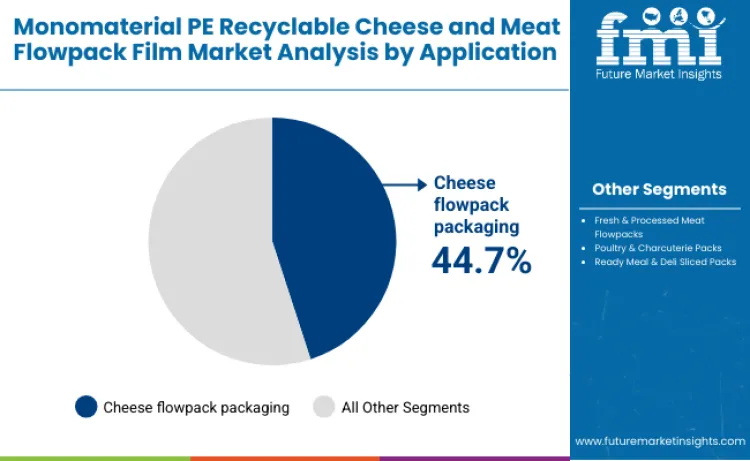
Cheese flowpack packaging holds 44.7%, making it the largest application segment globally. Cheese requires moisture control, oxygen management, and strong sealing performance, which oriented mono-PE films increasingly support. Fresh and processed meat flowpacks require high puncture resistance and reliable barrier properties for oxidation-sensitive proteins. Poultry and charcuterie packs rely on mono-PE films with tailored sealant layers and improved toughness. Ready-meal and deli-sliced packs demand clarity, strong hermetic sealing, and machinability for high-throughput lines. Application distribution reflects strong adoption of monomaterial PE formats in cheese, which serves as an early transition category for recyclable flowpacks.
Key Points:
- Cheese packs drive adoption due to barrier and recyclability needs.
- Meat packs require toughness and oxygen-control capability.
- Poultry and charcuterie rely on tailored sealant layers.
- Ready-meal packs need clarity and high-speed machinability.
Which Functional Layer Accounts for the Largest Share of Global Demand?
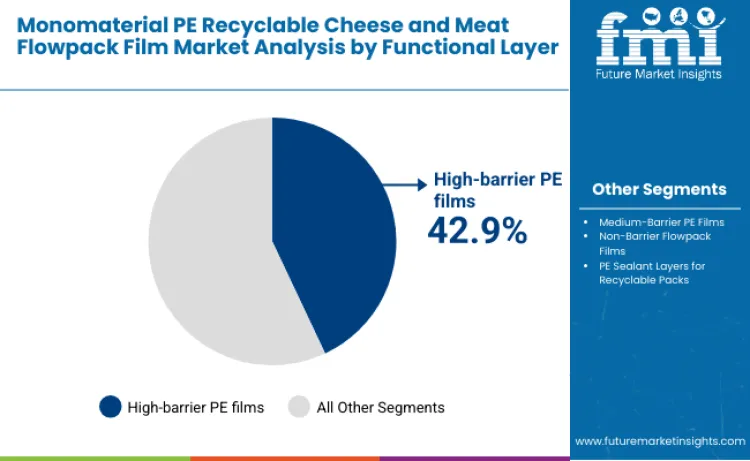
High-barrier PE films hold 42.9%, making them the leading functional-layer segment globally. These films use EVOH-free or low-EVOH barrier architectures optimized for mechanical recyclability while protecting oxygen- and moisture-sensitive foods. Medium-barrier PE films support products with moderate shelf-life requirements. Non-barrier flowpack films serve applications where freshness risk is lower or secondary packaging provides protection. PE sealant layers support strong hermetic closure and compatibility with mono-PE laminates. Functional-layer distribution reflects increasing reliance on improved PE barrier technologies that enable full mono-material recovery.
Key Points:
- High-barrier PE films support shelf-life requirements for proteins.
- Medium-barrier films suit less sensitive products.
- Non-barrier films fit low-risk or secondary-protected goods.
- PE sealant layers enable recyclable mono-PE structures.
What are the Key Dynamics in the Monomaterial PE Recyclable Cheese and Meat Flowpack Film Market?
Global demand rises as food manufacturers transition from multi-layer structures to monomaterial PE films that meet recyclability and regulatory expectations for cheese and meat products. Brands prioritise films with reliable seal integrity, barrier performance, and machinability on high speed lines. Recyclers gain interest in PE films compatible with established polyolefin streams. Retailers evaluate packaging that supports sustainability goals while maintaining shelf life and product protection across chilled distribution environments.
How are sustainability targets and packaging redesign efforts shaping adoption of monomaterial PE flowpack films?
Food producers adopt PE based structures to replace laminates combining PET, PA, and EVOH. Monomaterial designs simplify recycling by aligning with polyolefin recovery systems. Film suppliers engineer PE blends to achieve seal strength, puncture resistance, and optical clarity needed for cheese and meat categories. Barrier layers and coatings adapt to maintain freshness and reduce moisture loss. Converters optimize film stiffness and slip characteristics to ensure compatibility with flowpack machinery. Retailers collaborate with suppliers to validate shelf life performance across chilled supply chains. Regulatory pressure for recyclable packaging strengthens commitment to mono-material formats within high volume protein and dairy sectors.
How do barrier limitations, machinability challenges, and infrastructure variability influence scalability?
PE structures require engineered solutions to match oxygen and moisture barrier levels typically achieved through multilayer laminates. Flowpack lines require adjustments to sealing temperature, dwell time, and film tension, creating operational demands for converters and packers. Films with lower stiffness may reduce run speed or increase risk of wrinkles on high speed lines. Recycling infrastructure varies by region, influencing effective recovery of PE films placed in household waste streams. Contamination from food residues complicates recycling quality. Brands balancing cost, barrier function, and sustainability targets face constraints when transitioning entire product ranges. Supply consistency for specialized PE grades affects long term adoption planning.
How is Demand for Monomaterial PE Recyclable Cheese and Meat Flowpack Film Market Evolving Across Key Countries?
Demand for the monomaterial PE recyclable cheese and meat flowpack film market is rising due to increased regulatory pressure on flexible packaging, broader transition to mono-material structures, and stronger investment in recyclable food-contact films. China records a CAGR of 18.0% supported by rapid development of PE-based packaging lines. India shows a 17.4% CAGR driven by growth in processed dairy and meat sectors. USA posts a 16.1% CAGR supported by design-for-recycling shifts. Japan holds a 15.2% CAGR linked with precision packaging requirements. UK records a 14.6% CAGR supported by circular packaging commitments and EPR-driven adoption.
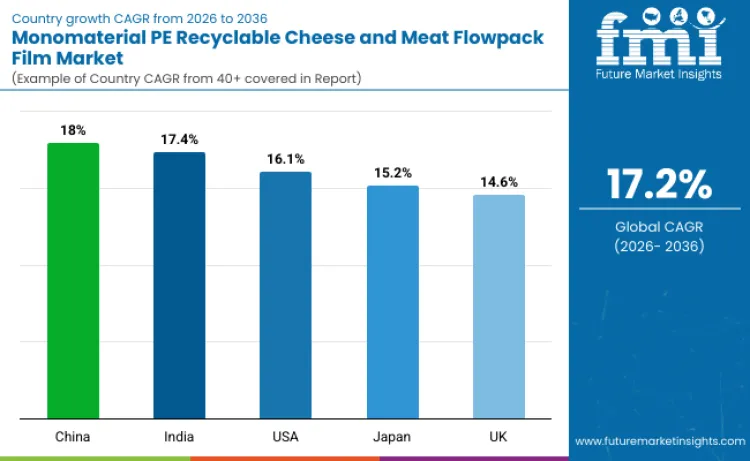
| Country | CAGR (%) |
|---|---|
| China | 18.0% |
| India | 17.4% |
| USA | 16.1% |
| Japan | 15.2% |
| UK | 14.6% |
How is China driving demand for Monomaterial PE Recyclable Cheese and Meat Flowpack Film?
China drives demand due to strong growth in chilled-food processing, rapid expansion of flexible-film manufacturing, and increased movement toward recyclable mono-material structures. The country’s CAGR of 18.0% reflects accelerated adoption of high-barrier PE flowpack films designed for cheese and meat applications. Packaging converters install upgraded extrusion and coating lines improving barrier performance. Food processors shift from multi-material laminates to PE structures supporting recycling targets. National sustainability policies reinforce adoption of recyclable food-contact films. Collaboration between resin suppliers and converters strengthens performance development of mono-material barrier technologies.
- Strong expansion of flexible-film manufacturing
- Shift from multi-material to mono-material PE structures
- Policy-driven emphasis on recyclable food packaging
- Collaborative development of enhanced PE barrier films
How is India driving demand for Monomaterial PE Recyclable Cheese and Meat Flowpack Film?
India supports rising demand due to growing processed dairy and meat production, increasing retail-packaged food penetration, and regulatory focus on recyclable flexible packaging. The country’s CAGR of 17.4% reflects broader adoption of PE-based mono-material films replacing traditional mixed laminates. Packaging manufacturers invest in high-barrier PE film technology to meet shelf-life and sealing requirements. Retail processors adopt recyclable structures to align with EPR-led sustainability targets. State-level waste-management reforms improve collection and recycling pathways for mono-material films. Industry collaboration improves clarity and barrier consistency across film categories.
- Growth in chilled dairy and meat packaging
- Investment in PE-based high-barrier technology
- EPR alignment encouraging mono-material usage
- Waste-management reforms supporting recycling feasibility
How is the USA driving demand for Monomaterial PE Recyclable Cheese and Meat Flowpack Film?
USA drives demand through design-for-recycling initiatives, food safety requirements, and increased adoption of mono-material films across chilled-food supply chains. The country’s CAGR of 16.1% reflects expansion of high-barrier PE film production lines and increased interest in recyclable alternatives to multi-layer laminates. CPG firms transition packaging portfolios to mono-material PE films supporting recyclability guidelines. Retailers encourage suppliers to adopt PE structures for cheese and meat packaging. Film producers incorporate advanced PE barrier layers improving oxygen and moisture performance. Recycling pilots test recovery of PE mono-material flexible films.
- Transition to design-for-recycling packaging formats
- Strong retailer and CPG interest in recyclable films
- Upgraded PE barrier-film production lines
- Recycling pilots supporting mono-material film recovery
How is Japan driving demand for Monomaterial PE Recyclable Cheese and Meat Flowpack Film?
Japan drives demand due to precise quality requirements for chilled-food packaging, strong engineering capabilities in barrier-film design, and strict waste-management systems. The country’s CAGR of 15.2% reflects controlled adoption of mono-material PE flowpack films supporting recyclability while maintaining food-safety standards. Packaging manufacturers develop high-barrier PE structures suited for cheese and meat texture and shelf-life demands. Municipal recycling programs encourage uniform materials improving collection and sorting efficiency. Industry partnerships refine sealing and mechanical-properties performance to support consistent processing.
- Precision-engineered PE barrier films
- Uniform-material structures supporting recycling
- Municipal systems reinforcing mono-material collection
- Collaborative refinement of sealing and mechanical performance
How is the UK driving demand for Monomaterial PE Recyclable Cheese and Meat Flowpack Film?
UK supports demand through national circular packaging goals, EPR frameworks, and strong retailer-led sustainability requirements. The country’s CAGR of 14.6% reflects broader adoption of PE-only films in chilled dairy and meat categories. Retailers transition to mono-material PE packaging aligned with recyclability guidelines. Converters invest in high-barrier PE structures meeting oxygen-transmission thresholds for cheese and meat preservation. Policy guidance encourages elimination of multi-material laminates. Regional recycling pilots evaluate processing consistency of mono-material flexible films.
- Retail commitments accelerating mono-material adoption
- High-barrier PE film upgrades for food preservation
- Policy alignment supporting removal of multi-material structures
- Regional recycling pilots testing mono-material film recovery
What is the competitive landscape of demand for monomaterial PE recyclable cheese and meat flowpack film globally?
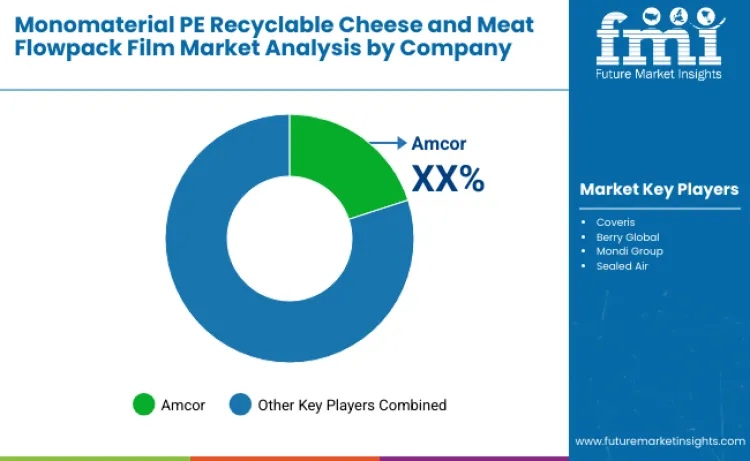
Demand for monomaterial PE recyclable cheese and meat flowpack film grows as food producers transition from multi-material laminates to recyclable structures meeting emerging packaging regulations and brand sustainability targets. Coveris participates with PE-based recyclable flowpack films supporting cheese and protein processors in Europe and North America. Berry Global contributes blown and cast PE structures with barrier enhancements suited for high-speed packing lines. Mondi Group maintains visibility with mono-material PE solutions developed for chilled food sectors requiring reliable sealing and controlled oxygen transmission. Sealed Air supports demand through engineered polyolefin films tailored for protein packaging lines seeking recyclable alternatives. Competitive positioning globally reflects barrier engineering capability, film stiffness control, sealing performance, and operational compatibility with established flowpack equipment. Requirements center on seal integrity, oxygen-barrier performance, mechanical strength, and machinability on high-speed flowpack lines. Buyers evaluate film clarity, puncture resistance, EVOH incorporation levels, and recyclability compliance with established polyolefin design guidelines. Procurement teams prioritize consistent extrusion quality, downgauging capability, and compatibility with chilled supply-chain conditions. Trend in the global market reflects rising adoption of mono-PE films replacing PET/PE laminates across cheese slices, blocks, deli meats, and vacuum packs.
Key Players in the Monomaterial PE Recyclable Cheese and Meat Flowpack Film Market
- Amcor
- Coveris
- Berry Global
- Mondi Group
- Sealed Air
Scope of the Report
| Items | Values |
|---|---|
| Quantitative Units | USD billion |
| Material Type | Mono-PE MDO (Machine-Direction Oriented) Films, Mono-PE BOPE (Bi-Oriented PE) Films, Cast PE Flowpack Films, Recyclable PE/PE Laminates |
| Application | Cheese Flowpack Packaging, Fresh & Processed Meat Flowpacks, Poultry & Charcuterie Packs, Ready Meal & Deli Sliced Packs |
| Functional Layer | High-Barrier PE Films, Medium-Barrier PE Films, Non-Barrier Flowpack Films, PE Sealant Layers for Recyclable Packs |
| End-User | Dairy & Cheese Processors, Meat & Poultry Processors, Retail & Private-Label Food Brands, Flexible Packaging Converters |
| Regions Covered | Asia Pacific, Europe, North America, Latin America, Middle East & Africa |
| Countries Covered | India, China, USA, Germany, South Korea, Japan, Italy, and 40+ countries |
| Key Companies Profiled | Amcor, Coveris, Berry Global, Mondi Group, Sealed Air |
| Additional Attributes | Dollar sales by material type, application, and functional layer categories; regional adoption trends for recyclable monomaterial PE flowpacks; compliance with recycling guidelines such as CEFLEX, RecyClass, and store-drop-off schemes; development of high-barrier MDO/BOPE solutions for cheese and meat; integration of PE sealant layers to replace multi-material laminates; converter capability expansion for monomaterial food packaging; alignment with sustainability targets for meat and dairy processors and private-label brands. |
Monomaterial PE Recyclable Cheese and Meat Flowpack Film Market by Segment
By Material Type:
- Mono-PE MDO (Machine-Direction Oriented) Films
- Mono-PE BOPE (Bi-Oriented PE) Films
- Cast PE Flowpack Films
- Recyclable PE/PE Laminates
By Application:
- Cheese Flowpack Packaging
- Fresh & Processed Meat Flowpacks
- Poultry & Charcuterie Packs
- Ready Meal & Deli Sliced Packs
By Functional Layer:
- High-Barrier PE Films
- Medium-Barrier PE Films
- Non-Barrier Flowpack Films
- PE Sealant Layers for Recyclable Packs
By End-User:
- Dairy & Cheese Processors
- Meat & Poultry Processors
- Retail & Private-Label Food Brands
- Flexible Packaging Converters
Region:
- Asia Pacific
- China
- Japan
- South Korea
- India
- Australia & New Zealand
- ASEAN
- Rest of Asia Pacific
- Europe
- Germany
- United Kingdom
- France
- Italy
- Spain
- Nordic
- BENELUX
- Rest of Europe
- North America
- United States
- Canada
- Mexico
- Latin America
- Brazil
- Chile
- Rest of Latin America
- Middle East & Africa
- Kingdom of Saudi Arabia
- Other GCC Countries
- Turkey
- South Africa
- Other African Union
- Rest of Middle East & Africa
Frequently Asked Questions
What is the size of the monomaterial PE recyclable cheese and meat flowpack film market in 2026?
The market is valued at USD 1.6 billion in 2026 due to rising substitution of multi-layer structures with recyclable mono-PE films.
What will be the industry size by 2036?
Industry value will reach USD 7.8 billion by 2036 as food manufacturers adopt mono-PE solutions aligned with recycling-stream compatibility.
What is the CAGR for 2026 to 2036?
The monomaterial PE recyclable cheese and meat flowpack film market expands at a 17.2% CAGR during the forecast period.
Which material-type segment leads in 2026?
Mono-PE MDO films hold 46.4% share due to improved strength, printability, and suitability for high-speed flowpack operations.
Which application segment holds the highest share?
Cheese flowpack packaging leads with 44.7% share, reflecting high film usage in sliced, block, and portioned cheese formats.
Preview the report firsthand - request a free sample
Get SampleGet the brochure for pricing and purchase details.
Get PDFTable of Content
- Executive Summary
- Market Overview
- Global Market Value, 2020-2026
- Global Market Forecast, 2026-2036
- Market Dynamics
- Drivers
- Restraints
- Opportunities
- Regulatory & Standards Landscape
- Technology & Material Innovation Outlook
- Market Segmentation Analysis
- By Material Type
- Mono-PE MDO Films
- Mono-PE BOPE Films
- Cast PE Flowpack Films
- Recyclable PE/PE Laminates
- By Application
- Cheese Flowpack Packaging
- Fresh & Processed Meat Flowpacks
- Poultry & Charcuterie Packs
- Ready Meal & Deli Sliced Packs
- By Functional Layer
- High-Barrier PE Films
- Medium-Barrier PE Films
- Non-Barrier Flowpack Films
- PE Sealant Layers for Recyclable Packs
- By End-User
- Dairy & Cheese Processors
- Meat & Poultry Processors
- Retail & Private-Label Food Brands
- Flexible Packaging Converters
- By Material Type
- Regional Outlook
- Asia Pacific
- Europe
- North America
- Latin America
- Middle East & Africa
- Country-Level Outlook
- China
- India
- USA
- Japan
- United Kingdom
- Germany
- South Korea
- Italy
- Australia & New Zealand
- ASEAN
- Brazil
- Chile
- Turkey
- South Africa
- Other GCC Countries
- Rest of Europe
- Rest of Latin America
- Rest of Middle East & Africa
- Competitive Landscape
- Market Structure Overview
- Company Positioning
- Strategic Initiatives
- Key Player Profiles
- Scope of the Report
- Research Methodology
- Assumptions & Acronyms


