

- Industry Size (2026)
- USD 18.3 Bn
- Forecast (2036)
- USD 28.1 Bn
- CAGR (2026 to 2036)
- 4.4%
PET Preform Market Size, Market Forecast and Outlook By FMI
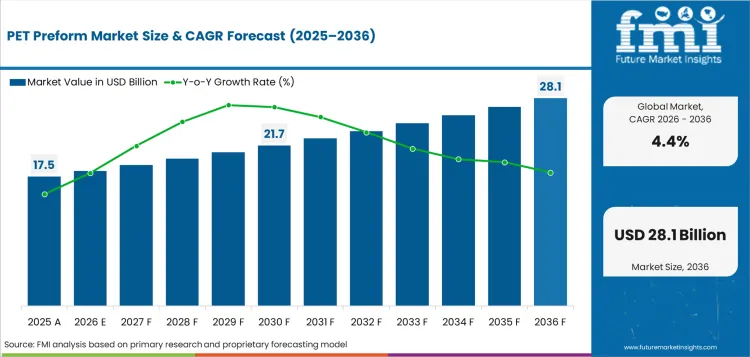
The PET preform market size stood at USD 17.5 billion in 2025. Industry revenue is estimated at USD 18.3 billion in 2026 and projected to reach USD 28.1 billion by 2036 at 4.4% CAGR. Virgin PET is projected to represent 72.0% share of material in 2026. By end use, beverage is expected to account for 60.0% share in 2026.
Key Takeaways, Market Size, and Forecast
| Metric | Value |
|---|---|
| Market Size (2025) | USD 17.5 Billion |
| Market Size (2036) | USD 28.1 Billion |
| CAGR (2026–2036) | 4.4% |
| Incremental Opportunity (2026–2036) | USD 9.8 Billion |
| Leading Material (2026) | Virgin PET |
| Virgin PET Share (2026) | 72.0% |
| Leading Application (2026) | Beverage |
| Beverage Share (2026) | 60.0% |
| Fastest-Growing Country | India |
| India CAGR | 7.3% |
| 2nd Fastest-Growing Country | China |
| China CAGR | 5.7% |
Summary of PET Preform Market
- Demand and Growth Drivers
- Beverage fillers keep preforms central to high-volume packs as water and soft drink lines depend on stable bottle conversion.
- Recycled-content rules push converters toward better resin checks before preforms move into bottle blowing.
- Lightweight bottle work raises preform design value since resin savings repeat across large filling runs.
- Product and Segment View
- Virgin PET is expected to account for 72.0% share in 2026, influenced by food-grade recycled supply remaining uneven across regions.
- Beverage is forecast to capture 60.0% share in 2026 due to water and soft drink use across high-speed filling plants.
- 500 ml to 1 L preforms are projected to hold 44.0% share in 2026 through mainstream single-serve formats.
- Geography and Competitive Outlook
- India is projected to record 7.3% CAGR by 2036, driven by bottled drinks and rigid packaging rules supporting preform capacity.
- China is expected to expand at 5.7% CAGR by 2036, reflected by export scale and domestic beverage output influencing volume.
- RETAL Group, ALPLA Group and Plastipak Holdings Inc. lead competition around recycled PET control and preform quality.
- Analyst Opinion
- Ismail Sutaria, Principal Consultant for Packaging at FMI, opines, “PET preform supply is shifting from volume bidding to performance proof. Beverage brands want preforms blowing consistently and using less resin. Recycled-content targets must be met with fewer line trials. Suppliers controlling resin input and neck finish repeatability are expected to have higher contract positions.”
- PET Preform Market Value Analysis
- Market value in the PET bottle value chain is tied to resin weight and stable blow-molding output.
- Supplier pricing reflects cavity count and cycle time before fillers approve preform supply for repeat bottle runs.
- Revenue rises above resin conversion value as converters add traceability records and bottle design support.
- Beverage fillers promote demand for light preforms reducing resin use without line stoppage.
PET preform suppliers are now required to prove their products will work well with recycled plastic and attached caps. DIN Consumer Council stated in November 2024, EU beverage containers up to 3 litres must keep caps attached during the full use period from July 3, 2024. This makes neck design more important for preform makers. Poor cap fit can slow filling lines and create user complaints. PepsiCo stated in April 2026, it used 15% recycled plastic in primary plastic packaging across key markets in 2024.
This shows why beverage brands need suppliers handling recycled PET with stable quality. Netstal stated in June 2025, its PET-Line 4000 can produce 144 preforms every 4.8 seconds. This makes output speed important for large bottle programs. Preform suppliers with recycled PET handling and high-speed molding support are expected to gain stronger positions in beverage contracts.
PET Preform Market Definition
PET preforms are injection molded blanks made from polyethylene terephthalate resin. Preforms are later heated and blown into plastic bottles for water and soft drinks. Edible oil and personal care liquids use the same conversion route. Selected pharmaceutical liquids use PET preforms for pharmaceutical plastic bottles in controlled pack sizes. Scope includes standard and custom neck finishes. Scope includes virgin PET and recycled PET materials sold as preforms. Bio PET materials are included once sold as preforms. Finished bottles are excluded unless preforms are sold as part of a converter supply contract.
PET Preform Market Inclusions
Scope includes preforms supplied to beverage fillers and food packers. Personal care brands and pharmaceutical packers are included. Homecare product makers are included in applications using PET preforms. Preforms for bottled water and carbonated soft drinks are included. Hot-fill and standard cold-fill preforms are counted. Converter value includes resin handling and mold use. Quality checks and shipment to bottle blowers are included.
PET Preform Market Exclusions
Scope excludes loose PET resin sold without preform conversion. Blow-molded bottles are excluded unless preform value is separately sold or estimated. Caps and labels are excluded. Secondary packs and filling-line revenue are excluded. Recycling plant revenue is excluded unless recycled resin is converted into preforms within the same supply route.
PET Preform Market Research Methodology
- Primary Research: FMI analysts reviewed converter needs across beverage fillers and rigid packaging suppliers. Mold technology specialists were included in interview checks.
- Desk Research: Research used PET recycling data and trade flows. EU rules and company releases supported supplier mapping.
- Market Sizing and Forecasting: Forecasting used resin conversion value and bottle demand exposure. Country-level trade checks supported the forecast.
- Data Validation: Forecast checks compared 2026 value with 2036 value and tested CAGR consistency across seven country rates.
Why is the PET Preform Market Growing?
- Beverage fillers are tightening preform approval as lighter bottles need stable wall strength and consistent line performance.
- Recycled PET use is pushing converters to improve resin control before preforms enter bottle blowing lines.
- Neck finish precision is becoming more important as caps and closures affect sealing quality and pack handling.
Growth outlook is shifting toward preforms combining recyclable design and stable production output. EUR-Lex states, Regulation (EU) 2025/40 covers packaging and packaging waste across the EU, raising design pressure on plastic packaging suppliers. Coca-Cola’s 2024 Environmental Update says the company aims to use 35% to 40% recycled material in primary packaging by 2035, including 30% to 35% recycled plastic globally. Such target gives beverage converters a firm reason to qualify recycled PET preforms with better color control and bottle strength. SACMI stated in August 2025, its IPS240 preform press can accommodate 96-cavity molds with a 50 x 110 mm pitch. Such equipment progress supports larger preform runs where repeatable neck finish and weight control shape cost per bottle.
Market Segmentation Analysis
- 500 ml to 1 L is projected to account for 44.0% share in 2026 as mainstream drink sizes keep repeat filling demand.
- PCO/BPF is expected to account for 45.0% share in 2026 since closure compatibility lowers line change risk.
- Beverage is forecast to represent 60.0% share in 2026 through water and soft drink preform use.
- Virgin PET is expected to hold 72.0% share in 2026 due to food-grade recycled supply not being able to cover all bottle lines.
- Two Stage is projected to account for 68.0% share in 2026, led by converters separating injection molding from bottle blowing.
Segmentation is divided into five parent groups built around how buyers describe PET preform orders. Capacity separates single-serve and larger packs. Neck type reflects cap fit and filling-line needs. End use shows the product category paying for performance. Material measures resin source and circularity needs. Manufacturing explains how preforms move through injection and blowing assets.
Insights into PET Preform Market by Capacity
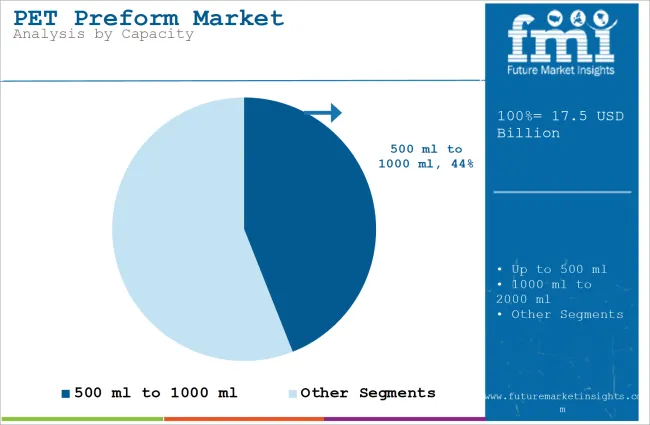
- 500 ml to 1 L is projected to account for 44.0% share in 2026 since beverage brands use it across daily water and soft drink packs.
- 1 L to 2 L gains value in family packs as converters manage wall thickness and top-load strength under heavier bottle weights.
Insights into PET Preform Market by Neck Type
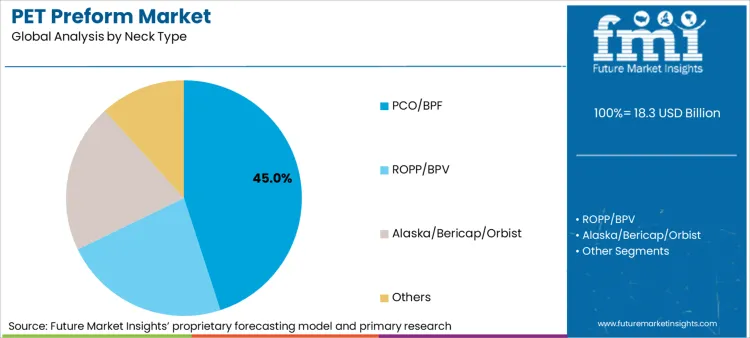
- PCO/BPF is expected to account for 45.0% share in 2026, led by bottlers protecting capper settings and sealing quality.
- Alaska and Bericap formats support water and dairy packs requiring lighter finishes with reliable sealing control.
Insights into PET Preform Market by End Use
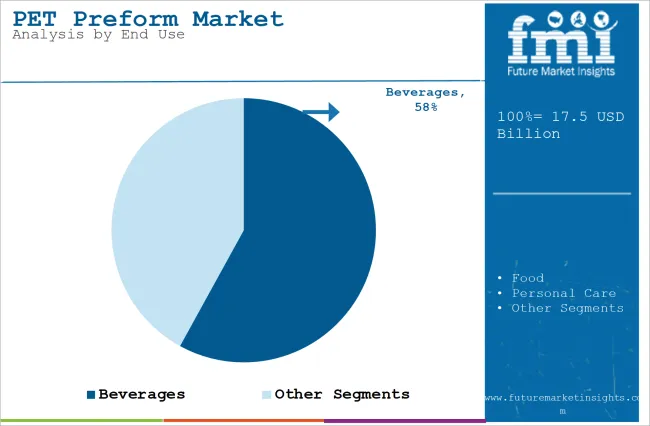
- Beverage is forecast to capture 60.0% share in 2026 due to water and soft drink lines using preforms at high frequency.
- Food and personal care uses expand through edible oil packaging and shampoo packs requiring custom color and barrier choices.
Insights into PET Preform Market by Material
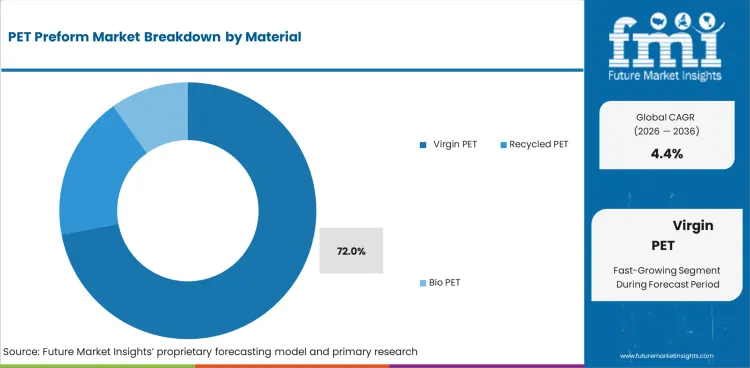
- Virgin PET is expected to hold 72.0% share in 2026, influenced by converters needing clear resin behavior for food and beverage qualification.
- Recycled PET moves into PET preform packaging as bottle makers improve washing and decontamination.
Insights into PET Preform Market by Manufacturing
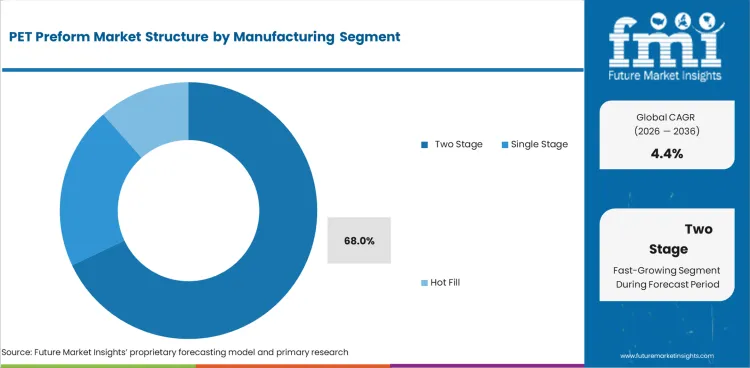
- Two stage is projected to account for 68.0% share in 2026 as many suppliers mold preforms separately before bottle blowing.
- Hot fill remains important for juice and tea packs requiring heat resistance without losing bottle shape after filling.
PET Preform Market Drivers, Restraints and Opportunities
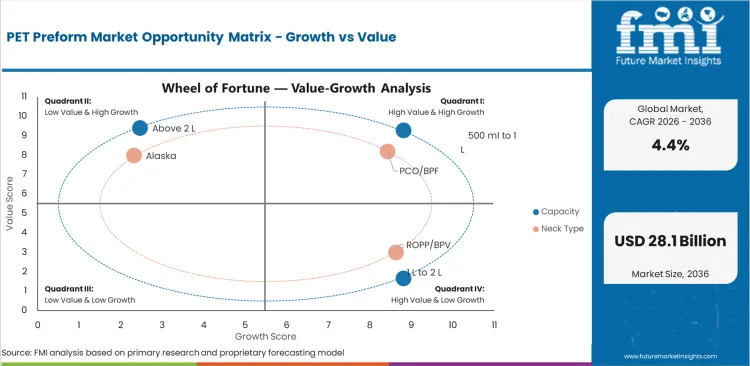
- Beverage fillers are tightening preform quality checks as bottle weight reduction increases the risk of line rejects.
- Recycled PET qualification remains difficult as color control and food contact standards differ across supply routes.
- Lightweight preform design is creating scope for converters to reduce resin use and improve compliance readiness.
PET preform industry is moving toward tighter quality proof and recyclable bottle design. RecyClass reported in 2025, findings from more than 20 testing campaigns were added to its plastic packaging recyclability guidelines. It also added a color module for PET bottle sorting checks. This makes resin clarity and bottle design more important before preforms are approved for large beverage runs. Plastics Recyclers Europe reported in 2025, PET recycling capacity in Europe increased from 3.2 million tonnes to 3.3 million tonnes in 2024.
It also noted pressure on food-contact rPET due to strict safety and quality rules. This keeps recycled material qualification as the main restraint for PET packaging converters. Eastman and Doloop stated in September 2025, their Drinktec bottle used chemically recycled PET for beverage packaging. This supports suppliers pairing lighter preforms with proven recycled resin performance.
Raw Material Price Trend Analysis
Raw material pricing for the PET preform industry is expected to stay sensitive to thermoplastic resin swings as converters depend on resin cost discipline before quoting high-volume beverage orders. Federal Reserve Economic Data, using United States Bureau of Labor Statistics data, showed the thermoplastic resins and plastics materials producer price index at 253.737 in December 2025 and 280.025 in April 2026. This indicates a short-term rise of about 10.4% in a key polymer input price signal. The increase is important for preform suppliers since resin makes up the main cost block. Higher resin pressure is expected to push converters toward lighter preform designs and shorter price review cycles with beverage fillers.
Sustainability Transition Analysis
Sustainability transition in rigid plastic packaging is moving from broad recyclability claims toward measurable portfolio changes affecting recycled PET packaging and preform sourcing decisions. Amcor reported in its FY25 Sustainability Report, it reached 10% post-consumer recycled content by June 30, 2025. It also stated, 96% of its rigid packaging portfolio by weight was recyclable. Such figures show why beverage and personal care brands are asking preform suppliers for clearer recycled-content proof and bottle compatibility data. Preform converters with resin traceability and design support are expected to acquire higher positions as brand owners shift packaging targets into supplier qualification requirements.
Analysis of PET Preform Market by Key Countries
.webp "Top Country Growth Comparison Pet Preform Market Cagr (2026 2036)")
| Country | CAGR |
|---|---|
| India | 7.3% |
| China | 5.7% |
| United States | 4.6% |
| Brazil | 4.4% |
| Germany | 3.9% |
| Japan | 3.6% |
| United Kingdom | 3.4% |
Source: FMI analysis based on primary research and proprietary forecasting model
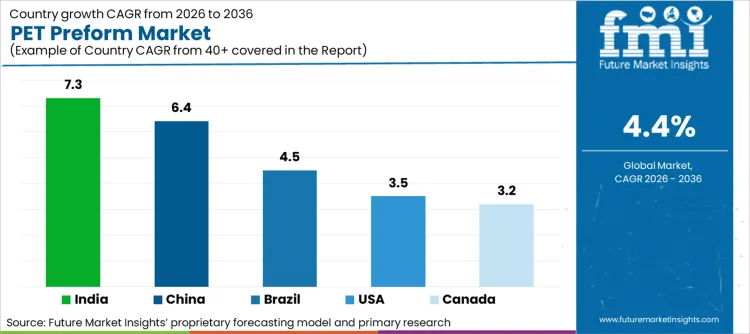
PET Preform Market CAGR Analysis by Country
- India is projected to record 7.3% CAGR by 2036, driven by bottled beverage lines and domestic rigid packaging demand.
- China is expected to expand at 5.7% CAGR by 2036, led by export scale and large domestic beverage production.
- United States is forecast to grow at 4.6% CAGR by 2036 through recycled PET qualification in beverage contracts.
- Brazil is expected to advance at 4.4% CAGR by 2036 due to beverage demand and plastic recovery obligations.
- Germany is projected to rise at 3.9% CAGR by 2036, reflected by EU recycled-content rules and beverage pack quality needs.
- Japan is forecast at 3.6% CAGR by 2036 as established drinks and personal care packs favor tight quality control.
- United Kingdom is expected to post 3.4% CAGR by 2036 with deposit planning and imported rigid packaging flows.
Country performance differs by beverage scale and regulation. India and China track above the global rate as beverage consumption and packaging conversion add new volume. United States and Brazil expand around recycled content and recovery rules. Germany, Japan and United Kingdom grow at measured rates through stricter quality and compliance needs.
Demand Outlook for PET Preform in India
Demand in India is projected to record 7.3% CAGR by 2036, driven by beverage brands adding packs for water and ready-to-drink products. World Integrated Trade Solution of the World Bank refreshed May 2026 data showing India imported 7.6 million kg of plastic bottles and similar articles under HS 392330 in 2024. Imported finished packaging is not a direct preform measure, however it signals demand for rigid PET packaging tied to local conversion. Indian converters profit once brands shift from imported bottle formats to domestic preform supply.
- Rigid packaging rules increase interest in preforms made with traceable recycled input.
- Beverage fillers value domestic supply reducing freight exposure for light but bulky bottle formats.
- Regional converters can serve water and edible oil brands with shorter lead times.
Demand Analysis of PET Preform in China
Industry in China is projected to expand at 5.7% CAGR by 2036 due to domestic beverage scale and export flows promoting preform consumption. World Integrated Trade Solution of the World Bank refreshed May 2026 data showed China exported 341.8 million kg of plastic bottles and similar articles under HS 392330 in 2024. Export scale gives Chinese converters resin purchasing leverage and mold use stability. Premium bottled water formats add value for suppliers with clearer resin and tighter neck control.
- Large beverage runs keep clear PET preforms important for water and ready-to-drink packs.
- Export-oriented converters need consistent weights to satisfy brand audits across destination markets.
- Local mold and machine ecosystems support faster shifts into lighter preform formats.
Growth Outlook for PET Preform in the United States
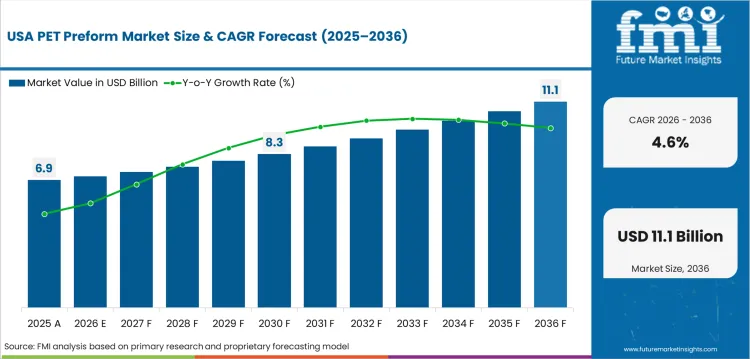
Demand in the United States is forecast to grow at 4.6% CAGR by 2036, led by recycled input supply becoming more important in beverage contracts. North American PET Container Resources reported in December 2025, recycled PET imports accounted for 23.0% of total recycled PET supply in 2024. Import dependence raises the value of suppliers qualifying multiple recycled PET sources. Domestic preform orders should favor converters with higher resin testing and color control.
- Water and soft drink fillers need preforms working across fast filling lines.
- Beverage converters are prioritizing cleaner recycled resin streams so preforms can meet brand audits with less rework.
- Cap compatibility affects orders as closures shift toward attached designs and lower material use.
Sales Analysis of PET Preform in Brazil
Demand in Brazil is projected to record 4.4% CAGR by 2036, reflected by beverage demand meeting new plastic recovery obligations. World Integrated Trade Solution of the World Bank refreshed May 2026 data showing Brazil imported 126.6 million kg of plastic bottles and similar articles in 2024. Import volume suggests scope for domestic preform conversion as local bottle demand expands. Recovery rules beginning in 2026 should push converters toward traceable recycled resin sourcing.
- Compliance pressure is making Brazil’s preform suppliers document recycled resin use before serving large beverage accounts.
- Beverage plants need preforms reducing resin weight without weakening shelf and transport performance.
- Local supply can reduce freight cost for light bottle formats being expensive to move empty.
Industry Outlook for PET Preform in Germany
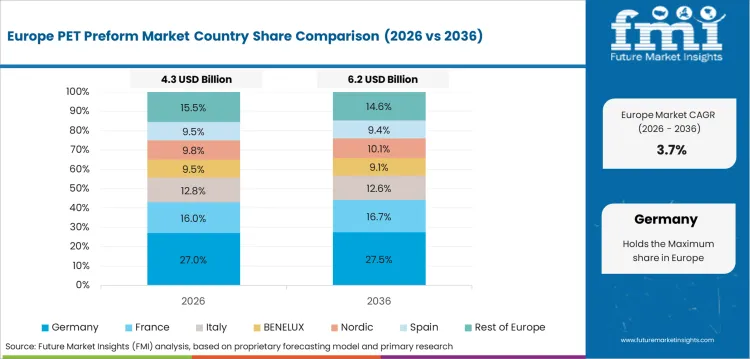
Sector in Germany is projected to rise at 3.9% CAGR by 2036 through strict recycled-content expectations and an established beverage packaging network. World Integrated Trade Solution of the World Bank refreshed May 2026 data showed Germany exported 145.2 million kg of plastic bottles and similar articles in 2024. Export scale keeps converters focused on standardized finishes and repeatable bottle quality. EU recycled-content rules raise the value of recycled PET ready preform capability.
- EU bottle collection targets make recycled input documentation more important for German suppliers.
- Tethered caps packaging changes encourage closer work between preform and closure suppliers.
- Converters with nearby design and testing support can help fillers qualify lighter packs faster.
Sales Outlook for PET Preform in Japan
Sales in Japan are forecast at 3.6% CAGR by 2036 as quality-sensitive beverage and personal care brands use lighter PET formats. Japan PET preform demand is shaped by strict line performance needs and careful material control. World Integrated Trade Solution of the World Bank refreshed May 2026 data showed Japan exported 4.4 million kg of plastic bottles and similar articles in 2024. Smaller export volume points to a domestic sector centered on high quality and precise formats.
- Quality audits favor preforms with narrow weight tolerance and low visual defects.
- Personal care packs use color and shape control to protect brand appearance.
- Lightweighting must not reduce bottle strength during retail handling and vending flows.
Demand Outlook for PET Preform in the United Kingdom
Demand in the United Kingdom is projected to record 3.4% CAGR by 2036 since beverage brands balance imported pack supply with local compliance needs. World Integrated Trade Solution of the World Bank refreshed May 2026 data showed United Kingdom imports of plastic bottles and similar articles reached USD 404.1 million in 2024. Import value signals a large rigid packaging flow supporting preform demand. Local converters can gain if they pair recycled content with stable neck finish supply.
- Deposit planning raises attention on bottle identification and recovery readiness.
- Flip top caps and closures demand affects personal care PET formats with smaller neck finishes.
- Disc top caps usage keeps closure compatibility important for shampoo and lotion preforms.
Company Landscape and Strategic Positioning
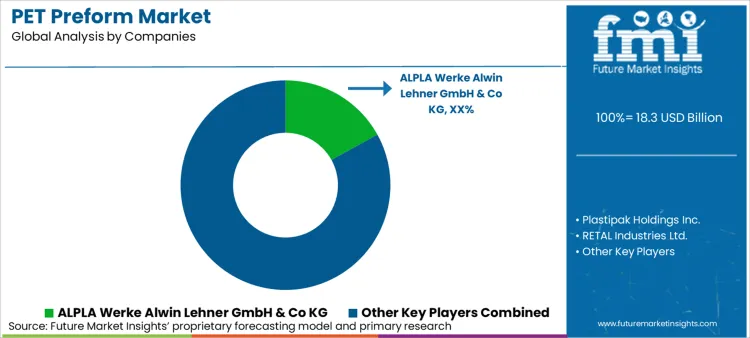
- Integrated converters hold advantage as beverage brands need preforms across many plants with the same neck finish.
- Recycling-backed suppliers gain from access to food-grade recycled PET and traceability records.
- Machine and mold specialists influence competition by cutting weight without raising bottle failure risk.
Competition is divided across global converters and regional packaging groups. RETAL Group and ALPLA Group compete based on international coverage and material control. Plastipak Holdings Inc. and Resilux NV support beverage and food preform supply in key Western markets. Manjushree Technopack Limited and Chemco Group hold higher positions in India through local filling relationships. SGT Group supports European preform supply through specialist production depth.
Supplier choice depends on recycled PET qualification and neck finish repeatability. Beverage brands want clear approval records before they shift large bottle runs. Smaller converters can hold local share through shorter lead times and pack customization. Larger groups gain from resin sourcing and multi-plant supply assurance. Technology partners influence the market by reducing preform weight and keeping filling performance stable.
Key Companies in the PET Preform Market
Competitive structure is better understood by converter role and material control. Product catalog breadth gives less insight here.
- Global PET Converters: RETAL Group and ALPLA Group support beverage and food preform supply. Plastipak Holdings Inc. and Resilux NV serve the same space led by recycling and converter capacity.
- Regional PET Converters: Manjushree Technopack Limited and Chemco Group support high-volume local filling needs. SGT Group serves European preform customers with specialist PET formats.
- Technology Partners: Husky Technologies and KHS Group influence preform weight. Sidel Group and Nissei ASB Machine influence line stability and recycled PET processing.
Company Benchmarking: PET Preform Market
| Company | rPET Control | Neck Finish Depth | Beverage Pack Fit | Geographic Footprint |
|---|---|---|---|---|
| RETAL Group | High | High | Strong | Global |
| ALPLA Group | High | Medium | Strong | Global |
| Plastipak Holdings Inc. | High | Medium | Strong | North America and Europe |
| Resilux NV | High | Medium | Medium | Europe |
| Manjushree Technopack Limited | Medium | Medium | Strong | India |
| Chemco Group | Medium | Medium | Strong | India and Middle East |
| SGT Group | Medium | High | Medium | Europe |
Ratings reflect recycled PET control, neck finish depth and beverage pack fit.
Key Developments in PET Preform Market
- In May 2024, Husky Technologies launched HyPET 6e and showed a 5.89 gram 100.0% rPET preform running at a 4.5 second cycle on a 144-cavity mold.
- In November 2024, ALPLA opened its Ballito recycling plant in South Africa with planned annual output of up to 35,000 tonnes of recycled PET from 2025.
- In June 2025, Netstal presented its next-generation PET-Line 4000 for drinktec, producing 144 lightweight 6.9 gram preforms every 4.8 seconds.
Key Players in the PET Preform Market
Major Global Players:
- RETAL Group
- ALPLA Group
- Plastipak Holdings Inc.
- Resilux NV
- SGT Group
Specialist and Regional Players:
- Manjushree Technopack Limited
- Chemco Group
Technology Partners Influencing PET Preform Production:
- Husky Technologies
- KHS Group
- Sidel Group
- Nissei ASB Machine Co., Ltd.
- SACMI
Market Report Scope
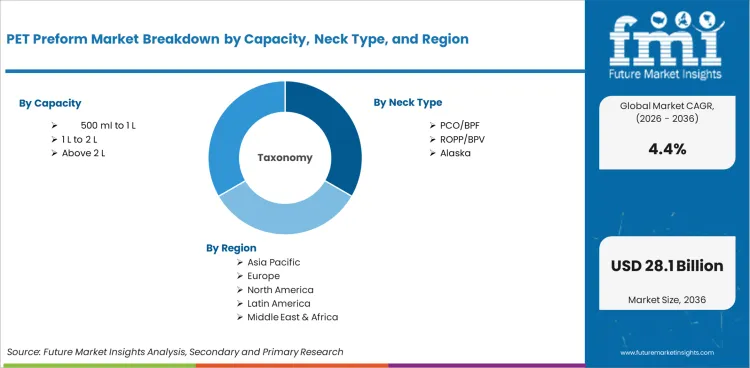
| Parameter | Details |
|---|---|
| Quantitative units | USD 18.3 billion to USD 28.1 billion, at 4.4% CAGR |
| Market definition | Injection molded PET preforms sold for bottle and rigid container production |
| Capacity | Up to 500 ml, 500 ml to 1 L, 1 L to 2 L, above 2 L |
| Neck type | PCO/BPF, ROPP/BPV, Alaska, Bericap, Orbist |
| End use | Beverage, food, personal care, pharmaceuticals, homecare |
| Material | Virgin PET, recycled PET, bio PET |
| Manufacturing | Two stage, single stage, hot fill |
| Regions covered | North America, Latin America, Western Europe, Eastern Europe, East Asia, South Asia and Pacific, Middle East and Africa |
| Countries covered | India, China, United States, Brazil, Germany, Japan, United Kingdom |
| Key companies profiled | RETAL Group, ALPLA Group, Plastipak Holdings Inc., Resilux NV, Manjushree Technopack Limited, Chemco Group, SGT Group |
| Forecast period | 2026 to 2036 |
| Approach | Hybrid top-down and bottom-up model with resin conversion, trade-flow and end-use checks |
PET Preform Market Breakdown by Capacity, Neck Type, End Use, Material, Manufacturing, and Region
By Capacity:
- Up to 500 ml
- 500 ml to 1 L
- 1 L to 2 L
- Above 2 L
By Neck Type:
- PCO/BPF
- ROPP/BPV
- Alaska
- Bericap
- Orbist
By End Use:
- Beverage
- Food
- Personal Care
- Pharmaceuticals
- Homecare
By Material:
- Virgin PET
- Recycled PET
- Bio PET
By Manufacturing:
- Two Stage
- Single Stage
- Hot Fill
By Region:
- North America
- United States
- Latin America
- Brazil
- Western Europe
- Germany
- United Kingdom
- Eastern Europe
- East Asia
- China
- Japan
- South Asia and Pacific
- India
- Middle East and Africa
Research Sources and Bibliography
- ALPLA Group. (2024, November 1). ALPLA opens state-of-the-art recycling plant in South Africa.
- Amcor plc. (2025). FY25 sustainability report.
- DIN Consumer Council. (2024, November 14). Study 2024: Usability and consumer acceptance of tethered caps for beverage containers. DIN e. V.
- Eastman Chemical Company. (2025, September 4). Eastman and Doloop partner to unveil 100% rPET beverage bottle at Drinktec 2025 in Munich.
- European Commission. (2025, December). Single-use plastics.
- European Parliament and Council of the European Union. (2025, January 22). Regulation (EU) 2025/40 of the European Parliament and of the Council of 19 December 2024 on packaging and packaging waste. EUR-Lex.
- Federal Reserve Bank of St. Louis. (2026). Producer Price Index by Commodity: Chemicals and Allied Products: Thermoplastic Resins and Plastics Materials [WPU0662]. FRED.
- Husky Technologies. (2024, May 7). Husky launches HyPET 6e platform at NPE 2024.
- KHS Group. (2025, May 13). KHS unveils ultralight 5.89 g PET Bottle “Faktor 101”.
- NAPCOR. (2025, December 10). NAPCOR releases 2024 PET Recycling Report highlighting system efficiency gains and continued strength of PET circularity.
- Netstal Maschinen AG. (2025, June 23). Efficient and resource-saving: Netstal presents the next generation PET-Line at drinktec.
- Nissei ASB Machine Co., Ltd. (2025, November). PM-90/111N.
- Plastics Recyclers Europe. (2025). Plastics recycling industry figures 2024: Mapping of installed capacities.
- RecyClass. (2025). RecyClass updates packaging recyclability recommendations following extensive testing in 2025.
- SACMI. (2025, August 7). SACMI @ ProPak India 2025.
- Sidel Group. (2025, January 30). StarLITE-R Still: Sidel’s new high production speed 100% rPET lightweight bottle base for still products.
This bibliography is provided for reader reference and is not exhaustive. The full report contains the complete reference list and detailed citations.
This Report Answers
- What is the expected value of PET preform market by 2036?
- What CAGR is forecast for PET preform market from 2026 to 2036?
- Which capacity range is projected to account for a leading share in 2026?
- Which material is expected to hold a higher share of demand?
- How do recycled-content rules and bottle collection targets affect supplier selection?
- Which countries are forecast to record broader expansion by 2036?
- Which companies compete in PET preform market?
- How do neck finish quality and recycled PET control affect market value?
- What methodology supports the PET preform market forecast?
Frequently Asked Questions
What is the PET preform market value in 2026?
The PET preform market size is estimated at USD 18.3 billion in 2026 as beverage fillers keep preforms central to bottle supply.
What is the expected value of PET preform market by 2036?
Industry revenue is forecast to reach USD 28.1 billion by 2036, led by lightweighting and recycled PET programs.
What CAGR is expected for PET preform market?
The PET preform sector is projected to expand at 4.4% CAGR from 2026 to 2036 across global packaging applications.
Which capacity range holds a higher share in PET preform market?
500 ml to 1 L preforms are expected to account for 44.0% share in 2026 through mainstream drink formats.
Which material is prominent in PET preform market?
Virgin PET is expected to represent 72.0% share in 2026 since food-grade recycled PET supply remains uneven globally.
Which end use is prominent in PET preform market?
Beverage is forecast to account for 60.0% share in 2026 due to water and soft drink packaging demand.
Which country grows faster in PET preform market?
India is projected to record 7.3% CAGR by 2036 as drink packaging and rigid plastic rules support conversion work.
What products are included in PET preform market?
Included products cover standard PET preforms and custom neck finishes. Virgin PET and recycled PET preforms are counted.
How is PET preform market forecast prepared?
Forecasting uses resin conversion value and country trade checks. Country rates refine the global outlook.
Why do PET preform suppliers need recycled PET control?
Recycled PET control reduces color variation and performance risk, so beverage brands can qualify preforms with fewer line trials.
Who uses PET preforms?
Beverage fillers and food packers use PET preforms for bottles. Personal care and pharmaceutical brands use them for selected rigid packs.
Preview the report firsthand - request a free sample
Get SampleGet the brochure for pricing and purchase details.
Get PDFTable of Content
- Key Takeaways
- Market Size and CAGR
- Top Growth Driver
- Fastest Growing Segment
- Leading Region
- Key Companies
- Emerging Opportunities
- Executive Summary
- Global Market Outlook
- Demand-side Trends
- Supply-side Trends
- Technology Roadmap Analysis
- Analysis and Recommendations
- Analyst Perspective (What is happening? Why now? What should investors know?)
- Key Questions Answered
- How large is the market?
- What is the CAGR?
- What are key trends?
- Which region dominates?
- Who are the leaders?
- Market Overview
- Market Coverage / Taxonomy
- Market Definition / Scope / Limitations
- Research Methodology
- Chapter Orientation
- Analytical Lens and Working Hypotheses
- Market Structure, Signals, and Trend Drivers
- Benchmarking and Cross-market Comparability
- Market Sizing, Forecasting, and Opportunity Mapping
- Research Design and Evidence Framework
- Desk Research Programme (Secondary Evidence)
- Expert Input and Fieldwork (Primary Evidence)
- Tooling, Models, and Reference Databases
- Data Engineering and Model Build
- Quality Assurance and Audit Trail
- Market Background
- Market Dynamics (Drivers, Restraints, Opportunity, Trends)
- Scenario Forecast (Optimistic, Likely, Conservative)
- Impact Analysis
- AI Impact
- Sustainability Impact
- Regulatory Impact
- Technology Impact
- Consumer / Buyer Analysis
- Purchase Drivers
- Adoption Barriers
- Buyer Journey
- Opportunity Map Analysis
- Product Life Cycle Analysis
- Supply Chain Analysis
- Investment Feasibility Matrix
- Value Chain Analysis
- PESTLE and Porter's Analysis
- Regulatory Landscape
- Regional Parent Market Outlook
- Production and Consumption Statistics
- Import and Export Statistics
- Global Market Analysis and Forecast, 2021 to 2036
- Historical Market Size Value (USD Billion) Analysis, 2021 to 2025
- Current and Future Market Size Value (USD Billion) Projections, 2026 to 2036
- Y-o-Y Growth Trend Analysis
- Absolute $ Opportunity Analysis
- Global Market Pricing Analysis, 2021 to 2036
- Global Market Analysis and Forecast, By Capacity, 2021 to 2036
- Introduction / Key Findings
- Historical Market Size Value (USD Billion) Analysis By Capacity, 2021 to 2025
- Current and Future Market Size Value (USD Billion) Analysis and Forecast By Capacity, 2026 to 2036
- 500 ml to 1 L
- Up to 500 ml
- 1 L to 2 L
- Above 2 L
- 500 ml to 1 L
- Y-o-Y Growth Trend Analysis By Capacity, 2021 to 2025
- Absolute $ Opportunity Analysis By Capacity, 2026 to 2036
- Global Market Analysis and Forecast, By Neck Type, 2021 to 2036
- Introduction / Key Findings
- Historical Market Size Value (USD Billion) Analysis By Neck Type, 2021 to 2025
- Current and Future Market Size Value (USD Billion) Analysis and Forecast By Neck Type, 2026 to 2036
- PCO/BPF
- ROPP/BPV
- Alaska
- Bericap
- Orbist
- PCO/BPF
- Y-o-Y Growth Trend Analysis By Neck Type, 2021 to 2025
- Absolute $ Opportunity Analysis By Neck Type, 2026 to 2036
- Global Market Analysis and Forecast, By End Use, 2021 to 2036
- Introduction / Key Findings
- Historical Market Size Value (USD Billion) Analysis By End Use, 2021 to 2025
- Current and Future Market Size Value (USD Billion) Analysis and Forecast By End Use, 2026 to 2036
- Beverage
- Food
- Personal Care
- Pharmaceuticals
- Homecare
- Beverage
- Y-o-Y Growth Trend Analysis By End Use, 2021 to 2025
- Absolute $ Opportunity Analysis By End Use, 2026 to 2036
- Global Market Analysis and Forecast, By Material, 2021 to 2036
- Introduction / Key Findings
- Historical Market Size Value (USD Billion) Analysis By Material, 2021 to 2025
- Current and Future Market Size Value (USD Billion) Analysis and Forecast By Material, 2026 to 2036
- Virgin PET
- Recycled PET
- Bio PET
- Virgin PET
- Y-o-Y Growth Trend Analysis By Material, 2021 to 2025
- Absolute $ Opportunity Analysis By Material, 2026 to 2036
- Global Market Analysis and Forecast, By Manufacturing, 2021 to 2036
- Introduction / Key Findings
- Historical Market Size Value (USD Billion) Analysis By Manufacturing, 2021 to 2025
- Current and Future Market Size Value (USD Billion) Analysis and Forecast By Manufacturing, 2026 to 2036
- Two Stage
- Single Stage
- Hot Fill
- Two Stage
- Y-o-Y Growth Trend Analysis By Manufacturing, 2021 to 2025
- Absolute $ Opportunity Analysis By Manufacturing, 2026 to 2036
- Global Market Analysis and Forecast, By Region, 2021 to 2036
- Introduction
- Historical Market Size Value (USD Billion) Analysis By Region, 2021 to 2025
- Current Market Size Value (USD Billion) Analysis and Forecast By Region, 2026 to 2036
- North America
- Latin America
- Western Europe
- Eastern Europe
- East Asia
- South Asia and Pacific
- Middle East & Africa
- Market Attractiveness Analysis By Region
- North America Market Analysis and Forecast, By Country, 2021 to 2036
- Historical Market Size Value (USD Billion) Trend Analysis By Market Taxonomy, 2021 to 2025
- Market Size Value (USD Billion) Forecast By Market Taxonomy, 2026 to 2036
- By Country
- USA
- Canada
- By Capacity
- By Neck Type
- By End Use
- By Material
- By Manufacturing
- By Country
- Market Attractiveness Analysis
- By Country
- By Capacity
- By Neck Type
- By End Use
- By Material
- By Manufacturing
- Key Takeaways
- Latin America Market Analysis and Forecast, By Country
- Historical Market Size Value (USD Billion) Trend Analysis By Market Taxonomy, 2021 to 2025
- Market Size Value (USD Billion) Forecast By Market Taxonomy, 2026 to 2036
- By Country
- Brazil
- Mexico
- Chile
- Rest of Latin America
- By Capacity
- By Neck Type
- By End Use
- By Material
- By Manufacturing
- By Country
- Market Attractiveness Analysis
- By Country
- By Capacity
- By Neck Type
- By End Use
- By Material
- By Manufacturing
- Key Takeaways
- Western Europe Market Analysis and Forecast, By Country
- Historical Market Size Value (USD Billion) Trend Analysis By Market Taxonomy, 2021 to 2025
- Market Size Value (USD Billion) Forecast By Market Taxonomy, 2026 to 2036
- By Country
- Germany
- UK
- Italy
- Spain
- France
- Nordic
- BENELUX
- Rest of Western Europe
- By Capacity
- By Neck Type
- By End Use
- By Material
- By Manufacturing
- By Country
- Market Attractiveness Analysis
- By Country
- By Capacity
- By Neck Type
- By End Use
- By Material
- By Manufacturing
- Key Takeaways
- Eastern Europe Market Analysis and Forecast, By Country
- Historical Market Size Value (USD Billion) Trend Analysis By Market Taxonomy, 2021 to 2025
- Market Size Value (USD Billion) Forecast By Market Taxonomy, 2026 to 2036
- By Country
- Russia
- Poland
- Hungary
- Balkan & Baltic
- Rest of Eastern Europe
- By Capacity
- By Neck Type
- By End Use
- By Material
- By Manufacturing
- By Country
- Market Attractiveness Analysis
- By Country
- By Capacity
- By Neck Type
- By End Use
- By Material
- By Manufacturing
- Key Takeaways
- East Asia Market Analysis and Forecast, By Country
- Historical Market Size Value (USD Billion) Trend Analysis By Market Taxonomy, 2021 to 2025
- Market Size Value (USD Billion) Forecast By Market Taxonomy, 2026 to 2036
- By Country
- China
- Japan
- South Korea
- By Capacity
- By Neck Type
- By End Use
- By Material
- By Manufacturing
- By Country
- Market Attractiveness Analysis
- By Country
- By Capacity
- By Neck Type
- By End Use
- By Material
- By Manufacturing
- Key Takeaways
- South Asia and Pacific Market Analysis and Forecast, By Country
- Historical Market Size Value (USD Billion) Trend Analysis By Market Taxonomy, 2021 to 2025
- Market Size Value (USD Billion) Forecast By Market Taxonomy, 2026 to 2036
- By Country
- India
- ASEAN
- Australia & New Zealand
- Rest of South Asia and Pacific
- By Capacity
- By Neck Type
- By End Use
- By Material
- By Manufacturing
- By Country
- Market Attractiveness Analysis
- By Country
- By Capacity
- By Neck Type
- By End Use
- By Material
- By Manufacturing
- Key Takeaways
- Middle East & Africa Market Analysis and Forecast, By Country
- Historical Market Size Value (USD Billion) Trend Analysis By Market Taxonomy, 2021 to 2025
- Market Size Value (USD Billion) Forecast By Market Taxonomy, 2026 to 2036
- By Country
- Kingdom of Saudi Arabia
- Other GCC Countries
- Türkiye
- South Africa
- Other African Union
- Rest of Middle East & Africa
- By Capacity
- By Neck Type
- By End Use
- By Material
- By Manufacturing
- By Country
- Market Attractiveness Analysis
- By Country
- By Capacity
- By Neck Type
- By End Use
- By Material
- By Manufacturing
- Key Takeaways
- Key Countries Market Analysis
- USA
- Pricing Analysis
- Market Share Analysis, 2025
- By Capacity
- By Neck Type
- By End Use
- By Material
- By Manufacturing
- Canada
- Pricing Analysis
- Market Share Analysis, 2025
- By Capacity
- By Neck Type
- By End Use
- By Material
- By Manufacturing
- Mexico
- Pricing Analysis
- Market Share Analysis, 2025
- By Capacity
- By Neck Type
- By End Use
- By Material
- By Manufacturing
- Brazil
- Pricing Analysis
- Market Share Analysis, 2025
- By Capacity
- By Neck Type
- By End Use
- By Material
- By Manufacturing
- Chile
- Pricing Analysis
- Market Share Analysis, 2025
- By Capacity
- By Neck Type
- By End Use
- By Material
- By Manufacturing
- Germany
- Pricing Analysis
- Market Share Analysis, 2025
- By Capacity
- By Neck Type
- By End Use
- By Material
- By Manufacturing
- UK
- Pricing Analysis
- Market Share Analysis, 2025
- By Capacity
- By Neck Type
- By End Use
- By Material
- By Manufacturing
- Italy
- Pricing Analysis
- Market Share Analysis, 2025
- By Capacity
- By Neck Type
- By End Use
- By Material
- By Manufacturing
- Spain
- Pricing Analysis
- Market Share Analysis, 2025
- By Capacity
- By Neck Type
- By End Use
- By Material
- By Manufacturing
- France
- Pricing Analysis
- Market Share Analysis, 2025
- By Capacity
- By Neck Type
- By End Use
- By Material
- By Manufacturing
- India
- Pricing Analysis
- Market Share Analysis, 2025
- By Capacity
- By Neck Type
- By End Use
- By Material
- By Manufacturing
- ASEAN
- Pricing Analysis
- Market Share Analysis, 2025
- By Capacity
- By Neck Type
- By End Use
- By Material
- By Manufacturing
- Australia & New Zealand
- Pricing Analysis
- Market Share Analysis, 2025
- By Capacity
- By Neck Type
- By End Use
- By Material
- By Manufacturing
- China
- Pricing Analysis
- Market Share Analysis, 2025
- By Capacity
- By Neck Type
- By End Use
- By Material
- By Manufacturing
- Japan
- Pricing Analysis
- Market Share Analysis, 2025
- By Capacity
- By Neck Type
- By End Use
- By Material
- By Manufacturing
- South Korea
- Pricing Analysis
- Market Share Analysis, 2025
- By Capacity
- By Neck Type
- By End Use
- By Material
- By Manufacturing
- Russia
- Pricing Analysis
- Market Share Analysis, 2025
- By Capacity
- By Neck Type
- By End Use
- By Material
- By Manufacturing
- Poland
- Pricing Analysis
- Market Share Analysis, 2025
- By Capacity
- By Neck Type
- By End Use
- By Material
- By Manufacturing
- Hungary
- Pricing Analysis
- Market Share Analysis, 2025
- By Capacity
- By Neck Type
- By End Use
- By Material
- By Manufacturing
- Kingdom of Saudi Arabia
- Pricing Analysis
- Market Share Analysis, 2025
- By Capacity
- By Neck Type
- By End Use
- By Material
- By Manufacturing
- Türkiye
- Pricing Analysis
- Market Share Analysis, 2025
- By Capacity
- By Neck Type
- By End Use
- By Material
- By Manufacturing
- South Africa
- Pricing Analysis
- Market Share Analysis, 2025
- By Capacity
- By Neck Type
- By End Use
- By Material
- By Manufacturing
- USA
- Market Structure Analysis
- Competition Dashboard
- Competition Benchmarking
- Market Share Analysis of Top Players
- By Regional
- By Capacity
- By Neck Type
- By End Use
- By Material
- By Manufacturing
- Emerging Startups
- Innovation Benchmarking
- Competition Analysis
- Competition Deep Dive
- RETAL Group
- Overview
- Product Portfolio
- Profitability by Market Segments
- Sales Footprint
- Strategy Overview
- Marketing Strategy
- Product Strategy
- Channel Strategy
- ALPLA Group
- Plastipak Holdings Inc.
- Resilux NV
- SGT Group
- Manjushree Technopack Limited
- Chemco Group
- Husky Technologies
- KHS Group
- Sidel Group
- RETAL Group
- Case Studies
- Success Stories
- Recent Developments
- Competition Deep Dive
- Assumptions & Acronyms Used


