

- Industry Size (2026)
- USD 995.4 Mn
- Forecast (2036)
- USD 2189.1 Mn
- CAGR (2026 to 2036)
- 8.20%
Personal Care Surfactants Market Forecast and Outlook 2026 to 2036
The personal care surfactants market stands at USD 8.9 billion in 2026 and is projected to reach USD 13.8 billion by 2036, at a CAGR of 4.50%. Market performance is closely tied to how effectively production and supply chains are controlled rather than to rapid shifts in end-user demand. Manufacturing remains concentrated among a limited group of global chemical producers with integrated feedstock access, creating structural advantages in cost control and formulation consistency. Anionic and amphoteric surfactants rely heavily on petrochemical and oleochemical inputs, exposing suppliers to volatility in raw material pricing and regional availability.
Large personal care brands favor suppliers with multi-regional manufacturing footprints to ensure uninterrupted supply and regulatory compliance across markets. Switching suppliers is often constrained by formulation revalidation, sensory testing, and regulatory approvals, reinforcing supplier stickiness once qualified. At the same time, emerging-market demand places pressure on capacity utilization and logistics reliability. Overall, supply discipline, regional production balance, and input security remain the primary determinants of stable performance in this market.
Quick Stats for Personal Care Surfactants Market
- Personal Care Surfactants Market Value (2026): USD 8.9 Billion
- Personal Care Surfactants Market Forecast Value (2036): USD 13.8 Billion
- Personal Care Surfactants Market Forecast CAGR (2026 to 2036): 4.5%
- Leading Chemistry Segment: Anionic Surfactants (38% share)
- Leading Application Segment: Skin and Body Care (30% share)
- High Growth Countries: China (5.7% CAGR), Brazil (5.3% CAGR), United States (4.2% CAGR), Germany (4.1% CAGR), South Korea (3.7% CAGR)
- Key Growth Regions: Asia Pacific, Europe, North America, Latin America, Middle East and Africa
- Top Key Players: BASF SE, Dow Chemical Company, Evonik Industries AG, Clariant AG, Croda International Plc, Solvay SA, Kao Corporation, Stepan Company, Nouryon, Lion Corporation
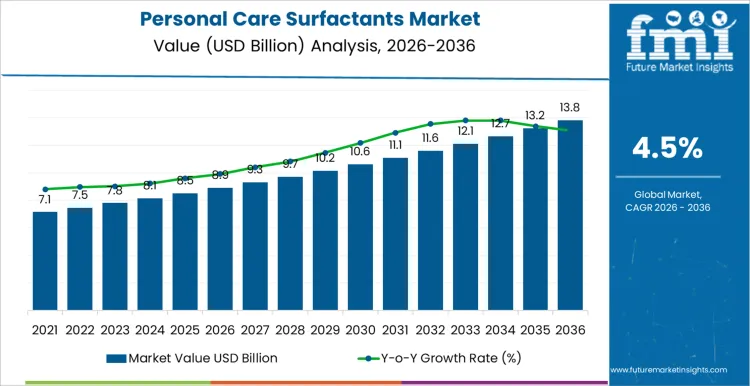
Personal Care Surfactants Market Key Takeaways
| Metric | Value |
|---|---|
| Personal Care Surfactants Market Value (2026) | USD 8.9 Billion |
| Personal Care Surfactants Market Forecast Value (2036) | USD 13.8 Billion |
| Personal Care Surfactants Market Forecast CAGR 2026 to 2036 | 4.50% |
How are Mildness Expectations and Portfolio Premiumization Driving the Personal Care Surfactants Market?
The personal care surfactants market is evolving as brands balance cleansing efficacy with growing consumer sensitivity to skin and hair health. Shampoos, facial cleansers, body washes, and baby care products increasingly rely on mild surfactant systems that reduce irritation while maintaining foam quality and sensory appeal. This is shifting demand away from single, high-foaming surfactants toward blended systems that combine anionic, amphoteric, and nonionic chemistries to optimize performance across skin types and use frequencies.
Formulation flexibility and brand positioning are central to purchasing decisions. Personal care brands are selecting surfactants based on compatibility with sulfate-free claims, biodegradability targets, and regional regulatory standards. Ingredient suppliers that offer modular surfactant portfolios-allowing formulators to fine-tune viscosity, foam profile, and conditioning feel-are enabling faster product differentiation and line extensions. Support with formulation guidance, sensory benchmarking, and stability testing is increasingly valued during new product development.
Scale efficiency and supply reliability continue to underpin steady market growth. High-volume personal care categories demand consistent quality, predictable pricing, and global availability of surfactant inputs. At the same time, emerging markets are driving volume expansion through mass-market hygiene products, while mature markets push premiumization through gentle and multifunctional formulations. For surfactant producers, competitive advantage increasingly depends on balancing cost efficiency with innovation in mildness and sustainability positioning personal care surfactants as a stable, formulation-driven backbone of the global personal care industry.
How is the Personal Care Surfactants Market Structured by Chemistry and Application?
The personal care surfactants market is segmented by chemistry and application, reflecting how cleansing performance, skin compatibility, and formulation behavior influence surfactant selection. By chemistry, anionic surfactants represent the leading segment, widely used for their strong cleansing and foaming characteristics. Other chemistries include nonionic surfactants, amphoteric or zwitterionic surfactants, and cationic and specialty surfactants, each selected to balance mildness, conditioning, and formulation stability. By application, skin and body care products account for the largest demand, followed by hair care, oral care and personal wash, and other personal care uses that require tailored surfactant systems.
Why Do Anionic Surfactants Lead Chemistry Adoption in the Personal Care Surfactants Market?
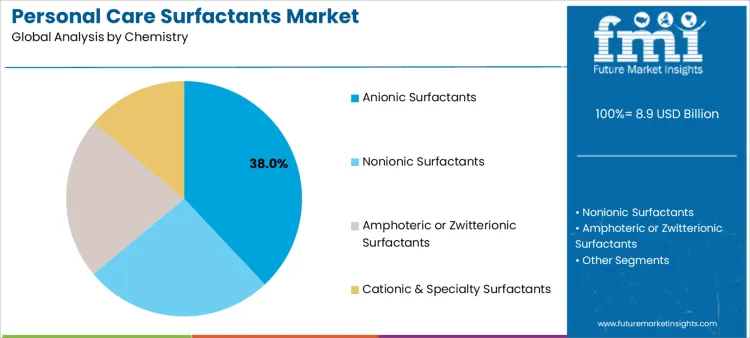
Anionic surfactants account for 38% share of the personal care surfactants market because they deliver effective removal of oils, dirt, and impurities while generating rich foam preferred by consumers. These surfactants are widely used in soaps, body washes, facial cleansers, and shampoos due to their high cleaning efficiency and cost effectiveness. Formulators value anionic systems for predictable performance and ease of blending with other surfactant types to adjust mildness. Large-scale production and broad raw material availability further support adoption. These performance reliability and formulation flexibility factors explain why anionic surfactants remain the dominant chemistry.
Why Does Skin And Body Care Dominate Application Demand In The Personal Care Surfactants Market?
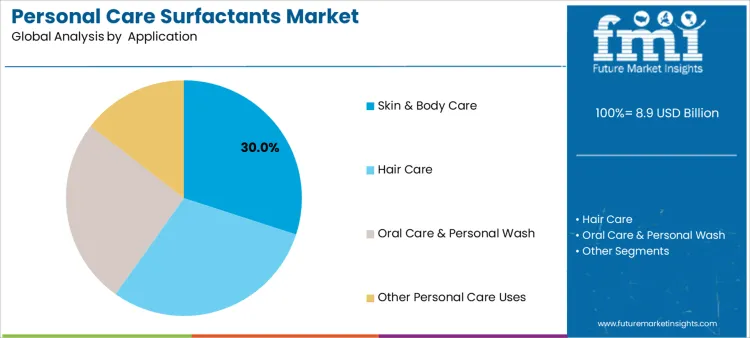
Skin and body care applications hold 30% share of the personal care surfactants market because cleansing products such as body washes, liquid soaps, and facial cleansers are used daily across global consumer markets. These products require surfactants that provide effective cleansing while maintaining acceptable skin feel. High product turnover, frequent usage, and wide consumer reach drive consistent surfactant demand. Manufacturers focus on optimizing foam quality, viscosity, and sensory attributes for skin contact products. These volume-driven consumption patterns and formulation requirements explain why skin and body care remains the leading application segment.
What are the Key Dynamics of the Personal Care Surfactants Market?
The personal care surfactants market is driven by demand for effective, skin-safe cleansing and foaming agents used in products such as shampoos, body washes, facial cleansers, liquid hand soaps, bubble baths, and intimate washes. Surfactants are essential for reducing surface tension and enabling removal of oils, dirt, and impurities while delivering consumer-preferred sensory attributes like rich foam and gentle skin feel. Ingredient suppliers and formulators focus on mildness, biodegradability, compatibility with other formulation components, regulatory compliance, and multi-functional performance when selecting or developing surfactant systems.
How do Consumer and Formulation Trends Shape This Market?
Consumer preferences and formulation trends are shaping the personal care surfactants market through increasing interest in products that deliver enhanced mildness, sensory appeal, and perceived ingredient quality. Growth in daily use categories (hand hygiene, cleansing) elevates demand for surfactants that provide effective cleaning without irritation. Trends toward clear, sulfate-free, and “gentle” formulations have prompted formulators to adopt alternative surfactants such as betaines, amphoteric surfactants, glucosides, ethoxylates, and alkyl polyglucosides. Increasing emphasis on pleasant tactile experience, thick lather, and compatibility with fragrances and actives further influences surfactant selection.
What Opportunities are emerging for Suppliers and Formulators?
Opportunities in the personal care surfactants market are emerging with innovation in gentle and naturally derived surfactants, value-added formulation platforms, and technical support services. Growth in sulfate-free, plant-derived, and mild cleansing systems opens demand for specialty surfactants such as alkyl polyglucosides, amino acid-based surfactants, betaines, and amphoteric blends that deliver performance with improved skin compatibility. Suppliers that offer tailored surfactant blends, standardized quality, and formulation toolkits help brands achieve targeted performance while reducing development risk. Expansion of personal care segments in emerging markets such as grooming products, men’s skincare, and premium body care broadens the addressable market.
How is the Personal Care Surfactants Market Growing across Key Countries?
The personal care surfactants market is expanding steadily as demand rises for shampoos, facial cleansers, body washes, and skincare formulations with improved foaming, mildness, and sensory performance. Surfactants are core functional ingredients that determine cleansing efficiency, skin compatibility, and product texture. Country-wise growth varies based on population scale, personal care consumption patterns, product premiumization, and manufacturing capacity. High-growth markets are supported by rising hygiene awareness and expanding mass-market consumption, while mature regions focus on formulation optimization, product differentiation, and consistent quality for branded personal care products.
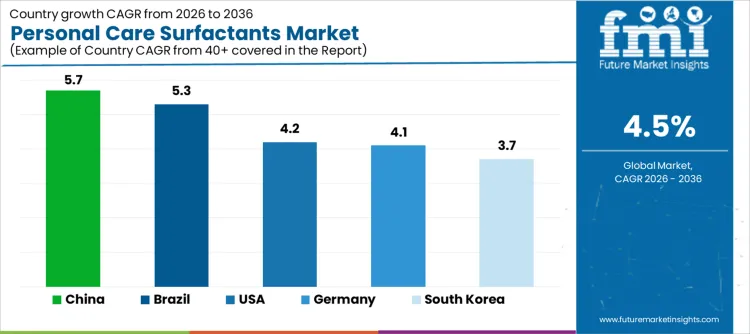
| Country | CAGR (%) |
|---|---|
| China | 5.7% |
| Brazil | 5.3% |
| United States | 4.2% |
| Germany | 4.1% |
| South Korea | 3.7% |
Why is China Leading the Personal Care Surfactants Market?
China’s personal care surfactants market is expanding at a CAGR of 5.7% during 2026 to 2036, driven by large population scale, rising hygiene awareness, and strong demand for haircare and skincare products. Growth is supported by increasing urbanization and higher consumption of shampoos, facial cleansers, and liquid soaps across mass-market and mid-range segments. Domestic brands and contract manufacturers consume large volumes of anionic, amphoteric, and non-ionic surfactants for daily-use formulations. Chinese manufacturers prioritize surfactants that offer reliable cleansing performance, good foaming behavior, and compatibility with high-volume production processes. Cost efficiency and supply scalability are key factors, particularly for mass-market personal care products. Domestic chemical producers benefit from integrated supply chains and large-scale manufacturing capabilities, ensuring stable availability.
Why is Brazil Seeing Steady Growth in Personal Care Surfactants Demand?
Brazil’s personal care surfactants market is growing at a CAGR of 5.3% during 2026 to 2036, supported by strong consumer demand for haircare, body wash, and skincare products. Brazil has one of the world’s largest personal care markets, with high per-capita usage of shampoos and conditioners, driving sustained surfactant consumption. Brazilian formulators value surfactants that perform well under humid and warm conditions while delivering stable foam and skin feel. Demand is strong for mild surfactant systems used in haircare and daily cleansing products. Adoption is balanced between mass-market and premium formulations. Procurement decisions often favor suppliers offering local production, technical formulation support, and consistent quality. Market growth is supported by steady personal care consumption, strong domestic brands, and continued innovation in haircare and skin cleansing products.
What is Driving Demand for Personal Care Surfactants in the United States?
The United States personal care surfactants market is expanding at a CAGR of 4.2% during 2026 to 2036, driven by demand from skincare, haircare, and specialty cleansing products. Growth is supported by product diversification, premium formulations, and strong private-label activity across retail channels. U.S. buyers emphasize mildness, formulation stability, and compatibility with complex ingredient systems. Demand is strongest for surfactants used in facial cleansers, sensitive-skin products, and multifunctional personal care formulations. Adoption is more value-driven than volume-driven, with emphasis on product performance and consumer experience. Procurement decisions prioritize supplier reliability, regulatory compliance, and technical documentation. Market growth is shaped by continuous product innovation, premiumization trends, and steady replacement cycles in personal care formulations.
How is Germany Supporting Growth in the Personal Care Surfactants Market?
Germany’s personal care surfactants market is growing at a CAGR of 4.1% during 2026 to 2036, supported by demand for high-quality skincare, haircare, and dermocosmetic products. German manufacturers emphasize formulation precision, product safety, and consistent sensory performance. Buyers prioritize surfactants with predictable cleansing behavior, good skin compatibility, and stable formulation properties. Demand is concentrated in premium personal care and pharmacy-led product segments. Procurement decisions favor suppliers with strong quality systems, regulatory expertise, and long-term supply assurance. Market growth is reinforced by Germany’s focus on high-quality personal care manufacturing and steady demand for reliable surfactant ingredients.
How Is South Korea Expanding Use of Personal Care Surfactants?
South Korea’s personal care surfactants market is expanding at a CAGR of 3.7% during 2026 to 2036, driven by demand from advanced skincare and cosmetic formulations. South Korean brands focus heavily on product texture, foam quality, and skin feel, driving careful selection of surfactant systems. Buyers emphasize mildness, formulation flexibility, and compatibility with multifunctional skincare products. Adoption is strongest in facial cleansers, cosmetic cleansers, and specialty beauty products. Procurement decisions are influenced by supplier technical capability, consistent quality, and alignment with global cosmetic standards. Market growth is supported by ongoing innovation in skincare products and steady domestic and export demand.
How are Suppliers Competing in the Personal Care Surfactants Market?
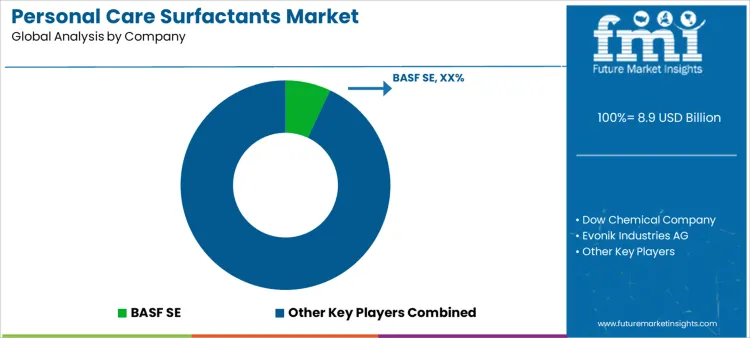
Competition in the personal care surfactants market is anchored on formulation performance, mildness to skin and hair, and sustainable sourcing-attributes that matter to brand R&D teams and formulators. BASF SE positions its surfactants around broad performance across cleansing, foaming, and emulsification, with product materials emphasizing balance between effective cleansing and gentleness. Its portfolio is often specified by global personal care brands for shampoos, body washes, and cleansers where skin feel and irritation potential are critical. Dow Chemical Company competes through multifunctional surfactants that deliver high foaming and conditioning benefits, highlighting compatibility with sulfate-free and biodegradable formulations.
Major specialty chemical producers differentiate through sustainability claims and tailorability. Evonik Industries AG focuses on engineered surfactants optimized for mildness and sensory performance, with emphasis on renewable content and low environmental impact. Clariant AG and Croda International Plc compete with green and bio-based surfactant solutions that resonate with clean and natural personal care trends, backed by documented biodegradability and raw material traceability.
Regional and niche specialists add depth with specialized chemistries and formulation support. Solvay SA and Kao Corporation offer surfactants tailored for Asian and global personal care platforms, with focus on mild anionic and amphoteric blends. Stepan Company, Nouryon, and Lion Corporation differentiate through cost-effective, performance-balanced surfactants that support mass-market and niche personal care lines. Across all suppliers, competitive advantage is defined by mildness profiling, sustainability credentials, and global formulation support rather than price alone.
Key Players in Personal Care Surfactants Market
- BASF SE
- Dow Chemical Company
- Evonik Industries AG
- Clariant AG
- Croda International Plc
- Solvay SA
- Kao Corporation (chemical division)
- Stepan Company
- Nouryon
- Lion Corporation (chemical division)
Scope of Report
| Attribute | Details |
|---|---|
| Market Size Unit | USD Billion |
| Chemistry Covered | Anionic Surfactants, Nonionic Surfactants, Amphoteric or Zwitterionic Surfactants, Cationic & Specialty Surfactants |
| Application Covered | Skin & Body Care, Hair Care, Oral Care & Personal Wash, Other Personal Care Uses |
| Countries Covered | China, Japan, South Korea, India, Australia & New Zealand, ASEAN, Rest of Asia Pacific, Germany, United Kingdom, France, Italy, Spain, Nordic, BENELUX, Rest of Europe, United States, Canada, Mexico, Brazil, Chile, Rest of Latin America, Kingdom of Saudi Arabia, Other GCC Countries, Turkey, South Africa, Other African Union, Rest of Middle East & Africa |
| Regions Covered | Asia Pacific, Europe, North America, Latin America, Middle East & Africa |
| Key Companies Profiled | BASF SE, Dow Chemical Company, Evonik Industries AG, Clariant AG, Croda International Plc, Solvay SA, Kao Corporation, Stepan Company, Nouryon, Lion Corporation |
| Additional Attributes | Dollar sales by surfactant chemistry and personal care application are evaluated across mass-market, premium, and dermatological formulations. The scope analyzes mildness profiles, foaming performance, biodegradability, and sulfate-free transitions. Country-level assessment reflects regulatory pressure on ingredient safety, rising demand for natural and bio-based surfactants, and formulation shifts driven by clean-label, sensitive-skin, and sustainability-focused personal care products. |
Personal Care Surfactants Market by Key Segments
Chemistry:
- Anionic Surfactants
- Nonionic Surfactants
- Amphoteric or Zwitterionic Surfactants
- Cationic & Specialty Surfactants
Application:
- Skin & Body Care
- Hair Care
- Oral Care & Personal Wash
- Other Personal Care Uses
Region:
- Asia Pacific
- China
- Japan
- South Korea
- India
- Australia & New Zealand
- ASEAN
- Rest of Asia Pacific
- Europe
- Germany
- United Kingdom
- France
- Italy
- Spain
- Nordic
- BENELUX
- Rest of Europe
- North America
- United States
- Canada
- Mexico
- Latin America
- Brazil
- Chile
- Rest of Latin America
- Middle East & Africa
- Kingdom of Saudi Arabia
- Other GCC Countries
- Turkey
- South Africa
- Other African Union
- Rest of Middle East & Africa
Bibliography
- European Commission, Scientific Committee on Consumer Safety. (2024). Guidance on the safety assessment of cosmetic ingredients in cleansing and rinse‑off products. Publications Office of the European Union.
- Food and Agriculture Organization of the United Nations. (2024). Oleochemical feedstocks and surfactant use in personal care and hygiene products. FAO.
- International Organization for Standardization. (2024). ISO 16128‑2: Criteria for ingredients and products in cosmetic formulations. ISO.
- United Nations Environment Programme. (2024). Sustainable surfactants and detergents: Environmental performance and policy considerations. UNEP.
- OECD Environment Directorate. (2024). Lifecycle assessment of surfactants used in personal care applications. OECD.
Frequently Asked Questions
How big is the personal care surfactants market in 2026?
The global personal care surfactants market is estimated to be valued at USD 8.9 billion in 2026.
What will be the size of personal care surfactants market in 2036?
The market size for the personal care surfactants market is projected to reach USD 13.8 billion by 2036.
How much will be the personal care surfactants market growth between 2026 and 2036?
The personal care surfactants market is expected to grow at a 4.5% CAGR between 2026 and 2036.
What are the key product types in the personal care surfactants market?
The key product types in personal care surfactants market are anionic surfactants, nonionic surfactants, amphoteric or zwitterionic surfactants and cationic & specialty surfactants.
Which application segment to contribute significant share in the personal care surfactants market in 2026?
In terms of application, skin & body care segment to command 30.0% share in the personal care surfactants market in 2026.
Preview the report firsthand - request a free sample
Get SampleGet the brochure for pricing and purchase details.
Get PDFTable of Content
- Executive Summary
- Global Market Outlook
- Demand-side Trends
- Supply-side Trends
- Technology Roadmap Analysis
- Analysis and Recommendations
- Market Overview
- Market Coverage / Taxonomy
- Market Definition / Scope / Limitations
- Market Background
- Market Dynamics
- Drivers
- Restraints
- Opportunity
- Trends
- Scenario Forecast
- Demand in Optimistic Scenario
- Demand in Likely Scenario
- Demand in Conservative Scenario
- Opportunity Map Analysis
- Product Life Cycle Analysis
- Supply Chain Analysis
- Investment Feasibility Matrix
- Value Chain Analysis
- PESTLE and Porter’s Analysis
- Regulatory Landscape
- Regional Parent Market Outlook
- Production and Consumption Statistics
- Import and Export Statistics
- Market Dynamics
- Global Market Analysis 2021 to 2025 and Forecast, 2026 to 2036
- Historical Market Size Value (USD Million) Analysis, 2021 to 2025
- Current and Future Market Size Value (USD Million) Projections, 2026 to 2036
- Y-o-Y Growth Trend Analysis
- Absolute $ Opportunity Analysis
- Global Market Pricing Analysis 2021 to 2025 and Forecast 2026 to 2036
- Global Market Analysis 2021 to 2025 and Forecast 2026 to 2036, By Chemistry
- Introduction / Key Findings
- Historical Market Size Value (USD Million) Analysis By Chemistry , 2021 to 2025
- Current and Future Market Size Value (USD Million) Analysis and Forecast By Chemistry , 2026 to 2036
- Anionic Surfactants
- Nonionic Surfactants
- Amphoteric or Zwitterionic Surfactants
- Cationic & Specialty Surfactants
- Anionic Surfactants
- Y-o-Y Growth Trend Analysis By Chemistry , 2021 to 2025
- Absolute $ Opportunity Analysis By Chemistry , 2026 to 2036
- Global Market Analysis 2021 to 2025 and Forecast 2026 to 2036, By Application
- Introduction / Key Findings
- Historical Market Size Value (USD Million) Analysis By Application, 2021 to 2025
- Current and Future Market Size Value (USD Million) Analysis and Forecast By Application, 2026 to 2036
- Skin & Body Care
- Hair Care
- Oral Care & Personal Wash
- Other Personal Care Uses
- Skin & Body Care
- Y-o-Y Growth Trend Analysis By Application, 2021 to 2025
- Absolute $ Opportunity Analysis By Application, 2026 to 2036
- Global Market Analysis 2021 to 2025 and Forecast 2026 to 2036, By Region
- Introduction
- Historical Market Size Value (USD Million) Analysis By Region, 2021 to 2025
- Current Market Size Value (USD Million) Analysis and Forecast By Region, 2026 to 2036
- North America
- Latin America
- Western Europe
- Eastern Europe
- East Asia
- South Asia and Pacific
- Middle East & Africa
- Market Attractiveness Analysis By Region
- North America Market Analysis 2021 to 2025 and Forecast 2026 to 2036, By Country
- Historical Market Size Value (USD Million) Trend Analysis By Market Taxonomy, 2021 to 2025
- Market Size Value (USD Million) Forecast By Market Taxonomy, 2026 to 2036
- By Country
- USA
- Canada
- Mexico
- By Chemistry
- By Application
- By Country
- Market Attractiveness Analysis
- By Country
- By Chemistry
- By Application
- Key Takeaways
- Latin America Market Analysis 2021 to 2025 and Forecast 2026 to 2036, By Country
- Historical Market Size Value (USD Million) Trend Analysis By Market Taxonomy, 2021 to 2025
- Market Size Value (USD Million) Forecast By Market Taxonomy, 2026 to 2036
- By Country
- Brazil
- Chile
- Rest of Latin America
- By Chemistry
- By Application
- By Country
- Market Attractiveness Analysis
- By Country
- By Chemistry
- By Application
- Key Takeaways
- Western Europe Market Analysis 2021 to 2025 and Forecast 2026 to 2036, By Country
- Historical Market Size Value (USD Million) Trend Analysis By Market Taxonomy, 2021 to 2025
- Market Size Value (USD Million) Forecast By Market Taxonomy, 2026 to 2036
- By Country
- Germany
- UK
- Italy
- Spain
- France
- Nordic
- BENELUX
- Rest of Western Europe
- By Chemistry
- By Application
- By Country
- Market Attractiveness Analysis
- By Country
- By Chemistry
- By Application
- Key Takeaways
- Eastern Europe Market Analysis 2021 to 2025 and Forecast 2026 to 2036, By Country
- Historical Market Size Value (USD Million) Trend Analysis By Market Taxonomy, 2021 to 2025
- Market Size Value (USD Million) Forecast By Market Taxonomy, 2026 to 2036
- By Country
- Russia
- Poland
- Hungary
- Balkan & Baltic
- Rest of Eastern Europe
- By Chemistry
- By Application
- By Country
- Market Attractiveness Analysis
- By Country
- By Chemistry
- By Application
- Key Takeaways
- East Asia Market Analysis 2021 to 2025 and Forecast 2026 to 2036, By Country
- Historical Market Size Value (USD Million) Trend Analysis By Market Taxonomy, 2021 to 2025
- Market Size Value (USD Million) Forecast By Market Taxonomy, 2026 to 2036
- By Country
- China
- Japan
- South Korea
- By Chemistry
- By Application
- By Country
- Market Attractiveness Analysis
- By Country
- By Chemistry
- By Application
- Key Takeaways
- South Asia and Pacific Market Analysis 2021 to 2025 and Forecast 2026 to 2036, By Country
- Historical Market Size Value (USD Million) Trend Analysis By Market Taxonomy, 2021 to 2025
- Market Size Value (USD Million) Forecast By Market Taxonomy, 2026 to 2036
- By Country
- India
- ASEAN
- Australia & New Zealand
- Rest of South Asia and Pacific
- By Chemistry
- By Application
- By Country
- Market Attractiveness Analysis
- By Country
- By Chemistry
- By Application
- Key Takeaways
- Middle East & Africa Market Analysis 2021 to 2025 and Forecast 2026 to 2036, By Country
- Historical Market Size Value (USD Million) Trend Analysis By Market Taxonomy, 2021 to 2025
- Market Size Value (USD Million) Forecast By Market Taxonomy, 2026 to 2036
- By Country
- Kingdom of Saudi Arabia
- Other GCC Countries
- Turkiye
- South Africa
- Other African Union
- Rest of Middle East & Africa
- By Chemistry
- By Application
- By Country
- Market Attractiveness Analysis
- By Country
- By Chemistry
- By Application
- Key Takeaways
- Key Countries Market Analysis
- USA
- Pricing Analysis
- Market Share Analysis, 2025
- By Chemistry
- By Application
- Canada
- Pricing Analysis
- Market Share Analysis, 2025
- By Chemistry
- By Application
- Mexico
- Pricing Analysis
- Market Share Analysis, 2025
- By Chemistry
- By Application
- Brazil
- Pricing Analysis
- Market Share Analysis, 2025
- By Chemistry
- By Application
- Chile
- Pricing Analysis
- Market Share Analysis, 2025
- By Chemistry
- By Application
- Germany
- Pricing Analysis
- Market Share Analysis, 2025
- By Chemistry
- By Application
- UK
- Pricing Analysis
- Market Share Analysis, 2025
- By Chemistry
- By Application
- Italy
- Pricing Analysis
- Market Share Analysis, 2025
- By Chemistry
- By Application
- Spain
- Pricing Analysis
- Market Share Analysis, 2025
- By Chemistry
- By Application
- France
- Pricing Analysis
- Market Share Analysis, 2025
- By Chemistry
- By Application
- India
- Pricing Analysis
- Market Share Analysis, 2025
- By Chemistry
- By Application
- ASEAN
- Pricing Analysis
- Market Share Analysis, 2025
- By Chemistry
- By Application
- Australia & New Zealand
- Pricing Analysis
- Market Share Analysis, 2025
- By Chemistry
- By Application
- China
- Pricing Analysis
- Market Share Analysis, 2025
- By Chemistry
- By Application
- Japan
- Pricing Analysis
- Market Share Analysis, 2025
- By Chemistry
- By Application
- South Korea
- Pricing Analysis
- Market Share Analysis, 2025
- By Chemistry
- By Application
- Russia
- Pricing Analysis
- Market Share Analysis, 2025
- By Chemistry
- By Application
- Poland
- Pricing Analysis
- Market Share Analysis, 2025
- By Chemistry
- By Application
- Hungary
- Pricing Analysis
- Market Share Analysis, 2025
- By Chemistry
- By Application
- Kingdom of Saudi Arabia
- Pricing Analysis
- Market Share Analysis, 2025
- By Chemistry
- By Application
- Turkiye
- Pricing Analysis
- Market Share Analysis, 2025
- By Chemistry
- By Application
- South Africa
- Pricing Analysis
- Market Share Analysis, 2025
- By Chemistry
- By Application
- USA
- Market Structure Analysis
- Competition Dashboard
- Competition Benchmarking
- Market Share Analysis of Top Players
- By Regional
- By Chemistry
- By Application
- Competition Analysis
- Competition Deep Dive
- BASF SE
- Overview
- Product Portfolio
- Profitability by Market Segments (Product/Age /Sales Channel/Region)
- Sales Footprint
- Strategy Overview
- Marketing Strategy
- Product Strategy
- Channel Strategy
- Dow Chemical Company
- Evonik Industries AG
- Clariant AG
- Croda International Plc
- Solvay SA
- Kao Corporation (chemical division)
- Stepan Company
- Nouryon
- Lion Corporation (chemical division)
- BASF SE
- Competition Deep Dive
- Assumptions & Acronyms Used
- Research Methodology


