

- Industry Size (2026)
- USD 62.55 Bn
- Forecast (2036)
- USD 114.15 Bn
- CAGR (2026 to 2036)
- 6.20%
Oral Care Chemicals Market Size, Market Forecast and Outlook By FMI
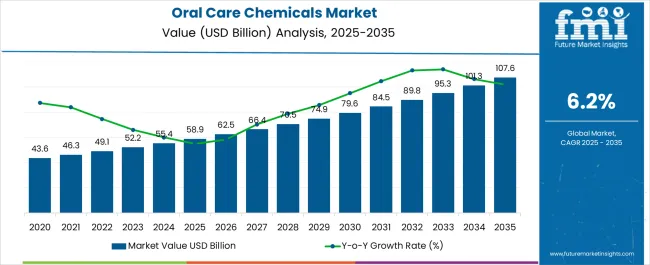
In 2025, the oral care chemicals market was valued at USD 58.90 billion. Based on Future Market Insights' analysis, demand is estimated to grow to USD 62.55 billion in 2026 and USD 114.15 billion by 2036. FMI projects a CAGR of 6.20% during the forecast period.
The market is set to add approximately USD 51.60 billion in absolute terms between 2026 and 2036. Premiumization of oral care products toward whitening, sensitivity relief, and microbiome-targeted formulations is increasing per-unit active ingredient content and value, driving oral care chemical demand growth faster than basic toothpaste volume. Asia Pacific oral hygiene penetration expansion, particularly in India and Southeast Asia where per-capita toothpaste consumption remains below global averages, provides the volume growth foundation.
Summary of Oral Care Chemicals Market
- Oral Care Chemicals Market Definition
- Oral care chemicals are specialty ingredient categories including active agents (fluoride compounds, antimicrobials, whitening agents), functional additives (abrasives, humectants, flavors), preservatives, rheology modifiers (thickeners, binders), and surfactants (foaming agents) formulated into toothpaste, gels, mouth rinses, polishes, and medicated oral care products.
- Demand Drivers in the Market
- Oral care premiumization toward whitening (hydrogen peroxide, PAP), sensitivity relief (potassium nitrate, stannous fluoride), and enamel repair (hydroxyapatite) formulations increases active ingredient loading per SKU, driving chemical supplier revenue growth at rates above finished product volume growth.
- Asia Pacific oral hygiene penetration expansion in India, Indonesia, and Vietnam, where per-capita toothpaste consumption is 30% to 50% below developed market levels, provides a structural volume growth pathway for basic fluoride, abrasive, and surfactant chemical categories.
- Natural and clean-label oral care trends drive reformulation from synthetic surfactants (SLS) to plant-derived alternatives (cocamidopropyl betaine, decyl glucoside), creating ingredient substitution procurement cycles at oral care brand contract manufacturers.
- Key Segments Analyzed in the FMI Report
- Toothpaste end use application: 38.2% share in 2026, reflecting its structural position as the primary category across established procurement channels.
- Actives chemical categories: 34.2% share in 2026, reflecting its structural position as the primary category across established procurement channels.
- China: 8.40% compound growth through 2036, indicating concentrated demand acceleration.
- Analyst Opinion at FMI
- Nikhil Kaitwade, Principal Consultant for Chemicals and Materials, opines, The oral care chemicals market is a specialty ingredient category where formulation premiumization and geographic penetration expansion create dual growth vectors. FMI analysts observe that toothpaste at 38.2% application share leads because it consumes the broadest range of chemical ingredient categories (actives, abrasives, humectants, surfactants, flavors, preservatives) per finished product SKU. Active ingredients at 34.2% chemical category share command the highest per-kilogram pricing because fluoride compounds, antimicrobials, and whitening agents are the specification-defining components that differentiate branded oral care products. China leads at 8.4% CAGR because the domestic oral care market is simultaneously premiumizing (whitening, sensitivity) and expanding penetration (rural and lower-tier city distribution), creating compound ingredient demand growth.
- Strategic Implications / Executive Takeaways
- Oral care chemical suppliers should develop hydroxyapatite and bioactive glass active ingredients to capture the fluoride-alternative segment where consumer demand for non-fluoride remineralization options is creating a premium formulation tier.
- Surfactant manufacturers should scale production of sulfate-free foaming agents (cocamidopropyl betaine, decyl glucoside) to serve the growing clean-label oral care reformulation wave driven by consumer preference for SLS-free toothpaste.
- Oral care brands expanding into India and Southeast Asia should partner with regional chemical distributors offering local regulatory registration support for active ingredients requiring country-specific cosmetic or drug product notification.
Oral Care Chemicals Market Key Takeaways
| Metric | Details |
|---|---|
| Industry Size (2026) | USD 62.55 Billion |
| Industry Value (2036) | USD 114.15 Billion |
| CAGR (2026 to 2036) | 6.20% |
Source: Future Market Insights, 2026
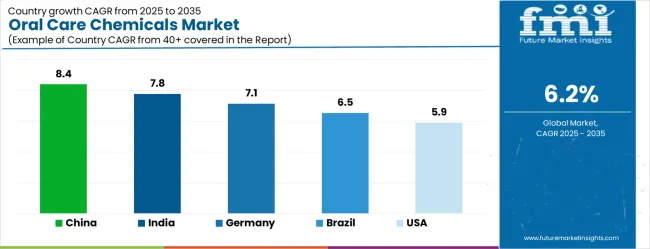
As per FMI, country-level growth rates through 2036 are projected as follows: China at 8.40%, India at 7.80%, Germany at 7.10%, Brazil at 6.50%, USA at 5.90%, UK at 5.30%, Japan at 4.70%. China records the fastest expansion driven by concentrated industry investment.
Oral Care Chemicals Market Definition
The oral care chemicals market encompasses specialty ingredient categories supplied to oral hygiene product manufacturers for formulation into consumer and professional dental care products. Chemical categories span active agents (fluoride, antimicrobials, whitening compounds), functional additives (abrasives, humectants, flavors), preservatives, rheology modifiers (thickeners, binders, gelling agents), and surfactants (foaming and cleansing agents). As per FMI, the market is driven by formulation premiumization in developed markets and oral hygiene penetration expansion in developing markets, with both trends increasing total chemical ingredient demand per capita.
Oral Care Chemicals Market Inclusions
Market scope covers active ingredients, additives, preservatives, rheology modifiers, and surfactants supplied to oral care product manufacturers for formulation into toothpaste, dental gel, tooth polish, mouth rinse, and medicated oral care products.
Oral Care Chemicals Market Exclusions
Finished oral care consumer products at retail pricing, dental materials for professional in-office use (composites, cements), and oral care device components (toothbrush bristles, electric motor assemblies) are excluded.
Oral Care Chemicals Market Research Methodology
- Primary Research: Analysts conducted structured interviews with procurement managers, product engineers, and distribution channel operators to map purchase decision triggers and specification requirements across key verticals.
- Desk Research: Data collection aggregated regulatory filings, industry standards documentation, patent registries, trade body publications, and company annual reports across all target geographies.
- Market-Sizing and Forecasting: Baseline values derive from a bottom-up aggregation of product shipment volumes and average selling prices, validated against publicly disclosed revenue figures from leading suppliers.
- Data Validation and Update Cycle: Projections are cross-referenced against quarterly earnings data, import-export trade statistics, and industry association production reports to maintain forecast integrity.
Why is the Oral Care Chemicals Market Growing?
The Oral Care Chemicals market is witnessing robust growth, driven by rising consumer awareness about oral hygiene, increasing demand for specialized dental products, and the expansion of preventive healthcare practices. The growing prevalence of dental problems such as cavities, plaque, and gum disease has encouraged the widespread adoption of oral care solutions globally. Manufacturers are increasingly focusing on innovation in chemical formulations to enhance efficacy, improve taste, and deliver multifunctional benefits.
The trend toward natural and sustainable ingredients is also shaping product development, as consumers become more conscious of safety and eco-friendly solutions. Significant advancements in oral care chemistry, such as the use of actives for enamel strengthening, antibacterial protection, and whitening, are further driving market expansion.
Additionally, rising disposable incomes, expanding retail availability, and the growth of e-commerce platforms are making oral care products more accessible to a larger consumer base As oral hygiene becomes a key part of overall wellness, the Oral Care Chemicals market is expected to continue its steady growth, driven by innovation, personalization, and global health trends.
Segmental Analysis
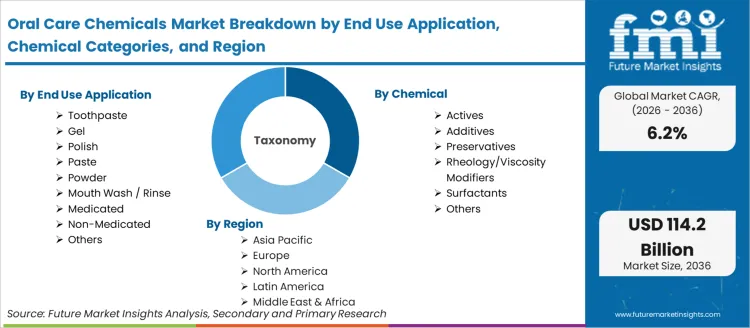
The oral care chemicals market is segmented by end use application, chemical categories, and geographic regions. By end use application, oral care chemicals market is divided into Toothpaste, Gel, Polish, Paste, Powder, Mouth Wash / Rinse, Medicated, Non-Medicated, and Others. In terms of chemical categories, oral care chemicals market is classified into Actives, Additives, Preservatives, Rheology/Viscosity Modifiers, Surfactants, and Others. Regionally, the oral care chemicals industry is classified into North America, Latin America, Western Europe, Eastern Europe, Balkan & Baltic Countries, Russia & Belarus, Central Asia, East Asia, South Asia & Pacific, and the Middle East & Africa.
Insights into the Toothpaste End Use Application Segment
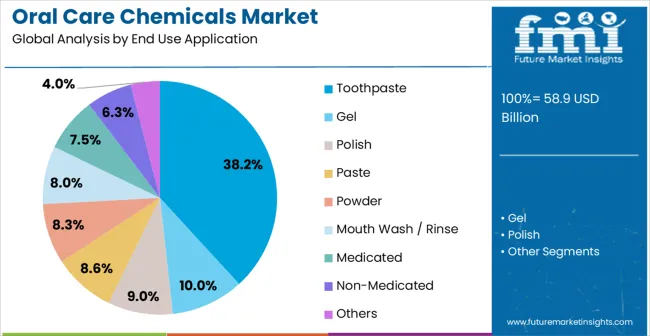
The toothpaste segment is expected to account for 38.2% of the Oral Care Chemicals market revenue share in 2026, positioning it as the leading end use application. This growth is being driven by the segment’s role as the most widely consumed oral care product, used daily by billions of individuals across the globe. Formulation advancements such as the inclusion of fluoride, whitening agents, herbal extracts, and antimicrobial compounds have increased both consumer trust and demand for toothpaste.
The convenience of packaging formats and the availability of toothpaste for specialized needs, including sensitive teeth, gum protection, and cavity prevention, further enhance its appeal. The rising awareness of oral hygiene, driven by government campaigns and dental associations, has significantly boosted consumption, especially in emerging economies.
Strong marketing efforts by leading brands and the influence of dentists in recommending toothpaste have further reinforced its position in the market With growing demand for premium and natural formulations, toothpaste is expected to retain its leadership as the most important category within oral care chemicals.
Insights into the Actives Chemical Categories Segment
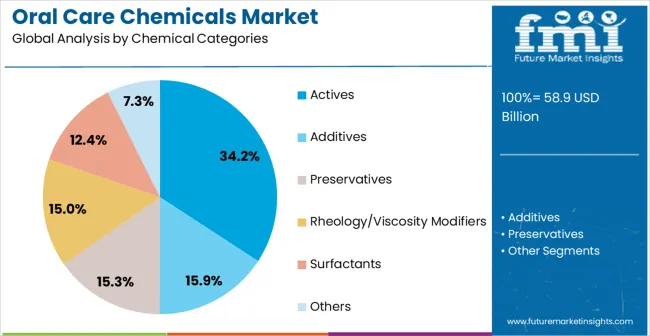
The actives segment is projected to capture 34.2% of the Oral Care Chemicals market revenue share in 2026, establishing it as the leading chemical category. This dominance is being supported by the critical role of actives in delivering therapeutic and preventive benefits in oral care products. Actives such as fluoride, triclosan alternatives, zinc compounds, and herbal agents provide key functionalities including cavity protection, enamel strengthening, antibacterial action, and whitening.
Growing consumer preference for targeted solutions, such as sensitivity relief or gum health improvement, is further driving demand for innovative actives. Continuous advancements in chemistry and biotechnology are enabling the development of new molecules that improve efficacy while maintaining safety standards. The shift toward natural and plant-based actives is also expanding opportunities within this segment, as eco-conscious consumers seek clean-label formulations.
The regulatory emphasis on product effectiveness and safety continues to shape this category, ensuring sustained investment and innovation As oral health awareness grows globally, actives are expected to remain at the forefront of chemical categories in the market.
Market Overview
Oral Care Chemicals Market Overview
In recent few years, the concern about personal care has increased very mush recently, personal care industry include hair care, skin care, oral care, cosmetic, etc. among all these segments oral care products are finding prominent use in day to day life of customers. Oral care is a practice of cleaning one’s mouth and free from dental diseases such as tooth decay (cavities, dental caries) and gum diseases.
Oral hygiene being a critical factor for overall health, the concern regarding oral health has grown among the people in recently and hence led to increase in demand of oral care products. With the development of technology and increasing awareness about dental hygiene and health have led to introduction of new attractive products in the market.
Furthermore, paradigm shift from traditional product usage towards modern usage is being observed. Oral care chemicals are used in several oral care products such as toothpaste, mouthwash, whitening and rinses. Toothpaste segment is expected to be dominating segment driving the oral care chemicals market.
Analysis of Oral Care Chemicals Market By Key Countries
.webp "Top Country Growth Comparison Oral Care Chemicals Market Cagr (2026 2036)")
| Country | CAGR |
|---|---|
| China | 8.4% |
| India | 7.8% |
| Germany | 7.1% |
| Brazil | 6.5% |
| USA | 5.9% |
| UK | 5.3% |
| Japan | 4.7% |
Source: FMI analysis based on primary research and proprietary forecasting model
Country-wise Analysis
The Oral Care Chemicals Market is expected to register a CAGR of 6.2% during the forecast period, exhibiting varied country level momentum. China leads with the highest CAGR of 8.4%, followed by India at 7.8%. Developed markets such as Germany, France, and the UK continue to expand steadily, while the USA is likely to grow at consistent rates. Japan posts the lowest CAGR at 4.7%, yet still underscores a broadly positive trajectory for the global Oral Care Chemicals Market. In 2024, Germany held a dominant revenue in the Western Europe market and is expected to grow with a CAGR of 7.1%. The USA Oral Care Chemicals Market is estimated to be valued at USD 21.4 billion in 2026 and is anticipated to reach a valuation of USD 21.4 billion by 2036. Sales are projected to rise at a CAGR of 0.0% over the forecast period between 2026 and 2036. While Japan and South Korea markets are estimated to be valued at USD 3.1 billion and USD 1.8 billion respectively in 2026.
Key Players in the Oral Care Chemicals Market
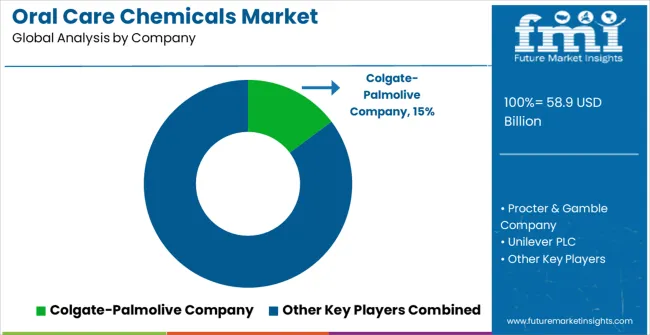
- Colgate-Palmolive Company
- Procter & Gamble Company
- Unilever PLC
- Haleon plc
- Church & Dwight Co. Inc.
- Kenvue Inc.
- Henkel AG & Co. KGaA
- LG Household & Health Care Ltd.
- Lion Corporation
- Sunstar Suisse SA
- Koninklijke Philips N.V.
- Panasonic Corporation
Scope of the Report
| Metric | Value |
|---|---|
| Quantitative Units | USD 62.55 Bn to USD 114.15 Bn, at a CAGR of 6.20% |
| Market Definition | Oral care chemicals are specialty ingredient categories including active agents (fluoride compounds, antimicrobials, whitening agents), functional additives (abrasives, humectants, flavors), preservatives, rheology modifiers (thickeners, binders), and surfactants (foaming agents) formulated into toothpaste, gels, mouth rinses, polishes, and medicated oral care products. |
| End Use Application Segmentation | Toothpaste, Gel, Polish, Paste, Powder, Mouth Wash/Rinse, Medicated, Non-Medicated, Others |
| Chemical Categories Segmentation | Actives, Additives, Preservatives, Rheology/Viscosity Modifiers, Surfactants, Others |
| Regions Covered | North America, Latin America, Europe, East Asia, South Asia, Oceania, Middle East & Africa |
| Countries Covered | China, India, Germany, Brazil, USA, UK, Japan, and 40 plus countries |
| Key Companies Profiled | Colgate-Palmolive Company, Procter & Gamble Company, Unilever PLC, Haleon plc, Church & Dwight Co. Inc., Kenvue Inc., Henkel AG & Co. KGaA, LG Household & Health Care Ltd., Lion Corporation, Sunstar Suisse SA, Koninklijke Philips N.V., Panasonic Corporation |
| Forecast Period | 2026 to 2036 |
| Approach | Hybrid bottom-up and top-down modeling validated against primary research inputs and publicly available industry data. |
Oral Care Chemicals Market by Segments
End Use Application:
- Toothpaste
- Gel
- Polish
- Paste
- Powder
- Mouth Wash / Rinse
- Medicated
- Non-Medicated
- Others
Chemical Categories:
- Actives
- Additives
- Preservatives
- Rheology/Viscosity Modifiers
- Surfactants
- Others
Region:
- North America
- USA
- Canada
- Mexico
- Latin America
- Brazil
- Chile
- Rest of Latin America
- Western Europe
- Germany
- UK
- Italy
- Spain
- France
- Nordic
- BENELUX
- Rest of Western Europe
- Eastern Europe
- Russia
- Poland
- Hungary
- Balkan & Baltic
- Rest of Eastern Europe
- East Asia
- China
- Japan
- South Korea
- South Asia and Pacific
- India
- ASEAN
- Australia & New Zealand
- Rest of South Asia and Pacific
- Middle East & Africa
- Kingdom of Saudi Arabia
- Other GCC Countries
- Turkiye
- South Africa
- Other African Union
- Rest of Middle East & Africa
Bibliography
- [1] European Commission. (2024). Cosmetics Regulation (EC) No 1223/2009: Oral Care Product Ingredient Annex Updates. European Commission.
- [2] USA Food and Drug Administration. (2024). OTC Drug Monograph: Anticaries and Antigingivitis Active Ingredients. FDA.
- [3] Colgate-Palmolive. (2024). Annual Report 2024: Oral, Personal and Home Care Division. Colgate-Palmolive.
- [4] World Health Organization. (2024). Global Oral Health Status Report: Oral Hygiene Product Access. WHO.
- [5] Personal Care Products Council. (2024). INCI Dictionary: Oral Care Ingredient Monographs. PCPC.
This bibliography is provided for reader reference. The full FMI report contains the complete reference list with primary research documentation.
Frequently Asked Questions
How large is the demand for Oral Care Chemicals in the global market in 2026?
Demand for Oral Care Chemicals in the global market is estimated to be valued at USD 62.55 billion in 2026.
What will be the market size of Oral Care Chemicals by 2036?
Market size for Oral Care Chemicals is projected to reach USD 114.15 billion by 2036.
What is the expected demand growth between 2026 and 2036?
Demand is expected to grow at a CAGR of 6.20% between 2026 and 2036.
Which End Use Application is poised to lead by 2026?
Toothpaste accounts for 38.2% in 2026.
How significant is Actives in driving adoption?
Actives represents 34.2% of segment share in 2026.
What country records the fastest growth?
China is projected to grow at a CAGR of 8.40% during 2026 to 2036.
What is the projected growth for India?
India is projected to expand at a CAGR of 7.80% during 2026 to 2036.
What is included in the scope of this report?
Market scope covers active ingredients, additives, preservatives, rheology modifiers, and surfactants supplied to oral care product manufacturers for formulation into toothpaste, dental gel, tooth polish, mouth rinse, and medicated oral care products.
Preview the report firsthand - request a free sample
Get SampleGet the brochure for pricing and purchase details.
Get PDFTable of Content
- Executive Summary
- Global Market Outlook
- Demand-side Trends
- Supply-side Trends
- Technology Roadmap Analysis
- Analysis and Recommendations
- Market Overview
- Market Coverage / Taxonomy
- Market Definition / Scope / Limitations
- Research Methodology
- Chapter Orientation
- Analytical Lens and Working Hypotheses
- Market Structure, Signals, and Trend Drivers
- Benchmarking and Cross-market Comparability
- Market Sizing, Forecasting, and Opportunity Mapping
- Research Design and Evidence Framework
- Desk Research Programme (Secondary Evidence)
- Company Annual and Sustainability Reports
- Peer-reviewed Journals and Academic Literature
- Corporate Websites, Product Literature, and Technical Notes
- Earnings Decks and Investor Briefings
- Statutory Filings and Regulatory Disclosures
- Technical White Papers and Standards Notes
- Trade Journals, Industry Magazines, and Analyst Briefs
- Conference Proceedings, Webinars, and Seminar Materials
- Government Statistics Portals and Public Data Releases
- Press Releases and Reputable Media Coverage
- Specialist Newsletters and Curated Briefings
- Sector Databases and Reference Repositories
- FMI Internal Proprietary Databases and Historical Market Datasets
- Subscription Datasets and Paid Sources
- Social Channels, Communities, and Digital Listening Inputs
- Additional Desk Sources
- Expert Input and Fieldwork (Primary Evidence)
- Primary Modes
- Qualitative Interviews and Expert Elicitation
- Quantitative Surveys and Structured Data Capture
- Blended Approach
- Why Primary Evidence is Used
- Field Techniques
- Interviews
- Surveys
- Focus Groups
- Observational and In-context Research
- Social and Community Interactions
- Stakeholder Universe Engaged
- C-suite Leaders
- Board Members
- Presidents and Vice Presidents
- R&D and Innovation Heads
- Technical Specialists
- Domain Subject-matter Experts
- Scientists
- Physicians and Other Healthcare Professionals
- Governance, Ethics, and Data Stewardship
- Research Ethics
- Data Integrity and Handling
- Primary Modes
- Tooling, Models, and Reference Databases
- Desk Research Programme (Secondary Evidence)
- Data Engineering and Model Build
- Data Acquisition and Ingestion
- Cleaning, Normalisation, and Verification
- Synthesis, Triangulation, and Analysis
- Quality Assurance and Audit Trail
- Market Background
- Market Dynamics
- Drivers
- Restraints
- Opportunity
- Trends
- Scenario Forecast
- Demand in Optimistic Scenario
- Demand in Likely Scenario
- Demand in Conservative Scenario
- Opportunity Map Analysis
- Product Life Cycle Analysis
- Supply Chain Analysis
- Investment Feasibility Matrix
- Value Chain Analysis
- PESTLE and Porter’s Analysis
- Regulatory Landscape
- Regional Parent Market Outlook
- Production and Consumption Statistics
- Import and Export Statistics
- Market Dynamics
- Global Market Analysis 2021 to 2025 and Forecast, 2026 to 2036
- Historical Market Size Value (USD Million) Analysis, 2021 to 2025
- Current and Future Market Size Value (USD Million) Projections, 2026 to 2036
- Y-o-Y Growth Trend Analysis
- Absolute $ Opportunity Analysis
- Global Market Pricing Analysis 2021 to 2025 and Forecast 2026 to 2036
- Global Market Analysis 2021 to 2025 and Forecast 2026 to 2036, By End Use Application
- Introduction / Key Findings
- Historical Market Size Value (USD Million) Analysis By End Use Application , 2021 to 2025
- Current and Future Market Size Value (USD Million) Analysis and Forecast By End Use Application , 2026 to 2036
- Toothpaste
- Gel
- Polish
- Paste
- Powder
- Mouth Wash / Rinse
- Medicated
- Non-Medicated
- Others
- Toothpaste
- Y-o-Y Growth Trend Analysis By End Use Application , 2021 to 2025
- Absolute $ Opportunity Analysis By End Use Application , 2026 to 2036
- Global Market Analysis 2021 to 2025 and Forecast 2026 to 2036, By Chemical Categories
- Introduction / Key Findings
- Historical Market Size Value (USD Million) Analysis By Chemical Categories, 2021 to 2025
- Current and Future Market Size Value (USD Million) Analysis and Forecast By Chemical Categories, 2026 to 2036
- Actives
- Additives
- Preservatives
- Rheology/Viscosity Modifiers
- Surfactants
- Others
- Actives
- Y-o-Y Growth Trend Analysis By Chemical Categories, 2021 to 2025
- Absolute $ Opportunity Analysis By Chemical Categories, 2026 to 2036
- Global Market Analysis 2021 to 2025 and Forecast 2026 to 2036, By Region
- Introduction
- Historical Market Size Value (USD Million) Analysis By Region, 2021 to 2025
- Current Market Size Value (USD Million) Analysis and Forecast By Region, 2026 to 2036
- North America
- Latin America
- Western Europe
- Eastern Europe
- East Asia
- South Asia and Pacific
- Middle East & Africa
- Market Attractiveness Analysis By Region
- North America Market Analysis 2021 to 2025 and Forecast 2026 to 2036, By Country
- Historical Market Size Value (USD Million) Trend Analysis By Market Taxonomy, 2021 to 2025
- Market Size Value (USD Million) Forecast By Market Taxonomy, 2026 to 2036
- By Country
- USA
- Canada
- Mexico
- By End Use Application
- By Chemical Categories
- By Country
- Market Attractiveness Analysis
- By Country
- By End Use Application
- By Chemical Categories
- Key Takeaways
- Latin America Market Analysis 2021 to 2025 and Forecast 2026 to 2036, By Country
- Historical Market Size Value (USD Million) Trend Analysis By Market Taxonomy, 2021 to 2025
- Market Size Value (USD Million) Forecast By Market Taxonomy, 2026 to 2036
- By Country
- Brazil
- Chile
- Rest of Latin America
- By End Use Application
- By Chemical Categories
- By Country
- Market Attractiveness Analysis
- By Country
- By End Use Application
- By Chemical Categories
- Key Takeaways
- Western Europe Market Analysis 2021 to 2025 and Forecast 2026 to 2036, By Country
- Historical Market Size Value (USD Million) Trend Analysis By Market Taxonomy, 2021 to 2025
- Market Size Value (USD Million) Forecast By Market Taxonomy, 2026 to 2036
- By Country
- Germany
- UK
- Italy
- Spain
- France
- Nordic
- BENELUX
- Rest of Western Europe
- By End Use Application
- By Chemical Categories
- By Country
- Market Attractiveness Analysis
- By Country
- By End Use Application
- By Chemical Categories
- Key Takeaways
- Eastern Europe Market Analysis 2021 to 2025 and Forecast 2026 to 2036, By Country
- Historical Market Size Value (USD Million) Trend Analysis By Market Taxonomy, 2021 to 2025
- Market Size Value (USD Million) Forecast By Market Taxonomy, 2026 to 2036
- By Country
- Russia
- Poland
- Hungary
- Balkan & Baltic
- Rest of Eastern Europe
- By End Use Application
- By Chemical Categories
- By Country
- Market Attractiveness Analysis
- By Country
- By End Use Application
- By Chemical Categories
- Key Takeaways
- East Asia Market Analysis 2021 to 2025 and Forecast 2026 to 2036, By Country
- Historical Market Size Value (USD Million) Trend Analysis By Market Taxonomy, 2021 to 2025
- Market Size Value (USD Million) Forecast By Market Taxonomy, 2026 to 2036
- By Country
- China
- Japan
- South Korea
- By End Use Application
- By Chemical Categories
- By Country
- Market Attractiveness Analysis
- By Country
- By End Use Application
- By Chemical Categories
- Key Takeaways
- South Asia and Pacific Market Analysis 2021 to 2025 and Forecast 2026 to 2036, By Country
- Historical Market Size Value (USD Million) Trend Analysis By Market Taxonomy, 2021 to 2025
- Market Size Value (USD Million) Forecast By Market Taxonomy, 2026 to 2036
- By Country
- India
- ASEAN
- Australia & New Zealand
- Rest of South Asia and Pacific
- By End Use Application
- By Chemical Categories
- By Country
- Market Attractiveness Analysis
- By Country
- By End Use Application
- By Chemical Categories
- Key Takeaways
- Middle East & Africa Market Analysis 2021 to 2025 and Forecast 2026 to 2036, By Country
- Historical Market Size Value (USD Million) Trend Analysis By Market Taxonomy, 2021 to 2025
- Market Size Value (USD Million) Forecast By Market Taxonomy, 2026 to 2036
- By Country
- Kingdom of Saudi Arabia
- Other GCC Countries
- Turkiye
- South Africa
- Other African Union
- Rest of Middle East & Africa
- By End Use Application
- By Chemical Categories
- By Country
- Market Attractiveness Analysis
- By Country
- By End Use Application
- By Chemical Categories
- Key Takeaways
- Key Countries Market Analysis
- USA
- Pricing Analysis
- Market Share Analysis, 2025
- By End Use Application
- By Chemical Categories
- Canada
- Pricing Analysis
- Market Share Analysis, 2025
- By End Use Application
- By Chemical Categories
- Mexico
- Pricing Analysis
- Market Share Analysis, 2025
- By End Use Application
- By Chemical Categories
- Brazil
- Pricing Analysis
- Market Share Analysis, 2025
- By End Use Application
- By Chemical Categories
- Chile
- Pricing Analysis
- Market Share Analysis, 2025
- By End Use Application
- By Chemical Categories
- Germany
- Pricing Analysis
- Market Share Analysis, 2025
- By End Use Application
- By Chemical Categories
- UK
- Pricing Analysis
- Market Share Analysis, 2025
- By End Use Application
- By Chemical Categories
- Italy
- Pricing Analysis
- Market Share Analysis, 2025
- By End Use Application
- By Chemical Categories
- Spain
- Pricing Analysis
- Market Share Analysis, 2025
- By End Use Application
- By Chemical Categories
- France
- Pricing Analysis
- Market Share Analysis, 2025
- By End Use Application
- By Chemical Categories
- India
- Pricing Analysis
- Market Share Analysis, 2025
- By End Use Application
- By Chemical Categories
- ASEAN
- Pricing Analysis
- Market Share Analysis, 2025
- By End Use Application
- By Chemical Categories
- Australia & New Zealand
- Pricing Analysis
- Market Share Analysis, 2025
- By End Use Application
- By Chemical Categories
- China
- Pricing Analysis
- Market Share Analysis, 2025
- By End Use Application
- By Chemical Categories
- Japan
- Pricing Analysis
- Market Share Analysis, 2025
- By End Use Application
- By Chemical Categories
- South Korea
- Pricing Analysis
- Market Share Analysis, 2025
- By End Use Application
- By Chemical Categories
- Russia
- Pricing Analysis
- Market Share Analysis, 2025
- By End Use Application
- By Chemical Categories
- Poland
- Pricing Analysis
- Market Share Analysis, 2025
- By End Use Application
- By Chemical Categories
- Hungary
- Pricing Analysis
- Market Share Analysis, 2025
- By End Use Application
- By Chemical Categories
- Kingdom of Saudi Arabia
- Pricing Analysis
- Market Share Analysis, 2025
- By End Use Application
- By Chemical Categories
- Turkiye
- Pricing Analysis
- Market Share Analysis, 2025
- By End Use Application
- By Chemical Categories
- South Africa
- Pricing Analysis
- Market Share Analysis, 2025
- By End Use Application
- By Chemical Categories
- USA
- Market Structure Analysis
- Competition Dashboard
- Competition Benchmarking
- Market Share Analysis of Top Players
- By Regional
- By End Use Application
- By Chemical Categories
- Competition Analysis
- Competition Deep Dive
- Colgate-Palmolive Company
- Overview
- Product Portfolio
- Profitability by Market Segments (Product/Age /Sales Channel/Region)
- Sales Footprint
- Strategy Overview
- Marketing Strategy
- Product Strategy
- Channel Strategy
- Procter & Gamble Company
- Unilever PLC
- Haleon plc
- Church & Dwight Co. Inc.
- Kenvue Inc.
- Henkel AG & Co. KGaA
- LG Household & Health Care Ltd.
- Lion Corporation
- Sunstar Suisse SA
- Koninklijke Philips N.V.
- Panasonic Corporation
- Colgate-Palmolive Company
- Competition Deep Dive
- Assumptions & Acronyms Used


