

- Industry Size (2026)
- USD 1.2 Bn
- Forecast (2036)
- USD 2.5 Bn
- CAGR (2026 to 2036)
- 7.7%
Oral Irrigator Market Size, Market Forecast and Outlook By FMI
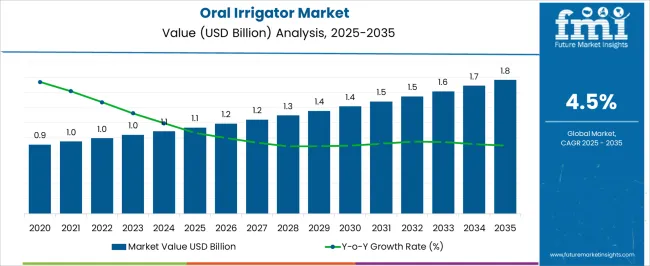
In 2025, the oral irrigator market surpassed USD 1.1 billion. The market is anticipated to be valued at USD 1.2 billion in 2026 and USD 2.5 billion by 2036. It projects a CAGR of 7.7% during the forecast period.
Dental hygiene practitioners and oral health consumers are prioritizing interdental cleaning effectiveness and gum stimulation capabilities through water-based devices that deliver plaque removal without requiring manual dexterity skills. Equipment selection is moving toward adjustable pressure settings, multiple nozzle attachments, and travel-friendly designs to support periodontal health goals. Product development is responding to this shift through pulsation pattern optimization, reservoir capacity expansion, and rechargeable battery integration, enabling targeted cleaning assistance while maintaining clinical recommendation standards.
Device brands are expanding dental professional partnerships while reinforcing clinical credibility through pressure safety protocols, nozzle sterilization specifications, and water filtration compatibility. Product range expansions in compact travel models, multi-user reservoir systems, and cordless charging docks across major pharmacy retailers underscore how water flossing equipment is moving from specialty dental tool installations into standard bathroom fixture specifications linked to electric toothbrush ecosystems and oral care routines.
Leading consumer goods companies are sharpening their operational focus and accelerating product portfolio execution to maintain margins and sustain growth, even as demand patterns fluctuate across key regions. This shift aligns with evolving consumer expectations for more effective and convenient oral care solutions. “Our mission has always been simple: make professional oral care accessible to everyone," noted Bobby Jacobs, Founder of MySmile.
Summary of Oral Irrigator Market
- Oral Irrigator Market Definition
- The industry covers water-based interdental cleaning devices utilized for plaque removal and periodontal care including household bathrooms, dental clinics, and orthodontic practices.
- Demand Drivers in the Market
- Rising preventive dental care awareness drives equipment acquisition for periodontal disease prevention programs.
- Orthodontic treatment expansion increases demand for bracket cleaning devices with specialized nozzle configurations.
- Product innovation in cordless technology reduces countertop space requirements while maintaining water pressure performance standards.
- Key Segments Analyzed in the Report
- Product Type: Cordless Irrigators (45%) versus countertop models and faucet-attached systems.
- Distribution Channel: Online Retail (41%) versus pharmacy chains and dental professional offices.
- Geography: High-growth Asia Pacific versus mature North American and European markets.
- Analyst Opinion at FMI
- Rahul Pandita, Senior Consultant for Consumer Products at Future Market Insights, remarks, "The 2026 to 2036 evaluation of the Oral Irrigator Market highlights a growing reliance on preventive care frameworks within dental practices, where adjunct cleaning devices are increasingly positioned as part of routine oral hygiene regimens rather than optional accessories. My assessment indicates that purchasing decisions are becoming more influenced by practitioner guidance, patient compliance outcomes, and long term gum health indicators, which are now shaping product positioning across clinical and home care settings. This trend places greater pressure on manufacturers to demonstrate sustained periodontal benefits, align product claims with clinical practice standards, and strengthen professional education channels that support long term device adoption."
- Strategic Implications/Executive Takeaways
- Build product portfolios around pressure customization, targeting sensitive gums, orthodontic users, and implant care.
- Position clinical validation and efficacy data as core purchase drivers across retail and e-commerce channels.
- Integrate smart features such as usage tracking and guided cleaning modes to support habit formation and device stickiness.
- Expand refill and accessory ecosystems to increase recurring revenue beyond the base device sale.
- Localize product design and pricing tiers to accelerate adoption in emerging dental care markets.
- Strengthen partnerships with dental clinics and hygiene networks to anchor category trust at the point of care.
- Methodology
- Validated through direct pharmacy sales data and dental professional recommendation surveys.
- Zero reliance on speculative oral care trend forecasting.
- Based on verifiable brand performance metrics and verified distribution agreements.
"More dentists are recommending daily water flossing because it works, it dramatically improves gum health and keeps smiles brighter for longer. With our LP211, LP221, and LP233 Pro models, we're giving people reliable, high-quality tools they'll actually want to use every day." [1]” These strategic advancements and consumer‑centric innovations are reinforcing the market’s transition toward more accessible, technology‑enhanced oral hygiene solutions
Oral Irrigator Market Key Takeaways
| Metric | Value |
|---|---|
| Market Value (2026) | USD 1.2 billion |
| Market Forecast Value (2036) | USD 2.5 billion |
| Forecast CAGR (2026-2036) | 7.7% |
Source: FMI analysis based on proprietary forecasting model and primary research
Oral Irrigator Market Definition
Oral irrigators, which include devices made for pulsing water stream operation in both home and clinical settings, are the main class of water-based interdental cleaning devices for plaque removal and gum care. The global development, manufacturing, and distribution of electric water flossing devices with reservoir technology, pressure control systems, and interchangeable nozzles for oral hygiene operations make up the oral irrigator market.
Oral Irrigator Market Inclusions
The report includes a comprehensive analysis of market dynamics, featuring Global and Regional Market Sizes (Volume and Value) and a 10-year Forecast (2026-2036). It covers segmental breakdowns by product type (Countertop Irrigators, Cordless Irrigators, Faucet-Attached Irrigators, Implant-Specific Irrigators), distribution channels (Pharmacy Chains, Online Retail, Dental Professional Offices, Mass Merchandisers), and applications (Household Use, Dental Clinics, Orthodontic Care, Periodontal Treatment).
Oral Irrigator Market Exclusions
Industrial dental equipment, simple oral rinse solutions, manual dental floss, and interdental brushes are not included in the scope. It also excludes producers of pressure pumps, nozzle fabrication services, and suppliers of device components, concentrating only on consumer-ready water flossing devices that are intended for use in oral hygiene and their direct retail applications. Device repair services and marketplaces for reconditioned irrigators with little brand distinctiveness are not included in the report.
Oral Irrigator Market Research Methodology
- Primary Research: Interviews were conducted with oral care device manufacturers, dental hygiene product representatives, pharmacy buyers, distribution channel managers, and dental professional associations across major markets. Periodontal specialists clarified clinical efficacy standards and patient recommendation protocols.
- Desk Research: Consumer purchase data from pharmacy retail analytics platforms, preventive dental care adoption rates from oral health surveys, and import/export statistics from medical device trade organizations supported market benchmarking.
- Market-Sizing and Forecasting: A hybrid top-down and bottom-up model was developed. Demand was reconstructed from brand sales figures, pharmacy inventory turnover data, and dental office equipment recommendation volumes, then validated against manufacturing output capacity and distribution network coverage.
- Data Validation and Update Cycle: Outputs undergo variance checks across retail and wholesale datasets, cross-verification with dental industry associations, and structured expert review prior to release.
Segmental Analysis
Oral Irrigator Market Analysis by Product Type
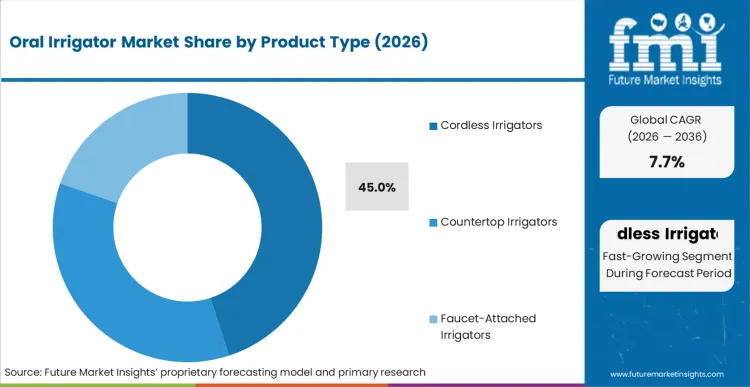
The cordless irrigators segment is projected to account for 45% share in 2026. The high demand for cordless oral irrigators is primarily fueled by a shift toward portable, space-saving dental technology that fits modern, mobile lifestyles. Unlike traditional corded models, these handheld devices eliminate the need for bulky reservoirs and proximity to power outlets, making them ideal for small urban bathrooms and frequent travelers. This growth is further accelerated by the rising popularity of orthodontic treatments and dental implants, where the maneuverability of a cordless flosser offers superior plaque removal around brackets and bridges compared to manual flossing.
- User Accessibility and Compliance: These devices are widely accepted because users find them significantly more comfortable and faster to use than traditional methods. This ease of use is particularly vital for individuals with limited manual dexterity or conditions such as arthritis, as it simplifies the mechanical process of cleaning between teeth and supports more consistent daily hygiene habits.
- Professional Endorsement for Complex Dental Work: Dental professionals increasingly recommend portable irrigators as a key preventive strategy for patients with braces, bridges, or implants. The targeted pulsating pressure is uniquely effective at dislodging debris from anatomically complex areas and deep gum pockets that are often unreachable by standard brushing or string floss alone.
Oral Irrigator Market Analysis by Distribution Channel
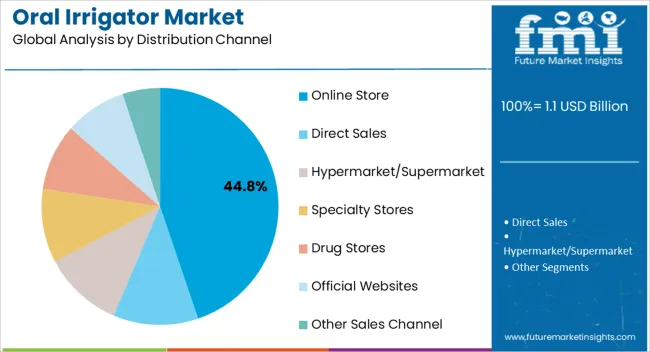
Online retail segment is anticipated to register a 41% market share in 2026. The widespread sale of oral irrigators through online retail is driven by the unique ability of digital platforms to bridge the gap between complex dental technology and consumer education. Unlike traditional pharmacies with limited shelf space, e-commerce marketplaces offer an extensive inventory that allows users to compare specialized features such as adjustable pressure settings and orthodontic nozzles alongside detailed peer reviews and instructional videos. This accessibility is particularly impactful for those in underserved regions who may not have local access to high-end dental appliances.
- Comparative Shopping and Transparency: Online marketplaces allow consumers to easily compare complex technical specifications, such as pressure range, pulse frequency, and battery longevity, across dozens of brands simultaneously. Detailed peer reviews and video demonstrations provide the social proof and practical instruction necessary for high-tech personal care devices, which can be difficult to assess in a traditional retail setting.
- Accessibility of Specialized Solutions: E-commerce bridges the gap for niche consumer needs, offering a wider range of specialized nozzles and orthodontic attachments that are rarely stocked in supermarkets. Digital platforms facilitate direct access for those in underserved or rural areas, while providing competitive pricing and subscription models for replacement parts that ensure long-term maintenance is both convenient and affordable.
Oral Irrigator Market Drivers, Restraints, and Opportunities
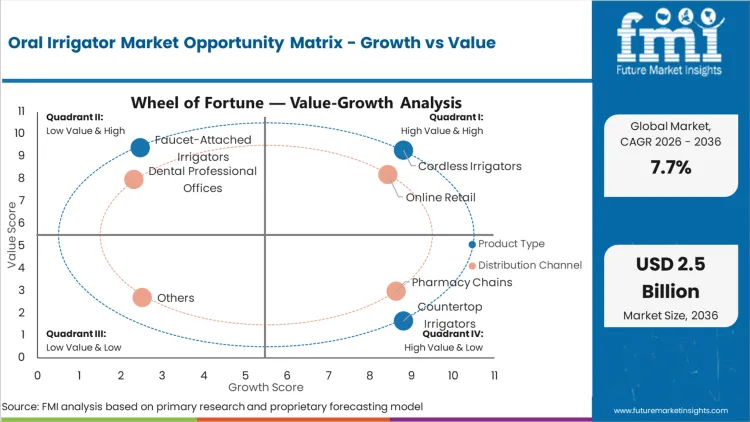
The oral irrigator market is currently experiencing steady growth, driven largely by a rising global awareness of the importance of proactive oral hygiene and its connection to overall systemic health. As dental issues like periodontal disease and tooth decay become more prevalent, consumers are increasingly seeking advanced, at-home solutions that offer a deeper clean than traditional brushing and flossing. This demand is further amplified by a growing aging population and a higher frequency of orthodontic treatments, such as braces and implants, which require specialized interdental care. Additionally, rising disposable incomes and the widespread availability of these devices through expanding retail and e-commerce channels are making it easier for people to invest in premium dental care.
While the demand is growing, the market does face some significant hurdles, most notably the high initial cost of the devices. For many price-sensitive consumers, the upfront investment required for an oral irrigator can be prohibitive when compared to the inexpensive and readily available alternatives like traditional string dental floss or interdental brushes. Beyond consumer costs, manufacturers also face substantial restraints in the form of high development and regulatory expenses. Designing effective water flossers requires specialized components and rigorous clinical trials to meet stringent safety standards from regulatory bodies like the FDA, which can act as a major barrier to entry for smaller companies and slow the pace of market expansion in cost-sensitive regions.
Despite these challenges, there are exciting opportunities on the horizon, particularly through technological innovation and sustainable product design. The integration of smart technologies, such as Bluetooth sensors and mobile apps that provide real-time coaching and track gum health, is opening up a new premium segment for tech-savvy consumers who want personalized dental care. There is also a surging demand for compact, cordless models that cater to busy, on-the-go lifestyles. Furthermore, as environmental awareness increases, manufacturers have a unique chance to stand out by developing eco-friendly devices utilizing post-consumer recycled plastics or biodegradable components.
Regional Analysis
.webp "Top Country Growth Comparison Oral Irrigator Market Cagr (2026 2036)")
Based on regional analysis, the oral irrigator market is segmented into North America, Latin America, Europe, East Asia, South Asia, Oceania and Middle East & Africa across 40 countries. The full report also offers market attractiveness analysis based on regional trends.
| Country | CAGR (2026 to 2036) |
|---|---|
| United States | 8.3% |
| Germany | 7.4% |
| China | 9.5% |
| India | 8.9% |
| Brazil | 7.7% |
Source: Market analysis based on proprietary forecasting model and primary research
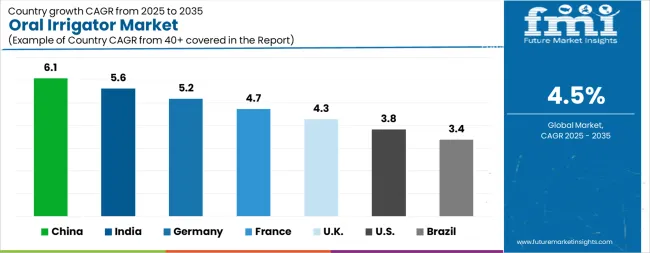
North America Oral Irrigator Market Analysis
North America’s oral irrigator sector is advancing as preventive dental care becomes more routine, aging populations manage chronic gum sensitivity, and smart home appliances extend into personal oral hygiene. Wider use of at home dental devices is linked with rising implant placements and orthodontic aligners, which increase the need for interdental cleaning beyond manual flossing. Public oral health programs emphasize daily plaque control and gingival care, which is improving device trial rates among first time users. Retail penetration is widening through pharmacy chains and online platforms, improving access across suburban and semi urban households. Replacement demand is supported by shorter product lifecycles for cordless units, battery degradation, and nozzle wear driven by shared household usage.
- United States: Demand for oral irrigators in the United States is projected to rise at 7.9% CAGR through 2036. Growth is supported by high adult plaque and periodontitis prevalence, expanding dental implant procedures, and increased clinician guidance for water based interdental cleaning among patients with braces, crowns, and periodontal maintenance needs.
The report presents in depth analysis of growth across the North American region, with country level assessment covering the USA and Canada. Readers gain insight into preventive dentistry adoption, evolving pharmacy and e commerce channels, and category level development across countertop, cordless, and faucet attached irrigators aligned with changing household usage patterns.
Asia Pacific Oral Irrigator Market Analysis
Asia Pacific continues to register the strongest growth momentum as changing dietary habits raise plaque accumulation risks and more consumers seek convenient home-based solutions for daily oral hygiene. As per the WHO, oral diseases are diagnosed in over 800 million people in the Western Pacific. [3] Wider availability of entry-level cordless irrigators through mass retail and online marketplaces is improving first-time adoption among younger consumers and working professionals. Product uptake is also supported by growing cosmetic dentistry volumes, which increase the need for plaque control around veneers, aligners, and crowns.
- China: Demand for oral irrigator in China is set to expand at a 9.1% CAGR during the forecast period. The market growth is supported by rising case volumes for orthodontic treatments in urban clinics, increasing cosmetic dental procedures among young adults, and broader patient compliance with at-home plaque management routines following in-clinic consultations.
- India: The oral irrigator market in India is likely to grow at 8.4% CAGR during the study period. This can be credited to the higher footfall at dental departments in public hospitals, growing employer-sponsored dental check-up programs, and rising uptake of affordable powered oral care devices among salaried urban households.
The full report assesses the oral irrigator market across East and South Asia from 2021 to 2036, covering shifts in patient care pathways, outpatient dental service utilization, product accessibility across retail formats, and evolving pricing strategies across China, Japan, South Korea, India, Singapore, and Australia.
Europe Oral Irrigator Market Analysis
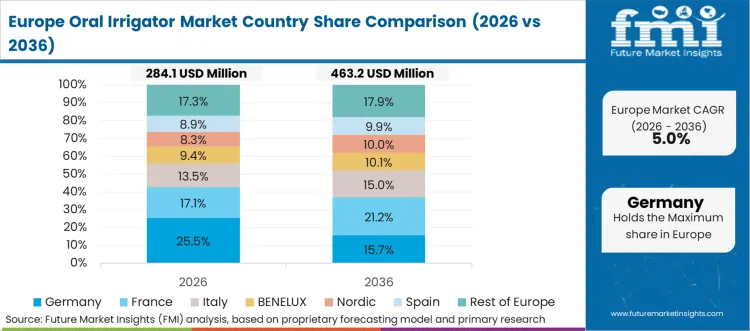
Europe represents a mature oral care market where replacement demand and product upgrading cycles shape category expansion across major economies. Adoption is supported by a high frequency of routine dental checkups, strong emphasis on long term plaque control for aging populations, and growing use of home care devices for patients managing crowns, bridges, and orthodontic retainers. Urban households show higher uptake of powered interdental cleaning solutions as space efficient countertop appliances gain preference. Retail pharmacies and dental clinic channels continue to influence purchasing behavior through bundled care kits and post-treatment hygiene recommendations.
- Germany: Demand for oral irrigators in Germany is slated to grow at 7.2% CAGR through 2036, supported by high rates of scheduled periodontal maintenance visits, widespread use of dental prosthetics among older adults, and sustained household spending on preventive oral care equipment.
The analysis of the European oral irrigator market provides country level assessment across the United Kingdom, Germany, France, Italy, Spain, the Netherlands, and Scandinavia. Readers gain access to insights on patient care pathways, clinic-to-home continuity practices, and category level performance across different device formats and retail environments within the region.
Competitive Landscape for Oral Irrigator Market Players
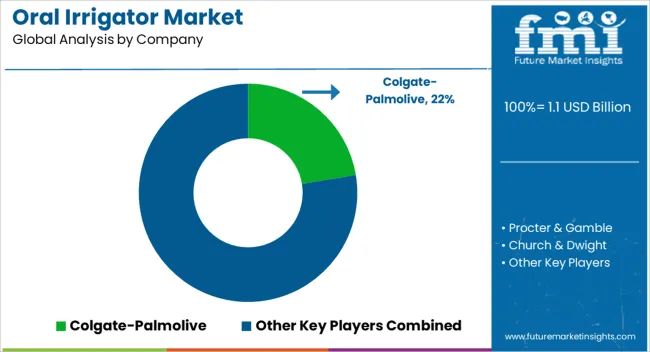
The competitive landscape of the oral irrigator market is shaped by a broad mix of global consumer health manufacturers and specialized oral care brands competing across retail, pharmacy, and digital channels. Market participants focus on expanding product availability in household settings, supported by growing consumer interest in preventive oral hygiene routines. Competition centers on improving device usability, comfort during use, and reliability of water pressure performance, as these factors influence repeat purchases and long term adoption. Brands seek differentiation through ergonomic designs, compact form factors for travel use, and simplified maintenance features that reduce cleaning effort and replacement complexity.
Pricing strategies play an important role in shaping competitive positioning, with a wide range of entry level, mid range, and premium products available across regions. Companies invest in packaging, in store visibility, and digital merchandising to improve product discovery and conversion rates. Online retail has intensified competition by lowering barriers for new entrants and enabling direct engagement with consumers through targeted promotions and educational content. Product lifecycles remain relatively short, which encourages frequent model updates and feature refreshes to sustain consumer interest. Regulatory compliance, safety certifications, and quality assurance processes also influence competitive dynamics, particularly in mature healthcare oriented markets.
Recent Developments
The report includes comprehensive coverage of key industry developments and competitive positioning:
- In January 2026, Colgate-Palmolive inked a multi-year partnership with WHO Foundation to support the World Health Organization's work on oral health. [5]
- In March 2025, Lion Corporation announced to launch OraCo, a new service that collaborates with dental clinics to promote good oral care habits. [6]
Key Players in Oral Irrigator Market
- Colgate-Palmolive
- Procter & Gamble
- Church & Dwight
- GlaxoSmithKline
- Johnson & Johnson
- Lion Corporation
- Dr. Fresh
- Dentaid
Scope of the Report
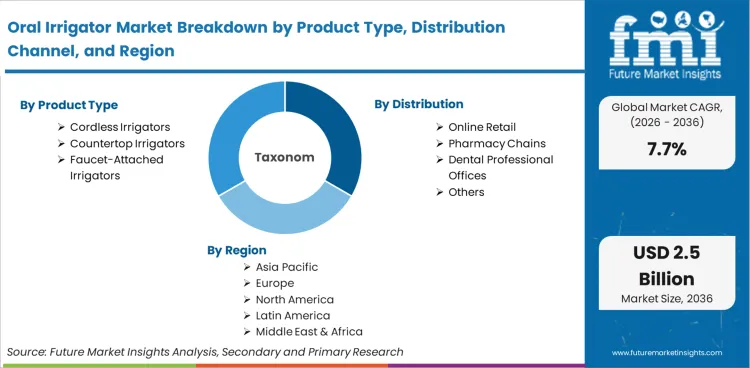
| Metric | Value |
|---|---|
| Quantitative Units | USD 1.2 billion (2026) to USD 2.5 billion (2036), at a CAGR of 7.7% |
| Market Definition | The oral irrigator market comprises the global development, production, and distribution of electric water flossing devices including countertop and cordless irrigators designed for interdental cleaning operations across household and clinical applications. |
| Product Type Segmentation | Countertop Irrigators, Cordless Irrigators, Faucet-Attached Irrigators, Implant-Specific Irrigators |
| Distribution Channel Coverage | Pharmacy Chains, Online Retail, Dental Professional Offices, Mass Merchandisers |
| Application Segmentation | Household Use, Dental Clinics, Orthodontic Care, Periodontal Treatment |
| Regions Covered | North America, Latin America, Europe, East Asia, South Asia, Oceania, Middle East and Africa |
| Countries Covered | United States, Canada, United Kingdom, Germany, France, China, Japan, India, Brazil, UAE and 40 countries |
| Key Companies Profiled | Colgate-Palmolive, Procter & Gamble, Church & Dwight, GlaxoSmithKline, Johnson & Johnson, Lion Corporation, Dr. Fresh, and Dentaid |
| Forecast Period | 2026 to 2036 |
| Approach | Hybrid top down and bottom up market modeling validated through pharmacy sales tracking and dental professional recommendation surveys, supported by distribution network verification and clinical adoption pattern analysis |
Oral Irrigator Market by Segments
Product Type
- Countertop Irrigators
- Cordless Irrigators
- Faucet-Attached Irrigators
- Implant-Specific Irrigators
Distribution Channel
- Pharmacy Chains
- Online Retail
- Dental Professional Offices
- Mass Merchandisers
- Others (dental trade shows, subscription services)
Application
- Household Use
- Dental Clinics
- Orthodontic Care
- Periodontal Treatment
Region
- Asia Pacific
- China
- Japan
- South Korea
- India
- Australia
- Singapore
- Thailand
- Rest of Asia Pacific
- Europe
- United Kingdom
- Germany
- France
- Italy
- Spain
- Netherlands
- Scandinavia
- Switzerland
- Rest of Europe
- North America
- United States
- Canada
- Latin America
- Brazil
- Mexico
- Argentina
- Rest of Latin America
- Middle East & Africa
- United Arab Emirates
- Saudi Arabia
- South Africa
- Israel
- Rest of Middle East & Africa
Bibliography
- [1] MySmile Oral Care Inc. (2026, January 12). MySmile announces its 2026 water flosser collection, reinforcing daily water flossing as the new standard in oral health [Press release].
- [2] Centers for Disease Control and Prevention. (2024). 2024 oral health surveillance report: Selected findings. USA Department of Health and Human Services.
- [3] World Health Organization Western Pacific Region. (2023, June 8). Oral diseases affect more than 800 million people in the Western Pacific. World Health Organization.
- [5] Colgate-Palmolive. (n.d.). Colgate-Palmolive and WHO Foundation announce global partnership on oral health.
- [6] Lion Corporation. (2025, March 6). Lion launches OraCo, a service promoting oral care habits in collaboration with dental clinics.
This bibliography is provided for reader reference and is not exhaustive. The full report contains the complete reference list and detailed citations.
This Report Addresses
- Market intelligence to enable strategic decision making across established and emerging oral care markets
- Market size estimation and 10-year revenue forecasts from 2026 to 2036, supported by validated pharmacy sales data and dental professional recommendation surveys
- Growth opportunity mapping across product types and application segments with emphasis on periodontal care optimization
- Segment and regional revenue forecasts covering cordless irrigators, countertop devices, specialized nozzle systems, and pharmacy distribution networks
- Competition strategy assessment including dental endorsement requirements, clinical efficacy positioning, and pressure technology adoption
- Product development tracking including battery innovations, reservoir miniaturization trends, and nozzle attachment capabilities
- Market access analysis covering distribution agreements, dental professional partnerships, and pharmacy chain engagement programs
- Market report delivery in PDF, Excel, PPT, and interactive dashboard formats for executive and operational use
Frequently Asked Questions
How large is the demand for Oral Irrigators in the global market in 2026?
Demand for Oral Irrigators in the global market is estimated to be valued at USD 1.2 billion in 2026.
What will be the market size of Oral Irrigators in the global market by 2036?
Market size for Oral Irrigators is projected to reach USD 2.5 billion by 2036.
What is the expected demand growth for Oral Irrigators in the global market between 2026 and 2036?
Demand for Oral Irrigators in the global market is expected to grow at a CAGR of 7.7% between 2026 and 2036.
Which Product Type is poised to lead global sales by 2026?
Cordless Irrigators is expected to be the dominant product type, capturing approximately 45.0% of global market share in 2026 due to portability advantages and battery technology improvements.
How significant is the role of Online Retail in driving Oral Irrigator adoption in 2026?
Online retail represents a primary distribution channel, projected to hold approximately 41% share of the total market in 2026 as clinical information tools and broader product selection maintain digital channel relevance.
What is Driving Oral Irrigator Demand in the United States?
Orthodontic treatment prevalence and increased periodontal care recommendations across adult patient categories are driving growth.
What Consumer Trends are Referenced for the United States?
Preventive dental care adoption patterns and dental insurance coverage expansion programs are referenced as key consumer behavior shifts.
What is the United States Growth Outlook in this Report?
The United States is projected to grow at a CAGR of 8.3% during 2026 to 2036.
Why is Europe described as Important for Device Development in this Report?
Growth is driven by national health service recommendations and preventive care protocols that establish standardized equipment specifications.
What Type of Product Development Dominates in Europe?
Clinically-endorsed water flossers with dental professional integration and periodontal efficacy validation dominates regional market segments.
What is Germany Growth Outlook in this Report?
Germany is projected to expand at a CAGR of 7.4% during 2026 to 2036.
Does the Report Cover China in its Regional Analysis?
China is included within East Asia under the regional scope of analysis.
What are the Sources referred to for analyzing the Market in China?
Oral care awareness data, dental clinic expansion statistics, and domestic brand performance tracking covering purchase patterns, price sensitivity analysis, and device preference evolution are cited as primary reference sources.
What is the Main Development Theme Linked to China in Asia Coverage?
Asia Pacific development is associated with domestic oral care awareness campaigns enabling device standardization across metropolitan centers.
Does the Report Cover India in its Regional Analysis?
India is included within South Asia under the regional coverage framework.
What is the Main India Related Development Theme in Asia Coverage?
Rising disposable income levels creating foundation for electric oral care adoption and local assembly using cost-effective manufacturing methods is emphasized.
Which Distribution Strategies are Strategically Important for Asia Pacific Market Entry?
Dental professional partnerships and pharmacy chain programs are prioritized for cost-effective brand building across regional markets.
What is Oral Irrigator and What is It Mainly Used For?
Oral irrigators involve electric water flossing devices primarily used for interdental plaque removal and periodontal care including household bathrooms, dental clinics, and orthodontic practices.
What does Oral Irrigator Market Mean in this Report?
Oral irrigator market refers to global development, manufacturing, and retail distribution of water-based cleaning equipment across various application categories and user segments.
What is Included in the Scope of this Oral Irrigator Market Report?
Scope covers devices by product type, key distribution channels such as pharmacy chains and online platforms, and application segments including household use, dental clinics, and periodontal treatment.
What is Excluded from the Scope of this Report?
Manual dental floss, interdental brushes, basic oral rinse solutions, and industrial dental equipment are excluded unless part of oral irrigator product offerings.
What does Market Forecast Mean on this Page?
Market forecast represents model-based projections built on pharmacy sales trends and preventive dental care adoption assumptions for strategic planning purposes.
How is the Oral Irrigator Market Forecast Built and Validated?
Forecast is developed using hybrid modeling validated through pharmacy point-of-sale data, dental professional recommendation surveys, and distribution network verification.
What does Zero Reliance on Speculative Third Party Market Research Mean Here?
Market analysis is based on verifiable sales figures, dental care adoption data, and device recommendation patterns rather than speculative oral health trend predictions.
Preview the report firsthand - request a free sample
Get SampleGet the brochure for pricing and purchase details.
Get PDFTable of Content
- Executive Summary
- Global Market Outlook
- Demand-side Trends
- Supply-side Trends
- Technology Roadmap Analysis
- Analysis and Recommendations
- Market Overview
- Market Coverage / Taxonomy
- Market Definition / Scope / Limitations
- Research Methodology
- Chapter Orientation
- Analytical Lens and Working Hypotheses
- Market Structure, Signals, and Trend Drivers
- Benchmarking and Cross-market Comparability
- Market Sizing, Forecasting, and Opportunity Mapping
- Research Design and Evidence Framework
- Desk Research Programme (Secondary Evidence)
- Company Annual and Sustainability Reports
- Peer-reviewed Journals and Academic Literature
- Corporate Websites, Product Literature, and Technical Notes
- Earnings Decks and Investor Briefings
- Statutory Filings and Regulatory Disclosures
- Technical White Papers and Standards Notes
- Trade Journals, Industry Magazines, and Analyst Briefs
- Conference Proceedings, Webinars, and Seminar Materials
- Government Statistics Portals and Public Data Releases
- Press Releases and Reputable Media Coverage
- Specialist Newsletters and Curated Briefings
- Sector Databases and Reference Repositories
- FMI Internal Proprietary Databases and Historical Market Datasets
- Subscription Datasets and Paid Sources
- Social Channels, Communities, and Digital Listening Inputs
- Additional Desk Sources
- Expert Input and Fieldwork (Primary Evidence)
- Primary Modes
- Qualitative Interviews and Expert Elicitation
- Quantitative Surveys and Structured Data Capture
- Blended Approach
- Why Primary Evidence is Used
- Field Techniques
- Interviews
- Surveys
- Focus Groups
- Observational and In-context Research
- Social and Community Interactions
- Stakeholder Universe Engaged
- C-suite Leaders
- Board Members
- Presidents and Vice Presidents
- R&D and Innovation Heads
- Technical Specialists
- Domain Subject-matter Experts
- Scientists
- Physicians and Other Healthcare Professionals
- Governance, Ethics, and Data Stewardship
- Research Ethics
- Data Integrity and Handling
- Primary Modes
- Tooling, Models, and Reference Databases
- Desk Research Programme (Secondary Evidence)
- Data Engineering and Model Build
- Data Acquisition and Ingestion
- Cleaning, Normalisation, and Verification
- Synthesis, Triangulation, and Analysis
- Quality Assurance and Audit Trail
- Market Background
- Market Dynamics
- Drivers
- Restraints
- Opportunity
- Trends
- Scenario Forecast
- Demand in Optimistic Scenario
- Demand in Likely Scenario
- Demand in Conservative Scenario
- Opportunity Map Analysis
- Product Life Cycle Analysis
- Supply Chain Analysis
- Investment Feasibility Matrix
- Value Chain Analysis
- PESTLE and Porter’s Analysis
- Regulatory Landscape
- Regional Parent Market Outlook
- Production and Consumption Statistics
- Import and Export Statistics
- Market Dynamics
- Global Market Analysis 2021 to 2025 and Forecast, 2026 to 2036
- Historical Market Size Value (USD Million) Analysis, 2021 to 2025
- Current and Future Market Size Value (USD Million) Projections, 2026 to 2036
- Y-o-Y Growth Trend Analysis
- Absolute $ Opportunity Analysis
- Global Market Pricing Analysis 2021 to 2025 and Forecast 2026 to 2036
- Global Market Analysis 2021 to 2025 and Forecast 2026 to 2036, By Product Type
- Introduction / Key Findings
- Historical Market Size Value (USD Million) Analysis By Product Type , 2021 to 2025
- Current and Future Market Size Value (USD Million) Analysis and Forecast By Product Type , 2026 to 2036
- Cordless Irrigators
- Countertop Irrigators
- Faucet-Attached Irrigators
- Cordless Irrigators
- Y-o-Y Growth Trend Analysis By Product Type , 2021 to 2025
- Absolute $ Opportunity Analysis By Product Type , 2026 to 2036
- Global Market Analysis 2021 to 2025 and Forecast 2026 to 2036, By Distribution Channel
- Introduction / Key Findings
- Historical Market Size Value (USD Million) Analysis By Distribution Channel, 2021 to 2025
- Current and Future Market Size Value (USD Million) Analysis and Forecast By Distribution Channel, 2026 to 2036
- Online Retail
- Pharmacy Chains
- Dental Professional Offices
- Others
- Online Retail
- Y-o-Y Growth Trend Analysis By Distribution Channel, 2021 to 2025
- Absolute $ Opportunity Analysis By Distribution Channel, 2026 to 2036
- Global Market Analysis 2021 to 2025 and Forecast 2026 to 2036, By Region
- Introduction
- Historical Market Size Value (USD Million) Analysis By Region, 2021 to 2025
- Current Market Size Value (USD Million) Analysis and Forecast By Region, 2026 to 2036
- North America
- Latin America
- Western Europe
- Eastern Europe
- East Asia
- South Asia and Pacific
- Middle East & Africa
- Market Attractiveness Analysis By Region
- North America Market Analysis 2021 to 2025 and Forecast 2026 to 2036, By Country
- Historical Market Size Value (USD Million) Trend Analysis By Market Taxonomy, 2021 to 2025
- Market Size Value (USD Million) Forecast By Market Taxonomy, 2026 to 2036
- By Country
- USA
- Canada
- Mexico
- By Product Type
- By Distribution Channel
- By Country
- Market Attractiveness Analysis
- By Country
- By Product Type
- By Distribution Channel
- Key Takeaways
- Latin America Market Analysis 2021 to 2025 and Forecast 2026 to 2036, By Country
- Historical Market Size Value (USD Million) Trend Analysis By Market Taxonomy, 2021 to 2025
- Market Size Value (USD Million) Forecast By Market Taxonomy, 2026 to 2036
- By Country
- Brazil
- Chile
- Rest of Latin America
- By Product Type
- By Distribution Channel
- By Country
- Market Attractiveness Analysis
- By Country
- By Product Type
- By Distribution Channel
- Key Takeaways
- Western Europe Market Analysis 2021 to 2025 and Forecast 2026 to 2036, By Country
- Historical Market Size Value (USD Million) Trend Analysis By Market Taxonomy, 2021 to 2025
- Market Size Value (USD Million) Forecast By Market Taxonomy, 2026 to 2036
- By Country
- Germany
- UK
- Italy
- Spain
- France
- Nordic
- BENELUX
- Rest of Western Europe
- By Product Type
- By Distribution Channel
- By Country
- Market Attractiveness Analysis
- By Country
- By Product Type
- By Distribution Channel
- Key Takeaways
- Eastern Europe Market Analysis 2021 to 2025 and Forecast 2026 to 2036, By Country
- Historical Market Size Value (USD Million) Trend Analysis By Market Taxonomy, 2021 to 2025
- Market Size Value (USD Million) Forecast By Market Taxonomy, 2026 to 2036
- By Country
- Russia
- Poland
- Hungary
- Balkan & Baltic
- Rest of Eastern Europe
- By Product Type
- By Distribution Channel
- By Country
- Market Attractiveness Analysis
- By Country
- By Product Type
- By Distribution Channel
- Key Takeaways
- East Asia Market Analysis 2021 to 2025 and Forecast 2026 to 2036, By Country
- Historical Market Size Value (USD Million) Trend Analysis By Market Taxonomy, 2021 to 2025
- Market Size Value (USD Million) Forecast By Market Taxonomy, 2026 to 2036
- By Country
- China
- Japan
- South Korea
- By Product Type
- By Distribution Channel
- By Country
- Market Attractiveness Analysis
- By Country
- By Product Type
- By Distribution Channel
- Key Takeaways
- South Asia and Pacific Market Analysis 2021 to 2025 and Forecast 2026 to 2036, By Country
- Historical Market Size Value (USD Million) Trend Analysis By Market Taxonomy, 2021 to 2025
- Market Size Value (USD Million) Forecast By Market Taxonomy, 2026 to 2036
- By Country
- India
- ASEAN
- Australia & New Zealand
- Rest of South Asia and Pacific
- By Product Type
- By Distribution Channel
- By Country
- Market Attractiveness Analysis
- By Country
- By Product Type
- By Distribution Channel
- Key Takeaways
- Middle East & Africa Market Analysis 2021 to 2025 and Forecast 2026 to 2036, By Country
- Historical Market Size Value (USD Million) Trend Analysis By Market Taxonomy, 2021 to 2025
- Market Size Value (USD Million) Forecast By Market Taxonomy, 2026 to 2036
- By Country
- Kingdom of Saudi Arabia
- Other GCC Countries
- Turkiye
- South Africa
- Other African Union
- Rest of Middle East & Africa
- By Product Type
- By Distribution Channel
- By Country
- Market Attractiveness Analysis
- By Country
- By Product Type
- By Distribution Channel
- Key Takeaways
- Key Countries Market Analysis
- USA
- Pricing Analysis
- Market Share Analysis, 2025
- By Product Type
- By Distribution Channel
- Canada
- Pricing Analysis
- Market Share Analysis, 2025
- By Product Type
- By Distribution Channel
- Mexico
- Pricing Analysis
- Market Share Analysis, 2025
- By Product Type
- By Distribution Channel
- Brazil
- Pricing Analysis
- Market Share Analysis, 2025
- By Product Type
- By Distribution Channel
- Chile
- Pricing Analysis
- Market Share Analysis, 2025
- By Product Type
- By Distribution Channel
- Germany
- Pricing Analysis
- Market Share Analysis, 2025
- By Product Type
- By Distribution Channel
- UK
- Pricing Analysis
- Market Share Analysis, 2025
- By Product Type
- By Distribution Channel
- Italy
- Pricing Analysis
- Market Share Analysis, 2025
- By Product Type
- By Distribution Channel
- Spain
- Pricing Analysis
- Market Share Analysis, 2025
- By Product Type
- By Distribution Channel
- France
- Pricing Analysis
- Market Share Analysis, 2025
- By Product Type
- By Distribution Channel
- India
- Pricing Analysis
- Market Share Analysis, 2025
- By Product Type
- By Distribution Channel
- ASEAN
- Pricing Analysis
- Market Share Analysis, 2025
- By Product Type
- By Distribution Channel
- Australia & New Zealand
- Pricing Analysis
- Market Share Analysis, 2025
- By Product Type
- By Distribution Channel
- China
- Pricing Analysis
- Market Share Analysis, 2025
- By Product Type
- By Distribution Channel
- Japan
- Pricing Analysis
- Market Share Analysis, 2025
- By Product Type
- By Distribution Channel
- South Korea
- Pricing Analysis
- Market Share Analysis, 2025
- By Product Type
- By Distribution Channel
- Russia
- Pricing Analysis
- Market Share Analysis, 2025
- By Product Type
- By Distribution Channel
- Poland
- Pricing Analysis
- Market Share Analysis, 2025
- By Product Type
- By Distribution Channel
- Hungary
- Pricing Analysis
- Market Share Analysis, 2025
- By Product Type
- By Distribution Channel
- Kingdom of Saudi Arabia
- Pricing Analysis
- Market Share Analysis, 2025
- By Product Type
- By Distribution Channel
- Turkiye
- Pricing Analysis
- Market Share Analysis, 2025
- By Product Type
- By Distribution Channel
- South Africa
- Pricing Analysis
- Market Share Analysis, 2025
- By Product Type
- By Distribution Channel
- USA
- Market Structure Analysis
- Competition Dashboard
- Competition Benchmarking
- Market Share Analysis of Top Players
- By Regional
- By Product Type
- By Distribution Channel
- Competition Analysis
- Competition Deep Dive
- Colgate-Palmolive
- Overview
- Product Portfolio
- Profitability by Market Segments (Product/Age /Sales Channel/Region)
- Sales Footprint
- Strategy Overview
- Marketing Strategy
- Product Strategy
- Channel Strategy
- Procter & Gamble
- Church & Dwight
- GlaxoSmithKline
- Johnson & Johnson
- Colgate-Palmolive
- Competition Deep Dive
- Assumptions & Acronyms Used


