

- Industry Size (2025)
- USD 611.3 Mn
- Forecast (2035)
- USD 1025.4 Mn
- CAGR (2025 to 2035)
- 5.3%
Cocamidopropyl Betaine Market Forecast and Outlook 2025 to 2035
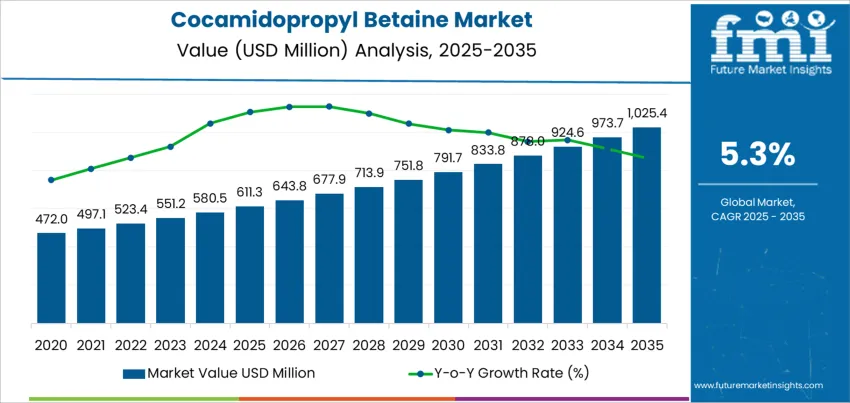
The cocamidopropyl betaine market is valued at USD 611.3 million in 2025 and is expected to reach USD 1,025.4 million by 2035, growing at a CAGR of 5.3%. Growth remains steady because cocamidopropyl betaine is a regular co-surfactant used in shampoos, body washes, hand soaps, and face cleansers, not a temporary trend ingredient. Until 2030, demand remains strong because it works well in both sulfate systems and sulfate-free systems, making it easy for brands to keep using it across multiple formula changes.
Production increases at the same pace as the overall output of personal hygiene products, rather than relying on new product launches. Costs may fluctuate with feedstock prices, but ordering patterns remain stable and consistent as global personal care brands continue to rely on cocamidopropyl betaine in their core cleansing products. Supplier competition centers on impurity control, low residual amine content, and odor reduction to meet tightening personal care safety standards. Distribution remains dominated by contract-based supply to large manufacturers, reinforcing long-duration volume stability. The persistence of growth is defined more by formulation dependency and revalidation cycles than by short-term shifts in consumer cleansing preferences.
Quick Stats of the Cocamidopropyl Betaine Market
- Cocamidopropyl Betaine Market Value (2025): USD 611.3 million
- Cocamidopropyl Betaine Market Forecast Value (2035): USD 1,025.4 million
- Cocamidopropyl Betaine Market Forecast CAGR (2025 to 2035): 5.3%
- Leading Product Form in Cocamidopropyl Betaine Market: Powder (15.0%)
- Key Growth Regions in Cocamidopropyl Betaine Market: Asia Pacific, Europe
- Top Players in Cocamidopropyl Betaine Market: BASF SE, Croda International, Evonik Industries, Symrise (incl. IFF/Givaudan actives), Dow / Dow Inc., Ashland, Clariant, Seppic / Others
What is the Growth Forecast for the Cocamidopropyl Betaine Market through 2035? Expansion Threshold Level Perspective
From 2030 onward, growth persistence remains intact as cocamidopropyl betaine continues to function as a formulation anchor rather than as a discretionary ingredient. Market value rises from about USD 791.7 million in 2030 toward USD 1,025.4 million by 2035 as usage intensity increases in concentrated cleansers, refill formats, and premium sulfate-free lines. Oral care and intimate hygiene add steady incremental demand through low-irritation foaming systems. The global cocamidopropyl betaine market expands from USD 611.3 million in 2025 to USD 751.8 million by 2030, generating an absolute increase of USD 140.5 million in the first half of the forecast period. This phase represents a pre-threshold expansion zone where demand growth is structurally stable but not yet in full acceleration. The market crosses the USD 700 million level between 2028 and 2029, marking a commercial threshold where cocamidopropyl betaine shifts from being a secondary amphoteric surfactant into a mandatory backbone ingredient across sulfate-free shampoos, facial cleansers, baby washes, and institutional hygiene products. Growth up to this level is supported by brand-wide migration toward milder surfactant systems and high-frequency daily-use formulations.
From 2030 to 2035, the market advances from USD 751.8 million to USD 1,025.4 million, adding USD 273.6 million in the second half of the decade and clearly moving beyond the expansion threshold. This phase reflects post-threshold scaling, where demand is no longer limited to personal care alone but deepens across oral care, medical cleansers, refill-based hygiene systems, and export-oriented bath and body products. Annual value additions rise consistently above USD 40 million after 2031, confirming threshold breach into accelerated expansion. As manufacturers standardize high-foam mild surfactant architectures across multi-product portfolios, cocamidopropyl betaine enters a structurally higher demand tier that sustains strong long-term market growth through 2035.
Cocamidopropyl Betaine Industry Key Takeaways
| Metric | Value |
|---|---|
| Industry Value (2025) | USD 611.3 million |
| Forecast Value (2035) | USD 1,025.4 million |
| Forecast CAGR (2025 to 2035) | 5.3% |
How Is the Cocamidopropyl Betaine Market Evolving Across Cleansing, Foaming, and Formulation Systems?
The cocamidopropyl betaine market developed from the need for a surfactant that could soften the harshness of primary cleansers while preserving foam volume and stability. Its amphoteric nature allowed it to work as both a foam builder and a foam stabilizer across a wide pH range. Early commercial use expanded through mass market shampoos, body washes, and liquid hand soaps where it helped reduce irritation caused by stronger anionic surfactants. Over time, it became a standard secondary surfactant in most rinse off personal care products rather than a specialty additive. Its ability to improve viscosity, enhance mildness, and stabilize emulsions made it a routine structural component in modern cleansing formulations.
Future growth of the cocamidopropyl betaine market will be shaped by continued demand for balanced cleansing systems that combine performance with improved skin tolerance. Expansion is expected in sulfate free shampoos, facial cleansers, baby care, and intimate hygiene where mildness and foam quality must coexist. Demand will also grow in household and institutional cleaners as formulators seek low irritation surfactant blends for frequent use products.
Barriers include consumer scrutiny around purity and potential trace impurities, cost pressure in highly competitive mass market categories, and substitution by newer amphoteric or amino acid surfactants in premium products. Long term growth will depend on purification improvements, price stability of coconut based feedstocks, and sustained relevance as a foam balancing backbone in cleansing systems.
How Are End Use Application and Product Form Structuring the Demand for Cocamidopropyl Betaine?
The demand for cocamidopropyl betaine is structured by end use application and product form. Skin care accounts for 11.0% of total demand, followed by body care, hair care, sun care, color cosmetics, men grooming, baby and kids care, and dermocosmetic and professional care. By product form, powder represents 15.0% of total consumption, followed by granules and agglomerates, flakes, pellets and prills, liquid solutions, high active concentrates, dispersions and suspensions, emulsions, pastes, gels, wax or solid block formats, and oils. Demand is shaped by amphoteric surfactant versatility, foam stability requirements, sulfate-free product expansion, and wide compatibility with both anionic and non-ionic cleansing systems.
Why Does Skin Care Lead the Cocamidopropyl Betaine End Use Demand?
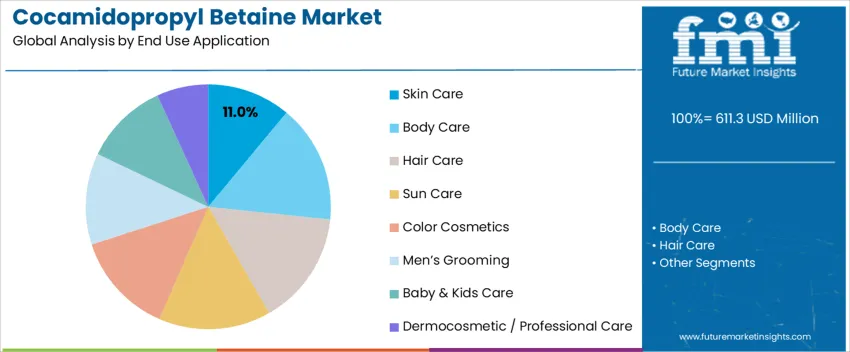
Skin care represents 11.0% of total cocamidopropyl betaine demand due to its dual role as a secondary surfactant and foam stabilizer in daily facial and body cleansing products. It is widely used in face washes, micellar waters, acne cleansers, and exfoliating gels where it enhances foam creaminess while reducing irritation from primary anionic surfactants. The amphoteric structure allows effective removal of oil, pollution residues, and cosmetic films without excessive lipid extraction. This balance supports frequent-use cleansing systems designed for sensitive and combination skin.
Skin care formulators also rely on cocamidopropyl betaine for its broad pH tolerance and compatibility with actives such as salicylic acid, zinc salts, botanical antimicrobials, and soothing agents. It helps reduce viscosity fluctuations in multi-surfactant blends and improves clarity in transparent gel cleansers. Favorable eye tolerance enables its use in makeup removal and periocular products. These foam modulation properties, formulation flexibility, and dermal tolerance characteristics sustain skin care as the leading end use segment.
Why Does Powder Lead the Cocamidopropyl Betaine Product Form Demand?
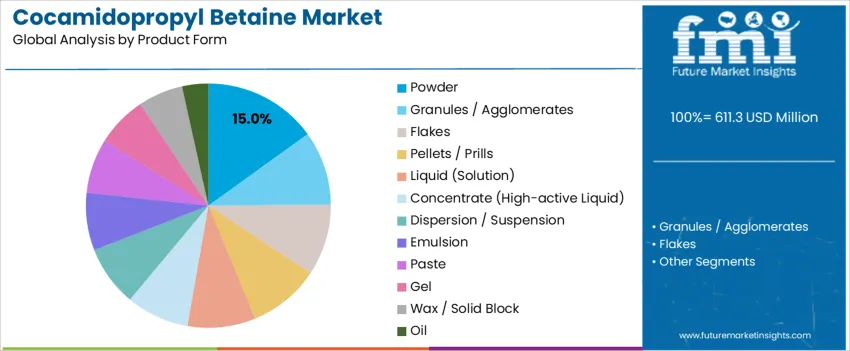
Powder accounts for 15.0% of total cocamidopropyl betaine demand due to its suitability for both liquid dilution systems and compact solid cleanser manufacturing. Powdered form allows precise adjustment of amphoteric surfactant concentration during batch preparation of facial cleansers, body washes, and shampoos. Its low moisture content reduces the risk of microbial growth and stabilizes surfactant structure during long-term storage. These properties support consistent processing behavior across large production volumes.
Powder format is also used in pressed cleanser tablets, water-activated foaming powders, and syndet bar blends where controlled dispersion under compression is required. Free-flowing characteristics enable automated feeding in continuous production systems. Transport efficiency is higher than liquid grades due to lower weight and reduced leakage risk. These storage, handling, and processing advantages support powder as the preferred product form within cocamidopropyl betaine demand.
Why Has Cocamidopropyl Betaine Become the Stabilizing Core of Mixed Surfactant Systems?
Cocamidopropyl betaine is rarely used as the main cleanser, yet it often determines whether a formula feels harsh or balanced. Its zwitterionic structure allows it to soften the irritation profile of strong anionic surfactants without collapsing foam. It thickens systems through salt response while improving wet combing, skin glide, and rinse feel. This makes it the internal stabilizer of shampoos, body washes, hand soaps, and facial cleansers. Demand is driven by its ability to reconcile cleansing strength with tolerance rather than by standalone detergency.
How Does Its Dual Charge Behavior Control Foam Texture Across Water Conditions?
The molecule carries both positive and negative charges depending on solution environment, which allows it to adapt foam structure across soft and hard water. In anionic-heavy systems, it boosts bubble density and improves foam elasticity. In milder systems, it prevents flat, watery collapse. This adaptability keeps foam behavior consistent across geographic regions where mineral content of water shifts widely. For global brands, this reliability matters more than peak foam volume. Demand follows its capacity to stabilize sensory experience under unpredictable washing conditions rather than to maximize bubble height.
What Sensitivity Debates and Impurity Risks Quietly Shape Its Market Boundaries?
Cocamidopropyl betaine carries long-standing scrutiny tied to amidoamine and DMAPA impurities that can trigger contact dermatitis in sensitive users if purification is poor. This has forced tighter manufacturing controls and higher-grade variants for facial, baby, and dermatology products. Regulatory pressure does not eliminate the ingredient but segments it by purity tier and use context. Low-grade material stays in household cleaners, while high-purity grades move into personal care. Market structure is therefore shaped by impurity management capability, not by raw chemical demand alone.
Where Is Demand Concentrating as Formats Shift Toward High-Frequency And Treatment Cleansing?
Demand is expanding in formats that involve repeated daily contact with already stressed skin or scalp. Anti-dandruff shampoos, medicated body washes, acne cleansers, and post-procedure hygiene products depend on betaine to limit cumulative irritation. Waterless concentrates and refill systems also rely on it for viscosity control in low-solids liquids. Hand hygiene remains a major volume driver because it enables frequent washing without excessive barrier damage. Growth is therefore concentrating in tolerance-critical, high-frequency cleansing environments rather than in occasional-use beauty washes.
What Is the Global Growth Outlook for the Cocamidopropyl Betaine Industry by Country?
| Country | CAGR (%) |
|---|---|
| India | 7.2 |
| China | 6.6 |
| Japan | 6.1 |
| UK | 5.6 |
| Germany | 5.0 |
| USA | 4.5 |
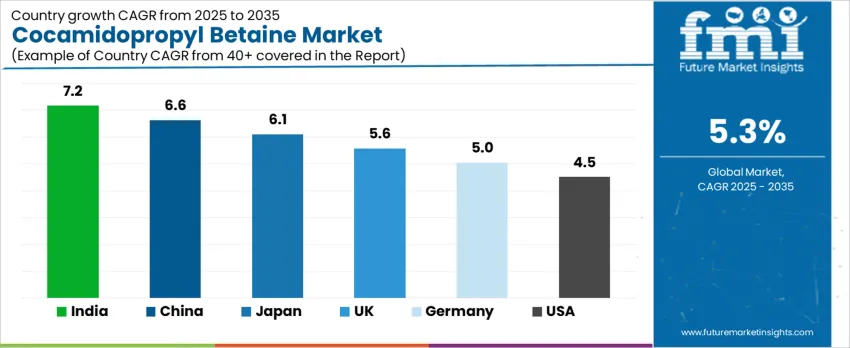
The cocamidopropyl betaine industry is expanding steadily across global personal care and home care formulation markets, with India at a 7.2% CAGR. Growth in India is supported by rising production of shampoos, body washes, facial cleansers, and baby care products that rely on mild amphoteric surfactants. China follows at 6.6%, driven by large-scale cosmetic and hygiene product manufacturing, export-oriented formulation activity, and strong domestic consumption.
Japan at 6.1% reflects stable demand from sensitive skin products, dermatology focused cleansers, and premium personal care lines. The UK and Germany record 5.6% and 5.0% growth, supported by preference for balanced surfactant systems in clean label formulations. The USA at 4.5% reflects a mature but steadily advancing market driven by natural personal care brands and steady replacement demand.
What Is Driving Cocamidopropyl Betaine Usage Growth in India Haircare and Cleansers?
Expansion in India is progressing at a CAGR of 7.2% through 2035 for cocamidopropyl betaine demand, driven by rising production of shampoos, face washes, and liquid hand soaps. Personal care brands rely on this surfactant for foam boosting, viscosity control, and irritation reduction in daily cleansing products. Herbal shampoo formulations and salon-grade haircare support steady volume uptake. Domestic blending meets part of mass market demand, while higher purity grades continue to rely on imports. Demand remains formulation-driven and retail-aligned, shaped by strong household hygiene consumption and steady growth in organized personal care retail.
- Shampoos and body washes anchor primary demand
- Facial cleansers support steady daily usage
- Salon haircare products add professional demand
- Imports dominate high purity supply
How Is China Scaling Mass Production of Cocamidopropyl Betaine for Hygiene Products?
Growth in China reflects a CAGR of 6.6% through 2035 for cocamidopropyl betaine utilization, supported by large scale manufacturing of household cleaners, shampoos, and family hygiene products. The ingredient is widely used in liquid soaps, dishwashing liquids, and foam cleansers. Domestic chemical plants operate high capacity facilities for stable bulk supply. Export oriented personal care manufacturers also ship finished products globally. Demand remains production driven and volume oriented, aligned with mass hygiene consumption, private label expansion, and steady replacement of harsher surfactants across everyday cleansing products.
- Liquid soaps sustain large batch consumption
- Household cleaners support stable industrial demand
- Domestic production stabilizes volume availability
- Export finished goods strengthen demand continuity
Why Does Japan Maintain Measured Demand for Cocamidopropyl Betaine in Sensitive Skin Products?
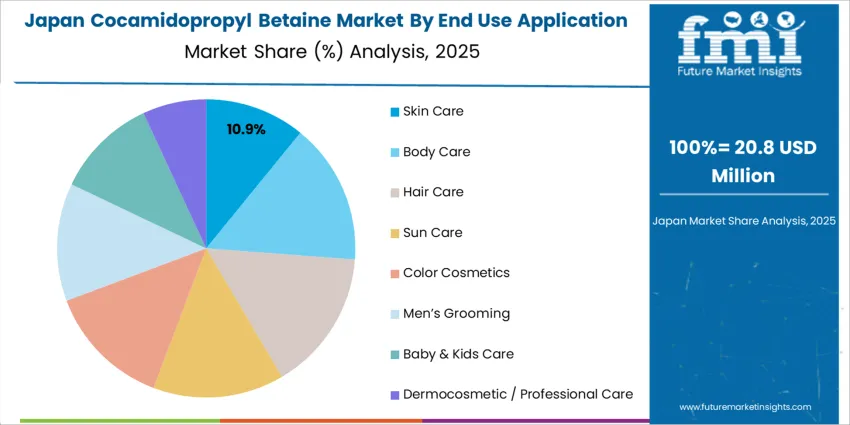
Demand in Japan is increasing at a CAGR of 6.1% through 2035 for cocamidopropyl betaine usage, supported by sensitive skin product development, dermatology aligned shampoos, and premium facial cleansers. The surfactant is applied in fragrance free shampoos, foam face washes, and body cleansers designed for low irritation performance. Domestic formulators emphasize skin compatibility and foam stability. Pharmacy distributed personal care brands support steady daily use. Demand stays quality driven and safety focused, supported by aging population skincare patterns and consistent development of mild cleansing systems.
- Sensitive scalp shampoos anchor regulated usage
- Foam facial cleansers support premium daily routines
- Domestic formulation stabilizes skin compatibility
- Pharmacy retail supports stable turnover
What Is Supporting Cocamidopropyl Betaine Market Expansion in the United Kingdom?
Growth in the UK is advancing at a CAGR of 5.6% through 2035 for cocamidopropyl betaine demand, supported by clean label personal care products, family hygiene consumption, and expanding sulfate reduced shampoo ranges. The ingredient appears in face washes, baby shampoos, shower gels, and liquid hand soaps. Independent clean beauty brands and contract formulators drive steady product launches. Imports dominate ingredient sourcing due to limited domestic surfactant intermediates production. Demand remains retail driven and formulation focused, shaped by ethical beauty trends and steady household hygiene spending.
- Baby shampoos support mild surfactant demand
- Liquid hand soaps sustain household usage
- Contract formulation drives product diversification
- Imported sourcing dominates national supply
How Is Germany Applying Cocamidopropyl Betaine in Regulated Personal Care Products?
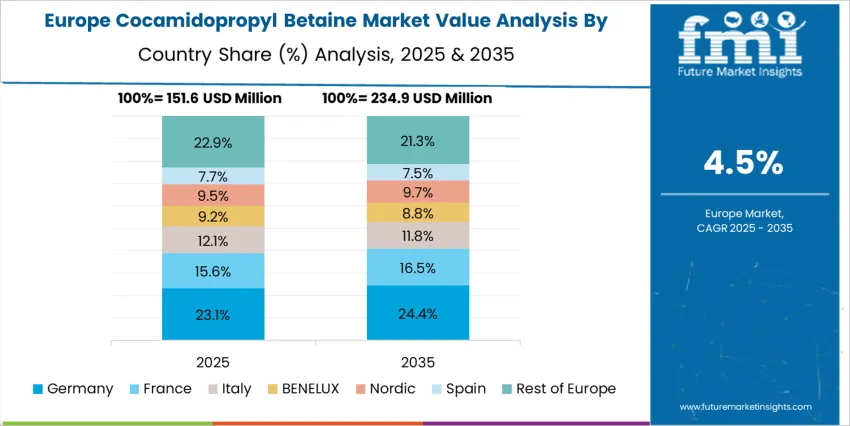
Growth in Germany reflects a CAGR of 5.0% through 2035 for cocamidopropyl betaine consumption, driven by pharmacy grade cleansers, certified natural cosmetics, and sensitive skin hygiene products. The surfactant is used in eczema friendly body washes, fragrance free shampoos, and medical grade foam cleansers. Strict ingredient testing and documentation guide formulation and supplier approval. Imports remain the primary supply route for consistent cosmetic quality grades. Demand stays quality focused and regulation aligned, supported by preventive dermatology practices and steady expansion of certified natural personal care retail.
- Dermatology cleansers anchor regulated usage
- Certified natural cosmetics support eco compliant demand
- Testing standards shape ingredient qualification
- Pharmacy retail stabilizes long term consumption
What Is Driving Measured Cocamidopropyl Betaine Growth in the United States?
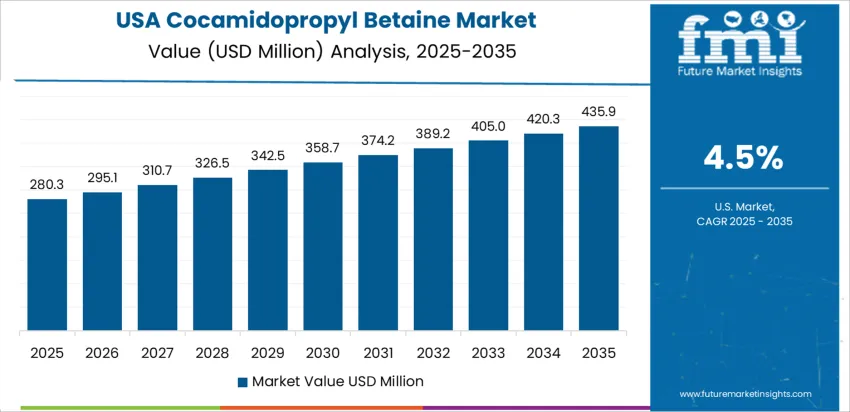
Expansion in the United States is moving at a CAGR of 4.5% through 2035 for cocamidopropyl betaine demand, supported by mass personal care production, family hygiene products, and sulfate reduced shampoo adoption. The ingredient appears in face washes, scalp cleansers, intimate hygiene products, and gentle hand soaps. Professional salon brands and mass retail labels both contribute to volume consumption. Imports supply most cosmetic grade material. Demand remains application driven and formulation diverse, shaped by stable household hygiene purchasing and consistent use across everyday cleansing product categories.
- Family shampoos sustain core domestic demand
- Intimate hygiene products support specialty usage
- Salon brands contribute professional turnover
- Import dependence dominates cosmetic grade sourcing
What Is Driving Demand for Cocamidopropyl Betaine (CAPB) and Who Are the Key Suppliers Supplying the Market
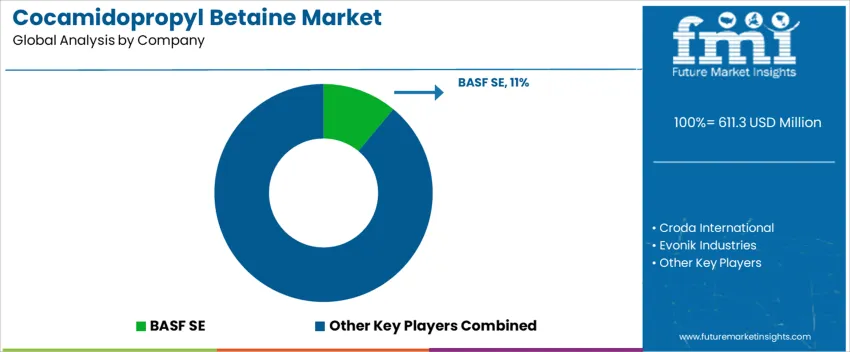
Demand for Cocamidopropyl Betaine has grown as personal care and household product manufacturers aim to meet consumer preference for mild, skin friendly cleansing agents. CAPB delivers foam boosting, effective cleansing and reduced irritation compared with harsher surfactants. It works well in shampoos, body washes, facial cleansers and baby care products and remains compatible with a variety of formulation types. Rising consumer awareness of skin sensitivity, combined with increasing demand for sulfate free, "clean label" and environmentally conscious products, supports CAPB’s adoption. Its mildness, biodegradability and compatibility with other surfactants make it a preferred choice for sensitive skin, hypoallergenic and everyday use products across global and regional markets.
Major global suppliers of CAPB include BASF SE, Croda International, Evonik Industries, Symrise (including IFF/Givaudan actives), Dow Inc., Ashland, Clariant, Seppic and several smaller specialty chemical firms. Large producers supply bulk-volume surfactant that meets regulatory and quality standards and serve global personal care and household cleaning product manufacturers. Specialist firms focus on providing high purity or eco certified variants, formulation support and niche-grade CAPB tailored for premium or sensitive skin applications. This layered supplier base allows both large-scale commodity supply and differentiated niche positioning, ensuring broad availability and product level flexibility in the CAPB market.
Key Players in the Cocamidopropyl Betaine (CAPB) Market
- BASF SE
- Croda International
- Evonik Industries
- Symrise (incl. IFF/Givaudan actives)
- Dow / Dow Inc.
- Ashland
- Clariant
- Seppic
- Others
Scope of the report
| Items | Values |
|---|---|
| Quantitative Units (2025) | USD million |
| End-Use Applications | Skin Care, Body Care, Hair Care, Sun Care, Color Cosmetics, Men’s Grooming, Baby & Kids Care, Dermocosmetic / Professional Care |
| Product Forms | Powder, Granules/Agglomerates, Flakes, Pellets/Prills, Liquid (Solution), Concentrate (High-active Liquid), Dispersion/Suspension, Emulsion, Paste, Gel, Wax / Solid Block, Oil |
| Regions Covered | Asia Pacific, Europe, North America, Latin America, Middle East & Africa |
| Countries Covered | China, Japan, South Korea, India, Australia & New Zealand, ASEAN, Germany, United Kingdom, France, Italy, Spain, Nordic, BENELUX, USA, Canada, Mexico, Brazil, Chile, Saudi Arabia, Turkey, South Africa, plus 40+ additional countries globally |
| Key Companies Profiled | BASF SE, Croda International, Evonik Industries, Symrise (incl. IFF/Givaudan actives), Dow Inc., Ashland, Clariant, Seppic, Lubrizol, Lonza, Inolex |
| Additional Attributes | Dollar by sales breakdown by region, country, end-use, and product form; global growth projections; multi-sector adoption (cosmetic, nutraceutical, functional food); extract bioactivity profiling; iodine and polyphenol standardization; contract harvesting; vertical integration; supply chain stability; regulatory compliance; sensory and bioavailability performance |
Cocamidopropyl Betaine (CAPB) Market Segmentation
End Use Application:
- Skin Care
- Body Care
- Hair Care
- Sun Care
- Color Cosmetics
- Men’s Grooming
- Baby & Kids Care
- Dermocosmetic / Professional Care
Product Form:
- Powder
- Granules / Agglomerates
- Flakes
- Pellets / Prills
- Liquid (Solution)
- Concentrate (High-active Liquid)
- Dispersion / Suspension
- Emulsion
- Paste
- Gel
- Wax / Solid Block
- Oil
Region
-
Asia Pacific
- China
- Japan
- South Korea
- India
- Australia & New Zealand
- ASEAN
- Rest of Asia Pacific
-
Europe
- Germany
- United Kingdom
- France
- Italy
- Spain
- Nordic
- BENELUX
- Rest of Europe
-
North America
- United States
- Canada
- Mexico
-
Latin America
- Brazil
- Chile
- Rest of Latin America
-
Middle East & Africa
- Kingdom of Saudi Arabia
- Other GCC Countries
- Turkey
- South Africa
- Other African Union
- Rest of Middle East & Africa
Frequently Asked Questions
How big is the cocamidopropyl betaine market in 2025?
The global cocamidopropyl betaine market is estimated to be valued at USD 611.3 million in 2025.
What will be the size of cocamidopropyl betaine market in 2035?
The market size for the cocamidopropyl betaine market is projected to reach USD 1,025.4 million by 2035.
How much will be the cocamidopropyl betaine market growth between 2025 and 2035?
The cocamidopropyl betaine market is expected to grow at a 5.3% CAGR between 2025 and 2035.
What are the key product types in the cocamidopropyl betaine market?
The key product types in cocamidopropyl betaine market are skin care, body care, hair care, sun care, color cosmetics, men’s grooming, baby & kids care and dermocosmetic / professional care.
Which product form segment to contribute significant share in the cocamidopropyl betaine market in 2025?
In terms of product form , powder segment to command 15.0% share in the cocamidopropyl betaine market in 2025.
Preview the report firsthand - request a free sample
Get SampleGet the brochure for pricing and purchase details.
Get PDFTable of Content
- Executive Summary
- Global Market Outlook
- Demand-side Trends
- Supply-side Trends
- Technology Roadmap Analysis
- Analysis and Recommendations
- Market Overview
- Market Coverage / Taxonomy
- Market Definition / Scope / Limitations
- Market Background
- Market Dynamics
- Drivers
- Restraints
- Opportunity
- Trends
- Scenario Forecast
- Demand in Optimistic Scenario
- Demand in Likely Scenario
- Demand in Conservative Scenario
- Opportunity Map Analysis
- Product Life Cycle Analysis
- Supply Chain Analysis
- Investment Feasibility Matrix
- Value Chain Analysis
- PESTLE and Porter’s Analysis
- Regulatory Landscape
- Regional Parent Market Outlook
- Production and Consumption Statistics
- Import and Export Statistics
- Market Dynamics
- Global Market Analysis 2020 to 2024 and Forecast, 2025 to 2035
- Historical Market Size Value (USD Million) Analysis, 2020 to 2024
- Current and Future Market Size Value (USD Million) Projections, 2025 to 2035
- Y-o-Y Growth Trend Analysis
- Absolute $ Opportunity Analysis
- Global Market Pricing Analysis 2020 to 2024 and Forecast 2025 to 2035
- Global Market Analysis 2020 to 2024 and Forecast 2025 to 2035, By End Use Application
- Introduction / Key Findings
- Historical Market Size Value (USD Million) Analysis By End Use Application , 2020 to 2024
- Current and Future Market Size Value (USD Million) Analysis and Forecast By End Use Application , 2025 to 2035
- Skin Care
- Body Care
- Hair Care
- Sun Care
- Color Cosmetics
- Men’s Grooming
- Baby & Kids Care
- Dermocosmetic / Professional Care
- Y-o-Y Growth Trend Analysis By End Use Application , 2020 to 2024
- Absolute $ Opportunity Analysis By End Use Application , 2025 to 2035
- Global Market Analysis 2020 to 2024 and Forecast 2025 to 2035, By Product Form
- Introduction / Key Findings
- Historical Market Size Value (USD Million) Analysis By Product Form, 2020 to 2024
- Current and Future Market Size Value (USD Million) Analysis and Forecast By Product Form, 2025 to 2035
- Powder
- Granules / Agglomerates
- Flakes
- Pellets / Prills
- Liquid (Solution)
- Concentrate (High-active Liquid)
- Dispersion / Suspension
- Emulsion
- Paste
- Gel
- Wax / Solid Block
- Y-o-Y Growth Trend Analysis By Product Form, 2020 to 2024
- Absolute $ Opportunity Analysis By Product Form, 2025 to 2035
- Global Market Analysis 2020 to 2024 and Forecast 2025 to 2035, By Region
- Introduction
- Historical Market Size Value (USD Million) Analysis By Region, 2020 to 2024
- Current Market Size Value (USD Million) Analysis and Forecast By Region, 2025 to 2035
- North America
- Latin America
- Western Europe
- Eastern Europe
- East Asia
- South Asia and Pacific
- Middle East & Africa
- Market Attractiveness Analysis By Region
- North America Market Analysis 2020 to 2024 and Forecast 2025 to 2035, By Country
- Historical Market Size Value (USD Million) Trend Analysis By Market Taxonomy, 2020 to 2024
- Market Size Value (USD Million) Forecast By Market Taxonomy, 2025 to 2035
- By Country
- USA
- Canada
- Mexico
- By End Use Application
- By Product Form
- By Country
- Market Attractiveness Analysis
- By Country
- By End Use Application
- By Product Form
- Key Takeaways
- Latin America Market Analysis 2020 to 2024 and Forecast 2025 to 2035, By Country
- Historical Market Size Value (USD Million) Trend Analysis By Market Taxonomy, 2020 to 2024
- Market Size Value (USD Million) Forecast By Market Taxonomy, 2025 to 2035
- By Country
- Brazil
- Chile
- Rest of Latin America
- By End Use Application
- By Product Form
- By Country
- Market Attractiveness Analysis
- By Country
- By End Use Application
- By Product Form
- Key Takeaways
- Western Europe Market Analysis 2020 to 2024 and Forecast 2025 to 2035, By Country
- Historical Market Size Value (USD Million) Trend Analysis By Market Taxonomy, 2020 to 2024
- Market Size Value (USD Million) Forecast By Market Taxonomy, 2025 to 2035
- By Country
- Germany
- UK
- Italy
- Spain
- France
- Nordic
- BENELUX
- Rest of Western Europe
- By End Use Application
- By Product Form
- By Country
- Market Attractiveness Analysis
- By Country
- By End Use Application
- By Product Form
- Key Takeaways
- Eastern Europe Market Analysis 2020 to 2024 and Forecast 2025 to 2035, By Country
- Historical Market Size Value (USD Million) Trend Analysis By Market Taxonomy, 2020 to 2024
- Market Size Value (USD Million) Forecast By Market Taxonomy, 2025 to 2035
- By Country
- Russia
- Poland
- Hungary
- Balkan & Baltic
- Rest of Eastern Europe
- By End Use Application
- By Product Form
- By Country
- Market Attractiveness Analysis
- By Country
- By End Use Application
- By Product Form
- Key Takeaways
- East Asia Market Analysis 2020 to 2024 and Forecast 2025 to 2035, By Country
- Historical Market Size Value (USD Million) Trend Analysis By Market Taxonomy, 2020 to 2024
- Market Size Value (USD Million) Forecast By Market Taxonomy, 2025 to 2035
- By Country
- China
- Japan
- South Korea
- By End Use Application
- By Product Form
- By Country
- Market Attractiveness Analysis
- By Country
- By End Use Application
- By Product Form
- Key Takeaways
- South Asia and Pacific Market Analysis 2020 to 2024 and Forecast 2025 to 2035, By Country
- Historical Market Size Value (USD Million) Trend Analysis By Market Taxonomy, 2020 to 2024
- Market Size Value (USD Million) Forecast By Market Taxonomy, 2025 to 2035
- By Country
- India
- ASEAN
- Australia & New Zealand
- Rest of South Asia and Pacific
- By End Use Application
- By Product Form
- By Country
- Market Attractiveness Analysis
- By Country
- By End Use Application
- By Product Form
- Key Takeaways
- Middle East & Africa Market Analysis 2020 to 2024 and Forecast 2025 to 2035, By Country
- Historical Market Size Value (USD Million) Trend Analysis By Market Taxonomy, 2020 to 2024
- Market Size Value (USD Million) Forecast By Market Taxonomy, 2025 to 2035
- By Country
- Kingdom of Saudi Arabia
- Other GCC Countries
- Turkiye
- South Africa
- Other African Union
- Rest of Middle East & Africa
- By End Use Application
- By Product Form
- By Country
- Market Attractiveness Analysis
- By Country
- By End Use Application
- By Product Form
- Key Takeaways
- Key Countries Market Analysis
- USA
- Pricing Analysis
- Market Share Analysis, 2024
- By End Use Application
- By Product Form
- Canada
- Pricing Analysis
- Market Share Analysis, 2024
- By End Use Application
- By Product Form
- Mexico
- Pricing Analysis
- Market Share Analysis, 2024
- By End Use Application
- By Product Form
- Brazil
- Pricing Analysis
- Market Share Analysis, 2024
- By End Use Application
- By Product Form
- Chile
- Pricing Analysis
- Market Share Analysis, 2024
- By End Use Application
- By Product Form
- Germany
- Pricing Analysis
- Market Share Analysis, 2024
- By End Use Application
- By Product Form
- UK
- Pricing Analysis
- Market Share Analysis, 2024
- By End Use Application
- By Product Form
- Italy
- Pricing Analysis
- Market Share Analysis, 2024
- By End Use Application
- By Product Form
- Spain
- Pricing Analysis
- Market Share Analysis, 2024
- By End Use Application
- By Product Form
- France
- Pricing Analysis
- Market Share Analysis, 2024
- By End Use Application
- By Product Form
- India
- Pricing Analysis
- Market Share Analysis, 2024
- By End Use Application
- By Product Form
- ASEAN
- Pricing Analysis
- Market Share Analysis, 2024
- By End Use Application
- By Product Form
- Australia & New Zealand
- Pricing Analysis
- Market Share Analysis, 2024
- By End Use Application
- By Product Form
- China
- Pricing Analysis
- Market Share Analysis, 2024
- By End Use Application
- By Product Form
- Japan
- Pricing Analysis
- Market Share Analysis, 2024
- By End Use Application
- By Product Form
- South Korea
- Pricing Analysis
- Market Share Analysis, 2024
- By End Use Application
- By Product Form
- Russia
- Pricing Analysis
- Market Share Analysis, 2024
- By End Use Application
- By Product Form
- Poland
- Pricing Analysis
- Market Share Analysis, 2024
- By End Use Application
- By Product Form
- Hungary
- Pricing Analysis
- Market Share Analysis, 2024
- By End Use Application
- By Product Form
- Kingdom of Saudi Arabia
- Pricing Analysis
- Market Share Analysis, 2024
- By End Use Application
- By Product Form
- Turkiye
- Pricing Analysis
- Market Share Analysis, 2024
- By End Use Application
- By Product Form
- South Africa
- Pricing Analysis
- Market Share Analysis, 2024
- By End Use Application
- By Product Form
- USA
- Market Structure Analysis
- Competition Dashboard
- Competition Benchmarking
- Market Share Analysis of Top Players
- By Regional
- By End Use Application
- By Product Form
- Competition Analysis
- Competition Deep Dive
- BASF SE
- Overview
- Product Portfolio
- Profitability by Market Segments (Product/Age /Sales Channel/Region)
- Sales Footprint
- Strategy Overview
- Marketing Strategy
- Product Strategy
- Channel Strategy
- Croda International
- Evonik Industries
- Symrise (incl. IFF/Givaudan actives)
- Dow / Dow Inc.
- Ashland
- Clariant
- Seppic
- Others
- BASF SE
- Competition Deep Dive
- Assumptions & Acronyms Used
- Research Methodology


