

- Market Size (2026)
- USD 258.1 Mn
- Forecast (2036)
- USD 520.7 Mn
- CAGR (2026 to 2036)
- 7.3%
How big is Antimicrobial Car Care Products Market in 2026?
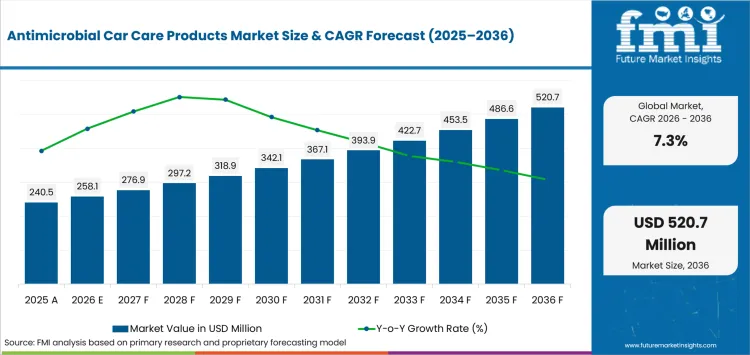
USD 258.1 million in 2026 and USD 520.7 million by 2036 at a 7.3% CAGR.
The antimicrobial car care products demand is expected to push valuation at USD 258.1 million in 2026 and is projected to reach USD 520.7 million by 2036 at 7.3% CAGR. Routine cabin care supports that path because one treatment can address visible soil and a substantiated hygiene function during the same service visit. The Environmental Protection Agency updated its antimicrobial-pesticide guidance in January 2026 and describes sprays plus liquids among registered formats for inanimate surfaces. That regulatory breadth gives formulators routes for surface disinfectant chemistry without requiring another cabin-care category.
Installed vehicle age also changes the repeat-purchase opportunity because older interiors face longer exposure to spills and repeated handling. Auto Care Association reported in June 2025 that the United States had more than 239 million licensed drivers and an average vehicle age above 12.8 years. Mature fleets therefore support replacement-oriented automotive interior materials while faster national vehicle markets create additional first-use occasions. Commercial conversion still depends on credible claims and material safety at a price close enough to ordinary interior cleaners.
Key Takeaways
- Routine cabin hygiene supports demand when manufacturers place antimicrobial function inside familiar interior-cleaning steps instead of separate sanitation appointments.
- By type, fabric & surface cleaners are estimated to hold 41.3% in 2026 owing to one formulation serving several common cabin surfaces.
- Passenger cars are projected to hold 74.2% share in 2026 owing to private ownership producing the broadest repeat cleaning base.
- In 2026, offline sales are expected to lead sales channel with 79.2% share because first-use selection often requires compatibility and application advice.
- Claims substantiation and sensitive cabin materials restrain adoption because failed wording or residue problems can delay launch and undermine repeat use.
- Some of the key players in this market include 3M Company, Microban International, SANITIZED AG, Ziebart International Corporation, Adam's Polishes, SONAX GmbH, Chemical Guys, and Turtle Wax.
Analyst Perspective
“Antimicrobial car-care brands should judge a formula by claim scope and cabin-material compatibility before comparing unit price. Commercial value is strongest when one treatment fits a normal detailing visit and returns for replenishment without adding another technician step.”
- Nikhil Kaitwade, Principal Consultant, Future Market Insights
How is the antimicrobial car care products market segmented?
The antimicrobial car care products market is segmented by type, vehicle type, sales channel and region.
The antimicrobial car care products market is segmented by type, vehicle type, sales channel and region. Type covers fabric & surface cleaners, coating shield and foam cleaners, while vehicle type separates passenger cars from commercial cars. Sales channel separates offline from online purchases, and regional analysis follows the standard Future Market Insights geography.
Why does offline lead demand within the sales channel category?
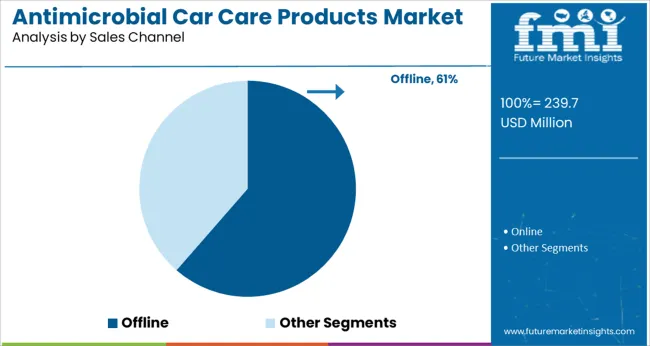
Offline channels matter at first purchase because application errors can leave haze or residue on cabin materials. Physical outlets place the automotive aftermarket product beside service decisions and provide immediate application advice during first use.
- In 2026, offline sales are expected to lead sales channel with 79.2% share because first-use selection often requires surface-compatibility guidance.
- Physical outlets convert first-time demand by pairing product choice with mixed-material instructions during cabin-care purchases. In November 2025 Auto Care Association and MEMA documented online research increasingly starting purchases completed in physical auto-care channels. Digital discovery supports store conversion without replacing service-linked sales or first-use guidance for unfamiliar cabin materials.
Why do fabric & surface cleaners lead demand within the type category?
Fabric & surface cleaners cover frequent interior jobs because detailers move between plastics and textiles during one service. The format fits broader car care products by reducing chemical changeovers on mixed cabin materials and limiting technician switching during one interior-care visit.
- By type, fabric & surface cleaners are estimated to hold 41.3% in 2026 owing to routine multi-material cabin cleaning.
- Chemical Guys documented 2025 releases that included a Complete Interior Deep Clean & Protect Kit for interior surfaces in its December 2025 year-end review. That release supports the automotive fabric use case where one purchase covers cleaning plus protection instead of several narrow products.
Why do passenger cars lead demand within the vehicle type category?
Passenger cars spread cabin-care purchases among households and detailers instead of concentrating demand in a few fleet contracts. Owners return to service centers for routine cleaning and resale preparation during vehicle ownership cycles. In February 2026 the USA Bureau of Labor Statistics counted about 396 thousand vehicle and equipment cleaners in its 2025 annual averages, giving passenger-car treatments a ready professional application route.
- Passenger cars are projected to hold 74.2% share in 2026 owing to private ownership producing repeated interior-care occasions.
- Service centers can repeat cabin treatments during ordinary ownership because technicians already handle interior cleaning and vehicle handover work without a separate sanitation appointment.
What are the drivers, restraints and opportunities in the Antimicrobial Car Care Products Market?
Routine interior cleaning raises repeat use, regulatory claim boundaries slow qualification and service-compatible formulas provide the clearest route to broader adoption.
- Driver: Vehicle owners and professional detailers are incorporating hygiene into ordinary interior cleaning because the same visit can address appearance and microbial concerns.
- Restraint: Public-health antimicrobial claims require evidence that matches local rules while sensitive cabin materials raise the cost of compatibility testing.
- Opportunity: Manufacturers can expand use by placing verified antimicrobial performance inside simple multi-surface products and professional application programs.
Professional service capacity converts cabin hygiene from an occasional purchase into a repeatable detailing step with an existing labor route. Ziebart reported in February 2026 that its 2025 performance included four new United States locations and three additional franchise agreements. A larger service footprint gives multi-surface cleaners and cabin treatments more scheduled customer contact without requiring manufacturers to build a separate service channel.
Claims compliance becomes expensive when marketing language crosses from protecting a treated article into a public-health microorganism claim. The Environmental Protection Agency clarified in May 2026 that public-health claims can require pesticide registration and supporting data. Manufacturers using antimicrobial additives therefore need claim architecture and efficacy records aligned before packaging decisions lock in wording that later requires avoidable costly revision.
Dealer-installed protection programs provide an expansion route when treatment fits a scheduled vehicle-care visit without adding a separate customer appointment. Ziebart launched its Gold Shield Protection Program nationwide in January 2026 for franchised and independent dealerships using trained in-house staff. That dealer route gives automotive foams and related antimicrobial treatments an existing sales and application moment if claims and instructions fit technician workflows.
Which country CAGRs are profiled in the Antimicrobial Car Care Products Market?
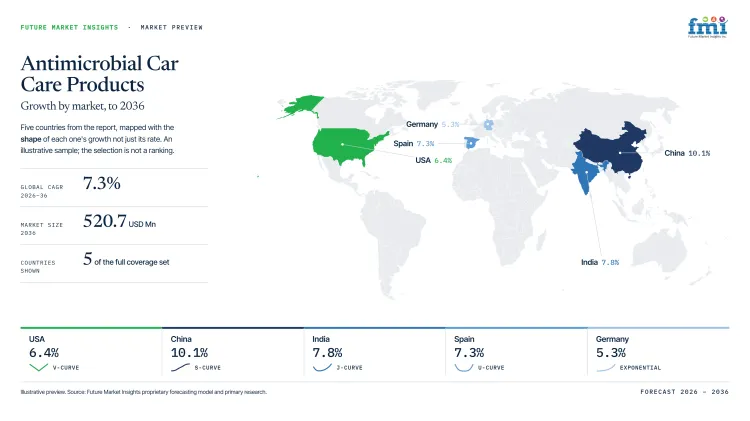
| Country | CAGR |
|---|---|
| Mexico | 8.3% |
| Russia | 7.6% |
| Spain | 7.3% |
| United States | 6.4% |
| Germany | 5.3% |
How do country-level CAGRs compare in the Antimicrobial Car Care Products Market?
The five profiled CAGRs span 3.0 percentage points from Mexico at 8.3% to Germany at 5.3% during the forecast period. Mexico and Russia form the faster group because vehicle turnover gives care brands more customer contacts. Spain occupies the middle position while United States and Germany rely on mature replacement demand.
- Mexico pairs dealer turnover with regional distribution that shapes repeat product access.
- Russia needs stable replenishment because regional assortment gaps weaken repeated cabin-care purchases.
- Spain pairs a mature fleet with European biocidal rules that tighten product labeling.
- United States service density supports repeat treatments while public-health claims face federal review.
- Germany rewards proven compatibility because mature owners replace cleaners more often than vehicles.
Similar CAGRs can mask different service and compliance economics. The full report provides country-level CAGR analysis across North America, Latin America, Europe, East Asia, South Asia, Oceania and the Middle East and Africa.
Country-wise Analysis
- Mexico's light-vehicle market gives car-care brands dealer and aftermarket contact points where dealership groups and detailers compete for routine maintenance visits. INEGI recorded 1,524,583 light-vehicle sales during 2025 in its January 2026 release for the national vehicle market. That sales flow gives detailers a steady stream of newer vehicles entering maintenance cycles after dealer delivery. Antimicrobial car care products demand in Mexico is forecast to rise at 8.3% CAGR through 2036 owing to vehicle turnover and dealer-linked service activity. Spanish-language instructions and multipurpose cabin formats fit familiar retail habits, but price-sensitive repeat purchasing favors products that replace several specialist chemicals without adding technician steps on each service visit.
- Regional assortment continuity matters in Russia today because independent service outlets outside major cities cannot rely on the same replenishment cadence as metropolitan chains. The Russian Government stated in June 2025 that car sales topped 1.8 million vehicles during 2024 and increased about 40% from 2023, enlarging later-ownership maintenance demand. Russia is estimated to post 7.6% CAGR through 2036 given continued vehicle turnover and a large stock entering later ownership. Import availability limits repeat orders in Russia, so brands with simplified formulations and steady distributor inventory have a clearer path to cabin-care sales beyond major cities in secondary regional markets.
- Spain's mature passenger-car fleet keeps interior preservation relevant long after first sale, especially for vehicles that remain in service well past a decade and change owners. The Dirección General de Tráfico documented more than 37 million registered vehicles in June 2025, including about 25 million passenger cars. European biocidal rules raise the claims threshold, while Spanish-language directions and low-residue formulas help brands serve older plastics and upholstery without pushing routine care into specialist treatment. Sales of antimicrobial car care products in Spain are forecast to expand at 7.3% CAGR by 2036 attributable to that large maintenance base during resale preparation.
- United States demand reaches consumers through national retailers and a dense detailing trade, although stronger public-health claims trigger federal registration and evidence requirements before broad retail rollout. Antimicrobial car care products demand in the United States is projected to grow at 6.4% CAGR through 2036 reflecting sustained vehicle use by a large active fleet. Federal Highway Administration forecasts published in October 2025 project light-duty vehicle miles traveled to increase about 0.5% annually through 2053, preserving regular cabin-use exposure. Brands that resolve claims review and material compatibility before launch can use existing service density without teaching consumers a separate sanitation routine.
- German vehicle owners use a mature service environment where compatibility records and clear application instructions carry more weight than novelty claims for aging passenger cars and premium cabins. Automotive retail networks give brands broad access, but European biocidal requirements raise the evidence threshold for antimicrobial wording in consumer-facing claims. Destatis documented roughly 49.5 million registered passenger cars in July 2026, giving brands a large replacement-led care base. Germany's antimicrobial car care products outlook is anticipated to advance at 5.3% CAGR through 2036 because mature ownership sustains cleaner replacement. Proven material compatibility therefore separates offers more clearly than rapid assortment expansion in this mature market.
Who are the notable companies in the Antimicrobial Car Care Products Market?
3M Company, Microban International, SANITIZED AG, Ziebart International Corporation, Adam's Polishes, SONAX GmbH, Chemical Guys, Turtle Wax are the notable companies serving this market.
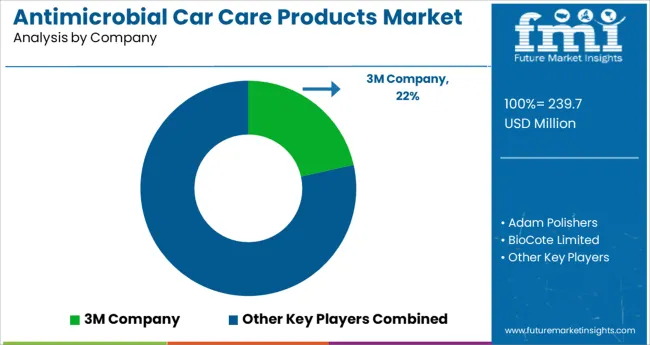
Competition divides between antimicrobial technology specialists and finished car-care brands because buyers need both credible claims support and simple aftermarket execution. Microban International and SANITIZED AG contribute upstream antimicrobial expertise while Ziebart International Corporation carries vehicle treatments into professional service. 3M Company and consumer detailing brands compete through broader automotive coatings and polyurethane foam knowledge plus retail reach.
- Technology and claims support: Microban International and SANITIZED AG provide antimicrobial formulation knowledge that finished-product brands can use during qualification.
- Professional vehicle-care execution: 3M Company and Ziebart International Corporation support automotive service routes where trained application can reduce first-use errors.
- Consumer detailing reach: Adam's Polishes, SONAX GmbH, Chemical Guys and Turtle Wax sell broad car-care portfolios through direct and retail channels.
Competitive Benchmarking: Antimicrobial Car Care Products Market
| Company | Claims & Technical Support | Vehicle-Interior Application Breadth | Aftermarket Delivery Depth | Geographic Reach |
|---|---|---|---|---|
| 3M Company | High | High | High | Global |
| Microban International | High | High | Medium | Global technology partnerships |
| SANITIZED AG | High | Medium | Medium | Europe-led with international distribution |
| Ziebart International Corporation | Medium | High | High | 37-country service network |
| Adam's Polishes | Medium | High | High | North America-led with international retail |
| SONAX GmbH | Medium | High | High | Europe-led with international distribution |
| Chemical Guys | Medium | High | High | North America-led with international e-commerce |
| Turtle Wax | Medium | High | High | 120+ country distribution |
Scoring basis: High claims and technical support requires multiple documented testing or regulatory-support routes while Medium requires one current verified route. High interior breadth requires at least three documented cabin-surface groups while Medium requires two and Low identifies one. High aftermarket depth requires multiple direct or service channels while Medium reflects one established channel and Low identifies one limited route.
Key Developments in the Antimicrobial Car Care Products Market
- In July 2025, SONAX GmbH introduced its ANS professional cleaning system with three defined vehicle-cleaning phases for commercial detailing operators.
- In April 2025, Ziebart International Corporation signed a Mexico master franchise agreement covering ten planned stores and operations in about forty dealerships.
- In March 2025, Microban International launched the AkoTech multifunctional coating platform with antimicrobial options for manufactured surfaces and spray-coating application.
Key Players in the Antimicrobial Car Care Products Market
Antimicrobial Technology and Technical Support
- 3M Company
- Microban International
- SANITIZED AG
Professional Vehicle-Care Delivery
- Ziebart International Corporation
Consumer and Detailing Brands
- Adam's Polishes
- SONAX GmbH
- Chemical Guys
- Turtle Wax
Antimicrobial Car Care Products Market - Report Scope
| Coverage field | Report scope |
|---|---|
| Market breakdown | By type, vehicle type, sales channel and region. |
| Quantitative Units | USD million. |
| Market Definition | Revenue from finished antimicrobial vehicle-cleaning and interior-care chemical products sold for passenger and commercial cars within the defined type and channel categories. |
| Regions Covered | North America, Latin America, Europe, East Asia, South Asia and Pacific, and Middle East and Africa. |
| Countries Covered | Mexico, Russia, Spain, United States, Germany, and 20+ countries included in the full report. |
| Key Companies Profiled | 3M Company, Microban International, SANITIZED AG, Ziebart International Corporation, Adam's Polishes, SONAX GmbH, Chemical Guys, Turtle Wax. |
| Forecast Period | 2026 to 2036. |
| Approach | Primary and secondary research with market triangulation. |
Antimicrobial Car Care Products Market - Research Methodology
| Method | Approach |
|---|---|
| Primary Research | FMI analysts gathered input from manufacturers, service providers, technology developers, distributors, end users, procurement teams, and subject-matter experts. Interviews examined purchasing decisions, product or service evaluation, adoption barriers, approval requirements, pricing considerations, and expectations for technical or commercial support. Respondents were also asked what evidence is required before a trial, pilot, or initial order develops into regular purchasing. |
| Desk Research | Desk research covered government statistics, regulatory publications, trade data, industry associations, technical literature, standards, company filings, product information, and official corporate announcements. Sources were reviewed for relevance, publication date, geographic coverage, and consistency with the defined market scope. Claims relating to performance, applications, approvals, capacity, investment, and commercial activity were retained only when supported by credible public evidence. |
| Market Sizing and Forecasting | The market model combined the baseline value with historical performance, segment structure, pricing and volume indicators, adoption levels, company participation, and country-level demand conditions. Forecast assumptions considered economic activity, investment trends, regulatory developments, technology adoption, purchasing cycles, supply availability, and barriers to wider market use. Segment and regional estimates were reconciled before the final market total was calculated. |
| Data Validation | Estimates were checked against multiple independent indicators, including public data, company activity, trade patterns, industry developments, and findings from primary interviews. Validation also tested whether products, services, applications, and company revenues fell within the defined market boundaries. Adjacent categories, unsupported claims, overlapping revenues, and activities without direct market relevance were excluded to reduce double counting and maintain consistency across segments and countries. |
Antimicrobial Car Care Products Market by Segments
Antimicrobial Car Care Products Market segmented by Type:
- Fabric & Surface Cleaners
- Coating Shield
- Foam Cleaners
Antimicrobial Car Care Products Market segmented by Vehicle Type:
- Passenger Cars
- Commercial Cars
Antimicrobial Car Care Products Market segmented by Sales Channel:
- Offline
- Online
Antimicrobial Car Care Products Market by Region:
- North America
- United States
- Canada
- Latin America
- Brazil
- Mexico
- Chile
- Rest of Latin America
- Western Europe
- Germany
- United Kingdom
- Italy
- Spain
- France
- Nordics
- Benelux
- Rest of Western Europe
- Eastern Europe
- Russia
- Poland
- Hungary
- Balkan and Baltic States
- Rest of Eastern Europe
- East Asia
- China
- Japan
- South Korea
- South Asia and Pacific
- India
- ASEAN
- Australia and New Zealand
- Rest of South Asia and Pacific
- Middle East and Africa
- Kingdom of Saudi Arabia
- Other GCC Countries
- Türkiye
- South Africa
- Other African Union Countries
- Rest of Middle East and Africa
Research Sources and Bibliography
- USA Environmental Protection Agency. (2026, January 29). What are antimicrobial pesticides?.
- Auto Care Association. (2025, June 13). New report: 5.1% growth expected for auto care industry in 2025, reaching $664 billion in 2028.
- Chemical Guys. (2025, December 27). Here's to all the Chemical Guys drops in 2025.
- USA Bureau of Labor Statistics. (2026, February 20). Employed people by detailed occupation, sex, race, and Hispanic or Latino ethnicity.
- Auto Care Association & MEMA Aftermarket Suppliers. (2025, November 5). Auto Care Association, MEMA Aftermarket Suppliers release 2025 Joint E-commerce Trends and Outlook Forecast Report.
- Ziebart International Corporation. (2026, February 5). Ziebart reports record 2025 performance and outlines 2026 growth strategy.
- Ziebart International Corporation. (2026, March 3). Ziebart launches in-house vehicle protection program for car dealerships nationwide.
- USA Environmental Protection Agency. (2026, May 5). Consumer products treated with pesticides.
- SONAX GmbH. (2025, July). SONAX erfindet die Profi-Autowäsche neu.
- Instituto Nacional de Estadística y Geografía. (2026, January 6). Registro Administrativo de la Industria Automotriz de Vehículos Ligeros: diciembre de 2025.
- Government of the Russian Federation. (2025, June 17). Mikhail Mishustin holds strategic session on automotive industry development.
- Dirección General de Tráfico. (2025, June 12). 40 años en la carretera.
- Federal Highway Administration. (2025, October 10). 2025 FHWA forecasts of vehicle miles traveled.
- Federal Statistical Office of Germany. (2026, July 22). Pkw-Dichte 2026 erneut gestiegen.
- Ziebart International Corporation. (2025, April 8). Ziebart solidifies international expansion with Canada master franchise renewal, Mexico development deal.
- Microban International. (2025, March 18). Microban introduces AkoTech: Advanced multifunctional coating platform.
- Ziebart International Corporation. (2025, April 22). Ziebart builds early 2025 success with strong Q1 growth, expanding in key USA and international markets.
- SANITIZED AG. (2025, May 6). Welcome to our new distributor: Prakash Chemicals Private Limited.
- Microban International. (2025, October 21). Microban International launches EcoFresh odor-capture technology.
- SONAX GmbH. (2025, June). SONAX Felgenbeast startet in SB-Waschanlagen durch.
- 3M. (2025, September 8). 3M at IAA Mobility 2025: What the automotive industry needs next, 3M is innovating now.
- 3M. (2026, June 8). 3M innovates to help the automotive industry navigate what's ahead.
- Ziebart International Corporation. (2025, August 25). Mattiacio Group becomes largest Ziebart franchisee with 17-unit acquisition.
- SANITIZED AG. (2025, April 1). GOTS approval for Sanitized® OX20.
- SONAX GmbH. (2025, June 22). SONAX und ABT starten Partnerschaft beim 24-Stunden-Rennen.
- Adam's Polishes. (2025, November 21). Adam's Polishes Black Friday 2025 Lookbook.
- Chemical Guys. (2025, October 22). A Cosmic New Scent Lands for This Interior Cleaner.
- BioCote Limited. (2026, June 10). BioBond antimicrobial coatings.
- Autoglym. (2025, March 11). New Autoglym sprayer delivers thick blanket of foam without a pressure washer.
This bibliography is provided for reader reference and is not exhaustive. The full report contains the complete reference list and detailed citations
This Report Answers
- How large is the antimicrobial car care products market in 2026 and 2036?
- Which cabin-cleaning conditions support repeat demand for antimicrobial car care products?
- Why do fabric & surface cleaners lead the type category?
- Why do passenger cars lead the vehicle type category?
- How does offline distribution influence product selection and first-use adoption?
- How do CAGR profiles differ among the five countries?
- Which companies serve antimicrobial technology and finished car-care roles?
- Which claim and material-compatibility constraints slow antimicrobial car-care qualification?
Frequently Asked Questions
How big is the antimicrobial car care products market in 2026?
The antimicrobial car care products market is valued at USD 258.1 million in 2026 and is projected to reach USD 520.7 million by 2036. Routine cabin cleaning supports growth because hygiene performance fits existing detailing visits without a separate sanitation appointment.
What is the CAGR of the antimicrobial car care products market from 2026 to 2036?
The antimicrobial car care products market is projected to grow at a CAGR of 7.3% between 2026 and 2036. Repeat interior-care purchases support expansion when application time and material compatibility stay close to ordinary cleaning routines.
Which type leads the antimicrobial car care products market?
The fabric & surface cleaners segment is expected to hold 41.3% of the antimicrobial car care products market in 2026, driven by routine multi-material cabin cleaning. Detailers can treat plastics and textiles during one service without switching among several narrow-purpose products.
Which vehicle type leads the antimicrobial car care products market?
The passenger cars segment is expected to hold 74.2% of the antimicrobial car care products market in 2026, attributable to repeated cabin-cleaning occasions among private owners. Retail products and detailing services return during vehicle ownership as cabins accumulate routine wear from daily use.
Which countries are projected to record the highest growth in the antimicrobial car care products market?
Mexico is projected to grow at 8.3% CAGR, followed by Russia at 7.6% and Spain at 7.3% through 2036. Their growth rates reflect different service and distribution conditions rather than identical purchasing patterns in each national aftermarket.
Which companies are active in the antimicrobial car care products market?
Key companies operating in the antimicrobial car care products market include 3M Company, Microban International, SANITIZED AG, Ziebart International Corporation, Adam's Polishes, SONAX GmbH, Chemical Guys, and Turtle Wax. Their roles cover antimicrobial technical support, professional application and consumer detailing distribution through distinct customer routes.
Preview the report firsthand - request a free sample
Get SampleGet the brochure for pricing and purchase details.
Get PDFTable of Content
- Key Takeaways
- Market Size and CAGR
- Top Growth Driver
- Fastest Growing Segment
- Leading Region
- Key Companies
- Emerging Opportunities
- Executive Summary
- Global Market Outlook
- Demand-side Trends
- Supply-side Trends
- Technology Roadmap Analysis
- Analysis and Recommendations
- Analyst Perspective (What is happening? Why now? What should investors know?)
- Key Questions Answered
- How large is the market?
- What is the CAGR?
- What are key trends?
- Which region dominates?
- Who are the leaders?
- Market Overview
- Market Coverage / Taxonomy
- Market Definition / Scope / Limitations
- Research Methodology
- Chapter Orientation
- Analytical Lens and Working Hypotheses
- Market Structure, Signals, and Trend Drivers
- Benchmarking and Cross-market Comparability
- Market Sizing, Forecasting, and Opportunity Mapping
- Research Design and Evidence Framework
- Desk Research Programme (Secondary Evidence)
- Expert Input and Fieldwork (Primary Evidence)
- Tooling, Models, and Reference Databases
- Data Engineering and Model Build
- Quality Assurance and Audit Trail
- Market Background
- Market Dynamics (Drivers, Restraints, Opportunity, Trends)
- Scenario Forecast (Optimistic, Likely, Conservative)
- Impact Analysis
- AI Impact
- Sustainability Impact
- Regulatory Impact
- Technology Impact
- Consumer / Buyer Analysis
- Purchase Drivers
- Adoption Barriers
- Buyer Journey
- Opportunity Map Analysis
- Product Life Cycle Analysis
- Supply Chain Analysis
- Investment Feasibility Matrix
- Value Chain Analysis
- PESTLE and Porter's Analysis
- Regulatory Landscape
- Regional Parent Market Outlook
- Production and Consumption Statistics
- Import and Export Statistics
- Global Market Analysis and Forecast, 2021 to 2036
- Historical Market Size Value (USD Million) Analysis, 2021 to 2025
- Current and Future Market Size Value (USD Million) Projections, 2026 to 2036
- Y-o-Y Growth Trend Analysis
- Absolute $ Opportunity Analysis
- Global Market Pricing Analysis, 2021 to 2036
- Global Market Analysis and Forecast, By Type, 2021 to 2036
- Introduction / Key Findings
- Historical Market Size Value (USD Million) Analysis By Type, 2021 to 2025
- Current and Future Market Size Value (USD Million) Analysis and Forecast By Type, 2026 to 2036
- Fabric & Surface Cleaners
- Coating Shield
- Foam Cleaners
- Fabric & Surface Cleaners
- Y-o-Y Growth Trend Analysis By Type, 2021 to 2025
- Absolute $ Opportunity Analysis By Type, 2026 to 2036
- Global Market Analysis and Forecast, By Vehicle Type, 2021 to 2036
- Introduction / Key Findings
- Historical Market Size Value (USD Million) Analysis By Vehicle Type, 2021 to 2025
- Current and Future Market Size Value (USD Million) Analysis and Forecast By Vehicle Type, 2026 to 2036
- Passenger Cars
- Commercial Cars
- Passenger Cars
- Y-o-Y Growth Trend Analysis By Vehicle Type, 2021 to 2025
- Absolute $ Opportunity Analysis By Vehicle Type, 2026 to 2036
- Global Market Analysis and Forecast, By Sales Channel, 2021 to 2036
- Introduction / Key Findings
- Historical Market Size Value (USD Million) Analysis By Sales Channel, 2021 to 2025
- Current and Future Market Size Value (USD Million) Analysis and Forecast By Sales Channel, 2026 to 2036
- Offline
- Online
- Offline
- Y-o-Y Growth Trend Analysis By Sales Channel, 2021 to 2025
- Absolute $ Opportunity Analysis By Sales Channel, 2026 to 2036
- Global Market Analysis and Forecast, By Region, 2021 to 2036
- Introduction
- Historical Market Size Value (USD Million) Analysis By Region, 2021 to 2025
- Current Market Size Value (USD Million) Analysis and Forecast By Region, 2026 to 2036
- North America
- Latin America
- Western Europe
- Eastern Europe
- East Asia
- South Asia and Pacific
- Middle East & Africa
- Market Attractiveness Analysis By Region
- North America Market Analysis and Forecast, By Country, 2021 to 2036
- Historical Market Size Value (USD Million) Trend Analysis By Market Taxonomy, 2021 to 2025
- Market Size Value (USD Million) Forecast By Market Taxonomy, 2026 to 2036
- By Country
- USA
- Canada
- By Type
- By Vehicle Type
- By Sales Channel
- By Country
- Market Attractiveness Analysis
- By Country
- By Type
- By Vehicle Type
- By Sales Channel
- Key Takeaways
- Latin America Market Analysis and Forecast, By Country
- Historical Market Size Value (USD Million) Trend Analysis By Market Taxonomy, 2021 to 2025
- Market Size Value (USD Million) Forecast By Market Taxonomy, 2026 to 2036
- By Country
- Brazil
- Mexico
- Chile
- Rest of Latin America
- By Type
- By Vehicle Type
- By Sales Channel
- By Country
- Market Attractiveness Analysis
- By Country
- By Type
- By Vehicle Type
- By Sales Channel
- Key Takeaways
- Western Europe Market Analysis and Forecast, By Country
- Historical Market Size Value (USD Million) Trend Analysis By Market Taxonomy, 2021 to 2025
- Market Size Value (USD Million) Forecast By Market Taxonomy, 2026 to 2036
- By Country
- Germany
- UK
- Italy
- Spain
- France
- Nordic
- BENELUX
- Rest of Western Europe
- By Type
- By Vehicle Type
- By Sales Channel
- By Country
- Market Attractiveness Analysis
- By Country
- By Type
- By Vehicle Type
- By Sales Channel
- Key Takeaways
- Eastern Europe Market Analysis and Forecast, By Country
- Historical Market Size Value (USD Million) Trend Analysis By Market Taxonomy, 2021 to 2025
- Market Size Value (USD Million) Forecast By Market Taxonomy, 2026 to 2036
- By Country
- Russia
- Poland
- Hungary
- Balkan & Baltic
- Rest of Eastern Europe
- By Type
- By Vehicle Type
- By Sales Channel
- By Country
- Market Attractiveness Analysis
- By Country
- By Type
- By Vehicle Type
- By Sales Channel
- Key Takeaways
- East Asia Market Analysis and Forecast, By Country
- Historical Market Size Value (USD Million) Trend Analysis By Market Taxonomy, 2021 to 2025
- Market Size Value (USD Million) Forecast By Market Taxonomy, 2026 to 2036
- By Country
- China
- Japan
- South Korea
- By Type
- By Vehicle Type
- By Sales Channel
- By Country
- Market Attractiveness Analysis
- By Country
- By Type
- By Vehicle Type
- By Sales Channel
- Key Takeaways
- South Asia and Pacific Market Analysis and Forecast, By Country
- Historical Market Size Value (USD Million) Trend Analysis By Market Taxonomy, 2021 to 2025
- Market Size Value (USD Million) Forecast By Market Taxonomy, 2026 to 2036
- By Country
- India
- ASEAN
- Australia & New Zealand
- Rest of South Asia and Pacific
- By Type
- By Vehicle Type
- By Sales Channel
- By Country
- Market Attractiveness Analysis
- By Country
- By Type
- By Vehicle Type
- By Sales Channel
- Key Takeaways
- Middle East & Africa Market Analysis and Forecast, By Country
- Historical Market Size Value (USD Million) Trend Analysis By Market Taxonomy, 2021 to 2025
- Market Size Value (USD Million) Forecast By Market Taxonomy, 2026 to 2036
- By Country
- Kingdom of Saudi Arabia
- Other GCC Countries
- Türkiye
- South Africa
- Other African Union
- Rest of Middle East & Africa
- By Type
- By Vehicle Type
- By Sales Channel
- By Country
- Market Attractiveness Analysis
- By Country
- By Type
- By Vehicle Type
- By Sales Channel
- Key Takeaways
- Key Countries Market Analysis
- USA
- Pricing Analysis
- Market Share Analysis, 2025
- By Type
- By Vehicle Type
- By Sales Channel
- Canada
- Pricing Analysis
- Market Share Analysis, 2025
- By Type
- By Vehicle Type
- By Sales Channel
- Mexico
- Pricing Analysis
- Market Share Analysis, 2025
- By Type
- By Vehicle Type
- By Sales Channel
- Brazil
- Pricing Analysis
- Market Share Analysis, 2025
- By Type
- By Vehicle Type
- By Sales Channel
- Chile
- Pricing Analysis
- Market Share Analysis, 2025
- By Type
- By Vehicle Type
- By Sales Channel
- Germany
- Pricing Analysis
- Market Share Analysis, 2025
- By Type
- By Vehicle Type
- By Sales Channel
- UK
- Pricing Analysis
- Market Share Analysis, 2025
- By Type
- By Vehicle Type
- By Sales Channel
- Italy
- Pricing Analysis
- Market Share Analysis, 2025
- By Type
- By Vehicle Type
- By Sales Channel
- Spain
- Pricing Analysis
- Market Share Analysis, 2025
- By Type
- By Vehicle Type
- By Sales Channel
- France
- Pricing Analysis
- Market Share Analysis, 2025
- By Type
- By Vehicle Type
- By Sales Channel
- India
- Pricing Analysis
- Market Share Analysis, 2025
- By Type
- By Vehicle Type
- By Sales Channel
- ASEAN
- Pricing Analysis
- Market Share Analysis, 2025
- By Type
- By Vehicle Type
- By Sales Channel
- Australia & New Zealand
- Pricing Analysis
- Market Share Analysis, 2025
- By Type
- By Vehicle Type
- By Sales Channel
- China
- Pricing Analysis
- Market Share Analysis, 2025
- By Type
- By Vehicle Type
- By Sales Channel
- Japan
- Pricing Analysis
- Market Share Analysis, 2025
- By Type
- By Vehicle Type
- By Sales Channel
- South Korea
- Pricing Analysis
- Market Share Analysis, 2025
- By Type
- By Vehicle Type
- By Sales Channel
- Russia
- Pricing Analysis
- Market Share Analysis, 2025
- By Type
- By Vehicle Type
- By Sales Channel
- Poland
- Pricing Analysis
- Market Share Analysis, 2025
- By Type
- By Vehicle Type
- By Sales Channel
- Hungary
- Pricing Analysis
- Market Share Analysis, 2025
- By Type
- By Vehicle Type
- By Sales Channel
- Kingdom of Saudi Arabia
- Pricing Analysis
- Market Share Analysis, 2025
- By Type
- By Vehicle Type
- By Sales Channel
- Türkiye
- Pricing Analysis
- Market Share Analysis, 2025
- By Type
- By Vehicle Type
- By Sales Channel
- South Africa
- Pricing Analysis
- Market Share Analysis, 2025
- By Type
- By Vehicle Type
- By Sales Channel
- USA
- Market Structure Analysis
- Competition Dashboard
- Competition Benchmarking
- Market Share Analysis of Top Players
- By Regional
- By Type
- By Vehicle Type
- By Sales Channel
- Emerging Startups
- Innovation Benchmarking
- Competition Analysis
- Competition Deep Dive
- 3M Company
- Overview
- Product Portfolio
- Profitability by Market Segments
- Sales Footprint
- Strategy Overview
- Marketing Strategy
- Product Strategy
- Channel Strategy
- Microban International
- BioCote Limited
- Clariant AG
- SANITIZED AG
- Ziebart International Corporation
- Adam's Polishes
- SONAX GmbH
- Chemical Guys
- Turtle Wax
- 3M Company
- Case Studies
- Success Stories
- Recent Developments
- Competition Deep Dive
- Assumptions & Acronyms Used


