

- Industry Size (2026)
- USD 2.3 Bn
- Forecast (2036)
- USD 6.9 Bn
- CAGR (2026 to 2036)
- 11.6%
PCR Resin Demand in Consumer Electronics Housings Market Forecast and Outlook 2026 to 2036
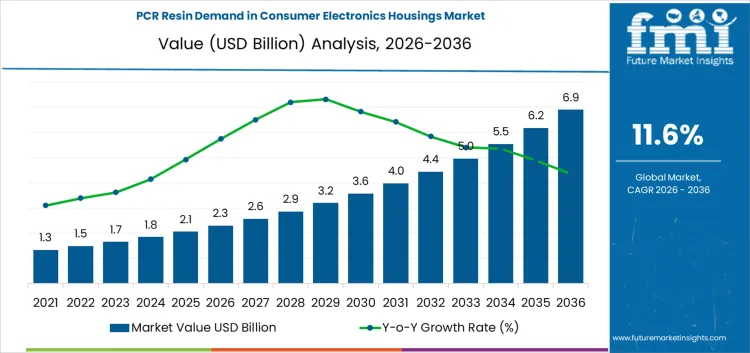
The PCR resin demand in consumer electronics housings market is projected to reach USD 2.3 billion in 2026 and is expected to grow to USD 6.9 billion by 2036, with a CAGR of 11.6%. This growth is primarily driven by the increasing utilization of post-consumer recycled (PCR) resins in the production of electronic housings. As manufacturers face rising environmental regulations and seek to optimize material efficiency, PCR resins are emerging as a viable solution, offering both economic and environmental advantages without compromising product performance.
PCR resins are increasingly favored in consumer electronics for their strength, durability, and cost-efficiency. They provide an effective alternative to virgin plastics while maintaining the high standards required for electronics housings. The demand for PCR-based materials is further propelled by regulatory frameworks that incentivize the use of post-consumer recycled plastics, coupled with industry-wide initiatives to reduce carbon footprints. With ongoing advancements in polymer technology, PCR resins are expected to meet the evolving needs of the consumer electronics sector, offering manufacturers a eco-efficient pathway to enhance product quality and comply with stringent environmental standards.
Quick Stats for PCR Resin Demand in Consumer Electronics Housings Market
- PCR Resin Demand in Consumer Electronics Housings Market Value (2026): USD 2.3 billion
- PCR Resin Demand in Consumer Electronics Housings Market Forecast Value (2036): USD 6.9 billion
- PCR Resin Demand in Consumer Electronics Housings Market Forecast CAGR 2026 to 2036: 11.6%
- Leading Type in PCR Resin Demand in Consumer Electronics Housings Market: Injection-molded housings
- Key Growth Regions in PCR Resin Demand in Consumer Electronics Housings Market: Asia Pacific, North America, Europe
- Top Players in PCR Resin Demand in Consumer Electronics Housings Market: SABIC, LG Chem, Kingfa, Covestro, Trinseo, Avient, Celanese, Mitsubishi Chemical, Supreme Petrochem, LOTTE Chemical
What is the Growth Forecast for PCR Resin Demand in Consumer Electronics Housings Market through 2036?
The PCR resin demand in consumer electronics housings market is projected to grow from USD 1.2 billion in 2020 to USD 2.3 billion in 2026, with a compound annual growth rate (CAGR) of 11.6%. The increasing focus on sustainability and stricter regulations is driving the adoption of PCR resins in electronic housing applications. North America is likely to remain the leading region, driven by regulatory frameworks, while Asia Pacific will experience rapid growth, supported by expanding manufacturing capabilities. As consumer electronics production increases, the demand for eco-friendly, high-performance materials will continue to rise.
From 2026 to 2036, the market is expected to grow from USD 2.6 billion in 2027 to USD 6.9 billion by 2036. This steady expansion reflects the ongoing shift toward sustainable materials in response to consumer preferences and evolving regulations. As manufacturers adopt PCR resins for product performance and environmental compliance, technological advancements in polymer chemistry will enhance the material's applications in consumer electronics housings. Companies focusing on improving the performance of PCR resins while meeting regulatory standards will be well-positioned to capture significant market share in the years ahead.
PCR Resin Demand in Consumer Electronics Housings Market Key Takeaways
| Metric | Value |
|---|---|
| Market Value (2026) | USD 2.3 billion |
| Forecast Value (2036) | USD 6.9 billion |
| Forecast CAGR 2026 to 2036 | 11.6% |
How Is PCR Resin Transforming Consumer Electronics Housing Production?
Post-consumer recycled (PCR) resins are increasingly adopted for consumer electronics housings to provide durable, lightweight, and cost-efficient materials for devices such as smartphones, laptops, and wearable electronics. Historically, electronics housings relied on virgin plastics, which offered mechanical strength but contributed to high material costs and environmental burden. Modern PCR resins combine high mechanical performance, heat resistance, and aesthetic versatility to meet design, durability, and safety requirements in electronic devices. Electronics manufacturers, OEMs, and contract manufacturers prioritize material consistency, dimensional stability, and compliance with industry standards. Early adoption focused on premium devices and environmentally conscious brands, while current demand spans mainstream consumer electronics, smart home devices, and portable gadgets, driven by cost efficiency, durability needs, and regulatory pressure. Thermal resistance, mechanical strength, and processability influence supplier selection.
Rising electronics production, demand for lightweight durable materials, and regulatory focus on material traceability are shaping market growth. Compared with conventional plastics, PCR resins emphasize mechanical reliability, dimensional accuracy, and compatibility with injection molding and surface finishing. Cost structures depend on resin sourcing, pellet processing, and quality testing, concentrating margins among suppliers capable of delivering consistent, high-performance materials. Electronics manufacturers adopt PCR resins to reduce production costs, maintain device durability, and meet environmental compliance requirements. By 2036, PCR resins are expected to become standard in consumer electronics housings, supporting cost-effective manufacturing, reliable device performance, and regulatory adherence.
What Factors Are Shaping the Demand for PCR Resins in Consumer Electronics Housings by Device Category and Housing Construction in 2026?
The PCR resin demand in consumer electronics housings market in 2026 is segmented by end use device category and by housing construction type. By end use, demand is divided into smartphones, televisions, and laptops, premium consumer electronics, IT and smart home devices, high precision electronics, and small appliances or display devices, each with different volume profiles and cosmetic requirements. By housing type, demand is organized around injection molded housings, thin wall housings, structural housings, compact housings, and other formats that differ in wall thickness, stiffness targets, and assembly method. These segments reflect how OEMs balance appearance standards, tooling reuse, and recycled content targets.
Why Do High Volume Personal Electronics Anchor PCR Resin Consumption?
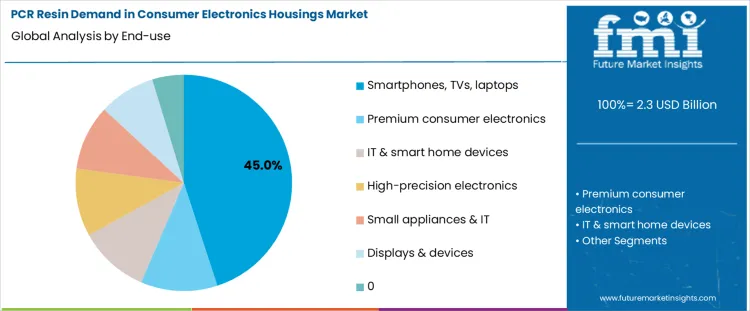
Smartphones, TVs, and laptops account for about 45% of demand in 2026, reflecting their sheer production scale and frequent model refresh cycles. These product lines ship in tens or hundreds of millions of units, which makes even small resin content per unit translate into large material volumes. Housing designs in this segment are tightly cost controlled, and once a PCR formulation is qualified, it can be rolled out across multiple models and regions. Tooling reuse across generations further supports consistent material choices. Replacement and upgrade cycles keep production lines active year round. This combination of scale, platform reuse, and continuous output makes mainstream personal electronics the primary driver of PCR resin consumption in housings.
Premium, IT, and high precision devices follow different material selection logics. Premium products impose stricter surface finish and color consistency standards, which slows PCR adoption or limits allowable content. IT and smart home devices vary widely in form factor and volume, which fragments demand. High precision electronics focus on dimensional stability and tolerance control, which narrows acceptable material windows. Small appliances and display devices add volume, yet their designs are more heterogeneous. These segments contribute to growth, but none matches the unit throughput and standardization potential of mass market personal electronics, which keeps them secondary in total PCR resin volume terms.
Why Do Injection Molded Housings Represent the Largest Construction Format?
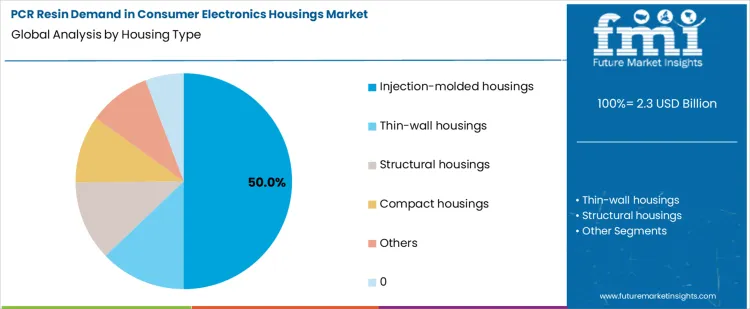
Injection molded housings represent about 50% of demand in 2026 because they offer the best balance between geometric freedom, surface quality, and production speed. This process supports complex internal features such as clips, bosses, and ribs in a single cycle, which reduces part count and assembly time. From a PCR perspective, injection molding also allows compounders to fine tune formulations for flow and appearance within existing tool designs. High speed, multi cavity tools suit the volume requirements of consumer electronics. The combination of manufacturing efficiency and design integration keeps injection molding as the dominant housing construction method.
Thin wall, structural, and compact housings address specific packaging and strength targets. Thin wall designs push flow and stiffness limits, which tightens material property windows and reduces tolerance for variability. Structural housings prioritize load bearing and drop resistance, which often requires conservative material choices. Compact housings aim to minimize size but can increase warpage risk. These formats are important in certain products, yet they impose more constraints on PCR usage. As a result, while they grow in selected categories, injection molded standard housings continue to absorb the largest share of PCR resin used in consumer electronics enclosures.
Why Are Brand Risk Management and Platform Scale Decisions Driving PCR Resin Demand in Consumer Electronics Housings through 2036?
Demand is anchored in portfolio governance rather than in casing aesthetics. Large electronics brands now manage materials at platform level, where one housing design may ship in tens of millions of units across regions. Any material choice therefore carries reputational, regulatory, and supply continuity implications. PCR resins allow brands to align housing materials with internal material policies without changing industrial design or assembly processes. Once a grade is validated for drop, heat, and finish retention, it is locked into the platform for several years. Volume follows shipment scale of successful product families, not short term fashion cycles or limited edition models.
What Qualification Cost, Yield Risk, and Visual Consistency Concerns Are Slowing Wider Substitution?
The main restraint is manufacturing risk. Housings are high visibility parts, and color shift, surface defects, or flow marks create immediate rejection. PCR feedstock variability makes tight cosmetic control harder, increasing scrap risk and rework cost. Every new grade also requires full mechanical, thermal, and regulatory requalification, which ties up test capacity and engineering time. In high volume programs, even small yield losses erase material cost benefits. Assemblers therefore prefer proven virgin compounds with predictable behavior. Unless PCR grades can demonstrate stable processing windows and consistent appearance across batches, adoption remains limited to carefully selected models and controlled production runs.
How Are Platform Standardization and Supplier Consolidation Reshaping PCR Use in Device Housings?
The structure of demand is becoming programmatic. Brands are reducing the number of approved housing materials and pushing suppliers to offer PCR and non PCR variants under the same base specification. This allows gradual transition without redesigning tools or processes. Contract manufacturers also prefer fewer material SKUs to simplify planning and inventory. Documentation, traceability, and batch control are becoming part of sourcing decisions, not just price. Over time, PCR resin use becomes embedded in platform refresh cycles and supplier framework agreements, turning what was once a product level choice into a portfolio level materials strategy managed centrally.
What is the Demand for PCR Resin in Consumer Electronics Housings by Country?
| Country | CAGR (%) |
|---|---|
| China | 13.8% |
| Germany | 10.2% |
| USA | 9.6% |
| Japan | 8.4% |
| India | 12.0% |
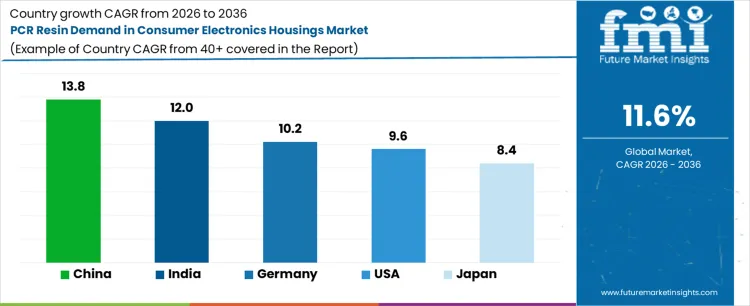
Demand for PCR resin in consumer electronics housings is rising as manufacturers adopt recycled materials to meet regulatory standards, ensure product durability, and reduce environmental impact. China leads with a 13.8% CAGR, driven by large-scale electronics production and demand for cost-effective recycled materials. India follows at 12.0%, supported by growth in domestic electronics manufacturing and adoption of PCR resin in housings. Germany records 10.2% growth, shaped by industrial and consumer electronics applications. The USA grows at 9.6%, influenced by replacement demand and integration in durable electronics housings. Japan shows 8.4% CAGR, reflecting steady adoption of PCR resin for electronic device enclosures.
How is China experiencing growth in the PCR resin demand in consumer electronics housings market?
China is experiencing growth at a CAGR of 13.8%, driven by the expansion of electronics manufacturing hubs in Shenzhen, Shanghai, and Guangzhou, where smartphones, tablets, and laptops are produced in high volumes. PCR resins are optimized for durability, heat resistance, and surface finish quality, suitable for housings in compact and high-performance electronic devices. Demand is concentrated in industrial parks, assembly lines, and contract manufacturing facilities. Investments focus on material consistency, compliance with national quality standards, and integration into high-volume production processes. Growth reflects the increasing domestic production of consumer electronics and adoption of recycled polymers for environmentally conscious manufacturing.
- Electronics manufacturing drives adoption.
- Resins optimize heat resistance and surface finish.
- Industrial parks and assembly lines concentrate demand.
- Material consistency and quality compliance guide investment.
How is Germany witnessing growth in the PCR resin demand in consumer electronics housings market?
Germany is witnessing growth at a CAGR of 10.2%, supported by the automotive electronics and precision electronics industries in Bavaria, Baden-Württemberg, and North Rhine-Westphalia. PCR resins are optimized for high-quality housing components, thermal stability, and mechanical strength for consumer and industrial electronics. Demand is concentrated in industrial manufacturing zones, research centers, and electronics suppliers. Investments focus on material reliability, process precision, and compliance with EU electrical and product safety standards. Growth reflects a steady increase in electronics assembly, quality-focused production, and adoption of recycled polymers in high-value applications.
- Automotive and precision electronics drive adoption.
- Resins enhance mechanical strength and thermal stability.
- Industrial zones and research hubs concentrate demand.
- Material reliability and EU compliance guide investment.
How is the United States experiencing growth in the PCR resin demand in consumer electronics housings market?
United States is experiencing growth at a CAGR of 9.6%, driven by electronics manufacturing clusters in California, Texas, and Massachusetts, producing devices such as laptops, wearables, and smart home equipment. PCR resins are optimized for durability, heat resistance, and impact strength, suitable for housing delicate electronics. Demand is concentrated in high-tech manufacturing parks and electronics assembly facilities. Investments focus on material performance, quality control, and adherence to UL and federal product safety standards. Growth reflects rising domestic production, demand for environmentally conscious materials, and integration of recycled polymers into electronics housings.
- Electronics and high-tech manufacturing drive adoption.
- Resins optimize impact resistance and heat tolerance.
- Manufacturing parks concentrate demand.
- Material performance and safety compliance guide investment.
How is Japan witnessing growth in the PCR resin demand in consumer electronics housings market?
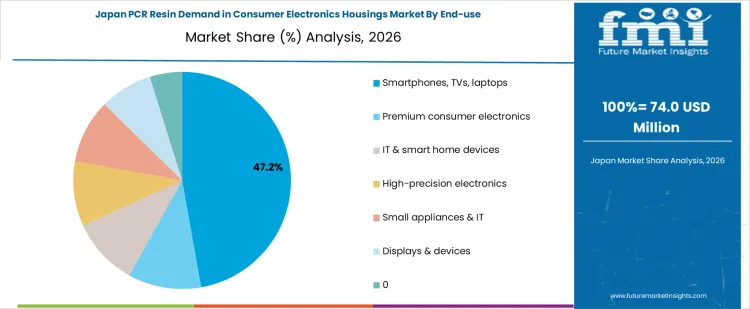
Japan is witnessing growth at a CAGR of 8.4%, supported by precision consumer electronics and robotics industries in Tokyo, Osaka, and Nagoya. PCR resins are optimized for dimensional stability, surface finish quality, and heat resistance, suitable for compact and high-precision device housings. Demand is concentrated in electronics factories, robotics assembly plants, and high-tech industrial zones. Investments focus on process control, material consistency, and compliance with Japanese industrial and electrical standards. Growth reflects increasing miniaturization of electronics, high-quality production requirements, and the use of recycled polymers in housings.
- Precision electronics and robotics drive adoption.
- Resins enhance dimensional stability and surface finish.
- Industrial and manufacturing zones concentrate demand.
- Material consistency and standards compliance guide investment.
How is India experiencing growth in the PCR resin demand in consumer electronics housings market?
India is experiencing growth at a CAGR of 12%, fueled by the rapid expansion of electronics manufacturing, assembly plants, and consumer device production in Bengaluru, Pune, and Hyderabad. PCR resins are optimized for mechanical strength, thermal resistance, and surface quality in smartphone, laptop, and appliance housings. Demand is concentrated in electronics parks, industrial clusters, and contract manufacturing facilities. Investments focus on material performance, cost efficiency, and adherence to national safety and quality standards. Growth reflects the scaling of domestic electronics production, increased adoption of recycled materials, and rising demand for durable consumer electronics components.
- Electronics manufacturing and assembly drive adoption.
- Resins optimize mechanical strength and thermal resistance.
- Electronics parks and industrial clusters concentrate demand.
- Material performance and quality compliance guide investment.
Who Are the Key Players in the PCR Resin Demand for Consumer Electronics Housings Market and How Do They Compete?
Competition in the post consumer recycled (PCR) resin market for consumer electronics housings is driven by material performance, recyclate quality, and compliance with durability and safety standards. SABIC supplies PCR resins engineered for mechanical strength, surface finish quality, and dimensional stability demanded by handsets, laptops, and wearable housings. LG Chem provides high performance PCR polymer grades formulated to balance recyclate content with impact resistance and thermal performance needed in compact electronic enclosures. Kingfa offers PCR compounds tailored for consumer electronics applications, focusing on consistent quality and integration with existing molding processes. Covestro and Trinseo deliver engineered PCR resins that combine recycled content with required rigidity, heat deflection, and aesthetic finish for visible housings.
Avient and Celanese supply PCR based material formulations that emphasize color stability, processability, and compliance with flammability and safety standards relevant to consumer devices. Mitsubishi Chemical develops PCR polymer solutions optimized for integration with high speed injection molding and thin wall electronics parts. Supreme Petrochem contributes PCR resins with validated mechanical and thermal properties for housings and structural components. LOTTE Chemical offers PCR resin grades that address specific end use requirements in consumer electronics, including improved surface quality and part reliability. Other regional suppliers and recyclers provide niche PCR feedstock and compounds aligned with local market needs. Competitive differentiation arises from recyclate consistency, mechanical and thermal performance, compliance with regulatory and industry standards, and ability to meet OEM aesthetic and durability specifications. Suppliers with documented PCR quality control, scalable supply, and support for material qualification help manufacturers integrate PCR resins into electronics housings without compromising performance or regulatory compliance.
Key Players in the PCR Resin Demand in Consumer Electronics Housings Market
- SABIC
- LG Chem
- Kingfa
- Covestro
- Trinseo
- Avient
- Celanese
- Mitsubishi Chemical
- Supreme Petrochem
- LOTTE Chemical
Scope of the Report
| Items | Values |
|---|---|
| Quantitative Units (2026) | USD billion |
| End-use | Smartphones, TVs & Laptops, Premium Consumer Electronics, IT & Smart Home Devices, High-Precision Electronics, Small Appliances & IT, Displays & Devices |
| Housing Type | Injection-Molded Housings, Thin-Wall Housings, Structural Housings, Compact Housings, Others |
| Material | PCR-ABS, PCR PC-ABS, PCR PC, Other PCR Polymers |
| Technology | High-Flow Low-Defect Molding, Surface-Finish-Optimised Compounding, OEM-Qualified PCR Resin Systems, Tight Dimensional Control, Others |
| Regions Covered | Asia Pacific, Europe, North America, Latin America, Middle East & Africa |
| Countries Covered | China, Japan, South Korea, India, Australia & New Zealand, ASEAN, Germany, United Kingdom, France, Italy, Spain, Nordic, BENELUX, United States, Canada, Mexico, Brazil, Chile, Saudi Arabia, Turkey, South Africa, and other regional markets |
| Key Companies Profiled | SABIC, LG Chem, Kingfa, Covestro, Trinseo, Avient, Celanese, Mitsubishi Chemical, Supreme Petrochem, LOTTE Chemical |
| Additional Attributes | Dollar sales by end-use, housing type, material, and technology; injection-molded housings as the leading format; demand anchored in high-volume personal electronics; procurement shaped by OEM qualification and cosmetic consistency; performance emphasis on flow, surface finish, dimensional stability, and thermal resistance; PCR adoption constrained by appearance control, yield risk, and batch-to-batch consistency. |
PCR Resin Demand in Consumer Electronics Housings Market Segmentation
End-use:
- Smartphones, TVs, laptops
- Premium consumer electronics
- IT & smart home devices
- High-precision electronics
- Small appliances & IT
- Displays & devices
Housing Type:
- Injection-molded housings
- Thin-wall housings
- Structural housings
- Compact housings
- Others
Material:
- PCR-ABS
- PCR PC-ABS
- PCR-ABS
- PCR PC
- Others
Technology:
- High-flow, low-defect molding
- Surface-finish-optimised compounding
- OEM-qualified PCR resin systems
- Tight dimensional control
- Others
Region
Asia Pacific
- China
- Japan
- South Korea
- India
- Australia & New Zealand
- ASEAN
- Rest of Asia Pacific
Europe
- Germany
- United Kingdom
- France
- Italy
- Spain
- Nordic
- BENELUX
- Rest of Europe
North America
- United States
- Canada
- Mexico
Latin America
- Brazil
- Chile
- Rest of Latin America
Middle East & Africa
- Kingdom of Saudi Arabia
- Other GCC Countries
- Turkey
- South Africa
- Other African Union
- Rest of Middle East & Africa
Bibliography
- European Parliament, & Council of the European Union. (2024). Regulation (EU) 2024/1781 of 13 June 2024 establishing a framework for the setting of ecodesign requirements for sustainable products (ESPR). Official Journal of the European Union.
- U.S. Environmental Protection Agency. (2021). National recycling strategy: Part one of a series on building a circular economy for all. U.S. Environmental Protection Agency.
- Brown, A., & Börkey, P. (2024). Plastics recycled content requirements (OECD Environment Working Papers No. 236). OECD Publishing.
Frequently Asked Questions
How big is the pcr resin demand in consumer electronics housings market in 2026?
The global pcr resin demand in consumer electronics housings market is estimated to be valued at USD 2.3 billion in 2026.
What will be the size of pcr resin demand in consumer electronics housings market in 2036?
The market size for the pcr resin demand in consumer electronics housings market is projected to reach USD 6.9 billion by 2036.
How much will be the pcr resin demand in consumer electronics housings market growth between 2026 and 2036?
The pcr resin demand in consumer electronics housings market is expected to grow at a 11.6% CAGR between 2026 and 2036.
What are the key product types in the pcr resin demand in consumer electronics housings market?
The key product types in pcr resin demand in consumer electronics housings market are smartphones, tvs, laptops, premium consumer electronics, it & smart home devices, high-precision electronics, small appliances & it, displays & devices and end-use.
Which housing type segment to contribute significant share in the pcr resin demand in consumer electronics housings market in 2026?
In terms of housing type, injection-molded housings segment to command 50.0% share in the pcr resin demand in consumer electronics housings market in 2026.
Preview the report firsthand - request a free sample
Get SampleGet the brochure for pricing and purchase details.
Get PDFTable of Content
- Executive Summary
- Global Market Outlook
- Demand-side Trends
- Supply-side Trends
- Technology Roadmap Analysis
- Analysis and Recommendations
- Market Overview
- Market Coverage / Taxonomy
- Market Definition / Scope / Limitations
- Market Background
- Market Dynamics
- Drivers
- Restraints
- Opportunity
- Trends
- Scenario Forecast
- Demand in Optimistic Scenario
- Demand in Likely Scenario
- Demand in Conservative Scenario
- Opportunity Map Analysis
- Product Life Cycle Analysis
- Supply Chain Analysis
- Investment Feasibility Matrix
- Value Chain Analysis
- PESTLE and Porter’s Analysis
- Regulatory Landscape
- Regional Parent Market Outlook
- Production and Consumption Statistics
- Import and Export Statistics
- Market Dynamics
- Global Market Analysis 2021 to 2025 and Forecast, 2026 to 2036
- Historical Market Size Value (USD Million) Analysis, 2021 to 2025
- Current and Future Market Size Value (USD Million) Projections, 2026 to 2036
- Y-o-Y Growth Trend Analysis
- Absolute $ Opportunity Analysis
- Global Market Pricing Analysis 2021 to 2025 and Forecast 2026 to 2036
- Global Market Analysis 2021 to 2025 and Forecast 2026 to 2036, By End-use
- Introduction / Key Findings
- Historical Market Size Value (USD Million) Analysis By End-use , 2021 to 2025
- Current and Future Market Size Value (USD Million) Analysis and Forecast By End-use , 2026 to 2036
- Smartphones, TVs, laptops
- Premium consumer electronics
- IT & smart home devices
- High-precision electronics
- Small appliances & IT
- Displays & devices
- Smartphones, TVs, laptops
- Y-o-Y Growth Trend Analysis By End-use , 2021 to 2025
- Absolute $ Opportunity Analysis By End-use , 2026 to 2036
- Global Market Analysis 2021 to 2025 and Forecast 2026 to 2036, By Housing Type
- Introduction / Key Findings
- Historical Market Size Value (USD Million) Analysis By Housing Type, 2021 to 2025
- Current and Future Market Size Value (USD Million) Analysis and Forecast By Housing Type, 2026 to 2036
- Injection-molded housings
- Thin-wall housings
- Structural housings
- Compact housings
- Others
- Injection-molded housings
- Y-o-Y Growth Trend Analysis By Housing Type, 2021 to 2025
- Absolute $ Opportunity Analysis By Housing Type, 2026 to 2036
- Global Market Analysis 2021 to 2025 and Forecast 2026 to 2036, By Material
- Introduction / Key Findings
- Historical Market Size Value (USD Million) Analysis By Material, 2021 to 2025
- Current and Future Market Size Value (USD Million) Analysis and Forecast By Material, 2026 to 2036
- PCR-ABS
- PCR PC-ABS
- PCR-ABS
- PCR PC
- Others
- PCR-ABS
- Y-o-Y Growth Trend Analysis By Material, 2021 to 2025
- Absolute $ Opportunity Analysis By Material, 2026 to 2036
- Global Market Analysis 2021 to 2025 and Forecast 2026 to 2036, By Technology
- Introduction / Key Findings
- Historical Market Size Value (USD Million) Analysis By Technology, 2021 to 2025
- Current and Future Market Size Value (USD Million) Analysis and Forecast By Technology, 2026 to 2036
- High-flow, low-defect molding
- Surface-finish-optimised compounding
- OEM-qualified PCR resin systems
- Tight dimensional control
- Others
- High-flow, low-defect molding
- Y-o-Y Growth Trend Analysis By Technology, 2021 to 2025
- Absolute $ Opportunity Analysis By Technology, 2026 to 2036
- Global Market Analysis 2021 to 2025 and Forecast 2026 to 2036, By 0.38
- Introduction / Key Findings
- Historical Market Size Value (USD Million) Analysis By 0.38, 2021 to 2025
- Current and Future Market Size Value (USD Million) Analysis and Forecast By 0.38, 2026 to 2036
- 0.28
- 0.22
- 0.08
- 0.02
- 0.02
- 0.28
- Y-o-Y Growth Trend Analysis By 0.38, 2021 to 2025
- Absolute $ Opportunity Analysis By 0.38, 2026 to 2036
- Global Market Analysis 2021 to 2025 and Forecast 2026 to 2036, By Region
- Introduction
- Historical Market Size Value (USD Million) Analysis By Region, 2021 to 2025
- Current Market Size Value (USD Million) Analysis and Forecast By Region, 2026 to 2036
- North America
- Latin America
- Western Europe
- Eastern Europe
- East Asia
- South Asia and Pacific
- Middle East & Africa
- Market Attractiveness Analysis By Region
- North America Market Analysis 2021 to 2025 and Forecast 2026 to 2036, By Country
- Historical Market Size Value (USD Million) Trend Analysis By Market Taxonomy, 2021 to 2025
- Market Size Value (USD Million) Forecast By Market Taxonomy, 2026 to 2036
- By Country
- USA
- Canada
- Mexico
- By End-use
- By Housing Type
- By Material
- By Technology
- By 0.38
- By Country
- Market Attractiveness Analysis
- By Country
- By End-use
- By Housing Type
- By Material
- By Technology
- By 0.38
- Key Takeaways
- Latin America Market Analysis 2021 to 2025 and Forecast 2026 to 2036, By Country
- Historical Market Size Value (USD Million) Trend Analysis By Market Taxonomy, 2021 to 2025
- Market Size Value (USD Million) Forecast By Market Taxonomy, 2026 to 2036
- By Country
- Brazil
- Chile
- Rest of Latin America
- By End-use
- By Housing Type
- By Material
- By Technology
- By 0.38
- By Country
- Market Attractiveness Analysis
- By Country
- By End-use
- By Housing Type
- By Material
- By Technology
- By 0.38
- Key Takeaways
- Western Europe Market Analysis 2021 to 2025 and Forecast 2026 to 2036, By Country
- Historical Market Size Value (USD Million) Trend Analysis By Market Taxonomy, 2021 to 2025
- Market Size Value (USD Million) Forecast By Market Taxonomy, 2026 to 2036
- By Country
- Germany
- UK
- Italy
- Spain
- France
- Nordic
- BENELUX
- Rest of Western Europe
- By End-use
- By Housing Type
- By Material
- By Technology
- By 0.38
- By Country
- Market Attractiveness Analysis
- By Country
- By End-use
- By Housing Type
- By Material
- By Technology
- By 0.38
- Key Takeaways
- Eastern Europe Market Analysis 2021 to 2025 and Forecast 2026 to 2036, By Country
- Historical Market Size Value (USD Million) Trend Analysis By Market Taxonomy, 2021 to 2025
- Market Size Value (USD Million) Forecast By Market Taxonomy, 2026 to 2036
- By Country
- Russia
- Poland
- Hungary
- Balkan & Baltic
- Rest of Eastern Europe
- By End-use
- By Housing Type
- By Material
- By Technology
- By 0.38
- By Country
- Market Attractiveness Analysis
- By Country
- By End-use
- By Housing Type
- By Material
- By Technology
- By 0.38
- Key Takeaways
- East Asia Market Analysis 2021 to 2025 and Forecast 2026 to 2036, By Country
- Historical Market Size Value (USD Million) Trend Analysis By Market Taxonomy, 2021 to 2025
- Market Size Value (USD Million) Forecast By Market Taxonomy, 2026 to 2036
- By Country
- China
- Japan
- South Korea
- By End-use
- By Housing Type
- By Material
- By Technology
- By 0.38
- By Country
- Market Attractiveness Analysis
- By Country
- By End-use
- By Housing Type
- By Material
- By Technology
- By 0.38
- Key Takeaways
- South Asia and Pacific Market Analysis 2021 to 2025 and Forecast 2026 to 2036, By Country
- Historical Market Size Value (USD Million) Trend Analysis By Market Taxonomy, 2021 to 2025
- Market Size Value (USD Million) Forecast By Market Taxonomy, 2026 to 2036
- By Country
- India
- ASEAN
- Australia & New Zealand
- Rest of South Asia and Pacific
- By End-use
- By Housing Type
- By Material
- By Technology
- By 0.38
- By Country
- Market Attractiveness Analysis
- By Country
- By End-use
- By Housing Type
- By Material
- By Technology
- By 0.38
- Key Takeaways
- Middle East & Africa Market Analysis 2021 to 2025 and Forecast 2026 to 2036, By Country
- Historical Market Size Value (USD Million) Trend Analysis By Market Taxonomy, 2021 to 2025
- Market Size Value (USD Million) Forecast By Market Taxonomy, 2026 to 2036
- By Country
- Kingdom of Saudi Arabia
- Other GCC Countries
- Turkiye
- South Africa
- Other African Union
- Rest of Middle East & Africa
- By End-use
- By Housing Type
- By Material
- By Technology
- By 0.38
- By Country
- Market Attractiveness Analysis
- By Country
- By End-use
- By Housing Type
- By Material
- By Technology
- By 0.38
- Key Takeaways
- Key Countries Market Analysis
- USA
- Pricing Analysis
- Market Share Analysis, 2025
- By End-use
- By Housing Type
- By Material
- By Technology
- By 0.38
- Canada
- Pricing Analysis
- Market Share Analysis, 2025
- By End-use
- By Housing Type
- By Material
- By Technology
- By 0.38
- Mexico
- Pricing Analysis
- Market Share Analysis, 2025
- By End-use
- By Housing Type
- By Material
- By Technology
- By 0.38
- Brazil
- Pricing Analysis
- Market Share Analysis, 2025
- By End-use
- By Housing Type
- By Material
- By Technology
- By 0.38
- Chile
- Pricing Analysis
- Market Share Analysis, 2025
- By End-use
- By Housing Type
- By Material
- By Technology
- By 0.38
- Germany
- Pricing Analysis
- Market Share Analysis, 2025
- By End-use
- By Housing Type
- By Material
- By Technology
- By 0.38
- UK
- Pricing Analysis
- Market Share Analysis, 2025
- By End-use
- By Housing Type
- By Material
- By Technology
- By 0.38
- Italy
- Pricing Analysis
- Market Share Analysis, 2025
- By End-use
- By Housing Type
- By Material
- By Technology
- By 0.38
- Spain
- Pricing Analysis
- Market Share Analysis, 2025
- By End-use
- By Housing Type
- By Material
- By Technology
- By 0.38
- France
- Pricing Analysis
- Market Share Analysis, 2025
- By End-use
- By Housing Type
- By Material
- By Technology
- By 0.38
- India
- Pricing Analysis
- Market Share Analysis, 2025
- By End-use
- By Housing Type
- By Material
- By Technology
- By 0.38
- ASEAN
- Pricing Analysis
- Market Share Analysis, 2025
- By End-use
- By Housing Type
- By Material
- By Technology
- By 0.38
- Australia & New Zealand
- Pricing Analysis
- Market Share Analysis, 2025
- By End-use
- By Housing Type
- By Material
- By Technology
- By 0.38
- China
- Pricing Analysis
- Market Share Analysis, 2025
- By End-use
- By Housing Type
- By Material
- By Technology
- By 0.38
- Japan
- Pricing Analysis
- Market Share Analysis, 2025
- By End-use
- By Housing Type
- By Material
- By Technology
- By 0.38
- South Korea
- Pricing Analysis
- Market Share Analysis, 2025
- By End-use
- By Housing Type
- By Material
- By Technology
- By 0.38
- Russia
- Pricing Analysis
- Market Share Analysis, 2025
- By End-use
- By Housing Type
- By Material
- By Technology
- By 0.38
- Poland
- Pricing Analysis
- Market Share Analysis, 2025
- By End-use
- By Housing Type
- By Material
- By Technology
- By 0.38
- Hungary
- Pricing Analysis
- Market Share Analysis, 2025
- By End-use
- By Housing Type
- By Material
- By Technology
- By 0.38
- Kingdom of Saudi Arabia
- Pricing Analysis
- Market Share Analysis, 2025
- By End-use
- By Housing Type
- By Material
- By Technology
- By 0.38
- Turkiye
- Pricing Analysis
- Market Share Analysis, 2025
- By End-use
- By Housing Type
- By Material
- By Technology
- By 0.38
- South Africa
- Pricing Analysis
- Market Share Analysis, 2025
- By End-use
- By Housing Type
- By Material
- By Technology
- By 0.38
- USA
- Market Structure Analysis
- Competition Dashboard
- Competition Benchmarking
- Market Share Analysis of Top Players
- By Regional
- By End-use
- By Housing Type
- By Material
- By Technology
- By 0.38
- Competition Analysis
- Competition Deep Dive
- SABIC
- Overview
- Product Portfolio
- Profitability by Market Segments (Product/Age /Sales Channel/Region)
- Sales Footprint
- Strategy Overview
- Marketing Strategy
- Product Strategy
- Channel Strategy
- Covestro
- Avient
- Mitsubishi Chemical
- Supreme Petrochem
- LOTTE Chemical
- LG Chem
- Kingfa
- SABIC
- Competition Deep Dive
- Assumptions & Acronyms Used
- Research Methodology


