

- Industry Size (2026)
- USD 47.22 Bn
- Forecast (2036)
- USD 132.28 Bn
- CAGR (2026 to 2036)
- 10.85%
Consumer Electronics Packaging Market Size, Market Forecast and Outlook By FMI
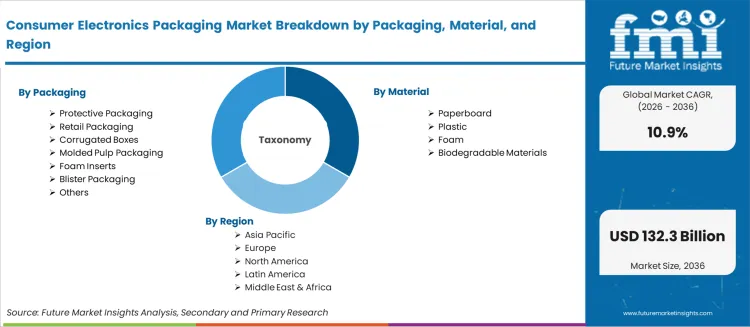
The consumer electronics packaging market is expected to expand from USD 47.22 billion in 2026 to USD 132.28 billion by 2036. The market is likely to register a 10.85% CAGR during the forecast period. Protective packaging is anticipated to lead packaging type with a 58.0% share, while paperboard is projected to account for 44.0% share of material demand in 2026.
Summary of the Consumer Electronics Packaging Market
- Demand and Growth Drivers
- Smartphone and laptop shipments are expected to support demand for packaging that protects devices during transit.
- E-commerce growth is likely to increase the need for stronger cushioning and damage-control packaging formats.
- Sustainability commitments are anticipated to shift more electronics brands toward recyclable paperboard and molded pulp solutions.
- Product and Segment View
- Protective packaging is expected to lead the packaging type segment due to its role in shock absorption and transit safety.
- Paperboard is likely to remain the leading material type because it supports recyclability and premium printed presentation.
- Smartphones and laptops are anticipated to remain major end-use areas as shipment volumes require reliable packaging systems.
- Geography and Competitive Outlook
- China is expected to lead country-level expansion due to its large electronics manufacturing base and rising premium device shipments.
- The USA is likely to record strong growth as online electronics sales increase packaging performance requirements.
- Companies with stronger sustainable material capability and broader converter networks are anticipated to improve their position.
- Analyst Opinion
- Ismail Sutaria, Principal Consultant for Packaging at FMI, suggests, “The consumer electronics packaging market is likely to move toward recyclable protection formats that can support both transit safety and brand presentation. Suppliers with molded pulp, paperboard, and validated cushioning capabilities are expected to gain advantage as electronics brands tighten sustainability requirements.”
- Consumer Electronics Packaging Market Value Analysis
- The consumer electronics packaging market is moving from standard device boxes toward engineered protection and premium retail presentation.
- Demand is likely to rise as electronics brands manage higher shipping volumes and lower tolerance for transit damage.
- Adoption is expected to improve as paperboard and molded pulp formats replace foam in more packaging programs.
- Spending is anticipated to be supported by e-commerce fulfillment growth and regulation-led packaging redesign.
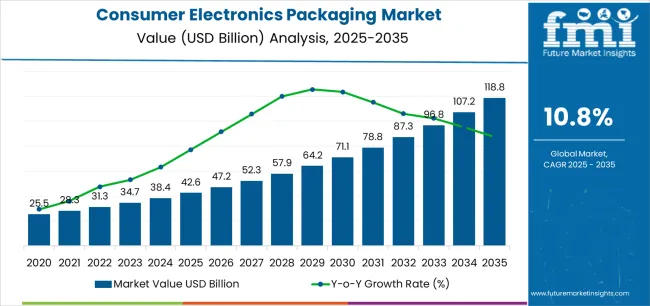
Key Takeaways, Market Size, and Forecast
| Metric | Value |
|---|---|
| Market Size (2025) | USD 42.60 Billion |
| Market Size (2026) | USD 47.22 Billion |
| Market Size (2036) | USD 132.28 Billion |
| CAGR (2026–2036) | 10.85% |
| Leading Packaging Type (2026) | Protective Packaging |
| Protective Packaging Share (2026) | 58.0% |
| Leading Material Type (2026) | Paperboard |
| Paperboard Share (2026) | 44.0% |
| Fastest-Growing Country | China |
| China CAGR | 12.1% |
Consumer Electronics Packaging Market Market Key Takeaways
| Metric | Details |
|---|---|
| Industry Size (2026) | USD 47.22 billion |
| Industry Value (2036) | USD 132.28 billion |
| CAGR (2026 to 2036) | 10.85% |
Source: Future Market Insights, 2026
FMI analysts observe that regional growth trajectories reflect varying concentrations of consumer electronics manufacturing and packaging sustainability regulation. China leads at 12.1% CAGR, driven by the scale of domestic electronics production and the shift toward premium retail packaging for domestic brand smartphones. The USA follows at 10.4%, supported by e-commerce transit packaging demand and state-level EPR legislation mandating recyclable packaging. Japan registers 9.8% growth as electronics OEMs headquartered in Tokyo and Osaka invest in sustainable packaging redesign programmes. Germany maintains 9.6% growth tied to PPWR compliance and circular economy packaging mandates.
The UK sustains 9.3% growth driven by Extended Producer Responsibility fee structures incentivising recyclable material adoption. Based on FMI's report, OEMs that have transitioned from foam to molded pulp inserts report packaging material cost increases of 8% to 15% offset by EPR fee reductions of 20% to 30%. Future Market Insights analysis indicates protective packaging dominates at 58.0% share, reflecting the critical importance of transit damage prevention in global electronics fulfilment.
Consumer Electronics Packaging Market Market Definition
Based on FMI's report, the Consumer Electronics Packaging market covers protective packaging, retail packaging, corrugated boxes, molded pulp packaging, foam inserts, blister packaging, and other formats in paperboard, plastic, foam, and biodegradable materials used for smartphones, laptops, wearable devices, audio devices, gaming consoles, cameras, and other consumer electronics globally.
Consumer Electronics Packaging Market Market Inclusions
Future Market Insights analysis covers consumer electronics packaging across all major packaging types, material formats, and end-use device categories. The scope encompasses regional market sizes across five key countries, forecast projections from 2026 to 2036, and segmentation by packaging type, material, and end use.
Consumer Electronics Packaging Market Market Exclusions
The scope excludes industrial electronics shipping containers, bulk palletisation materials, and point-of-sale display fixtures not classified as primary or secondary product packaging.
Consumer Electronics Packaging Market Market Research Methodology
- Primary Research: Analysts engaged with consumer electronics OEM packaging engineers, contract packaging service providers, and sustainable packaging material suppliers to map specification trends and material transition timelines.
- Desk Research: Data collection aggregated EU PPWR regulatory impact assessments, national EPR fee structure schedules, and published packaging sustainability target disclosures from major consumer electronics OEMs.
- Market-Sizing and Forecasting: Baseline values derive from a bottom-up aggregation of consumer electronics packaging material consumption across five key countries, applying device shipment volume growth curves and material transition penetration rates.
- Data Validation and Update Cycle: Projections are cross-validated against quarterly packaging revenue guidance from major protective packaging manufacturers and global consumer electronics device shipment statistics.
Why is the Consumer Electronics Packaging Market Growing?
Market expansion is being supported by the increasing global demand for electronics protection solutions and the corresponding shift toward specialized packaging that can provide superior protective outcomes while meeting manufacturer requirements for damage reduction and efficient logistics processes. Modern electronics brands are increasingly focused on incorporating packaging solutions that can enhance product presentation while satisfying demands for durable, consistently performing protection and optimized distribution practices. Consumer electronics packaging's proven ability to deliver protection benefits, brand enhancement, and diverse application possibilities makes it an essential component for electronics manufacturers and quality-conscious retailers.
The growing emphasis on e-commerce optimization and customer experience is driving demand for high-quality packaging solutions that can support distinctive unboxing outcomes and comprehensive brand positioning across smartphone packaging, tablet protection, and wearable device categories. Manufacturer preference for solutions that combine protective excellence with presentation characteristics is creating opportunities for innovative implementations in both traditional retail and emerging direct-to-consumer applications. The rising influence of online reviews and social media unboxing content is also contributing to increased adoption of packaging solutions that can provide authentic brand experiences and memorable characteristics.
Segmental Analysis
The market is segmented by packaging type, material type, end-use application, and region. By packaging type, the market is divided into protective packaging, retail packaging, corrugated boxes, molded pulp packaging, foam inserts, blister packaging, and other packaging types. Based on material type, the market is categorized into paperboard, plastic, foam, and biodegradable materials. By end-use application, the market includes smartphones, laptops & tablets, wearable devices, audio devices, gaming consoles, cameras, and other electronics. Regionally, the market is divided into North America, Europe, Asia Pacific, Latin America, Middle East & Africa, and other regions.
By Packaging Type, the Protective Packaging Segment Accounts for 58% Market Share
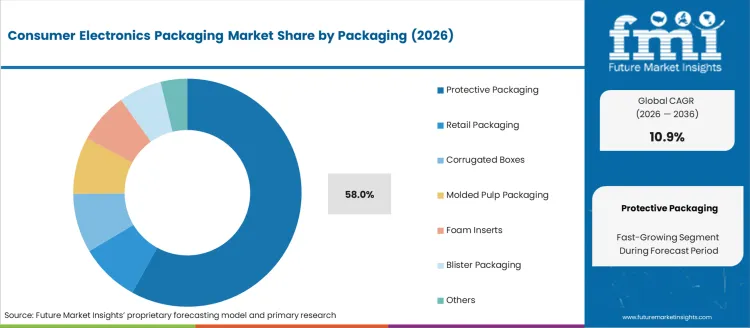
The protective packaging segment is projected to account for 58% of the consumer electronics packaging market in 2026, reaffirming its position as the leading packaging category. Manufacturers and retailers increasingly utilize protective packaging for its superior cushioning characteristics, established shock absorption capabilities, and essential functionality in damage prevention applications across diverse distribution categories. Protective packaging's standardized protection characteristics and proven effectiveness directly address manufacturer requirements for reliable product safety and optimal protection value in logistics applications.
This packaging segment forms the foundation of modern electronics distribution patterns, as it represents the format with the greatest manufacturer acceptance potential and established compatibility across multiple product systems. Manufacturing investments in damage reduction optimization and quality standardization continue to strengthen adoption among cost-conscious organizations. With brands prioritizing product integrity and customer satisfaction, protective packaging aligns with both safety objectives and performance requirements, making it the central component of comprehensive electronics distribution strategies.
By Material Type, Paperboard Shows Strong Growth Potential
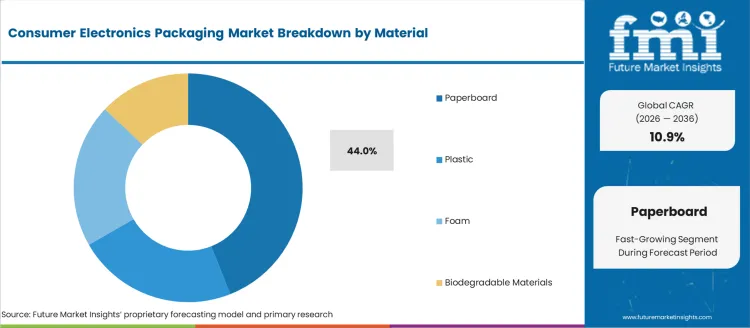
Paperboard is projected to represent 44% of the consumer electronics packaging market growth through 2036, underscoring its critical role as the primary choice for brand-focused manufacturers seeking superior printing capabilities and enhanced presentation credentials. Electronics brands and premium device manufacturers prefer paperboard for its enhanced graphics standards, proven recyclability advantages, and ability to maintain exceptional structural profiles while supporting premium positioning during retail and e-commerce experiences. Positioned as essential material for discerning brands, paperboard offerings provide both protective functionality and presentation excellence.
The segment is supported by continuous improvement in paperboard manufacturing technology and the widespread availability of established production infrastructure that enables quality assurance and premium positioning at the manufacturing level. The packaging converters are optimizing paperboard processing methods to support market differentiation and accessible premium pricing. As material technology continues to advance and brands seek superior presentation solutions, paperboard packaging will continue to drive market growth while supporting product protection and brand differentiation strategies.
What are the Drivers, Restraints, and Key Trends of the Consumer Electronics Packaging Market?
The consumer electronics packaging market is advancing rapidly due to increasing product protection consciousness and growing need for specialized packaging choices that emphasize superior protective outcomes across electronics segments and distribution applications. The market faces challenges, including higher material costs for premium solutions, dimensional constraints for compact device packaging, and supply chain complexities affecting pricing stability. Innovation in lightweight materials and specialized cushioning development continues to influence market development and expansion patterns.
Expansion of E-Commerce and Direct-to-Consumer Applications
The growing adoption of consumer electronics packaging in e-commerce programs and direct-to-consumer applications is enabling brands to develop distribution patterns that provide distinctive protection benefits while commanding premium positioning and enhanced customer experience characteristics. E-commerce applications provide superior brand visibility while allowing more sophisticated product presentation across various electronics categories. Manufacturers are increasingly recognizing the competitive advantages of premium packaging positioning for enhanced customer satisfaction and brand-conscious operational integration.
Integration of Smart Features and Tracking Technologies
Modern packaging manufacturers are incorporating advanced authentication systems, tracking technologies, and anti-counterfeiting protocols to enhance brand protection, improve supply chain visibility, and meet manufacturer demands for product-specific security solutions. These systems improve packaging effectiveness while enabling new applications, including integrated sensors and tamper-evident programs. Advanced technology integration also allows manufacturers to support premium market positioning and protection leadership beyond traditional packaging operations.
Analysis of the Consumer Electronics Packaging Market by Key Country
.webp "Top Country Growth Comparison Consumer Electronics Packaging Market Cagr (2026 2036)")
| Country | CAGR (2026-2036) |
|---|---|
| USA | 10.4% |
| Germany | 9.6% |
| UK | 9.3% |
| China | 12.1% |
| Japan | 9.8% |
Source: FMI analysis based on primary research and proprietary forecasting model
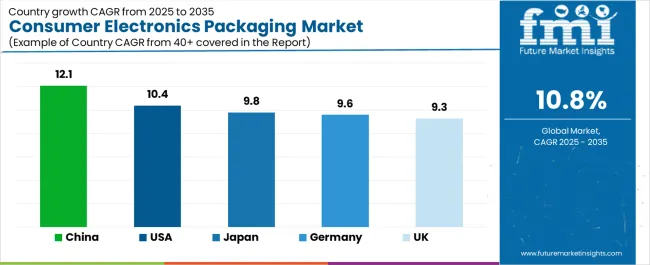
The consumer electronics packaging market is experiencing robust growth globally, with China leading at a 12.1% CAGR through 2036, driven by the country's position as the world's largest electronics manufacturing hub, growing domestic consumption, and increasing adoption of premium packaging solutions. The USA follows at 10.4%, supported by rising e-commerce penetration, expanding direct-to-consumer channels, and growing acceptance of protective packaging innovations. Germany shows growth at 9.6%, emphasizing established manufacturing excellence and comprehensive quality standards. The UK records 9.3%, focusing on premium retail experiences and e-commerce optimization. Japan demonstrates 9.8% growth, prioritizing quality packaging solutions and technological advancement.
The report covers an in-depth analysis of 40+ countries, with top-performing countries highlighted below.
USA Leads Global Market Growth with E-Commerce Expansion
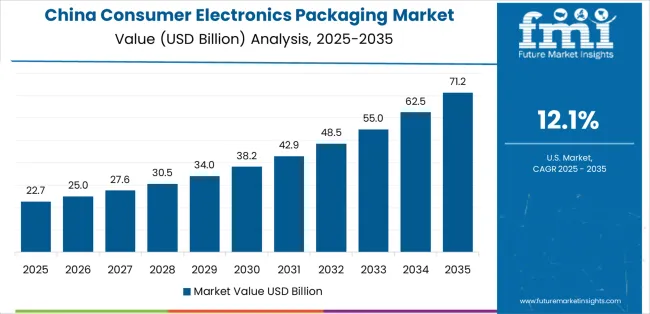
Revenue from consumer electronics packaging consumption and sales in the USA is projected to exhibit exceptional growth with a CAGR of 10.4% through 2036, driven by the country's rapidly expanding e-commerce sector, favorable consumer attitudes toward online electronics purchasing, and initiatives promoting packaging innovation across major technology hubs. The USA's position as a leading consumer electronics market and increasing focus on customer experience optimization are creating substantial demand for high-quality packaging solutions in both retail and online markets. Major packaging suppliers and specialty converters are establishing comprehensive production capabilities to serve growing brand demand and emerging e-commerce opportunities.
- Established e-commerce infrastructure and expanding direct-to-consumer practices are driving demand for consumer electronics packaging across retail outlets, online fulfillment centers, and comprehensive distribution systems throughout American electronics markets.
- Strong consumer spending power and brand experience awareness initiatives are supporting the rapid adoption of premium packaging solutions among quality-conscious manufacturers seeking to meet evolving customer expectations and protection requirements.
Germany Demonstrates Strong Market Potential with Manufacturing Excellence
Demand for consumer electronics packaging products in Germany is expanding at a CAGR of 9.6%, supported by rising manufacturing sophistication, growing precision engineering, and expanding electronics production infrastructure. The country's developing industrial capabilities and increasing manufacturer investment in quality packaging are driving demand for protective solutions across both domestic and export-focused applications. International packaging companies and domestic converters are establishing comprehensive production networks to address growing market demand for quality packaging and protective solutions.
- Rising electronics manufacturing and expanding production capabilities are creating opportunities for packaging adoption across manufacturing operations, modern assembly systems, and electronics companies throughout major German industrial regions.
- Growing engineering infrastructure development and manufacturing modernization initiatives are driving the adoption of packaging production and consumption among domestic manufacturers seeking to enhance their operational capabilities and meet increasing protection demand.
UK Maintains Market Leadership with Retail Excellence
Revenue from consumer electronics packaging products in the UK is projected to grow at a CAGR of 9.3% through 2036, supported by the country's mature consumer electronics market, established retail culture, and leadership in e-commerce innovation. Britain's sophisticated retail infrastructure and strong support for customer experience are creating steady demand for both traditional and innovative packaging varieties. Leading packaging suppliers and specialty converters are establishing comprehensive operational strategies to serve both domestic markets and growing export opportunities.
- Advanced retail capabilities and established consumer markets are driving demand for premium packaging solutions across electronics retailers, specialty stores, and comprehensive omnichannel companies seeking superior presentation profiles and quality innovation.
- Strong consumer consciousness and retail excellence are supporting the adoption of innovative packaging solutions among brands prioritizing customer experience and product protection in retail applications.
China Strengthens Position with Manufacturing Scale and Innovation
Demand for consumer electronics packaging products in China is projected to expand at a CAGR of 12.1% through 2036, driven by the country's emphasis on electronics manufacturing dominance, production leadership, and sophisticated manufacturing capabilities for devices requiring specialized protective varieties. Chinese manufacturers and brands consistently seek professional-grade packaging that enhances product protection and supports manufacturing operations for both domestic and international electronics applications. The country's position as the global electronics manufacturing leader continues to drive innovation in specialty packaging applications and professional product standards.
- Sophisticated manufacturing culture and expanding electronics production markets are driving demand for professional packaging solutions across device manufacturers, component suppliers, and production-focused operations seeking superior performance and distinctive protection profiles.
- Increasing focus on product quality and brand differentiation is supporting the adoption of specialty packaging varieties among manufacturers and brands seeking authentic quality products in regional markets with established manufacturing expertise.
Japan Anchors Growth with Quality and Innovation Focus
Revenue for consumer electronics packaging products in Japan is anticipated to grow at a CAGR of 9.8% through 2036, supported by the country's emphasis on quality manufacturing, product presentation standards, and advanced technology integration requiring efficient protective solutions. Japanese manufacturers and electronics brands prioritize quality performance and precision protection, making advanced packaging essential components for both traditional and modern electronics applications. The country's comprehensive manufacturing excellence and advancing retail patterns support continued market expansion.
- Advanced manufacturing technology capabilities and growing premium device protection are driving demand for packaging solutions across specialty converters, modern retail formats, and technology-integrated distribution programs serving domestic markets with increasing presentation requirements.
- Strong focus on customer experience optimization and quality excellence is encouraging manufacturers and retailers to adopt packaging solutions that support brand objectives and meet Japanese quality standards for electronics applications.
Europe Market Split by Country
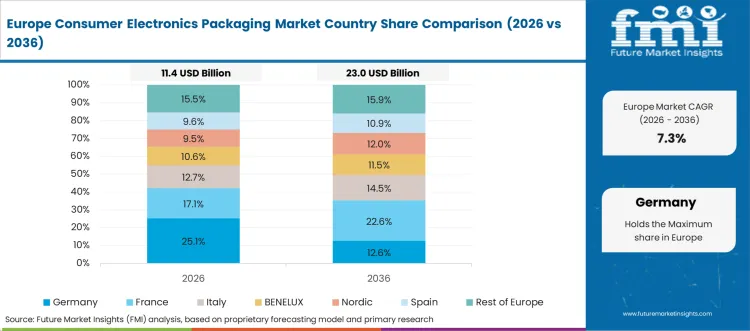
The Europe consumer electronics packaging market is projected to grow from USD 11.8 billion in 2026 to USD 28.6 billion by 2036, recording a CAGR of 9.2% over the forecast period. Germany leads the region with a 34.0% share in 2026, moderating slightly to 33.5% by 2036, supported by its strong electronics manufacturing base and demand for premium, professionally engineered packaging solutions. The United Kingdom follows with 22.5% in 2026, easing to 22.0% by 2036, driven by a sophisticated retail market and emphasis on customer experience and e-commerce excellence. France accounts for 19.0% in 2026, rising to 19.5% by 2036, reflecting steady adoption of protective packaging solutions and retail innovation. Italy holds 10.5% in 2026, expanding to 11.2% by 2036 as electronics retail modernization and specialty device applications grow. Spain contributes 7.0% in 2026, growing to 7.5% by 2036, supported by expanding consumer electronics markets and retail development. The Nordic countries rise from 5.5% in 2026 to 6.0% by 2036 on the back of strong quality adoption and advanced retail integration. BENELUX remains at 1.5% share across both 2026 and 2036, reflecting mature, premium-focused markets.
Competitive Landscape of the Consumer Electronics Packaging Market
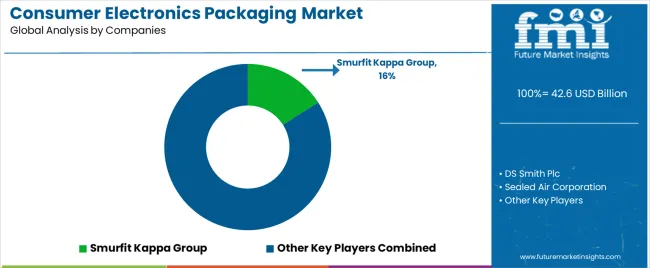
The consumer electronics packaging market features 10-15 players with moderate concentration, where the top three companies collectively hold around 45-52% of global market share. Growth is driven by the increasing demand for protective packaging solutions for fragile consumer electronics, as well as the growing trend of e-commerce and direct-to-consumer shipping. The leading company, Smurfit Kappa Group, commands 16% of the market share, supported by its extensive portfolio of corrugated and paper-based packaging solutions, global reach, and strong customer relationships across the electronics sector. Competition centers on protective performance, packaging sustainability, cost-effectiveness, and ease of integration into supply chains rather than price alone.
Market leaders such as Smurfit Kappa Group, DS Smith Plc, and Sealed Air Corporation maintain dominant positions by offering high-quality, customizable packaging solutions designed to protect delicate electronics during shipping and handling, including cushioning, anti-static, and tamper-evident packaging formats. Their strengths include advanced protective material technology, global production facilities, and comprehensive customer support.
Challenger companies including Mondi Group, Sonoco Products Company, and International Paper Company focus on eco-friendly, recyclable packaging alternatives for consumer electronics, catering to brands seeking sustainability in packaging.
Additional competition comes from WestRock Company, Pregis Corporation, UFP Technologies Inc., and Packaging Corporation of America, which strengthen their market presence through cost-effective solutions, regional manufacturing strength, and specialized designs for various consumer electronics applications.
Global Consumer Electronics Packaging Market - Stakeholder Contribution Framework
The success of consumer electronics packaging in meeting manufacturer protection demands, brand-driven presentation requirements, and quality assurance integration will not only enhance product outcomes but also strengthen global electronics manufacturing capabilities. It will consolidate emerging regions' positions as hubs for efficient packaging production and align advanced economies with innovative packaging systems. This calls for a concerted effort by all stakeholders - governments, industry bodies, suppliers, converters, and investors. Each can be a crucial enabler in preparing the market for its next phase of growth.
How Governments Could Spur Local Production and Adoption?
- Targeted Incentives: Introduce manufacturing modernization subsidies for companies adopting advanced packaging production technologies in electronics manufacturing and packaging innovation regions, and production-linked incentives for facilities producing packaging solutions for domestic consumption and export markets.
- Trade Agreements: Accelerate export growth through bilateral and multilateral agreements that classify electronics packaging under "protective industrial packaging," easing cross-border regulatory approvals and quality certifications.
- Facilitate Innovation: Establish Centers of Excellence for packaging innovation and materials engineering. Fund R&D into efficient production methods, material optimization, and quality-standard integration for electronics packaging operations.
How Industry Bodies Could Support Market Development?
- Foster Connectivity: Constitute a global electronics packaging consortium linking manufacturers, material suppliers, converters, and policymakers to align production targets with quality and protection commitments.
- Promote Exports: Work with export councils to brand electronics packaging as premium, professionally engineered protection solutions. Facilitate trade fairs to connect packaging innovators with global buyers in electronics, retail, and e-commerce sectors.
- Upskilling Programs: Develop curricula on advanced packaging manufacturing, quality control, materials engineering, and certification literacy to prepare suppliers and converters for premium market opportunities.
How Converters and Electronics Manufacturers Could Strengthen the Ecosystem?
- Drive Integration: Bundle packaging solutions with brand-focused marketing and protection messaging systems. Position protective packaging as part of holistic "product experience solutions."
- Forge Partnerships: Collaborate with packaging manufacturers and testing laboratories for joint R&D on protective applications, quality initiatives, and global safety assurance for premium markets.
How Suppliers Could Navigate the Shift?
- Capture Premium Markets: Leverage government incentives and rising product protection demand to supply packaging solutions into growth markets where conventional packaging faces quality and performance challenges.
- Invest in Technology: Partner with technology providers to advance efficient packaging production, professional-grade quality, and advanced manufacturing practices.
- Build Capabilities: Train technical staff and quality specialists to demonstrate packaging's protection advantages, repositioning supplier relationships toward long-term quality partnerships.
Key Players in the Consumer Electronics Packaging Market
- Smurfit Kappa Group
- DS Smith Plc
- Sealed Air Corporation
- Mondi Group
- Sonoco Products Company
- International Paper Company
- WestRock Company
- Pregis Corporation
- UFP Technologies Inc.
- Packaging Corporation of America
Scope of the Report
| Metric | Value |
|---|---|
| Quantitative Units | USD 47.22 billion to USD 132.28 billion, at a CAGR of 10.85% |
| Market Definition | Based on FMI's report, the Consumer Electronics Packaging market covers protective packaging, retail packaging, corrugated boxes, molded pulp packaging, foam inserts, blister packaging, and other formats in paperboard, plastic, foam, and biodegradable materials used for smartphones, laptops, wearable devices, audio devices, gaming consoles, cameras, and other consumer electronics globally. |
| Segmentation | Packaging: Protective Packaging, Retail Packaging, Corrugated Boxes, Molded Pulp Packaging, Foam Inserts, Blister Packaging, Others; Material: Paperboard, Plastic, Foam, Biodegradable Materials; End Use: Smartphones, Laptops & Tablets, Wearable Devices, Audio Devices, Gaming Consoles, Cameras, Others Electronics |
| Regions Covered | China, USA, Japan, Germany, UK |
| Key Companies Profiled | Smurfit Kappa Group, DS Smith Plc, Sealed Air Corporation, Mondi Group, Sonoco Products Company, International Paper Company, WestRock Company, Pregis Corporation, UFP Technologies Inc., Packaging Corporation of America |
| Forecast Period | 2026 to 2036 |
| Approach | Hybrid bottom-up methodology combining installed base metrics with regulatory compliance adoption curves and primary research validation. |
Consumer Electronics Packaging Market by Segments
Packaging Type:
- Protective Packaging
- Retail Packaging
- Corrugated Boxes
- Molded Pulp Packaging
- Foam Inserts
- Blister Packaging
- Other Packaging Types
Material Type:
- Paperboard
- Plastic
- Foam
- Biodegradable Materials
End-Use Application:
- Smartphones
- Laptops & Tablets
- Wearable Devices
- Audio Devices
- Gaming Consoles
- Cameras
- Other Electronics
Region:
- North America
- United States
- Canada
- Mexico
- Europe
- Germany
- United Kingdom
- France
- Italy
- Spain
- Nordic Countries
- BENELUX
- Rest of Europe
- Asia Pacific
- China
- Japan
- South Korea
- India
- Australia
- Rest of Asia Pacific
- Latin America
- Brazil
- Argentina
- Rest of Latin America
- Middle East & Africa
- Kingdom of Saudi Arabia
- United Arab Emirates
- South Africa
- Rest of Middle East & Africa
- Other Regions
- Oceania
- Central Asia
- Other Markets
Bibliography
- 1. European Commission. (2024). Packaging and Packaging Waste Regulation (PPWR): Final Text. European Commission.
- 2. USA Environmental Protection Agency. (2025). Facts and Figures about Materials, Waste and Recycling: Packaging Category. EPA.
- 3. World Packaging Organisation. (2024). Global Packaging Trends Report. WPO.
- 4. International Organization for Standardization. (2024). ISO 18601: Packaging and the Environment, General Requirements. ISO.
- 5. Organisation for Economic Co-operation and Development. (2025). Extended Producer Responsibility: Updated Guidance for Efficient Waste Management. OECD Publishing.
- 6. Consumer Technology Association. (2025). Global Consumer Electronics Device Shipment Forecast. CTA.
This bibliography is provided for reader reference. The full Future Market Insights report contains the complete reference list with primary research documentation.
Frequently Asked Questions
How large is the Consumer Electronics Packaging market in 2026?
The Consumer Electronics Packaging market is estimated to be valued at USD 47.22 billion in 2026.
What will be the market size of Consumer Electronics Packaging by 2036?
Market size for Consumer Electronics Packaging is projected to reach USD 132.28 billion by 2036.
What is the expected CAGR for Consumer Electronics Packaging between 2026 and 2036?
The Consumer Electronics Packaging market is expected to grow at a CAGR of 10.85% between 2026 and 2036.
Which Packaging leads the Consumer Electronics Packaging market in 2026?
Protective Packaging accounts for 58% share in 2026 by Packaging.
Which region is projected to grow fastest?
China is projected to grow at a CAGR of 12.1% during 2026 to 2036.
What does this report include in its scope?
The report covers market sizing, segmentation analysis, regional forecasts, competitive landscape evaluation, and forecast projections from 2026 to 2036.
How does FMI build and validate the Consumer Electronics Packaging forecast?
Forecasting models apply a bottom-up methodology starting with installed base metrics and cross-validate projections against quarterly revenue volumes and industry shipment data.
Preview the report firsthand - request a free sample
Get SampleGet the brochure for pricing and purchase details.
Get PDFTable of Content
- Executive Summary
- Global Market Outlook
- Demand-side Trends
- Supply-side Trends
- Technology Roadmap Analysis
- Analysis and Recommendations
- Market Overview
- Market Coverage / Taxonomy
- Market Definition / Scope / Limitations
- Research Methodology
- Chapter Orientation
- Analytical Lens and Working Hypotheses
- Market Structure, Signals, and Trend Drivers
- Benchmarking and Cross-market Comparability
- Market Sizing, Forecasting, and Opportunity Mapping
- Research Design and Evidence Framework
- Desk Research Programme (Secondary Evidence)
- Company Annual and Sustainability Reports
- Peer-reviewed Journals and Academic Literature
- Corporate Websites, Product Literature, and Technical Notes
- Earnings Decks and Investor Briefings
- Statutory Filings and Regulatory Disclosures
- Technical White Papers and Standards Notes
- Trade Journals, Industry Magazines, and Analyst Briefs
- Conference Proceedings, Webinars, and Seminar Materials
- Government Statistics Portals and Public Data Releases
- Press Releases and Reputable Media Coverage
- Specialist Newsletters and Curated Briefings
- Sector Databases and Reference Repositories
- FMI Internal Proprietary Databases and Historical Market Datasets
- Subscription Datasets and Paid Sources
- Social Channels, Communities, and Digital Listening Inputs
- Additional Desk Sources
- Expert Input and Fieldwork (Primary Evidence)
- Primary Modes
- Qualitative Interviews and Expert Elicitation
- Quantitative Surveys and Structured Data Capture
- Blended Approach
- Why Primary Evidence is Used
- Field Techniques
- Interviews
- Surveys
- Focus Groups
- Observational and In-context Research
- Social and Community Interactions
- Stakeholder Universe Engaged
- C-suite Leaders
- Board Members
- Presidents and Vice Presidents
- R&D and Innovation Heads
- Technical Specialists
- Domain Subject-matter Experts
- Scientists
- Physicians and Other Healthcare Professionals
- Governance, Ethics, and Data Stewardship
- Research Ethics
- Data Integrity and Handling
- Primary Modes
- Tooling, Models, and Reference Databases
- Desk Research Programme (Secondary Evidence)
- Data Engineering and Model Build
- Data Acquisition and Ingestion
- Cleaning, Normalisation, and Verification
- Synthesis, Triangulation, and Analysis
- Quality Assurance and Audit Trail
- Market Background
- Market Dynamics
- Drivers
- Restraints
- Opportunity
- Trends
- Scenario Forecast
- Demand in Optimistic Scenario
- Demand in Likely Scenario
- Demand in Conservative Scenario
- Opportunity Map Analysis
- Product Life Cycle Analysis
- Supply Chain Analysis
- Investment Feasibility Matrix
- Value Chain Analysis
- PESTLE and Porter’s Analysis
- Regulatory Landscape
- Regional Parent Market Outlook
- Production and Consumption Statistics
- Import and Export Statistics
- Market Dynamics
- Global Market Analysis 2021 to 2025 and Forecast, 2026 to 2036
- Historical Market Size Value (USD Million) Analysis, 2021 to 2025
- Current and Future Market Size Value (USD Million) Projections, 2026 to 2036
- Y-o-Y Growth Trend Analysis
- Absolute $ Opportunity Analysis
- Global Market Pricing Analysis 2021 to 2025 and Forecast 2026 to 2036
- Global Market Analysis 2021 to 2025 and Forecast 2026 to 2036, By Packaging
- Introduction / Key Findings
- Historical Market Size Value (USD Million) Analysis By Packaging , 2021 to 2025
- Current and Future Market Size Value (USD Million) Analysis and Forecast By Packaging , 2026 to 2036
- Protective Packaging
- Retail Packaging
- Corrugated Boxes
- Molded Pulp Packaging
- Foam Inserts
- Blister Packaging
- Others
- Protective Packaging
- Y-o-Y Growth Trend Analysis By Packaging , 2021 to 2025
- Absolute $ Opportunity Analysis By Packaging , 2026 to 2036
- Global Market Analysis 2021 to 2025 and Forecast 2026 to 2036, By Material
- Introduction / Key Findings
- Historical Market Size Value (USD Million) Analysis By Material, 2021 to 2025
- Current and Future Market Size Value (USD Million) Analysis and Forecast By Material, 2026 to 2036
- Paperboard
- Plastic
- Foam
- Biodegradable Materials
- Paperboard
- Y-o-Y Growth Trend Analysis By Material, 2021 to 2025
- Absolute $ Opportunity Analysis By Material, 2026 to 2036
- Global Market Analysis 2021 to 2025 and Forecast 2026 to 2036, By End Use
- Introduction / Key Findings
- Historical Market Size Value (USD Million) Analysis By End Use, 2021 to 2025
- Current and Future Market Size Value (USD Million) Analysis and Forecast By End Use, 2026 to 2036
- Smartphones
- Laptops & Tablets
- Wearable Devices
- Audio Devices
- Gaming Consoles
- Cameras
- Others Electronics
- Smartphones
- Y-o-Y Growth Trend Analysis By End Use, 2021 to 2025
- Absolute $ Opportunity Analysis By End Use, 2026 to 2036
- Global Market Analysis 2021 to 2025 and Forecast 2026 to 2036, By Region
- Introduction
- Historical Market Size Value (USD Million) Analysis By Region, 2021 to 2025
- Current Market Size Value (USD Million) Analysis and Forecast By Region, 2026 to 2036
- North America
- Latin America
- Western Europe
- Eastern Europe
- East Asia
- South Asia and Pacific
- Middle East & Africa
- Market Attractiveness Analysis By Region
- North America Market Analysis 2021 to 2025 and Forecast 2026 to 2036, By Country
- Historical Market Size Value (USD Million) Trend Analysis By Market Taxonomy, 2021 to 2025
- Market Size Value (USD Million) Forecast By Market Taxonomy, 2026 to 2036
- By Country
- USA
- Canada
- Mexico
- By Packaging
- By Material
- By End Use
- By Country
- Market Attractiveness Analysis
- By Country
- By Packaging
- By Material
- By End Use
- Key Takeaways
- Latin America Market Analysis 2021 to 2025 and Forecast 2026 to 2036, By Country
- Historical Market Size Value (USD Million) Trend Analysis By Market Taxonomy, 2021 to 2025
- Market Size Value (USD Million) Forecast By Market Taxonomy, 2026 to 2036
- By Country
- Brazil
- Chile
- Rest of Latin America
- By Packaging
- By Material
- By End Use
- By Country
- Market Attractiveness Analysis
- By Country
- By Packaging
- By Material
- By End Use
- Key Takeaways
- Western Europe Market Analysis 2021 to 2025 and Forecast 2026 to 2036, By Country
- Historical Market Size Value (USD Million) Trend Analysis By Market Taxonomy, 2021 to 2025
- Market Size Value (USD Million) Forecast By Market Taxonomy, 2026 to 2036
- By Country
- Germany
- UK
- Italy
- Spain
- France
- Nordic
- BENELUX
- Rest of Western Europe
- By Packaging
- By Material
- By End Use
- By Country
- Market Attractiveness Analysis
- By Country
- By Packaging
- By Material
- By End Use
- Key Takeaways
- Eastern Europe Market Analysis 2021 to 2025 and Forecast 2026 to 2036, By Country
- Historical Market Size Value (USD Million) Trend Analysis By Market Taxonomy, 2021 to 2025
- Market Size Value (USD Million) Forecast By Market Taxonomy, 2026 to 2036
- By Country
- Russia
- Poland
- Hungary
- Balkan & Baltic
- Rest of Eastern Europe
- By Packaging
- By Material
- By End Use
- By Country
- Market Attractiveness Analysis
- By Country
- By Packaging
- By Material
- By End Use
- Key Takeaways
- East Asia Market Analysis 2021 to 2025 and Forecast 2026 to 2036, By Country
- Historical Market Size Value (USD Million) Trend Analysis By Market Taxonomy, 2021 to 2025
- Market Size Value (USD Million) Forecast By Market Taxonomy, 2026 to 2036
- By Country
- China
- Japan
- South Korea
- By Packaging
- By Material
- By End Use
- By Country
- Market Attractiveness Analysis
- By Country
- By Packaging
- By Material
- By End Use
- Key Takeaways
- South Asia and Pacific Market Analysis 2021 to 2025 and Forecast 2026 to 2036, By Country
- Historical Market Size Value (USD Million) Trend Analysis By Market Taxonomy, 2021 to 2025
- Market Size Value (USD Million) Forecast By Market Taxonomy, 2026 to 2036
- By Country
- India
- ASEAN
- Australia & New Zealand
- Rest of South Asia and Pacific
- By Packaging
- By Material
- By End Use
- By Country
- Market Attractiveness Analysis
- By Country
- By Packaging
- By Material
- By End Use
- Key Takeaways
- Middle East & Africa Market Analysis 2021 to 2025 and Forecast 2026 to 2036, By Country
- Historical Market Size Value (USD Million) Trend Analysis By Market Taxonomy, 2021 to 2025
- Market Size Value (USD Million) Forecast By Market Taxonomy, 2026 to 2036
- By Country
- Kingdom of Saudi Arabia
- Other GCC Countries
- Turkiye
- South Africa
- Other African Union
- Rest of Middle East & Africa
- By Packaging
- By Material
- By End Use
- By Country
- Market Attractiveness Analysis
- By Country
- By Packaging
- By Material
- By End Use
- Key Takeaways
- Key Countries Market Analysis
- USA
- Pricing Analysis
- Market Share Analysis, 2025
- By Packaging
- By Material
- By End Use
- Canada
- Pricing Analysis
- Market Share Analysis, 2025
- By Packaging
- By Material
- By End Use
- Mexico
- Pricing Analysis
- Market Share Analysis, 2025
- By Packaging
- By Material
- By End Use
- Brazil
- Pricing Analysis
- Market Share Analysis, 2025
- By Packaging
- By Material
- By End Use
- Chile
- Pricing Analysis
- Market Share Analysis, 2025
- By Packaging
- By Material
- By End Use
- Germany
- Pricing Analysis
- Market Share Analysis, 2025
- By Packaging
- By Material
- By End Use
- UK
- Pricing Analysis
- Market Share Analysis, 2025
- By Packaging
- By Material
- By End Use
- Italy
- Pricing Analysis
- Market Share Analysis, 2025
- By Packaging
- By Material
- By End Use
- Spain
- Pricing Analysis
- Market Share Analysis, 2025
- By Packaging
- By Material
- By End Use
- France
- Pricing Analysis
- Market Share Analysis, 2025
- By Packaging
- By Material
- By End Use
- India
- Pricing Analysis
- Market Share Analysis, 2025
- By Packaging
- By Material
- By End Use
- ASEAN
- Pricing Analysis
- Market Share Analysis, 2025
- By Packaging
- By Material
- By End Use
- Australia & New Zealand
- Pricing Analysis
- Market Share Analysis, 2025
- By Packaging
- By Material
- By End Use
- China
- Pricing Analysis
- Market Share Analysis, 2025
- By Packaging
- By Material
- By End Use
- Japan
- Pricing Analysis
- Market Share Analysis, 2025
- By Packaging
- By Material
- By End Use
- South Korea
- Pricing Analysis
- Market Share Analysis, 2025
- By Packaging
- By Material
- By End Use
- Russia
- Pricing Analysis
- Market Share Analysis, 2025
- By Packaging
- By Material
- By End Use
- Poland
- Pricing Analysis
- Market Share Analysis, 2025
- By Packaging
- By Material
- By End Use
- Hungary
- Pricing Analysis
- Market Share Analysis, 2025
- By Packaging
- By Material
- By End Use
- Kingdom of Saudi Arabia
- Pricing Analysis
- Market Share Analysis, 2025
- By Packaging
- By Material
- By End Use
- Turkiye
- Pricing Analysis
- Market Share Analysis, 2025
- By Packaging
- By Material
- By End Use
- South Africa
- Pricing Analysis
- Market Share Analysis, 2025
- By Packaging
- By Material
- By End Use
- USA
- Market Structure Analysis
- Competition Dashboard
- Competition Benchmarking
- Market Share Analysis of Top Players
- By Regional
- By Packaging
- By Material
- By End Use
- Competition Analysis
- Competition Deep Dive
- Smurfit Kappa Group
- Overview
- Product Portfolio
- Profitability by Market Segments (Product/Age /Sales Channel/Region)
- Sales Footprint
- Strategy Overview
- Marketing Strategy
- Product Strategy
- Channel Strategy
- DS Smith Plc
- Sealed Air Corporation
- Mondi Group
- Sonoco Products Company
- International Paper Company
- WestRock Company
- Pregis Corporation
- UFP Technologies Inc.
- Packaging Corporation of America
- Smurfit Kappa Group
- Competition Deep Dive
- Assumptions & Acronyms Used


