

- Industry Size (2026)
- USD 86.19 Bn
- Forecast (2036)
- USD 172.74 Bn
- CAGR (2026 to 2036)
- 7.2%
Consumer Cloud Subscription Market Size, Market Forecast and Outlook By FMI
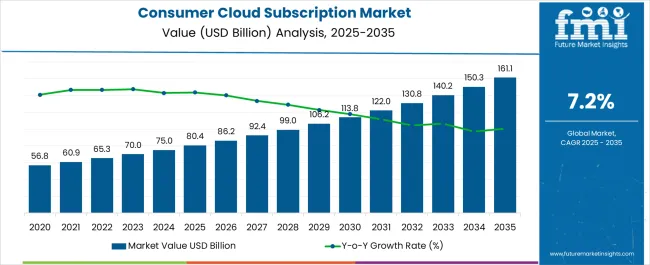
The consumer cloud subscription market was valued at USD 80.4 billion in 2025, projected to reach USD 86.19 billion in 2026, and is forecast to expand to USD 172.74 billion by 2036 at a 7.2% CAGR.
Demand is driven by the growing consumer and small business adoption of cloud-delivered services spanning storage, streaming, productivity, and collaboration platforms on recurring subscription models. Direct revenue channels maintain the leading share at 57.3% as platform operators sell subscriptions directly to end users through proprietary storefronts and application ecosystems. Individual users anchor the largest user segment at 49.6%, reflecting the mass-market penetration of cloud storage, music streaming, video streaming, and productivity suite subscriptions. Small and medium businesses are an expanding segment as cloud productivity and collaboration tools replace on-premises software with per-seat monthly pricing that aligns with operating expenditure preferences.
Summary of Consumer Cloud Subscription Market
- Market Overview
- The consumer cloud subscription market is valued at USD 80.4 billion in 2025 and is projected to reach USD 172.74 billion by 2036.
- The industry is expected to grow at a 7.2% CAGR from 2026 to 2036, creating an incremental opportunity of USD 86.55 billion.
- The market is a digital services category where revenue tracks consumer internet penetration, smartphone adoption, digital content willingness-to-pay, and small business cloud migration economics.
- Demand and Growth Drivers
- Demand is driven by mass-market consumer adoption of cloud storage, streaming, and productivity subscriptions across smartphone and desktop platforms.
- Direct subscription channels maintain the leading revenue share as platform operators sell through proprietary storefronts and app ecosystems.
- Small and medium business adoption is expanding as cloud productivity tools replace on-premises software with per-seat subscription pricing.
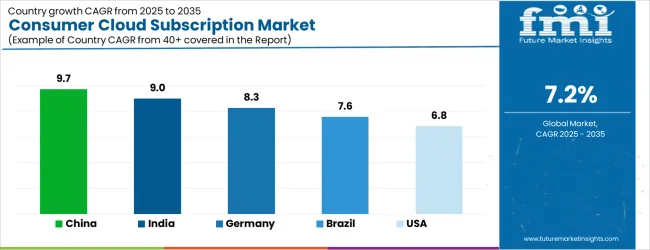
- Among key countries, China at 9.7%, India at 9%, Germany at 8.3%, Brazil at 7.6%, USA at 6.8%, UK at 6.1%, Japan at 5.4%.
- Product and Segment View
- The market covers recurring subscription services for cloud storage, content streaming, productivity suites, and collaboration platforms sold to consumers and small businesses.
- These services are delivered through direct and indirect revenue channels to individual users, small businesses, and medium businesses.
- Direct leads by Revenue with 57.3% share in 2026, driven by platform operators selling subscriptions through proprietary storefronts.
- Individual leads by User with 49.6% share in 2026.
- The scope includes consumer and SMB cloud subscription revenue, excluding enterprise-only B2B SaaS, infrastructure-as-a-service, and one-time digital content purchases.
- Geography and Competitive Outlook
- China and India are the fastest-growing markets due to massive user bases, smartphone penetration growth, and expanding digital content consumption.
- USA and Germany sustain demand through premium content renewals, productivity suite adoption, and SMB cloud migration.
- Competition is shaped by content library depth, platform ecosystem lock-in, pricing flexibility, and cross-device experience quality, with key players including Apple Inc., Google LLC, Amazon.com Inc., Microsoft Corporation, Netflix Inc., Spotify Technology S.A., Dropbox Inc..
- Analyst Opinion at FMI
- Sudip saha, Principal Consultant at Future Market Insights, opines: 'As per FMI analysis, the consumer cloud subscription market is entering a phase where specification precision, regulatory compliance, and lifecycle economics define procurement decisions. Organizations that delay standardization risk exclusion from major procurement cycles where qualification thresholds tighten progressively.'
- Strategic Implications / Executive Takeaways
- Platform operators must expand bundle offerings that combine storage, streaming, and productivity services to increase per-user average revenue and reduce churn rates.
- Content and service providers should develop localized pricing tiers for high-growth emerging markets where affordability thresholds differ from mature market willingness-to-pay levels.
- SMB-focused providers must develop simplified onboarding and administration interfaces to capture the expanding small business segment migrating from consumer-grade to business-tier cloud tools.
Consumer Cloud Subscription Market Key Takeaways
| Metric | Details |
|---|---|
| Industry Size (2026) | USD 86.19 billion |
| Industry Value (2036) | USD 172.74 billion |
| CAGR (2026-2036) | 7.2% |
Source: Future Market Insights, 2026
All major markets reflect digital adoption maturity and internet penetration rates. China leads at 9.7% CAGR driven by the massive user base of domestic cloud platform operators and expanding digital content consumption. India follows at 9% fueled by smartphone penetration growth, affordable mobile data, and rising digital content subscription willingness among urban consumers. Germany maintains 8.3% growth anchored by enterprise productivity suite adoption and small business cloud migration. Brazil at 7.6% and USA at 6.8% sustain demand through streaming service expansion and SMB cloud tool adoption. UK at 6.1% and Japan at 5.4% reflect steady growth driven by premium content and productivity platform renewals.
Consumer Cloud Subscription Market Definition
Consumer Cloud Subscription Market encompasses recurring subscription revenue from cloud-delivered services sold to individual consumers and small and medium businesses, including cloud storage, content streaming, productivity suites, and collaboration platforms. These services are distributed through direct platform storefronts and indirect channel partners on monthly, annual, and multi-year pricing models. Market growth tracks consumer internet penetration, digital willingness-to-pay, and SMB cloud adoption economics.
Consumer Cloud Subscription Market Inclusions
Market scope includes consumer and SMB cloud subscription revenue across storage, streaming, productivity, and collaboration services through direct and indirect revenue channels. Coverage spans global and regional market sizes, the 2026 to 2036 forecast period, and segment breakdowns by revenue channel, user type, and region.
Consumer Cloud Subscription Market Exclusions
The scope excludes enterprise-only B2B SaaS revenue, infrastructure-as-a-service, platform-as-a-service, one-time digital content purchases, and hardware device sales. It also omits advertising-supported free-tier revenue.
Consumer Cloud Subscription Market Research Methodology
- Primary Research: Analysts conducted structured interviews with procurement directors, industry specialists, and end-use operators to map decision gates and specification requirements in the consumer cloud subscription market.
- Desk Research: Data collection aggregated regulatory filings, industry standards, trade association reports, and publicly available corporate disclosures relevant to the consumer cloud subscription sector.
- Market-Sizing and Forecasting: Baseline values derive from a bottom-up aggregation of procurement volumes and revenue data, applying region-specific adoption curves to project future demand trajectories.
- Data Validation and Update Cycle: Projections are tested against publicly reported expenditure guidance and procurement records from major end-use operators and industry participants.
Why is the Consumer Cloud Subscription Market Growing?
The Consumer Cloud Subscription market is witnessing significant growth, driven by increasing reliance on cloud-based services for storage, productivity, and media consumption. Rising adoption of smartphones, laptops, and connected devices has accelerated the demand for cloud subscriptions that offer seamless access to personal and entertainment data. Enhanced convenience, flexibility, and remote accessibility provided by cloud platforms are further supporting widespread adoption.
Advanced features such as automatic backup, real-time synchronization, AI-driven content recommendations, and cross-device compatibility are improving user experience while increasing engagement. Security and data privacy enhancements have further reinforced consumer confidence in cloud services. The shift toward digital lifestyles, remote work, and streaming-based entertainment is creating new growth avenues.
As service providers expand offerings, introduce tiered subscription models, and integrate emerging technologies like AI and edge computing, the market is expected to sustain robust growth Rising demand for scalable, personalized, and cost-effective cloud solutions positions the Consumer Cloud Subscription market for continued expansion across both developed and emerging economies.
Segmental Analysis
The consumer cloud subscription market is segmented by revenue, user, and geographic regions. By revenue, consumer cloud subscription market is divided into Direct and Indirect. In terms of user, consumer cloud subscription market is classified into Individual, Small Businesses, and Medium Businesses. Regionally, the consumer cloud subscription industry is classified into North America, Latin America, Western Europe, Eastern Europe, Balkan & Baltic Countries, Russia & Belarus, Central Asia, East Asia, South Asia & Pacific, and the Middle East & Africa.
Insights into the Direct Revenue Segment
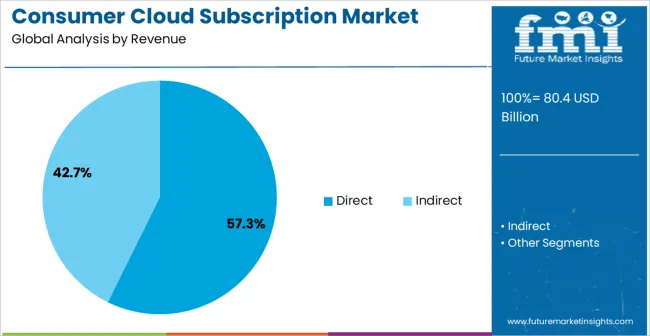
The direct revenue segment is projected to hold 57.3% of the market revenue in 2026, establishing it as the leading revenue model. Growth in this segment is being driven by the increasing preference of consumers and businesses for subscription-based payment models that provide predictable costs and immediate access to cloud services. Direct subscriptions offer benefits such as tiered pricing, flexible plans, and bundled service packages, which improve user retention and satisfaction.
Providers can offer enhanced customer support, personalized recommendations, and regular feature updates, increasing perceived value and reducing churn. The direct revenue model also enables faster monetization of new offerings and simplifies billing and account management processes.
With increasing adoption of cloud platforms for personal storage, collaboration tools, and entertainment streaming, direct subscription models are expected to maintain market leadership Providers are increasingly investing in marketing, loyalty programs, and platform integration to strengthen this segment, ensuring sustained growth while meeting evolving consumer expectations and technological trends.
Insights into the Individual User Segment
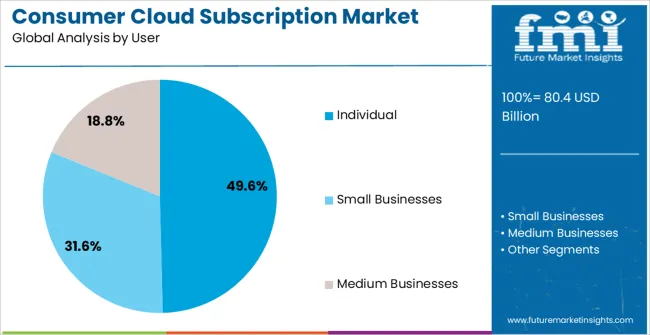
The individual user segment is anticipated to account for 49.6% of the market revenue in 2026, making it the leading user category. Growth is being driven by rising consumer reliance on cloud services for personal storage, entertainment, productivity applications, and data backup across multiple devices. Individual users value seamless access, real-time synchronization, and convenience, which are supported by subscription-based cloud solutions.
The ability to scale storage, customize plans, and integrate with various devices enhances adoption. Increasing awareness of data security and privacy solutions further strengthens consumer confidence and encourages migration to cloud platforms. Entertainment streaming, collaborative tools, and AI-powered personalization features are also driving individual subscriptions.
As remote work and digital lifestyle trends continue, individual consumers are expected to remain the primary revenue source for cloud service providers Service enhancements, innovative pricing models, and improved user experience are expected to sustain adoption, reinforcing the individual user segment’s leading position in the market.
Market Overview
Consumer Cloud Subscription Market Overview
The increasing usage of mobile devices and smartphone needs real-time data storage platform where users can store their data on one platform. This enabled cloud service providers to offer Consumer Cloud Subscription services through cloud platform.
The primary feature of the cloud platform is that the stored data can be accessed anytime, anywhere on various devices. This is a major advantage increases the demand for consumer cloud subscription services.
In addition to this, other key benefits of consumer cloud subscription enhanced storage and data sharing. The platform enables an enhanced user friendly interface as compared to the conventional data storage platform.
, cloud subscription services are majorly used the storage of photos, videos, contacts, personal information and songs.
Analysis of Consumer Cloud Subscription Market By Key Countries
.webp "Top Country Growth Comparison Consumer Cloud Subscription Market Cagr (2026 2036)")
| Country | CAGR |
|---|---|
| China | 9.7% |
| India | 9.0% |
| Germany | 8.3% |
| Brazil | 7.6% |
| USA | 6.8% |
| UK | 6.1% |
| Japan | 5.4% |
Source: FMI analysis based on primary research and proprietary forecasting model
Country-wise Analysis
The Consumer Cloud Subscription Market is expected to register a CAGR of 7.2% during the forecast period, exhibiting varied country level momentum. China leads with the highest CAGR of 9.7%, followed by India at 9.0%. Developed markets such as Germany, France, and the UK continue to expand steadily, while the USA is likely to grow at consistent rates. Japan posts the lowest CAGR at 5.4%, yet still underscores a broadly positive trajectory for the global Consumer Cloud Subscription Market. In 2024, Germany held a dominant revenue in the Western Europe market and is expected to grow with a CAGR of 8.3%. The USA Consumer Cloud Subscription Market is estimated to be valued at USD 27.6 billion in 2026 and is anticipated to reach a valuation of USD 27.6 billion by 2036. Sales are projected to rise at a CAGR of 0.0% over the forecast period between 2026 and 2036. While Japan and South Korea markets are estimated to be valued at USD 3.8 billion and USD 2.3 billion respectively in 2026.
Key Players in the Consumer Cloud Subscription Market
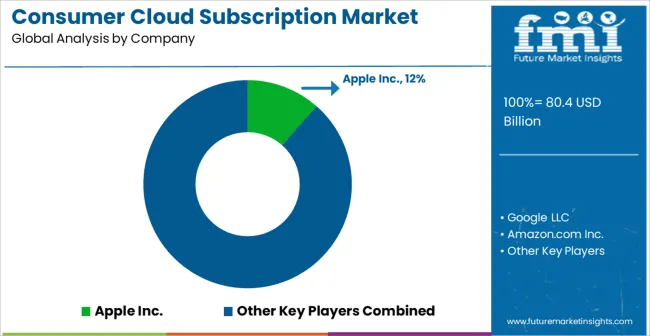
- Apple Inc.
- Google LLC
- Amazon.com Inc.
- Microsoft Corporation
- Netflix Inc.
- Spotify Technology S.A.
- Dropbox Inc.
- Adobe Inc.
- Tencent Holdings Ltd.
- Alibaba Group Holding Ltd.
- Box Inc.
- Zoom Video Communications Inc.
- Sony Group Corporation
- Samsung Electronics Co. Ltd.
- Meta Platforms Inc.
Scope of the Report
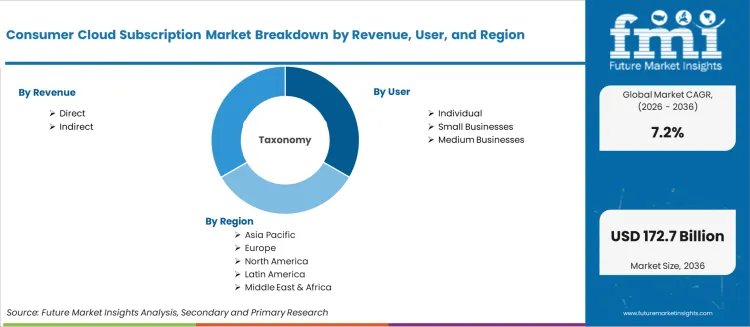
| Metric | Value |
|---|---|
| Quantitative Units | USD 86.19 billion to USD 172.74 billion, at a CAGR of 7.2% |
| Market Definition | Consumer cloud subscriptions cover recurring revenue from cloud storage, content streaming, productivity suites, and collaboration platforms sold to individual users and small businesses. |
| Segmentation | Revenue: Direct, Indirect; User: Individual, Small Businesses, Medium Businesses |
| Regions Covered | North America, Latin America, Europe, East Asia, South Asia, Oceania, Middle East & Africa |
| Countries Covered | China, India, Germany, Brazil, USA, UK, Japan, and 40 plus countries |
| Key Companies Profiled | Apple Inc., Google LLC, Amazon.com Inc., Microsoft Corporation, Netflix Inc., Spotify Technology S.A., Dropbox Inc., Adobe Inc. |
| Forecast Period | 2026 to 2036 |
| Approach | Forecasting models apply a bottom-up methodology starting with regional activity metrics and cross-validate projections against industry data and corporate disclosures. |
Consumer Cloud Subscription Market by Segments
Revenue:
- Direct
- Indirect
User:
- Individual
- Small Businesses
- Medium Businesses
Region:
- North America
- USA
- Canada
- Mexico
- Latin America
- Brazil
- Chile
- Rest of Latin America
- Western Europe
- Germany
- UK
- Italy
- Spain
- France
- Nordic
- BENELUX
- Rest of Western Europe
- Eastern Europe
- Russia
- Poland
- Hungary
- Balkan & Baltic
- Rest of Eastern Europe
- East Asia
- China
- Japan
- South Korea
- South Asia and Pacific
- India
- ASEAN
- Australia & New Zealand
- Rest of South Asia and Pacific
- Middle East & Africa
- Kingdom of Saudi Arabia
- Other GCC Countries
- Turkiye
- South Africa
- Other African Union
- Rest of Middle East & Africa
Bibliography
- 1. International Telecommunication Union. (2025). Global Connectivity Report: Internet and Mobile Subscription Trends. ITU.
- 2. Organisation for Economic Co-operation and Development. (2024). Digital Economy Outlook: Consumer Cloud Services. OECD.
- 3. European Commission. (2024). Digital Single Market: Consumer Cloud Services Regulation. European Commission.
- 4. World Bank Group. (2024). Digital Development: Consumer Internet Adoption Trends. World Bank.
- 5. United Nations Conference on Trade and Development. (2025). Digital Economy Report: Platform Services. UNCTAD.
This bibliography is provided for reader reference. The full Future Market Insights report contains the complete reference list with primary research documentation.
Frequently Asked Questions
How large is the demand for Consumer Cloud Subscription in the global market in 2026?
Demand for Consumer Cloud Subscription in the global market is estimated to be valued at USD 86.19 billion in 2026.
What will be the market size of Consumer Cloud Subscription in the global market by 2036?
Market size for Consumer Cloud Subscription is projected to reach USD 172.74 billion by 2036.
What is the expected demand growth for Consumer Cloud Subscription between 2026 and 2036?
Demand for Consumer Cloud Subscription is expected to grow at a CAGR of 7.2% between 2026 and 2036.
Which Revenue is poised to lead global sales by 2026?
Direct accounts for 57.3% share in 2026 based on FMI analysis.
How is the role of Individual in driving Consumer Cloud Subscription adoption in 2026?
Individual represents 49.6% of segment share in 2026 as per FMI's consumer cloud subscription market report.
What is the fastest-growing country market in this report?
China is projected to grow at a CAGR of 9.7% during 2026 to 2036.
What is Consumer Cloud Subscription and what is it mainly used for?
Consumer cloud subscriptions cover recurring revenue from cloud storage, content streaming, productivity suites, and collaboration platforms sold to individual users and small businesses.
What is included in the scope of this Consumer Cloud Subscription report?
The market covers recurring subscription revenue from cloud storage, streaming, productivity, and collaboration services for consumers and SMBs through direct and indirect channels.
Preview the report firsthand - request a free sample
Get SampleGet the brochure for pricing and purchase details.
Get PDFTable of Content
- Executive Summary
- Global Market Outlook
- Demand-side Trends
- Supply-side Trends
- Technology Roadmap Analysis
- Analysis and Recommendations
- Market Overview
- Market Coverage / Taxonomy
- Market Definition / Scope / Limitations
- Research Methodology
- Chapter Orientation
- Analytical Lens and Working Hypotheses
- Market Structure, Signals, and Trend Drivers
- Benchmarking and Cross-market Comparability
- Market Sizing, Forecasting, and Opportunity Mapping
- Research Design and Evidence Framework
- Desk Research Programme (Secondary Evidence)
- Company Annual and Sustainability Reports
- Peer-reviewed Journals and Academic Literature
- Corporate Websites, Product Literature, and Technical Notes
- Earnings Decks and Investor Briefings
- Statutory Filings and Regulatory Disclosures
- Technical White Papers and Standards Notes
- Trade Journals, Industry Magazines, and Analyst Briefs
- Conference Proceedings, Webinars, and Seminar Materials
- Government Statistics Portals and Public Data Releases
- Press Releases and Reputable Media Coverage
- Specialist Newsletters and Curated Briefings
- Sector Databases and Reference Repositories
- FMI Internal Proprietary Databases and Historical Market Datasets
- Subscription Datasets and Paid Sources
- Social Channels, Communities, and Digital Listening Inputs
- Additional Desk Sources
- Expert Input and Fieldwork (Primary Evidence)
- Primary Modes
- Qualitative Interviews and Expert Elicitation
- Quantitative Surveys and Structured Data Capture
- Blended Approach
- Why Primary Evidence is Used
- Field Techniques
- Interviews
- Surveys
- Focus Groups
- Observational and In-context Research
- Social and Community Interactions
- Stakeholder Universe Engaged
- C-suite Leaders
- Board Members
- Presidents and Vice Presidents
- R&D and Innovation Heads
- Technical Specialists
- Domain Subject-matter Experts
- Scientists
- Physicians and Other Healthcare Professionals
- Governance, Ethics, and Data Stewardship
- Research Ethics
- Data Integrity and Handling
- Primary Modes
- Tooling, Models, and Reference Databases
- Desk Research Programme (Secondary Evidence)
- Data Engineering and Model Build
- Data Acquisition and Ingestion
- Cleaning, Normalisation, and Verification
- Synthesis, Triangulation, and Analysis
- Quality Assurance and Audit Trail
- Market Background
- Market Dynamics
- Drivers
- Restraints
- Opportunity
- Trends
- Scenario Forecast
- Demand in Optimistic Scenario
- Demand in Likely Scenario
- Demand in Conservative Scenario
- Opportunity Map Analysis
- Product Life Cycle Analysis
- Supply Chain Analysis
- Investment Feasibility Matrix
- Value Chain Analysis
- PESTLE and Porter’s Analysis
- Regulatory Landscape
- Regional Parent Market Outlook
- Production and Consumption Statistics
- Import and Export Statistics
- Market Dynamics
- Global Market Analysis 2021 to 2025 and Forecast, 2026 to 2036
- Historical Market Size Value (USD Million) Analysis, 2021 to 2025
- Current and Future Market Size Value (USD Million) Projections, 2026 to 2036
- Y-o-Y Growth Trend Analysis
- Absolute $ Opportunity Analysis
- Global Market Pricing Analysis 2021 to 2025 and Forecast 2026 to 2036
- Global Market Analysis 2021 to 2025 and Forecast 2026 to 2036, By Revenue
- Introduction / Key Findings
- Historical Market Size Value (USD Million) Analysis By Revenue , 2021 to 2025
- Current and Future Market Size Value (USD Million) Analysis and Forecast By Revenue , 2026 to 2036
- Direct
- Indirect
- Direct
- Y-o-Y Growth Trend Analysis By Revenue , 2021 to 2025
- Absolute $ Opportunity Analysis By Revenue , 2026 to 2036
- Global Market Analysis 2021 to 2025 and Forecast 2026 to 2036, By User
- Introduction / Key Findings
- Historical Market Size Value (USD Million) Analysis By User, 2021 to 2025
- Current and Future Market Size Value (USD Million) Analysis and Forecast By User, 2026 to 2036
- Individual
- Small Businesses
- Medium Businesses
- Individual
- Y-o-Y Growth Trend Analysis By User, 2021 to 2025
- Absolute $ Opportunity Analysis By User, 2026 to 2036
- Global Market Analysis 2021 to 2025 and Forecast 2026 to 2036, By Region
- Introduction
- Historical Market Size Value (USD Million) Analysis By Region, 2021 to 2025
- Current Market Size Value (USD Million) Analysis and Forecast By Region, 2026 to 2036
- North America
- Latin America
- Western Europe
- Eastern Europe
- East Asia
- South Asia and Pacific
- Middle East & Africa
- Market Attractiveness Analysis By Region
- North America Market Analysis 2021 to 2025 and Forecast 2026 to 2036, By Country
- Historical Market Size Value (USD Million) Trend Analysis By Market Taxonomy, 2021 to 2025
- Market Size Value (USD Million) Forecast By Market Taxonomy, 2026 to 2036
- By Country
- USA
- Canada
- Mexico
- By Revenue
- By User
- By Country
- Market Attractiveness Analysis
- By Country
- By Revenue
- By User
- Key Takeaways
- Latin America Market Analysis 2021 to 2025 and Forecast 2026 to 2036, By Country
- Historical Market Size Value (USD Million) Trend Analysis By Market Taxonomy, 2021 to 2025
- Market Size Value (USD Million) Forecast By Market Taxonomy, 2026 to 2036
- By Country
- Brazil
- Chile
- Rest of Latin America
- By Revenue
- By User
- By Country
- Market Attractiveness Analysis
- By Country
- By Revenue
- By User
- Key Takeaways
- Western Europe Market Analysis 2021 to 2025 and Forecast 2026 to 2036, By Country
- Historical Market Size Value (USD Million) Trend Analysis By Market Taxonomy, 2021 to 2025
- Market Size Value (USD Million) Forecast By Market Taxonomy, 2026 to 2036
- By Country
- Germany
- UK
- Italy
- Spain
- France
- Nordic
- BENELUX
- Rest of Western Europe
- By Revenue
- By User
- By Country
- Market Attractiveness Analysis
- By Country
- By Revenue
- By User
- Key Takeaways
- Eastern Europe Market Analysis 2021 to 2025 and Forecast 2026 to 2036, By Country
- Historical Market Size Value (USD Million) Trend Analysis By Market Taxonomy, 2021 to 2025
- Market Size Value (USD Million) Forecast By Market Taxonomy, 2026 to 2036
- By Country
- Russia
- Poland
- Hungary
- Balkan & Baltic
- Rest of Eastern Europe
- By Revenue
- By User
- By Country
- Market Attractiveness Analysis
- By Country
- By Revenue
- By User
- Key Takeaways
- East Asia Market Analysis 2021 to 2025 and Forecast 2026 to 2036, By Country
- Historical Market Size Value (USD Million) Trend Analysis By Market Taxonomy, 2021 to 2025
- Market Size Value (USD Million) Forecast By Market Taxonomy, 2026 to 2036
- By Country
- China
- Japan
- South Korea
- By Revenue
- By User
- By Country
- Market Attractiveness Analysis
- By Country
- By Revenue
- By User
- Key Takeaways
- South Asia and Pacific Market Analysis 2021 to 2025 and Forecast 2026 to 2036, By Country
- Historical Market Size Value (USD Million) Trend Analysis By Market Taxonomy, 2021 to 2025
- Market Size Value (USD Million) Forecast By Market Taxonomy, 2026 to 2036
- By Country
- India
- ASEAN
- Australia & New Zealand
- Rest of South Asia and Pacific
- By Revenue
- By User
- By Country
- Market Attractiveness Analysis
- By Country
- By Revenue
- By User
- Key Takeaways
- Middle East & Africa Market Analysis 2021 to 2025 and Forecast 2026 to 2036, By Country
- Historical Market Size Value (USD Million) Trend Analysis By Market Taxonomy, 2021 to 2025
- Market Size Value (USD Million) Forecast By Market Taxonomy, 2026 to 2036
- By Country
- Kingdom of Saudi Arabia
- Other GCC Countries
- Turkiye
- South Africa
- Other African Union
- Rest of Middle East & Africa
- By Revenue
- By User
- By Country
- Market Attractiveness Analysis
- By Country
- By Revenue
- By User
- Key Takeaways
- Key Countries Market Analysis
- USA
- Pricing Analysis
- Market Share Analysis, 2025
- By Revenue
- By User
- Canada
- Pricing Analysis
- Market Share Analysis, 2025
- By Revenue
- By User
- Mexico
- Pricing Analysis
- Market Share Analysis, 2025
- By Revenue
- By User
- Brazil
- Pricing Analysis
- Market Share Analysis, 2025
- By Revenue
- By User
- Chile
- Pricing Analysis
- Market Share Analysis, 2025
- By Revenue
- By User
- Germany
- Pricing Analysis
- Market Share Analysis, 2025
- By Revenue
- By User
- UK
- Pricing Analysis
- Market Share Analysis, 2025
- By Revenue
- By User
- Italy
- Pricing Analysis
- Market Share Analysis, 2025
- By Revenue
- By User
- Spain
- Pricing Analysis
- Market Share Analysis, 2025
- By Revenue
- By User
- France
- Pricing Analysis
- Market Share Analysis, 2025
- By Revenue
- By User
- India
- Pricing Analysis
- Market Share Analysis, 2025
- By Revenue
- By User
- ASEAN
- Pricing Analysis
- Market Share Analysis, 2025
- By Revenue
- By User
- Australia & New Zealand
- Pricing Analysis
- Market Share Analysis, 2025
- By Revenue
- By User
- China
- Pricing Analysis
- Market Share Analysis, 2025
- By Revenue
- By User
- Japan
- Pricing Analysis
- Market Share Analysis, 2025
- By Revenue
- By User
- South Korea
- Pricing Analysis
- Market Share Analysis, 2025
- By Revenue
- By User
- Russia
- Pricing Analysis
- Market Share Analysis, 2025
- By Revenue
- By User
- Poland
- Pricing Analysis
- Market Share Analysis, 2025
- By Revenue
- By User
- Hungary
- Pricing Analysis
- Market Share Analysis, 2025
- By Revenue
- By User
- Kingdom of Saudi Arabia
- Pricing Analysis
- Market Share Analysis, 2025
- By Revenue
- By User
- Turkiye
- Pricing Analysis
- Market Share Analysis, 2025
- By Revenue
- By User
- South Africa
- Pricing Analysis
- Market Share Analysis, 2025
- By Revenue
- By User
- USA
- Market Structure Analysis
- Competition Dashboard
- Competition Benchmarking
- Market Share Analysis of Top Players
- By Regional
- By Revenue
- By User
- Competition Analysis
- Competition Deep Dive
- Apple Inc.
- Overview
- Product Portfolio
- Profitability by Market Segments (Product/Age /Sales Channel/Region)
- Sales Footprint
- Strategy Overview
- Marketing Strategy
- Product Strategy
- Channel Strategy
- Google LLC
- Amazon.com Inc.
- Microsoft Corporation
- Netflix Inc.
- Spotify Technology S.A.
- Dropbox Inc.
- Adobe Inc.
- Tencent Holdings Ltd.
- Alibaba Group Holding Ltd.
- Box Inc.
- Zoom Video Communications Inc.
- Sony Group Corporation
- Samsung Electronics Co. Ltd.
- Meta Platforms Inc.
- Apple Inc.
- Competition Deep Dive
- Assumptions & Acronyms Used


