

- Industry Size (2026)
- USD 153.06 Bn
- Forecast (2036)
- USD 1953.29 Bn
- CAGR (2026 to 2036)
- 29%
Consumer Facing AI Products Market Market Size, Market Forecast and Outlook By FMI
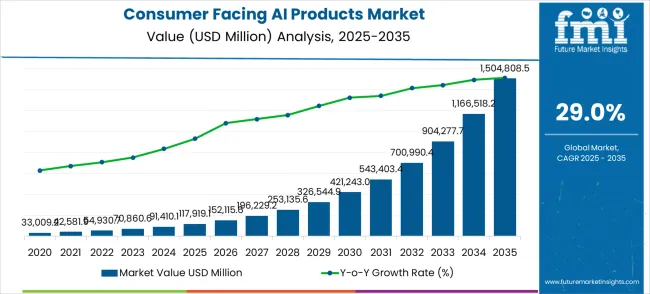
The Consumer Facing AI Products market was valued at USD 118.65 billion in 2025, projected to reach USD 153.06 billion in 2026, and is forecast to expand to USD 1953.29 billion by 2036 at a 29% CAGR. FMI opines that the integration of generative AI capabilities into smartphones, smart home ecosystems, wearable health devices, and entertainment platforms is converting AI from a backend infrastructure technology into a direct consumer purchase driver. As per FMI, the deployment of on-device large language models in smartphones and the proliferation of AI-powered health monitoring wearables are creating product categories where AI capability is the primary specification consumers evaluate at point of purchase, rather than a supplementary feature layered onto existing hardware.
Summary of Consumer Facing AI Products Market Market
- Market Overview
- The Consumer Facing AI Products market is valued at USD 118.65 billion in 2025 and is projected to reach USD 1953.29 billion by 2036.
- The industry is expected to grow at a 29% CAGR from 2026 to 2036, creating an incremental opportunity of USD 1800.23 billion.
- The market is a technology-disruption-driven consumer electronics category where on-device AI processing capability, generative AI integration depth, and health monitoring accuracy define competitive positioning among consumer AI product suppliers globally.
- Demand and Growth Drivers
- Demand is driven by integration of generative AI into smartphones, smart home ecosystems, and wearable health devices, converting AI from backend infrastructure into a direct consumer purchase driver.
- On-device large language model deployment in smartphones is creating product categories where AI capability is the primary purchase specification.
- AI-powered health monitoring wearables are generating new demand in healthcare and wellness applications across all age demographics.
- China leads at 39.2% CAGR, followed by India at 36.3%, Germany at 33.4%, Brazil at 30.5%, USA at 27.6%, UK at 24.7%, and Japan at 21.8%.
- Product and Segment View
- The market includes product, application as primary segmentation dimensions.
- Smart Home & IoT Devices leads by Product with 38% share in 2026.
- Healthcare and Wellness leads by Application with 28% share in 2026.
- Geography and Competitive Outlook
- China is the fastest-growing region at 39.2% CAGR, while India anchors the second-largest demand base.
- Competition is shaped by manufacturing scale, material specialisation, and distribution reach, with key players including Apple Inc., Google, Amazon, Samsung, Microsoft.
- Analyst Opinion at FMI
- Ronak Shah, Principal Consultant, opines: 'FMI's analysis reveals that the consumer facing ai products market is entering a phase where procurement decisions are increasingly shaped by regulatory compliance timelines and measurable performance thresholds. Organisations that delay investment risk falling behind competitors actively securing next-generation platform positions.'
- Strategic Implications / Executive Takeaways
- Solution providers must secure certified integration pathways with tier-1 enterprise systems to qualify for forthcoming institutional procurement contracts.
- Capital project directors should mandate native platform compatibility in all new procurement specifications.
- Technical teams must develop specialised competencies in product validation to demonstrate compliance parameters.
Consumer Facing AI Products Market Market Key Takeaways
| Metric | Details |
|---|---|
| Industry Size (2026) | USD 153.06 billion |
| Industry Value (2036) | USD 1953.29 billion |
| CAGR (2026 to 2036) | 29% |
Source: Future Market Insights, 2026
FMI is of the opinion that regional growth trajectories reflect varying AI infrastructure maturity and consumer technology adoption propensity. China leads at 39.2% CAGR, driven by the scale of domestic AI chip manufacturing and the rapid integration of generative AI into consumer electronics by Huawei and Xiaomi. India follows at 36.3%, supported by affordable AI-enabled smartphone proliferation and the expansion of voice-first AI assistant adoption in vernacular languages. Germany registers 33.4% growth as automotive AI crossover applications and smart home energy management systems generate dual-use consumer demand. Brazil maintains 30.5% growth driven by fintech AI adoption and retail recommendation engine expansion.
The USA registers 27.6% growth reflecting mature market upgrade cycles for AI-enhanced devices from Apple and Google. The UK sustains 24.7% growth driven by healthcare AI wearable adoption. Japan maintains 21.8% growth as robotics and eldercare AI products address demographic-specific consumer needs. Based on FMI's report, smartphones with on-device AI processing capabilities now command average selling prices 40% higher than non-AI equivalents across all regions. Future Market Insights analysis indicates smart home and IoT devices account for 38.0% product share as AI-powered home automation transitions from early adopter to mainstream consumer procurement.
Consumer Facing AI Products Market Market Definition
Based on FMI's report, the Consumer Facing AI Products market covers AI-powered consumer products including smart home and IoT devices, wearables and health AI platforms, smartphones with on-device AI features, entertainment and media AI applications, consumer robotics, drones, and related AI-enabled consumer electronics sold globally.
Consumer Facing AI Products Market Market Inclusions
Future Market Insights analysis covers AI-powered consumer products across all major product categories and application verticals. The scope encompasses regional market sizes across seven key countries, forecast projections from 2026 to 2036, and segmentation by product and application.
Consumer Facing AI Products Market Market Exclusions
The scope excludes enterprise AI software platforms not sold directly to consumers, backend cloud AI infrastructure, industrial robotics, and B2B AI analytics tools without a consumer-facing product component.
Consumer Facing AI Products Market Market Research Methodology
- Primary Research: Analysts engaged with consumer electronics OEM AI product directors, AI chip design teams, and consumer technology retail analysts to map feature specification trends and pricing premium dynamics.
- Desk Research: Data collection aggregated ITU global smartphone penetration statistics, national AI strategy investment disclosures, and published consumer AI product revenue guidance from major technology companies.
- Market-Sizing and Forecasting: Baseline values derive from a bottom-up aggregation of consumer AI product retail sales across seven key countries, applying AI feature penetration curves and device category volume projections.
- Data Validation and Update Cycle: Projections are cross-validated against quarterly AI product revenue disclosures from major consumer electronics companies and global device shipment statistics from industry tracking services.
Why is the Consumer Facing AI Products Market Growing?
Market expansion is being supported by unprecedented advances in artificial intelligence capabilities and the corresponding transformation of consumer expectations for intelligent, personalized, and autonomous product experiences. Modern consumers increasingly demand products that understand, learn, and adapt to their preferences, creating explosive demand for AI-powered devices that deliver sophisticated functionality and seamless user experiences. The revolutionary improvements in AI processing power, natural language understanding, and computer vision are making previously impossible consumer applications practical and affordable.
The growing digitalization of daily life and smart home adoption is driving massive demand for AI-enabled consumer products from leading technology companies with proven track records of innovation and user experience excellence. Consumer electronics manufacturers are investing billions in AI technology development to create products that offer unprecedented convenience, personalization, and autonomous functionality while maintaining intuitive user interfaces. Technology standards and consumer expectations are establishing performance benchmarks that favor AI-integrated products with advanced learning capabilities and superior user experience design.
The technology industry's focus on artificial general intelligence and human-AI interaction is creating substantial demand for consumer products capable of natural communication and intelligent assistance across diverse applications. The entertainment and media sectors continue to drive innovation in AI-powered content creation and personalization while maintaining user engagement, leading to development of revolutionary AI applications with enhanced creativity and entertainment value for consumer markets worldwide.
Segmental Analysis
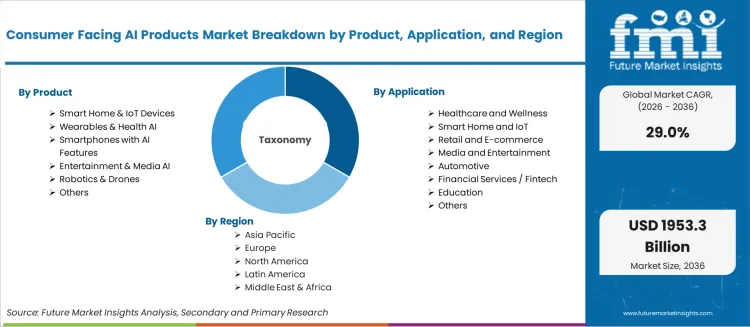
The market is segmented by product type, application, and region. By product type, the market is divided into smart home & IoT devices, wearables & health AI, smartphones with AI features, entertainment & media AI, robotics & drones, and other configurations. Based on application, the market is categorized into healthcare and wellness, smart home and IoT, retail and e-commerce, media and entertainment, automotive, financial services/fintech (consumer-focused), education, and other applications. Regionally, the market is divided into North America, Europe, East Asia, South Asia & Pacific, Latin America, and Middle East & Africa.
By Product Type, Smart Home & IoT Devices Segment Accounts for 38% Market Share
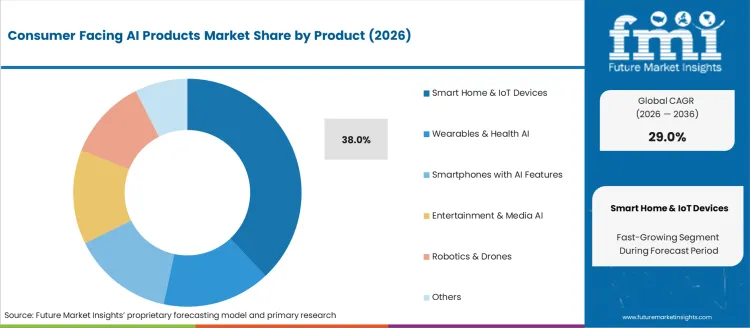
Smart Home & IoT Devices configurations are projected to account for 38% of the consumer facing AI products market in 2026. This leading share is supported by explosive adoption of AI-powered home automation systems and growing consumer demand for intelligent connected living environments. Smart home AI devices provide unprecedented convenience and energy efficiency, making them the preferred choice for modern households seeking automated comfort, security, and lifestyle enhancement. The segment benefits from revolutionary advances in voice recognition, natural language processing, and IoT connectivity that have created entirely new categories of intelligent home products.
Modern smart home AI devices incorporate sophisticated machine learning algorithms and advanced sensor integration that enable predictive automation and personalized home management while ensuring seamless connectivity across diverse household systems. These innovations have transformed home living experiences while reducing energy consumption and enhancing security through intelligent monitoring and automated responses. The residential market particularly drives demand for smart home solutions, as these applications require intuitive AI interfaces and reliable automation to deliver superior convenience and lifestyle enhancement.
Additionally, the commercial and hospitality sectors increasingly adopt smart building AI technologies to optimize operational efficiency and enhance customer experiences through intelligent environmental control and personalized service delivery. The growing emphasis on sustainable living creates opportunities for AI-powered home systems designed for energy optimization and environmental responsibility while maintaining superior comfort and convenience.
By Application, Healthcare and Wellness Segment Accounts for 28% Market Share
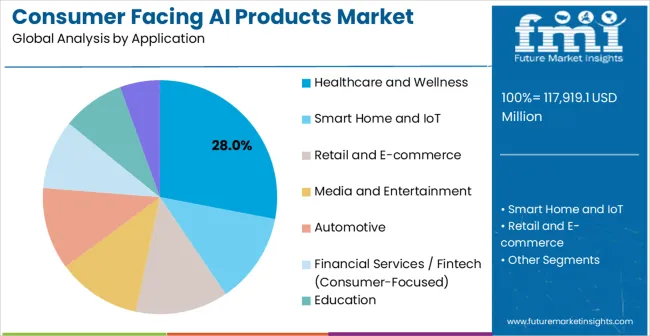
Healthcare and wellness applications are expected to represent 28% of consumer facing AI products demand in 2026. This dominant share reflects the transformative impact of AI in personal health monitoring and the growing consumer focus on preventive healthcare through intelligent wellness technologies. Healthcare AI product manufacturers require sophisticated algorithms capable of providing accurate health insights while maintaining strict privacy and regulatory compliance standards. The segment benefits from breakthrough advances in health AI that utilize continuous monitoring and predictive analytics for personalized wellness optimization.
The global healthcare revolution drives significant demand for consumer AI products that provide exceptional health tracking capabilities and intelligent wellness recommendations for proactive health management. These applications require AI systems with superior accuracy characteristics and comprehensive health data integration to ensure reliable health insights and personalized wellness guidance. The segment benefits from growing consumer investment in preventive healthcare and increasing demand for intelligent fitness and wellness optimization technologies.
Wearable technology and digital health sectors contribute substantially to market growth as companies implement AI-powered health monitoring in advanced fitness tracking and medical-grade wellness applications. The growing adoption of personalized medicine creates opportunities for specialized AI health products designed for individual health optimization and chronic condition management. Additionally, the trend toward holistic wellness drives demand for intelligent AI systems that enable comprehensive health and lifestyle optimization through continuous monitoring and personalized recommendations.
What are the Market Drivers, Restraints, and Key Trends of the Consumer Facing AI Products Market?
The consumer facing AI products market is advancing explosively due to revolutionary AI technology breakthroughs and unprecedented consumer adoption of intelligent products across all lifestyle categories. However, the market faces challenges including privacy and security concerns, need for robust AI ethics frameworks, and varying regulatory requirements across different regions and applications. AI safety standards and consumer privacy regulations continue to influence product development and market adoption patterns.
Integration of Advanced Machine Learning and Natural Language Processing
The revolutionary advances in transformer models, large language models, and multimodal AI systems are enabling unprecedented consumer product capabilities while maintaining intuitive user experiences and practical functionality. Advanced AI architectures and neural network innovations provide superior understanding and response capabilities, enabling natural human-AI interaction and personalized product experiences. These technologies are particularly valuable for consumer applications that require sophisticated understanding, creativity, and adaptive functionality.
Development of Edge AI and Privacy-Preserving Technologies
Modern consumer AI product manufacturers are implementing breakthrough edge computing capabilities and privacy-preserving AI technologies that enable powerful local processing while protecting user data and ensuring responsive performance. Advanced on-device AI processing enables real-time intelligence without cloud dependency while supporting comprehensive privacy protection and regulatory compliance requirements.
Analysis of Consumer Facing AI Products Market by Key Country
.webp "Top Country Growth Comparison Consumer Facing Ai Products Market Cagr (2026 2036)")
| Country | CAGR (2026-2036) |
|---|---|
| China | 39.2% |
| India | 36.3% |
| Germany | 33.4% |
| Brazil | 30.5% |
| United States | 27.6% |
| United Kingdom | 24.7% |
| Japan | 21.8% |
Source: FMI analysis based on primary research and proprietary forecasting model
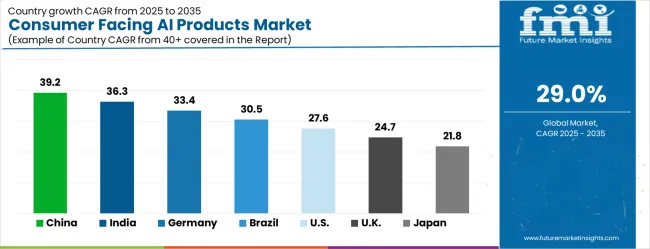
The consumer facing AI products market is experiencing explosive growth, with China leading at an unprecedented 39.2% CAGR through 2036, driven by massive AI technology investment and rapidly expanding consumer AI adoption across all product categories. India follows at 36.3%, supported by enormous consumer market potential and increasing AI technology accessibility. Germany records exceptional growth at 33.4%, emphasizing AI innovation excellence and advanced consumer technology development. Brazil grows remarkably at 30.5%, benefiting from expanding digital economy and AI technology adoption. The United States shows tremendous growth at 27.6%, focusing on AI innovation leadership and premium consumer AI applications. The United Kingdom maintains substantial expansion at 24.7%, supported by AI technology advancement. Japan demonstrates strong growth at 21.8%, emphasizing precision AI technology and consumer electronics innovation.
The report covers an in-depth analysis of 40+ countries, the top-performing countries are highlighted below.
Growth Outlook for Consumer Facing AI Products Market in China
The consumer facing AI products market in China is projected to exhibit the highest growth rate with a CAGR of 39.2% through 2036, driven by the country's position as a global AI technology powerhouse and massive domestic consumer market for intelligent products. The extensive AI research infrastructure and unprecedented investment in consumer AI development are creating extraordinary opportunities for revolutionary AI product adoption. Major technology companies are developing world-leading AI capabilities to serve both the enormous domestic market and global consumer AI product expansion while establishing technological leadership in artificial intelligence.
AI technology revolution and consumer market dominance are supporting explosive adoption of advanced AI product technologies across consumer electronics manufacturing operations, driving demand for sophisticated AI capabilities and massive production scaling systems. Global AI leadership and consumer market size are creating unprecedented opportunities for Chinese AI companies in worldwide consumer markets requiring cutting-edge AI functionality and competitive pricing structures.
In-depth Review of Consumer Facing AI Products Market in India
The consumer facing AI products market in India is expanding at a CAGR of 36.3%, supported by the country's massive consumer population and rapidly accelerating digital transformation across all demographics and economic segments. The enormous smartphone adoption and increasing AI technology accessibility are driving extraordinary consumer AI product demand potential. Technology companies are leveraging India's vast consumer market while developing affordable AI solutions to capture emerging opportunities in the world's largest democracy and fastest-growing major economy.
Digital revolution acceleration and consumer market expansion are creating unprecedented opportunities for consumer AI product integration across diverse technology categories requiring accessible pricing and localized AI capabilities systems. Domestic technology development and international collaboration programs are driving investments in consumer AI technologies throughout major urban centers and rural expansion markets.
Sales Forecast for Consumer Facing AI Products Market in Germany
The consumer facing AI products market in Germany is projected to grow at a CAGR of 33.4%, supported by the country's leadership in AI innovation and advanced consumer technology development across automotive, industrial, and consumer electronics sectors. German technology companies are implementing sophisticated AI product development that meets stringent quality standards and privacy requirements while delivering superior user experiences. The market is characterized by focus on AI innovation, advanced technology integration, and compliance with comprehensive data privacy and AI ethics regulations.
AI innovation investments are prioritizing advanced consumer AI technologies that demonstrate superior performance characteristics and privacy compliance while meeting German technology quality and data protection standards for consumer applications. Innovation programs and AI technology development initiatives are driving adoption of precision-engineered AI systems that support optimal user experiences and enhanced consumer technology integration.
Revenue Prospects for Consumer Facing AI Products Market in Brazil
The consumer facing AI products market in Brazil is growing at a CAGR of 30.5%, driven by expanding digital economy transformation and increasing consumer technology adoption across urban and emerging market segments. The growing smartphone penetration and increasing digital service adoption are creating substantial opportunities for consumer AI product market development. Technology companies are adapting AI products to support growing consumer demand and digital lifestyle transformation while maintaining price accessibility and local market relevance.
Digital economy transformation and consumer technology expansion are facilitating adoption of accessible consumer AI product systems capable of meeting diverse consumer requirements and technology adoption patterns across traditional and emerging market segments. Regional technology capability development and digital infrastructure expansion are creating demand for localized AI products that meet consumer preferences and market accessibility requirements.
Demand Assessment for Consumer Facing AI Products Market in the United States
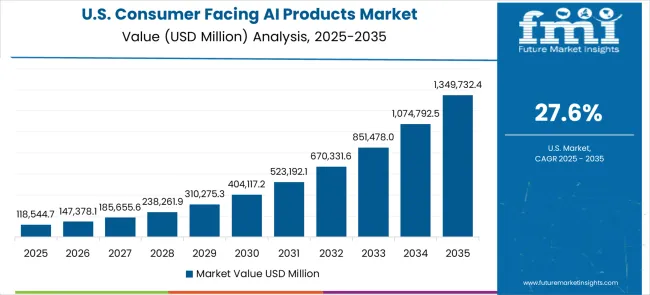
The consumer facing AI products market in the United States is expanding at a CAGR of 27.6%, driven by the country's AI innovation leadership and consumer market demand for premium intelligent products and cutting-edge technology experiences. The sophisticated technology ecosystem and consumer willingness to adopt advanced AI products create enormous demand for high-quality consumer AI solutions. The market benefits from breakthrough AI research and premium consumer market segments across technology, entertainment, and lifestyle applications.
AI innovation leadership programs and premium application development initiatives are driving adoption of advanced consumer AI products that offer revolutionary capabilities and superior user experiences for demanding consumer applications. Research and development investments and technology advancement programs are supporting demand for cutting-edge AI products that meet premium consumer requirements and innovation leadership standards.
Market Penetration Analysis for Consumer Facing AI Products Market in the United Kingdom
The consumer facing AI products market in the United Kingdom is projected to grow at a CAGR of 24.7%, supported by ongoing AI technology advancement and increasing consumer demand for intelligent products in lifestyle and professional applications. Technology companies are investing in consumer AI product development that provides advanced functionality while meeting privacy requirements and regulatory compliance for consumer applications. The market is characterized by focus on AI innovation, consumer privacy protection, and advanced technology integration across diverse consumer segments.
AI technology advancement and consumer innovation programs are supporting adoption of advanced consumer AI products that meet contemporary privacy and functionality standards for consumer applications. Innovation enhancement initiatives and technology excellence programs are creating demand for sophisticated AI products that provide superior user experiences and privacy compliance verification.
Opportunity Analysis for Consumer Facing AI Products Market in Japan
The consumer facing AI products market in Japan is expanding at a CAGR of 21.8%, driven by the country's emphasis on AI technology excellence and precision consumer electronics development across robotics, automotive, and entertainment sectors. Japanese technology companies are developing sophisticated consumer AI applications that incorporate precision engineering and user experience optimization principles. The market benefits from focus on AI precision, technology reliability, and continuous innovation in consumer AI product development and human-AI interaction.
AI technology excellence programs and precision consumer application initiatives are driving advancement of premium consumer AI products that demonstrate superior technology characteristics and user experience reliability. Consumer technology excellence programs and AI advancement initiatives are supporting adoption of precision-engineered AI solutions that optimize user experiences and ensure consistent performance in demanding consumer applications and lifestyle integration scenarios.
Europe Market Split by Country
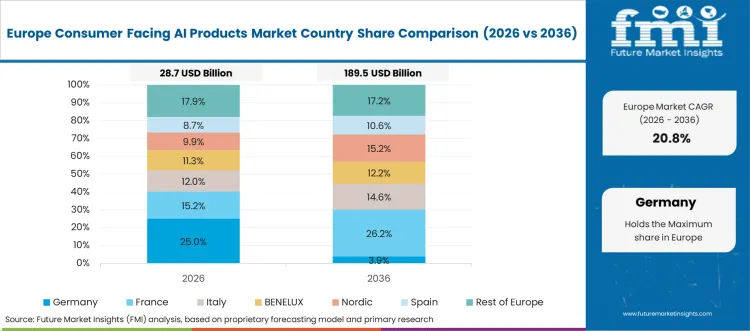
The consumer facing AI products market in Europe is projected to grow from USD 32,844.2 million in 2026 to USD 389,257.8 million by 2036, registering a CAGR of 28.4% over the forecast period. Germany is expected to maintain its leadership with a 26.3% share in 2026, supported by its advanced AI research industry and consumer technology excellence. The United Kingdom follows with 19.7% market share, driven by AI innovation advancement and consumer technology development. France holds 16.8% of the European market, benefiting from AI technology expansion and consumer electronics industry development. Italy and Spain collectively represent 21.4% of regional demand, with growing focus on consumer AI development and technology applications. The Rest of Europe region accounts for 15.8% of the market, supported by AI development in Eastern European countries and Nordic technology advancement.
Competitive Landscape
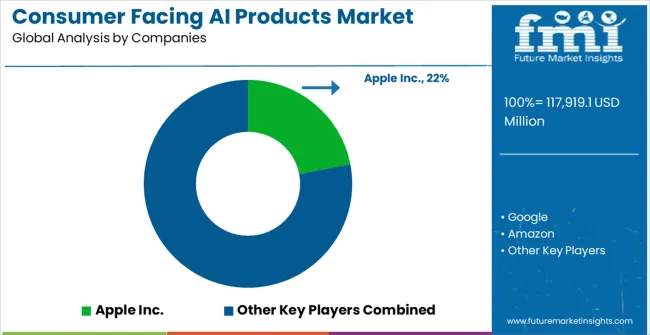
The consumer facing AI products market is defined by intense competition among technology giants, innovative AI startups, and established consumer electronics companies. Companies are investing billions in AI research and development, advanced product design, global manufacturing capabilities, and ecosystem integration to deliver revolutionary, user-friendly, and intelligent consumer products. Strategic partnerships, technological breakthrough, and rapid market expansion are central to achieving market leadership and consumer adoption.
Apple Inc., operating globally, offers comprehensive AI-integrated consumer products with focus on user privacy, seamless ecosystem integration, and premium user experience across smartphones, wearables, and smart home applications. Google, technology leader, provides advanced AI services and products with emphasis on machine learning excellence, natural language processing, and intelligent search and assistance capabilities. Amazon delivers revolutionary AI-powered consumer products with focus on voice interaction, smart home automation, and e-commerce integration. Samsung offers comprehensive AI-enabled electronics with global manufacturing capabilities and consumer technology innovation.
Microsoft provides advanced AI platforms and consumer applications with emphasis on productivity enhancement and enterprise-consumer integration. Meta (Facebook) delivers social AI and virtual reality products with focus on human connection and immersive experiences. Sony offers precision AI-integrated entertainment and electronics products with technology excellence and content creation capabilities. Tesla Inc. provides revolutionary AI-powered automotive and energy products with autonomous technology leadership.
Huawei, Xiaomi, LG Electronics, Garmin, Snap Inc., Replika, and iRobot offer specialized consumer AI expertise, innovative product development, and technical advancement across artificial intelligence and consumer technology networks.
Global Consumer Facing AI Products Market -- Stakeholder Contribution Framework
The consumer facing AI products market underpins technological revolution advancement, consumer lifestyle transformation, artificial intelligence democratization, and human-AI interaction evolution. With accelerating AI capabilities, consumer adoption expansion, and privacy protection requirements, the sector faces pressure to balance innovation velocity, user privacy protection, and ethical AI development. Coordinated contributions from governments, industry bodies, OEMs/technology integrators, suppliers, and investors will accelerate the transition toward beneficial, safe, and universally accessible consumer AI product ecosystems.
How Governments Could Spur Market Growth and Adoption
- AI Innovation Incentives: Provide comprehensive support for AI research and development and incentivize consumer AI product innovation through tax credits, research grants, and technology development programs.
- R&D Support: Fund breakthrough research programs on artificial general intelligence, human-AI interaction, and ethical AI systems for consumer applications and societal benefit.
- AI Ethics Standards: Establish comprehensive AI ethics frameworks and consumer protection standards to ensure beneficial AI development and user privacy protection.
- Digital Infrastructure: Invest in advanced computing infrastructure, 5G networks, and edge computing capabilities to support sophisticated consumer AI applications and accessibility.
- Education Initiatives: Integrate AI literacy programs into educational curricula and public awareness campaigns to prepare society for AI-transformed lifestyle and work environments.
How Industry Bodies Could Support Market Development
- Standardization & Certification: Develop global guidelines for AI product safety, privacy protection, and ethical AI development to ensure consumer trust and technology reliability.
- Innovation Promotion: Position regional AI companies as leaders in responsible AI development and consumer-beneficial artificial intelligence applications.
- Talent Development: Create comprehensive training programs for AI engineers, ethical AI specialists, and human-AI interaction designers to address critical skill requirements.
- Policy Advocacy: Engage with regulators worldwide to shape beneficial AI policies and consumer protection frameworks that enable innovation while ensuring safety and privacy.
How OEMs and Technology Integrators Could Strengthen the Ecosystem
- AI Innovation: Advance machine learning architectures, natural language processing, and computer vision technologies for revolutionary consumer product capabilities and user experiences.
- Ecosystem Integration: Collaborate with software developers, content creators, and service providers to develop comprehensive AI product ecosystems and platform solutions.
- User Experience Design: Develop intuitive human-AI interaction interfaces, privacy-preserving AI systems, and accessible AI technologies for diverse consumer populations and use cases.
- Platform Solutions: Bundle AI capabilities with complete consumer ecosystems, offering integrated hardware, software, and service solutions for seamless AI experiences.
How Suppliers Could Navigate the Shift
- Advanced Technologies: Provide cutting-edge AI processors, neural network accelerators, and edge computing systems to enable sophisticated consumer AI applications and real-time processing.
- Innovation Partnerships: Establish collaborative relationships with AI research institutions and technology companies to access breakthrough AI technologies and integration opportunities.
- Scalable Manufacturing: Develop massive production capabilities for AI-enabled consumer electronics while maintaining quality standards and cost competitiveness for global markets.
- Technical Expertise: Deploy AI specialists and integration engineers to support consumer AI product development and implementation across diverse technology applications.
How Investors and Financial Enablers Could Unlock Value
- Innovation Investment: Fund revolutionary AI research, consumer AI product development, and breakthrough technology companies developing next-generation artificial intelligence applications.
- Infrastructure Financing: Support AI computing infrastructure, semiconductor fabrication, and global distribution networks for consumer AI products and services.
- Market Development: Back consumer AI companies expanding into emerging markets and developing accessible AI technologies for global consumer adoption.
- Risk Management: Provide specialized investment and insurance products for AI technology development risks and rapid market evolution uncertainties.
Ecosystem Development: Channel capital toward comprehensive AI platform development, AI safety research, and ethical AI technology advancement for beneficial consumer AI evolution.
Key Players in the Consumer Facing AI Products Market
- Apple Inc.
- Amazon
- Samsung
- Microsoft
- Meta (Facebook)
- Sony
- Tesla Inc.
- Huawei
- Xiaomi
- LG Electronics
- Garmin
- Snap Inc.
- Replika
- iRobot
Scope of the Report
| Metric | Value |
|---|---|
| Quantitative Units | USD 153.06 billion to USD 1953.29 billion, at a CAGR of 29% |
| Market Definition | Based on FMI's report, the Consumer Facing AI Products market covers AI-powered consumer products including smart home and IoT devices, wearables and health AI platforms, smartphones with on-device AI features, entertainment and media AI applications, consumer robotics, drones, and related AI-enabled consumer electronics sold globally. |
| Segmentation | Product: Smart Home & IoT Devices, Wearables & Health AI, Smartphones with AI Features, Entertainment & Media AI, Robotics & Drones, Others; Application: Healthcare and Wellness, Smart Home and IoT, Retail and E-commerce, Media and Entertainment, Automotive, Financial Services / Fintech, Education, Others |
| Regions Covered | China, India, Germany, Brazil, USA, UK, Japan |
| Key Companies Profiled | Apple Inc., Google, Amazon, Samsung, Microsoft, Meta (Facebook), Sony, Tesla Inc., Huawei, Xiaomi |
| Forecast Period | 2026 to 2036 |
| Approach | Hybrid bottom-up methodology combining installed base metrics with regulatory compliance adoption curves and primary research validation. |
Consumer Facing AI Products Market by Segments
Product Type:
- Smart Home & IoT Devices
- Wearables & Health AI
- Smartphones with AI Features
- Entertainment & Media AI
- Robotics & Drones
- Others
Application:
- Healthcare and Wellness
- Smart Home and IoT
- Retail and E-commerce
- Media and Entertainment
- Automotive
- Financial Services / Fintech (Consumer-Focused)
- Education
- Others
Region:
- North America
- United States
- Canada
- Mexico
- Europe
- Germany
- United Kingdom
- France
- Italy
- Spain
- Nordic
- BENELUX
- Rest of Europe
- East Asia
- China
- Japan
- South Korea
- South Asia & Pacific
- India
- ASEAN
- Australia & New Zealand
- Rest of South Asia & Pacific
- Latin America
- Brazil
- Chile
- Rest of Latin America
- Middle East & Africa
- Kingdom of Saudi Arabia
- Other GCC Countries
- Turkey
- South Africa
- Other African Union
- Rest of Middle East & Africa
Bibliography
- 1. International Telecommunication Union. (2025). ICT Facts and Figures: AI-Enabled Device Penetration Statistics. ITU.
- 2. Organisation for Economic Co-operation and Development. (2025). AI Policy Observatory: Consumer AI Adoption Indicators. OECD.
- 3. World Intellectual Property Organization. (2024). Technology Trends: Artificial Intelligence in Consumer Products. WIPO.
- 4. European Commission. (2025). AI Act: Consumer-Facing AI Product Compliance Requirements. European Commission.
- 5. Consumer Technology Association. (2025). USA Consumer AI Technology Sales and Forecast Report. CTA.
- 6. World Economic Forum. (2024). The Global AI Readiness Index: Consumer Market Assessment. WEF.
This bibliography is provided for reader reference. The full Future Market Insights report contains the complete reference list with primary research documentation.
Frequently Asked Questions
How large is the Consumer Facing AI Products market in 2026?
The Consumer Facing AI Products market is estimated to be valued at USD 153.06 billion in 2026.
What will be the market size of Consumer Facing AI Products by 2036?
Market size for Consumer Facing AI Products is projected to reach USD 1953.29 billion by 2036.
What is the expected CAGR for Consumer Facing AI Products between 2026 and 2036?
The Consumer Facing AI Products market is expected to grow at a CAGR of 29% between 2026 and 2036.
Which Product leads the Consumer Facing AI Products market in 2026?
Smart Home & IoT Devices accounts for 38% share in 2026 by Product.
Which region is projected to grow fastest?
China is projected to grow at a CAGR of 39.2% during 2026 to 2036.
What does this report include in its scope?
The report covers market sizing, segmentation analysis, regional forecasts, competitive landscape evaluation, and forecast projections from 2026 to 2036.
How does FMI build and validate the Consumer Facing AI Products forecast?
Forecasting models apply a bottom-up methodology starting with installed base metrics and cross-validate projections against quarterly revenue volumes and industry data.
Preview the report firsthand - request a free sample
Get SampleGet the brochure for pricing and purchase details.
Get PDFTable of Content
- Executive Summary
- Global Market Outlook
- Demand-side Trends
- Supply-side Trends
- Technology Roadmap Analysis
- Analysis and Recommendations
- Market Overview
- Market Coverage / Taxonomy
- Market Definition / Scope / Limitations
- Research Methodology
- Chapter Orientation
- Analytical Lens and Working Hypotheses
- Market Structure, Signals, and Trend Drivers
- Benchmarking and Cross-market Comparability
- Company Annual and Sustainability Reports
- Peer-reviewed Journals and Academic Literature
- Corporate Websites, Product Literature, and Technical Notes
- Earnings Decks and Investor Briefings
- Statutory Filings and Regulatory Disclosures
- Technical White Papers and Standards Notes
- Trade Journals, Industry Magazines, and Analyst Briefs
- Conference Proceedings, Webinars, and Seminar Materials
- Government Statistics Portals and Public Data Releases
- Press Releases and Reputable Media Coverage
- Specialist Newsletters and Curated Briefings
- Sector Databases and Reference Repositories
- FMI Internal Proprietary Databases and Historical Market Datasets
- Subscription Datasets and Paid Sources
- Social Channels, Communities, and Digital Listening Inputs
- Additional Desk Sources
- Expert Input and Fieldwork (Primary Evidence)
- Primary Modes
- Qualitative Interviews and Expert Elicitation
- Quantitative Surveys and Structured Data Capture
- Blended Approach
- Why Primary Evidence is Used
- Field Techniques
- Interviews
- Surveys
- Focus Groups
- Observational and In-context Research
- Social and Community Interactions
- Stakeholder Universe Engaged
- C-suite Leaders
- Board Members
- Presidents and Vice Presidents
- R&D and Innovation Heads
- Technical Specialists
- Domain Subject-matter Experts
- Scientists
- Physicians and Other Healthcare Professionals
- Governance, Ethics, and Data Stewardship
- Research Ethics
- Data Integrity and Handling
- Primary Modes
- Tooling, Models, and Reference Databases
- Data Engineering and Model Build
- Data Acquisition and Ingestion
- Cleaning, Normalisation, and Verification
- Synthesis, Triangulation, and Analysis
- Quality Assurance and Audit Trail
- Market Background
- Market Dynamics
- Drivers
- Restraints
- Opportunity
- Trends
- Scenario Forecast
- Demand in Optimistic Scenario
- Demand in Likely Scenario
- Demand in Conservative Scenario
- Opportunity Map Analysis
- Product Life Cycle Analysis
- Supply Chain Analysis
- Investment Feasibility Matrix
- Value Chain Analysis
- PESTLE and Porter’s Analysis
- Regulatory Landscape
- Regional Parent Market Outlook
- Production and Consumption Statistics
- Import and Export Statistics
- Market Dynamics
- Global Market Analysis 2021 to 2025 and Forecast, 2026 to 2036
- Historical Market Size Value (USD Million) Analysis, 2021 to 2025
- Current and Future Market Size Value (USD Million) Projections, 2026 to 2036
- Y-o-Y Growth Trend Analysis
- Absolute $ Opportunity Analysis
- Global Market Pricing Analysis 2021 to 2025 and Forecast 2026 to 2036
- Global Market Analysis 2021 to 2025 and Forecast 2026 to 2036, By Product
- Introduction / Key Findings
- Historical Market Size Value (USD Million) Analysis By Product , 2021 to 2025
- Current and Future Market Size Value (USD Million) Analysis and Forecast By Product , 2026 to 2036
- Smart Home & IoT Devices
- Wearables & Health AI
- Smartphones with AI Features
- Entertainment & Media AI
- Robotics & Drones
- Others
- Smart Home & IoT Devices
- Y-o-Y Growth Trend Analysis By Product , 2021 to 2025
- Absolute $ Opportunity Analysis By Product , 2026 to 2036
- Global Market Analysis 2021 to 2025 and Forecast 2026 to 2036, By Application
- Introduction / Key Findings
- Historical Market Size Value (USD Million) Analysis By Application, 2021 to 2025
- Current and Future Market Size Value (USD Million) Analysis and Forecast By Application, 2026 to 2036
- Healthcare and Wellness
- Smart Home and IoT
- Retail and E-commerce
- Media and Entertainment
- Automotive
- Financial Services / Fintech
- Education
- Others
- Healthcare and Wellness
- Y-o-Y Growth Trend Analysis By Application, 2021 to 2025
- Absolute $ Opportunity Analysis By Application, 2026 to 2036
- Global Market Analysis 2021 to 2025 and Forecast 2026 to 2036, By Region
- Introduction
- Historical Market Size Value (USD Million) Analysis By Region, 2021 to 2025
- Current Market Size Value (USD Million) Analysis and Forecast By Region, 2026 to 2036
- North America
- Latin America
- Western Europe
- Eastern Europe
- East Asia
- South Asia and Pacific
- Middle East & Africa
- Market Attractiveness Analysis By Region
- North America Market Analysis 2021 to 2025 and Forecast 2026 to 2036, By Country
- Historical Market Size Value (USD Million) Trend Analysis By Market Taxonomy, 2021 to 2025
- Market Size Value (USD Million) Forecast By Market Taxonomy, 2026 to 2036
- By Country
- USA
- Canada
- Mexico
- By Product
- By Application
- By Country
- Market Attractiveness Analysis
- By Country
- By Product
- By Application
- Key Takeaways
- Latin America Market Analysis 2021 to 2025 and Forecast 2026 to 2036, By Country
- Historical Market Size Value (USD Million) Trend Analysis By Market Taxonomy, 2021 to 2025
- Market Size Value (USD Million) Forecast By Market Taxonomy, 2026 to 2036
- By Country
- Brazil
- Chile
- Rest of Latin America
- By Product
- By Application
- By Country
- Market Attractiveness Analysis
- By Country
- By Product
- By Application
- Key Takeaways
- Western Europe Market Analysis 2021 to 2025 and Forecast 2026 to 2036, By Country
- Historical Market Size Value (USD Million) Trend Analysis By Market Taxonomy, 2021 to 2025
- Market Size Value (USD Million) Forecast By Market Taxonomy, 2026 to 2036
- By Country
- Germany
- UK
- Italy
- Spain
- France
- Nordic
- BENELUX
- Rest of Western Europe
- By Product
- By Application
- By Country
- Market Attractiveness Analysis
- By Country
- By Product
- By Application
- Key Takeaways
- Eastern Europe Market Analysis 2021 to 2025 and Forecast 2026 to 2036, By Country
- Historical Market Size Value (USD Million) Trend Analysis By Market Taxonomy, 2021 to 2025
- Market Size Value (USD Million) Forecast By Market Taxonomy, 2026 to 2036
- By Country
- Russia
- Poland
- Hungary
- Balkan & Baltic
- Rest of Eastern Europe
- By Product
- By Application
- By Country
- Market Attractiveness Analysis
- By Country
- By Product
- By Application
- Key Takeaways
- East Asia Market Analysis 2021 to 2025 and Forecast 2026 to 2036, By Country
- Historical Market Size Value (USD Million) Trend Analysis By Market Taxonomy, 2021 to 2025
- Market Size Value (USD Million) Forecast By Market Taxonomy, 2026 to 2036
- By Country
- China
- Japan
- South Korea
- By Product
- By Application
- By Country
- Market Attractiveness Analysis
- By Country
- By Product
- By Application
- Key Takeaways
- South Asia and Pacific Market Analysis 2021 to 2025 and Forecast 2026 to 2036, By Country
- Historical Market Size Value (USD Million) Trend Analysis By Market Taxonomy, 2021 to 2025
- Market Size Value (USD Million) Forecast By Market Taxonomy, 2026 to 2036
- By Country
- India
- ASEAN
- Australia & New Zealand
- Rest of South Asia and Pacific
- By Product
- By Application
- By Country
- Market Attractiveness Analysis
- By Country
- By Product
- By Application
- Key Takeaways
- Middle East & Africa Market Analysis 2021 to 2025 and Forecast 2026 to 2036, By Country
- Historical Market Size Value (USD Million) Trend Analysis By Market Taxonomy, 2021 to 2025
- Market Size Value (USD Million) Forecast By Market Taxonomy, 2026 to 2036
- By Country
- Kingdom of Saudi Arabia
- Other GCC Countries
- Turkiye
- South Africa
- Other African Union
- Rest of Middle East & Africa
- By Product
- By Application
- By Country
- Market Attractiveness Analysis
- By Country
- By Product
- By Application
- Key Takeaways
- Key Countries Market Analysis
- USA
- Pricing Analysis
- Market Share Analysis, 2025
- By Product
- By Application
- Canada
- Pricing Analysis
- Market Share Analysis, 2025
- By Product
- By Application
- Mexico
- Pricing Analysis
- Market Share Analysis, 2025
- By Product
- By Application
- Brazil
- Pricing Analysis
- Market Share Analysis, 2025
- By Product
- By Application
- Chile
- Pricing Analysis
- Market Share Analysis, 2025
- By Product
- By Application
- Germany
- Pricing Analysis
- Market Share Analysis, 2025
- By Product
- By Application
- UK
- Pricing Analysis
- Market Share Analysis, 2025
- By Product
- By Application
- Italy
- Pricing Analysis
- Market Share Analysis, 2025
- By Product
- By Application
- Spain
- Pricing Analysis
- Market Share Analysis, 2025
- By Product
- By Application
- France
- Pricing Analysis
- Market Share Analysis, 2025
- By Product
- By Application
- India
- Pricing Analysis
- Market Share Analysis, 2025
- By Product
- By Application
- ASEAN
- Pricing Analysis
- Market Share Analysis, 2025
- By Product
- By Application
- Australia & New Zealand
- Pricing Analysis
- Market Share Analysis, 2025
- By Product
- By Application
- China
- Pricing Analysis
- Market Share Analysis, 2025
- By Product
- By Application
- Japan
- Pricing Analysis
- Market Share Analysis, 2025
- By Product
- By Application
- South Korea
- Pricing Analysis
- Market Share Analysis, 2025
- By Product
- By Application
- Russia
- Pricing Analysis
- Market Share Analysis, 2025
- By Product
- By Application
- Poland
- Pricing Analysis
- Market Share Analysis, 2025
- By Product
- By Application
- Hungary
- Pricing Analysis
- Market Share Analysis, 2025
- By Product
- By Application
- Kingdom of Saudi Arabia
- Pricing Analysis
- Market Share Analysis, 2025
- By Product
- By Application
- Turkiye
- Pricing Analysis
- Market Share Analysis, 2025
- By Product
- By Application
- South Africa
- Pricing Analysis
- Market Share Analysis, 2025
- By Product
- By Application
- USA
- Market Structure Analysis
- Competition Dashboard
- Competition Benchmarking
- Market Share Analysis of Top Players
- By Regional
- By Product
- By Application
- Competition Analysis
- Competition Deep Dive
- Apple Inc.
- Overview
- Product Portfolio
- Profitability by Market Segments (Product/Age /Sales Channel/Region)
- Sales Footprint
- Strategy Overview
- Marketing Strategy
- Product Strategy
- Channel Strategy
- Amazon
- Samsung
- Microsoft
- Meta (Facebook)
- Sony
- Tesla Inc.
- Huawei
- Xiaomi
- LG Electronics
- Garmin
- Snap Inc.
- Replika
- iRobot
- Apple Inc.
- Competition Deep Dive
- Assumptions & Acronyms Used


