

- Industry Size (2026)
- USD 15.48 Mn
- Forecast (2036)
- USD 25.94 Mn
- CAGR (2026 to 2036)
- 5.3%
Consumer Grade Electrochemical CO Sensor Market Market Size, Market Forecast and Outlook By FMI
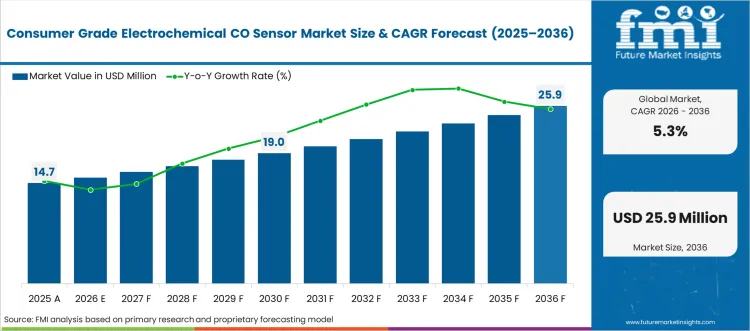
The Consumer Grade Electrochemical CO Sensor market was valued at USD 14.70 million in 2025, projected to reach USD 15.48 million in 2026, and is forecast to expand to USD 25.94 million by 2036 at a 5.3% CAGR. As per FMI, tightening residential carbon monoxide alarm mandates across multiple national building codes and the expansion of smart home gas detection systems are sustaining steady procurement of electrochemical CO sensor modules from alarm manufacturers and household appliance OEMs. FMI is of the opinion that the revision of EN 50291 in Europe and UL 2034 in the United States, requiring lower detection thresholds and faster response times, is compelling alarm manufacturers to upgrade from legacy semiconductor sensors to electrochemical cells with higher sensitivity and selectivity specifications.
Summary of Consumer Grade Electrochemical CO Sensor Market Market
- Market Overview
- The Consumer Grade Electrochemical CO Sensor market is valued at USD 14.70 million in 2025 and is projected to reach USD 25.94 million by 2036.
- The industry is expected to grow at a 5.3% CAGR from 2026 to 2036, creating an incremental opportunity of USD 10.46 million.
- The market is a building-code-mandate-driven safety component category where CO alarm legislation expansion, sensor sensitivity specification upgrades, and residential construction volume define competitive positioning among electrochemical CO sensor manufacturers globally.
- Demand and Growth Drivers
- Demand is sustained by tightening residential CO alarm mandates across national building codes and the expansion of smart home gas detection integration.
- Revised EN 50291 and UL 2034 standards requiring lower detection thresholds are compelling alarm manufacturers to upgrade to higher-sensitivity electrochemical cells.
- Urban housing construction code updates in China and India are incorporating CO detection requirements for residential gas appliance installations for the first time.
- China leads at 7.2% CAGR, followed by India at 6.6%, Germany at 6.1%, Brazil at 5.6%, USA at 5.0%, UK at 4.5%, and Japan at 4.0%.
- Product and Segment View
- The market includes electrode, application as primary segmentation dimensions.
- 2-electrode sensor leads by Electrode with 60% share in 2026.
- CO Alarm leads by Application with 45% share in 2026.
- Geography and Competitive Outlook
- China is the fastest-growing region at 7.2% CAGR, while India anchors the second-largest demand base.
- Competition is shaped by manufacturing scale, material specialisation, and distribution reach, with key players including City Technology, Alphasense, MEMBRAPOR, SGX Sensortech, Figaro.
- Analyst Opinion at FMI
- Nikhil Kaitwade, Principal Consultant, opines: 'FMI's analysis reveals that the consumer grade electrochemical co sensor market is entering a phase where procurement decisions are increasingly shaped by regulatory compliance timelines and measurable performance thresholds. Organisations that delay investment risk falling behind competitors actively securing next-generation platform positions.'
- Strategic Implications / Executive Takeaways
- Solution providers must secure certified integration pathways with tier-1 enterprise systems to qualify for forthcoming institutional procurement contracts.
- Capital project directors should mandate native platform compatibility in all new procurement specifications.
- Technical teams must develop specialised competencies in electrode validation to demonstrate compliance parameters.
Consumer Grade Electrochemical CO Sensor Market Market Key Takeaways
| Metric | Details |
|---|---|
| Industry Size (2026) | USD 15.48 million |
| Industry Value (2036) | USD 25.94 million |
| CAGR (2026 to 2036) | 5.3% |
Source: Future Market Insights, 2026
FMI analysts observe that regional growth trajectories reflect varying building code enforcement intensity and residential CO alarm penetration rates. China leads at 7.2% CAGR, driven by updated national fire code requirements mandating CO detection in residential gas appliance installations. India follows at 6.6%, supported by urban housing construction codes incorporating gas safety monitoring requirements for the first time. Germany registers 6.1% growth as EU CO alarm harmonisation directives drive retrofit installations across existing housing stock. Brazil maintains 5.6% growth tied to residential gas heater safety regulation enforcement. The USA registers 5.0% growth reflecting state-level CO alarm mandate expansions beyond bedrooms to all habitable rooms.
The UK sustains 4.5% growth driven by landlord CO alarm compliance obligations under the Smoke and Carbon Monoxide Alarm Regulations. Japan maintains 4.0% growth as municipal fire prevention ordinance updates expand CO detection requirements. Based on FMI's report, 2-electrode sensors command 60.0% share due to their cost advantage in high-volume residential alarm applications. Future Market Insights analysis indicates CO alarm applications account for 45.0% of total sensor consumption.
Consumer Grade Electrochemical CO Sensor Market Market Definition
Based on FMI's report, the Consumer Grade Electrochemical CO Sensor market covers 2-electrode and 3-electrode electrochemical carbon monoxide sensor modules used in CO alarms and household appliances for residential and light commercial gas safety monitoring applications globally.
Consumer Grade Electrochemical CO Sensor Market Market Inclusions
Future Market Insights analysis covers electrochemical CO sensors across both electrode configurations and major application categories. The scope encompasses regional market sizes across seven key countries, forecast projections from 2026 to 2036, and segmentation by electrode type and application.
Consumer Grade Electrochemical CO Sensor Market Market Exclusions
The scope excludes industrial-grade fixed gas detection systems, portable personal gas monitors for occupational safety, semiconductor metal oxide CO sensors, and non-dispersive infrared CO analysers.
Consumer Grade Electrochemical CO Sensor Market Market Research Methodology
- Primary Research: Analysts engaged with CO alarm OEM procurement managers, electrochemical sensor manufacturers, and national fire code standards committee members to map specification upgrade timelines and volume forecasting methodologies.
- Desk Research: Data collection aggregated national building code CO alarm mandate adoption statistics, EN 50291 and UL 2034 revision timelines, and published residential construction permit data from national statistics agencies.
- Market-Sizing and Forecasting: Baseline values derive from a bottom-up aggregation of electrochemical CO sensor module shipments into consumer alarm and appliance applications across seven key countries, applying building code mandate adoption curves and housing stock growth rates.
- Data Validation and Update Cycle: Projections are cross-validated against quarterly sensor revenue guidance from major electrochemical sensor manufacturers and national fire safety equipment installation statistics.
Why is the Consumer Grade Electrochemical CO Sensor Market Growing?
Market expansion is being supported by the increasing global awareness of carbon monoxide poisoning risks driven by residential safety education campaigns and tragic incident prevention initiatives, alongside the corresponding need for affordable gas detection technologies that can provide accurate carbon monoxide measurement, enable early warning alerts, and maintain operational reliability across various single-family homes, multi-unit residential buildings, and recreational vehicle applications. Modern homeowners and residential property managers are increasingly focused on implementing electrochemical CO sensor solutions that can deliver continuous monitoring protection, support family safety objectives, and provide dependable toxic gas detection in everyday living environments.
The growing emphasis on residential safety codes and carbon monoxide detector mandates is driving demand for consumer grade electrochemical CO sensors that can offer cost-effective detection performance, enable easy installation and maintenance, and ensure comprehensive household protection across diverse residential configurations. Homeowner preference for safety devices that combine detection accuracy with long battery life and minimal false alarm occurrences is creating opportunities for innovative electrochemical CO sensor implementations. The rising influence of smart home technologies and connected safety ecosystems is also contributing to increased adoption of electrochemical CO sensors that can provide smartphone notifications without compromising detection reliability or consumer affordability.
What are the Key Segments in the Consumer Grade Electrochemical CO Sensor Market?
The market is segmented by electrode configuration, application, and region. By electrode configuration, the market is divided into 2-electrode sensor and 3-electrode sensor. Based on application, the market is categorized into household appliances and CO alarm. Regionally, the market is divided into East Asia, Europe, North America, South Asia, Latin America, Middle East & Africa, and Eastern Europe.
By Electrode Configuration, the 2-electrode Sensor Segment Leads the Market
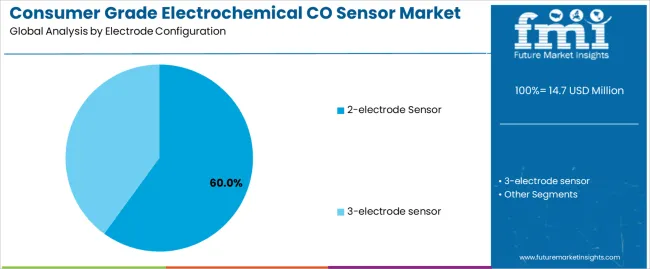
The 2-electrode sensor segment is projected to maintain its leading position in the consumer grade electrochemical CO sensor market in 2026 with a 60% market share, reaffirming its role as the preferred electrode design for cost-effective residential carbon monoxide detection and consumer alarm applications. Safety alarm manufacturers and consumer product companies increasingly utilize 2-electrode electrochemical CO sensors for their simplified construction characteristics, economical manufacturing processes, and adequate performance in providing residential carbon monoxide detection while maintaining affordability. 2-electrode sensor technology's proven cost-effectiveness and application suitability directly address the consumer market requirements for economical safety protection and accessible gas detection across diverse household alarm devices and residential monitoring products.
This electrode configuration segment forms the foundation of consumer CO alarm programs, as it represents the design with optimal cost-performance balance and established manufacturing efficiency across multiple consumer safety product categories and price points. Consumer safety industry investments in high-volume sensor production continue to strengthen adoption among alarm manufacturers and household product companies. With building codes requiring widespread CO detector installation and consumer demand for affordable safety solutions, 2-electrode electrochemical CO sensors align with both economic objectives and detection adequacy requirements, making them the central component of comprehensive residential safety strategies.
By Application, the CO Alarm Segment Dominates Market Demand
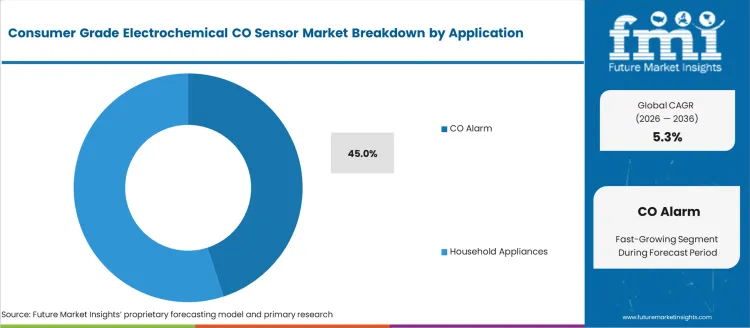
The CO alarm application segment is projected to represent the largest share of consumer grade electrochemical CO sensor demand in 2026 with a 45% market share, underscoring its critical role as the primary driver for sensor adoption across standalone carbon monoxide alarms, combination smoke-CO detectors, and residential safety alarm systems. Homeowners and residential property managers prefer electrochemical CO sensors for alarm applications due to their reliable detection of carbon monoxide in living spaces, proven performance in residential atmospheres, and ability to support family protection while enabling building code compliance and insurance requirements. Positioned as essential components for modern residential safety systems, consumer grade electrochemical CO sensors offer both hazard detection advantages and household peace of mind.
The segment is supported by continuous expansion in residential construction and the growing implementation of mandatory CO detector requirements that necessitate widespread alarm installation with reliable monitoring capabilities and affordable ownership costs. Homeowners are investing in carbon monoxide alarm systems to support increasingly stringent safety codes and personal demands for comprehensive household hazard monitoring throughout bedrooms, hallways, and living areas. As residential safety awareness increases and building standards advance, the CO alarm application will continue to dominate the market while supporting advanced sensor technology utilization and comprehensive household safety optimization.
What are the Drivers, Restraints, and Key Trends of the Consumer Grade Electrochemical CO Sensor Market?
The consumer grade electrochemical CO sensor market is advancing steadily due to increasing awareness of residential carbon monoxide risks driven by safety education programs and growing implementation of building code requirements that mandate detector technologies providing accurate carbon monoxide measurement and reliable household warning capabilities across diverse single-family residences, apartment buildings, and recreational vehicle applications. The market faces challenges, including consumer price sensitivity limiting premium feature adoption, sensor replacement awareness gaps affecting timely detector updates, and competition from alternative sensing technologies including biomimetic and metal oxide sensors. Innovation in low-power electronics and smart connectivity continues to influence product development and market expansion patterns.
Expansion of Building Codes and CO Detector Mandates
The growing implementation of residential building codes is driving demand for carbon monoxide detection solutions that address mandatory installation requirements including bedroom proximity placement, combination alarm specifications, and interconnected detector systems for multi-level homes. Residential safety applications require affordable electrochemical CO sensors that deliver reliable performance across extended operational periods while supporting homeowner compliance and protecting occupant safety. Property developers and homeowners are increasingly recognizing the necessity of electrochemical CO sensor integration for meeting regulatory obligations and preventing residential carbon monoxide incidents, creating opportunities for compliant sensor products specifically designed for building code adherence and mass-market residential alarm devices.
Integration of Smart Home Connectivity and Mobile Alerts
Modern consumer grade electrochemical CO sensor manufacturers are incorporating wireless connectivity capabilities and smartphone application integration to enhance residential monitoring convenience, enable remote safety alerts, and support comprehensive household protection through connected alarm ecosystems and cloud-based notification platforms. Leading companies are developing sensors with Wi-Fi connectivity, implementing mobile push notifications, and advancing voice assistant compatibility that provide homeowners with remote monitoring access and family safety updates. These technologies improve household protection effectiveness while enabling new consumer features, including vacation home monitoring, rental property oversight, and multi-location family safety management. Advanced connectivity integration also allows homeowners to support comprehensive safety awareness objectives and peace of mind beyond traditional standalone alarm devices.
Development of Extended Lifetime and Sealed Battery Designs
The expansion of building code compliance periods and increasing consumer demand for reduced maintenance requirements is driving development of electrochemical CO sensors with extended operational lifetimes and integrated sealed battery systems. These advanced applications require optimized sensor chemistry and efficient power management technologies that enable ten-year sensor operation without battery replacement, creating premium market segments with differentiated value propositions. Manufacturers are investing in advanced cell chemistry and ultra-low-power electronics to serve homeowners seeking minimal maintenance obligations and maximum detection reliability while supporting innovation in tamper-resistant installations, rental property applications, and compliance-focused residential safety products.
How Does the Consumer Grade Electrochemical CO Sensor Market Perform Across Key Countries?
.webp "Top Country Growth Comparison Consumer Grade Electrochemical Co Sensor Market Cagr (2026 2036)")
| Country | CAGR (2026-2036) |
|---|---|
| China | 7.2% |
| India | 6.6% |
| Germany | 6.1% |
| Brazil | 5.6% |
| United States | 5.0% |
| United Kingdom | 4.5% |
| Japan | 4.0% |
Source: FMI analysis based on primary research and proprietary forecasting model
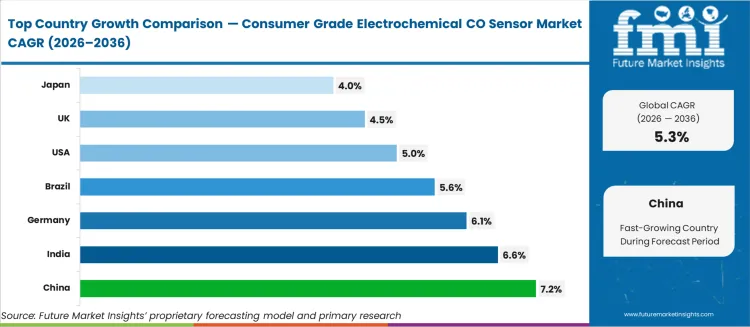
The consumer grade electrochemical CO sensor market is experiencing solid growth globally, with China leading at a 7.2% CAGR through 2036, driven by rapid residential development, growing middle-class safety awareness, and increasing adoption of household safety devices in urban housing developments. India follows at 6.6%, supported by urbanization growth, expanding middle-class population, and increasing awareness of residential safety requirements across apartment complexes and individual homes. Germany shows growth at 6.1%, emphasizing residential safety standards, building code enforcement, and comprehensive household protection regulations requiring carbon monoxide detection. Brazil demonstrates 5.6% growth, supported by residential construction expansion, growing safety consciousness, and increasing household appliance adoption requiring gas monitoring. The United States records 5.0%, focusing on established building code requirements, homeowner safety awareness, and residential alarm system adoption for carbon monoxide protection. The United Kingdom exhibits 4.5% growth, emphasizing building regulations compliance, residential safety campaigns, and household detector installation requirements. Japan shows 4.0% growth, supported by residential safety culture, housing quality standards, and comprehensive household safety practices.
The report covers an in-depth analysis of 40+ countries, with top-performing countries highlighted below.
Why Does China Lead Global Market Growth with Residential Development and Safety Awareness?
Revenue from consumer grade electrochemical CO sensors in China is projected to exhibit exceptional growth with a CAGR of 7.2% through 2036, driven by massive residential development and growing middle-class safety awareness supported by urbanization programs and household safety education initiatives. The country's extensive residential construction sector and increasing emphasis on family protection are creating substantial demand for electrochemical CO sensor solutions. Major consumer electronics manufacturers and safety product companies are establishing comprehensive production capabilities to serve both domestic markets and export opportunities.
- Government support for residential safety improvement and building quality standards is driving demand for consumer grade electrochemical CO sensors throughout major urban centers and residential developments across apartment buildings, single-family homes, and residential complexes.
- Strong middle-class growth and an expanding network of modern housing developments are supporting the rapid adoption of household safety technologies among homeowners seeking family protection and residential security.
How Does India Demonstrate Strong Market Potential with Urbanization and Middle-Class Expansion?
Demand for consumer grade electrochemical CO sensors in India is expanding at a CAGR of 6.6%, supported by the country's rapid urbanization, expanding middle-class population, and increasing adoption of residential safety standards among homeowners and property developers. The country's comprehensive urban development programs and rising safety awareness are driving demand for electrochemical CO sensor solutions throughout diverse residential sectors. Leading consumer safety product manufacturers and international companies are establishing distribution networks and market presence to address growing demand.
- Rising urban housing development and expanding middle-class homeownership are creating opportunities for consumer grade electrochemical CO sensor adoption across apartment complexes, residential towers, and individual homes in major metropolitan areas.
- Growing awareness of household safety requirements and increasing disposable income under economic development programs are driving investment in residential safety devices among homeowners seeking family protection and property security.
What Drives Germany's Safety Excellence with Building Code Leadership?
Revenue from consumer grade electrochemical CO sensors in Germany is growing at a CAGR of 6.1%, supported by the country's residential safety standards, building code enforcement, and comprehensive household protection regulations requiring carbon monoxide detection systems. The nation's safety standards and quality requirements are driving sophisticated electrochemical CO sensor implementations throughout residential sectors. Leading safety equipment manufacturers and consumer electronics companies are investing extensively in compliant sensor technology development and market expansion.
- Advanced building regulations and comprehensive residential safety requirements are creating demand for certified consumer grade electrochemical CO sensors among property developers seeking regulatory compliance and homeowner protection.
- Strong household safety culture and emphasis on family protection are supporting the adoption of residential gas detection technologies in homes throughout major residential regions.
Why Does Brazil Emphasize Residential Construction and Household Safety Growth?
Demand for consumer grade electrochemical CO sensors in Brazil is anticipated to expand at a CAGR of 5.6%, supported by the country's residential construction expansion, growing safety consciousness, and increasing household appliance adoption requiring gas monitoring capabilities. Brazil's urban development and improving living standards are driving demand for electrochemical CO sensor technologies. Consumer safety product distributors and retail channels are investing in market development to serve residential and household safety segments.
- Residential construction growth and urban housing development are creating demand for consumer grade electrochemical CO sensors among property developers and homeowners seeking household safety protection.
- Growing middle class and increasing awareness of residential safety risks are driving adoption of carbon monoxide alarm systems in homes across major metropolitan areas.
How Does the United States Focus on Building Code Compliance and Homeowner Safety?
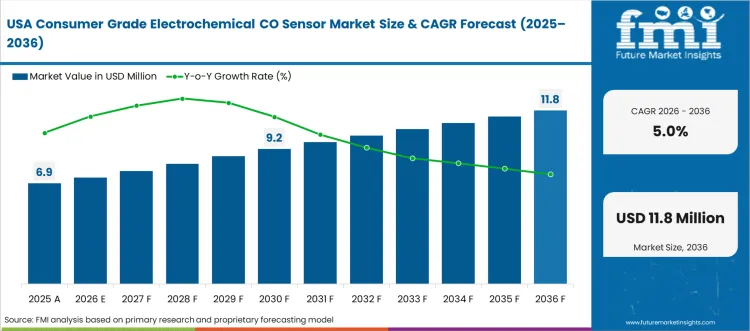
Revenue from consumer grade electrochemical CO sensors in the United States is projected to grow at a CAGR of 5.0%, supported by the country's established building code requirements, homeowner safety awareness, and residential alarm system adoption for carbon monoxide protection. The nation's comprehensive safety regulations and mature consumer market are driving demand for reliable electrochemical CO sensor technologies. Safety alarm manufacturers and consumer electronics companies are investing in product development and distribution to serve diverse residential requirements.
- Building code compliance requirements and residential safety regulations are creating demand for consumer grade electrochemical CO sensors among homeowners seeking regulatory compliance and family protection.
- Strong homeowner safety awareness and established residential alarm adoption are driving implementation of carbon monoxide detection systems in homes, apartments, and residential properties across diverse geographic regions.
Why Does the United Kingdom Emphasize Building Regulations and Residential Safety Campaigns?
Demand for consumer grade electrochemical CO sensors in the United Kingdom is expanding at a CAGR of 4.5%, supported by the country's building regulations compliance requirements, residential safety campaigns, and household detector installation mandates. The UK's safety regulatory framework and consumer awareness programs are driving demand for electrochemical CO sensor solutions. Consumer safety product suppliers and retail distributors are establishing comprehensive product availability and consumer education programs.
- Building regulations compliance and residential safety requirements are creating demand for consumer grade electrochemical CO sensors among homeowners and landlords seeking regulatory adherence and tenant protection.
- Residential safety campaigns and carbon monoxide awareness programs are supporting the adoption of household alarm systems throughout residential properties across England, Scotland, Wales, and Northern Ireland.
How Does Japan Show a Quality Focus with Residential Safety Culture?
Revenue from consumer grade electrochemical CO sensors in Japan is growing at a CAGR of 4.0%, supported by the country's residential safety culture, housing quality standards, and comprehensive household safety practices. Japan's technological sophistication and safety emphasis are driving demand for high-quality electrochemical CO sensor products. Consumer electronics manufacturers and safety equipment providers are investing in product development for Japanese residential requirements and consumer expectations.
- Advanced residential quality standards and comprehensive household safety programs are creating demand for reliable consumer grade electrochemical CO sensors throughout homes meeting stringent safety requirements.
- Strong safety culture and quality housing traditions are driving adoption of certified residential gas detection technologies in apartments and homes requiring consistent performance and reliability.
Europe Market Split by Country
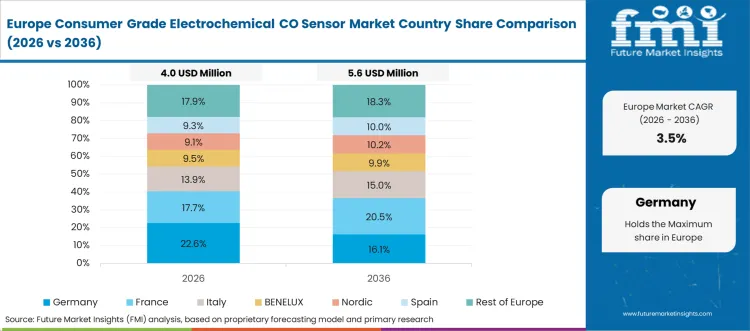
The consumer grade electrochemical CO sensor market in Europe is projected to grow from USD 5.0 million in 2026 to USD 8.5 million by 2036, registering a CAGR of 5.5% over the forecast period. Germany is expected to maintain leadership with a 29.3% market share in 2026, moderating to 29.0% by 2036, supported by residential safety standards, building code enforcement, and comprehensive household protection regulations.
France follows with 19.0% in 2026, projected at 19.2% by 2036, driven by residential building regulations, household safety requirements, and carbon monoxide awareness programs. The United Kingdom holds 17.1% in 2026, expected to reach 16.8% by 2036 due to building regulations compliance and residential safety campaigns. Italy commands 13.3% in 2026, rising slightly to 13.5% by 2036, while Spain accounts for 10.0% in 2026, reaching 10.2% by 2036 aided by residential development and household safety awareness growth. The Netherlands maintains 4.8% in 2026, up to 4.9% by 2036 due to residential safety standards and household protection emphasis. The Rest of Europe region, including Nordics, Central & Eastern Europe, and other markets, is anticipated to hold 6.5% in 2026 and 6.4% by 2036, reflecting steady development in residential safety awareness, building code implementation, and household detector adoption.
How is the Competitive Landscape Shaped in the Consumer Grade Electrochemical CO Sensor Market?
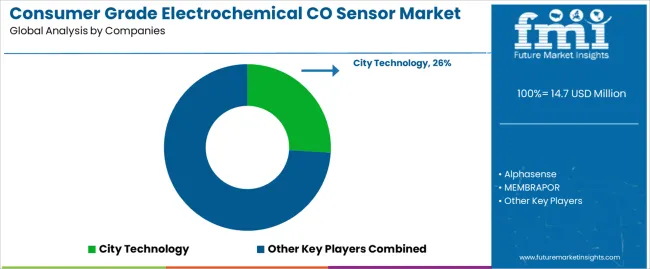
The consumer grade electrochemical CO sensor market is characterized by competition among established gas sensor manufacturers, consumer safety product companies, and specialized electrochemical sensor developers. Companies are investing in cost-optimized sensor designs, low-power electronics integration, consumer-friendly packaging, and smart connectivity features to deliver affordable, reliable, and user-accessible electrochemical CO sensor solutions. Innovation in sealed battery systems, smartphone connectivity, and extended operational lifetimes is central to strengthening market position and competitive advantage.
City Technology leads the market with comprehensive electrochemical gas sensor solutions focusing on residential carbon monoxide detection, consumer alarm applications, and cost-effective sensor reliability across diverse household environments. Alphasense provides advanced electrochemical sensors with emphasis on measurement accuracy and consumer product integration. MEMBRAPOR delivers specialized electrochemical gas sensors with focus on residential safety markets and quality manufacturing. SGX Sensortech offers comprehensive gas sensing solutions with emphasis on consumer applications and home safety monitoring. Figaro specializes in gas sensor technologies with focus on consumer electronics integration and cost-effective solutions. Draeger provides safety technology expertise with comprehensive residential gas detection capabilities.
Additional market participants include Winsen, Hanwei Electronics, Fosensor, and Nemoto, each contributing specialized expertise in electrochemical sensor technologies, consumer market knowledge, and residential application solutions.
Consumer Grade Electrochemical CO Sensor Market - Stakeholder Contribution Framework
Consumer grade electrochemical CO sensors represent a specialized residential safety component within household protection and carbon monoxide detection applications, projected to grow from USD 14.7 million in 2026 to USD 24.6 million by 2036 at a 5.3% CAGR. These electrochemical sensing devices, providing affordable carbon monoxide concentration measurement for residential environments, serve as critical safety components in household CO alarms, combination smoke-CO detectors, and residential gas monitoring systems where family protection, early hazard warning, and affordable safety solutions are paramount. Market expansion is driven by increasing residential safety awareness, growing building code requirements, expanding smart home adoption, and rising demand for reliable household carbon monoxide monitoring across diverse residential properties and living environments.
How Building Code Authorities Could Strengthen Residential Safety Standards?
- Detector Installation Requirements: Establish mandatory carbon monoxide detector installation specifications for residential buildings, including bedroom proximity requirements, detector placement guidelines, and installation verification procedures that ensure comprehensive household protection.
- Performance Standards: Develop minimum performance requirements for consumer grade electrochemical CO sensors, including accuracy specifications, alarm threshold standards, and operational lifetime requirements that ensure reliable residential detection.
- Replacement Mandates: Implement regulations requiring periodic carbon monoxide detector replacement based on sensor operational lifetime specifications, addressing end-of-life replacement schedules and ensuring continued detection effectiveness.
- Interconnection Requirements: Create building code provisions for interconnected carbon monoxide alarm systems in multi-level residences, addressing wireless connectivity standards and simultaneous alarm activation that enhance household warning effectiveness.
- Compliance Verification: Establish inspection protocols for carbon monoxide detector installation compliance, including new construction verification, rental property requirements, and resale inspection procedures that ensure regulatory adherence.
How Consumer Safety Organizations Could Advance Awareness and Education Programs?
- Public Education Campaigns: Develop comprehensive awareness programs educating homeowners about carbon monoxide risks, detector importance, and proper installation practices that increase household safety adoption and reduce poisoning incidents.
- Product Testing Standards: Establish independent testing protocols for consumer grade electrochemical CO sensors, including accuracy verification, false alarm resistance, and lifetime validation that provide consumers with reliable product comparison information.
- Installation Guidance: Create consumer-friendly recommendations for carbon monoxide detector placement, installation techniques, and maintenance practices that maximize detection effectiveness and ensure proper household protection.
- Technology Evaluation: Conduct comparative assessments of electrochemical versus alternative sensing technologies, including performance characteristics, cost considerations, and application suitability that guide consumer purchasing decisions.
- Advocacy Programs: Facilitate partnerships between safety organizations, sensor manufacturers, building officials, and community groups to advance residential safety awareness and accelerate carbon monoxide detector adoption.
How Consumer Grade Electrochemical CO Sensor Manufacturers Could Drive Innovation and Market Leadership?
- Cost Optimization: Invest in manufacturing efficiency improvements, simplified sensor designs, and automated production processes that reduce product costs while maintaining detection performance and enabling widespread consumer adoption.
- Smart Integration: Implement wireless connectivity capabilities, smartphone application development, and voice assistant compatibility that enable connected home integration, remote monitoring, and enhanced consumer convenience features.
- Extended Lifetime Designs: Develop sensor technologies with ten-year operational lifetimes and sealed battery systems that eliminate maintenance requirements, reduce replacement burdens, and improve consumer value propositions.
- User Experience Enhancement: Establish intuitive installation processes, clear indicator systems, and consumer-friendly interfaces that enable easy setup, simple operation, and effective household safety management.
- Distribution Excellence: Develop comprehensive retail partnerships, online marketplace presence, and consumer education programs that ensure product availability, provide purchase guidance, and support successful detector adoption.
How Homeowners and Property Managers Could Optimize Residential Safety Protection?
- Strategic Detector Placement: Conduct assessments of carbon monoxide hazard sources, sleeping area locations, and residential layouts to optimize electrochemical CO sensor placement and achieve desired protection coverage while meeting building code requirements.
- Maintenance Programs: Implement systematic testing schedules, battery replacement protocols, and sensor replacement planning that ensure continued detection reliability, maintain household protection, and support family safety objectives.
- Technology Selection: Evaluate product options considering detection performance, smart connectivity features, battery lifetime specifications, and cost considerations to select appropriate carbon monoxide detectors that align with household requirements and budget constraints.
- Family Education: Establish household awareness programs educating family members about carbon monoxide risks, alarm response procedures, and emergency evacuation protocols that enhance safety preparedness and incident response effectiveness.
- System Integration: Create coordinated approaches connecting carbon monoxide detectors with smoke alarms, security systems, and smart home platforms that enable comprehensive household safety monitoring and coordinated emergency response.
How Research Institutions Could Enable Technology Advancement?
- Sensor Chemistry Research: Conduct fundamental investigations into electrode materials, electrolyte formulations, and reaction mechanisms that advance understanding of carbon monoxide detection principles and enable breakthrough innovations in consumer sensor performance.
- Low-Power Electronics: Develop ultra-efficient circuit designs, power management technologies, and energy harvesting approaches that extend battery lifetimes and enable maintenance-free residential detection systems.
- False Alarm Reduction: Investigate interference rejection techniques, signal processing algorithms, and sensor selectivity improvements that minimize nuisance alarms while maintaining reliable carbon monoxide detection sensitivity.
- Consumer Testing Studies: Conduct field evaluation programs assessing real-world sensor performance, consumer usage patterns, and installation effectiveness that guide product development and inform safety education programs.
- Knowledge Dissemination: Facilitate technology transfer through technical publications, consumer safety conferences, standards development participation, and industry collaboration that accelerates innovation adoption and strengthens residential safety outcomes.
How Investors and Financial Enablers Could Support Market Growth and Innovation?
- Manufacturing Scale Investment: Provide capital for high-volume production facility development, automated assembly systems, and quality control infrastructure that enable cost-effective sensor manufacturing and mass-market consumer adoption.
- Product Development Financing: Fund research and development of smart connectivity features, extended-lifetime technologies, and user experience enhancements that address consumer preferences and create competitive differentiation.
- Market Expansion Support: Finance distribution channel development, retail partnerships, and consumer marketing programs that accelerate market penetration and strengthen brand positions in residential safety markets.
- Technology Acquisition: Support strategic acquisitions of complementary technologies, intellectual property, and market access that expand product capabilities and strengthen competitive positions in consumer safety markets.
- Consumer Education Programs: Provide financing for public awareness campaigns, safety education initiatives, and community outreach programs that increase carbon monoxide detector adoption and reduce residential poisoning incidents.
Key Players in the Consumer Grade Electrochemical CO Sensor Market
- City Technology
- Alphasense
- MEMBRAPOR
- SGX Sensortech
- Figaro
- Draeger
- Winsen
- Hanwei Electronics
- Fosensor
- Nemoto
Scope of the Report
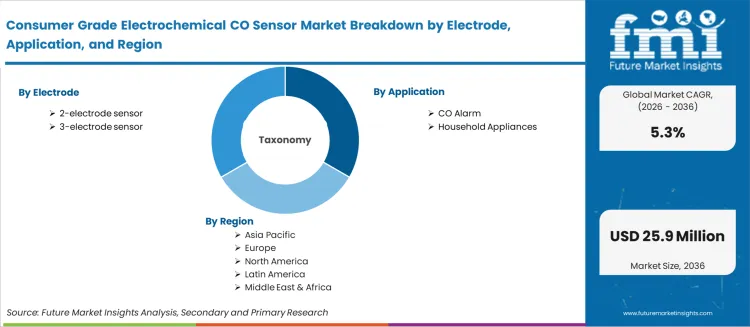
| Metric | Value |
|---|---|
| Quantitative Units | USD 15.48 million to USD 25.94 million, at a CAGR of 5.3% |
| Market Definition | Based on FMI's report, the Consumer Grade Electrochemical CO Sensor market covers 2-electrode and 3-electrode electrochemical carbon monoxide sensor modules used in CO alarms and household appliances for residential and light commercial gas safety monitoring applications globally. |
| Segmentation | Electrode: 2-electrode sensor, 3-electrode sensor; Application: CO Alarm, Household Appliances |
| Regions Covered | China, India, Germany, Brazil, USA, UK, Japan |
| Key Companies Profiled | City Technology, Alphasense, MEMBRAPOR, SGX Sensortech, Figaro, Draeger, Winsen, Hanwei Electronics, Fosensor, Nemoto |
| Forecast Period | 2026 to 2036 |
| Approach | Hybrid bottom-up methodology combining installed base metrics with regulatory compliance adoption curves and primary research validation. |
Consumer Grade Electrochemical CO Sensor Market by Segments
Electrode Configuration:
- 2-electrode sensor
- 3-electrode sensor
Application:
- Household Appliances
- CO Alarm
Region:
East Asia
- China
- Japan
- South Korea
- Taiwan
- Rest of East Asia
Europe
- Germany
- United Kingdom
- France
- Italy
- Spain
- Netherlands
- Nordic
- BENELUX
- Rest of Europe
North America
- United States
- Canada
- Mexico
South Asia
- India
- Pakistan
- Bangladesh
- Rest of South Asia
Latin America
- Brazil
- Argentina
- Chile
- Rest of Latin America
Middle East & Africa
- Kingdom of Saudi Arabia
- Other GCC Countries
- Turkey
- South Africa
- Other African Union
- Rest of Middle East & Africa
Eastern Europe
- Russia
- Poland
- Czech Republic
- Rest of Eastern Europe
Bibliography
- 1. European Committee for Standardization. (2024). EN 50291-1: Electrical Apparatus for the Detection of Carbon Monoxide in Domestic Premises. CEN.
- 2. Underwriters Laboratories. (2024). UL 2034: Standard for Single and Multiple Station Carbon Monoxide Alarms. UL.
- 3. International Organization for Standardization. (2024). ISO 12100: Safety of Machinery, General Principles for Design. ISO.
- 4. UK Government. (2024). The Smoke and Carbon Monoxide Alarm (Amendment) Regulations 2022: Compliance Report. legislation.gov.uk.
- 5. World Health Organization. (2024). Indoor Air Quality Guidelines: Carbon Monoxide. WHO.
- 6. Organisation for Economic Co-operation and Development. (2025). Housing and Urban Development: Safety Standards. OECD Publishing.
This bibliography is provided for reader reference. The full Future Market Insights report contains the complete reference list with primary research documentation.
Frequently Asked Questions
How large is the Consumer Grade Electrochemical CO Sensor market in 2026?
The Consumer Grade Electrochemical CO Sensor market is estimated to be valued at USD 15.48 million in 2026.
What will be the market size of Consumer Grade Electrochemical CO Sensor by 2036?
Market size for Consumer Grade Electrochemical CO Sensor is projected to reach USD 25.94 million by 2036.
What is the expected CAGR for Consumer Grade Electrochemical CO Sensor between 2026 and 2036?
The Consumer Grade Electrochemical CO Sensor market is expected to grow at a CAGR of 5.3% between 2026 and 2036.
Which Electrode leads the Consumer Grade Electrochemical CO Sensor market in 2026?
2-electrode sensor accounts for 60% share in 2026 by Electrode.
Which region is projected to grow fastest?
China is projected to grow at a CAGR of 7.2% during 2026 to 2036.
What does this report include in its scope?
The report covers market sizing, segmentation analysis, regional forecasts, competitive landscape evaluation, and forecast projections from 2026 to 2036.
How does FMI build and validate the Consumer Grade Electrochemical CO Sensor forecast?
Forecasting models apply a bottom-up methodology starting with installed base metrics and cross-validate projections against quarterly revenue volumes and industry data.
Preview the report firsthand - request a free sample
Get SampleGet the brochure for pricing and purchase details.
Get PDFTable of Content
- Executive Summary
- Global Market Outlook
- Demand-side Trends
- Supply-side Trends
- Technology Roadmap Analysis
- Analysis and Recommendations
- Market Overview
- Market Coverage / Taxonomy
- Market Definition / Scope / Limitations
- Research Methodology
- Chapter Orientation
- Analytical Lens and Working Hypotheses
- Market Structure, Signals, and Trend Drivers
- Benchmarking and Cross-market Comparability
- Market Sizing, Forecasting, and Opportunity Mapping
- Research Design and Evidence Framework
- Desk Research Programme (Secondary Evidence)
- Company Annual and Sustainability Reports
- Peer-reviewed Journals and Academic Literature
- Corporate Websites, Product Literature, and Technical Notes
- Earnings Decks and Investor Briefings
- Statutory Filings and Regulatory Disclosures
- Technical White Papers and Standards Notes
- Trade Journals, Industry Magazines, and Analyst Briefs
- Conference Proceedings, Webinars, and Seminar Materials
- Government Statistics Portals and Public Data Releases
- Press Releases and Reputable Media Coverage
- Specialist Newsletters and Curated Briefings
- Sector Databases and Reference Repositories
- FMI Internal Proprietary Databases and Historical Market Datasets
- Subscription Datasets and Paid Sources
- Social Channels, Communities, and Digital Listening Inputs
- Additional Desk Sources
- Expert Input and Fieldwork (Primary Evidence)
- Primary Modes
- Qualitative Interviews and Expert Elicitation
- Quantitative Surveys and Structured Data Capture
- Blended Approach
- Why Primary Evidence is Used
- Field Techniques
- Interviews
- Surveys
- Focus Groups
- Observational and In-context Research
- Social and Community Interactions
- Stakeholder Universe Engaged
- C-suite Leaders
- Board Members
- Presidents and Vice Presidents
- R&D and Innovation Heads
- Technical Specialists
- Domain Subject-matter Experts
- Scientists
- Physicians and Other Healthcare Professionals
- Governance, Ethics, and Data Stewardship
- Research Ethics
- Data Integrity and Handling
- Primary Modes
- Tooling, Models, and Reference Databases
- Desk Research Programme (Secondary Evidence)
- Data Engineering and Model Build
- Data Acquisition and Ingestion
- Cleaning, Normalisation, and Verification
- Synthesis, Triangulation, and Analysis
- Quality Assurance and Audit Trail
- Market Background
- Market Dynamics
- Drivers
- Restraints
- Opportunity
- Trends
- Scenario Forecast
- Demand in Optimistic Scenario
- Demand in Likely Scenario
- Demand in Conservative Scenario
- Opportunity Map Analysis
- Product Life Cycle Analysis
- Supply Chain Analysis
- Investment Feasibility Matrix
- Value Chain Analysis
- PESTLE and Porter’s Analysis
- Regulatory Landscape
- Regional Parent Market Outlook
- Production and Consumption Statistics
- Import and Export Statistics
- Market Dynamics
- Global Market Analysis 2021 to 2025 and Forecast, 2026 to 2036
- Historical Market Size Value (USD Million) Analysis, 2021 to 2025
- Current and Future Market Size Value (USD Million) Projections, 2026 to 2036
- Y-o-Y Growth Trend Analysis
- Absolute $ Opportunity Analysis
- Global Market Pricing Analysis 2021 to 2025 and Forecast 2026 to 2036
- Global Market Analysis 2021 to 2025 and Forecast 2026 to 2036, By Electrode
- Introduction / Key Findings
- Historical Market Size Value (USD Million) Analysis By Electrode , 2021 to 2025
- Current and Future Market Size Value (USD Million) Analysis and Forecast By Electrode , 2026 to 2036
- 2-electrode sensor
- 3-electrode sensor
- 2-electrode sensor
- Y-o-Y Growth Trend Analysis By Electrode , 2021 to 2025
- Absolute $ Opportunity Analysis By Electrode , 2026 to 2036
- Global Market Analysis 2021 to 2025 and Forecast 2026 to 2036, By Application
- Introduction / Key Findings
- Historical Market Size Value (USD Million) Analysis By Application, 2021 to 2025
- Current and Future Market Size Value (USD Million) Analysis and Forecast By Application, 2026 to 2036
- CO Alarm
- Household Appliances
- CO Alarm
- Y-o-Y Growth Trend Analysis By Application, 2021 to 2025
- Absolute $ Opportunity Analysis By Application, 2026 to 2036
- Global Market Analysis 2021 to 2025 and Forecast 2026 to 2036, By Region
- Introduction
- Historical Market Size Value (USD Million) Analysis By Region, 2021 to 2025
- Current Market Size Value (USD Million) Analysis and Forecast By Region, 2026 to 2036
- North America
- Latin America
- Western Europe
- Eastern Europe
- East Asia
- South Asia and Pacific
- Middle East & Africa
- Market Attractiveness Analysis By Region
- North America Market Analysis 2021 to 2025 and Forecast 2026 to 2036, By Country
- Historical Market Size Value (USD Million) Trend Analysis By Market Taxonomy, 2021 to 2025
- Market Size Value (USD Million) Forecast By Market Taxonomy, 2026 to 2036
- By Country
- USA
- Canada
- Mexico
- By Electrode
- By Application
- By Country
- Market Attractiveness Analysis
- By Country
- By Electrode
- By Application
- Key Takeaways
- Latin America Market Analysis 2021 to 2025 and Forecast 2026 to 2036, By Country
- Historical Market Size Value (USD Million) Trend Analysis By Market Taxonomy, 2021 to 2025
- Market Size Value (USD Million) Forecast By Market Taxonomy, 2026 to 2036
- By Country
- Brazil
- Chile
- Rest of Latin America
- By Electrode
- By Application
- By Country
- Market Attractiveness Analysis
- By Country
- By Electrode
- By Application
- Key Takeaways
- Western Europe Market Analysis 2021 to 2025 and Forecast 2026 to 2036, By Country
- Historical Market Size Value (USD Million) Trend Analysis By Market Taxonomy, 2021 to 2025
- Market Size Value (USD Million) Forecast By Market Taxonomy, 2026 to 2036
- By Country
- Germany
- UK
- Italy
- Spain
- France
- Nordic
- BENELUX
- Rest of Western Europe
- By Electrode
- By Application
- By Country
- Market Attractiveness Analysis
- By Country
- By Electrode
- By Application
- Key Takeaways
- Eastern Europe Market Analysis 2021 to 2025 and Forecast 2026 to 2036, By Country
- Historical Market Size Value (USD Million) Trend Analysis By Market Taxonomy, 2021 to 2025
- Market Size Value (USD Million) Forecast By Market Taxonomy, 2026 to 2036
- By Country
- Russia
- Poland
- Hungary
- Balkan & Baltic
- Rest of Eastern Europe
- By Electrode
- By Application
- By Country
- Market Attractiveness Analysis
- By Country
- By Electrode
- By Application
- Key Takeaways
- East Asia Market Analysis 2021 to 2025 and Forecast 2026 to 2036, By Country
- Historical Market Size Value (USD Million) Trend Analysis By Market Taxonomy, 2021 to 2025
- Market Size Value (USD Million) Forecast By Market Taxonomy, 2026 to 2036
- By Country
- China
- Japan
- South Korea
- By Electrode
- By Application
- By Country
- Market Attractiveness Analysis
- By Country
- By Electrode
- By Application
- Key Takeaways
- South Asia and Pacific Market Analysis 2021 to 2025 and Forecast 2026 to 2036, By Country
- Historical Market Size Value (USD Million) Trend Analysis By Market Taxonomy, 2021 to 2025
- Market Size Value (USD Million) Forecast By Market Taxonomy, 2026 to 2036
- By Country
- India
- ASEAN
- Australia & New Zealand
- Rest of South Asia and Pacific
- By Electrode
- By Application
- By Country
- Market Attractiveness Analysis
- By Country
- By Electrode
- By Application
- Key Takeaways
- Middle East & Africa Market Analysis 2021 to 2025 and Forecast 2026 to 2036, By Country
- Historical Market Size Value (USD Million) Trend Analysis By Market Taxonomy, 2021 to 2025
- Market Size Value (USD Million) Forecast By Market Taxonomy, 2026 to 2036
- By Country
- Kingdom of Saudi Arabia
- Other GCC Countries
- Turkiye
- South Africa
- Other African Union
- Rest of Middle East & Africa
- By Electrode
- By Application
- By Country
- Market Attractiveness Analysis
- By Country
- By Electrode
- By Application
- Key Takeaways
- Key Countries Market Analysis
- USA
- Pricing Analysis
- Market Share Analysis, 2025
- By Electrode
- By Application
- Canada
- Pricing Analysis
- Market Share Analysis, 2025
- By Electrode
- By Application
- Mexico
- Pricing Analysis
- Market Share Analysis, 2025
- By Electrode
- By Application
- Brazil
- Pricing Analysis
- Market Share Analysis, 2025
- By Electrode
- By Application
- Chile
- Pricing Analysis
- Market Share Analysis, 2025
- By Electrode
- By Application
- Germany
- Pricing Analysis
- Market Share Analysis, 2025
- By Electrode
- By Application
- UK
- Pricing Analysis
- Market Share Analysis, 2025
- By Electrode
- By Application
- Italy
- Pricing Analysis
- Market Share Analysis, 2025
- By Electrode
- By Application
- Spain
- Pricing Analysis
- Market Share Analysis, 2025
- By Electrode
- By Application
- France
- Pricing Analysis
- Market Share Analysis, 2025
- By Electrode
- By Application
- India
- Pricing Analysis
- Market Share Analysis, 2025
- By Electrode
- By Application
- ASEAN
- Pricing Analysis
- Market Share Analysis, 2025
- By Electrode
- By Application
- Australia & New Zealand
- Pricing Analysis
- Market Share Analysis, 2025
- By Electrode
- By Application
- China
- Pricing Analysis
- Market Share Analysis, 2025
- By Electrode
- By Application
- Japan
- Pricing Analysis
- Market Share Analysis, 2025
- By Electrode
- By Application
- South Korea
- Pricing Analysis
- Market Share Analysis, 2025
- By Electrode
- By Application
- Russia
- Pricing Analysis
- Market Share Analysis, 2025
- By Electrode
- By Application
- Poland
- Pricing Analysis
- Market Share Analysis, 2025
- By Electrode
- By Application
- Hungary
- Pricing Analysis
- Market Share Analysis, 2025
- By Electrode
- By Application
- Kingdom of Saudi Arabia
- Pricing Analysis
- Market Share Analysis, 2025
- By Electrode
- By Application
- Turkiye
- Pricing Analysis
- Market Share Analysis, 2025
- By Electrode
- By Application
- South Africa
- Pricing Analysis
- Market Share Analysis, 2025
- By Electrode
- By Application
- USA
- Market Structure Analysis
- Competition Dashboard
- Competition Benchmarking
- Market Share Analysis of Top Players
- By Regional
- By Electrode
- By Application
- Competition Analysis
- Competition Deep Dive
- City Technology
- Overview
- Product Portfolio
- Profitability by Market Segments (Product/Age /Sales Channel/Region)
- Sales Footprint
- Strategy Overview
- Marketing Strategy
- Product Strategy
- Channel Strategy
- Alphasense
- MEMBRAPOR
- SGX Sensortech
- Figaro
- Draeger
- Winsen
- Hanwei Electronics
- Fosensor
- Nemoto
- City Technology
- Competition Deep Dive
- Assumptions & Acronyms Used


