

- Industry Size (2025)
- USD 14.7 Mn
- Forecast (2035)
- USD 24.8 Mn
- CAGR (2025 to 2035)
- 5.4%
Electrochemical CO Sensor for Portable Device Market Forecast and Outlook 2025 to 2035
The global electrochemical CO sensors for portable device market is expected to advance from USD 14.7 million in 2025 to USD 24.9 million by 2035, translating to a CAGR of 5.4%. Expansion in the sales of electrochemical CO sensors is being influenced by new safety mandates, increasing household awareness of carbon monoxide exposure, and the push for compact, battery-efficient sensors across connected and portable devices. Models with a diameter below 15 mm are projected to dominate with a 51% market share, as manufacturers prioritize smaller footprints and reduced energy draw for integration in detectors, smart home units, and wearable monitors.
Residential safety remains the primary adoption sphere, accounting for about 60% of total installations, supported by government-backed safety codes and broader consumer interest in indoor air monitoring. Industrial usage is also expanding gradually through handheld detectors for confined spaces and maintenance operations. Future revenue pools are shifting toward IoT-enabled CO sensors, combining digital calibration, wireless diagnostics, and real-time alerts via mobile and networked platforms. East Asia remains the hub of growth, driven by China’s electronics manufacturing infrastructure and rapid regulatory adoption, followed by India and Western Europe. Key participants such as City Technology, Alphasense, and SGX Sensortech are refining sensor chemistry and microelectrode design to improve accuracy and lifespan in miniature formats. As end-users focus on connectivity and reliability over standalone sensitivity, the market’s competitive frontier is expected to favor multi-functional, cloud-integrated, and ultra-compact sensing modules tailored for smart safety ecosystems.
Quick Stats for Electrochemical CO Sensor for Portable Device Market
- Electrochemical CO Sensor for Portable Device Market Value (2025): USD 14.7 million
- Electrochemical CO Sensor for Portable Device Market Forecast Value (2035): USD 24.8 million
- Electrochemical CO Sensor for Portable Device Market Forecast CAGR: 5.4%
- Leading Sensor Size in Electrochemical CO Sensor for Portable Device Market: Diameter<15 mm
- Key Growth Regions in Electrochemical CO Sensor for Portable Device Market: East Asia, South Asia Pacific, and Western Europe
- Top Key Players in Electrochemical CO Sensor for Portable Device Market: City Technology, Alphasense, MEMBRAPOR, SGX Sensortech, Figaro
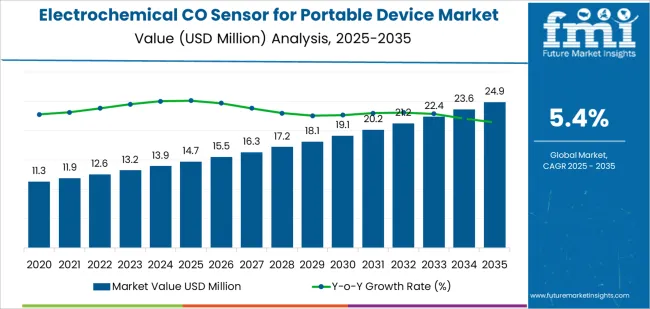
The latter half (2030-2035) will witness continued growth from USD 19.1 million to USD 24.8 million, representing an addition of USD 5.7 million or 56% of the decade's expansion. This period will be defined by mass market penetration of ultra-compact sensing technologies, integration with comprehensive IoT safety platforms, and seamless compatibility with existing portable device infrastructure. The market trajectory signals fundamental shifts in how safety device manufacturers approach gas detection and sensor miniaturization, with participants positioned to benefit from growing demand across multiple sensor sizes and application segments.
Where revenue comes from -- now vs next (industry-level view)
| Period | Primary Revenue Buckets | Share | Notes |
|---|---|---|---|
| Today | New sensor sales (residential, industrial detectors) | 48% | OEM-led, safety device integration-driven purchases |
| Replacement sensors & calibration | 22% | End-of-life replacement, periodic calibration | |
| Industrial safety device integration | 18% | Portable gas detectors, multi-gas monitors | |
| Technical services & calibration support | 12% | Field calibration, technical consultation | |
| Future (3-5 yrs) | IoT-enabled smart sensors | 38-42% | Wireless connectivity, cloud data integration |
| Ultra-compact sensor modules | 24-28% | Wearable devices, consumer electronics integration | |
| Replacement & aftermarket | 14-18% | Sensor lifecycle management, calibration services | |
| Industrial safety applications | 10-14% | Multi-gas detection, hazardous environment monitoring | |
| Data services & analytics | 8-11% | Air quality tracking, exposure monitoring platforms | |
| Technical support (calibration, certification, training) | 5-8% | Professional calibration services |
Electrochemical CO Sensor for Portable Device Market Key Takeaways
| Metric | Value |
|---|---|
| Market Value (2025) | USD 14.7 million |
| Market Forecast (2035) | USD 24.8 million |
| Growth Rate | 5.4% CAGR |
| Leading Technology | Diameter<15 mm |
| Primary Application | Residential Segment |
The market demonstrates strong fundamentals with ultra-compact sensor systems capturing a dominant share through advanced miniaturization capabilities and portable device optimization. Residential applications drive primary demand, supported by increasing safety awareness and carbon monoxide detection requirements. Geographic expansion remains concentrated in developed markets with established safety regulation infrastructure, while emerging economies show accelerating adoption rates driven by safety standard initiatives and rising residential protection requirements.
Imperatives for Stakeholders in Electrochemical CO Sensor for Portable Device Market
Design for miniaturization, not just sensitivity
- Offer complete sensing packages: sensors + integration support + calibration protocols + technical documentation + certification assistance.
- Preconfigured detection profiles: alarm thresholds, response time specifications, temperature compensation, and digital calibration tracking on portable devices.
IoT connectivity readiness
- Wireless communication capabilities, cloud data integration, and smart device connectivity (Bluetooth integration, mobile app compatibility, network monitoring platforms).
Quality-by-design approach
- Low power consumption optimization, long-term stability characteristics, automated self-diagnostic capabilities, and comprehensive performance validation documentation.
Value-based pricing models
- Clear base sensor price + transparent service tiers (technical support, calibration services, performance guarantees); support for lifecycle management and replacement programs.
What Is the Market Segmentation for Electrochemical CO Sensor for Portable Device Market?
Primary Classification: The market segments by sensor size into diameter<15 mm, 15≤diameter<20 mm, and others, representing the evolution from standard sensing elements to ultra-compact detection solutions for comprehensive portable device integration optimization.
Secondary Classification: Application segmentation divides the market into residential and industrial categories, reflecting distinct requirements for gas detection, portability, and device integration standards.
Regional Classification: Geographic distribution covers North America, Latin America, Western Europe, Eastern Europe, East Asia, South Asia Pacific, and Middle East & Africa, with developed markets leading adoption while emerging economies show accelerating growth patterns driven by safety regulation expansion programs.
The segmentation structure reveals technology progression from standard sensor elements toward ultra-miniaturized detection systems with enhanced sensitivity and power efficiency capabilities, while application diversity spans from residential safety devices to industrial portable monitors requiring precise carbon monoxide detection solutions.
By Sensor Size, the Diameter<15 mm Segment Accounts for Dominant Market Share
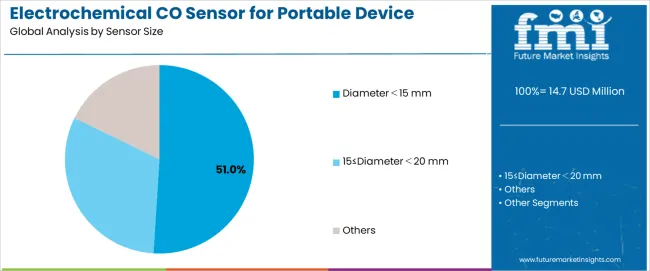
Market Position: Diameter<15 mm systems command the leading position in the electrochemical CO sensor for portable device market with 51% market share through advanced miniaturization features, including superior space efficiency, integration flexibility, and portable device optimization that enable detector manufacturers to achieve optimal sensing performance across diverse residential and industrial portable environments.
Value Drivers: The segment benefits from device manufacturer preference for compact sensing systems that provide reliable CO detection, minimal space requirements, and design flexibility optimization without requiring significant device footprint allocation. Advanced design features enable low power consumption, fast response time, and integration with portable electronics, where operational performance and size constraints represent critical product requirements.
Competitive Advantages: Diameter<15 mm systems differentiate through proven miniaturization capabilities, consistent detection characteristics, and integration with compact portable devices that enhance product effectiveness while maintaining optimal sensitivity standards suitable for diverse residential and industrial applications.
Key market characteristics:
- Advanced sensor designs with optimized electrode configuration and space efficiency capabilities
- Enhanced detection effectiveness, enabling accurate CO measurement with compact form factor
- Device compatibility, including battery-powered systems, wearable integration, and performance optimization for portable operations
15≤Diameter<20 mm Systems Show Balanced Market Growth
15≤Diameter<20 mm systems maintain a market position in the electrochemical CO sensor for portable device market due to their balanced performance properties and industrial application advantages. These systems appeal to manufacturers requiring enhanced sensitivity with competitive pricing for professional-grade portable detector applications. Market growth is driven by industrial safety expansion, emphasizing reliable detection solutions and operational performance through optimized sensor designs.
Other Sensor Sizes Demonstrate Specialized Applications
Other sensor size systems capture market share through specialized detection requirements in legacy devices, custom applications, and specific product configurations. These applications demand flexible sensor systems capable of meeting unique requirements while providing effective CO detection capabilities and operational reliability.
By Application, the Residential Segment Shows Fastest Growth
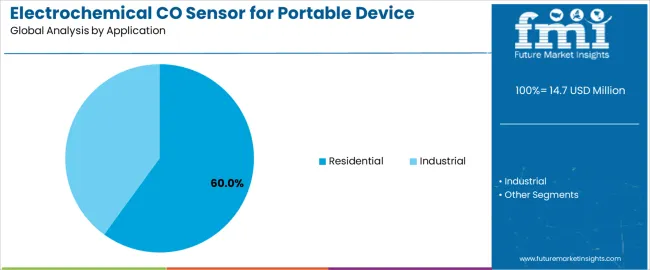
Market Context: Residential applications demonstrate the highest growth rate in the electrochemical CO sensor for portable device market with 7.3% CAGR due to widespread adoption of portable CO detectors and increasing focus on home safety optimization, health protection improvement, and indoor monitoring applications that maximize occupant safety while maintaining affordability standards.
Appeal Factors: Residential device manufacturers prioritize sensor reliability, long battery life, and integration with compact detector designs that enable effective CO monitoring across household environments. The segment benefits from substantial consumer safety investment and residential protection programs that emphasize the acquisition of portable CO detection systems for health protection and safety compliance applications.
Growth Drivers: Home safety awareness programs incorporate portable CO detectors as essential devices for residential protection, while building safety modernization increases demand for reliable sensor capabilities that comply with safety standards and minimize carbon monoxide exposure risk.
Market Challenges: Varying price sensitivity and consumer awareness levels may limit sensor standardization across different markets or product segments.
Application dynamics include:
- Strong growth in residential safety and portable detector deployment requiring compact sensor capabilities
- Increasing adoption in home protection and safety monitoring applications for consumers
- Rising integration with smart home systems for alert optimization and remote monitoring
Industrial Applications Maintain Strong Demand
Industrial applications capture market share through critical safety requirements in workplace monitoring, confined space detection, and professional safety equipment. These facilities demand durable sensor systems capable of operating in demanding environments while providing effective CO detection and operational reliability capabilities.
By Region, East Asia Leads Growth
Market Position: East Asia commands significant market position with 7.3% CAGR through rapid manufacturing activity that drives demand for portable gas detection solutions across residential and industrial safety applications.
Value Drivers: This region provides the ideal combination of electronics manufacturing capability and safety regulation development, meeting requirements for residential detector applications, industrial safety equipment, and consumer device installations without excessive technology complexity.
Growth Characteristics: The segment benefits from broad electronics manufacturing activity across device sectors, government safety programs, and established sensor supply chains that support widespread adoption and production efficiency.
What are the Drivers, Restraints, and Key Trends of the Electrochemical CO Sensor for Portable Device Market?
| Category | Factor | Impact | Why It Matters |
|---|---|---|---|
| Driver | Safety regulation expansion & building codes (CO detector mandates) | ★★★★★ | Mandatory CO detection installation requirements drive sensor demand with reliable performance and regulatory compliance across residential markets. |
| Driver | Portable device proliferation & wearable technology growth | ★★★★★ | Increasing portable safety devices and wearable electronics create integration opportunities; miniaturization becomes critical competitive differentiator. |
| Driver | Industrial safety standards & workplace monitoring requirements | ★★★★☆ | Occupational health regulations mandate personal gas detection; portable industrial monitors expanding addressable sensor market segments. |
| Restraint | Sensor lifecycle limitations & replacement costs | ★★★★☆ | Electrochemical sensors have finite operational life; replacement requirements create ongoing cost concerns for consumers and commercial users. |
| Restraint | Calibration complexity & maintenance requirements | ★★★☆☆ | Regular calibration needs increase ownership complexity; maintenance requirements limit adoption in consumer segments with minimal technical support. |
| Trend | IoT integration & connected safety devices | ★★★★★ | Wireless connectivity enables remote monitoring and cloud data integration; smart features transform standalone detectors into connected safety ecosystems. |
| Trend | Ultra-miniaturization & wearable integration | ★★★★☆ | Continuous size reduction enables new applications in consumer electronics and wearables; nano-scale sensors drive innovation in personal safety monitoring. |
How Does the Demand for Electrochemical CO Sensor for Portable Device Market Vary Across Countries?
The electrochemical CO sensor for portable device market demonstrates varied regional dynamics with Growth Leaders including China (7.3% growth rate) and India (6.8% growth rate) driving expansion through electronics manufacturing initiatives and safety regulation development. Steady Performers encompass Germany (6.2% growth rate), Brazil (5.7% growth rate), and developed regions, benefiting from established safety device markets and regulatory compliance adoption. Emerging Markets feature developing regions, where safety awareness initiatives and detector deployment support consistent growth patterns.
Regional synthesis reveals East Asian markets leading adoption through electronics manufacturing expansion and safety regulation development, while South Asian countries maintain strong growth supported by residential construction and safety awareness advancement. European and North American markets show moderate growth driven by sensor replacement and device upgrade trends.
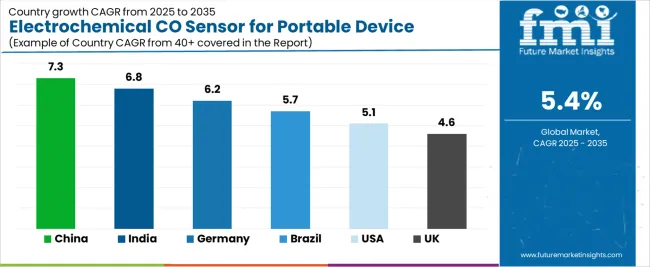
| Region/Country | 2025-2035 Growth | How to win | What to watch out |
|---|---|---|---|
| China | 7.3% | Lead with cost-effective integration | Manufacturing competition; price pressures |
| India | 6.8% | Focus on residential safety segment | Awareness gaps; distribution challenges |
| Germany | 6.2% | Offer premium quality sensors | Certification complexity; high standards |
| Brazil | 5.7% | Value-oriented product positioning | Economic volatility; regulatory inconsistency |
| United States | 5.1% | Provide technical support services | Market saturation; replacement cycles |
| United Kingdom | 4.6% | Push IoT-enabled solutions | Market maturity; Brexit certification impacts |
How Does the Demand for Electrochemical CO Sensor for Portable Device Market Perform in China?
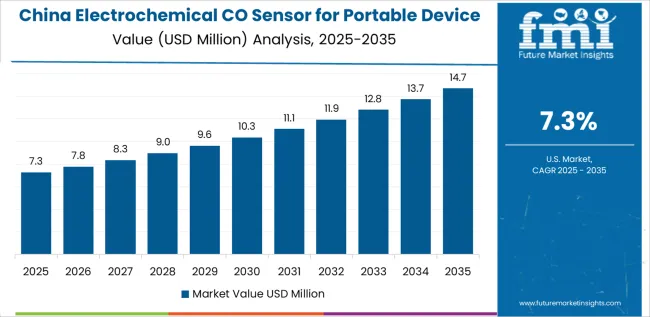
China establishes fastest market growth through aggressive electronics manufacturing programs and comprehensive safety regulation development, integrating electrochemical CO sensors as essential components in portable detector manufacturing and safety device applications. The country's 7.3% growth rate reflects government initiatives promoting safety standards and domestic sensor manufacturing capabilities that mandate the use of CO detection systems in residential and industrial portable devices. Growth concentrates in major manufacturing hubs, including Shenzhen, Shanghai, and Guangzhou, where electronics technology development showcases integrated sensor systems that appeal to device manufacturers seeking advanced miniaturization capabilities and cost optimization applications.
Chinese manufacturers are developing cost-effective sensor solutions that combine domestic production advantages with performance features, including ultra-compact designs and low power consumption capabilities. Distribution channels through electronics component suppliers and safety device manufacturers expand market access, while government support for safety regulation adoption supports deployment across diverse residential and industrial segments.
Strategic Market Indicators:
- Electronics manufacturing facilities leading adoption with 72% integration rate in portable detector and consumer device sectors
- Government safety programs providing substantial support for domestic sensor technology development
- Local manufacturers capturing 58% market share through competitive pricing and rapid production capabilities
- Export market development for cost-effective sensor solutions targeting emerging safety device markets
What Are the Trends in the Demand for Electrochemical CO Sensor for Portable Device Market in India?
In Mumbai, Delhi, and Bangalore, residential safety device manufacturers and industrial equipment suppliers are implementing electrochemical CO sensors as essential components for portable detector manufacturing and safety monitoring applications, driven by increasing government safety investment and residential construction programs that emphasize the importance of carbon monoxide detection capabilities. The market holds a 6.8% growth rate, supported by government safety awareness initiatives and building code development programs that promote CO sensor integration for residential and industrial portable devices. Indian operators are adopting sensor systems that provide reliable detection performance and cost-effective features, particularly appealing in regions where safety compliance and affordability represent critical product requirements.
Market expansion benefits from growing residential safety awareness capabilities and international technology partnerships that enable domestic availability of CO sensor systems for detector and device applications. Technology adoption follows patterns established in safety equipment, where reliability and value drive procurement decisions and product integration.
Market Intelligence Brief:
- Residential and industrial segments are driving initial adoption with 41% annual growth in sensor integration
- Safety awareness programs emphasizing CO sensors for home protection and workplace safety
- Local distributors partnering with international providers for technology availability
- Device manufacturers implementing sensors for safety compliance and product differentiation
How Is the Demand for Electrochemical CO Sensor for Portable Device Market Evolving in Germany?
Germany establishes technology leadership through comprehensive safety regulation programs and advanced electronics infrastructure development, integrating electrochemical CO sensors across residential and industrial portable device applications. The country's 6.2% growth rate reflects established safety device industry relationships and mature sensor technology adoption that supports widespread use of premium CO detection systems in portable detector and industrial safety facilities. Growth concentrates in major industrial centers, including Baden-Württemberg, Bavaria, and North Rhine-Westphalia, where safety technology showcases mature sensor deployment that appeals to device manufacturers seeking proven detection capabilities and certification compliance applications.
German equipment providers leverage established distribution networks and comprehensive technical capabilities, including calibration support and certification assistance that create customer relationships and operational advantages. The market benefits from mature safety standards and device requirements that support CO sensor use while encouraging technology advancement and performance optimization.
Market Intelligence Brief:
- Safety device and industrial equipment manufacturers maintaining 83% adoption rate with mature sensor deployment
- Established certification standards providing consistent demand for sensor technology advancement
- Electronics distribution networks capturing 69% market share through technical expertise and quality assurance
- Safety regulation programs expanding advanced sensor adoption in device scenarios
What Is the Outlook for Electrochemical CO Sensor for Portable Device Market in Brazil?
Brazil's market expansion benefits from diverse safety device demand, including residential detector development in São Paulo and Rio de Janeiro, industrial safety equipment manufacturing, and government safety awareness programs that increasingly incorporate CO sensor solutions for protection applications. The country maintains a 5.7% growth rate, driven by rising safety regulation activity and increasing recognition of carbon monoxide detection benefits, including home protection and workplace safety enhancement.
Market dynamics focus on cost-effective sensor solutions that balance detection performance with affordability considerations important to Brazilian device manufacturers and consumers. Growing residential construction creates continued demand for modern CO detection systems in new safety device infrastructure and detector deployment projects.
Strategic Market Considerations:
- Residential and industrial segments leading growth with focus on safety compliance and detection reliability applications
- Regional safety requirements driving a diverse sensor portfolio from basic detection elements to advanced systems
- Import challenges offset by potential local assembly partnerships with international manufacturers
- Government safety initiatives beginning to influence product standards and integration requirements
How Does the Demand for Electrochemical CO Sensor for Portable Device Market Vary in the United States?
United States establishes market position through comprehensive safety regulation programs and mature detector infrastructure development, integrating electrochemical CO sensors across residential and industrial portable device applications. The country's 5.1% growth rate reflects established safety device industry relationships and mature technology adoption that supports widespread use of CO sensors in detector and industrial safety facilities. Growth concentrates in major markets, including California, Texas, and the Northeast, where safety regulations maintain steady sensor demand that appeals to manufacturers seeking proven detection capabilities and compliance applications.
American device manufacturers leverage established distribution networks and comprehensive technical capabilities, including calibration services and technical support that create customer advantages. The market benefits from mature safety code requirements and detection standards that support CO sensor demand while encouraging performance improvements.
Market Intelligence Brief:
- Residential detector manufacturers maintaining 76% adoption rate with established sensor applications
- Mature replacement market providing consistent demand for sensor technology
- Distribution networks capturing 67% market share through technical support and product availability
- Safety regulation programs expanding advanced sensor adoption in device scenarios
How Is the Demand for Electrochemical CO Sensor for Portable Device Market Performing in the United Kingdom?
United Kingdom's market demonstrates mature sensor deployment with operational effectiveness in residential detector applications and industrial safety facilities through integration with existing portable device systems and safety infrastructure. The country maintains a 4.6% growth rate through sensor replacement demand and device upgrade programs. Urban regions, including London, Manchester, and Birmingham, showcase established installations where CO sensors integrate with portable detectors and safety monitoring programs to optimize occupant protection.
British distributors prioritize product availability and technical support in sensor supply operations, creating demand for reliable systems with proven performance, including calibration support and warranty coverage. The market benefits from established safety regulations and a focus on detection reliability that provides steady sensor demand and compliance with protection standards.
Market Intelligence Brief:
- Residential detector focus on sensor replacement and performance reliability, supporting steady demand
- Distribution partnerships providing reliable supply and technical support capabilities
- Safety equipment networks maintaining established manufacturer relationships and service quality
- Regulation programs expanding advanced sensor adoption in device scenarios
Europe Market Split by Country
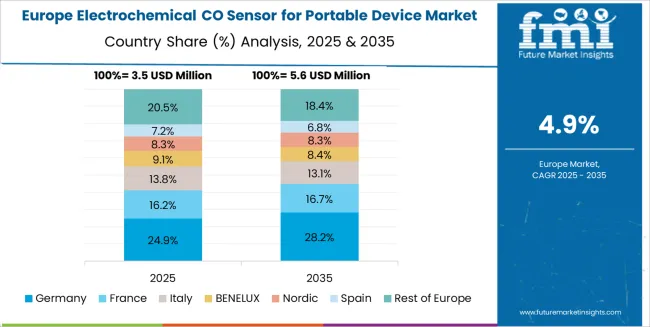
The electrochemical CO sensor for portable device market in Europe is projected to grow from USD 5.1 million in 2025 to USD 8.4 million by 2035, registering a CAGR of 5.1% over the forecast period. Germany is expected to maintain its leadership position with a 35.6% market share in 2025, supported by its advanced safety device infrastructure and major electronics manufacturing centers including Baden-Württemberg and Bavaria.
United Kingdom follows with a 20.8% share in 2025, driven by comprehensive safety regulation programs and detector deployment initiatives. France holds a 17.3% share through specialized residential applications and safety compliance requirements. Italy commands a 13.2% share, while Spain accounts for 9.4% in 2025. The rest of Europe region is anticipated to gain momentum, expanding its collective share from 3.7% to 4.5% by 2035, attributed to increasing CO sensor adoption in Nordic countries and emerging Eastern European residential safety device manufacturers implementing detection technology programs.
Japan Demonstrates Advanced Application Integration
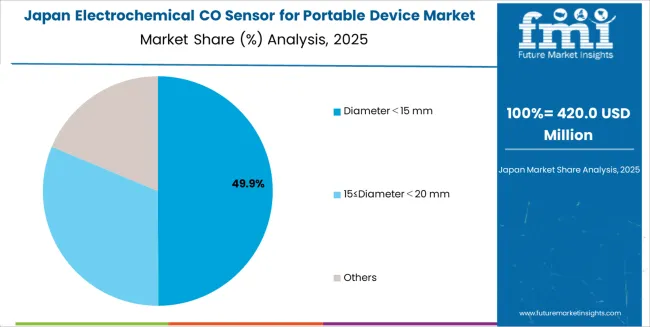
Japan's market exhibits sophisticated sensor integration with documented operational effectiveness in portable detector manufacturing and industrial safety applications through compatibility with existing device systems and electronics infrastructure. The country maintains a 4.1% growth rate, leveraging engineering expertise in sensor technology and quality control. Manufacturing centers showcase premium installations where CO sensors integrate with comprehensive safety device platforms and detection monitoring systems to optimize protection operations and sensing precision.
Japanese manufacturers prioritize sensor quality and detection accuracy in electrochemical CO sensor development, creating demand for premium products with advanced features, including long-term stability and low power consumption characteristics. The market benefits from established electronics infrastructure and investment in safety technology that provides long-term operational benefits and compliance with detection standards.
South Korea Shows Technology Focus
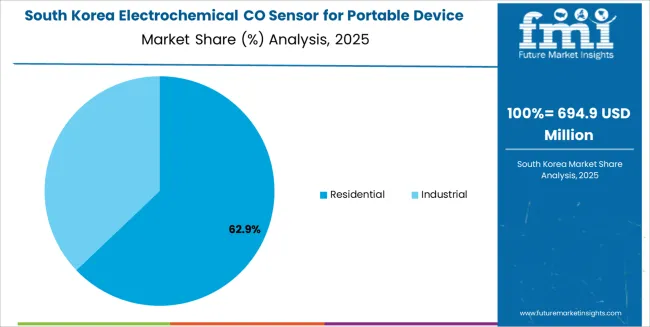
South Korea maintains a 3.9% growth rate through advanced electronics programs and sensor technology development initiatives that integrate CO detection systems across portable device manufacturing, consumer electronics, and industrial safety applications. The country's device manufacturers implement sensor solutions for safety compliance operations and product differentiation, with technology adoption driven by electronics miniaturization and safety integration programs. Market development focuses on high-performance sensor systems with enhanced miniaturization capabilities and connectivity features for portable applications.
What Is the Competitive Landscape of the Electrochemical CO Sensor for Portable Device Market?
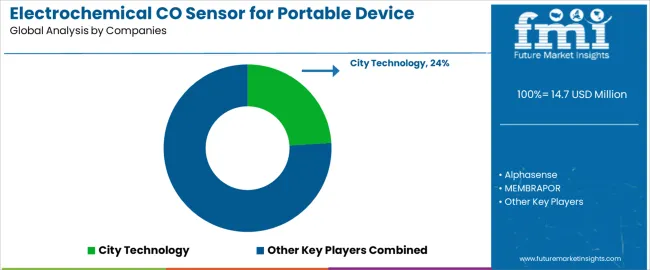
The electrochemical CO sensor for portable device market operates with a moderately concentrated structure where 12-18 established players maintain market presence, with the top 5-7 manufacturers holding approximately 55-62% market share by revenue. Market leadership is maintained through sensor performance consistency, miniaturization expertise, technical support capabilities, and manufacturing quality that enables reliable CO detection while maintaining competitive pricing across application segments.
Basic electrochemical sensing functionality is becoming increasingly standardized, with entry-level CO sensors offering similar detection characteristics across manufacturers. However, margin opportunities exist in value-added features including ultra-miniaturization capabilities, IoT connectivity integration, long-term stability enhancement, and comprehensive calibration support services that extend beyond standard sensor supply.
Established sensor manufacturers compete through proven detection performance and extensive certification portfolios, while specialized gas sensor companies leverage technical expertise and application engineering capabilities. The competitive environment increasingly emphasizes size reduction capabilities, power efficiency optimization, and IoT integration readiness rather than purely sensitivity-based differentiation. Technical support quality and calibration service availability represent critical competitive advantages, with established certification and testing infrastructure creating barriers to entry for new participants without validation capabilities.
Technology innovation focuses on nano-scale electrode designs, advanced electrolyte formulations, wireless connectivity integration, and self-diagnostic capabilities. However, fundamental electrochemical CO sensing principles remain relatively stable, with competitive differentiation emerging through manufacturing consistency, miniaturization achievement, and customer support quality. The market experiences moderate pricing pressure from Asian manufacturers in standard segments, while ultra-compact and IoT-enabled categories maintain premium positioning through proven reliability and comprehensive technical documentation.
| Stakeholder | What they actually control | Typical strengths | Typical blind spots |
|---|---|---|---|
| Global sensor manufacturers | Technology development, certification portfolio, production scale | Wide product range, proven reliability, technical resources | Rapid customization; emerging market pricing |
| Gas sensor specialists | Detection expertise, application engineering, calibration services | Technical depth, performance optimization, industry knowledge | Device integration breadth; consumer market access |
| Device manufacturers | OEM integration, product specification, end-user access | Application understanding, volume leverage, customer relationships | Sensor technology depth; alternative supplier development |
| Regional distributors | Channel access, technical support, calibration services | Local presence, service capability, customer proximity | Technology innovation; manufacturing scale limitations |
Who Are the Key Players in the Electrochemical CO Sensor for Portable Device Market?
- City Technology
- Alphasense
- MEMBRAPOR
- SGX Sensortech
- Figaro
- Draeger
- Winsen
- Dart
- GE
- Nemoto
Scope of the Report
| Item | Value |
|---|---|
| Quantitative Units | USD 14.7 million |
| Sensor Size | Diameter<15 mm, 15≤Diameter<20 mm, Others |
| Application | Residential, Industrial |
| Regions Covered | North America, Latin America, Western Europe, Eastern Europe, East Asia, South Asia Pacific, Middle East & Africa |
| Countries Covered | United States, China, Germany, India, United Kingdom, Japan, Brazil, and 20+ additional countries |
| Key Companies Profiled | City Technology, Alphasense, MEMBRAPOR, SGX Sensortech, Figaro, Draeger, Winsen, Dart, GE, Nemoto |
| Additional Attributes | Dollar sales by sensor size and application categories, regional adoption trends across East Asia, South Asia Pacific, and Western Europe, competitive landscape with gas sensor manufacturers and portable device suppliers, device manufacturer preferences for sensor miniaturization and detection reliability, integration with portable electronics and safety monitoring platforms, innovations in electrochemical sensing technology and miniaturization enhancement, and development of advanced CO detection solutions with enhanced performance and portable device optimization capabilities. |
Electrochemical CO Sensor for Portable Device Market by Segments
Sensor Size:
- Diameter<15 mm
- 15≤Diameter<20 mm
- Others
Application:
- Residential
- Industrial
Region:
- North America
- United States
- Canada
- Mexico
- Latin America
- Brazil
- Chile
- Rest of Latin America
- Western Europe
- Germany
- United Kingdom
- France
- Italy
- Spain
- Nordic
- BENELUX
- Rest of Western Europe
- Eastern Europe
- Russia
- Poland
- Rest of Eastern Europe
- East Asia
- China
- Japan
- South Korea
- South Asia Pacific
- India
- ASEAN
- Australia & New Zealand
- Rest of South Asia Pacific
- Middle East & Africa
- Kingdom of Saudi Arabia
- Other GCC Countries
- Turkey
- South Africa
- Other African Union
- Rest of Middle East & Africa
Frequently Asked Questions
How big is the electrochemical co sensor for portable device market in 2025?
The global electrochemical co sensor for portable device market is estimated to be valued at USD 14.7 million in 2025.
What will be the size of electrochemical co sensor for portable device market in 2035?
The market size for the electrochemical co sensor for portable device market is projected to reach USD 24.9 million by 2035.
How much will be the electrochemical co sensor for portable device market growth between 2025 and 2035?
The electrochemical co sensor for portable device market is expected to grow at a 5.4% CAGR between 2025 and 2035.
What are the key product types in the electrochemical co sensor for portable device market?
The key product types in electrochemical co sensor for portable device market are diameter<15 mm, 15≤diameter<20 mm and others.
Which application segment to contribute significant share in the electrochemical co sensor for portable device market in 2025?
In terms of application, residential segment to command 60.0% share in the electrochemical co sensor for portable device market in 2025.
Preview the report firsthand - request a free sample
Get SampleGet the brochure for pricing and purchase details.
Get PDFTable of Content
- Executive Summary
- Global Market Outlook
- Demand-side Trends
- Supply-side Trends
- Technology Roadmap Analysis
- Analysis and Recommendations
- Market Overview
- Market Coverage / Taxonomy
- Market Definition / Scope / Limitations
- Market Background
- Market Dynamics
- Drivers
- Restraints
- Opportunity
- Trends
- Scenario Forecast
- Demand in Optimistic Scenario
- Demand in Likely Scenario
- Demand in Conservative Scenario
- Opportunity Map Analysis
- Product Life Cycle Analysis
- Supply Chain Analysis
- Investment Feasibility Matrix
- Value Chain Analysis
- PESTLE and Porter’s Analysis
- Regulatory Landscape
- Regional Parent Market Outlook
- Production and Consumption Statistics
- Import and Export Statistics
- Market Dynamics
- Global Market Analysis 2020 to 2024 and Forecast, 2025 to 2035
- Historical Market Size Value (USD Million) Analysis, 2020 to 2024
- Current and Future Market Size Value (USD Million) Projections, 2025 to 2035
- Y-o-Y Growth Trend Analysis
- Absolute $ Opportunity Analysis
- Global Market Pricing Analysis 2020 to 2024 and Forecast 2025 to 2035
- Global Market Analysis 2020 to 2024 and Forecast 2025 to 2035, By Sensor Size
- Introduction / Key Findings
- Historical Market Size Value (USD Million) Analysis By Sensor Size , 2020 to 2024
- Current and Future Market Size Value (USD Million) Analysis and Forecast By Sensor Size , 2025 to 2035
- Diameter<15 mm
- 15≤Diameter<20 mm
- Others
- Y-o-Y Growth Trend Analysis By Sensor Size , 2020 to 2024
- Absolute $ Opportunity Analysis By Sensor Size , 2025 to 2035
- Global Market Analysis 2020 to 2024 and Forecast 2025 to 2035, By Application
- Introduction / Key Findings
- Historical Market Size Value (USD Million) Analysis By Application, 2020 to 2024
- Current and Future Market Size Value (USD Million) Analysis and Forecast By Application, 2025 to 2035
- Residential
- Industrial
- Y-o-Y Growth Trend Analysis By Application, 2020 to 2024
- Absolute $ Opportunity Analysis By Application, 2025 to 2035
- Global Market Analysis 2020 to 2024 and Forecast 2025 to 2035, By Region
- Introduction
- Historical Market Size Value (USD Million) Analysis By Region, 2020 to 2024
- Current Market Size Value (USD Million) Analysis and Forecast By Region, 2025 to 2035
- North America
- Latin America
- Western Europe
- Eastern Europe
- East Asia
- South Asia and Pacific
- Middle East & Africa
- Market Attractiveness Analysis By Region
- North America Market Analysis 2020 to 2024 and Forecast 2025 to 2035, By Country
- Historical Market Size Value (USD Million) Trend Analysis By Market Taxonomy, 2020 to 2024
- Market Size Value (USD Million) Forecast By Market Taxonomy, 2025 to 2035
- By Country
- USA
- Canada
- Mexico
- By Sensor Size
- By Application
- By Country
- Market Attractiveness Analysis
- By Country
- By Sensor Size
- By Application
- Key Takeaways
- Latin America Market Analysis 2020 to 2024 and Forecast 2025 to 2035, By Country
- Historical Market Size Value (USD Million) Trend Analysis By Market Taxonomy, 2020 to 2024
- Market Size Value (USD Million) Forecast By Market Taxonomy, 2025 to 2035
- By Country
- Brazil
- Chile
- Rest of Latin America
- By Sensor Size
- By Application
- By Country
- Market Attractiveness Analysis
- By Country
- By Sensor Size
- By Application
- Key Takeaways
- Western Europe Market Analysis 2020 to 2024 and Forecast 2025 to 2035, By Country
- Historical Market Size Value (USD Million) Trend Analysis By Market Taxonomy, 2020 to 2024
- Market Size Value (USD Million) Forecast By Market Taxonomy, 2025 to 2035
- By Country
- Germany
- UK
- Italy
- Spain
- France
- Nordic
- BENELUX
- Rest of Western Europe
- By Sensor Size
- By Application
- By Country
- Market Attractiveness Analysis
- By Country
- By Sensor Size
- By Application
- Key Takeaways
- Eastern Europe Market Analysis 2020 to 2024 and Forecast 2025 to 2035, By Country
- Historical Market Size Value (USD Million) Trend Analysis By Market Taxonomy, 2020 to 2024
- Market Size Value (USD Million) Forecast By Market Taxonomy, 2025 to 2035
- By Country
- Russia
- Poland
- Hungary
- Balkan & Baltic
- Rest of Eastern Europe
- By Sensor Size
- By Application
- By Country
- Market Attractiveness Analysis
- By Country
- By Sensor Size
- By Application
- Key Takeaways
- East Asia Market Analysis 2020 to 2024 and Forecast 2025 to 2035, By Country
- Historical Market Size Value (USD Million) Trend Analysis By Market Taxonomy, 2020 to 2024
- Market Size Value (USD Million) Forecast By Market Taxonomy, 2025 to 2035
- By Country
- China
- Japan
- South Korea
- By Sensor Size
- By Application
- By Country
- Market Attractiveness Analysis
- By Country
- By Sensor Size
- By Application
- Key Takeaways
- South Asia and Pacific Market Analysis 2020 to 2024 and Forecast 2025 to 2035, By Country
- Historical Market Size Value (USD Million) Trend Analysis By Market Taxonomy, 2020 to 2024
- Market Size Value (USD Million) Forecast By Market Taxonomy, 2025 to 2035
- By Country
- India
- ASEAN
- Australia & New Zealand
- Rest of South Asia and Pacific
- By Sensor Size
- By Application
- By Country
- Market Attractiveness Analysis
- By Country
- By Sensor Size
- By Application
- Key Takeaways
- Middle East & Africa Market Analysis 2020 to 2024 and Forecast 2025 to 2035, By Country
- Historical Market Size Value (USD Million) Trend Analysis By Market Taxonomy, 2020 to 2024
- Market Size Value (USD Million) Forecast By Market Taxonomy, 2025 to 2035
- By Country
- Kingdom of Saudi Arabia
- Other GCC Countries
- Turkiye
- South Africa
- Other African Union
- Rest of Middle East & Africa
- By Sensor Size
- By Application
- By Country
- Market Attractiveness Analysis
- By Country
- By Sensor Size
- By Application
- Key Takeaways
- Key Countries Market Analysis
- USA
- Pricing Analysis
- Market Share Analysis, 2024
- By Sensor Size
- By Application
- Canada
- Pricing Analysis
- Market Share Analysis, 2024
- By Sensor Size
- By Application
- Mexico
- Pricing Analysis
- Market Share Analysis, 2024
- By Sensor Size
- By Application
- Brazil
- Pricing Analysis
- Market Share Analysis, 2024
- By Sensor Size
- By Application
- Chile
- Pricing Analysis
- Market Share Analysis, 2024
- By Sensor Size
- By Application
- Germany
- Pricing Analysis
- Market Share Analysis, 2024
- By Sensor Size
- By Application
- UK
- Pricing Analysis
- Market Share Analysis, 2024
- By Sensor Size
- By Application
- Italy
- Pricing Analysis
- Market Share Analysis, 2024
- By Sensor Size
- By Application
- Spain
- Pricing Analysis
- Market Share Analysis, 2024
- By Sensor Size
- By Application
- France
- Pricing Analysis
- Market Share Analysis, 2024
- By Sensor Size
- By Application
- India
- Pricing Analysis
- Market Share Analysis, 2024
- By Sensor Size
- By Application
- ASEAN
- Pricing Analysis
- Market Share Analysis, 2024
- By Sensor Size
- By Application
- Australia & New Zealand
- Pricing Analysis
- Market Share Analysis, 2024
- By Sensor Size
- By Application
- China
- Pricing Analysis
- Market Share Analysis, 2024
- By Sensor Size
- By Application
- Japan
- Pricing Analysis
- Market Share Analysis, 2024
- By Sensor Size
- By Application
- South Korea
- Pricing Analysis
- Market Share Analysis, 2024
- By Sensor Size
- By Application
- Russia
- Pricing Analysis
- Market Share Analysis, 2024
- By Sensor Size
- By Application
- Poland
- Pricing Analysis
- Market Share Analysis, 2024
- By Sensor Size
- By Application
- Hungary
- Pricing Analysis
- Market Share Analysis, 2024
- By Sensor Size
- By Application
- Kingdom of Saudi Arabia
- Pricing Analysis
- Market Share Analysis, 2024
- By Sensor Size
- By Application
- Turkiye
- Pricing Analysis
- Market Share Analysis, 2024
- By Sensor Size
- By Application
- South Africa
- Pricing Analysis
- Market Share Analysis, 2024
- By Sensor Size
- By Application
- USA
- Market Structure Analysis
- Competition Dashboard
- Competition Benchmarking
- Market Share Analysis of Top Players
- By Regional
- By Sensor Size
- By Application
- Competition Analysis
- Competition Deep Dive
- City Technology
- Overview
- Product Portfolio
- Profitability by Market Segments (Product/Age /Sales Channel/Region)
- Sales Footprint
- Strategy Overview
- Marketing Strategy
- Product Strategy
- Channel Strategy
- Alphasense
- MEMBRAPOR
- SGX Sensortech
- Figaro
- Draeger
- Winsen
- Dart
- GE
- Nemoto
- City Technology
- Competition Deep Dive
- Assumptions & Acronyms Used
- Research Methodology


