

- Industry Size (2026)
- USD 5.5 Bn
- Forecast (2036)
- USD 10.6 Bn
- CAGR (2026 to 2036)
- 6.8%
Consumer Battery Composite Copper Foil Market Forecast and Outlook 2026 to 2036
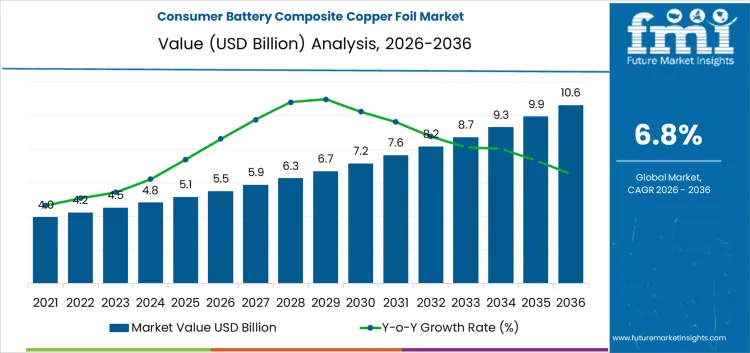
The consumer battery composite copper foil market is expected to reach USD 5.5 billion in 2026 and extend to USD 10.6 billion by 2036 at a 6.80% CAGR. This growth trajectory underscores the increasing demand for high-performance materials in battery production. During initial cell qualification phases, product engineers focus on key specifications, including the thickness of current collectors, surface treatments, and peel strength. Once production lines successfully complete cycle life and safety evaluations, any modifications to materials necessitate a comprehensive reopening of the validation process, highlighting the importance of strict adherence to quality standards.
Purchasing departments emphasize the importance of sourcing from approved suppliers, utilizing audit trails and historical lot data to ensure reliability. Yield sensitivity underscores the necessity of maintaining uniform coating and minimizing pinhole defects, as these factors are critical for overall product quality. Additionally, precision in slitting and roll cleanliness significantly influences winding stability, which is vital for efficient production.
Inventory management practices favor long production runs with established recipes, promoting efficiency and reducing variability. Price negotiations are typically deferred until after successful qualification and validation of consistent throughput, reflecting the industry's focus on quality-driven cost structures.
Quick Stats for Consumer Battery Composite Copper Foil Market
- Consumer Battery Composite Copper Foil Market Value (2026): USD 5.5 billion
- Consumer Battery Composite Copper Foil Market Forecast Value (2036): USD 10.6 billion
- Consumer Battery Composite Copper Foil Market Forecast CAGR 2026 to 2036: 6.8%
- Leading Product Type in Consumer Battery Composite Copper Foil Market: Electro-deposited composite copper foil
- Leading Application in Consumer Battery Composite Copper Foil Market: Lithium-ion batteries for consumer electronics
- Key Growth Regions in Consumer Battery Composite Copper Foil Market: Asia Pacific, Europe, North America
- Top Players in Consumer Battery Composite Copper Foil Market: Furukawa Electric, Mitsui Mining & Smelting, JX Nippon Mining & Metals, SK Nexilis, Iljin Materials
What Is the Growth Forecast for the Consumer Battery Composite Copper Foil Market through 2036?
Cell design choices and materials qualification cycles set the pace for the consumer battery composite copper foil market more than short term device shipment swings. In 2026, at about USD 5.5 billion, demand is anchored in smartphone, notebook, and power tool cells where current density and thickness tolerance affect yield and cycle life. Foil specifications are fixed during cell platform development and remain in place across long production runs, which ties volumes to platform transitions rather than to quarterly procurement. Growth comes from higher energy density targets, wider use of multi layer structures, and tighter uniformity requirements inside compact cells. The expansion path reflects gradual shifts in cell architecture and performance thresholds rather than rapid changes in end device mix.
Manufacturing yield and cost discipline shape the later phase of the consumer battery composite copper foil market. As value approaches roughly USD 10.6 billion by 2036, producers place weight on coating adhesion, surface stability, and thickness control across large continuous runs. Capacity planning favors long campaigns of standardized grades that reduce changeover loss and inspection load. Buyers focus on lot consistency, traceability, and predictable behavior during winding and calendaring. The move from the mid five billions into the ten billion range reflects accumulated platform wins across many consumer cell programs rather than a single product cycle. Suppliers that combine process control, stable output quality, and reliable delivery schedules tend to secure repeat positions in approved material lists.
Consumer Battery Composite Copper Foil Market Key Takeaways
| Metric | Value |
|---|---|
| Market Value (2026) | USD 5.5 billion |
| Forecast Value (2036) | USD 10.6 billion |
| Forecast CAGR 2026 to 2036 | 6.8% |
How Is the Consumer Battery Composite Copper Foil Market Shaping Anode Performance and Manufacturing Yield?
Consumer battery composite copper foil is used as the anode current collector in lithium ion cells for phones, laptops, and wearable devices. The composite structure combines a thin copper layer with polymer or reinforced substrates to reduce weight while keeping electrical continuity. Earlier anode designs depended on thicker rolled copper, which limited energy density gains and increased material use. Cell designers now specify foil by surface roughness, tensile strength, coating adhesion, and thickness uniformity across wide rolls. Adoption follows platform redesign cycles because collector behavior affects coating speed, drying, and calendering stability. Manufacturers evaluate pinhole rate, edge quality, and winding behavior since small defects translate into scrap. Volume demand tracks consumer electronics refresh cycles, not only total battery output, because thinner collectors support higher capacity in fixed cell sizes.
Supply decisions are led by cell process engineers and quality teams rather than commodity purchasing groups. Earlier sourcing allowed wider tolerance bands, which increased line stops and rework during coating. Current programs require narrow thickness control, consistent surface treatment, and predictable mechanical response under tension. Producers compete on roll to roll stability, inspection coverage, and yield at scale rather than headline conductivity figures. Cell makers compare total cost through scrap rate, uptime, and coating speed, not foil price per kilogram. Qualification cycles are long because any collector change affects safety tests and cycle life data. Over time, demand follows pressure to increase energy density in small devices while keeping production lines stable and certification data unchanged across successive product generations.
How is Consumer Battery Composite Copper Foil Market Structured by Product Type and Application?
Specification in Consumer Battery Composite Copper Foil Market is determined by cell design limits, yield management targets, and qualification discipline rather than by spot material pricing. Once current collector thickness, surface treatment, and mechanical tolerance are approved, foil selection becomes part of the locked cell architecture. Any change requires repeated coating trials, cycle testing, and safety validation. This ties demand to platform introductions and cell format transitions rather than to short term device shipment swings. Segment structure reflects differences in forming method, strength profile, and thickness control. Buyers prioritize dimensional consistency, defect density control, and traceable process stability because foil behavior affects both cell performance and manufacturing yield.
How Does Product Type Selection Influence Yield Stability and Cost Control in the Consumer Battery Composite Copper Foil Market?
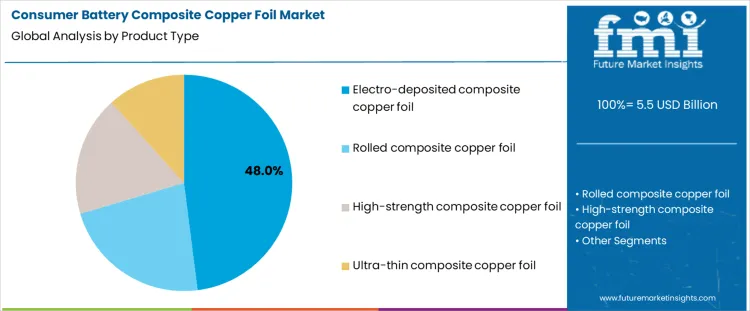
Electro deposited composite copper foil represents about 48% of demand in the Consumer Battery Composite Copper Foil Market because it supports high volume production with tight thickness control and consistent surface morphology. This makes it suitable for mass produced lithium ion cells. Rolled composite copper foil serves applications that require improved mechanical properties and edge stability, though it carries higher processing cost and lower throughput. High strength composite copper foil is specified where winding stress and dimensional stability are critical, increasing material and qualification expense. Ultra thin composite copper foil addresses energy density targets and space constrained designs, which raises sensitivity to handling damage and defect control. Each type imposes different scrap risk and inspection intensity.
From a manufacturing economics perspective, foil type selection fixes much of the yield profile. Electro deposited material benefits from mature process windows and stable large scale capacity. Rolled and high strength variants require tighter mechanical control and introduce more restrictive handling procedures. Ultra thin foil shifts cost toward clean handling, packaging, and in process inspection because minor defects propagate into cell failures. Once a cell line is tuned to a specific foil, changes are avoided because coating recipes, winding tension, and safety validation must be reworked. Demand by product type therefore follows long cell platform cycles rather than short term sourcing optimization.
Why Does Application Mix Determine Volume Concentration and Technical Stringency in the Consumer Battery Composite Copper Foil Market?
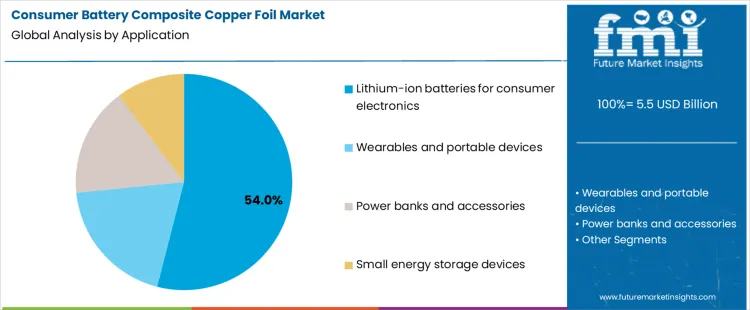
Lithium ion batteries for consumer electronics account for about 54% of demand in the Consumer Battery Composite Copper Foil Market because smartphones, laptops, and tablets consume large numbers of standardized cells with consistent specifications. This creates high volume, repeatable demand. Wearables and portable devices use smaller cells and thinner formats, which increases sensitivity to thickness variation and surface defects. Power banks and accessories prioritize durability and cycle stability over extreme thinness, which supports use of stronger foil grades. Small energy storage devices involve diverse form factors and intermittent production runs, increasing customization and qualification workload. These differences explain why volume concentrates in mainstream consumer electronics while technical demands intensify in compact formats.
Application mix also shapes contracting and approval behavior. Large consumer electronics programs lock material specifications for full product generations and place long horizon orders. Wearable and accessory producers operate shorter cycles and request faster material changes. Energy storage device manufacturers often qualify multiple sources due to variable demand. The resulting structure concentrates stable volume in core consumer electronics while other segments contribute smaller, specification driven orders. Segment shares therefore move with device platform transitions and form factor evolution rather than with short term fluctuations in retail demand.
How Is the Consumer Battery Composite Copper Foil Market Being Shaped by Energy Density Targets and Production Yield Discipline?
The Consumer Battery Composite Copper Foil Market is defined by how battery manufacturers balance cell performance targets with large-scale production stability. Composite copper foil plays a direct role in current collection, weight control, and electrode integrity, which makes it a core material choice rather than a minor consumable. Buyers evaluate suppliers based on thickness uniformity, surface treatment consistency, mechanical strength, and defect rates. Selection decisions involve cell design teams, process engineers, and quality departments. This positions composite copper foil as part of the yield and reliability equation inside battery plants, not simply as a cost line item in the bill of materials.
How Is Platform Cell Design Standardization Changing Material Requirements in The Consumer Battery Composite Copper Foil Market?
Consumer battery producers increasingly rely on standardized cell formats that are used across many device models. This behavior is changing expectations in the Consumer Battery Composite Copper Foil Market toward materials that perform consistently across very large production volumes. Once a foil specification is locked into a platform design, any variation can disrupt coating, winding, or stacking processes. As a result, buyers prioritize supply stability, narrow tolerance control, and predictable interaction with active materials. Supplier evaluation focuses on process control capability and long-term specification stability rather than on short-term performance gains.
Where Is Volume Growth Being Built in The Consumer Battery Composite Copper Foil Market?
Volume growth is being built through expansion of high-volume consumer electronics production and through gradual increases in battery capacity per device. Each increase in energy content raises material usage per cell, even when unit device shipments grow slowly. The Consumer Battery Composite Copper Foil Market also benefits when manufacturers introduce new battery lines using similar foil specifications, which multiplies demand across several plants. There is opportunity for suppliers that can support multi-site supply agreements and consistent quality replication. Being approved for a major cell platform can secure long production runs and stable volume commitments.
Why Do Qualification Lock-In and Cost Pressure Limit Supplier Switching in The Consumer Battery Composite Copper Foil Market?
Once a composite copper foil is qualified in a battery production line, changing suppliers introduces yield risk, requalification work, and possible performance drift. This makes battery producers cautious about switching, even when alternative sources exist. The Consumer Battery Composite Copper Foil Market also operates under strong cost pressure because copper foil represents a meaningful material expense at scale. Buyers constantly balance performance margins against cost targets, which limits tolerance for experimentation. These factors create a conservative sourcing environment where existing suppliers are protected by process integration and qualification history.
What is the Demand Outlook for Consumer Battery Composite Copper Foil by Country?
| Country | CAGR |
|---|---|
| USA | 6.3% |
| UK | 6.0% |
| China | 7.2% |
| India | 7.5% |
| Brazil | 6.5% |
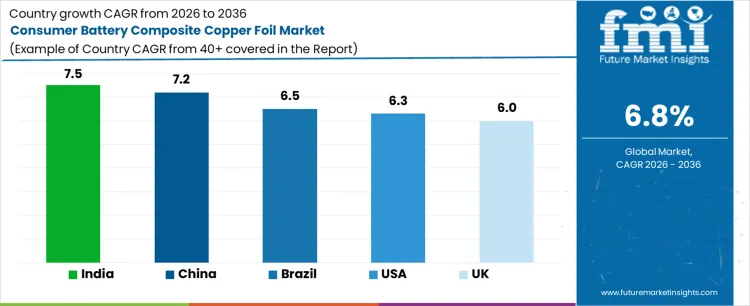
Demand for consumer battery composite copper foil is rising as manufacturers seek thinner, lighter, and more durable current collectors for lithium ion cells used in smartphones, wearables, power tools, and portable electronics. India leads with a 7.5% CAGR, supported by growth in local battery assembly, electronics manufacturing, and import substitution efforts. China follows at 7.2%, driven by its large scale battery supply chain and continuous upgrades in cell design. Brazil records 6.5%, reflecting expanding consumer electronics usage and gradual localization of battery components. The USA grows at 6.3%, shaped by stable demand from device makers and replacement cycles. The UK, at 6.0%, reflects steady but mature electronics manufacturing demand.
How Do Cell Design Cycles and Qualification Systems Shape Demand in the United States?
Product redesign cycles keep the consumer battery composite copper foil market in the United States on a 6.3% CAGR path. Demand comes from electronics cells used in phones, laptops, power tools, and home devices. Battery engineers specify foil based on thickness uniformity, tensile strength, and surface treatment consistency. Procurement follows long approval sequences tied to cell validation programs. Orders usually sit inside electrode material supply packages. Quality teams monitor pinhole rates, coating adhesion, and winding stability. Replacement of approved foil grades occurs rarely due to retesting cost. Inventory policies reflect continuous coating line operation. Domestic and imported supply share volumes across grades. Technical service support influences supplier continuity. Payment terms align with cell production schedules. Commercial position depends on approved material lists and stable process performance rather than competition for short cycle spot purchases.
Why Do Centralized Purchasing and Compliance Reviews Guide Adoption in the United Kingdom?
Electronics manufacturing standards place the consumer battery composite copper foil market in the United Kingdom on a 6.0% CAGR trajectory. Cell assembly plants serving medical, industrial, and consumer devices represent the main users. Material approval follows laboratory testing and pilot line trials. Central technical teams manage accepted foil lists across programs. Procurement aligns volumes with annual build plans. Storage handling and humidity control receive attention. Production teams track electrode yield and scrap levels. Change management procedures limit frequent supplier switches. Distributor networks support logistics and documentation. Import reliance shapes delivery scheduling. Audit records remain part of customer quality files. Replacement demand links to cell redesign projects. Commercial access depends on inclusion in approved material schedules and consistent technical support rather than competition for small volume spot material orders from individual lines.
What Role Do High Volume Cell Manufacturing and Process Control Play in China?
Large scale cell production places the consumer battery composite copper foil market in China on a 7.2% growth path. Smartphone, notebook, and power tool battery plants account for most consumption. Corporate engineering groups define foil specifications and coating compatibility standards. Local foil production supports volume supply and price stability. Procurement flows through group purchasing organizations. Plant trials confirm winding behavior and coating adhesion. Quality teams monitor thickness variation, surface defects, and tensile properties. Inventory planning follows continuous electrode coating schedules. Replacement of qualified grades occurs infrequently due to yield risk. Export oriented production adds documentation requirements. Payment schedules follow long term supply contracts. Commercial success depends on placement within major battery group approvals and multi-year supply programs rather than fragmented sales to small assembly workshops.
How Do Capacity Expansion and Consumer Electronics Output Shape Demand in India?
Rising battery assembly activity fixes the consumer battery composite copper foil market in India at a 7.5% CAGR. Mobile device, tool battery, and accessory pack producers represent core users. Procurement decisions focus on consistency, service access, and qualification support. Many plants follow group specifications shared across product lines. Incoming material testing remains mandatory before release. Storage and handling controls receive attention due to humidity sensitivity. Production teams track yield losses and winding stability. Import and domestic supply compete under approval rules. Inventory planning aligns with coating and slitting schedules. Replacement demand follows major cell redesign programs. Distributor technical teams support trials and audits. Commercial results depend on inclusion in approved material lists and maintaining technical service coverage rather than competition for one time material supply to individual factories.
How Do Regional Assembly Operations and Supply Chain Structure Shape Spending in Brazil?
Electronics manufacturing development keeps the consumer battery composite copper foil market in Brazil near a 6.5% CAGR. Battery pack assembly plants serving local devices and tools form the main customer base. Material choice reflects uniformity, handling safety, and documentation quality. Procurement often occurs through long term agreements aligned with cell programs. Import procedures influence lead times and stock policies. Quality teams perform routine checks on surface defects and mechanical strength. Change approval processes limit frequent grade switching. Inventory management follows steady production runs. Technical service support influences plant confidence. Replacement cycles link to product updates. Distributor networks manage local delivery and audits. Commercial position depends on approved supplier status and consistent performance rather than competition for short term material sales to individual assembly lines.
How Do Materials Suppliers Compete for Qualification in the Consumer Battery Composite Copper Foil Market?
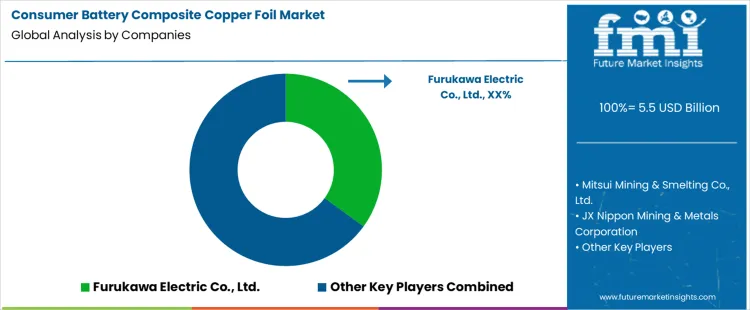
Consumer battery composite copper foil selection happens during cell architecture definition rather than at purchasing stage. Electrode designers set thickness targets, surface treatment needs, tensile limits, and coating adhesion windows. Furukawa Electric, Mitsui Mining and Smelting, JX Nippon Mining and Metals, SK Nexilis, Iljin Materials compete inside those qualification programs. Once a foil grade enters process files, substitution requires new coating trials and cycle life testing. Furukawa Electric and JX Nippon rely on metallurgy control and rolling precision. Mitsui Mining and Smelting focuses on surface treatment consistency and defect control. SK Nexilis supports high volume programs with wide width capacity and yield management. Iljin Materials supplies programs that value stable deliveries and predictable physical properties. Tooling setups, slurry recipes, and winding parameters bind suppliers to each platform.
Competitive outcomes follow yield stability, lot traceability, and ramp capacity rather than spot pricing. Cell makers review pinhole counts, surface roughness, thickness uniformity, and tensile behavior during approval. Scale programs require synchronized deliveries across multiple coating lines. Smaller programs value flexible order sizes and short changeover times. Furukawa Electric benefits from long production history in electronics foils. Mitsui Mining and Smelting holds positions where surface chemistry discipline governs scrap rates. JX Nippon leverages upstream metal control and documentation depth. SK Nexilis wins volume awards through width capability and throughput. Iljin Materials competes through delivery reliability and plant proximity to cell factories. Market positions vary by cell format, energy density target, and customer internal qualification policy.
Key Players of Consumer Battery Composite Copper Foil Market
- Furukawa Electric Co., Ltd.
- Mitsui Mining & Smelting Co., Ltd.
- JX Nippon Mining & Metals Corporation
- SK Nexilis (SKC Group)
- Iljin Materials Co., Ltd.
Scope of the Report
| Items | Values |
|---|---|
| Quantitative Units (2026) | USD billion |
| Product Type | Electro-deposited composite copper foil, Rolled composite copper foil, High-strength composite copper foil, Ultra-thin composite copper foil |
| Application | Lithium-ion batteries for consumer electronics, Wearables and portable devices, Power banks and accessories, Small energy storage devices |
| Region | Asia Pacific, Europe, North America, Latin America, Middle East & Africa |
| Countries Covered | China, Japan, South Korea, India, Australia & New Zealand, ASEAN, Germany, United Kingdom, France, Italy, Spain, Nordic, BENELUX, United States, Canada, Mexico, Brazil, Chile, Saudi Arabia, Turkey, South Africa, and other regional markets |
| Key Companies Profiled | Furukawa Electric, Mitsui Mining & Smelting, JX Nippon Mining & Metals, SK Nexilis, Iljin Materials |
| Additional Attributes | Dollar by sales by product type and application; demand driven by cell platform qualification cycles and energy density targets; selection governed by thickness control, surface stability, and defect rates; procurement tied to long production runs and approved material lists; focus on yield stability, traceability, and consistent roll-to-roll performance. |
Consumer Battery Composite Copper Foil Market Segmentation
Product Type:
- Electro-deposited composite copper foil
- Rolled composite copper foil
- High-strength composite copper foil
- Ultra-thin composite copper foil
Application:
- Lithium-ion batteries for consumer electronics
- Wearables and portable devices
- Power banks and accessories
- Small energy storage devices
Region:
- Asia Pacific
- China
- Japan
- South Korea
- India
- Australia & New Zealand
- ASEAN
- Rest of Asia Pacific
- Europe
- Germany
- United Kingdom
- France
- Italy
- Spain
- Nordic
- BENELUX
- Rest of Europe
- North America
- United States
- Canada
- Mexico
- Latin America
- Brazil
- Chile
- Rest of Latin America
- Middle East & Africa
- Kingdom of Saudi Arabia
- Other GCC Countries
- Turkey
- South Africa
- Other African Union
- Rest of Middle East & Africa
Bibliography
- Gan, M., Liu, Y., Zhang, Q., & Wang, H. (2024). Phytic-acid-modified copper foil as a current collector for lithium-ion batteries. Metals, 14(2), 247.
- Örüm Aydın, A., & Al-Khayat, N. (2023). Lithium-ion battery manufacturing: An industrial view on process and scale-up potential. Batteries, 9(11), 555.
- Niu, J., Smith, R., Zhao, L., & Chen, P. (2024). Future-proof anode current collector solution for lithium-ion batteries: Composite copper foil approaches. ACS Applied Materials & Interfaces, 16(18), 24122–24133.
- U.S. Congressional Research Service. (2025). Advanced lithium-ion energy storage battery manufacturing in the United States (CRS Report No. R48538). Library of Congress.
Frequently Asked Questions
How big is the consumer battery composite copper foil market in 2026?
The global consumer battery composite copper foil market is estimated to be valued at USD 5.5 billion in 2026.
What will be the size of consumer battery composite copper foil market in 2036?
The market size for the consumer battery composite copper foil market is projected to reach USD 10.6 billion by 2036.
How much will be the consumer battery composite copper foil market growth between 2026 and 2036?
The consumer battery composite copper foil market is expected to grow at a 6.8% CAGR between 2026 and 2036.
What are the key product types in the consumer battery composite copper foil market?
The key product types in consumer battery composite copper foil market are electro‑deposited composite copper foil , rolled composite copper foil, high‑strength composite copper foil and ultra‑thin composite copper foil.
Which application segment to contribute significant share in the consumer battery composite copper foil market in 2026?
In terms of application, lithium‑ion batteries for consumer electronics segment to command 54.0% share in the consumer battery composite copper foil market in 2026.
Preview the report firsthand - request a free sample
Get SampleGet the brochure for pricing and purchase details.
Get PDFTable of Content
- Executive Summary
- Global Market Outlook
- Demand-side Trends
- Supply-side Trends
- Technology Roadmap Analysis
- Analysis and Recommendations
- Market Overview
- Market Coverage / Taxonomy
- Market Definition / Scope / Limitations
- Market Background
- Market Dynamics
- Drivers
- Restraints
- Opportunity
- Trends
- Scenario Forecast
- Demand in Optimistic Scenario
- Demand in Likely Scenario
- Demand in Conservative Scenario
- Opportunity Map Analysis
- Product Life Cycle Analysis
- Supply Chain Analysis
- Investment Feasibility Matrix
- Value Chain Analysis
- PESTLE and Porter’s Analysis
- Regulatory Landscape
- Regional Parent Market Outlook
- Production and Consumption Statistics
- Import and Export Statistics
- Market Dynamics
- Global Market Analysis 2021 to 2025 and Forecast, 2026 to 2036
- Historical Market Size Value (USD Million) Analysis, 2021 to 2025
- Current and Future Market Size Value (USD Million) Projections, 2026 to 2036
- Y-o-Y Growth Trend Analysis
- Absolute $ Opportunity Analysis
- Global Market Pricing Analysis 2021 to 2025 and Forecast 2026 to 2036
- Global Market Analysis 2021 to 2025 and Forecast 2026 to 2036, By Product Type
- Introduction / Key Findings
- Historical Market Size Value (USD Million) Analysis By Product Type , 2021 to 2025
- Current and Future Market Size Value (USD Million) Analysis and Forecast By Product Type , 2026 to 2036
- Electro‑deposited composite copper foil
- Rolled composite copper foil
- High‑strength composite copper foil
- Ultra‑thin composite copper foil
- Electro‑deposited composite copper foil
- Y-o-Y Growth Trend Analysis By Product Type , 2021 to 2025
- Absolute $ Opportunity Analysis By Product Type , 2026 to 2036
- Global Market Analysis 2021 to 2025 and Forecast 2026 to 2036, By Application
- Introduction / Key Findings
- Historical Market Size Value (USD Million) Analysis By Application, 2021 to 2025
- Current and Future Market Size Value (USD Million) Analysis and Forecast By Application, 2026 to 2036
- Lithium‑ion batteries for consumer electronics
- Wearables and portable devices
- Power banks and accessories
- Small energy storage devices
- Lithium‑ion batteries for consumer electronics
- Y-o-Y Growth Trend Analysis By Application, 2021 to 2025
- Absolute $ Opportunity Analysis By Application, 2026 to 2036
- Global Market Analysis 2021 to 2025 and Forecast 2026 to 2036, By Region
- Introduction
- Historical Market Size Value (USD Million) Analysis By Region, 2021 to 2025
- Current Market Size Value (USD Million) Analysis and Forecast By Region, 2026 to 2036
- North America
- Latin America
- Western Europe
- Eastern Europe
- East Asia
- South Asia and Pacific
- Middle East & Africa
- Market Attractiveness Analysis By Region
- North America Market Analysis 2021 to 2025 and Forecast 2026 to 2036, By Country
- Historical Market Size Value (USD Million) Trend Analysis By Market Taxonomy, 2021 to 2025
- Market Size Value (USD Million) Forecast By Market Taxonomy, 2026 to 2036
- By Country
- USA
- Canada
- Mexico
- By Product Type
- By Application
- By Country
- Market Attractiveness Analysis
- By Country
- By Product Type
- By Application
- Key Takeaways
- Latin America Market Analysis 2021 to 2025 and Forecast 2026 to 2036, By Country
- Historical Market Size Value (USD Million) Trend Analysis By Market Taxonomy, 2021 to 2025
- Market Size Value (USD Million) Forecast By Market Taxonomy, 2026 to 2036
- By Country
- Brazil
- Chile
- Rest of Latin America
- By Product Type
- By Application
- By Country
- Market Attractiveness Analysis
- By Country
- By Product Type
- By Application
- Key Takeaways
- Western Europe Market Analysis 2021 to 2025 and Forecast 2026 to 2036, By Country
- Historical Market Size Value (USD Million) Trend Analysis By Market Taxonomy, 2021 to 2025
- Market Size Value (USD Million) Forecast By Market Taxonomy, 2026 to 2036
- By Country
- Germany
- UK
- Italy
- Spain
- France
- Nordic
- BENELUX
- Rest of Western Europe
- By Product Type
- By Application
- By Country
- Market Attractiveness Analysis
- By Country
- By Product Type
- By Application
- Key Takeaways
- Eastern Europe Market Analysis 2021 to 2025 and Forecast 2026 to 2036, By Country
- Historical Market Size Value (USD Million) Trend Analysis By Market Taxonomy, 2021 to 2025
- Market Size Value (USD Million) Forecast By Market Taxonomy, 2026 to 2036
- By Country
- Russia
- Poland
- Hungary
- Balkan & Baltic
- Rest of Eastern Europe
- By Product Type
- By Application
- By Country
- Market Attractiveness Analysis
- By Country
- By Product Type
- By Application
- Key Takeaways
- East Asia Market Analysis 2021 to 2025 and Forecast 2026 to 2036, By Country
- Historical Market Size Value (USD Million) Trend Analysis By Market Taxonomy, 2021 to 2025
- Market Size Value (USD Million) Forecast By Market Taxonomy, 2026 to 2036
- By Country
- China
- Japan
- South Korea
- By Product Type
- By Application
- By Country
- Market Attractiveness Analysis
- By Country
- By Product Type
- By Application
- Key Takeaways
- South Asia and Pacific Market Analysis 2021 to 2025 and Forecast 2026 to 2036, By Country
- Historical Market Size Value (USD Million) Trend Analysis By Market Taxonomy, 2021 to 2025
- Market Size Value (USD Million) Forecast By Market Taxonomy, 2026 to 2036
- By Country
- India
- ASEAN
- Australia & New Zealand
- Rest of South Asia and Pacific
- By Product Type
- By Application
- By Country
- Market Attractiveness Analysis
- By Country
- By Product Type
- By Application
- Key Takeaways
- Middle East & Africa Market Analysis 2021 to 2025 and Forecast 2026 to 2036, By Country
- Historical Market Size Value (USD Million) Trend Analysis By Market Taxonomy, 2021 to 2025
- Market Size Value (USD Million) Forecast By Market Taxonomy, 2026 to 2036
- By Country
- Kingdom of Saudi Arabia
- Other GCC Countries
- Turkiye
- South Africa
- Other African Union
- Rest of Middle East & Africa
- By Product Type
- By Application
- By Country
- Market Attractiveness Analysis
- By Country
- By Product Type
- By Application
- Key Takeaways
- Key Countries Market Analysis
- USA
- Pricing Analysis
- Market Share Analysis, 2025
- By Product Type
- By Application
- Canada
- Pricing Analysis
- Market Share Analysis, 2025
- By Product Type
- By Application
- Mexico
- Pricing Analysis
- Market Share Analysis, 2025
- By Product Type
- By Application
- Brazil
- Pricing Analysis
- Market Share Analysis, 2025
- By Product Type
- By Application
- Chile
- Pricing Analysis
- Market Share Analysis, 2025
- By Product Type
- By Application
- Germany
- Pricing Analysis
- Market Share Analysis, 2025
- By Product Type
- By Application
- UK
- Pricing Analysis
- Market Share Analysis, 2025
- By Product Type
- By Application
- Italy
- Pricing Analysis
- Market Share Analysis, 2025
- By Product Type
- By Application
- Spain
- Pricing Analysis
- Market Share Analysis, 2025
- By Product Type
- By Application
- France
- Pricing Analysis
- Market Share Analysis, 2025
- By Product Type
- By Application
- India
- Pricing Analysis
- Market Share Analysis, 2025
- By Product Type
- By Application
- ASEAN
- Pricing Analysis
- Market Share Analysis, 2025
- By Product Type
- By Application
- Australia & New Zealand
- Pricing Analysis
- Market Share Analysis, 2025
- By Product Type
- By Application
- China
- Pricing Analysis
- Market Share Analysis, 2025
- By Product Type
- By Application
- Japan
- Pricing Analysis
- Market Share Analysis, 2025
- By Product Type
- By Application
- South Korea
- Pricing Analysis
- Market Share Analysis, 2025
- By Product Type
- By Application
- Russia
- Pricing Analysis
- Market Share Analysis, 2025
- By Product Type
- By Application
- Poland
- Pricing Analysis
- Market Share Analysis, 2025
- By Product Type
- By Application
- Hungary
- Pricing Analysis
- Market Share Analysis, 2025
- By Product Type
- By Application
- Kingdom of Saudi Arabia
- Pricing Analysis
- Market Share Analysis, 2025
- By Product Type
- By Application
- Turkiye
- Pricing Analysis
- Market Share Analysis, 2025
- By Product Type
- By Application
- South Africa
- Pricing Analysis
- Market Share Analysis, 2025
- By Product Type
- By Application
- USA
- Market Structure Analysis
- Competition Dashboard
- Competition Benchmarking
- Market Share Analysis of Top Players
- By Regional
- By Product Type
- By Application
- Competition Analysis
- Competition Deep Dive
- Furukawa Electric Co., Ltd.
- Overview
- Product Portfolio
- Profitability by Market Segments (Product/Age /Sales Channel/Region)
- Sales Footprint
- Strategy Overview
- Marketing Strategy
- Product Strategy
- Channel Strategy
- Mitsui Mining & Smelting Co., Ltd.
- JX Nippon Mining & Metals Corporation
- SK Nexilis (SKC Group)
- Iljin Materials Co., Ltd.
- Furukawa Electric Co., Ltd.
- Competition Deep Dive
- Assumptions & Acronyms Used
- Research Methodology


