

- Industry Size (2026)
- USD 256.3 Mn
- Forecast (2036)
- USD 494.9 Mn
- CAGR (2026 to 2036)
- 6.8%
Composite Pylon Fairing Systems for New Engine Options Market Size, Market Forecast and Outlook By FMI
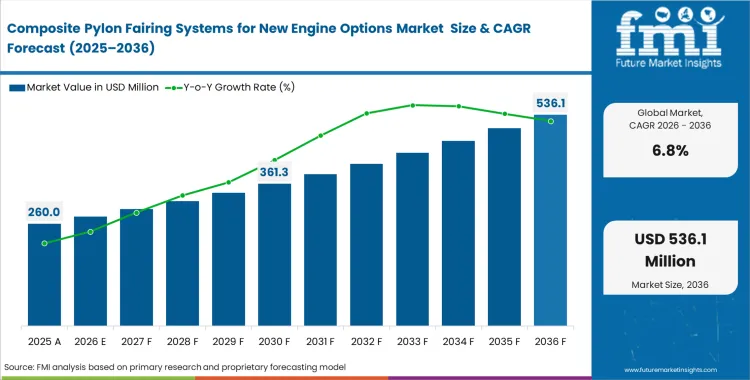
The valuation for integrated composite pylon fairing systems market stood at USD 240.0 million in 2025. Industry analysis points to an expansion reaching USD 256.3 million in 2026 at a CAGR of 6.8% during this forecast period. Revenue generation carries total opportunity to USD 494.9 million through 2036 as aerodynamic load requirements dictate heavier composite integration around larger fan diameters.
Summary of Composite Pylon Fairing Systems for New Engine Options Market
- The market is forecast to reach USD 494.9 million by 2036.
- The market is expected to grow at a CAGR of 6.8% from 2026 to 2036.
- The market was estimated at USD 240.0 million in 2025.
- The forecast period represents an incremental opportunity of USD 240.0 million.
- The A320neo family leads the aircraft program segment with 71.0% share, supported by strong order backlog and dual-engine option relevance.
- Thermoset composites dominate the material segment with 62.0% share, driven by proven certification performance and durability.
- Aft fairings account for 41.0% share in the fairing module segment, benefiting from redesign requirements in re-engined aircraft.
- OEM line-fit leads the fitment segment with 74.0% share, reflecting strong dependence on original aircraft certification and integration.
- LEAP-1A engine pairing holds 46.0% share, supported by its widespread use on A320neo platforms.
| Metric | Details |
|---|---|
| Industry Size (2026) | USD 256.3 million |
| Industry Value (2036) | USD 494.9 million |
| CAGR (2026 to 2036) | 6.80% |
Source: Future Market Insights (FMI) analysis, based on proprietary forecasting model and primary research
Re-engined narrowbody fleets lose part of the expected efficiency gain when legacy aerodynamic profiles do not adequately shield larger turbofan installations. Engineering teams must qualify cowlings that can handle localized heat loads without adding unnecessary weight, because any mismatch at the engine-fairing interface raises fuel use above planned levels. Outer shape alone does not determine performance. Tight component tolerances matter because airflow separation around larger engine shells can create enough drag to offset part of the turbine-efficiency benefit. Laminate design near attachment points therefore carries direct commercial value.
Once maintenance, repair, and overhaul providers become proficient in thermoplastic consolidation, retrofit programs move more quickly across installed fleets. Earlier reliance on high-temperature curing slowed replacement schedules and limited part throughput. Out-of-autoclave production removes much of that delay by shortening fabrication time and easing process constraints. Shorter build cycles return aircraft to service sooner, improving overhaul economics and reducing time on the ground. Manufacturers that clear this production hurdle are more likely to secure longer-term supply agreements as the next round of overhaul activity builds. Turnaround time will remain a key factor in determining which fabricators stay competitive in future retrofit cycles.
China is forecast to record 8.4% CAGR in the market during 2026 to 2036, supported by fleet modernization programs that continue to favor local sourcing of critical aerostructure components. France is projected to post 7.3% CAGR over the same period as Airbus final assembly activity keeps integration work close to production lines. The market in the United States is expected to expand at 6.9% CAGR through 2036, with fleet renewal and upgrade programs placing more emphasis on aerodynamic precision and installation fit. Austria is likely to register 6.7% CAGR during the forecast period through strong tier-one capability in complex laminate manufacturing and consistent high-spec production.
Germany is set to advance at 6.5% CAGR from 2026 to 2036, backed by engineering investment aimed at weight reduction and material performance. Singapore is anticipated to see 6.2% CAGR in this market through 2036 because its regional maintenance role supports recurring replacement and technical support activity. The United Kingdom is forecast to record 5.9% CAGR between 2026 and 2036 through continued focus on specialized aerodynamic and fan-cowl engineering. Europe retains strength in design and materials engineering, while Asia Pacific remains more closely tied to assembly scale and supply-chain localization.
Segmental Analysis
Composite Pylon Fairing Systems for New Engine Options Market Analysis by Aircraft program
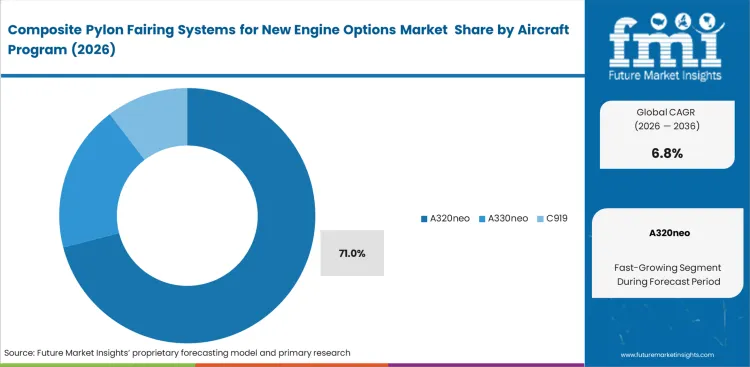
Large order backlogs for upgraded European narrowbodies continue to set the production tempo for this market. The A320neo pylon fairing systems segment is expected to account for 71.0% share in 2026, supported by the scale of the installed fleet and the depth of the program pipeline. Airlines and maintenance teams also favor this platform because a larger operating base makes spare-parts pooling more practical and keeps inventory planning more manageable. That advantage is not as simple as volume alone. Different engine options on the same airframe require different internal thermal shielding layouts, which means operators running mixed-engine fleets must carry separate spare inventories. Any attempt to interchange incompatible panels creates immediate aerodynamic and thermal compliance issues. Incorporating pylon fairing retrofit kits solves specific clearance issues during mid-life upgrades. Installing incorrect panels voids regulatory airworthiness certificates instantly.
- Clearance validation: Larger high-bypass turbofans require very tight dimensional control beneath existing wing mounts to preserve safe ground clearance during steep bank angles and certified operating conditions. Engineering teams cannot afford deviations at this stage, because any shortfall in clearance performance can delay flight approval and interrupt aircraft entry into service.
- Thermal isolation: Aft-section components operate close to exhaust zones, so heat shielding is essential to protect composite layers from gradual matrix damage over long service intervals. Engineering and materials teams therefore focus on aerospace-grade barrier materials, including titanium foil solutions, to reduce early panel wear, limit replacement frequency, and preserve in-service durability.
- Aerodynamic smoothing: Complex three-dimensional fairing shapes help maintain cleaner airflow through the wing-to-engine junction, where small surface errors can raise drag more quickly than many operators expect. Poor contour accuracy weakens the fuel-efficiency benefit of re-engining programs, leaving airlines with higher operating costs across routine flight schedules.
Composite Pylon Fairing Systems for New Engine Options Market Analysis by Material system
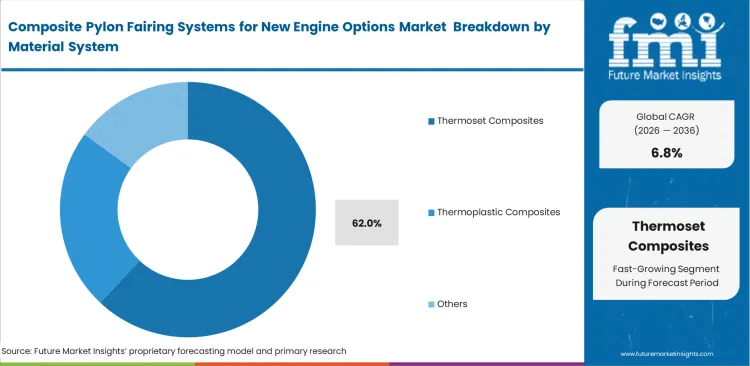
Established qualification records continue to protect incumbent resin systems from rapid substitution in this market. Thermoset pylon fairings are projected to account for 62.0% share in 2026, largely because aerospace certification teams place greater confidence in materials backed by long fatigue histories and well-documented in-service performance. Thermosets also retain an advantage in high-vibration zones where acoustic treatment performance remains important. Producers that fail to complete resin qualification early are likely to remain outside multi-year sourcing programs. Utilizing proven composite leading edge components guarantees operational integrity. Forcing radical material changes invites fatal flight failure events.
- Fatigue resistance: Exterior fairing shells stay under constant vibration from high-bypass turbofans, so material damping and layup accuracy matter throughout the service life. Engineers use controlled carbon-fiber orientations to reduce stress buildup and lower the risk of small cracks turning into larger failures over time.
- Moisture ingress prevention: Sealed edges help stop water from entering the panel and freezing at altitude, where it can weaken bonds and spread damage through the honeycomb core. Once internal delamination moves too far, maintenance teams often have to replace the full panel, which raises unplanned replacement cost during routine checks.
- Acoustic attenuation: Acoustic honeycomb cores are used to reduce turbofan noise before it reaches the cabin. Designers keep specifying thicker thermoset panels with tuned internal patterns when noise control, cabin comfort, and service performance all need to be managed together.
Composite Pylon Fairing Systems for New Engine Options Market Analysis by Fairing module
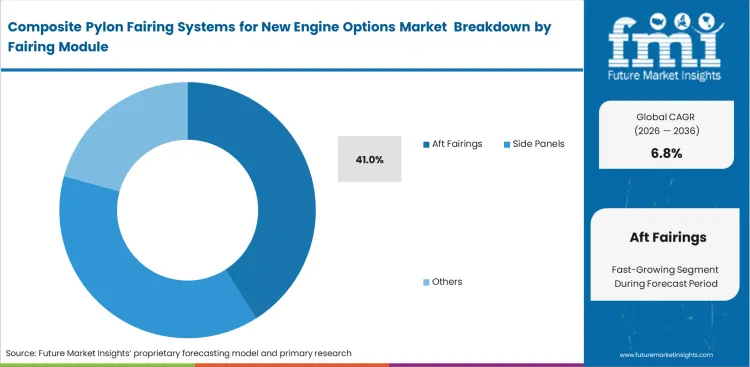
Exhaust exposure has a direct effect on service life in this category. Aircraft aft pylon fairings are expected to account for 41.0% share in 2026 because these trailing-edge sections operate closest to sustained heat loads and repeated thermal cycling. Engineering teams therefore specify hybrid laminate constructions that can tolerate higher temperature stress over long operating intervals. Forward sections do not face the same level of thermal exposure, which is why aft components usually require closer inspection and more frequent replacement. Operators that underestimate this replacement pattern risk carrying too little spare inventory. Integrated antenna fairing systems placed near these zones also need added thermal protection, or in-service reliability can deteriorate quickly.
- Heat deflection: Lower aft fairing surfaces sit directly in the path of exhaust flow during high-thrust operation, so thermal protection has to be built into the design from the start. Engineers use cooling gaps and higher-temperature material systems to prevent resin softening, distortion, and early panel replacement.
- Access optimization: Removable side sections help maintenance teams complete engine boroscope inspections more quickly and with less equipment burden. Poor fastener layout or awkward access points add avoidable turnaround time and reduce maintenance efficiency during tightly scheduled operations.
- Lightning strike protection: Expanded copper foil layers are built into these fairings to disperse electrical energy and protect the composite surface during lightning events. Certification teams require conductivity validation before approval because localized burn-through is not acceptable on critical exterior components.
Composite Pylon Fairing Systems for New Engine Options Market Analysis by Fitment
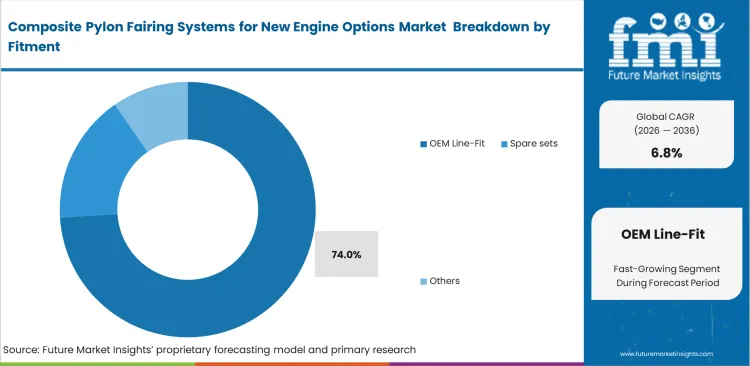
Factory installation remains the main route for initial component supply in this market. OEM line-fit pylon fairings are projected to account for 74.0% share in 2026 because airframe manufacturers control fit, alignment, and assembly quality at the point of installation. Manufacturers therefore work to tight delivery windows so final assembly schedules are not disrupted. This leaves limited room for independent fabricators in the primary supply stream, especially where complex three-dimensional contours and proprietary aerostructure geometry are involved. Airlines also face clear compliance risk if they use uncertified third-party panels on these applications. Approved aerostructure components still need controlled factory installation conditions to meet certification and airworthiness requirements.
- Tolerance control: Digital laser alignment during initial assembly helps maintain accurate mating surfaces between the pylon and the engine nacelle. Quality teams reject even small dimensional deviations, which means fabricators must keep tooling conditions stable and tightly controlled to avoid costly line rejections.
- Certification bundling: Factory-installed components are covered within the aircraft’s original type-certification framework. Operators avoid extra approval work by using specified aerodynamic covers, which keeps the aircraft compliant without adding months of supplemental testing and documentation.
- Warranty preservation: Approved original equipment parts help protect engine and airframe warranty coverage. Finance teams usually avoid unapproved aftermarket substitutes because a rejected warranty claim can leave the operator exposed to large repair costs.
Composite Pylon Fairing Systems for New Engine Options Market Analysis by Engine pairing
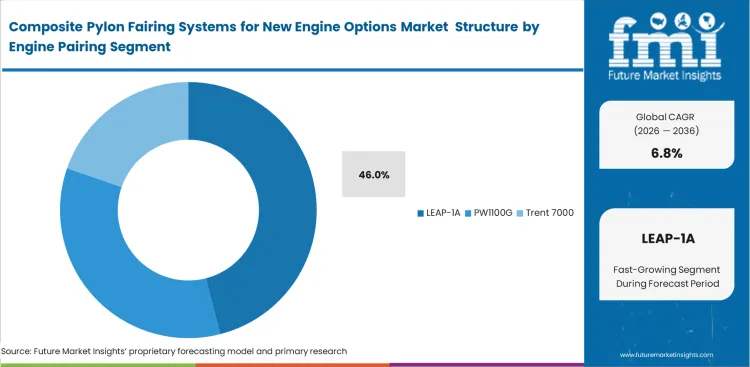
Pylon fairing systems for LEAP engines are expected to account for 46.0% share in 2026, reflecting the engine’s broad use across narrowbody programs and the volume that follows from that installed base. Integration teams have to align each engine selection with the correct fairing architecture because these assemblies are built around exact dimensional and systems-layout requirements. They are not interchangeable parts. Internal clearances shift with accessory placement, service access needs, and installation geometry, so an incorrect variant has little practical value once delivered. Similar constraints apply when operators specify belly fairing modification kits, where dimensional accuracy is equally important. Mistakes at the ordering stage can leave carriers with unusable inventory and avoidable capital loss.
- Accessory clearance: Internal shaping must accommodate the exact position of external gearbox hardware and surrounding service lines on this engine variant. Maintenance crews also need enough tool access for routine overnight work, so even a small layout mismatch can make the assembly unusable at installation stage.
- Vibration tuning: Fan-passing frequencies differ by engine configuration, which means acoustic cavity design has to be tuned to the signature of the selected powerplant. Operators working under strict airport noise limits rely on this tuning to keep departure performance within acceptable operating thresholds.
- Thrust management: Takeoff loads place repeated stress on attachment areas, so these assemblies need reinforced metallic interfaces built into the composite build. Engineering teams validate lateral deflection limits carefully because retention performance has to remain reliable over long operating cycles.
Composite Pylon Fairing Systems for New Engine Options Market Drivers, Restraints, and Opportunities
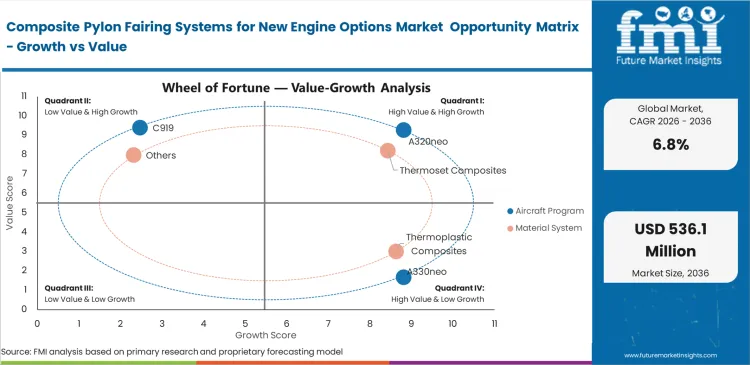
Airlines upgrading narrowbody fleets with larger, more efficient turbofans need matching aerodynamic changes around the engine mount if they want the expected fuel benefit to materialize. Fuel performance depends on controlling drag at the pylon interface, and older metallic shrouds do not offer the shape flexibility needed for cleaner airflow transition. Legacy profiles leave part of the efficiency gain on the table and keep operating cost higher across routine flight cycles. Composite fairing upgrades address that gap by allowing tighter geometry control around larger engines. Advanced camera fairing systems can also be added without materially disturbing drag performance when the external form is designed correctly. Carriers that postpone these modifications risk carrying a fuel penalty for much longer than planned.
Heat exposure around larger exhaust nozzles also raises the technical bar for vendors. Standard composite layups can lose durability early in service when thermal cycling is not managed properly, so engineering teams specify higher-temperature resin systems for these zones. That requirement limits the use of lower-cost alternatives and narrows the field of qualified manufacturers. Many smaller fabricators still lack the process control needed to meet both thermal tolerance and aerodynamic accuracy on the same part. Airlines are left competing for limited capacity among manufacturers that can deliver consistent quality. Faster curing is not a practical shortcut, because poorly controlled cycles can weaken the panel and reduce in-service reliability.
Opportunities in the Composite Pylon Fairing Systems for New Engine Options Market
- Thermoplastic consolidation: Automated high-temperature polymer processing shortens production time and eases factory bottlenecks. Suppliers that can deliver faster are in a stronger position when airlines are working against fleet expansion timelines.
- Acoustic integration: Built-in noise-control materials help lower cabin sound without adding extra insulation weight. This gives suppliers an advantage on programs where passenger comfort is part of the specification.
- Predictive maintenance sensors: Strain gauges placed at key attachment points make it easier to track fatigue during service. Maintenance teams can then replace stressed panels earlier and avoid unscheduled aircraft downtime.
Regional Analysis
.webp "Top Country Growth Comparison Composite Pylon Fairing Systems For New Engine Options Market Cagr (2026 2036)")
Based on regional analysis, composite pylon fairing systems for new engine options market is segmented into North America, Latin America, Europe, Asia Pacific, and Middle East and Africa across 40 plus countries.
| Country | CAGR (2026 to 2036) |
|---|---|
| China | 8.4% |
| France | 7.3% |
| United States | 6.9% |
| Austria | 6.7% |
| Germany | 6.5% |
| Singapore | 6.2% |
| United Kingdom | 5.9% |
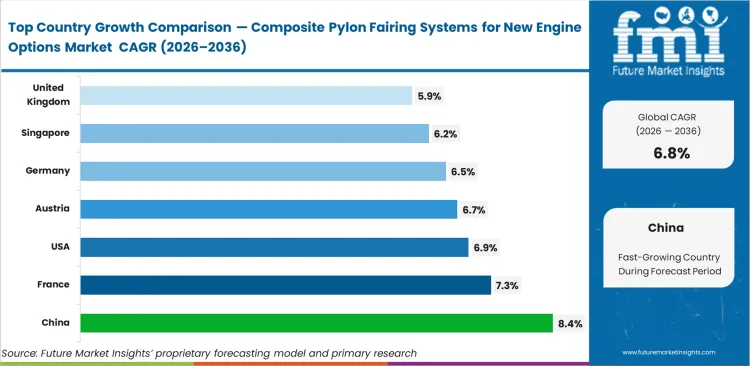
Source: Future Market Insights (FMI) analysis, based on proprietary forecasting model and primary research
Asia Pacific Composite Pylon Fairing Systems for New Engine Options Market Analysis
Asia Pacific remains an important region for this market because aircraft manufacturing localization, regional fleet expansion, and maintenance capacity additions are moving in parallel. Government-backed aviation programs across the region are encouraging local production of high-value aerostructure components, including composite fairing assemblies that sit close to the engine-pylon interface. This creates a favorable industry outlook for suppliers that can meet certification requirements, maintain process consistency, and support nearby final assembly or maintenance activity. Regional airlines and aerospace manufacturers increasingly prefer vendors with local production capability because shorter supply chains reduce lead times, ease regulatory coordination, and improve execution on program schedules.
- China: Local manufacturing requirements continue to shape the market for composite pylon fairing systems in China. Foreign suppliers often need domestic partnerships and locally aligned production arrangements to participate in aircraft programs tied to national aviation priorities. The market in China is projected to witness 8.4% CAGR through 2036. That pace reflects the commercial importance of domestic aerospace capability, the push to reduce reliance on imported aerostructure parts, and the advantage held by suppliers that can qualify within local certification and sourcing requirements.
- Singapore: The market for composite pylon fairing systems in Singapore is expected to expand at a 6.2% CAGR during the forecast period. This keeps the country relevant as a service-led node in the regional aftermarket. Singapore plays a different role in the regional market, with its position tied more closely to maintenance, repair, and overhaul activity than to large-scale airframe manufacturing. Airlines and service providers use the country as a technical hub for narrowbody support, component replacement, and certified repair work, which supports recurring requirements for spare composite panels and related fairing assemblies.
FMI's report includes Japan and India alongside broader regional assessments. Asian carriers continually expand maintenance capacities addressing rising passenger volumes across diverse short-haul routes.
Europe Composite Pylon Fairing Systems for New Engine Options Market Analysis
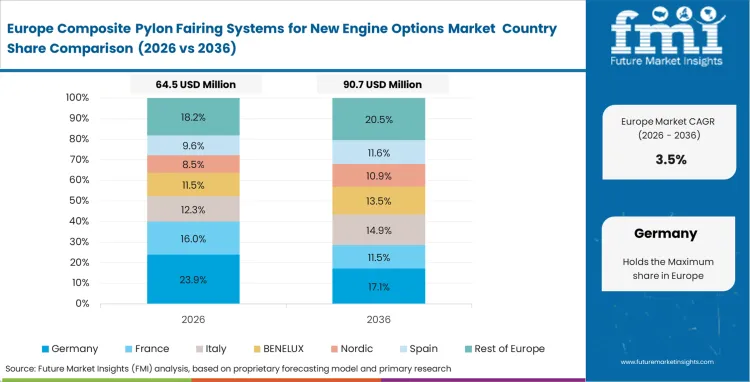
Europe remains central to this market because it combines aircraft OEM proximity, deep composite engineering capability, and long experience in certification-led aerostructure production. Suppliers in the region benefit from established design centers, automated layup capacity, and close coordination with major aircraft programs where fairing geometry, acoustic requirements, and weight targets are tightly controlled. Production decisions in Europe are influenced by delivery timing, design-change responsiveness, and the need to protect proprietary materials and process knowledge. That combination keeps the regional industry outlook firm, especially for suppliers serving re-engined aircraft platforms.
- France: France is likely to post a 7.3% CAGR in the composite pylon fairing systems market by 2036. Proximity to final assembly remains a clear commercial advantage in this country. It benefits from its close connection to major aircraft assembly activity, which supports steady demand for localized pylon fairing production. Suppliers operating near OEM lines are better positioned to manage just-in-time delivery, reduce transport risk for delicate composite parts, and respond quickly when engine-related geometry changes require design updates.
- Austria: Austria’s role in this market is tied to precision composite manufacturing and advanced automation in aerostructure production. Suppliers with strong tape-laying, robotic placement, and repeatable lamination capability are well placed to win contracts where dimensional accuracy and process consistency matter as much as cost. The composite pylon fairing systems market in Austria is poised to expand at a 6.7% CAGR through 2036. This supports the country’s position as a specialized manufacturing base for high-specification composite parts.
- Germany: The market for composite pylon fairing systems in Germany is expected to rise at a 6.5% CAGR during the study period. Its role is supported by strong engineering depth and dependable production quality. The country remains important because regional aerospace suppliers continue to emphasize lightweight engineering, material efficiency, and manufacturing accuracy. Buyers value these capabilities where even modest reductions in part weight and rework rates can improve aircraft performance and program economics over time.
- United Kingdom: The United Kingdom contributes to this market through composite design expertise and work linked to acoustics, advanced materials, and multifunctional aerostructure development. Suppliers with strength in these areas can support programs where fairings are expected to manage aerodynamic performance alongside secondary operating requirements such as noise control and durability. The United Kingdom is forecast to record 5.9% CAGR in the composite pylon fairing systems market through 2036. This keeps the country relevant in technically specialized portions of the value chain.
FMI's report includes Italy and Spain alongside broader regional assessments. Tight aerospace integration across European borders ensures continuous cross-pollination regarding advanced composite manufacturing techniques.
North America Composite Pylon Fairing Systems for New Engine Options Market Analysis
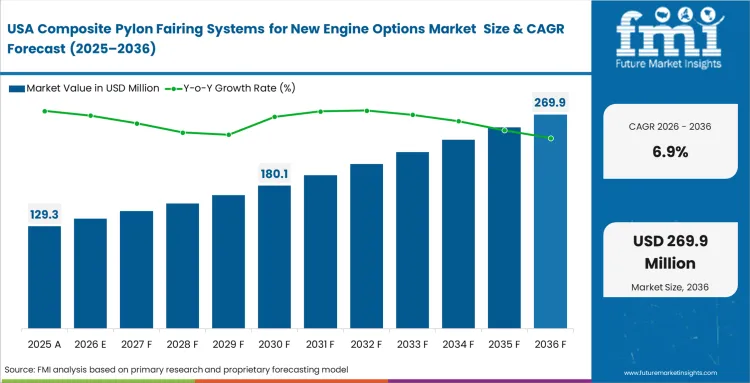
North America remains a meaningful market because airlines, modification providers, and aerospace suppliers continue to focus on operating efficiency, fleet life extension, and maintenance-led upgrades. Demand is shaped by the need to improve aircraft performance without depending entirely on new aircraft replacement cycles. Composite pylon fairing systems fit this requirement because they support aerodynamic refinement, replacement demand, and program-specific modification work tied to engine and nacelle integration. Regional suppliers benefit where they can combine certification capability with reliable support for line-fit and aftermarket requirements.
- United States: The United States remains the core North America market because domestic operators and aerospace contractors continue to invest in upgrade programs, certified modifications, and replacement activity for commercial fleets. Program participation depends on engineering capability, regulatory approval discipline, and the ability to deliver components suited to complex integration work around engine and pylon assemblies. The composite pylon fairing systems market in the United States is anticipated to move ahead at a 6.9% CAGR through 2036. This keeps the country firmly positioned in both OEM-linked and aftermarket demand.
FMI's report includes Canada alongside broader regional assessments. Cross-border aerospace manufacturing agreements guarantee seamless component flow between specialized North American production facilities.
Competitive Aligners for Market Players
Aerospace qualification requirements keep this supplier base narrow. Safran Nacelles and Spirit AeroSystems remain strong because they control fatigue data and certification history that matter in EASA and FAA approval work. Independent fabricators cannot enter this category easily, especially for load-bearing aerodynamic parts that require long testing records and proven in-service reliability. Airline buying teams place far more weight on long-term integrity and validation history than on low-cost bids that lack flight-hour evidence. In this market, safety documentation is a basic entry requirement, not a supporting advantage.
Incumbents also benefit from automated composite production systems that can deliver complex three-dimensional geometries with consistent quality. Tight contour accuracy depends on expensive out-of-autoclave processing, stable tooling conditions, and digital alignment control. Challengers relying on manual layup methods face higher rejection rates because small voids and dimensional distortion are harder to contain at scale. Competing at this level requires heavy investment in specialized automation and process discipline. Using advanced composites without that manufacturing base is unlikely to be commercially viable.
Airframe manufacturers still try to limit supplier dependence by encouraging secondary sources where possible. That is one reason OEMs support companies such as FACC AG in building competing capability for selected components. In response, established suppliers are adding proprietary acoustic treatments and thermal shielding into specific panel designs so substitution becomes more difficult. The next competitive step is likely to center on repairable thermoplastic layouts, especially for companies trying to build a stronger position in aftermarket maintenance work.
Key Players in Composite Pylon Fairing Systems for New Engine Options Market
- Safran Nacelles
- Spirit AeroSystems
- FACC AG
- Collins Aerospace
- GKN Aerospace
- ST Engineering MRAS
- Airbus Atlantic
Scope of the Report
| Metric | Value |
|---|---|
| Quantitative Units | USD 256.3 million to USD 494.9 million, at a CAGR of 6.80% |
| Market Definition | Aerodynamic shielding systems encasing wing-to-engine attachment struts. Upgraded aircraft rely on these contoured panels to integrate oversized turbofans without generating excessive aerodynamic drag. |
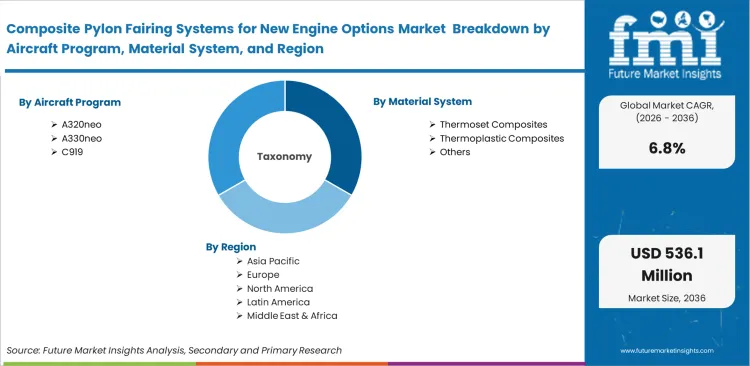
| Segmentation | Aircraft program, Material system, Fairing module, Fitment, Engine pairing |
| Regions Covered | North America, Latin America, Europe, Asia Pacific, Middle East and Africa |
| Countries Covered | China, France, United States, Austria, Germany, Singapore, United Kingdom |
| Key Companies Profiled | Safran Nacelles, Spirit AeroSystems, FACC AG, Collins Aerospace, GKN Aerospace, ST Engineering MRAS, Airbus Atlantic |
| Forecast Period | 2026 to 2036 |
| Approach | Annual re-engined narrowbody delivery rates cross-referenced with component replacement schedules |
Source: Future Market Insights (FMI) analysis, based on proprietary forecasting model and primary research
Composite Pylon Fairing Systems for New Engine Options Market Analysis by Segments
Aircraft program:
- A320neo family
- A330neo
- C919
- Other re-engined jets
Material system:
- Thermoset composites
- Thermoplastic composites
- Hybrid laminates
- Metal-composite builds
Fairing module:
- Aft fairings
- Side panels
- Lower closeouts
- Access doors
Fitment:
- OEM line-fit
- Spare sets
- MRO replacements
- Retrofit kits
Engine pairing:
- LEAP-1A
- PW1100G
- Trent 7000
- LEAP-1C
Region:
- North America
- Latin America
- Europe
- Asia Pacific
- Middle East and Africa
Bibliography
- Airbus. (2026, January 12). Airbus reports 793 commercial aircraft deliveries in 2025. Airbus.
- European Union Aviation Safety Agency. (2026, March 19). TYPE-CERTIFICATE DATA SHEET: Airbus A318, A319, A320, A321 (Issue 61). EASA.
- International Air Transport Association. (2025, October). Reviving the commercial aircraft supply chain. IATA.
- Spirit AeroSystems Holdings, Inc. (2025). 2024 annual report.
- EASA. (2025, August 26). Airworthiness Directive 2025-0185: Wings - Pylon spigot fitting - inspections.
This bibliography is provided for reader reference. The full FMI report contains the complete reference list with primary source documentation.
This Report Addresses
- Component certification barriers blocking new aerodynamic suppliers.
- Thermal fatigue rates affecting aft fairing replacement schedules.
- Acoustic tuning requirements unique to oversized LEAP-1A engines.
- Regional assembly mandates shaping Chinese joint venture agreements.
- Automated tape laying technology driving Austrian manufacturing dominance.
- Thermoset versus thermoplastic material selection criteria during qualification.
- Warranty preservation risks associated with aftermarket composite components.
- Digital laser alignment protocols ensuring perfect aerodynamic mating surfaces.
Frequently Asked Questions
What drives demand for A320neo family fairings?
Massive existing order backlogs guarantee long-term component consumption across global operating networks.
Why do thermoset composites lead material selection?
Extensive historical fatigue data provides aerospace certifying authorities unmatched confidence for critical load-bearing surfaces.
How does China shape regional component manufacturing?
Mandatory localized assembly directives force foreign aerospace manufacturers into complex domestic joint ventures.
What purpose do aft fairings serve?
These trailing-edge structures endure extreme thermal punishment from engine exhaust plumes continuously.
Why do OEMs dominate initial fairing fitment?
Airframe manufacturers exert absolute control over initial assembly quality to prevent aerodynamic misalignment.
How does engine pairing affect fairing geometry?
Specific powerplant dimensions dictate entirely unique aerodynamic fairing geometries and internal clearance requirements.
What commercial risk does delayed replacement carry?
Delaying upgrades bleeds operating capital through excessive fuel burn caused by parasitic drag.
Why do airlines prefer localized maintenance hubs?
Stockpiling essential spare panels locally minimizes devastating aircraft grounding events across Asian flight networks.
What advantage does automated tape laying provide?
Manufacturing executives leverage precision robotics to eliminate human error during critical laminations.
How do thermal gradients restrict thermoplastic adoption?
Complex thermal gradients near larger exhaust nozzles warp standard composite layups prematurely.
What forces engineers to develop acoustic panels?
Airlines specify quieter components explicitly to avoid stringent European airport noise penalties during nighttime landings.
Why do aircrafts avoid uncertified third-party panels?
Utilizing authorized original equipment components maintains comprehensive multi-million-dollar powerplant guarantees and regulatory compliance.
What role do predictive maintenance sensors play?
Laminating strain gauges within critical attachment points enables real-time fatigue tracking to prevent failure.
How does France maintain aerospace manufacturing leadership?
Final assembly line proximity demands localized just-in-time composite component delivery, locking in preferred supplier status.
What operational penalty occurs if laminar airflow detaches?
Flight operations chiefs lose projected fuel efficiency targets entirely, forcing airlines to burn excess fuel.
Why do incumbents hold a competitive moat?
Independent fabricators cannot legally produce critical aerodynamic parts without reproducing decades of destructive testing results.
How does moisture ingress destroy composite fairings?
Undetected moisture delamination propagates internally through vulnerable acoustic honeycomb cores, destroying panel integrity.
What value do retrofit kits offer operators?
Extending existing airframe lifespans through clever aerodynamic upgrades saves airline finance chiefs billions in capital.
Why do stress analysts insist on strict layups?
These orientations ensure panels absorb resonant frequencies without developing microscopic stress fractures over time.
How do OEMs prevent supplier monopolies?
Major airframe manufacturers exert immense pricing pressure by dual-sourcing critical components whenever possible.
What danger necessitates lightning strike protection?
Embedded expanded copper foils prevent localized composite burn-through incidents mid-flight during severe electrical discharge events.
Why is out-of-autoclave manufacturing gaining attention?
Advancing out-of-autoclave manufacturing directly eliminates traditional curing bottlenecks, drastically accelerating component production cycles.
Preview the report firsthand - request a free sample
Get SampleGet the brochure for pricing and purchase details.
Get PDFTable of Content
- Executive Summary
- Global Market Outlook
- Demand-side Trends
- Supply-side Trends
- Technology Roadmap Analysis
- Analysis and Recommendations
- Market Overview
- Market Coverage / Taxonomy
- Market Definition / Scope / Limitations
- Research Methodology
- Chapter Orientation
- Analytical Lens and Working Hypotheses
- Market Structure, Signals, and Trend Drivers
- Benchmarking and Cross-market Comparability
- Market Sizing, Forecasting, and Opportunity Mapping
- Research Design and Evidence Framework
- Desk Research Programme (Secondary Evidence)
- Company Annual and Sustainability Reports
- Peer-reviewed Journals and Academic Literature
- Corporate Websites, Product Literature, and Technical Notes
- Earnings Decks and Investor Briefings
- Statutory Filings and Regulatory Disclosures
- Technical White Papers and Standards Notes
- Trade Journals, Industry Magazines, and Analyst Briefs
- Conference Proceedings, Webinars, and Seminar Materials
- Government Statistics Portals and Public Data Releases
- Press Releases and Reputable Media Coverage
- Specialist Newsletters and Curated Briefings
- Sector Databases and Reference Repositories
- FMI Internal Proprietary Databases and Historical Market Datasets
- Subscription Datasets and Paid Sources
- Social Channels, Communities, and Digital Listening Inputs
- Additional Desk Sources
- Expert Input and Fieldwork (Primary Evidence)
- Primary Modes
- Qualitative Interviews and Expert Elicitation
- Quantitative Surveys and Structured Data Capture
- Blended Approach
- Why Primary Evidence is Used
- Field Techniques
- Interviews
- Surveys
- Focus Groups
- Observational and In-context Research
- Social and Community Interactions
- Stakeholder Universe Engaged
- C-suite Leaders
- Board Members
- Presidents and Vice Presidents
- R&D and Innovation Heads
- Technical Specialists
- Domain Subject-matter Experts
- Scientists
- Physicians and Other Healthcare Professionals
- Governance, Ethics, and Data Stewardship
- Research Ethics
- Data Integrity and Handling
- Primary Modes
- Tooling, Models, and Reference Databases
- Desk Research Programme (Secondary Evidence)
- Data Engineering and Model Build
- Data Acquisition and Ingestion
- Cleaning, Normalisation, and Verification
- Synthesis, Triangulation, and Analysis
- Quality Assurance and Audit Trail
- Market Background
- Market Dynamics
- Drivers
- Restraints
- Opportunity
- Trends
- Scenario Forecast
- Demand in Optimistic Scenario
- Demand in Likely Scenario
- Demand in Conservative Scenario
- Opportunity Map Analysis
- Product Life Cycle Analysis
- Supply Chain Analysis
- Investment Feasibility Matrix
- Value Chain Analysis
- PESTLE and Porter’s Analysis
- Regulatory Landscape
- Regional Parent Market Outlook
- Production and Consumption Statistics
- Import and Export Statistics
- Market Dynamics
- Global Market Analysis 2021 to 2025 and Forecast, 2026 to 2036
- Historical Market Size Value (USD Million) Analysis, 2021 to 2025
- Current and Future Market Size Value (USD Million) Projections, 2026 to 2036
- Y-o-Y Growth Trend Analysis
- Absolute $ Opportunity Analysis
- Global Market Pricing Analysis 2021 to 2025 and Forecast 2026 to 2036
- Global Market Analysis 2021 to 2025 and Forecast 2026 to 2036, By Aircraft Program
- Introduction / Key Findings
- Historical Market Size Value (USD Million) Analysis By Aircraft Program , 2021 to 2025
- Current and Future Market Size Value (USD Million) Analysis and Forecast By Aircraft Program , 2026 to 2036
- A320neo
- A330neo
- C919
- A320neo
- Y-o-Y Growth Trend Analysis By Aircraft Program , 2021 to 2025
- Absolute $ Opportunity Analysis By Aircraft Program , 2026 to 2036
- Global Market Analysis 2021 to 2025 and Forecast 2026 to 2036, By Material System
- Introduction / Key Findings
- Historical Market Size Value (USD Million) Analysis By Material System, 2021 to 2025
- Current and Future Market Size Value (USD Million) Analysis and Forecast By Material System, 2026 to 2036
- Thermoset Composites
- Thermoplastic Composites
- Others
- Thermoset Composites
- Y-o-Y Growth Trend Analysis By Material System, 2021 to 2025
- Absolute $ Opportunity Analysis By Material System, 2026 to 2036
- Global Market Analysis 2021 to 2025 and Forecast 2026 to 2036, By Fairing Module
- Introduction / Key Findings
- Historical Market Size Value (USD Million) Analysis By Fairing Module, 2021 to 2025
- Current and Future Market Size Value (USD Million) Analysis and Forecast By Fairing Module, 2026 to 2036
- Aft Fairings
- Side Panels
- Others
- Aft Fairings
- Y-o-Y Growth Trend Analysis By Fairing Module, 2021 to 2025
- Absolute $ Opportunity Analysis By Fairing Module, 2026 to 2036
- Global Market Analysis 2021 to 2025 and Forecast 2026 to 2036, By Fitment
- Introduction / Key Findings
- Historical Market Size Value (USD Million) Analysis By Fitment, 2021 to 2025
- Current and Future Market Size Value (USD Million) Analysis and Forecast By Fitment, 2026 to 2036
- OEM Line-Fit
- Spare sets
- Others
- OEM Line-Fit
- Y-o-Y Growth Trend Analysis By Fitment, 2021 to 2025
- Absolute $ Opportunity Analysis By Fitment, 2026 to 2036
- Global Market Analysis 2021 to 2025 and Forecast 2026 to 2036, By Engine Pairing
- Introduction / Key Findings
- Historical Market Size Value (USD Million) Analysis By Engine Pairing, 2021 to 2025
- Current and Future Market Size Value (USD Million) Analysis and Forecast By Engine Pairing, 2026 to 2036
- LEAP-1A
- PW1100G
- Trent 7000
- LEAP-1A
- Y-o-Y Growth Trend Analysis By Engine Pairing, 2021 to 2025
- Absolute $ Opportunity Analysis By Engine Pairing, 2026 to 2036
- Global Market Analysis 2021 to 2025 and Forecast 2026 to 2036, By Region
- Introduction
- Historical Market Size Value (USD Million) Analysis By Region, 2021 to 2025
- Current Market Size Value (USD Million) Analysis and Forecast By Region, 2026 to 2036
- North America
- Latin America
- Western Europe
- Eastern Europe
- East Asia
- South Asia and Pacific
- Middle East & Africa
- Market Attractiveness Analysis By Region
- North America Market Analysis 2021 to 2025 and Forecast 2026 to 2036, By Country
- Historical Market Size Value (USD Million) Trend Analysis By Market Taxonomy, 2021 to 2025
- Market Size Value (USD Million) Forecast By Market Taxonomy, 2026 to 2036
- By Country
- USA
- Canada
- Mexico
- By Aircraft Program
- By Material System
- By Fairing Module
- By Fitment
- By Engine Pairing
- By Country
- Market Attractiveness Analysis
- By Country
- By Aircraft Program
- By Material System
- By Fairing Module
- By Fitment
- By Engine Pairing
- Key Takeaways
- Latin America Market Analysis 2021 to 2025 and Forecast 2026 to 2036, By Country
- Historical Market Size Value (USD Million) Trend Analysis By Market Taxonomy, 2021 to 2025
- Market Size Value (USD Million) Forecast By Market Taxonomy, 2026 to 2036
- By Country
- Brazil
- Chile
- Rest of Latin America
- By Aircraft Program
- By Material System
- By Fairing Module
- By Fitment
- By Engine Pairing
- By Country
- Market Attractiveness Analysis
- By Country
- By Aircraft Program
- By Material System
- By Fairing Module
- By Fitment
- By Engine Pairing
- Key Takeaways
- Western Europe Market Analysis 2021 to 2025 and Forecast 2026 to 2036, By Country
- Historical Market Size Value (USD Million) Trend Analysis By Market Taxonomy, 2021 to 2025
- Market Size Value (USD Million) Forecast By Market Taxonomy, 2026 to 2036
- By Country
- Germany
- UK
- Italy
- Spain
- France
- Nordic
- BENELUX
- Rest of Western Europe
- By Aircraft Program
- By Material System
- By Fairing Module
- By Fitment
- By Engine Pairing
- By Country
- Market Attractiveness Analysis
- By Country
- By Aircraft Program
- By Material System
- By Fairing Module
- By Fitment
- By Engine Pairing
- Key Takeaways
- Eastern Europe Market Analysis 2021 to 2025 and Forecast 2026 to 2036, By Country
- Historical Market Size Value (USD Million) Trend Analysis By Market Taxonomy, 2021 to 2025
- Market Size Value (USD Million) Forecast By Market Taxonomy, 2026 to 2036
- By Country
- Russia
- Poland
- Hungary
- Balkan & Baltic
- Rest of Eastern Europe
- By Aircraft Program
- By Material System
- By Fairing Module
- By Fitment
- By Engine Pairing
- By Country
- Market Attractiveness Analysis
- By Country
- By Aircraft Program
- By Material System
- By Fairing Module
- By Fitment
- By Engine Pairing
- Key Takeaways
- East Asia Market Analysis 2021 to 2025 and Forecast 2026 to 2036, By Country
- Historical Market Size Value (USD Million) Trend Analysis By Market Taxonomy, 2021 to 2025
- Market Size Value (USD Million) Forecast By Market Taxonomy, 2026 to 2036
- By Country
- China
- Japan
- South Korea
- By Aircraft Program
- By Material System
- By Fairing Module
- By Fitment
- By Engine Pairing
- By Country
- Market Attractiveness Analysis
- By Country
- By Aircraft Program
- By Material System
- By Fairing Module
- By Fitment
- By Engine Pairing
- Key Takeaways
- South Asia and Pacific Market Analysis 2021 to 2025 and Forecast 2026 to 2036, By Country
- Historical Market Size Value (USD Million) Trend Analysis By Market Taxonomy, 2021 to 2025
- Market Size Value (USD Million) Forecast By Market Taxonomy, 2026 to 2036
- By Country
- India
- ASEAN
- Australia & New Zealand
- Rest of South Asia and Pacific
- By Aircraft Program
- By Material System
- By Fairing Module
- By Fitment
- By Engine Pairing
- By Country
- Market Attractiveness Analysis
- By Country
- By Aircraft Program
- By Material System
- By Fairing Module
- By Fitment
- By Engine Pairing
- Key Takeaways
- Middle East & Africa Market Analysis 2021 to 2025 and Forecast 2026 to 2036, By Country
- Historical Market Size Value (USD Million) Trend Analysis By Market Taxonomy, 2021 to 2025
- Market Size Value (USD Million) Forecast By Market Taxonomy, 2026 to 2036
- By Country
- Kingdom of Saudi Arabia
- Other GCC Countries
- Turkiye
- South Africa
- Other African Union
- Rest of Middle East & Africa
- By Aircraft Program
- By Material System
- By Fairing Module
- By Fitment
- By Engine Pairing
- By Country
- Market Attractiveness Analysis
- By Country
- By Aircraft Program
- By Material System
- By Fairing Module
- By Fitment
- By Engine Pairing
- Key Takeaways
- Key Countries Market Analysis
- USA
- Pricing Analysis
- Market Share Analysis, 2025
- By Aircraft Program
- By Material System
- By Fairing Module
- By Fitment
- By Engine Pairing
- Canada
- Pricing Analysis
- Market Share Analysis, 2025
- By Aircraft Program
- By Material System
- By Fairing Module
- By Fitment
- By Engine Pairing
- Mexico
- Pricing Analysis
- Market Share Analysis, 2025
- By Aircraft Program
- By Material System
- By Fairing Module
- By Fitment
- By Engine Pairing
- Brazil
- Pricing Analysis
- Market Share Analysis, 2025
- By Aircraft Program
- By Material System
- By Fairing Module
- By Fitment
- By Engine Pairing
- Chile
- Pricing Analysis
- Market Share Analysis, 2025
- By Aircraft Program
- By Material System
- By Fairing Module
- By Fitment
- By Engine Pairing
- Germany
- Pricing Analysis
- Market Share Analysis, 2025
- By Aircraft Program
- By Material System
- By Fairing Module
- By Fitment
- By Engine Pairing
- UK
- Pricing Analysis
- Market Share Analysis, 2025
- By Aircraft Program
- By Material System
- By Fairing Module
- By Fitment
- By Engine Pairing
- Italy
- Pricing Analysis
- Market Share Analysis, 2025
- By Aircraft Program
- By Material System
- By Fairing Module
- By Fitment
- By Engine Pairing
- Spain
- Pricing Analysis
- Market Share Analysis, 2025
- By Aircraft Program
- By Material System
- By Fairing Module
- By Fitment
- By Engine Pairing
- France
- Pricing Analysis
- Market Share Analysis, 2025
- By Aircraft Program
- By Material System
- By Fairing Module
- By Fitment
- By Engine Pairing
- India
- Pricing Analysis
- Market Share Analysis, 2025
- By Aircraft Program
- By Material System
- By Fairing Module
- By Fitment
- By Engine Pairing
- ASEAN
- Pricing Analysis
- Market Share Analysis, 2025
- By Aircraft Program
- By Material System
- By Fairing Module
- By Fitment
- By Engine Pairing
- Australia & New Zealand
- Pricing Analysis
- Market Share Analysis, 2025
- By Aircraft Program
- By Material System
- By Fairing Module
- By Fitment
- By Engine Pairing
- China
- Pricing Analysis
- Market Share Analysis, 2025
- By Aircraft Program
- By Material System
- By Fairing Module
- By Fitment
- By Engine Pairing
- Japan
- Pricing Analysis
- Market Share Analysis, 2025
- By Aircraft Program
- By Material System
- By Fairing Module
- By Fitment
- By Engine Pairing
- South Korea
- Pricing Analysis
- Market Share Analysis, 2025
- By Aircraft Program
- By Material System
- By Fairing Module
- By Fitment
- By Engine Pairing
- Russia
- Pricing Analysis
- Market Share Analysis, 2025
- By Aircraft Program
- By Material System
- By Fairing Module
- By Fitment
- By Engine Pairing
- Poland
- Pricing Analysis
- Market Share Analysis, 2025
- By Aircraft Program
- By Material System
- By Fairing Module
- By Fitment
- By Engine Pairing
- Hungary
- Pricing Analysis
- Market Share Analysis, 2025
- By Aircraft Program
- By Material System
- By Fairing Module
- By Fitment
- By Engine Pairing
- Kingdom of Saudi Arabia
- Pricing Analysis
- Market Share Analysis, 2025
- By Aircraft Program
- By Material System
- By Fairing Module
- By Fitment
- By Engine Pairing
- Turkiye
- Pricing Analysis
- Market Share Analysis, 2025
- By Aircraft Program
- By Material System
- By Fairing Module
- By Fitment
- By Engine Pairing
- South Africa
- Pricing Analysis
- Market Share Analysis, 2025
- By Aircraft Program
- By Material System
- By Fairing Module
- By Fitment
- By Engine Pairing
- USA
- Market Structure Analysis
- Competition Dashboard
- Competition Benchmarking
- Market Share Analysis of Top Players
- By Region
- By Aircraft Program
- By Material System
- By Fairing Module
- By Fitment
- By Engine Pairing
- Competition Analysis
- Competition Deep Dive
- Safran Nacelles
- Overview
- Product Portfolio
- Profitability by Market Segments (Product/Age /Sales Channel/Region)
- Sales Footprint
- Strategy Overview
- Marketing Strategy
- Product Strategy
- Channel Strategy
- Spirit AeroSystems
- FACC AG
- Collins Aerospace
- GKN Aerospace
- ST Engineering MRAS
- Safran Nacelles
- Competition Deep Dive
- Assumptions & Acronyms Used


