

- Industry Size (2026)
- USD 1.0 Bn
- Forecast (2036)
- USD 2.4 Bn
- CAGR (2026 to 2036)
- 9.4%
Automated Composite Structure Inspection Systems for Aerospace Market Size, Market Forecast and Outlook By FMI
The automated composite structure inspection systems for aerospace market was valued at USD 0.9 billion in 2025. Sector size is poised to reach USD 1.0 billion in 2026 at a CAGR of 9.4% during this forecast period. Sustained investment propels cumulative valuation to USD 2.4 billion through 2036 as aviation manufacturers prioritize defect resolution speed across high-volume production lines.
Summary of Automated Composite Structure Inspection Systems for Aerospace Market
- The market is forecast to reach USD 2.4 billion by 2036.
- The market is expected to grow at a CAGR of 9.4% from 2026 to 2036.
- The market was estimated at USD 0.9 billion in 2025.
- The forecast period represents an incremental opportunity of USD 1.4 billion.
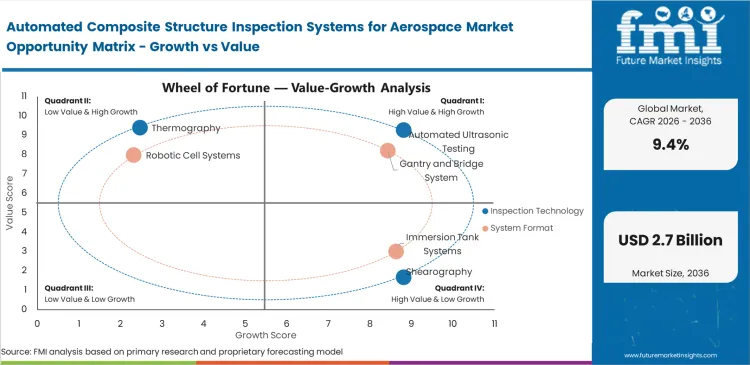
- Automated ultrasonic testing leads the inspection technology segment with 39.0% share, driven by full-depth defect detection and high repeatability.
- Gantry and bridge systems dominate the system format segment with 34.0% share, supported by large composite structure scanning needs.
- Skins and panels account for 29.0% share in the structure type segment due to high inspection frequency.
- Production QA leads the application stage with 46.0% share, reflecting strong demand for early defect detection before assembly.
- Key companies in the market include Testia, Evident, Waygate Technologies, TecScan, ScanMaster Systems, Comet Yxlon, and Nikon.
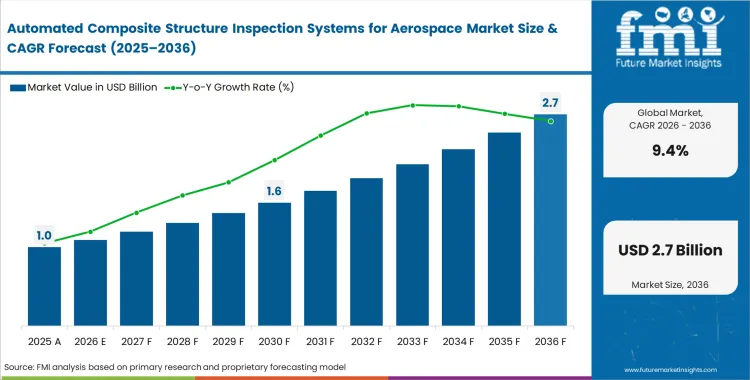
Key Takeaways, Market Size, and Forecast
- 2025 market size: USD 0.9 billion
- 2026 market size: USD 1.0 billion
- 2036 forecast: USD 2.4 billion
- CAGR: 9.4%
- Top inspection technology: Automated ultrasonic testing (39.0%)
- Top system format: Gantry and bridge systems (34.0%)
- Top structure type: Skins and panels (29.0%)
- Top application stage: Production QA (46.0%)
- Top buyer type: OEMs and Tier-1s (41.0%)
Aerospace manufacturing directors face immense pressure scaling monthly aircraft delivery targets without compromising stringent safety tolerances. Manual composite testing creates severe production bottlenecks, forcing quality assurance teams to halt assembly lines while technicians scan large carbon fiber panels by hand. Transitioning toward aircraft automated inspection hardware shifts the capital focus from hiring scarce certified technicians to purchasing robotic scanning cells. Failing to automate flaw detection causes staggering delays in final airframe certification. Engineering chiefs rarely factor in the hidden cost of false positives generated by fatigued human operators. Automated scanning systems eliminate these subjective human errors entirely, guaranteeing consistent resolution standards across thousands of manufactured parts. Securing vendor agreements for these automated systems ensures long-term manufacturing predictability.
Scaling production rates depends entirely on clearing non-destructive testing backlogs quickly. The trigger occurs when aerospace manufacturers transition from metal alloys to complex multilayered composites requiring volumetric verification. Consequently, quality control managers replace isolated manual scanners with integrated gantry systems. This shift forces suppliers to engineer faster acoustic arrays capable of mapping microscopic delaminations without slowing the main assembly workflow.
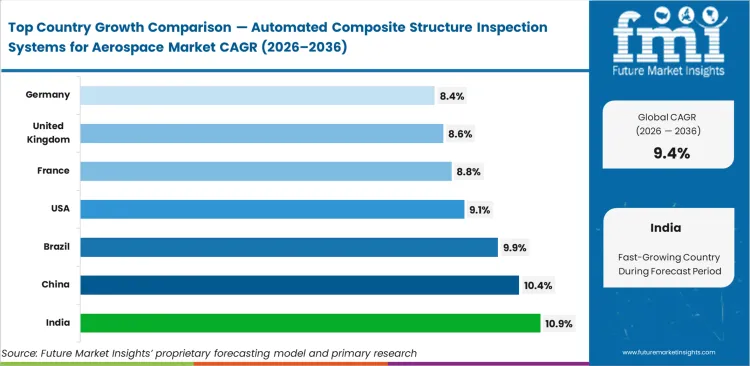
Automated composite structure inspection demand shows clear country‑level divergence tied to aerospace manufacturing investment cycles. India is anticipated to see the market expand at a 10.9% CAGR, supported by defense‑led composite qualification programs, while China is projected to grow at 10.4% CAGR as state‑backed commercial aircraft production scales. Brazil is set to record 9.9% CAGR as regional jet manufacturers modernize inspection facilities. The market in the United States is expected to grow at 9.1% CAGR, with France at 8.8%, the United Kingdom at 8.6%, and Germany at 8.4% during the forecast period, reflecting sustained automation upgrades across mature aerospace hubs.
Segmental Analysis
Automated Composite Structure Inspection Systems for Aerospace Market Analysis by Inspection Technology
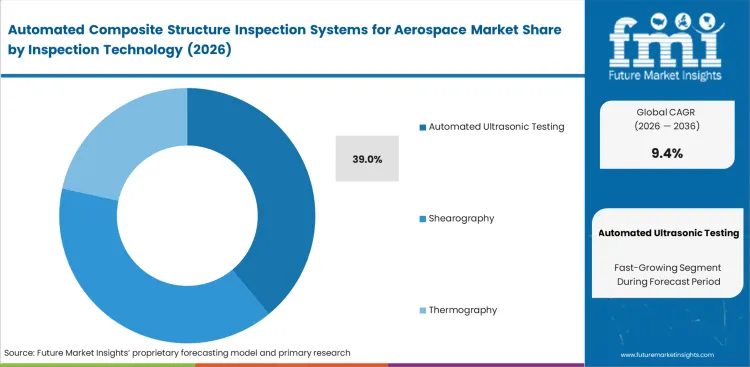
Automated ultrasonic testing is estimated to account for 39.0% share in 2026. This dominant position stems directly from the ability to generate high-resolution volumetric data across thick carbon fiber laminates. Identifying microscopic internal delaminations demands high-frequency acoustic waves that purely surface-level technologies cannot provide. Quality control managers require precise depth calculations to determine whether a microscopic void exceeds acceptable regulatory limits. What procurement teams rarely factor into unit-cost comparisons is that advanced non-destructive testing equipment requires constant recalibration using certified reference standards. Selecting alternative surface-scanning technologies limits defect detection entirely to the outermost composite layers. Integrating highly responsive ultrasonic ndt equipment simplifies complex multilayer evaluations.
- Volumetric depth mapping: Acoustic waves penetrate deep carbon fiber layers reliably. Quality engineers rely on this volumetric data to locate hidden structural voids before parts advance toward final assembly.
- Defect quantification precision: Precise acoustic arrays measure exact anomaly dimensions accurately. Manufacturing leads utilize these specific measurements to determine whether an expensive component requires immediate localized repair.
- Couplant requirement constraint: Standard acoustic testing demands continuous water or gel coupling mediums. Production managers must design specialized drainage systems around robotic cells to manage massive volumes of liquid couplant safely.
Automated Composite Structure Inspection Systems for Aerospace Market Analysis by System Format
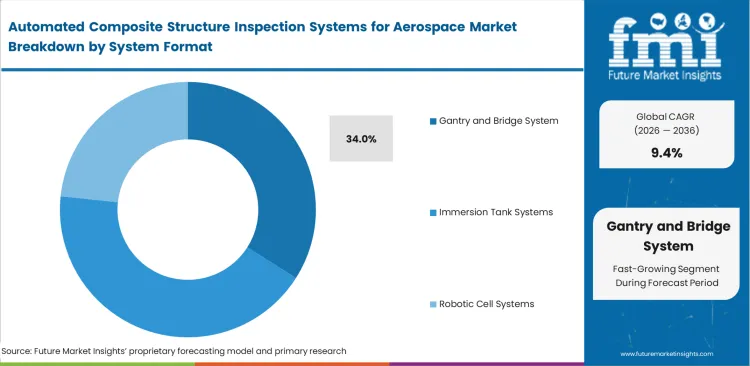
Physical component dimensions dictate the necessary mechanical architecture for positioning sensitive payloads. Gantry and bridge systems are expected to hold 34.0% share in 2026. Huge commercial aircraft wing skins require incredibly stable overhead positioning rails spanning factory floor footprints. Based on FMI's assessment, manufacturers select these heavy rigid structures to guarantee perfect sensor alignment across thirty-meter longitudinal scans. Operations directors avoid portable alternatives for primary flight structures because minor positioning deviations ruin massive acoustic datasets instantly. Installing permanent bridge rails consumes significant factory real estate, forcing facility managers to plan specific heavy-lift crane access routes around the inspection cell. Relying on advanced testing and inspection gantries guarantees high-speed repeatability.
- Positional stability requirement: Heavy overhead rails eliminate vibration during rapid sensor movement. Operations managers ensure scanning payloads maintain exact distances from complex contoured surfaces accurately.
- Large envelope capacity: Massive bridge architectures accommodate entire wing sections easily. Facility directors process enormous primary flight structures without requiring dangerous manual repositioning halfway through the scan.
- Capital installation burden: Erecting rigid gantry systems requires massive reinforced concrete foundations. Industrial engineers face significant upfront construction delays before actual testing hardware installation begins.
Automated Composite Structure Inspection Systems for Aerospace Market Analysis by Structure Type
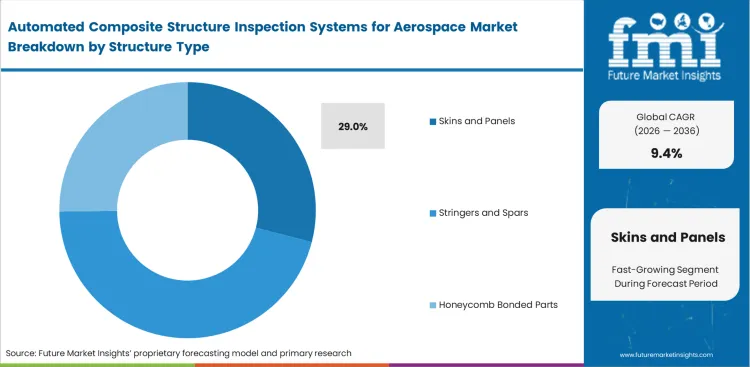
Surface area volume drives the immediate financial justification for replacing human inspectors. Skins and panels are anticipated to capture 29.0% of market share in 2026. Commercial airliners feature thousands of square meters of thin composite outer layers requiring continuous structural verification. Production leads prioritize automating these huge flat or gently curved surfaces because they generate the highest manual labor bottlenecks. Quality assurance supervisors need rapid continuous scanning paths rather than complex localized spot-checking. What manufacturing planners often underestimate is that complex honeycomb bonded parts feature varied acoustic impedances that confuse basic automated algorithms instantly. Outsourcing panel verification to reliable ndt inspection services helps smaller suppliers manage overflow volumes effectively.
- Surface volume metrics: Massive external aircraft layers require weeks of manual scanning. Production chiefs slash these verification timelines drastically by deploying high-speed automated robotic scanning arrays.
- Curvature complexity mapping: Gentle panel curves allow fast continuous mechanical positioning. Software engineers program perfect robotic sweep paths avoiding the complex collision risks associated with tight structural corners.
- Varying thickness challenges: Dropped carbon fiber plies alter material thickness rapidly across single panels. Acoustic engineers must program dynamic focal adjustments keeping sensors calibrated perfectly across transitioning structural depths.
Automated Composite Structure Inspection Systems for Aerospace Market Analysis by Application Stage
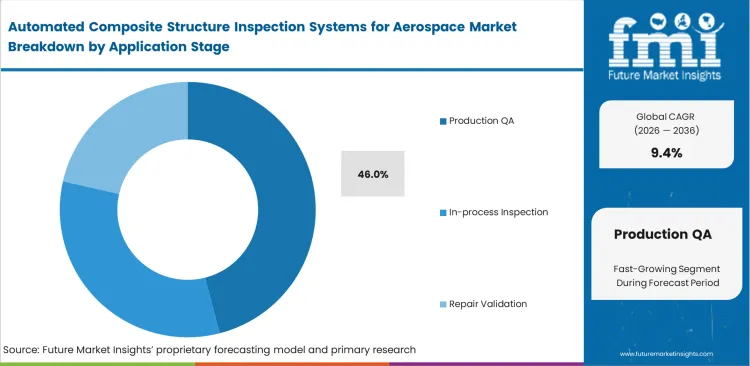
Production QA is poised to garner 46.0% share in 2026. Aerospace original equipment manufacturers enforce strict pass-fail thresholds before integrating any composite component into a final airframe. Clearing parts at this specific stage prevents defective components from accumulating expensive subsequent assembly labor. Manufacturing executives require actionable structural reports immediately, not post-assembly discoveries requiring massive tear-down operations. In-process inspection checks catch manufacturing deviations early, but final Production QA provides the legally required documentation for airworthiness certification. Delaying automated verification until final assembly risks catastrophic schedule delays. Integrating precise diagnostics supports profitable commercial aircraft mro lifecycle contracts eventually.
- Airworthiness certification proof: Regulatory bodies demand unalterable digital defect records. Quality directors utilize automated cell outputs to generate irrefutable compliance documentation required for final aircraft delivery.
- Scrap reduction strategy: Identifying flaws immediately after curing prevents wasted assembly labor. Production managers avoid installing defective panels onto expensive titanium frames by qualifying parts strictly at the source.
- Bottleneck elimination speed: Rapid robotic scanning clears massive component backlogs. Facility leads maintain aggressive monthly delivery targets by preventing completed composite structures from waiting idly inside quality assurance queues.
Automated Composite Structure Inspection Systems for Aerospace Market Analysis by Buyer Type
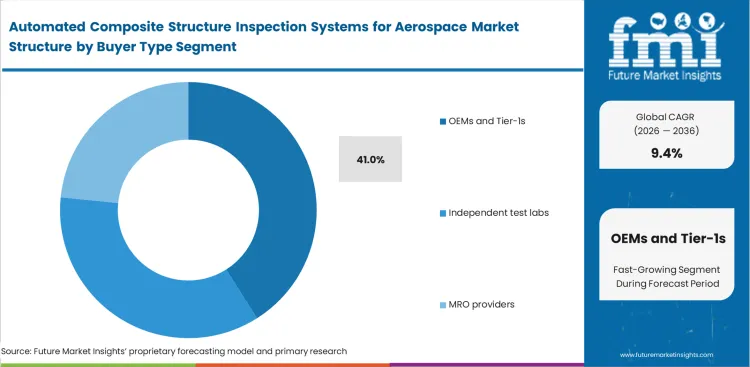
Corporate supply chain control drives advanced equipment procurement strategies. OEMs and Tier-1s are set to represent 41.0% of market share in 2026. Prime aerospace contractors purchase enormous automated testing cells to handle massive localized production volumes directly. In FMI's view, these parent organizations purchase highly customized hardware and enforce strict testing specifications that their downstream supply chain must replicate identically. Directors at smaller independent test labs cannot afford these massive custom gantries, settling for versatile smaller robotic cells instead. Developing uniform digital data formats ensures prime contractors can ingest inspection records from any Tier-2 supplier instantly. Expanding internal aviation test equipment capabilities keeps proprietary manufacturing methods securely in-house.
- Throughput control capability: Prime contractors manufacture thousands of components annually. Operations executives justify massive capital inspection budgets by distributing the cell cost across continuous high-yield production runs.
- Specification enforcement power: Parent organizations write rigid non-destructive testing manuals. Vendor compliance officers force external suppliers to match internal prime contractor testing standards perfectly.
- Proprietary data security: Keeping final qualification operations internal protects sensitive manufacturing tolerances. Security directors prevent critical aircraft design data from leaking into the broader independent testing market unnecessarily.
Automated Composite Structure Inspection Systems for Aerospace Market Drivers, Restraints, and Opportunities
Commercial aircraft delivery schedules force aerospace manufacturers to replace manual testing operations with high-speed automated scanning cells. Relying on human technicians to scan massive carbon fiber wing skins consumes critical production time and risks severe repetitive strain injuries. Engineering directors demand technology capable of generating continuous high-resolution volumetric data without stopping the primary assembly line. Halting production for mandatory quality assurance bottlenecks destroys quarterly profitability targets. Automated inspection platforms bypass these physical labor limitations entirely, capturing essential structural data at unprecedented speeds. Delaying this transition leaves manufacturers vulnerable to staggering delivery backlogs that slow-moving manual inspection routines consistently trigger.
Data processing friction throttles adoption momentum even when facility managers eagerly acquire advanced robotic testing hardware. Quality assurance teams drown in terabytes of high-resolution acoustic imagery lacking clear automated context or categorization. Software platforms struggle to automatically identify microscopic resin voids against complex varying material thicknesses. IT directors cannot simply dump massive proprietary inspection files into legacy corporate databases designed for simple text entries. Until advanced algorithms can reliably translate raw sensor data into immediate pass or fail decisions without extensive human intervention, scaling automated operations remains constrained by severe internal engineering bandwidth limits.
Opportunities in the Automated Composite Structure Inspection Systems for Aerospace Market
- AI-driven defect classification: Processing raw ultrasonic data consumes excessive human hours. Software directors eagerly adopt machine learning tools that automatically identify microscopic structural anomalies utilizing advanced aerospace tester algorithms.
- Inline inspection integration: Testing completed parts separately wastes valuable factory real estate. Manufacturing chiefs prioritize robotic sensors capable of inspecting composite layers immediately during the automated fiber placement process.
- Multimodal sensor fusion: Single technologies miss specific defect types routinely. Engineering leads aggressively fund vendors combining thermography and acoustic sensors onto single robotic arms for comprehensive evaluations simultaneously.
Regional Analysis
Based on regional analysis, Automated Composite Structure Inspection Systems for Aerospace is segmented into North America, Latin America, Europe, East Asia, South Asia, Oceania, and Middle East and Africa across 40 plus countries.
.webp "Top Country Growth Comparison Automated Composite Structure Inspection Systems For Aerospace Market Cagr (2026 2036)")
| Country | CAGR (2026 to 2036) |
|---|---|
| India | 10.9% |
| China | 10.4% |
| Brazil | 9.9% |
| United States | 9.1% |
| France | 8.8% |
| United Kingdom | 8.6% |
| Germany | 8.4% |
Source: Future Market Insights (FMI) analysis, based on proprietary forecasting model and primary research
North America Automated Composite Structure Inspection Systems for Aerospace Market Analysis
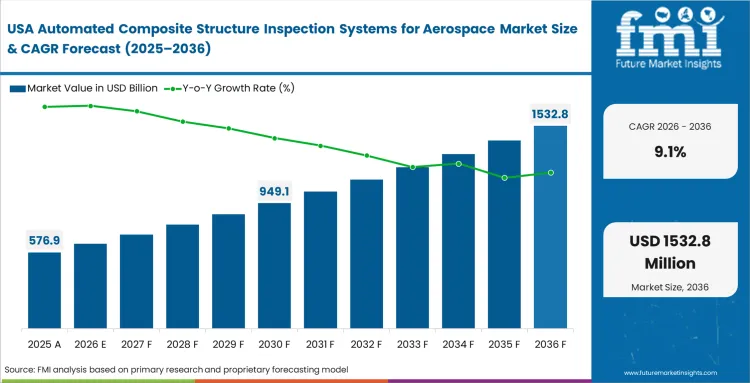
Strict federal aviation safety mandates require major aircraft manufacturers to document every internal structural anomaly meticulously. Regional prime contractors push supply chain modernization mandates forcing smaller suppliers to adopt automated flaw detection capabilities. Utility boards mandate automated quality oversight to combat severe production delays linked to outdated manual testing. Domestic hardware vendors encounter strict federal export controls regarding advanced imaging software configurations. Operations directors leverage specialized integration firms to map vast factory floor installations efficiently.
- United States: Strict regulatory compliance mandates in the USA dictate high-resolution volumetric data collection across critical military and commercial airframes. Directors leverage specialized domestic integration providers to build massive robotic inspection cells. Demand in the United States is anticipated to rise at a CAGR of 9.1% through 2036. Prime contractors dominate regional supply chains by offering highly customized flight line testing equipment specifications supporting aging aircraft platforms safely.
Latin America Automated Composite Structure Inspection Systems for Aerospace Market Analysis
Regional jet manufacturing expansions require localized quality assurance upgrades directly alongside assembly lines. Aerospace operators deploy automated inspection cells to evaluate complex composite wing geometries reliably. FMI analysts note extreme humidity profiles force hardware developers to engineer specialized environmentally sealed testing electronics. Civil aviation ministries enforce strict documentation standards for new commercial aircraft certifications locally. Facility managers integrate automated diagnostic data directly into centralized manufacturing execution systems.
- Brazil: Local commercial jet manufacturers are accelerating modernization programs that require high-speed continuous scanning systems. Production teams are replacing manual acoustic inspection methods with automated gantry-based platforms to improve throughput and consistency. Favorable export conditions support increased airframe production, which raises the need for advanced fatigue monitoring across test structures. Brazil is projected to grow at a CAGR of 9.9% in guided wave ultrasonic inspection system demand from 2026 to 2036. This growth reflects steady investment in inspection infrastructure aligned with expanding aerospace manufacturing activity.
Europe Automated Composite Structure Inspection Systems for Aerospace Market Analysis
Aerospace sustainability transitions dictate intense weight-reduction efforts pushing massive composite integration across continental airframe designs. Commercial aviation consortiums deploying massive passenger jets demand specialized inspection systems capable of mapping massive continuous carbon fiber barrels. According to FMI's estimates, stringent industrial safety regulations give local engineering software developers a significant advantage in pushing predictive maintenance standards. Facility managers integrate automated structural data directly into centralized digital twin databases to optimize lifecycle data retention.
- France: High-volume commercial aircraft production requires rapid continuous inspection solutions avoiding severe supply chain bottlenecks. Compliance officers utilize heavily regulated platforms guaranteeing safe operational flight limits for massive twin-aisle jets perfectly. France is expected to witness 8.8% CAGR through 2036. Dominating core precision engineering algorithms allows regional vendors to push highly advanced advanced composites testing capabilities past international rivals.
- United Kingdom: The United Kingdom is anticipated to see guided wave ultrasonic inspection system adoption grow at a CAGR of 8.6% from 2026 to 2036. Defense aerospace programs require continuous structural monitoring across highly classified platforms. Chief engineers depend on high-fidelity spatial models to detect early-stage delamination under extreme operating conditions. Complex military procurement frameworks shape how these systems are deployed and integrated. Local firms continue to build expertise in handling sensitive composite tooling data within secure environments.
- Germany: Transitioning critical urban air mobility manufacturing toward automated inline scanning requires precise structural evaluation solutions. Quality managers utilize high-speed robotic cells to guarantee flawless material fusion across novel aircraft designs safely. Germany is expected to post 8.4% CAGR through 2036. Dominating precision robotics allows local operators to develop cutting-edge aerospace lightweight materials inspection architectures reliably.
East Asia Automated Composite Structure Inspection Systems for Aerospace Market Analysis
Accelerated deployment of massive state-funded commercial aviation programs demands automated diagnostic solutions immediately. Civil aviation ministries require local manufacturers to map structural baselines rapidly. In FMI's view, national transport boards penalize uncertified component deliveries severely, forcing prime contractors to adopt continuous preventive scanning routines. Maintenance directors cannot rely on slow manual thickness readings to protect critical widebody jet programs. Integrating advanced simulation software turns raw acoustic telemetry into prioritized repair work orders automatically.
- China: State-funded aircraft manufacturing programs require parallel investment in predictive inspection systems. Engineering teams are adopting locally customized high-capacity robotic cells to transmit acoustic signals through complex multilayered wing structures. China is set to record a CAGR of 10.4% from 2026 to 2036, reflecting steady demand tied to large-scale production expansion. Strong domestic capabilities in industrial automation support efficient execution of high-speed inspections across specialized airframe joints.
South Asia Automated Composite Structure Inspection Systems for Aerospace Market Analysis
National policy mandates prioritizing localized defense manufacturing reshape aerospace procurement dynamics across this zone. Heavy industrial conglomerates face immense pressure to evaluate newly designed carbon fiber structures rapidly. Local military boards mandate automated structural oversight to combat severe production delays linked to scarce certified inspector availability. Foreign hardware vendors encounter steep localization requirements, forcing them into strategic joint ventures with regional engineering firms. Operations directors leverage expanding domestic facilities to map complex fighter jet components efficiently.
- India: India’s industry is projected to witness 10.9% CAGR through 2036. Regulatory bodies force defense contractors to submit complete baseline acoustic maps before receiving final military airworthiness approvals. Compliance officers deploy these platforms to generate irrefutable digital evidence proving critical flight integrity safely. Local technology startups dominate software integration contracts by offering hyper-customized analytical interfaces managing complex structural health monitoring coatings reliably.
Competitive Aligners for Market Players
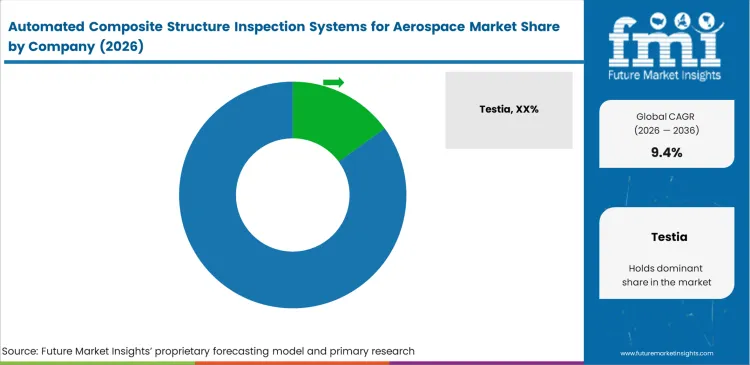
Hardware commoditization is reshaping competitive dynamics across non-destructive testing, pushing vendors to shift focus toward proprietary analytical software. Producing high-speed robotic scanner arms no longer delivers meaningful differentiation, as regional startups can replicate similar hardware using widely available supply chains. Companies such as Testia and Evident are advancing cloud-native defect recognition platforms that automatically interpret complex acoustic signals. Procurement teams now prioritize machine learning accuracy that eliminates false echoes and reduces manual data cleaning, making intelligent software the primary decision factor.
Established players maintain a strong advantage through decades of accumulated inspection intelligence. Firms like Waygate Technologies and TecScan leverage extensive proprietary datasets and material response algorithms to deliver highly reliable flaw characterization. This depth of validation enables accurate differentiation between minor porosity and critical structural defects. Quality managers prefer these vendors because their outputs are consistent and interpretable, directly reducing manufacturing scrap and ensuring engineering teams can act on inspection results with confidence.
Large aerospace and industrial manufacturers are also resisting closed software ecosystems by demanding open data interoperability. Vendors including ScanMaster Systems, Comet Yxlon, and Nikon are securing contracts by enabling seamless data export into third-party digital twin and manufacturing execution platforms. This shift is accelerating platform consolidation, where buyers expect integrated solutions that connect inspection hardware, advanced analytics, and lifecycle monitoring within a unified and flexible digital framework.
Key Players in Automated Composite Structure Inspection Systems for Aerospace Market
- Testia
- Evident
- Waygate Technologies
- TecScan
- ScanMaster Systems
- Comet Yxlon
- Nikon
Scope of the Report
| Metric | Value |
|---|---|
| Quantitative Units | USD 1.0 billion to USD 2.4 billion, at a CAGR of 9.40% |
| Market Definition | Engineered hardware and software architectures designed specifically to detect internal anomalies within aviation-grade carbon fiber structures without manual human intervention. |
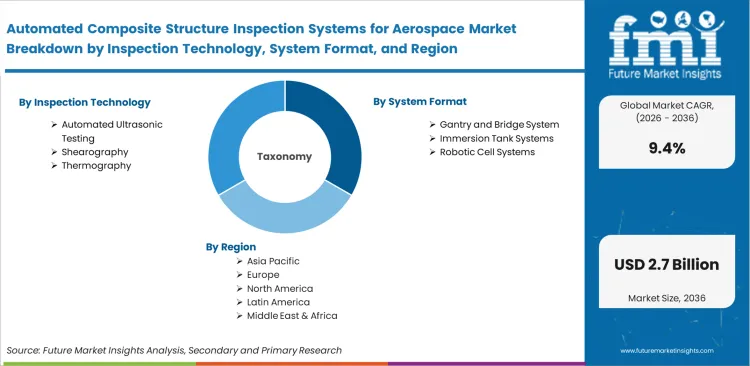
| Segmentation | Inspection Technology, System Format, Structure Type, Application Stage, Buyer Type |
| Regions Covered | North America, Latin America, Europe, East Asia, South Asia, Oceania, Middle East and Africa |
| Countries Covered | India, China, Brazil, United States, France, United Kingdom, Germany |
| Key Companies Profiled | Testia, Evident, Waygate Technologies, TecScan, ScanMaster Systems, Comet Yxlon, Nikon |
| Forecast Period | 2026 to 2036 |
| Approach | Automated scanning cell shipment volumes cross-referenced with active commercial aircraft backlog data anchored baseline valuation modeling. |
Source: Future Market Insights (FMI) analysis, based on proprietary forecasting model and primary research
Automated Composite Structure Inspection Systems for Aerospace Market Analysis by Segments
Inspection Technology:
- Automated ultrasonic testing
- Thermography
- Shearography
- CT/X-ray
- Hybrid multimodal
System Format:
- Gantry and bridge systems
- Immersion tank systems
- Robotic cell systems
- Portable scanner systems
- Inline inspection stations
Structure Type:
- Skins and panels
- Stringers and spars
- Honeycomb bonded parts
- Control surfaces
- Radomes and nacelles
Application Stage:
- Production QA
- In-process inspection
- Repair validation
- MRO inspection
- R&D and qualification
Buyer Type:
- OEMs and Tier-1s
- Independent test labs
- MRO providers
- Defense depots
- Research centers
Region:
- North America
- Latin America
- Europe
- East Asia
- South Asia
- Oceania
- Middle East and Africa
Bibliography
- Airbus. (2025, June 12). Airbus Global Market Forecast 2025: People and commerce driving air traffic growth.
- Argonne National Laboratory. (2025). Tool for AI-enabled automated non-destructive inspection of composite aerostructures.
- Boeing. (2025). Commercial Market Outlook 2025-2044.
- Cambridge University Press. (2024). Handling, inspection and repair of aircraft composites: A pilot study on the awareness of maintenance personnel. The Aeronautical Journal.
- Federal Aviation Administration. (2024, August 7). Transport airplane metallic and composite structures working group recommendation report - Revision A.
This bibliography is provided for reader reference and is not exhaustive. The full report contains the complete reference list with primary source documentation.
This Report Addresses
- Integration pathways connecting raw ultrasonic testing data directly with predictive manufacturing execution software metrics securely.
- Federal aviation compliance strategies utilized by production managers leveraging automated volumetric records to secure final airworthiness certifications efficiently.
- Algorithmic filtering requirements necessary to isolate critical internal delamination signatures from complex honeycomb bonded part reflections accurately.
- Production friction impacting operations directors relying on rigid gantry systems across newly configured continuous assembly line environments completely.
- Sensor coupling standards dictating acceptable mechanical positioning tolerance limits across high-speed robotic continuous scanning operations reliably.
- Software interoperability frictions preventing prime contractors from merging proprietary supplier inspection outputs into unified visual digital twin dashboards perfectly.
- Catastrophic structural failure prediction protocols intercepting invisible internal resin voids before composite flight control surfaces fail permanently.
- Architectural shifts replacing reactive manual spot-check evaluations with continuous automated volumetric scanning programs across modern aerospace manufacturing securely.
Frequently Asked Questions
What drives the 9.4% CAGR for Automated Composite Structure Inspection Systems for Aerospace?
Aviation manufacturers prioritize defect resolution speed across high-volume production lines. Scaling commercial aircraft delivery targets forces quality assurance teams to replace slow manual scanning with robotic cells to eliminate severe production bottlenecks reliably.
Why does automated ultrasonic testing dominate inspection technology?
Identifying microscopic internal delaminations demands high-frequency acoustic waves that purely surface-level technologies cannot provide. Quality control managers require precise volumetric depth calculations to determine whether a microscopic void exceeds acceptable regulatory safety limits.
What restricts portable scanner adoption across primary flight structures?
Minor positioning deviations ruin massive acoustic datasets instantly. Operations directors avoid portable alternatives for large surfaces because massive commercial aircraft wing skins require incredibly stable overhead positioning rails to guarantee perfect sensor alignment.
How does India outpace global average growth rates?
Domestic defense manufacturing programs demand rapid qualification of newly designed composite aero structures. Military boards mandate automated structural oversight to combat severe production delays linked to scarce certified human inspector availability locally.
Why do OEMs and Tier-1s control procurement dynamics?
Prime aerospace contractors purchase highly customized hardware and enforce strict testing specifications that their downstream supply chain must replicate identically. Smaller suppliers must develop uniform digital data formats ensuring prime contractors can ingest inspection records instantly.
What forces aerospace manufacturers away from manual testing?
Manual composite testing creates severe production bottlenecks. Quality assurance teams halt assembly lines while technicians scan large carbon fiber panels by hand, generating staggering delays in final airframe certification and risking severe repetitive strain injuries.
How do complex honeycomb parts challenge automated scanning?
Varying internal structures feature unpredictable acoustic impedances that confuse basic automated algorithms instantly. Acoustic engineers must program dynamic focal adjustments keeping sensors calibrated perfectly across transitioning structural depths accurately.
Why do gantry architectures remain the preferred system format?
Massive commercial aircraft wing skins require incredibly stable overhead rails spanning massive factory floor footprints. Heavy rigid structures guarantee perfect sensor alignment across thirty-meter longitudinal scans without requiring dangerous manual repositioning halfway through the test.
What role does AI play in post-scan data processing?
Processing raw ultrasonic data consumes excessive human hours. Software directors eagerly adopt machine learning tools that automatically identify microscopic structural anomalies, clearing component backlogs by preventing completed structures from waiting idly inside quality assurance queues.
How do export controls impact North American hardware procurement?
Domestic hardware vendors encounter strict federal export controls regarding advanced imaging software configurations. Procurement directors leverage specialized domestic integration providers to build massive robotic inspection cells compliant with highly classified military programs securely.
Why does production QA hold majority application share?
Regulatory bodies demand unalterable digital defect records before final delivery. Clearing parts at this specific stage prevents defective components from accumulating expensive subsequent assembly labor while providing legally required documentation for immediate airworthiness certification.
What specific operational consequence occurs without universal data export?
IT directors face severe vendor lock-in when robotic platforms tie exclusively to proprietary cloud processing environments. This isolates critical inspection imagery from broader manufacturing execution software, disrupting seamless digital twin lifecycle integration completely.
How do prime contractors utilize specification enforcement power?
Parent organizations write rigid non-destructive testing manuals. Vendor compliance officers force external suppliers to match internal prime contractor testing standards perfectly, ensuring uniform data collection across the entire global component supply chain reliably.
Why does defect quantification precision matter during inspection?
Precise acoustic arrays measure exact anomaly dimensions accurately. Manufacturing leads utilize these specific measurements to determine whether an expensive component requires immediate localized repair or warrants complete structural scrapping before advancing to final assembly.
What restricts the scaling of fully automated inspection operations?
Quality assurance teams drown in terabytes of high-resolution acoustic imagery lacking clear automated context. Until advanced algorithms reliably translate raw sensor data into immediate pass or fail decisions without extensive human intervention, severe internal engineering bandwidth limits persist.
How do extreme humidity profiles affect Latin American equipment deployments?
Aggressive regional jet manufacturing expansions require localized quality assurance upgrades directly alongside assembly lines. Extreme ambient humidity forces hardware developers to engineer specialized environmentally sealed testing electronics protecting sensitive payloads reliably.
What fundamental limitation restricts thermography compared to ultrasonic testing?
Thermography excels at rapid surface inspections but struggles to generate high-resolution volumetric data deep across thick carbon fiber laminates reliably. Microscopic internal delaminations demand high-frequency acoustic waves that purely thermal technologies cannot map accurately.
How do insurance requirements shape corporate diagnostic deployment strategies?
Network owners bear ultimate legal responsibility for unpredicted structural failures. Risk managers demand highly encrypted unalterable acoustic records from external contractors to prove regulatory compliance during catastrophic incident investigations securely.
Why do heavy-lift capabilities dictate factory floor planning?
Erecting rigid gantry systems requires massive reinforced concrete foundations. Installing permanent bridge rails consumes significant factory real estate, forcing facility managers to plan specific heavy-lift crane access routes around the inspection cell permanently.
What structural condition accelerates multimodal sensor fusion engineering?
Single technologies miss specific defect types routinely. Engineering leads aggressively fund vendors combining thermography and acoustic sensors onto single robotic arms for comprehensive evaluations simultaneously, capturing diverse structural anomaly sets within one scanning pass.
How do aerospace operators utilize specialized inline scanning architectures?
Testing completed parts separately wastes valuable factory real estate. Manufacturing chiefs prioritize robotic sensors capable of inspecting composite layers immediately during the automated fiber placement process, preventing defective layer curing completely.
What specific bottleneck slows true scale across independent test labs?
Procurement directors at smaller test labs cannot afford massive custom gantry architectures. They settle for versatile smaller robotic cells, forcing them to manually reposition massive aerospace structures repeatedly during continuous high-volume scanning operations.
Preview the report firsthand - request a free sample
Get SampleGet the brochure for pricing and purchase details.
Get PDFTable of Content
- Executive Summary
- Global Market Outlook
- Demand-side Trends
- Supply-side Trends
- Technology Roadmap Analysis
- Analysis and Recommendations
- Market Overview
- Market Coverage / Taxonomy
- Market Definition / Scope / Limitations
- Research Methodology
- Chapter Orientation
- Analytical Lens and Working Hypotheses
- Market Structure, Signals, and Trend Drivers
- Benchmarking and Cross-market Comparability
- Market Sizing, Forecasting, and Opportunity Mapping
- Research Design and Evidence Framework
- Desk Research Programme (Secondary Evidence)
- Company Annual and Sustainability Reports
- Peer-reviewed Journals and Academic Literature
- Corporate Websites, Product Literature, and Technical Notes
- Earnings Decks and Investor Briefings
- Statutory Filings and Regulatory Disclosures
- Technical White Papers and Standards Notes
- Trade Journals, Industry Magazines, and Analyst Briefs
- Conference Proceedings, Webinars, and Seminar Materials
- Government Statistics Portals and Public Data Releases
- Press Releases and Reputable Media Coverage
- Specialist Newsletters and Curated Briefings
- Sector Databases and Reference Repositories
- FMI Internal Proprietary Databases and Historical Market Datasets
- Subscription Datasets and Paid Sources
- Social Channels, Communities, and Digital Listening Inputs
- Additional Desk Sources
- Expert Input and Fieldwork (Primary Evidence)
- Primary Modes
- Qualitative Interviews and Expert Elicitation
- Quantitative Surveys and Structured Data Capture
- Blended Approach
- Why Primary Evidence is Used
- Field Techniques
- Interviews
- Surveys
- Focus Groups
- Observational and In-context Research
- Social and Community Interactions
- Stakeholder Universe Engaged
- C-suite Leaders
- Board Members
- Presidents and Vice Presidents
- R&D and Innovation Heads
- Technical Specialists
- Domain Subject-matter Experts
- Scientists
- Physicians and Other Healthcare Professionals
- Governance, Ethics, and Data Stewardship
- Research Ethics
- Data Integrity and Handling
- Primary Modes
- Tooling, Models, and Reference Databases
- Desk Research Programme (Secondary Evidence)
- Data Engineering and Model Build
- Data Acquisition and Ingestion
- Cleaning, Normalisation, and Verification
- Synthesis, Triangulation, and Analysis
- Quality Assurance and Audit Trail
- Market Background
- Market Dynamics
- Drivers
- Restraints
- Opportunity
- Trends
- Scenario Forecast
- Demand in Optimistic Scenario
- Demand in Likely Scenario
- Demand in Conservative Scenario
- Opportunity Map Analysis
- Product Life Cycle Analysis
- Supply Chain Analysis
- Investment Feasibility Matrix
- Value Chain Analysis
- PESTLE and Porter’s Analysis
- Regulatory Landscape
- Regional Parent Market Outlook
- Production and Consumption Statistics
- Import and Export Statistics
- Market Dynamics
- Global Market Analysis 2021 to 2025 and Forecast, 2026 to 2036
- Historical Market Size Value (USD Million) Analysis, 2021 to 2025
- Current and Future Market Size Value (USD Million) Projections, 2026 to 2036
- Y-o-Y Growth Trend Analysis
- Absolute $ Opportunity Analysis
- Global Market Pricing Analysis 2021 to 2025 and Forecast 2026 to 2036
- Global Market Analysis 2021 to 2025 and Forecast 2026 to 2036, By Inspection Technology
- Introduction / Key Findings
- Historical Market Size Value (USD Million) Analysis By Inspection Technology , 2021 to 2025
- Current and Future Market Size Value (USD Million) Analysis and Forecast By Inspection Technology , 2026 to 2036
- Automated Ultrasonic Testing
- Shearography
- Thermography
- Automated Ultrasonic Testing
- Y-o-Y Growth Trend Analysis By Inspection Technology , 2021 to 2025
- Absolute $ Opportunity Analysis By Inspection Technology , 2026 to 2036
- Global Market Analysis 2021 to 2025 and Forecast 2026 to 2036, By System Format
- Introduction / Key Findings
- Historical Market Size Value (USD Million) Analysis By System Format, 2021 to 2025
- Current and Future Market Size Value (USD Million) Analysis and Forecast By System Format, 2026 to 2036
- Gantry and Bridge System
- Immersion Tank Systems
- Robotic Cell Systems
- Gantry and Bridge System
- Y-o-Y Growth Trend Analysis By System Format, 2021 to 2025
- Absolute $ Opportunity Analysis By System Format, 2026 to 2036
- Global Market Analysis 2021 to 2025 and Forecast 2026 to 2036, By Structure Type
- Introduction / Key Findings
- Historical Market Size Value (USD Million) Analysis By Structure Type, 2021 to 2025
- Current and Future Market Size Value (USD Million) Analysis and Forecast By Structure Type, 2026 to 2036
- Skins and Panels
- Stringers and Spars
- Honeycomb Bonded Parts
- Skins and Panels
- Y-o-Y Growth Trend Analysis By Structure Type, 2021 to 2025
- Absolute $ Opportunity Analysis By Structure Type, 2026 to 2036
- Global Market Analysis 2021 to 2025 and Forecast 2026 to 2036, By Application Stage
- Introduction / Key Findings
- Historical Market Size Value (USD Million) Analysis By Application Stage, 2021 to 2025
- Current and Future Market Size Value (USD Million) Analysis and Forecast By Application Stage, 2026 to 2036
- Production QA
- In-process Inspection
- Repair Validation
- Production QA
- Y-o-Y Growth Trend Analysis By Application Stage, 2021 to 2025
- Absolute $ Opportunity Analysis By Application Stage, 2026 to 2036
- Global Market Analysis 2021 to 2025 and Forecast 2026 to 2036, By Buyer Type
- Introduction / Key Findings
- Historical Market Size Value (USD Million) Analysis By Buyer Type, 2021 to 2025
- Current and Future Market Size Value (USD Million) Analysis and Forecast By Buyer Type, 2026 to 2036
- OEMs and Tier-1s
- Independent test labs
- MRO providers
- OEMs and Tier-1s
- Y-o-Y Growth Trend Analysis By Buyer Type, 2021 to 2025
- Absolute $ Opportunity Analysis By Buyer Type, 2026 to 2036
- Global Market Analysis 2021 to 2025 and Forecast 2026 to 2036, By Region
- Introduction
- Historical Market Size Value (USD Million) Analysis By Region, 2021 to 2025
- Current Market Size Value (USD Million) Analysis and Forecast By Region, 2026 to 2036
- North America
- Latin America
- Western Europe
- Eastern Europe
- East Asia
- South Asia and Pacific
- Middle East & Africa
- Market Attractiveness Analysis By Region
- North America Market Analysis 2021 to 2025 and Forecast 2026 to 2036, By Country
- Historical Market Size Value (USD Million) Trend Analysis By Market Taxonomy, 2021 to 2025
- Market Size Value (USD Million) Forecast By Market Taxonomy, 2026 to 2036
- By Country
- USA
- Canada
- Mexico
- By Inspection Technology
- By System Format
- By Structure Type
- By Application Stage
- By Buyer Type
- By Country
- Market Attractiveness Analysis
- By Country
- By Inspection Technology
- By System Format
- By Structure Type
- By Application Stage
- By Buyer Type
- Key Takeaways
- Latin America Market Analysis 2021 to 2025 and Forecast 2026 to 2036, By Country
- Historical Market Size Value (USD Million) Trend Analysis By Market Taxonomy, 2021 to 2025
- Market Size Value (USD Million) Forecast By Market Taxonomy, 2026 to 2036
- By Country
- Brazil
- Chile
- Rest of Latin America
- By Inspection Technology
- By System Format
- By Structure Type
- By Application Stage
- By Buyer Type
- By Country
- Market Attractiveness Analysis
- By Country
- By Inspection Technology
- By System Format
- By Structure Type
- By Application Stage
- By Buyer Type
- Key Takeaways
- Western Europe Market Analysis 2021 to 2025 and Forecast 2026 to 2036, By Country
- Historical Market Size Value (USD Million) Trend Analysis By Market Taxonomy, 2021 to 2025
- Market Size Value (USD Million) Forecast By Market Taxonomy, 2026 to 2036
- By Country
- Germany
- UK
- Italy
- Spain
- France
- Nordic
- BENELUX
- Rest of Western Europe
- By Inspection Technology
- By System Format
- By Structure Type
- By Application Stage
- By Buyer Type
- By Country
- Market Attractiveness Analysis
- By Country
- By Inspection Technology
- By System Format
- By Structure Type
- By Application Stage
- By Buyer Type
- Key Takeaways
- Eastern Europe Market Analysis 2021 to 2025 and Forecast 2026 to 2036, By Country
- Historical Market Size Value (USD Million) Trend Analysis By Market Taxonomy, 2021 to 2025
- Market Size Value (USD Million) Forecast By Market Taxonomy, 2026 to 2036
- By Country
- Russia
- Poland
- Hungary
- Balkan & Baltic
- Rest of Eastern Europe
- By Inspection Technology
- By System Format
- By Structure Type
- By Application Stage
- By Buyer Type
- By Country
- Market Attractiveness Analysis
- By Country
- By Inspection Technology
- By System Format
- By Structure Type
- By Application Stage
- By Buyer Type
- Key Takeaways
- East Asia Market Analysis 2021 to 2025 and Forecast 2026 to 2036, By Country
- Historical Market Size Value (USD Million) Trend Analysis By Market Taxonomy, 2021 to 2025
- Market Size Value (USD Million) Forecast By Market Taxonomy, 2026 to 2036
- By Country
- China
- Japan
- South Korea
- By Inspection Technology
- By System Format
- By Structure Type
- By Application Stage
- By Buyer Type
- By Country
- Market Attractiveness Analysis
- By Country
- By Inspection Technology
- By System Format
- By Structure Type
- By Application Stage
- By Buyer Type
- Key Takeaways
- South Asia and Pacific Market Analysis 2021 to 2025 and Forecast 2026 to 2036, By Country
- Historical Market Size Value (USD Million) Trend Analysis By Market Taxonomy, 2021 to 2025
- Market Size Value (USD Million) Forecast By Market Taxonomy, 2026 to 2036
- By Country
- India
- ASEAN
- Australia & New Zealand
- Rest of South Asia and Pacific
- By Inspection Technology
- By System Format
- By Structure Type
- By Application Stage
- By Buyer Type
- By Country
- Market Attractiveness Analysis
- By Country
- By Inspection Technology
- By System Format
- By Structure Type
- By Application Stage
- By Buyer Type
- Key Takeaways
- Middle East & Africa Market Analysis 2021 to 2025 and Forecast 2026 to 2036, By Country
- Historical Market Size Value (USD Million) Trend Analysis By Market Taxonomy, 2021 to 2025
- Market Size Value (USD Million) Forecast By Market Taxonomy, 2026 to 2036
- By Country
- Kingdom of Saudi Arabia
- Other GCC Countries
- Turkiye
- South Africa
- Other African Union
- Rest of Middle East & Africa
- By Inspection Technology
- By System Format
- By Structure Type
- By Application Stage
- By Buyer Type
- By Country
- Market Attractiveness Analysis
- By Country
- By Inspection Technology
- By System Format
- By Structure Type
- By Application Stage
- By Buyer Type
- Key Takeaways
- Key Countries Market Analysis
- USA
- Pricing Analysis
- Market Share Analysis, 2025
- By Inspection Technology
- By System Format
- By Structure Type
- By Application Stage
- By Buyer Type
- Canada
- Pricing Analysis
- Market Share Analysis, 2025
- By Inspection Technology
- By System Format
- By Structure Type
- By Application Stage
- By Buyer Type
- Mexico
- Pricing Analysis
- Market Share Analysis, 2025
- By Inspection Technology
- By System Format
- By Structure Type
- By Application Stage
- By Buyer Type
- Brazil
- Pricing Analysis
- Market Share Analysis, 2025
- By Inspection Technology
- By System Format
- By Structure Type
- By Application Stage
- By Buyer Type
- Chile
- Pricing Analysis
- Market Share Analysis, 2025
- By Inspection Technology
- By System Format
- By Structure Type
- By Application Stage
- By Buyer Type
- Germany
- Pricing Analysis
- Market Share Analysis, 2025
- By Inspection Technology
- By System Format
- By Structure Type
- By Application Stage
- By Buyer Type
- UK
- Pricing Analysis
- Market Share Analysis, 2025
- By Inspection Technology
- By System Format
- By Structure Type
- By Application Stage
- By Buyer Type
- Italy
- Pricing Analysis
- Market Share Analysis, 2025
- By Inspection Technology
- By System Format
- By Structure Type
- By Application Stage
- By Buyer Type
- Spain
- Pricing Analysis
- Market Share Analysis, 2025
- By Inspection Technology
- By System Format
- By Structure Type
- By Application Stage
- By Buyer Type
- France
- Pricing Analysis
- Market Share Analysis, 2025
- By Inspection Technology
- By System Format
- By Structure Type
- By Application Stage
- By Buyer Type
- India
- Pricing Analysis
- Market Share Analysis, 2025
- By Inspection Technology
- By System Format
- By Structure Type
- By Application Stage
- By Buyer Type
- ASEAN
- Pricing Analysis
- Market Share Analysis, 2025
- By Inspection Technology
- By System Format
- By Structure Type
- By Application Stage
- By Buyer Type
- Australia & New Zealand
- Pricing Analysis
- Market Share Analysis, 2025
- By Inspection Technology
- By System Format
- By Structure Type
- By Application Stage
- By Buyer Type
- China
- Pricing Analysis
- Market Share Analysis, 2025
- By Inspection Technology
- By System Format
- By Structure Type
- By Application Stage
- By Buyer Type
- Japan
- Pricing Analysis
- Market Share Analysis, 2025
- By Inspection Technology
- By System Format
- By Structure Type
- By Application Stage
- By Buyer Type
- South Korea
- Pricing Analysis
- Market Share Analysis, 2025
- By Inspection Technology
- By System Format
- By Structure Type
- By Application Stage
- By Buyer Type
- Russia
- Pricing Analysis
- Market Share Analysis, 2025
- By Inspection Technology
- By System Format
- By Structure Type
- By Application Stage
- By Buyer Type
- Poland
- Pricing Analysis
- Market Share Analysis, 2025
- By Inspection Technology
- By System Format
- By Structure Type
- By Application Stage
- By Buyer Type
- Hungary
- Pricing Analysis
- Market Share Analysis, 2025
- By Inspection Technology
- By System Format
- By Structure Type
- By Application Stage
- By Buyer Type
- Kingdom of Saudi Arabia
- Pricing Analysis
- Market Share Analysis, 2025
- By Inspection Technology
- By System Format
- By Structure Type
- By Application Stage
- By Buyer Type
- Turkiye
- Pricing Analysis
- Market Share Analysis, 2025
- By Inspection Technology
- By System Format
- By Structure Type
- By Application Stage
- By Buyer Type
- South Africa
- Pricing Analysis
- Market Share Analysis, 2025
- By Inspection Technology
- By System Format
- By Structure Type
- By Application Stage
- By Buyer Type
- USA
- Market Structure Analysis
- Competition Dashboard
- Competition Benchmarking
- Market Share Analysis of Top Players
- By Region
- By Inspection Technology
- By System Format
- By Structure Type
- By Application Stage
- By Buyer Type
- Competition Analysis
- Competition Deep Dive
- Testia
- Overview
- Product Portfolio
- Profitability by Market Segments (Product/Age /Sales Channel/Region)
- Sales Footprint
- Strategy Overview
- Marketing Strategy
- Product Strategy
- Channel Strategy
- Evident
- Waygate Technologies
- TecScan
- ScanMaster Systems
- Testia
- Competition Deep Dive
- Assumptions & Acronyms Used


