

- Industry Size (2026)
- USD 275.0 Mn
- Forecast (2036)
- USD 1.09 Bn
- CAGR (2026 to 2036)
- 14.8%
Fiber-Optic Strain Sensing Systems for Composite Wing Structures Market Size, Market Forecast and Outlook by FMI
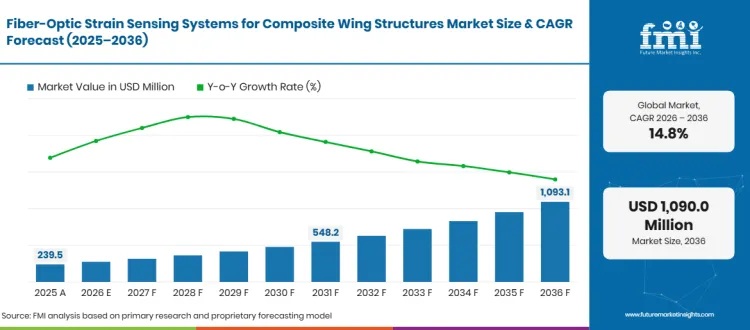
As per FMI, the fiber-optic strain sensing systems for composite wing structures market was valued at USD 239.5 million in 2025 and USD 275.0 million in 2026. Market value is projected to reach USD 1,090 million by 2036, reflecting a 14.8% CAGR from 2026 to 2036. Incremental opportunity across the assessment period is expected to be USD 815.0 million.
Summary of Fiber-Optic Strain Sensing Systems for Composite Wing Structures Market
- The fiber-optic strain sensing systems for composite wing structures market forms a focused aerospace sensing category tied to strain, load, deformation, and fatigue visibility across composite wings.
- Market value was USD 239.5 million in 2025 and is estimated at USD 275.0 million in 2026.
- Forecast value is projected to reach USD 1,090 million by 2036 at a 14.8% CAGR over the forecast period.
- FBG arrays lead sensor-type segment, with 42.0% share expected in 2026, because multiplexing efficiency and dense sensing coverage fit wing-monitoring needs.
- Surface-bonded systems lead deployment segment, with 46.0% share expected in 2026, supported by easier validation and stronger use in testing and retrofit activity.
- Commercial jets lead aircraft-platform segment, with 44.0% share expected in 2026 due to fleet scale, composite-wing relevance, and maintenance value.
- Strain-load monitoring leads functional segment, with 48.0% share expected in 2026 because structural-load visibility creates the clearest early value case.
- OEM line-fit systems lead lifecycle-stage segment, with 57.0% share expected in 2026 because early placement during design and build improves long-term structural visibility.
Key Takeaways, Market Size, and Forecast
- Fiber-Optic Strain Sensing Systems for Composite Wing Structures Market is projected to grow from USD 275.0 million in 2026 to USD 1,090 million by 2036, at a CAGR of 14.8%.
- The fiber-optic strain sensing systems for composite wing structures market was valued at USD 239.5 million in 2025.
- By 2036, the Fiber-Optic Strain Sensing Systems for Composite Wing Structures Market is expected to be worth USD 1,090 million.
- From 2026 to 2036, the market is projected to expand at a CAGR of 14.8%.
- The market is projected to create an incremental opportunity of USD 815.0 million between 2026 and 2036.
- In 2026, FBG Arrays are expected to account for 42.0% of the sensor type segment.
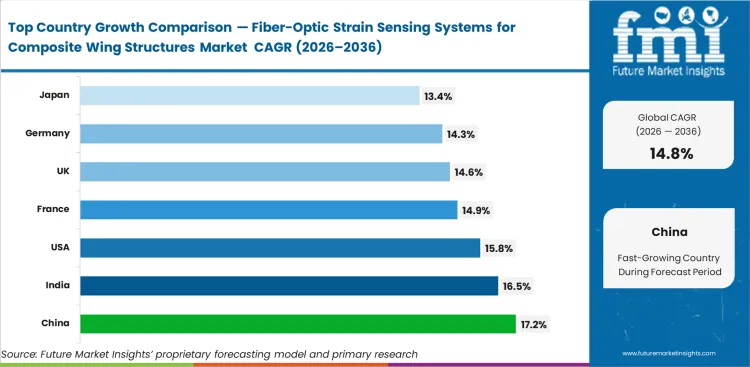
- China (17.2%) and India (16.5%) are two of the fastest growing markets.
Fiber-Optic Strain Sensing Systems for Composite Wing Structures Market Key Takeaways
| Parameter | Details |
|---|---|
| Market value (2026) | USD 275.0 million |
| Forecast value (2036) | USD 1.09 billion |
| CAGR (2026 to 2036) | 14.8% |
| Estimated market value (2025) | USD 239.5 million |
| Incremental opportunity | USD 815.0 million |
| Leading sensor technology | FBG Arrays ( 42.0% of sensor type segment) |
| Leading deployment mode | Surface-Bonded ( 46.0% of deployment mode segment) |
| Leading wing zone | Wing Skins ( 38.0% of wing zone segment) |
| Leading aircraft platform | Commercial Jets ( 44.0% of aircraft platform segment) |
| Leading monitoring function | Strain Loads ( 48.0% of monitoring function segment) |
| Leading system architecture | Wired Networks ( 51.0% of system architecture segment) |
| Leading lifecycle stage | OEM Line-Fit ( 57.0% of lifecycle stage segment) |
| Key players | Luna Innovations, HBK FiberSensing, FBGS, PhotonFirst, Sensuron, Opsens Solutions, Technica Optical Components |
Source: Future Market Insights
Composite wings create a measurement challenge across long spans, curved geometries, and distributed load paths. Fiber-optic strain sensing systems offer stronger value in such settings because one optical line can support many sensing points while reducing added weight and cable burden. Product demand increases further in aircraft applications focused on structural validation, fatigue monitoring, and condition-based maintenance. Market growth is supported by wider composite-wing use, stronger interest in structural monitoring, and better fit of dense sensing layouts across large wing sections.
China is projected to register a CAGR of 17.2%, followed by India at 16.5%, the United States at 15.8%, France at 14.9%, the United Kingdom at 14.6%, Germany at 14.3%, and Japan at 13.4% through 2036. Variation across these markets comes from differences in composite-airframe capacity, aerospace testing depth, certification readiness, and supplier access.
Fiber-Optic Strain Sensing Systems for Composite Wing Structures Market Definition
Fiber-optic strain sensing systems for composite wing structures are monitoring systems that use optical fibers to measure strain across composite aircraft wings. These systems help track structural load, stress, and deformation, supporting damage detection, validation work, and maintenance planning.
Fiber-Optic Strain Sensing Systems for Composite Wing Structures Market Inclusions
Market scope includes FBG arrays, distributed optical fibers, and hybrid optical sensing formats. It also includes interrogators, network configurations, bonding and embedding methods, and wing-zone monitoring applications. Application or end use extends across commercial, military, business, regional, UAV, and eVTOL aircraft platforms in cases involving wing-level strain intelligence.
Fiber-Optic Strain Sensing Systems for Composite Wing Structures Market Exclusions
Scope of the market excludes general aircraft cabin sensors, unrelated avionics data links, and non-wing structural monitoring categories. Generic telecom optical components, and sensing systems used only for temperature, pressure, or fluid monitoring without a defined composite-wing strain role are also excluded. Broader structural-monitoring software without direct linkage to these optical systems falls outside this market scope.
Fiber-Optic Strain Sensing Systems for Composite Wing Structures Market Research Methodology
- Primary Research: Interviews with aerospace sensing suppliers, structural-monitoring specialists, engineering teams, and market participants across optical sensing and composite-airframe programs.
- Desk Research: Review of aerospace sensing materials, public company information, technical publications, official aerospace sources, and verified product or application pages relevant to fiber-optic sensing in aircraft structures.
- Market-Sizing and Forecasting: Combination of parent-market narrowing, application-level adoption logic, supplier participation mapping, and forecast modelling based on composite-wing penetration and structural-monitoring use cases.
- Data Validation and Update Cycle: Cross-checking of market values, shares, country growth assumptions, and company participation through iterative validation and periodic updates aligned with new aerospace-program activity.
Why is the Fiber-Optic Strain Sensing Systems for Composite Wing Structures Market Growing?
- Composite wing structures need strain measurement across large surface areas.
- OEM integration creates stronger long-term value than later add-ons.
- Structural monitoring gains more importance in aircraft applications focused on maintenance timing and load tracking.
Composite wing designs have increased the need for dense strain data because load paths, material behavior, and fatigue patterns are harder to assess through limited point sensing alone. Fiber-optic systems support adoption by placing many sensing points along a light and compact optical path, due to lower wiring need and better sensing coverage across large structural areas. Product demand is expected to increase further in aircraft applications as companies focus on structural testing, design validation, and long-service monitoring rather than one-time instrumentation purchase. That same move toward fatigue visibility can be seen in the aircraft panel fatigue monitoring sensor systems market.
Adoption is rising from the steady shift towards structural health monitoring in aerospace applications that need clearer condition visibility over service life. This product fits optical systems because dense strain mapping improves structural understanding, supported by lighter sensor routing and better coverage across complex composite wing geometry. NASA has stated that fiber-optic sensing systems can deliver up to 2,000 data points on a single optical fiber, while FAA guidance includes structural health monitoring in compliance discussion for transport-airplane structures. Rising use of advanced composites, visible in the composite airframes market, adds further support to this demand path.
Approval requirements can limit adoption. Aerospace buyers do not approve systems based only on sensing density because installation durability and interrogator ruggedness matter during approval review. Repair access and connector reliability affect adoption pace over operating life. FAA guidance on structural health monitoring methods of compliance also proves that approval work is important in this market.
Segmental Analysis
- FBG arrays lead sensor-type demand because dense multiplexing and lower wiring load support composite wing measurement, and the FBG arrays segment is estimated to account for 42.0% share in 2026.
- Validation needs and retrofit practicality support surface-bonded systems across deployment demand. In 2026, surface-bonded is expected to contribute 46.0% of total market share, driven by easier inspection and lower installation disruption.
- Broad-area structural reading keeps wing skins important in monitoring layouts, and wing skins are anticipated to capture 38.0% of the market in 2026, supported by distributed strain visibility and fatigue review value. Commercial jets add further demand support, with the commercial jets category likely to account for 44.0% share in 2026 because of fleet size and maintenance value.
- Aerospace teams continue to favor direct structural-load visibility during early deployment stages. Strain loads are set to represent 48.0% of market share in 2026, driven by testing value and maintenance planning use. Wired networks are poised to garner 51.0% share in 2026 due to certifiable layouts and signal reliability. OEM line-fit leads lifecycle-stage demand, and the OEM line-fit segment is expected to hold 57.0% share in 2026 because design-stage integration and routing flexibility improve long-term system value.
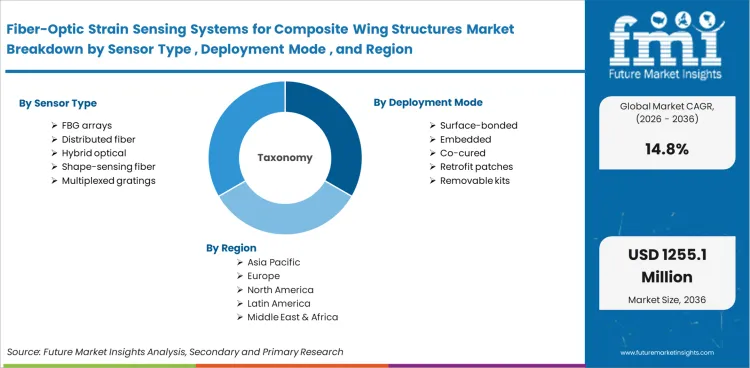
The fiber-optic strain sensing systems for composite wing structures market is segmented by sensor type, deployment mode, wing zone, aircraft platform, monitoring function, system architecture, lifecycle stage, and region.
Insights into the Sensor Type Segment
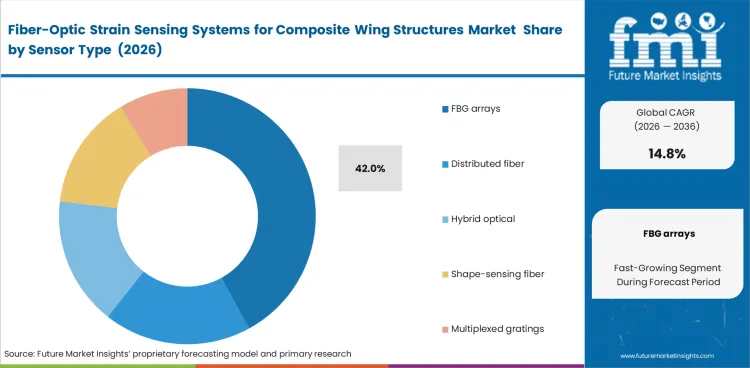
Dense sensing coverage is a major reason for product selection in this market, since composite wings need strain visibility across broad structural sections instead of a few isolated points. FBG arrays lead because one optical line can support many sensing locations with lower added wiring mass. The FBG arrays segment is estimated to account for 42.0% share in 2026, supported by sensing density and lower wiring load. This position keeps FBG arrays relevant in structural testing and calibration work.
Insights into the Deployment Mode Segment
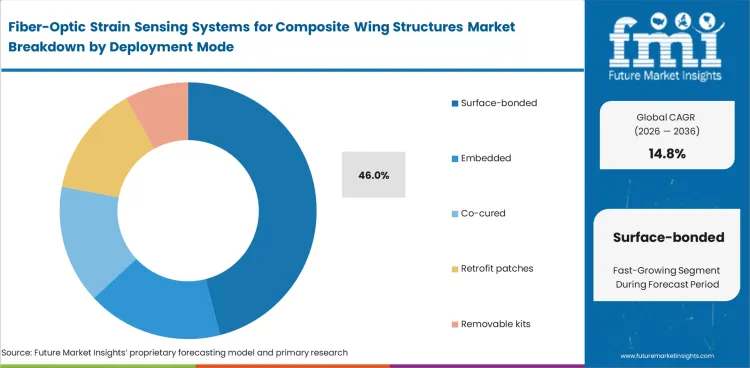
Installation discipline matters almost as much as sensing performance in aerospace applications. Surface-bonded systems are more practical in validation work, inspection activity, and selected retrofit use because access is easier after installation. The surface-bonded segment is expected to hold 46.0% share in 2026, driven by easier inspection and lower installation disruption. Wider use in testing environments adds support to this position. Similar access-related logic also shapes demand for aircraft exterior thermal gradient monitoring systems.
Insights into the Wing Zone Segment
Large monitored areas bring wing skins into focus across many structural applications. Broad skin coverage gives engineering a clearer view of distributed flexure and strain response across composite wing surfaces. Wing skins are anticipated to capture 38.0% of the market in 2026, supported by distributed strain visibility and fatigue review value. Such coverage improves practical value in load characterization and fatigue review work, especially in airframe designs that already rely on structures discussed in the composite winglet and sharklet structures market.
Insights into the Aircraft Platform Segment
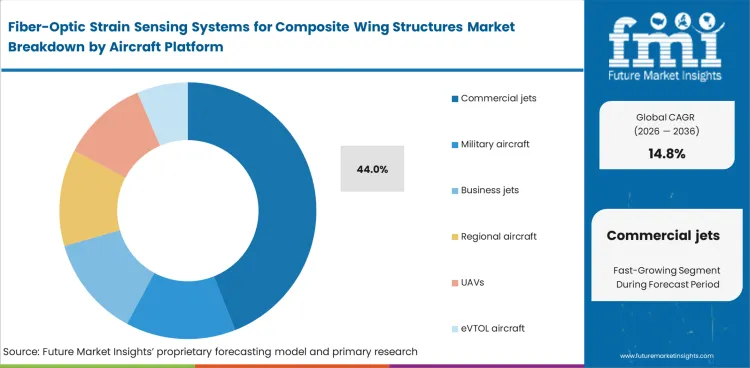
Demand is stronger in high-use aircraft applications than in smaller low-volume platforms. New architectures in the electric aircraft sensors market can widen future sensing demand. Fleet scale and maintenance economics shape platform demand. Commercial jets lead because large installed fleets and stronger composite-airframe relevance improve demand visibility for sensing systems used in structural monitoring. The commercial jets segment is poised to garner 44.0% share in 2026, due to fleet size and maintenance value.
Insights into the Monitoring Function Segment
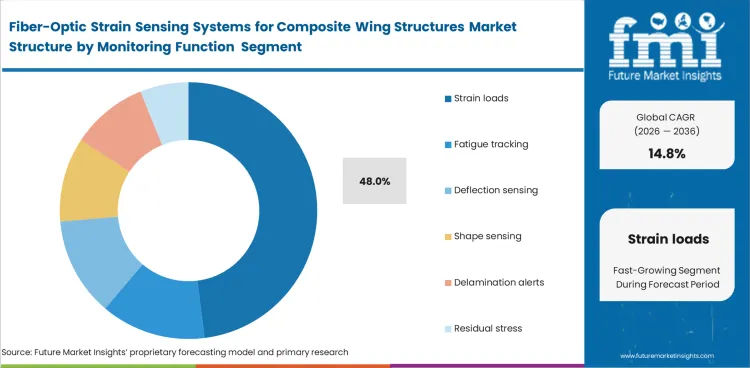
Direct structural-load visibility is important in early stages of use in this market. Engineering and maintenance staff often begin with strain-load monitoring because measurable value is easier to justify in testing and maintenance planning. Strain loads are set to represent 48.0% of market share in 2026, driven by testing value and maintenance planning. A clearer link with structural decisions keeps this function ahead of broader analytics categories.
Insights into the System Architecture Segment
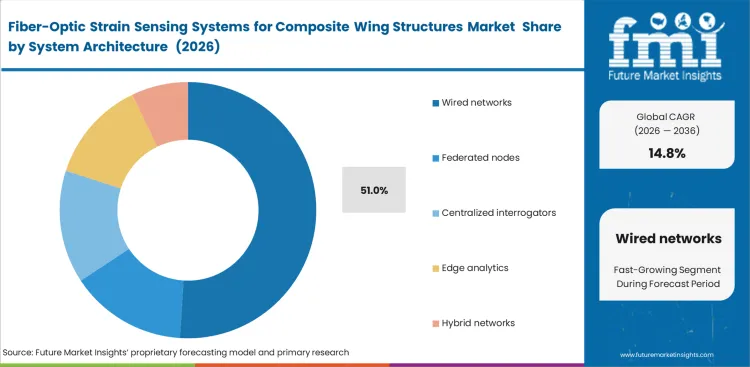
Architecture choice in aerospace applications often leans toward proven stability instead of layout flexibility. Wired networks are more acceptable in settings involving qualification review, signal consistency, and tighter control over integration. In 2026, wired networks are expected to contribute 51.0% of total market share, supported by certifiable layouts and signal reliability. Stronger acceptance in certifiable layouts keeps this segment in front.
What are the Drivers, Restraints, and Key Trends of the Fiber-Optic Strain Sensing Systems for Composite Wing Structures Market?
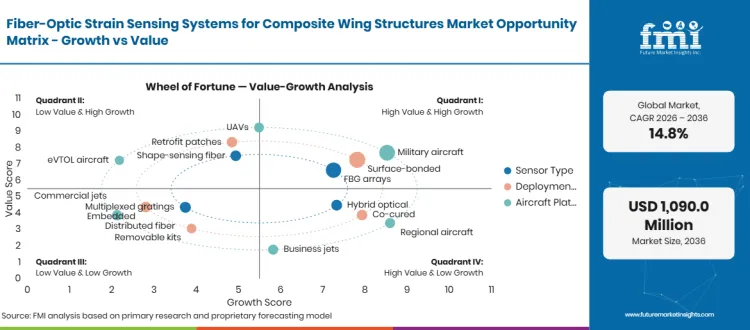
- Wider use of composite wing structures is increasing demand for dense strain monitoring across long and complex load paths.
- Qualification work, installation discipline, and proof of long service-life performance are limiting faster commercial scale.
- Demand is shifting toward integrated optical sensing systems that combine sensors, interrogators, data handling, and structural monitoring support.
The fiber-optic strain sensing systems for composite wing structures market is expanding beyond a narrow instrumentation field into a clearer aerospace structural-monitoring segment. OEMs, test teams, and maintenance groups are giving more attention to optical systems that can map strain and deformation across composite wing skins and spars. This improves the commercial value in programs where conventional point sensing gives limited coverage and added wiring creates weight and packaging penalties. Demand is shifting toward integrated system layouts because aircraft manufacturers want structural insight that supports validation and maintenance planning.
Market growth is supported by broader use of composite-rich wing designs and by the need for better condition visibility across long service cycles. Strain behavior in composite structures is harder to read through sparse measurement points, especially in programs involving long spans, distributed flexure, and fatigue-sensitive loading. Fiber-optic sensing gains more relevance in such settings because dense multiplexing can improve structural visibility without the same wiring burden seen in conventional layouts. Adoption still depends on whether suppliers can meet aerospace qualification and service-life requirements in a practical way.
Composite Wing Complexity and Load Visibility Are Supporting Market Growth
Demand is increasing because composite wing programs need better strain evidence across large structural areas. Engineers need more detailed load mapping to improve validation work, reduce uncertainty in fatigue-sensitive zones, and strengthen visibility into deformation across complex wing geometries. Composite structures add more support because internal strain behavior and damage progression are harder to interpret through limited point measurement alone. This keeps fiber-optic strain sensing more relevant in long-cycle aerospace programs where better structural awareness can justify added system complexity, similar to adjacent applications such as the aircraft panel fatigue monitoring sensor systems market.
Certification Burden and Integration Discipline Are Slowing Faster Expansion
Adoption is limited because fiber-optic strain sensing in composite wing structures must meet more than sensing performance alone. Qualification work takes time. Routing and connector design add execution pressure, and installation must align with composite build logic, structural packaging, and long service-life requirements. Aircraft manufacturers need confidence that the sensing system will improve structural decision-making rather than add a new integration burden. Adoption is higher in programs where optical sensing can be validated early and linked clearly to design assurance, structural testing, or maintenance planning.
Analysis of Fiber-Optic Strain Sensing Systems for Composite Wing Structures Market By Key Countries
- China and India add fresh scale through expanding aerospace capability and broader room for first-time integration.
- China is projected to register 17.2% CAGR through 2036.
- India follows at 16.5%, supported by aerospace capability build-up and rising interest in advanced sensing use.
- The United States records 15.8% CAGR, reflecting strong testing infrastructure and steady structural-monitoring relevance.
- France is projected at 14.9%, supported by composite-airframe expertise and major aerospace program depth.
- The United Kingdom is estimated at 14.6%, close to France in forecast growth.
- Germany posts 14.3% CAGR, while Japan records 13.4%, reflecting solid aerospace relevance yet slower program expansion than the fastest-growth markets.
.webp "Top Country Growth Comparison Fiber Optic Strain Sensing Systems For Composite Wing Structures Market Cagr (2026 2036)")
| Country | CAGR |
|---|---|
| China | 17.2% |
| India | 16.5% |
| United States | 15.8% |
| France | 14.9% |
| United Kingdom | 14.6% |
| Germany | 14.3% |
| Japan | 13.4% |
Demand Outlook for fiber-optic strain sensing systems for composite wing structures market in China
China is expanding in this market because aerospace manufacturing capacity is rising and local work on advanced structural systems is increasing. More aircraft programs are creating new opportunity for first-time installation of sensing layouts across qualification work and structural testing. The fiber-optic strain sensing systems for composite wing structures market in China is poised to expand at a CAGR of 17.2% through 2036, supported by composite-airframe build-up and local sensing capability growth.
- Expanding aerospace programs create a broader installation base.
- Composite-wing activity can increase project demand for distributed strain monitoring.
- Local sensing capability can create more supplier opportunity across future aircraft programs.
Sales Analysis of fiber-optic strain sensing systems for composite wing structures market in India
India is showing strong growth potential because aerospace capability is expanding from a smaller installed base. Demand for structural monitoring is increasing through advanced materials work and domestic aerospace development. Sales of fiber-optic strain sensing systems for composite wing structures market in India are expected to increase at a CAGR of 16.5% during the forecast period, driven by aerospace modernization and wider engineering adoption.
- Domestic aerospace capability growth creates fresh room for optical sensing integration.
- Composite-material activity can increase project interest in strain monitoring systems.
- Engineering support and validation depth can influence supplier success in this market.
Opportunity Analysis of fiber-optic strain sensing systems for composite wing structures market in the United States
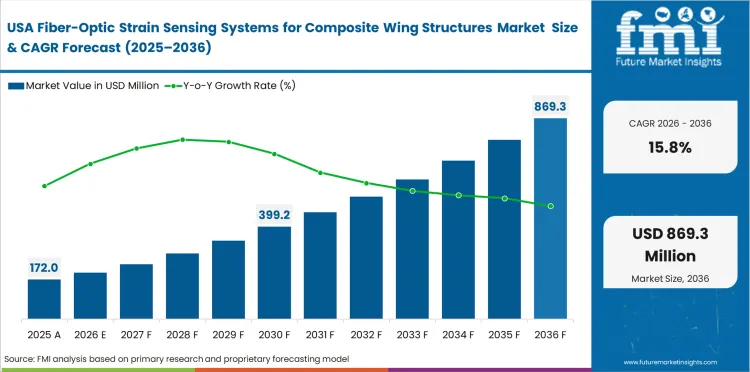
The United States has a large aerospace base and strong technical infrastructure for advanced structural programs. NASA testing activity and structural-monitoring work are increasing technology visibility across composite wing development. The market for fiber-optic strain sensing systems for composite wing structures market in the United States is expected to grow at a CAGR of 15.8% during the study period, due to test infrastructure depth and broad aerospace program concentration. NASA and FAA material together show active technical development and formal compliance relevance in this field.
- Large research infrastructure supports technical depth across advanced sensing work.
- Structural-monitoring work in aerospace testing can improve commercial acceptance.
- Approval-focused program environments can support suppliers with stronger engineering support.
Future Outlook for fiber-optic strain sensing systems for composite wing structures market in France
France is important in this market because aerospace program concentration is high and composite-airframe capability is well established. Structural sensing is gaining stronger commercial relevance across design validation and long-cycle aircraft work. France is set to record a CAGR of 14.9% in fiber-optic strain sensing systems for composite wing structures market during the assessment period, supported by OEM program depth and composite engineering expertise.
- Strong OEM program depth supports stable activity.
- Composite-airframe expertise can improve fit for embedded and bonded sensing layouts.
- Long-cycle aircraft programs can support demand for qualified monitoring systems.
In-depth Analysis of fiber-optic strain sensing systems for composite wing structures market in the United Kingdom
The United Kingdom has strong aerospace engineering capability and active work in composite materials. Program participation across advanced aircraft activity is increasing the commercial relevance of strain-sensing systems. Adoption of fiber-optic strain sensing systems for composite wing structures market in the United Kingdom is likely to advance at a CAGR of 14.6% by 2036, driven by aerospace engineering capability and program-linked demand.
- Aerospace engineering depth supports adoption across advanced structural programs.
- Composite-material work can increase relevance for strain-sensing integration.
- Program-linked sales models carry strong value in this market.
Market Outlook for fiber-optic strain sensing systems for composite wing structures market in Germany
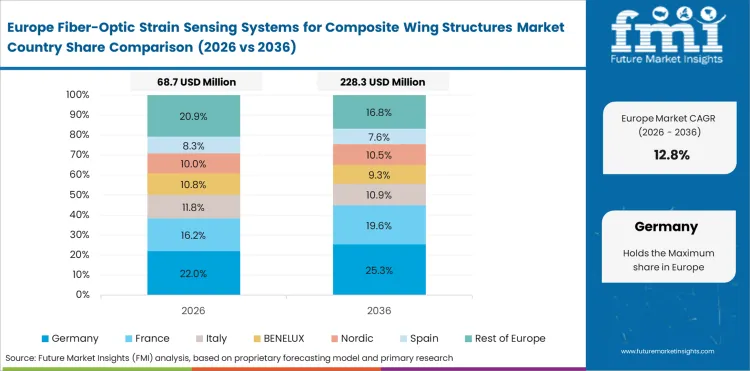
Germany is important in this market because of engineering precision and aerospace manufacturing strength. System evaluation in this market gives high importance to reliability and integration discipline across technical systems. Germany is projected to witness 14.3% CAGR in the fiber-optic strain sensing systems for composite wing structures market through 2036, driven by strong manufacturing capability and precision-focused aerospace demand.
- Precision manufacturing supports a selective demand base.
- Reliability-focused aerospace work can support stable optical sensing architectures.
- Engineering discipline can increase demand for validated monitoring systems.
Future Demand for fiber-optic strain sensing systems for composite wing structures market in Japan
Japan shows slower growth than the leading markets in this set. Demand is present across high-value aerospace programs. Supplier acceptance depends on precision engineering, stable output, and alignment with long-cycle program expectations. Adoption of fiber-optic strain sensing systems for composite wing structures market in Japan is expected to move ahead at a CAGR of 13.4% through 2036, supported by precision engineering and participation in advanced aerospace work.
- High-value aerospace programs support demand in this market.
- Precision engineering culture can support acceptance of advanced sensing systems.
- Long program cycles can support suppliers with consistent technical performance.
Competitive Landscape of Fiber-Optic Strain Sensing Systems for Composite Wing Structures Market
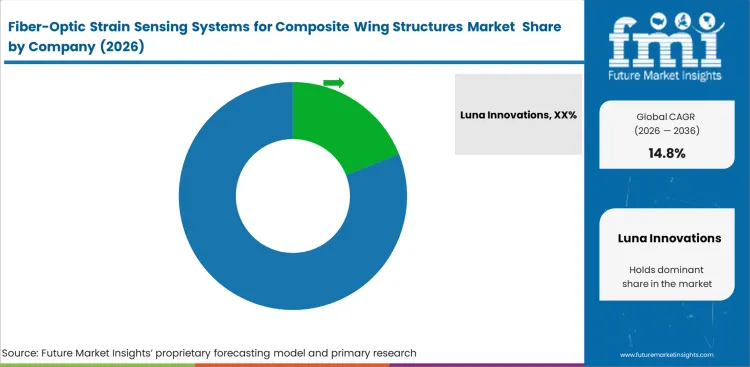
- Leading competition comes from specialist fiber-optic sensing companies such as Luna Innovations, HBK FiberSensing, FBGS, and PhotonFirst.
- Market structure is moderately fragmented because participation is spread across sensing specialists, interrogator suppliers, and application-focused engineering vendors.
- Competitive differentiation rests on sensing density, interrogator capability, aerospace relevance, integration support, and progress from structural test use into long-cycle monitoring activity.
Companies active in this market do not compete on brand name alone. Aerospace procurement teams assess sensing hardware, interrogation capability, packaging discipline, and engineering support together because aerospace approval paths require stable execution across the full system. Such conditions keep experienced optical-sensing specialists in a stronger position.
A second supplier cluster adds value through narrower yet credible positioning. PhotonFirst, Sensuron, and Opsens Solutions contribute in settings involving real-time monitoring, distributed sensing, and aerospace measurement capability. Commercial relevance improves in programs needing application support rather than catalog supply alone.
Entry barriers carry real weight because procurement teams need more than lab-capable sensing elements. Qualification support, connector reliability, calibration discipline, and long program engagement all shape supplier staying power, due to longer approval cycles and tighter aerospace performance expectations. Stronger supplier positions usually build over time through repeat engineering support and credible program participation.
Major Industry Players
Key global companies leading the fiber-optic strain sensing systems for composite wing structures market include:
- Global optical-sensing specialists such as Luna Innovations, HBK FiberSensing, and FBGS sit among the most visible suppliers because sensing hardware, interrogators, and structural-monitoring relevance appear across active portfolios.
- Aerospace and SHM-focused challengers such as PhotonFirst, Sensuron, and Opsens Solutions add competitive pressure through real-time monitoring, distributed sensing, and aircraft-system measurement capability.
- Application-focused FBG suppliers such as Technica Optical Components stay relevant in projects involving customized sensor builds, rugged sensing elements, and system-integration support.
Competitive Benchmarking: Fiber-Optic Strain Sensing Systems for Composite Wing Structures Market
| Company | Aerospace relevance | Fiber sensing depth | SHM / integration readiness | Geographic Footprint |
|---|---|---|---|---|
| Luna Innovations | High | High | High | Global |
| HBK FiberSensing | High | High | Medium | Global |
| FBGS | Medium | High | Medium | Multi-region |
| PhotonFirst | High | Medium | High | Multi-region |
| Sensuron | Medium | Medium | Medium | Country-focused |
| Opsens Solutions | Medium | Medium | Medium | Multi-region |
Source: Future Market Insights competitive analysis, 2026.
Key Developments in Fiber-Optic Strain Sensing Systems for Composite Wing Structures Market
- In July 2024, Luna announced the appointment of Kevin Ilcisin as Chief Executive Officer and closed a USD 15 million credit facility. This move matters in this market because aerospace sensing programs value supplier continuity and financial stability across long qualification cycles.
- In June 2025, PhotonFirst and NLR announced a partnership for structural health and usage monitoring in helicopters. This is relevant because it ties fiber-optic monitoring directly to aerospace structural-load and fatigue-use cases.
Key Players in Fiber-Optic Strain Sensing Systems for Composite Wing Structures Market
- Luna Innovations
- HBK FiberSensing
- FBGS
- PhotonFirst
- Sensuron
- Opsens Solutions
- Technica Optical Components
Scope of the Report
| Metric | Value |
|---|---|
| Quantitative Units | USD 239.5 million (2025) to USD 1.09 billion (2036), at a CAGR of 14.8% |
| Market Definition | The fiber-optic strain sensing systems for composite wing structures market comprises optical sensing systems, interrogators, integration formats, and related monitoring functions used to measure strain, load distribution, deformation, fatigue response, and structural behavior across aircraft wings built with composite materials. Scope includes FBG arrays, distributed optical sensing, deployment methods, wing-zone coverage, and lifecycle-stage integration tied directly to composite wing performance. |
| Segmentation |
|
| Regions Covered | North America, Latin America, Europe, Asia Pacific, and Middle East & Africa |
| Countries Covered | China, India, United States, France, United Kingdom, Germany, Japan |
| Key Companies Profiled | Luna Innovations, HBK FiberSensing, FBGS, PhotonFirst, Sensuron, Opsens Solutions, Technica Optical Components |
| Forecast Period | 2026 to 2036 |
| Approach | Top-down market modeling using aerospace sensing and structural-monitoring demand as the parent base, narrowed through composite-wing use, optical sensing applicability, lifecycle-stage integration logic, and segment-level allocation across sensor type, deployment mode, architecture, and platform demand, supported by country-level growth modeling and segment share estimation. |
Fiber-Optic Strain Sensing Systems for Composite Wing Structures Market by Segments
Fiber-Optic Strain Sensing Systems for Composite Wing Structures Market by Sensor Type
- FBG arrays
- Distributed fiber
- Hybrid optical
- Shape-sensing fiber
- Multiplexed gratings
Fiber-Optic Strain Sensing Systems for Composite Wing Structures Market by Deployment Mode
- Surface-bonded
- Embedded
- Co-cured
- Retrofit patches
- Removable kits
Fiber-Optic Strain Sensing Systems for Composite Wing Structures Market by Wing Zone
- Wing skins
- Spars
- Stringers
- Wingbox
- Wing roots
- Leading edge
- Trailing edge
Fiber-Optic Strain Sensing Systems for Composite Wing Structures Market by Aircraft Platform
- Commercial jets
- Military aircraft
- Business jets
- Regional aircraft
- UAVs
- eVTOL aircraft
Fiber-Optic Strain Sensing Systems for Composite Wing Structures Market by Monitoring Function
- Strain loads
- Fatigue tracking
- Deflection sensing
- Shape sensing
- Delamination alerts
- Residual stress
Fiber-Optic Strain Sensing Systems for Composite Wing Structures Market by System Architecture
- Wired networks
- Federated nodes
- Centralized interrogators
- Edge analytics
- Hybrid networks
Fiber-Optic Strain Sensing Systems for Composite Wing Structures Market by Lifecycle Stage
- OEM line-fit
- Ground test
- Flight test
- Retrofit
- MRO upgrades
Fiber-Optic Strain Sensing Systems for Composite Wing Structures Market by Country and Region
- North America
- USA
- Canada
- Mexico
- Latin America
- Brazil
- Chile
- Rest of Latin America
- Western Europe
- Germany
- UK
- Italy
- Spain
- France
- Nordic
- BENELUX
- Rest of Western Europe
- Eastern Europe
- Russia
- Poland
- Hungary
- Balkan & Baltic
- Rest of Eastern Europe
- East Asia
- China
- Japan
- South Korea
- South Asia and Pacific
- India
- ASEAN
- Australia & New Zealand
- Rest of South Asia and Pacific
- Middle East & Africa
- Kingdom of Saudi Arabia
- Other GCC Countries
- Turkiye
- South Africa
- Other African Union
- Rest of Middle East & Africa
Bibliography
- Luna Innovations Incorporated. (2024, July 23). Luna announces appointment of Kevin Ilcisin as CEO, retirement of Richard Roedel and $15 million credit facility from White Hat Capital Partners.
- PhotonFirst. (2025, June 17). June 2025 | Partnership between NLR and PhotonFirst.
- Francisco Peña and Brian Park (2024, September). Mock Truss-Braced Wing Loads Calibration Research Utilizing Fiber-Optic Sensors.
- National Aeronautics and Space Administration (2025, August). AFRC Fiber Optic Sensing System.
- Zhen Ma, Xiyuan Chen, Bingbo Cui, and Xinzhong Wang (2025, September). Advanced Fiber Optic Sensing Technology in Aerospace: Packaging, Bonding, and Calibration Review.
This Report Addresses
- Market size and forecast for the fiber-optic strain sensing systems for composite wing structures market
- Leading segment positions across sensor type, deployment, wing zone, platform, function, architecture, and lifecycle stage
- Country growth outlook across China, India, the United States, France, the United Kingdom, Germany, and Japan
- Commercial logic supporting OEM line-fit demand and FBG array leadership
- Supplier positioning across specialist optical-sensing and SHM-focused companies
- Competitive benchmarking based on current company and application evidence
- Strategic issues tied to certification burden, integration timing, and aerospace adoption pathways
- Key developments affecting supplier relevance in this market
Frequently Asked Questions
2026 market size for fiber-optic strain sensing systems for composite wing structures market?
The market is estimated at USD 275.0 million in 2026.
2036 forecast value for fiber-optic strain sensing systems for composite wing structures market?
The market is projected to reach USD 1.09 million by 2036.
CAGR from 2026 to 2036 for fiber-optic strain sensing systems for composite wing structures market?
The market is forecast to expand at 14.8% CAGR.
Leading sensor type in fiber-optic strain sensing systems for composite wing structures market?
FBG arrays lead the sensor type segment with 42.0% share expected in 2026.
Leading deployment mode in fiber-optic strain sensing systems for composite wing structures market?
Surface-bonded systems lead deployment demand with 46.0% share expected in 2026.
Largest aircraft platform in fiber-optic strain sensing systems for composite wing structures market?
Commercial jets lead with 44.0% of aircraft-platform demand expected in 2026.
Leading monitoring function in fiber-optic strain sensing systems for composite wing structures market?
Strain loads lead the monitoring-function segment with 48.0% share expected in 2026.
Preview the report firsthand - request a free sample
Get SampleGet the brochure for pricing and purchase details.
Get PDFTable of Content
- Executive Summary
- Global Market Outlook
- Demand-side Trends
- Supply-side Trends
- Technology Roadmap Analysis
- Analysis and Recommendations
- Market Overview
- Market Coverage / Taxonomy
- Market Definition / Scope / Limitations
- Research Methodology
- Chapter Orientation
- Analytical Lens and Working Hypotheses
- Market Structure, Signals, and Trend Drivers
- Benchmarking and Cross-market Comparability
- Market Sizing, Forecasting, and Opportunity Mapping
- Research Design and Evidence Framework
- Desk Research Programme (Secondary Evidence)
- Company Annual and Sustainability Reports
- Peer-reviewed Journals and Academic Literature
- Corporate Websites, Product Literature, and Technical Notes
- Earnings Decks and Investor Briefings
- Statutory Filings and Regulatory Disclosures
- Technical White Papers and Standards Notes
- Trade Journals, Industry Magazines, and Analyst Briefs
- Conference Proceedings, Webinars, and Seminar Materials
- Government Statistics Portals and Public Data Releases
- Press Releases and Reputable Media Coverage
- Specialist Newsletters and Curated Briefings
- Sector Databases and Reference Repositories
- FMI Internal Proprietary Databases and Historical Market Datasets
- Subscription Datasets and Paid Sources
- Social Channels, Communities, and Digital Listening Inputs
- Additional Desk Sources
- Expert Input and Fieldwork (Primary Evidence)
- Primary Modes
- Qualitative Interviews and Expert Elicitation
- Quantitative Surveys and Structured Data Capture
- Blended Approach
- Why Primary Evidence is Used
- Field Techniques
- Interviews
- Surveys
- Focus Groups
- Observational and In-context Research
- Social and Community Interactions
- Stakeholder Universe Engaged
- C-suite Leaders
- Board Members
- Presidents and Vice Presidents
- R&D and Innovation Heads
- Technical Specialists
- Domain Subject-matter Experts
- Scientists
- Physicians and Other Healthcare Professionals
- Governance, Ethics, and Data Stewardship
- Research Ethics
- Data Integrity and Handling
- Primary Modes
- Tooling, Models, and Reference Databases
- Desk Research Programme (Secondary Evidence)
- Data Engineering and Model Build
- Data Acquisition and Ingestion
- Cleaning, Normalisation, and Verification
- Synthesis, Triangulation, and Analysis
- Quality Assurance and Audit Trail
- Market Background
- Market Dynamics
- Drivers
- Restraints
- Opportunity
- Trends
- Scenario Forecast
- Demand in Optimistic Scenario
- Demand in Likely Scenario
- Demand in Conservative Scenario
- Opportunity Map Analysis
- Product Life Cycle Analysis
- Supply Chain Analysis
- Investment Feasibility Matrix
- Value Chain Analysis
- PESTLE and Porter’s Analysis
- Regulatory Landscape
- Regional Parent Market Outlook
- Production and Consumption Statistics
- Import and Export Statistics
- Market Dynamics
- Global Market Analysis 2021 to 2025 and Forecast, 2026 to 2036
- Historical Market Size Value (USD Million) Analysis, 2021 to 2025
- Current and Future Market Size Value (USD Million) Projections, 2026 to 2036
- Y-o-Y Growth Trend Analysis
- Absolute $ Opportunity Analysis
- Global Market Pricing Analysis 2021 to 2025 and Forecast 2026 to 2036
- Global Market Analysis 2021 to 2025 and Forecast 2026 to 2036, By Sensor Type
- Introduction / Key Findings
- Historical Market Size Value (USD Million) Analysis By Sensor Type , 2021 to 2025
- Current and Future Market Size Value (USD Million) Analysis and Forecast By Sensor Type , 2026 to 2036
- FBG arrays
- Distributed fiber
- Hybrid optical
- Shape-sensing fiber
- Multiplexed gratings
- FBG arrays
- Y-o-Y Growth Trend Analysis By Sensor Type , 2021 to 2025
- Absolute $ Opportunity Analysis By Sensor Type , 2026 to 2036
- Global Market Analysis 2021 to 2025 and Forecast 2026 to 2036, By Deployment Mode
- Introduction / Key Findings
- Historical Market Size Value (USD Million) Analysis By Deployment Mode, 2021 to 2025
- Current and Future Market Size Value (USD Million) Analysis and Forecast By Deployment Mode, 2026 to 2036
- Surface-bonded
- Embedded
- Co-cured
- Retrofit patches
- Removable kits
- Surface-bonded
- Y-o-Y Growth Trend Analysis By Deployment Mode, 2021 to 2025
- Absolute $ Opportunity Analysis By Deployment Mode, 2026 to 2036
- Global Market Analysis 2021 to 2025 and Forecast 2026 to 2036, By Wing Zone
- Introduction / Key Findings
- Historical Market Size Value (USD Million) Analysis By Wing Zone, 2021 to 2025
- Current and Future Market Size Value (USD Million) Analysis and Forecast By Wing Zone, 2026 to 2036
- Wing skins
- Spars
- Stringers
- Wingbox
- Wing roots
- Leading edge
- Trailing edge
- Wing skins
- Y-o-Y Growth Trend Analysis By Wing Zone, 2021 to 2025
- Absolute $ Opportunity Analysis By Wing Zone, 2026 to 2036
- Global Market Analysis 2021 to 2025 and Forecast 2026 to 2036, By Aircraft Platform
- Introduction / Key Findings
- Historical Market Size Value (USD Million) Analysis By Aircraft Platform, 2021 to 2025
- Current and Future Market Size Value (USD Million) Analysis and Forecast By Aircraft Platform, 2026 to 2036
- Commercial jets
- Military aircraft
- Business jets
- Regional aircraft
- UAVs
- eVTOL aircraft
- Commercial jets
- Y-o-Y Growth Trend Analysis By Aircraft Platform, 2021 to 2025
- Absolute $ Opportunity Analysis By Aircraft Platform, 2026 to 2036
- Global Market Analysis 2021 to 2025 and Forecast 2026 to 2036, By Monitoring Function
- Introduction / Key Findings
- Historical Market Size Value (USD Million) Analysis By Monitoring Function, 2021 to 2025
- Current and Future Market Size Value (USD Million) Analysis and Forecast By Monitoring Function, 2026 to 2036
- Strain loads
- Fatigue tracking
- Deflection sensing
- Shape sensing
- Delamination alerts
- Residual stress
- Strain loads
- Y-o-Y Growth Trend Analysis By Monitoring Function, 2021 to 2025
- Absolute $ Opportunity Analysis By Monitoring Function, 2026 to 2036
- Global Market Analysis 2021 to 2025 and Forecast 2026 to 2036, By System Architecture
- Introduction / Key Findings
- Historical Market Size Value (USD Million) Analysis By System Architecture, 2021 to 2025
- Current and Future Market Size Value (USD Million) Analysis and Forecast By System Architecture, 2026 to 2036
- Wired networks
- Federated nodes
- Centralized interrogators
- Edge analytics
- Hybrid networks
- Wired networks
- Y-o-Y Growth Trend Analysis By System Architecture, 2021 to 2025
- Absolute $ Opportunity Analysis By System Architecture, 2026 to 2036
- Global Market Analysis 2021 to 2025 and Forecast 2026 to 2036, By Region
- Introduction
- Historical Market Size Value (USD Million) Analysis By Region, 2021 to 2025
- Current Market Size Value (USD Million) Analysis and Forecast By Region, 2026 to 2036
- North America
- Latin America
- Western Europe
- Eastern Europe
- East Asia
- South Asia and Pacific
- Middle East & Africa
- Market Attractiveness Analysis By Region
- North America Market Analysis 2021 to 2025 and Forecast 2026 to 2036, By Country
- Historical Market Size Value (USD Million) Trend Analysis By Market Taxonomy, 2021 to 2025
- Market Size Value (USD Million) Forecast By Market Taxonomy, 2026 to 2036
- By Country
- USA
- Canada
- Mexico
- By Sensor Type
- By Deployment Mode
- By Wing Zone
- By Aircraft Platform
- By Monitoring Function
- By System Architecture
- By Country
- Market Attractiveness Analysis
- By Country
- By Sensor Type
- By Deployment Mode
- By Wing Zone
- By Aircraft Platform
- By Monitoring Function
- By System Architecture
- Key Takeaways
- Latin America Market Analysis 2021 to 2025 and Forecast 2026 to 2036, By Country
- Historical Market Size Value (USD Million) Trend Analysis By Market Taxonomy, 2021 to 2025
- Market Size Value (USD Million) Forecast By Market Taxonomy, 2026 to 2036
- By Country
- Brazil
- Chile
- Rest of Latin America
- By Sensor Type
- By Deployment Mode
- By Wing Zone
- By Aircraft Platform
- By Monitoring Function
- By System Architecture
- By Country
- Market Attractiveness Analysis
- By Country
- By Sensor Type
- By Deployment Mode
- By Wing Zone
- By Aircraft Platform
- By Monitoring Function
- By System Architecture
- Key Takeaways
- Western Europe Market Analysis 2021 to 2025 and Forecast 2026 to 2036, By Country
- Historical Market Size Value (USD Million) Trend Analysis By Market Taxonomy, 2021 to 2025
- Market Size Value (USD Million) Forecast By Market Taxonomy, 2026 to 2036
- By Country
- Germany
- UK
- Italy
- Spain
- France
- Nordic
- BENELUX
- Rest of Western Europe
- By Sensor Type
- By Deployment Mode
- By Wing Zone
- By Aircraft Platform
- By Monitoring Function
- By System Architecture
- By Country
- Market Attractiveness Analysis
- By Country
- By Sensor Type
- By Deployment Mode
- By Wing Zone
- By Aircraft Platform
- By Monitoring Function
- By System Architecture
- Key Takeaways
- Eastern Europe Market Analysis 2021 to 2025 and Forecast 2026 to 2036, By Country
- Historical Market Size Value (USD Million) Trend Analysis By Market Taxonomy, 2021 to 2025
- Market Size Value (USD Million) Forecast By Market Taxonomy, 2026 to 2036
- By Country
- Russia
- Poland
- Hungary
- Balkan & Baltic
- Rest of Eastern Europe
- By Sensor Type
- By Deployment Mode
- By Wing Zone
- By Aircraft Platform
- By Monitoring Function
- By System Architecture
- By Country
- Market Attractiveness Analysis
- By Country
- By Sensor Type
- By Deployment Mode
- By Wing Zone
- By Aircraft Platform
- By Monitoring Function
- By System Architecture
- Key Takeaways
- East Asia Market Analysis 2021 to 2025 and Forecast 2026 to 2036, By Country
- Historical Market Size Value (USD Million) Trend Analysis By Market Taxonomy, 2021 to 2025
- Market Size Value (USD Million) Forecast By Market Taxonomy, 2026 to 2036
- By Country
- China
- Japan
- South Korea
- By Sensor Type
- By Deployment Mode
- By Wing Zone
- By Aircraft Platform
- By Monitoring Function
- By System Architecture
- By Country
- Market Attractiveness Analysis
- By Country
- By Sensor Type
- By Deployment Mode
- By Wing Zone
- By Aircraft Platform
- By Monitoring Function
- By System Architecture
- Key Takeaways
- South Asia and Pacific Market Analysis 2021 to 2025 and Forecast 2026 to 2036, By Country
- Historical Market Size Value (USD Million) Trend Analysis By Market Taxonomy, 2021 to 2025
- Market Size Value (USD Million) Forecast By Market Taxonomy, 2026 to 2036
- By Country
- India
- ASEAN
- Australia & New Zealand
- Rest of South Asia and Pacific
- By Sensor Type
- By Deployment Mode
- By Wing Zone
- By Aircraft Platform
- By Monitoring Function
- By System Architecture
- By Country
- Market Attractiveness Analysis
- By Country
- By Sensor Type
- By Deployment Mode
- By Wing Zone
- By Aircraft Platform
- By Monitoring Function
- By System Architecture
- Key Takeaways
- Middle East & Africa Market Analysis 2021 to 2025 and Forecast 2026 to 2036, By Country
- Historical Market Size Value (USD Million) Trend Analysis By Market Taxonomy, 2021 to 2025
- Market Size Value (USD Million) Forecast By Market Taxonomy, 2026 to 2036
- By Country
- Kingdom of Saudi Arabia
- Other GCC Countries
- Turkiye
- South Africa
- Other African Union
- Rest of Middle East & Africa
- By Sensor Type
- By Deployment Mode
- By Wing Zone
- By Aircraft Platform
- By Monitoring Function
- By System Architecture
- By Country
- Market Attractiveness Analysis
- By Country
- By Sensor Type
- By Deployment Mode
- By Wing Zone
- By Aircraft Platform
- By Monitoring Function
- By System Architecture
- Key Takeaways
- Key Countries Market Analysis
- USA
- Pricing Analysis
- Market Share Analysis, 2025
- By Sensor Type
- By Deployment Mode
- By Wing Zone
- By Aircraft Platform
- By Monitoring Function
- By System Architecture
- Canada
- Pricing Analysis
- Market Share Analysis, 2025
- By Sensor Type
- By Deployment Mode
- By Wing Zone
- By Aircraft Platform
- By Monitoring Function
- By System Architecture
- Mexico
- Pricing Analysis
- Market Share Analysis, 2025
- By Sensor Type
- By Deployment Mode
- By Wing Zone
- By Aircraft Platform
- By Monitoring Function
- By System Architecture
- Brazil
- Pricing Analysis
- Market Share Analysis, 2025
- By Sensor Type
- By Deployment Mode
- By Wing Zone
- By Aircraft Platform
- By Monitoring Function
- By System Architecture
- Chile
- Pricing Analysis
- Market Share Analysis, 2025
- By Sensor Type
- By Deployment Mode
- By Wing Zone
- By Aircraft Platform
- By Monitoring Function
- By System Architecture
- Germany
- Pricing Analysis
- Market Share Analysis, 2025
- By Sensor Type
- By Deployment Mode
- By Wing Zone
- By Aircraft Platform
- By Monitoring Function
- By System Architecture
- UK
- Pricing Analysis
- Market Share Analysis, 2025
- By Sensor Type
- By Deployment Mode
- By Wing Zone
- By Aircraft Platform
- By Monitoring Function
- By System Architecture
- Italy
- Pricing Analysis
- Market Share Analysis, 2025
- By Sensor Type
- By Deployment Mode
- By Wing Zone
- By Aircraft Platform
- By Monitoring Function
- By System Architecture
- Spain
- Pricing Analysis
- Market Share Analysis, 2025
- By Sensor Type
- By Deployment Mode
- By Wing Zone
- By Aircraft Platform
- By Monitoring Function
- By System Architecture
- France
- Pricing Analysis
- Market Share Analysis, 2025
- By Sensor Type
- By Deployment Mode
- By Wing Zone
- By Aircraft Platform
- By Monitoring Function
- By System Architecture
- India
- Pricing Analysis
- Market Share Analysis, 2025
- By Sensor Type
- By Deployment Mode
- By Wing Zone
- By Aircraft Platform
- By Monitoring Function
- By System Architecture
- ASEAN
- Pricing Analysis
- Market Share Analysis, 2025
- By Sensor Type
- By Deployment Mode
- By Wing Zone
- By Aircraft Platform
- By Monitoring Function
- By System Architecture
- Australia & New Zealand
- Pricing Analysis
- Market Share Analysis, 2025
- By Sensor Type
- By Deployment Mode
- By Wing Zone
- By Aircraft Platform
- By Monitoring Function
- By System Architecture
- China
- Pricing Analysis
- Market Share Analysis, 2025
- By Sensor Type
- By Deployment Mode
- By Wing Zone
- By Aircraft Platform
- By Monitoring Function
- By System Architecture
- Japan
- Pricing Analysis
- Market Share Analysis, 2025
- By Sensor Type
- By Deployment Mode
- By Wing Zone
- By Aircraft Platform
- By Monitoring Function
- By System Architecture
- South Korea
- Pricing Analysis
- Market Share Analysis, 2025
- By Sensor Type
- By Deployment Mode
- By Wing Zone
- By Aircraft Platform
- By Monitoring Function
- By System Architecture
- Russia
- Pricing Analysis
- Market Share Analysis, 2025
- By Sensor Type
- By Deployment Mode
- By Wing Zone
- By Aircraft Platform
- By Monitoring Function
- By System Architecture
- Poland
- Pricing Analysis
- Market Share Analysis, 2025
- By Sensor Type
- By Deployment Mode
- By Wing Zone
- By Aircraft Platform
- By Monitoring Function
- By System Architecture
- Hungary
- Pricing Analysis
- Market Share Analysis, 2025
- By Sensor Type
- By Deployment Mode
- By Wing Zone
- By Aircraft Platform
- By Monitoring Function
- By System Architecture
- Kingdom of Saudi Arabia
- Pricing Analysis
- Market Share Analysis, 2025
- By Sensor Type
- By Deployment Mode
- By Wing Zone
- By Aircraft Platform
- By Monitoring Function
- By System Architecture
- Turkiye
- Pricing Analysis
- Market Share Analysis, 2025
- By Sensor Type
- By Deployment Mode
- By Wing Zone
- By Aircraft Platform
- By Monitoring Function
- By System Architecture
- South Africa
- Pricing Analysis
- Market Share Analysis, 2025
- By Sensor Type
- By Deployment Mode
- By Wing Zone
- By Aircraft Platform
- By Monitoring Function
- By System Architecture
- USA
- Market Structure Analysis
- Competition Dashboard
- Competition Benchmarking
- Market Share Analysis of Top Players
- By Regional
- By Sensor Type
- By Deployment Mode
- By Wing Zone
- By Aircraft Platform
- By Monitoring Function
- By System Architecture
- Competition Analysis
- Competition Deep Dive
- Luna Innovations
- Overview
- Product Portfolio
- Profitability by Market Segments (Product/Age /Sales Channel/Region)
- Sales Footprint
- Strategy Overview
- Marketing Strategy
- Product Strategy
- Channel Strategy
- HBK FiberSensing
- FBGS
- PhotonFirst
- Sensuron
- Opsens Solutions
- Technica Optical Components
- Luna Innovations
- Competition Deep Dive
- Assumptions & Acronyms Used


