

- Market Size (2026)
- USD 32.4 Mn
- Forecast (2036)
- USD 59 Mn
- CAGR (2026 to 2036)
- 6.2%
Wing Inspection and Taxi Lighting Upgrade Kits Market Size, Market Forecast and Outlook By FMI
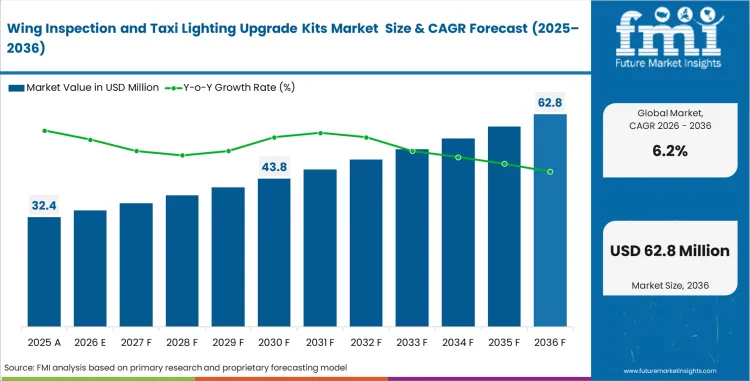
The wing inspection and taxi lighting upgrade kits market recorded a value of USD 30.5 million in 2025 and is projected to rise to USD 32.4 million in 2026. Sector is expected to expand at a 6.2% CAGR from 2026 to 2036, taking total value to USD 59 million by the end of the forecast period. Progress is being supported by a gradual replacement cycle in which airlines, business aircraft operators, and maintenance teams are moving away from older lighting assemblies toward certified LED-based retrofit kits that lower replacement frequency and improve installation efficiency.
Summary of Wing Inspection and Taxi Lighting Upgrade Kits Market
- Wing Inspection and Taxi Lighting Upgrade Kits Market Snapshot
- Wing Inspection and Taxi Lighting Upgrade Kits Market is valued at USD 30.5 million in 2025 and is projected to reach USD 59 million by 2036, based on a retrofit-aftermarket sizing approach built around aircraft fleet and certification proxies.
- Industry outlook points to a 6.2% CAGR from 2026 to 2036, creating an incremental opportunity of USD 26.7 million over the forecast period.
- Scope covers certified retrofit kits for wing inspection, ice inspection, and taxi lights installed on aircraft already in service, rather than full factory-fit exterior lighting suites.
- Airworthiness requirements tied to visibility, icing checks, and low-visibility operation continue supporting this category, while longer-life LED replacements are improving service intervals versus halogen and HID systems.
- Wing Inspection and Taxi Lighting Upgrade Kits Market Demand and Growth Drivers
- A larger active aircraft base is widening the retrofit pool, with the global commercial fleet moving from just over 27,000 aircraft in 2024 toward nearly 50,000 by 2044.
- Business, utility, and special-mission aircraft also support industry valuation, as U.S. turbine-powered general aviation and rotorcraft fleets continue expanding and create a broader replacement base for approved upgrade kits.
- LED conversion is gaining ground because available offerings now extend from PMA wing-inspection lights to aircraft-specific STC taxi and landing-light kits, easing installation fit and reducing repeat maintenance effort.
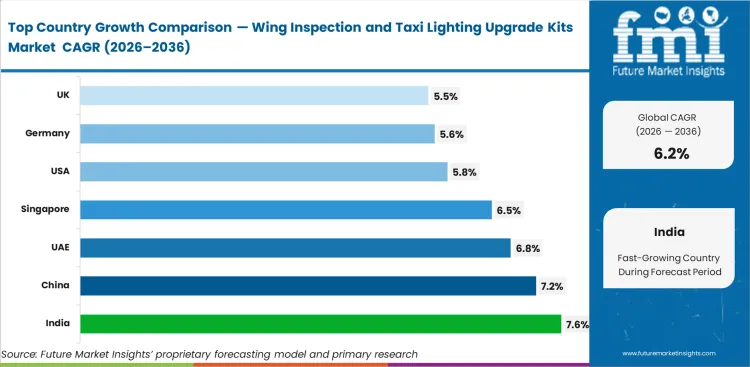
- India is expected to register 7.6% CAGR through 2036, followed by China at 7.2%, the United Arab Emirates at 6.8%, Singapore at 6.5%, the United States at 5.8%, Germany at 5.6%, and the United Kingdom at 5.5%, with faster countries benefiting from wider fleet additions and stronger MRO depth.
- Certification workload, aircraft-specific installation requirements, and the tendency to schedule upgrades during heavy maintenance checks continue keeping this category from moving faster.
- Wing Inspection and Taxi Lighting Upgrade Kits Market Product and Segment View
- Market scope includes LED, HID, and halogen retrofit kits sold as wing-only, taxi-only, combined, or control-kit packages across business jets, commercial aircraft, turboprops, rotorcraft, and special-mission platforms.
- Product use spans night taxi, icing inspection, ground visibility, and special-mission recognition, where approval status, installation ease, and service reliability carry more weight than appearance.
- LED kits are expected to account for 72% share in the Light Source segment, supported by longer service life, lower maintenance burden, and stronger replacement economics.
- Reflecting higher retrofit spend per aircraft and broader use of aircraft-specific approved lighting packages, business jets are projected to hold 34% share in the Aircraft Type segment.
- Combined kits are likely to represent 41% share in the Kit Scope segment, as many operators prefer replacing wing inspection and taxi or landing lights within one planned downtime event.
- Since category scope centers on in-service aircraft upgrades rather than OEM line-fit revenue, aftermarket retrofit is anticipated to contribute 78% share in the Sales Channel segment.
- STC kits are forecast to account for 63% share in the Certification Route segment, because many conversion programs are sold as aircraft-specific approved packages rather than loose generic components.
- Included scope covers kit hardware, mounting provisions, drivers, controllers, and certification-linked installation packages, while airport taxiway guidance lights, full OEM exterior-lighting suites, and non-certified decorative lighting remain outside the category boundary.
- Wing Inspection and Taxi Lighting Upgrade Kits Market Geography and Competitive Outlook
- India, China, and the UAE remain the fastest-advancing countries in this niche, while the United States continues to provide the most stable high-value installed base through its deep turbine, business-aviation, and retrofit ecosystem.
- Supplier positioning depends more on certification depth and aircraft-platform coverage than on price alone, with operators favoring vendors able to support PMA-ready, STC-ready, or OEM-approved replacement assemblies.
- Market concentration remains moderate, as OEM-tier suppliers and specialist retrofit brands continue competing by aircraft application, approval pathway, and channel reach.
Key Takeaways, Market Size, and Forecast
- Wing Inspection and Taxi Lighting Upgrade Kits Market is expected to grow from USD 32.4 million in 2026 to USD 59 million by 2036, at a CAGR of 6.2%.
- The wing inspection and taxi lighting upgrade kits market was valued at USD 30.5 million in 2025.
- By 2036, the Wing Inspection and Taxi Lighting Upgrade Kits Market is anticipated to be worth USD 59 million.
- From 2026 to 2036, the market is likely to expand at a CAGR of 6.2%.
- The market is projected to generate an incremental opportunity of USD 26.7 million through the forecast period.
- In 2026, LED kits are forecast to account for 72% of the light source segment.
- India (7.6% CAGR) and China (7.2% CAGR) are expected to be the fastest growing country markets.
Buyer behavior in this category is also becoming more deliberate. Operators are no longer assessing exterior lighting only through immediate replacement need; they are increasingly weighing the operational cost of keeping legacy taxi and wing inspection lights in service, particularly where repeated bulb changes, avoidable downtime, and added installation effort disrupt tightly managed maintenance schedules. This is pushing the category toward a reliability-led replacement model, where certification pathway, fitment confidence, and service interval carry greater weight than upfront hardware cost alone, much like adjacent aircraft exterior lighting categories.
Adoption tends to accelerate once retrofit activity becomes repeatable rather than one-off. Standardization across aircraft families, better installer familiarity, and easier access to approved parts together reduce internal review effort and improve confidence around scheduling. As more MRO teams align on certified kits across multiple platforms, replacement programs become easier to plan, execution becomes more predictable, and follow-on demand is better supported through established maintenance workflows.
India is projected to record a 7.6% CAGR in the market through 2036, supported by a growing aviation base and rising maintenance capacity. China is expected to expand at a 7.2% CAGR, driven by fleet enlargement and broader retrofit modernization across active aircraft. The United Arab Emirates is likely to register 6.8% CAGR during the forecast period, while Singapore is set to post 6.5%, benefiting from strong MRO concentration and regional service relevance. The United States market is anticipated to grow at a 5.8% CAGR, backed by a mature installed fleet and established retrofit practices. Germany is expected to register 5.6% CAGR, compared with 5.5% for the United Kingdom, reflecting a steadier replacement environment across aviation systems where upgrade cycles are already more developed.
Wing Inspection and Taxi Lighting Upgrade Kits Market Key Takeaways
| Metric | Details |
|---|---|
| Industry Size (2026) | USD 32.4 million |
| Industry Value (2036) | USD 59 million |
| CAGR (2026-2036) | 6.2% |
Source: Future Market Insights (FMI) analysis, based on proprietary forecasting model and primary research
Segmental Analysis
Wing Inspection and Taxi Lighting Upgrade Kits Market Analysis by Light Source
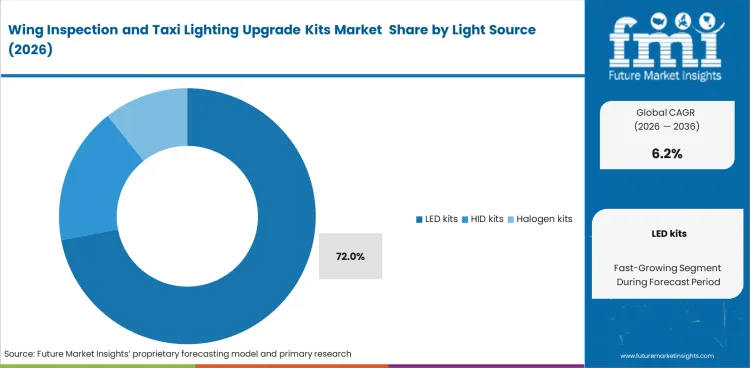
Replacement intervals matter more than component familiarity in this category. Maintenance teams have worked with halogen and HID formats for years, yet repeated service events and shorter operating life keep pushing operators toward alternatives that reduce workshop repetition and improve lighting consistency across aircraft already flying dense schedules. In 2026, LED kits are expected to account for 72% share in the market which comes from a practical operating advantage; one approved kit can lower recurring replacement work while supporting cleaner retrofit planning during scheduled maintenance. Buyers are not choosing LED packages for novelty. They are choosing them because line-maintenance effort, removal frequency, and service burden become easier to manage once the aircraft moves onto a longer-life lighting format. Wrong fitment decisions still create cost drag, especially where operators keep mixed lighting formats across similar aircraft families.
- Service interval advantage: Longer replacement cycles help maintenance teams reduce repeat visits and keep lighting work from returning too quickly into the service queue.
- Power-use discipline: Lower electrical burden and cleaner output improve suitability for operators trying to modernize legacy installations without adding unnecessary complexity.
- Fleet standardization path: Wider LED adoption helps mixed fleets reduce parts variation, making stocking and repeat installation easier during routine checks.
Wing Inspection and Taxi Lighting Upgrade Kits Market Analysis by Aircraft Type
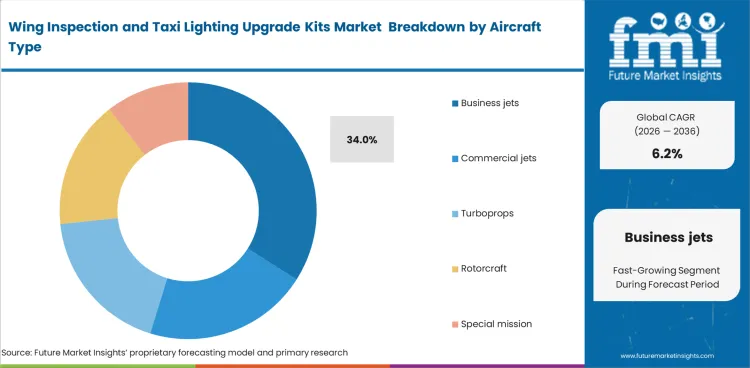
Business jets are anticipated to represent 34% of the market in 2026. Business aircraft owners and service centers tend to approve lighting upgrades faster than larger fleet categories because downtime carries a visible service and usability cost on each airframe. Retrofit activity in this part of aviation also benefits from aircraft-specific kits that make replacement planning more direct for technicians handling premium, tightly scheduled assets. It reflects a buyer base that places strong value on fit, finish, reliability, and reduced repeat intervention during maintenance events. Commercial fleets generate wider unit volume, yet internal review layers, broader fleet diversity, and stricter scheduling coordination often lengthen replacement decisions. Business jet operators usually move sooner when a lighting upgrade offers cleaner installation logic and visible improvement in service continuity.
- Downtime sensitivity: Business aircraft usage patterns make avoidable workshop return less acceptable, lifting interest in longer-life certified replacements.
- Approval readiness: Aircraft-specific kit availability supports faster decision-making where maintenance teams prefer a clear fitment path.
- Service image value: Reliable exterior lighting also matters for operators managing premium aircraft presentation and dispatch confidence.
Wing Inspection and Taxi Lighting Upgrade Kits Market Analysis by Kit Scope
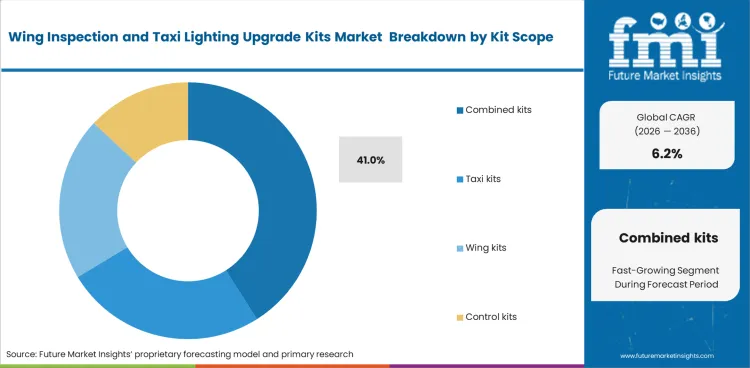
Many operators prefer solving more than one lighting issue during the same aircraft visit. Replacing wing inspection and taxi light hardware together reduces repeated access work, lowers incremental labor, and gives maintenance teams a better chance to leave the aircraft on a more consistent lighting platform. Combined kits are projected to secure 41% share in 2026. Buyers lean toward these packages because one coordinated retrofit event usually creates better workshop efficiency than separate interventions spread across multiple service windows. Standalone taxi or wing packages still hold value where aircraft need targeted correction, though broader kit bundles gain attention when operators want fewer repeat openings, cleaner planning, and a more complete upgrade outcome. Separation between individual kit categories becomes less attractive once downtime cost starts outweighing the appeal of small-step replacement.
- Labor consolidation: Combined packages reduce repeated access work and help technicians complete more lighting tasks during one maintenance event.
- Installation continuity: One retrofit package lowers the chance of leaving the aircraft with mixed upgrade status across related lighting functions.
- Downtime control: Bundled replacement makes scheduling easier where operators are trying to contain aircraft time away from service.
Wing Inspection and Taxi Lighting Upgrade Kits Market Analysis by Sales Channel
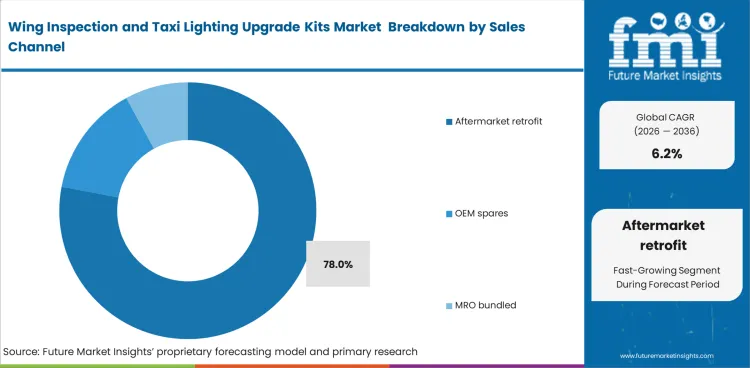
Aftermarket retrofit is forecast to account for 78% share in 2026. In-service aircraft determine how this category behaves. Buyers are not building demand here through new production lines alone; most valuation comes from aircraft already flying and moving through planned checks, corrective maintenance, and retrofit programs. It is a direct result of fleet age, replacement need, and the practical reality that many operators modernize exterior lighting only after entering established maintenance cycles. OEM spare channels remain relevant, and MRO-bundled activity also contributes, though the center of decision-making continues to sit inside the replacement economy. What matters most is not simply part availability. Operators need approved kits, predictable installation work, and supplier support that fits the timing and documentation burden of aircraft already in service.
- Installed-base pull: Active fleets keep the aftermarket channel dominant because replacement logic sits closer to service need than to factory specification.
- Workshop alignment: Retrofit buying often moves through maintenance planning windows where kit availability and documentation support shape supplier choice.
- Lifecycle economics: Buyers evaluate aftermarket packages through repeat service burden, aircraft time on ground, and fitment certainty rather than unit price alone.
Wing Inspection and Taxi Lighting Upgrade Kits Market Analysis by Certification Route
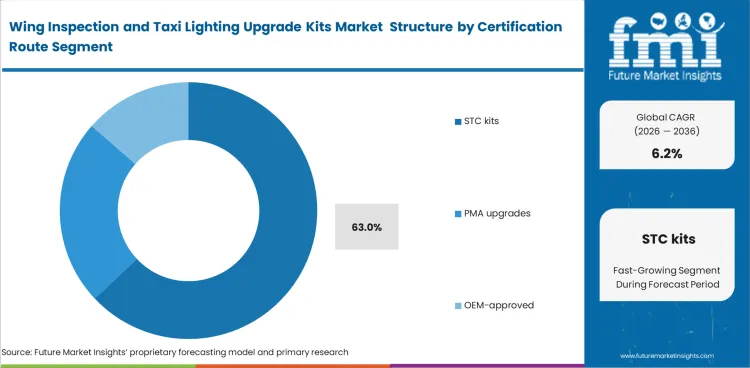
Approval path can decide whether a kit is practical long before hardware quality becomes the main issue. Maintenance teams and engineering groups usually favor routes that reduce fitment doubt and make installation planning more predictable across specific aircraft types. STC kits are likely to secure 63% share in 2026. Aircraft-specific approval gives operators more confidence in retrofit work, especially when a clearer technical and documentation path is needed before replacement moves ahead. PMA upgrades still carry weight in selected applications, and OEM-approved routes remain relevant where legacy support is strong. Even so, wider preference continues leaning toward packages that arrive with a more complete aircraft-level approval basis, since unclear qualification can delay installation decisions and extend time spent on internal review.
- Approval clarity: Aircraft-specific certification routes reduce uncertainty during engineering review and installation planning.
- Fitment confidence: A clearer approval basis improves buyer comfort where mixed fleets create tighter tolerance for mismatch risk.
- Documentation ease: Better-defined kit pathways help maintenance teams handle records, installation traceability, and repeat ordering with fewer questions.
Wing Inspection and Taxi Lighting Upgrade Kits Market Drivers, Restraints, and Opportunities
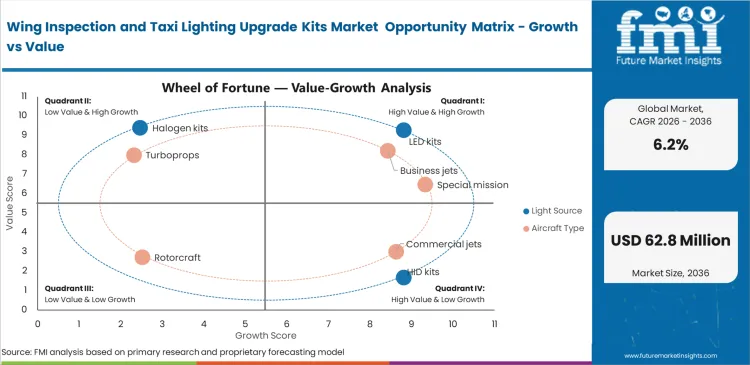
Aircraft operators are putting more attention on lighting reliability because repeated replacement work creates a service burden that looks small per event but becomes expensive across active fleets. Engineering teams are increasingly treating wing inspection and taxi lights as part of maintenance-efficiency planning, especially where older hardware leads to repeat removals, inconsistent output, or added workshop interruptions. Retrofit interest is also rising because approved LED-based kits can fit more naturally into planned maintenance than repeated one-off corrections. Industry outlook therefore keeps ascending as buyers place greater value on fewer interventions, longer service life, and cleaner installation pathways tied to approved aircraft applications.
Internal review still slows wider conversion. Aircraft lighting upgrades may appear straightforward, yet many installations require engineering sign-off, compatibility checks, records handling, and coordination across maintenance and technical teams before replacement moves ahead. That burden becomes more visible in larger fleets and mixed-aircraft operations where standardization is harder to achieve. Partial solutions are available through more familiar kit pathways and repeat installer experience, though approval-related workload continues limiting faster replacement in parts of the sector. Delays rarely come from product visibility alone. They usually come from the time needed to align fitment confidence, documentation, and maintenance scheduling around one approved route.
Opportunities in the Wing Inspection and Taxi Lighting Upgrade Kits Market
- Fleet standardization programs: Operators with mixed lighting formats can improve maintenance consistency by moving more aircraft onto repeatable approved kit selections, especially where replacement intervals vary too widely today.
- Business aviation retrofits: Service centers focused on premium aircraft can capture more value by offering aircraft-specific upgrade packages that combine appearance, reliability, and lower repeat workshop burden in one visit.
- MRO bundling scope: Broader use of retrofit packages alongside adjacent commercial aircraft mro activity can help maintenance providers offer lighting replacement within larger scheduled service events.
Regional Analysis
Based on the regional analysis, the Wing Inspection and Taxi Lighting Upgrade Kits market is segmented into North America, Latin America, Western Europe, Eastern Europe, East Asia, South Asia Pacific, and Middle East & Africa across 40 plus countries.
.webp "Top Country Growth Comparison Wing Inspection And Taxi Lighting Upgrade Kits Market Cagr (2026 2036)")
| Country | CAGR (2026 to 2036) |
|---|---|
| India | 7.6% |
| China | 7.2% |
| United Arab Emirates | 6.8% |
| Singapore | 6.5% |
| United States | 5.8% |
| Germany | 5.6% |
| United Kingdom | 5.5% |
Source: Future Market Insights (FMI) analysis, based on proprietary forecasting model and primary research
North America Wing Inspection and Taxi Lighting Upgrade Kits Market Analysis
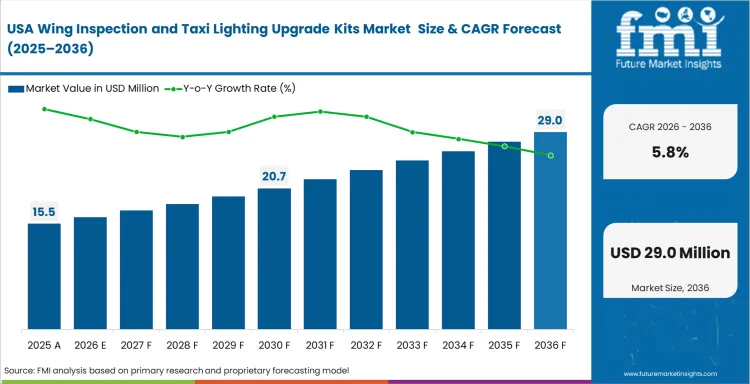
North America remains a mature retrofit base for aircraft lighting, supported by a large installed fleet, established maintenance networks, and broad familiarity with approved replacement pathways. Buyers in this region rarely approach lighting upgrades as first-time adoption decisions. Most evaluations center on whether a certified kit can reduce repeat service work, fit smoothly into planned maintenance, and move through technical review without slowing aircraft release. Regional importance stays intact even though country movement is more measured than in faster-rising aviation markets, because business aviation, rotorcraft, and commercial fleets already create a dependable replacement base. This also aligns with related aircraft refurbishing activity, where operators continue extending asset life through selective modernization rather than broad fleet replacement.
-
United States: A deep installed fleet keeps the United States at the center of this market. Airlines, business aviation operators, and utility-aircraft maintenance teams work within a service environment where approved lighting replacements are easier to source, certify, and install than in smaller aviation systems. What matters here is less early conversion momentum, and more repeat nature of replacement demand across aircraft that remain heavily utilized and tightly scheduled. Industry outlook in the United States points to 5.8% CAGR through 2036. That pace reflects a market built on continuity rather than acceleration, where suppliers benefit from steady workshop demand, broad aircraft coverage, and a buyer base that values fitment certainty and installation discipline over novelty.
FMI's report includes Canada and Mexico. Wider North America benefits from strong service maturity, although regional pacing still varies by fleet mix, workshop density, and how quickly operators move from reactive replacement toward planned retrofit scheduling.
Western Europe Wing Inspection and Taxi Lighting Upgrade Kits Market Analysis
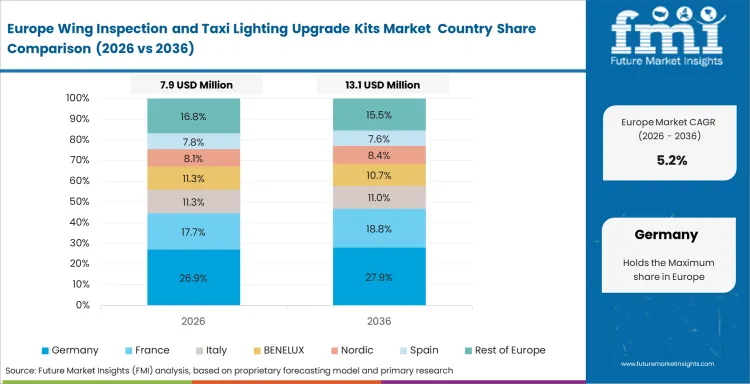
Western Europe presents a more measured retrofit setting, but one with strong technical discipline and high service expectations. Buyers across the region place clear weight on approval clarity, installation fit, and service reliability, which gives certified upgrade packages a durable advantage over loosely defined replacement activity. Slower fleet expansion does not weaken commercial relevance here, because operators continue supporting in-service aircraft through targeted technical upgrades rather than early retirement. Business aviation presence and specialist maintenance capability reinforce that position. Similar logic appears in connected aircraft interior lighting categories, where buyers often judge value through continuity in service support rather than component cost alone.
- Germany: Germany is likely to post 5.6% CAGR in this sector through 2036. That figure points to a steady market rather than a fast-moving one, with buyers continuing to favor approved kits that reduce technical ambiguity. Engineering discipline shapes the German market more than fleet size alone. Maintenance teams and technical reviewers place strong value on products that fit documented service planning, move through internal approval cleanly, and reduce repeated intervention on aircraft already in operation. Suppliers that can support traceable installation, clear documentation, and dependable after-service handling remain better placed here than those competing only on price.
- United Kingdom: Business aviation activity, established service capability, and continued reliance on in-service aircraft support a stable retrofit base in the United Kingdom. Maintenance teams often evaluate lighting upgrades through practical workshop questions like how easily the kit fits, how much review it creates, and whether it improves reliability without extending downtime. The United Kingdom is projected to grow at a 5.5% CAGR through 2036. This reflects a market where demand remains closely linked to recurring service activity and structured replacement planning. Commercial appeal stays firm because buyers continue valuing installation ease and service continuity as much as product performance.
FMI's report includes Benelux and Nordic regions. Service centers in these areas give Western Europe added depth through specialist technical support, parts handling capability, and continued relevance in regional aircraft maintenance.
East Asia Wing Inspection and Taxi Lighting Upgrade Kits Market Analysis
East Asia is advancing in this market as fleet expansion and maintenance capability continue improving across key aviation centers. Retrofit adoption in the region depends on how quickly operators move from corrective replacement toward more planned upgrade activity, especially where aircraft utilization is rising and maintenance windows are under pressure. Aviation scale is part of the story, but technical readiness matters just as much. Workshop development, broader installed aircraft numbers, and increasing familiarity with approved retrofit pathways are lifting the region’s position in aircraft lighting replacement. Related activity in aircraft automated inspection and monitoring also points to wider interest in maintenance efficiency rather than isolated hardware replacement.
- China: China is forecast to register 7.2% CAGR in this market through 2036. Fleet enlargement, stronger maintenance depth, and ongoing modernization across active aircraft continue supporting retrofit demand in China. Buyers are paying closer attention to approved upgrade packages that reduce repeated intervention and fit the needs of larger aircraft populations moving through active service cycles. The speed is also supported by a practical operating need; as fleet scale rises, repeated corrective replacement becomes harder to absorb efficiently. Country direction also points to broader acceptance of better-supported upgrade choices, especially where service reliability and workshop throughput need to improve at the same time.
- Singapore: Singapore plays a different role from larger fleet countries, yet its maintenance concentration gives it influence well beyond domestic aircraft numbers. Technical capability, installer familiarity, and regional servicing reach keep the country visible in aircraft lighting upgrade activity, particularly where retrofit work is linked to aircraft managed across broader aviation networks. Its importance therefore comes from execution strength as much as local replacement volume. Singapore is expected to see a 6.5% CAGR through 2036 in this market. That leaves the country well positioned as a regional installation and support base, where approved retrofit work can move with stronger technical confidence and better turnaround discipline.
FMI's report includes Japan and South Korea. Wider East Asia is benefiting from stronger maintenance capability, although adoption speed still depends on how consistently operators place approved retrofit planning into regular service schedules.
South Asia Pacific Wing Inspection and Taxi Lighting Upgrade Kits Market Analysis
South Asia Pacific carries some of the strongest forward momentum in this study because aviation expansion is widening the installed base for future retrofit activity. Buyers here are doing more than replacing aging lights. Maintenance practices are also becoming more organized, and that will shape how aircraft modernization decisions are handled over the next decade. Regional importance is rising for suppliers trying to establish repeat kit selection before replacement patterns become more settled. Aircraft additions, workshop expansion, and improving technical familiarity are strengthening the case for approved upgrade packages across a larger operating base. This also supports adjacent commercial aircraft mro activity, where service planning and replacement efficiency increasingly move together.
-
India: India is expected to record a 7.6% CAGR through 2036 in the wing inspection and taxi lighting upgrade kits market. Growth is supported by fleet expansion, rising maintenance capacity, and stronger commercial aviation activity. Operators are increasingly evaluating retrofit kits through service continuity, approval clarity, and the burden of repeated replacement rather than through simple component cost. The growth reflects a country moving toward a more organized retrofit environment, where approved upgrade packages can gain wider acceptance across active fleets. Suppliers that establish repeatable fitment support and dependable service response early are likely to find a deeper installed-base opportunity here than in many comparable aviation markets.
FMI's report includes Australia, New Zealand, and ASEAN countries beyond Singapore. Wider South Asia Pacific offers a broad runway for retrofit adoption as maintenance capability, aircraft utilization, and technical familiarity continue rising across multiple aviation bases.
Middle East & Africa Wing Inspection and Taxi Lighting Upgrade Kits Market Analysis
Middle East & Africa remains commercially relevant because service expectations stay high in major aviation hubs even when national fleet profiles differ widely. Retrofit decisions across the region often reflect a practical need to maintain aircraft presentation, dispatch reliability, and service readiness under demanding operating conditions. Hub-based maintenance ecosystems help approved lighting upgrades gain traction faster than in smaller fragmented aviation settings. Buyers generally look for clean installation, dependable technical support, and lower repeat intervention, especially where aircraft utilization leaves limited room for avoidable downtime. Related logic also connects with selected civil helicopter mro activity, where visibility hardware and service reliability continue carrying weight.
-
United Arab Emirates: Hub-led aviation activity and strong maintenance visibility keep the United Arab Emirates in a favorable position for higher-value retrofit work. Operators and technical teams here tend to expect replacement packages that combine reliability, fitment clarity, and minimal workshop interruption, especially where aircraft presentation and dispatch readiness matter alongside service life. Demand analysis for the United Arab Emirates indicates 6.8% CAGR through 2036. Country relevance also extends beyond local fleet activity because its role as an aviation and service center improves supplier visibility across customers looking for repeatable approved upgrade options. That makes the UAE a key reference point for premium retrofit execution within the wider region.
FMI's report includes Saudi Arabia, South Africa, and other Gulf and African aviation markets. Broader regional opportunity will depend on how far service ecosystems deepen and how widely approved retrofit activity extends beyond major hub-centered maintenance networks.
Competitive Aligners for Market Players
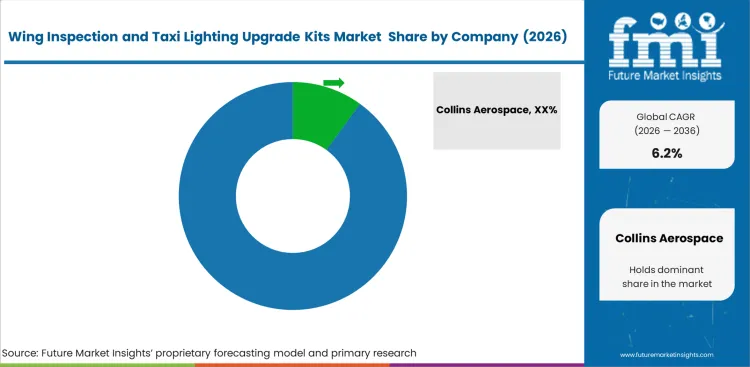
Buyer preference in this market is shaped more by approval certainty, installation fit, and service reliability than by brand presence alone. Collins Aerospace, Astronics, AeroLEDs, Whelen Aerospace Technologies, Oxley Group, Aveo Engineering, and Precise Flight remain relevant because engineering teams and maintenance functions usually assess suppliers through documentation quality, aircraft applicability, after-sales support, and consistency in repeat replacement programs. Price still influences selection, but it rarely closes the decision on its own when unclear fitment or added review could extend aircraft downtime. Suppliers with stronger acceptance are usually those that make replacement easier to validate, easier to install, and easier to repeat across active fleet programs.
Established suppliers benefit from broad aircraft familiarity, recognized support channels, and the ability to address more than one lighting requirement within adjacent retrofit activity. Smaller or narrower brands can still secure a position when they offer aircraft-specific fit, dependable technical support, and a cleaner approval path for operators that do not want installation work tied up in prolonged review. Hardware quality alone does not determine competitive standing. Installed-base familiarity, confidence during technical evaluation, and alignment with wider global air transport mro activity also influence supplier preference because buyers often favor vendors that sit comfortably within existing maintenance planning.
Large operators and established service providers retain bargaining strength because approved alternatives can be compared in advance and timed around scheduled maintenance rather than urgent part failure. Competitive concentration is therefore unlikely to tighten sharply by 2036. Industry direction points to a moderately fragmented field in which established names retain an edge through approved fitment and service confidence, while specialist retrofit brands continue finding room where aircraft-specific kit quality and workshop simplicity matter more than broad portfolio breadth.
Key Players in Wing Inspection and Taxi Lighting Upgrade Kits Market
- Collins Aerospace
- Astronics
- AeroLEDs
- Whelen Aerospace Technologies
- Oxley Group
- Aveo Engineering
- Precise Flight
Scope of the Report
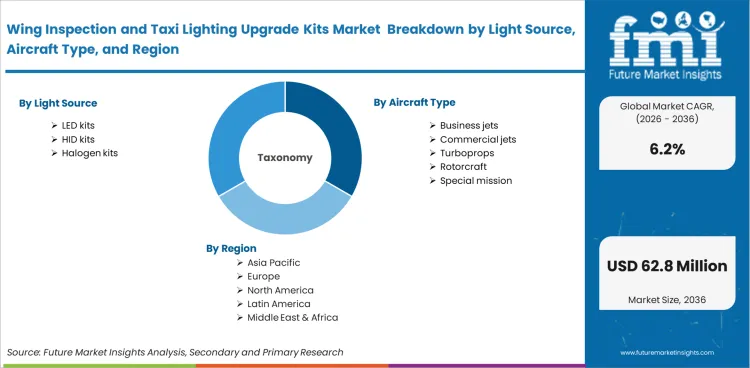
| Metric | Value |
|---|---|
| Quantitative Units | USD 32.4 million to USD 59 million, at a 6.2% CAGR |
| Market Definition | Wing inspection and taxi lighting upgrade kits cover certified retrofit and replacement packages used on aircraft already in service. Scope includes wing inspection or ice inspection lights, taxi light upgrades, related control hardware, and aircraft-specific approval routes linked to installation. Full OEM-fit exterior lighting systems and airport-side lighting assets are excluded. |
| Light Source Segmentation | LED kits, HID kits, halogen kits |
| Aircraft Type Segmentation | Business jets, commercial jets, turboprops, rotorcraft, special mission |
| Kit Scope Segmentation | Combined kits, taxi kits, wing kits, control kits |
| Sales Channel Segmentation | Aftermarket retrofit, OEM spares, MRO bundled |
| Certification Route Segmentation | STC kits, PMA upgrades, OEM-approved |
| Regions Covered | North America, Latin America, Western Europe, Eastern Europe, East Asia, South Asia Pacific, Middle East & Africa |
| Countries Covered | India, China, United Arab Emirates, Singapore, United States, Germany, United Kingdom, and 40 plus countries |
| Key Companies Profiled | Collins Aerospace, Astronics, AeroLEDs, Whelen Aerospace Technologies, Oxley Group, Aveo Engineering, Precise Flight |
| Forecast Period | 2026 to 2036 |
| Approach | FMI combines primary interviews with airline engineering heads, maintenance managers, installers, and aftermarket distributors. Baseline valuation is built from active aircraft retrofit potential, replacement timing, and weighted kit values by aircraft category. Forecasts are checked against fleet direction, workshop workload, and recurring replacement logic across in-service aircraft. |
Source: Future Market Insights (FMI) analysis, based on proprietary forecasting model and primary research
Wing Inspection and Taxi Lighting Upgrade Kits Market Analysis by Segments
Light Source:
- LED kits
- HID kits
- Halogen kits
Aircraft Type:
- Business jets
- Commercial jets
- Turboprops
- Rotorcraft
- Special mission
Kit Scope:
- Combined kits
- Taxi kits
- Wing kits
- Control kits
Sales Channel:
- Aftermarket retrofit
- OEM spares
- MRO bundled
Certification Route:
- STC kits
- PMA upgrades
- OEM-approved
Region:
- North America
- United States
- Western Europe
- Germany
- United Kingdom
- East Asia
- China
- Singapore
- South Asia Pacific
- India
- Middle East & Africa
- United Arab Emirates
Bibliography
- Boeing. (2025, June). Commercial Services Market Outlook 2025-2044. Boeing.
- Federal Aviation Administration. (2024, February). FAA Aerospace Forecast Fiscal Years 2025-2045. FAA.
- International Civil Aviation Organization. (2025, January). Annual Report 2024: The World of Air Transport in 2024. ICAO.
- Air Transport Action Group. (2024, September). Facts & Figures. ATAG.
- General Aviation Manufacturers Association. (2025, February). 2024 Annual Data. GAMA.
This bibliography is provided for reader reference. The full FMI report contains the complete reference list with primary source documentation.
This Report Addresses
- Market intelligence to support strategic decision making across wing inspection lights, taxi light upgrade kits, combined retrofit kits, and aircraft-specific approval-linked lighting packages
- Market size estimation and 10-year revenue forecasts from 2026 to 2036, supported by active aircraft retrofit potential, replacement timing, and weighted kit valuation analysis
- Growth opportunity mapping across light source, aircraft type, kit scope, sales channel, and certification route with emphasis on repeatable approved retrofit adoption
- Segment and regional revenue forecasts covering LED kits, business jets, combined kits, aftermarket retrofit, and STC kits across active aircraft maintenance environments
- Competition assessment including approval confidence, installation ease, aircraft applicability, support quality, and repeat ordering suitability
- Retrofit-kit development tracking including LED conversion, approval pathways, maintenance-cycle fit, combined replacement packages, and in-service aircraft modernization logic
- Market access analysis covering aftermarket retrofit channels, OEM-approved pathways, PMA upgrades, STC kit relevance, and workshop adoption conditions
- Market report delivery in PDF, Excel, PPT, and interactive dashboard formats for executive strategy, fleet planning, and operational benchmarking use
Frequently Asked Questions
How large is the Wing Inspection and Taxi Lighting Upgrade Kits Market in 2026?
Industry valuation is expected to reach USD 32.4 million in 2026, reflecting a niche retrofit category for in-service aircraft.
What will the market be valued at by 2036?
FMI estimates the category will reach USD 59 million by 2036 as approved retrofit adoption continues across fleets.
What CAGR is projected for the market?
FMI projects a 6.2% CAGR from 2026 to 2036, supported by replacement-cycle improvement and retrofit planning.
Which Light Source segment leads the market?
FMI projects a 6.2% CAGR from 2026 to 2036, supported by replacement-cycle improvement and retrofit planning.
Which Light Source segment leads the market?
LED kits lead the category and are expected to account for 72% share in 2026.
Which Aircraft Type segment leads the market?
Business jets lead this segment, with 34% share expected in 2026 due to higher retrofit attention per aircraft.
Which Kit Scope segment leads the market?
Combined kits lead Kit Scope, with 41% share expected in 2026 because operators prefer one planned replacement event.
What is pushing industry outlook higher in this market?
Longer service life, fewer repeat replacements, and cleaner approved installation pathways are lifting industry outlook.
What is the primary restraint in this market?
Internal technical review, fitment checks, and approval-related documentation continue slowing broader retrofit conversion across fleets.
Which country is advancing the fastest in this market?
India leads the country ranking, with the sector expected to expand at 7.6% CAGR through 2036.
Why do approval pathways matter so much in this category?
Approval clarity reduces installation doubt, shortens internal review, and improves confidence in aircraft-specific retrofit decisions.
Why are LED kits preferred over older lighting formats?
LED kits reduce replacement frequency, improve service consistency, and fit better into scheduled maintenance planning.
How does competition work in this market?
Suppliers compete on approval confidence, aircraft applicability, installation ease, and support quality rather than visibility alone.
Why does the aftermarket channel dominate this category?
Most valuation comes from aircraft already in service, making retrofit and replacement channels more relevant than factory installation.
Why are STC kits leading by certification route?
STC kits offer aircraft-specific approval confidence, helping engineering teams handle fitment and installation with fewer uncertainties.
How are business jets supporting category expansion?
Business jet operators value reliability, appearance, and lower workshop repetition, making approved upgrades easier to justify.
Why are combined kits drawing more attention than single-function replacements?
One coordinated retrofit event reduces repeated access work, labor duplication, and aircraft downtime across related lighting functions.
Why is the United States still important in this market?
Its large installed fleet, mature maintenance base, and retrofit familiarity keep the United States commercially important.
What makes China one of the stronger national markets?
Fleet expansion and rising maintenance capability are improving retrofit opportunity and approved upgrade adoption across active aircraft.
What is included in this market and what is excluded?
Included scope covers certified retrofit kits; excluded scope covers airport lighting systems and full OEM-fit exterior suites.
How does FMI build this market estimate?
FMI uses retrofit potential, replacement timing, weighted kit values, and primary interviews across aviation maintenance channels.
Preview the report firsthand - request a free sample
Get SampleGet the brochure for pricing and purchase details.
Get PDFTable of Content
- Executive Summary
- Global Market Outlook
- Demand-side Trends
- Supply-side Trends
- Technology Roadmap Analysis
- Analysis and Recommendations
- Market Overview
- Market Coverage / Taxonomy
- Market Definition / Scope / Limitations
- Research Methodology
- Chapter Orientation
- Analytical Lens and Working Hypotheses
- Market Structure, Signals, and Trend Drivers
- Benchmarking and Cross-market Comparability
- Market Sizing, Forecasting, and Opportunity Mapping
- Research Design and Evidence Framework
- Desk Research Programme (Secondary Evidence)
- Company Annual and Sustainability Reports
- Peer-reviewed Journals and Academic Literature
- Corporate Websites, Product Literature, and Technical Notes
- Earnings Decks and Investor Briefings
- Statutory Filings and Regulatory Disclosures
- Technical White Papers and Standards Notes
- Trade Journals, Industry Magazines, and Analyst Briefs
- Conference Proceedings, Webinars, and Seminar Materials
- Government Statistics Portals and Public Data Releases
- Press Releases and Reputable Media Coverage
- Specialist Newsletters and Curated Briefings
- Sector Databases and Reference Repositories
- FMI Internal Proprietary Databases and Historical Market Datasets
- Subscription Datasets and Paid Sources
- Social Channels, Communities, and Digital Listening Inputs
- Additional Desk Sources
- Expert Input and Fieldwork (Primary Evidence)
- Primary Modes
- Qualitative Interviews and Expert Elicitation
- Quantitative Surveys and Structured Data Capture
- Blended Approach
- Why Primary Evidence is Used
- Field Techniques
- Interviews
- Surveys
- Focus Groups
- Observational and In-context Research
- Social and Community Interactions
- Stakeholder Universe Engaged
- C-suite Leaders
- Board Members
- Presidents and Vice Presidents
- R&D and Innovation Heads
- Technical Specialists
- Domain Subject-matter Experts
- Scientists
- Physicians and Other Healthcare Professionals
- Governance, Ethics, and Data Stewardship
- Research Ethics
- Data Integrity and Handling
- Primary Modes
- Tooling, Models, and Reference Databases
- Desk Research Programme (Secondary Evidence)
- Data Engineering and Model Build
- Data Acquisition and Ingestion
- Cleaning, Normalisation, and Verification
- Synthesis, Triangulation, and Analysis
- Quality Assurance and Audit Trail
- Market Background
- Market Dynamics
- Drivers
- Restraints
- Opportunity
- Trends
- Scenario Forecast
- Demand in Optimistic Scenario
- Demand in Likely Scenario
- Demand in Conservative Scenario
- Opportunity Map Analysis
- Product Life Cycle Analysis
- Supply Chain Analysis
- Investment Feasibility Matrix
- Value Chain Analysis
- PESTLE and Porter’s Analysis
- Regulatory Landscape
- Regional Parent Market Outlook
- Production and Consumption Statistics
- Import and Export Statistics
- Market Dynamics
- Global Market Analysis 2021 to 2025 and Forecast, 2026 to 2036
- Historical Market Size Value (USD Million) Analysis, 2021 to 2025
- Current and Future Market Size Value (USD Million) Projections, 2026 to 2036
- Y-o-Y Growth Trend Analysis
- Absolute $ Opportunity Analysis
- Global Market Pricing Analysis 2021 to 2025 and Forecast 2026 to 2036
- Global Market Analysis 2021 to 2025 and Forecast 2026 to 2036, By Light Source
- Introduction / Key Findings
- Historical Market Size Value (USD Million) Analysis By Light Source , 2021 to 2025
- Current and Future Market Size Value (USD Million) Analysis and Forecast By Light Source , 2026 to 2036
- LED kits
- HID kits
- Halogen kits
- LED kits
- Y-o-Y Growth Trend Analysis By Light Source , 2021 to 2025
- Absolute $ Opportunity Analysis By Light Source , 2026 to 2036
- Global Market Analysis 2021 to 2025 and Forecast 2026 to 2036, By Aircraft Type
- Introduction / Key Findings
- Historical Market Size Value (USD Million) Analysis By Aircraft Type, 2021 to 2025
- Current and Future Market Size Value (USD Million) Analysis and Forecast By Aircraft Type, 2026 to 2036
- Business jets
- Commercial jets
- Turboprops
- Rotorcraft
- Special mission
- Business jets
- Y-o-Y Growth Trend Analysis By Aircraft Type, 2021 to 2025
- Absolute $ Opportunity Analysis By Aircraft Type, 2026 to 2036
- Global Market Analysis 2021 to 2025 and Forecast 2026 to 2036, By Kit Scope
- Introduction / Key Findings
- Historical Market Size Value (USD Million) Analysis By Kit Scope, 2021 to 2025
- Current and Future Market Size Value (USD Million) Analysis and Forecast By Kit Scope, 2026 to 2036
- Combined kits
- Taxi kits
- Wing kits
- Control kits
- Combined kits
- Y-o-Y Growth Trend Analysis By Kit Scope, 2021 to 2025
- Absolute $ Opportunity Analysis By Kit Scope, 2026 to 2036
- Global Market Analysis 2021 to 2025 and Forecast 2026 to 2036, By Sales Channel
- Introduction / Key Findings
- Historical Market Size Value (USD Million) Analysis By Sales Channel, 2021 to 2025
- Current and Future Market Size Value (USD Million) Analysis and Forecast By Sales Channel, 2026 to 2036
- Aftermarket retrofit
- OEM spares
- MRO bundled
- Aftermarket retrofit
- Y-o-Y Growth Trend Analysis By Sales Channel, 2021 to 2025
- Absolute $ Opportunity Analysis By Sales Channel, 2026 to 2036
- Global Market Analysis 2021 to 2025 and Forecast 2026 to 2036, By Certification Route
- Introduction / Key Findings
- Historical Market Size Value (USD Million) Analysis By Certification Route, 2021 to 2025
- Current and Future Market Size Value (USD Million) Analysis and Forecast By Certification Route, 2026 to 2036
- STC kits
- PMA upgrades
- OEM-approved
- STC kits
- Y-o-Y Growth Trend Analysis By Certification Route, 2021 to 2025
- Absolute $ Opportunity Analysis By Certification Route, 2026 to 2036
- Global Market Analysis 2021 to 2025 and Forecast 2026 to 2036, By Region
- Introduction
- Historical Market Size Value (USD Million) Analysis By Region, 2021 to 2025
- Current Market Size Value (USD Million) Analysis and Forecast By Region, 2026 to 2036
- North America
- Latin America
- Western Europe
- Eastern Europe
- East Asia
- South Asia and Pacific
- Middle East & Africa
- Market Attractiveness Analysis By Region
- North America Market Analysis 2021 to 2025 and Forecast 2026 to 2036, By Country
- Historical Market Size Value (USD Million) Trend Analysis By Market Taxonomy, 2021 to 2025
- Market Size Value (USD Million) Forecast By Market Taxonomy, 2026 to 2036
- By Country
- USA
- Canada
- Mexico
- By Light Source
- By Aircraft Type
- By Kit Scope
- By Sales Channel
- By Certification Route
- By Country
- Market Attractiveness Analysis
- By Country
- By Light Source
- By Aircraft Type
- By Kit Scope
- By Sales Channel
- By Certification Route
- Key Takeaways
- Latin America Market Analysis 2021 to 2025 and Forecast 2026 to 2036, By Country
- Historical Market Size Value (USD Million) Trend Analysis By Market Taxonomy, 2021 to 2025
- Market Size Value (USD Million) Forecast By Market Taxonomy, 2026 to 2036
- By Country
- Brazil
- Chile
- Rest of Latin America
- By Light Source
- By Aircraft Type
- By Kit Scope
- By Sales Channel
- By Certification Route
- By Country
- Market Attractiveness Analysis
- By Country
- By Light Source
- By Aircraft Type
- By Kit Scope
- By Sales Channel
- By Certification Route
- Key Takeaways
- Western Europe Market Analysis 2021 to 2025 and Forecast 2026 to 2036, By Country
- Historical Market Size Value (USD Million) Trend Analysis By Market Taxonomy, 2021 to 2025
- Market Size Value (USD Million) Forecast By Market Taxonomy, 2026 to 2036
- By Country
- Germany
- UK
- Italy
- Spain
- France
- Nordic
- BENELUX
- Rest of Western Europe
- By Light Source
- By Aircraft Type
- By Kit Scope
- By Sales Channel
- By Certification Route
- By Country
- Market Attractiveness Analysis
- By Country
- By Light Source
- By Aircraft Type
- By Kit Scope
- By Sales Channel
- By Certification Route
- Key Takeaways
- Eastern Europe Market Analysis 2021 to 2025 and Forecast 2026 to 2036, By Country
- Historical Market Size Value (USD Million) Trend Analysis By Market Taxonomy, 2021 to 2025
- Market Size Value (USD Million) Forecast By Market Taxonomy, 2026 to 2036
- By Country
- Russia
- Poland
- Hungary
- Balkan & Baltic
- Rest of Eastern Europe
- By Light Source
- By Aircraft Type
- By Kit Scope
- By Sales Channel
- By Certification Route
- By Country
- Market Attractiveness Analysis
- By Country
- By Light Source
- By Aircraft Type
- By Kit Scope
- By Sales Channel
- By Certification Route
- Key Takeaways
- East Asia Market Analysis 2021 to 2025 and Forecast 2026 to 2036, By Country
- Historical Market Size Value (USD Million) Trend Analysis By Market Taxonomy, 2021 to 2025
- Market Size Value (USD Million) Forecast By Market Taxonomy, 2026 to 2036
- By Country
- China
- Japan
- South Korea
- By Light Source
- By Aircraft Type
- By Kit Scope
- By Sales Channel
- By Certification Route
- By Country
- Market Attractiveness Analysis
- By Country
- By Light Source
- By Aircraft Type
- By Kit Scope
- By Sales Channel
- By Certification Route
- Key Takeaways
- South Asia and Pacific Market Analysis 2021 to 2025 and Forecast 2026 to 2036, By Country
- Historical Market Size Value (USD Million) Trend Analysis By Market Taxonomy, 2021 to 2025
- Market Size Value (USD Million) Forecast By Market Taxonomy, 2026 to 2036
- By Country
- India
- ASEAN
- Australia & New Zealand
- Rest of South Asia and Pacific
- By Light Source
- By Aircraft Type
- By Kit Scope
- By Sales Channel
- By Certification Route
- By Country
- Market Attractiveness Analysis
- By Country
- By Light Source
- By Aircraft Type
- By Kit Scope
- By Sales Channel
- By Certification Route
- Key Takeaways
- Middle East & Africa Market Analysis 2021 to 2025 and Forecast 2026 to 2036, By Country
- Historical Market Size Value (USD Million) Trend Analysis By Market Taxonomy, 2021 to 2025
- Market Size Value (USD Million) Forecast By Market Taxonomy, 2026 to 2036
- By Country
- Kingdom of Saudi Arabia
- Other GCC Countries
- Turkiye
- South Africa
- Other African Union
- Rest of Middle East & Africa
- By Light Source
- By Aircraft Type
- By Kit Scope
- By Sales Channel
- By Certification Route
- By Country
- Market Attractiveness Analysis
- By Country
- By Light Source
- By Aircraft Type
- By Kit Scope
- By Sales Channel
- By Certification Route
- Key Takeaways
- Key Countries Market Analysis
- USA
- Pricing Analysis
- Market Share Analysis, 2025
- By Light Source
- By Aircraft Type
- By Kit Scope
- By Sales Channel
- By Certification Route
- Canada
- Pricing Analysis
- Market Share Analysis, 2025
- By Light Source
- By Aircraft Type
- By Kit Scope
- By Sales Channel
- By Certification Route
- Mexico
- Pricing Analysis
- Market Share Analysis, 2025
- By Light Source
- By Aircraft Type
- By Kit Scope
- By Sales Channel
- By Certification Route
- Brazil
- Pricing Analysis
- Market Share Analysis, 2025
- By Light Source
- By Aircraft Type
- By Kit Scope
- By Sales Channel
- By Certification Route
- Chile
- Pricing Analysis
- Market Share Analysis, 2025
- By Light Source
- By Aircraft Type
- By Kit Scope
- By Sales Channel
- By Certification Route
- Germany
- Pricing Analysis
- Market Share Analysis, 2025
- By Light Source
- By Aircraft Type
- By Kit Scope
- By Sales Channel
- By Certification Route
- UK
- Pricing Analysis
- Market Share Analysis, 2025
- By Light Source
- By Aircraft Type
- By Kit Scope
- By Sales Channel
- By Certification Route
- Italy
- Pricing Analysis
- Market Share Analysis, 2025
- By Light Source
- By Aircraft Type
- By Kit Scope
- By Sales Channel
- By Certification Route
- Spain
- Pricing Analysis
- Market Share Analysis, 2025
- By Light Source
- By Aircraft Type
- By Kit Scope
- By Sales Channel
- By Certification Route
- France
- Pricing Analysis
- Market Share Analysis, 2025
- By Light Source
- By Aircraft Type
- By Kit Scope
- By Sales Channel
- By Certification Route
- India
- Pricing Analysis
- Market Share Analysis, 2025
- By Light Source
- By Aircraft Type
- By Kit Scope
- By Sales Channel
- By Certification Route
- ASEAN
- Pricing Analysis
- Market Share Analysis, 2025
- By Light Source
- By Aircraft Type
- By Kit Scope
- By Sales Channel
- By Certification Route
- Australia & New Zealand
- Pricing Analysis
- Market Share Analysis, 2025
- By Light Source
- By Aircraft Type
- By Kit Scope
- By Sales Channel
- By Certification Route
- China
- Pricing Analysis
- Market Share Analysis, 2025
- By Light Source
- By Aircraft Type
- By Kit Scope
- By Sales Channel
- By Certification Route
- Japan
- Pricing Analysis
- Market Share Analysis, 2025
- By Light Source
- By Aircraft Type
- By Kit Scope
- By Sales Channel
- By Certification Route
- South Korea
- Pricing Analysis
- Market Share Analysis, 2025
- By Light Source
- By Aircraft Type
- By Kit Scope
- By Sales Channel
- By Certification Route
- Russia
- Pricing Analysis
- Market Share Analysis, 2025
- By Light Source
- By Aircraft Type
- By Kit Scope
- By Sales Channel
- By Certification Route
- Poland
- Pricing Analysis
- Market Share Analysis, 2025
- By Light Source
- By Aircraft Type
- By Kit Scope
- By Sales Channel
- By Certification Route
- Hungary
- Pricing Analysis
- Market Share Analysis, 2025
- By Light Source
- By Aircraft Type
- By Kit Scope
- By Sales Channel
- By Certification Route
- Kingdom of Saudi Arabia
- Pricing Analysis
- Market Share Analysis, 2025
- By Light Source
- By Aircraft Type
- By Kit Scope
- By Sales Channel
- By Certification Route
- Turkiye
- Pricing Analysis
- Market Share Analysis, 2025
- By Light Source
- By Aircraft Type
- By Kit Scope
- By Sales Channel
- By Certification Route
- South Africa
- Pricing Analysis
- Market Share Analysis, 2025
- By Light Source
- By Aircraft Type
- By Kit Scope
- By Sales Channel
- By Certification Route
- USA
- Market Structure Analysis
- Competition Dashboard
- Competition Benchmarking
- Market Share Analysis of Top Players
- By Regional
- By Light Source
- By Aircraft Type
- By Kit Scope
- By Sales Channel
- By Certification Route
- Competition Analysis
- Competition Deep Dive
- Collins Aerospace
- Overview
- Product Portfolio
- Profitability by Market Segments (Product/Age /Sales Channel/Region)
- Sales Footprint
- Strategy Overview
- Marketing Strategy
- Product Strategy
- Channel Strategy
- Astronics
- AeroLEDs
- Whelen Aerospace Technologies
- Oxley Group
- Aveo Engineering
- Precise Flight
- Collins Aerospace
- Competition Deep Dive
- Assumptions & Acronyms Used


