

- Industry Size (2026)
- USD 27.4 Mn
- Forecast (2036)
- USD 63.7 Mn
- CAGR (2026 to 2036)
- 8.8%
Aircraft Over-Wing Exit Aerodynamic Enhancement Kits Market Size, Market Forecast and Outlook By FMI
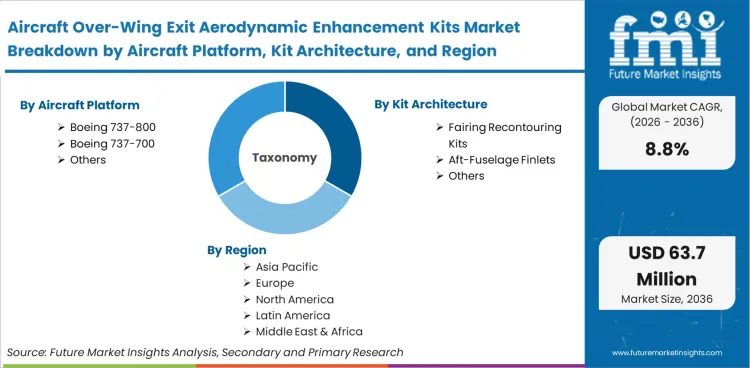
The aircraft over-wing exit aerodynamic enhancement kits market size crossed USD 25.2 million in 2025 with a short-term adoption trajectory positioning the industry to surpass USD 27.4 million in 2026, establishing a baseline that supports an overwing exit retrofit kits CAGR of 8.8% over the next decade. An unwavering financial pipeline drives the market growth to USD 63.7 million through 2036 as severe fuel burn reduction mandates compel legacy narrowbody operators to physically optimize existing airframes rather than passively wait out prolonged new-delivery backlogs.
Fleet managers are moving from passive acceptance of OEM aerodynamic profiles to active third-party intervention. This shift forces technical operations directors to evaluate aircraft fairings not merely as structural covers, but as highly active variables within the aircraft exit fairing retrofit market. Operators who bypass aftermarket aerodynamic tuning forfeit immediate fuel savings, structurally handicapping their unit costs against optimized competitors on identically operated routes. The measurement of success extends beyond gross fuel burn, isolating the specific drag penalty eliminated at the critical mid-fuselage junction where airflow detachment historically degrades performance.
Summary of Aircraft Over-Wing Exit Aerodynamic Enhancement Kits Market
- Aircraft Over-Wing Exit Aerodynamic Enhancement Kits Market Definition
- This category covers aftermarket structural modifications installed around narrowbody emergency exits to eliminate airflow separation. It is structurally defined by the application of third-party engineering to reclaim aerodynamic penalties inherent in legacy OEM fuselage designs.
- Demand Drivers in the Market
- Prolonged new-aircraft delivery delays force fleet planning VPs to wring margin out of aging legacy airframes, accelerating the 737NG aerodynamic enhancement retrofit market.
- Rising jet fuel baseline costs compel route profitability analysts to mandate micro-efficiency upgrades previously dismissed as immaterial.
- Aggressive sustainability reporting requirements push airline chief sustainability officers to document specific airline fuel burn reduction retrofit around overwing exits.
- Key Segments Analyzed in the FMI Report
- Boeing 737-800: 62% share in 2026, driven by the massive global installed base and the specific, well-documented drag penalty of its factory over-wing configuration.
- Fairing Recontouring Kits: 48% share in 2026, due to their straightforward certification pathway compared to active flow control systems.
- Third-Party MRO / Retrofit Specialist: 44% share, as specialized facilities absorb the complex installation risks airlines prefer not to handle internally.
- Türkiye: 10.4% CAGR, reflecting rapid capacity expansion by carriers operating high-utilization narrowbody models on transcontinental corridors.
- Analyst Opinion at FMI
- Nikhil Kaitwade, Principal Analyst, Automotive and Industrial, at FMI, opines, "The generalist assumption is that operators only buy aerodynamic kits when fuel prices spike. However, the actual trigger in the current environment is lease extension. When a carrier is forced to extend a 737-800 lease for another five years because they cannot get a MAX delivery, the economics of a localized aerodynamic retrofit suddenly clear the internal hurdle rate. The kit pays for the maintenance downtime."
- Strategic Implications / Executive Takeaways
- MRO facility managers must secure specialized composite technicians to compress overnight installation timelines to prevent costly aircraft groundings.
- STC package developers should validate designs with both FAA and EASA simultaneously to avoid locking out critical transatlantic lease transferability.
- Fleet transition planners face a hard choice between investing capital in 15-year-old airframes or absorbing structurally higher route costs until next-generation deliveries arrive.
- Methodology
- Primary Research: Technical operations directors, airline fleet planning VPs, and regulatory compliance managers.
- Desk Research: STC registries, operator maintenance schedules, and public fleet transition announcements.
- Market-Sizing and Forecasting: Anchored to active global installed base of legacy narrowbody platforms and lease terms.
- Data Validation and Update Cycle: Cross-validated against composite supply volumes and independent MRO capacity.
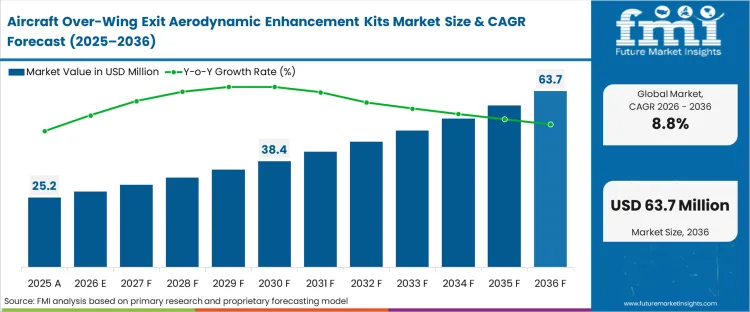
The adoption curve accelerates when kit installation aligns exactly with existing heavy-check intervals, negating the need for separate overnight aircraft drag reduction kit installation. Once engineering teams package aerodynamic enhancements directly into scheduled overnight line maintenance, the friction of taking an aircraft out of revenue service disappears. At that operational threshold, retrofitting shifts from a specialized capital project requiring explicit board approval to a standard element of fleet harmonization.
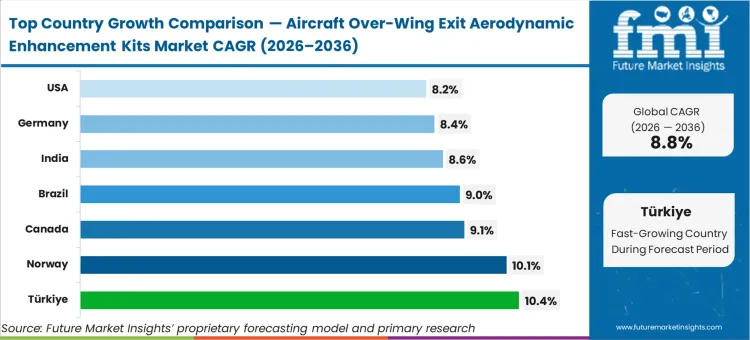
Türkiye is expected to expand at 10.4%, driven by network expansion across fuel-sensitive routes linking Europe and Asia. Norway is poised to track at 10.1%, while Canada is anticipated to register a 9.1% CAGR. Brazil is likely to advance at 9.0%, followed closely by India at 8.6%. Germany is set to post an 8.4% growth rate, while the United States will garner an 8.2% rate. The structural divergence across these territories reflects differing fleet maturity profiles and the local intensity of low-cost carrier margin competition.
Aircraft Over-Wing Exit Aerodynamic Enhancement Kits Market Definition
To explain the aircraft over-wing exit aerodynamic enhancement kits market in simple terms, this category covers engineered aftermarket modifications installed at the fuselage-wing root intersection of commercial narrowbody aircraft. These systems specifically target parasite drag and airflow separation caused by structural mandates for emergency egress routes. The boundary is functional: it includes components designed exclusively to reclaim aerodynamic efficiency lost to the mandated exit geometry, distinguishing it from general aesthetic or structural replacements.
Aircraft Over-Wing Exit Aerodynamic Enhancement Kits Market Inclusions
The scope encompasses recontoured escape hatch fairings, localized vortex-generator arrays mounted adjacent to the exit framing, and aft-fuselage finlets that reattach airflow disturbed by the over-wing gap. These components operate under the same aerodynamic principles as winglets, focusing strictly on mid-fuselage boundary layer management.
Aircraft Over-Wing Exit Aerodynamic Enhancement Kits Market Exclusions
The analysis explicitly excludes cabin-interior emergency exit hardware, exit door seals, inflatable evacuation slides, and general fuselage skin panels. It also omits factory-installed aerodynamic profiles delivered natively by original equipment manufacturers. These exclusions exist because OEM-delivered profiles represent baseline aircraft capability rather than aftermarket efficiency upgrades, while interior egress hardware serves safety mandates rather than aerodynamic performance recovery.
Aircraft Over-Wing Exit Aerodynamic Enhancement Kits Market Research Methodology
- Primary Research: Technical operations directors, airline fleet planning VPs, and regulatory compliance managers at third-party MRO facilities.
- Desk Research: Supplemental Type Certificate (STC) registries from the FAA and EASA, operator maintenance schedules, and public fleet transition announcements from network carriers.
- Market-Sizing and Forecasting: The baseline anchors to the active global installed base of specific legacy narrowbody platforms, filtered by average airframe age and outstanding operational lease terms.
- Data Validation and Update Cycle: Forecasts are cross-validated against composite material supply chain volumes and independent MRO shop-visit capacity constraint data.
Segmental Analysis
Aircraft Over-Wing Exit Aerodynamic Enhancement Kits Market Analysis by Aircraft Platform
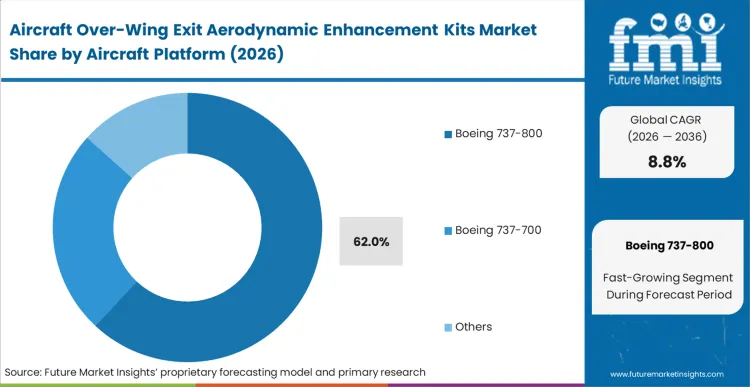
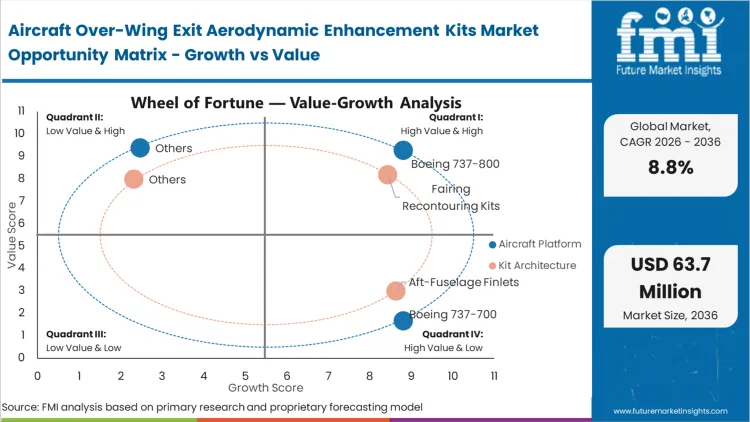
The reason the 737 over-wing exit drag reduction kit market holds 62% of this space comes down to a specific geometric reality, the baseline factory configuration of the 737-800's over-wing exit zone creates a measurable parasitic drag pocket. Operators specifying aircraft refurbishing mandates recognize that this specific airframe represents the highest density of viable retrofit candidates globally. According to FMI's estimates, fleet planners evaluating aerodynamic enhancement kits for Boeing 737-800 fleets do not upgrade these platforms out of preference, but out of necessity, as they seek the best aircraft drag reduction retrofit for 737-800 to survive highly contested medium-haul routes. The adoption sequence accelerates as lessors recognize the modification adds residual value. Operators who fail to integrate these packages face structurally higher block-hour costs against competitors flying identical, but optimized, equipment.
- Acquisition Trigger: Proven block-fuel reduction data validated by early-adopter LCCs. This provides the internal business case for technical directors to authorize the STC purchase.
- Qualification Validation: Seamless integration with existing structural inspection intervals. This proves to maintenance controllers that the kit will not introduce novel inspection burdens.
- Fleet Expansion: The ability to port the STC across entire sub-fleets without re-engineering. This allows chief operating officers to standardize performance assumptions across their scheduling software.
Aircraft Over-Wing Exit Aerodynamic Enhancement Kits Market Analysis by Kit Architecture
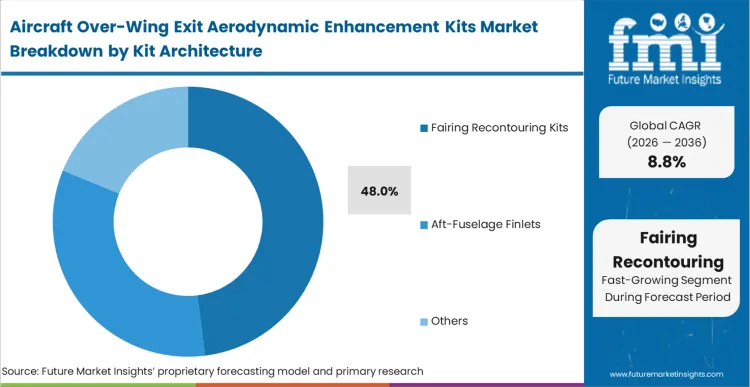
As per FMI's projection, the physical swap of a passive fairing presents drastically lower certification risk than active vortex manipulation. These kits are manufactured using advanced composites that match the thermal expansion coefficients of the surrounding fuselage. Buyers attempting to solve the drag penalty via generic seal improvements face a harsh reality: surface smoothing alone cannot correct the fundamental geometric separation that these molded high performance composites address. When airlines evaluate fairing kit vs finlet retrofit for 737 architectures, fairing recontouring kits capture a dominant 48% share because legacy flush-mounted covers fail to maintain boundary layer attachment during high-angle-of-attack climbs. Engineering directors calculating type III exit fairing retrofit economics specify these exact aerostructure replacements because they address the failure without requiring invasive structural stringer modifications.
- Separation Prevention: Exact matching of the external mold line to optimal fluid dynamics. Technical operations managers eliminate the specific turbulent wake that scrubs speed off the aft fuselage.
- Residual Risk: Minor impact damage from ground support equipment requires specialized repair. Maintenance crews must adapt line-repair manuals to account for the unique contouring.
- Benefit Realization: Aligning flight management system software with the new aerodynamic profile. Pilots must fly the updated drag index to actually capture the promised block-fuel reduction.
Aircraft Over-Wing Exit Aerodynamic Enhancement Kits Market Analysis by Installation Channel
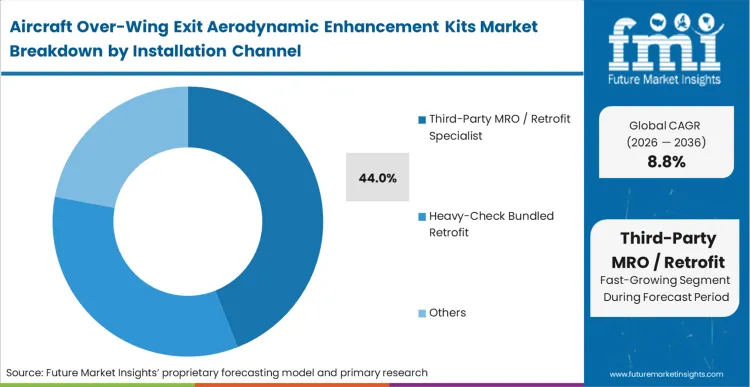
When airlines attempt to bundle aircraft STC aerodynamic retrofit kits for legacy narrowbodies into routine line maintenance, they rapidly discover that specialized composite bonding requires environmental controls that flightline aprons cannot provide. This operational constraint forces the dominant 44% share into the Third-party MRO / retrofit specialist channel. These dedicated facilities have the curing equipment and localized engineering support necessary to guarantee zero return-to-service delays. FMI analysts opine that technical procurement heads accept the labor premium of commercial aircraft MRO partners to shield their internal line-mechanics from tasks that fall outside daily dispatch requirements. Attempting in-house installation without dedicated composite tooling results in extended aircraft groundings, obliterating the very margin the kit was purchased to protect.
- Cost Origin: The specialized labor rate of certified composite technicians. Procurement managers absorb this upfront capital expenditure to secure a fixed-price installation guarantee.
- Hidden Penalty: The logistics cost of positioning the airframe at the capable third-party facility. Route planners must carefully schedule non-revenue ferry flights or route the aircraft organically into the MRO hub.
- Lifecycle Comparison: Third-Party installation guarantees warranty coverage on the bond integrity. This shields the airline's maintenance budget from the long-term liability of delamination.
Aircraft Over-Wing Exit Aerodynamic Enhancement Kits Market Analysis by End User
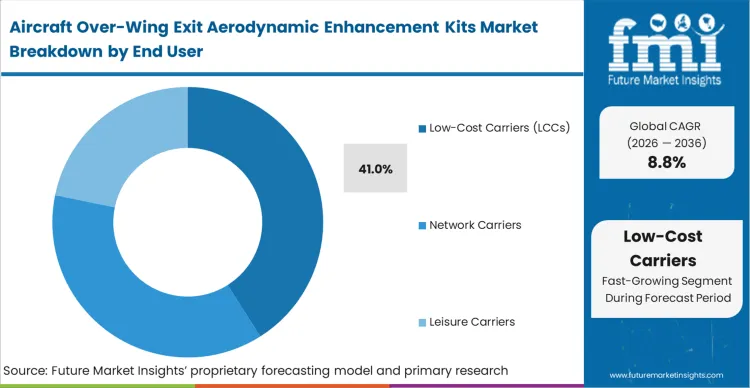
Network carriers who delay face a permanent cost-per-available-seat-mile disadvantage. A deep structural tension exists between network carriers who optimize for scheduling flexibility and Low-cost carriers (LCCs) who obsess over raw unit costs, explaining why LCCs hold 41% of the opportunity. LCC route analysts model fuel consumption to the decimal, recognizing that even a fractional drag reduction on high-frequency, short-turnaround operations compounds massively over an annual schedule, effectively maximizing fuel burn reduction for 737-800 retrofit fleets. Based on FMI's assessment, network carriers initially dismissed these marginal gains, but are now being forced to follow the LCC adoption curve as fuel prices compress margins across all models. Similar to the adoption of drag reduction film applications, LCCs move first because their simplified single-type fleets magnify the ROI of any standardized modification.
- First Movers: Ultra-low-cost carriers operating highly uniform 737-800 fleets. They validate the modification, establishing the baseline fuel savings that the rest of the industry watches.
- Secondary Adopters: Major network carriers extending the lives of legacy narrowbodies. They integrate the kits only when their internal engineering departments verify the LCC-generated performance data.
- Late Arrivals: Charter and ACMI operators. They finally adopt the technology when lessors begin mandating the modification to protect the asset's residual value before transferring it to secondary markets.
Aircraft Over-Wing Exit Aerodynamic Enhancement Kits Market Analysis by Certification Pathway
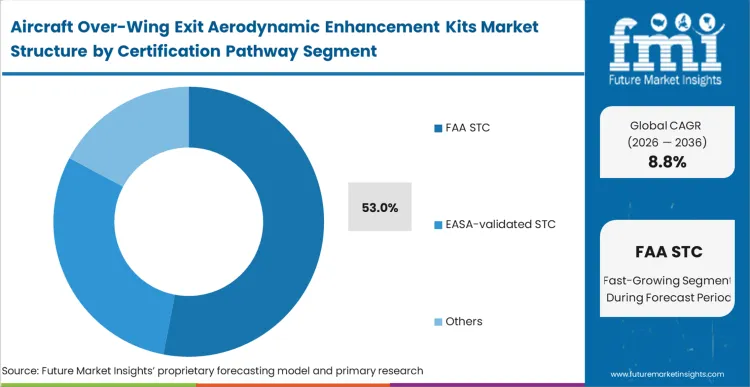
In FMI's view, developers rely heavily on aerospace engineering services outsourcing to navigate the immense documentation burden of the STC process. The barrier to entry is not manufacturing the composite; it is legally proving to the FAA that the modification does not alter emergency egress capabilities. Engineering firms that attempt to bypass full FAA STC rigor for localized approvals immediately disqualify themselves from major global leasing portfolios. Through 2036, the pathway will consolidate heavily around the FAA STC, which currently governs 53% of the sector, because the primary engineering firms developing these kits are anchored in North American aerospace hubs. Selecting an FAA STC aerodynamic modification provider ensures that EASA validations will tightly trail FAA approvals, though the initial engineering and flight-test data will remain FAA-centric.
- Production Capability: Deep institutional knowledge of FAA submittal protocols. Technical operations directors evaluate aircraft fairings not merely as structural covers, but as highly active variables within the aircraft exit fairing retrofit market.
- Supply Constraint: The limited availability of FAA Designated Engineering Representatives (DERs) to sign off on the structural data. Program managers must book these specialists months in advance.
- Future Landscape: Mutual recognition agreements will streamline the transfer of FAA STCs to other jurisdictions. This ensures that a kit certified in Seattle can be legally installed on an airframe registered in Jakarta without re-engineering.
Aircraft Over-Wing Exit Aerodynamic Enhancement Kits Market Drivers, Restraints, and Opportunities
The persistent failure of OEMs to deliver next-generation narrowbodies on schedule forces a brutal reality onto airline technical directors: they must extract modern fuel-efficiency numbers from legacy airframes. Extending the operational life of an aircraft past its intended retirement date requires aggressive aerodynamic intervention to offset the crushing combination of rising maintenance bills and volatile fuel prices. By investing in retrofit kits for aging 737NG fleets, fleet planners are essentially buying a bridge to the future, artificially replicating the unit-cost economics of the newer models they cannot yet acquire. Inaction is not a neutral stance; it immediately leaves a carrier structurally uncompetitive on contested corridors.
The absolute heaviest friction point in this market is aircraft availability, a localized reality well recognized by aircraft aerodynamic retrofit kit suppliers. Technical operations cannot simply ground a revenue-producing narrowbody mid-season to execute a multi-day composite bonding procedure. This limitation is hardwired into the economics of commercial aviation, where an idle airframe burns through potential profit far faster than parasitic drag ever will. While specialized MRO facilities are aggressively trying to compress installations into standard overnight "line-maintenance" windows, the unforgiving chemical curing times of aerospace-grade adhesives continue to dictate the actual speed of fleet-wide rollouts.
Opportunities in the Aircraft Over-Wing Exit Aerodynamic Enhancement Kits Market
- Lease Transition Bundling: Lessors mandate upgrades during asset transfer between operators. Transition management firms capture this opportunity by installing the kits while the airframe is already stripped for heavy maintenance.
- Sustainability Mandate Alignment: Carbon reporting frameworks allow operators to claim specific fuel reductions. ESG compliance officers use the validated aerodynamic data to secure green financing rates.
- Synergistic Composite Retrofits: Engineering firms bundle over-wing kits with sustainable composite wings optimization packages. Technical buyers approve these combined STCs to minimize total aircraft downtime.
Regional Analysis
The global landscape for aircraft overwing exit drag reduction kit market adoption reveals a stark geographical divide, shaped heavily by localized regulatory pressures, fleet maturity, and operating economics. From Europe's carbon-taxed skies to the aggressive capacity expansions in the Asia-Pacific, regional dynamics dictate the pace and necessity of these aftermarket modifications with the market being segmented into Europe, North America and Latin America, and Asia-Pacific across 40 plus countries.
.webp "Top Country Growth Comparison Aircraft Over Wing Exit Aerodynamic Enhancement Kits Market Cagr (2026 2036)")
| Country | CAGR (2026 to 2036) |
|---|---|
| Türkiye | 10.4% |
| Norway | 10.1% |
| Canada | 9.1% |
| Brazil | 9.0% |
| India | 8.6% |
| Germany | 8.4% |
| United States | 8.2% |
Source: Future Market Insights (FMI) analysis, based on proprietary forecasting model and primary research
Europe Aircraft Over-Wing Exit Aerodynamic Enhancement Kits Market Analysis
The profound focus on reducing parasitic drag at every airframe junction perfectly mirrors the intense deployment of specialized aerospace RAD OME technologies across the European theater. Micro-modifications that were previously dismissed as immaterial now easily clear capital hurdle rates, fundamentally reshaping how technical procurement directors evaluate aerodynamic retrofits. This environment essentially forces operators to view aerodynamic drag as a direct tax liability rather than just an operational penalty, as aggressive carbon taxation frameworks heavily penalize inefficient fuel burn.
- Germany: Turning drag reduction into a strict compliance calculation, Germany’s updated aviation emission taxation establishes a direct cost differential between standard and optimized airframes. Route planners for charter and leisure operators are now initiating fleet-wide STC evaluations to shield their thin margins from these penalties. By securing these modifications, operators successfully capture lucrative, low-emission routing slots that remain strictly closed to less efficient competitors. The space in Germany is forecast to observe a CAGR of 8.4%.
- Norway: Intense domestic competition combined with a brutal operating environment mandates absolute fuel efficiency alongside rugged structural modifications in this Nordic market. A CAGR of 10.1% is expected for Norway over the forecast period, as technical directors at regional LCCs exploit these kits to extend the viability of their legacy 737 fleets on routes where next-gen aircraft prove too large. Ultimately, this trajectory positions Norwegian buyers to export their harsh-weather operational data, establishing a valuable competitive gap against southern European carriers.
FMI's report includes secondary European markets like Spain and Italy. Carriers in these tourist-heavy corridors are adopting kits to offset the higher gross weights associated with maximum-density seating configurations.
North America and Latin America Aircraft Over-Wing Exit Aerodynamic Enhancement Kits Market Analysis
The deployment of smart composite layup machines at regional MRO hubs is accelerating the domestic availability of required composite components across the Americas. Unlike regulatory environments driven by carbon taxation, adoption throughout this hemisphere is a pure margin protection play driven by massive fleet sizes where even a fractional percentage drop in block fuel translates to millions in annual savings. The major carriers as a result are deeply integrating these aerodynamic kits alongside major interior overhauls, a trajectory dictated entirely by the scale of the legacy installed base and the ruthless cost-per-seat-mile economics of hub-and-spoke networks.
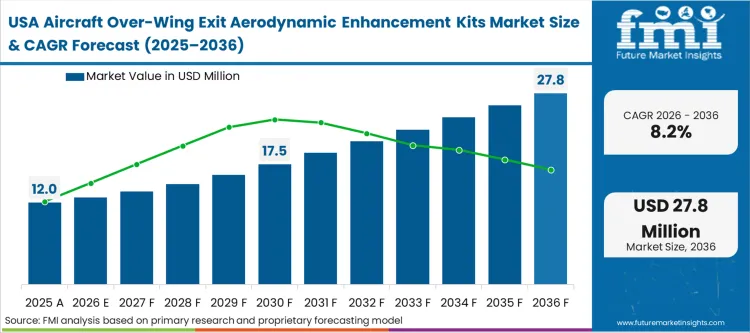
- United States: FMI estimates the United States aircraft overwing exit kit market to expand at an annual growth rate of 8.2%. The sheer concentration of aging 737-800s operating within domestic USA fleets forces network carriers to engineer massive life-extension programs just to maintain capacity. To justify the necessary aircraft downtime, VP-level fleet planners strategically bundle these aerodynamic kits with Wi-Fi radome installations. Once these installations are standardized across a carrier's sub-fleet, dispatchers immediately regain critical payload flexibility for hot-and-high summer operations out of western hubs.
- Canada: Because Canadian aircraft spend significant time in high-altitude cruise where the drag penalty is most pronounced, the country's vast domestic stage lengths drastically amplify the value of mid-fuselage aerodynamic recovery. To maintain parity on these vital transcontinental routes, operations heads at major Canadian carriers have no choice but to authorize these retrofits. The transition toward fully optimized legacy fleets creates a structural reality where unmodified airframes are permanently relegated to low-yield regional feeder routes. Canada's industry is expected to demonstrate a CAGR of 9.1%.
- Brazil: Fleet planners are forced to execute these vital retrofits just to survive the localized economic volatility that consistently threatens route margins. The Brazilian landscape is likely to post a CAGR of 9.0%, as the notoriously high cost of imported jet fuel compels domestic operators to ruthlessly pursue any modification capable of reducing trip fuel. Ultimately, carriers that successfully manage the import and installation of these kits capture a profound cost advantage on the highly contested Rio-São Paulo shuttle corridor.
FMI's report includes Mexican and Central American operators. These carriers benefit directly from the engineering paid for by US majors, adopting the FAA STCs with minimal localized friction.
Asia-Pacific Aircraft Over-Wing Exit Aerodynamic Enhancement Kits Market Analysis
Demonstrating the expanding technical capability of MRO networks across these geographies, the installation of associated aerospace defense ducting components is rising sharply. Local technical directors often find themselves managing the maintenance of these systems rather than driving their initial acquisition, creating a unique operational dynamic. This occurs because operators in these high-growth corridors frequently receive aircraft with aerodynamic enhancements already mandated by a leasing company's transition team, meaning procurement practices here diverge sharply from Western models as lessors heavily dictate the structural condition of incoming aircraft.
- Türkiye: Demand driving the Türkiye aircraft finlet retrofit market is estimated to expand at a CAGR of 10.4%. To remain profitable while serving as a massive bridging hub, the country's dominant LCCs are required to operate legacy narrowbodies at absolute maximum utilization rates. The technical procurement officers as a result heavily specify these aerodynamic kits to squeeze every possible mile of range out of aging assets. The practitioner reality on the ground is that this growth reflects an aggressive fleet expansion strategy built on leased, mid-life assets rather than a green environmental initiative.
- India: Operations directors are rapidly adopting these enhancements to offset the severe operational penalties associated with flying in heavily congested airspace. Leaving zero room for structural inefficiencies on legacy airframes, India's hyper-competitive domestic aviation sector demands absolute operational perfection. This modernization trajectory positions Indian LCCs to continuously dominate domestic capacity, effectively pushing unmodified competitors out of tier-1 airport slots entirely. The landscape in India is set to achieve a CAGR of 8.6%.
FMI's report includes Southeast Asian and Middle Eastern markets. Carriers in these zones are highly dependent on the secondary lease market, making them passive but massive recipients of this technology.
Competitive Aligners for Market Players
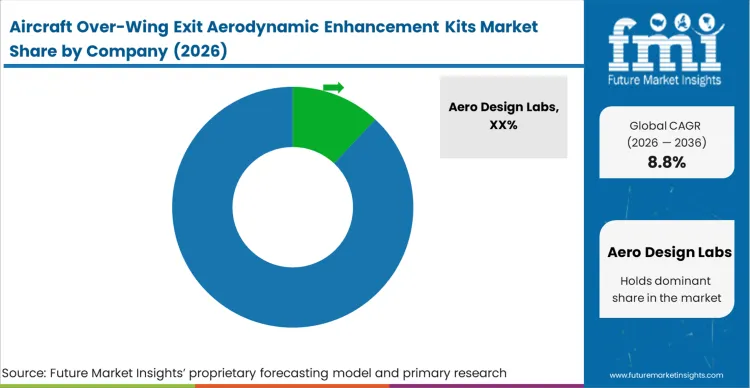
Airlines evaluating aerodynamic retrofits do not differentiate aircraft aerodynamic retrofit kit suppliers by composite manufacturing capabilities, but by the irrefutable legality of their certification data. This dynamic renders the competitive structure exceptionally concentrated, as the punishing financial barrier of achieving an FAA or EASA STC eliminates undercapitalized entrants before they even reach the procurement desk. When procurement directors review proposals from established over-wing exit drag reduction kit manufacturers like Aero Design Labs and Vortex Control Technologies, they scrutinize the validation data and the absolute legality of the STC package rather than the proprietary weave of the materials. As an aspiring FAA STC aerodynamic modification provider, a vendor without a fully approved, irrefutable block-fuel reduction guarantee cannot secure an initial meeting with a tier-1 network carrier. This effectively separates the sector into those who own validated flight data and those who merely manufacture parts, similar to the stringent qualification matrices seen in the aircraft strut sector.
Proprietary flight-test libraries and entrenched relationships with major aircraft leasing firms form an impenetrable structural moat for established players. To replicate the exact positions held by heavyweights like ALOFT AeroArchitects or NORDAM, a challenger must build an exhaustive archive of computational fluid dynamics models backed by thousands of expensive, real-world flight test hours, a critical differentiator when buyers conduct an airline aerodynamic retrofit suppliers comparison or weigh an ADL kit vs VCT finlets. They must also secure integration partnerships to ensure their modifications align with standard commercial aircraft mro schedules, often utilizing the scale of logistics and maintenance operators like AAR Corp. to guarantee that engineering packages can be installed without triggering OEM intervention. This advantage persists structurally because once an airline standardizes on a specific vendor's STC across a massive sub-fleet of composite airframes, the switching costs of requalifying a new design become mathematically unjustifiable.
The fundamental conflict shaping the next decade of fleet optimization lies between airlines demanding supplier diversity and certification frameworks that systematically punish it. While large fleet transition planners actively attempt to leverage multiple suppliers by engaging specialized certification partners like Kilroy Aviation LLC and AES Global to validate alternative installation pathways, effectively seeking reliable airline retrofit engineering services for drag reduction kits, the narrow scope of approved hardware providers severely restricts their negotiating power. Heading toward 2036, this environment will likely experience increased structural rigidity as leading hardware vendors acquire these smaller, independent engineering firms simply to capture their STC portfolios and monopolize the installation pathways. The tension between airlines demanding lower kit prices to protect their route margins and vendors aggressively shielding their STC investments will dictate the pace of fleet-wide adoption over the next decade, mirroring consolidation trends observed in the aerospace accumulator supply chain.
Key Players in Aircraft Over-Wing Exit Aerodynamic Enhancement Kits Market
- Aero Design Labs
- Vortex Control Technologies
- ALOFT AeroArchitects
- NORDAM
- AAR Corp.
- Kilroy Aviation LLC
- AES Global
Scope of the Report
| Metric | Value |
|---|---|
| Quantitative Units | USD 27.4 million to USD 63.7 million, at a CAGR of 8.8% |
| Market Definition | This segment covers aftermarket structural modifications installed around narrowbody emergency exits to eliminate airflow separation. It focuses strictly on engineering solutions that reclaim aerodynamic penalties inherent in legacy fuselage designs. |
| Aircraft Platform Segmentation | Boeing 737-700, Boeing 737-800, Boeing 737-900ER, A320-family opportunity set, Other legacy narrowbody candidates |
| Kit Architecture Segmentation | Fairing recontouring kits, Vortex-generator arrays, Aft-fuselage finlets, Hybrid fairing-plus-vortex packages |
| Installation Channel Segmentation | Third-party MRO / retrofit specialist, Airline in-house engineering and maintenance, Line-maintenance overnight install, Heavy-check bundled retrofit |
| End User Segmentation | Low-cost carriers, Network carriers, Leisure carriers, Charter / ACMI operators |
| Certification Pathway Segmentation | FAA STC, EASA-validated STC, Other national authority acceptance |
| Regions Covered | Europe, North America and Latin America, Asia-Pacific |
| Countries Covered | Türkiye, Norway, Canada, Brazil, India, Germany, United States, and 40 plus countries |
| Key Companies Profiled | Aero Design Labs, Vortex Control Technologies, ALOFT AeroArchitects, NORDAM, AAR Corp., Kilroy Aviation LLC, AES Global |
| Forecast Period | 2026 to 2036 |
| Approach | Primary interviews were conducted with airline fleet planning VPs and technical operations directors. The baseline anchors to the active global installed base of legacy narrowbody platforms and outstanding lease terms. Forecasts are validated against composite supply volumes and MRO capacity data. |
Source: Future Market Insights (FMI) analysis, based on proprietary forecasting model and primary research
Segments
Aircraft Platform:
- Boeing 737-700
- Boeing 737-800
- Boeing 737-900ER
- A320-family opportunity set
- Other legacy narrowbody candidates
Kit Architecture:
- Fairing recontouring kits
- Vortex-generator arrays
- Aft-fuselage finlets
- Hybrid fairing-plus-vortex packages
Installation Channel:
- Third-party MRO / retrofit specialist
- Airline in-house engineering and maintenance
- Line-maintenance overnight install
- Heavy-check bundled retrofit
End User:
- Low-cost carriers
- Network carriers
- Leisure carriers
- Charter / ACMI operators
Certification Pathway:
- FAA STC
- EASA-validated STC
- Other national authority acceptance
Region:
- North America
- United States
- Canada
- Europe
- Germany
- United Kingdom
- France
- Italy
- Spain
- Asia Pacific
- China
- Japan
- South Korea
- Taiwan
- Singapore
- Latin America
- Brazil
- Mexico
- Argentina
- Middle East & Africa
- GCC Countries
- South Africa
- Israel
Bibliography
- Southwest Airlines Co. (2024). luv-20241231. USA Securities and Exchange Commission.
- Norwegian Air Shuttle ASA. (2024). Annual Report 2024. Norwegian Air Shuttle.
- Ryanair Holdings plc. (2025, May). ANNUAL REPORT 2025. Ryanair Investor Relations.
- European Union Aviation Safety Agency. (2026, February). TYPE-CERTIFICATE DATA SHEET. EASA.
- Delta Air Lines, Inc. (2026, January). Delta Air Lines Announces December Quarter and Full Year 2025 Financial Results. Delta Investor Relations.
This bibliography is provided for reader reference. The full FMI report contains the complete reference list with primary source documentation.
This Report Addresses
- Market intelligence to support strategic decision making across fairing recontouring kits and vortex-generator array categories
- Market size estimation and 10-year revenue forecasts from 2026 to 2036, supported by legacy narrowbody installed base lease data
- Growth opportunity mapping across third-party MRO installation channels with emphasis on bundling enhancements into scheduled heavy-check intervals
- Segment and regional revenue forecasts covering Boeing 737-800 operators across aggressive carbon taxation frameworks in European theaters
- Competition strategy assessment including FAA STC barriers, proprietary flight-test data ownership, and lessor network relationships
- Capability development tracking including continuous refinement of composite curing times, installation procedures, and EASA validation protocols
- Preparation for a 737 aerodynamic retrofit kit RFQ, including structural inspection mandates, and return-to-service authorizations
- Market report delivery in PDF, Excel, PPT, and interactive dashboard formats for executive strategy, fleet transition planning, and operational benchmarking use
Frequently Asked Questions
What is an over-wing exit aerodynamic enhancement kit?
This category covers engineered aftermarket modifications installed at the fuselage-wing root intersection of commercial narrowbody aircraft to target parasite drag and airflow separation caused by structural mandates for emergency egress routes.
How much fuel can a 737 drag reduction kit save?
While savings are fractional per flight, LCC route analysts recognize that these minor aerodynamic corrections yield millions in cumulative savings as they compound massively across high-frequency networks over an annual schedule.
Are over-wing exit aerodynamic kits FAA approved?
Yes, the certification pathway heavily consolidates around the FAA STC, requiring engineering firms to explicitly demonstrate that recontoured fairings do not impede over-wing hatch operation or evacuation slide deployment.
Which aircraft use overwing exit drag reduction kits?
The Boeing 737-800 is the primary candidate capturing the bulk of current installations because its sheer global volume and known drag profile guarantee the fastest return on the STC investment.
How over-wing exit aerodynamic kits reduce drag on 737 aircraft?
By exactly matching an external mold line via fairings or finlets to manage fluid dynamics, these kits eliminate the specific turbulent wake and parasitic drag pocket created by the baseline factory configuration of the 737-800's over-wing exit zone.
Which airlines are likely to buy over-wing exit aerodynamic kits through 2036?
Low-cost carriers will remain the first movers validating modifications across highly uniform fleets, followed sequentially by network carriers and charter operators as fuel prices compress margins and lessors mandate upgrades during asset transfers.
What is the expected payback period for a retrofit kit?
When tightly aligned with existing heavy-check intervals, the economics of a localized aerodynamic retrofit during a lease extension suddenly clear the internal hurdle rate, allowing the kit to quickly pay for the maintenance downtime.
What is the primary restraint slowing market growth?
The primary restraint is the rigid mechanics of aircraft routing and maintenance scheduling, as pulling a revenue-generating asset out of service solely for a composite aerodynamic retrofit destroys the exact margin the kit is designed to protect.
Which country grows fastest in this sector?
Türkiye is expected to expand at the fastest rate of 10.4%, structurally driven by Turkish operators aggressively expanding transcontinental capacity using leased legacy assets compared to defensive margin protection seen in other regions.
Why are third-party MROs dominating the installation channel?
Technical procurement heads outsource installations to third-party MROs to shield their daily dispatch reliability from the risks of incomplete adhesive curing, as composite bonding requires specialized environmental controls and expertise that routine line-mechanics rarely possess.
What prevents new engineering firms from entering the competitive landscape?
The massive upfront cost of generating computational fluid dynamics models and real-world flight test data prevents new entrants, as challenger firms cannot convince the FAA to issue the necessary STC without a validated block-fuel reduction guarantee.
How does lease extension trigger kit purchases?
When a carrier is forced to extend a legacy narrowbody lease by five years, the extended operational horizon suddenly makes the ROI of an aircraft landing gear or aerodynamic retrofit mathematically viable.
What happens if a fairing kit is damaged by ground equipment?
If damaged, the aerodynamic benefit is instantly lost until the specialized contouring is restored, requiring maintenance crews to follow specific STC repair manuals rather than using generic reusable aircraft cabin panel fasteners or standard sheet-metal patches.
How do these kits interact with existing aircraft liveries?
Because replacement fairings must align perfectly with the surrounding fuselage, they must be painted or wrapped using highly conformable aircraft livery change film systems that do not add measurable thickness to the aerodynamic profile.
Can fleet operators bundle these kits with other aesthetic upgrades?
Yes, technical directors often align the downtime required for the over-wing fairing swap with the application of new aircraft branding decal systems to consolidate work and minimize the total block of non-revenue days.
Why are OEM factory profiles considered less efficient?
OEM factory profiles are considered less efficient because they are engineered as universally acceptable baselines that prioritize manufacturing speed and absolute safety over the micro-aerodynamic perfection that aftermarket engineers achieve by refining specific junction fluid dynamics.
Preview the report firsthand - request a free sample
Get SampleGet the brochure for pricing and purchase details.
Get PDFTable of Content
- Executive Summary
- Global Market Outlook
- Demand-side Trends
- Supply-side Trends
- Technology Roadmap Analysis
- Analysis and Recommendations
- Market Overview
- Market Coverage / Taxonomy
- Market Definition / Scope / Limitations
- Research Methodology
- Chapter Orientation
- Analytical Lens and Working Hypotheses
- Market Structure, Signals, and Trend Drivers
- Benchmarking and Cross-market Comparability
- Market Sizing, Forecasting, and Opportunity Mapping
- Research Design and Evidence Framework
- Desk Research Programme (Secondary Evidence)
- Company Annual and Sustainability Reports
- Peer-reviewed Journals and Academic Literature
- Corporate Websites, Product Literature, and Technical Notes
- Earnings Decks and Investor Briefings
- Statutory Filings and Regulatory Disclosures
- Technical White Papers and Standards Notes
- Trade Journals, Industry Magazines, and Analyst Briefs
- Conference Proceedings, Webinars, and Seminar Materials
- Government Statistics Portals and Public Data Releases
- Press Releases and Reputable Media Coverage
- Specialist Newsletters and Curated Briefings
- Sector Databases and Reference Repositories
- FMI Internal Proprietary Databases and Historical Market Datasets
- Subscription Datasets and Paid Sources
- Social Channels, Communities, and Digital Listening Inputs
- Additional Desk Sources
- Expert Input and Fieldwork (Primary Evidence)
- Primary Modes
- Qualitative Interviews and Expert Elicitation
- Quantitative Surveys and Structured Data Capture
- Blended Approach
- Why Primary Evidence is Used
- Field Techniques
- Interviews
- Surveys
- Focus Groups
- Observational and In-context Research
- Social and Community Interactions
- Stakeholder Universe Engaged
- C-suite Leaders
- Board Members
- Presidents and Vice Presidents
- R&D and Innovation Heads
- Technical Specialists
- Domain Subject-matter Experts
- Scientists
- Physicians and Other Healthcare Professionals
- Governance, Ethics, and Data Stewardship
- Research Ethics
- Data Integrity and Handling
- Primary Modes
- Tooling, Models, and Reference Databases
- Desk Research Programme (Secondary Evidence)
- Data Engineering and Model Build
- Data Acquisition and Ingestion
- Cleaning, Normalisation, and Verification
- Synthesis, Triangulation, and Analysis
- Quality Assurance and Audit Trail
- Market Background
- Market Dynamics
- Drivers
- Restraints
- Opportunity
- Trends
- Scenario Forecast
- Demand in Optimistic Scenario
- Demand in Likely Scenario
- Demand in Conservative Scenario
- Opportunity Map Analysis
- Product Life Cycle Analysis
- Supply Chain Analysis
- Investment Feasibility Matrix
- Value Chain Analysis
- PESTLE and Porter’s Analysis
- Regulatory Landscape
- Regional Parent Market Outlook
- Production and Consumption Statistics
- Import and Export Statistics
- Market Dynamics
- Global Market Analysis 2021 to 2025 and Forecast, 2026 to 2036
- Historical Market Size Value (USD Million) Analysis, 2021 to 2025
- Current and Future Market Size Value (USD Million) Projections, 2026 to 2036
- Y-o-Y Growth Trend Analysis
- Absolute $ Opportunity Analysis
- Global Market Pricing Analysis 2021 to 2025 and Forecast 2026 to 2036
- Global Market Analysis 2021 to 2025 and Forecast 2026 to 2036, By Aircraft Platform
- Introduction / Key Findings
- Historical Market Size Value (USD Million) Analysis By Aircraft Platform , 2021 to 2025
- Current and Future Market Size Value (USD Million) Analysis and Forecast By Aircraft Platform , 2026 to 2036
- Boeing 737-800
- Boeing 737-700
- Others
- Boeing 737-800
- Y-o-Y Growth Trend Analysis By Aircraft Platform , 2021 to 2025
- Absolute $ Opportunity Analysis By Aircraft Platform , 2026 to 2036
- Global Market Analysis 2021 to 2025 and Forecast 2026 to 2036, By Kit Architecture
- Introduction / Key Findings
- Historical Market Size Value (USD Million) Analysis By Kit Architecture, 2021 to 2025
- Current and Future Market Size Value (USD Million) Analysis and Forecast By Kit Architecture, 2026 to 2036
- Fairing Recontouring Kits
- Aft-Fuselage Finlets
- Others
- Fairing Recontouring Kits
- Y-o-Y Growth Trend Analysis By Kit Architecture, 2021 to 2025
- Absolute $ Opportunity Analysis By Kit Architecture, 2026 to 2036
- Global Market Analysis 2021 to 2025 and Forecast 2026 to 2036, By Installation Channel
- Introduction / Key Findings
- Historical Market Size Value (USD Million) Analysis By Installation Channel, 2021 to 2025
- Current and Future Market Size Value (USD Million) Analysis and Forecast By Installation Channel, 2026 to 2036
- Third-Party MRO / Retrofit Specialist
- Heavy-Check Bundled Retrofit
- Others
- Third-Party MRO / Retrofit Specialist
- Y-o-Y Growth Trend Analysis By Installation Channel, 2021 to 2025
- Absolute $ Opportunity Analysis By Installation Channel, 2026 to 2036
- Global Market Analysis 2021 to 2025 and Forecast 2026 to 2036, By End User
- Introduction / Key Findings
- Historical Market Size Value (USD Million) Analysis By End User, 2021 to 2025
- Current and Future Market Size Value (USD Million) Analysis and Forecast By End User, 2026 to 2036
- Low-Cost Carriers (LCCs)
- Network Carriers
- Leisure Carriers
- Low-Cost Carriers (LCCs)
- Y-o-Y Growth Trend Analysis By End User, 2021 to 2025
- Absolute $ Opportunity Analysis By End User, 2026 to 2036
- Global Market Analysis 2021 to 2025 and Forecast 2026 to 2036, By Certification Pathway
- Introduction / Key Findings
- Historical Market Size Value (USD Million) Analysis By Certification Pathway, 2021 to 2025
- Current and Future Market Size Value (USD Million) Analysis and Forecast By Certification Pathway, 2026 to 2036
- FAA STC
- EASA-validated STC
- Others
- FAA STC
- Y-o-Y Growth Trend Analysis By Certification Pathway, 2021 to 2025
- Absolute $ Opportunity Analysis By Certification Pathway, 2026 to 2036
- Global Market Analysis 2021 to 2025 and Forecast 2026 to 2036, By Region
- Introduction
- Historical Market Size Value (USD Million) Analysis By Region, 2021 to 2025
- Current Market Size Value (USD Million) Analysis and Forecast By Region, 2026 to 2036
- North America
- Latin America
- Western Europe
- Eastern Europe
- East Asia
- South Asia and Pacific
- Middle East & Africa
- Market Attractiveness Analysis By Region
- North America Market Analysis 2021 to 2025 and Forecast 2026 to 2036, By Country
- Historical Market Size Value (USD Million) Trend Analysis By Market Taxonomy, 2021 to 2025
- Market Size Value (USD Million) Forecast By Market Taxonomy, 2026 to 2036
- By Country
- USA
- Canada
- Mexico
- By Aircraft Platform
- By Kit Architecture
- By Installation Channel
- By End User
- By Certification Pathway
- By Country
- Market Attractiveness Analysis
- By Country
- By Aircraft Platform
- By Kit Architecture
- By Installation Channel
- By End User
- By Certification Pathway
- Key Takeaways
- Latin America Market Analysis 2021 to 2025 and Forecast 2026 to 2036, By Country
- Historical Market Size Value (USD Million) Trend Analysis By Market Taxonomy, 2021 to 2025
- Market Size Value (USD Million) Forecast By Market Taxonomy, 2026 to 2036
- By Country
- Brazil
- Chile
- Rest of Latin America
- By Aircraft Platform
- By Kit Architecture
- By Installation Channel
- By End User
- By Certification Pathway
- By Country
- Market Attractiveness Analysis
- By Country
- By Aircraft Platform
- By Kit Architecture
- By Installation Channel
- By End User
- By Certification Pathway
- Key Takeaways
- Western Europe Market Analysis 2021 to 2025 and Forecast 2026 to 2036, By Country
- Historical Market Size Value (USD Million) Trend Analysis By Market Taxonomy, 2021 to 2025
- Market Size Value (USD Million) Forecast By Market Taxonomy, 2026 to 2036
- By Country
- Germany
- UK
- Italy
- Spain
- France
- Nordic
- BENELUX
- Rest of Western Europe
- By Aircraft Platform
- By Kit Architecture
- By Installation Channel
- By End User
- By Certification Pathway
- By Country
- Market Attractiveness Analysis
- By Country
- By Aircraft Platform
- By Kit Architecture
- By Installation Channel
- By End User
- By Certification Pathway
- Key Takeaways
- Eastern Europe Market Analysis 2021 to 2025 and Forecast 2026 to 2036, By Country
- Historical Market Size Value (USD Million) Trend Analysis By Market Taxonomy, 2021 to 2025
- Market Size Value (USD Million) Forecast By Market Taxonomy, 2026 to 2036
- By Country
- Russia
- Poland
- Hungary
- Balkan & Baltic
- Rest of Eastern Europe
- By Aircraft Platform
- By Kit Architecture
- By Installation Channel
- By End User
- By Certification Pathway
- By Country
- Market Attractiveness Analysis
- By Country
- By Aircraft Platform
- By Kit Architecture
- By Installation Channel
- By End User
- By Certification Pathway
- Key Takeaways
- East Asia Market Analysis 2021 to 2025 and Forecast 2026 to 2036, By Country
- Historical Market Size Value (USD Million) Trend Analysis By Market Taxonomy, 2021 to 2025
- Market Size Value (USD Million) Forecast By Market Taxonomy, 2026 to 2036
- By Country
- China
- Japan
- South Korea
- By Aircraft Platform
- By Kit Architecture
- By Installation Channel
- By End User
- By Certification Pathway
- By Country
- Market Attractiveness Analysis
- By Country
- By Aircraft Platform
- By Kit Architecture
- By Installation Channel
- By End User
- By Certification Pathway
- Key Takeaways
- South Asia and Pacific Market Analysis 2021 to 2025 and Forecast 2026 to 2036, By Country
- Historical Market Size Value (USD Million) Trend Analysis By Market Taxonomy, 2021 to 2025
- Market Size Value (USD Million) Forecast By Market Taxonomy, 2026 to 2036
- By Country
- India
- ASEAN
- Australia & New Zealand
- Rest of South Asia and Pacific
- By Aircraft Platform
- By Kit Architecture
- By Installation Channel
- By End User
- By Certification Pathway
- By Country
- Market Attractiveness Analysis
- By Country
- By Aircraft Platform
- By Kit Architecture
- By Installation Channel
- By End User
- By Certification Pathway
- Key Takeaways
- Middle East & Africa Market Analysis 2021 to 2025 and Forecast 2026 to 2036, By Country
- Historical Market Size Value (USD Million) Trend Analysis By Market Taxonomy, 2021 to 2025
- Market Size Value (USD Million) Forecast By Market Taxonomy, 2026 to 2036
- By Country
- Kingdom of Saudi Arabia
- Other GCC Countries
- Turkiye
- South Africa
- Other African Union
- Rest of Middle East & Africa
- By Aircraft Platform
- By Kit Architecture
- By Installation Channel
- By End User
- By Certification Pathway
- By Country
- Market Attractiveness Analysis
- By Country
- By Aircraft Platform
- By Kit Architecture
- By Installation Channel
- By End User
- By Certification Pathway
- Key Takeaways
- Key Countries Market Analysis
- USA
- Pricing Analysis
- Market Share Analysis, 2025
- By Aircraft Platform
- By Kit Architecture
- By Installation Channel
- By End User
- By Certification Pathway
- Canada
- Pricing Analysis
- Market Share Analysis, 2025
- By Aircraft Platform
- By Kit Architecture
- By Installation Channel
- By End User
- By Certification Pathway
- Mexico
- Pricing Analysis
- Market Share Analysis, 2025
- By Aircraft Platform
- By Kit Architecture
- By Installation Channel
- By End User
- By Certification Pathway
- Brazil
- Pricing Analysis
- Market Share Analysis, 2025
- By Aircraft Platform
- By Kit Architecture
- By Installation Channel
- By End User
- By Certification Pathway
- Chile
- Pricing Analysis
- Market Share Analysis, 2025
- By Aircraft Platform
- By Kit Architecture
- By Installation Channel
- By End User
- By Certification Pathway
- Germany
- Pricing Analysis
- Market Share Analysis, 2025
- By Aircraft Platform
- By Kit Architecture
- By Installation Channel
- By End User
- By Certification Pathway
- UK
- Pricing Analysis
- Market Share Analysis, 2025
- By Aircraft Platform
- By Kit Architecture
- By Installation Channel
- By End User
- By Certification Pathway
- Italy
- Pricing Analysis
- Market Share Analysis, 2025
- By Aircraft Platform
- By Kit Architecture
- By Installation Channel
- By End User
- By Certification Pathway
- Spain
- Pricing Analysis
- Market Share Analysis, 2025
- By Aircraft Platform
- By Kit Architecture
- By Installation Channel
- By End User
- By Certification Pathway
- France
- Pricing Analysis
- Market Share Analysis, 2025
- By Aircraft Platform
- By Kit Architecture
- By Installation Channel
- By End User
- By Certification Pathway
- India
- Pricing Analysis
- Market Share Analysis, 2025
- By Aircraft Platform
- By Kit Architecture
- By Installation Channel
- By End User
- By Certification Pathway
- ASEAN
- Pricing Analysis
- Market Share Analysis, 2025
- By Aircraft Platform
- By Kit Architecture
- By Installation Channel
- By End User
- By Certification Pathway
- Australia & New Zealand
- Pricing Analysis
- Market Share Analysis, 2025
- By Aircraft Platform
- By Kit Architecture
- By Installation Channel
- By End User
- By Certification Pathway
- China
- Pricing Analysis
- Market Share Analysis, 2025
- By Aircraft Platform
- By Kit Architecture
- By Installation Channel
- By End User
- By Certification Pathway
- Japan
- Pricing Analysis
- Market Share Analysis, 2025
- By Aircraft Platform
- By Kit Architecture
- By Installation Channel
- By End User
- By Certification Pathway
- South Korea
- Pricing Analysis
- Market Share Analysis, 2025
- By Aircraft Platform
- By Kit Architecture
- By Installation Channel
- By End User
- By Certification Pathway
- Russia
- Pricing Analysis
- Market Share Analysis, 2025
- By Aircraft Platform
- By Kit Architecture
- By Installation Channel
- By End User
- By Certification Pathway
- Poland
- Pricing Analysis
- Market Share Analysis, 2025
- By Aircraft Platform
- By Kit Architecture
- By Installation Channel
- By End User
- By Certification Pathway
- Hungary
- Pricing Analysis
- Market Share Analysis, 2025
- By Aircraft Platform
- By Kit Architecture
- By Installation Channel
- By End User
- By Certification Pathway
- Kingdom of Saudi Arabia
- Pricing Analysis
- Market Share Analysis, 2025
- By Aircraft Platform
- By Kit Architecture
- By Installation Channel
- By End User
- By Certification Pathway
- Turkiye
- Pricing Analysis
- Market Share Analysis, 2025
- By Aircraft Platform
- By Kit Architecture
- By Installation Channel
- By End User
- By Certification Pathway
- South Africa
- Pricing Analysis
- Market Share Analysis, 2025
- By Aircraft Platform
- By Kit Architecture
- By Installation Channel
- By End User
- By Certification Pathway
- USA
- Market Structure Analysis
- Competition Dashboard
- Competition Benchmarking
- Market Share Analysis of Top Players
- By Regional
- By Aircraft Platform
- By Kit Architecture
- By Installation Channel
- By End User
- By Certification Pathway
- Competition Analysis
- Competition Deep Dive
- Aero Design Labs
- Overview
- Product Portfolio
- Profitability by Market Segments (Product/Age /Sales Channel/Region)
- Sales Footprint
- Strategy Overview
- Marketing Strategy
- Product Strategy
- Channel Strategy
- Vortex Control Technologies
- ALOFT AeroArchitects
- NORDAM
- AAR Corp.
- Kilroy Aviation LLC
- AES Global
- Aero Design Labs
- Competition Deep Dive
- Assumptions & Acronyms Used


