

- Market Size (2026)
- USD 14.8 Mn
- Forecast (2036)
- USD 72.0 Mn
- CAGR (2026 to 2036)
- 17.1%
High-Bypass Engine Nacelle External Aerodynamic Optimization Kits Market Size, Market Forecast and Outlook By FMI
Summary of the High-Bypass Engine Nacelle External Aerodynamic Optimization Kits
- Demand and Growth Drivers
- Demand is supported by long-haul fuel-efficiency programs across passenger and cargo widebody fleets.
- Product use is increasing at a stable rate in aircraft family related with certified retrofit pathways and visible in-service deployment.
- Broader focus on airline decarbonization influence the demand outlook of nacelle-focused aerodynamic surface upgrades.
- Product and Segment View
- Riblet films hold the largest installed demand base due to current airline deployment built around certified film-based systems.
- STC retrofit leads installation demand because airline engineering teams favor approval-backed modification routes before wider fleet use.
- Geography and Competitive Outlook
- Japan and Chile register faster growth as airline-linked validation and riblet-coating activity are increasing.
- Germany and Switzerland hold higher market shares as supplier development activity and certified fleet deployment are highly visible in these markets.
- Supplier rank depends on certification depth and retrofit execution. It also depends on airline confidence in service durability and operational repeatability.
- Analyst Opinion
- Nikhil Kaitwade, Principal Analyst states: “This market is scaling on two forces which are broader aircraft approvals and airlines moving from pilots to repeatable retrofit programs. The value is most concentrated in cruise-heavy widebody operations, where even marginal drag reduction compounds into meaningful fuel economics. Long term, advantage will belong to suppliers that can demonstrate certified and execute with the engineering depth to deliver consistently across fleets.”
- High-Bypass Engine Nacelle External Aerodynamic Optimization Kits Market Value Analysis
- Industry expansion is driven by retrofit economics and certified platform coverage an not just by aircraft production alone.
- Boeing 777 passenger fleets and widebody freighter programs drive revenue because long-haul utilization improves fuel-savings value per aircraft.
- Approval-led expansion into A330 programs supports market growth. Demand across certified film systems and emerging coating routes therefore retains future revenue scope wider.
- Revenue from airline programs using approved retrofit kits and engineering-backed installation is rising at a steady rateas these programs carry better pricing and stronger rollout continuity.
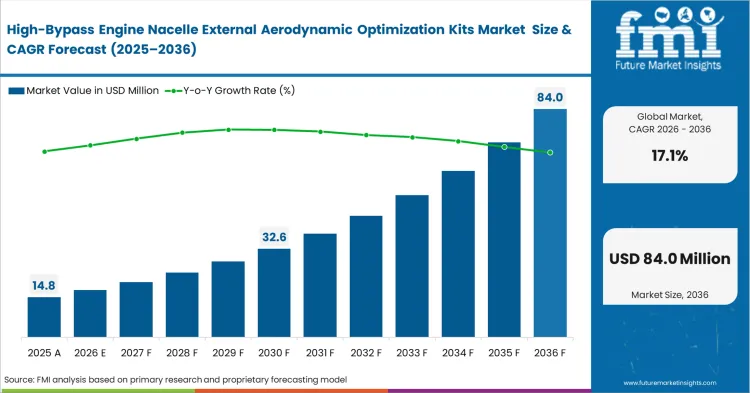
Key Takeaways, Market Size, and Forecast
- The high-bypass engine nacelle external aerodynamic optimization kits market valuation crossed USD 12.6 million in 2025.
- Industry is projected to surpass USD 72.0 million by 2036.
- Market is projected to expand at a 17.1% CAGR for 2026 to 2036.
- Incremental opportunity between 2026 and 2036 is estimated at USD 57.20 million.
- Riblet films in the kit type segment are expected to account for 58.0% share in 2026.
- Japan at 18.6% CAGR and Chile at 18.1% CAGR are expected to record faster growth among the key countries covered in this study.
- Commercial value is supported by long-haul fuel savings because certified nacelle drag-reduction programs improve retrofit economics in widebody fleets.
High-Bypass Engine Nacelle External Aerodynamic Optimization Kits Market Definition
High-bypass engine nacelle external aerodynamic optimization kits are retrofit assemblies used on nacelle exterior surfaces to reduce drag during cruise. These systems support lower fuel use and lower emissions along with improved operating efficiency in long-haul aircraft. This market includes riblet films and riblet coatings. It also includes localized contour-improvement systems and related aerodynamic surface-modification kits used across airline and MRO retrofit workflows.
High-Bypass Engine Nacelle External Aerodynamic Optimization Kits Market Inclusions
Scope includes riblet films and riblet coatings. Localized gap-seal kits and contour-improvement systems are also included. Related retrofit engineering support supplied at airline and MRO level is part of this market. Scope also includes polymeric film formats and riblet-paint routes. Passenger airlines and cargo airlines as well as lessors and MRO providers are also covered.
High-Bypass Engine Nacelle External Aerodynamic Optimization Kits Market Exclusions
Scope excludes full nacelle assemblies sold without aerodynamic retrofit function. Internal engine hardware and thrust-generation components are excluded. Broad fuselage-only drag-reduction systems remain outside this scope. Generic aero engine coatings without nacelle-optimization use are excluded. Full aircraft fairings and routine airline consumables without installed drag-reduction role are excluded from revenue capture.
High-Bypass Engine Nacelle External Aerodynamic Optimization Kits Market Research Methodology
- Primary Research: Review covered official airline retrofit releases and supplier product pages. Engineering capability material and deployment disclosures were included in the same review.
- Desk Research: Review covered public fitment updates and aviation decarbonization material. Company technical releases and adjacent retrofit references were also reviewed.
- Market sizing and forecasting: A bottom-up model using fitted-aircraft counts and retrofit-economics estimates was applied. Platform coverage and shipset logic were also used.
- Data validation: Cross-checks covered supplier activity and airline rollout evidence. Adjacent aerospace retrofit and maintenance-market logic was reviewed in the same validation step.
Why is the High-Bypass Engine Nacelle External Aerodynamic Optimization Kits Market Growing?
- Long-haul fuel-burn reduction maintains retrofit economics attractive in widebody fleets.
- Certified operating proof lowers airline hesitation for follow-on installations.
- A330ceo certification work and riblet-coating progress expand future revenue opportunities.
Growth in the high-bypass engine nacelle external aerodynamic optimization kits market is supported by long-haul fuel economics and visible service validation. Airlines are selecting retrofit actions that reduce drag without major structural redesign. Aircraft nacelle surface optimization gains value in this setting because one aircraft can deliver recurring savings across high-utilization routes.
Demand is also supported by approval-backed deployment. Airlines place more trust in systems already with certified 777 retrofit pathways and public fleet use. Supplier advantage therefore stays close to engineering depth and execution capability. Riblet coatings support the current film-led deployment. Wider surface coverage and broader aircraft-family work improve the revenue outlook.
Market Segmentation Analysis
- The riblet films segment is estimated to account for 58.0% share in 2026, supported by certified airline use and clearer field validation.
- The 777-300ER segment is estimated to account for 31.0% share in 2026, because early deployment and fleet-wide rollout activity are strongest in this platform.
- The STC retrofit segment is projected to hold 72.0% market share in 2026, driven by approval-led installation and repeatability across fleet programs.
- The passenger airlines segment is expected to garner 54.0% market share in 2026, due to high annual cruise exposure and public subfleet deployment.
- In 2026, the polymeric films segment is likely to secure 61.0% market share, as current kit architecture is built around riblet film application.
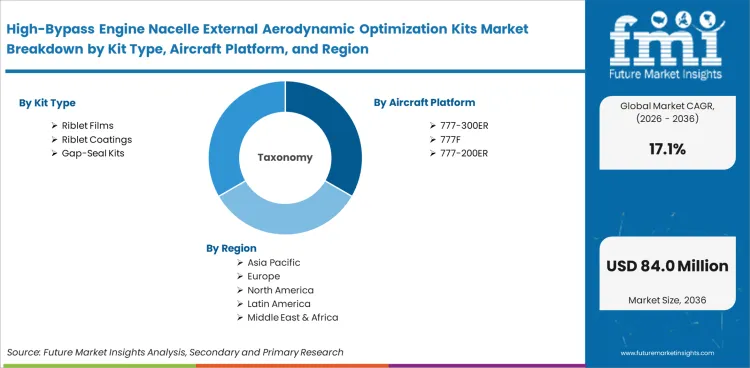
The market is divided into kit type, aircraft platform, installation path, material format, end user, and region. By kit type, it includes riblet films, riblet coatings, gap-seal kits, contour fairings, and vortex devices. By aircraft platform, it includes the 777-300ER, 777F, 777-200ER, A330-300, and A330-200. By installation path, it covers STC retrofit, MRO retrofit, trial installs, and fleet rollouts. By material format, it includes polymeric films, riblet paint, adhesive layers, and composite add-ons. By end user, it covers passenger airlines, cargo airlines, MRO providers, and lessors.
Insights into the Riblet Films Segment
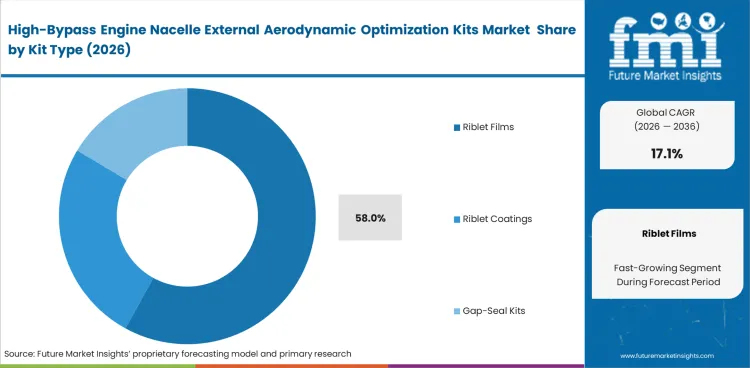
- In 2026, riblet films are expected to contribute 58.0% of total market share, supported by broad commercial visibility in airline retrofit programs and easier fit across current nacelle drag-reduction workflows.
- Riblet films hold the widest installed base in current nacelle optimization work as certified deployments have already moved beyond single-aircraft proof to wider fleet application.
Insights into the 777-300ER Segment
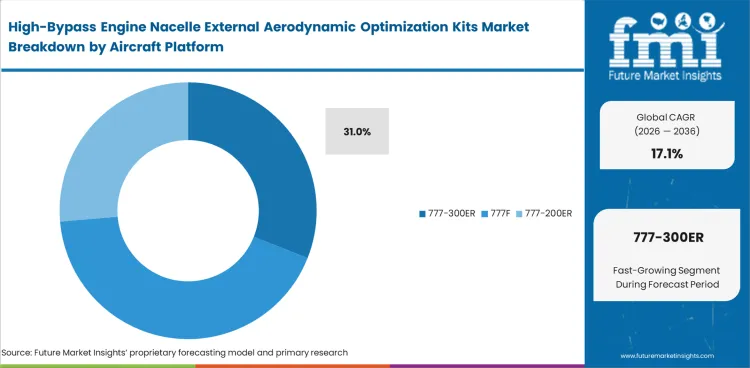
- The 777-300ER segment is likely to hold 31.0% share in 2026, because public rollout activity is concentrated in visible airline fleets and the platform has become the strongest proof point for current retrofit value.
- This market also includes 777F and 777-200ER along with A330ceo demand. Platform concentration still stays higher in the 777 family because certification depth and airline operating history are mature.
Insights into the STC Retrofit Segment
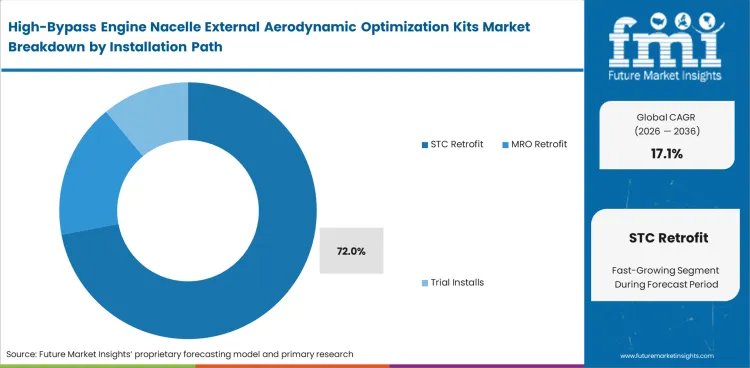
- STC retrofit is anticipated to capture 72.0% of the market in 2026, driven by approval-led installation and series modification suitability.
- Trial installs and MRO retrofit activity also create demand. STC retrofit holds a wider execution base because one approval path can support repeated application across a fleet and lower perceived risk in supplier selection.
Insights into the Passenger Airlines Segment
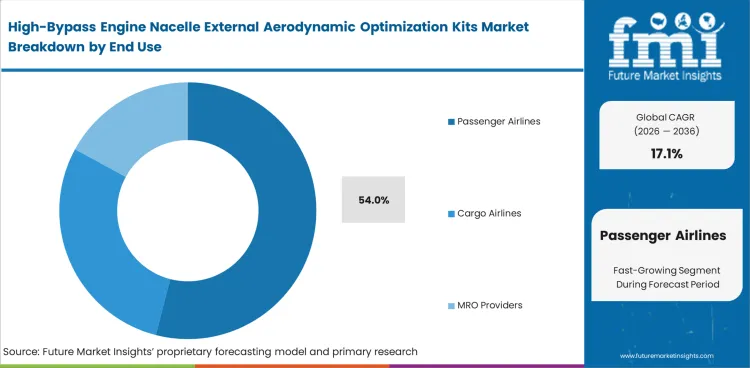
- Passenger airlines are set to represent 54.0% of market share in 2026, due to rising use in long-haul fleets with high annual cruise hours and visible public rollout.
- Cargo airlines and lessors are also driving demand. Passenger fleets provide higher commercial visibility and create early adoption momentum, while cargo operators strengthen the business case through fuel-economics discipline in cruise-heavy widebody freighter missions.
Insights into the Polymeric Films Segment
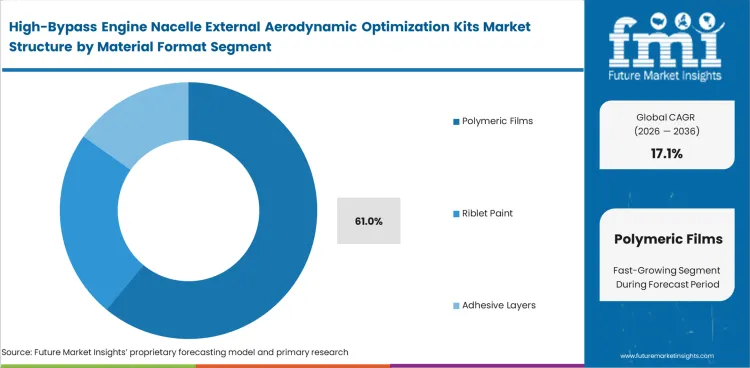
- Polymeric films are poised to garner 61.0% share in 2026, owing to current kit architecture and proven field use in certified airline retrofits.
- Riblet paint and composite add-ons broaden the development pipeline. Paint-based routes are receiving attention through Japan-based programs and wider surface-coverage trials.
High-Bypass Engine Nacelle External Aerodynamic Optimization Kits Market Drivers, Restraints, and Opportunities
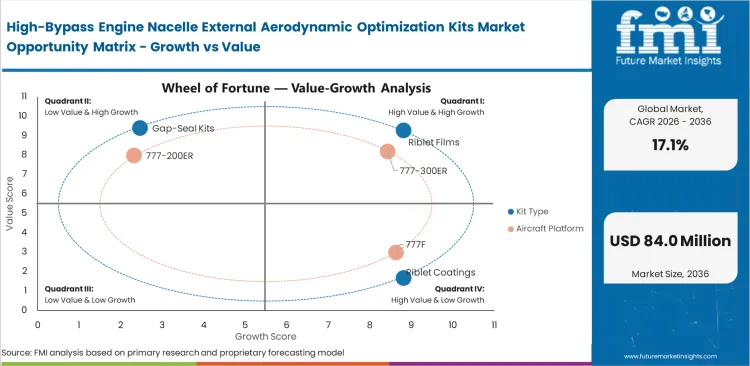
- Growth is supported by formal aircraft approval and long-haul fuel savings along with wider airline confidence in in-service drag reduction.
- Adoption is limited by narrow aircraft-family approval and certification cost in specialized aviation programs.
- Opportunity is expanding in A330ceo approval and broader nacelle-area coverage as well as riblet-coating routes linked with airline decarbonization.
This market is expected to expand steadily as airlines continue investing in cabin modernization and retrofit programs that improve passenger experience and operational efficiency. Demand is likely to be driven less by broad product variety and more by solutions that are certified, easy to integrate, and practical for large-scale fleet deployment. Suppliers that can prove reliability and support consistent maintenance performance across aircraft types are best positioned to capture future growth. In this environment, approval depth and long-term service durability will be the main factors shaping demand and supplier preference.
Qualification and Certification Constraints
Growth in aircraft modification programs depends on formal approval and airline engineering review before wider rollout. Supplier switching stays slower in this environment because installation continuity and maintenance execution carry more weight than small performance gains. Suppliers with proven retrofit history hold a stronger position because approval risk and execution risk are lower.
Surface-Technology Expansion Opportunity
Industry expansion is also propelled by wider surface coverage and new application routes. Broader riblet-coated area gains attention because one aircraft can deliver higher annual fuel and CO₂ savings without immediate fleet-wide expansion. Suppliers with scalable surface-application capability are better placed to capture this opportunity.
Analysis of High-Bypass Engine Nacelle External Aerodynamic Optimization Kits Market By Key Countries
.webp "Top Country Growth Comparison High Bypass Engine Nacelle External Aerodynamic Optimization Kits Market Cagr (2026 2036)")
| Country | CAGR |
|---|---|
| Japan | 18.6% |
| Chile | 18.1% |
| Taiwan | 17.8% |
| Austria | 17.4% |
| Germany | 16.8% |
| Switzerland | 15.2% |
| Singapore | 14.9% |
Source: FMI analysis based on primary research and proprietary forecasting model
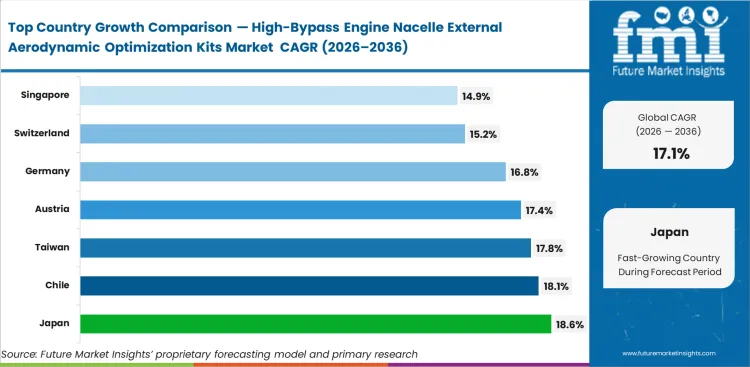
High-Bypass Engine Nacelle External Aerodynamic Optimization Kits Market CAGR Analysis By Country
- Demand for kits in Japan is anticipated to rise at a CAGR of 18.6% through 2036, supported by riblet-coating development and airline validation.
- Sales of kits in Chile are expected to increase at a CAGR of 18.1% during the forecast period, driven by LATAM fleet expansion and visible operating proof.
- The market in Taiwan is poised to expand at a CAGR of 17.8% through 2036, due to EVA Air cargo-fleet activity and long-haul freighter economics.
- Austria is set to record a CAGR of 17.4% in the market during the assessment period, due to Boeing 777-200ER approval and Austrian Airlines fitment.
- Product adoption in Germany is likely to advance at a CAGR of 16.8% by 2036, owing to supplier development activity and certification execution.
- Switzerland is projected to witness 15.2% CAGR in the high-bypass engine nacelle external aerodynamic optimization kits market through 2036.
- Singapore is likely to post a CAGR of 14.9% in high-bypass engine nacelle external aerodynamic optimization kits market by 2036.
The global market for high‑bypass engine nacelle external aerodynamic optimization kits is expected to grow at a CAGR of 17.1% from 2026 to 2036. The study covers more than 30 countries, with demand concentrated across established installed‑base hubs and faster‑growing airline retrofit markets. The key country markets contributing to this growth are outlined below.
Demand Outlook for High-Bypass Engine Nacelle External Aerodynamic Optimization Kits in Japan
Japan records one of the fastest growth rates in this market because riblet work has moved from research into airline use. Demand for high-bypass engine nacelle external aerodynamic optimization kits in Japan is forecast to rise at 18.6% CAGR through 2036, supported by JAXA-linked coating work and ANA operations with AeroSHARK. Supplier access improves where both film and coating pathways are active.
- Government-backed research builds trust in the technology.
- Use by ANA and JAL helps the airlines and suppliers get noticed.
- Strong local supply capabilities support future expansion.
Future Outlook for High-Bypass Engine Nacelle External Aerodynamic Optimization Kits in Chile
Chile records high growth in the market because LATAM fleet rollout and validated savings are increasing. Sales of high-bypass engine nacelle external aerodynamic optimization kits in Chile are expected to increase at a CAGR of 18.1% during the forecast period, driven by fleet-wide extension and fuel-efficiency gains.
- LATAM’s fleet growth increases demand for retrofits.
- A strong widebody fleet makes fuel savings easier to justify.
- Using the kits across entire subfleets builds confidence in performance.
Opportunity Analysis of High-Bypass Engine Nacelle External Aerodynamic Optimization Kits Market in Taiwan
The Taiwan market is supported by freighter activity and cargo-route economics as well as EVA Air deployment. The high-bypass engine nacelle external aerodynamic optimization kits market in Taiwan is poised to expand at a CAGR of 17.8% through 2036, owing to higher fuel-savings value in 777F operations. Low downtime and repeatable retrofit planning improve supplier position in this market.
- Cargo operations propels the demand in Taiwan.
- Freighter fleets are well suited for repeat retrofit installations.
- Use on 777F aircraft strengthens real-world commercial value.
In-depth Analysis of High-Bypass Engine Nacelle External Aerodynamic Optimization Kits Market in Austria
Austria growth is driven by approvals for Boeing 777-200ER and long-haul airline fitment. Austria is set to record a CAGR of 17.4% in high-bypass engine nacelle external aerodynamic optimization kits market during the assessment period, supported by Austria Airlines deployment and route-level fuel savings. High-spec fleet programs support stronger premium retrofit value across certified upgrade and replacement activity.
- Approval for the 777-200ER opens up new sales opportunities.
- Airline adoption favors suppliers with proven results.
- Long-haul routes help maintain strong fuel‑saving benefits.
Sales Analysis of High-Bypass Engine Nacelle External Aerodynamic Optimization Kits Market in Germany
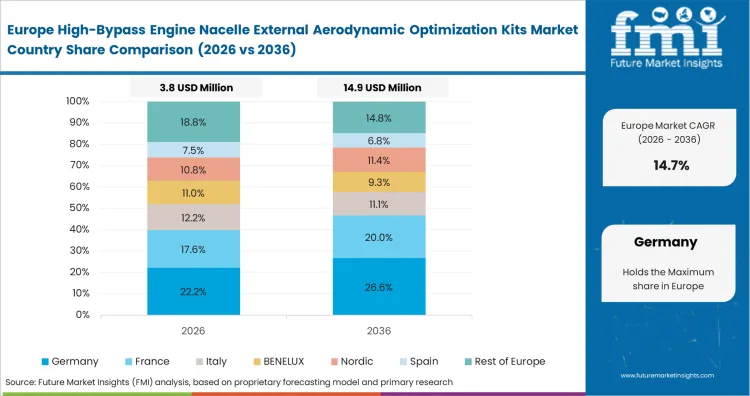
Germany gains support from strong supplier concentration and active certification work. High-bypass engine nacelle external aerodynamic optimization kits adoption in Germany is likely to advance at a CAGR of 16.8% by 2036 because engineering ownership and approval-led commercialization are concentrated there. Installed-base effect is smaller than strategic influence in this market.
- A dense supplier base supports technical expertise and leadership.
- Ongoing certification work creates future growth opportunities.
Strong engineering involvement keeps Germany influential in the market.
Demand Outlook for High-Bypass Engine Nacelle External Aerodynamic Optimization Kits Market in Switzerland
Switzerland supports a visible installed base because SWISS has equipped its Boeing 777-300ER fleet with AeroSHARK. Switzerland is forecast to record 15.2% CAGR through 2036 because fleet-wide use provides direct operating proof and service visibility. That service history lowers adoption risk for later retrofit programs.
- Equipping the full fleet builds strong operator confidence.
- Long-haul operations highlight fuel‑saving benefits.
- Proven service history reduces concerns for new adopters.
Future Outlook for High-Bypass Engine Nacelle External Aerodynamic Optimization Kits Market in Singapore
Singapore is estimated to expand at a steady rate in this market because of regional MRO depth and aviation service culture. The market for high-bypass engine nacelle external aerodynamic optimization kits in Singapore is expected to grow at a CAGR of 14.9% during the study period because execution value in Asia-Pacific retrofit programs supports demand. Demand is stronger in technical-service roles than in direct airline fleet rollout.
- Strong MRO capability allows flexible and efficient installation.
- Regional service strength helps suppliers reach more customers.
- Airline fleet usage is lower compared to faster‑growing markets.
Competitive Landscape and Strategic Positioning
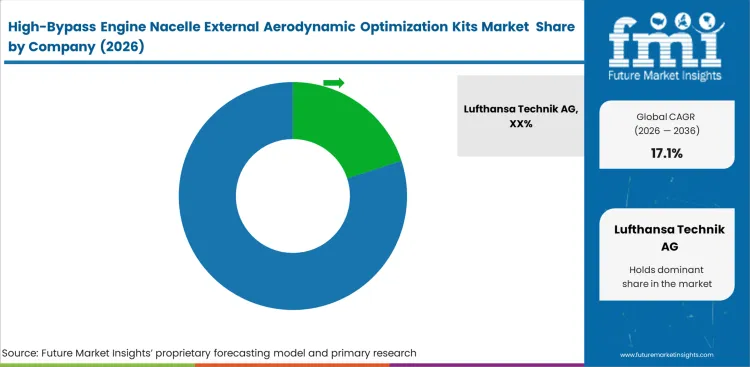
- Competition is shaped by certification depth and retrofit execution. It is also shaped by riblet-surface capability and airline confidence in service performance.
- Large suppliers gain advantage from broader approval pathways and technical literature visibility along with multi-airline retrofit access.
- New entrants face a higher barrier because drag reduction and durability as well as installation repeatability must work together inside commercial aviation programs.
Competition in the high-bypass engine nacelle external aerodynamic optimization kits market is driven by certification capability and airline program credibility. Suppliers gain advantage when they can show repeat fuel-saving performance and durable surface application on Boeing 777 platforms. Position also depends on how well the kit fits nacelle geometry and maintenance routines.
Market entry remains difficult because aircraft modification programs require formal approvaland airline-side validation before wider adoption. Certification effort, installation planning, and long service-life expectations add further barriers, favoring suppliers with proven retrofit experience and established aerospace support capability.
Key Companies in the High-Bypass Engine Nacelle External Aerodynamic Optimization Kits Market
Key global companies leading the high-bypass engine nacelle external aerodynamic optimization kits market include:
- Broad certified retrofit leaders: Lufthansa Technik AG, BASF Coatings GmbH
- Riblet coating and surface-application specialists: O-WELL CORPORATION, Nikon Corporation
- Emerging riblet and drag-reduction technology suppliers: MAKO, HAECO Group, Japan Airlines Co., Ltd.
Competitive Benchmarking: High-Bypass Engine Nacelle External Aerodynamic Optimization Kits
| Company | Certification Depth | Airline Validation | Retrofit Execution | Geographic Footprint |
|---|---|---|---|---|
| Lufthansa Technik AG | High | High | Strong | Global |
| BASF Coatings GmbH | High | Medium | Medium | Global |
| O-WELL CORPORATION | Medium | Medium | Medium | Japan |
| Nikon Corporation | Medium | Medium | Medium | Japan |
| MAKO | Medium | Medium | Medium | North America |
Source: Future Market Insights competitive analysis, 2026. Ratings reflect relative positioning based on certification depth, airline validation, retrofit execution, and stated market reach.
Key Developments in High-Bypass Engine Nacelle External Aerodynamic Optimization Kits
- In September, 2024, All Nippon Airways introduced their first AeroSHARK aircraft, pioneering fuel-saving innovation by Lufthansa Technik and BASF marked the first Boeing 777 in ANA service equipped with AeroSHARK and broadened airline-side proof for the market. [1]
- In August, 2025, Lufthansa Technik started AeroSHARK certification process for A330s extended the platform roadmap beyond Boeing 777 and improved the next growth layer for nacelle-focused retrofit demand. [2]
- In February, 2026, LATAM extended AeroSHARK use across its entire Boeing 777 fleet widened airline adoption and strengthened proof of repeat commercial value outside Lufthansa Group carriers. [3]
Key Players in the High-Bypass Engine Nacelle External Aerodynamic Optimization Kits
Major Global Players:
- Lufthansa Technik AG
- BASF Coatings GmbH
Emerging Players/Startups
- MAKO
- O-WELL CORPORATION
Report Scope and Coverage
| Parameter | Details |
|---|---|
| Quantitative Units | USD Million |
| Market Definition | Approved retrofit systems used to reduce drag on nacelle exterior surfaces of high-bypass commercial aircraft engines |
| Regions Covered | North America, Latin America, Europe, Asia Pacific, Middle East & Africa |
| Countries Covered | Japan, Chile, Taiwan, Austria, Germany, Switzerland, Singapore |
| Key Companies Profiled | Lufthansa Technik AG, BASF Coatings GmbH, O-WELL CORPORATION, Nikon Corporation, MAKO, HAECO Group, Japan Airlines Co., Ltd. |
| Forecast Period | 2026 - 2036 |
| Approach | Primary research, desk research, segment modeling, and proprietary forecasting |
High-Bypass Engine Nacelle External Aerodynamic Optimization Kits Market by Segments
High-Bypass Engine Nacelle External Aerodynamic Optimization Kits Market Segmented by Kit Type:
- Riblet Films
- Riblet Coatings
- Gap-Seal Kits
- Contour Fairings
- Vortex Devices
High-Bypass Engine Nacelle External Aerodynamic Optimization Kits Market Segmented by Aircraft Platform:
- 777-300ER
- 777F
- 777-200ER
- A330-300
- A330-200
High-Bypass Engine Nacelle External Aerodynamic Optimization Kits Market Segmented by Installation Path:
- STC Retrofit
- MRO Retrofit
- Trial Installs
- Fleet Rollouts
High-Bypass Engine Nacelle External Aerodynamic Optimization Kits Market Segmented by Material Format:
- Polymeric Films
- Riblet Paint
- Adhesive Layers
- Composite Add-ons
High-Bypass Engine Nacelle External Aerodynamic Optimization Kits Market Segmented by End User:
- Passenger Airlines
- Cargo Airlines
- MRO Providers
- Lessors
High-Bypass Engine Nacelle External Aerodynamic Optimization Kits Market Segmented by Region:
- North America
- USA
- Canada
- Mexico
- Latin America
- Brazil
- Chile
- Rest of Latin America
- Western Europe
- Germany
- UK
- Italy
- Spain
- France
- Nordic
- BENELUX
- Rest of Western Europe
- Eastern Europe
- Russia
- Poland
- Hungary
- Balkan & Baltic
- Rest of Eastern Europe
- East Asia
- China
- Japan
- South Korea
- South Asia and Pacific
- India
- ASEAN
- Australia & New Zealand
- Rest of South Asia and Pacific
- Middle East & Africa
- Kingdom of Saudi Arabia
- Other GCC Countries
- Turkiye
- South Africa
- Other African Union
- Rest of Middle East & Africa
Research Sources and Bibliography
- Lufthansa Technik AG. (2024, September 1). All Nippon Airways introduces their first AeroSHARK aircraft, pioneering fuel-saving innovation by Lufthansa Technik and BASF.
- Lufthansa Technik AG. (2025, August 12). Lufthansa Technik starts AeroSHARK certification process for A330s.
- Lufthansa Technik AG. (2026, February 5). LATAM extends AeroSHARK use across its entire Boeing 777 fleet.
- Japan Aerospace Exploration Agency. (2025, January). World's First Aircraft with Large-Scale Riblet Coating Introduced on International Routes.
- Japan Aerospace Exploration Agency, Japan Airlines Co., Ltd., ZIPAIR Tokyo Inc., and O-WELL CORPORATION. (2026, January). First Application of Riblet-shaped Paint to ZIPAIR Aircraft.
- European Union Aviation Safety Agency. (2024, July). Easy Access Rules for Initial Airworthiness and Environmental Protection (Regulation (EU) No 748/2012).
- International Civil Aviation Organization. (2025, June). Realizing Aviation's Sustainable Future.
- Qian Ma, Yiran Wang, Yuhao Deng, Wenzheng Xu, Zhuoran Xu, Xiaolei Guo, and Leichao Xiao. (2025, November). Experimental Investigation on Drag Reduction Performance of Biomimetic V-Groove Riblets on a High-Lift Wing Model.
This Report Answers
- How large is the high-bypass engine nacelle external aerodynamic optimization kits market in 2025?
- What revenue level is projected for 2036?
- What CAGR is expected across 2026 to 2036?
- Which kit type leads current revenue contribution?
- Why do Boeing 777 variants dominate fitment depth?
- What role does STC retrofit play in future sourcing?
- Why does Japan lead country growth?
- What limits wider expansion across added aircraft families?
- Which suppliers hold stronger certification depth?
- How does airline engineering review shape entry barriers?
- Which material formats gain wider use in current retrofit programs?
- What installation path controls most current revenue?
Frequently Asked Questions
What are high-bypass engine nacelle external aerodynamic optimization kits?
Approved retrofit systems used on nacelle exterior surfaces to reduce drag during cruise and improve fuel efficiency.
Why do airlines use these kits?
Airlines use them for fuel-burn savings and emissions reduction along with route-level operating improvement.
Why are riblet films gaining more attention?
Film-based systems already have certified airline deployment and clearer service history in current commercial fleets.
Do these kits apply to every aircraft family?
No. Each aircraft family needs its own approval path and engineering validation.
Which platform creates most demand?
Boeing 777 variants create most demand because certification and public rollout are strongest there.
Which country grows fastest?
Japan records the highest forecast CAGR in this article.
Why is broad supplier entry difficult?
Certification effort and installation planning along with airline confidence makes entry barriers high.
Which suppliers matter most?
Suppliers with certification depth and retrofit execution as well as service credibility matter most.
What is the main restraint?
Narrow aircraft-family approval limits faster expansion across the category.
What makes future demand healthy?
A330ceo certification work and riblet-coating progress as well as long-haul fuel economics makes demand healthy.
Preview the report firsthand - request a free sample
Get SampleGet the brochure for pricing and purchase details.
Get PDFTable of Content
- Key Takeaways
- Market Size and CAGR
- Top Growth Driver
- Fastest Growing Segment
- Leading Region
- Key Companies
- Emerging Opportunities
- Executive Summary
- Global Market Outlook
- Demand-side Trends
- Supply-side Trends
- Technology Roadmap Analysis
- Analysis and Recommendations
- Analyst Perspective (What is happening? Why now? What should investors know?)
- Key Questions Answered
- How large is the market?
- What is the CAGR?
- What are key trends?
- Which region dominates?
- Who are the leaders?
- Market Overview
- Market Coverage / Taxonomy
- Market Definition / Scope / Limitations
- Research Methodology
- Chapter Orientation
- Analytical Lens and Working Hypotheses
- Market Structure, Signals, and Trend Drivers
- Benchmarking and Cross-market Comparability
- Market Sizing, Forecasting, and Opportunity Mapping
- Research Design and Evidence Framework
- Desk Research Programme (Secondary Evidence)
- Expert Input and Fieldwork (Primary Evidence)
- Tooling, Models, and Reference Databases
- Data Engineering and Model Build
- Quality Assurance and Audit Trail
- Market Background
- Market Dynamics (Drivers, Restraints, Opportunity, Trends)
- Scenario Forecast (Optimistic, Likely, Conservative)
- Impact Analysis
- AI Impact
- Sustainability Impact
- Regulatory Impact
- Technology Impact
- Consumer / Buyer Analysis
- Purchase Drivers
- Adoption Barriers
- Buyer Journey
- Opportunity Map Analysis
- Product Life Cycle Analysis
- Supply Chain Analysis
- Investment Feasibility Matrix
- Value Chain Analysis
- PESTLE and Porter's Analysis
- Regulatory Landscape
- Regional Parent Market Outlook
- Production and Consumption Statistics
- Import and Export Statistics
- Global Market Analysis and Forecast, 2021 to 2036
- Historical Market Size Value (USD Million) & Volume (Unit) Analysis, 2021 to 2025
- Current and Future Market Size Value (USD Million) & Volume (Unit) Projections, 2026 to 2036
- Y-o-Y Growth Trend Analysis
- Absolute $ Opportunity Analysis
- Global Market Pricing Analysis, 2021 to 2036
- Global Market Analysis and Forecast, By Kit Type, 2021 to 2036
- Introduction / Key Findings
- Historical Market Size Value (USD Million) & Volume (Unit) Analysis By Kit Type, 2021 to 2025
- Current and Future Market Size Value (USD Million) & Volume (Unit) Analysis and Forecast By Kit Type, 2026 to 2036
- Riblet Films
- Riblet Coatings
- Gap-Seal Kits
- Contour Fairings
- Vortex Devices
- Riblet Films
- Y-o-Y Growth Trend Analysis By Kit Type, 2021 to 2025
- Absolute $ Opportunity Analysis By Kit Type, 2026 to 2036
- Global Market Analysis and Forecast, By Aircraft Platform, 2021 to 2036
- Introduction / Key Findings
- Historical Market Size Value (USD Million) & Volume (Unit) Analysis By Aircraft Platform, 2021 to 2025
- Current and Future Market Size Value (USD Million) & Volume (Unit) Analysis and Forecast By Aircraft Platform, 2026 to 2036
- 777-300ER
- 777F
- 777-200ER
- A330-300
- A330-200
- 777-300ER
- Y-o-Y Growth Trend Analysis By Aircraft Platform, 2021 to 2025
- Absolute $ Opportunity Analysis By Aircraft Platform, 2026 to 2036
- Global Market Analysis and Forecast, By Installation Path, 2021 to 2036
- Introduction / Key Findings
- Historical Market Size Value (USD Million) & Volume (Unit) Analysis By Installation Path, 2021 to 2025
- Current and Future Market Size Value (USD Million) & Volume (Unit) Analysis and Forecast By Installation Path, 2026 to 2036
- STC Retrofit
- MRO Retrofit
- Trial Installs
- Fleet Rollouts
- STC Retrofit
- Y-o-Y Growth Trend Analysis By Installation Path, 2021 to 2025
- Absolute $ Opportunity Analysis By Installation Path, 2026 to 2036
- Global Market Analysis and Forecast, By Material Format, 2021 to 2036
- Introduction / Key Findings
- Historical Market Size Value (USD Million) & Volume (Unit) Analysis By Material Format, 2021 to 2025
- Current and Future Market Size Value (USD Million) & Volume (Unit) Analysis and Forecast By Material Format, 2026 to 2036
- Polymeric Films
- Riblet Paint
- Adhesive Layers
- Composite Add-ons
- Polymeric Films
- Y-o-Y Growth Trend Analysis By Material Format, 2021 to 2025
- Absolute $ Opportunity Analysis By Material Format, 2026 to 2036
- Global Market Analysis and Forecast, By End User, 2021 to 2036
- Introduction / Key Findings
- Historical Market Size Value (USD Million) & Volume (Unit) Analysis By End User, 2021 to 2025
- Current and Future Market Size Value (USD Million) & Volume (Unit) Analysis and Forecast By End User, 2026 to 2036
- Passenger Airlines
- Cargo Airlines
- MRO Providers
- Lessors
- Passenger Airlines
- Y-o-Y Growth Trend Analysis By End User, 2021 to 2025
- Absolute $ Opportunity Analysis By End User, 2026 to 2036
- Global Market Analysis and Forecast, By Region, 2021 to 2036
- Introduction
- Historical Market Size Value (USD Million) & Volume (Unit) Analysis By Region, 2021 to 2025
- Current Market Size Value (USD Million) & Volume (Unit) Analysis and Forecast By Region, 2026 to 2036
- North America
- Latin America
- Western Europe
- Eastern Europe
- East Asia
- South Asia and Pacific
- Middle East & Africa
- Market Attractiveness Analysis By Region
- North America Market Analysis and Forecast, By Country, 2021 to 2036
- Historical Market Size Value (USD Million) & Volume (Unit) Trend Analysis By Market Taxonomy, 2021 to 2025
- Market Size Value (USD Million) & Volume (Unit) Forecast By Market Taxonomy, 2026 to 2036
- By Country
- USA
- Canada
- Mexico
- By Kit Type
- By Aircraft Platform
- By Installation Path
- By Material Format
- By End User
- By Country
- Market Attractiveness Analysis
- By Country
- By Kit Type
- By Aircraft Platform
- By Installation Path
- By Material Format
- By End User
- Key Takeaways
- Latin America Market Analysis and Forecast, By Country
- Historical Market Size Value (USD Million) & Volume (Unit) Trend Analysis By Market Taxonomy, 2021 to 2025
- Market Size Value (USD Million) & Volume (Unit) Forecast By Market Taxonomy, 2026 to 2036
- By Country
- Brazil
- Chile
- Rest of Latin America
- By Kit Type
- By Aircraft Platform
- By Installation Path
- By Material Format
- By End User
- By Country
- Market Attractiveness Analysis
- By Country
- By Kit Type
- By Aircraft Platform
- By Installation Path
- By Material Format
- By End User
- Key Takeaways
- Western Europe Market Analysis and Forecast, By Country
- Historical Market Size Value (USD Million) & Volume (Unit) Trend Analysis By Market Taxonomy, 2021 to 2025
- Market Size Value (USD Million) & Volume (Unit) Forecast By Market Taxonomy, 2026 to 2036
- By Country
- Germany
- UK
- Italy
- Spain
- France
- Nordic
- BENELUX
- Rest of Western Europe
- By Kit Type
- By Aircraft Platform
- By Installation Path
- By Material Format
- By End User
- By Country
- Market Attractiveness Analysis
- By Country
- By Kit Type
- By Aircraft Platform
- By Installation Path
- By Material Format
- By End User
- Key Takeaways
- Eastern Europe Market Analysis and Forecast, By Country
- Historical Market Size Value (USD Million) & Volume (Unit) Trend Analysis By Market Taxonomy, 2021 to 2025
- Market Size Value (USD Million) & Volume (Unit) Forecast By Market Taxonomy, 2026 to 2036
- By Country
- Russia
- Poland
- Hungary
- Balkan & Baltic
- Rest of Eastern Europe
- By Kit Type
- By Aircraft Platform
- By Installation Path
- By Material Format
- By End User
- By Country
- Market Attractiveness Analysis
- By Country
- By Kit Type
- By Aircraft Platform
- By Installation Path
- By Material Format
- By End User
- Key Takeaways
- East Asia Market Analysis and Forecast, By Country
- Historical Market Size Value (USD Million) & Volume (Unit) Trend Analysis By Market Taxonomy, 2021 to 2025
- Market Size Value (USD Million) & Volume (Unit) Forecast By Market Taxonomy, 2026 to 2036
- By Country
- China
- Japan
- South Korea
- By Kit Type
- By Aircraft Platform
- By Installation Path
- By Material Format
- By End User
- By Country
- Market Attractiveness Analysis
- By Country
- By Kit Type
- By Aircraft Platform
- By Installation Path
- By Material Format
- By End User
- Key Takeaways
- South Asia and Pacific Market Analysis and Forecast, By Country
- Historical Market Size Value (USD Million) & Volume (Unit) Trend Analysis By Market Taxonomy, 2021 to 2025
- Market Size Value (USD Million) & Volume (Unit) Forecast By Market Taxonomy, 2026 to 2036
- By Country
- India
- ASEAN
- Australia & New Zealand
- Rest of South Asia and Pacific
- By Kit Type
- By Aircraft Platform
- By Installation Path
- By Material Format
- By End User
- By Country
- Market Attractiveness Analysis
- By Country
- By Kit Type
- By Aircraft Platform
- By Installation Path
- By Material Format
- By End User
- Key Takeaways
- Middle East & Africa Market Analysis and Forecast, By Country
- Historical Market Size Value (USD Million) & Volume (Unit) Trend Analysis By Market Taxonomy, 2021 to 2025
- Market Size Value (USD Million) & Volume (Unit) Forecast By Market Taxonomy, 2026 to 2036
- By Country
- Kingdom of Saudi Arabia
- Other GCC Countries
- Türkiye
- South Africa
- Other African Union
- Rest of Middle East & Africa
- By Kit Type
- By Aircraft Platform
- By Installation Path
- By Material Format
- By End User
- By Country
- Market Attractiveness Analysis
- By Country
- By Kit Type
- By Aircraft Platform
- By Installation Path
- By Material Format
- By End User
- Key Takeaways
- Key Countries Market Analysis
- USA
- Pricing Analysis
- Market Share Analysis, 2025
- By Kit Type
- By Aircraft Platform
- By Installation Path
- By Material Format
- By End User
- Canada
- Pricing Analysis
- Market Share Analysis, 2025
- By Kit Type
- By Aircraft Platform
- By Installation Path
- By Material Format
- By End User
- Mexico
- Pricing Analysis
- Market Share Analysis, 2025
- By Kit Type
- By Aircraft Platform
- By Installation Path
- By Material Format
- By End User
- Brazil
- Pricing Analysis
- Market Share Analysis, 2025
- By Kit Type
- By Aircraft Platform
- By Installation Path
- By Material Format
- By End User
- Chile
- Pricing Analysis
- Market Share Analysis, 2025
- By Kit Type
- By Aircraft Platform
- By Installation Path
- By Material Format
- By End User
- Germany
- Pricing Analysis
- Market Share Analysis, 2025
- By Kit Type
- By Aircraft Platform
- By Installation Path
- By Material Format
- By End User
- UK
- Pricing Analysis
- Market Share Analysis, 2025
- By Kit Type
- By Aircraft Platform
- By Installation Path
- By Material Format
- By End User
- Italy
- Pricing Analysis
- Market Share Analysis, 2025
- By Kit Type
- By Aircraft Platform
- By Installation Path
- By Material Format
- By End User
- Spain
- Pricing Analysis
- Market Share Analysis, 2025
- By Kit Type
- By Aircraft Platform
- By Installation Path
- By Material Format
- By End User
- France
- Pricing Analysis
- Market Share Analysis, 2025
- By Kit Type
- By Aircraft Platform
- By Installation Path
- By Material Format
- By End User
- India
- Pricing Analysis
- Market Share Analysis, 2025
- By Kit Type
- By Aircraft Platform
- By Installation Path
- By Material Format
- By End User
- ASEAN
- Pricing Analysis
- Market Share Analysis, 2025
- By Kit Type
- By Aircraft Platform
- By Installation Path
- By Material Format
- By End User
- Australia & New Zealand
- Pricing Analysis
- Market Share Analysis, 2025
- By Kit Type
- By Aircraft Platform
- By Installation Path
- By Material Format
- By End User
- China
- Pricing Analysis
- Market Share Analysis, 2025
- By Kit Type
- By Aircraft Platform
- By Installation Path
- By Material Format
- By End User
- Japan
- Pricing Analysis
- Market Share Analysis, 2025
- By Kit Type
- By Aircraft Platform
- By Installation Path
- By Material Format
- By End User
- South Korea
- Pricing Analysis
- Market Share Analysis, 2025
- By Kit Type
- By Aircraft Platform
- By Installation Path
- By Material Format
- By End User
- Russia
- Pricing Analysis
- Market Share Analysis, 2025
- By Kit Type
- By Aircraft Platform
- By Installation Path
- By Material Format
- By End User
- Poland
- Pricing Analysis
- Market Share Analysis, 2025
- By Kit Type
- By Aircraft Platform
- By Installation Path
- By Material Format
- By End User
- Hungary
- Pricing Analysis
- Market Share Analysis, 2025
- By Kit Type
- By Aircraft Platform
- By Installation Path
- By Material Format
- By End User
- Kingdom of Saudi Arabia
- Pricing Analysis
- Market Share Analysis, 2025
- By Kit Type
- By Aircraft Platform
- By Installation Path
- By Material Format
- By End User
- Türkiye
- Pricing Analysis
- Market Share Analysis, 2025
- By Kit Type
- By Aircraft Platform
- By Installation Path
- By Material Format
- By End User
- South Africa
- Pricing Analysis
- Market Share Analysis, 2025
- By Kit Type
- By Aircraft Platform
- By Installation Path
- By Material Format
- By End User
- USA
- Market Structure Analysis
- Competition Dashboard
- Competition Benchmarking
- Market Share Analysis of Top Players
- By Regional
- By Kit Type
- By Aircraft Platform
- By Installation Path
- By Material Format
- By End User
- Emerging Startups
- Innovation Benchmarking
- Competition Analysis
- Competition Deep Dive
- Lufthansa Technik AG
- Overview
- Product Portfolio
- Profitability by Market Segments (Product/Region/Sales Channel)
- Sales Footprint
- Strategy Overview
- Marketing Strategy
- Product Strategy
- Channel Strategy
- BASF Coatings GmbH
- O-WELL CORPORATION
- Nikon Corporation
- MAKO
- HAECO Group
- Japan Airlines Co., Ltd.
- Lufthansa Technik AG
- Case Studies
- Success Stories
- Recent Developments
- Competition Deep Dive
- Assumptions & Acronyms Used


