

- Industry Size (2026)
- USD 413 Mn
- Forecast (2036)
- USD 2161.6 Mn
- CAGR (2026 to 2036)
- 18.0%
NACS Retrofit Kits Markets Forecast and Outlook (2026 to 2036)
The NACS retrofit kits market is projected to expand from USD 413 million in 2026 to USD 2,161.6 million by 2036, registering a CAGR of 18.0%. Its upside is anchored in conversion economics: retrofitting is materially cheaper and faster than replacing vehicles or charging assets, allowing fleets and operators to protect prior investments while improving utilization. Demand strength, however, is uneven and execution-sensitive. Adoption depends heavily on certification readiness, installer capacity, and OEM approval, all of which can slow deployment timelines. Fragmentation across legacy charger designs and vehicle architectures introduces integration risk, limiting the addressable scope of standardized kits. Pricing pressure is also rising as competition intensifies and buyers compare retrofit costs against declining prices of next-generation NACS-native hardware. As a result, growth quality will favor suppliers that manage regulatory compliance, software compatibility, and field reliability at scale, rather than those relying solely on volume expansion or short-term network momentum.
Quick Stats for NACS Retrofit Kits Market
- NACS Retrofit Kits Market Value (2026): USD 413 Million
- NACS Retrofit Kits Market Forecast Value (2036): USD 2,161.6 Million
- NACS Retrofit Kits Market Forecast CAGR (2026 to 2036): 18.0%
- Leading Vehicle Group in NACS Retrofit Kits Market: Passenger Electric Vehicles (72% share)
- Key Growth Regions in NACS Retrofit Kits Market: Asia Pacific, Europe, North America, Latin America, Middle East & Africa
- Top Key Players in NACS Retrofit Kits Market: Tesla, Lectron, A2Z EV, Emporia, ChargePoint (HW kits), EVgo (partner kits), Siemens eMobility, ABB E-Mobility, Grizzl-E, Juice Technology (Juice Booster)
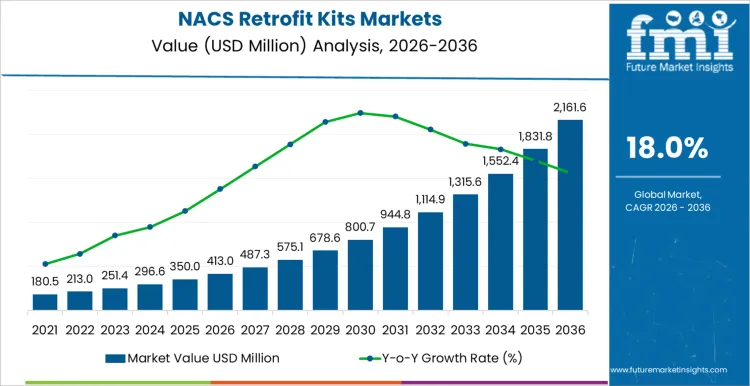
NACS Retrofit Kits Market Key Takeaways
| Metric | Value |
|---|---|
| NACS Retrofit Kits Market Value (2026) | USD 413 Million |
| NACS Retrofit Kits Market Forecast Value (2036) | USD 2,161.6 Million |
| NACS Retrofit Kits Market Forecast CAGR (2026 to 2036) | 18.00% |
How Are Installed-Base Conversion and Fast-Track Access Driving the NACS Retrofit Kits Market?
The NACS retrofit kits market is accelerating as EV owners, fleets, and charging operators seek immediate access to expanding NACS-based charging networks without waiting for new vehicle platforms or charger replacements. Retrofit kits provide a pragmatic bridge converting existing CCS or proprietary interfaces to NACS unlocking network compatibility and reducing range anxiety. For suppliers, demand is anchored in speed: rapid certification, simple installation, and minimal vehicle downtime are decisive buying factors.
Commercial momentum is being shaped by channel strategy and validation depth. OEM-approved kits, fleet-qualified solutions, and installer-ready packages are gaining traction over DIY options as buyers prioritize safety, warranty continuity, and predictable performance. Suppliers that offer end-to-end kits connectors, harnesses, firmware updates, thermal safeguards, and documentation shorten deployment cycles and win bulk orders from fleets and charging operators. Training programs and authorized installer networks are becoming critical go-to-market levers.
Economics and scalability are further amplifying adoption. Compared with replacing vehicles or chargers, retrofits deliver a lower-capex path to network access and utilization gains. As standards converge, procurement favors suppliers with automotive-grade components, PPAP/validation artifacts, and multi-region supply. For manufacturers and distributors, competitive advantage increasingly depends on certification readiness, installer partnerships, and the ability to scale SKUs across vehicle models positioning NACS retrofit kits as a high-growth, conversion-led segment in the EV charging ecosystem.
How Is The NACS Retrofit Kits Market Structured By Vehicle Group And Channel?
The nacs retrofit kits market is segmented by vehicle group and channel, reflecting how installed vehicle base, warranty considerations, and retrofit complexity shape adoption patterns. By vehicle group, passenger electric vehicles dominate demand, supported by a large on-road population of non-native NACS vehicles seeking compatibility with expanded charging infrastructure. Other vehicle groups include light commercial vehicles and niche EV segments with lower retrofit volumes. By channel, OEM or authorized service networks lead installations, while independent workshops and direct-to-consumer channels serve cost-sensitive users and older vehicle models where warranty constraints are less restrictive.
Why Do Passenger Electric Vehicles Lead The NACS Retrofit Kits Market By Vehicle Group?

Passenger electric vehicles account for 72% share of the nacs retrofit kits market because they represent the largest and fastest-growing installed base of EVs requiring charging standard alignment. Many early and mid-generation passenger EVs were launched with non-NACS connectors, creating retrofit demand as NACS charging access expands. Owners prioritize compatibility to reduce charging friction and improve network availability. Retrofit kits for passenger EVs are typically standardized, enabling higher volumes and repeat installations. High daily usage amplifies the value of charging flexibility. These installed-base scale, usability, and standardization factors explain why passenger EVs dominate retrofit demand.
Why Do OEM Or Authorized Service Channels Lead NACS Retrofit Installations?
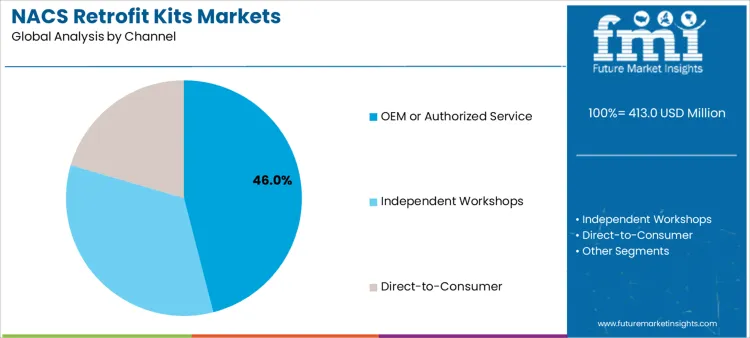
OEM or authorized service channels hold 46% share of the nacs retrofit kits market because retrofit work often involves high-voltage systems, firmware updates, and safety validation. Vehicle owners prefer authorized channels to protect warranties and ensure compatibility with onboard charging and thermal systems. OEM-backed installations reduce risk of connector faults, software conflicts, and regulatory non-compliance. Automakers also use authorized channels to control retrofit quality and manage liability. For retrofit kit suppliers, OEM partnerships enable structured rollouts and predictable volumes. These safety, warranty, and quality-control considerations explain the dominance of OEM and authorized service channels.
What Are The Key Dynamics Of The NACS Retrofit Kits Market?
The NACS retrofit kits market is driven by the broad adoption of the North American Charging Standard (NACS) as EV charging infrastructure and vehicle OEMs standardize on a common connector and communication protocol. Retrofit kits enable owners of older EVs, public charging stations, workplaces, fleets, and multi-unit dwellings to upgrade existing hardware to be compatible with NACS sockets without replacing entire charging units. For kit manufacturers, compatibility with legacy charging protocols (such as CCS1), electrical reliability, safety certifications, ease of installation, and cost effectiveness are central to customer adoption and retrofit success. Strong aftermarket demand and interoperability requirements influence supplier strategy and partnerships.
How Are Technology And Industry Trends Shaping The Market?
Technology and industry trends are shaping the NACS retrofit kits market through increasing collaboration between charging network operators, EV OEMs, and retrofit solution providers. Demand for plug-and-play electrical interfaces, robust firmware support for power negotiation, and seamless integration with network billing and authentication systems are key considerations. Retrofit kits are being designed to support dynamic load management, tethered NACS outputs, and high-current capacity to align with fast charging expectations. Standardization efforts and ecosystem alignment by major automakers and EV charging associations accelerate retrofit requirements. For suppliers, offering retrofit solutions that minimize downtime and avoid complex cabling changes improves appeal to infrastructure owners and service providers.
Why Do Technical, Regulatory, And Integration Challenges Restrain Market Growth?
Technical, regulatory, and integration challenges restrain growth in the NACS retrofit kits market due to variability in legacy charger architectures, electrical standards, and safety compliance requirements. Retrofit kits must bridge differences in electrical configurations, firmware protocols, and safety interlocks across older charger models, which can complicate design and increase engineering effort. Achieving compliance with electrical codes (such as NEC, UL certification) and regional standards adds validation complexity and extends lead time for product introduction. Integration with legacy network management systems and billing platforms requires careful software adaptation, which can delay deployment. These hurdles increase development costs and sometimes limit retrofit applicability for certain charger models.
What is the Country-Wise Growth Outlook for the NACS Retrofit Kits Market?
The NACS retrofit kits market is expanding rapidly as EV owners, fleet operators, and charging service providers seek compatibility with North American Charging Standard (NACS) infrastructure without replacing existing vehicles or chargers. Retrofit kits enable conversion from CCS or other connector standards to NACS, supporting broader charging access and reducing stranded asset risk. Growth varies by country based on EV parc size, pace of charging standard convergence, and rollout of NACS-compatible fast-charging networks. High-growth markets are driven by large installed bases of non-NACS vehicles and aggressive infrastructure upgrades, while mature EV regions emphasize interoperability and future-proofing.
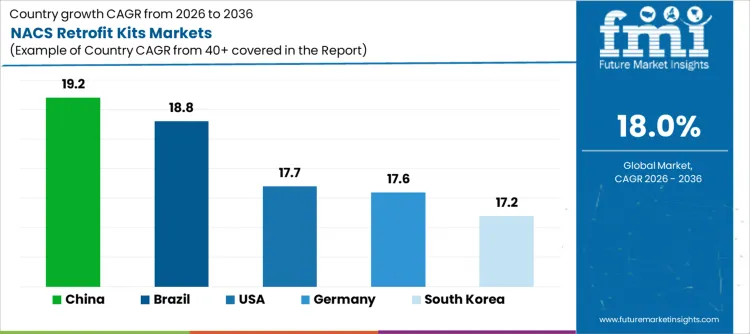
| Country | CAGR (%) |
|---|---|
| China | 19.2 |
| Brazil | 18.8 |
| United States | 17.7 |
| Germany | 17.6 |
| South Korea | 17.2 |
Why Is China Emerging As The Fastest-Growing Market For NACS Retrofit Kits?
China’s NACS retrofit kits market is expanding at a CAGR of 19.2% during 2026 to 2036, driven by growing interest in cross-standard charging compatibility for exported EVs and fleet vehicles operating on international routes. While China maintains its own charging standards domestically, OEMs and fleet operators increasingly require NACS compatibility for vehicles destined for North American and select overseas markets. Retrofit kits enable manufacturers and exporters to adapt existing vehicle platforms without redesigning onboard charging systems. Buyers prioritize electrical safety, thermal stability, and seamless communication between vehicle power electronics and NACS infrastructure. Adoption is strongest among export-focused OEMs, logistics fleets, and aftermarket integrators supporting vehicle conversion programs. Procurement decisions favor suppliers with strong certification credentials, scalable production capability, and experience with high-voltage connectors.
Why Is Brazil Seeing Rapid Uptake of NACS Retrofit Kits?
Brazil’s NACS retrofit kits market is growing at a CAGR of 18.8% during 2026 to 2036, supported by rapid EV adoption alongside evolving charging infrastructure strategies. As charging networks increasingly align with NACS-compatible hardware, retrofit kits offer a cost-effective pathway for existing EV owners and fleets to gain broader charging access. Buyers emphasize affordability, installation simplicity, and compatibility with mixed charging environments. Adoption is particularly strong among commercial fleets, ride-hailing operators, and delivery services seeking to minimize downtime. Procurement decisions are influenced by total cost of ownership, local availability, and installer support. Brazil represents a high-growth transition market where supplier success depends on modular kit design, distributor partnerships, and ability to support diverse vehicle models.
How Is The United States Driving Large-Scale Adoption Of NACS Retrofit Kits?
The United States NACS retrofit kits market is expanding at a CAGR of 17.7% during 2026 to 2036, driven by rapid consolidation of NACS as a dominant fast-charging interface. A large installed base of CCS-equipped electric vehicles creates immediate demand for retrofit solutions that unlock access to expanding NACS charging networks without requiring vehicle replacement. Adoption spans private EV owners, commercial fleets, ride-hailing operators, and charging hardware providers upgrading legacy installations. Buyers prioritize electrical integrity, thermal performance, and retention of high-power DC fast-charging capability after conversion. Compliance with UL certification, SAE standards, and OEM validation requirements strongly influences procurement decisions. Retrofit kits are increasingly distributed through certified installers and OEM-supported aftermarket channels to manage safety and warranty considerations. The USA represents a volume-driven market where success depends on regulatory compliance, scalable installation models, strong testing credentials, and alignment with evolving national charging infrastructure standards.
Why Is Germany Adopting NACS Retrofit Kits Through Structured Transition?
Germany’s NACS retrofit kits market is growing at a CAGR of 17.6% during 2026 to 2036, shaped by a methodical and export-focused adoption approach. As German OEMs increasingly ship vehicles to NACS-dominant regions, retrofit kits provide a practical pathway to maintain platform commonality without extensive redesign of onboard charging systems. Domestic demand remains selective, with adoption primarily tied to OEM programs, pilot fleets, and certified aftermarket conversions. Buyers emphasize engineering rigor, electromagnetic compatibility, thermal stability, and long-term durability under repeated high-current charging cycles. Procurement processes involve extensive testing, documentation, and conformity assessments aligned with European and international automotive standards. Germany represents a quality-driven market where supplier success depends on validation depth, compliance readiness, and close collaboration with OEM engineering and homologation teams rather than rapid deployment volumes.
How Is South Korea Positioning NACS Retrofit Kits Within Global EV Supply Chains?
South Korea’s NACS retrofit kits market is expanding at a CAGR of 17.2% during 2026 to 2036, supported by the country’s strong position in global EV and component supply chains. Retrofit kits are increasingly used to adapt vehicles, battery systems, and charging equipment for export to NACS-centric markets, particularly North America. Buyers prioritize compact form factors, high-current handling capability, and seamless integration with advanced battery management and power electronics systems. Adoption is driven by export programs, cross-market fleet deployments, and supplier obligations to support multiple charging standards with minimal platform variation. Procurement decisions favor suppliers with strong materials expertise, precision manufacturing, and automated production lines capable of consistent high-volume output. South Korea represents an export-led market where success depends on precision engineering, scalability, and close alignment with global charging infrastructure evolution.
How Are Hardware and Infrastructure Players Competing in the NACS Retrofit Kits Market?

Competition in the NACS (North American Charging Standard) retrofit kits market is driven by electrical safety, backward compatibility with CCS infrastructure, certification readiness, and ease of field installation. As charging networks and fleet operators transition toward NACS adoption, retrofit kits are positioned as interim hardware solutions that extend asset life while maintaining uptime. Tesla, as the originator of NACS, anchors the ecosystem through OEM-aligned hardware specifications and reference designs that set performance and safety benchmarks for adapters and retrofit components.
Independent hardware specialists focus on speed-to-market and installer-friendly designs. Lectron and A2Z EV compete by offering NACS retrofit adapters and inlet solutions engineered for high-current handling and thermal stability, emphasizing plug-and-play installation for residential, fleet, and light commercial chargers. Emporia positions retrofit kits alongside smart energy monitoring, appealing to users seeking integrated load management and home energy optimization.
Charging network operators and industrial OEMs strengthen competition through infrastructure-scale retrofits. ChargePoint and EVgo focus on retrofit kits and partner programs designed to convert existing public chargers to NACS while preserving backend software and payment systems. Industrial power electronics leaders Siemens eMobility and ABB E-Mobility emphasize standards-compliant retrofit modules engineered for high-power DC fast chargers, highlighting safety certifications, grid compatibility, and long-term serviceability.
Consumer-focused brands add niche differentiation. Grizzl-E competes through ruggedized retrofit-compatible hardware for residential and workplace use, while Juice Technology (Juice Booster) emphasizes portable and adaptable charging hardware that bridges connector standards. Across the market, competitive advantage is defined by certification readiness, electrical robustness, and seamless integration with existing charging assets rather than adapter pricing alone.
Key Players in NACS Retrofit Kits Markets
- Tesla (OEM)
- Lectron
- A2Z EV
- Emporia
- ChargePoint (HW kits)
- EVgo (partner kits)
- Siemens eMobility
- ABB E‑Mobility
- Grizzl‑E
- Juice Technology (Juice Booster)
Scope of Report
| Attribute | Details |
|---|---|
| Market Size Unit | USD Million |
| Vehicle Group Covered | Passenger Electric Vehicles, Light Commercial Vehicles, Other Electric Vehicle Platforms |
| Channel Covered | OEM or Authorized Service Networks, Independent Workshops, Direct-to-Consumer Sales |
| Countries Covered | China, Japan, South Korea, India, Australia & New Zealand, ASEAN, Rest of Asia Pacific, Germany, United Kingdom, France, Italy, Spain, Nordic, BENELUX, Rest of Europe, United States, Canada, Mexico, Brazil, Chile, Rest of Latin America, Kingdom of Saudi Arabia, Other GCC Countries, Turkey, South Africa, Other African Union, Rest of Middle East & Africa |
| Regions Covered | Asia Pacific, Europe, North America, Latin America, Middle East & Africa |
| Key Companies Profiled | Tesla, Lectron, A2Z EV, Emporia, ChargePoint, EVgo, Siemens eMobility, ABB E-Mobility, Grizzl-E, Juice Technology |
| Additional Attributes | Dollar sales by vehicle group and installation channel are evaluated across NACS transition pathways. The scope analyzes connector compatibility, power rating upgrades, installation complexity, and safety compliance. Country-level assessment reflects Tesla NACS adoption timelines, public charging network conversion, and consumer retrofit demand driven by charging standard harmonization. |
NACS Retrofit Kits Markets by Key Segments
Vehicle Group:
- Passenger EV
- Light Commercial
- Other
Channel:
- OEM or Authorized Service
- Independent Workshops
- Direct‑to‑Consumer
Region:
- Asia Pacific
- China
- Japan
- South Korea
- India
- Australia & New Zealand
- ASEAN
- Rest of Asia Pacific
- Europe
- Germany
- United Kingdom
- France
- Italy
- Spain
- Nordic
- BENELUX
- Rest of Europe
- North America
- United States
- Canada
- Mexico
- Latin America
- Brazil
- Chile
- Rest of Latin America
- Middle East & Africa
- Kingdom of Saudi Arabia
- Other GCC Countries
- Turkey
- South Africa
- Other African Union
- Rest of Middle East & Africa
Bibliography
- United States Department of Energy, Office of Energy Efficiency and Renewable Energy. (2023, April). Electric vehicles for consumers. U.S. Department of Energy.
- Joint Office of Energy and Transportation. (2024, July 19). Request for information to explore the transition to the SAE J3400 connector (formerly known as the North American Charging Standard). Joint Office of Energy and Transportation.
- Federal Highway Administration. (2024, March 6). Request for information on the J3400 connector and potential options for performance-based charging requirements (Docket No. FHWA-2023-0054). U.S. Department of Transportation.
- National Renewable Energy Laboratory. (2024). Transportation infrastructure trends: 2024 Q1 update. National Renewable Energy Laboratory.
- Federal Highway Administration. (2025, August 11). NEVI interim final program guidance. U.S. Department of Transportation.
Frequently Asked Questions
How big is the nacs retrofit kits markets in 2026?
The global nacs retrofit kits markets is estimated to be valued at USD 413.0 million in 2026.
What will be the size of nacs retrofit kits markets in 2036?
The market size for the nacs retrofit kits markets is projected to reach USD 2,161.6 million by 2036.
How much will be the nacs retrofit kits markets growth between 2026 and 2036?
The nacs retrofit kits markets is expected to grow at a 18.0% CAGR between 2026 and 2036.
What are the key product types in the nacs retrofit kits markets?
The key product types in nacs retrofit kits markets are passenger ev, light commercial and other.
Which channel segment to contribute significant share in the nacs retrofit kits markets in 2026?
In terms of channel, oem or authorized service segment to command 46.0% share in the nacs retrofit kits markets in 2026.
Preview the report firsthand - request a free sample
Get SampleGet the brochure for pricing and purchase details.
Get PDFTable of Content
- Executive Summary
- Global Market Outlook
- Demand-side Trends
- Supply-side Trends
- Technology Roadmap Analysis
- Analysis and Recommendations
- Market Overview
- Market Coverage / Taxonomy
- Market Definition / Scope / Limitations
- Market Background
- Market Dynamics
- Drivers
- Restraints
- Opportunity
- Trends
- Scenario Forecast
- Demand in Optimistic Scenario
- Demand in Likely Scenario
- Demand in Conservative Scenario
- Opportunity Map Analysis
- Product Life Cycle Analysis
- Supply Chain Analysis
- Investment Feasibility Matrix
- Value Chain Analysis
- PESTLE and Porter’s Analysis
- Regulatory Landscape
- Regional Parent Market Outlook
- Production and Consumption Statistics
- Import and Export Statistics
- Market Dynamics
- Global Market Analysis 2021 to 2025 and Forecast, 2026 to 2036
- Historical Market Size Value (USD Million) Analysis, 2021 to 2025
- Current and Future Market Size Value (USD Million) Projections, 2026 to 2036
- Y-o-Y Growth Trend Analysis
- Absolute $ Opportunity Analysis
- Global Market Pricing Analysis 2021 to 2025 and Forecast 2026 to 2036
- Global Market Analysis 2021 to 2025 and Forecast 2026 to 2036, By Vehicle Group
- Introduction / Key Findings
- Historical Market Size Value (USD Million) Analysis By Vehicle Group , 2021 to 2025
- Current and Future Market Size Value (USD Million) Analysis and Forecast By Vehicle Group , 2026 to 2036
- Passenger EV
- Light Commercial
- Other
- Passenger EV
- Y-o-Y Growth Trend Analysis By Vehicle Group , 2021 to 2025
- Absolute $ Opportunity Analysis By Vehicle Group , 2026 to 2036
- Global Market Analysis 2021 to 2025 and Forecast 2026 to 2036, By Channel
- Introduction / Key Findings
- Historical Market Size Value (USD Million) Analysis By Channel, 2021 to 2025
- Current and Future Market Size Value (USD Million) Analysis and Forecast By Channel, 2026 to 2036
- OEM or Authorized Service
- Independent Workshops
- Direct‑to‑Consumer
- OEM or Authorized Service
- Y-o-Y Growth Trend Analysis By Channel, 2021 to 2025
- Absolute $ Opportunity Analysis By Channel, 2026 to 2036
- Global Market Analysis 2021 to 2025 and Forecast 2026 to 2036, By Region
- Introduction
- Historical Market Size Value (USD Million) Analysis By Region, 2021 to 2025
- Current Market Size Value (USD Million) Analysis and Forecast By Region, 2026 to 2036
- North America
- Latin America
- Western Europe
- Eastern Europe
- East Asia
- South Asia and Pacific
- Middle East & Africa
- Market Attractiveness Analysis By Region
- North America Market Analysis 2021 to 2025 and Forecast 2026 to 2036, By Country
- Historical Market Size Value (USD Million) Trend Analysis By Market Taxonomy, 2021 to 2025
- Market Size Value (USD Million) Forecast By Market Taxonomy, 2026 to 2036
- By Country
- USA
- Canada
- Mexico
- By Vehicle Group
- By Channel
- By Country
- Market Attractiveness Analysis
- By Country
- By Vehicle Group
- By Channel
- Key Takeaways
- Latin America Market Analysis 2021 to 2025 and Forecast 2026 to 2036, By Country
- Historical Market Size Value (USD Million) Trend Analysis By Market Taxonomy, 2021 to 2025
- Market Size Value (USD Million) Forecast By Market Taxonomy, 2026 to 2036
- By Country
- Brazil
- Chile
- Rest of Latin America
- By Vehicle Group
- By Channel
- By Country
- Market Attractiveness Analysis
- By Country
- By Vehicle Group
- By Channel
- Key Takeaways
- Western Europe Market Analysis 2021 to 2025 and Forecast 2026 to 2036, By Country
- Historical Market Size Value (USD Million) Trend Analysis By Market Taxonomy, 2021 to 2025
- Market Size Value (USD Million) Forecast By Market Taxonomy, 2026 to 2036
- By Country
- Germany
- UK
- Italy
- Spain
- France
- Nordic
- BENELUX
- Rest of Western Europe
- By Vehicle Group
- By Channel
- By Country
- Market Attractiveness Analysis
- By Country
- By Vehicle Group
- By Channel
- Key Takeaways
- Eastern Europe Market Analysis 2021 to 2025 and Forecast 2026 to 2036, By Country
- Historical Market Size Value (USD Million) Trend Analysis By Market Taxonomy, 2021 to 2025
- Market Size Value (USD Million) Forecast By Market Taxonomy, 2026 to 2036
- By Country
- Russia
- Poland
- Hungary
- Balkan & Baltic
- Rest of Eastern Europe
- By Vehicle Group
- By Channel
- By Country
- Market Attractiveness Analysis
- By Country
- By Vehicle Group
- By Channel
- Key Takeaways
- East Asia Market Analysis 2021 to 2025 and Forecast 2026 to 2036, By Country
- Historical Market Size Value (USD Million) Trend Analysis By Market Taxonomy, 2021 to 2025
- Market Size Value (USD Million) Forecast By Market Taxonomy, 2026 to 2036
- By Country
- China
- Japan
- South Korea
- By Vehicle Group
- By Channel
- By Country
- Market Attractiveness Analysis
- By Country
- By Vehicle Group
- By Channel
- Key Takeaways
- South Asia and Pacific Market Analysis 2021 to 2025 and Forecast 2026 to 2036, By Country
- Historical Market Size Value (USD Million) Trend Analysis By Market Taxonomy, 2021 to 2025
- Market Size Value (USD Million) Forecast By Market Taxonomy, 2026 to 2036
- By Country
- India
- ASEAN
- Australia & New Zealand
- Rest of South Asia and Pacific
- By Vehicle Group
- By Channel
- By Country
- Market Attractiveness Analysis
- By Country
- By Vehicle Group
- By Channel
- Key Takeaways
- Middle East & Africa Market Analysis 2021 to 2025 and Forecast 2026 to 2036, By Country
- Historical Market Size Value (USD Million) Trend Analysis By Market Taxonomy, 2021 to 2025
- Market Size Value (USD Million) Forecast By Market Taxonomy, 2026 to 2036
- By Country
- Kingdom of Saudi Arabia
- Other GCC Countries
- Turkiye
- South Africa
- Other African Union
- Rest of Middle East & Africa
- By Vehicle Group
- By Channel
- By Country
- Market Attractiveness Analysis
- By Country
- By Vehicle Group
- By Channel
- Key Takeaways
- Key Countries Market Analysis
- USA
- Pricing Analysis
- Market Share Analysis, 2025
- By Vehicle Group
- By Channel
- Canada
- Pricing Analysis
- Market Share Analysis, 2025
- By Vehicle Group
- By Channel
- Mexico
- Pricing Analysis
- Market Share Analysis, 2025
- By Vehicle Group
- By Channel
- Brazil
- Pricing Analysis
- Market Share Analysis, 2025
- By Vehicle Group
- By Channel
- Chile
- Pricing Analysis
- Market Share Analysis, 2025
- By Vehicle Group
- By Channel
- Germany
- Pricing Analysis
- Market Share Analysis, 2025
- By Vehicle Group
- By Channel
- UK
- Pricing Analysis
- Market Share Analysis, 2025
- By Vehicle Group
- By Channel
- Italy
- Pricing Analysis
- Market Share Analysis, 2025
- By Vehicle Group
- By Channel
- Spain
- Pricing Analysis
- Market Share Analysis, 2025
- By Vehicle Group
- By Channel
- France
- Pricing Analysis
- Market Share Analysis, 2025
- By Vehicle Group
- By Channel
- India
- Pricing Analysis
- Market Share Analysis, 2025
- By Vehicle Group
- By Channel
- ASEAN
- Pricing Analysis
- Market Share Analysis, 2025
- By Vehicle Group
- By Channel
- Australia & New Zealand
- Pricing Analysis
- Market Share Analysis, 2025
- By Vehicle Group
- By Channel
- China
- Pricing Analysis
- Market Share Analysis, 2025
- By Vehicle Group
- By Channel
- Japan
- Pricing Analysis
- Market Share Analysis, 2025
- By Vehicle Group
- By Channel
- South Korea
- Pricing Analysis
- Market Share Analysis, 2025
- By Vehicle Group
- By Channel
- Russia
- Pricing Analysis
- Market Share Analysis, 2025
- By Vehicle Group
- By Channel
- Poland
- Pricing Analysis
- Market Share Analysis, 2025
- By Vehicle Group
- By Channel
- Hungary
- Pricing Analysis
- Market Share Analysis, 2025
- By Vehicle Group
- By Channel
- Kingdom of Saudi Arabia
- Pricing Analysis
- Market Share Analysis, 2025
- By Vehicle Group
- By Channel
- Turkiye
- Pricing Analysis
- Market Share Analysis, 2025
- By Vehicle Group
- By Channel
- South Africa
- Pricing Analysis
- Market Share Analysis, 2025
- By Vehicle Group
- By Channel
- USA
- Market Structure Analysis
- Competition Dashboard
- Competition Benchmarking
- Market Share Analysis of Top Players
- By Regional
- By Vehicle Group
- By Channel
- Competition Analysis
- Competition Deep Dive
- Tesla (OEM)
- Overview
- Product Portfolio
- Profitability by Market Segments (Product/Age /Sales Channel/Region)
- Sales Footprint
- Strategy Overview
- Marketing Strategy
- Product Strategy
- Channel Strategy
- Lectron
- A2Z EV
- Emporia
- ChargePoint (HW kits)
- EVgo (partner kits)
- Siemens eMobility
- ABB E‑Mobility
- Grizzl‑E
- Juice Technology (Juice Booster)
- Tesla (OEM)
- Competition Deep Dive
- Assumptions & Acronyms Used
- Research Methodology


