

- Industry Size (2026)
- USD 759.2 Mn
- Forecast (2036)
- USD 1679.4 Mn
- CAGR (2026 to 2036)
- 8.30%
Net Zero Retrofit AI Building Management Market Forecast and Outlook 2026 to 2036
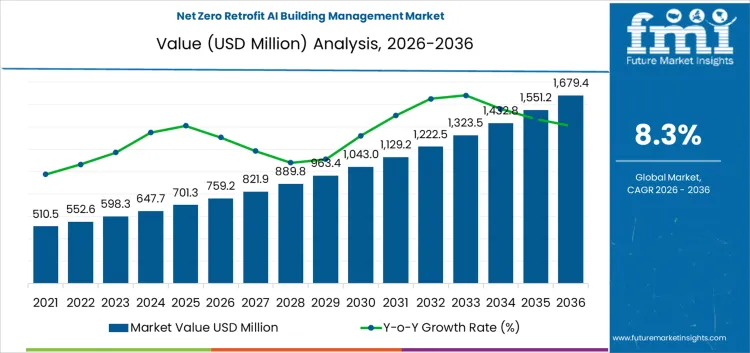
The net zero retrofit AI building management market is valued at USD 759.2 million in 2026 and is projected to reach USD 1,679.4 million by 2036, reflecting a CAGR of 8.3%. Market performance is concentrated among suppliers capable of integrating AI-based energy optimization with existing building infrastructure. Adoption varies by region according to building age, energy efficiency regulations, and retrofit incentives. Geographic cost advantages arise where local labor, software development, and hardware assembly reduce implementation expenses. Smaller providers face challenges in scaling multi-building deployments while meeting regulatory compliance and performance validation requirements.
Market outcomes are influenced by alignment with large-scale commercial and institutional retrofit programs. Margin concentration favors operators offering certified AI management systems with integrated monitoring, predictive analytics, and support services. Fragmentation persists among regional or niche technology providers, while leading firms capture concentrated value through platform standardization, integration capabilities, and proven energy performance rather than deployment volume alone. Adoption timelines vary according to regional energy codes, incentive programs, and institutional investment cycles.
Quick Stats of the Net Zero Retrofit AI Building Management Market
- Net Zero Retrofit AI Building Management Market Value (2026): USD 759.2 million
- Net Zero Retrofit AI Building Management Forecast Value (2036): USD 1,679.4 million
- Net Zero Retrofit AI Building Management Forecast CAGR 2026 to 2036: 8.3%
- Leading Application in Net Zero Retrofit AI Building Management Market: Energy optimisation (32 % share)
- Leading Building Type in Net Zero Retrofit AI Building Management Market: Commercial offices (41 % share)
- Key Growth Regions in Net Zero Retrofit AI Building Management Market: USA, Germany, UK, Australia
- Top Players in Net Zero Retrofit AI Building Management Market: Schneider Electric, Siemens Smart Infrastructure, Johnson Controls, Honeywell Building Technologies, ABB, Mitsubishi Electric
What is the Growth Forecast for Net Zero Retrofit AI Building Management Market through 2036?
Between 2026 and 2031, the net zero retrofit AI building management market is projected to grow from USD 759.2 million to USD 1,044.4 million, generating an absolute increase of USD 285.2 million and reflecting a CAGR of 8.3%. Growth is driven by adoption of energy optimisation, HVAC automation, predictive maintenance, and carbon analytics across commercial offices, institutional, residential, and mixed-use buildings. Retrofit depth varies from software-only to full hardware + software solutions. Expansion is supported by rising regulatory pressure for energy efficiency, sustainability goals, and building decarbonization initiatives. Suppliers focus on validated AI algorithms, integration, and operational efficiency improvements.
From 2031 to 2036, the market is expected to expand from USD 1,044.4 million to USD 1,679.4 million, adding USD 635.3 million. Growth is fueled by wider adoption of AI-driven energy management, predictive maintenance, and grid/DR integration across building types. Market drivers include increasing retrofit activity, net zero commitments, and digitalization of building operations. Competitive advantage favors suppliers providing scalable AI platforms, seamless integration with existing building systems, and demonstrable energy and cost savings. Leading companies include Schneider Electric, Siemens Smart Infrastructure, Johnson Controls, Honeywell Building Technologies, ABB, and Mitsubishi Electric.
Net Zero Retrofit AI Building Management Market Key Takeaways
| Metric | Value |
|---|---|
| Market Value (2026) | USD 759.2 million |
| Forecast Value (2036) | USD 1,679.4 million |
| Forecast CAGR 2026 to 2036 | 8.30% |
What Is Driving Demand for Net Zero Retrofit AI Building Management Systems?
Net zero retrofit AI building management systems are increasingly adopted to optimize energy use, reduce operational emissions, and enhance occupant comfort in existing buildings. Historically, retrofitting relied on manual monitoring and conventional control systems, limiting efficiency and real-time responsiveness. Modern AI-driven systems integrate sensors, predictive analytics, and automated control of HVAC, lighting, and energy resources to achieve energy reduction targets and operational optimization. Facility managers, building owners, and energy service providers prioritize system integration, scalability, and compliance with energy codes. Early adoption focused on high-performance commercial and institutional buildings, while current demand extends to office complexes, hotels, and industrial facilities driven by energy efficiency mandates, carbon reduction goals, and operational cost savings. Sensor accuracy, AI algorithm performance, and system interoperability influence deployment.
Rising regulatory pressure, energy cost concerns, and sustainability targets are shaping market growth. Compared with conventional retrofits, AI building management systems emphasize real-time analytics, predictive maintenance, and adaptive control for energy-intensive operations. Cost structures depend on sensor deployment, software integration, and ongoing system management, concentrating margins among suppliers delivering reliable, scalable solutions. Building operators adopt AI systems to reduce energy consumption, improve occupant comfort, and achieve compliance with net zero or low-carbon standards. By 2036, AI-driven retrofit building management is expected to become standard in commercial and industrial facilities, supporting operational efficiency, emission reduction, and advanced energy optimization across the built environment.
What Factors Are Shaping the Demand for Net Zero Retrofit AI Building Management in Terms of Application and Building Type?
The demand for net zero retrofit AI building management is segmented by application and building type. Applications include energy optimization, HVAC automation, predictive maintenance, carbon analytics, and grid or demand response integration. Building types include commercial offices, institutional facilities, residential complexes, and mixed-use developments. Adoption is influenced by energy efficiency targets, carbon reduction mandates, and operational cost reduction. Uptake is driven by sustainability goals, regulatory incentives, and technological advancements in AI. Application and building type selection depend on building size, occupancy patterns, and retrofit feasibility, ensuring scalable, reliable, and energy-efficient operation across diverse urban and institutional environments.
Why Is Energy Optimization Leading the Application Segment in Net Zero Retrofit AI Building Management?
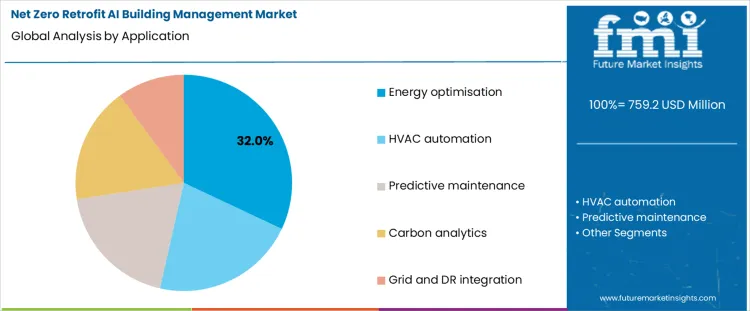
Energy optimization accounts for approximately 32% of total application demand, making it the leading category. AI systems monitor electricity, heating, and cooling consumption in real time to identify inefficiencies and reduce energy usage. Adoption is driven by rising energy costs, stringent carbon regulations, and corporate sustainability initiatives. These systems integrate with building management platforms, sensors, and metering devices to dynamically adjust lighting, HVAC operation, and equipment scheduling. Operational protocols include continuous data collection, predictive modeling, and automated control adjustments. Energy optimization provides measurable reductions in consumption, operational costs, and carbon emissions, reinforcing adoption.
Operational factors further shape adoption. Systems must operate reliably under variable occupancy, fluctuating external temperatures, and changing utility pricing. Integration with legacy infrastructure and real-time analytics ensures consistent performance. Energy optimization leads because it delivers quantifiable energy savings, operational efficiency, and supports compliance with net zero building targets, making it a critical component of retrofit strategies across commercial, institutional, and mixed-use properties.
Why Are Commercial Offices Representing the Largest Building Type Segment in Net Zero Retrofit AI Building Management?
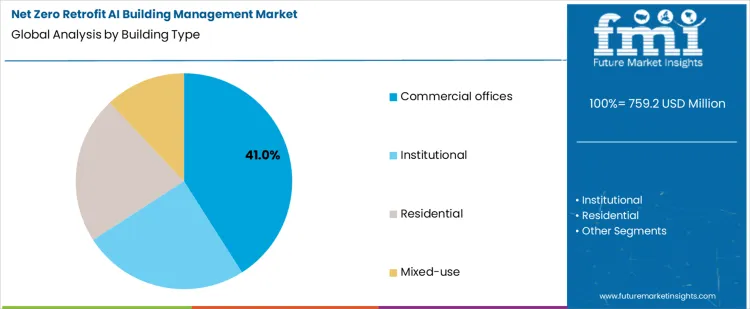
Commercial offices account for approximately 41% of total building type demand, making them the largest category. Adoption is driven by high energy usage, tenant expectations for comfort, and corporate sustainability commitments. Offices implement AI retrofit systems to optimize HVAC, lighting, and equipment schedules, reducing operational costs while enhancing occupant comfort. Operational procedures include sensor installation, continuous monitoring, and predictive maintenance scheduling. Integration with energy management dashboards allows facility managers to track performance and identify improvement areas, ensuring continuous optimization and compliance.
Operational and functional factors further reinforce adoption. Systems must handle variable occupancy, multiple floors, and complex layouts while providing consistent efficiency gains. Commercial offices lead because they offer measurable reductions in energy consumption, cost savings, and carbon footprint, making them the primary target for AI retrofit building management solutions.
How Are AI-Powered Retrofits Driving Net Zero Building Performance?
Net zero retrofit AI building management systems are increasingly adopted to optimize energy consumption, reduce carbon emissions, and enhance operational efficiency in existing commercial and residential buildings. Adoption is strongest in regions with strict building energy codes, sustainability incentives, and aging building stock. Systems are selected for real-time energy monitoring, predictive control, and integration with HVAC, lighting, and renewable energy sources. Growth is driven by regulatory mandates for carbon reduction, corporate sustainability commitments, and rising energy costs. Investment focuses on AI algorithms, sensor networks, and interoperability with existing infrastructure. Operators prioritize solutions that maximize energy efficiency while maintaining occupant comfort.
Why Are Regional Energy Policies and Aging Building Infrastructure Driving Adoption?
Demand is influenced by local mandates on energy efficiency, retrofitting subsidies, and carbon reduction targets for the built environment. Facility managers adopt AI retrofits to monitor and reduce energy use, optimize system performance, and achieve compliance. Platforms providing predictive analytics, adaptive control, and seamless integration with multiple building systems gain preference. Adoption is concentrated in regions with large commercial and industrial building inventories and strong sustainability programs. Regulatory compliance, operational cost savings, and performance optimization drive procurement rather than upfront cost. Suppliers offering validated, scalable AI systems gain competitive advantage among building operators and retrofit contractors.
What Operational and Technical Constraints Limit Broader Deployment?
High installation and integration costs, interoperability challenges, and data management complexity restrict adoption. Performance can be affected by building layout, legacy systems, and inconsistent sensor calibration. Staff training and cybersecurity considerations add operational complexity. Smaller buildings or regions with limited digital infrastructure adopt solutions more slowly. These factors concentrate early deployment among large commercial properties, corporate campuses, and regions with technical expertise and sustainability mandates.
How Are AI Advancements and Collaborative Ecosystems Shaping Market Growth?
Recent innovations include predictive maintenance algorithms, real-time energy optimization, and adaptive occupant behavior modeling. Collaboration between AI platform providers, building operators, and energy utilities ensures system validation, compliance, and operational efficiency. Pilot implementations evaluate energy savings, system responsiveness, and occupant comfort before full-scale deployment. Quality monitoring, data analytics, and standardized integration protocols maintain reliability. Focus is on energy reduction, operational efficiency, and occupant well-being rather than cost or scale. Collaborative initiatives enable broader adoption of net zero retrofit AI building management systems in regional and global sustainable building programs.
What is the Demand for Net Zero Retrofit AI Building Management by Country?
| Country | CAGR (%) |
|---|---|
| USA | 8.0% |
| Germany | 7.8% |
| UK | 7.5% |
| Australia | 7.0% |
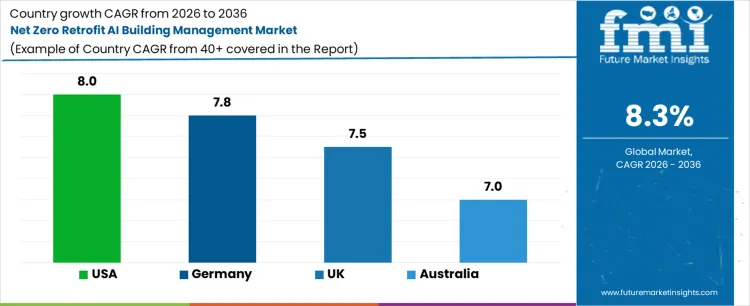
Demand for net zero retrofit AI building management systems is rising as property owners and facility managers implement energy-efficient, AI-driven solutions to reduce carbon emissions and operational costs. The USA leads with an 8.0% CAGR, driven by government incentives, corporate sustainability initiatives, and adoption of AI-based energy optimization in commercial and residential buildings. Germany follows at 7.8%, supported by stringent energy efficiency regulations, retrofitting programs, and smart building integration. The UK records 7.5% growth, shaped by urban modernization projects and energy reduction mandates. Australia shows 7.0% CAGR, reflecting steady adoption in commercial and institutional buildings and growing interest in AI-driven energy management technologies.
How Is the United States Experiencing Growth in the Net Zero Retrofit AI Building Management Market?
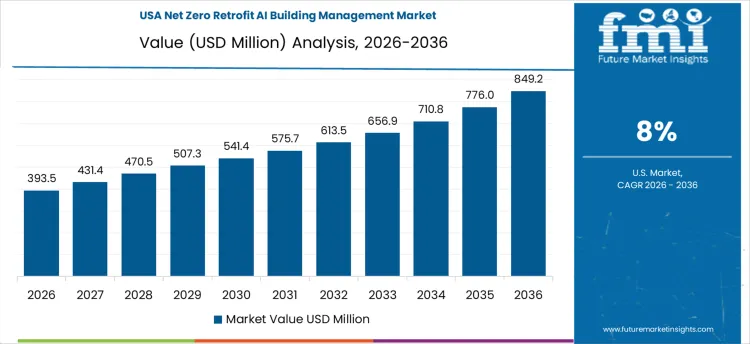
United States is experiencing growth at a CAGR of 8%, driven by deployment of AI-powered retrofit solutions in commercial and industrial buildings to meet net zero energy targets and optimize operational efficiency. Facility operators and technology providers are implementing systems designed for real-time energy monitoring, predictive maintenance, and automated HVAC control. Demand is concentrated in metropolitan retrofit projects, corporate campuses, and industrial complexes. Investments focus on system intelligence, integration with existing building infrastructure, and adherence to energy regulations rather than new construction. Growth reflects rising government incentives for energy efficiency, industrial adoption of AI-based building solutions, and increasing pressure to reduce operational carbon emissions.
- AI-driven energy solutions drive adoption.
- Systems enhance predictive maintenance and climate control.
- Metropolitan retrofits and industrial complexes concentrate demand.
- System intelligence and regulatory compliance guide investment.
How Is Germany Experiencing Expansion with Smart Building Retrofits?
Germany is witnessing growth at a CAGR of 7.8%, supported by implementation of AI-based building management systems in retrofit projects to improve energy efficiency and reduce carbon footprint. Technology providers and facility managers are deploying systems optimized for automated energy monitoring, load management, and predictive maintenance. Demand is concentrated in commercial offices, manufacturing facilities, and urban retrofit projects. Investments focus on integration with existing systems, system performance, and compliance with national energy standards rather than new development projects. Growth reflects industrial adoption of intelligent building technologies, government-backed sustainability programs, and rising demand for low-carbon operations.
- Smart building retrofits drive adoption.
- Systems optimize energy usage and automated load management.
- Commercial and industrial retrofits concentrate demand.
- Integration and energy compliance guide investment.
How Is the United Kingdom Witnessing Adoption with AI-Enabled Energy Management?
United Kingdom is experiencing growth at a CAGR of 7.5%, fueled by adoption of AI-enabled building management systems in retrofit projects targeting reduced energy consumption and net zero compliance. Facility operators and technology providers are deploying systems designed for predictive analytics, automated climate control, and efficient energy distribution. Demand is concentrated in commercial retrofit projects, public infrastructure, and industrial facilities. Investments prioritize AI system performance, integration with legacy infrastructure, and regulatory compliance rather than large-scale new builds. Growth reflects rising government incentives, industrial adoption of intelligent energy management, and increasing corporate focus on sustainability.
- AI-enabled energy management drives adoption.
- Systems provide predictive analytics and automated climate control.
- Commercial retrofits and public infrastructure concentrate demand.
- System performance and integration guide investment.
How Is Australia Experiencing Growth with Retrofitted Net Zero Solutions?
Australia is witnessing growth at a CAGR of 7%, supported by adoption of AI-driven building management systems in retrofits to enhance energy efficiency and achieve net zero operational targets. Technology providers and facility managers are deploying systems optimized for real-time monitoring, predictive maintenance, and automated energy optimization. Demand is concentrated in commercial buildings, urban retrofit projects, and industrial complexes. Investments focus on material and system performance, integration with existing infrastructure, and adherence to environmental regulations rather than broad-scale development. Growth reflects government initiatives for energy efficiency, industrial adoption of AI technologies, and increasing awareness of sustainable building practices.
- Retrofitted net zero solutions drive adoption.
- Systems optimize monitoring, energy efficiency, and maintenance.
- Commercial buildings and industrial complexes concentrate demand.
- System performance and environmental compliance guide investment.
Who Competes in the Net Zero Retrofit AI Building Management Market and What Defines Their Capabilities?
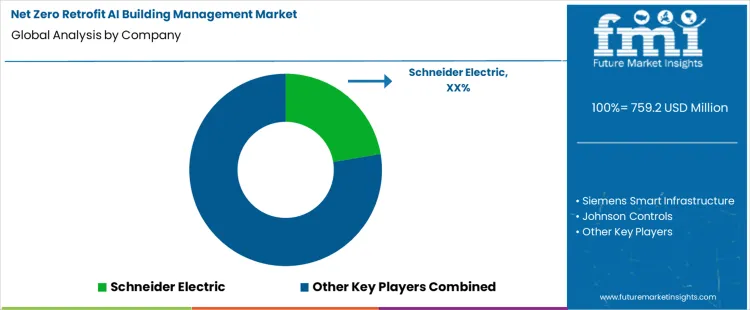
Competition in the net zero retrofit AI building management market is defined by energy optimization, system integration, and analytics-driven operational control. Schneider Electric provides AI-enabled building management systems designed to optimize energy consumption, monitor equipment performance, and support net-zero retrofit projects. Siemens Smart Infrastructure delivers integrated building automation platforms combining AI, IoT sensors, and energy analytics to reduce carbon footprints in retrofitted facilities. Johnson Controls supplies AI-based control solutions for HVAC, lighting, and energy monitoring to support efficiency upgrades in existing structures. Honeywell Building Technologies develops predictive AI software and building control systems that optimize energy use and maintain occupant comfort. ABB provides integrated electrical and automation solutions with AI-driven energy management.
Mitsubishi Electric offers smart building management platforms designed for net-zero retrofit applications, focusing on energy efficiency, system interoperability, and data analytics. Other competitors include regional integrators and specialized software providers offering AI-powered solutions for energy monitoring, predictive maintenance, and efficiency optimization in retrofitted buildings. Differentiation arises from AI analytics sophistication, system compatibility with existing infrastructure, scalability across building types, and ability to reduce energy consumption while maintaining operational performance. Companies capable of combining retrofit feasibility, energy optimization, and robust AI control gain stronger positioning in the growing net zero building management market.
Key Players in the Net Zero Retrofit AI Building Management Market
- Schneider Electric
- Siemens Smart Infrastructure
- Johnson Controls
- Honeywell Building Technologies
- ABB
- Mitsubishi Electric
Scope of the Report
| Items | Values |
|---|---|
| Quantitative Units (2026) | USD million |
| Application | Energy optimisation, HVAC automation, Predictive maintenance, Carbon analytics, Grid and DR integration |
| Building Type | Commercial offices, Institutional, Residential, Mixed-use |
| Retrofit Depth | Software-only, HW + SW, Full retrofit |
| Region | Asia Pacific, Europe, North America, Latin America, Middle East & Africa |
| Key Countries Covered | USA, Germany, UK, Australia, China, Japan, India, France, Italy |
| Key Companies Profiled | Schneider Electric, Siemens Smart Infrastructure, Johnson Controls, Honeywell Building Technologies, ABB, Mitsubishi Electric |
| Additional Attributes | Dollar sales by application, building type, and retrofit depth; regional CAGR, value and volume growth projections; adoption across commercial, institutional, residential, and mixed-use buildings; AI algorithm performance, predictive maintenance efficiency, and energy optimisation capabilities; integration with existing building infrastructure and BMS; retrofit depth and scalability; regulatory compliance with energy efficiency codes; operational reliability and occupant comfort; partnerships with building operators and retrofit contractors. |
Net Zero Retrofit AI Building Management Market Segmentation
Application:
- Energy optimisation
- HVAC automation
- Predictive maintenance
- Carbon analytics
- Grid and DR integration
Building Type:
- Commercial offices
- Institutional
- Residential
- Mixed-use
Retrofit Depth:
- Software-only
- HW + SW
- Full retrofit
Region
- Asia Pacific
- China
- Japan
- South Korea
- India
- Australia & New Zealand
- ASEAN
- Rest of Asia Pacific
- Europe
- Germany
- United Kingdom
- France
- Italy
- Spain
- Nordic
- BENELUX
- Rest of Europe
- North America
- United States
- Canada
- Mexico
- Latin America
- Brazil
- Chile
- Rest of Latin America
- Middle East & Africa
- Kingdom of Saudi Arabia
- Other GCC Countries
- Turkey
- South Africa
- Other African Union
- Rest of Middle East & Africa
Bibliography
International Energy Agency. (2024). Energy Efficiency 2024. International Energy Agency.
European Parliament and Council of the European Union. (2024). Directive (EU) 2024/1275 of 24 April 2024 on the energy performance of buildings (recast) (Text with EEA relevance). Official Journal of the European Union.
European Commission. (n.d.). Renovation wave. European Commission.
International Organization for Standardization. (2018). ISO 50001:2018 Energy management systems—Requirements with guidance for use. ISO.
Ding, F., Yao, Y., Hao, J., Pei, Y., Wang, J., & Zhao, J. (2024).
Frequently Asked Questions
How big is the net zero retrofit ai building management market in 2026?
The global net zero retrofit ai building management market is estimated to be valued at USD 759.2 million in 2026.
What will be the size of net zero retrofit ai building management market in 2036?
The market size for the net zero retrofit ai building management market is projected to reach USD 1,679.4 million by 2036.
How much will be the net zero retrofit ai building management market growth between 2026 and 2036?
The net zero retrofit ai building management market is expected to grow at a 8.3% CAGR between 2026 and 2036.
What are the key product types in the net zero retrofit ai building management market?
The key product types in net zero retrofit ai building management market are energy optimisation, hvac automation, predictive maintenance, carbon analytics and grid and dr integration.
Which building type segment to contribute significant share in the net zero retrofit ai building management market in 2026?
In terms of building type, commercial offices segment to command 41.0% share in the net zero retrofit ai building management market in 2026.
Preview the report firsthand - request a free sample
Get SampleGet the brochure for pricing and purchase details.
Get PDFTable of Content
- Executive Summary
- Global Market Outlook
- Demand-side Trends
- Supply-side Trends
- Technology Roadmap Analysis
- Analysis and Recommendations
- Market Overview
- Market Coverage / Taxonomy
- Market Definition / Scope / Limitations
- Market Background
- Market Dynamics
- Drivers
- Restraints
- Opportunity
- Trends
- Scenario Forecast
- Demand in Optimistic Scenario
- Demand in Likely Scenario
- Demand in Conservative Scenario
- Opportunity Map Analysis
- Product Life Cycle Analysis
- Supply Chain Analysis
- Investment Feasibility Matrix
- Value Chain Analysis
- PESTLE and Porter’s Analysis
- Regulatory Landscape
- Regional Parent Market Outlook
- Production and Consumption Statistics
- Import and Export Statistics
- Market Dynamics
- Global Market Analysis 2021 to 2025 and Forecast, 2026 to 2036
- Historical Market Size Value (USD Million) Analysis, 2021 to 2025
- Current and Future Market Size Value (USD Million) Projections, 2026 to 2036
- Y-o-Y Growth Trend Analysis
- Absolute $ Opportunity Analysis
- Global Market Pricing Analysis 2021 to 2025 and Forecast 2026 to 2036
- Global Market Analysis 2021 to 2025 and Forecast 2026 to 2036, By Application
- Introduction / Key Findings
- Historical Market Size Value (USD Million) Analysis By Application , 2021 to 2025
- Current and Future Market Size Value (USD Million) Analysis and Forecast By Application , 2026 to 2036
- Energy optimisation
- HVAC automation
- Predictive maintenance
- Carbon analytics
- Grid and DR integration
- Energy optimisation
- Y-o-Y Growth Trend Analysis By Application , 2021 to 2025
- Absolute $ Opportunity Analysis By Application , 2026 to 2036
- Global Market Analysis 2021 to 2025 and Forecast 2026 to 2036, By Building Type
- Introduction / Key Findings
- Historical Market Size Value (USD Million) Analysis By Building Type, 2021 to 2025
- Current and Future Market Size Value (USD Million) Analysis and Forecast By Building Type, 2026 to 2036
- Commercial offices
- Institutional
- Residential
- Mixed-use
- Commercial offices
- Y-o-Y Growth Trend Analysis By Building Type, 2021 to 2025
- Absolute $ Opportunity Analysis By Building Type, 2026 to 2036
- Global Market Analysis 2021 to 2025 and Forecast 2026 to 2036, By Retrofit Depth
- Introduction / Key Findings
- Historical Market Size Value (USD Million) Analysis By Retrofit Depth, 2021 to 2025
- Current and Future Market Size Value (USD Million) Analysis and Forecast By Retrofit Depth, 2026 to 2036
- Software-only
- HW + SW
- Full retrofit
- Software-only
- Y-o-Y Growth Trend Analysis By Retrofit Depth, 2021 to 2025
- Absolute $ Opportunity Analysis By Retrofit Depth, 2026 to 2036
- Global Market Analysis 2021 to 2025 and Forecast 2026 to 2036, By Region
- Introduction
- Historical Market Size Value (USD Million) Analysis By Region, 2021 to 2025
- Current Market Size Value (USD Million) Analysis and Forecast By Region, 2026 to 2036
- North America
- Latin America
- Western Europe
- Eastern Europe
- East Asia
- South Asia and Pacific
- Middle East & Africa
- Market Attractiveness Analysis By Region
- North America Market Analysis 2021 to 2025 and Forecast 2026 to 2036, By Country
- Historical Market Size Value (USD Million) Trend Analysis By Market Taxonomy, 2021 to 2025
- Market Size Value (USD Million) Forecast By Market Taxonomy, 2026 to 2036
- By Country
- USA
- Canada
- Mexico
- By Application
- By Building Type
- By Retrofit Depth
- By Country
- Market Attractiveness Analysis
- By Country
- By Application
- By Building Type
- By Retrofit Depth
- Key Takeaways
- Latin America Market Analysis 2021 to 2025 and Forecast 2026 to 2036, By Country
- Historical Market Size Value (USD Million) Trend Analysis By Market Taxonomy, 2021 to 2025
- Market Size Value (USD Million) Forecast By Market Taxonomy, 2026 to 2036
- By Country
- Brazil
- Chile
- Rest of Latin America
- By Application
- By Building Type
- By Retrofit Depth
- By Country
- Market Attractiveness Analysis
- By Country
- By Application
- By Building Type
- By Retrofit Depth
- Key Takeaways
- Western Europe Market Analysis 2021 to 2025 and Forecast 2026 to 2036, By Country
- Historical Market Size Value (USD Million) Trend Analysis By Market Taxonomy, 2021 to 2025
- Market Size Value (USD Million) Forecast By Market Taxonomy, 2026 to 2036
- By Country
- Germany
- UK
- Italy
- Spain
- France
- Nordic
- BENELUX
- Rest of Western Europe
- By Application
- By Building Type
- By Retrofit Depth
- By Country
- Market Attractiveness Analysis
- By Country
- By Application
- By Building Type
- By Retrofit Depth
- Key Takeaways
- Eastern Europe Market Analysis 2021 to 2025 and Forecast 2026 to 2036, By Country
- Historical Market Size Value (USD Million) Trend Analysis By Market Taxonomy, 2021 to 2025
- Market Size Value (USD Million) Forecast By Market Taxonomy, 2026 to 2036
- By Country
- Russia
- Poland
- Hungary
- Balkan & Baltic
- Rest of Eastern Europe
- By Application
- By Building Type
- By Retrofit Depth
- By Country
- Market Attractiveness Analysis
- By Country
- By Application
- By Building Type
- By Retrofit Depth
- Key Takeaways
- East Asia Market Analysis 2021 to 2025 and Forecast 2026 to 2036, By Country
- Historical Market Size Value (USD Million) Trend Analysis By Market Taxonomy, 2021 to 2025
- Market Size Value (USD Million) Forecast By Market Taxonomy, 2026 to 2036
- By Country
- China
- Japan
- South Korea
- By Application
- By Building Type
- By Retrofit Depth
- By Country
- Market Attractiveness Analysis
- By Country
- By Application
- By Building Type
- By Retrofit Depth
- Key Takeaways
- South Asia and Pacific Market Analysis 2021 to 2025 and Forecast 2026 to 2036, By Country
- Historical Market Size Value (USD Million) Trend Analysis By Market Taxonomy, 2021 to 2025
- Market Size Value (USD Million) Forecast By Market Taxonomy, 2026 to 2036
- By Country
- India
- ASEAN
- Australia & New Zealand
- Rest of South Asia and Pacific
- By Application
- By Building Type
- By Retrofit Depth
- By Country
- Market Attractiveness Analysis
- By Country
- By Application
- By Building Type
- By Retrofit Depth
- Key Takeaways
- Middle East & Africa Market Analysis 2021 to 2025 and Forecast 2026 to 2036, By Country
- Historical Market Size Value (USD Million) Trend Analysis By Market Taxonomy, 2021 to 2025
- Market Size Value (USD Million) Forecast By Market Taxonomy, 2026 to 2036
- By Country
- Kingdom of Saudi Arabia
- Other GCC Countries
- Turkiye
- South Africa
- Other African Union
- Rest of Middle East & Africa
- By Application
- By Building Type
- By Retrofit Depth
- By Country
- Market Attractiveness Analysis
- By Country
- By Application
- By Building Type
- By Retrofit Depth
- Key Takeaways
- Key Countries Market Analysis
- USA
- Pricing Analysis
- Market Share Analysis, 2025
- By Application
- By Building Type
- By Retrofit Depth
- Canada
- Pricing Analysis
- Market Share Analysis, 2025
- By Application
- By Building Type
- By Retrofit Depth
- Mexico
- Pricing Analysis
- Market Share Analysis, 2025
- By Application
- By Building Type
- By Retrofit Depth
- Brazil
- Pricing Analysis
- Market Share Analysis, 2025
- By Application
- By Building Type
- By Retrofit Depth
- Chile
- Pricing Analysis
- Market Share Analysis, 2025
- By Application
- By Building Type
- By Retrofit Depth
- Germany
- Pricing Analysis
- Market Share Analysis, 2025
- By Application
- By Building Type
- By Retrofit Depth
- UK
- Pricing Analysis
- Market Share Analysis, 2025
- By Application
- By Building Type
- By Retrofit Depth
- Italy
- Pricing Analysis
- Market Share Analysis, 2025
- By Application
- By Building Type
- By Retrofit Depth
- Spain
- Pricing Analysis
- Market Share Analysis, 2025
- By Application
- By Building Type
- By Retrofit Depth
- France
- Pricing Analysis
- Market Share Analysis, 2025
- By Application
- By Building Type
- By Retrofit Depth
- India
- Pricing Analysis
- Market Share Analysis, 2025
- By Application
- By Building Type
- By Retrofit Depth
- ASEAN
- Pricing Analysis
- Market Share Analysis, 2025
- By Application
- By Building Type
- By Retrofit Depth
- Australia & New Zealand
- Pricing Analysis
- Market Share Analysis, 2025
- By Application
- By Building Type
- By Retrofit Depth
- China
- Pricing Analysis
- Market Share Analysis, 2025
- By Application
- By Building Type
- By Retrofit Depth
- Japan
- Pricing Analysis
- Market Share Analysis, 2025
- By Application
- By Building Type
- By Retrofit Depth
- South Korea
- Pricing Analysis
- Market Share Analysis, 2025
- By Application
- By Building Type
- By Retrofit Depth
- Russia
- Pricing Analysis
- Market Share Analysis, 2025
- By Application
- By Building Type
- By Retrofit Depth
- Poland
- Pricing Analysis
- Market Share Analysis, 2025
- By Application
- By Building Type
- By Retrofit Depth
- Hungary
- Pricing Analysis
- Market Share Analysis, 2025
- By Application
- By Building Type
- By Retrofit Depth
- Kingdom of Saudi Arabia
- Pricing Analysis
- Market Share Analysis, 2025
- By Application
- By Building Type
- By Retrofit Depth
- Turkiye
- Pricing Analysis
- Market Share Analysis, 2025
- By Application
- By Building Type
- By Retrofit Depth
- South Africa
- Pricing Analysis
- Market Share Analysis, 2025
- By Application
- By Building Type
- By Retrofit Depth
- USA
- Market Structure Analysis
- Competition Dashboard
- Competition Benchmarking
- Market Share Analysis of Top Players
- By Regional
- By Application
- By Building Type
- By Retrofit Depth
- Competition Analysis
- Competition Deep Dive
- Schneider Electric
- Overview
- Product Portfolio
- Profitability by Market Segments (Product/Age /Sales Channel/Region)
- Sales Footprint
- Strategy Overview
- Marketing Strategy
- Product Strategy
- Channel Strategy
- Siemens Smart Infrastructure
- Johnson Controls
- Honeywell Building Technologies
- ABB
- Mitsubishi Electric
- Schneider Electric
- Competition Deep Dive
- Assumptions & Acronyms Used
- Research Methodology


