

- Industry Size (2026)
- USD 620 Mn
- Forecast (2036)
- USD 1520 Mn
- CAGR (2026 to 2036)
- 9.4%
Cap Retrofitting Market Forecast and Outlook 2026 to 2036
The cap retrofitting market is projected to experience consistent growth from 2026 to 2036. In 2026, the market value is expected to be USD 620 million, with steady growth anticipated, reaching USD 1,520 million by 2036. The compound annual growth rate (CAGR) for this market is forecasted at 9.4%, driven by increasing demand for cap retrofitting solutions across industries such as packaging, automotive, and consumer goods. The growing need for efficient, cost-effective solutions to improve the performance and functionality of existing packaging systems will continue to support market expansion.
The market's growth is influenced by rising awareness of the benefits of retrofitting existing cap systems, including reduced operational costs, improved efficiency, and compliance with updated regulations. As industries continue to prioritize sustainability and resource optimization, cap retrofitting solutions will become more widely adopted. Over the forecast period, the market is expected to experience steady growth, supported by ongoing innovations and increasing investment in retrofitting technologies.
Quick Stats of the Cap Retrofitting Market
- Cap Retrofitting Market Value (2026): USD 620 million
- Cap Retrofitting Market Forecast Value (2036): USD 1,520 million
- Cap Retrofitting Market Global Forecast CAGR (2026-2036): 9.4%
- Cap Retrofitting Market Leading Segment: Technology (PPWR-compliant cap conversion) 55%
- Key Growth Regions in Cap Retrofitting Market: China
- Top Players in Cap Retrofitting Market: Aptar, ALPLA, Zhongfu Packaging, Manjushree, Silgan, Toyo Seikan, Bericap

What is the Growth Forecast for the Cap Retrofitting Market through 2036?
The growth forecast for the cap retrofitting market indicates a steady and positive trend, with a projected CAGR of 9.4%. Starting at USD 620 million in 2026, the market is expected to grow consistently, reaching USD 678.4 million in 2027, USD 742.5 million in 2028, and USD 813 million in 2029. By 2030, the market value will reach USD 890.9 million, continuing to rise steadily throughout the forecast period.
From 2031 to 2036, the market will continue to build momentum, with values reaching USD 976.1 million in 2031, USD 1,069 million in 2032, and USD 1,170.2 million in 2033. The growth will persist with USD 1,280.6 million in 2034, USD 1,400.7 million in 2035, and finally USD 1,520 million by 2036. The growth momentum analysis shows that the cap retrofitting market is set for continuous and predictable expansion throughout the forecast period, driven by ongoing industry adoption and technological advancements.
Cap Retrofitting Market Key Takeaways
| Metric | Value |
|---|---|
| Industry Sales Value (2026) | USD 620 million |
| Industry Forecast Value (2036) | USD 1,520 million |
| Industry Forecast CAGR (2026-2036) | 9.4% |
What Is Driving the Demand for the Cap Retrofitting Market Globally?
The global demand for the cap retrofitting market is driven by a need to extend the useful life of equipment, improve performance, and maintain compliance without full system replacement. Cap retrofitting refers to upgrading or replacing the functional “cap” or head unit of machinery, instrumentation, packaging lines, and fluid handling systems with modernized components that improve reliability, precision, connectivity, and safety. In industries such as packaging, food and beverage, pharmaceuticals, automotive, and industrial manufacturing, legacy equipment often remains structurally sound but lacks contemporary features such as advanced sealing, automated actuation, smart sensing, or ergonomic design. Retrofitting caps can enhance seal integrity, reduce downtime from leaks and failures, and support integration with digital monitoring systems. This is especially valuable where complete equipment replacement is cost prohibitive, delivery lead times for new systems are long, or facilities must maintain continuous production. Sustainability and circularity priorities also reinforce retrofit strategies because updating select components reduces material waste and total lifecycle impact compared with full machine turnover.
Future demand for cap retrofitting is expected to grow as industry adoption of digitalization, automation, and predictive maintenance expands. Advances in sensor integration, IoT connectivity, and modular design make retrofit caps more capable of delivering real time performance data, remote diagnostics, and adaptive control, helping operators optimize throughput and maintenance schedules. Regulatory standards that emphasize safety, hygiene, and traceability - particularly in food, pharmaceutical, and clean manufacturing environments - will further encourage upgrades that bring older systems into alignment with current codes. Growth in retrofit service models and third party solution providers will make access to specialized retrofitting expertise more widespread, enabling smaller facilities and emerging market operations to benefit. As capital expenditure budgets tighten and competitiveness pressures increase, retrofitting specific components such as caps will remain an attractive strategy for balancing cost, performance, and sustainability. Overall, the cap retrofitting market is positioned for steady global expansion as organizations seek cost efficient ways to modernize equipment, extend asset life, and integrate smarter capabilities into existing infrastructure.
What are the Leading Segments in the Global Cap Retrofitting Market?
The global cap retrofitting market is segmented by closure type and technology. Among closure types, HDPE/PP caps lead the market, capturing 50% of the share, followed by PET bottle caps, PP caps, and HDPE caps. HDPE/PP caps are widely used in various packaging applications, particularly in the food and beverage industry, where the demand for secure and reliable closures is critical. On the technology side, PPWR-compliant cap conversion dominates the market, holding 55% of the share, followed by high-speed torque optimization, servo-driven cap handling, and cost-efficient mechanical upgrades. The growing need for compliance with sustainability regulations and increasing production efficiency are driving the demand for advanced retrofitting technologies.
What Drives the Growth of HDPE/PP Caps in the Cap Retrofitting Market?
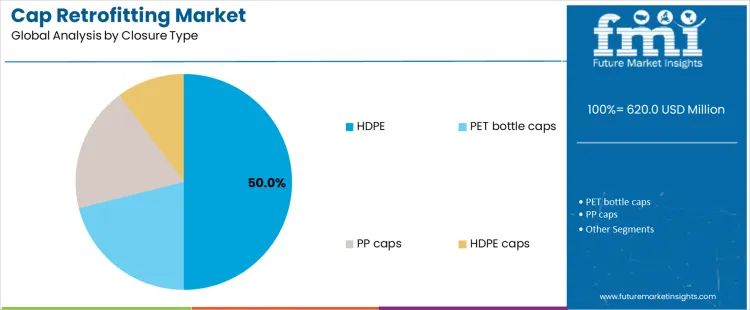
HDPE/PP caps are the leading closure type in the cap retrofitting market, holding 50% of the share. This is primarily due to their widespread use in packaging applications, particularly for food, beverages, and consumer goods. HDPE and PP are durable, lightweight, and cost-effective materials, making them ideal for high-volume manufacturing and packaging. The demand for retrofitting these caps is driven by the need to improve sealing performance, enhance functionality, and comply with sustainability regulations. Retrofitting HDPE/PP caps can improve their compatibility with new packaging systems, reduce leakage, and extend shelf life, which is crucial for industries like food and beverage. Additionally, as sustainability becomes a priority for many companies, retrofitting existing caps to be more environmentally friendly or compliant with the latest industry standards is gaining importance. The ease of retrofitting these materials and their cost-effectiveness further supports their dominance in the market.
What is Driving the Demand for PPWR-Compliant Cap Conversion in the Cap Retrofitting Market?

PPWR-compliant cap conversion is the leading technology in the cap retrofitting market, capturing 55% of the share. This technology is driven by the growing demand for packaging solutions that meet the requirements of the Packaging and Packaging Waste Regulation (PPWR), which aims to improve recycling rates and reduce packaging waste. Cap retrofitting to make HDPE/PP caps compliant with PPWR standards ensures that caps are easier to recycle, thus contributing to sustainability goals. The conversion process typically involves modifying the cap's design or material properties to align with recycling standards while maintaining functionality, durability, and ease of use. With increasing pressure from regulatory bodies and consumers to adopt sustainable packaging practices, the demand for PPWR-compliant cap conversion technology is expected to grow. This retrofitting solution allows companies to keep their existing packaging systems while improving their environmental impact, making it a preferred choice in the cap retrofitting market.
What is the Summary of the Global Cap Retrofitting Market?
The global cap retrofitting market is growing as manufacturers and packaging professionals upgrade existing closure systems with new cap technologies that improve functionality, safety and user experience. Cap retrofits can add features such as tamper evidence, child resistance, dosing control, ergonomic design and compatibility with new product formulations or sustainability goals. Demand spans food and beverage, pharmaceuticals, personal care and industrial segments where evolving consumer preferences and regulatory requirements drive modernization of packaging without full line replacement. Adoption reflects focus on performance, compliance and lifecycle cost optimization worldwide.
What are the Key Drivers for the Global Cap Retrofitting Market?
A key driver is the need to enhance existing packaging with advanced closure features that meet updated safety, convenience and sustainability expectations. Brands often retrofit caps to add tamper evidence, child resistant mechanisms, precision dosing or reclosability without investing in completely new containers. Evolving regulatory requirements for closure safety in healthcare and food sectors encourage upgrades that sustain compliance. Consumer preference for easy to use, secure and differentiated packaging supports retrofit demand. Cost conscious companies also favor retrofitting as a lower cost strategy to improve packaging performance while extending the life of existing filling and capping equipment.
What are the Restraints for the Global Cap Retrofitting Market?
One restraint is the technical and operational complexity of integrating retrofit caps into existing production lines. Upgrades may require adjustments to capping equipment, changeovers in tooling, training of operators and validation to ensure new caps perform reliably at speed. Compatibility issues between retrofit components and legacy containers can necessitate redesign or additional testing. Some markets face hesitation due to perceived cost versus direct performance benefit, especially where current packaging meets minimum requirements. Variability in global regulatory standards for closure performance and labeling also adds planning and compliance considerations for retrofit programs.
What is the Key Trends in the Global Cap Retrofitting Market?
A key trend is adoption of smart and sustainable closure solutions that support traceability, dose control and reduced material use. Manufacturers are integrating RFID, NFC and QR code elements into cap retrofits to enable supply chain visibility and consumer engagement. Growth in lightweight and recyclable cap designs aligns with brand sustainability commitments and circular packaging goals. Child resistant and assisted use closure solutions are gaining traction in healthcare and nutraceutical packaging. Collaboration between closure suppliers and OEMs is rising to develop modular retrofit kits that minimise line disruption and support faster deployment across different packaging formats.
What is the Country-Wise Analysis of the Cap Retrofitting Market?
The cap retrofitting market is expected to grow steadily, driven by the increasing demand for packaging solutions that offer enhanced safety, convenience, and functionality. Cap retrofitting involves modifying or upgrading existing caps to improve performance, add new features, or comply with new regulations, making it a cost-effective solution for businesses seeking to improve their packaging without investing in entirely new systems. High-growth markets like China and India are seeing strong demand, driven by rapid industrialization, expanding manufacturing sectors, and increasing consumer demand for improved packaging. Developed markets such as the USA, Germany, and Brazil are also experiencing steady growth, supported by advancements in packaging technologies and the need for sustainable, efficient packaging solutions.
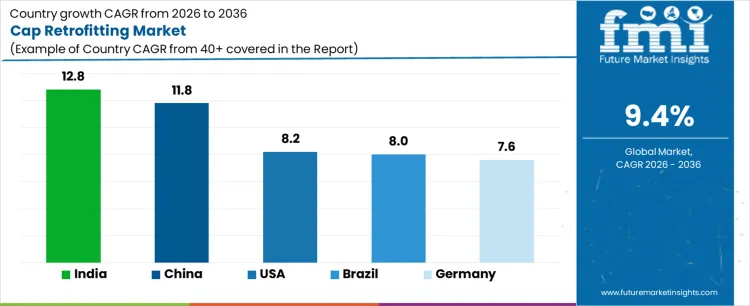
| Country | CAGR (%) |
|---|---|
| China | 11.8 |
| India | 12.8 |
| United States | 8.2 |
| Germany | 7.6 |
| Brazil | 8 |
What is the Growth Outlook for the Cap Retrofitting Market in China?
The cap retrofitting market in China is expected to grow at the highest rate, with a projected CAGR of 11.8%. China’s rapidly expanding manufacturing sector, coupled with the growing demand for improved packaging solutions across various industries, is driving this market growth. The country’s focus on increasing product safety, enhancing convenience, and meeting new regulations is fueling the adoption of cap retrofitting technologies. As the Chinese market continues to prioritize innovation and efficiency in packaging, businesses are increasingly opting for retrofitting solutions that upgrade existing systems at a lower cost. With these factors, China is poised to lead the global market for cap retrofitting.
What is the Market Outlook for the Cap Retrofitting Market in India?
The cap retrofitting market in India is projected to grow at the highest rate, with a projected CAGR of 12.8%. India’s fast-growing manufacturing and retail sectors are driving demand for packaging solutions that improve functionality, safety, and sustainability. As the market for packaged goods expands, businesses are increasingly focusing on upgrading their packaging systems without incurring the high costs associated with completely new equipment. Cap retrofitting is seen as a cost-effective solution for improving packaging quality while maintaining compliance with new regulations. With the rising focus on product protection and packaging optimization, India’s cap retrofitting market is expected to experience robust growth.
What is the Growth Forecast for the Cap Retrofitting Market in the United States?
The cap retrofitting market in the United States is expected to grow steadily, with a projected CAGR of 8.2%. In the U.S., the packaging industry continues to evolve, with businesses seeking efficient, cost-effective solutions to enhance their packaging systems. Cap retrofitting offers a way to improve the performance of existing packaging without the need for full system replacements. Additionally, growing consumer demand for safer, more user-friendly packaging is pushing businesses to adopt retrofitting solutions. As sustainability and regulatory compliance remain key drivers in the packaging industry, the market for cap retrofitting in the U.S. is expected to grow steadily over the next several years.
What is the Market Outlook for the Cap Retrofitting Market in Germany?

The cap retrofitting market in Germany is projected to grow at a steady pace, with a projected CAGR of 7.6%. Germany’s well-established manufacturing sector, coupled with its strong focus on efficiency and sustainability, is driving the demand for advanced packaging solutions, including cap retrofitting. As businesses look to optimize their packaging without investing in entirely new systems, retrofitting is seen as a practical solution. With increasing regulatory requirements for packaging safety and environmental impact, companies in Germany are turning to cap retrofitting to improve packaging systems while maintaining compliance. As the market for sustainable and efficient packaging grows, Germany’s cap retrofitting market is expected to continue its steady expansion.
What are the Growth Prospects for the Cap Retrofitting Market in Brazil?
The cap retrofitting market in Brazil is expected to grow at a moderate pace, with a projected CAGR of 8%. Brazil’s growing manufacturing sector, coupled with increasing demand for packaging solutions that are both functional and sustainable, is contributing to the rise of cap retrofitting. As Brazilian businesses look for cost-effective solutions to improve packaging without replacing entire systems, retrofitting technologies are becoming more popular. The increasing focus on compliance with packaging regulations and safety standards is also supporting market growth. While Brazil’s market growth may be slower than in other regions, the demand for enhanced packaging functionality is expected to drive steady adoption of cap retrofitting technologies.
What is the Competitive Landscape for the Cap Retrofitting Market?
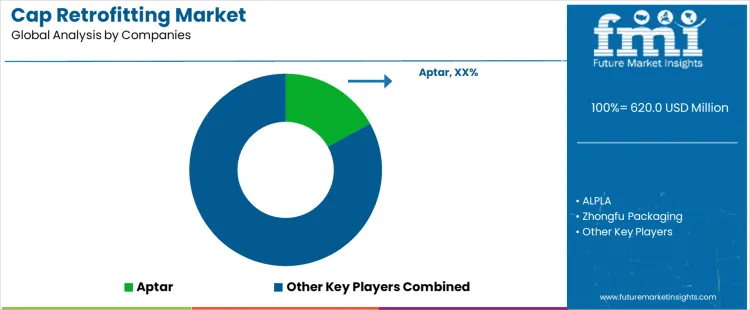
The cap retrofitting market is expanding as industries look for cost-effective solutions to enhance the functionality and performance of existing packaging without the need for complete replacements. Aptar leads the market with its innovative cap retrofitting solutions, offering high-quality, adaptable systems designed to improve packaging performance, user convenience, and product integrity. Their strong focus on sustainability, customization, and product innovation has made them a dominant player. ALPLA, Zhongfu Packaging, and Manjushree are significant competitors, providing specialized retrofitting solutions tailored to a range of packaging applications. ALPLA focuses on providing durable, efficient retrofitting solutions that enhance packaging functionality, while Zhongfu Packaging and Manjushree offer cost-effective solutions for various industries.
Silgan, Toyo Seikan, and Bericap further contribute to the competitive landscape by offering retrofitting services for caps and closures. Silgan and Toyo Seikan provide advanced cap retrofitting solutions that enhance sealing performance and ease of use, while Bericap focuses on improving product integrity through innovative retrofitting systems. These companies compete by focusing on product innovation, cost efficiency, and the ability to offer flexible and sustainable retrofitting solutions that meet the growing demand for packaging optimization across various sectors.
Key Players of the Cap Retrofitting Market
- Aptar
- ALPLA
- Zhongfu Packaging
- Manjushree
- Silgan
- Toyo Seikan
- Bericap
Scope of the Report
| Items | Values |
|---|---|
| Quantitative Units (2026) | USD Million |
| Application | Beverage & Dairy Plants, Bottled Water & Soft Drinks, FMCG Bottling, Local Beverage Brands, Juice & Dairy, Precision Bottling |
| Retrofit Type | Tamper-Evident & Tethered Cap Retrofits, Line-Change Retrofit Kits, Cap Feeder & Applicator Upgrades, Manual-to-Auto Retrofits |
| Closure Type | HDPE / PP Caps, PET Bottle Caps, PP Caps, HDPE Caps |
| Technology | PPWR-Compliant Cap Conversion, High-Speed Torque Optimisation, Servo-Driven Cap Handling, Cost-Efficient Mechanical Upgrades |
| Companies | Aptar, ALPLA, Zhongfu Packaging, Manjushree, Silgan, Toyo Seikan, Bericap |
| Regions Covered | North America, Latin America, Western Europe, Eastern Europe, South Asia and Pacific, East Asia, Middle East & Africa |
| Countries Covered | United States, Canada, Mexico, Brazil, Argentina, Germany, France, United Kingdom, Italy, Spain, Netherlands, China, India, Japan, South Korea, ANZ, GCC Countries, South Africa |
| Additional Attributes | Dollar by sales by application, retrofit type, closure type, technology, and region. Includes market trends in cap retrofitting, focusing on tamper-evident, line-change kits, cap feeder upgrades, and manual-to-auto retrofits. Highlights the role of high-speed torque optimisation, servo-driven handling, and cost-efficient mechanical upgrades in beverage, dairy, FMCG, and local beverage packaging. Focus on regulatory compliance, performance, cost-effectiveness, market share, and competitive positioning of key companies in the packaging industry. |
Cap Retrofitting Market Segmentation
Application:
- Beverage & dairy plants
- Bottled water & soft drinks
- FMCG bottling
- Local beverage brands
- Juice & dairy
- Precision bottling
Retrofit Type:
- Tamper-evident & tethered cap retrofits
- Line-change retrofit kits
- Cap feeder & applicator upgrades
- Manual-to-auto retrofits
- Others
Closure Type:
- HDPE / PP caps
- PET bottle caps
- PP caps
- HDPE caps
- Others
Technology:
- PPWR-compliant cap conversion
- High-speed torque optimisation
- Servo-driven cap handling
- Cost-efficient mechanical upgrades
- Others
Region:
- Asia Pacific
- China
- Japan
- South Korea
- India
- Australia & New Zealand
- ASEAN
- Rest of Asia Pacific
- Europe
- Germany
- United Kingdom
- France
- Italy
- Spain
- Nordic
- BENELUX
- Rest of Europe
- North America
- United States
- Canada
- Mexico
- Latin America
- Brazil
- Chile
- Rest of Latin America
- Middle East & Africa
- Kingdom of Saudi Arabia
- Other GCC Countries
- Turkey
- South Africa
- Other African Union
- Rest of Middle East & Africa
Frequently Asked Questions
How big is the cap retrofitting market in 2026?
The global cap retrofitting market is valued at USD 620 million in 2026.
What will be the size of the cap retrofitting market in 2036?
The market is projected to reach USD 1,520 million by 2036.
How fast will the cap retrofitting market grow between 2026 and 2036?
The market will grow at a CAGR of 9.4% from 2026 to 2036.
Which technology segment leads the cap retrofitting market in 2026?
PPWR-compliant cap conversion leads the market with a 55% share in 2026.
Who are the major players in the cap retrofitting market?
Key players include Aptar, ALPLA, Zhongfu Packaging, Manjushree, Silgan, Toyo Seikan, and Bericap.
Preview the report firsthand - request a free sample
Get SampleGet the brochure for pricing and purchase details.
Get PDFTable of Content
- Executive Summary
- Global Market Outlook
- Demand-side Trends
- Supply-side Trends
- Technology Roadmap Analysis
- Analysis and Recommendations
- Market Overview
- Market Coverage / Taxonomy
- Market Definition / Scope / Limitations
- Market Background
- Market Dynamics
- Drivers
- Restraints
- Opportunity
- Trends
- Scenario Forecast
- Demand in Optimistic Scenario
- Demand in Likely Scenario
- Demand in Conservative Scenario
- Opportunity Map Analysis
- Product Life Cycle Analysis
- Supply Chain Analysis
- Investment Feasibility Matrix
- Value Chain Analysis
- PESTLE and Porter’s Analysis
- Regulatory Landscape
- Regional Parent Market Outlook
- Production and Consumption Statistics
- Import and Export Statistics
- Market Dynamics
- Global Market Analysis 2021 to 2025 and Forecast, 2026 to 2036
- Historical Market Size Value (USD Million) Analysis, 2021 to 2025
- Current and Future Market Size Value (USD Million) Projections, 2026 to 2036
- Y-o-Y Growth Trend Analysis
- Absolute $ Opportunity Analysis
- Global Market Pricing Analysis 2021 to 2025 and Forecast 2026 to 2036
- Global Market Analysis 2021 to 2025 and Forecast 2026 to 2036, By Application
- Introduction / Key Findings
- Historical Market Size Value (USD Million) Analysis By Application , 2021 to 2025
- Current and Future Market Size Value (USD Million) Analysis and Forecast By Application , 2026 to 2036
- Beverage & dairy plants
- Bottled water & soft drinks
- FMCG bottling
- Local beverage brands
- Juice & dairy
- Precision bottling
- Beverage & dairy plants
- Y-o-Y Growth Trend Analysis By Application , 2021 to 2025
- Absolute $ Opportunity Analysis By Application , 2026 to 2036
- Global Market Analysis 2021 to 2025 and Forecast 2026 to 2036, By Retrofit Type
- Introduction / Key Findings
- Historical Market Size Value (USD Million) Analysis By Retrofit Type, 2021 to 2025
- Current and Future Market Size Value (USD Million) Analysis and Forecast By Retrofit Type, 2026 to 2036
- Tamper-evident & tethered cap retrofits
- Line-change retrofit kits
- Cap feeder & applicator upgrades
- Manual-to-auto retrofits
- Tamper-evident & tethered cap retrofits
- Y-o-Y Growth Trend Analysis By Retrofit Type, 2021 to 2025
- Absolute $ Opportunity Analysis By Retrofit Type, 2026 to 2036
- Global Market Analysis 2021 to 2025 and Forecast 2026 to 2036, By Closure Type
- Introduction / Key Findings
- Historical Market Size Value (USD Million) Analysis By Closure Type, 2021 to 2025
- Current and Future Market Size Value (USD Million) Analysis and Forecast By Closure Type, 2026 to 2036
- HDPE
- PET bottle caps
- PP caps
- HDPE caps
- HDPE
- Y-o-Y Growth Trend Analysis By Closure Type, 2021 to 2025
- Absolute $ Opportunity Analysis By Closure Type, 2026 to 2036
- Global Market Analysis 2021 to 2025 and Forecast 2026 to 2036, By Technology
- Introduction / Key Findings
- Historical Market Size Value (USD Million) Analysis By Technology, 2021 to 2025
- Current and Future Market Size Value (USD Million) Analysis and Forecast By Technology, 2026 to 2036
- PPWR-compliant cap conversion
- High-speed torque optimisation
- Servo-driven cap handling
- Cost-efficient mechanical upgrades
- PPWR-compliant cap conversion
- Y-o-Y Growth Trend Analysis By Technology, 2021 to 2025
- Absolute $ Opportunity Analysis By Technology, 2026 to 2036
- Global Market Analysis 2021 to 2025 and Forecast 2026 to 2036, By Region
- Introduction
- Historical Market Size Value (USD Million) Analysis By Region, 2021 to 2025
- Current Market Size Value (USD Million) Analysis and Forecast By Region, 2026 to 2036
- North America
- Latin America
- Western Europe
- Eastern Europe
- East Asia
- South Asia and Pacific
- Middle East & Africa
- Market Attractiveness Analysis By Region
- North America Market Analysis 2021 to 2025 and Forecast 2026 to 2036, By Country
- Historical Market Size Value (USD Million) Trend Analysis By Market Taxonomy, 2021 to 2025
- Market Size Value (USD Million) Forecast By Market Taxonomy, 2026 to 2036
- By Country
- USA
- Canada
- Mexico
- By Application
- By Retrofit Type
- By Closure Type
- By Technology
- By Country
- Market Attractiveness Analysis
- By Country
- By Application
- By Retrofit Type
- By Closure Type
- By Technology
- Key Takeaways
- Latin America Market Analysis 2021 to 2025 and Forecast 2026 to 2036, By Country
- Historical Market Size Value (USD Million) Trend Analysis By Market Taxonomy, 2021 to 2025
- Market Size Value (USD Million) Forecast By Market Taxonomy, 2026 to 2036
- By Country
- Brazil
- Chile
- Rest of Latin America
- By Application
- By Retrofit Type
- By Closure Type
- By Technology
- By Country
- Market Attractiveness Analysis
- By Country
- By Application
- By Retrofit Type
- By Closure Type
- By Technology
- Key Takeaways
- Western Europe Market Analysis 2021 to 2025 and Forecast 2026 to 2036, By Country
- Historical Market Size Value (USD Million) Trend Analysis By Market Taxonomy, 2021 to 2025
- Market Size Value (USD Million) Forecast By Market Taxonomy, 2026 to 2036
- By Country
- Germany
- UK
- Italy
- Spain
- France
- Nordic
- BENELUX
- Rest of Western Europe
- By Application
- By Retrofit Type
- By Closure Type
- By Technology
- By Country
- Market Attractiveness Analysis
- By Country
- By Application
- By Retrofit Type
- By Closure Type
- By Technology
- Key Takeaways
- Eastern Europe Market Analysis 2021 to 2025 and Forecast 2026 to 2036, By Country
- Historical Market Size Value (USD Million) Trend Analysis By Market Taxonomy, 2021 to 2025
- Market Size Value (USD Million) Forecast By Market Taxonomy, 2026 to 2036
- By Country
- Russia
- Poland
- Hungary
- Balkan & Baltic
- Rest of Eastern Europe
- By Application
- By Retrofit Type
- By Closure Type
- By Technology
- By Country
- Market Attractiveness Analysis
- By Country
- By Application
- By Retrofit Type
- By Closure Type
- By Technology
- Key Takeaways
- East Asia Market Analysis 2021 to 2025 and Forecast 2026 to 2036, By Country
- Historical Market Size Value (USD Million) Trend Analysis By Market Taxonomy, 2021 to 2025
- Market Size Value (USD Million) Forecast By Market Taxonomy, 2026 to 2036
- By Country
- China
- Japan
- South Korea
- By Application
- By Retrofit Type
- By Closure Type
- By Technology
- By Country
- Market Attractiveness Analysis
- By Country
- By Application
- By Retrofit Type
- By Closure Type
- By Technology
- Key Takeaways
- South Asia and Pacific Market Analysis 2021 to 2025 and Forecast 2026 to 2036, By Country
- Historical Market Size Value (USD Million) Trend Analysis By Market Taxonomy, 2021 to 2025
- Market Size Value (USD Million) Forecast By Market Taxonomy, 2026 to 2036
- By Country
- India
- ASEAN
- Australia & New Zealand
- Rest of South Asia and Pacific
- By Application
- By Retrofit Type
- By Closure Type
- By Technology
- By Country
- Market Attractiveness Analysis
- By Country
- By Application
- By Retrofit Type
- By Closure Type
- By Technology
- Key Takeaways
- Middle East & Africa Market Analysis 2021 to 2025 and Forecast 2026 to 2036, By Country
- Historical Market Size Value (USD Million) Trend Analysis By Market Taxonomy, 2021 to 2025
- Market Size Value (USD Million) Forecast By Market Taxonomy, 2026 to 2036
- By Country
- Kingdom of Saudi Arabia
- Other GCC Countries
- Turkiye
- South Africa
- Other African Union
- Rest of Middle East & Africa
- By Application
- By Retrofit Type
- By Closure Type
- By Technology
- By Country
- Market Attractiveness Analysis
- By Country
- By Application
- By Retrofit Type
- By Closure Type
- By Technology
- Key Takeaways
- Key Countries Market Analysis
- USA
- Pricing Analysis
- Market Share Analysis, 2025
- By Application
- By Retrofit Type
- By Closure Type
- By Technology
- Canada
- Pricing Analysis
- Market Share Analysis, 2025
- By Application
- By Retrofit Type
- By Closure Type
- By Technology
- Mexico
- Pricing Analysis
- Market Share Analysis, 2025
- By Application
- By Retrofit Type
- By Closure Type
- By Technology
- Brazil
- Pricing Analysis
- Market Share Analysis, 2025
- By Application
- By Retrofit Type
- By Closure Type
- By Technology
- Chile
- Pricing Analysis
- Market Share Analysis, 2025
- By Application
- By Retrofit Type
- By Closure Type
- By Technology
- Germany
- Pricing Analysis
- Market Share Analysis, 2025
- By Application
- By Retrofit Type
- By Closure Type
- By Technology
- UK
- Pricing Analysis
- Market Share Analysis, 2025
- By Application
- By Retrofit Type
- By Closure Type
- By Technology
- Italy
- Pricing Analysis
- Market Share Analysis, 2025
- By Application
- By Retrofit Type
- By Closure Type
- By Technology
- Spain
- Pricing Analysis
- Market Share Analysis, 2025
- By Application
- By Retrofit Type
- By Closure Type
- By Technology
- France
- Pricing Analysis
- Market Share Analysis, 2025
- By Application
- By Retrofit Type
- By Closure Type
- By Technology
- India
- Pricing Analysis
- Market Share Analysis, 2025
- By Application
- By Retrofit Type
- By Closure Type
- By Technology
- ASEAN
- Pricing Analysis
- Market Share Analysis, 2025
- By Application
- By Retrofit Type
- By Closure Type
- By Technology
- Australia & New Zealand
- Pricing Analysis
- Market Share Analysis, 2025
- By Application
- By Retrofit Type
- By Closure Type
- By Technology
- China
- Pricing Analysis
- Market Share Analysis, 2025
- By Application
- By Retrofit Type
- By Closure Type
- By Technology
- Japan
- Pricing Analysis
- Market Share Analysis, 2025
- By Application
- By Retrofit Type
- By Closure Type
- By Technology
- South Korea
- Pricing Analysis
- Market Share Analysis, 2025
- By Application
- By Retrofit Type
- By Closure Type
- By Technology
- Russia
- Pricing Analysis
- Market Share Analysis, 2025
- By Application
- By Retrofit Type
- By Closure Type
- By Technology
- Poland
- Pricing Analysis
- Market Share Analysis, 2025
- By Application
- By Retrofit Type
- By Closure Type
- By Technology
- Hungary
- Pricing Analysis
- Market Share Analysis, 2025
- By Application
- By Retrofit Type
- By Closure Type
- By Technology
- Kingdom of Saudi Arabia
- Pricing Analysis
- Market Share Analysis, 2025
- By Application
- By Retrofit Type
- By Closure Type
- By Technology
- Turkiye
- Pricing Analysis
- Market Share Analysis, 2025
- By Application
- By Retrofit Type
- By Closure Type
- By Technology
- South Africa
- Pricing Analysis
- Market Share Analysis, 2025
- By Application
- By Retrofit Type
- By Closure Type
- By Technology
- USA
- Market Structure Analysis
- Competition Dashboard
- Competition Benchmarking
- Market Share Analysis of Top Players
- By Regional
- By Application
- By Retrofit Type
- By Closure Type
- By Technology
- Competition Analysis
- Competition Deep Dive
- Aptar
- Overview
- Product Portfolio
- Profitability by Market Segments (Product/Age /Sales Channel/Region)
- Sales Footprint
- Strategy Overview
- Marketing Strategy
- Product Strategy
- Channel Strategy
- ALPLA
- Zhongfu Packaging
- Manjushree
- Silgan
- Toyo Seikan
- Bericap
- Aptar
- Competition Deep Dive
- Assumptions & Acronyms Used
- Research Methodology


