

- Industry Size (2026)
- USD 480 Mn
- Forecast (2036)
- USD 1256.4 Mn
- CAGR (2026 to 2036)
- 10.1%
Capture-Carbon Substrates Market Forecast and Outlook 2026 to 2036
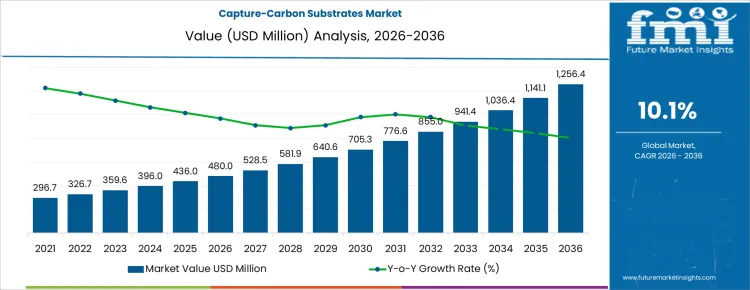
The capture-carbon substrates market is witnessing steady growth, projected to reach USD 1,256.4 million by 2036, up from USD 480 million in 2026, representing a CAGR of 10.1%. The market is driven by the increasing need for efficient carbon capture solutions to meet stringent environmental regulations and sustainability goals across various industries. Active packaging & industrial filters lead the market with a 40% share, as they are essential in industries such as food freshness, odor control, and industrial filtration, where efficient carbon capture is critical. Carbon-embedded sheets & films dominate the substrate type category with a 45% share, offering high performance for capturing carbon emissions in diverse applications, including packaging and industrial filtration. Their superior flexibility and insulating properties make them ideal for applications requiring reliable and lightweight carbon capture.
Quick Stats for Capture-Carbon Substrates Market
- Capture-Carbon Substrates Market Value (2026): USD 480 million
- Capture-Carbon Substrates Market Forecast Value (2036): USD 1,256.4 million
- Capture-Carbon Substrates Market Forecast CAGR: 10.1%
- Top Substrate Type in Capture-Carbon Substrates Market: Carbon-embedded sheets & films
- Key Growth Regions in Capture-Carbon Substrates Market: India, China, USA, Germany, Brazil
- Key Players in Capture-Carbon Substrates Market: Kuraray, Cabot, Freudenberg, Calgon Carbon China, Indo German Carbon
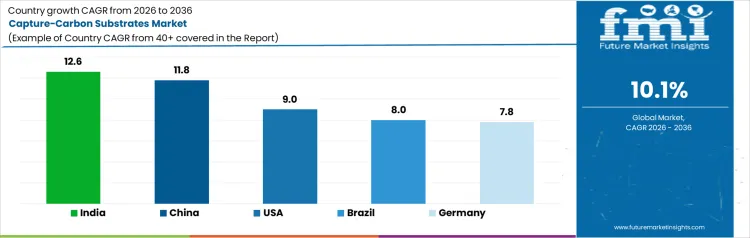
India leads the market with a 12.6% CAGR, driven by its rapid industrial growth, increasing focus on sustainability, and government initiatives promoting carbon capture technologies. China follows closely with an 11.8% CAGR, supported by its large-scale industrial base and government support for reducing carbon emissions. The USA sees a growth rate of 9%, spurred by increasing demand for carbon capture solutions in energy and manufacturing sectors. Germany grows at 7.8%, driven by its emphasis on clean technologies and environmental regulations. Brazil grows at 8%, benefiting from the increasing adoption of eco-friendly solutions in its expanding industrial sector. As regulatory pressure and demand for eco-friendly practices rise, the market for capture-carbon substrates is poised for continued growth across these regions.
Capture‑Carbon Substrates Market Key Takeaways
| Metric | Value |
|---|---|
| Industry Value (2026) | USD 480 million |
| Forecast Value (2036) | USD 1,256.4 million |
| Forecast CAGR (2026 to 2036) | 10.1% |
How is the Global Capture-Carbon Substrates Sector Advancing?
The global capture carbon substrates market is growing as industries and governments intensify efforts to reduce industrial carbon emissions and mitigate climate change. Capture carbon substrates are specialized materials used in carbon capture systems to adsorb, absorb, or chemically bind carbon dioxide from industrial exhaust streams, power plants, or process emissions. These substrates include advanced sorbents, porous solids, and engineered media that offer high selectivity and capacity for carbon dioxide, making them essential in carbon capture, utilization, and storage (CCUS) technologies. As regulatory frameworks tighten and carbon pricing mechanisms expand, demand for effective capture substrates has risen across sectors such as energy, steel, cement, and chemical production, which are seeking to lower their carbon footprints.
Advancements in material science have improved the performance, durability, and regeneration efficiency of capture carbon substrates, helping reduce operational costs and energy requirements associated with carbon capture processes. Innovations include tailored pore structures, functionalized surfaces, and hybrid materials that enhance carbon affinity while maintaining stability under industrial conditions. These improvements support broader adoption of CCUS technologies by offering more cost competitive and scalable solutions for large scale emissions management.
The capture carbon substrates market is anticipated to continue its growth trajectory as investments in climate mitigation infrastructure increase and as CCUS implementation expands globally. Challenges such as high initial deployment costs, integration complexity with existing industrial systems, and the need for supporting policy incentives may influence adoption rates. Despite these factors, the emphasis on achieving net zero emission goals and the expansion of carbon management strategies will sustain demand for advanced capture carbon substrates worldwide.
What Is the Segment-Wise Analysis for the Global Capture-Carbon Substrates Market?
The global capture-carbon substrates market is segmented by end-use and substrate type. Active packaging & industrial filters lead the market with a 40% share, followed by food freshness & odor control, industrial & FMCG uses, and packaging & safety products. In terms of substrate type, carbon-embedded sheets & films dominate with a 45% share, followed by paper & nonwoven substrates, carbon films, and carbon-lined sheets.
How Do Active Packaging & Industrial Filters Lead the Global Capture-Carbon Substrates Market?
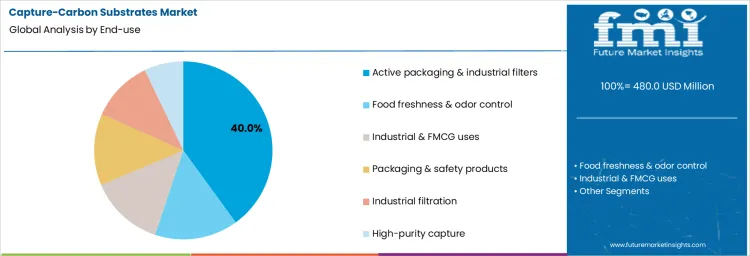
Active packaging & industrial filters lead the global capture-carbon substrates market with a 40% share due to their growing importance in meeting the demand for effective carbon capture and filtration solutions across multiple industries. These substrates are integral in applications requiring efficient carbon emission capture, extended product shelf life, and improved freshness.
In active packaging, they help control odors and maintain food quality, while in industrial filters, they efficiently remove pollutants. As environmental regulations become stricter and industries shift toward eco-friendlier solutions, the adoption of capture-carbon substrates in these applications continues to rise. This growing emphasis on eco-friendly packaging and filtration solutions propels their continued market leadership.
Why Do Carbon-Embedded Sheets & Films Hold the Largest Market Share in the Global Capture-Carbon Substrates Market?
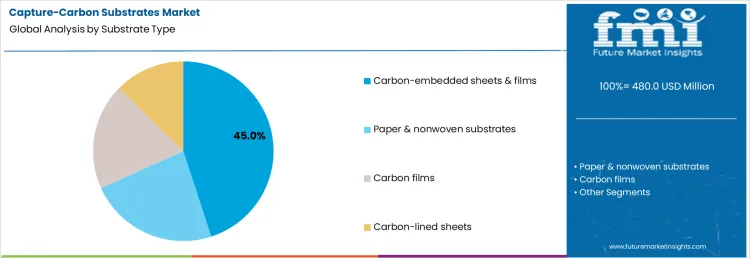
Carbon-embedded sheets & films hold the largest share of 45% in the global capture-carbon substrates market because they offer the ideal combination of carbon capture efficiency with lightweight, flexible materials. These substrates are widely used in applications such as active packaging and industrial filtration, where their ability to capture carbon while preserving the performance of the material is crucial.
Their versatility in various sectors, combined with their environmental benefits, drives their widespread adoption. As environmental concerns intensify and demand for eco-friendly packaging increases, carbon-embedded sheets & films are poised to maintain their dominant market position, providing an eco-friendly solution to carbon capture needs.
What are the Key Dynamics for Capture-Carbon Substrates Market?
The capture-carbon substrates market is growing due to the increasing focus on carbon reduction and climate change mitigation. Governments, industries, and companies are setting ambitious decarbonization goals, driving demand for efficient and cost effective carbon capture technologies. Advances in substrate materials, such as metal organic frameworks (MOFs) and functionalized polymers, are improving carbon adsorption capacity and regeneration efficiency. With the growing need for emission reductions in sectors like energy, manufacturing, and transportation, capture-carbon substrates are seen as crucial tools in achieving global carbon neutrality targets.
What Key Trends Are Shaping the Capture-Carbon Substrates Market?
Key trends in the capture-carbon substrates market include the development of more efficient, low cost materials that offer improved adsorption and regeneration properties. The trend toward eco-friendly and bio based materials is growing, with industries seeking alternatives that minimize environmental impact. Hybrid systems, combining adsorption and membrane technologies, are gaining traction for increased efficiency. Digital technologies like AI and sensors are being integrated into carbon capture systems for real time monitoring and optimization. As more companies focus on achieving carbon neutrality, innovation in carbon capture substrates will be pivotal to scaling decarbonization efforts.
What Is the Growth Outlook for the Capture-Carbon Substrates Market?
The capture-carbon substrates market is poised for growth as industries increasingly adopt carbon capture solutions to meet regulatory pressures and sustainability goals. With advancements in substrate materials, scalability, and cost reduction, the market is expected to witness significant investments. Public and private sector partnerships, focused on developing cleaner technologies and improving performance, will further accelerate the adoption of carbon capture systems across energy and manufacturing sectors. The market’s growth will be driven by the urgent need for solutions to mitigate climate change and reduce industrial emissions.
What is the Growth Outlook for the Capture-Carbon Substrates Market by Country?
| Country | CAGR (%) |
|---|---|
| USA | 9% |
| Germany | 7.8% |
| China | 11.8% |
| India | 12.6% |
| Brazil | 8% |
The capture-carbon substrates market is experiencing steady growth, with India leading at a 12.6% CAGR, driven by the country’s increasing focus on sustainability and carbon capture technologies. China follows with 11.8%, supported by its large industrial base and government initiatives to reduce carbon emissions. The USA’s market grows at 9%, driven by the growing demand for carbon capture solutions in industries such as energy, manufacturing, and transportation. Germany’s market grows at 7.8%, fueled by its emphasis on environmental regulations and clean technologies. Brazil’s market grows at 8%, supported by the increasing need for eco-friendly carbon reduction solutions in industrial processes.
Why is India Leading in the Capture-Carbon Substrates Market?
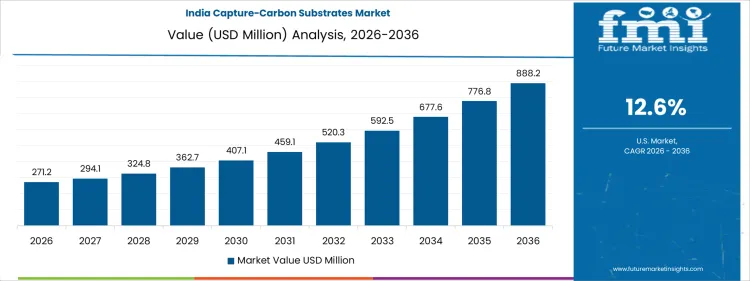
India’s capture-carbon substrates market is growing at 12.6%, driven by the country’s increasing focus on sustainability and its commitment to reducing carbon emissions. As India’s industrial base grows, particularly in energy, manufacturing, and transportation sectors, there is a growing need for technologies that can capture and store carbon. The government’s push for clean technologies and carbon reduction initiatives is further accelerating the adoption of capture-carbon substrates. India’s efforts to align with global climate agreements and reduce pollution are fueling demand for innovative carbon capture solutions. As environmental concerns grow and India’s industrial sectors expand, the market for capture-carbon substrates is expected to continue its strong growth.
What is Driving the Growth of the Capture-Carbon Substrates Market in China?
China’s capture-carbon substrates market is growing at 11.8%, driven by the country’s push to reduce carbon emissions and combat climate change. As China continues to be a global manufacturing powerhouse, the demand for carbon capture technologies in industries such as energy and heavy manufacturing is rising. The Chinese government’s focus on improving air quality and meeting international climate targets has led to the adoption of carbon capture solutions. Capture-carbon substrates play a key role in these efforts, offering an effective way to capture carbon emissions from industrial processes. With continued investments in clean technologies, China’s market for carbon capture solutions is expected to grow at a steady pace.
How is the Capture-Carbon Substrates Market Expanding in the USA?
The USA’s capture-carbon substrates market is growing at 9%, driven by the rising demand for carbon capture solutions across various industries, including energy, manufacturing, and transportation. As environmental regulations become stricter and the need to reduce greenhouse gas emissions increases, there is a growing focus on technologies that capture and store carbon effectively. The USA’s strong industrial base and government support for clean energy initiatives are contributing to the adoption of capture-carbon substrates. The growing demand for carbon offsets and compliance with climate policies is further driving market growth. As the focus on addressing climate change intensifies, the market for capture-carbon substrates in the USA is expected to continue expanding.
What is Contributing to the Growth of the Capture-Carbon Substrates Market in Germany?
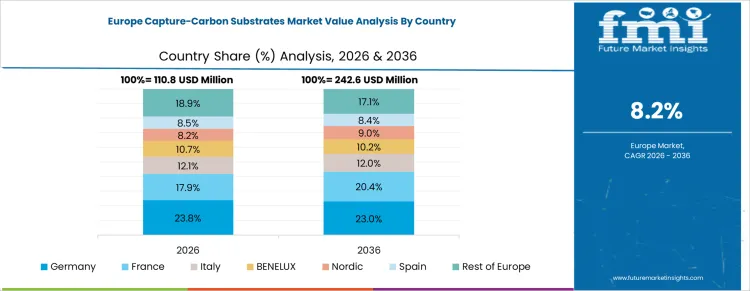
Germany’s capture-carbon substrates market is growing at 7.8%, supported by the country’s strong environmental policies and commitment to reducing carbon emissions. As Germany continues to lead in the development of clean technologies, industries such as energy, manufacturing, and transportation are increasingly adopting carbon capture solutions to meet sustainability goals. The country’s regulatory framework, which focuses on reducing carbon footprints, is driving the demand for capture-carbon substrates in both industrial and commercial applications. As Germany focuses on its ambitious climate goals, including carbon neutrality, the market for carbon capture technologies is expected to grow steadily, supported by government incentives and private sector innovation.
What is Driving the Growth of the Capture-Carbon Substrates Market in Brazil?
Brazil’s capture-carbon substrates market is growing at 8%, driven by the increasing need for eco-friendly solutions in industrial processes. As Brazil’s industrial base continues to grow, the demand for carbon capture technologies that help reduce emissions is rising. The Brazilian government is focusing on reducing its carbon footprint and promoting clean energy, further driving the adoption of carbon capture solutions. With growing pressure from international climate agreements and the need to improve environmental standards, Brazilian industries are turning to capture-carbon substrates to meet sustainability goals. As Brazil prioritizes reducing carbon emissions and improving its industrial practices, the market for capture-carbon substrates is expected to continue expanding.
How Are Companies Competing in the Capture Carbon Substrates Market?
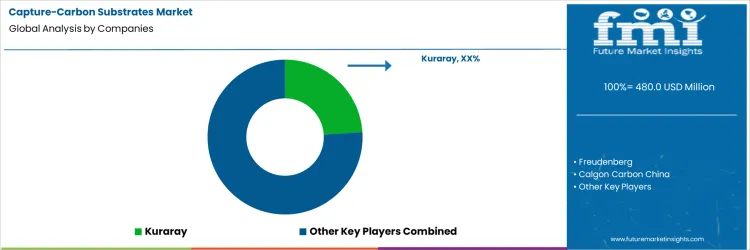
In the capture carbon substrates market Kuraray, Cabot, Freudenberg, Calgon Carbon China, Indo German Carbon, and local suppliers are positioned with product brochures that emphasize high adsorption capacity, tailored pore structures, and application specific performance. At Kuraray brochures showcase engineered carbon substrates designed for CO₂ capture in industrial and point source settings. Technical data on surface area and regeneration behavior are presented with clear visuals and guidance on matching substrates to process conditions. Cabot materials focus on high purity carbon formulations with consistent performance and durability across cycles. Performance summaries and comparison tables are used to help planners evaluate options for gas separation and carbon capture units.
Freudenberg literature presents a range of porous substrates and fibrous carbon materials described with strength in scalability and consistent quality control. Visual guides and specs help users understand substrate selection for diverse capture technologies. Calgon Carbon China product briefs highlight localized production of activated and engineered carbons with competitive pricing and tailored grades. Dosing recommendations and expected performance ranges are summarized to support specification. Indo German Carbon collateral emphasizes flexible grades and regional supply responsiveness, with concise charts showing adsorption kinetics and substrate properties. Local suppliers are featured with custom carbon substrates designed to meet specific regional or niche process needs, often with rapid turnaround and bespoke sizing options.
Key Players in Capture-Carbon Substrates Market
- Kuraray, Cabot
- Freudenberg
- Calgon Carbon China
- Indo German Carbon
- Local suppliers
- Kuraray (Japan)
Scope of Report
| Items | Values |
|---|---|
| Quantitative Units (2026) | USD million |
| End-use Application | Active packaging & industrial filters, Food freshness & odor control, Industrial & FMCG uses, Packaging & safety products, Industrial filtration, High-purity capture |
| Substrate Type | Carbon-embedded sheets & films, Paper & nonwoven substrates, Carbon films, Carbon-lined sheets |
| Regions Covered | Asia Pacific, Europe, North America, Latin America, Middle East & Africa |
| Countries Covered | USA, China, Japan, South Korea, India, Australia & New Zealand, ASEAN, Germany, UK, France, Italy, Spain, Nordic, BENELUX, Brazil, Chile, Mexico, Saudi Arabia, Other GCC Countries, Turkey, South Africa, Other African Union |
| Key Companies Profiled | Kuraray, Cabot, Freudenberg, Calgon Carbon China, Indo German Carbon, Local suppliers, Mitsubishi Chemical |
| Additional Attributes | Dollar sales by end-use, substrate type, and region; regional CAGR and growth outlook; distribution channels including packaging and industrial filtration; innovation trends in carbon capture substrates; competitive positioning of global vs regional suppliers. |
Capture-Carbon Substrates Market by Segments
By End-use:
- Active packaging & industrial filters
- Food freshness & odor control
- Industrial & FMCG uses
- Packaging & safety products
- Industrial filtration
- High-purity capture
By Substrate Type:
- Carbon-embedded sheets & films
- Paper & nonwoven substrates
- Carbon films
- Carbon-lined sheets
By Region:
- Asia Pacific
- China
- Japan
- South Korea
- India
- Australia & New Zealand
- ASEAN
- Rest of Asia Pacific
- Europe
- Germany
- United Kingdom
- France
- Italy
- Spain
- Nordic
- BENELUX
- Rest of Europe
- North America
- United States
- Canada
- Mexico
- Latin America
- Brazil
- Chile
- Rest of Latin America
- Middle East & Africa
- Kingdom of Saudi Arabia
- Other GCC Countries
- Turkey
- South Africa
- Other African Union
- Rest of Middle East & Africa
Frequently Asked Questions
How big is the capture-carbon substrates market in 2026?
The global capture-carbon substrates market is estimated to be valued at USD 480.0 million in 2026.
What will be the size of capture-carbon substrates market in 2036?
The market size for the capture-carbon substrates market is projected to reach USD 1,256.4 million by 2036.
How much will be the capture-carbon substrates market growth between 2026 and 2036?
The capture-carbon substrates market is expected to grow at a 10.1% CAGR between 2026 and 2036.
What are the key product types in the capture-carbon substrates market?
The key product types in capture-carbon substrates market are active packaging & industrial filters, food freshness & odor control, industrial & fmcg uses, packaging & safety products, industrial filtration and high-purity capture.
Which substrate type segment to contribute significant share in the capture-carbon substrates market in 2026?
In terms of substrate type, carbon-embedded sheets & films segment to command 45.0% share in the capture-carbon substrates market in 2026.
Preview the report firsthand - request a free sample
Get SampleGet the brochure for pricing and purchase details.
Get PDFTable of Content
- Executive Summary
- Global Market Outlook
- Demand-side Trends
- Supply-side Trends
- Technology Roadmap Analysis
- Analysis and Recommendations
- Market Overview
- Market Coverage / Taxonomy
- Market Definition / Scope / Limitations
- Market Background
- Market Dynamics
- Drivers
- Restraints
- Opportunity
- Trends
- Scenario Forecast
- Demand in Optimistic Scenario
- Demand in Likely Scenario
- Demand in Conservative Scenario
- Opportunity Map Analysis
- Product Life Cycle Analysis
- Supply Chain Analysis
- Investment Feasibility Matrix
- Value Chain Analysis
- PESTLE and Porter’s Analysis
- Regulatory Landscape
- Regional Parent Market Outlook
- Production and Consumption Statistics
- Import and Export Statistics
- Market Dynamics
- Global Market Analysis 2021 to 2025 and Forecast, 2026 to 2036
- Historical Market Size Value (USD Million) Analysis, 2021 to 2025
- Current and Future Market Size Value (USD Million) Projections, 2026 to 2036
- Y-o-Y Growth Trend Analysis
- Absolute $ Opportunity Analysis
- Global Market Pricing Analysis 2021 to 2025 and Forecast 2026 to 2036
- Global Market Analysis 2021 to 2025 and Forecast 2026 to 2036, By End-use
- Introduction / Key Findings
- Historical Market Size Value (USD Million) Analysis By End-use , 2021 to 2025
- Current and Future Market Size Value (USD Million) Analysis and Forecast By End-use , 2026 to 2036
- Active packaging & industrial filters
- Food freshness & odor control
- Industrial & FMCG uses
- Packaging & safety products
- Industrial filtration
- High-purity capture
- Y-o-Y Growth Trend Analysis By End-use , 2021 to 2025
- Absolute $ Opportunity Analysis By End-use , 2026 to 2036
- Global Market Analysis 2021 to 2025 and Forecast 2026 to 2036, By Substrate Type
- Introduction / Key Findings
- Historical Market Size Value (USD Million) Analysis By Substrate Type, 2021 to 2025
- Current and Future Market Size Value (USD Million) Analysis and Forecast By Substrate Type, 2026 to 2036
- Carbon-embedded sheets & films
- Paper & nonwoven substrates
- Carbon films
- Carbon-lined sheets
- Y-o-Y Growth Trend Analysis By Substrate Type, 2021 to 2025
- Absolute $ Opportunity Analysis By Substrate Type, 2026 to 2036
- Global Market Analysis 2021 to 2025 and Forecast 2026 to 2036, By Region
- Introduction
- Historical Market Size Value (USD Million) Analysis By Region, 2021 to 2025
- Current Market Size Value (USD Million) Analysis and Forecast By Region, 2026 to 2036
- North America
- Latin America
- Western Europe
- Eastern Europe
- East Asia
- South Asia and Pacific
- Middle East & Africa
- Market Attractiveness Analysis By Region
- North America Market Analysis 2021 to 2025 and Forecast 2026 to 2036, By Country
- Historical Market Size Value (USD Million) Trend Analysis By Market Taxonomy, 2021 to 2025
- Market Size Value (USD Million) Forecast By Market Taxonomy, 2026 to 2036
- By Country
- USA
- Canada
- Mexico
- By End-use
- By Substrate Type
- By Country
- Market Attractiveness Analysis
- By Country
- By End-use
- By Substrate Type
- Key Takeaways
- Latin America Market Analysis 2021 to 2025 and Forecast 2026 to 2036, By Country
- Historical Market Size Value (USD Million) Trend Analysis By Market Taxonomy, 2021 to 2025
- Market Size Value (USD Million) Forecast By Market Taxonomy, 2026 to 2036
- By Country
- Brazil
- Chile
- Rest of Latin America
- By End-use
- By Substrate Type
- By Country
- Market Attractiveness Analysis
- By Country
- By End-use
- By Substrate Type
- Key Takeaways
- Western Europe Market Analysis 2021 to 2025 and Forecast 2026 to 2036, By Country
- Historical Market Size Value (USD Million) Trend Analysis By Market Taxonomy, 2021 to 2025
- Market Size Value (USD Million) Forecast By Market Taxonomy, 2026 to 2036
- By Country
- Germany
- UK
- Italy
- Spain
- France
- Nordic
- BENELUX
- Rest of Western Europe
- By End-use
- By Substrate Type
- By Country
- Market Attractiveness Analysis
- By Country
- By End-use
- By Substrate Type
- Key Takeaways
- Eastern Europe Market Analysis 2021 to 2025 and Forecast 2026 to 2036, By Country
- Historical Market Size Value (USD Million) Trend Analysis By Market Taxonomy, 2021 to 2025
- Market Size Value (USD Million) Forecast By Market Taxonomy, 2026 to 2036
- By Country
- Russia
- Poland
- Hungary
- Balkan & Baltic
- Rest of Eastern Europe
- By End-use
- By Substrate Type
- By Country
- Market Attractiveness Analysis
- By Country
- By End-use
- By Substrate Type
- Key Takeaways
- East Asia Market Analysis 2021 to 2025 and Forecast 2026 to 2036, By Country
- Historical Market Size Value (USD Million) Trend Analysis By Market Taxonomy, 2021 to 2025
- Market Size Value (USD Million) Forecast By Market Taxonomy, 2026 to 2036
- By Country
- China
- Japan
- South Korea
- By End-use
- By Substrate Type
- By Country
- Market Attractiveness Analysis
- By Country
- By End-use
- By Substrate Type
- Key Takeaways
- South Asia and Pacific Market Analysis 2021 to 2025 and Forecast 2026 to 2036, By Country
- Historical Market Size Value (USD Million) Trend Analysis By Market Taxonomy, 2021 to 2025
- Market Size Value (USD Million) Forecast By Market Taxonomy, 2026 to 2036
- By Country
- India
- ASEAN
- Australia & New Zealand
- Rest of South Asia and Pacific
- By End-use
- By Substrate Type
- By Country
- Market Attractiveness Analysis
- By Country
- By End-use
- By Substrate Type
- Key Takeaways
- Middle East & Africa Market Analysis 2021 to 2025 and Forecast 2026 to 2036, By Country
- Historical Market Size Value (USD Million) Trend Analysis By Market Taxonomy, 2021 to 2025
- Market Size Value (USD Million) Forecast By Market Taxonomy, 2026 to 2036
- By Country
- Kingdom of Saudi Arabia
- Other GCC Countries
- Turkiye
- South Africa
- Other African Union
- Rest of Middle East & Africa
- By End-use
- By Substrate Type
- By Country
- Market Attractiveness Analysis
- By Country
- By End-use
- By Substrate Type
- Key Takeaways
- Key Countries Market Analysis
- USA
- Pricing Analysis
- Market Share Analysis, 2025
- By End-use
- By Substrate Type
- Canada
- Pricing Analysis
- Market Share Analysis, 2025
- By End-use
- By Substrate Type
- Mexico
- Pricing Analysis
- Market Share Analysis, 2025
- By End-use
- By Substrate Type
- Brazil
- Pricing Analysis
- Market Share Analysis, 2025
- By End-use
- By Substrate Type
- Chile
- Pricing Analysis
- Market Share Analysis, 2025
- By End-use
- By Substrate Type
- Germany
- Pricing Analysis
- Market Share Analysis, 2025
- By End-use
- By Substrate Type
- UK
- Pricing Analysis
- Market Share Analysis, 2025
- By End-use
- By Substrate Type
- Italy
- Pricing Analysis
- Market Share Analysis, 2025
- By End-use
- By Substrate Type
- Spain
- Pricing Analysis
- Market Share Analysis, 2025
- By End-use
- By Substrate Type
- France
- Pricing Analysis
- Market Share Analysis, 2025
- By End-use
- By Substrate Type
- India
- Pricing Analysis
- Market Share Analysis, 2025
- By End-use
- By Substrate Type
- ASEAN
- Pricing Analysis
- Market Share Analysis, 2025
- By End-use
- By Substrate Type
- Australia & New Zealand
- Pricing Analysis
- Market Share Analysis, 2025
- By End-use
- By Substrate Type
- China
- Pricing Analysis
- Market Share Analysis, 2025
- By End-use
- By Substrate Type
- Japan
- Pricing Analysis
- Market Share Analysis, 2025
- By End-use
- By Substrate Type
- South Korea
- Pricing Analysis
- Market Share Analysis, 2025
- By End-use
- By Substrate Type
- Russia
- Pricing Analysis
- Market Share Analysis, 2025
- By End-use
- By Substrate Type
- Poland
- Pricing Analysis
- Market Share Analysis, 2025
- By End-use
- By Substrate Type
- Hungary
- Pricing Analysis
- Market Share Analysis, 2025
- By End-use
- By Substrate Type
- Kingdom of Saudi Arabia
- Pricing Analysis
- Market Share Analysis, 2025
- By End-use
- By Substrate Type
- Turkiye
- Pricing Analysis
- Market Share Analysis, 2025
- By End-use
- By Substrate Type
- South Africa
- Pricing Analysis
- Market Share Analysis, 2025
- By End-use
- By Substrate Type
- USA
- Market Structure Analysis
- Competition Dashboard
- Competition Benchmarking
- Market Share Analysis of Top Players
- By Regional
- By End-use
- By Substrate Type
- Competition Analysis
- Competition Deep Dive
- Kuraray
- Overview
- Product Portfolio
- Profitability by Market Segments (Product/Age /Sales Channel/Region)
- Sales Footprint
- Strategy Overview
- Marketing Strategy
- Product Strategy
- Channel Strategy
- Freudenberg
- Calgon Carbon China
- Indo German Carbon
- Local suppliers
- Kuraray (Japan)
- Kuraray
- Competition Deep Dive
- Assumptions & Acronyms Used
- Research Methodology


