

- Industry Size (2026)
- USD 680.0 Mn
- Forecast (2036)
- USD 980.0 Mn
- CAGR (2026 to 2036)
- 3.70%
Aircraft Winglet Retrofit Kits for Narrow-Body Fleets Market Size, Market Forecast and Outlook By FMI
The aircraft winglet retrofit kits market was valued at USD 660.0 million in 2025. Revenue is set to hit USD 680.0 million in 2026, registering an aircraft winglet retrofit CAGR of 3.70% during the winglet retrofit market forecast 2026 to 2036. Consistent investment propels cumulative revenue to USD 980.0 million through 2036 as lessors mandate aerodynamic upgrades to maintain asset placement viability before secondary transitions.
Fleet planning directors face intense pressure to mitigate unit cost inflation by wringing remaining aerodynamic efficiencies from aging baseline airframes. Extending the economic life of CEO and NG models without incurring capital-intensive fleet replacement costs requires immediate aircraft winglet retrofit kits. What models originally excluded from factory-installed aerodynamic packages now represent is the final reservoir of unoptimized fuel burn. Incorporating engineered winglets physically alters the limit of these older assets, transforming their unit economics.
Crossing the residual value threshold occurs when transition lessors refuse to place unmodified aircraft with secondary operators. Upgraded aircraft gain immediate lease placement priority over their unmodified counterparts. Asset managers essentially dictate baseline aerodynamic standards by penalizing platforms lacking modern wing tip devices, accelerating the adoption of fuel efficiency upgrades for narrow-body aircraft.
Summary of Aircraft Winglet Retrofit Kits for Narrow-Body Fleets Market
- Aircraft Winglet Retrofit Kits for Narrow-Body Fleets Market Definition
- Engineered aerodynamic surfaces and their required internal reinforcements designed specifically for post-production installation on existing single-aisle commercial aircraft wings to reduce induced drag.
- Demand Drivers in the Market
- Fleet utilization economics force airline technical directors to evaluate the airline winglet retrofit ROI to extract maximum efficiency.
- Carbon taxation liabilities compel sustainability officers to mandate emissions reduction retrofits for airline fleets.
- Transition lessor requirements push asset managers to require an aircraft winglet retrofit RFQ before secondary market placement.
- Key Segments Analyzed in the FMI Report
- Boeing 737NG family is projected to hold 58.0% share in 2026, supported by an enormous installed base of unmodified mid-life airframes.
- Split scimitar winglet retrofit kits is set to lead by kit architecture through 2036.
- Airline-contracted MRO installation is anticipated to record 49.0% share in 2026.
- Low-cost carriers is poised to hold 43.0% share in 2026.
- Fuel-burn reduction is estimated to capture 51.0% share in 2026.
- India: 5.4% compound growth, driven by aggressive domestic route expansion requiring maximum fuel efficiency.
- Analyst Opinion at FMI
- Nikhil Kaitwade, Principal Analyst, Automotive and Aerospace, at FMI, notes that, "Generalist assumptions treat aerodynamic retrofits strictly as fuel-saving investments. What standard payback calculations miss entirely is the asset placement reality. Lessors now view un-modified narrow-bodies as fundamentally un-leaseable to tier-two operators in high-growth regions. The hardware isn't just saving fuel; it is acting as a mandatory ticket for secondary market transition."
- Strategic Implications / Executive Takeaways
- Fleet managers must align heavy maintenance schedules with kit availability to avoid excessive aircraft downtime.
- Transition lessors face stranded asset risks if they delay contracting modification slots before lease expirations.
- MRO facility directors gain negotiation leverage by controlling the limited number of specialized modification bays.
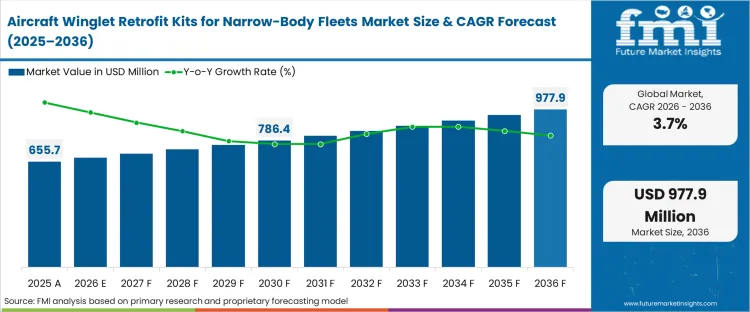
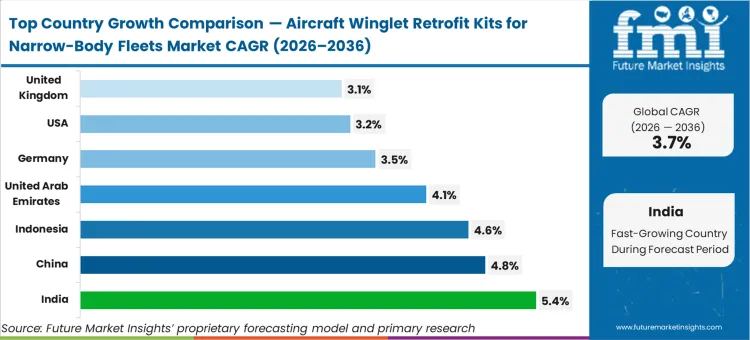
India leads at 5.4% CAGR as high utilization intensity shortens the payback period for hardware upgrades, while China tracks at 4.8% driven by aggressive emission reduction mandates for legacy operator fleets. Indonesia follows at 4.6% based on low-cost carrier route expansion requirements. The United Arab Emirates expands at 4.1% supported by active mid-life MRO activities. Germany registers a 3.5% growth rate resulting from stringent European carbon compliance pressures. The United States advances at 3.2% alongside the United Kingdom at 3.1%, reflecting a mature installation base where the remaining retrofit pool is naturally compressing. The divergence exists across these geographies: Asian hubs prioritise immediate operational savings, whereas Western networks view retrofits primarily through an asset-longevity lens.
Key Takeaways
| Metric | Details |
|---|---|
| Industry Size (2026) | USD 680.0 million |
| Industry Value (2036) | USD 980.0 million |
| CAGR (2026–2036) | 3.70% |
Source: Future Market Insights (FMI) analysis, based on proprietary forecasting model and primary research
Aircraft Winglet Retrofit Kits for Narrow-Body Fleets Market Definition
The aircraft winglet retrofit kits market encompasses engineered aerodynamic surfaces and required reinforcements designed for post-production installation on single-aisle aircraft wings. Hardware packages modify existing wing tip geometry to reduce induced drag and improve fuel burn efficiency. Kits require specific modification instructions and supplemental type certificates for legal installation.
Aircraft Winglet Retrofit Kits for Narrow-Body Fleets Market Inclusions
Scope includes complete installation kits featuring blended winglets, split scimitars, and sharklet aerodynamic surfaces for narrow-body platforms, specifically categorizing narrow-body fleet fuel-burn reduction retrofits. Hardware packages contain all necessary attachment fittings, internal wing reinforcements, and modified aircraft fairings required for compliance. Supplemental documentation and specific aerodynamic testing validation data form part of the delivered retrofit solution.
Aircraft Winglet Retrofit Kits for Narrow-Body Fleets Market Exclusions
Factory-installed aerodynamic devices delivered on new aircraft fall outside this tracking scope. Wide-body aerodynamic modifications remain excluded due to entirely different structural stress profiles and certification pathways. Standalone wingtip fences or basic end-plates without extensive internal reinforcement requirements do not qualify under this specific hardware classification.
Aircraft Winglet Retrofit Kits for Narrow-Body Fleets Market Research Methodology
- Primary Research: Fleet transition directors, MRO facility general managers, and airline technical procurement officers.
- Desk Research: Supplemental Type Certificate registries, airline fleet phase-out schedules, lessor transition documentation, and aviation authority airworthiness directives.
- Market-Sizing and Forecasting: Scheduled heavy maintenance check intervals cross-referenced against unmodified fleet inventory data.
- Data Validation and Update Cycle: Independent tracking of scheduled C-checks and D-checks at authorized modification centers.
Segmental Analysis
Aircraft Winglet Retrofit Kits for Narrow-Body Fleets Market Analysis by Aircraft Platform
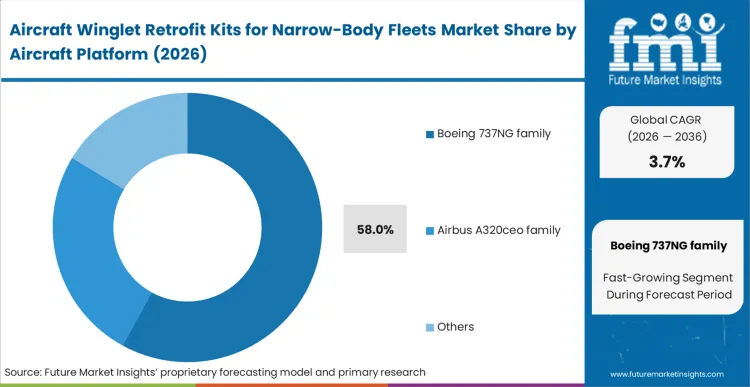
Massive legacy fleets lacking modern aerodynamic efficiency define the modification schedule for technical procurement officers. Limits on older platforms dictate precisely when these upgrades must occur during heavy maintenance cycles. FMI's analysis indicates the Boeing 737NG family holds 58.0% share, sustained by thousands of mid-life airframes demanding 737NG winglet retrofit kits. Selecting this platform for retrofit physically alters the aircraft's lift distribution, requiring specialized reinforcement techniques that independent commercial aircraft MRO facilities must master. What pure share figures obscure is the certification bottleneck: clearing supplemental type certificates for older NG variants demands specific flight test data that delays approvals for niche sub-models. Operators skipping these scheduled upgrade windows face severe penalties in secondary lease markets when transitioning aging assets.
- Certification hurdles: Engineering validation requires extensive flight test data to secure supplemental type certificates. Technical directors risk severe aircraft downtime if paperwork approval lags behind physical installation schedules.
- Structural tolerance: Altering wingtip geometry changes the bending moment across the entire wing box. MRO managers must verify existing fatigue limits before committing to heavy reinforcement procedures.
- Lease transition: Lessors require standardized aerodynamic configurations before accepting returned aircraft. Asset managers face costly rejection clauses if they fail to specify A320ceo sharklet retrofit kits or equivalent modifications prior to handover.
Aircraft Winglet Retrofit Kits for Narrow-Body Fleets Market Analysis by Kit Architecture
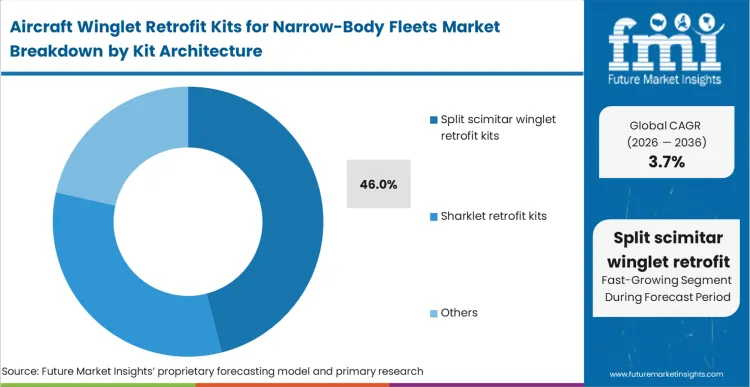
Advanced geometries offer compounding aerodynamic benefits that basic end-plates cannot replicate under high-altitude cruise conditions. Procurement directors actively specify complex curved surfaces to maximize payload range on marginal routes. Based on FMI's assessment, the split scimitar winglet retrofit market commands 46.0% share because their dual-surface design manipulates tip vortices more effectively than single-plane variants. Integrating these sophisticated shapes requires extreme precision in composite manufacturing, testing the capabilities of tier-one aerostructure suppliers. What procurement teams rarely model is the hidden weight penalty: adding complex scimitar geometry requires heavier internal spar reinforcements that partially offset the gross fuel savings during short-haul operations. Failing to match the correct architecture to the specific route profile erodes the projected return on investment rapidly.
- Weight penalties: Complex geometries demand heavier internal structural support blocks. Performance engineers face shrinking net fuel savings if these heavier architectures are deployed on ultra-short segments.
- Manufacturability limits: Producing precise composite curves requires specialized autoclave tooling. Supply chain directors experience severe delivery delays when composite vendors encounter localized resin curing defects.
- Aerodynamic optimization: Dual-surface designs actively suppress vortex formation at cruise altitudes. Route planners secure immediate payload range extensions that allow direct scheduling on previously marginal city pairs.
Aircraft Winglet Retrofit Kits for Narrow-Body Fleets Market Analysis by Installation Channel
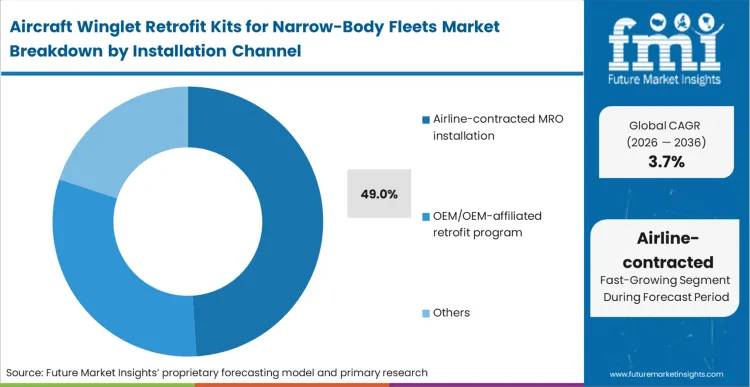
Scheduling modification slots demands perfect synchronization between hardware delivery and scheduled heavy maintenance events. Maintenance planners negotiate fiercely to secure limited hangar space equipped for major structural alterations. FMI analysts note that Airline-contracted MRO installation captures 49.0% share, reflecting the necessity of combining winglet retrofits with mandatory C-checks to minimize out-of-service time. Utilizing external facilities allows carriers to leverage specialized labor without expanding internal payrolls. Independent global air transport MRO centers effectively control the pace of fleet modernization through bay availability. What contract volume data misses is the labor reality: finding reliable winglet retrofit installation providers or an authorized modification center winglet retrofit slot becomes a critical supply chain bottleneck. Airlines attempting internal installations frequently miscalculate the required labor hours, triggering cascading delays across their entire maintenance schedule.
- Bay availability: Securing dedicated hangar space requires booking years in advance of the actual modification date. Maintenance directors face grounded aircraft if scheduling conflicts displace their reserved slots.
- Skill shortages: Drilling and reinforcing main wing spars demands specialized sheet metal expertise. MRO facility managers struggle to expand capacity due to a severe lack of qualified structural technicians.labour
- k alignment: Combining installations with heavy maintenance checks minimizes total out-of-service penalties. Technical planners fail to capture full economic value if modifications occur outside established D-check windows.
Aircraft Winglet Retrofit Kits for Narrow-Body Fleets Market Analysis by Buyer Type
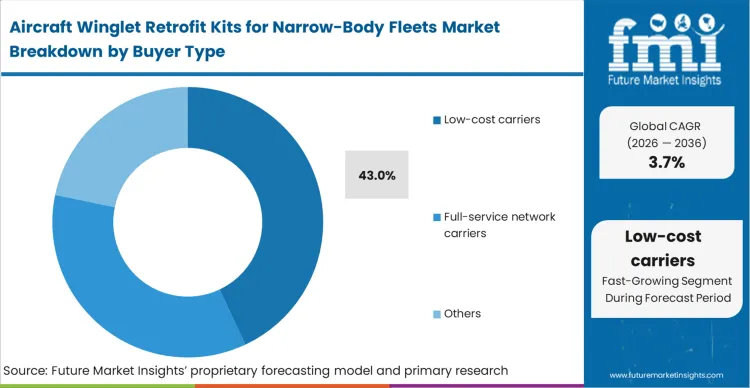
Aggressive cost containment strategies force specific operators to pursue every available fractional percentage of fuel efficiency. Route profitability models dictate immediate adoption of drag-reducing technologies to maintain competitive pricing. In FMI's view, Low-cost carriers represent 43.0% share, driven by their reliance on high daily utilization rates that accelerate the winglet retrofit payback period narrow-body. These operators possess the capital agility to authorize fleet-wide modifications rapidly compared to legacy network carriers, speeding up physical aircraft refurbishing investments. What passenger volume figures hide is the vulnerability, low-cost models operating exclusively short-hop routes extract significantly less value from winglets than the marketing brochures suggest, given the limited time spent at optimal cruise altitudes. Operators ignoring their specific flight profiles risk deploying expensive capital for marginal operational returns.
- Utilization sensitivity: High daily flight hours dramatically shorten the investment payback timeline. Financial officers secure rapid capital approval when asset utilization models project continuous multi-cycle operations.
- Capital agility: Flat organizational structures permit rapid approval of fleet-wide modification programs. Technical procurement teams execute bulk hardware orders months faster than legacy carrier counterparts.
- Profile mismatch: Short-hop operations spend minimal time at efficient cruise altitudes. Route planners fail to achieve projected fuel savings when modified aircraft are restricted to regional feeder networks.
Aircraft Winglet Retrofit Kits for Narrow-Body Fleets Market Analysis by Retrofit Objective
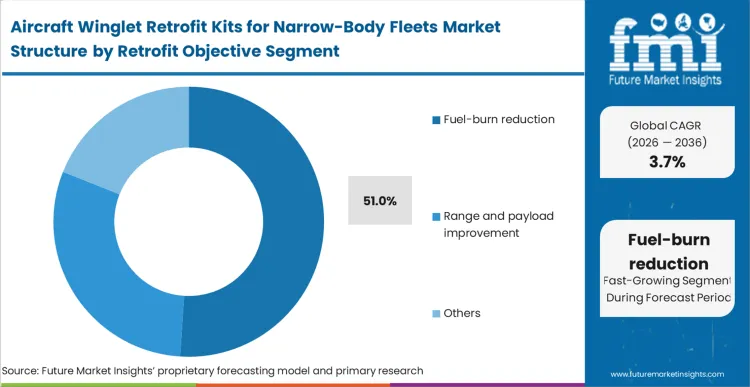
Volatile energy markets compel operational directors to seek permanent physical solutions to consumption rates rather than relying solely on software optimizations. Modifying the airframe provides guaranteed efficiency gains independent of pilot technique or weather routing. According to FMI's estimates, Fuel-burn reduction holds 51.0% share, answering the immediate commercial pressure to lower block hour operating costs. Executing these modifications allows airlines to immediately revise their block fuel calculations downward. Integrating modern aircraft flight control system software with these new aerodynamic profiles maximizes the physical hardware's potential. What emissions reporting metrics fail to reveal is the actual motivation: compliance with tightening ESG mandates serves primarily as secondary corporate messaging, while the raw economics of kerosene displacement drive the actual board-level approval. Delaying these physical modifications exposes operators to crippling unhedged fuel exposure during market price spikes.
- Cost mitigation: Physical drag reduction permanently lowers the baseline fuel consumption rate. Operations directors secure immediate block-hour cost improvements independent of external market volatility.
- Payload expansion: Enhanced lift characteristics allow higher maximum takeoff weights from hot and high airports. Dispatchers execute direct flights on demanding routes previously requiring technical fuel stops.
- Regulatory messaging: Upgrading physical assets provides tangible proof of sustainability commitments. Corporate communications officers leverage these modifications to satisfy investor demands for immediate carbon footprint reductions.
Aircraft Winglet Retrofit Kits for Narrow-Body Fleets Market Drivers, Restraints, and Opportunities
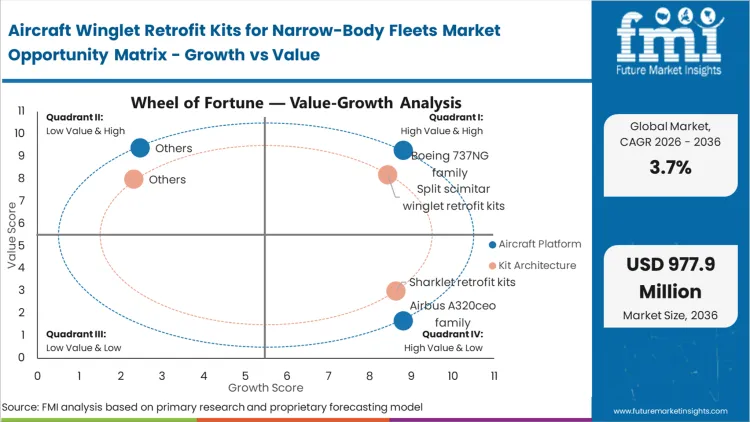
Severe unit cost inflation forces technical procurement officers to reconsider the economic viability of their aging single-aisle assets. Replacing entire fleets with next-generation aircraft requires massive capital expenditure that many balance sheets cannot currently support, pushing operators toward extending the life of existing platforms. Upgrading these older airframes with modern aerodynamic surfaces presents the only immediate physical mechanism to narrow the fuel-burn gap against newer models. Aircraft operating without these modifications face severe commercial disadvantages, burning disproportionately higher fuel loads while incurring identical landing and navigation fees. Delaying the adoption of these engineered kits guarantees prolonged exposure to volatile kerosene prices.
Structural modification bay availability creates a persistent bottleneck that physically prevents rapid fleet-wide transitions. Completing these complex installations requires specialized tooling, specific scaffolding, and highly trained structural mechanics working in dedicated hangar environments. MRO facilities face immense difficulty scaling this specific capacity because the labor pool of qualified aviation sheet metal workers is actively shrinking. Airlines wanting to upgrade their assets frequently encounter waiting lists stretching up to two years simply to secure an installation slot. Applying specialized aircraft livery change film systems during the same maintenance visit helps compress total downtime, but does not solve the fundamental structural labor shortage.
Opportunities in the Aircraft Winglet Retrofit Kits for Narrow-Body Fleets Market
- Composite integration: Advanced composite airframes manufacturing techniques lower the total kit weight. Engineering directors achieve better net fuel savings by specifying lighter attachment structures.
- Sensor inclusion: Embedding strain gauges within the winglet attachment points provides real-time fatigue monitoring. Maintenance planners transition from scheduled inspections to predictive structural assessments.
- Coating applications: Applying specialized drag reduction film applications directly to the new winglets amplifies the aerodynamic benefits. Technical officers compound their efficiency gains without additional heavy structural work.
Regional Analysis
Based on regional analysis, Aircraft Winglet Retrofit Kits for Narrow-Body Fleets is segmented into North America, Latin America, Western Europe, Eastern Europe, Asia Pacific, and Middle East & Africa across 40 plus countries.
.webp "Top Country Growth Comparison Aircraft Winglet Retrofit Kits For Narrow Body Fleets Market Cagr (2026 2036)")
| Country | CAGR (2026 to 2036) |
|---|---|
| India | 5.4% |
| China | 4.8% |
| Indonesia | 4.6% |
| United Arab Emirates | 4.1% |
| Germany | 3.5% |
| United States | 3.2% |
| United Kingdom | 3.1% |
Source: Future Market Insights (FMI) analysis, based on proprietary forecasting model and primary research
North America Aircraft Winglet Retrofit Kits for Narrow-Body Fleets Market Analysis
Asset longevity strategies define the modification schedules across massive legacy networks operating in this region. Maintenance directors focus on extracting the absolute maximum cycle limits from older airframes before committing to costly replacement programs. FMI observes that the regional dynamic centers on managing the final phase of the narrow-body lifecycle, where physical upgrades act as a bridge to next-generation deliveries. Applying specific anti-soiling and easy clean exterior coatings alongside the winglet installation helps preserve the modified asset's surface integrity. Operators delaying these mid-life investments face severe operational penalties when maintenance costs eventually outpace the asset's residual revenue potential.
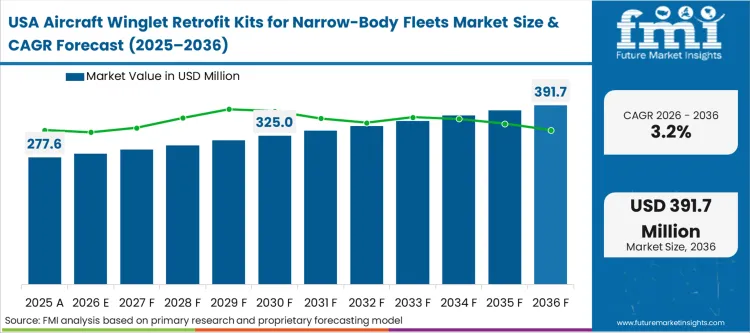
- United States: Mature fleet profiles systematically push transition managers to thoroughly evaluate the final economic viability of their aging single-aisle platforms. Purchasing directors approve these extensive structural modifications strictly to bridge the operational gap until newer models arrive from the OEMs, recording a 3.2% CAGR for the USA aircraft winglet retrofit market. Western network operators view these targeted retrofits primarily through this specific asset-longevity lens rather than as tools for immediate route expansion, focusing entirely on maximizing remaining airframe lifecycle value.
FMI's report includes Canada. Operations across this region reflect a mature installation base where the remaining retrofit pool is naturally compressing.
Asia Pacific Aircraft Winglet Retrofit Kits for Narrow-Body Fleets Market Analysis
Explosive domestic route expansion requires operational directors to maximize the fuel efficiency of every available asset immediately. High daily utilization rates characterize operations here, physically forcing carriers to adopt drag-reduction technologies to protect tight margins. As per FMI's projection, the regional focus remains squarely on shortening the payback period through relentless flight scheduling. Integrating advanced metallic composite hybrid aircraft exterior components into local supply chains supports the broader MRO ecosystem handling these upgrades. Delaying fleet optimization severely damages competitiveness in markets defined by aggressive fare pricing.
- India: Aggressive domestic route expansion requires maximum fuel efficiency to maintain the intense operational tempo of ultra-low-cost carrier models across the subcontinent. Technical officers authorize rapid modification programs to offset volatile energy costs, driving a robust 5.4% CAGR. Consequently, the India aircraft winglet retrofit market leads the regional transition. Rapid adoption yields immediate competitive positioning, allowing carriers to dominate marginal routes against regional rivals who continue operating unmodified, older legacy fleets with significantly higher block-hour fuel consumption penalties.
- China: Aggressive governmental emission reduction mandates push legacy operator fleets toward immediate hardware compliance before secondary asset transitions occur. Maintenance directors coordinate massive installation blocks to meet these stringent environmental targets, tracking at a 4.8% CAGR to support the expanding China narrow-body retrofit kits market. Integrating advanced aircraft automated inspection and monitoring tools during these structural upgrades standardizes regulatory compliance reporting, ensuring that upgraded airframes remain commercially viable and fully authorized for high-density domestic operations through the next decade.
- Indonesia: Dispersed island networks across the archipelago force regional low-cost carriers to prioritize immediate payload range extensions on their aging single-aisle aircraft. Route planners demand these specific hardware upgrades to optimize block-hour economics, reaching a 4.6% CAGR within the Indonesia aircraft winglet retrofit market. Achieving this precise operational outcome secures vital connectivity across marginal regional airports, where short runways and hot-and-high conditions otherwise severely restrict payload capacities for unmodified airframes operating without advanced aerodynamic tip devices.
FMI's report includes Japan, South Korea, and Australia. High utilization intensity shortens the payback period for hardware upgrades across these varied operating environments.
Western Europe Aircraft Winglet Retrofit Kits for Narrow-Body Fleets Market Analysis
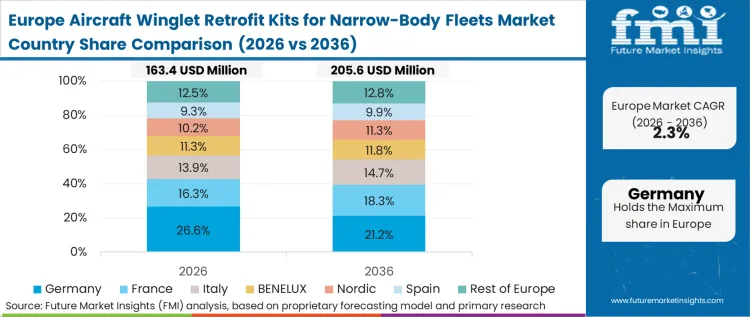
Severe regulatory pressure regarding carbon emissions fundamentally alters the payback calculations for technical procurement teams. Sustainability officers essentially dictate hardware compliance standards, overriding traditional block-hour cost analyses. Based on FMI's assessment, operators treat these aerodynamic modifications as mandatory environmental compliance tools rather than discretionary fuel-saving options. Embedding aircraft fuselage corrosion monitoring sensors during the structural teardown phase provides secondary value to these forced maintenance events. Carriers failing to modify their aging assets face escalating carbon taxation penalties that destroy route profitability.
- Germany: Asset managers mandate the critical structural installations well before initiating any secondary market placement, registering a steady 3.5% CAGR across the Germany winglet retrofit MRO market. Stringent European carbon compliance pressures force the immediate modernization of extensive mid-life leasing portfolios managed by centralized financial institutions. This proactive hardware strategy ensures ongoing commercial opportunity and asset liquidity within tightly regulated airspace zones, preventing older narrow-body platforms from becoming permanently stranded assets due to escalating emission taxation penalties.
- United Kingdom: High-density short-haul networks push maintenance planners to extract fractional block-hour efficiency gains from rapidly maturing legacy fleets. Engineering teams meticulously execute these late-stage upgrades, growing at a 3.1% CAGR for the United Kingdom aircraft winglet retrofit market. What the baseline CAGR figure fundamentally misses is the underlying practitioner reality on the ground: domestic operators are rapidly running out of older unmodified airframes that still qualify for economically viable structural modifications before mandatory fleet phase-out schedules take precedence.
FMI's report includes France, Italy, and Spain. Operations across these nations stay near the middle because they retain meaningful engineering capacity but lack the volume-led replacement lag seen elsewhere.
Middle East & Africa Aircraft Winglet Retrofit Kits for Narrow-Body Fleets Market Analysis
Harsh operating environments force technical directors to prioritize performance upgrades that improve hot-and-high takeoff capabilities. Modifying the wing geometry physically alters the lift profile, allowing dispatchers to maintain payload capacities during extreme summer temperature spikes. FMI's analysis indicates that independent MRO hubs drive the regional narrative by actively absorbing global modification overflow capacity. Utilizing specific integrated sensor ready coatings protects these new structural additions from severe sand abrasion. Operators ignoring these performance realities suffer severe payload restrictions during peak summer scheduling.
- United Arab Emirates: Facility directors strategically control regional upgrade pacing, expanding at a 4.1% CAGR for the UAE narrow-body upgrade market. Active mid-life maintenance activities concentrate massive structural modification capabilities within specific industrial free zones dedicated to global aviation support. Controlling these highly limited specialised teardown bays defines the structural trajectory of the local aviation services sector, allowing regional MRO hubs to actively absorb massive modification overflow capacity from surrounding global transit networks seeking immediate structural upgrades.
FMI's report includes Saudi Arabia and South Africa. These hubs retain meaningful engineering and mid-life fleet support activity serving broader regional transit networks.
Competitive Aligners for Market Players
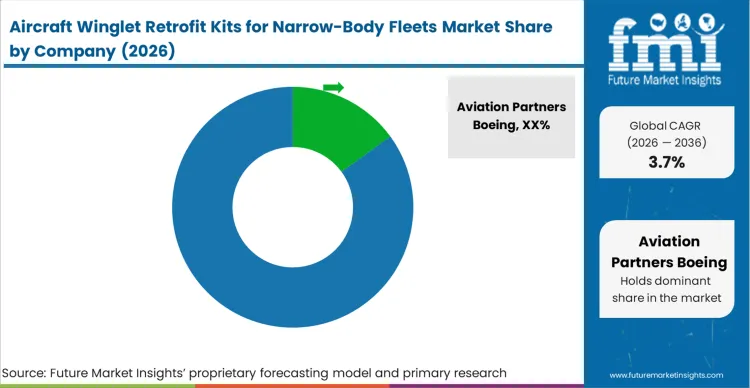
Engineering certification acts as the absolute barrier to entry, fundamentally separating primary winglet retrofit kit suppliers from generic aerospace manufacturers. Aviation Partners Boeing dictates the baseline technical standard because their proprietary aerodynamic designs hold the essential supplemental type certificates required for legal installation. MRO facility directors cannot simply reverse-engineer the physical hardware; they must purchase the licensed kits complete with the validated structural reinforcement data. This certification monopoly forces airlines to accept established pricing models, as no unapproved alternatives can legally fly.
Incumbents possess deep libraries of flight test data and established relationships with global airworthiness authorities. Airbus Services maintains a distinct advantage by leveraging its original equipment manufacturer status to rapidly certify sharklet modifications on its own legacy platforms. Utilizing aircraft structural health monitoring coatings during these OEM-affiliated upgrades provides additional maintenance value that third-party developers struggle to replicate. Challengers face an insurmountable timeline attempting to gather the millions of hours of operational flight data required to validate competing structural modification techniques.
Asset managers exert their influence by dictating which specific aerodynamic architectures hold value in the secondary leasing market. Lessors actively refuse to finance unknown or unproven winglet designs, regardless of their theoretical aerodynamic performance. Boeing Global Services capitalizes on this dynamic by providing predictable, globally recognized modification packages that preserve asset liquidity. Transition directors will consistently choose a slightly more expensive, universally accepted retrofit kit over a cheaper alternative that complicates future aircraft placements.
Key Players in Aircraft Winglet Retrofit Kits for Narrow-Body Fleets Market
- Aviation Partners Boeing
- Airbus Services
- FACC AG
- Boeing Global Services
- AAR CORP
- STAECO
- HAECO Xiamen
Scope of the Report
| Metric | Value |
|---|---|
| Quantitative Units | USD 680.0 million to USD 980.0 million, at a CAGR of 3.70% |
| Market Definition | Engineered aerodynamic surfaces and their required internal structural reinforcements designed specifically for post-production installation on existing single-aisle commercial aircraft wings to reduce induced drag. |
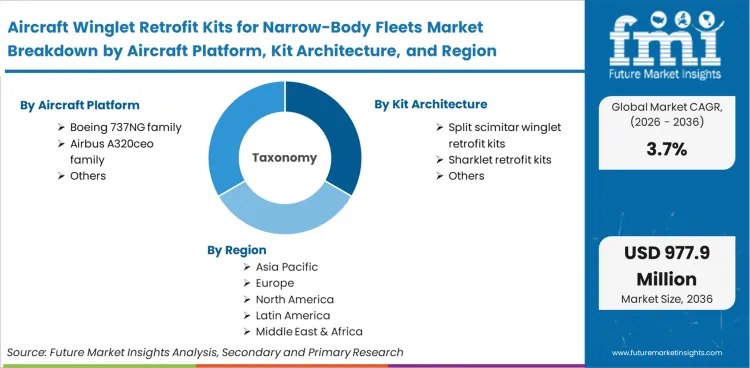
| Segmentation | By aircraft platform, By kit architecture, By installation channel, By buyer type, By retrofit objective, and Region |
| Regions Covered | North America, Latin America, Western Europe, Eastern Europe, Asia Pacific, Middle East and Africa |
| Countries Covered | United States, Canada, Brazil, Mexico, Germany, United Kingdom, France, Italy, Spain, Russia, Poland, China, Japan, India, South Korea, Australia, Indonesia, GCC Countries, South Africa |
| Key Companies Profiled | Aviation Partners Boeing, Airbus Services, FACC AG, Boeing Global Services, AAR CORP, STAECO, HAECO Xiamen |
| Forecast Period | 2026 to 2036 |
| Approach | Scheduled heavy maintenance check intervals cross-referenced against unmodified fleet inventory data. |
Source: Future Market Insights (FMI) analysis, based on proprietary forecasting model and primary research
Aircraft Winglet Retrofit Kits for Narrow-Body Fleets Market Analysis by Segments
By aircraft platform
- Boeing 737NG family
- Airbus A320ceo family
- Other legacy narrow-body retrofit candidates
By kit architecture
- Split scimitar winglet retrofit kits
- Sharklet retrofit kits
- Blended winglet retrofit kits
- Structural reinforcement and interface kits
By installation channel
- Airline-contracted MRO installation
- OEM/OEM-affiliated retrofit program
- Authorized modification center
- In-house engineering and maintenance organization
By buyer type
- Low-cost carriers
- Full-service network carriers
- Leasing company transition programs
- Cargo narrow-body operators
By retrofit objective
- Fuel-burn reduction
- Range and payload improvement
- Residual-value enhancement
- ESG and emissions reduction support
Region
- North America
- United States
- Canada
- Latin America
- Brazil
- Mexico
- Western Europe
- Germany
- United Kingdom
- France
- Italy
- Spain
- Eastern Europe
- Russia
- Poland
- Asia Pacific
- China
- Japan
- India
- South Korea
- Australia
- Indonesia
- Middle East & Africa
- GCC Countries
- South Africa
Bibliography
- Airbus. (2024, February). A320 Family Digest of available enhancements 2024. Airbus Digital.
- Boeing. (2025, February). Commercial Services Market Outlook 2025–2044. Boeing Services Data.
- FACC AG. (2025, March). Annual Report 2024. FACC Investor Relations.
- European Union Aviation Safety Agency. (2025, January). Supplemental Type Certificate Regulations. EASA Documentation.
- Federal Aviation Administration. (2024, November). Airworthiness Directives and Modification Standards. FAA Official.
This bibliography is provided for reader reference. The full FMI report contains the complete reference list with primary source documentation.
This Report Addresses
- Fleet utilization economics driving single-aisle platform modification decisions
- Component specific transition lessor requirements dictating aerodynamic standard configurations
- Engineering challenges restricting specialized structural modification bay availability
- Route profitability calculations favoring split scimitar architectures on short networks
- Certification bottlenecks delaying supplemental type certificates for specific legacy airframes
- MRO labor dynamics capping the total annual capacity for heavy structural teardowns
- ESG mandates forcing physical hardware compliance prior to secondary market asset placement
- Composite manufacturing tolerances dictating the weight penalties of complex winglet geometries
Frequently Asked Questions
What is the market size of aircraft winglet retrofit kits?
The industry valuation crossed USD 660.0 million in 2025 and is projected to reach USD 980.0 million by 2036, reflecting the continuous need to upgrade legacy single-aisle assets.
Are winglet retrofits still relevant for 737NG fleets?
Absolutely. Thousands of mid-life NG airframes remain in active global service lacking modern efficiency upgrades, forcing transition managers to modify this installed base before newer MAX variants saturate the secondary lease market.
Do A320ceo sharklet retrofits still make economic sense?
High daily flight hours fundamentally shorten the capital payback timeline. Low-cost carriers leverage their intense route scheduling to extract maximum value from the aerodynamic efficiency gains, proving the economics remain viable.
Compare sharklet retrofit vs fleet replacement economics?
Replacing entire fleets requires massive capital expenditure that many balance sheets cannot currently support. Upgrading older airframes presents an immediate physical mechanism to narrow the fuel-burn gap against newer models at a fraction of the acquisition cost.
Should an airline retrofit winglets on aging 737NG aircraft?
Airlines ignoring the available drag-reduction hardware retain entirely unhedged exposure to kerosene market spikes. Dispatchers must continually load higher fuel volumes, generating a permanent block-hour cost disadvantage against modified competitors.
What limits the speed of global fleet modifications?
Structural modification bay availability creates a hard physical cap on how many aircraft can undergo simultaneous upgrades. Independent MRO centers lack the licensed sheet metal mechanics required to expand specialized teardown capacity.
Why do lessors force these installations?
Unmodified narrow-bodies represent massive stranded asset risks during secondary market transitions. Leasing directors require baseline aerodynamic efficiency standards to ensure tier-two operators accept the aging airframes.
How does utilization impact the investment calculation?
High daily flight hours fundamentally shorten the capital payback timeline for physical hardware. Low-cost carriers leverage their intense route scheduling to extract maximum value from the aerodynamic efficiency gains.
What hides behind the fuel-burn objective?
Operations directors use raw block-hour cost improvements to justify the capital expenditure. Corporate communications teams subsequently leverage these physical modifications to satisfy investor demands for tangible ESG progress.
Why does the Boeing 737NG family dominate the modification schedule?
Thousands of these mid-life airframes remain in active global service lacking modern efficiency upgrades. Transition managers must modify this massive installed base before newer MAX variants entirely collapse the secondary lease market.
How do complex geometries alter the payload reality?
Applying dual-surface architectures suppresses tip vortices effectively at high cruise altitudes. Route planners utilize this enhanced lift profile to schedule direct flights on marginal city pairs previously requiring technical stops.
Why do Asian networks adopt these kits faster than Western fleets?
Aggressive domestic route expansion physically forces carriers to adopt drag-reduction technologies immediately. Western networks treat the modifications strictly as end-of-life asset longevity tools, while Asian operators need the immediate competitive margin.
What capability defines the top-tier kit developers?
Holding the proprietary supplemental type certificates completely locks out generic manufacturers. Engineering directors must purchase licensed packages because unapproved alternative structural modifications cannot legally fly under global aviation authority rules.
How do these upgrades alter scheduled heavy maintenance?
Technical procurement officers actively synchronize kit deliveries with mandatory C-checks and D-checks. Executing the structural teardown outside these planned windows inflicts crippling out-of-service financial penalties on the operating airline.
What penalty comes with complex winglet architectures?
Curved composite designs require substantially heavier internal spar reinforcements inside the wing box. Operations planners face shrinking net fuel savings if they deploy these heavier configurations on ultra-short regional feeder networks.
Why does Germany show a distinct adoption profile?
Stringent European carbon compliance pressures override traditional block-hour cost calculations for regional asset managers. Sustainability officers treat the hardware installation as mandatory environmental compliance rather than discretionary capital expenditure.
How do advanced coatings integrate with the retrofit process?
Applying aircraft passenger door and hatch seal systems during the modification protects internal pressurization dynamics. Applying aerospace composite materials using pcr standardizes the external finish and preserves the engineered lift profile over time.
What risk do operators take by skipping the upgrade?
Airlines ignoring the available drag-reduction hardware retain entirely unhedged exposure to kerosene market spikes. Dispatchers must continually load higher fuel volumes, generating a permanent block-hour cost disadvantage against modified competitors.
Why do specific narrow-body models face certification delays?
Aviation authorities demand precise operational flight test data to validate structural integrity changes on aging airframes. Engineering teams struggle to collect sufficient validation hours on niche variants, slowing final type certificate approvals.
How does internal capability shape airline decision making?
Only the largest global carriers possess the internal engineering capability to execute massive structural wing modifications. The vast majority of operators must contract third-party facilities, physically handing over schedule control to external vendors.
What alters the value proposition for cargo operators?
Freighter conversions strip passenger weight but retain identical aerodynamic drag profiles. Payload directors rely on winglets to maximize the volumetric efficiency of the modified deck by expanding the overall range boundary.
Why do independent MROs struggle to scale this capability?
Drilling and reinforcing primary wing spars demands highly specialized sheet metal experience. Generalist mechanics cannot legally execute the structural sign-offs required to release the modified aircraft back into commercial service.
How do original equipment manufacturers approach this aftermarket?
Incumbent builders possess the original design data required to rapidly certify their own proprietary hardware upgrades. Leveraging aerospace lightweight materials allows them to offer engineered packages that independent developers cannot easily replicate.
What drives the specific demand in the Indonesian market?
Dispersed island networks restrict operations to aging narrow-body aircraft incapable of long-haul efficiency. Route planners demand hardware modifications to safely extend payload ranges across the sprawling archipelago infrastructure.
How do supply chains handle the specialized composite manufacturing?
Producing precise curved geometries requires specialized high-pressure autoclave tooling. Facility managers encounter localized delivery delays when primary tier-one composite vendors hit maximum capacity on simultaneous defense aerospace contracts.
Preview the report firsthand - request a free sample
Get SampleGet the brochure for pricing and purchase details.
Get PDFTable of Content
- Executive Summary
- Global Market Outlook
- Demand-side Trends
- Supply-side Trends
- Technology Roadmap Analysis
- Analysis and Recommendations
- Market Overview
- Market Coverage / Taxonomy
- Market Definition / Scope / Limitations
- Research Methodology
- Chapter Orientation
- Analytical Lens and Working Hypotheses
- Market Structure, Signals, and Trend Drivers
- Benchmarking and Cross-market Comparability
- Market Sizing, Forecasting, and Opportunity Mapping
- Research Design and Evidence Framework
- Desk Research Programme (Secondary Evidence)
- Company Annual and Sustainability Reports
- Peer-reviewed Journals and Academic Literature
- Corporate Websites, Product Literature, and Technical Notes
- Earnings Decks and Investor Briefings
- Statutory Filings and Regulatory Disclosures
- Technical White Papers and Standards Notes
- Trade Journals, Industry Magazines, and Analyst Briefs
- Conference Proceedings, Webinars, and Seminar Materials
- Government Statistics Portals and Public Data Releases
- Press Releases and Reputable Media Coverage
- Specialist Newsletters and Curated Briefings
- Sector Databases and Reference Repositories
- FMI Internal Proprietary Databases and Historical Market Datasets
- Subscription Datasets and Paid Sources
- Social Channels, Communities, and Digital Listening Inputs
- Additional Desk Sources
- Expert Input and Fieldwork (Primary Evidence)
- Primary Modes
- Qualitative Interviews and Expert Elicitation
- Quantitative Surveys and Structured Data Capture
- Blended Approach
- Why Primary Evidence is Used
- Field Techniques
- Interviews
- Surveys
- Focus Groups
- Observational and In-context Research
- Social and Community Interactions
- Stakeholder Universe Engaged
- C-suite Leaders
- Board Members
- Presidents and Vice Presidents
- R&D and Innovation Heads
- Technical Specialists
- Domain Subject-matter Experts
- Scientists
- Physicians and Other Healthcare Professionals
- Governance, Ethics, and Data Stewardship
- Research Ethics
- Data Integrity and Handling
- Primary Modes
- Tooling, Models, and Reference Databases
- Desk Research Programme (Secondary Evidence)
- Data Engineering and Model Build
- Data Acquisition and Ingestion
- Cleaning, Normalisation, and Verification
- Synthesis, Triangulation, and Analysis
- Quality Assurance and Audit Trail
- Market Background
- Market Dynamics
- Drivers
- Restraints
- Opportunity
- Trends
- Scenario Forecast
- Demand in Optimistic Scenario
- Demand in Likely Scenario
- Demand in Conservative Scenario
- Opportunity Map Analysis
- Product Life Cycle Analysis
- Supply Chain Analysis
- Investment Feasibility Matrix
- Value Chain Analysis
- PESTLE and Porter’s Analysis
- Regulatory Landscape
- Regional Parent Market Outlook
- Production and Consumption Statistics
- Import and Export Statistics
- Market Dynamics
- Global Market Analysis 2021 to 2025 and Forecast, 2026 to 2036
- Historical Market Size Value (USD Million) Analysis, 2021 to 2025
- Current and Future Market Size Value (USD Million) Projections, 2026 to 2036
- Y-o-Y Growth Trend Analysis
- Absolute $ Opportunity Analysis
- Global Market Pricing Analysis 2021 to 2025 and Forecast 2026 to 2036
- Global Market Analysis 2021 to 2025 and Forecast 2026 to 2036, By Aircraft Platform
- Introduction / Key Findings
- Historical Market Size Value (USD Million) Analysis By Aircraft Platform , 2021 to 2025
- Current and Future Market Size Value (USD Million) Analysis and Forecast By Aircraft Platform , 2026 to 2036
- Boeing 737NG family
- Airbus A320ceo family
- Others
- Boeing 737NG family
- Y-o-Y Growth Trend Analysis By Aircraft Platform , 2021 to 2025
- Absolute $ Opportunity Analysis By Aircraft Platform , 2026 to 2036
- Global Market Analysis 2021 to 2025 and Forecast 2026 to 2036, By Kit Architecture
- Introduction / Key Findings
- Historical Market Size Value (USD Million) Analysis By Kit Architecture, 2021 to 2025
- Current and Future Market Size Value (USD Million) Analysis and Forecast By Kit Architecture, 2026 to 2036
- Split scimitar winglet retrofit kits
- Sharklet retrofit kits
- Others
- Split scimitar winglet retrofit kits
- Y-o-Y Growth Trend Analysis By Kit Architecture, 2021 to 2025
- Absolute $ Opportunity Analysis By Kit Architecture, 2026 to 2036
- Global Market Analysis 2021 to 2025 and Forecast 2026 to 2036, By Installation Channel
- Introduction / Key Findings
- Historical Market Size Value (USD Million) Analysis By Installation Channel, 2021 to 2025
- Current and Future Market Size Value (USD Million) Analysis and Forecast By Installation Channel, 2026 to 2036
- Airline-contracted MRO installation
- OEM/OEM-affiliated retrofit program
- Others
- Airline-contracted MRO installation
- Y-o-Y Growth Trend Analysis By Installation Channel, 2021 to 2025
- Absolute $ Opportunity Analysis By Installation Channel, 2026 to 2036
- Global Market Analysis 2021 to 2025 and Forecast 2026 to 2036, By Buyer Type
- Introduction / Key Findings
- Historical Market Size Value (USD Million) Analysis By Buyer Type, 2021 to 2025
- Current and Future Market Size Value (USD Million) Analysis and Forecast By Buyer Type, 2026 to 2036
- Low-cost carriers
- Full-service network carriers
- Others
- Low-cost carriers
- Y-o-Y Growth Trend Analysis By Buyer Type, 2021 to 2025
- Absolute $ Opportunity Analysis By Buyer Type, 2026 to 2036
- Global Market Analysis 2021 to 2025 and Forecast 2026 to 2036, By Retrofit Objective
- Introduction / Key Findings
- Historical Market Size Value (USD Million) Analysis By Retrofit Objective, 2021 to 2025
- Current and Future Market Size Value (USD Million) Analysis and Forecast By Retrofit Objective, 2026 to 2036
- Fuel-burn reduction
- Range and payload improvement
- Others
- Fuel-burn reduction
- Y-o-Y Growth Trend Analysis By Retrofit Objective, 2021 to 2025
- Absolute $ Opportunity Analysis By Retrofit Objective, 2026 to 2036
- Global Market Analysis 2021 to 2025 and Forecast 2026 to 2036, By Region
- Introduction
- Historical Market Size Value (USD Million) Analysis By Region, 2021 to 2025
- Current Market Size Value (USD Million) Analysis and Forecast By Region, 2026 to 2036
- North America
- Latin America
- Western Europe
- Eastern Europe
- East Asia
- South Asia and Pacific
- Middle East & Africa
- Market Attractiveness Analysis By Region
- North America Market Analysis 2021 to 2025 and Forecast 2026 to 2036, By Country
- Historical Market Size Value (USD Million) Trend Analysis By Market Taxonomy, 2021 to 2025
- Market Size Value (USD Million) Forecast By Market Taxonomy, 2026 to 2036
- By Country
- USA
- Canada
- Mexico
- By Aircraft Platform
- By Kit Architecture
- By Installation Channel
- By Buyer Type
- By Retrofit Objective
- By Country
- Market Attractiveness Analysis
- By Country
- By Aircraft Platform
- By Kit Architecture
- By Installation Channel
- By Buyer Type
- By Retrofit Objective
- Key Takeaways
- Latin America Market Analysis 2021 to 2025 and Forecast 2026 to 2036, By Country
- Historical Market Size Value (USD Million) Trend Analysis By Market Taxonomy, 2021 to 2025
- Market Size Value (USD Million) Forecast By Market Taxonomy, 2026 to 2036
- By Country
- Brazil
- Chile
- Rest of Latin America
- By Aircraft Platform
- By Kit Architecture
- By Installation Channel
- By Buyer Type
- By Retrofit Objective
- By Country
- Market Attractiveness Analysis
- By Country
- By Aircraft Platform
- By Kit Architecture
- By Installation Channel
- By Buyer Type
- By Retrofit Objective
- Key Takeaways
- Western Europe Market Analysis 2021 to 2025 and Forecast 2026 to 2036, By Country
- Historical Market Size Value (USD Million) Trend Analysis By Market Taxonomy, 2021 to 2025
- Market Size Value (USD Million) Forecast By Market Taxonomy, 2026 to 2036
- By Country
- Germany
- UK
- Italy
- Spain
- France
- Nordic
- BENELUX
- Rest of Western Europe
- By Aircraft Platform
- By Kit Architecture
- By Installation Channel
- By Buyer Type
- By Retrofit Objective
- By Country
- Market Attractiveness Analysis
- By Country
- By Aircraft Platform
- By Kit Architecture
- By Installation Channel
- By Buyer Type
- By Retrofit Objective
- Key Takeaways
- Eastern Europe Market Analysis 2021 to 2025 and Forecast 2026 to 2036, By Country
- Historical Market Size Value (USD Million) Trend Analysis By Market Taxonomy, 2021 to 2025
- Market Size Value (USD Million) Forecast By Market Taxonomy, 2026 to 2036
- By Country
- Russia
- Poland
- Hungary
- Balkan & Baltic
- Rest of Eastern Europe
- By Aircraft Platform
- By Kit Architecture
- By Installation Channel
- By Buyer Type
- By Retrofit Objective
- By Country
- Market Attractiveness Analysis
- By Country
- By Aircraft Platform
- By Kit Architecture
- By Installation Channel
- By Buyer Type
- By Retrofit Objective
- Key Takeaways
- East Asia Market Analysis 2021 to 2025 and Forecast 2026 to 2036, By Country
- Historical Market Size Value (USD Million) Trend Analysis By Market Taxonomy, 2021 to 2025
- Market Size Value (USD Million) Forecast By Market Taxonomy, 2026 to 2036
- By Country
- China
- Japan
- South Korea
- By Aircraft Platform
- By Kit Architecture
- By Installation Channel
- By Buyer Type
- By Retrofit Objective
- By Country
- Market Attractiveness Analysis
- By Country
- By Aircraft Platform
- By Kit Architecture
- By Installation Channel
- By Buyer Type
- By Retrofit Objective
- Key Takeaways
- South Asia and Pacific Market Analysis 2021 to 2025 and Forecast 2026 to 2036, By Country
- Historical Market Size Value (USD Million) Trend Analysis By Market Taxonomy, 2021 to 2025
- Market Size Value (USD Million) Forecast By Market Taxonomy, 2026 to 2036
- By Country
- India
- ASEAN
- Australia & New Zealand
- Rest of South Asia and Pacific
- By Aircraft Platform
- By Kit Architecture
- By Installation Channel
- By Buyer Type
- By Retrofit Objective
- By Country
- Market Attractiveness Analysis
- By Country
- By Aircraft Platform
- By Kit Architecture
- By Installation Channel
- By Buyer Type
- By Retrofit Objective
- Key Takeaways
- Middle East & Africa Market Analysis 2021 to 2025 and Forecast 2026 to 2036, By Country
- Historical Market Size Value (USD Million) Trend Analysis By Market Taxonomy, 2021 to 2025
- Market Size Value (USD Million) Forecast By Market Taxonomy, 2026 to 2036
- By Country
- Kingdom of Saudi Arabia
- Other GCC Countries
- Turkiye
- South Africa
- Other African Union
- Rest of Middle East & Africa
- By Aircraft Platform
- By Kit Architecture
- By Installation Channel
- By Buyer Type
- By Retrofit Objective
- By Country
- Market Attractiveness Analysis
- By Country
- By Aircraft Platform
- By Kit Architecture
- By Installation Channel
- By Buyer Type
- By Retrofit Objective
- Key Takeaways
- Key Countries Market Analysis
- USA
- Pricing Analysis
- Market Share Analysis, 2025
- By Aircraft Platform
- By Kit Architecture
- By Installation Channel
- By Buyer Type
- By Retrofit Objective
- Canada
- Pricing Analysis
- Market Share Analysis, 2025
- By Aircraft Platform
- By Kit Architecture
- By Installation Channel
- By Buyer Type
- By Retrofit Objective
- Mexico
- Pricing Analysis
- Market Share Analysis, 2025
- By Aircraft Platform
- By Kit Architecture
- By Installation Channel
- By Buyer Type
- By Retrofit Objective
- Brazil
- Pricing Analysis
- Market Share Analysis, 2025
- By Aircraft Platform
- By Kit Architecture
- By Installation Channel
- By Buyer Type
- By Retrofit Objective
- Chile
- Pricing Analysis
- Market Share Analysis, 2025
- By Aircraft Platform
- By Kit Architecture
- By Installation Channel
- By Buyer Type
- By Retrofit Objective
- Germany
- Pricing Analysis
- Market Share Analysis, 2025
- By Aircraft Platform
- By Kit Architecture
- By Installation Channel
- By Buyer Type
- By Retrofit Objective
- UK
- Pricing Analysis
- Market Share Analysis, 2025
- By Aircraft Platform
- By Kit Architecture
- By Installation Channel
- By Buyer Type
- By Retrofit Objective
- Italy
- Pricing Analysis
- Market Share Analysis, 2025
- By Aircraft Platform
- By Kit Architecture
- By Installation Channel
- By Buyer Type
- By Retrofit Objective
- Spain
- Pricing Analysis
- Market Share Analysis, 2025
- By Aircraft Platform
- By Kit Architecture
- By Installation Channel
- By Buyer Type
- By Retrofit Objective
- France
- Pricing Analysis
- Market Share Analysis, 2025
- By Aircraft Platform
- By Kit Architecture
- By Installation Channel
- By Buyer Type
- By Retrofit Objective
- India
- Pricing Analysis
- Market Share Analysis, 2025
- By Aircraft Platform
- By Kit Architecture
- By Installation Channel
- By Buyer Type
- By Retrofit Objective
- ASEAN
- Pricing Analysis
- Market Share Analysis, 2025
- By Aircraft Platform
- By Kit Architecture
- By Installation Channel
- By Buyer Type
- By Retrofit Objective
- Australia & New Zealand
- Pricing Analysis
- Market Share Analysis, 2025
- By Aircraft Platform
- By Kit Architecture
- By Installation Channel
- By Buyer Type
- By Retrofit Objective
- China
- Pricing Analysis
- Market Share Analysis, 2025
- By Aircraft Platform
- By Kit Architecture
- By Installation Channel
- By Buyer Type
- By Retrofit Objective
- Japan
- Pricing Analysis
- Market Share Analysis, 2025
- By Aircraft Platform
- By Kit Architecture
- By Installation Channel
- By Buyer Type
- By Retrofit Objective
- South Korea
- Pricing Analysis
- Market Share Analysis, 2025
- By Aircraft Platform
- By Kit Architecture
- By Installation Channel
- By Buyer Type
- By Retrofit Objective
- Russia
- Pricing Analysis
- Market Share Analysis, 2025
- By Aircraft Platform
- By Kit Architecture
- By Installation Channel
- By Buyer Type
- By Retrofit Objective
- Poland
- Pricing Analysis
- Market Share Analysis, 2025
- By Aircraft Platform
- By Kit Architecture
- By Installation Channel
- By Buyer Type
- By Retrofit Objective
- Hungary
- Pricing Analysis
- Market Share Analysis, 2025
- By Aircraft Platform
- By Kit Architecture
- By Installation Channel
- By Buyer Type
- By Retrofit Objective
- Kingdom of Saudi Arabia
- Pricing Analysis
- Market Share Analysis, 2025
- By Aircraft Platform
- By Kit Architecture
- By Installation Channel
- By Buyer Type
- By Retrofit Objective
- Turkiye
- Pricing Analysis
- Market Share Analysis, 2025
- By Aircraft Platform
- By Kit Architecture
- By Installation Channel
- By Buyer Type
- By Retrofit Objective
- South Africa
- Pricing Analysis
- Market Share Analysis, 2025
- By Aircraft Platform
- By Kit Architecture
- By Installation Channel
- By Buyer Type
- By Retrofit Objective
- USA
- Market Structure Analysis
- Competition Dashboard
- Competition Benchmarking
- Market Share Analysis of Top Players
- By Regional
- By Aircraft Platform
- By Kit Architecture
- By Installation Channel
- By Buyer Type
- By Retrofit Objective
- Competition Analysis
- Competition Deep Dive
- Aviation Partners Boeing
- Overview
- Product Portfolio
- Profitability by Market Segments (Product/Age /Sales Channel/Region)
- Sales Footprint
- Strategy Overview
- Marketing Strategy
- Product Strategy
- Channel Strategy
- Airbus Services
- FACC AG
- Boeing Global Services
- AAR CORP
- STAECO
- Aviation Partners Boeing
- Competition Deep Dive
- Assumptions & Acronyms Used


