

- Industry Size (2026)
- USD 392.0 Mn
- Forecast (2036)
- USD 846.3 Mn
- CAGR (2026 to 2036)
- 8.0%
Aircraft High-Lift Device Aerodynamic Modification Systems Market Size, Market Forecast and Outlook By FMI
The aircraft high-lift device aerodynamic modification systems market was valued at USD 363.0 million in 2025. Sales are poised to surpass USD 392.0 million in 2026, pushing the overall aircraft high-lift retrofit market size upward at an aircraft high-lift retrofit CAGR of 8.0% during the forecast period. Revenue expansion lifts cumulative output to USD 846.3 million through 2036 as fleet engineering departments mandate component-level drag reduction to offset fuel price volatility and carbon offset penalties.
Airlines face immediate pressure to extract residual efficiency from existing airframes rather than wait for next-generation deliveries. Directors of engineering must justify heavy maintenance downtime by bolting on immediate aerodynamic gains. Delaying these aircraft fairings enhancements costs operators millions in unrecovered fuel efficiency over remaining airframe lifecycles. Carriers analyzing aircraft fuel burn reduction retrofit ROI rarely prioritize high-lift zones until primary wing modifications hit diminishing returns, making flap-track interventions highly lucrative targets within the broader high-lift device retrofit systems market.
Summary of Aircraft High-Lift Device Aerodynamic Modification Systems Market
- Aircraft High-Lift Device Aerodynamic Modification Systems Market Definition:
- Engineered modifications and surface treatments applied to commercial and business airframes specifically targeting drag reduction around flaps, slats, and deployment mechanisms.
- Demand Drivers in the Market:
- Carbon offset penalties force airline sustainability officers to extract marginal fuel efficiency gains from existing fleets using aviation sustainability retrofit technologies.
- Extended airframe lifecycles require fleet managers to install aftermarket aerodynamic packages during heavy maintenance intervals.
- Next-generation engine delays push operators toward airframe-level efficiency improvements to maintain operating margin targets.
- Key Segments Analyzed in the FMI Report:
- Flap-track fairing modification kits anticipated to hold 34.0% share in 2026, driven by proven STC availability across mature narrowbody platforms.
- Retrofit / aftermarket / STC-based installations expected to hold 62.0% share in 2026, as airlines upgrade massive installed bases of previous-generation jets.
- Single-aisle commercial aircraft poised to garner 56.0% share in 2026, resulting from high-cycle operations multiplying absolute fuel savings for narrowbody aerodynamic retrofit systems.
- Composite fairing and contour modules projected to hold 41.0% share in 2026, due to optimal weight-to-strength ratios during rapid installation.
- Airlines and cargo operators estimated to record 48.0% share in 2026, representing direct beneficiaries of operational cost reductions.
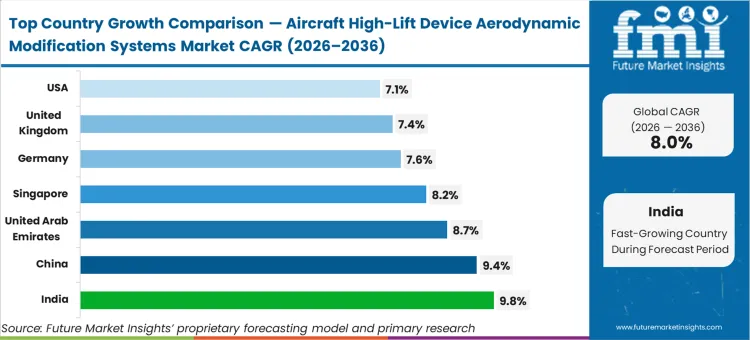
- India: 9.8% compound growth, sustained by massive narrowbody fleet inductions and expanding domestic MRO capabilities.
- Analyst Opinion at FMI:
- Nikhil Kaitwade, Principal Analyst, Automotive and Aerospace, at FMI, points out, "Airlines model aerodynamic upgrades assuming continuous cruise conditions. Reality grounds these expectations when line mechanics routinely damage delicate gap-seal treatments during standard turnaround inspections. MRO facility chiefs managing aircraft aerodynamic retrofit installation downtime know surface film durability dictates true return on investment, not pristine wind-tunnel drag counts. Carriers choosing modifications without assessing harsh tarmac handling realities often see theoretical fuel savings erased by frequent component replacement costs."
- Strategic Implications / Executive Takeaways:
- Fleet directors must align STC modification schedules strictly with C-check inductions to avoid unrecoverable downtime penalties.
- MRO procurement leads should secure long-term composite fairing supply agreements before global fleet aging strains component availability.
- Engineering vice presidents need comprehensive durability data on surface films before authorizing fleet-wide application across high-wear zones.
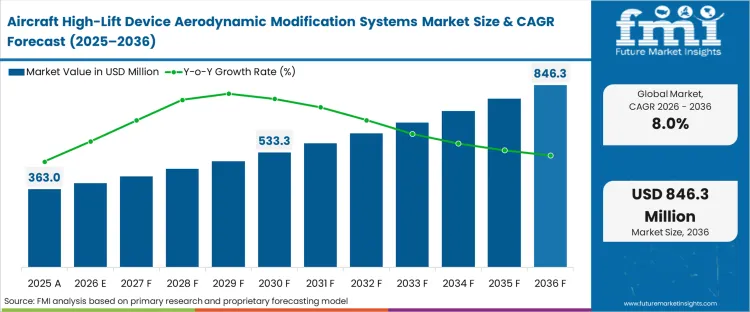
When component manufacturers secure Supplemental Type Certificates for specific airframe families, airline adoption within the aircraft high-lift aerodynamic modification market accelerates rapidly. Securing regulatory approval transitions these upgrades from experimental risk to standard maintenance protocol. Maintenance providers bundle these proven modifications into scheduled C-checks, shifting the entire aircraft aerodynamic retrofit systems market toward predictable procurement cycles.
India leads at 9.8% on back of aggressive fleet expansion and maintenance localization, while China tracks at 9.4% driven by efficiency-focused operating economics. United Arab Emirates carriers pursue visible fuel-efficiency optimization at 8.7%. Singapore reaches 8.2% through strong MRO ecosystems. Germany grows at 7.6% alongside United Kingdom at 7.4% owing to mature certification infrastructure. United States expands at 7.1%, constrained by an already saturated installed base of early-generation upgrades. Divergence separates regions, building new engineering hubs from those merely replacing legacy modules.
Aircraft High-Lift Device Aerodynamic Modification Systems Market Key Takeaways
| Metric | Details |
|---|---|
| Industry Size (2026) | USD 392.0 million |
| Industry Value (2036) | USD 846.3 million |
| CAGR (2026 to 2036) | 8.0% |
Source: Future Market Insights (FMI) analysis, based on proprietary forecasting model and primary research
Aircraft High-Lift Device Aerodynamic Modification Systems Market Definition
Answering what are aircraft high-lift device aerodynamic modification systems requires looking beyond basic maintenance. This segment covers engineered add-ons and surface treatments explicitly designed to reduce drag around trailing edge flaps, leading edge slats, and associated track mechanisms. Products within these aircraft drag reduction modification systems alter local flow vectors without requiring fundamental wing redesign or primary load-path recertification. Core components maintain integrity during high-angle-of-attack deployment phases.
Aircraft High-Lift Device Aerodynamic Modification Systems Market Inclusions
Scope incorporates composite fairing extensions, gap-sealing components, and surface-applied riblet films positioned near high-lift structures. Regulatory-approved aircraft STC aerodynamic retrofit kits requiring supplemental type certification fall directly within analysis parameters. Factory-installed flow conditioning packages and aircraft slat aerodynamic upgrade kits also sit within these boundaries. Hardware includes specialized attach fittings, winglets, aircraft flap gap seal retrofit systems, and vortex generators explicitly targeted at flap or slat aerodynamic refinement.
Aircraft High-Lift Device Aerodynamic Modification Systems Market Exclusions
Primary flight control surfaces like native ailerons or baseline factory flaps remain outside tracking boundaries. Actuation mechanisms, hydraulic rams, and internal deployment kinematics face exclusion because they govern mechanical movement rather than aerodynamic shape modification. Complete wing replacements or fuselage aerodynamic alterations fall beyond scope. General exterior paint systems lack specific flow-conditioning geometry and thus sit outside analytical consideration.
Aircraft High-Lift Device Aerodynamic Modification Systems Market Research Methodology
- Primary Research: Directors of engineering, STC certification managers, and procurement officers evaluating aircraft aerodynamic modification companies
- Desk Research: FAA/EASA supplemental type certificate databases, airline sustainability reports, and RFQ archives from aircraft drag reduction retrofit suppliers
- Market-Sizing and Forecasting: Airframe delivery backlogs and scheduled heavy maintenance induction volumes across global fleets
- Data Validation and Update Cycle: Global fleet tracking databases and commercial aviation fuel-burn reporting mandates
Segmental Analysis
Aircraft High-Lift Device Aerodynamic Modification Systems Market Analysis by System type
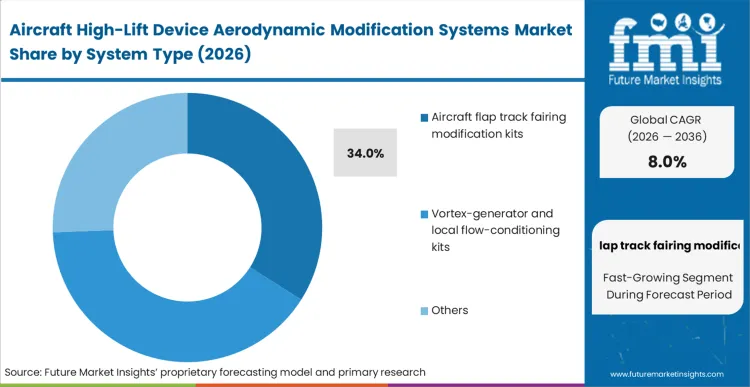
Legacy track fairings generate disproportionate parasitic drag during cruise phases. Aircraft flap track fairing modification kits hold 34.0% share in 2026, and FMI's analysis indicates fleet engineering directors target these specific modules for immediate return on investment. Replacing factory-standard blunt fairings with highly contoured composite alternatives smooths under-wing airflow vectors. Airlines undertaking commercial aircraft mro upgrades swap these components during routine maintenance windows. Operators answering how do flap track fairing modifications reduce drag rarely scrutinize flap-track kinematics until rising fuel prices force comprehensive aerodynamic audits. Upgraded fairings present an intriguing paradox; they add slight empty weight while netting overall mission fuel savings through dramatic wake reduction. Carriers delaying these component swaps bleed continuous margin across high-utilization narrowbody networks.
- Wake-vortex mitigation: Highly sculpted trailing edges reduce turbulent flow separation aft of complex deployment mechanisms. Fleet performance engineers measure distinct fuel burn improvements across long-haul route profiles.
- Clearance-envelope validation: Engineering teams must verify modified fairings do not impinge upon critical ground clearance limits during maximum-crosswind landing attitudes. Certification managers reject designs risking runway contact.
- Kinematic-track protection: Enclosing complex screw-jacks within refined aerodynamic shells shields sensitive lubrication points from environmental degradation. Maintenance planners observe reduced wear rates on primary flap drive components.
Aircraft High-Lift Device Aerodynamic Modification Systems Market Analysis by Fitment type
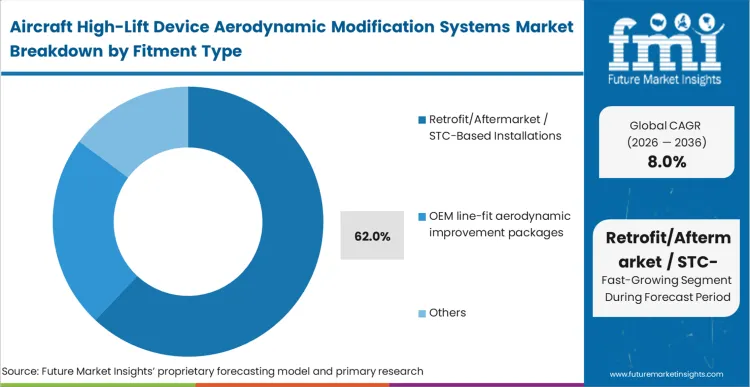
Aging fleets necessitate continuous efficiency improvements outside standard OEM delivery cycles. Retrofit/aftermarket / STC-based installations capture 62.0% share in 2026, as sustainability officers demand immediate carbon reduction from flying assets. Inserting these commercial aircraft MRO aerodynamic modifications during major tear-downs avoids schedule disruption. Aircraft undergoing comprehensive global air transport mro overhauls receive supplemental fairings alongside interior cabin updates. OEM line-fit options look attractive on paper but rarely address massive pre-existing fleets operating below modern aerodynamic standards. Third-party STC holders quietly dominate this tier because primary airframers allocate engineering talent toward clean-sheet aircraft designs rather than legacy platform optimization. Operators ignoring retrofit opportunities operate at distinct unit-cost disadvantages against modernized competitor fleets.
- Downtime-synchronized execution: Installation crews bolt new composite structures onto existing hardpoints explicitly during scheduled heavy maintenance checks. Station managers avoid generating standalone out-of-service penalties.
- Supplemental-certification hurdles: Engineering firms must prove aftermarket additions never interfere with native flight control authority under any failure mode. Regulatory authorities demand exhaustive flutter testing before issuing installation approval.
- Asset-value preservation: Leasing companies mandate specific aerodynamic upgrades before transitioning airframes to secondary operators. Remarketing directors command higher monthly lease rates for optimized platforms.
Aircraft High-Lift Device Aerodynamic Modification Systems Market Analysis by Aircraft Platform
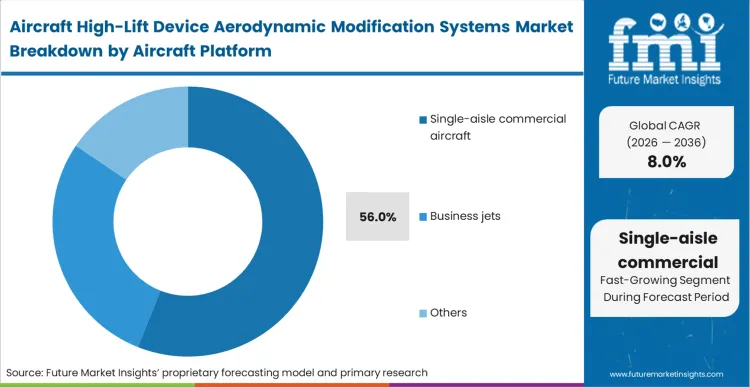
High-frequency operations multiply minor aerodynamic inefficiencies into massive annual fuel expenditures. Single-aisle commercial aircraft account for 56.0% share in 2026, according to FMI's estimates, because network planners run these assets across intensive daily utilization cycles. Narrowbody operators deploy these jets on multiple short segments where climb and descent drag penalties accumulate rapidly. Adding refined aerospace fasteners and fairings nets measurable block-fuel reductions for narrowbody aerodynamic retrofit systems. Short-haul economics obscure true aerodynamic potential; drag penalties matter intensely when performing four to six daily sectors. Route profitability managers recognize thin margins on domestic networks vanish completely without aggressive airframe optimization. Single-aisle operators failing to implement these packages surrender competitive pricing leverage, while widebody drag reduction modification systems offer similar scaling on long-haul routes.
- Utilization-multiplier effect: Shaving fractions of a percent off trip fuel accumulates massively across narrowbody fleets flying continuous regional schedules. Route managers translate these micro-savings into tangible annual budget reductions.
- Ramp-handling vulnerability: Low-to-the-ground single-aisle jets expose modified flap fairings to frequent baggage cart and catering truck strikes. Ramp safety officers must establish wider exclusion zones around delicate aerodynamic add-ons.
- Turnaround-inspection reality: Line mechanics require visual access to critical deployment tracks hidden behind elongated composite fairings. Maintenance training departments rewrite inspection protocols to accommodate restricted visual angles.
Aircraft High-Lift Device Aerodynamic Modification Systems Market Analysis by Technology / Material
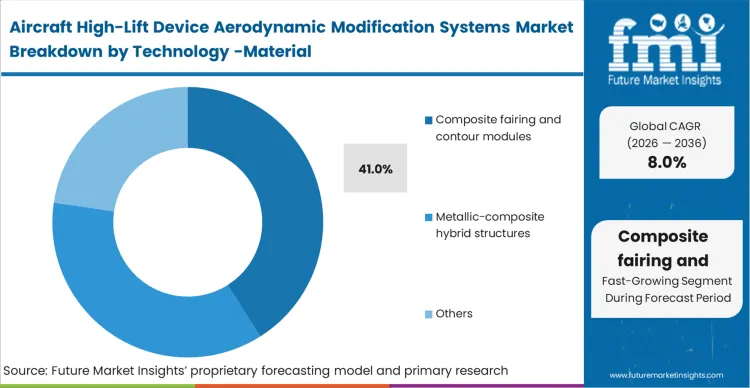
Replacing metallic components with advanced laminates eliminates significant parasitic weight. Composite fairing and contour modules secure 41.0% share in 2026, driven by stress engineers demanding superior strength-to-weight ratios. Manufacturing these complex double-curvature shapes requires advanced pre-preg layups rather than traditional aluminum stamping. Integrating aircraft actuators within these confined composite shells demands precise internal tolerance management. Material science breakthroughs often mask mundane operational realities; operators discover rigid carbon-fiber fairings shatter upon minor impact whereas legacy aluminum merely dents. Airlines must stock expensive composite spares at line stations to prevent minor ramp rash from grounding revenue flights. Procurement directors evaluating aircraft riblet film retrofit for drag reduction face similar durability tradeoffs against the broader riblet films for commercial aircraft market.
- Double-curvature fabrication: Specialized layup techniques allow manufacturers to produce highly swept aerodynamic shapes impossible to form with traditional metals. Production managers achieve optimal laminar flow characteristics.
- Impact-delamination risk: Minor ground equipment collisions cause hidden subsurface composite fractures rather than visible dents. Non-destructive testing technicians must deploy ultrasonic inspection tools following any suspected ramp incident.
- Thermal-expansion mismatch: Mating stiff carbon fairings to flexible aluminum wing structures requires specialized elastomeric interface brackets. Structural engineers spend months solving differential expansion challenges across extreme temperature cycles.
Aircraft High-Lift Device Aerodynamic Modification Systems Market Analysis by End User
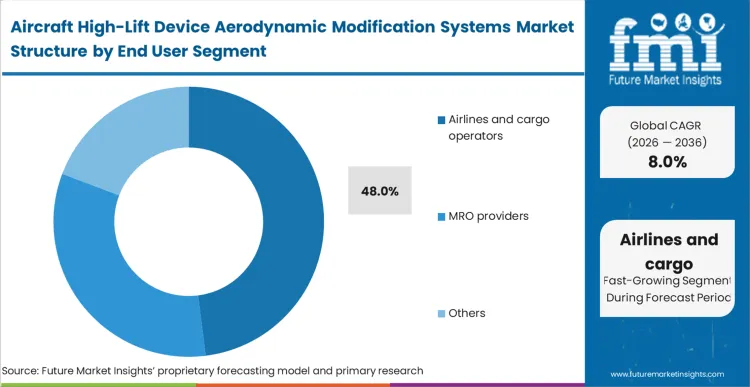
Fuel constitutes largest controllable expense on any carrier's profit and loss statement. Airlines and cargo operators hold 48.0% share in 2026, as FMI observes financial controllers directly funding these upgrade programs. Cargo carriers flying older converted airframes utilize these kits to extend economically viable platform lifespans. Direct operators bypass intermediary aircraft flight control system suppliers to negotiate fleet-wide STC licenses. Public sustainability commitments rarely mention flap-track fairings, yet procurement teams issuing an aircraft drag reduction retrofit RFQ demand hard metric improvements. Freight operators calculating what is the ROI of aircraft aerodynamic retrofit programs depend heavily on these modifications. Carriers delaying implementation bleed cash directly to aviation fuel providers.
- Payload-range extension: Drag reduction directly translates into lower trip fuel requirements, allowing dispatchers to load additional revenue cargo. Freight loadmasters exploit this newly available weight capacity on marginal long-haul sectors.
- Fleet-standardization complexity: Mixed-age fleets require multiple STC variations to accommodate minor production-line changes across airframe generations. Configuration control managers struggle maintaining accurate engineering drawings across varied aircraft tails.
- Fuel-hedging synergy: Aerodynamic efficiency acts as a permanent physical hedge against volatile jet fuel spot prices. Financial officers model these hardware upgrades alongside traditional financial derivates to stabilize operating costs.
Aircraft High-Lift Device Aerodynamic Modification Systems Market Drivers, Restraints, and Opportunities
Carbon offset penalties force airline sustainability officers to extract marginal fuel efficiency gains from existing fleets immediately. Operators face mounting legislative pressure to demonstrate tangible emission reductions across legacy airframes. Directors of engineering cannot wait for clean-sheet aircraft deliveries; they must bolt on immediate aircraft sensors and aerodynamic refinements. Delaying these modifications exposes carriers to severe financial penalties in highly regulated airspace. Next-generation engine delays exacerbate this urgency, pushing operators toward airframe-level efficiency improvements to maintain operating margin targets. Shaving fractions of drag from flap tracks translates directly into massive fleet-wide fuel savings.
Certification delays slow adoption even when fleet managers want to move quickly. Supplemental type certificate approvals require exhausting flight test hours to prove modified fairings do not alter critical stall characteristics, extending the aircraft drag reduction retrofit certification timeline. Regulatory agencies treat high-lift device proximity with extreme caution. Start-up engineering firms design brilliant aerodynamic shapes but lack financial stamina to survive multi-year certification bureaucracies. Engineering vice presidents cannot commit capital to uncertified promises. Digital modeling accelerates initial design, yet physical flight testing remains an unavoidable bottleneck.
Opportunities in the Aircraft High-Lift Device Aerodynamic Modification Systems Market
- Micro-riblet surface film scaling: Material scientists scaling durable drag-reducing films shape the future of aircraft drag reduction retrofit technologies. Fleet managers capture efficiency without tear-downs.
- Predictive wear analytics integration: MRO providers embedding aircraft automated inspection and monitoring technology inside new fairings. Maintenance planners anticipate component degradation before catastrophic failure.
- 3D-printed gap seal manufacturing: Tooling engineers producing custom gap-seals beat the high-lift device aerodynamic modification systems forecast 2036 projections. Procurement directors slash supply chain lead times for specialized aerodynamic parts.
Regional Analysis
Based on regional analysis, Aircraft High-Lift Device Aerodynamic Modification Systems Market is segmented into North America, Europe, Asia Pacific, and Middle East and Africa across 40 plus countries.
.webp "Top Country Growth Comparison Aircraft High Lift Device Aerodynamic Modification Systems Market Cagr (2026 2036)")
| Country | CAGR (2026 to 2036) |
|---|---|
| India | 9.8% |
| China | 9.4% |
| United Arab Emirates | 8.7% |
| Singapore | 8.2% |
| Germany | 7.6% |
| United Kingdom | 7.4% |
| United States | 7.1% |
Source: Future Market Insights (FMI) analysis, based on proprietary forecasting model and primary research
North America Aircraft High-Lift Device Aerodynamic Modification Systems Market Analysis
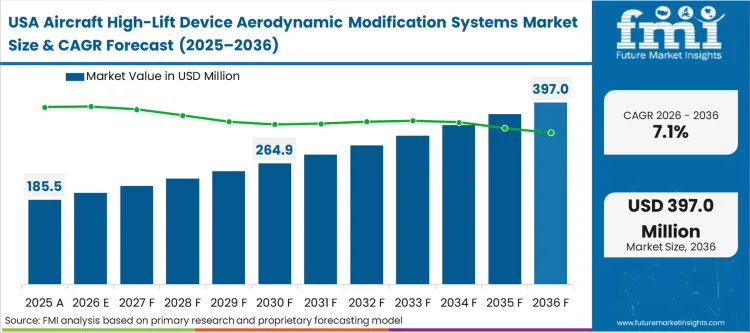
Massive installed bases of legacy airframes define adoption curves across North America. Fleet planners manage thousands of mature single-aisle jets requiring continuous efficiency updates to remain profitable. Engineering depth allows local operators to execute complex STC installations seamlessly during routine maintenance. Independent engineering firms cluster around major aviation hubs, generating continuous streams of regulatory-approved modifications. Established carriers prioritize incremental upgrades over wholesale fleet replacement.
- United States: Mature certification ecosystems enable rapid deployment of aftermarket aerodynamic packages. Fleet engineering directors leverage established STC catalogs to squeeze final efficiency margins from aging fleets. Growth registers at 7.1% as saturation limits further explosive expansion. Carriers completing these upgrades secure strong competitive positioning against un-optimized domestic rivals.
FMI's report includes Canada and Mexico. Cross-border maintenance operations facilitate widespread component installation across unified North American airspace.
Europe Aircraft High-Lift Device Aerodynamic Modification Systems Market Analysis
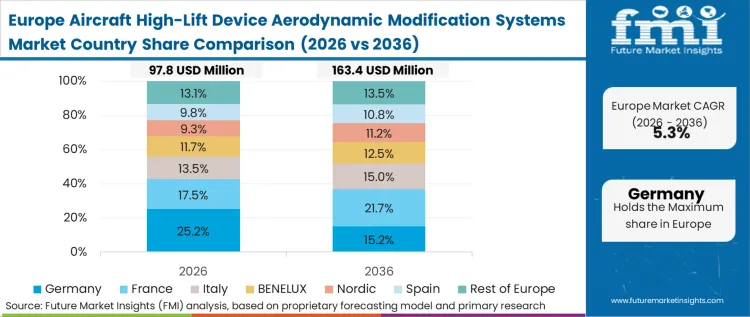
Aggressive carbon taxation mandates compel European carriers to pursue every available aerodynamic optimization. Sustainability officers operate under severe regulatory scrutiny, demanding hard engineering solutions rather than abstract carbon credits. MRO infrastructure across this region supports complex composite manufacturing and rapid line-fit installations. Aircraft leasing companies headquartered here dictate modification standards for global secondary markets, defining broader aircraft aerodynamic retrofit trends.
- Germany: Sales within the german aircraft high-lift device aerodynamic modification systems market expand at a 7.6% CAGR alongside stringent environmental compliance requirements. Deep local MRO expertise supports intricate composite fairing design and advanced manufacturing. Heavy maintenance station chiefs integrate drag-reduction installations directly into scheduled heavy checks. Operators adopting these exacting European standards achieve a distinct operational outcome, clearing strict emission benchmarks while simultaneously lowering fuel expenditures.
- United Kingdom: Advanced aerospace manufacturing clusters drive localized innovation in complex gap-seal technologies. Airline procurement leads source highly engineered composite structures directly from established domestic suppliers. Revenue advances at a 7.4% CAGR for the United Kingdom Aircraft High-Lift Device Aerodynamic Modification Systems Market, driven by strong engineering partnerships. Companies controlling local intellectual property lock in lucrative commercial opportunities while supporting regional aviation sustainability and emission reduction mandates.
FMI's report includes France and Italy. Stringent European Aviation Safety Agency oversight ensures all aerodynamic modifications meet rigorous safety thresholds.
Asia Pacific Aircraft High-Lift Device Aerodynamic Modification Systems Market Analysis
Explosive fleet growth shifts engineering focus toward massive narrowbody inductions. Regional operators acquire hundreds of airframes annually, multiplying base inefficiencies across vast route networks. Local maintenance facilities rapidly expand composite repair capabilities to support these new fleets. Airline executives prioritize fuel-burn reduction to combat volatile regional fuel pricing structures.
- India: Massive single-aisle fleet expansion drives unprecedented demand for localized maintenance solutions across the country. The India Aircraft High-Lift Device Aerodynamic Modification Systems Market is projected to expand at a 9.8% CAGR through 2036. Airline chief operating officers mandate these efficiency upgrades to survive brutal domestic fare wars. This aggressive modernization trajectory indicates India will soon dictate new pricing models for global STC developers.
- China: China aircraft high-lift device aerodynamic modification systems industrytracks at a 9.4% CAGR on the back of continuous capacity expansion. Efficiency-focused operating economics force state-backed carriers to adopt global aerodynamic standards. Maintenance localized within massive new airport hubs enables rapid fleet-wide package installations. What international suppliers often miss is that strict Chinese regulatory approval acts as a formidable barrier, protecting growing domestic engineering firms.
- Singapore: Growth in the Singapore Aircraft High-Lift Device Aerodynamic Modification Systems Market hits an 8.2% CAGR as specialised engineering talent concentrates within specific aviation parks. Strategic geographic positioning establishes premier heavy maintenance hubs serving global widebody fleets. MRO facility chiefs execute complex aerodynamic retrofits during massive international layovers. Suppliers established here gain massive commercial opportunities, securing highly lucrative long-term contracts across much broader Asian aviation networks.
FMI's report includes Japan and South Korea. High-cycle regional operations compel operators to continuously monitor fatigue on newly installed metallic composite hybrid aircraft exterior components.
Middle East and Africa Aircraft High-Lift Device Aerodynamic Modification Systems Market Analysis
Extreme temperature operations stress delicate composite structures and surface films differently than temperate climates. Fleet managers operating out of desert hubs must validate thermal expansion tolerances before authorizing fleet-wide aerodynamic upgrades. Premium carriers utilize these modifications to maximize ultra-long-haul payload capabilities.
- United Arab Emirates: The United Arab Emirates Aircraft High-Lift Device Aerodynamic Modification Systems Market accelerates at an 8.7% CAGR, reflecting premium-fleet optimization programs. Carriers pursue visible fuel-efficiency optimization to maximize range on global connecting routes out of desert hubs. Network planners require absolutely minimized drag profiles to reach distant city pairs profitably. MRO providers mastering high-temperature composite repairs secure dominant competitive positioning across these specialized regional maintenance markets.
FMI's report includes Saudi Arabia and Qatar. Dust abrasion presents severe challenges to polymeric surface films, demanding specialized localized material formulations.
Competitive Aligners for Market Players
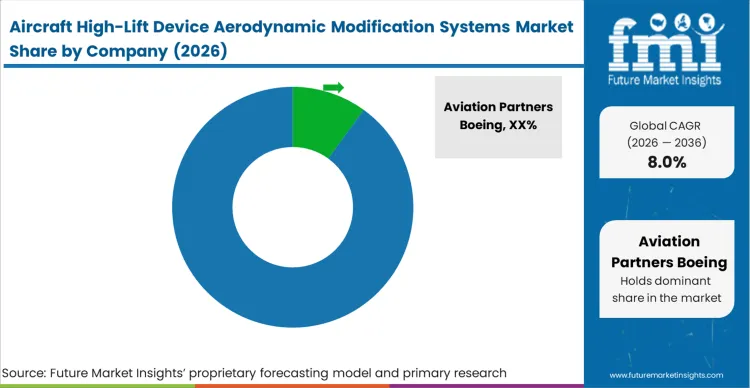
Regulatory certification ownership dictates power dynamics across this specific tier. Startups can design brilliant composite geometries, but established players controlling FAA and EASA supplemental type certificates hold actual commercial leverage. Aviation Partners Boeing utilizes massive historical flight-data libraries to guarantee precise fuel-burn reductions. Airlines refuse to ground revenue-generating assets for unproven hardware. Procurement directors understand how to evaluate aircraft aerodynamic retrofit suppliers based strictly on their existing STC portfolio breadth, effectively locking out novel engineering firms lacking deep certification budgets.
Incumbents possess massive databases of interface parameters detailing exactly how legacy wings flex under load. Lufthansa Technik translates this proprietary airframe knowledge into seamless aerospace composite materials using pcr structures that never induce unintended fatigue on native hardpoints. Challengers face an extreme barrier; replicating this specific load-transfer data requires thousands of hours of proprietary flight testing. Any aircraft aerodynamic retrofit supplier must bypass major MRO providers who bundle their proprietary aerodynamic kits directly into scheduled heavy maintenance contracts, preventing independent hardware manufacturers from accessing aircraft during crucial tear-down phases.
Major leasing companies actively resist proprietary fairing designs requiring specialized line-station maintenance tooling. Fleet transition managers demand standardized hardware to ensure seamless airframe transfers between global operators. When an aircraft drag reduction retrofit suppliers attempts to introduce hyper-specialized fastening systems for their aerodynamic packages, lessors frequently veto the installation. Large airlines exert power by mandating open-architecture composite repairs, forcing hardware vendors to abandon closed-ecosystem maintenance models.
Key Players in Aircraft High-Lift Device Aerodynamic Modification Systems Market
- Aviation Partners Boeing
- Lufthansa Technik
- BASF Coatings
- Aviation Partners, Inc.
- SACS Aerospace
- MicroTau
- GKN Aerospace
Scope of the Report
| Metric | Value |
|---|---|
| Quantitative Units | USD 392.0 million to USD 846.3 million, at a CAGR of 8.0% |
| Market Definition | Engineered structural add-ons and surface treatments explicitly designed to reduce drag around trailing edge flaps, leading edge slats, and associated track mechanisms. Products within this boundary modify airflow separation characteristics during cruise while maintaining structural integrity during high-angle-of-attack deployment phases. |
| Segmentation | By System type, By Fitment type, By Aircraft platform, By Technology / material, By End user, and By Region |
| Regions Covered | North America, Latin America, Europe, Asia Pacific, and Middle East and Africa |
| Countries Covered | United States, Germany, United Kingdom, Singapore, United Arab Emirates, China, India |
| Key Companies Profiled | Aviation Partners Boeing, Lufthansa Technik, BASF Coatings, Aviation Partners, Inc., SACS Aerospace, MicroTau, GKN Aerospace |
| Forecast Period | 2026 to 2036 |
| Approach | Airframe delivery backlogs and scheduled heavy maintenance induction volumes |
Source: Future Market Insights (FMI) analysis, based on proprietary forecasting model and primary research
Aircraft High-Lift Device Aerodynamic Modification Systems Market Analysis by Segments
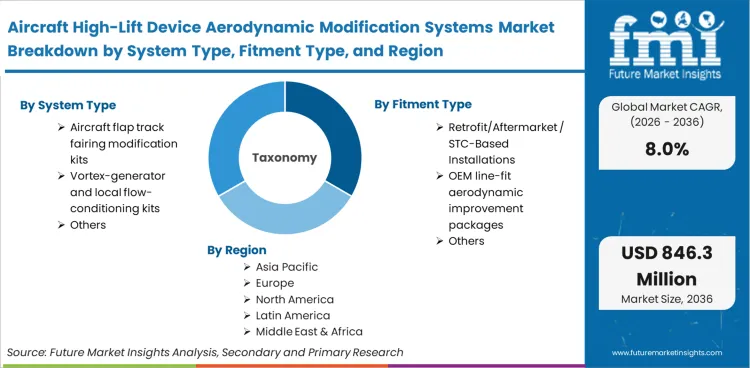
By System type:
- Flap-track fairing modification kits
- Slat/flap gap-seal and contour-improvement kits
- Riblet or drag-reduction film systems applied near high-lift flow regions
- Leading-edge droop / slat aerodynamic refinement packages
- Vortex-generator and local flow-conditioning kits
By Fitment type:
- Retrofit / aftermarket / STC-based installations
- OEM line-fit aerodynamic improvement packages
- Heavy-maintenance bundled upgrades
By Aircraft platform:
- Single-aisle commercial aircraft
- Widebody commercial aircraft
- Regional jets / turboprops
- Business jets
By Technology / material:
- Composite fairing and contour modules
- Metallic-composite hybrid structures
- Polymeric riblet films and surface treatments
- Sealants / bonded aerodynamic add-ons
By End user:
- Airlines and cargo operators
- MRO providers
- OEM / completion centers
- Business aviation operators
Region:
- North America
- United States
- Canada
- Europe
- Germany
- United Kingdom
- France
- Italy
- Spain
- Asia Pacific
- China
- Japan
- South Korea
- Taiwan
- Singapore
- Latin America
- Brazil
- Mexico
- Argentina
- Middle East & Africa
- GCC Countries
- South Africa
Bibliography
- International Air Transport Association. (2025, January). IATA Annual Review 2025. IATA Publications.
- International Civil Aviation Organization. (2025, February). ICAO Environmental Report 2025. ICAO Environmental Protection.
- European Union Aviation Safety Agency. (2025, March). European Aviation Environmental Report 2025. EASA Reports.
- MicroTau. (2025, April). Delta partners with MicroTau to test Riblet Modification Package on Delta 767s. MicroTau Press Releases.
- Clean Aviation. (2024, November). Technology Clean Sky 2: Technical Annex. Clean Aviation EU.
This bibliography is provided for reader reference. The full FMI report contains the complete reference list with primary source documentation.
This Report Addresses
- Drag reduction impact from aftermarket flap-track fairing replacements
- Airline engineering director strategies for heavy maintenance scheduling
- Supplemental type certificate barriers limiting startup composite manufacturers
- Line mechanic turnaround inspection realities impacting delicate surface films
- Narrowbody fleet utilization multiplying marginal block-fuel savings
- Carbon offset penalty avoidance driving immediate component upgrades
- Thermal expansion mismatch challenges mating stiff carbon to aluminum
- Widebody payload-range extension unlocked via trailing edge flow conditioning
Frequently Asked Questions
What limits rapid deployment of micro-riblet surface films?
Surface film durability dictates true return on investment rather than pristine wind-tunnel drag counts. Carriers choosing modifications without assessing harsh tarmac handling realities often see theoretical fuel savings erased by frequent component replacement costs.
Why do single-aisle platforms lead adoption over widebodies?
High-frequency operations multiply minor aerodynamic inefficiencies into massive annual fuel expenditures. Narrowbody operators deploy these jets on multiple short segments where climb and descent drag penalties accumulate rapidly across intensive daily utilization cycles.
How do operators bypass OEM line-fit pricing premiums?
Aging fleets necessitate continuous efficiency improvements outside standard OEM delivery cycles. Inserting aftermarket aerodynamic packages during major tear-downs avoids schedule disruption while bypassing primary airframer pricing structures entirely.
What structural barrier protects established STC holders?
Regulatory certification ownership dictates power dynamics across this specific tier. Challengers face an extreme barrier replicating specific load-transfer data requiring thousands of hours of proprietary flight testing.
Why does India present such high growth potential?
Massive single-aisle fleet expansion drives unprecedented demand for localized maintenance solutions. Airline chief operating officers mandate efficiency upgrades to survive brutal domestic fare wars.
What counts as a high-lift device aerodynamic modification system in commercial aviation?
This segment covers engineered structural add-ons and surface treatments explicitly designed to reduce drag around trailing edge flaps, leading edge slats, and associated track mechanisms. Core components alter local flow vectors without requiring fundamental wing redesign or primary load-path recertification.
How large is this market in 2026 and how fast is it growing through 2036?
Demand is expected to reach USD 392.0 million in 2026 and USD 846.3 million by 2036. Revenue expansion lifts cumulative output upward at a compound annual growth rate of 8.0% during the forecast period.
Which retrofit technologies deliver the fastest fuel-burn payback?
Flap-track fairing modification kits yield immediate return on investment by smoothing under-wing airflow vectors. Replacing factory-standard blunt fairings with highly contoured composite alternatives nets overall mission fuel savings through dramatic wake reduction.
Are flap-track fairing modifications different from winglet retrofits?
Products within this boundary modify airflow separation characteristics specifically around trailing edge mechanisms. Winglets address induced drag at the wingtip, whereas flap fairings target parasitic drag generated by complex under-wing deployment tracks.
Which aircraft fleets are the main buyers of these systems?
Single-aisle commercial aircraft operators deploy these jets on multiple short segments where climb and descent drag penalties accumulate rapidly. Adding refined composite fairings nets measurable block-fuel reductions critical for short-haul profitability.
What certification path is usually required for aerodynamic retrofit systems?
Engineering firms must prove aftermarket additions never interfere with native flight control authority under any failure mode. Regulatory authorities demand exhaustive flutter testing before issuing a Supplemental Type Certificate for installation approval.
Which companies are active in this market right now?
Aviation Partners Boeing, Lufthansa Technik, BASF Coatings, Aviation Partners, Inc., SACS Aerospace, MicroTau, and GKN Aerospace control significant market presence. Established players leverage historical flight-data libraries and STC portfolios to secure commercial dominance.
Why are airlines funding drag-reduction retrofits instead of waiting for new aircraft?
Next-generation engine delays push operators toward airframe-level efficiency improvements to maintain operating margin targets. Carbon offset penalties force airline sustainability officers to extract marginal fuel efficiency gains from existing fleets immediately.
How do riblet-film solutions compare with structural fairing upgrades?
Surface-applied riblet films offer lightweight drag reduction without heavy composite modifications. Reality grounds expectations when line mechanics routinely damage delicate treatments during standard turnaround inspections, making durability a primary constraint.
Which regions are adopting these systems fastest?
India leads at 9.8% on back of aggressive fleet expansion and maintenance localization. China tracks at 9.4% driven by efficiency-focused operating economics, while United Arab Emirates carriers pursue visible fuel-efficiency optimization at 8.7%.
How do thermal expansion properties affect composite fairings?
Mating stiff carbon fairings to flexible aluminum wing structures requires specialized elastomeric interface brackets. Structural engineers spend months solving differential expansion challenges across extreme temperature cycles.
What prevents startups from dominating fairing innovation?
Airlines refuse to ground revenue-generating assets for unproven hardware. Procurement directors evaluate vendors based strictly on existing STC portfolio breadth, effectively locking out novel engineering firms lacking deep certification budgets.
Why do leasing companies reject certain aerodynamic modifications?
Major leasing companies actively resist proprietary fairing designs requiring specialized line-station maintenance tooling. Fleet transition managers demand standardized hardware to ensure seamless airframe transfers between global operators.
What drives airline sustainability officers toward aerodynamic retrofits?
Carbon offset penalties force airline sustainability officers to extract marginal fuel efficiency gains from existing fleets immediately. Operators face mounting legislative pressure to demonstrate tangible emission reductions across legacy airframes.
How do MRO providers leverage these upgrade packages?
Maintenance providers bundle these proven modifications into scheduled C-checks. Operators immediately recognize fuel burn reductions, prompting fleet-wide standardization through centralized MRO contracts.
What operational risk accompanies composite fairing installations?
Minor ground equipment collisions cause hidden subsurface composite fractures rather than visible dents. Non-destructive testing technicians must deploy ultrasonic inspection tools following any suspected ramp incident.
Why are gap seals frequently replaced?
Airlines model aerodynamic upgrades assuming continuous cruise conditions. Reality grounds these expectations when line mechanics routinely damage delicate gap-seal treatments during standard turnaround inspections.
How do freight operators utilize these systems differently?
Drag reduction directly translates into lower trip fuel requirements, allowing dispatchers to load additional revenue cargo. Freight loadmasters exploit newly available weight capacity on marginal long-haul sectors.
What specific flight phase benefits most from these upgrades?
Products within this boundary modify airflow separation characteristics primarily during cruise. Core components alter local flow vectors without requiring fundamental wing redesign.
Preview the report firsthand - request a free sample
Get SampleGet the brochure for pricing and purchase details.
Get PDFTable of Content
- Executive Summary
- Global Market Outlook
- Demand-side Trends
- Supply-side Trends
- Technology Roadmap Analysis
- Analysis and Recommendations
- Market Overview
- Market Coverage / Taxonomy
- Market Definition / Scope / Limitations
- Research Methodology
- Chapter Orientation
- Analytical Lens and Working Hypotheses
- Market Structure, Signals, and Trend Drivers
- Benchmarking and Cross-market Comparability
- Market Sizing, Forecasting, and Opportunity Mapping
- Research Design and Evidence Framework
- Desk Research Programme (Secondary Evidence)
- Company Annual and Sustainability Reports
- Peer-reviewed Journals and Academic Literature
- Corporate Websites, Product Literature, and Technical Notes
- Earnings Decks and Investor Briefings
- Statutory Filings and Regulatory Disclosures
- Technical White Papers and Standards Notes
- Trade Journals, Industry Magazines, and Analyst Briefs
- Conference Proceedings, Webinars, and Seminar Materials
- Government Statistics Portals and Public Data Releases
- Press Releases and Reputable Media Coverage
- Specialist Newsletters and Curated Briefings
- Sector Databases and Reference Repositories
- FMI Internal Proprietary Databases and Historical Market Datasets
- Subscription Datasets and Paid Sources
- Social Channels, Communities, and Digital Listening Inputs
- Additional Desk Sources
- Expert Input and Fieldwork (Primary Evidence)
- Primary Modes
- Qualitative Interviews and Expert Elicitation
- Quantitative Surveys and Structured Data Capture
- Blended Approach
- Why Primary Evidence is Used
- Field Techniques
- Interviews
- Surveys
- Focus Groups
- Observational and In-context Research
- Social and Community Interactions
- Stakeholder Universe Engaged
- C-suite Leaders
- Board Members
- Presidents and Vice Presidents
- R&D and Innovation Heads
- Technical Specialists
- Domain Subject-matter Experts
- Scientists
- Physicians and Other Healthcare Professionals
- Governance, Ethics, and Data Stewardship
- Research Ethics
- Data Integrity and Handling
- Primary Modes
- Tooling, Models, and Reference Databases
- Desk Research Programme (Secondary Evidence)
- Data Engineering and Model Build
- Data Acquisition and Ingestion
- Cleaning, Normalisation, and Verification
- Synthesis, Triangulation, and Analysis
- Quality Assurance and Audit Trail
- Market Background
- Market Dynamics
- Drivers
- Restraints
- Opportunity
- Trends
- Scenario Forecast
- Demand in Optimistic Scenario
- Demand in Likely Scenario
- Demand in Conservative Scenario
- Opportunity Map Analysis
- Product Life Cycle Analysis
- Supply Chain Analysis
- Investment Feasibility Matrix
- Value Chain Analysis
- PESTLE and Porter’s Analysis
- Regulatory Landscape
- Regional Parent Market Outlook
- Production and Consumption Statistics
- Import and Export Statistics
- Market Dynamics
- Global Market Analysis 2021 to 2025 and Forecast, 2026 to 2036
- Historical Market Size Value (USD Million) Analysis, 2021 to 2025
- Current and Future Market Size Value (USD Million) Projections, 2026 to 2036
- Y-o-Y Growth Trend Analysis
- Absolute $ Opportunity Analysis
- Global Market Pricing Analysis 2021 to 2025 and Forecast 2026 to 2036
- Global Market Analysis 2021 to 2025 and Forecast 2026 to 2036, By System Type
- Introduction / Key Findings
- Historical Market Size Value (USD Million) Analysis By System Type , 2021 to 2025
- Current and Future Market Size Value (USD Million) Analysis and Forecast By System Type , 2026 to 2036
- Aircraft flap track fairing modification kits
- Vortex-generator and local flow-conditioning kits
- Others
- Aircraft flap track fairing modification kits
- Y-o-Y Growth Trend Analysis By System Type , 2021 to 2025
- Absolute $ Opportunity Analysis By System Type , 2026 to 2036
- Global Market Analysis 2021 to 2025 and Forecast 2026 to 2036, By Fitment Type
- Introduction / Key Findings
- Historical Market Size Value (USD Million) Analysis By Fitment Type, 2021 to 2025
- Current and Future Market Size Value (USD Million) Analysis and Forecast By Fitment Type, 2026 to 2036
- Retrofit/Aftermarket / STC-Based Installations
- OEM line-fit aerodynamic improvement packages
- Others
- Retrofit/Aftermarket / STC-Based Installations
- Y-o-Y Growth Trend Analysis By Fitment Type, 2021 to 2025
- Absolute $ Opportunity Analysis By Fitment Type, 2026 to 2036
- Global Market Analysis 2021 to 2025 and Forecast 2026 to 2036, By Aircraft Platform
- Introduction / Key Findings
- Historical Market Size Value (USD Million) Analysis By Aircraft Platform, 2021 to 2025
- Current and Future Market Size Value (USD Million) Analysis and Forecast By Aircraft Platform, 2026 to 2036
- Single-aisle commercial aircraft
- Business jets
- Others
- Single-aisle commercial aircraft
- Y-o-Y Growth Trend Analysis By Aircraft Platform, 2021 to 2025
- Absolute $ Opportunity Analysis By Aircraft Platform, 2026 to 2036
- Global Market Analysis 2021 to 2025 and Forecast 2026 to 2036, By Technology -Material
- Introduction / Key Findings
- Historical Market Size Value (USD Million) Analysis By Technology -Material, 2021 to 2025
- Current and Future Market Size Value (USD Million) Analysis and Forecast By Technology -Material, 2026 to 2036
- Composite fairing and contour modules
- Metallic-composite hybrid structures
- Others
- Composite fairing and contour modules
- Y-o-Y Growth Trend Analysis By Technology -Material, 2021 to 2025
- Absolute $ Opportunity Analysis By Technology -Material, 2026 to 2036
- Global Market Analysis 2021 to 2025 and Forecast 2026 to 2036, By End User
- Introduction / Key Findings
- Historical Market Size Value (USD Million) Analysis By End User, 2021 to 2025
- Current and Future Market Size Value (USD Million) Analysis and Forecast By End User, 2026 to 2036
- Airlines and cargo operators
- MRO providers
- Others
- Airlines and cargo operators
- Y-o-Y Growth Trend Analysis By End User, 2021 to 2025
- Absolute $ Opportunity Analysis By End User, 2026 to 2036
- Global Market Analysis 2021 to 2025 and Forecast 2026 to 2036, By Region
- Introduction
- Historical Market Size Value (USD Million) Analysis By Region, 2021 to 2025
- Current Market Size Value (USD Million) Analysis and Forecast By Region, 2026 to 2036
- North America
- Latin America
- Western Europe
- Eastern Europe
- East Asia
- South Asia and Pacific
- Middle East & Africa
- Market Attractiveness Analysis By Region
- North America Market Analysis 2021 to 2025 and Forecast 2026 to 2036, By Country
- Historical Market Size Value (USD Million) Trend Analysis By Market Taxonomy, 2021 to 2025
- Market Size Value (USD Million) Forecast By Market Taxonomy, 2026 to 2036
- By Country
- USA
- Canada
- Mexico
- By System Type
- By Fitment Type
- By Aircraft Platform
- By Technology -Material
- By End User
- By Country
- Market Attractiveness Analysis
- By Country
- By System Type
- By Fitment Type
- By Aircraft Platform
- By Technology -Material
- By End User
- Key Takeaways
- Latin America Market Analysis 2021 to 2025 and Forecast 2026 to 2036, By Country
- Historical Market Size Value (USD Million) Trend Analysis By Market Taxonomy, 2021 to 2025
- Market Size Value (USD Million) Forecast By Market Taxonomy, 2026 to 2036
- By Country
- Brazil
- Chile
- Rest of Latin America
- By System Type
- By Fitment Type
- By Aircraft Platform
- By Technology -Material
- By End User
- By Country
- Market Attractiveness Analysis
- By Country
- By System Type
- By Fitment Type
- By Aircraft Platform
- By Technology -Material
- By End User
- Key Takeaways
- Western Europe Market Analysis 2021 to 2025 and Forecast 2026 to 2036, By Country
- Historical Market Size Value (USD Million) Trend Analysis By Market Taxonomy, 2021 to 2025
- Market Size Value (USD Million) Forecast By Market Taxonomy, 2026 to 2036
- By Country
- Germany
- UK
- Italy
- Spain
- France
- Nordic
- BENELUX
- Rest of Western Europe
- By System Type
- By Fitment Type
- By Aircraft Platform
- By Technology -Material
- By End User
- By Country
- Market Attractiveness Analysis
- By Country
- By System Type
- By Fitment Type
- By Aircraft Platform
- By Technology -Material
- By End User
- Key Takeaways
- Eastern Europe Market Analysis 2021 to 2025 and Forecast 2026 to 2036, By Country
- Historical Market Size Value (USD Million) Trend Analysis By Market Taxonomy, 2021 to 2025
- Market Size Value (USD Million) Forecast By Market Taxonomy, 2026 to 2036
- By Country
- Russia
- Poland
- Hungary
- Balkan & Baltic
- Rest of Eastern Europe
- By System Type
- By Fitment Type
- By Aircraft Platform
- By Technology -Material
- By End User
- By Country
- Market Attractiveness Analysis
- By Country
- By System Type
- By Fitment Type
- By Aircraft Platform
- By Technology -Material
- By End User
- Key Takeaways
- East Asia Market Analysis 2021 to 2025 and Forecast 2026 to 2036, By Country
- Historical Market Size Value (USD Million) Trend Analysis By Market Taxonomy, 2021 to 2025
- Market Size Value (USD Million) Forecast By Market Taxonomy, 2026 to 2036
- By Country
- China
- Japan
- South Korea
- By System Type
- By Fitment Type
- By Aircraft Platform
- By Technology -Material
- By End User
- By Country
- Market Attractiveness Analysis
- By Country
- By System Type
- By Fitment Type
- By Aircraft Platform
- By Technology -Material
- By End User
- Key Takeaways
- South Asia and Pacific Market Analysis 2021 to 2025 and Forecast 2026 to 2036, By Country
- Historical Market Size Value (USD Million) Trend Analysis By Market Taxonomy, 2021 to 2025
- Market Size Value (USD Million) Forecast By Market Taxonomy, 2026 to 2036
- By Country
- India
- ASEAN
- Australia & New Zealand
- Rest of South Asia and Pacific
- By System Type
- By Fitment Type
- By Aircraft Platform
- By Technology -Material
- By End User
- By Country
- Market Attractiveness Analysis
- By Country
- By System Type
- By Fitment Type
- By Aircraft Platform
- By Technology -Material
- By End User
- Key Takeaways
- Middle East & Africa Market Analysis 2021 to 2025 and Forecast 2026 to 2036, By Country
- Historical Market Size Value (USD Million) Trend Analysis By Market Taxonomy, 2021 to 2025
- Market Size Value (USD Million) Forecast By Market Taxonomy, 2026 to 2036
- By Country
- Kingdom of Saudi Arabia
- Other GCC Countries
- Turkiye
- South Africa
- Other African Union
- Rest of Middle East & Africa
- By System Type
- By Fitment Type
- By Aircraft Platform
- By Technology -Material
- By End User
- By Country
- Market Attractiveness Analysis
- By Country
- By System Type
- By Fitment Type
- By Aircraft Platform
- By Technology -Material
- By End User
- Key Takeaways
- Key Countries Market Analysis
- USA
- Pricing Analysis
- Market Share Analysis, 2025
- By System Type
- By Fitment Type
- By Aircraft Platform
- By Technology -Material
- By End User
- Canada
- Pricing Analysis
- Market Share Analysis, 2025
- By System Type
- By Fitment Type
- By Aircraft Platform
- By Technology -Material
- By End User
- Mexico
- Pricing Analysis
- Market Share Analysis, 2025
- By System Type
- By Fitment Type
- By Aircraft Platform
- By Technology -Material
- By End User
- Brazil
- Pricing Analysis
- Market Share Analysis, 2025
- By System Type
- By Fitment Type
- By Aircraft Platform
- By Technology -Material
- By End User
- Chile
- Pricing Analysis
- Market Share Analysis, 2025
- By System Type
- By Fitment Type
- By Aircraft Platform
- By Technology -Material
- By End User
- Germany
- Pricing Analysis
- Market Share Analysis, 2025
- By System Type
- By Fitment Type
- By Aircraft Platform
- By Technology -Material
- By End User
- UK
- Pricing Analysis
- Market Share Analysis, 2025
- By System Type
- By Fitment Type
- By Aircraft Platform
- By Technology -Material
- By End User
- Italy
- Pricing Analysis
- Market Share Analysis, 2025
- By System Type
- By Fitment Type
- By Aircraft Platform
- By Technology -Material
- By End User
- Spain
- Pricing Analysis
- Market Share Analysis, 2025
- By System Type
- By Fitment Type
- By Aircraft Platform
- By Technology -Material
- By End User
- France
- Pricing Analysis
- Market Share Analysis, 2025
- By System Type
- By Fitment Type
- By Aircraft Platform
- By Technology -Material
- By End User
- India
- Pricing Analysis
- Market Share Analysis, 2025
- By System Type
- By Fitment Type
- By Aircraft Platform
- By Technology -Material
- By End User
- ASEAN
- Pricing Analysis
- Market Share Analysis, 2025
- By System Type
- By Fitment Type
- By Aircraft Platform
- By Technology -Material
- By End User
- Australia & New Zealand
- Pricing Analysis
- Market Share Analysis, 2025
- By System Type
- By Fitment Type
- By Aircraft Platform
- By Technology -Material
- By End User
- China
- Pricing Analysis
- Market Share Analysis, 2025
- By System Type
- By Fitment Type
- By Aircraft Platform
- By Technology -Material
- By End User
- Japan
- Pricing Analysis
- Market Share Analysis, 2025
- By System Type
- By Fitment Type
- By Aircraft Platform
- By Technology -Material
- By End User
- South Korea
- Pricing Analysis
- Market Share Analysis, 2025
- By System Type
- By Fitment Type
- By Aircraft Platform
- By Technology -Material
- By End User
- Russia
- Pricing Analysis
- Market Share Analysis, 2025
- By System Type
- By Fitment Type
- By Aircraft Platform
- By Technology -Material
- By End User
- Poland
- Pricing Analysis
- Market Share Analysis, 2025
- By System Type
- By Fitment Type
- By Aircraft Platform
- By Technology -Material
- By End User
- Hungary
- Pricing Analysis
- Market Share Analysis, 2025
- By System Type
- By Fitment Type
- By Aircraft Platform
- By Technology -Material
- By End User
- Kingdom of Saudi Arabia
- Pricing Analysis
- Market Share Analysis, 2025
- By System Type
- By Fitment Type
- By Aircraft Platform
- By Technology -Material
- By End User
- Turkiye
- Pricing Analysis
- Market Share Analysis, 2025
- By System Type
- By Fitment Type
- By Aircraft Platform
- By Technology -Material
- By End User
- South Africa
- Pricing Analysis
- Market Share Analysis, 2025
- By System Type
- By Fitment Type
- By Aircraft Platform
- By Technology -Material
- By End User
- USA
- Market Structure Analysis
- Competition Dashboard
- Competition Benchmarking
- Market Share Analysis of Top Players
- By Regional
- By System Type
- By Fitment Type
- By Aircraft Platform
- By Technology -Material
- By End User
- Competition Analysis
- Competition Deep Dive
- Aviation Partners Boeing
- Overview
- Product Portfolio
- Profitability by Market Segments (Product/Age /Sales Channel/Region)
- Sales Footprint
- Strategy Overview
- Marketing Strategy
- Product Strategy
- Channel Strategy
- Lufthansa Technik
- BASF Coatings
- Aviation Partners, Inc.
- SACS Aerospace
- MicroTau
- Aviation Partners Boeing
- Competition Deep Dive
- Assumptions & Acronyms Used


