

- Industry Size (2026)
- USD 7.42 Bn
- Forecast (2036)
- USD 13.98 Bn
- CAGR (2026 to 2036)
- 6.54%
Aircraft Automated Inspection and Monitoring Market Size, Market Forecast and Outlook By FMI
The Aircraft Automated Inspection and Monitoring market was valued at USD 6.96 billion in 2025. The industry is expected to reach USD 7.42 billion in 2026 at a CAGR of 6.54% during the forecast period. Demand outlook carries the total opportunity to USD 13.98 billion through 2036 as the transition from schedule-based to condition-based maintenance shifts the operational burden from physical labor to high-frequency data interpretation.
Fleet maintenance directors are currently navigating a fundamental decision shift: whether to maintain legacy schedule-based manual inspection protocols or transition to predictive maintenance architectures that anticipate failure before it disrupts flight operations. The commercial stakes of delay are measured in aircraft-on-ground duration and the ballooning cost of emergency unscheduled maintenance. By shifting to automated monitoring, operators eliminate the high variability of human visual inspection and establish a verifiable digital record of airframe integrity. FMI analysts observe that the true bottleneck in this transformation is not the inspection hardware itself, but the maturity of data ingestion pipelines that can withstand the rigors of aviation certification environments.
Summary of Aircraft Automated Inspection and Monitoring Market
- Aircraft Automated Inspection and Monitoring Market Definition
- The market represents the structural shift from manual visual checks to data-driven autonomous diagnostics. It involves the deployment of robotic sensors and aviation compliance monitoring software to ensure safety through continuous digital oversight of aircraft structural health.
- Demand Drivers in the Market
- The high operational cost of unscheduled downtime forces airline fleet managers to adopt prognostic monitoring systems.
- Chronic shortages of certified non-destructive testing technicians drive MRO facilities to automate routine visual inspection tasks.
- Tightening safety mandates from regulatory bodies require more frequent and granular structural data than manual logging can provide.
- Key Segments Analyzed in the FMI Report
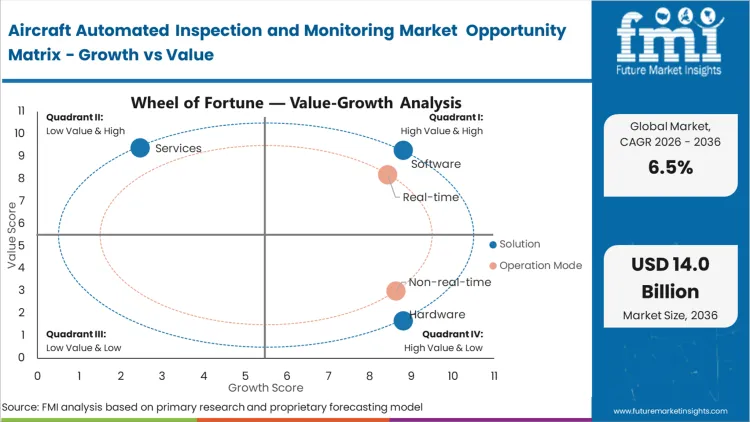
- Software: Software is expected to hold 42.0% share in 2026, as the value of automated inspection increasingly resides in the AI algorithms that interpret complex sensor data.
- Real-time: Real-time operation mode is anticipated to dominate through the forecast period, reflecting the structural move toward continuous health monitoring during flight.
- Retrofit: Retrofit applications accounts for 58.0% share in 2026, driven by the massive installed base of aging aircraft requiring digital monitoring upgrades.
- China: 4.5% compound growth, sustained by the rapid rollout of high-tech airport infrastructure and a digitally-native fleet.
- Analyst Opinion at FMI
- Rahul Pandita, Principal Analyst, Technology, at FMI, states, "The bottleneck for automated monitoring isn't the drone or the sensor; it is the data cleaning required before an AI can actually make a safety-critical decision that an engineer will sign off on. We are seeing a practitioner paradox where the most advanced sensor suites are often the hardest to certify because they produce more data than legacy airworthiness frameworks are designed to absorb. The real value in the coming decade will be won by those who can bridge the gap between high-fidelity sensor output and the conservative requirements of aviation safety documentation."
- Strategic Implications / Executive Takeaways
- Airline CTOs: Must prioritize data interoperability to ensure automated inspection results can be shared seamlessly across global MRO networks.
- MRO Providers: Should invest in vision-analytics training for their workforce to manage the shift from manual labor to digital oversight.
- OEM Strategy Teams: Face a structural requirement to integrate sensor-ready coatings and embedded SHM systems during the line-fit phase to remain competitive.
- Methodology
- FMI’s methodology leverages a bottom-up fleet analysis combined with primary insights from maintenance directors to capture the rate of digital transition. The approach utilizes procurement specifications as the baseline for forecasting the adoption of aviation test equipment and software.
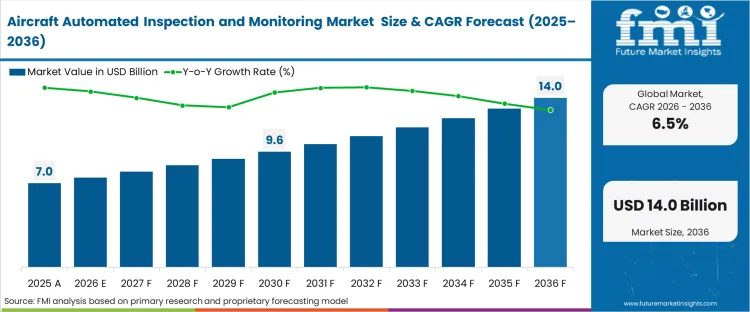
Aircraft Automated Inspection and Monitoring Market Key Takeaways
| Metric | Details |
|---|---|
| Industry Size (2026) | USD 7.42 Billion |
| Industry Value (2036) | USD 13.98 Billion |
| CAGR (2026-2036) | 6.54% |
| Leading Segment | Software (42.0% Share) |
| Dominant Operation Mode | Real-time |
| Dominant Fit Type | Retrofit (58.0% Share) |
Source: Future Market Insights (FMI) analysis, based on proprietary forecasting model and primary research
The structural gate to widespread adoption remains the harmonization of digital logbook standards and regulatory acceptance of automated data as the primary record of airworthiness. Once the FAA and EASA move beyond recognizing automated tools as mere supplements to manual checks, the industry will cross a threshold where manual-only inspection becomes a commercial liability due to insurance premiums and secondary market valuation gaps. Leading airlines trigger this inflection by integrating aviation analytics into their core enterprise resource planning systems, making the self-reporting airframe an operational reality rather than a pilot program.
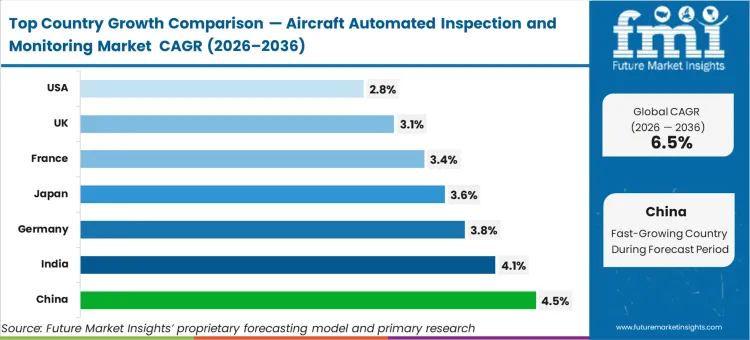
Sales in China are projected to rise at a 4.5% CAGR as massive infrastructure investments in smart airports favor automated over manual labor. The India sector is poised to expand at 4.1% following a rapid fleet expansion that outpaces the growth of certified manual inspection technicians. Germany is anticipated to track a 3.8% CAGR, driven by engineering-led demands for structural health monitoring across aging European airframes. Japan is set to garner a 3.6% CAGR as robotic inspection density increases to offset a shrinking technical workforce. France is likely to register a 3.4% growth rate, anchored by strong OEM participation in automated line-fit solutions. The United Kingdom industry is expected to record 3.1% growth, while the United States market is forecast to register a CAGR of 2.8% over the forecast period. This structural divergence reflects the tension between established legacy maintenance hubs and rapidly scaling emerging aviation networks.
Aircraft Automated Inspection and Monitoring Market Definition
The Aircraft Automated Inspection and Monitoring market encompasses the technologies and services designed to identify structural defects, mechanical wear, and component degradation through autonomous or semi-autonomous means. It distinguishes itself from traditional maintenance through the use of robotic platforms, embedded sensors, and image-analytics software that remove human subjectivity from the inspection loop. The boundary of this market is defined by systems that provide objective, repeatable, and digitally-traceable data regarding the airworthiness of fixed-wing and rotary-wing aircraft.
Aircraft Automated Inspection and Monitoring Market Inclusions
This market includes hardware components such as drones, robotic crawlers, and aircraft sensors designed for permanent or temporary airframe attachment. It further includes specialized software platforms for vision-based defect detection, structural health monitoring algorithms, and digital twin analytics that simulate airframe stress. Services within scope cover the integration of IoT in aviation architectures and the provision of inspection-as-a-service models for regional and global carriers.
Aircraft Automated Inspection and Monitoring Market Exclusions
Exclusions from this market include generic manual inspection tools like borescopes or flashlights that do not provide automated data analysis. It also excludes standard flight control systems and avionics that do not directly contribute to structural or mechanical integrity monitoring. General-purpose cloud storage and basic maintenance management software that lacks specific AI-driven predictive maintenance or image-analytics capabilities are also considered out of scope. Aircraft filters and other consumable components are also excluded unless integrated with active monitoring sensors.
Aircraft Automated Inspection and Monitoring Market Research Methodology
- Primary Research: FMI conducted interviews with Chief Technical Officers at major airlines, MRO hangar directors, and Lead Certification Engineers at Tier-1 aerospace OEMs to determine adoption rates.
- Desk Research: Data was aggregated from airworthiness certification databases, aerospace procurement specification archives, and technical publications from major industry associations.
- Market-Sizing and Forecasting: The baseline anchors to the global active commercial and defense aircraft fleet counts, triangulated against the average annual spend on structural inspection per airframe.
- Data Validation and Update Cycle: Forecasts were cross-validated using independent data streams from independent MRO service providers and satellite tracking of global flight frequency patterns.
Segmental Analysis
Aircraft Automated Inspection and Monitoring Market Analysis by Solution
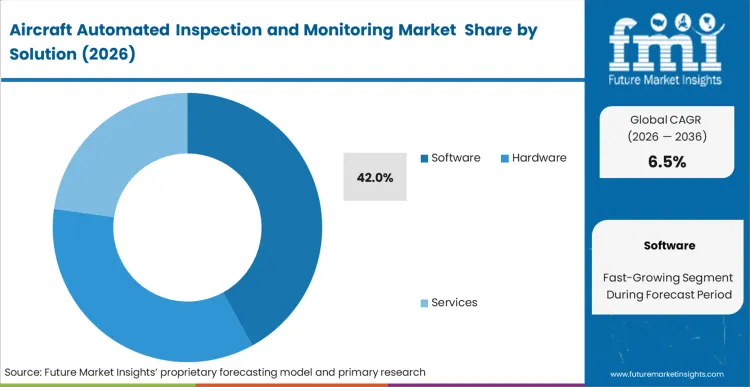
The displacement of manual visual inspection by aviation cloud analytics has shifted the market’s center of gravity toward software solutions. While hardware provides the eyes, the software represents the brain capable of distinguishing a superficial scratch from a structural crack across thousands of frames. Software is expected to capture a 42.0% share in 2026 as FMI analysts opine that the complexity of airframe image processing necessitates significant investment in neural networks. Decision-makers are increasingly choosing platforms that offer seamless integration with existing maintenance logs rather than isolated hardware-software bundles. According to FMI's estimates, the reliance on high-frequency data updates compels airlines to move toward subscription-based software models to ensure their diagnostic algorithms remain current with the latest airframe fatigue models.
- Automated Defect Recognition: AI recognition machine vision alignment systems process gigabytes of airframe imagery to identify corrosion and fatigue with higher repeatability than human eyes. This reduces the time spent in the hangar for routine structural checks.
- Maintenance Digital Twins: Software platforms create a virtual replica of the airframe that tracks cumulative stress and flight cycles to predict component failure. This allows fleet managers to schedule repairs precisely before a part reaches its safety limit.
- Reporting Interoperability: Standardized data formats allow inspection results to be uploaded directly into regulatory compliance databases. This eliminates manual data entry errors that could lead to airworthiness grounding.
Aircraft Automated Inspection and Monitoring Market Analysis by Operation Mode
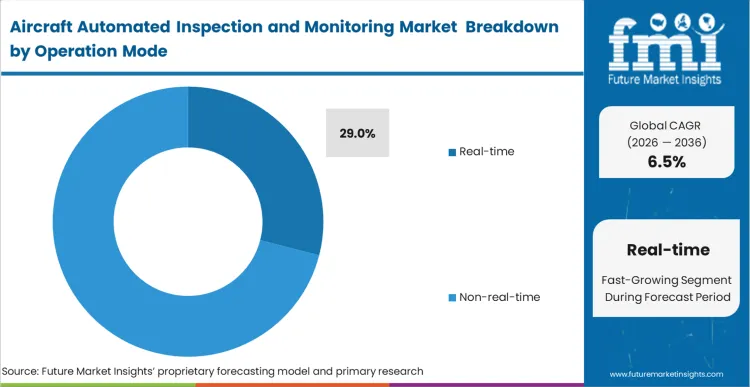
The structural reason real-time operation mode holds its dominant position is the immediate commercial value of detecting anomalies during flight rather than at the gate. Real-time systems provide a continuous stream of flight data monitoring and analysis that allows for immediate pilot notification of structural stress. FMI notes that the cost of an unplanned diversion is so high that the insurance premium reduction for real-time monitoring often pays for the system within two years of operation. Buyers are moving away from non-real-time batch processing because it lacks the prognostic power to prevent in-flight emergencies. The operational consequence of delaying this transition is a reliance on reactive maintenance cycles that cannot keep pace with the high utilization rates of modern narrow-body fleets.
- In-flight Structural Health: Continuous sensor monitoring identifies abnormal vibration or stress patterns during takeoff and landing. This provides flight crews with immediate situational awareness regarding the aircraft's mechanical integrity.
- Wireless Data Telemetry: High-speed data links transmit airframe health metrics to ground-based maintenance teams while the aircraft is in transit. This enables parts and technicians to be staged before the aircraft even lands.
- Dynamic Load Tracking: Systems monitor the actual stress experienced by the airframe rather than relying on estimated cycles. This prevents hidden fatigue from developing in aircraft operating in harsh or variable environments.
Aircraft Automated Inspection and Monitoring Market Analysis by Fit
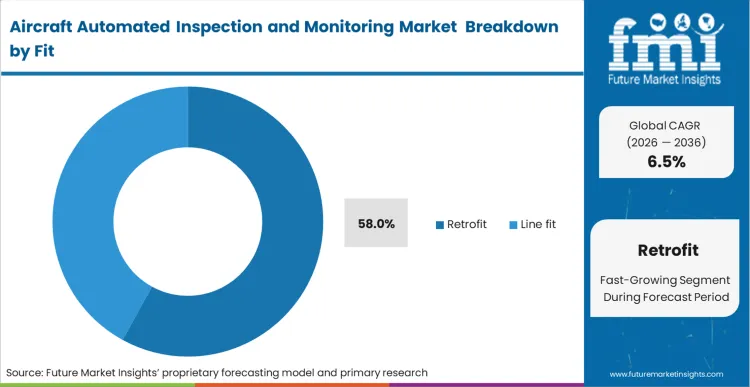
The requirement for fleet managers to choose between line-fit systems on new orders and the immediate need to modernize their existing fleets through aircraft structural health monitoring upgrades. Retrofit applications hold a dominant 58.0% share in 2026 because the average commercial aircraft remains in service for over two decades, far outlasting the current technology cycle. FMI views the retrofit segment as the primary engine of adoption as operators seek to extract more value from their legacy assets. The failure mode for airlines that only rely on line-fit updates is a fragmented maintenance profile where half the fleet is digitally optimized while the other half remains a manual inspection bottleneck. Buyers are finding that the ROI on a retrofit sensor package is often realized through a 15% reduction in annual unscheduled maintenance labor.
- Sensor Attachment Mechanics: Specialized adhesives and thin-film sensors allow for the monitoring of legacy airframes without requiring major structural modifications. This minimizes the downtime required for initial system installation.
- Legacy Systems Integration: Retrofit kits are designed to interface with older avionics architectures using standardized data buses. This allows data from decades-old aircraft to be ingested into modern aviation asset management platforms.
- Qualification Thresholds: Buyers must ensure that retrofit hardware does not interfere with existing signal profiles or aerodynamic properties. Reaching this threshold allows for the rapid scaling of automated monitoring across diverse fleet types.
Aircraft Automated Inspection and Monitoring Market Analysis by End User
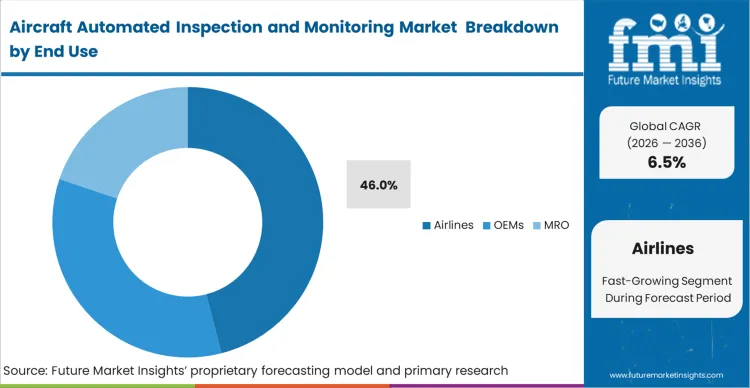
Airlines lead the end-user segment with a 46.0% share because they bear the direct financial burden of aircraft downtime and fuel efficiency losses. The adoption sequence begins with tier-1 global carriers who have the capital to invest in digital maintenance and the scale to realize significant savings. FMI analysts observe that as the technology matures, low-cost carriers and regional operators are following suit to keep their thin margins from being eroded by aging fleet maintenance costs. The consequence of being late to this adoption curve is a widening competitive gap in operational reliability and the inability to participate in modern digital maintenance pooling agreements. As airlines move toward being data-driven organizations, the inspection function is being absorbed into broader operational efficiency strategies rather than being treated as an isolated cost center.
- Operational Reliability: Direct access to automated inspection data allows airlines to achieve higher dispatch reliability rates. This is a critical metric for maintaining slot-sensitive flight schedules in congested hubs.
- Fuel Efficiency Optimization: Monitoring structural health ensures that airframes remain aerodynamically clean and free of unnecessary drag-inducing defects. This results in measurable fuel savings over thousands of flight hours.
- Resale Value Preservation: A verifiable digital history of automated monitoring increases the secondary market value of the airframe. Buyers are willing to pay a premium for aircraft with transparent, sensor-backed maintenance records.
Aircraft Automated Inspection and Monitoring Market Analysis by Platform / Monitoring Focus
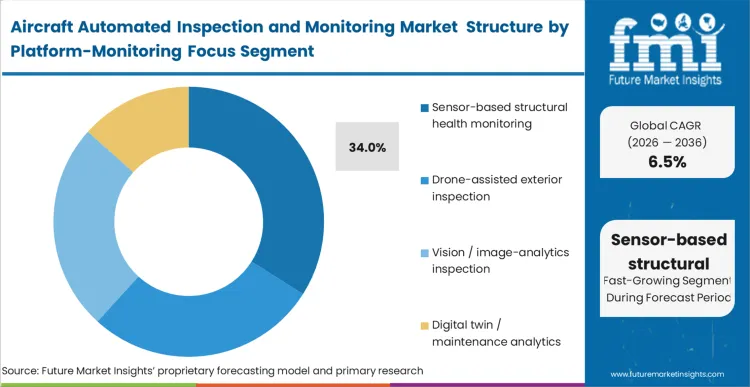
The friction between the rapid deployment of drone inspection and monitoring for exterior surfaces and the deep integration required for sensor-based structural health monitoring defines this segment. While drones offer immediate visual relief, sensor-based SHM holds 34.0% of the market focus due to its ability to see what eyes cannot. FMI projection indicates that the performance gradient is shifting toward embedded systems that can detect sub-surface fatigue or fastener loosening within composite structures. Buyers are realizing that exterior drones are a diagnostic tool, while embedded sensors are a prognostic tool. The operational outcome for practitioners is a shift in focus from "where is the damage" to "when will the damage occur," allowing for the complete optimization of the heavy maintenance calendar.
- Composite Integrity Detection: Embedded sensors monitor the internal layers of carbon-fiber structures for delamination that visual drones cannot see. This is essential for the safety of new-generation aircraft like the 787 or A350.
- Vibration Profile Analysis: Systems analyze the acoustic and vibration signatures of engines and airframes to identify mechanical imbalances. This allows for the detection of bearing wear or turbine blade degradation in real-time.
- Environmental Stress Sensing: Sensors monitor the aircraft's exposure to moisture, salt, and temperature extremes that accelerate corrosion. This enables targeted anti-corrosion treatments rather than blanket, schedule-based applications.
Aircraft Automated Inspection and Monitoring Market Drivers, Restraints, and Opportunities
The primary driver is the structural pressure to reduce the "maintenance per flight hour" ratio as global fleets expand and technical labor pools shrink. Fleet managers are being forced to decide between scaling their workforce at an unsustainable cost or embedding flight tracking system capabilities that provide remote structural oversight. The commercial stakes are high: acting now allows for the consolidation of maintenance hubs and the reduction of regional spares inventory. This is not about marginal gains; it is a structural move to decouple fleet size from maintenance headcount, driven by the increasing complexity of composite-heavy airframes that require more than human visual checks can offer.
The structural restraint is the organizational friction caused by legacy airworthiness certification cycles that remain anchored to manual signatures. While mechanical components are easily monitored, the "system of record" in aviation is inherently conservative. This friction is structural because safety regulators must maintain a standard that works for both a 40-year-old cargo plane and a new-generation jet. A partial solution is emerging through the adoption of digital twin frameworks, but these are currently limited by the lack of global standardization in data certification. Until a "digital signature" is as universally accepted as a physical stamp, automated systems will remain an expensive parallel process rather than a complete replacement for manual labor.
Opportunities in the Aircraft Automated Inspection and Monitoring Market
- Digital Twin Integration: The ability to map real-time aircraft sensor data to a structural digital twin allows airlines to customize maintenance for every individual tail number. Procurement directors capture this by shifting from fleet-wide maintenance contracts to tail-specific performance agreements.
- Hangar-based Robotics: Automated robotic crawlers equipped with radiographic testing services can perform overnight NDT scans without human intervention. MRO facilities can capture this by offering "lights-out" inspection services that maximize hangar utilization.
- Composite Health Monitoring: New coatings such as icephobic nano structured coatings for aircraft leading edges can be integrated with sensors to monitor aerodynamic icing in real-time. Technology developers can capture this by bundling material science with digital monitoring solutions.
Regional Analysis
Based on the regional analysis, the Aircraft Automated Inspection and Monitoring market is segmented into North America, Europe, Asia Pacific, and Rest of the World across 40 plus countries.
.webp "Top Country Growth Comparison Aircraft Automated Inspection And Monitoring Market Cagr (2026 2036)")
| Country | CAGR (2026 to 2036) |
|---|---|
| China | 4.5% |
| India | 4.1% |
| Germany | 3.8% |
| Japan | 3.6% |
| France | 3.4% |
| United Kingdom | 3.1% |
| United States | 2.8% |
Source: Future Market Insights (FMI) analysis, based on proprietary forecasting model and primary research
Asia Pacific Aircraft Automated Inspection and Monitoring Market Analysis
Infrastructure readiness defines the Asia Pacific trajectory, as the region’s younger airport networks are built to accommodate automated flight inspection systems from the ground up. In FMI's view, the lack of legacy maintenance baggage in emerging hubs allows for the rapid deployment of drone-based inspection swarms that would face significant airspace hurdles in older Western airports. The regional dynamic is one of rapid scaling, where the sheer volume of new aircraft deliveries necessitates automation to prevent a massive maintenance backlog.
- China: China's massive investment in "Smart MRO" hubs makes the transition to automated monitoring an economic calculation centered on domestic manufacturing throughput. Airline operators are projected to register a 4.5% CAGR as they integrate automated airframe scans into every 48-hour check cycle. Companies that move first capture preferred supplier status in a rapidly maturing aerospace ecosystem that is unlikely to revert to manual-intensive processes.
- India: The Indian aviation sector faces a unique structural constraint: a massive order book for new aircraft with a comparatively small pool of certified airframe technicians. To bridge this gap, Indian carriers are poised to demonstrate a 4.1% CAGR as they rely on automated monitoring to maintain high daily utilization rates. The trajectory suggests that India will become a global testing ground for cloud-based remote inspection models.
- Japan: Japanese aerospace players operate under a structural reality of a shrinking and aging technical workforce, forcing an early move toward robotic inspection density. The industry is expected to demonstrate a 3.6% CAGR as MRO providers substitute human labor with autonomous crawlers for heavy maintenance checks. Practitioners see this not as a choice, but as a survival mechanism for the domestic maintenance sector.
Europe Aircraft Automated Inspection and Monitoring Market Analysis
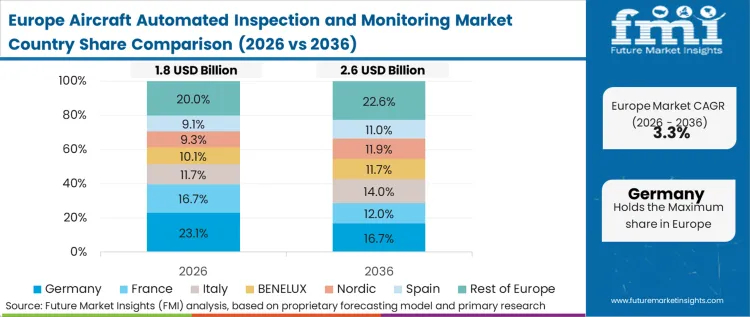
The structural lens for Europe is economics-led, as high labor costs and strict environmental regulations force a move toward commercial aircraft MRO efficiency. FMI analysts note that European carriers are the most aggressive in using automated monitoring to extend the life of aging airframes while maintaining carbon neutrality targets through drag reduction. The region is characterized by deep OEM involvement, where the focus is on integrating SHM systems during the line-fit phase to ensure long-term fleet reliability.
- Germany: Germany's engineering-intensive maintenance sector is moving toward "Prognostics 4.0," where sensor data is used to eliminate redundant manual inspections. The sector is poised for a 3.8% CAGR as major carriers move from schedule-based to outcome-based maintenance contracts. This operational outcome allows for the optimization of spare parts logistics across the entire Lufthansa Technik network.
- France: France remains the heart of European aerostructures, where the structural advantage lies in the direct integration of automated monitoring into the Airbus production line. The market for automated inspection in France is likely to post a CAGR of 3.4% as OEMs seek to offer "digital airworthiness" as a standard feature for new deliveries. This positioning solidifies the country's role as a leader in high-value aerospace technology.
- United Kingdom: UK-based aerospace firms are leveraging their strength in artificial intelligence in aviation to offer remote monitoring services for global fleets. Demand in the United Kingdom is set to grow at a 3.1% CAGR through 2036. This creates a commercial opportunity for UK firms to export maintenance-as-a-service models to regional carriers worldwide.
North America Aircraft Automated Inspection and Monitoring Market Analysis
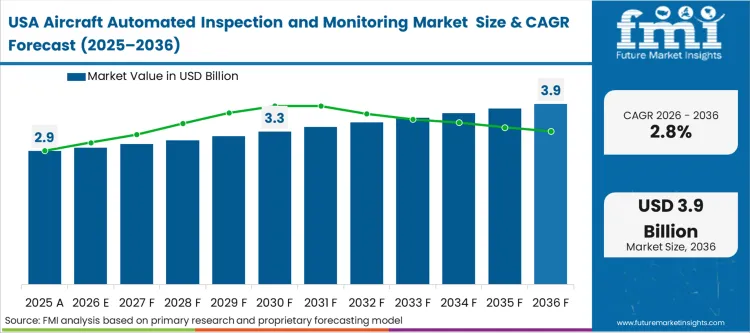
In North America, the market trajectory is policy-led, as the FAA’s evolving stance on digital logbooks and automated inspection data dictates the pace of adoption. FMI analysts observe that the high concentration of major global carriers in the US creates a powerful incentive for the standardization of compliance software. The regional focus is on safety-critical certification and the integration of automated monitoring into the massive North American defense and commercial MRO ecosystem.
- United States: The United States market for automated monitoring is likely to post a CAGR of 2.8% as carriers cycle through their older narrow-body fleets. Fleet managers are under structural pressure to modernize their inspection protocols to keep pace with the digitalization of the global air traffic management system. The operational outcome is a more resilient supply chain that can react to structural issues before they trigger fleet-wide groundings.
Competitive Aligners for Market Players
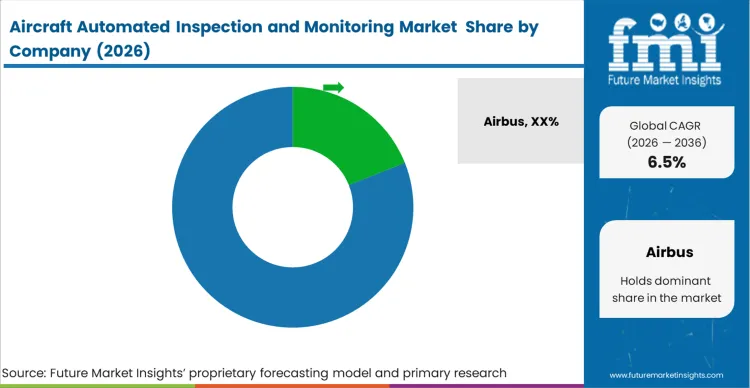
The competitive structure of the Aircraft Automated Inspection and Monitoring market is highly concentrated, driven by the extreme barriers to entry created by aviation safety certification. Buyers distinguish qualified from unqualified vendors based on their ability to integrate with OEM-specific data architectures and their track record with regulatory bodies like the FAA. Leading players such as Airbus, Boeing, and Honeywell Aerospace Technologies maintain their dominance through "architectural lock-in," where their monitoring systems are woven into the aircraft’s core digital fabric. A vendor without a deep partnership with the airframe OEM faces a structural disadvantage, as they cannot access the proprietary stress models required for high-fidelity predictive analytics.
Incumbents in this space hold a structural advantage in the form of massive datasets of historical airframe failure modes, which are essential for training accurate machine learning algorithms. Companies like GE Aerospace and Safran have invested decades in understanding the thermal and mechanical fatigue of engines, a capability that a generalist tech challenger cannot replicate through software alone. To compete, challengers must build specialized vision-analytics capabilities that can operate under hangar-lighting conditions or develop structural health monitoring sensors that meet the strict weight and power constraints of aerospace hardware. This requirement for deep domain expertise ensures that the market remains the domain of established aerospace giants and their specialized technology partners.
Buyer power is gradually increasing as large airlines resist vendor lock-in by demanding open-standard data formats for their maintenance logs. Through 2036, the structural tension between proprietary OEM monitoring ecosystems and airline-driven open data platforms will define the competitive trajectory. FMI predicts the market will remain concentrated but will see a shift toward "maintenance-as-a-service" models, where revenue is derived from uptime guarantees rather than hardware sales. This shifts the incentive for vendors from selling sensors to ensuring the total structural integrity of the fleet, a dynamic that will increasingly favor those with the most advanced cloud-based aviation analytics platforms.
Key Players in Aircraft Automated Inspection and Monitoring Market
- Airbus
- Boeing
- Honeywell Aerospace Technologies
- Collins Aerospace
- GE Aerospace
- Safran
- Lufthansa Technik
- Teradyne
- Testek Solutions
- Donecle
- Mainblades
- ScanReach
Scope of the Report
| Metric | Value |
|---|---|
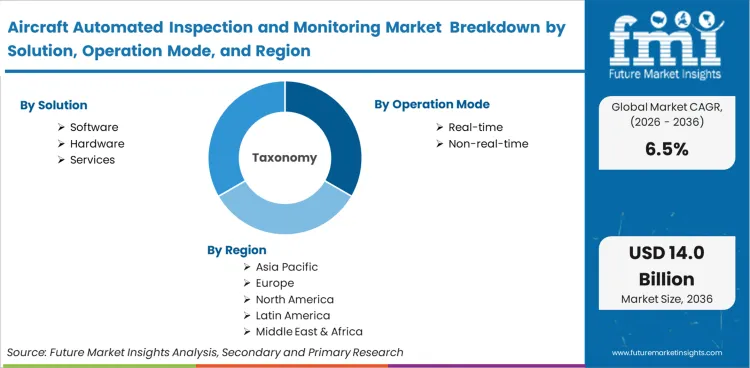
| Quantitative Units | USD 7.42 Billion in 2026 to USD 13.98 Billion in 2036, at a CAGR of 6.54% |
| Market Definition | The deployment of autonomous robotic platforms, embedded sensors, and image-analytics software to identify and monitor airframe and component defects. |
| Solution Segmentation | Hardware, Software, Services |
| Operation Mode Segmentation | Real-time, Non-real-time |
| Fit Segmentation | Line fit, Retrofit |
| End User Segmentation | OEMs, MRO, Airlines |
| Regions Covered | North America, Europe, Asia Pacific, Rest of World |
| Countries Covered | China, India, Germany, Japan, France, United Kingdom, United States, and 40 plus countries |
| Key Companies Profiled | Airbus, Boeing, Honeywell, Collins, GE Aerospace, Safran, Lufthansa Technik |
| Forecast Period | 2026 to 2036 |
Source: Future Market Insights (FMI) analysis, based on proprietary forecasting model and primary research
Aircraft Automated Inspection and Monitoring Market Analysis by Segments
By Solution:
- Software
- Hardware
- Services
By Operation Mode:
- Real-time
- Non-real-time
By Fit:
- Retrofit
- Line fit
By End User:
- Airlines
- OEMs
- MRO
By Platform / Monitoring Focus:
- Drone-assisted exterior inspection
- Sensor-based structural health monitoring
- Vision / image-analytics inspection
- Digital twin / maintenance analytics
By Region:
- North America
- United States
- Europe
- Germany
- France
- United Kingdom
- Asia Pacific
- China
- India
- Japan
Bibliography
- Rodríguez, D. A. (2024, August). Inspection of aircrafts and airports using UAS: A review. Results in Engineering.
- Kosova, F. (2025, January). Structural health monitoring in aviation: A comprehensive review. Journal of Intelligent Material Systems and Structures.
- Ballarin, P. (2025, February). Impact of Structural Health Monitoring on Aircraft Operating Costs by Multidisciplinary Analysis. PMC / MDPI Sensors.
- Federal Aviation Administration (FAA). (2025, December). Advisory Circular AC 43-218: Integrated Aircraft Health Management (IAHM).
- European Union Aviation Safety Agency (EASA). (2026, January). EASA Part-145 Digital Maintenance Compliance Guidelines.
- Airbus. (2025). Skywise: The Open Data Platform for the Aviation Industry. Technical Brochure.
- Honeywell Aerospace. (2025). Honeywell Forge for Airlines: Nose-to-Tail Analytics Platform.
- International Air Transport Association (IATA). (2025). MRO SmartHub: Digitizing Spare Parts Sourcing and Maintenance Insights.
- SAE International. (2021, August). ARP6461A: Guidelines for Implementation of Structural Health Monitoring on Fixed Wing Aircraft.
This bibliography is provided for reader reference and is not exhaustive. The full report contains the complete reference list and detailed citations.
Frequently Asked Questions
What is the current size of the global Aircraft Automated Inspection and Monitoring market?
The industry is valued at USD 6.96 billion in 2025 and is projected to reach USD 7.42 billion in 2026. This valuation reflects the growing integration of digital sensing technologies within both commercial and defense aviation sectors as operators prioritize airworthiness data over manual labor.
What is the projected growth rate for the market through 2036?
The market is expected to expand at a compound annual growth rate (CAGR) of 6.54% between 2026 and 2036. This steady growth is driven by the structural requirement for more granular safety data to manage aging fleets and the increasing complexity of new-generation composite aircraft.
Which segment leads the market by solution type?
Software is the leading segment, projected to account for a 42.0% share in 2026. The shift from "hardware as a sensor" to "software as the brain" means the highest value-add now lies in the AI algorithms that interpret complex image and sensor data into actionable safety decisions.
Why is the retrofit segment larger than the line-fit segment?
Retrofit applications hold a 58.0% share because the vast majority of the global fleet consists of older airframes that were built before automated monitoring became standard. Retrofitting these assets is essential for airlines to maintain operational parity with newer, digitally-native aircraft.
Which region is growing the fastest in the aircraft automated inspection market?
China is leading the growth trajectory with a 4.5% CAGR. This is supported by massive investments in "Smart MRO" hubs and the absence of legacy manual inspection bottlenecks found in older Western aviation markets.
What is the difference between real-time and non-real-time monitoring?
Real-time monitoring provides continuous data streams during flight, allowing for immediate situational awareness, while non-real-time systems capture data during flight for batch processing once the aircraft lands. Real-time is currently the dominant mode as it enables immediate prognostic alerts.
How does automated inspection reduce aircraft downtime?
By eliminating the need for manual visual checks that require extensive dismantling or human access to difficult airframe sections, automated systems can complete routine structural scans in a fraction of the time, often during overnight turnarounds.
What are the main barriers to adopting automated monitoring in aviation?
The primary structural restraint is regulatory certification. While the technology is mature, aviation authorities like the FAA and EASA are still standardizing the "digital sign-off" process that would allow automated data to completely replace manual human inspections.
Which end-user segment has the highest adoption rate?
Airlines are the primary end-users, holding a 46.0% share. They are the most motivated by the financial benefits of reducing unscheduled maintenance and improving dispatch reliability, which directly impacts their daily revenue and operational margins.
How do drones compare to embedded sensors for aircraft inspection?
Drones are highly effective for exterior visual inspections (diagnostic), whereas embedded sensors provide internal structural health data (prognostic). The market focus is shifting toward embedded sensors because they can detect sub-surface fatigue that is invisible to drone cameras.
What is a digital twin in the context of aircraft maintenance?
A digital twin is a virtual replica of a specific aircraft tail number that uses real-time sensor data to track stress and wear. It allows maintenance directors to customize the repair schedule for that specific aircraft rather than following a generic fleet-wide timetable.
Does automated monitoring improve fuel efficiency?
Yes, by ensuring the airframe is perfectly maintained and aerodynamic surfaces are free from subtle defects or drag-inducing damage, automated monitoring helps maintain the aircraft's original design performance, leading to measurable fuel savings.
How is the labor shortage in the MRO industry affecting this market?
The chronic global shortage of certified non-destructive testing (NDT) technicians is a major driver for automation. Airlines are turning to robotic and AI systems to perform routine checks that would otherwise require a large team of specialized human inspectors.
What role does India play in the global market trajectory?
India is poised for a 4.1% CAGR, acting as a critical testing ground for automated monitoring. Due to its massive order books and emerging infrastructure, Indian carriers are "leapfrogging" older manual standards in favor of digital-first maintenance architectures.
Are composite aircraft harder to inspect than aluminum aircraft?
Composite structures like those on the 787 or A350 require specialized inspection because damage is often internal (delamination) and not visible on the surface. This necessitates the use of embedded sensors and advanced ultrasonic automated tools included in this market.
What is the impact of automated monitoring on aircraft resale value?
Aircraft with a continuous, sensor-backed digital maintenance record generally command a higher resale price. The transparency and objective data provide future buyers with higher confidence in the airframe's integrity compared to manual logbooks.
Can automated systems detect corrosion in real-time?
Modern embedded environmental sensors can monitor moisture and salt exposure levels, allowing AI algorithms to predict and detect the early onset of corrosion before it becomes a structural risk, enabling targeted preventative treatments.
Who are the leading companies in this space?
The market is dominated by aerospace giants like Airbus, Boeing, Honeywell, and GE Aerospace, who integrate these systems into their aircraft. Specialized technology firms like Donecle and Mainblades are also key players in the drone and robotics sub-segments.
How do insurance companies view automated aircraft monitoring?
Insurers are increasingly favoring automated monitoring as it provides a verifiable trail of safety data. This often results in lower insurance premiums for operators who can prove they use real-time structural health monitoring to prevent catastrophic failures.
What will the Aircraft Automated Inspection market look like in 2036?
By 2036, the market is expected to reach USD 13.98 billion, characterized by a complete transition to "maintenance-as-a-service." In this future, the aircraft will be largely self-diagnostic, with automated systems managing the entire airworthiness lifecycle with minimal human intervention.
Preview the report firsthand - request a free sample
Get SampleGet the brochure for pricing and purchase details.
Get PDFTable of Content
- Executive Summary
- Global Market Outlook
- Demand-side Trends
- Supply-side Trends
- Technology Roadmap Analysis
- Analysis and Recommendations
- Market Overview
- Market Coverage / Taxonomy
- Market Definition / Scope / Limitations
- Research Methodology
- Chapter Orientation
- Analytical Lens and Working Hypotheses
- Market Structure, Signals, and Trend Drivers
- Benchmarking and Cross-market Comparability
- Market Sizing, Forecasting, and Opportunity Mapping
- Research Design and Evidence Framework
- Desk Research Programme (Secondary Evidence)
- Company Annual and Sustainability Reports
- Peer-reviewed Journals and Academic Literature
- Corporate Websites, Product Literature, and Technical Notes
- Earnings Decks and Investor Briefings
- Statutory Filings and Regulatory Disclosures
- Technical White Papers and Standards Notes
- Trade Journals, Industry Magazines, and Analyst Briefs
- Conference Proceedings, Webinars, and Seminar Materials
- Government Statistics Portals and Public Data Releases
- Press Releases and Reputable Media Coverage
- Specialist Newsletters and Curated Briefings
- Sector Databases and Reference Repositories
- FMI Internal Proprietary Databases and Historical Market Datasets
- Subscription Datasets and Paid Sources
- Social Channels, Communities, and Digital Listening Inputs
- Additional Desk Sources
- Expert Input and Fieldwork (Primary Evidence)
- Primary Modes
- Qualitative Interviews and Expert Elicitation
- Quantitative Surveys and Structured Data Capture
- Blended Approach
- Why Primary Evidence is Used
- Field Techniques
- Interviews
- Surveys
- Focus Groups
- Observational and In-context Research
- Social and Community Interactions
- Stakeholder Universe Engaged
- C-suite Leaders
- Board Members
- Presidents and Vice Presidents
- R&D and Innovation Heads
- Technical Specialists
- Domain Subject-matter Experts
- Scientists
- Physicians and Other Healthcare Professionals
- Governance, Ethics, and Data Stewardship
- Research Ethics
- Data Integrity and Handling
- Primary Modes
- Tooling, Models, and Reference Databases
- Desk Research Programme (Secondary Evidence)
- Data Engineering and Model Build
- Data Acquisition and Ingestion
- Cleaning, Normalisation, and Verification
- Synthesis, Triangulation, and Analysis
- Quality Assurance and Audit Trail
- Market Background
- Market Dynamics
- Drivers
- Restraints
- Opportunity
- Trends
- Scenario Forecast
- Demand in Optimistic Scenario
- Demand in Likely Scenario
- Demand in Conservative Scenario
- Opportunity Map Analysis
- Product Life Cycle Analysis
- Supply Chain Analysis
- Investment Feasibility Matrix
- Value Chain Analysis
- PESTLE and Porter’s Analysis
- Regulatory Landscape
- Regional Parent Market Outlook
- Production and Consumption Statistics
- Import and Export Statistics
- Market Dynamics
- Global Market Analysis 2021 to 2025 and Forecast, 2026 to 2036
- Historical Market Size Value (USD Million) Analysis, 2021 to 2025
- Current and Future Market Size Value (USD Million) Projections, 2026 to 2036
- Y-o-Y Growth Trend Analysis
- Absolute $ Opportunity Analysis
- Global Market Pricing Analysis 2021 to 2025 and Forecast 2026 to 2036
- Global Market Analysis 2021 to 2025 and Forecast 2026 to 2036, By Solution
- Introduction / Key Findings
- Historical Market Size Value (USD Million) Analysis By Solution , 2021 to 2025
- Current and Future Market Size Value (USD Million) Analysis and Forecast By Solution , 2026 to 2036
- Software
- Hardware
- Services
- Software
- Y-o-Y Growth Trend Analysis By Solution , 2021 to 2025
- Absolute $ Opportunity Analysis By Solution , 2026 to 2036
- Global Market Analysis 2021 to 2025 and Forecast 2026 to 2036, By Operation Mode
- Introduction / Key Findings
- Historical Market Size Value (USD Million) Analysis By Operation Mode, 2021 to 2025
- Current and Future Market Size Value (USD Million) Analysis and Forecast By Operation Mode, 2026 to 2036
- Real-time
- Non-real-time
- Real-time
- Y-o-Y Growth Trend Analysis By Operation Mode, 2021 to 2025
- Absolute $ Opportunity Analysis By Operation Mode, 2026 to 2036
- Global Market Analysis 2021 to 2025 and Forecast 2026 to 2036, By Fit
- Introduction / Key Findings
- Historical Market Size Value (USD Million) Analysis By Fit, 2021 to 2025
- Current and Future Market Size Value (USD Million) Analysis and Forecast By Fit, 2026 to 2036
- Retrofit
- Line fit
- Retrofit
- Y-o-Y Growth Trend Analysis By Fit, 2021 to 2025
- Absolute $ Opportunity Analysis By Fit, 2026 to 2036
- Global Market Analysis 2021 to 2025 and Forecast 2026 to 2036, By End Use
- Introduction / Key Findings
- Historical Market Size Value (USD Million) Analysis By End Use, 2021 to 2025
- Current and Future Market Size Value (USD Million) Analysis and Forecast By End Use, 2026 to 2036
- Airlines
- OEMs
- MRO
- Airlines
- Y-o-Y Growth Trend Analysis By End Use, 2021 to 2025
- Absolute $ Opportunity Analysis By End Use, 2026 to 2036
- Global Market Analysis 2021 to 2025 and Forecast 2026 to 2036, By Platform / Monitoring Focus
- Introduction / Key Findings
- Historical Market Size Value (USD Million) Analysis By Platform / Monitoring Focus, 2021 to 2025
- Current and Future Market Size Value (USD Million) Analysis and Forecast By Platform / Monitoring Focus, 2026 to 2036
- Sensor-based structural health monitoring
- Drone-assisted exterior inspection
- Vision / image-analytics inspection
- Digital twin / maintenance analytics
- Sensor-based structural health monitoring
- Y-o-Y Growth Trend Analysis By Platform / Monitoring Focus, 2021 to 2025
- Absolute $ Opportunity Analysis By Platform / Monitoring Focus, 2026 to 2036
- Global Market Analysis 2021 to 2025 and Forecast 2026 to 2036, By Region
- Introduction
- Historical Market Size Value (USD Million) Analysis By Region, 2021 to 2025
- Current Market Size Value (USD Million) Analysis and Forecast By Region, 2026 to 2036
- North America
- Latin America
- Western Europe
- Eastern Europe
- East Asia
- South Asia and Pacific
- Middle East & Africa
- Market Attractiveness Analysis By Region
- North America Market Analysis 2021 to 2025 and Forecast 2026 to 2036, By Country
- Historical Market Size Value (USD Million) Trend Analysis By Market Taxonomy, 2021 to 2025
- Market Size Value (USD Million) Forecast By Market Taxonomy, 2026 to 2036
- By Country
- USA
- Canada
- Mexico
- By Solution
- By Operation Mode
- By Fit
- By End Use
- By Platform / Monitoring Focus
- By Country
- Market Attractiveness Analysis
- By Country
- By Solution
- By Operation Mode
- By Fit
- By End Use
- By Platform / Monitoring Focus
- Key Takeaways
- Latin America Market Analysis 2021 to 2025 and Forecast 2026 to 2036, By Country
- Historical Market Size Value (USD Million) Trend Analysis By Market Taxonomy, 2021 to 2025
- Market Size Value (USD Million) Forecast By Market Taxonomy, 2026 to 2036
- By Country
- Brazil
- Chile
- Rest of Latin America
- By Solution
- By Operation Mode
- By Fit
- By End Use
- By Platform / Monitoring Focus
- By Country
- Market Attractiveness Analysis
- By Country
- By Solution
- By Operation Mode
- By Fit
- By End Use
- By Platform / Monitoring Focus
- Key Takeaways
- Western Europe Market Analysis 2021 to 2025 and Forecast 2026 to 2036, By Country
- Historical Market Size Value (USD Million) Trend Analysis By Market Taxonomy, 2021 to 2025
- Market Size Value (USD Million) Forecast By Market Taxonomy, 2026 to 2036
- By Country
- Germany
- UK
- Italy
- Spain
- France
- Nordic
- BENELUX
- Rest of Western Europe
- By Solution
- By Operation Mode
- By Fit
- By End Use
- By Platform / Monitoring Focus
- By Country
- Market Attractiveness Analysis
- By Country
- By Solution
- By Operation Mode
- By Fit
- By End Use
- By Platform / Monitoring Focus
- Key Takeaways
- Eastern Europe Market Analysis 2021 to 2025 and Forecast 2026 to 2036, By Country
- Historical Market Size Value (USD Million) Trend Analysis By Market Taxonomy, 2021 to 2025
- Market Size Value (USD Million) Forecast By Market Taxonomy, 2026 to 2036
- By Country
- Russia
- Poland
- Hungary
- Balkan & Baltic
- Rest of Eastern Europe
- By Solution
- By Operation Mode
- By Fit
- By End Use
- By Platform / Monitoring Focus
- By Country
- Market Attractiveness Analysis
- By Country
- By Solution
- By Operation Mode
- By Fit
- By End Use
- By Platform / Monitoring Focus
- Key Takeaways
- East Asia Market Analysis 2021 to 2025 and Forecast 2026 to 2036, By Country
- Historical Market Size Value (USD Million) Trend Analysis By Market Taxonomy, 2021 to 2025
- Market Size Value (USD Million) Forecast By Market Taxonomy, 2026 to 2036
- By Country
- China
- Japan
- South Korea
- By Solution
- By Operation Mode
- By Fit
- By End Use
- By Platform / Monitoring Focus
- By Country
- Market Attractiveness Analysis
- By Country
- By Solution
- By Operation Mode
- By Fit
- By End Use
- By Platform / Monitoring Focus
- Key Takeaways
- South Asia and Pacific Market Analysis 2021 to 2025 and Forecast 2026 to 2036, By Country
- Historical Market Size Value (USD Million) Trend Analysis By Market Taxonomy, 2021 to 2025
- Market Size Value (USD Million) Forecast By Market Taxonomy, 2026 to 2036
- By Country
- India
- ASEAN
- Australia & New Zealand
- Rest of South Asia and Pacific
- By Solution
- By Operation Mode
- By Fit
- By End Use
- By Platform / Monitoring Focus
- By Country
- Market Attractiveness Analysis
- By Country
- By Solution
- By Operation Mode
- By Fit
- By End Use
- By Platform / Monitoring Focus
- Key Takeaways
- Middle East & Africa Market Analysis 2021 to 2025 and Forecast 2026 to 2036, By Country
- Historical Market Size Value (USD Million) Trend Analysis By Market Taxonomy, 2021 to 2025
- Market Size Value (USD Million) Forecast By Market Taxonomy, 2026 to 2036
- By Country
- Kingdom of Saudi Arabia
- Other GCC Countries
- Turkiye
- South Africa
- Other African Union
- Rest of Middle East & Africa
- By Solution
- By Operation Mode
- By Fit
- By End Use
- By Platform / Monitoring Focus
- By Country
- Market Attractiveness Analysis
- By Country
- By Solution
- By Operation Mode
- By Fit
- By End Use
- By Platform / Monitoring Focus
- Key Takeaways
- Key Countries Market Analysis
- USA
- Pricing Analysis
- Market Share Analysis, 2025
- By Solution
- By Operation Mode
- By Fit
- By End Use
- By Platform / Monitoring Focus
- Canada
- Pricing Analysis
- Market Share Analysis, 2025
- By Solution
- By Operation Mode
- By Fit
- By End Use
- By Platform / Monitoring Focus
- Mexico
- Pricing Analysis
- Market Share Analysis, 2025
- By Solution
- By Operation Mode
- By Fit
- By End Use
- By Platform / Monitoring Focus
- Brazil
- Pricing Analysis
- Market Share Analysis, 2025
- By Solution
- By Operation Mode
- By Fit
- By End Use
- By Platform / Monitoring Focus
- Chile
- Pricing Analysis
- Market Share Analysis, 2025
- By Solution
- By Operation Mode
- By Fit
- By End Use
- By Platform / Monitoring Focus
- Germany
- Pricing Analysis
- Market Share Analysis, 2025
- By Solution
- By Operation Mode
- By Fit
- By End Use
- By Platform / Monitoring Focus
- UK
- Pricing Analysis
- Market Share Analysis, 2025
- By Solution
- By Operation Mode
- By Fit
- By End Use
- By Platform / Monitoring Focus
- Italy
- Pricing Analysis
- Market Share Analysis, 2025
- By Solution
- By Operation Mode
- By Fit
- By End Use
- By Platform / Monitoring Focus
- Spain
- Pricing Analysis
- Market Share Analysis, 2025
- By Solution
- By Operation Mode
- By Fit
- By End Use
- By Platform / Monitoring Focus
- France
- Pricing Analysis
- Market Share Analysis, 2025
- By Solution
- By Operation Mode
- By Fit
- By End Use
- By Platform / Monitoring Focus
- India
- Pricing Analysis
- Market Share Analysis, 2025
- By Solution
- By Operation Mode
- By Fit
- By End Use
- By Platform / Monitoring Focus
- ASEAN
- Pricing Analysis
- Market Share Analysis, 2025
- By Solution
- By Operation Mode
- By Fit
- By End Use
- By Platform / Monitoring Focus
- Australia & New Zealand
- Pricing Analysis
- Market Share Analysis, 2025
- By Solution
- By Operation Mode
- By Fit
- By End Use
- By Platform / Monitoring Focus
- China
- Pricing Analysis
- Market Share Analysis, 2025
- By Solution
- By Operation Mode
- By Fit
- By End Use
- By Platform / Monitoring Focus
- Japan
- Pricing Analysis
- Market Share Analysis, 2025
- By Solution
- By Operation Mode
- By Fit
- By End Use
- By Platform / Monitoring Focus
- South Korea
- Pricing Analysis
- Market Share Analysis, 2025
- By Solution
- By Operation Mode
- By Fit
- By End Use
- By Platform / Monitoring Focus
- Russia
- Pricing Analysis
- Market Share Analysis, 2025
- By Solution
- By Operation Mode
- By Fit
- By End Use
- By Platform / Monitoring Focus
- Poland
- Pricing Analysis
- Market Share Analysis, 2025
- By Solution
- By Operation Mode
- By Fit
- By End Use
- By Platform / Monitoring Focus
- Hungary
- Pricing Analysis
- Market Share Analysis, 2025
- By Solution
- By Operation Mode
- By Fit
- By End Use
- By Platform / Monitoring Focus
- Kingdom of Saudi Arabia
- Pricing Analysis
- Market Share Analysis, 2025
- By Solution
- By Operation Mode
- By Fit
- By End Use
- By Platform / Monitoring Focus
- Turkiye
- Pricing Analysis
- Market Share Analysis, 2025
- By Solution
- By Operation Mode
- By Fit
- By End Use
- By Platform / Monitoring Focus
- South Africa
- Pricing Analysis
- Market Share Analysis, 2025
- By Solution
- By Operation Mode
- By Fit
- By End Use
- By Platform / Monitoring Focus
- USA
- Market Structure Analysis
- Competition Dashboard
- Competition Benchmarking
- Market Share Analysis of Top Players
- By Regional
- By Solution
- By Operation Mode
- By Fit
- By End Use
- By Platform / Monitoring Focus
- Competition Analysis
- Competition Deep Dive
- Airbus
- Overview
- Product Portfolio
- Profitability by Market Segments (Product/Age /Sales Channel/Region)
- Sales Footprint
- Strategy Overview
- Marketing Strategy
- Product Strategy
- Channel Strategy
- Boeing
- Honeywell Aerospace Technologies
- Collins Aerospace
- GE Aerospace
- Safran
- Lufthansa Technik
- Teradyne
- Testek Solutions
- Donecle
- Mainblades
- ScanReach
- Airbus
- Competition Deep Dive
- Assumptions & Acronyms Used


