

- Industry Size (2026)
- USD 1.9 Bn
- Forecast (2036)
- USD 3.6 Bn
- CAGR (2026 to 2036)
- 6.70%
Radiographic Testing Services Market Forecast and Outlook 2026 to 2036
The global radiographic testing services market is projected to grow from USD 1.9 billion in 2026 to USD 3.6 billion by 2036, reflecting a CAGR of 6.70%. This market is being driven by the increasing demand for non-destructive testing (NDT) solutions across industries such as aerospace, automotive, manufacturing, oil and gas, and construction. Radiographic testing (RT) utilizes X-rays or gamma rays to inspect the internal structure of materials, helping to identify flaws without damaging the material.
With a growing focus on safety, product quality, and regulatory compliance, radiographic testing has become a critical tool for industries to ensure their products and components meet stringent standards. Technological innovations such as digital radiography (DR) and computed tomography (CT) are further enhancing the market by providing more accurate, efficient, and cost-effective inspection solutions. As the demand for precise and reliable testing services continues to grow, the radiographic testing services market is poised for significant expansion over the next decade.
Quick Stats for Radiographic Testing Services Market
- Radiographic Testing Services Market Value (2026): USD 1.9 Billion
- Radiographic Testing Services Market Forecast Value (2036): USD 3.6 Billion
- Radiographic Testing Services Market Forecast CAGR 2026 to 2036: 6.70%
- Leading Inspection Setting in Radiographic Testing Services Market: Field or On-Site
- Key Growth Regions in Radiographic Testing Services Market: Asia Pacific, North America, Europe
- Top Key Players in Radiographic Testing Services Market: SGS, Intertek, Bureau Veritas, Applus+, TÜV Rheinland
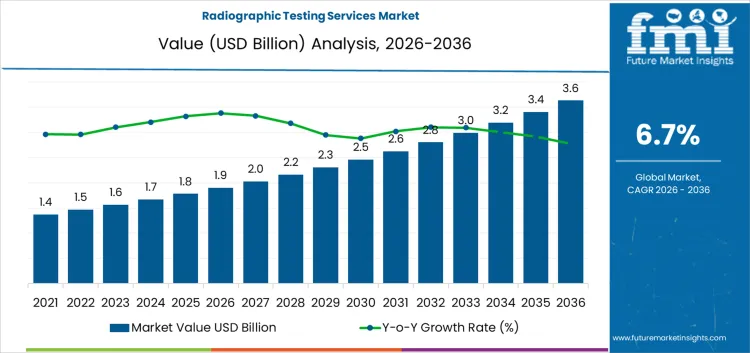
Radiographic Testing Services Market Key Takeaways
| Metric | Value |
|---|---|
| Industry Value (2026) | USD 1.9 Billion |
| Forecast Value (2036) | USD 3.6 Billion |
| Forecast CAGR 2026 to 2036 | 6.70% |
How is the Global Radiographic Testing Services Market Advancing?
The global radiographic testing services market is experiencing steady growth, driven by the increasing demand for non-destructive testing (NDT) solutions across industries such as aerospace, automotive, manufacturing, oil and gas, and construction. Radiographic testing (RT) uses X-rays or gamma rays to inspect the internal structure of materials, identifying flaws such as cracks, voids, and weld defects without causing any damage to the material. As industries continue to prioritize safety, quality, and reliability, radiographic testing has become a critical tool in ensuring that products and components meet stringent industry standards.
A major driver of this market is the increasing focus on safety and the need to comply with regulatory standards for material integrity and product quality. Radiographic testing is widely used to assess the structural integrity of components and materials, especially in high-risk industries such as aerospace and oil and gas, where failures can have catastrophic consequences. With rising safety standards and regulatory pressures, businesses are increasingly investing in advanced radiographic testing services to ensure their products meet quality benchmarks and avoid costly recalls or accidents.
Technological advancements in radiographic testing, such as digital radiography (DR) and computed tomography (CT), are contributing to the market’s growth by providing faster, more accurate, and cost-effective inspection solutions. These innovations allow for higher resolution imaging, real-time analysis, and improved detection of internal defects. As industries continue to demand more efficient and precise testing solutions, the radiographic testing services market is expected to expand steadily, providing critical support in quality assurance and regulatory compliance across multiple sectors.
What Is the Segment-Wise Analysis for the Radiographic Testing Services Market?
The radiographic testing services market is segmented by inspection setting and end user. Field or on-site inspection leads the inspection setting segment with a 54% share, followed by lab-based inspections, manufacturing line inspections, and other settings. On-site inspections are preferred for their flexibility and ability to quickly assess materials and structures in the field. In terms of end users, asset owners hold the largest share at 34%, followed by EPC (Engineering, Procurement, and Construction) contractors, manufacturers, and regulators or other. The growing need for non-destructive testing and quality assurance across industries is driving the demand for radiographic testing services in these sectors.
Why Does Field or On-Site Inspection Lead the Radiographic Testing Services Market?
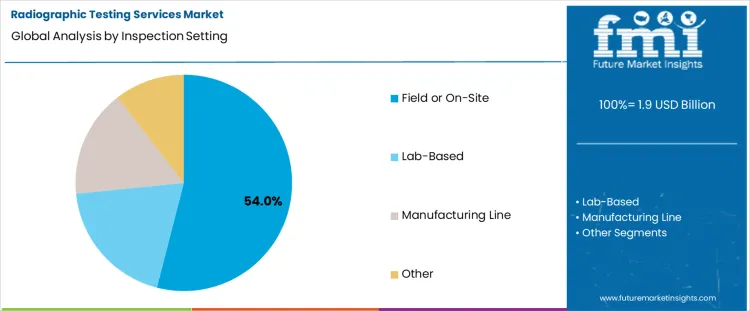
Field or on-site inspection leads the radiographic testing services market with a 54% share due to its flexibility and ability to assess the integrity of materials and components directly in their working environment. This inspection setting is crucial for industries like oil and gas, construction, and power generation, where equipment and infrastructure need to be inspected in place without disassembly. On-site inspections offer faster turnaround times and cost efficiencies compared to sending materials to a lab for testing. As industries increasingly focus on minimizing downtime and maintaining operational efficiency, field or on-site radiographic testing services continue to dominate the market.
How Do Asset Owners Contribute to the Radiographic Testing Services Market?
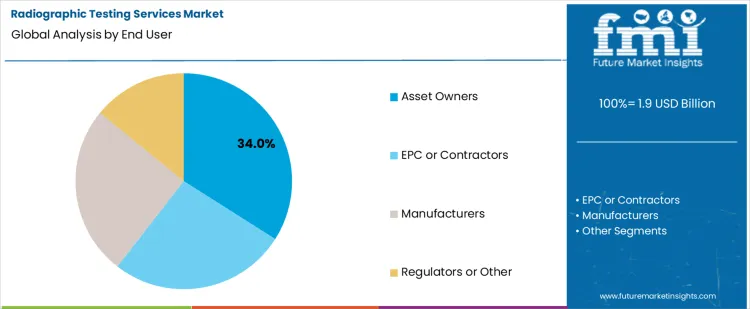
Asset owners account for 34% of the end-user segment in the radiographic testing services market. These include companies or organizations that own infrastructure, machinery, or equipment and need regular inspections to ensure their assets are functioning safely and efficiently. Asset owners, particularly in industries such as oil and gas, power generation, and manufacturing, rely on radiographic testing to detect faults, corrosion, or structural weaknesses in critical assets. Regular inspections help asset owners meet safety regulations, extend asset life, and reduce the risk of unplanned failures. As safety and operational efficiency remain top priorities, asset owners continue to drive the demand for radiographic testing services.
What Are the Key Dynamics for the Radiographic Testing Services Market?
The radiographic testing services market is driven by the growing demand for non-destructive testing (NDT) solutions in various industries, including aerospace, automotive, manufacturing, and construction. Radiographic testing (RT) uses X-rays or gamma rays to inspect the internal structure of materials without damaging them. The market is expanding due to the increasing emphasis on product safety, quality assurance, and regulatory compliance. As industries face the need to detect internal flaws, cracks, or defects in critical components, the demand for radiographic testing services continues to rise, particularly in sectors requiring high levels of material integrity and performance.
How Are the Key Drivers Shaping the Radiographic Testing Services Market?
The key drivers of the Radiographic Testing Services Market include the growing adoption of advanced inspection technologies in industries such as aerospace, automotive, and oil & gas, where safety and compliance are critical. Increasing regulatory pressure to ensure the safety and reliability of critical components is fueling the demand for radiographic testing. The need for accurate, non-invasive inspection of complex materials and components, especially in high-stakes industries, is driving market growth. The ability of radiographic testing to provide detailed internal images of materials, leading to early defect detection, also enhances its appeal for quality control and maintenance purposes.
What Are the Restraints Impacting the Radiographic Testing Services Market?
The radiographic testing services market faces several challenges, including the high cost associated with radiographic testing, particularly in industries with budget constraints. The need for specialized equipment, skilled technicians, and adherence to strict safety regulations increases the operational costs of these services. Radiographic testing can sometimes be limited in its application, particularly when inspecting materials with high density or thick walls, which may require longer exposure times or specialized equipment. Environmental and health concerns related to the use of radiation also pose challenges in terms of safety compliance and public perception, particularly in areas with strict environmental regulations.
What is the Growth Outlook for the Radiographic Testing Services Market by Country?
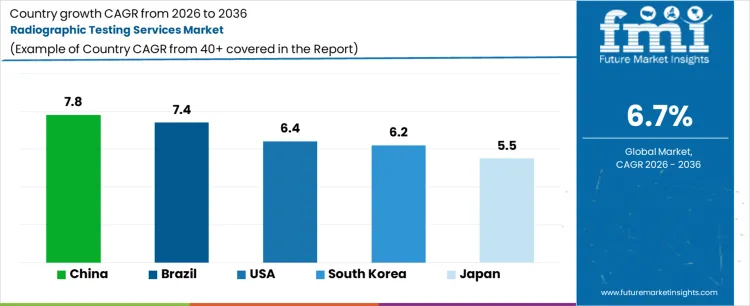
| Country | CAGR (%) |
|---|---|
| China | 7.8% |
| Brazil | 7.4% |
| USA | 6.4% |
| South Korea | 6.2% |
| Japan | 5.5% |
The radiographic testing services market is growing across key regions, with China leading at 7.8%, driven by the rapid expansion of industrial sectors such as manufacturing, construction, and automotive. Brazil follows at 7.4%, supported by its increasing demand for high-quality testing solutions across its industrial base. The USA grows at 6.4%, driven by stringent regulatory requirements and the need for reliable inspection solutions in sectors like aerospace, energy, and construction. South Korea’s market expands at 6.2%, fueled by innovation and industrial demand for accurate testing services. Japan grows at 5.5%, supported by its commitment to quality control and safety in industrial applications.
What is Driving the Growth of the Radiographic Testing Services Market in China?
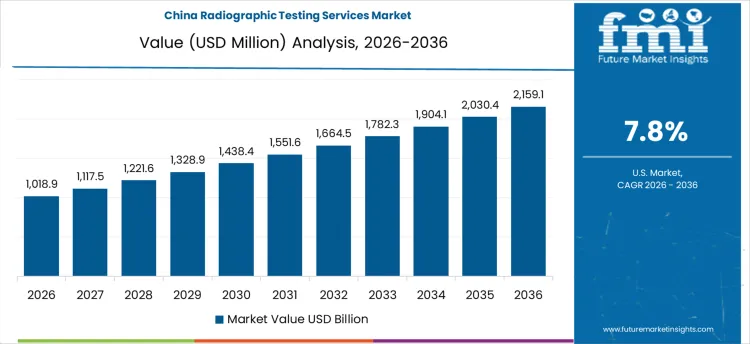
China’s radiographic testing services market is growing at 7.8%, driven by rapid industrialization, particularly in the manufacturing, automotive, and construction sectors. The demand for high-quality, reliable testing services to ensure the safety and performance of critical infrastructure and machinery is on the rise. As China continues to modernize its industrial operations, there is an increasing focus on quality control and adherence to international standards, particularly in sectors like energy, manufacturing, and transportation. China’s push toward high-tech manufacturing and sustainable infrastructure development is driving the adoption of advanced inspection and testing services, including radiographic testing. The government's emphasis on safety regulations and environmental standards also supports the demand for these testing services. As industries continue to expand and innovate, the radiographic testing market in China is expected to grow steadily.
How is the Radiographic Testing Services Market Expanding in Brazil?
Brazil’s radiographic testing services market is growing at 7.4%, fueled by the country’s growing demand for high-performance, reliable testing solutions in the automotive, aerospace, and energy sectors. As Brazil’s industrial base expands and modernizes, there is increasing reliance on radiographic testing to ensure that critical components and systems meet quality, safety, and regulatory standards. The rising demand for energy infrastructure and industrial equipment, particularly in oil and gas, is further contributing to market growth. Brazil’s focus on improving the safety and efficiency of its manufacturing and construction industries is driving the need for advanced inspection and testing services. As the country continues to prioritize safety and quality in its industrial operations, the radiographic testing services market is expected to maintain steady growth, supporting the adoption of innovative technologies.
How is the Radiographic Testing Services Market Expanding in the USA?
The radiographic testing services market in the USA is growing at 6.4%, driven by strict regulations across industries such as aerospace, energy, automotive, and construction. The increasing need for safety, compliance, and reliability in these sectors is pushing the demand for advanced testing solutions like radiographic inspection. As the U.S. industrial sector embraces higher performance standards and seeks to improve operational efficiency, the need for thorough inspection methods to detect defects, cracks, or weaknesses in materials and structures has grown. The focus on maintaining safety standards, particularly in critical industries such as nuclear power and aerospace, continues to fuel the market. The USA’s commitment to innovation and technological advancements in testing methodologies ensures ongoing market growth, as industries increasingly prioritize safety and quality control in their operations.
What is Driving the Growth of the Radiographic Testing Services Market in South Korea?
South Korea’s radiographic testing services market is growing at 6.2%, supported by the country’s strong automotive, electronics, and manufacturing sectors. South Korea’s industrial sectors are increasingly adopting advanced testing solutions to ensure the quality and safety of critical components. Radiographic testing is becoming essential in sectors such as automotive manufacturing, aerospace, and energy to detect defects in parts and ensure compliance with international safety standards. South Korea’s commitment to technology and innovation in manufacturing and industrial production is driving the adoption of more sophisticated testing methods. As the demand for high-quality, reliable products grows, particularly in the electronics and automotive sectors, South Korea’s market for radiographic testing services is expected to continue expanding steadily.
How is the Radiographic Testing Services Market Expanding in Japan?
Japan’s radiographic testing services market is growing at 5.5%, driven by the country’s well-established automotive, manufacturing, and electronics sectors. As Japan continues to prioritize quality control, safety, and compliance in its industries, the demand for advanced testing solutions such as radiographic testing is increasing. The country’s automotive sector, which produces high-performance vehicles and parts, relies heavily on radiographic testing to ensure the durability and safety of components. Japan’s commitment to energy infrastructure, particularly in nuclear and renewable energy sectors, is driving the need for non-destructive testing to ensure the integrity of critical systems. As Japan focuses on maintaining high-quality production standards, the radiographic testing market will continue to grow, supporting the need for reliable and effective testing services in various industries.
How Are Companies Competing in the Radiographic Testing Services Market?
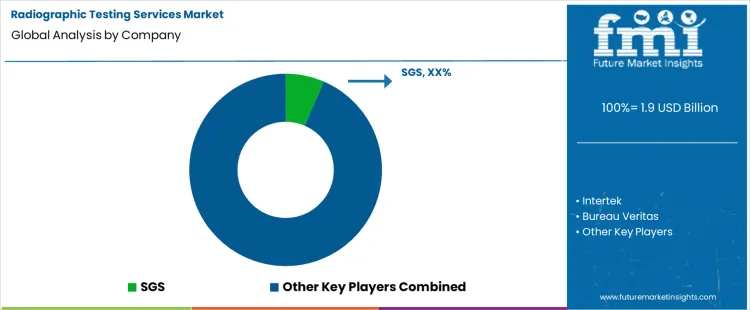
Competition in the Radiographic Testing Services Market is driven by technology sophistication, testing accuracy, compliance with global standards (e.g., ASME, ISO, AWS), turnaround time, and industry-specific expertise. SGS positions its radiographic testing services with a strong global laboratory and field network, emphasizing high-resolution imaging, detailed reporting, and regulatory compliance that help clients in oil & gas, manufacturing, and infrastructure sectors confidently assess welds and critical components. Intertek competes by offering integrated nondestructive testing (NDT) services that combine radiography with complementary methods, marketed for comprehensive asset inspection and quality assurance tailored to client specifications.
Bureau Veritas and Applus+ differentiate through multi-discipline inspection portfolios that include film and digital radiography, phased array alternatives, and remote operations, with materials highlighting certified technicians and consistent methodology across international projects. TÜV Rheinland adds value with industry-aligned NDT programs supported by strong accreditation credentials and experience in sectors where safety and compliance are paramount.
Specialized service providers such as Mistras Group, Acuren, and Element Materials Technology focus on advanced radiographic techniques and rapid deployment teams capable of on-site execution, with collateral emphasizing real-world defect detection, high throughput, and technical consultation support. TEAM, Inc. and NDT Global compete with high-end digital radiographic systems and inspection analytics, marketed for precision detection and data traceability in large-scale industrial environments. Across all players, service materials underscore accuracy, certified procedures, detailed analysis, and rapid reporting as key differentiators that help manufacturers and owners ensure structural integrity and regulatory compliance.
Key Players in Radiographic Testing Services Market
- SGS
- Intertek
- Bureau Veritas
- Applus+
- TÜV Rheinland
- Mistras Group
- Acuren
- TEAM, Inc.
- Element Materials Technology
- NDT Global
Scope of Report
| Attributes | Description |
|---|---|
| Quantitative Unit (2026) | USD Billion |
| Inspection Setting | Field or On-Site, Lab-Based, Manufacturing Line, Other |
| End User | Asset Owners, EPC or Contractors, Manufacturers, Regulators or Other |
| Regions Covered | Asia Pacific, Europe, North America, Latin America, Middle East & Africa |
| Countries Covered | China, Japan, South Korea, India, Australia & New Zealand, ASEAN, Germany, United Kingdom, France, Italy, Spain, Nordic, BENELUX, United States, Canada, Mexico, Brazil, Chile, Turkey, South Africa, Other GCC Countries |
| Key Companies Profiled | SGS, Intertek, Bureau Veritas, Applus+, TÜV Rheinland, Mistras Group, Acuren, TEAM, Inc., Element Materials Technology, NDT Global |
| Additional Attributes | Dollar sales by inspection setting, end user, and region; regional CAGR and growth outlook for the radiographic testing services market. |
Radiographic Testing Services Market by Key Segments
By Inspection Setting:
- Field or On-Site
- Lab-Based
- Manufacturing Line
- Other
By End User:
- Asset Owners
- EPC or Contractors
- Manufacturers
- Regulators or Other
By Region:
- Asia Pacific
- China
- Japan
- South Korea
- India
- Australia & New Zealand
- ASEAN
- Rest of Asia Pacific
- Europe
- Germany
- United Kingdom
- France
- Italy
- Spain
- Nordic
- BENELUX
- Rest of Europe
- North America
- United States
- Canada
- Mexico
- Latin America
- Brazil
- Chile
- Rest of Latin America
- Middle East & Africa
- Kingdom of Saudi Arabia
- Other GCC Countries
- Turkey
- South Africa
- Other African Union
Bibliography
- SGS. (2023). Global laboratory and field network offering high-resolution imaging and regulatory compliance for welds and critical components inspection. SGS SA.
- Intertek. (2023). Integrated nondestructive testing services combining radiography with complementary methods for comprehensive asset inspection. Intertek Group.
- Bureau Veritas. (2023). Multi-discipline inspection portfolios, including film and digital radiography, for international projects in various industries. Bureau Veritas.
Frequently Asked Questions
How big is the radiographic testing services market in 2026?
The global radiographic testing services market is estimated to be valued at USD 1.9 billion in 2026.
What will be the size of radiographic testing services market in 2036?
The market size for the radiographic testing services market is projected to reach USD 3.6 billion by 2036.
How much will be the radiographic testing services market growth between 2026 and 2036?
The radiographic testing services market is expected to grow at a 6.7% CAGR between 2026 and 2036.
What are the key product types in the radiographic testing services market?
The key product types in radiographic testing services market are field or on-site, lab-based, manufacturing line and other.
Which end user segment to contribute significant share in the radiographic testing services market in 2026?
In terms of end user, asset owners segment to command 34.0% share in the radiographic testing services market in 2026.
Preview the report firsthand - request a free sample
Get SampleGet the brochure for pricing and purchase details.
Get PDFTable of Content
- Executive Summary
- Global Market Outlook
- Demand-side Trends
- Supply-side Trends
- Technology Roadmap Analysis
- Analysis and Recommendations
- Market Overview
- Market Coverage / Taxonomy
- Market Definition / Scope / Limitations
- Market Background
- Market Dynamics
- Drivers
- Restraints
- Opportunity
- Trends
- Scenario Forecast
- Demand in Optimistic Scenario
- Demand in Likely Scenario
- Demand in Conservative Scenario
- Opportunity Map Analysis
- Product Life Cycle Analysis
- Supply Chain Analysis
- Investment Feasibility Matrix
- Value Chain Analysis
- PESTLE and Porter’s Analysis
- Regulatory Landscape
- Regional Parent Market Outlook
- Production and Consumption Statistics
- Import and Export Statistics
- Market Dynamics
- Global Market Analysis 2021 to 2025 and Forecast, 2026 to 2036
- Historical Market Size Value (USD Million) Analysis, 2021 to 2025
- Current and Future Market Size Value (USD Million) Projections, 2026 to 2036
- Y-o-Y Growth Trend Analysis
- Absolute $ Opportunity Analysis
- Global Market Pricing Analysis 2021 to 2025 and Forecast 2026 to 2036
- Global Market Analysis 2021 to 2025 and Forecast 2026 to 2036, By Inspection Setting
- Introduction / Key Findings
- Historical Market Size Value (USD Million) Analysis By Inspection Setting , 2021 to 2025
- Current and Future Market Size Value (USD Million) Analysis and Forecast By Inspection Setting , 2026 to 2036
- Field or On-Site
- Lab-Based
- Manufacturing Line
- Other
- Field or On-Site
- Y-o-Y Growth Trend Analysis By Inspection Setting , 2021 to 2025
- Absolute $ Opportunity Analysis By Inspection Setting , 2026 to 2036
- Global Market Analysis 2021 to 2025 and Forecast 2026 to 2036, By End User
- Introduction / Key Findings
- Historical Market Size Value (USD Million) Analysis By End User, 2021 to 2025
- Current and Future Market Size Value (USD Million) Analysis and Forecast By End User, 2026 to 2036
- Asset Owners
- EPC or Contractors
- Manufacturers
- Regulators or Other
- Asset Owners
- Y-o-Y Growth Trend Analysis By End User, 2021 to 2025
- Absolute $ Opportunity Analysis By End User, 2026 to 2036
- Global Market Analysis 2021 to 2025 and Forecast 2026 to 2036, By Region
- Introduction
- Historical Market Size Value (USD Million) Analysis By Region, 2021 to 2025
- Current Market Size Value (USD Million) Analysis and Forecast By Region, 2026 to 2036
- North America
- Latin America
- Western Europe
- Eastern Europe
- East Asia
- South Asia and Pacific
- Middle East & Africa
- Market Attractiveness Analysis By Region
- North America Market Analysis 2021 to 2025 and Forecast 2026 to 2036, By Country
- Historical Market Size Value (USD Million) Trend Analysis By Market Taxonomy, 2021 to 2025
- Market Size Value (USD Million) Forecast By Market Taxonomy, 2026 to 2036
- By Country
- USA
- Canada
- Mexico
- By Inspection Setting
- By End User
- By Country
- Market Attractiveness Analysis
- By Country
- By Inspection Setting
- By End User
- Key Takeaways
- Latin America Market Analysis 2021 to 2025 and Forecast 2026 to 2036, By Country
- Historical Market Size Value (USD Million) Trend Analysis By Market Taxonomy, 2021 to 2025
- Market Size Value (USD Million) Forecast By Market Taxonomy, 2026 to 2036
- By Country
- Brazil
- Chile
- Rest of Latin America
- By Inspection Setting
- By End User
- By Country
- Market Attractiveness Analysis
- By Country
- By Inspection Setting
- By End User
- Key Takeaways
- Western Europe Market Analysis 2021 to 2025 and Forecast 2026 to 2036, By Country
- Historical Market Size Value (USD Million) Trend Analysis By Market Taxonomy, 2021 to 2025
- Market Size Value (USD Million) Forecast By Market Taxonomy, 2026 to 2036
- By Country
- Germany
- UK
- Italy
- Spain
- France
- Nordic
- BENELUX
- Rest of Western Europe
- By Inspection Setting
- By End User
- By Country
- Market Attractiveness Analysis
- By Country
- By Inspection Setting
- By End User
- Key Takeaways
- Eastern Europe Market Analysis 2021 to 2025 and Forecast 2026 to 2036, By Country
- Historical Market Size Value (USD Million) Trend Analysis By Market Taxonomy, 2021 to 2025
- Market Size Value (USD Million) Forecast By Market Taxonomy, 2026 to 2036
- By Country
- Russia
- Poland
- Hungary
- Balkan & Baltic
- Rest of Eastern Europe
- By Inspection Setting
- By End User
- By Country
- Market Attractiveness Analysis
- By Country
- By Inspection Setting
- By End User
- Key Takeaways
- East Asia Market Analysis 2021 to 2025 and Forecast 2026 to 2036, By Country
- Historical Market Size Value (USD Million) Trend Analysis By Market Taxonomy, 2021 to 2025
- Market Size Value (USD Million) Forecast By Market Taxonomy, 2026 to 2036
- By Country
- China
- Japan
- South Korea
- By Inspection Setting
- By End User
- By Country
- Market Attractiveness Analysis
- By Country
- By Inspection Setting
- By End User
- Key Takeaways
- South Asia and Pacific Market Analysis 2021 to 2025 and Forecast 2026 to 2036, By Country
- Historical Market Size Value (USD Million) Trend Analysis By Market Taxonomy, 2021 to 2025
- Market Size Value (USD Million) Forecast By Market Taxonomy, 2026 to 2036
- By Country
- India
- ASEAN
- Australia & New Zealand
- Rest of South Asia and Pacific
- By Inspection Setting
- By End User
- By Country
- Market Attractiveness Analysis
- By Country
- By Inspection Setting
- By End User
- Key Takeaways
- Middle East & Africa Market Analysis 2021 to 2025 and Forecast 2026 to 2036, By Country
- Historical Market Size Value (USD Million) Trend Analysis By Market Taxonomy, 2021 to 2025
- Market Size Value (USD Million) Forecast By Market Taxonomy, 2026 to 2036
- By Country
- Kingdom of Saudi Arabia
- Other GCC Countries
- Turkiye
- South Africa
- Other African Union
- Rest of Middle East & Africa
- By Inspection Setting
- By End User
- By Country
- Market Attractiveness Analysis
- By Country
- By Inspection Setting
- By End User
- Key Takeaways
- Key Countries Market Analysis
- USA
- Pricing Analysis
- Market Share Analysis, 2025
- By Inspection Setting
- By End User
- Canada
- Pricing Analysis
- Market Share Analysis, 2025
- By Inspection Setting
- By End User
- Mexico
- Pricing Analysis
- Market Share Analysis, 2025
- By Inspection Setting
- By End User
- Brazil
- Pricing Analysis
- Market Share Analysis, 2025
- By Inspection Setting
- By End User
- Chile
- Pricing Analysis
- Market Share Analysis, 2025
- By Inspection Setting
- By End User
- Germany
- Pricing Analysis
- Market Share Analysis, 2025
- By Inspection Setting
- By End User
- UK
- Pricing Analysis
- Market Share Analysis, 2025
- By Inspection Setting
- By End User
- Italy
- Pricing Analysis
- Market Share Analysis, 2025
- By Inspection Setting
- By End User
- Spain
- Pricing Analysis
- Market Share Analysis, 2025
- By Inspection Setting
- By End User
- France
- Pricing Analysis
- Market Share Analysis, 2025
- By Inspection Setting
- By End User
- India
- Pricing Analysis
- Market Share Analysis, 2025
- By Inspection Setting
- By End User
- ASEAN
- Pricing Analysis
- Market Share Analysis, 2025
- By Inspection Setting
- By End User
- Australia & New Zealand
- Pricing Analysis
- Market Share Analysis, 2025
- By Inspection Setting
- By End User
- China
- Pricing Analysis
- Market Share Analysis, 2025
- By Inspection Setting
- By End User
- Japan
- Pricing Analysis
- Market Share Analysis, 2025
- By Inspection Setting
- By End User
- South Korea
- Pricing Analysis
- Market Share Analysis, 2025
- By Inspection Setting
- By End User
- Russia
- Pricing Analysis
- Market Share Analysis, 2025
- By Inspection Setting
- By End User
- Poland
- Pricing Analysis
- Market Share Analysis, 2025
- By Inspection Setting
- By End User
- Hungary
- Pricing Analysis
- Market Share Analysis, 2025
- By Inspection Setting
- By End User
- Kingdom of Saudi Arabia
- Pricing Analysis
- Market Share Analysis, 2025
- By Inspection Setting
- By End User
- Turkiye
- Pricing Analysis
- Market Share Analysis, 2025
- By Inspection Setting
- By End User
- South Africa
- Pricing Analysis
- Market Share Analysis, 2025
- By Inspection Setting
- By End User
- USA
- Market Structure Analysis
- Competition Dashboard
- Competition Benchmarking
- Market Share Analysis of Top Players
- By Regional
- By Inspection Setting
- By End User
- Competition Analysis
- Competition Deep Dive
- SGS
- Overview
- Product Portfolio
- Profitability by Market Segments (Product/Age /Sales Channel/Region)
- Sales Footprint
- Strategy Overview
- Marketing Strategy
- Product Strategy
- Channel Strategy
- Intertek
- Bureau Veritas
- Applus+
- TÜV Rheinland
- Mistras Group
- Acuren
- TEAM, Inc.
- Element Materials Technology
- NDT Global
- SGS
- Competition Deep Dive
- Assumptions & Acronyms Used
- Research Methodology


