

- Industry Size (2026)
- USD 3.3 Bn
- Forecast (2036)
- USD 6.3 Bn
- CAGR (2026 to 2036)
- 6.60%
Chemical and Contaminant Residue Analysis Testing Services Market Forecast and Outlook 2026 to 2036
The global chemical and contaminant residue analysis testing services market is projected to grow from USD 3.3 billion in 2026 to USD 6.3 billion by 2036, reflecting a CAGR of 6.60%. This growth is driven by increasing concerns over food safety, environmental pollution, and regulatory compliance. The market is expanding as industries, including food and beverage, pharmaceuticals, and consumer goods, seek reliable testing services to ensure their products are free from harmful levels of chemicals, pesticides, heavy metals, and other contaminants.
Regulatory bodies worldwide are enforcing stricter limits on the levels of chemical residues in products, fueling the demand for accurate testing services. Technological advancements in testing methodologies, such as HPLC, mass spectrometry, and immunoassays, are making residue testing faster, more accurate, and more cost-effective. As industries prioritize consumer health and safety, the demand for chemical and contaminant residue analysis testing services is expected to grow, supporting the market's steady expansion in the coming years.
Quick Stats for Chemical and Contaminant Residue Analysis Testing Services Market
- Chemical and Contaminant Residue Analysis Testing Services Market Value (2026): USD 3.3 Billion
- Chemical and Contaminant Residue Analysis Testing Services Market Forecast Value (2036): USD 6.3 Billion
- Chemical and Contaminant Residue Analysis Testing Services Market Forecast CAGR 2026 to 2036: 6.60%
- Leading Residue Type in Chemical and Contaminant Residue Analysis Testing Services Market: Pesticides or Agrochemicals
- Key Growth Regions in Chemical and Contaminant Residue Analysis Testing Services Market: Asia Pacific, North America, Europe
- Top Key Players in Chemical and Contaminant Residue Analysis Testing Services Market: Eurofins, SGS, Intertek, Bureau Veritas, ALS Limited
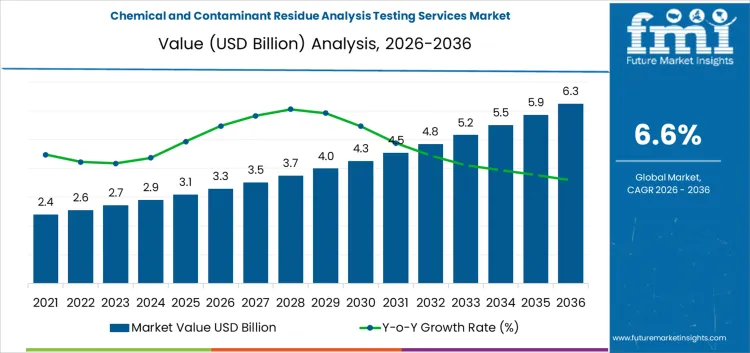
Chemical and Contaminant Residue Analysis Testing Services Market Key Takeaways
| Metric | Value |
|---|---|
| Industry Value (2026) | USD 3.3 Billion |
| Forecast Value (2036) | USD 6.3 Billion |
| Forecast CAGR 2026 to 2036 | 6.60% |
How Is the Global Chemical and Contaminant Residue Analysis Testing Services Market Advancing?
The global chemical and contaminant residue analysis testing services market is experiencing steady growth, driven by increasing concerns over food safety, environmental pollution, and regulatory compliance. Chemical and contaminant residue analysis is essential in ensuring that products such as food, beverages, pharmaceuticals, and consumer goods are free from harmful levels of chemicals, pesticides, heavy metals, and other contaminants. With rising global awareness around health risks associated with exposure to hazardous substances, the demand for accurate testing services is growing across multiple industries.
A key driver of the market is the increasing stringency of regulations and standards surrounding product safety and quality. Governments and regulatory bodies worldwide are enforcing more stringent limits on the levels of chemical residues allowed in food products, pharmaceuticals, and other consumer goods. These regulations are prompting manufacturers to adopt comprehensive residue testing to ensure compliance and protect consumer health. Additionally, the growing consumer demand for transparency and safety in the products they consume is driving the need for reliable chemical and contaminant residue testing.
Technological advancements in testing methodologies, such as high-performance liquid chromatography (HPLC), mass spectrometry (MS), and immunoassays, are further enhancing the market’s growth. These innovations allow for faster, more accurate, and sensitive detection of contaminants at trace levels, enabling companies to meet regulatory requirements more efficiently. As concerns over chemical exposure continue to rise and as industries prioritize consumer safety, the demand for chemical and contaminant residue analysis testing services is expected to grow, supporting the market’s expansion in the coming years.
What Is the Segment-Wise Analysis for the Chemical and Contaminant Residue Analysis Testing Services Market?
The chemical and contaminant residue analysis testing services market is segmented by residue type and industry. Pesticides or agrochemicals lead the residue type segment with a 28% share, followed by solvents & VOCs, metals & inorganics, chemicals & materials, other contaminants, and personal care or other residue types. In terms of industry, food & beverage holds the largest share at 30%, followed by pharma or biotech, chemical & materials, and other industries. The need for ensuring the safety, quality, and compliance of products across various sectors is driving the growth of chemical and contaminant residue analysis testing services.
Why Do Pesticides or Agrochemicals Lead the Chemical and Contaminant Residue Analysis Testing Services Market?
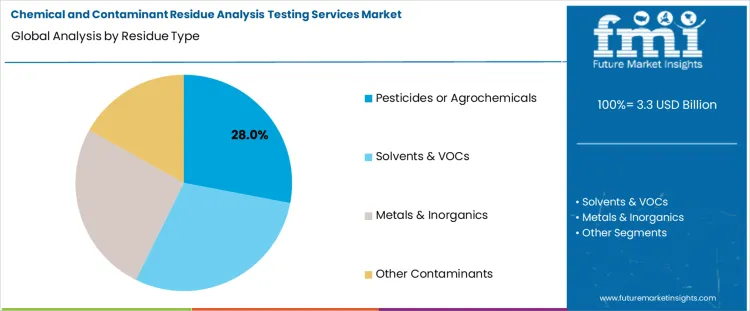
Pesticides or agrochemicals lead the residue type segment with a 28% share due to the critical need to ensure the safety of food products and the environment. The use of pesticides and agrochemicals in agriculture is essential for improving crop yield and quality; however, the presence of pesticide residues in food and water can pose health risks. As regulatory standards for pesticide residues become stricter worldwide, the demand for testing services that can accurately detect and quantify pesticide residues has increased. This is driving the growth of the pesticide testing market, as manufacturers and regulatory bodies work to ensure consumer safety and compliance with environmental regulations.
How Does the Food & Beverage Industry Contribute to the Chemical and Contaminant Residue Analysis Testing Services Market?
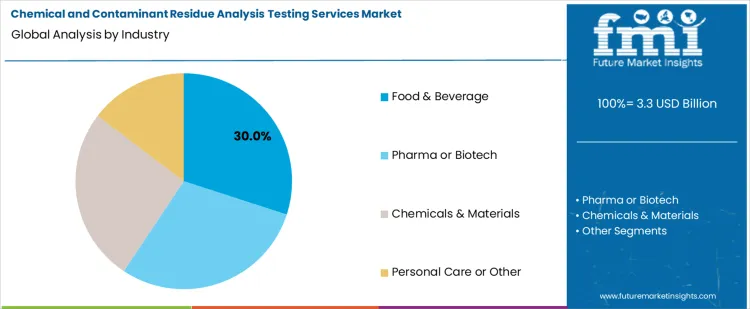
The food & beverage industry contributes the largest share of 30% in the chemical and contaminant residue analysis testing services market. The industry’s focus on consumer health and safety is driving the need for comprehensive residue analysis to ensure that food products are free from harmful chemicals, pesticides, and other contaminants. Residue testing is essential for verifying compliance with safety standards and regulations regarding food safety, particularly in areas such as pesticide residues, solvents, and metals. With the increasing demand for clean, safe, and organic food, the food & beverage sector remains a key driver of the growth in chemical and contaminant residue analysis testing services.
What Are the Key Dynamics for the Chemical and Contaminant Residue Analysis Testing Services Market?
The chemical and contaminant residue analysis testing services market is driven by increasing concerns regarding food safety, environmental pollution, and regulatory compliance. As industries such as food, agriculture, pharmaceuticals, and cosmetics face rising demand for high-quality, safe products, the need for accurate residue analysis has grown. Regulatory bodies across the world are implementing stricter standards for chemical residues, pesticides, and contaminants, fueling the demand for testing services. The market is also influenced by consumer awareness around health risks from harmful chemicals and the need for businesses to ensure their products meet safety and quality standards.
How Are the Key Drivers Shaping the Chemical and Contaminant Residue Analysis Testing Services Market?
The key drivers for the chemical and contaminant residue analysis testing services market include stringent government regulations, rising public health concerns, and the growing demand for traceability in food and product safety. Regulatory agencies worldwide require manufacturers to comply with safety standards, prompting industries to invest in residue analysis testing services. The increasing use of pesticides, heavy metals, and chemicals in agriculture and manufacturing is also driving demand for testing services. The trend of consumers demanding more transparency regarding product safety and quality, especially in food and beverages, is accelerating market growth for residue analysis services.
What Are the Key Trends Shaping the Chemical and Contaminant Residue Analysis Testing Services Market?
Key trends in the market include the growing use of advanced testing technologies such as high-performance liquid chromatography (HPLC), mass spectrometry, and molecular techniques for more accurate and faster residue detection. The increasing demand for organic and sustainably produced products is driving the need for residue testing to verify product claims. The rise in global supply chains and food exports is pushing the demand for testing services to ensure quality and safety across borders. There is also a growing trend toward using automation and digital platforms to streamline testing processes and enhance reporting accuracy and efficiency.
What is the Growth Outlook for the Chemical and Contaminant Residue Analysis Testing Services Market by Country?
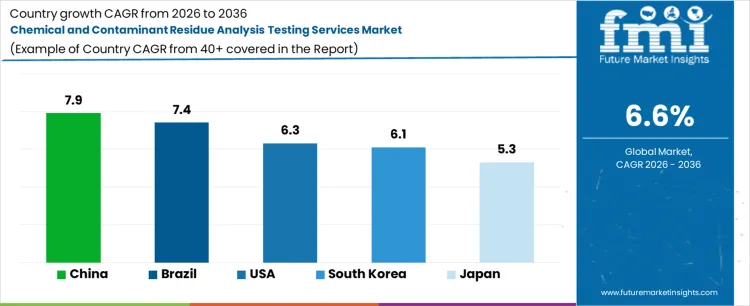
| Country | CAGR (%) |
|---|---|
| China | 7.9% |
| Brazil | 7.4% |
| USA | 6.3% |
| South Korea | 6.1% |
| Japan | 5.3% |
The chemical and contaminant residue analysis testing services market is growing across key regions, with China leading at 7.9%, driven by the expansion of industrial and agricultural sectors, coupled with stringent government regulations. Brazil follows at 7.4%, supported by the demand for food safety and quality testing in its large agricultural industry. The USA grows at 6.3%, fueled by regulatory frameworks and increasing consumer awareness of food safety concerns. South Korea’s market expands at 6.1%, driven by food safety regulations and technological advancements. Japan grows at 5.3%, supported by strict food safety and environmental regulations, alongside increasing consumer demand for high-quality, safe products.
What is Driving the Growth of the Chemical and Contaminant Residue Analysis Testing Services Market in China?
China’s chemical and contaminant residue analysis testing services market is growing at 7.9%, driven by rapid industrialization, expanding agricultural production, and an increased focus on food safety. As China modernizes its manufacturing and agricultural sectors, there is a growing need for testing services to ensure product safety, particularly in food, pharmaceuticals, and consumer products. The government’s stringent regulations on food safety, chemical use, and environmental contamination are propelling the demand for residue analysis. The rising awareness of the risks of contamination, particularly in food exports, is pushing industries to adopt these testing services. China’s commitment to sustainable development and improving public health also fuels the market, as the government prioritizes clean and safe food production, water quality, and environmental protection.
How is the Chemical and Contaminant Residue Analysis Testing Services Market Expanding in Brazil?
Brazil’s chemical and contaminant residue analysis testing services market is growing at 7.4%, supported by the country’s large agricultural sector and growing food exports. As one of the world’s largest producers and exporters of agricultural products, Brazil is increasingly focused on ensuring that food products meet global safety and quality standards. The demand for testing services to detect pesticide residues, heavy metals, and other contaminants is rising as Brazil seeks to meet international regulations and enhance the safety of its food exports. The rising awareness among Brazilian consumers about food safety and environmental sustainability is contributing to the market growth. Government regulations aimed at reducing pollution and promoting environmental sustainability also support the adoption of testing services.
How is the Chemical and Contaminant Residue Analysis Testing Services Market Expanding in the USA?
The chemical and contaminant residue analysis testing services market in the USA is growing at 6.3%, driven by the increasing demand for food safety, regulatory compliance, and environmental monitoring. Stricter environmental and safety regulations in industries like food, agriculture, and pharmaceuticals are pushing the need for more frequent and reliable residue testing. The USA’s regulatory agencies, such as the FDA and EPA, enforce rigorous standards for pesticide residues, heavy metals, and other contaminants in food and water. The rising consumer demand for safer food, particularly organic and clean-label products, is further fueling the market. The adoption of advanced technologies in residue analysis, combined with an increasing focus on transparency in product labeling, is contributing to market expansion.
What is Driving the Growth of the Chemical and Contaminant Residue Analysis Testing Services Market in South Korea?
South Korea’s chemical and contaminant residue analysis testing services market is growing at 6.1%, supported by the country’s stringent food safety regulations, technological advancements, and environmental policies. As South Korea’s food and agricultural industries modernize, the demand for reliable and efficient testing solutions to ensure compliance with international safety standards is increasing. Residue analysis is becoming increasingly important in detecting harmful substances such as pesticides, heavy metals, and other contaminants in food products, especially as South Korean consumers demand higher quality and safer products. South Korea’s commitment to sustainability and clean environmental practices is driving the need for these testing services. With the rise of organic and functional foods, the need for reliable residue testing will continue to grow, further contributing to market expansion.
How is the Chemical and Contaminant Residue Analysis Testing Services Market Expanding in Japan?
Japan’s chemical and contaminant residue analysis testing services market is growing at 5.3%, driven by the country’s emphasis on high-quality standards, environmental sustainability, and consumer safety. Japan has one of the world’s most stringent food safety regulations, ensuring that products meet the highest standards of quality. As the demand for safe, healthy food products increases, particularly organic and functional foods, there is a greater need for reliable testing to detect contaminants such as pesticides and heavy metals. Japan’s focus on preserving environmental quality and reducing pollution also contributes to the demand for residue analysis in industrial and agricultural sectors. Japan’s advanced technological infrastructure enables the development and implementation of cutting-edge testing methods, further driving market growth.
How Are Companies Competing in the Chemical and Contaminant Residue Analysis Testing Services Market?
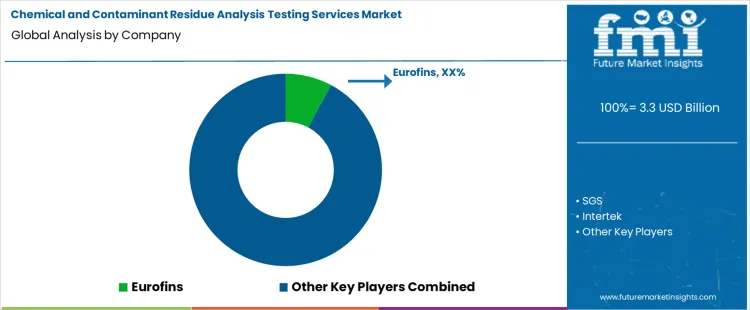
Competition in the Chemical and Contaminant Residue Analysis Testing Services Market is driven by analytical accuracy, breadth of test portfolios, turnaround time, global laboratory coverage, and compliance with regulatory standards such as FDA, EPA, ISO, and GLP. Eurofins positions its services with extensive analytical capabilities and deep regulatory expertise, and its service materials emphasize multi residue screening, robust quality assurance, and broad method accreditation that help manufacturers and regulators ensure product safety. SGS competes with a global network of accredited labs offering a wide range of residue analysis, with collateral highlighting fast reporting, standardized protocols, and capability across food, feed, environmental, and industrial matrices.
Intertek and Bureau Veritas differentiate by combining residue analysis with complementary testing services, including material characterization and environmental monitoring, marketed for comprehensive testing solutions and regulatory alignment. Their documentation stresses method validation, certified technicians, and tailored test packages that meet diverse industry needs. ALS Limited and Mérieux NutriSciences add value with specialized testing platforms and consultative support, their brochures focusing on reliable detection limits, application breadth, and quality systems that support client confidence in analytical results.
Element Materials Technology and QIMA bring integrated testing and inspection services that include residue analysis tied to supply chain quality programs, emphasizing traceability and data transparency. EMSL Analytical competes with comprehensive analytical capabilities covering chemical and microbiological testing, its materials highlighting method flexibility and rapid turnaround. Pace Analytical rounds out the landscape with environmental and industrial residue analysis expertise, documented for accurate quantification and regulatory reporting. Across all vendors, service materials underscore analytical precision, method accreditation, regulatory compliance, and actionable reporting as key differentiators that help clients ensure safety, quality, and market readiness.
Key Players in Chemical and Contaminant Residue Analysis Testing Services Market
- Eurofins
- SGS
- Intertek
- Bureau Veritas
- ALS Limited
- Mérieux NutriSciences
- Element Materials Technology
- QIMA
- EMSL Analytical
- Pace Analytical
Scope of Report
| Attributes | Description |
|---|---|
| Quantitative Unit (2026) | USD 3.3 Billion |
| Quantitative Unit (2036) | USD 6.3 Billion |
| Forecast CAGR 2026 to 2036 | 6.60% |
| Residue Type | Pesticides or Agrochemicals, Solvents & VOCs, Metals & Inorganics, Other Contaminants |
| Industry | Food & Beverage, Pharma or Biotech, Chemicals & Materials, Personal Care or Other |
| Regions Covered | Asia Pacific, Europe, North America, Latin America, Middle East & Africa |
| Countries Covered | China, Japan, South Korea, India, Australia & New Zealand, ASEAN, Germany, United Kingdom, France, Italy, Spain, Nordic, BENELUX, United States, Canada, Mexico, Brazil, Chile, Turkey, South Africa, Other GCC Countries |
| Key Companies Profiled | Eurofins, SGS, Intertek, Bureau Veritas, ALS Limited, Mérieux NutriSciences, Element Materials Technology, QIMA, EMSL Analytical, Pace Analytical |
| Additional Attributes | Dollar sales by residue type, industry, and region; regional CAGR and growth outlook for the chemical and contaminant residue analysis testing services market. |
Chemical and Contaminant Residue Analysis Testing Services Market by Key Segments
Residue Type
- Pesticides or Agrochemicals
- Solvents & VOCs
- Metals & Inorganics
- Other Contaminants
Industry
- Food & Beverage
- Pharma or Biotech
- Chemicals & Materials
- Personal Care or Other
Region
- Asia Pacific
- China
- Japan
- South Korea
- India
- Australia & New Zealand
- ASEAN
- Rest of Asia Pacific
- Europe
- Germany
- United Kingdom
- France
- Italy
- Spain
- Nordic
- BENELUX
- Rest of Europe
- North America
- United States
- Canada
- Mexico
- Latin America
- Brazil
- Chile
- Rest of Latin America
- Middle East & Africa
- Kingdom of Saudi Arabia
- Other GCC Countries
- Turkey
- South Africa
- Other African Union
- Rest of Middle East & Africa
Bibliography
- Eurofins. (2023). Multi residue screening and regulatory compliance for food and consumer products: Comprehensive testing services across global markets. Eurofins Scientific.
- SGS. (2023). Global network of accredited labs offering residue analysis services for food, feed, environmental, and industrial matrices. SGS SA.
- Intertek. (2023). Integrated residue analysis services combining material characterization and environmental monitoring for regulatory alignment. Intertek Group.
Frequently Asked Questions
How big is the chemical and contaminant residue analysis testing services market in 2026?
The global chemical and contaminant residue analysis testing services market is estimated to be valued at USD 3.3 billion in 2026.
What will be the size of chemical and contaminant residue analysis testing services market in 2036?
The market size for the chemical and contaminant residue analysis testing services market is projected to reach USD 6.3 billion by 2036.
How much will be the chemical and contaminant residue analysis testing services market growth between 2026 and 2036?
The chemical and contaminant residue analysis testing services market is expected to grow at a 6.6% CAGR between 2026 and 2036.
What are the key product types in the chemical and contaminant residue analysis testing services market?
The key product types in chemical and contaminant residue analysis testing services market are pesticides or agrochemicals, solvents & vocs, metals & inorganics and other contaminants.
Which industry segment to contribute significant share in the chemical and contaminant residue analysis testing services market in 2026?
In terms of industry, food & beverage segment to command 30.0% share in the chemical and contaminant residue analysis testing services market in 2026.
Preview the report firsthand - request a free sample
Get SampleGet the brochure for pricing and purchase details.
Get PDFTable of Content
- Executive Summary
- Global Market Outlook
- Demand-side Trends
- Supply-side Trends
- Technology Roadmap Analysis
- Analysis and Recommendations
- Market Overview
- Market Coverage / Taxonomy
- Market Definition / Scope / Limitations
- Market Background
- Market Dynamics
- Drivers
- Restraints
- Opportunity
- Trends
- Scenario Forecast
- Demand in Optimistic Scenario
- Demand in Likely Scenario
- Demand in Conservative Scenario
- Opportunity Map Analysis
- Product Life Cycle Analysis
- Supply Chain Analysis
- Investment Feasibility Matrix
- Value Chain Analysis
- PESTLE and Porter’s Analysis
- Regulatory Landscape
- Regional Parent Market Outlook
- Production and Consumption Statistics
- Import and Export Statistics
- Market Dynamics
- Global Market Analysis 2021 to 2025 and Forecast, 2026 to 2036
- Historical Market Size Value (USD Million) Analysis, 2021 to 2025
- Current and Future Market Size Value (USD Million) Projections, 2026 to 2036
- Y-o-Y Growth Trend Analysis
- Absolute $ Opportunity Analysis
- Global Market Pricing Analysis 2021 to 2025 and Forecast 2026 to 2036
- Global Market Analysis 2021 to 2025 and Forecast 2026 to 2036, By Residue Type
- Introduction / Key Findings
- Historical Market Size Value (USD Million) Analysis By Residue Type , 2021 to 2025
- Current and Future Market Size Value (USD Million) Analysis and Forecast By Residue Type , 2026 to 2036
- Pesticides or Agrochemicals
- Solvents & VOCs
- Metals & Inorganics
- Other Contaminants
- Pesticides or Agrochemicals
- Y-o-Y Growth Trend Analysis By Residue Type , 2021 to 2025
- Absolute $ Opportunity Analysis By Residue Type , 2026 to 2036
- Global Market Analysis 2021 to 2025 and Forecast 2026 to 2036, By Industry
- Introduction / Key Findings
- Historical Market Size Value (USD Million) Analysis By Industry, 2021 to 2025
- Current and Future Market Size Value (USD Million) Analysis and Forecast By Industry, 2026 to 2036
- Food & Beverage
- Pharma or Biotech
- Chemicals & Materials
- Personal Care or Other
- Food & Beverage
- Y-o-Y Growth Trend Analysis By Industry, 2021 to 2025
- Absolute $ Opportunity Analysis By Industry, 2026 to 2036
- Global Market Analysis 2021 to 2025 and Forecast 2026 to 2036, By Region
- Introduction
- Historical Market Size Value (USD Million) Analysis By Region, 2021 to 2025
- Current Market Size Value (USD Million) Analysis and Forecast By Region, 2026 to 2036
- North America
- Latin America
- Western Europe
- Eastern Europe
- East Asia
- South Asia and Pacific
- Middle East & Africa
- Market Attractiveness Analysis By Region
- North America Market Analysis 2021 to 2025 and Forecast 2026 to 2036, By Country
- Historical Market Size Value (USD Million) Trend Analysis By Market Taxonomy, 2021 to 2025
- Market Size Value (USD Million) Forecast By Market Taxonomy, 2026 to 2036
- By Country
- USA
- Canada
- Mexico
- By Residue Type
- By Industry
- By Country
- Market Attractiveness Analysis
- By Country
- By Residue Type
- By Industry
- Key Takeaways
- Latin America Market Analysis 2021 to 2025 and Forecast 2026 to 2036, By Country
- Historical Market Size Value (USD Million) Trend Analysis By Market Taxonomy, 2021 to 2025
- Market Size Value (USD Million) Forecast By Market Taxonomy, 2026 to 2036
- By Country
- Brazil
- Chile
- Rest of Latin America
- By Residue Type
- By Industry
- By Country
- Market Attractiveness Analysis
- By Country
- By Residue Type
- By Industry
- Key Takeaways
- Western Europe Market Analysis 2021 to 2025 and Forecast 2026 to 2036, By Country
- Historical Market Size Value (USD Million) Trend Analysis By Market Taxonomy, 2021 to 2025
- Market Size Value (USD Million) Forecast By Market Taxonomy, 2026 to 2036
- By Country
- Germany
- UK
- Italy
- Spain
- France
- Nordic
- BENELUX
- Rest of Western Europe
- By Residue Type
- By Industry
- By Country
- Market Attractiveness Analysis
- By Country
- By Residue Type
- By Industry
- Key Takeaways
- Eastern Europe Market Analysis 2021 to 2025 and Forecast 2026 to 2036, By Country
- Historical Market Size Value (USD Million) Trend Analysis By Market Taxonomy, 2021 to 2025
- Market Size Value (USD Million) Forecast By Market Taxonomy, 2026 to 2036
- By Country
- Russia
- Poland
- Hungary
- Balkan & Baltic
- Rest of Eastern Europe
- By Residue Type
- By Industry
- By Country
- Market Attractiveness Analysis
- By Country
- By Residue Type
- By Industry
- Key Takeaways
- East Asia Market Analysis 2021 to 2025 and Forecast 2026 to 2036, By Country
- Historical Market Size Value (USD Million) Trend Analysis By Market Taxonomy, 2021 to 2025
- Market Size Value (USD Million) Forecast By Market Taxonomy, 2026 to 2036
- By Country
- China
- Japan
- South Korea
- By Residue Type
- By Industry
- By Country
- Market Attractiveness Analysis
- By Country
- By Residue Type
- By Industry
- Key Takeaways
- South Asia and Pacific Market Analysis 2021 to 2025 and Forecast 2026 to 2036, By Country
- Historical Market Size Value (USD Million) Trend Analysis By Market Taxonomy, 2021 to 2025
- Market Size Value (USD Million) Forecast By Market Taxonomy, 2026 to 2036
- By Country
- India
- ASEAN
- Australia & New Zealand
- Rest of South Asia and Pacific
- By Residue Type
- By Industry
- By Country
- Market Attractiveness Analysis
- By Country
- By Residue Type
- By Industry
- Key Takeaways
- Middle East & Africa Market Analysis 2021 to 2025 and Forecast 2026 to 2036, By Country
- Historical Market Size Value (USD Million) Trend Analysis By Market Taxonomy, 2021 to 2025
- Market Size Value (USD Million) Forecast By Market Taxonomy, 2026 to 2036
- By Country
- Kingdom of Saudi Arabia
- Other GCC Countries
- Turkiye
- South Africa
- Other African Union
- Rest of Middle East & Africa
- By Residue Type
- By Industry
- By Country
- Market Attractiveness Analysis
- By Country
- By Residue Type
- By Industry
- Key Takeaways
- Key Countries Market Analysis
- USA
- Pricing Analysis
- Market Share Analysis, 2025
- By Residue Type
- By Industry
- Canada
- Pricing Analysis
- Market Share Analysis, 2025
- By Residue Type
- By Industry
- Mexico
- Pricing Analysis
- Market Share Analysis, 2025
- By Residue Type
- By Industry
- Brazil
- Pricing Analysis
- Market Share Analysis, 2025
- By Residue Type
- By Industry
- Chile
- Pricing Analysis
- Market Share Analysis, 2025
- By Residue Type
- By Industry
- Germany
- Pricing Analysis
- Market Share Analysis, 2025
- By Residue Type
- By Industry
- UK
- Pricing Analysis
- Market Share Analysis, 2025
- By Residue Type
- By Industry
- Italy
- Pricing Analysis
- Market Share Analysis, 2025
- By Residue Type
- By Industry
- Spain
- Pricing Analysis
- Market Share Analysis, 2025
- By Residue Type
- By Industry
- France
- Pricing Analysis
- Market Share Analysis, 2025
- By Residue Type
- By Industry
- India
- Pricing Analysis
- Market Share Analysis, 2025
- By Residue Type
- By Industry
- ASEAN
- Pricing Analysis
- Market Share Analysis, 2025
- By Residue Type
- By Industry
- Australia & New Zealand
- Pricing Analysis
- Market Share Analysis, 2025
- By Residue Type
- By Industry
- China
- Pricing Analysis
- Market Share Analysis, 2025
- By Residue Type
- By Industry
- Japan
- Pricing Analysis
- Market Share Analysis, 2025
- By Residue Type
- By Industry
- South Korea
- Pricing Analysis
- Market Share Analysis, 2025
- By Residue Type
- By Industry
- Russia
- Pricing Analysis
- Market Share Analysis, 2025
- By Residue Type
- By Industry
- Poland
- Pricing Analysis
- Market Share Analysis, 2025
- By Residue Type
- By Industry
- Hungary
- Pricing Analysis
- Market Share Analysis, 2025
- By Residue Type
- By Industry
- Kingdom of Saudi Arabia
- Pricing Analysis
- Market Share Analysis, 2025
- By Residue Type
- By Industry
- Turkiye
- Pricing Analysis
- Market Share Analysis, 2025
- By Residue Type
- By Industry
- South Africa
- Pricing Analysis
- Market Share Analysis, 2025
- By Residue Type
- By Industry
- USA
- Market Structure Analysis
- Competition Dashboard
- Competition Benchmarking
- Market Share Analysis of Top Players
- By Regional
- By Residue Type
- By Industry
- Competition Analysis
- Competition Deep Dive
- Eurofins
- Overview
- Product Portfolio
- Profitability by Market Segments (Product/Age /Sales Channel/Region)
- Sales Footprint
- Strategy Overview
- Marketing Strategy
- Product Strategy
- Channel Strategy
- SGS
- Intertek
- Bureau Veritas
- ALS Limited
- Mérieux NutriSciences
- Element Materials Technology
- QIMA
- EMSL Analytical
- Pace Analytical
- Eurofins
- Competition Deep Dive
- Assumptions & Acronyms Used
- Research Methodology


