

- Industry Size (2026)
- USD 1.3 Bn
- Forecast (2036)
- USD 2.2 Bn
- CAGR (2026 to 2036)
- 5.30%
Potable Water Testing Services Market Forecast and Outlook 2026 to 2036
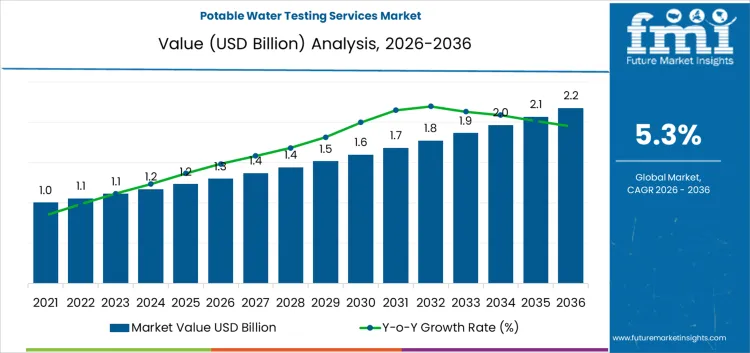
The global potable water testing services market is projected to grow from USD 1.3 billion in 2026 to USD 2.2 billion by 2036, reflecting a CAGR of 5.30%. The increasing concerns about water quality and safety, coupled with stricter regulatory requirements for water testing, are major factors contributing to the market's growth. Potable water testing services ensure that water intended for drinking, cooking, and human consumption meets necessary health standards by detecting contaminants like bacteria, viruses, chemicals, and heavy metals.
With urbanization and the growing demand for safe drinking water, particularly in emerging regions, the need for reliable water testing services is escalating. Advancements in testing technologies, such as real-time testing, automated systems, and advanced filtration methods, are enhancing the efficiency and accuracy of water quality monitoring. As the global focus on ensuring safe, clean water intensifies, the market for potable water testing services is set to expand in the coming years.
Quick Stats for Potable Water Testing Services Market
- Potable Water Testing Services Market Value (2026): USD 1.3 Billion
- Potable Water Testing Services Market Forecast Value (2036): USD 2.2 Billion
- Potable Water Testing Services Market Forecast CAGR 2026 to 2036: 5.30%
- Leading Test Type in Potable Water Testing Services Market: Microbiological Testing
- Key Growth Regions in Potable Water Testing Services Market: Asia Pacific, North America, Europe
- Top Key Players in Potable Water Testing Services Market: Eurofins, SGS, Intertek, Bureau Veritas, ALS Limited
Potable Water Testing Services Market Key Takeaways
| Metric | Value |
|---|---|
| Industry Value (2026) | USD 1.3 Billion |
| Forecast Value (2036) | USD 2.2 Billion |
| Forecast CAGR 2026 to 2036 | 5.30% |
How Is the Global Potable Water Testing Services Market Advancing?
The global potable water testing services market is experiencing steady growth, driven by increasing concerns over water quality and safety, as well as stricter regulatory requirements for water testing across the globe. Potable water testing services are essential to ensure that water supplied for drinking, cooking, and other human consumption meets the required health standards and is free from contaminants such as bacteria, viruses, chemicals, and heavy metals. As urbanization continues and access to safe drinking water remains a priority, the demand for reliable water testing services is growing.
A major driver of market growth is the rising awareness of waterborne diseases and contamination risks, particularly in developing regions where water quality monitoring infrastructure is often limited. Governments and health organizations worldwide are placing greater emphasis on testing and ensuring access to safe drinking water, driving the need for robust testing services. Increasing industrial and agricultural activities have raised concerns over the presence of pollutants in water sources, further fueling the demand for potable water testing services.
Technological advancements in water testing methods, including real-time testing, advanced filtration technologies, and automated testing systems, are also contributing to the market's growth. These innovations are improving the accuracy, speed, and efficiency of water testing, making it easier for municipalities, industries, and consumers to monitor water quality regularly. As the demand for clean, safe drinking water grows in both developed and emerging economies, the potable water testing services market is poised for continued expansion, ensuring better health outcomes and compliance with safety standards in the coming years.
What Is the Segment-Wise Analysis for the Potable Water Testing Services Market?
The potable water testing services market is segmented by test type and provider type. Microbiological testing leads the test type segment with a 34% share, followed by chemical contaminants, metals & minerals, and other types of tests. Microbiological testing is essential for ensuring the safety of drinking water by detecting harmful pathogens. In terms of provider type, global testing networks dominate with a 38% share, followed by regional labs, utility in-house labs, and other provider types. The growing emphasis on water safety, regulatory compliance, and environmental monitoring is driving the demand for various types of testing services across different provider segments.
Why Does Microbiological Testing Lead the Potable Water Testing Services Market?
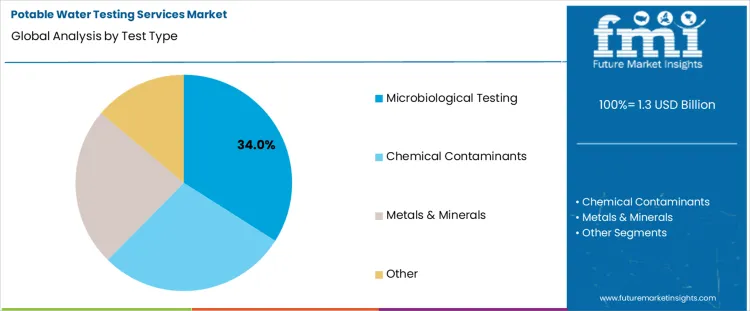
Microbiological testing leads the potable water testing services market with a 34% share due to its essential role in ensuring the safety of drinking water. This testing type detects harmful microorganisms like bacteria, viruses, and protozoa, which can pose significant health risks if present in water. With increasing global demand for safe drinking water, the need for reliable microbiological testing is growing. Stringent regulatory standards and public health concerns further drive the widespread use of microbiological testing, making it a dominant segment in the market. As waterborne diseases remain a significant concern, microbiological testing is crucial for maintaining water safety and public health, solidifying its leadership in the potable water testing market.
How Do Global Testing Networks Contribute to the Potable Water Testing Services Market?
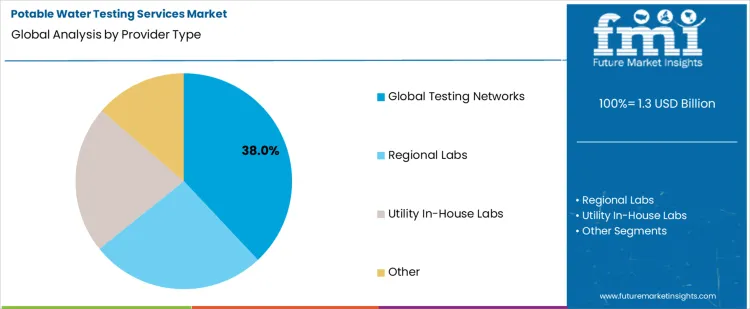
Global testing networks account for 38% of the provider type segment in the potable water testing services market. These networks offer comprehensive testing services across multiple regions, ensuring that water quality standards are maintained globally. Equipped with advanced testing technologies, they can process large volumes of samples from various sources, including municipal water supplies and industrial facilities. Their ability to handle diverse water testing requirements with consistency, reliability, and global reach makes them critical players in the market. As water safety regulations become stricter worldwide, the role of global testing networks in large-scale testing and compliance with international standards continues to drive their dominance in the market.
What Are the Key Dynamics for the Potable Water Testing Services Market?
The potable water testing services market is driven by increasing global concerns about water quality, health, and the rising demand for clean, safe drinking water. With the growing population and urbanization, ensuring access to potable water has become a critical priority for governments and industries. Regulatory requirements for water quality standards and the increasing awareness of the health risks associated with contaminated water are pushing the adoption of water testing services. These services help detect harmful contaminants such as bacteria, heavy metals, and chemicals, ensuring water safety and compliance with health regulations.
How Are the Key Drivers Shaping the Potable Water Testing Services Market?
Key drivers of the Potable Water Testing Services Market include rising water contamination concerns, stricter regulatory standards, and the growing need for safe drinking water in both developed and developing regions. Government mandates and regulations requiring regular water quality testing in municipalities, industries, and households are pushing demand. The increasing frequency of waterborne diseases due to poor water quality, combined with heightened consumer awareness of water safety, is also fueling market growth. Technological advancements in testing equipment and the rise of decentralized water treatment systems are further expanding the market's scope.
What Are the Restraints Impacting the Potable Water Testing Services Market?
The potable water testing services market faces challenges such as high testing costs, particularly in rural or underserved areas with limited infrastructure. The complexity of testing for a wide range of contaminants, such as pathogens, heavy metals, and chemicals, requires specialized equipment and skilled personnel, increasing operational costs. Furthermore, the lack of standardization in water quality testing procedures across regions may lead to inconsistent results and regulatory complications. Limited access to modern testing facilities in certain developing regions can restrict the availability and accessibility of potable water testing services.
What is the Growth Outlook for the Potable Water Testing Services Market by Country?
| Country | CAGR (%) |
|---|---|
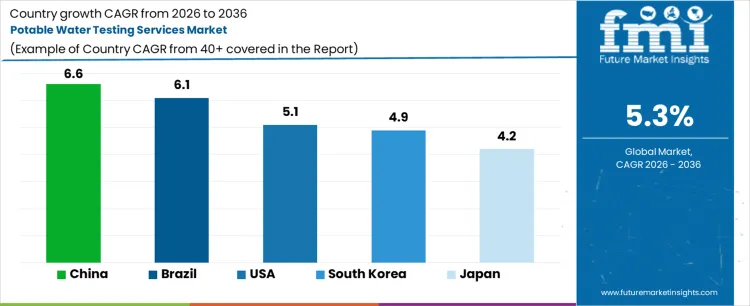
| China | 6.6% |
| Brazil | 6.1% |
| USA | 5.1% |
| South Korea | 4.9% |
| Japan | 4.2% |
What is Driving the Growth of the Potable Water Testing Services Market in China?
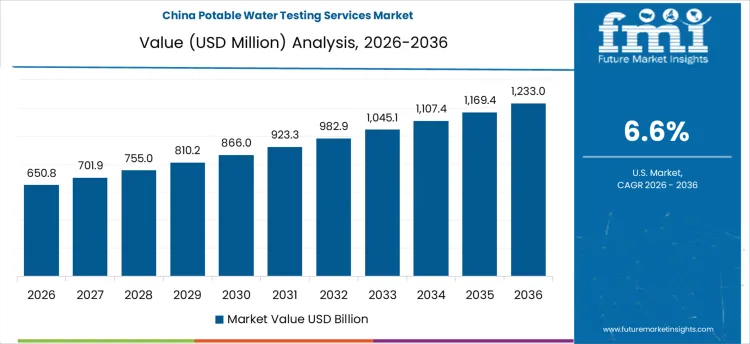
China’s potable water testing services market is growing at 6.6%, driven by rapid urbanization, industrialization, and increasing awareness of water quality issues. With a population of over 1.4 billion, the demand for safe drinking water is rising, prompting a focus on improving water treatment systems. Stringent government regulations on water quality, along with initiatives to reduce pollution, are driving the adoption of advanced testing services. Public health concerns regarding waterborne diseases, alongside an increasing industrial footprint, contribute to growing demand for potable water testing. The government’s push for greater environmental sustainability and the provision of clean water to rural areas also ensures continued growth in this market. As industries like agriculture, manufacturing, and mining expand, there will be an increasing need for accurate and reliable testing of potable water to meet both domestic and international standards.
How is the Potable Water Testing Services Market Expanding in Brazil?
Brazil’s potable water testing services market is growing at 6.1%, driven by the need for improved water quality standards and increased public health awareness. The country’s large agricultural and industrial sectors significantly contribute to water contamination, prompting a strong demand for effective water testing services. With Brazil's expanding urban population and ongoing urbanization, there is increasing pressure on water systems to deliver safe drinking water. Government efforts to improve sanitation infrastructure and provide clean water to underserved regions further fuel the demand for potable water testing. Rising concerns over waterborne diseases and water pollution also push industries and municipalities to invest in advanced testing services to ensure water quality. Brazil’s regulatory standards for water quality, especially for industrial and agricultural applications, are also key drivers of the market, with municipalities and companies seeking reliable and affordable testing solutions to comply with these standards.
How is the Potable Water Testing Services Market Expanding in the USA?
The potable water testing services market in the USA is growing at 5.1%, driven by stringent regulatory standards for water quality and a growing awareness of environmental and public health concerns. The U.S. government enforces regulations like the Clean Water Act and Safe Drinking Water Act, requiring regular testing to meet water safety standards. Aging infrastructure, water pollution, and concerns over contaminants such as lead and PFAS (per- and polyfluoroalkyl substances) are contributing to the increasing demand for testing services. The rise of decentralized water systems and the growth of private sector initiatives in water purification are also driving market expansion. Moreover, the increasing adoption of smart water monitoring technologies and greater consumer demand for transparency in water quality further contribute to the growth of this market. As public and industrial demand for safe drinking water rises, the need for regular water testing will continue to increase.
What is Driving the Growth of the Potable Water Testing Services Market in South Korea?
South Korea’s potable water testing services market is growing at 4.9%, supported by its stringent water quality standards and commitment to environmental sustainability. The country has advanced infrastructure for water treatment and distribution, but the increasing focus on ensuring the quality and safety of drinking water, particularly in urban areas, is driving the need for reliable testing services. South Korea’s commitment to public health and environmental protection fuels the demand for advanced water testing solutions. As the population grows and urbanization increases, ensuring that potable water meets safety and health standards is crucial. The rise of industrial pollution and the demand for cleaner water solutions in sectors like food processing and agriculture are pushing the adoption of advanced testing services. Government regulations focusing on the quality of drinking water further support the growth of the market, making water testing services essential for compliance.
How is the Potable Water Testing Services Market Expanding in Japan?
Japan’s potable water testing services market is growing at 4.2%, driven by the country’s stringent water safety regulations and public health concerns. Japan’s aging infrastructure and the increasing demand for clean and safe drinking water, particularly in urban centers, are contributing to the need for comprehensive water testing services. Government regulations on water quality, including the monitoring of potential contaminants in drinking water, are further fueling demand. The country’s commitment to sustainability and the protection of natural resources also promotes the adoption of advanced water treatment and testing technologies. The rising focus on water quality due to natural disasters, such as earthquakes and floods, also pushes demand for reliable and rapid testing services. Japan’s continued innovation in water treatment technologies ensures that the potable water testing services market will maintain steady growth, focusing on safety, reliability, and environmental sustainability.
How Are Companies Competing in the Potable Water Testing Services Market?
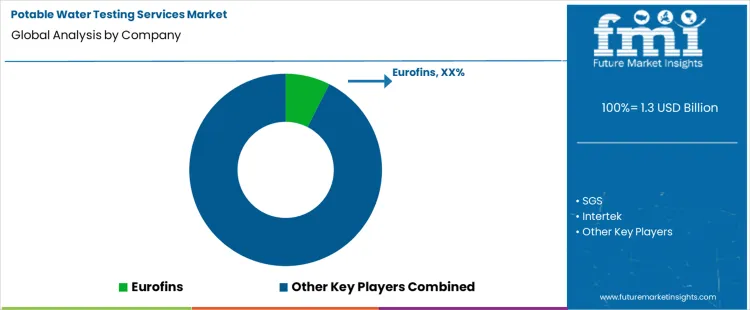
Competition in the Potable Water Testing Services Market is driven by laboratory coverage, analytical accuracy, regulatory compliance (e.g., EPA, WHO, ISO 17025), turnaround time, and water-testing specialization, turnaround time, and industry-specific expertise. SGS positions its radiographic testing services with a strong global laboratory and field network, emphasizing high-resolution imaging, detailed reporting, and regulatory compliance that help clients in oil & gas, manufacturing, and infrastructure sectors confidently assess welds and critical components. Intertek competes by offering integrated nondestructive testing (NDT) services that combine radiography with complementary methods, marketed for comprehensive asset inspection and quality assurance tailored to client specifications.
Bureau Veritas and Applus+ differentiate through multi-discipline inspection portfolios that include film and digital radiography, phased array alternatives, and remote operations, with materials highlighting certified technicians and consistent methodology across international projects. TÜV Rheinland adds value with industry-aligned NDT programs supported by strong accreditation credentials and experience in sectors where safety and compliance are paramount.
Specialized service providers such as Mistras Group, Acuren, and Element Materials Technology focus on advanced radiographic techniques and rapid deployment teams capable of on-site execution, with collateral emphasizing real-world defect detection, high throughput, and technical consultation support. TEAM, Inc. and NDT Global compete with high-end digital radiographic systems and inspection analytics, marketed for precision detection and data traceability in large-scale industrial environments. Across all players, service materials underscore accuracy, certified procedures, detailed analysis, and rapid reporting as key differentiators that help manufacturers and owners ensure structural integrity and regulatory compliance.
Key Players in Potable Water Testing Services Market
- Eurofins
- SGS
- Intertek
- Bureau Veritas
- ALS Limited
- Mérieux NutriSciences
- Element Materials Technology
- Pace Analytical
- NSF
- EMSL Analytical
Scope of Report
| Attributes | Description |
|---|---|
| Quantitative Unit (2026) | USD Billion |
| Test Type | Microbiological Testing, Chemical Contaminants, Metals & Minerals, Other |
| Provider Type | Global Testing Networks, Regional Labs, Utility In-House Labs, Other |
| Regions Covered | Asia Pacific, Europe, North America, Latin America, Middle East & Africa |
| Countries Covered | China, Japan, South Korea, India, Australia & New Zealand, ASEAN, Germany, United Kingdom, France, Italy, Spain, Nordic, BENELUX, United States, Canada, Mexico, Brazil, Chile, Turkey, South Africa, Other GCC Countries |
| Key Companies Profiled | Eurofins, SGS, Intertek, Bureau Veritas, ALS Limited, Mérieux NutriSciences, Element Materials Technology, Pace Analytical, NSF, EMSL Analytical |
| Additional Attributes | Dollar sales by test type, provider type, and region; regional CAGR and growth outlook for the potable water testing services market. |
Potable Water Testing Services Market by Key Segments
By Test Type:
- Microbiological Testing
- Chemical Contaminants
- Metals & Minerals
- Other
By Provider Type:
- Global Testing Networks
- Regional Labs
- Utility In-House Labs
- Other
By Region:
- Asia Pacific
- China
- Japan
- South Korea
- India
- Australia & New Zealand
- ASEAN
- Rest of Asia Pacific
- Europe
- Germany
- United Kingdom
- France
- Italy
- Spain
- Nordic
- BENELUX
- Rest of Europe
- North America
- United States
- Canada
- Mexico
- Latin America
- Brazil
- Chile
- Rest of Latin America
- Middle East & Africa
- Kingdom of Saudi Arabia
- Other GCC Countries
- Turkey
- South Africa
- Other African Union
- Rest of Middle East & Africa
Bibliography
- Eurofins. (2023). Global testing network for water quality with a focus on microbiological and chemical contaminants testing. Eurofins Scientific.
- SGS. (2023). Comprehensive potable water testing services with an emphasis on regulatory compliance and quality assurance for municipal and industrial clients. SGS SA.
- Intertek. (2023). Integrated testing services for potable water with advanced analytical technologies for chemical and microbiological contaminants. Intertek Group.
Frequently Asked Questions
How big is the potable water testing services market in 2026?
The global potable water testing services market is estimated to be valued at USD 1.3 billion in 2026.
What will be the size of potable water testing services market in 2036?
The market size for the potable water testing services market is projected to reach USD 2.2 billion by 2036.
How much will be the potable water testing services market growth between 2026 and 2036?
The potable water testing services market is expected to grow at a 5.3% CAGR between 2026 and 2036.
What are the key product types in the potable water testing services market?
The key product types in potable water testing services market are microbiological testing, chemical contaminants, metals & minerals and other.
Which provider type segment to contribute significant share in the potable water testing services market in 2026?
In terms of provider type, global testing networks segment to command 38.0% share in the potable water testing services market in 2026.
Preview the report firsthand - request a free sample
Get SampleGet the brochure for pricing and purchase details.
Get PDFTable of Content
- Executive Summary
- Global Market Outlook
- Demand-side Trends
- Supply-side Trends
- Technology Roadmap Analysis
- Analysis and Recommendations
- Market Overview
- Market Coverage / Taxonomy
- Market Definition / Scope / Limitations
- Market Background
- Market Dynamics
- Drivers
- Restraints
- Opportunity
- Trends
- Scenario Forecast
- Demand in Optimistic Scenario
- Demand in Likely Scenario
- Demand in Conservative Scenario
- Opportunity Map Analysis
- Product Life Cycle Analysis
- Supply Chain Analysis
- Investment Feasibility Matrix
- Value Chain Analysis
- PESTLE and Porter’s Analysis
- Regulatory Landscape
- Regional Parent Market Outlook
- Production and Consumption Statistics
- Import and Export Statistics
- Market Dynamics
- Global Market Analysis 2021 to 2025 and Forecast, 2026 to 2036
- Historical Market Size Value (USD Million) Analysis, 2021 to 2025
- Current and Future Market Size Value (USD Million) Projections, 2026 to 2036
- Y-o-Y Growth Trend Analysis
- Absolute $ Opportunity Analysis
- Global Market Pricing Analysis 2021 to 2025 and Forecast 2026 to 2036
- Global Market Analysis 2021 to 2025 and Forecast 2026 to 2036, By Test Type
- Introduction / Key Findings
- Historical Market Size Value (USD Million) Analysis By Test Type , 2021 to 2025
- Current and Future Market Size Value (USD Million) Analysis and Forecast By Test Type , 2026 to 2036
- Microbiological Testing
- Chemical Contaminants
- Metals & Minerals
- Other
- Microbiological Testing
- Y-o-Y Growth Trend Analysis By Test Type , 2021 to 2025
- Absolute $ Opportunity Analysis By Test Type , 2026 to 2036
- Global Market Analysis 2021 to 2025 and Forecast 2026 to 2036, By Provider Type
- Introduction / Key Findings
- Historical Market Size Value (USD Million) Analysis By Provider Type, 2021 to 2025
- Current and Future Market Size Value (USD Million) Analysis and Forecast By Provider Type, 2026 to 2036
- Global Testing Networks
- Regional Labs
- Utility In-House Labs
- Other
- Global Testing Networks
- Y-o-Y Growth Trend Analysis By Provider Type, 2021 to 2025
- Absolute $ Opportunity Analysis By Provider Type, 2026 to 2036
- Global Market Analysis 2021 to 2025 and Forecast 2026 to 2036, By Region
- Introduction
- Historical Market Size Value (USD Million) Analysis By Region, 2021 to 2025
- Current Market Size Value (USD Million) Analysis and Forecast By Region, 2026 to 2036
- North America
- Latin America
- Western Europe
- Eastern Europe
- East Asia
- South Asia and Pacific
- Middle East & Africa
- Market Attractiveness Analysis By Region
- North America Market Analysis 2021 to 2025 and Forecast 2026 to 2036, By Country
- Historical Market Size Value (USD Million) Trend Analysis By Market Taxonomy, 2021 to 2025
- Market Size Value (USD Million) Forecast By Market Taxonomy, 2026 to 2036
- By Country
- USA
- Canada
- Mexico
- By Test Type
- By Provider Type
- By Country
- Market Attractiveness Analysis
- By Country
- By Test Type
- By Provider Type
- Key Takeaways
- Latin America Market Analysis 2021 to 2025 and Forecast 2026 to 2036, By Country
- Historical Market Size Value (USD Million) Trend Analysis By Market Taxonomy, 2021 to 2025
- Market Size Value (USD Million) Forecast By Market Taxonomy, 2026 to 2036
- By Country
- Brazil
- Chile
- Rest of Latin America
- By Test Type
- By Provider Type
- By Country
- Market Attractiveness Analysis
- By Country
- By Test Type
- By Provider Type
- Key Takeaways
- Western Europe Market Analysis 2021 to 2025 and Forecast 2026 to 2036, By Country
- Historical Market Size Value (USD Million) Trend Analysis By Market Taxonomy, 2021 to 2025
- Market Size Value (USD Million) Forecast By Market Taxonomy, 2026 to 2036
- By Country
- Germany
- UK
- Italy
- Spain
- France
- Nordic
- BENELUX
- Rest of Western Europe
- By Test Type
- By Provider Type
- By Country
- Market Attractiveness Analysis
- By Country
- By Test Type
- By Provider Type
- Key Takeaways
- Eastern Europe Market Analysis 2021 to 2025 and Forecast 2026 to 2036, By Country
- Historical Market Size Value (USD Million) Trend Analysis By Market Taxonomy, 2021 to 2025
- Market Size Value (USD Million) Forecast By Market Taxonomy, 2026 to 2036
- By Country
- Russia
- Poland
- Hungary
- Balkan & Baltic
- Rest of Eastern Europe
- By Test Type
- By Provider Type
- By Country
- Market Attractiveness Analysis
- By Country
- By Test Type
- By Provider Type
- Key Takeaways
- East Asia Market Analysis 2021 to 2025 and Forecast 2026 to 2036, By Country
- Historical Market Size Value (USD Million) Trend Analysis By Market Taxonomy, 2021 to 2025
- Market Size Value (USD Million) Forecast By Market Taxonomy, 2026 to 2036
- By Country
- China
- Japan
- South Korea
- By Test Type
- By Provider Type
- By Country
- Market Attractiveness Analysis
- By Country
- By Test Type
- By Provider Type
- Key Takeaways
- South Asia and Pacific Market Analysis 2021 to 2025 and Forecast 2026 to 2036, By Country
- Historical Market Size Value (USD Million) Trend Analysis By Market Taxonomy, 2021 to 2025
- Market Size Value (USD Million) Forecast By Market Taxonomy, 2026 to 2036
- By Country
- India
- ASEAN
- Australia & New Zealand
- Rest of South Asia and Pacific
- By Test Type
- By Provider Type
- By Country
- Market Attractiveness Analysis
- By Country
- By Test Type
- By Provider Type
- Key Takeaways
- Middle East & Africa Market Analysis 2021 to 2025 and Forecast 2026 to 2036, By Country
- Historical Market Size Value (USD Million) Trend Analysis By Market Taxonomy, 2021 to 2025
- Market Size Value (USD Million) Forecast By Market Taxonomy, 2026 to 2036
- By Country
- Kingdom of Saudi Arabia
- Other GCC Countries
- Turkiye
- South Africa
- Other African Union
- Rest of Middle East & Africa
- By Test Type
- By Provider Type
- By Country
- Market Attractiveness Analysis
- By Country
- By Test Type
- By Provider Type
- Key Takeaways
- Key Countries Market Analysis
- USA
- Pricing Analysis
- Market Share Analysis, 2025
- By Test Type
- By Provider Type
- Canada
- Pricing Analysis
- Market Share Analysis, 2025
- By Test Type
- By Provider Type
- Mexico
- Pricing Analysis
- Market Share Analysis, 2025
- By Test Type
- By Provider Type
- Brazil
- Pricing Analysis
- Market Share Analysis, 2025
- By Test Type
- By Provider Type
- Chile
- Pricing Analysis
- Market Share Analysis, 2025
- By Test Type
- By Provider Type
- Germany
- Pricing Analysis
- Market Share Analysis, 2025
- By Test Type
- By Provider Type
- UK
- Pricing Analysis
- Market Share Analysis, 2025
- By Test Type
- By Provider Type
- Italy
- Pricing Analysis
- Market Share Analysis, 2025
- By Test Type
- By Provider Type
- Spain
- Pricing Analysis
- Market Share Analysis, 2025
- By Test Type
- By Provider Type
- France
- Pricing Analysis
- Market Share Analysis, 2025
- By Test Type
- By Provider Type
- India
- Pricing Analysis
- Market Share Analysis, 2025
- By Test Type
- By Provider Type
- ASEAN
- Pricing Analysis
- Market Share Analysis, 2025
- By Test Type
- By Provider Type
- Australia & New Zealand
- Pricing Analysis
- Market Share Analysis, 2025
- By Test Type
- By Provider Type
- China
- Pricing Analysis
- Market Share Analysis, 2025
- By Test Type
- By Provider Type
- Japan
- Pricing Analysis
- Market Share Analysis, 2025
- By Test Type
- By Provider Type
- South Korea
- Pricing Analysis
- Market Share Analysis, 2025
- By Test Type
- By Provider Type
- Russia
- Pricing Analysis
- Market Share Analysis, 2025
- By Test Type
- By Provider Type
- Poland
- Pricing Analysis
- Market Share Analysis, 2025
- By Test Type
- By Provider Type
- Hungary
- Pricing Analysis
- Market Share Analysis, 2025
- By Test Type
- By Provider Type
- Kingdom of Saudi Arabia
- Pricing Analysis
- Market Share Analysis, 2025
- By Test Type
- By Provider Type
- Turkiye
- Pricing Analysis
- Market Share Analysis, 2025
- By Test Type
- By Provider Type
- South Africa
- Pricing Analysis
- Market Share Analysis, 2025
- By Test Type
- By Provider Type
- USA
- Market Structure Analysis
- Competition Dashboard
- Competition Benchmarking
- Market Share Analysis of Top Players
- By Regional
- By Test Type
- By Provider Type
- Competition Analysis
- Competition Deep Dive
- Eurofins
- Overview
- Product Portfolio
- Profitability by Market Segments (Product/Age /Sales Channel/Region)
- Sales Footprint
- Strategy Overview
- Marketing Strategy
- Product Strategy
- Channel Strategy
- SGS
- Intertek
- Bureau Veritas
- ALS Limited
- Mérieux NutriSciences
- Element Materials Technology
- Pace Analytical
- NSF
- EMSL Analytical
- Eurofins
- Competition Deep Dive
- Assumptions & Acronyms Used
- Research Methodology


