

- Industry Size (2026)
- USD 0.71 Bn
- Forecast (2036)
- USD 2.22 Bn
- CAGR (2026 to 2036)
- 12.10%
EUV Mask Inspection and Pellicle Monitoring Systems Market Size, Market Forecast and Outlook By FMI
The EUV mask inspection market was valued at USD 0.63 billion in 2025. Sales are poised to surpass USD 0.71 billion in 2026 at a CAGR of 12.10% during this forecast period. Consistent investment propels the valuation to USD 2.22 billion through 2036 as advanced foundries mandate zero-defect printing for sub-3nm node production architectures.
Defect mitigation strategies at leading-edge nodes force lithography engineers to abandon statistical sampling for comprehensive reticle area coverage. Yield loss from a single repeating printable defect on a 3nm logic mask outpaces inspection tool acquisition costs within days, defining the EUV mask inspection market forecast trajectory. FMI's photomask inspection sector assessment highlights how operators must qualify reticles through intact carbon nanotube protective layers without breaking vacuum. Current fab workflows dictate that procurement officers prioritize native-wavelength detection above conventional deep ultraviolet platforms despite massive price premiums. Module owners realize that detecting phase anomalies inside multilayer reflectors prevents catastrophic lot failures, making EUV pellicle particle inspection a non-negotiable step. Facilities face immense pressure to secure dedicated metrology platforms before inserting early extreme ultraviolet layers into high-volume manufacturing environments.
Summary of EUV Mask Inspection and Pellicle Monitoring Systems Market
- EUV Mask Inspection and Pellicle Monitoring Systems Market Definition
- Specialized metrology infrastructure built to identify printable defects on 13.5nm lithography reticles. Platforms verify pattern fidelity and particle contamination through protective membranes to sustain advanced node wafer yields.
- Demand Drivers in Market
- Yield collapse risk forces foundry managers to implement printable defect detection on EUV masks before committing reticles to volume production.
- Shrinking defect margins compel metrology directors to deploy through-pellicle particle mapping systems.
- Anamorphic optics introduction pushes lithography teams toward advanced reticle qualification platforms.
- Key Segments Analyzed in FMI Report
- Actinic EUV patterned mask inspection systems projected to grab 34.0% share in 2026, driven by an inability of optical tools to resolve phase defects.
- Die-to-database inspection set to hold 38.0% share, reflecting mask shop reliance on computational layout comparisons.
- Mask-shop incoming and pre-ship qualification anticipated to command 31.0% share as merchant suppliers guarantee zero-defect shipment.
- Leading-edge foundries estimated to garner 42.0% share, dictating global metrology capital expenditure trends.
- 3nm and 2nm logic / equivalent DRAM layers likely to capture 46.0% share, concentrating advanced tool deployment.
- Taiwan: 13.6% compound growth, anchored by dominant foundry concentrations driving relentless requalification cadence.
- Analyst Opinion at FMI
- Rahul Pandita, Principal Analyst, Technology, at FMI, notes that, "Generalist models assume metrology spending scales linearly with scanner installations. Real capacity planning reveals a nonlinear multiplier effect at sub-3nm nodes. Foundries cannot simply sample reticles; they must inspect every mask, through intact pellicles, without breaking vacuum. This mandate shifts value capture from initial scanner deployment to sustained reticle lifecycle management. What optical tool manufacturers view as adequate resolution, yield managers view as unacceptable risk, accelerating native-wavelength platform adoption despite extreme cost premiums."
- Strategic Implications / Executive Takeaways
- Equipment developers must accelerate actinic source reliability to meet merchant mask shop throughput requirements.
- Lithography managers face urgent needs to standardize die-to-database computational models for anamorphic structures.
- Fab procurement officers gain negotiating leverage by bundling pellicle metrology with primary review tool acquisitions.
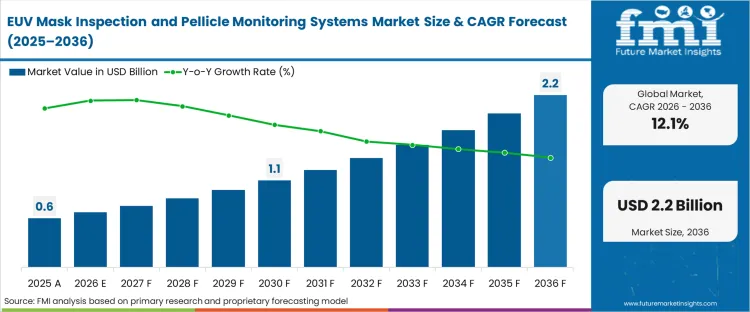
Key Takeaways
| Metric | Details |
|---|---|
| Industry Size (2026) | USD 0.71 billion |
| Industry Value (2036) | USD 2.22 billion |
| CAGR (2026 to 2036) | 12.10% |
Source: Future Market Insights (FMI) analysis, based on proprietary forecasting model and primary research
Once leading merchant mask shops validate anamorphic optics on production tools, commercial throughput requirements jump exponentially. Yield thresholds dictate that every extreme ultraviolet layer requires native-wavelength printability verification before final qualification, accelerating demand for High-NA EUV mask qualification systems. Fab managers purchasing next-generation scanners immediately face concurrent investments in actinic EUV mask inspection systems to avoid process bottlenecks. Tool manufacturers trigger this shift by delivering faster plasma sources, breaking historic computational rendering bottlenecks. Fabs attempting volume production without through-pellicle inspection for EUV masks suffer immediate defect-driven shutdowns.
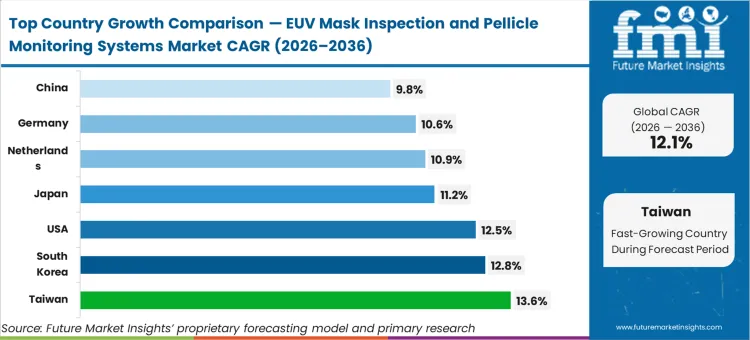
Taiwan EUV mask inspection leads regional growth at 13.6% as concentrated foundry capacity drives relentless requalification cycles. South Korea pellicle monitoring systems adoption tracks closely behind at 12.8% on aggressive memory layer transitions dictating high-volume equipment deployments. Fab capacity buildouts push United States expansion to 12.5% amid massive reshoring investments. Japan advances at 11.2%, while the Netherlands capacity expands at 10.9% due to localised core innovation hubs. Germany records 10.6% adoption, and China follows at 9.8%. The divergence splits regions operating early anamorphic pilot lines from those supporting legacy volume production, altering capital expenditure roadmaps entirely.
Market Definition
Equipment configurations designed to detect, classify, and review defects on extreme ultraviolet photomasks and protective membranes. These EUV photomask inspection systems utilize native 13.5nm wavelength illumination or deep ultraviolet optics to map pattern deviations, particles, and phase variations. Applications span initial mask shop qualification through routine wafer-fab requalification cycles. Tool architectures integrate vacuum handling, high-numerical-aperture optics, and computational defect rendering to ensure zero repeating yield limiters.
Inclusions
Actinic patterned mask inspection tools, die-to-database optical verification platforms, and dedicated pellicle transmission metrology units constitute core hardware segments. Software frameworks enabling advanced printability simulation, alongside EUV mask actinic review systems, fall within semiconductor inspection platforms boundaries. Vacuum-compatible reticle handling modules and automated backside cleaning stations integrate directly into qualified revenue streams. Services covering periodic calibration and optical column alignment represent included maintenance categories.
Exclusions
Primary extreme ultraviolet lithography scanners remain distinctly separate from defect metrology scope. Blank inspection systems utilized before pattern generation operate under different commercial dynamics and fall outside current parameters. General-purpose scanning electron microscopes lacking dedicated reticle vacuum interfaces, as well as standalone EUV mask backside inspection tools unlinked to actinic qualification, see exclusion. Unpatterned wafer surface particle counters and chemical mechanical planarization monitoring tools serve alternate yield control functions.
EUV Mask Inspection and Pellicle Monitoring Systems Market Research Methodology
- Primary Research: Fab yield managers, mask shop technical directors, and lithography equipment procurement officers tasked with semiconductor photomask quality assurance.
- Desk Research: Consortium technical roadmaps, advanced lithography conference proceedings, and leading foundry capital expenditure filings.
- Market-Sizing and Forecasting: Installed base tracking of actinic review platforms against planned 3nm logic wafer starts.
- Data Validation and Update Cycle: Vendor quarterly revenue recognition matched against merchant mask shop capacity utilization rates.
Segmental Analysis
EUV Mask Inspection and Pellicle Monitoring Systems Market Analysis by System Type
Actinic optics hold dominant position due to physical resolution limits inherent in deep ultraviolet alternatives. Phase defects buried inside multilayer reflectors remain invisible to conventional wavelengths, driving Actinic EUV patterned mask inspection systems to a 34.0% share in 2026. FMI's assessment indicates yield managers evaluating actinic inspection vs optical inspection for EUV masks require native 13.5nm illumination to predict wafer printability accurately before finalizing reticle qualification.
Procuring these platforms alters fab floor dynamics by eliminating blind spots during critical high-volume manufacturing cycles. What optical inspection advocates miss is that sub-3nm pitch resolution dictates contrast levels unachievable without extreme ultraviolet sources, forcing a complete architectural pivot. Lithography directors delaying actinic tool deployment face cascading yield failures when uncharacterized phase variations transfer onto production wafers. Equipment designers embed advanced lithography metrology capabilities directly into vacuum chambers, ensuring operators execute unbroken verification protocols. Process integration teams refuse to sign off on legacy workflows, demanding absolute photon-level confirmation.
- Phase-variation blindness: Optical tools fail to detect multilayer reflector anomalies during early fab development. Mask shop technicians face uncharacterized printable defects that ruin subsequent patterning steps. Yield engineers must implement native-wavelength verification to confirm pristine surfaces, avoiding massive financial liabilities associated with blind spot failures.
- Residual contamination risk: Standard cleaning leaves nanoscale particles embedded near sensitive gate structures. Yield enhancement directors deploy specialized platforms to scan intact assemblies, securing comprehensive baseline data. Facilities lacking dedicated hardware suffer chronic downtime when primary scanners detect unrecognized debris.
- Qualification workflow capture: Full yield protection requires integrated actinic review directly connected to lithography cells. Procurement directors must secure dedicated metrology budgets to avoid scanner idling. Delaying capital expenditure forces process teams to guess printability, drastically reducing overall fab profitability margins.
EUV Mask Inspection and Pellicle Monitoring Systems Market Analysis by Inspection Mode
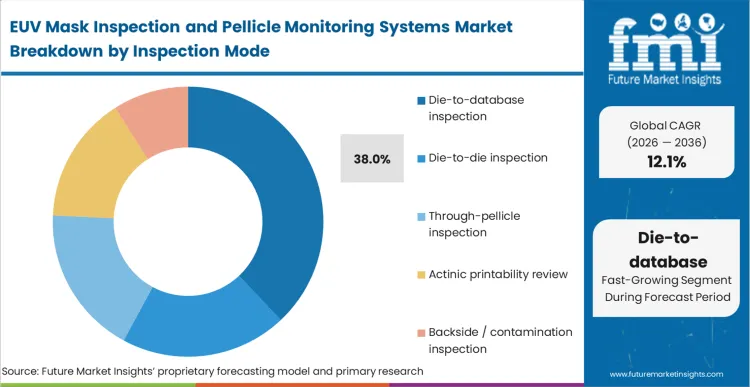
Complex computational requirements clash with physical measurement speed in advanced mask verification workflows. Die-to-database inspection captures 38.0% share because merchant mask shops must compare printed features against original digital design intent, not just adjacent dies. Fab process engineers rely on this mode to identify systemic errors introduced during reticle electron-beam writing. According to FMI's estimates, verifying complex optical proximity correction shapes requires massive parallel processing clusters linked to inspection optics.
A practitioner looking at throughput metrics knows that algorithm efficiency matters just as much as photon collection rates. Fabs attempting to use legacy die-to-die methods for single-die reticles encounter complete qualification roadblocks. Process control teams deploy specialized EUV contamination monitoring systems alongside these extreme ultraviolet platforms to resolve hidden computational bottlenecks. Capital planners authorize massive cluster upgrades to prevent layout rendering latency from freezing entire mask shop production lines. Algorithm precision determines ultimate tool viability.
- Design intent validation: Reticle generation requires absolute digital baseline matching against computer-aided design files. Mask shop directors approve purchases based solely on algorithm fidelity. Operations teams failing to deploy advanced database comparisons ship defective patterns, incurring catastrophic vendor penalties.
- Throughput optimization bottlenecks: High-volume facilities demand rapid database rendering across terabyte-scale layouts. Metrology managers validate vendor claims against rigorous speed tests. Procurement officers penalize suppliers whose computational frameworks slow down physical optical scanning, protecting aggressive fab delivery schedules.
- Fleet expansion triggers: Rising single-die chip designs force immediate capability upgrades across merchant networks. Capital planners release budgets when die-to-die techniques prove physically impossible to execute. Yield directors demand continuous software patches to refine machine learning defect classification logic.
EUV Mask Inspection and Pellicle Monitoring Systems Market Analysis by Deployment Stage
Merchant suppliers face immense financial penalties if defective reticles ship to volume manufacturing customers. Mask-shop incoming and pre-ship qualification secures 31.0% share by functioning as an absolute commercial firewall. Quality assurance directors deploy mask shop inspection equipment to certify zero printable anomalies before authorizing dispatch. FMI analysts point out that catching a multilayer defect here prevents catastrophic wafer losses later. An insider understands that pre-ship data packages often carry more contractual weight than independent fab verification. Facilities skipping rigorous outbound review risk immediate vendor disqualification from top-tier foundries. Operations teams integrate automated handling and advanced commercial lithography interfaces to maintain throughput. Yield optimization groups embed directly with mask shop personnel, auditing inspection logs daily. Correct tool calibration determines whether a merchant supplier retains elite foundry contracts or suffers rapid demotion.
- Defect liability transfer: Merchant suppliers bear massive financial risk for flawed deliverables crossing fab loading docks. Commercial directors require comprehensive, digitally signed inspection logs. Contractual disputes evaporate when native-wavelength review definitively proves reticle integrity prior to shipment.
- Metrology capacity constraints: Advanced nodes require significantly longer scan times per complex reticle. Equipment procurement officers must forecast tool needs years ahead of actual lithography deployment. Fab managers rejecting expanded metrology budgets face immediate supply chain bottlenecks.
- Ecosystem standardization limits: Foundries demand identical inspection parameters across external suppliers to normalize yield assumptions. Mask shop technical leads align capital roadmaps strictly with customer dictates. Diverging from established baseline protocols invites intense process audits from principal client engineering teams.
EUV Mask Inspection and Pellicle Monitoring Systems Market Analysis by End User
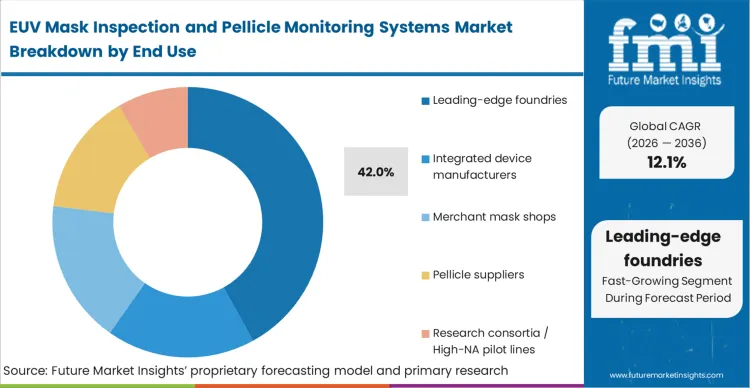
Legacy deep ultraviolet nodes spread capacity across numerous device manufacturers, whereas extreme ultraviolet economics concentrate power into specific geographic hubs. Leading-edge foundries hold 42.0% share because they operate massive scanner fleets requiring continuous EUV mask qualification in wafer fabs. Lithography module managers run these facilities with zero tolerance for repeater defects. Based on FMI's view, an aggressive transition toward 3nm production breaks conventional sampling methodologies completely. Generalists view fab metrology as a unified discipline, yet EUV mask inspection for foundries operates as an isolated, ultra-secure technical silo. Operators failing to deploy dedicated through-pellicle inspection tools experience severe scanner utilization drops. Fab networks invest heavily in integrated wafer metrology architectures to correlate reticle anomalies with actual printed failures. Centralized yield teams dictate exactly which hardware architectures smaller players must adopt to remain compatible.
- Foundry pioneer deployment: Leading volume producers require immediate defect mitigation to protect aggressive node ramps. Chief technology officers authorize massive initial capital outlays to establish baseline procedures. Competitors attempting to copy these protocols face steep learning curves without adequate hardware.
- Memory manufacturer fast-follow: DRAM producers transition critical capacitor layers to native wavelengths. Process integration directors adapt foundry-proven metrology protocols to fit memory-specific geometries. Operations leaders lacking actinic tools suffer massive yield degradation during high-volume ramp phases.
- Research consortium validation: Next-generation anamorphic architectures demand early baseline establishment before commercial scanners arrive. Pilot line managers test advanced tool capabilities, dictating future volume production standards. Yield engineers establish acceptable defect thresholds that eventually govern global manufacturing specifications.
EUV Mask Inspection and Pellicle Monitoring Systems Market Analysis by Node Focus
Aggressive shrinking of logic gate dimensions pushes metrology requirements beyond theoretical optical limits. FMI's analysis indicates 3nm and 2nm logic / equivalent DRAM layers capture 46.0% share as device manufacturers race toward gate-all-around architectures. Yield enhancement directors deploy pellicle monitoring systems for 2nm fabs to resolve increasingly complex optical proximity correction features. Navigating these nanoscale geometries demands unprecedented signal-to-noise ratios during defect review. While observers focus on scanner resolution, actual yield entitlement depends entirely on identifying stochastic mask defects before wafer printing. Module owners ignoring native-wavelength verification at 2nm geometries guarantee complete lot failures. Development teams utilize specialized laser photomask infrastructure to qualify early pathfinding designs. Equipment engineers optimize EUV mask defectivity reduction tools to penetrate dense routing layers, protecting critical wafer throughput metrics. Mask complexity dictates continuous tool algorithm refinement.
- Yield baseline establishment: Initial process ramp phases tolerate massive capital expenditure to uncover hidden failure modes. Financial controllers approve actinic tools specifically to accelerate crucial learning curves. Facilities delaying this expenditure hemorrhage cash through sustained sub-optimal wafer yields.
- Repeater defect penalty: Single mask anomalies destroy entire high-value wafer lots in hours. Yield managers justify severe equipment premiums against catastrophic scrap costs. Operations directors operating blindly without native-wavelength verification expose their organizations to crippling financial losses.
- Tool utilization optimization: Dedicated review stations keep primary scanners actively printing wafers instead of qualifying reticles. Operations directors calculate return on investment through increased overall lithography cell uptime. Fab supervisors demand robust standalone inspection capacity to maintain maximum facility throughput.
EUV Mask Inspection and Pellicle Monitoring Systems Market Drivers, Restraints, and Opportunities
Catastrophic financial consequences of repeating defects compel fab directors to implement 100% reticle area inspection. Single phase errors on a 3nm logic mask replicate across thousands of expensive wafers, creating unacceptable scrap costs. Yield managers cannot wait for printed wafer metrology to flag issues; they require immediate verification before production begins. Delaying platform integration exposes leading-edge facilities to hidden multilayer anomalies that optical tools routinely miss. This zero-defect mandate accelerates rapid capital deployment into dedicated inspection infrastructure, overriding traditional budget constraints. Module owners recognize that maintaining competitive fabrication costs relies entirely on catching reticle deviations prior to high-volume scanner insertion.
Actinic source reliability limits operational throughput during critical mask shop qualification cycles. Plasma source brightness and continuous uptime remain bottlenecks, preventing rapid high-volume scanning of entire reticle fields. Mask shop operations directors struggle to balance comprehensive defect detection against strict delivery schedule commitments. Upgraded plasma sources offer partial improvements but still fall short of optical tool throughput speeds. Evaluating EUV mask inspection total cost of ownership forces facilities to blend native-wavelength review with conventional optical scanning, complicating overall data architectures. Lithography teams must actively manage tool latency, prioritizing specific critical layers to prevent widespread supply chain congestion.
Opportunities in EUV Mask Inspection and Pellicle Monitoring Systems Market
- Anamorphic platform development: Next-generation optics require fundamentally different defect rendering algorithms. Metrology vendors capturing this transition secure early baseline dominance across pilot lines.
- Carbon nanotube pellicle metrology: Advanced membranes present unique transmission characteristics. Equipment designers developing specialized direct-write verification modules capture niche recurring revenue.
- Computational algorithm licensing: Mask shops demand faster die-to-database rendering times. Software engineering teams offering accelerated machine learning classification command extreme premium pricing.
Regional Analysis
Based on regional analysis, EUV mask inspection and pellicle monitoring systems market is segmented into North America, Latin America, Western Europe, Eastern Europe, East Asia, South Asia and Pacific, and Middle East and Africa across 40 plus countries.
.webp "Top Country Growth Comparison Euv Mask Inspection And Pellicle Monitoring Systems Market Cagr (2026 2036)")
| Country | CAGR (2026 to 2036) |
|---|---|
| Taiwan | 13.6% |
| South Korea | 12.8% |
| United States | 12.5% |
| Japan | 11.2% |
| Netherlands | 10.9% |
| Germany | 10.6% |
| China | 9.8% |
Source: Future Market Insights (FMI) analysis, based on proprietary forecasting model and primary research
East Asia EUV Mask Inspection and Pellicle Monitoring Systems Market Analysis
Massive foundry capacity concentration forces operators into relentless reticle requalification cycles across advanced nodes. Process engineers at leading-edge fabs demand continuous through-pellicle inspection to prevent particle-induced yield crashes. FMI's view confirms this region dictates global metrology specifications due to sheer equipment volume and aggressive layer counts. Integrated device manufacturers rapidly deploy native-wavelength review platforms to support complex memory transitions. Regional mask shops align capital roadmaps strictly with local foundry requirements, creating a tightly coupled technological ecosystem. Procuring advanced semiconductor capital control systems accelerates overall process maturity. Capital planners recognize that delayed investments in dedicated inspection infrastructure immediately degrade fab utilization rates. Yield directors implement zero-tolerance policies regarding repeating printable defects.
- Taiwan: The EUV mask inspection and pellicle monitoring systems segment in Taiwan advances at a 13.6% CAGR. Dense foundry networks execute ultra-fast reticle requalification cadences to protect advanced logic yields. Fab managers authorize massive actinic tool purchases to maintain competitive dominance and support artificial intelligence chip production. Aggressive metrology deployment grants local manufacturers an insurmountable cost advantage over international competitors attempting complex node scaling.
- South Korea: Memory manufacturers push layer counts rapidly upward, demanding stringent defect control. Yield directors implement comprehensive protective membrane scanning protocols to sustain high-volume dynamic random-access memory fabrication cycles. As a result, the South Korea EUV mask inspection and pellicle monitoring systems industry is expected to track at a 12.8% CAGR. Operations teams integrating these specialised platforms report dramatic reductions in wafer scrap rates across advanced facilities.
- Japan: The Japan EUV mask inspection and pellicle monitoring systems industry expands at an 11.2% CAGR. Established merchant mask shops command a significant global share by mastering complex computational defect rendering. Technical directors invest heavily in high-resolution database comparison clusters to satisfy aggressive foundry requirements. Regional suppliers maintain critical competitive leverage through continuous optimisation of native-wavelength verification techniques alongside substantial government-backed supply chain self-sufficiency initiatives.
- China: Equipment access restrictions fundamentally limit native-wavelength tool deployment across domestic fabrication facilities. Process engineers rely heavily on deep ultraviolet infrastructure for early-node logic development. Despite these barriers, the China EUV mask inspection and pellicle monitoring systems demand is estimated to grow at a 9.8% CAGR. Facilities operating under strict export controls face substantial challenges advancing toward sub-5nm qualification without acquiring dedicated actinic review hardware.
FMI's report includes qualitative assessments for emerging technological hubs across East Asia not explicitly detailed in quantitative projections. Foundries establishing secondary manufacturing sites require standardized metrology protocols matching primary facility capabilities.
North America EUV Mask Inspection and Pellicle Monitoring Systems Market Analysis
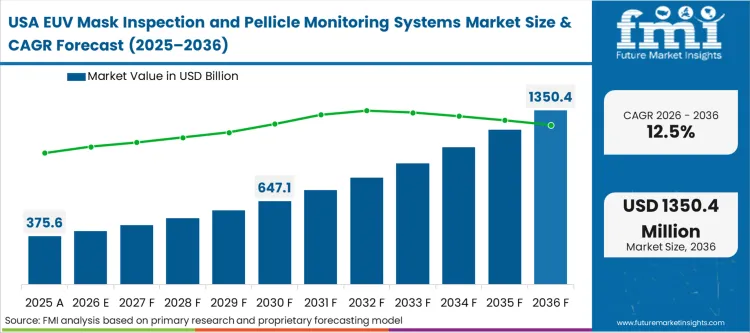
Strategic reshoring initiatives drive accelerated capital deployment into advanced process control infrastructure. Foundry expansion projects require dedicated reticle qualification capability to achieve baseline yield targets. According to FMI's estimates, regional research consortia heavily influence early anamorphic tool configuration standards. Mask shops expanding domestic footprint prioritize actinic review to capture high-margin defense and artificial intelligence semiconductor contracts. Operations directors integrate specialized analytics platforms to optimize tool utilization across expanding fab networks. Procurement officers face intense pressure to localize supply chains, reducing dependence on trans-Pacific reticle shipping and qualification delays. Facilities must secure independent metrology ecosystems to validate domestic production capabilities.
- United States: The domestic urgency drives the United States EUV mask inspection and pellicle monitoring systems segment to expand at a 12.5% CAGR. Strategic reshoring initiatives and ecosystem development accelerate critical pilot line capability buildouts. Procurement officers secure next-generation defect review platforms to support localized advanced logic architectures. Early establishment of anamorphic inspection protocols positions domestic research facilities well ahead of international high-volume equipment deployment timelines.
FMI's report includes secondary supplier networks supporting major semiconductor corridors across North America. Regional expansion demands localized service infrastructure to maintain complex vacuum and optical subsystems.
Western Europe EUV Mask Inspection and Pellicle Monitoring Systems Market Analysis
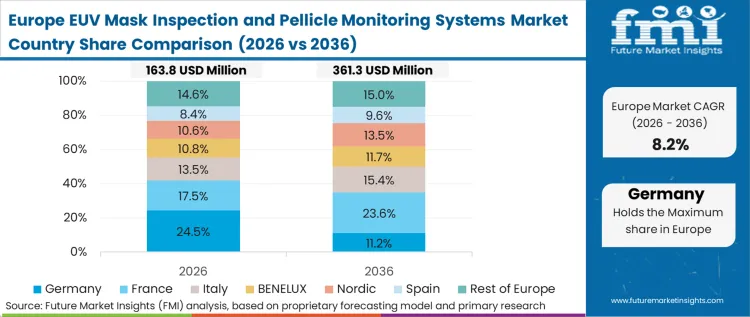
Core lithography ecosystem concentration positions regional suppliers as primary architects of next-generation metrology standards. Development teams define actinic source brightness requirements and computational optics algorithms. FMI analysts highlight how joint research programs between equipment vendors and premier research institutes accelerate product commercialization timelines. Pilot lines serve as global qualification testing grounds for advanced pellicle materials. Fab managers across allied global networks depend entirely on these regional innovation pipelines. Supply chain directors embed personnel directly within local development hubs to secure early access to prototype platforms. This geographic cluster controls essential optical patents required for physical defect rendering.
- Netherlands: Primary lithography equipment development anchors advanced metrology pathfinding and innovation. Engineering teams validate anamorphic optics performance against increasingly complex reticle designs. This foundational research pushes the Netherlands EUV mask inspection and pellicle monitoring systems segment to advance at a 10.9% CAGR. Foundational discoveries established within this highly concentrated geographic cluster dictate global foundry adoption roadmaps and next-generation extreme ultraviolet equipment capability baseline specifications.
- Germany: High-precision optical subsystem suppliers dominate core inspection hardware and sensor development. Technical directors optimize specialized vacuum handling and opto-mechanical integration required for native-wavelength platforms. This engineering concentration takes the German EUV mask inspection and pellicle monitoring systems industry to a 10.6% CAGR. Mastering these complex component interfaces grants regional vendors total technical dominance over critical niche segments within the global advanced lithography supply chain.
FMI's report includes specialty component manufacturers operating throughout Western Europe. Sustaining technological leadership requires continuous investment in ultra-high-vacuum engineering and sensitive sensor fabrication.
Competitive Aligners for Market Players
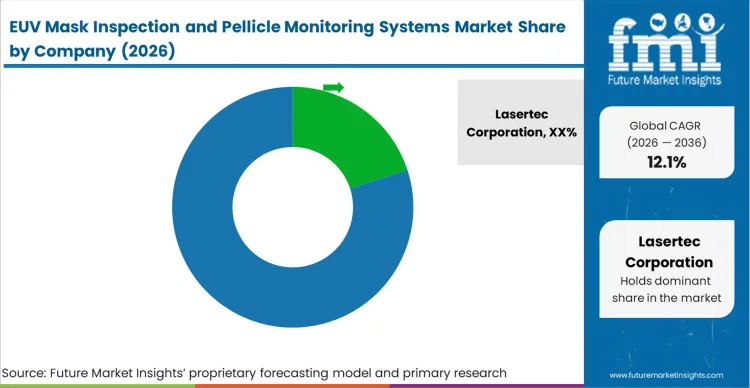
Actinic platform development requires massive capital investment and multi-year collaborative engineering with primary lithography providers. Lasertec Corporation, Carl Zeiss SMT GmbH, and KLA Corporation navigate a highly concentrated supplier environment where barriers to entry include specialized vacuum physics and native-wavelength optical expertise. EUV mask inspection key players evaluate equipment based purely on defect capture rates and false-positive elimination, ignoring minor pricing variations. Process engineers require absolute confidence that a designated tool identifies every printable anomaly before authoring volume production. Reliability metrics far outweigh initial acquisition costs during supplier selection protocols among top EUV mask inspection systems suppliers.
Established vendors hold vast libraries of proprietary defect classification algorithms that challengers cannot quickly replicate. NuFlare Technology, Inc., ASML Holding N.V., and Hitachi High-Tech Corporation leverage deep integration with merchant mask shop digital workflows. Foundries implementing advanced process monitoring demand seamless data handoffs between layout rendering clusters and physical inspection optics. Generating accurate die-to-database comparisons requires computational infrastructure that new EUV pellicle inspection equipment vendors lack. Advantest Corporation integrates specialized review capabilities to complement existing ecosystem workflows, securing distinct integration advantages.
Top-tier foundries fiercely resist equipment monopolies by cultivating secondary deep ultraviolet inspection pathways for non-critical layers, shifting the KLA vs Lasertec EUV mask inspection dynamics locally. Procurement directors deploy mixed metrology fleets to optimize capital expenditure while maintaining maximum yield protection. Equipment vendors face immense pressure to accelerate native-wavelength tool throughput, bridging wide gaps between slow review speeds and high-volume manufacturing demands. Future platform architectures will inevitably blend machine learning classification directly onto sensor hardware, drastically reducing image processing latency. Operators achieving these speed improvements dictate upcoming fab upgrade cycles.
Key Players in EUV Mask Inspection and Pellicle Monitoring Systems Market
- Lasertec Corporation
- KLA Corporation
- Carl Zeiss SMT GmbH
- NuFlare Technology, Inc.
- ASML Holding N.V.
- Advantest Corporation
- Hitachi High-Tech Corporation
Scope of the Report
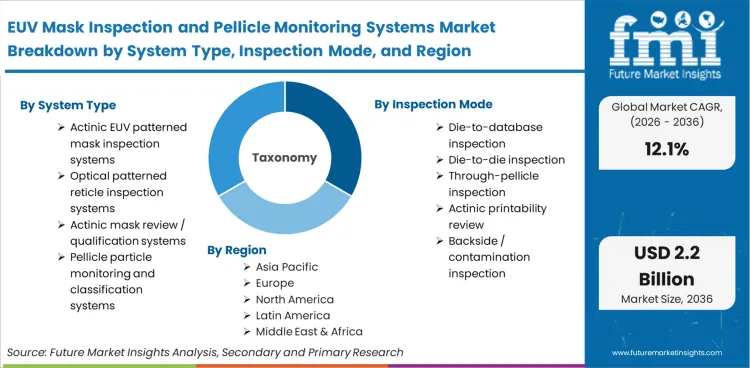
| Metric | Value |
|---|---|
| Quantitative Units | USD 0.71 billion to USD 2.22 billion, at a CAGR of 12.10% |
| Market Definition | Equipment configurations designed to detect, classify, and review defects on extreme ultraviolet photomasks and protective membranes. Platforms utilize native 13.5nm wavelength illumination or deep ultraviolet optics to map pattern deviations, particles, and phase variations. |
| Segmentation | System type, Inspection mode, Deployment stage, End user, Node focus, and Region |
| Regions Covered | North America, Latin America, Western Europe, Eastern Europe, East Asia, South Asia and Pacific, Middle East and Africa |
| Countries Covered | United States, Germany, Netherlands, China, Japan, South Korea, Taiwan |
| Key Companies Profiled | Lasertec Corporation, KLA Corporation, Carl Zeiss SMT GmbH, NuFlare Technology, Inc., ASML Holding N.V., Advantest Corporation, Hitachi High-Tech Corporation |
| Forecast Period | 2026 to 2036 |
| Approach | Installed base tracking of actinic review platforms against planned 3nm and 2nm logic wafer starts. |
Source: Future Market Insights (FMI) analysis, based on proprietary forecasting model and primary research
EUV Mask Inspection and Pellicle Monitoring Systems Market Analysis by Segments
System type:
- Actinic EUV patterned mask inspection systems
- Optical patterned reticle inspection systems
- Actinic mask review / qualification systems
- Pellicle particle monitoring and classification systems
- Mask backside inspection and cleaning systems
Inspection mode:
- Die-to-database inspection
- Die-to-die inspection
- Through-pellicle inspection
- Actinic printability review
- Backside / contamination inspection
Deployment stage:
- Mask-shop incoming and pre-ship qualification
- Wafer-fab incoming mask qualification
- Periodic in-fab requalification
- Pellicle manufacturing QA
- R&D / pilot-line process qualification
End user:
- Leading-edge foundries
- Integrated device manufacturers
- Merchant mask shops
- Pellicle suppliers
- Research consortia / High-NA pilot lines
Node focus:
- 3nm and 2nm logic / equivalent DRAM layers
- 5nm legacy EUV production support
- High-NA pilot and early HVM masks
- Advanced EUV memory layers
- Future sub-2nm exploratory programs
Region:
- North America
- United States
- Canada
- Europe
- Germany
- United Kingdom
- France
- Italy
- Spain
- Asia Pacific
- China
- Japan
- South Korea
- Taiwan
- Singapore
- Latin America
- Brazil
- Mexico
- Argentina
- Middle East & Africa
- GCC Countries
- South Africa
Bibliography
- ASML Holding N.V. (2026, February 25). ASML publishes 2025 Annual Reports. ASML Holding N.V.
- ASML Holding N.V. (2024, June 3). ASML and imec open joint High NA EUV Lithography Lab. ASML Holding N.V.
- Imec. (2024, February 26). Imec demonstrates the readiness of the High-NA EUV ecosystem. Imec.
- Lasertec Corporation. (2024, December 2). Lasertec Releases PELMIS Series EUV Pellicle Inspection System. Lasertec Corporation.
- Lasertec Corporation. (2025, July 11). Lasertec Releases PELMIS EPM200 EUV Pellicle Inspection System Supporting CNT Pellicles. Lasertec Corporation.
- ZEISS Semiconductor Manufacturing Technology. (2026, February 4). AIMS® EUV 3.0: ZEISS SMT extends global footprint in actinic mask qualification. ZEISS Semiconductor Manufacturing Technology.
- International Society for Optics and Photonics. (2024, November 12). EUV mask technologies: evolution and ecosystem for devices. SPIE Digital Library.
This bibliography is provided for reader's reference. The full FMI report contains the complete reference list with primary source documentation.
Frequently Asked Questions
What are EUV mask inspection and pellicle monitoring systems market dynamics?
Revenue is set to reach USD 2.22 billion by 2036, reflecting massive capital requirements for sub-3nm logic defect control. Tool adoption scales directly with extreme ultraviolet scanner deployment.
Why do EUV pellicles need dedicated monitoring?
Standard cleaning procedures leave nanoscale contamination. Yield managers deploy specialized metrology to verify pristine surfaces without breaking vacuum, as defects directly compromise mask integrity.
How does through-pellicle inspection for EUV masks differ from conventional reticle inspection?
Removing protective membranes for routine requalification introduces catastrophic particle risk. Through-pellicle platforms scan intact assemblies using specialized native-wavelength or optical subsystems to preserve the pristine mask environment.
How does High-NA EUV change mask inspection requirements?
Complex anamorphic structures require fundamentally different computational rendering algorithms. Foundries must upgrade entire database comparison clusters to support the unique field sizes of next-generation scanners.
Which companies currently lead this market?
Lasertec Corporation, KLA Corporation, and Carl Zeiss SMT GmbH dominate the sector. Incumbents hold vast proprietary defect classification libraries that challengers struggle to replicate.
Why is Taiwan expected to lead demand growth?
Concentrated foundry networks execute rapid mask verification cycles. Local fabs authorize massive actinic tool purchases to secure critical yield advantages over global competitors.
What is the role of actinic inspection in defect printability analysis?
Sub-3nm pitch resolution requires contrast levels unachievable with deep ultraviolet illumination. Actinic platforms identify uncharacterized phase variations that transfer directly onto production wafers.
How do wafer fabs evaluate pellicle monitoring vendors?
Procurement officers prioritize defect capture rates and false-positive elimination. Reliability metrics and tool uptime far outweigh initial acquisition costs during the supplier selection protocol.
What are the main failure modes on EUV pellicles?
Thermal degradation and particle contamination compromise transmission uniformity. If undetected by specialized metrology tools, these anomalies cast shadows that print as repeating wafer defects.
How often do EUV masks need requalification in production?
Leading-edge foundries demand continuous periodic verification. Aggressive transition toward 3nm production forces operators to abandon statistical sampling for 100% reticle area inspection.
Which System type currently leads adoption?
Actinic EUV patterned mask inspection systems command 34.0% share because deep ultraviolet tools cannot detect buried phase defects.
How fast is demand expanding globally?
Sales are expected to advance at a 12.10% compound annual rate through 2036, driven by zero-defect printing mandates.
Why does Die-to-database inspection hold dominant share?
Mask shop directors require absolute validation against original digital intent. Algorithm fidelity secures 38.0% segment share.
What deployment stage captures peak investment?
Mask-shop incoming and pre-ship qualification holds 31.0% share as merchant suppliers guarantee pristine reticle delivery.
Which end user dictates metrology requirements?
Leading-edge foundries control 42.0% share. Fab managers operate massive scanner fleets requiring continuous native-wavelength requalification.
What constraint slows early actinic platform deployment?
Source brightness limits operational throughput. Mask shop technical leads struggle to balance comprehensive defect scanning against delivery commitments.
How does South Korea compare to Taiwan?
South Korea expands at 12.8% due to aggressive memory layer transitions, whereas Taiwan relies on pure-play logic foundry capacity.
What role do merchant mask shops play in ecosystem maturity?
Independent suppliers assume massive financial liability for defective reticles. Quality assurance teams demand identical inspection parameters across external supply chains.
What operational consequence follows incorrect tool selection?
Single repeating printable defects destroy entire wafer lots. Module owners face massive scrap costs if inspection protocols fail.
How does the United States ecosystem approach anamorphic integration?
Regional research consortia establish early optical configuration standards. Domestic pilot lines secure next-generation defect review capabilities before global deployment.
What drives adoption among 3nm and 2nm logic layers?
Complex optical proximity correction features demand unprecedented signal-to-noise ratios. Metrology teams require native wavelengths to resolve intricate stochastic variations.
Why do fabs maintain secondary optical inspection pathways?
Procurement officers deploy mixed fleets to optimize capital expenditure. Deep ultraviolet platforms handle non-critical layers, preserving expensive actinic capacity.
What specialized capability defines Netherlands market presence?
Primary lithography equipment development anchors advanced metrology pathfinding. Regional engineering teams validate anamorphic optics performance against complex designs.
How will platform architectures evolve by 2036?
Machine learning classification will embed directly onto sensor hardware. Lithography directors anticipate drastic reductions in image processing latency during high-volume scans.
Preview the report firsthand - request a free sample
Get SampleGet the brochure for pricing and purchase details.
Get PDFTable of Content
- Executive Summary
- Global Market Outlook
- Demand-side Trends
- Supply-side Trends
- Technology Roadmap Analysis
- Analysis and Recommendations
- Market Overview
- Market Coverage / Taxonomy
- Market Definition / Scope / Limitations
- Research Methodology
- Chapter Orientation
- Analytical Lens and Working Hypotheses
- Market Structure, Signals, and Trend Drivers
- Benchmarking and Cross-market Comparability
- Market Sizing, Forecasting, and Opportunity Mapping
- Research Design and Evidence Framework
- Desk Research Programme (Secondary Evidence)
- Company Annual and Sustainability Reports
- Peer-reviewed Journals and Academic Literature
- Corporate Websites, Product Literature, and Technical Notes
- Earnings Decks and Investor Briefings
- Statutory Filings and Regulatory Disclosures
- Technical White Papers and Standards Notes
- Trade Journals, Industry Magazines, and Analyst Briefs
- Conference Proceedings, Webinars, and Seminar Materials
- Government Statistics Portals and Public Data Releases
- Press Releases and Reputable Media Coverage
- Specialist Newsletters and Curated Briefings
- Sector Databases and Reference Repositories
- FMI Internal Proprietary Databases and Historical Market Datasets
- Subscription Datasets and Paid Sources
- Social Channels, Communities, and Digital Listening Inputs
- Additional Desk Sources
- Expert Input and Fieldwork (Primary Evidence)
- Primary Modes
- Qualitative Interviews and Expert Elicitation
- Quantitative Surveys and Structured Data Capture
- Blended Approach
- Why Primary Evidence is Used
- Field Techniques
- Interviews
- Surveys
- Focus Groups
- Observational and In-context Research
- Social and Community Interactions
- Stakeholder Universe Engaged
- C-suite Leaders
- Board Members
- Presidents and Vice Presidents
- R&D and Innovation Heads
- Technical Specialists
- Domain Subject-matter Experts
- Scientists
- Physicians and Other Healthcare Professionals
- Governance, Ethics, and Data Stewardship
- Research Ethics
- Data Integrity and Handling
- Primary Modes
- Tooling, Models, and Reference Databases
- Desk Research Programme (Secondary Evidence)
- Data Engineering and Model Build
- Data Acquisition and Ingestion
- Cleaning, Normalisation, and Verification
- Synthesis, Triangulation, and Analysis
- Quality Assurance and Audit Trail
- Market Background
- Market Dynamics
- Drivers
- Restraints
- Opportunity
- Trends
- Scenario Forecast
- Demand in Optimistic Scenario
- Demand in Likely Scenario
- Demand in Conservative Scenario
- Opportunity Map Analysis
- Product Life Cycle Analysis
- Supply Chain Analysis
- Investment Feasibility Matrix
- Value Chain Analysis
- PESTLE and Porter’s Analysis
- Regulatory Landscape
- Regional Parent Market Outlook
- Production and Consumption Statistics
- Import and Export Statistics
- Market Dynamics
- Global Market Analysis 2021 to 2025 and Forecast, 2026 to 2036
- Historical Market Size Value (USD Million) Analysis, 2021 to 2025
- Current and Future Market Size Value (USD Million) Projections, 2026 to 2036
- Y-o-Y Growth Trend Analysis
- Absolute $ Opportunity Analysis
- Global Market Pricing Analysis 2021 to 2025 and Forecast 2026 to 2036
- Global Market Analysis 2021 to 2025 and Forecast 2026 to 2036, By System Type
- Introduction / Key Findings
- Historical Market Size Value (USD Million) Analysis By System Type , 2021 to 2025
- Current and Future Market Size Value (USD Million) Analysis and Forecast By System Type , 2026 to 2036
- Actinic EUV patterned mask inspection systems
- Optical patterned reticle inspection systems
- Actinic mask review / qualification systems
- Pellicle particle monitoring and classification systems
- Mask backside inspection and cleaning systems
- Actinic EUV patterned mask inspection systems
- Y-o-Y Growth Trend Analysis By System Type , 2021 to 2025
- Absolute $ Opportunity Analysis By System Type , 2026 to 2036
- Global Market Analysis 2021 to 2025 and Forecast 2026 to 2036, By Inspection Mode
- Introduction / Key Findings
- Historical Market Size Value (USD Million) Analysis By Inspection Mode, 2021 to 2025
- Current and Future Market Size Value (USD Million) Analysis and Forecast By Inspection Mode, 2026 to 2036
- Die-to-database inspection
- Die-to-die inspection
- Through-pellicle inspection
- Actinic printability review
- Backside / contamination inspection
- Die-to-database inspection
- Y-o-Y Growth Trend Analysis By Inspection Mode, 2021 to 2025
- Absolute $ Opportunity Analysis By Inspection Mode, 2026 to 2036
- Global Market Analysis 2021 to 2025 and Forecast 2026 to 2036, By Deployment Stage
- Introduction / Key Findings
- Historical Market Size Value (USD Million) Analysis By Deployment Stage, 2021 to 2025
- Current and Future Market Size Value (USD Million) Analysis and Forecast By Deployment Stage, 2026 to 2036
- Mask-shop incoming and pre-ship qualification
- Wafer-fab incoming mask qualification
- Periodic in-fab requalification
- Pellicle manufacturing QA
- R&D / pilot-line process qualification
- Mask-shop incoming and pre-ship qualification
- Y-o-Y Growth Trend Analysis By Deployment Stage, 2021 to 2025
- Absolute $ Opportunity Analysis By Deployment Stage, 2026 to 2036
- Global Market Analysis 2021 to 2025 and Forecast 2026 to 2036, By End Use
- Introduction / Key Findings
- Historical Market Size Value (USD Million) Analysis By End Use, 2021 to 2025
- Current and Future Market Size Value (USD Million) Analysis and Forecast By End Use, 2026 to 2036
- Leading-edge foundries
- Integrated device manufacturers
- Merchant mask shops
- Pellicle suppliers
- Research consortia / High-NA pilot lines
- Leading-edge foundries
- Y-o-Y Growth Trend Analysis By End Use, 2021 to 2025
- Absolute $ Opportunity Analysis By End Use, 2026 to 2036
- Global Market Analysis 2021 to 2025 and Forecast 2026 to 2036, By Node Focus
- Introduction / Key Findings
- Historical Market Size Value (USD Million) Analysis By Node Focus, 2021 to 2025
- Current and Future Market Size Value (USD Million) Analysis and Forecast By Node Focus, 2026 to 2036
- 3nm and 2nm logic / equivalent DRAM layers
- 5nm legacy EUV production support
- High-NA pilot and early HVM masks
- Advanced EUV memory layers
- Future sub-2nm exploratory programs
- 3nm and 2nm logic / equivalent DRAM layers
- Y-o-Y Growth Trend Analysis By Node Focus, 2021 to 2025
- Absolute $ Opportunity Analysis By Node Focus, 2026 to 2036
- Global Market Analysis 2021 to 2025 and Forecast 2026 to 2036, By Region
- Introduction
- Historical Market Size Value (USD Million) Analysis By Region, 2021 to 2025
- Current Market Size Value (USD Million) Analysis and Forecast By Region, 2026 to 2036
- North America
- Latin America
- Western Europe
- Eastern Europe
- East Asia
- South Asia and Pacific
- Middle East & Africa
- Market Attractiveness Analysis By Region
- North America Market Analysis 2021 to 2025 and Forecast 2026 to 2036, By Country
- Historical Market Size Value (USD Million) Trend Analysis By Market Taxonomy, 2021 to 2025
- Market Size Value (USD Million) Forecast By Market Taxonomy, 2026 to 2036
- By Country
- USA
- Canada
- Mexico
- By System Type
- By Inspection Mode
- By Deployment Stage
- By End Use
- By Node Focus
- By Country
- Market Attractiveness Analysis
- By Country
- By System Type
- By Inspection Mode
- By Deployment Stage
- By End Use
- By Node Focus
- Key Takeaways
- Latin America Market Analysis 2021 to 2025 and Forecast 2026 to 2036, By Country
- Historical Market Size Value (USD Million) Trend Analysis By Market Taxonomy, 2021 to 2025
- Market Size Value (USD Million) Forecast By Market Taxonomy, 2026 to 2036
- By Country
- Brazil
- Chile
- Rest of Latin America
- By System Type
- By Inspection Mode
- By Deployment Stage
- By End Use
- By Node Focus
- By Country
- Market Attractiveness Analysis
- By Country
- By System Type
- By Inspection Mode
- By Deployment Stage
- By End Use
- By Node Focus
- Key Takeaways
- Western Europe Market Analysis 2021 to 2025 and Forecast 2026 to 2036, By Country
- Historical Market Size Value (USD Million) Trend Analysis By Market Taxonomy, 2021 to 2025
- Market Size Value (USD Million) Forecast By Market Taxonomy, 2026 to 2036
- By Country
- Germany
- UK
- Italy
- Spain
- France
- Nordic
- BENELUX
- Rest of Western Europe
- By System Type
- By Inspection Mode
- By Deployment Stage
- By End Use
- By Node Focus
- By Country
- Market Attractiveness Analysis
- By Country
- By System Type
- By Inspection Mode
- By Deployment Stage
- By End Use
- By Node Focus
- Key Takeaways
- Eastern Europe Market Analysis 2021 to 2025 and Forecast 2026 to 2036, By Country
- Historical Market Size Value (USD Million) Trend Analysis By Market Taxonomy, 2021 to 2025
- Market Size Value (USD Million) Forecast By Market Taxonomy, 2026 to 2036
- By Country
- Russia
- Poland
- Hungary
- Balkan & Baltic
- Rest of Eastern Europe
- By System Type
- By Inspection Mode
- By Deployment Stage
- By End Use
- By Node Focus
- By Country
- Market Attractiveness Analysis
- By Country
- By System Type
- By Inspection Mode
- By Deployment Stage
- By End Use
- By Node Focus
- Key Takeaways
- East Asia Market Analysis 2021 to 2025 and Forecast 2026 to 2036, By Country
- Historical Market Size Value (USD Million) Trend Analysis By Market Taxonomy, 2021 to 2025
- Market Size Value (USD Million) Forecast By Market Taxonomy, 2026 to 2036
- By Country
- China
- Japan
- South Korea
- By System Type
- By Inspection Mode
- By Deployment Stage
- By End Use
- By Node Focus
- By Country
- Market Attractiveness Analysis
- By Country
- By System Type
- By Inspection Mode
- By Deployment Stage
- By End Use
- By Node Focus
- Key Takeaways
- South Asia and Pacific Market Analysis 2021 to 2025 and Forecast 2026 to 2036, By Country
- Historical Market Size Value (USD Million) Trend Analysis By Market Taxonomy, 2021 to 2025
- Market Size Value (USD Million) Forecast By Market Taxonomy, 2026 to 2036
- By Country
- India
- ASEAN
- Australia & New Zealand
- Rest of South Asia and Pacific
- By System Type
- By Inspection Mode
- By Deployment Stage
- By End Use
- By Node Focus
- By Country
- Market Attractiveness Analysis
- By Country
- By System Type
- By Inspection Mode
- By Deployment Stage
- By End Use
- By Node Focus
- Key Takeaways
- Middle East & Africa Market Analysis 2021 to 2025 and Forecast 2026 to 2036, By Country
- Historical Market Size Value (USD Million) Trend Analysis By Market Taxonomy, 2021 to 2025
- Market Size Value (USD Million) Forecast By Market Taxonomy, 2026 to 2036
- By Country
- Kingdom of Saudi Arabia
- Other GCC Countries
- Turkiye
- South Africa
- Other African Union
- Rest of Middle East & Africa
- By System Type
- By Inspection Mode
- By Deployment Stage
- By End Use
- By Node Focus
- By Country
- Market Attractiveness Analysis
- By Country
- By System Type
- By Inspection Mode
- By Deployment Stage
- By End Use
- By Node Focus
- Key Takeaways
- Key Countries Market Analysis
- USA
- Pricing Analysis
- Market Share Analysis, 2025
- By System Type
- By Inspection Mode
- By Deployment Stage
- By End Use
- By Node Focus
- Canada
- Pricing Analysis
- Market Share Analysis, 2025
- By System Type
- By Inspection Mode
- By Deployment Stage
- By End Use
- By Node Focus
- Mexico
- Pricing Analysis
- Market Share Analysis, 2025
- By System Type
- By Inspection Mode
- By Deployment Stage
- By End Use
- By Node Focus
- Brazil
- Pricing Analysis
- Market Share Analysis, 2025
- By System Type
- By Inspection Mode
- By Deployment Stage
- By End Use
- By Node Focus
- Chile
- Pricing Analysis
- Market Share Analysis, 2025
- By System Type
- By Inspection Mode
- By Deployment Stage
- By End Use
- By Node Focus
- Germany
- Pricing Analysis
- Market Share Analysis, 2025
- By System Type
- By Inspection Mode
- By Deployment Stage
- By End Use
- By Node Focus
- UK
- Pricing Analysis
- Market Share Analysis, 2025
- By System Type
- By Inspection Mode
- By Deployment Stage
- By End Use
- By Node Focus
- Italy
- Pricing Analysis
- Market Share Analysis, 2025
- By System Type
- By Inspection Mode
- By Deployment Stage
- By End Use
- By Node Focus
- Spain
- Pricing Analysis
- Market Share Analysis, 2025
- By System Type
- By Inspection Mode
- By Deployment Stage
- By End Use
- By Node Focus
- France
- Pricing Analysis
- Market Share Analysis, 2025
- By System Type
- By Inspection Mode
- By Deployment Stage
- By End Use
- By Node Focus
- India
- Pricing Analysis
- Market Share Analysis, 2025
- By System Type
- By Inspection Mode
- By Deployment Stage
- By End Use
- By Node Focus
- ASEAN
- Pricing Analysis
- Market Share Analysis, 2025
- By System Type
- By Inspection Mode
- By Deployment Stage
- By End Use
- By Node Focus
- Australia & New Zealand
- Pricing Analysis
- Market Share Analysis, 2025
- By System Type
- By Inspection Mode
- By Deployment Stage
- By End Use
- By Node Focus
- China
- Pricing Analysis
- Market Share Analysis, 2025
- By System Type
- By Inspection Mode
- By Deployment Stage
- By End Use
- By Node Focus
- Japan
- Pricing Analysis
- Market Share Analysis, 2025
- By System Type
- By Inspection Mode
- By Deployment Stage
- By End Use
- By Node Focus
- South Korea
- Pricing Analysis
- Market Share Analysis, 2025
- By System Type
- By Inspection Mode
- By Deployment Stage
- By End Use
- By Node Focus
- Russia
- Pricing Analysis
- Market Share Analysis, 2025
- By System Type
- By Inspection Mode
- By Deployment Stage
- By End Use
- By Node Focus
- Poland
- Pricing Analysis
- Market Share Analysis, 2025
- By System Type
- By Inspection Mode
- By Deployment Stage
- By End Use
- By Node Focus
- Hungary
- Pricing Analysis
- Market Share Analysis, 2025
- By System Type
- By Inspection Mode
- By Deployment Stage
- By End Use
- By Node Focus
- Kingdom of Saudi Arabia
- Pricing Analysis
- Market Share Analysis, 2025
- By System Type
- By Inspection Mode
- By Deployment Stage
- By End Use
- By Node Focus
- Turkiye
- Pricing Analysis
- Market Share Analysis, 2025
- By System Type
- By Inspection Mode
- By Deployment Stage
- By End Use
- By Node Focus
- South Africa
- Pricing Analysis
- Market Share Analysis, 2025
- By System Type
- By Inspection Mode
- By Deployment Stage
- By End Use
- By Node Focus
- USA
- Market Structure Analysis
- Competition Dashboard
- Competition Benchmarking
- Market Share Analysis of Top Players
- By Regional
- By System Type
- By Inspection Mode
- By Deployment Stage
- By End Use
- By Node Focus
- Competition Analysis
- Competition Deep Dive
- Lasertec Corporation
- Overview
- Product Portfolio
- Profitability by Market Segments (Product/Age /Sales Channel/Region)
- Sales Footprint
- Strategy Overview
- Marketing Strategy
- Product Strategy
- Channel Strategy
- KLA Corporation
- Carl Zeiss SMT GmbH
- NuFlare Technology, Inc.
- ASML Holding N.V.
- Advantest Corporation
- Hitachi High-Tech Corporation
- Lasertec Corporation
- Competition Deep Dive
- Assumptions & Acronyms Used


