

- Industry Size (2026)
- USD 0.6 Bn
- Forecast (2036)
- USD 1.3 Bn
- CAGR (2026 to 2036)
- 8.1%
Industrial X-Ray CT Inspection Systems for Complex Metal Components Market Size, Market Forecast and Outlook By FMI
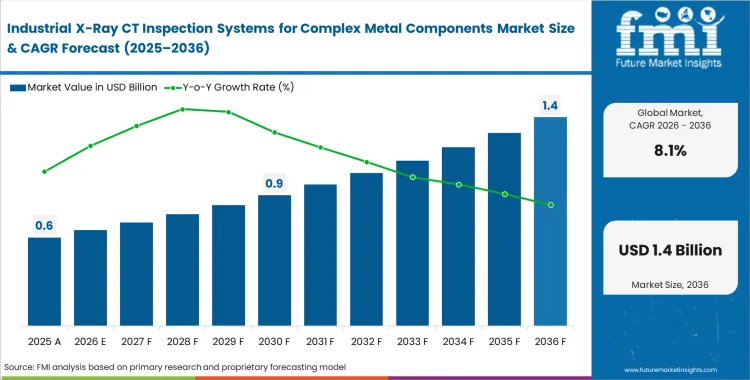
The industrial X-ray CT inspection systems for complex metal components market was valued at USD 0.5 billion in 2025. Sales are expected to reach USD 0.6 billion in 2026. The market is projected to expand at a CAGR of 8.1% from 2026 to 2036. Total valuation is expected to reach USD 1.3 billion by 2036. Growth is tied to aerospace and medical implant manufacturers requiring voxel-level internal defect validation before part assembly, which is shaping inspection system demand.
Summary of Industrial X-Ray CT Inspection Systems for Complex Metal Components Market
- The market is forecast to reach USD 1.3 billion by 2036.
- The market is expected to grow at a CAGR of 8.1% from 2026 to 2036.
- The market was estimated at USD 0.5 billion in 2025.
- The market is projected to reach USD 0.6 billion in 2026.
- The forecast period represents an incremental opportunity of USD 0.7 billion.
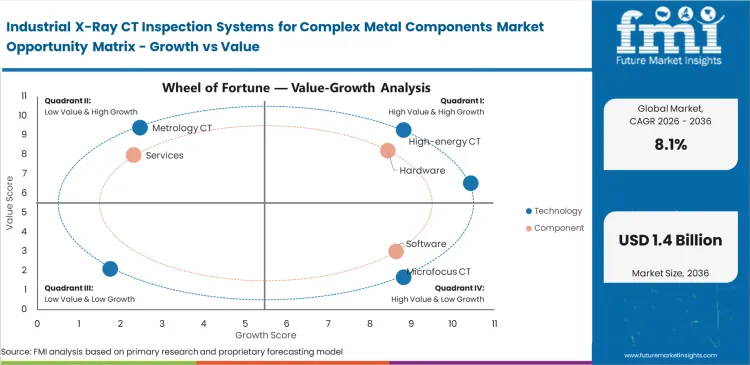
- High-energy CT leads by technology with a 34.0% share.
- Hardware dominates the component segment with a 71.0% share.
- Casting inspection leads application share with 31.0%.
- India is the fastest-growing market at 10.1%, followed by China at 9.2% and the United States at 8.5%.
- Key companies in the market include Waygate Technologies, ZEISS, Nikon Metrology, Comet Yxlon, RX Solutions, North Star Imaging, and Werth Messtechnik.
Tier-1 aerospace suppliers face production constraints in additive manufacturing lines due to inspection limitations. Destructive testing damages high-value 3D-printed titanium parts and increases scrap-related costs. Volumetric scanning using industrial computed tomography systems removes this loss and supports faster batch release. Procurement teams often underestimate the scale of data storage required for 3D scan volumes. Each production run generates large datasets, which creates infrastructure pressure and slows deployment at the facility level.
Factory adoption increases once CT systems are integrated into automated production environments. Inline scanners connected to manufacturing execution systems allow real-time feedback into production workflows. This shifts CT inspection from a lab-based activity to an active control function. Machine learning reduces manual review by automating defect detection across scan data. Inspection cycle time declines as a result, improving throughput in metal part evaluation.
Demand for industrial X-ray CT inspection systems for complex metal components is expected to grow fastest in India at a CAGR of 10.1%, supported by defense localization and stricter turbine blade inspection standards through 2036. China follows with 9.2% CAGR, driven by electric vehicle production and inspection needs for aluminum gigacast structures. The United States is projected to expand at 8.5% CAGR due to regulatory requirements for additively manufactured aerospace components. South Korea is likely to record 8.3% CAGR as battery enclosure inspection standards tighten. Germany is expected to grow at 7.9% CAGR as automotive metrology shifts toward volumetric inspection. Japan is projected to expand at 7.4% CAGR with demand from heavy machinery upgrades, while France is anticipated to register 7.1% CAGR as aerospace testing operations consolidate.
Segmental Analysis
Industrial X-Ray CT Inspection Systems for Complex Metal Components Market Analysis by Technology
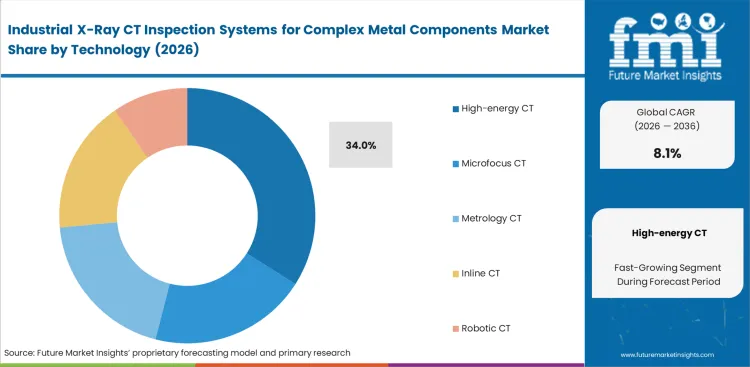
Legacy ultrasound cannot detect complex internal cooling channels in modern turbine components. High-energy CT is expected to account for 34.0% share of the industrial X-ray CT inspection systems for complex metal components market in 2026. Aerospace quality teams require at least 450 kV sources to inspect dense Inconel parts effectively. These systems allow engineers to identify internal defects without damaging high-value components. Facility preparation creates a major cost layer. High-energy CT setups require lead-lined enclosures that often cost more than the equipment itself. Delays in bunker construction can extend deployment timelines beyond twelve months. Many foundries underestimate this requirement when comparing industrial radiography and CT systems.
- Initial penetration verification: Aerospace quality directors select high-energy sources strictly on ability to push radiation through 50mm of dense steel or titanium. Procurement teams reject any system requiring excessive exposure times.
- Resolution validation: Metrology engineers test competing machines on complex reference standards to verify spatial resolution capabilities. Systems failing to distinguish 50-micron internal defects during these trials face immediate disqualification.
- Throughput scaling: Plant managers authorize fleet expansion only when non-destructive testers demonstrate stable continuous operation without thermal shutdown, ensuring factory floor production is never halted.
Industrial X-Ray CT Inspection Systems for Complex Metal Components Market Analysis by Component
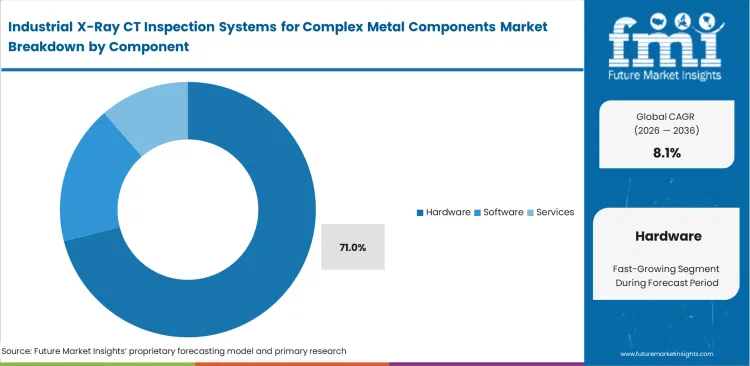
Hardware is estimated to represent 71.0% share of the industrial X-ray CT inspection systems for complex metal components market in 2026. Demand for high-resolution detectors and durable X-ray tubes drives this share. Procurement teams prioritize detector reliability and lifecycle performance over upfront savings. Increasing voltage requirements raise shielding needs, which directly expands system size and infrastructure cost. Software development is often funded through hardware margins, linking both components commercially. Facilities delaying hardware upgrades face compatibility issues with advanced defect detection tools.
- Tube replacement cycles: Maintenance directors budget for expensive microfocus filament replacements every few thousand hours of operation. Procurement teams track these consumable costs carefully against initial purchase discounts.
- Detector degradation: NDT lab managers monitor flat panel pixel health continuously, knowing high radiation doses slowly degrade sensor efficiency over time. Tracking these metrics dictates exact hardware replacement schedules.
- Shielding fabrication: Facilities managers absorb huge hidden costs designing concrete and lead vaults for high-energy applications. Evaluating computed tomography purely on scanner price ignores these mandatory safety infrastructure expenses.
Industrial X-Ray CT Inspection Systems for Complex Metal Components Market Analysis by Application
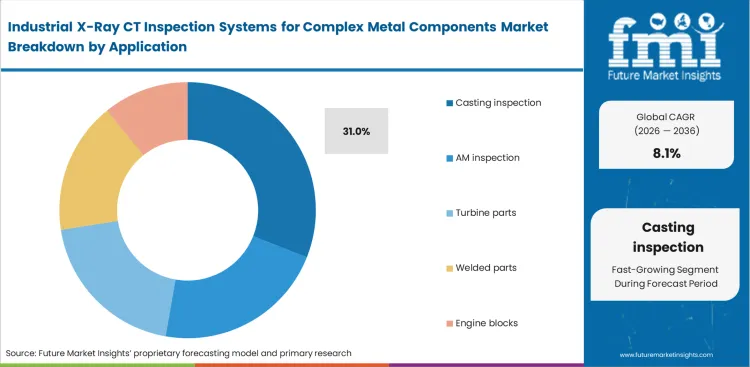
Defect analysis in traditional foundries shifts actively from reactive sectioning to proactive volumetric mapping. Casting inspection is predicted to hold 31.0% share in 2026, driven by zero-defect requirements in critical automotive chassis components. As per FMI's projection, metallurgical technicians use volumetric data for porosity inspection in aluminum castings with ct, feeding coordinate data back to die designers to adjust gating systems. Foundry owners often miss that implementing full volume scanning actually reduces nominal yield rates initially. Revealing sub-surface defects that previously went undetected forces quality managers to scrap more parts in the short term until upstream casting parameters are fully optimized during ct inspection of turbine blade castings.
- Porosity detection: Quality engineers utilize spatial data to identify clustered gas pores that weaken structural nodes. Detecting these hidden voids prevents critical system failures in automotive suspension arms.
- Residual core material: Production managers face significant downstream machining risks if ceramic core remnants remain inside turbine cooling channels. Volumetric scanning verifies complete core removal before expensive milling operations begin.
- Process feedback: Tooling engineers must actively loop dimensional deviations found during inspection back into mold redesigns. Failing to close this data loop turns expensive industrial digital radiography setups into mere sorting machines.
Industrial X-Ray CT Inspection Systems for Complex Metal Components Market Analysis by End Use
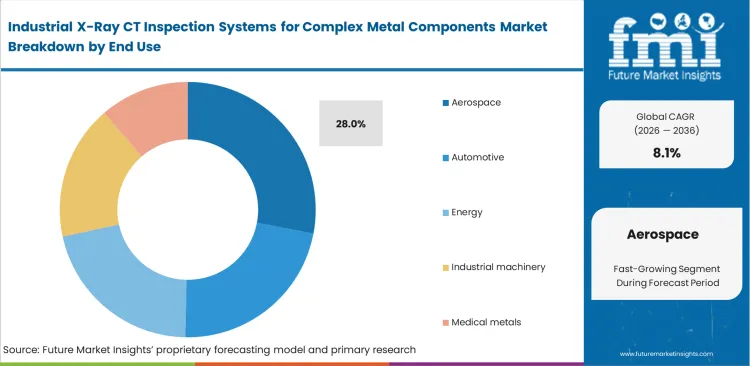
Flight-critical part qualification demands absolute internal structural certainty. Aerospace is estimated to represent 28.0% share in 2026, supported by stringent FAA mandates governing additively manufactured engine components. Supply chain directors at Tier-1 aerospace firms mandate 100% aerospace ct inspection systems verification for all 3D-printed titanium brackets prior to assembly. FMI observes this requirement pushes downstream foundries to install internal testing capabilities to avoid outsourcing delays. The structural irony of aerospace adoption is that older legacy components are grandfathered into use without volumetric scans, while demonstrably stronger modern AM parts face intense, expensive scrutiny. Suppliers lacking in-house capabilities risk immediate exclusion from next-generation aircraft engine programs.
- Superalloy penetration: NDT lab managers push imaging equipment to absolute limits when inspecting dense Inconel turbine blades. Lower-tier scanners produce substantial scattering artifacts that obscure true defect sizes under these conditions.
- Wall thickness mapping: Aerospace quality directors rely on precise algorithms to verify internal cooling channel dimensions. Systems struggling with edge-detection accuracy during these measurements fail stringent OEM qualification audits.
- Data archiving: Plant IT directors face strict compliance standards requiring original raw scan data retention for decades. Radiographic testing services must seamlessly integrate with immense cloud server architectures.
Industrial X-Ray CT Inspection Systems for Complex Metal Components Market Analysis by Installation
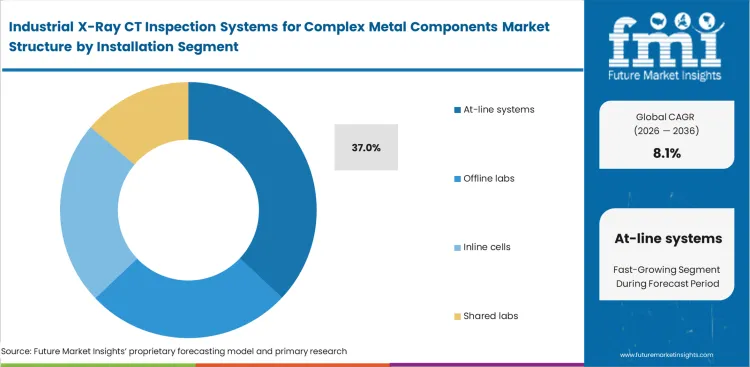
At-line systems are expected to secure 37.0% share in 2026, as manufacturing directors demand immediate defect feedback without delays of transporting parts to central laboratories. Quality control teams position specialized, environmentally sealed cabinets directly next to CNC machining centers, drastically cutting inspection turnaround times and boosting inline industrial ct adoption. Facilities failing to isolate at-line units via active vibration dampening platforms generate blurry volume reconstructions that cannot pass automated defect recognition thresholds.
- Ruggedized engineering: Equipment designers build robust, climate-controlled enclosures to protect delicate tubes from factory dust and temperature swings. Manufacturing directors prioritize this durability over absolute laboratory-grade resolution.
- Ergonomic loading: Tooling engineers demand platforms integrating easily with existing factory floor cranes and robotic arms. Adoption stalls if operators struggle to safely maneuver heavy engine blocks into inspection chambers.
- Decentralized footprint: Plant managers plan future factory layouts with multiple small-footprint stations rather than one central bunker. Distributed architecture models will define high-volume manufacturing environments by 2036.
Industrial X-Ray CT Inspection Systems for Complex Metal Components Market Drivers, Restraints, and Opportunities
FAA and EASA qualification mandates for additively manufactured flight hardware force aerospace supply chain directors to implement absolute internal flaw verification. Traditional destructive testing destroys economics of low-volume 3D-printed titanium parts, leaving high-energy computed tomography as the only viable method to prove internal structural integrity without scrapping components. Executing ct inspection for additive manufactured metal parts ensures defect-free delivery, whereas delaying volumetric integration directly blocks Tier-1 suppliers from bidding on next-generation engine programs.
Significant data processing and storage bottlenecks severely slow enterprise-wide deployment, compounded by beam hardening in industrial ct that complicates image reconstruction. Plant IT directors struggle to archive terabytes of volumetric data generated by a single shift of high-resolution scanning, while physicists battle metal artifacts in x-ray ct inspection that obscure small flaws. This infrastructure gap forces quality teams to periodically purge valuable historical scan data, violating long-term aerospace traceability requirements and limiting training data available for future machine learning models. Cloud storage costs for huge voxel sets remain prohibitively expensive for mid-size foundries.
Opportunities in the Industrial X-Ray CT Inspection Systems for Complex Metal Components Market
- Automated defect recognition: Software engineers developing machine learning in industrial ct inspection models that automatically flag porosity without human intervention drastically reduce inspection bottlenecks. Plant managers gain massive throughput advantages when software handles routine part disposition.
- Inline robotic integration: Automation directors embedding scanners directly into manufacturing cells eliminate manual part loading times. Continuous non-destructive testing equipment flow is crucial for high-volume automotive casting operations.
- Metrology capabilities: Quality engineers utilizing volumetric platforms for absolute dimensional measurement rather than just flaw detection can replace tactile coordinate measuring machines. Dual-purpose utility justifies higher initial capital expenditures.
Regional Analysis
Based on regional analysis, Industrial X-Ray CT Inspection Systems for Complex Metal Components is segmented into North America, Latin America, Europe, East Asia, South Asia & Pacific, and Middle East & Africa across 40 plus countries.
.webp "Top Country Growth Comparison Industrial X Ray Ct Inspection Systems For Complex Metal Components Market Cagr (2026 2036)")
| Country | CAGR (2026 to 2036) |
|---|---|
| India | 10.1% |
| China | 9.2% |
| United States | 8.5% |
| South Korea | 8.3% |
| Germany | 7.9% |
| Japan | 7.4% |
| France | 7.1% |
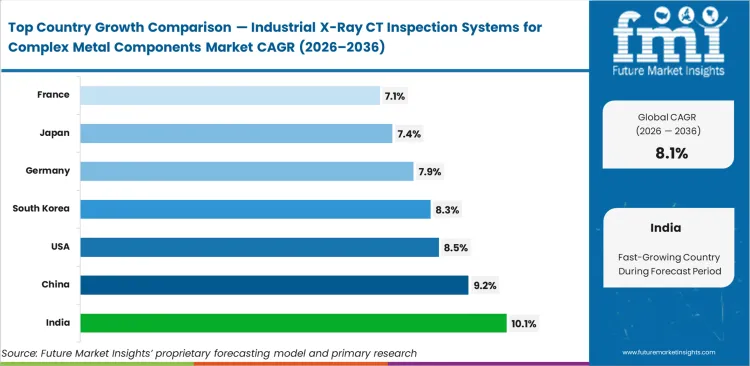
Source: Future Market Insights (FMI) analysis, based on proprietary forecasting model and primary research
South Asia & Pacific Industrial X-Ray CT Inspection Systems for Complex Metal Components Market Analysis
Defense localization programs and domestic aerospace production requirements are pushing sub-tier suppliers to upgrade inspection standards. Suppliers are replacing two-dimensional radiography with volumetric scanning to meet export qualification criteria. A limited pool of certified NDT Level III specialists restricts adoption, particularly for interpreting complex 3D datasets.
- India: Strict internal flaw detection mandates for cast turbine blades dictate capital equipment purchases at major defense contractors. Evaluating the industrial CT market in India shows metallurgical engineers must prove zero internal porosity to secure government aviation tenders. India is forecast to record steady growth at a CAGR of 10.1% through 2036. Securing these advanced inspection capabilities directly positions domestic foundries to win contracts previously monopolized by European suppliers.
FMI's report includes Australia and ASEAN nations. Rising infrastructure investments across Southeast Asia drive secondary demand for heavy machinery component testing.
East Asia Industrial X-Ray CT Inspection Systems for Complex Metal Components Market Analysis
Electric vehicle lightweighting strategies utilizing significant aluminum chassis gigacastings drive high-energy volumetric testing demand. Manufacturing directors across the region install inline scanning cells to catch internal voids before expensive downstream machining occurs. Based on FMI's assessment, rapid battery gigafactory construction requires automated systems to verify thousands of continuous welds per hour.
- China: Die-casting lines in China are adopting continuous CT inspection to detect internal cooling defects before they compromise structural automotive parts in service. Greater design complexity in lightweight cast components is making internal verification more important at earlier production stages, especially where conventional inspection cannot capture subsurface failure points clearly. Sales of industrial X-ray CT inspection systems in China are projected to rise at a CAGR of 9.2% from 2026 to 2036. Wider use in this market also reflects the need to reduce scrap, support tighter process control, and qualify more demanding casting geometries with less downstream risk.
- South Korea: Battery enclosure weld validation is becoming more demanding in South Korea as cell-to-pack designs and export quality requirements place greater pressure on joint reliability. Microfocus CT platforms are gaining wider use because microscopic weld porosity can remain undetected in routine inspection yet still weaken pack safety under thermal stress. During 2026 to 2036, sales of industrial X-ray CT inspection systems in South Korea are anticipated to advance at a CAGR of 8.3%. Added confidence in weld integrity also helps manufacturers document pack safety more convincingly for overseas customers and regulatory reviews tied to advanced battery systems.
- Japan: Volumetric measurement is gaining stronger acceptance in Japan as industrial equipment manufacturers move away from physical sectioning for internal part assessment and dimensional verification. Reverse engineering of legacy turbine components becomes faster under this approach, and maintenance teams can reduce downtime by inspecting internal structures without destroying the part. Japan is expected to record a CAGR of 7.4% in the industrial X-ray CT inspection systems segment during 2026 to 2036. Demand also benefits from the preference for inspection methods that support precision analysis, shorter validation cycles, and better use of high-value legacy equipment across mature manufacturing environments.
FMI's report includes Taiwan. Semiconductor manufacturing hubs require specialized nano-focus inspection systems for advanced packaging verification.
North America Industrial X-Ray CT Inspection Systems for Complex Metal Components Market Analysis
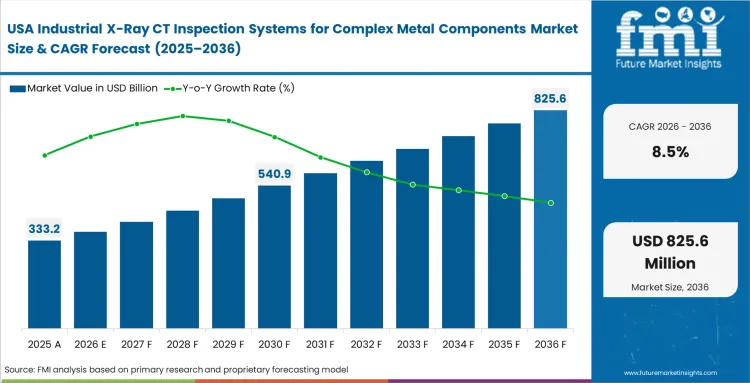
Stringent federal aviation guidelines governing powder bed fusion metal additive manufacturing strictly dictate end-use part qualification. Supply chain directors at prime contractors enforce 100% volumetric inspection on all structural 3D-printed nodes. In FMI's view, sheer volumes of high-density aerospace parts require scanning hardware capable of continuous operation without thermal shutdown.
- United States: FAA qualification pathways for additively manufactured aircraft engine parts compel quality teams to utilize high-energy computed tomography. Navigating the industrial ct market in United States demonstrates verifying complete internal powder removal prevents disastrous in-flight engine failures. Demand is anticipated to rise at a CAGR of 8.5% through 2036. Foundries failing to install required volumetric systems will be systematically removed from Tier-1 aerospace vendor lists.
FMI's report includes Canada. Heavy mining equipment manufacturing drives localized demand for large-envelope casting inspection platforms.
Europe Industrial X-Ray CT Inspection Systems for Complex Metal Components Market Analysis
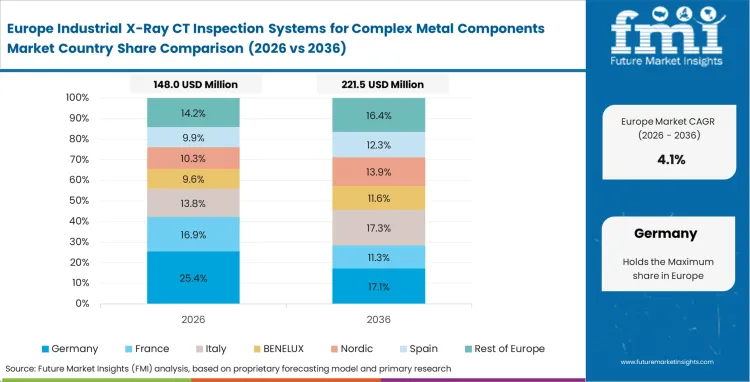
Precision automotive engineering and strict aerospace consortium standards define capital equipment investment profiles. Metrology lab directors demand extremely high-resolution non-destructive testing inspection service capabilities to measure complex internal features on miniaturized fluid control valves. FMI observes stringent environmental regulations surrounding lead shielding disposal complicate facility upgrades for older radiation installations.
- Germany: Germany’s industrial X-ray CT inspection systems industry is set to expand at a CAGR of 7.9% from 2026 to 2036. Automotive metrology is moving from coordinate measuring machines to volumetric inspection for drivetrain components. Engineers rely on micron-level accuracy to validate internal channel dimensions and reduce design iterations.
- France: Aerospace consortiums consolidate non-destructive testing supply chains around few highly certified Tier-1 facilities. NDT lab managers prioritize high-energy 450kV sources capable of penetrating dense titanium landing gear components. France is likely to post a CAGR of 7.1% by 2036. Upgrading to high-power systems prevents costly outsourcing delays during critical aircraft assembly phases.
FMI's report includes the United Kingdom and Italy. High-performance motorsport manufacturing clusters drive localized adoption of rapid inline inspection technologies.
Competitive Aligners for Market Players
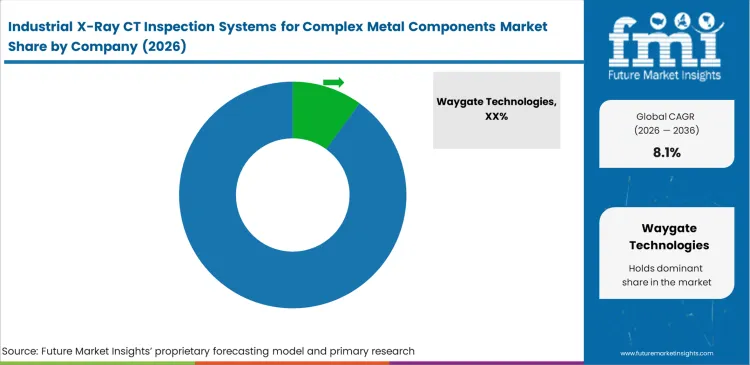
Volumetric imaging equipment procurement heavily favors established metrology giants with proven global support networks. Quality assurance directors at multinational aerospace firms actively exclude unproven startups from bidding on multi-million-dollar high-energy installations, carefully executing industrial ct supplier comparison. Companies like Waygate Technologies, ZEISS, and Nikon Metrology dominate factory floors because they guarantee rapid tube replacement and minimal machine downtime across disparate global manufacturing sites. Procurement teams evaluate top industrial ct companies for aerospace parts primarily on maturity of proprietary reconstruction algorithms and uptime guarantees of field service divisions.
Legacy hardware providers possess decades of iterative software development addressing specific beam hardening and scatter artifact reduction. Competitors attempting entry find it relatively straightforward to source basic hardware, but struggle immensely developing mathematical reconstruction engines required to generate clean 3D volumes from dense metal parts. Companies continuously train automated defect recognition models on vast proprietary libraries of known casting flaws. This additive manufacturing with metal powders data advantage creates significant barriers, as new systems generate noisy scans human operators must manually decipher when evaluating the best industrial ct systems for dense metal parts.
Enterprise buyers counter vendor lock-in by enforcing strict open-data standards for volumetric outputs. Plant IT directors demand proprietary platforms export standardized format files compatible with third-party visualization software, explicitly preventing hardware manufacturers from controlling downstream data analysis pipelines. Large automotive OEMs frequently purchase basic scanning hardware from one vendor while licensing advanced machine learning defect recognition platforms from specialized independent developers. Deliberate decoupling of hardware and software procurement cycles structurally limits pricing power of integrated equipment manufacturers.
Key Players in Industrial X-Ray CT Inspection Systems for Complex Metal Components Market
- Waygate Technologies
- ZEISS
- Nikon Metrology
- Comet Yxlon
- RX Solutions
- North Star Imaging
- Werth Messtechnik
Scope of the Report
| Metric | Value |
|---|---|
| Quantitative Units | USD 0.6 billion to USD 1.3 billion, at a CAGR of 8.1% |
| Market Definition | High-energy volumetric imaging platforms engineered to map internal structures, detect micro-porosity, and verify dimensional tolerances of dense metal parts without destructive sectioning. |
| Segmentation | Technology, Component, Application, End Use, Installation, Region |
| Regions Covered | North America, Latin America, Europe, East Asia, South Asia & Pacific, Middle East & Africa |
| Countries Covered | United States, Canada, Germany, France, United Kingdom, Italy, China, Japan, South Korea, India, Australia |
| Key Companies Profiled | Waygate Technologies, ZEISS, Nikon Metrology, Comet Yxlon, RX Solutions, North Star Imaging, Werth Messtechnik |
| Forecast Period | 2026 to 2036 |
| Approach | Capital equipment installation volumes for high-energy and microfocus CT units in heavy manufacturing sectors anchored base year valuations. |
Source: Future Market Insights (FMI) analysis, based on proprietary forecasting model and primary research
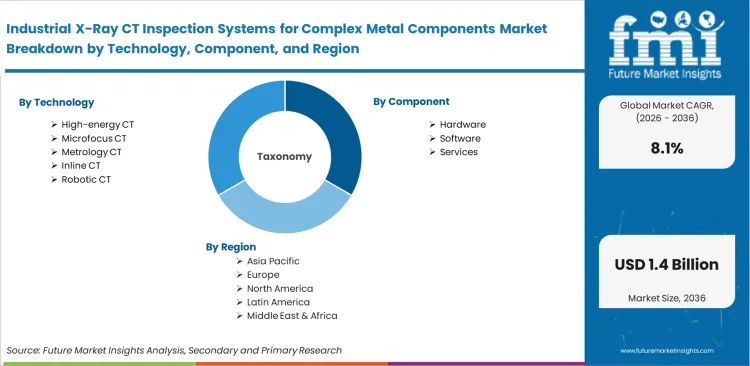
Industrial X-Ray CT Inspection Systems for Complex Metal Components Market Analysis by Segments
Technology
- High-energy CT
- Microfocus CT
- Metrology CT
- Inline CT
- Robotic CT
Component
- Hardware
- Software
- Services
Application
- Casting inspection
- AM inspection
- Turbine parts
- Welded parts
- Engine blocks
End Use
- Aerospace
- Automotive
- Energy
- Industrial machinery
- Medical metals
Installation
- At-line systems
- Offline labs
- Inline cells
- Shared labs
Region
- North America
- United States
- Canada
- Latin America
- Brazil
- Mexico
- Europe
- Germany
- France
- United Kingdom
- Italy
- Spain
- East Asia
- China
- Japan
- South Korea
- South Asia & Pacific
- India
- ASEAN
- Australia
- Middle East & Africa
- GCC Countries
- South Africa
Bibliography
- Bellens, S., Guerrero, P., Janssens, M., Vandewalle, P., & Dewulf, W. (2024). Machine learning in industrial X-ray computed tomography - a review. CIRP Journal of Manufacturing Science and Technology, 51, 324-341.
- Donmez, A., Baturynska, I., Hedberg, T., Jr., Hrabe, N., Lopez, F., Moylan, S., Smith, B., & Tiedje, N. (2024, September). In-process monitoring and non-destructive evaluation for metal additive manufacturing processes (NIST IR 8538). National Institute of Standards and Technology.
- Nagai, Y. (2024). Modeling Algorithms for Empowering Automated Manufacturing with Industrial X-Ray Computed Tomography. International Journal of Automation Technology, 18(5), 659-669.
- USA Department of Energy, Office of Nuclear Energy. (2024, November 1). New National Lab Algorithm Enables Faster, Safer Inspection of Nuclear Materials.
- Wilbig, J., Wilson-Heid, A. E., Bernard, L., Baptista, J., & Obaton, A.-F. (2025). Comparison of Porosity Analysis Based on X-Ray Computed Tomography on Metal Parts Produced by Additive Manufacturing. Applied Sciences, 15(18), 9876.
This bibliography is provided for reader reference. The full FMI report contains the complete reference list with primary source documentation.
This Report Addresses
- FAA mandates driving volumetric inspection requirements for additively manufactured titanium flight hardware.
- Hidden infrastructure costs associated with archiving massive terabyte-level datasets generated by microfocus scanning.
- Strategic decoupling of proprietary hardware procurement from advanced machine learning defect recognition software licensing.
- Yield rate drops experienced by automotive foundries when high-resolution imaging reveals previously undetected gigacasting porosity.
- Impact of factory floor vibrations on nanometer-resolution capabilities of decentralized at-line inspection stations.
- Transition timelines for metrology engineers replacing tactile coordinate measuring machines with absolute volumetric measurement algorithms.
- Consolidation of European aerospace testing supply chains around highly certified facilities equipped with 450kV generation sources.
- Qualification challenges faced by new equipment manufacturers attempting to develop clean 3D reconstruction algorithms for dense metals.
Frequently Asked Questions
What are industrial x-ray CT inspection systems for complex metal components?
Industrial x-ray CT inspection systems encompass volumetric imaging machines that utilize penetrating ionizing radiation to reconstruct three-dimensional internal geometries. Quality engineers utilize these platforms to identify hidden porosity, measure internal wall thicknesses, and verify assembly integrity of high-density metallic parts without altering or destroying the inspected components.
Why use CT instead of radiography for complex metal components?
Legacy two-dimensional radiography cannot accurately depth-locate internal defects or measure overlapping internal geometries. Evaluating industrial radiography vs industrial ct reveals that computed tomography generates a complete 3D voxel matrix, allowing quality teams to non-destructively measure internal cooling channels and verify exact structural integrity.
How does industrial CT detect porosity in castings?
Volumetric scanning captures hundreds of projection images as a sample rotates, using mathematical reconstruction to create digital cross-sections. This spatial data allows metallurgical engineers performing porosity inspection in aluminum castings with ct to pinpoint clustered gas pores that weaken structural nodes, feeding that data back to mold designers.
What industries use industrial CT for metal components?
Critical adoption spans sectors where component critical system failure. Aerospace utilizes it for 3D-printed flight hardware, automotive manufacturers rely on it for gigacasting defect detection, and medical device companies implement it to verify porous structures in orthopedic implants.
How accurate is industrial x-ray CT metrology?
When operated within controlled environments devoid of severe vibration, specialized microfocus metrology CT platforms can achieve micron-level and sub-micron accuracy. Metrology engineers use these precise algorithms to replace tactile coordinate measuring machines for verifying complex internal fluid channel dimensions.
What is the baseline valuation for Industrial X-Ray CT Inspection Systems for Complex Metal Components?
Valuation reached USD 0.5 billion in 2025. This baseline reflects massive capital expenditures by top-tier aerospace and automotive manufacturers installing high-energy volumetric platforms to satisfy stringent internal structural verification mandates.
How fast is demand expanding?
Demand is projected to advance at an 8.1% CAGR from 2026 to 2036. Strict regulatory standards governing 3D-printed flight components and electric vehicle battery enclosures force quality control teams to adopt complete volumetric mapping over destructive testing.
What is the projected value by 2036?
Total revenue is expected to cross USD 1.33 billion by 2036. Sustained investment in automated defect recognition software and inline robotic handling cells drives long-term equipment upgrades across heavy manufacturing sectors.
Why does high-energy CT lead the technology segment?
High-energy sources secure 34.0% share in 2026 because lower-power microfocus tubes physically cannot penetrate thick nickel superalloys. Aerospace quality directors require minimum 450kV capabilities to verify structural integrity of critical dense-metal castings.
What secures hardware dominance?
Hardware accounts for 71.0% share in 2026 due to immense manufacturing costs associated with precision generation tubes and large-area flat panel detectors. Facilities managers must also absorb massive capital requirements for mandatory lead-shielded safety enclosures.
Why is casting inspection the primary application?
Casting inspection captures 31.0% share in 2026 as foundries replace reactive physical sectioning with proactive volumetric mapping. Automotive gigacasting complexity requires identifying sub-surface porosity before expensive downstream milling operations begin.
What drives aerospace adoption?
Aerospace holds 28.0% share in 2026 driven by zero-defect tolerance policies. Supply chain directors mandate volumetric verification for flight-critical additively manufactured engine brackets to comply with rigorous FAA structural requirements.
Why are at-line systems gaining traction?
At-line installations secure 37.0% share in 2026 because manufacturing directors demand immediate defect feedback. Positioning ruggedized scanning cabinets directly next to CNC machining centers drastically reduces inspection turnaround times compared to central laboratory routing.
What explains the growth disparity between India and China?
India advances at 10.1% driven by localized defense aerospace initiatives requiring new baseline non-destructive testing infrastructure. China expands at 9.2% fueled by rapid integration of high-throughput inline scanners into automated electric vehicle gigacasting lines.
How do open-data standards impact competition?
Enterprise IT directors demand proprietary platforms export standardized file formats compatible with third-party visualization software. Decoupling hardware from software analysis pipelines prevents equipment manufacturers from locking buyers into closed data ecosystems.
Why do foundries experience initial yield drops after installing CT?
Implementing full volumetric scanning reveals microscopic sub-surface defects that previously passed basic planar radiography. Quality managers are forced to scrap more parts in the short term until upstream gating and cooling parameters are fully optimized.
What role does automated defect recognition play?
Machine learning algorithms automatically flag internal porosity without human intervention, drastically reducing inspection bottlenecks. Plant managers depend on these software models to prevent expensive hardware from sitting idle awaiting manual image review.
How do factory floor environments affect microfocus capabilities?
Ambient factory vibrations severely degrade nanometer-level resolution capabilities required for precision metrology. Facilities installing decentralized at-line units must invest heavily in active vibration dampening platforms to prevent blurry volume reconstructions.
Why is data archiving a restraint?
A single high-resolution turbine blade scan generates gigabytes of information. Plant IT directors struggle to fund petabyte-scale cloud storage architectures required to satisfy 30-year aerospace component traceability mandates.
What prevents startups from disrupting legacy equipment providers?
Legacy manufacturers possess decades of iterative software development addressing specific beam hardening and scatter artifacts. New entrants can easily source hardware components but struggle to engineer mathematical reconstruction algorithms capable of generating clean 3D volumes.
How does additive manufacturing rely on volumetric inspection?
Traditional destructive testing destroys economics of low-volume 3D-printed titanium parts. Quality teams utilize high-energy computed tomography as the only viable method to prove complete internal powder removal without scrapping the component.
Why do metrology engineers prefer CT over tactile probes?
Capturing full internal geometries accelerates absolute dimensional measurement of complex fluid control valves. Engineers verify internal cooling channel dimensions simultaneously without sectioning, significantly reducing iteration cycles during new engine development.
What structural barriers slow South Asian adoption?
Severe shortages of certified NDT Level III personnel capable of interpreting complex 3D scans constrain regional deployment. Foundries purchasing advanced hardware often lack internal expertise required to validate proprietary reconstruction models.
How do environmental regulations impact hardware installations?
Stringent European regulations surrounding lead shielding disposal complicate facility upgrades. Plant managers replacing older x-ray installations face significant compliance costs when decommissioning legacy radiation enclosures.
Preview the report firsthand - request a free sample
Get SampleGet the brochure for pricing and purchase details.
Get PDFTable of Content
- Executive Summary
- Global Market Outlook
- Demand-side Trends
- Supply-side Trends
- Technology Roadmap Analysis
- Analysis and Recommendations
- Market Overview
- Market Coverage / Taxonomy
- Market Definition / Scope / Limitations
- Research Methodology
- Chapter Orientation
- Analytical Lens and Working Hypotheses
- Market Structure, Signals, and Trend Drivers
- Benchmarking and Cross-market Comparability
- Market Sizing, Forecasting, and Opportunity Mapping
- Research Design and Evidence Framework
- Desk Research Programme (Secondary Evidence)
- Company Annual and Sustainability Reports
- Peer-reviewed Journals and Academic Literature
- Corporate Websites, Product Literature, and Technical Notes
- Earnings Decks and Investor Briefings
- Statutory Filings and Regulatory Disclosures
- Technical White Papers and Standards Notes
- Trade Journals, Industry Magazines, and Analyst Briefs
- Conference Proceedings, Webinars, and Seminar Materials
- Government Statistics Portals and Public Data Releases
- Press Releases and Reputable Media Coverage
- Specialist Newsletters and Curated Briefings
- Sector Databases and Reference Repositories
- FMI Internal Proprietary Databases and Historical Market Datasets
- Subscription Datasets and Paid Sources
- Social Channels, Communities, and Digital Listening Inputs
- Additional Desk Sources
- Expert Input and Fieldwork (Primary Evidence)
- Primary Modes
- Qualitative Interviews and Expert Elicitation
- Quantitative Surveys and Structured Data Capture
- Blended Approach
- Why Primary Evidence is Used
- Field Techniques
- Interviews
- Surveys
- Focus Groups
- Observational and In-context Research
- Social and Community Interactions
- Stakeholder Universe Engaged
- C-suite Leaders
- Board Members
- Presidents and Vice Presidents
- R&D and Innovation Heads
- Technical Specialists
- Domain Subject-matter Experts
- Scientists
- Physicians and Other Healthcare Professionals
- Governance, Ethics, and Data Stewardship
- Research Ethics
- Data Integrity and Handling
- Primary Modes
- Tooling, Models, and Reference Databases
- Desk Research Programme (Secondary Evidence)
- Data Engineering and Model Build
- Data Acquisition and Ingestion
- Cleaning, Normalisation, and Verification
- Synthesis, Triangulation, and Analysis
- Quality Assurance and Audit Trail
- Market Background
- Market Dynamics
- Drivers
- Restraints
- Opportunity
- Trends
- Scenario Forecast
- Demand in Optimistic Scenario
- Demand in Likely Scenario
- Demand in Conservative Scenario
- Opportunity Map Analysis
- Product Life Cycle Analysis
- Supply Chain Analysis
- Investment Feasibility Matrix
- Value Chain Analysis
- PESTLE and Porter’s Analysis
- Regulatory Landscape
- Regional Parent Market Outlook
- Production and Consumption Statistics
- Import and Export Statistics
- Market Dynamics
- Global Market Analysis 2021 to 2025 and Forecast, 2026 to 2036
- Historical Market Size Value (USD Million) Analysis, 2021 to 2025
- Current and Future Market Size Value (USD Million) Projections, 2026 to 2036
- Y-o-Y Growth Trend Analysis
- Absolute $ Opportunity Analysis
- Global Market Pricing Analysis 2021 to 2025 and Forecast 2026 to 2036
- Global Market Analysis 2021 to 2025 and Forecast 2026 to 2036, By Technology
- Introduction / Key Findings
- Historical Market Size Value (USD Million) Analysis By Technology , 2021 to 2025
- Current and Future Market Size Value (USD Million) Analysis and Forecast By Technology , 2026 to 2036
- High-energy CT
- Microfocus CT
- Metrology CT
- Inline CT
- Robotic CT
- High-energy CT
- Y-o-Y Growth Trend Analysis By Technology , 2021 to 2025
- Absolute $ Opportunity Analysis By Technology , 2026 to 2036
- Global Market Analysis 2021 to 2025 and Forecast 2026 to 2036, By Component
- Introduction / Key Findings
- Historical Market Size Value (USD Million) Analysis By Component, 2021 to 2025
- Current and Future Market Size Value (USD Million) Analysis and Forecast By Component, 2026 to 2036
- Hardware
- Software
- Services
- Hardware
- Y-o-Y Growth Trend Analysis By Component, 2021 to 2025
- Absolute $ Opportunity Analysis By Component, 2026 to 2036
- Global Market Analysis 2021 to 2025 and Forecast 2026 to 2036, By Application
- Introduction / Key Findings
- Historical Market Size Value (USD Million) Analysis By Application, 2021 to 2025
- Current and Future Market Size Value (USD Million) Analysis and Forecast By Application, 2026 to 2036
- Casting inspection
- AM inspection
- Turbine parts
- Welded parts
- Engine blocks
- Casting inspection
- Y-o-Y Growth Trend Analysis By Application, 2021 to 2025
- Absolute $ Opportunity Analysis By Application, 2026 to 2036
- Global Market Analysis 2021 to 2025 and Forecast 2026 to 2036, By End Use
- Introduction / Key Findings
- Historical Market Size Value (USD Million) Analysis By End Use, 2021 to 2025
- Current and Future Market Size Value (USD Million) Analysis and Forecast By End Use, 2026 to 2036
- Aerospace
- Automotive
- Energy
- Industrial machinery
- Medical metals
- Aerospace
- Y-o-Y Growth Trend Analysis By End Use, 2021 to 2025
- Absolute $ Opportunity Analysis By End Use, 2026 to 2036
- Global Market Analysis 2021 to 2025 and Forecast 2026 to 2036, By Installation
- Introduction / Key Findings
- Historical Market Size Value (USD Million) Analysis By Installation, 2021 to 2025
- Current and Future Market Size Value (USD Million) Analysis and Forecast By Installation, 2026 to 2036
- At-line systems
- Offline labs
- Inline cells
- Shared labs
- At-line systems
- Y-o-Y Growth Trend Analysis By Installation, 2021 to 2025
- Absolute $ Opportunity Analysis By Installation, 2026 to 2036
- Global Market Analysis 2021 to 2025 and Forecast 2026 to 2036, By Region
- Introduction
- Historical Market Size Value (USD Million) Analysis By Region, 2021 to 2025
- Current Market Size Value (USD Million) Analysis and Forecast By Region, 2026 to 2036
- North America
- Latin America
- Western Europe
- Eastern Europe
- East Asia
- South Asia and Pacific
- Middle East & Africa
- Market Attractiveness Analysis By Region
- North America Market Analysis 2021 to 2025 and Forecast 2026 to 2036, By Country
- Historical Market Size Value (USD Million) Trend Analysis By Market Taxonomy, 2021 to 2025
- Market Size Value (USD Million) Forecast By Market Taxonomy, 2026 to 2036
- By Country
- USA
- Canada
- Mexico
- By Technology
- By Component
- By Application
- By End Use
- By Installation
- By Country
- Market Attractiveness Analysis
- By Country
- By Technology
- By Component
- By Application
- By End Use
- By Installation
- Key Takeaways
- Latin America Market Analysis 2021 to 2025 and Forecast 2026 to 2036, By Country
- Historical Market Size Value (USD Million) Trend Analysis By Market Taxonomy, 2021 to 2025
- Market Size Value (USD Million) Forecast By Market Taxonomy, 2026 to 2036
- By Country
- Brazil
- Chile
- Rest of Latin America
- By Technology
- By Component
- By Application
- By End Use
- By Installation
- By Country
- Market Attractiveness Analysis
- By Country
- By Technology
- By Component
- By Application
- By End Use
- By Installation
- Key Takeaways
- Western Europe Market Analysis 2021 to 2025 and Forecast 2026 to 2036, By Country
- Historical Market Size Value (USD Million) Trend Analysis By Market Taxonomy, 2021 to 2025
- Market Size Value (USD Million) Forecast By Market Taxonomy, 2026 to 2036
- By Country
- Germany
- UK
- Italy
- Spain
- France
- Nordic
- BENELUX
- Rest of Western Europe
- By Technology
- By Component
- By Application
- By End Use
- By Installation
- By Country
- Market Attractiveness Analysis
- By Country
- By Technology
- By Component
- By Application
- By End Use
- By Installation
- Key Takeaways
- Eastern Europe Market Analysis 2021 to 2025 and Forecast 2026 to 2036, By Country
- Historical Market Size Value (USD Million) Trend Analysis By Market Taxonomy, 2021 to 2025
- Market Size Value (USD Million) Forecast By Market Taxonomy, 2026 to 2036
- By Country
- Russia
- Poland
- Hungary
- Balkan & Baltic
- Rest of Eastern Europe
- By Technology
- By Component
- By Application
- By End Use
- By Installation
- By Country
- Market Attractiveness Analysis
- By Country
- By Technology
- By Component
- By Application
- By End Use
- By Installation
- Key Takeaways
- East Asia Market Analysis 2021 to 2025 and Forecast 2026 to 2036, By Country
- Historical Market Size Value (USD Million) Trend Analysis By Market Taxonomy, 2021 to 2025
- Market Size Value (USD Million) Forecast By Market Taxonomy, 2026 to 2036
- By Country
- China
- Japan
- South Korea
- By Technology
- By Component
- By Application
- By End Use
- By Installation
- By Country
- Market Attractiveness Analysis
- By Country
- By Technology
- By Component
- By Application
- By End Use
- By Installation
- Key Takeaways
- South Asia and Pacific Market Analysis 2021 to 2025 and Forecast 2026 to 2036, By Country
- Historical Market Size Value (USD Million) Trend Analysis By Market Taxonomy, 2021 to 2025
- Market Size Value (USD Million) Forecast By Market Taxonomy, 2026 to 2036
- By Country
- India
- ASEAN
- Australia & New Zealand
- Rest of South Asia and Pacific
- By Technology
- By Component
- By Application
- By End Use
- By Installation
- By Country
- Market Attractiveness Analysis
- By Country
- By Technology
- By Component
- By Application
- By End Use
- By Installation
- Key Takeaways
- Middle East & Africa Market Analysis 2021 to 2025 and Forecast 2026 to 2036, By Country
- Historical Market Size Value (USD Million) Trend Analysis By Market Taxonomy, 2021 to 2025
- Market Size Value (USD Million) Forecast By Market Taxonomy, 2026 to 2036
- By Country
- Kingdom of Saudi Arabia
- Other GCC Countries
- Turkiye
- South Africa
- Other African Union
- Rest of Middle East & Africa
- By Technology
- By Component
- By Application
- By End Use
- By Installation
- By Country
- Market Attractiveness Analysis
- By Country
- By Technology
- By Component
- By Application
- By End Use
- By Installation
- Key Takeaways
- Key Countries Market Analysis
- USA
- Pricing Analysis
- Market Share Analysis, 2025
- By Technology
- By Component
- By Application
- By End Use
- By Installation
- Canada
- Pricing Analysis
- Market Share Analysis, 2025
- By Technology
- By Component
- By Application
- By End Use
- By Installation
- Mexico
- Pricing Analysis
- Market Share Analysis, 2025
- By Technology
- By Component
- By Application
- By End Use
- By Installation
- Brazil
- Pricing Analysis
- Market Share Analysis, 2025
- By Technology
- By Component
- By Application
- By End Use
- By Installation
- Chile
- Pricing Analysis
- Market Share Analysis, 2025
- By Technology
- By Component
- By Application
- By End Use
- By Installation
- Germany
- Pricing Analysis
- Market Share Analysis, 2025
- By Technology
- By Component
- By Application
- By End Use
- By Installation
- UK
- Pricing Analysis
- Market Share Analysis, 2025
- By Technology
- By Component
- By Application
- By End Use
- By Installation
- Italy
- Pricing Analysis
- Market Share Analysis, 2025
- By Technology
- By Component
- By Application
- By End Use
- By Installation
- Spain
- Pricing Analysis
- Market Share Analysis, 2025
- By Technology
- By Component
- By Application
- By End Use
- By Installation
- France
- Pricing Analysis
- Market Share Analysis, 2025
- By Technology
- By Component
- By Application
- By End Use
- By Installation
- India
- Pricing Analysis
- Market Share Analysis, 2025
- By Technology
- By Component
- By Application
- By End Use
- By Installation
- ASEAN
- Pricing Analysis
- Market Share Analysis, 2025
- By Technology
- By Component
- By Application
- By End Use
- By Installation
- Australia & New Zealand
- Pricing Analysis
- Market Share Analysis, 2025
- By Technology
- By Component
- By Application
- By End Use
- By Installation
- China
- Pricing Analysis
- Market Share Analysis, 2025
- By Technology
- By Component
- By Application
- By End Use
- By Installation
- Japan
- Pricing Analysis
- Market Share Analysis, 2025
- By Technology
- By Component
- By Application
- By End Use
- By Installation
- South Korea
- Pricing Analysis
- Market Share Analysis, 2025
- By Technology
- By Component
- By Application
- By End Use
- By Installation
- Russia
- Pricing Analysis
- Market Share Analysis, 2025
- By Technology
- By Component
- By Application
- By End Use
- By Installation
- Poland
- Pricing Analysis
- Market Share Analysis, 2025
- By Technology
- By Component
- By Application
- By End Use
- By Installation
- Hungary
- Pricing Analysis
- Market Share Analysis, 2025
- By Technology
- By Component
- By Application
- By End Use
- By Installation
- Kingdom of Saudi Arabia
- Pricing Analysis
- Market Share Analysis, 2025
- By Technology
- By Component
- By Application
- By End Use
- By Installation
- Turkiye
- Pricing Analysis
- Market Share Analysis, 2025
- By Technology
- By Component
- By Application
- By End Use
- By Installation
- South Africa
- Pricing Analysis
- Market Share Analysis, 2025
- By Technology
- By Component
- By Application
- By End Use
- By Installation
- USA
- Market Structure Analysis
- Competition Dashboard
- Competition Benchmarking
- Market Share Analysis of Top Players
- By Regional
- By Technology
- By Component
- By Application
- By End Use
- By Installation
- Competition Analysis
- Competition Deep Dive
- Waygate Technologies
- Overview
- Product Portfolio
- Profitability by Market Segments (Product/Age /Sales Channel/Region)
- Sales Footprint
- Strategy Overview
- Marketing Strategy
- Product Strategy
- Channel Strategy
- ZEISS
- Nikon Metrology
- Comet Yxlon
- RX Solutions
- North Star Imaging
- Werth Messtechnik
- Waygate Technologies
- Competition Deep Dive
- Assumptions & Acronyms Used


