

- Industry Size (2026)
- USD 1.1 Bn
- Forecast (2036)
- USD 2.0 Bn
- CAGR (2026 to 2036)
- 6.2%
Rail Track and Rolling Stock Advanced NDT Inspection Systems Market Size, Market Forecast and Outlook By FMI
The rail track and rolling stock advanced NDT inspection systems market was valued at USD 1.0 billion in 2025, with sales projected to reach USD 1.1 billion in 2026 and scale to USD 2.0 billion by 2036 at a 6.2% CAGR. Growth reflects a steady pivot from scheduled physical maintenance toward predictive intervention, particularly across high‑density corridors uptime and asset utilization shape operating performance.
Summary of Rail Track and Rolling Stock Advanced NDT Inspection Systems Market
- Market Snapshot
- The rail track and rolling stock advanced NDT inspection systems market is valued at USD 1.0 billion in 2025 and is projected to reach USD 2.0 billion by 2036.
- The market expands at a 6.2% CAGR from 2026 to 2036, generating an incremental USD 1.0 billion opportunity.
- The category is a compliance‑driven rail inspection segment, covering advanced systems used to detect internal rail flaws, wheel and axle defects, and geometry‑related risks that influence service reliability and derailment exposure.
- Standards and operator procedures anchor demand to recurring inspection cycles, making replacement, upgrade programs, and analytics integration the primary sources of revenue stability rather than one‑time modernization.
- Demand and Growth Drivers
- Railways are increasing continuous and vehicle-based inspection, supported by ongoing FRA investment in track and rolling‑stock inspection research, which positions inspection as a developing operational capability.
- Automated rolling‑stock inspection gains share as trackside wheel‑profile and wheel‑surface systems reduce depot subjectivity and provide consistent inputs for preventive maintenance decisions.
- Europe supports adoption through EN 16729, which sets requirements for ultrasonic inspection, defect identification, and personnel qualification.
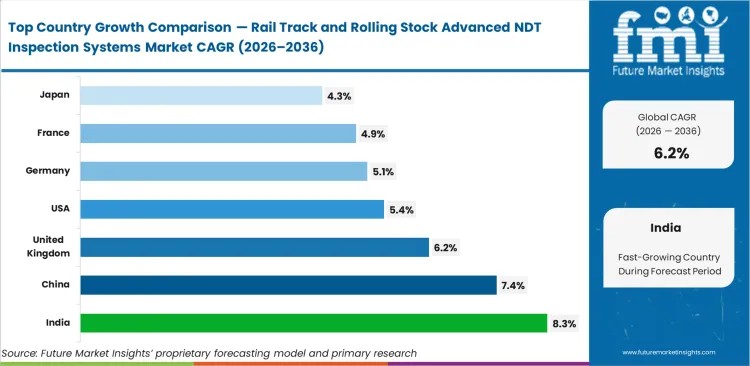
- Country-level momentum is led by India (8.3% CAGR), followed by China (7.4%), the United Kingdom (6.2%), the United States (5.4%), Germany (5.1%), France (4.9%), and Japan (4.3%).
- Growth faces constraints from the long operating life of rail assets, the time needed for railway approvals, and the work required to embed new hardware and analytics into legacy maintenance workflows.
- Product and Segment View
- The market includes ultrasonic, eddy current, machine‑vision, laser‑profile, and acoustic inspection systems deployed on track, in wayside environments, and in depots for condition‑based maintenance.
- These systems support mainline track inspection, turnout and weld inspection, wheel‑profile measurement, wheel‑surface detection, axle inspection, and broader rolling‑stock condition monitoring.
- Ultrasonic leads technology share at 42%, driven by its role in internal rail‑flaw detection and wheel/axle crack inspection in field and production settings.
- Vehicle‑mounted systems lead deployment with 37% share because high‑traffic corridors require coverage levels that portable and depot systems cannot match.
- Track accounts for 39% of the asset segment due to the scale of the global inspectable rail base, with significant network concentration across Asia-Pacific, Europe, and the Americas.
- Infrastructure managers hold 46% of end‑user share, reflecting their responsibility for rail‑in‑track testing, rail‑flaw programs, and inspection‑train procurement.
- Systems represent 61% of the offering segment, as capex for inspection cars, wayside portals, phased‑array rigs, and integrated imaging equipment exceeds standalone software spend.
- The scope includes advanced NDT hardware, embedded analytics, and specialized defect‑detection software, and excludes general maintenance machinery, non‑inspection rolling‑stock tools, and broad smart‑rail software not performing NDT inspection.
- Geography and Competitive Outlook
- India, China, and the United Kingdom are the fastest‑expanding demand centers, while the United States, Germany, and Japan maintain large, stable installed bases.
- Competitive dynamics are shaped by inspection‑train upgrades, wayside automation, and specialization in wheel and wheelset inspection, reinforced by wins such as Goldschmidt’s 2024 DB InfraGO inspection‑train award and India’s 2025 wheel‑profile measurement rollout, both indicating buyer preference for integrated systems over single‑sensor tools.
- MERMEC, Sperry Rail Service, ENSCO Rail, Goldschmidt, Wabtec, and Rosenxt are active across track, wheel, axle, and wayside inspection segments.
- The market remains moderately fragmented, with infrastructure, wheel, axle, and wayside inspection split between service‑focused specialists and equipment‑driven integrators.
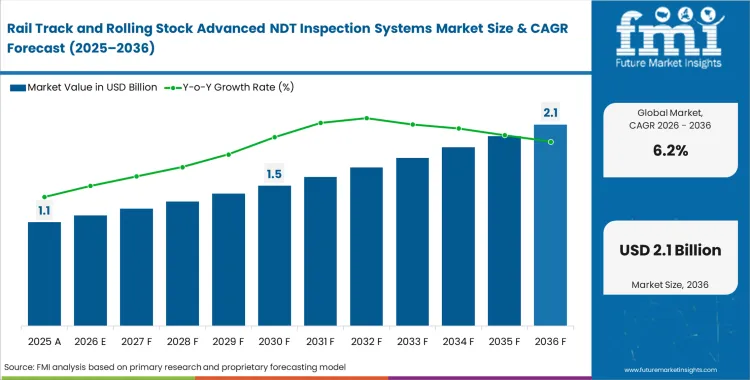
Inspection strategy is becoming an operating decision with direct implications for labor cost, track access, and line capacity. Manual inspection at fixed intervals keeps networks exposed to higher workforce requirements, longer possession blocks, and lower freight throughput across busy corridors. Continuous inspection systems reduce those pressures, yet their value depends on whether operators can handle the data they produce. High-speed wheel and rail monitoring equipment can overwhelm legacy IT environments within a short period, which is pushing rail authorities to expand backhaul links, edge processing, and analytics capacity at the same time they deploy new inspection assets. Catenary inspection is moving in the same direction because imaging and diagnostic streams also require stronger bandwidth and processing support for automated inspection to work reliably at network scale.
Maintenance planning changes once flaw telemetry is fed directly into traffic management systems. Control centers can respond to developing defects with rerouting decisions and targeted interventions instead of waiting for the next scheduled possession window. Inspection no longer sits in a separate testing cycle when that connection is in place. It becomes part of a coordinated operating model in which predictive alerts guide maintenance timing, asset prioritization, and traffic handling. High-speed digital inspection is now being treated as a core requirement in rail operations because the commercial value lies in faster decisions, lower disruption, and better use of maintenance access.
SPURT-car deployment and mandated automated wheel-profile inspection programs are strengthening demand in India, where the market is expected to grow at a CAGR of 8.3% through 2036. China is forecast to record 7.4% CAGR as high-speed network expansion increases inspection frequency and extends NDT deployment across larger rolling stock fleets. In the United Kingdom, the market is likely to expand at a CAGR of 6.2% through 2036, supported by Network Rail’s focus on ultrasonic precision and more consistent defect classification. The United States and Germany remain steadier upgrade markets, with demand projected to rise at CAGRs of 5.4% and 5.1%, respectively, as established installed bases shift spending toward system enhancement rather than large-scale new deployment. France is set to post 4.9% CAGR, while Japan is expected to register 4.3%, reflecting replacement-driven procurement and slower network expansion. The gap between these markets comes from differences in greenfield rail investment, corridor modernization intensity, and the extent to which continuous inspection is being integrated into routine network operations.
Segmental Analysis
Rail Track and Rolling Stock Advanced NDT Inspection Systems Market Analysis by Technology
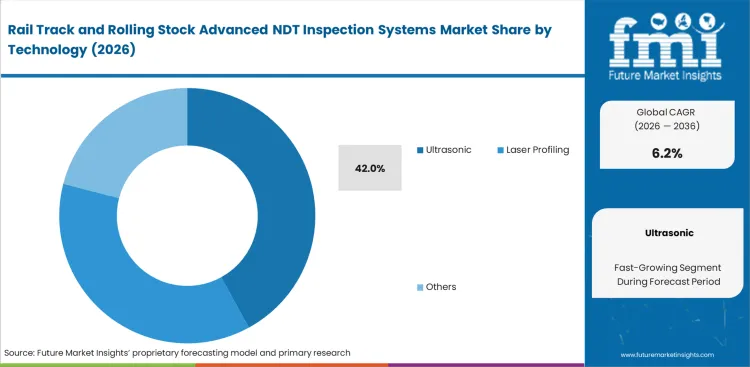
Regulatory frameworks set the parameters for subsurface inspection across all major rail networks and keep ultrasonic testing embedded in formal safety protocols. Executive teams continue to prioritize this method because it delivers validated internal defect detection accepted by national safety regulators. The ultrasonic segment is projected to secure 42.0% share in 2026, supported by decades of codified standards that make displacement by alternative technologies operationally unworkable. Rolling‑stock upgrade programs still depend on these acoustic reference signatures, and phased‑array ultrasonic systems generate data densities that regularly exceed the capacity of legacy railway communications. Operators that delay upgrading backhaul infrastructure often end up running advanced inspection trains at reduced speeds simply to give onboard processors time to handle the incoming signal load.
- Initial evaluation: Safety compliance officers mandate ultrasonic vs eddy current rail inspection comparisons before any other sensor modality is considered during fleet procurement.
- Validation threshold: Chief engineering officers require proven signal-to-noise ratios at specific operating speeds before certifying eddy current rail inspection test vehicles.
- Expansion trigger: Maintenance managers expand fleet deployments only when rail defect detection ai software demonstrably reduces manual verification requirements.
Rail Track and Rolling Stock Advanced NDT Inspection Systems Market Analysis by Deployment
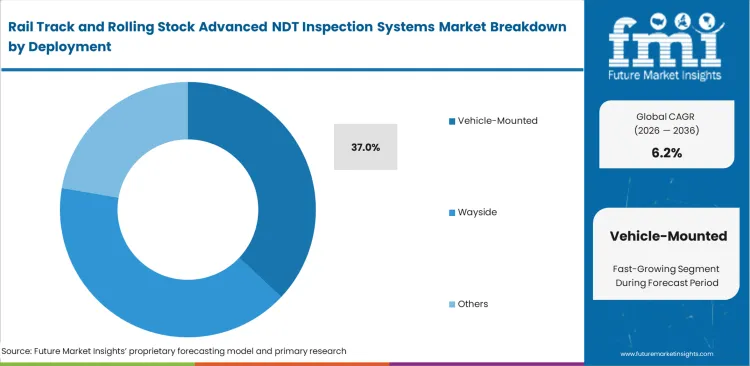
Freight volume requirements place sustained pressure on available maintenance windows, creating a constant operational trade‑off for inspection planning. Vehicle‑mounted platforms give track managers the ability to survey long corridors at line speed, ensuring that inspection frequency aligns with commercial throughput rather than interrupting it. High‑speed runs at roughly 100 kilometers per hour also generate continuous baseline condition data that feeds directly into locomotive maintenance scheduling. The vehicle‑mounted segment is expected to hold 37.0% share in 2026, supported by its ability to deliver broad‑area coverage with minimal impact on freight flow. Wayside systems continue to draw industry interest, yet mobile platforms remain the primary source of multi‑corridor data used to calibrate locomotive maintenance intervals and broader rolling‑stock planning. High‑speed vehicle inspection introduces vibration‑related noise in raw sensor streams, requiring stronger algorithmic filtering than stationary depot environments. Operators attempting to rely solely on wayside monitoring encounter persistent coverage gaps across remote routes, increasing risk exposure in low‑access rural corridors.
- Performance peak: High-speed measurement cars gather continuous rail profile data, identifying macroscopic wear patterns across thousands of track miles.
- Edge conditions: Severe weather environments degrade optical sensor reliability on moving platforms, forcing reliance on concurrent acoustic and magnetic testing.
- Acceptability standard: Track geometry directors establish maximum allowable deviation metrics, causing immediate slow orders when freight wagon wayside inspection sensors detect critical threshold breaches.
Rail Track and Rolling Stock Advanced NDT Inspection Systems Market Analysis by Asset
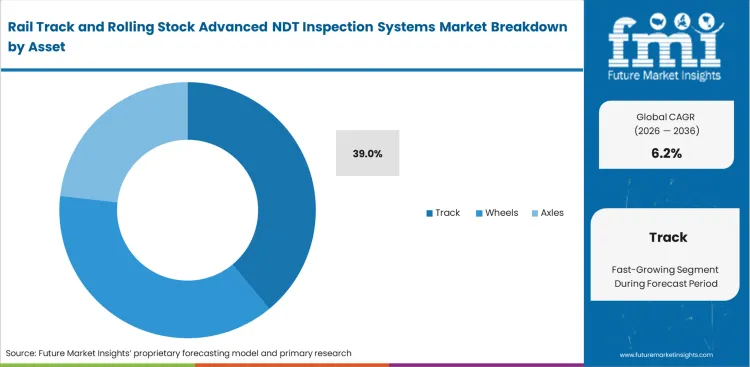
Derailments trace back to unmanaged rail fatigue. Track inspection is projected to command 39.0% share because infrastructure failure carries extreme financial and human liability. Chief safety officers prioritize continuous rail flaw detection over all other asset classes. Identifying microscopic transverse fissures before they propagate into total rail breaks remains a primary objective. FMI analysts note that rigorous rolling stock evaluations cannot mitigate risks associated with operating on compromised continuous welded rail. Automated wheel monitoring is catching up technologically, but fixed infrastructure geometry still demands substantial annual capital outlays. Operators neglecting track-focused NDT arrays face insurance premium increases and immediate regulatory intervention following any high-speed infrastructure failure.
- Prevention focus: Multi-channel ultrasonic arrays prevent rail breaks by detecting internal shelling and transverse fissures long before surface cracks appear.
- Residual risk: Minor geometry deviations remain undetected between scheduled test runs, allowing sudden localized track buckling during extreme temperature fluctuations.
- Full capture: Maintenance directors must integrate track sensor data with ambient environmental monitoring to fully predict heat-induced turnout and weld inspection systems failures.
Rail Track and Rolling Stock Advanced NDT Inspection Systems Market Analysis by End User
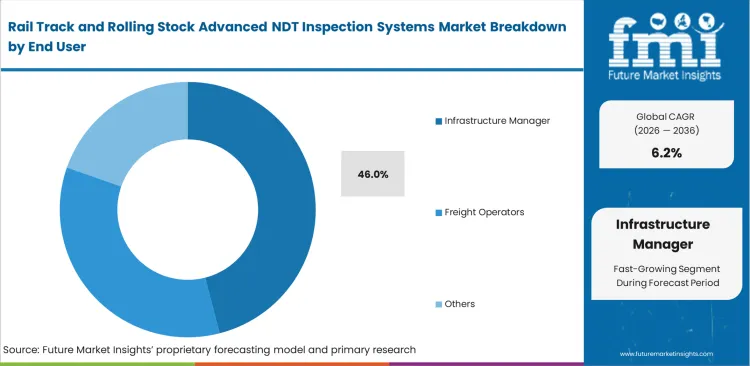
Financial responsibility for network safety sits primarily with organizations that own and manage physical railbeds, as they absorb the operational and regulatory consequences of any failure. Track owners define the condition‑monitoring requirements that passenger operators must follow, even though rolling‑stock procurement sits with the train operating companies themselves. Leading heads at national transit authorities weigh the upfront cost of autonomous inspection vehicles against the recurring expense of outsourced testing, especially as railway telematics platforms expand the volume of usable condition data. Integrated data environments also enable track owners to charge passenger operators based on measured wheel‑wear patterns rather than fixed allocations, shifting cost exposure toward actual asset utilization. The infrastructure manager segment is forecast to command 46.0% share in 2026, reflecting the concentration of safety accountability and compliance obligations with track custodians. This structure reinforces why operators continue to prioritize rigorous NDT regimes to retain operating permissions and regulatory confidence.
- Procurement savings: Network executives reduce long-term outsourced service contracts by acquiring proprietary automated testing vehicles for high-frequency corridors.
- Hidden operations: Daily calibration and specialized technician training add massive hidden overhead to ostensibly automated track inspection programs.
- Lifecycle reality: Total ownership costs over twenty-year testing vehicle lifespans far exceed initial acquisition, driven entirely by continuous railway inspection software platform upgrades.
Rail Track and Rolling Stock Advanced NDT Inspection Systems Market Analysis by Offering
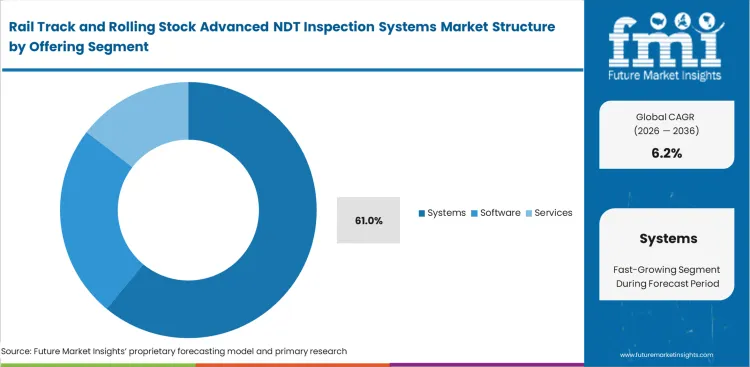
Software analytics continue to raise expectations for network‑wide efficiency gains, but physical hardware still determines the quality and reliability of the underlying data. Digital inspection workflows depend on capturing verified defect signatures that artificial intelligence can classify, making sensor arrays the starting point for any modernization effort. Hardware procurement cycles also set the pace at which operators can scale predictive inspection across expanding corridors, especially as smart railways depend on ruggedized trackside and onboard instrumentation to feed high‑resolution telemetry into analytics engines. Building these configurations requires substantial capital commitment to physical infrastructure before advanced software can generate meaningful diagnostic outputs. The systems segment is projected to secure 61.0% share in 2026, reflecting the foundational role of hardware as the gating layer for all downstream analytics and automation. Agencies attempting to prioritize software upgrades without replacing legacy sensor platforms consistently encounter data‑quality limitations that constrain the performance of new analytical tools.
- Initial wave: Well-funded national rail operators adopt advanced multi-modal inspection cars, establishing baseline operational standards for high-speed networks.
- Secondary followers: Regional transit authorities subsequently purchase scaled-down vehicle systems, focusing strictly on high-risk commuter corridors.
- Final conversion: Short-line freight operators transition to portable digital testing last, driven only when legacy analog equipment becomes entirely unsupportable.
Rail Track and Rolling Stock Advanced NDT Inspection Systems Market Drivers, Restraints, and Opportunities
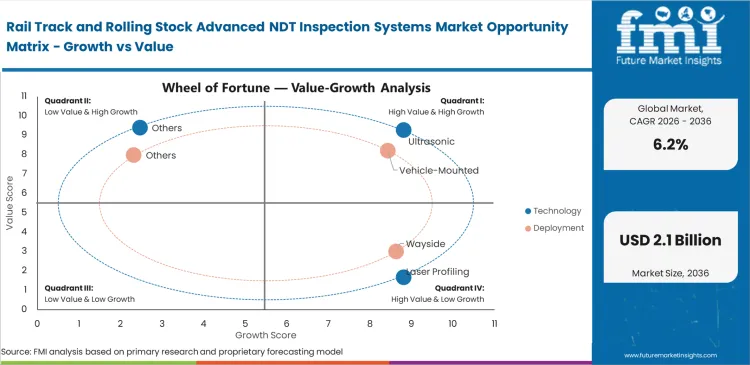
Regulatory agencies refuse to accept analog inspection data on modern high-speed corridors. Chief safety officers must procure digital, auditable defect records to maintain operating certificates. Delaying procurement exposes network operators to massive liability in the event of derailments, as investigators immediately seek digital proof of compliance. Increasing train traffic leaves virtually no time for manual track walking. Autonomous high-speed test vehicles provide mathematical solutions for fulfilling mandatory inspection frequencies without severely disrupting commercial freight schedules.
Data ingestion bandwidth acts as primary friction slowing autonomous inspection rollouts. Rural track environments lack continuous cellular or fiber-optic connectivity required to transmit terabytes of high-resolution ultrasonic and optical data back to central processing hubs. Maintenance directors possess highly advanced sensor cars but cannot extract data until vehicles physically return to depots. Edge computing solutions are emerging to process defect recognition directly on test trains, but power constraints and severe vibration environments limit onboard server reliability.
Opportunities in the Rail Track and Rolling Stock Advanced NDT Inspection Systems Market
- Predictive maintenance integration: Asset managers gain substantial efficiency by linking real-time defect telemetry directly to stock management software.
- Automated wheel reprofiling: Depot operators reduce rolling stock downtime by installing wayside optical arrays automatically scheduling precise wheel lathe interventions.
- Drone-based catenary scanning: Maintenance supervisors eliminate hazardous manual overhead wire inspections by deploying specialized optical drone fleets along electrified corridors.
Regional Analysis
.webp "Top Country Growth Comparison Rail Track And Rolling Stock Advanced Ndt Inspection Systems Market Cagr (2026 2036)")
Based on regional analysis, rail track and rolling stock advanced NDT inspection systems market is segmented into North America, Latin America, Western Europe, Eastern Europe, East Asia, South Asia and Pacific, and Middle East and Africa across 40 plus countries.
| Country | CAGR (2026 to 2036) |
|---|---|
| India | 8.3% |
| China | 7.4% |
| United Kingdom | 6.2% |
| United States | 5.4% |
| Germany | 5.1% |
| France | 4.9% |
| Japan | 4.3% |
Source: Future Market Insights (FMI) analysis, based on proprietary forecasting model and primary research
South Asia and Pacific Rail Track and Rolling Stock Advanced NDT Inspection Systems Market Analysis
Capacity expansion directly forces rapid technological leaps across developing rail networks. Transit authorities in this region operate under extreme pressure accommodating surging passenger and freight volumes simultaneously on shared infrastructure. FMI observes legacy manual track inspection practices completely collapse under high-density traffic realities. Directors aggressively source autonomous testing vehicles and wayside monitoring systems to eliminate human bottlenecks. Investment heavily targets rapid deployment of baseline digital capabilities rather than marginal software optimization. Managing railway communication equipment upgrades in tandem with new sensor deployments defines operational challenges for local track engineers.
- India: Directors across the country are aggressively acquiring SPURT-cars to comply with strict new automated wheel profile mandates on modernizing corridors. Demand for rail track and rolling stock NDT inspection systems in India is anticipated to rise at a CAGR of 8.3% through 2036. Railway ministry officials aim to eliminate manual wheel measurement entirely by 2030, presenting massive commercial opportunities for established optical array vendors.
East Asia Rail Track and Rolling Stock Advanced NDT Inspection Systems Market Analysis
High-speed rail dominance alters baseline requirements for infrastructure testing. Safety tolerances on corridors operating above 300 kilometers per hour demand continuous micron-level defect monitoring. According to FMI's estimates, transit operators in East Asia prioritize integrated vehicle-mounted arrays capable of processing multiple sensor modalities at extreme velocities. Rapid expansion of new track mileage requires immediate concurrent investment in dedicated diagnostic train fleets. Maintenance cycles here operate with microscopic precision, leaving zero margin for equipment failure or false positive readings.
- China: State operators possess the unique advantage of building dedicated digital maintenance architectures entirely from scratch, avoiding the legacy integration friction that plagues older Western networks. Sales of rail track and rolling stock advanced NDT inspection systems are poised to expand at a CAGR of 7.4% from 2026 to 2036. This continuous capacity expansion requires rigorous safety validation, accelerating the deployment of autonomous high-speed test vehicles.
- Japan: Japan is forecast to record steady growth in advanced railway NDT systems at a CAGR of 4.3% through 2036. Because the national network topography is highly mature, procurement cycles are fundamentally replacement-led rather than focused on greenfield installations. Engineering focus centers entirely on marginal software optimization and integrating predictive AI capabilities into existing diagnostic fleets rather than procuring massive new hardware deployments.
Western Europe Rail Track and Rolling Stock Advanced NDT Inspection Systems Market Analysis
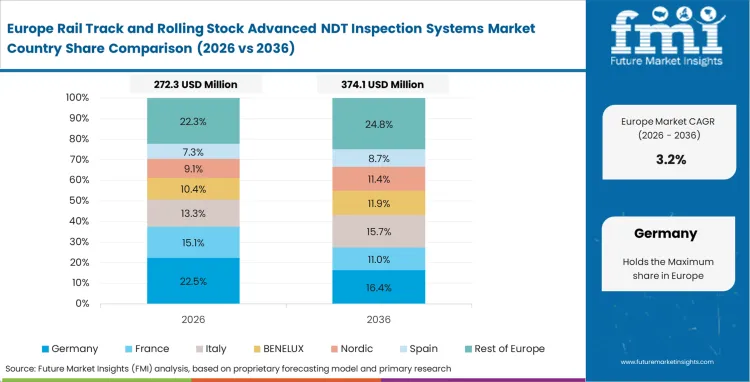
Cross-border interoperability mandates create rigid standardization across continental track maintenance programs. European Union directives require infrastructure managers to maintain unified digital records concerning track geometry and internal rail integrity. Based on FMI's analysis, regional transit operators focus heavily on harmonizing sensor data formats to comply with centralized safety registries. Procurement strategies favor vendors offering modular systems capable of upgrading specific sensor heads without replacing entire vehicle platforms. Brownfield modernization dominates capital expenditure as historic railbeds face unprecedented traffic loads.
- United Kingdom: Network Rail continues to enforce rigorous ultrasonic fleet accuracy upgrades to manage fatigue across aging infrastructure. As digital lineside inspection transitions alter how local maintenance depots schedule physical track interventions, the adoption of NDT platforms in the United Kingdom is expected to move ahead at a CAGR of 6.2% during the forecast period. Operators prioritize modular defect recognition software to manage these dense acoustic datasets.
- Germany: German infrastructure managers maintain significant competitive positioning by actively exporting their stringent internal safety protocols to neighboring European rail networks. Operating massive installed bases of automated depot measurement stations ensures the Germany sector is expected to register a CAGR of 5.1% from 2026 to 2036. Maintaining this dominance requires continuous investment in data translation middleware to support cross-border rolling stock qualification.
- France: High-speed network maturity across the country dictates an investment cycle focused strictly on advanced diagnostic system replacement. French rail operators increasingly demand robust edge-computing capabilities to process massive diagnostic datasets entirely onboard test vehicles. Driven by these operational requirements, railway NDT equipment sales in France are poised to grow at a CAGR of 4.9% during the assessment period. Such decentralized computing prevents critical bandwidth bottlenecks.
Competitive Aligners for Market Players
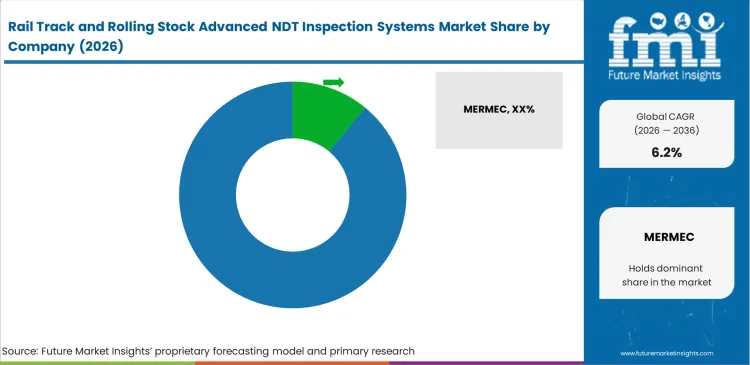
Competitive strength in this market comes from compatibility with long-established railway safety systems, not from sensor novelty alone. MERMEC and Sperry Rail Service remain strongly placed because their ultrasonic and optical inspection models are built on defect libraries validated over many years in live rail conditions. Procurement teams place real weight on that record. Faster acoustic sensors may look attractive on paper, yet certification becomes difficult when the software has not been trained against a long history of correlated rail-break data. Vendors are judged by how reliably they separate true defects from vibration noise at operating speed without triggering false alarms that disrupt rail traffic.
Incumbent suppliers also benefit from the way inspection data already sits inside operator workflows. ENSCO Rail and Goldschmidt have tied diagnostic outputs into customized asset management systems used by national rail authorities, which makes supplier replacement costly and operationally difficult. Network expansion plans often reinforce that position, since infrastructure managers prefer to extend existing contracts and preserve continuity in maintenance records. New entrants need more than inspection hardware to win share. They also need data translation tools that let operators bring new systems into established records without breaking historical comparability.
Tender requirements are starting to shift in response to concerns over supplier dependence. Transit authorities are writing more open-architecture conditions into new contracts, which is pushing vendors such as Wabtec, and Rosenxt to work in environments where engineering teams want flexibility across hardware and analytics layers. Larger rail operators are separating sensor purchases from software licensing decisions, reducing the advantage of closed systems. That change is pushing traditional manufacturers toward modular sensor designs and API-ready data streams. The strongest competitive position will sit with companies that can combine third-party wayside optical inputs with vehicle-mounted ultrasonic data in a single predictive maintenance view.
Key Players in Rail Track and Rolling Stock Advanced NDT Inspection Systems Market
- MERMEC
- Sperry Rail Service
- ENSCO Rail
- Goldschmidt
- Wabtec
- Rosenxt
Scope of the Report
| Metric | Value |
|---|---|
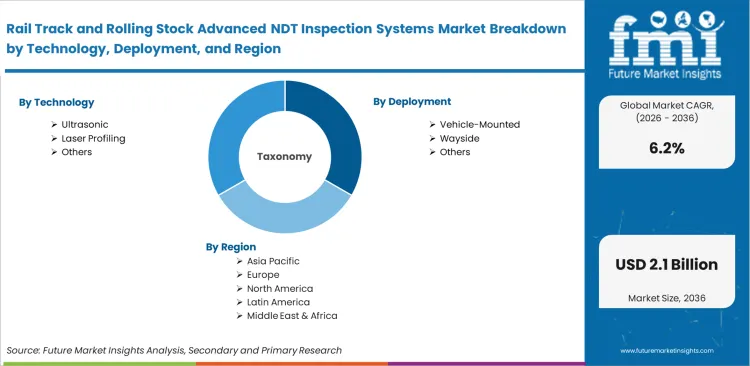
| Quantitative Units | USD 1.1 Billion in 2026 to USD 2.0 Billion by 2036, at a CAGR of 6.2% |
| Market Definition | Advanced non-destructive testing platforms deployed across rail networks to detect flaws in track and rolling stock components without disrupting physical integrity. |
| Segmentation | By Technology, Deployment, Asset, End User, Offering |
| Regions Covered | North America, Latin America, Western Europe, Eastern Europe, East Asia, South Asia and Pacific, Middle East and Africa |
| Countries Covered | India, China, United Kingdom, United States, Germany, France, Japan |
| Key Companies Profiled | MERMEC, Sperry Rail Service, ENSCO Rail, Goldschmidt, Wabtec, Rosenxt |
| Forecast Period | 2026 to 2036 |
| Approach | Baseline established through total track-miles and active train fleet volumes. |
Source: Future Market Insights (FMI) analysis, based on proprietary forecasting model and primary research
Rail Track and Rolling Stock Advanced NDT Inspection Systems Market Analysis by Segments
Technology
- Ultrasonic
- Eddy current
- Machine vision
- Laser profiling
- Acoustic sensing
Deployment
- Vehicle-mounted
- Wayside
- Depot
- Portable
Asset
- Track
- Wheels
- Axles
- Bogies
- Underframe
End User
- Infrastructure managers
- Passenger operators
- Freight operators
- MRO workshops
Offering
- Systems
- Software
- Services
Region:
- North America
- United States
- Canada
- Europe
- Germany
- United Kingdom
- France
- Italy
- Spain
- Asia Pacific
- China
- Japan
- South Korea
- Taiwan
- Singapore
- Latin America
- Brazil
- Mexico
- Argentina
- Middle East & Africa
- GCC Countries
- South Africa
Bibliography
- Rail Safety and Standards Board. (2024). NDT processes on rail vehicles (RIS-2701-RST, Issue 2 Draft 1c).
- European Union Agency for Railways. (2024). Report on railway safety and interoperability in the EU - 2024.
- Mordia, R., & Verma, A. K. (2025). Nondestructive testing methods for rail defects detection. High-speed Railway, 3(2), 163-173.
- Zhang, Q., Peng, J., Tian, K., Wang, A., Li, J., & Gao, X. (2024). Advancing ultrasonic defect detection in high-speed wheels via UT-YOLO. Sensors, 24(5), 1555.
- Qiu, L., Zhu, M., Jiang, Y., Teng, H. H., & Park, J. W. (2025). Non-disruptive rail track geometry measurement system using an unmanned aerial vehicle and a light detection and ranging sensor. International Journal of Transportation Science and Technology. Advance online publication.
This bibliography is provided for reader reference. The full FMI report contains the complete reference list with primary source documentation.
This Report Addresses
- Track geometry deviations and ultrasonic rail flaw data integration.
- Vehicle-mounted high-speed acoustic sensing payload configurations.
- Wayside automated wheel profile measurement installation timelines.
- Infrastructure manager procurement cycles for defect recognition software.
- Freight operator strategies for mitigating high-speed derailment liability.
- European Union interoperability standard impacts on NDT sensor mandates.
- Legacy IT infrastructure bottlenecks during massive sensor data ingestion.
- Edge-computing requirements for autonomous track inspection fleets.
Frequently Asked Questions
Estimate the size of the railway NDT inspection market?
Total revenue is projected to reach USD 1.1 billion in 2026. This figure reflects the immediate capital requirements for integrating digital sensor arrays into existing manual testing workflows across high-density rail corridors.
What drives growth in the railway inspection systems market?
Sector revenue will expand to USD 2.0 billion by 2036. Continued investment stems directly from infrastructure managers shifting from scheduled physical track possession to continuous predictive maintenance models.
What is advanced NDT in railways?
Advanced non-destructive testing includes phased-array acoustics and automated vision algorithms used to assess asset integrity. These platforms detect internal flaws and external wear without dismantling structural components or halting operational train flows.
How do railways inspect internal rail cracks?
Ultrasonic arrays provide the only validated subsurface defect detection currently accepted by national rail safety boards. High-frequency sound waves identify internal shelling and transverse fissures long before surface cracks appear on the rail head.
How are train wheels inspected automatically?
Depot operators install wayside optical arrays that capture precise wheel profiles as trains pass at operational speeds. This removes manual measurement bottlenecks and automatically schedules interventions on specialized wheel lathes when deviations exceed safety thresholds.
What is the difference between wayside and depot wheel inspection?
Wayside systems monitor passing trains on active commercial lines to flag immediate safety risks, while depot inspections handle stationary or slow-moving stock for precise maintenance calibration. Both are essential for comprehensive wheelset condition monitoring railway programs.
Which NDT method is used for rail flaw detection?
Acoustic testing dominates internal flaw evaluation, while eddy current effectively identifies surface-level defects. ultrasonic vs eddy current rail inspection choices depend entirely on whether safety officers prioritize internal fatigue or surface cracking parameters.
Explain the rail NDT inspection systems market?
This sector involves the hardware and software required to automate railway safety inspections. It encompasses the transition from manual track-walking to high-speed digital sensor deployment across global freight and passenger networks.
Which companies make railway wheel inspection systems?
Top suppliers include MERMEC, Sperry Rail Service, ENSCO Rail, Goldschmidt, Wabtec, and Rosenxt. These vendors compete heavily on providing ruggedized physical hardware paired with deep, proprietary defect-signature software libraries.
Where is rail NDT demand growing fastest?
India leads expansion at 8.3% driven by aggressive SPURT-car procurement and new automated wheel profile mandates. Transit authorities in this region operate under extreme pressure accommodating surging passenger and freight volumes simultaneously on shared infrastructure.
Railway wheel inspection system vs manual inspection: What is the ROI?
Calculating train wheel inspection system ROI relies on measuring the reduction in derailment liabilities against the upfront capital cost. Automated arrays drastically extend wheel lifecycles by preventing uneven wear before it causes cascading mechanical damage.
Can machine vision replace manual railcar inspection?
Machine vision accurately measures macroscopic geometry deviations and external part failures at speeds human inspectors cannot match. It cannot evaluate internal metallurgical fatigue, requiring operators to fuse vision data with underlying acoustic readings.
How often should rail tracks be ultrasonically tested?
Inspection frequency depends entirely on total gross tonnage and ambient environmental stress. Heavy haul freight lines and high-speed passenger corridors often require continuous monitoring, utilizing high-speed testing cars between scheduled commercial runs.
Who are the top suppliers in rail and NDT inspection?
Established vendors like MERMEC, Sperry Rail Service, and ENSCO Rail dominate because their diagnostic algorithms possess decades of validated defect signatures. Breaking their supplier lock-in requires massive data translation middleware from challengers.
Why is wayside inspection growing in rolling stock maintenance?
Wayside monitoring generates continuous safety data without pulling active locomotives out of commercial service. Freight operators rely heavily on these installations to avoid costly disruptions while satisfying strict government safety mandates.
Buy railway wheel inspection system: what do buyers evaluate?
Procurement officers prioritize seamless data integration into existing enterprise asset management platforms over pure sensor speed. Hardware procurement cycles define overall network modernization pacing, requiring systems that do not choke legacy IT bandwidths.
Preview the report firsthand - request a free sample
Get SampleGet the brochure for pricing and purchase details.
Get PDFTable of Content
- Executive Summary
- Global Market Outlook
- Demand-side Trends
- Supply-side Trends
- Technology Roadmap Analysis
- Analysis and Recommendations
- Market Overview
- Market Coverage / Taxonomy
- Market Definition / Scope / Limitations
- Research Methodology
- Chapter Orientation
- Analytical Lens and Working Hypotheses
- Market Structure, Signals, and Trend Drivers
- Benchmarking and Cross-market Comparability
- Market Sizing, Forecasting, and Opportunity Mapping
- Research Design and Evidence Framework
- Desk Research Programme (Secondary Evidence)
- Company Annual and Sustainability Reports
- Peer-reviewed Journals and Academic Literature
- Corporate Websites, Product Literature, and Technical Notes
- Earnings Decks and Investor Briefings
- Statutory Filings and Regulatory Disclosures
- Technical White Papers and Standards Notes
- Trade Journals, Industry Magazines, and Analyst Briefs
- Conference Proceedings, Webinars, and Seminar Materials
- Government Statistics Portals and Public Data Releases
- Press Releases and Reputable Media Coverage
- Specialist Newsletters and Curated Briefings
- Sector Databases and Reference Repositories
- FMI Internal Proprietary Databases and Historical Market Datasets
- Subscription Datasets and Paid Sources
- Social Channels, Communities, and Digital Listening Inputs
- Additional Desk Sources
- Expert Input and Fieldwork (Primary Evidence)
- Primary Modes
- Qualitative Interviews and Expert Elicitation
- Quantitative Surveys and Structured Data Capture
- Blended Approach
- Why Primary Evidence is Used
- Field Techniques
- Interviews
- Surveys
- Focus Groups
- Observational and In-context Research
- Social and Community Interactions
- Stakeholder Universe Engaged
- C-suite Leaders
- Board Members
- Presidents and Vice Presidents
- R&D and Innovation Heads
- Technical Specialists
- Domain Subject-matter Experts
- Scientists
- Physicians and Other Healthcare Professionals
- Governance, Ethics, and Data Stewardship
- Research Ethics
- Data Integrity and Handling
- Primary Modes
- Tooling, Models, and Reference Databases
- Desk Research Programme (Secondary Evidence)
- Data Engineering and Model Build
- Data Acquisition and Ingestion
- Cleaning, Normalisation, and Verification
- Synthesis, Triangulation, and Analysis
- Quality Assurance and Audit Trail
- Market Background
- Market Dynamics
- Drivers
- Restraints
- Opportunity
- Trends
- Scenario Forecast
- Demand in Optimistic Scenario
- Demand in Likely Scenario
- Demand in Conservative Scenario
- Opportunity Map Analysis
- Product Life Cycle Analysis
- Supply Chain Analysis
- Investment Feasibility Matrix
- Value Chain Analysis
- PESTLE and Porter’s Analysis
- Regulatory Landscape
- Regional Parent Market Outlook
- Production and Consumption Statistics
- Import and Export Statistics
- Market Dynamics
- Global Market Analysis 2021 to 2025 and Forecast, 2026 to 2036
- Historical Market Size Value (USD Million) Analysis, 2021 to 2025
- Current and Future Market Size Value (USD Million) Projections, 2026 to 2036
- Y-o-Y Growth Trend Analysis
- Absolute $ Opportunity Analysis
- Global Market Pricing Analysis 2021 to 2025 and Forecast 2026 to 2036
- Global Market Analysis 2021 to 2025 and Forecast 2026 to 2036, By Technology
- Introduction / Key Findings
- Historical Market Size Value (USD Million) Analysis By Technology , 2021 to 2025
- Current and Future Market Size Value (USD Million) Analysis and Forecast By Technology , 2026 to 2036
- Ultrasonic
- Laser Profiling
- Others
- Ultrasonic
- Y-o-Y Growth Trend Analysis By Technology , 2021 to 2025
- Absolute $ Opportunity Analysis By Technology , 2026 to 2036
- Global Market Analysis 2021 to 2025 and Forecast 2026 to 2036, By Deployment
- Introduction / Key Findings
- Historical Market Size Value (USD Million) Analysis By Deployment, 2021 to 2025
- Current and Future Market Size Value (USD Million) Analysis and Forecast By Deployment, 2026 to 2036
- Vehicle‑Mounted
- Wayside
- Others
- Vehicle‑Mounted
- Y-o-Y Growth Trend Analysis By Deployment, 2021 to 2025
- Absolute $ Opportunity Analysis By Deployment, 2026 to 2036
- Global Market Analysis 2021 to 2025 and Forecast 2026 to 2036, By Asset
- Introduction / Key Findings
- Historical Market Size Value (USD Million) Analysis By Asset, 2021 to 2025
- Current and Future Market Size Value (USD Million) Analysis and Forecast By Asset, 2026 to 2036
- Track
- Wheels
- Axles
- Track
- Y-o-Y Growth Trend Analysis By Asset, 2021 to 2025
- Absolute $ Opportunity Analysis By Asset, 2026 to 2036
- Global Market Analysis 2021 to 2025 and Forecast 2026 to 2036, By End User
- Introduction / Key Findings
- Historical Market Size Value (USD Million) Analysis By End User, 2021 to 2025
- Current and Future Market Size Value (USD Million) Analysis and Forecast By End User, 2026 to 2036
- Infrastructure Manager
- Freight Operators
- Others
- Infrastructure Manager
- Y-o-Y Growth Trend Analysis By End User, 2021 to 2025
- Absolute $ Opportunity Analysis By End User, 2026 to 2036
- Global Market Analysis 2021 to 2025 and Forecast 2026 to 2036, By Offering
- Introduction / Key Findings
- Historical Market Size Value (USD Million) Analysis By Offering, 2021 to 2025
- Current and Future Market Size Value (USD Million) Analysis and Forecast By Offering, 2026 to 2036
- Systems
- Software
- Services
- Systems
- Y-o-Y Growth Trend Analysis By Offering, 2021 to 2025
- Absolute $ Opportunity Analysis By Offering, 2026 to 2036
- Global Market Analysis 2021 to 2025 and Forecast 2026 to 2036, By Region
- Introduction
- Historical Market Size Value (USD Million) Analysis By Region, 2021 to 2025
- Current Market Size Value (USD Million) Analysis and Forecast By Region, 2026 to 2036
- North America
- Latin America
- Western Europe
- Eastern Europe
- East Asia
- South Asia and Pacific
- Middle East & Africa
- Market Attractiveness Analysis By Region
- North America Market Analysis 2021 to 2025 and Forecast 2026 to 2036, By Country
- Historical Market Size Value (USD Million) Trend Analysis By Market Taxonomy, 2021 to 2025
- Market Size Value (USD Million) Forecast By Market Taxonomy, 2026 to 2036
- By Country
- USA
- Canada
- Mexico
- By Technology
- By Deployment
- By Asset
- By End User
- By Offering
- By Country
- Market Attractiveness Analysis
- By Country
- By Technology
- By Deployment
- By Asset
- By End User
- By Offering
- Key Takeaways
- Latin America Market Analysis 2021 to 2025 and Forecast 2026 to 2036, By Country
- Historical Market Size Value (USD Million) Trend Analysis By Market Taxonomy, 2021 to 2025
- Market Size Value (USD Million) Forecast By Market Taxonomy, 2026 to 2036
- By Country
- Brazil
- Chile
- Rest of Latin America
- By Technology
- By Deployment
- By Asset
- By End User
- By Offering
- By Country
- Market Attractiveness Analysis
- By Country
- By Technology
- By Deployment
- By Asset
- By End User
- By Offering
- Key Takeaways
- Western Europe Market Analysis 2021 to 2025 and Forecast 2026 to 2036, By Country
- Historical Market Size Value (USD Million) Trend Analysis By Market Taxonomy, 2021 to 2025
- Market Size Value (USD Million) Forecast By Market Taxonomy, 2026 to 2036
- By Country
- Germany
- UK
- Italy
- Spain
- France
- Nordic
- BENELUX
- Rest of Western Europe
- By Technology
- By Deployment
- By Asset
- By End User
- By Offering
- By Country
- Market Attractiveness Analysis
- By Country
- By Technology
- By Deployment
- By Asset
- By End User
- By Offering
- Key Takeaways
- Eastern Europe Market Analysis 2021 to 2025 and Forecast 2026 to 2036, By Country
- Historical Market Size Value (USD Million) Trend Analysis By Market Taxonomy, 2021 to 2025
- Market Size Value (USD Million) Forecast By Market Taxonomy, 2026 to 2036
- By Country
- Russia
- Poland
- Hungary
- Balkan & Baltic
- Rest of Eastern Europe
- By Technology
- By Deployment
- By Asset
- By End User
- By Offering
- By Country
- Market Attractiveness Analysis
- By Country
- By Technology
- By Deployment
- By Asset
- By End User
- By Offering
- Key Takeaways
- East Asia Market Analysis 2021 to 2025 and Forecast 2026 to 2036, By Country
- Historical Market Size Value (USD Million) Trend Analysis By Market Taxonomy, 2021 to 2025
- Market Size Value (USD Million) Forecast By Market Taxonomy, 2026 to 2036
- By Country
- China
- Japan
- South Korea
- By Technology
- By Deployment
- By Asset
- By End User
- By Offering
- By Country
- Market Attractiveness Analysis
- By Country
- By Technology
- By Deployment
- By Asset
- By End User
- By Offering
- Key Takeaways
- South Asia and Pacific Market Analysis 2021 to 2025 and Forecast 2026 to 2036, By Country
- Historical Market Size Value (USD Million) Trend Analysis By Market Taxonomy, 2021 to 2025
- Market Size Value (USD Million) Forecast By Market Taxonomy, 2026 to 2036
- By Country
- India
- ASEAN
- Australia & New Zealand
- Rest of South Asia and Pacific
- By Technology
- By Deployment
- By Asset
- By End User
- By Offering
- By Country
- Market Attractiveness Analysis
- By Country
- By Technology
- By Deployment
- By Asset
- By End User
- By Offering
- Key Takeaways
- Middle East & Africa Market Analysis 2021 to 2025 and Forecast 2026 to 2036, By Country
- Historical Market Size Value (USD Million) Trend Analysis By Market Taxonomy, 2021 to 2025
- Market Size Value (USD Million) Forecast By Market Taxonomy, 2026 to 2036
- By Country
- Kingdom of Saudi Arabia
- Other GCC Countries
- Turkiye
- South Africa
- Other African Union
- Rest of Middle East & Africa
- By Technology
- By Deployment
- By Asset
- By End User
- By Offering
- By Country
- Market Attractiveness Analysis
- By Country
- By Technology
- By Deployment
- By Asset
- By End User
- By Offering
- Key Takeaways
- Key Countries Market Analysis
- USA
- Pricing Analysis
- Market Share Analysis, 2025
- By Technology
- By Deployment
- By Asset
- By End User
- By Offering
- Canada
- Pricing Analysis
- Market Share Analysis, 2025
- By Technology
- By Deployment
- By Asset
- By End User
- By Offering
- Mexico
- Pricing Analysis
- Market Share Analysis, 2025
- By Technology
- By Deployment
- By Asset
- By End User
- By Offering
- Brazil
- Pricing Analysis
- Market Share Analysis, 2025
- By Technology
- By Deployment
- By Asset
- By End User
- By Offering
- Chile
- Pricing Analysis
- Market Share Analysis, 2025
- By Technology
- By Deployment
- By Asset
- By End User
- By Offering
- Germany
- Pricing Analysis
- Market Share Analysis, 2025
- By Technology
- By Deployment
- By Asset
- By End User
- By Offering
- UK
- Pricing Analysis
- Market Share Analysis, 2025
- By Technology
- By Deployment
- By Asset
- By End User
- By Offering
- Italy
- Pricing Analysis
- Market Share Analysis, 2025
- By Technology
- By Deployment
- By Asset
- By End User
- By Offering
- Spain
- Pricing Analysis
- Market Share Analysis, 2025
- By Technology
- By Deployment
- By Asset
- By End User
- By Offering
- France
- Pricing Analysis
- Market Share Analysis, 2025
- By Technology
- By Deployment
- By Asset
- By End User
- By Offering
- India
- Pricing Analysis
- Market Share Analysis, 2025
- By Technology
- By Deployment
- By Asset
- By End User
- By Offering
- ASEAN
- Pricing Analysis
- Market Share Analysis, 2025
- By Technology
- By Deployment
- By Asset
- By End User
- By Offering
- Australia & New Zealand
- Pricing Analysis
- Market Share Analysis, 2025
- By Technology
- By Deployment
- By Asset
- By End User
- By Offering
- China
- Pricing Analysis
- Market Share Analysis, 2025
- By Technology
- By Deployment
- By Asset
- By End User
- By Offering
- Japan
- Pricing Analysis
- Market Share Analysis, 2025
- By Technology
- By Deployment
- By Asset
- By End User
- By Offering
- South Korea
- Pricing Analysis
- Market Share Analysis, 2025
- By Technology
- By Deployment
- By Asset
- By End User
- By Offering
- Russia
- Pricing Analysis
- Market Share Analysis, 2025
- By Technology
- By Deployment
- By Asset
- By End User
- By Offering
- Poland
- Pricing Analysis
- Market Share Analysis, 2025
- By Technology
- By Deployment
- By Asset
- By End User
- By Offering
- Hungary
- Pricing Analysis
- Market Share Analysis, 2025
- By Technology
- By Deployment
- By Asset
- By End User
- By Offering
- Kingdom of Saudi Arabia
- Pricing Analysis
- Market Share Analysis, 2025
- By Technology
- By Deployment
- By Asset
- By End User
- By Offering
- Turkiye
- Pricing Analysis
- Market Share Analysis, 2025
- By Technology
- By Deployment
- By Asset
- By End User
- By Offering
- South Africa
- Pricing Analysis
- Market Share Analysis, 2025
- By Technology
- By Deployment
- By Asset
- By End User
- By Offering
- USA
- Market Structure Analysis
- Competition Dashboard
- Competition Benchmarking
- Market Share Analysis of Top Players
- By Regional
- By Technology
- By Deployment
- By Asset
- By End User
- By Offering
- Competition Analysis
- Competition Deep Dive
- MERMEC
- Overview
- Product Portfolio
- Profitability by Market Segments (Product/Age /Sales Channel/Region)
- Sales Footprint
- Strategy Overview
- Marketing Strategy
- Product Strategy
- Channel Strategy
- Sperry Rail Service
- ENSCO Rail
- Goldschmidt
- Wabtec
- Rosenxt
- MERMEC
- Competition Deep Dive
- Assumptions & Acronyms Used


