

- Industry Size (2026)
- USD 8.2 Bn
- Forecast (2036)
- USD 16.5 Bn
- CAGR (2026 to 2036)
- 7.3%
Railway Telematics Market Forecast and Outlook 2026 to 2036
The global railway telematics sector is on track to achieve a valuation of USD 16.5 billion by 2036, accelerating from USD 8.2 billion in 2026 at a CAGR of 7.3%. As per Future Market Insights, expansion is structurally underpinned by the global push toward predictive maintenance across rail networks and the digital twin adoption mandates embedded in new rolling stock procurement tenders. The European Union Agency for Railways (ERA) published updated Technical Specifications for Interoperability (TSI) in 2024, which include provisions for onboard monitoring data exchange standards.
This regulatory framework compels rail operators and rolling stock OEMs to embed telematics-ready sensors and communication modules into new trains. Simultaneously, the industry is shifting from reactive, time-based maintenance schedules to condition-based and predictive regimes, which forces investment in edge computing, cloud analytics, and AI inference at the fleet level.
Marc Ludwig, CEO of Rail Infrastructure at Siemens Mobility, stated: 'Siemens Mobility's expertise and advanced solutions pave the way for future digitalization efforts, enabling sustainable and high-performing railway operations.' In October 2025, Siemens Mobility showcased its RailXplore asset performance monitoring platform at IREE 2025, demonstrating AI-driven anomaly detection for track and rolling stock. In the same month, Hitachi Rail became the first transportation firm globally to integrate the NVIDIA IGX Thor platform into its HMAX digital asset management suite. FMI is of the opinion that the deployment of GPU-class AI accelerators at the railway edge, rather than relying solely on cloud-based processing, will become standard for safety-critical applications where latency in anomaly detection directly affects operational risk.
The operational reality for railway telematics suppliers is defined by the need to balance interoperability standards with proprietary platform differentiation. As per FMI, the railway telematics market is structurally distinct from broader IoT markets because rail safety certification requirements (EN 50129, SIL standards) impose multi-year qualification cycles on new hardware and software. This certification barrier creates a high-trust supplier ecosystem where incumbent telematics providers maintain long-term relationships with rail operators. FMI analysts are of the view that the convergence of telematics with digital twin technology will be the next major investment cycle, as operators seek to model entire network assets virtually before committing to physical maintenance interventions.
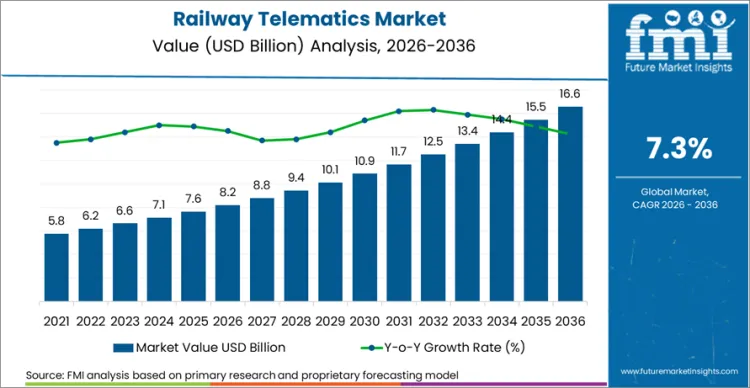
Summary of Railway Telematics Market
What Is Growth Outlook for Railway Telematics Market as per Future Market Insights Projection?
Future Market Insights projects the railway telematics market to expand at a CAGR of 7.3% from 2026 to 2036, increasing from USD 8.2 Billion in 2026 to USD 16.5 Billion by 2036.
FMI Research Approach: FMI forecasting model based on ERA TSI compliance timelines and rolling stock retrofit cycles.
How Do FMI Analysts Perceive Railway Telematics Market to Evolve?
FMI analysts perceive the market evolving toward edge AI-powered predictive maintenance platforms integrated with digital twin models of rail network assets.
FMI Research Approach: Hitachi Rail NVIDIA IGX Thor integration (October 2025) and Siemens RailXplore platform (October 2025).
Which Country Holds Largest Share in Global Railway Telematics Market?
Germany holds a significant share, supported by its position as the headquarters of Siemens Mobility and the Deutsche Bahn digital transformation program.
FMI Research Approach: FMI modeling by rail infrastructure spend and telematics contract values.
How Large Will Railway Telematics Market Be by 2036?
The global market is projected to reach USD 16.5 Billion by 2036.
FMI Research Approach: FMI forecast from ERA digital rail program budgets and rolling stock order backlogs.
What Is Definition of Railway Telematics Market?
The market includes revenue from onboard and trackside monitoring systems, fleet management platforms, predictive maintenance analytics, and communication modules for railway operations.
FMI Research Approach: FMI taxonomy aligned with ERA and UIC telematics classifications.
What Are Globally Unique Trends Shaping Railway Telematics Market?
Trends include edge AI deployment on rolling stock via GPU accelerators, digital twin integration for infrastructure, and updated TSI standards mandating telematics-ready new trains.
FMI Research Approach: Hitachi Rail-NVIDIA integration (October 2025) and ERA TSI update (2024).
Railway Telematics Market Key Takeaways
| Metric | Details |
|---|---|
| Industry Size (2026) | USD 8.2 Billion |
| Industry Value (2036) | USD 16.5 Billion |
| CAGR (2026 to 2036) | 7.3% |
Source: Future Market Insights (FMI) analysis, based on proprietary forecasting model and primary research
Railway Telematics Industry Analysis by Key Investment Segments
By Solution
| Attributes | Details |
|---|---|
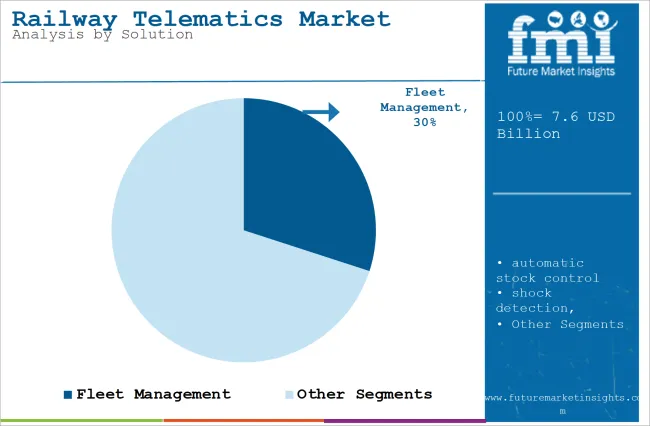
| Top Solution Type | Fleet Management |
| Market Share in 2026 | 30% |
By solution, the market is divided into fleet management, automatic stock control, shock detection, remote data access, railcar tracking and tracing, reefer wagon management, ETA, and others.
Fleet management is extremely important and accounts for 30% of the global market share in 2026. The growing importance of efficient fleet management for transporting cargo and passengers drives the fleet management segment ahead. A fleet means the entire set of wagons that goes as one single train.
To ensure the safe and intact transport of passengers or cargo, it is important to manage the railway fleet properly. The train schedule needs to be updated and prepared properly. Additionally, it needs to be optimized to reduce idle time. Energy or fuel consumption should also be constantly checked. It is also important to reduce operational costs by tracking and analyzing the performance. Moreover, regular maintenance of train wagons also needs to be done to prevent potential accidents.
By railcar
| Attributes | Details |
|---|---|
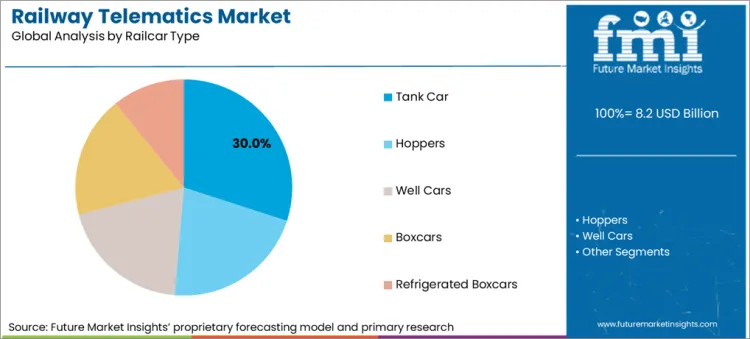
| Top Railcar Type | Tank Car |
| Market Share in 2026 | 30% |
By railcar, the market is divided into tank cars, hoppers, well cars, boxcars, refrigerated boxcars, and others. The tank cars segment accounts for a share of 30% in 2024. There is a growing use of tank cars for transporting perishable items, which is fostering segment growth. Tank cars are large containers in a train that are used for transporting fluids such as liquefied gases, petrol, diesel, and even milk.
A rise in fuel usage is another factor that drives the tank car segment ahead. Certain liquids that are perishable, such as milk, need to be transported on or before time, and no delay in such cases can be afforded. Transport through roadways can be quite delayed as unexpected traffic jams might arise.
Telematics systems help in designing appropriate schedules for trains and hence can ensure that these products are delivered on time. As railway telematics systems also detect if there are any maintenance issues with the train, they can be used even for checking leaks in the tanks. While transporting hazardous materials, tightly regulated conditions can be ensured, the status of which can be tracked by railway telematics systems.
By Component
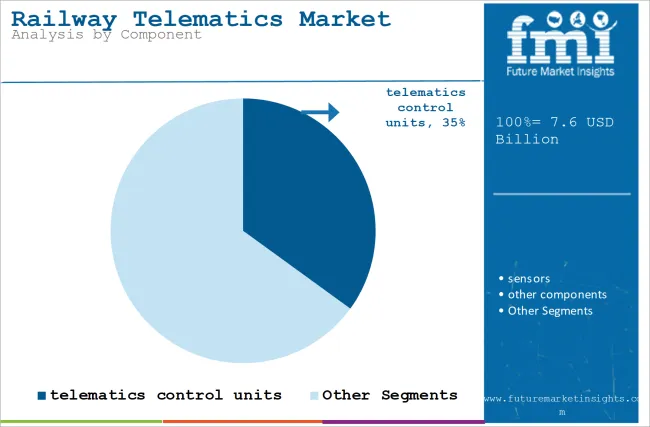
By component, the market is segmented into telematics control units, sensors, and other components. Sensors collect signals that further get processed by the TCUs. Using sensors, information about location can be gained for navigation. Because of sensors, fuel levels, temperature, and load capacities can be monitored to run trains at maximum efficiency.
With the help of TCUs, data from various sensors is collected, analyzed, and transmitted. The main purpose of TCUs and sensors is to enhance the safety of railways by detecting issues in the train to prevent future accidents, use fuels efficiently, save repairing costs, and minimize emissions.
By Train Type
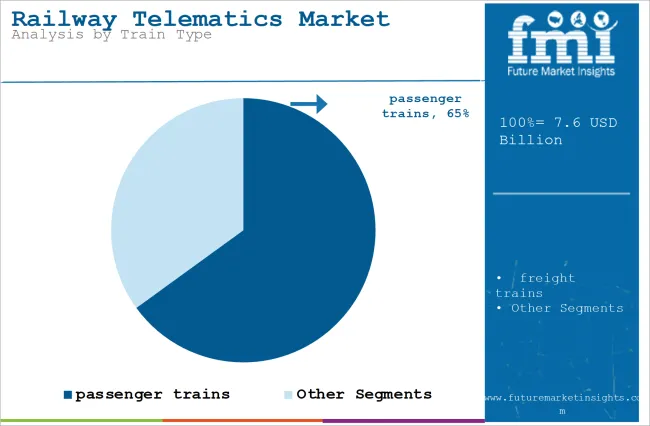
By train type, the market is segmented into passenger trains and freight trains. Prime focus of passenger trains is to ensure safety and comfort of passengers, and freight trains focus on transport cargo efficiently. Railway telematics in passenger trains provides location-updates of the train so that passengers can avoid last minute hassles.
Moreover, arrival and delay information is provided accurately by several train tracking apps. Railway telematics in freight trains help in handling cargo, tracking it, and to ensure proper distribution of weights when the cargo is loaded. Fuel gets used efficiently when load is properly managed and distributed in the freight trains.
Key Drivers Fueling the Railway Telematics Market
Increased Importance of Efficient Freight Management to Boost Telematics Adoption
Railways are an important means of transport for bulk goods. Consequently, the freight sector is seeing growth and expansion. To ensure that goods are delivered at the right time efficiently, it is important to reduce delays, reduce costs, and make the optimum use of time, which means efficient management of freights is required. Telematics solutions are feasible to detect the live location of cargo, leading to improved decision-making. Moreover, heavy government investment in modernizing railway infrastructure can improve efficiency and safety.
Rise in the Focus on Safety and Security to Augment Demand
There have been several railway accidents in the past, which were caused by uncontrolled railway speeds and miscommunication because of poor connectivity issues. Such accidents can be avoided, and railway transport can become safer and more efficient if we can monitor their speed and maintenance status in real-time.
Automatic braking systems can also be installed and with this facility, train accidents can be reduced. Repairing of trains can be done on time and certain AI algorithms can be used for collecting and analyzing large chunks of data in order to ensure smooth operations without any hiccups.
Need for Real-time Fuel Usage Monitoring to Expedite Product Sales
Telematics systems help monitor fuel levels in real time and analyze usage rates. Additionally, predictive analytics leveraged in railway telematics helps detect potential maintenance challenges that may result in surged fuel consumption. Moreover, they also help analyze fuel theft to reduce unauthorized usage. This way, fuel inventory levels can be monitored and operational efficiency can be maintained to streamline the supply chain process.
Smart Railways and Improving 5G Technology to Spur Product Uptake
As phones, trade, and other products keep getting smarter, trains can be made smart too by integrating telematics systems in railways. Additionally, technologies such as blockchain, cloud computing, and autonomous systems can be integrated. Moreover, customer experiences can be enhanced by real-time communication. Data can also be transmitted more efficiently and easily due to improvements in 5G technology. Furthermore, high-speed internet connectivity can also help monitor in real time.
Owing to faster network speeds, accidents caused because of poor maintenance of trains can be reduced. By using smart railway infrastructure, maintenance can be done regularly by scheduling timely maintenance checks. The sensors that can alert about the poor maintenance conditions can also be installed.
Moreover, the transportation of cargo requires proper weather conditions to take it to the destination in the best condition without damage. Before transporting cargo, temperature and external weather conditions are taken into account. By using telematics, fuel consumption can be regulated, leading to a reduction in greenhouse emissions.
Emerging Trends Transforming the Railway Telematics Market
Technological Innovations in Railway Telematics
In the prevailing scenario, cutting-edge technologies are being leveraged in railway telematics to ensure enhanced functionality. For instance, the telematics systems are now witnessing the deployment of machine learning and artificial intelligence algorithms to enhance their efficiency. These algorithms are helping improve route optimization and energy management. Moreover, AI-enabled systems are helping decrease manual errors to avoid collision and optimize the performance of railways.
Challenges in the Railway Telematics Market: High Initial Investment and Cyberattack Threats
For setting up railway telematics systems, advanced hardware, software, and high installation costs are required. Bearing these huge expenses is possible for the countries that are already developed, but this is very challenging for the countries that cannot afford these systems, and this can act as a huge barrier for them.
Not all railway stations have these systems installed for data collection and processing. If a train enters these stations, it may not be able to collect and process the data. Additionally, the incidences of cybercrime are increasing with growing advancements in technology. Hence, the security of data has become a matter of utmost importance.
With higher advancements, data breaches must be reduced. Several terrorist organizations can hack security systems, and hence professionals in the field of cybersecurity and railway operations are in high demand to protect the data.
Railway Telematics Industry Analyzed Across Key Regions
North America Railway Telematics Industry Analysis
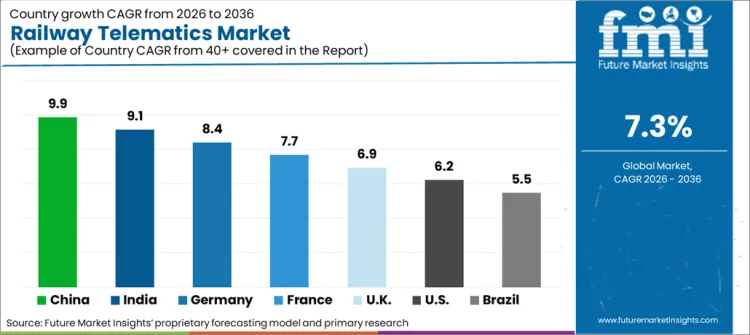
In North America, the USA accounts for 25.5% of the market share in 2024 and is set to observe a CAGR of 6.2% during the study period. North America has a growing and active rail industry, which is boosting the regional growth. Railroads are a key mode of transporting chemicals and oil.
Tank cars are necessary for transporting oil since the USA is one of the leading countries producing oil. Moreover, leakage of oils needs to be avoided to prevent losses. Telematics systems can help with maintenance checks of the train to ensure that the transport of fuels happens safely.
Europe Railway Telematics Industry Analysis
In Europe, Germany is expected to account for a 6.4% CAGR during the forecast period. The country is committed to enhancing the railway infrastructure. Steps are being taken to integrate advanced telematics solutions in railways to make them more efficient and safe, which are fostering regional expansion.
Asia Pacific Railway Telematics Industry Outlook
In Asia Pacific, Japan is anticipated to show a CAGR of 6.4% during the study period. The country shows great technological advancements in transportation systems. The Japanese government is spending on improving the railway networks and striving for safer, secure, and efficient railways. These factors are escalating regional growth.
Market Definition
The railway telematics market represents revenue from onboard condition monitoring systems, trackside sensors, fleet management platforms, predictive maintenance analytics software, and communication infrastructure for railway operations and maintenance.
Inclusions cover onboard sensor systems, trackside monitoring hardware, fleet management cloud platforms, predictive analytics software, edge AI computing modules, and train-to-ground communication systems.
Exclusions include railway signaling systems (ETCS/ERTMS), fare collection systems, and passenger information displays. Standalone cybersecurity products for rail networks are outside the scope.
Analysis of Competitive Landscape in the Railway Telematics Market
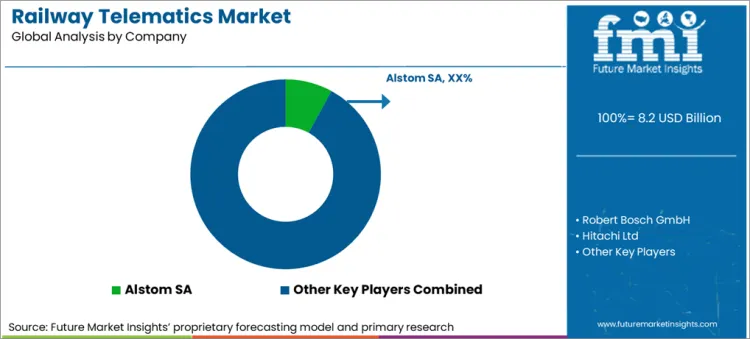
| Company | Area of focus |
|---|---|
| Alstom SA | Advanced signaling technologies such as Communications-Based Train Control (CBTC) and European Train Control System (ETCS). |
| Robert Bosch GmbH | Delivering telematics solutions for safety and efficiency, along with increasing connectivity in rail transport using IoT and AI. |
| Hitachi Ltd | Integrating telematics solutions to improve train operations by providing comprehensive railway signaling and control systems. |
| Siemens AG | Optimizing rail operations by focusing on advanced signaling and train control systems. |
| Wabtec Corporation | Focuses on improving the braking systems for trains. |
| Knorr-Bremse AG | Acquired Alstom’s conventional signaling business, expanding the portfolio beyond braking systems. |
| ORBCOMM | Provides telematics solutions for railcars that can enable train tracking in real-time and improve efficiency. |
| Railnova SA | Offers tools for monitoring fleet health, performance, and maintenance solutions for the railway industry. |
| SAVVY Telematic Systems AG | Focused on providing tools and services for accessing data in real-time, and managing fleets. |
Strategies focusing on maximizing profits are being implemented by the key players in the railway telematics market. To increase profits, companies ensure that the best solutions are provided and maximum efficiency is acquired while implementing telematics solutions. Railways are getting increasingly digital owing to improvements in the 5G network and easy internet access.
The live location of trains can be tracked, to avoid last-minute hassles while traveling. Even governments have launched several phone applications that can help passengers with easy booking, location tracking, lodging complaints, and others. For example, the IRCTC mobile app has been launched by the Indian Railways.
Recent Developments :
- In October 2025, Hitachi Rail became the first transportation firm to integrate the NVIDIA IGX Thor platform into its HMAX digital asset management suite for real-time edge AI processing.
- In October 2025, Siemens Mobility showcased its RailXplore asset performance monitoring platform at IREE 2025 with AI-driven anomaly detection.
Leading Companies in the Railway Telematics Market
- Alstom SA
- Robert Bosch GmbH
- Hitachi Ltd
- Siemens AG
- Wabtec Corporation
- Knorr-Bremse AG
- ORBCOMM
- Railnova SA
- SAVVY Telematic Systems AG
Scope of Report
| Items | Values |
|---|---|
| Quantitative Units (2026) | USD 8.2 Billion |
| Product Type | Onboard Monitoring, Trackside Sensors, Fleet Management Platforms, Predictive Analytics |
| Application | Freight Rail, Passenger Rail, Urban Transit, High-Speed Rail |
| Regions Covered | North America, Europe, Asia Pacific, Latin America, Middle East and Africa |
| Key Companies Profiled | Siemens Mobility, Hitachi Rail, Alstom, Knorr-Bremse, Bombardier Transportation |
Railway Telematics Industry Analysis by Key Categories
By Solution:
By solution, the market is segmented into fleet management, automatic stock control, shock detection, remote data access, railcar tracking and tracing, reefer wagon management, ETA, and others.
By Railcar:
By railcar, the market is segmented into tank cars, hoppers, well cars, boxcars, refrigerated boxcars, and others.
By Component:
By component, the market is segmented into telematics control units, sensors, and other components.
By Train Type:
By train type, the market is segmented into passenger trains and freight trains.
Bibliography
- Hitachi Rail. (2025, October). NVIDIA IGX Thor integration into HMAX platform. Hitachi Rail Press Releases.
- Siemens Mobility. (2025, October). RailXplore platform showcase at IREE 2025. Siemens Press Releases.
- European Union Agency for Railways. (2024). Technical Specifications for Interoperability update. ERA.
Frequently Asked Questions
What is the current global market size for Railway Telematics?
The global market is valued at USD 8.2 Billion in 2026, driven by the global push toward predictive maintenance and the deployment of edge AI processing on rolling stock and trackside infrastructure.
What is the projected Compound Annual Growth Rate (CAGR) for the market over the next 10 years?
The market is projected to grow at a CAGR of 7.3% from 2026 to 2036.
Which regions are experiencing the fastest expansion?
Europe leads driven by ERA digital rail mandates and TSI compliance requirements, followed by Asia Pacific where China and India railway modernization programs are investing heavily in condition monitoring.
What are the primary market drivers?
The deployment of edge AI processing via GPU accelerators on rolling stock and updated ERA Technical Specifications for Interoperability mandating telematics-ready new trains are the primary drivers.
Who are the leading suppliers in the industry?
Siemens Mobility, Hitachi Rail, Alstom, and Knorr-Bremse are key players, differentiating through edge AI asset management platforms and predictive maintenance analytics.
Preview the report firsthand - request a free sample
Get SampleGet the brochure for pricing and purchase details.
Get PDFTable of Content
- Executive Summary
- Global Market Outlook
- Demand-side Trends
- Supply-side Trends
- Technology Roadmap Analysis
- Analysis and Recommendations
- Market Overview
- Market Coverage / Taxonomy
- Market Definition / Scope / Limitations
- Research Methodology
- Chapter Orientation
- Analytical Lens and Working Hypotheses
- Market Structure, Signals, and Trend Drivers
- Benchmarking and Cross-market Comparability
- Market Sizing, Forecasting, and Opportunity Mapping
- Research Design and Evidence Framework
- Desk Research Programme (Secondary Evidence)
- Company Annual and Sustainability Reports
- Peer-reviewed Journals and Academic Literature
- Corporate Websites, Product Literature, and Technical Notes
- Earnings Decks and Investor Briefings
- Statutory Filings and Regulatory Disclosures
- Technical White Papers and Standards Notes
- Trade Journals, Industry Magazines, and Analyst Briefs
- Conference Proceedings, Webinars, and Seminar Materials
- Government Statistics Portals and Public Data Releases
- Press Releases and Reputable Media Coverage
- Specialist Newsletters and Curated Briefings
- Sector Databases and Reference Repositories
- FMI Internal Proprietary Databases and Historical Market Datasets
- Subscription Datasets and Paid Sources
- Social Channels, Communities, and Digital Listening Inputs
- Additional Desk Sources
- Expert Input and Fieldwork (Primary Evidence)
- Primary Modes
- Qualitative Interviews and Expert Elicitation
- Quantitative Surveys and Structured Data Capture
- Blended Approach
- Why Primary Evidence is Used
- Field Techniques
- Interviews
- Surveys
- Focus Groups
- Observational and In-context Research
- Social and Community Interactions
- Stakeholder Universe Engaged
- C-suite Leaders
- Board Members
- Presidents and Vice Presidents
- R&D and Innovation Heads
- Technical Specialists
- Domain Subject-matter Experts
- Scientists
- Physicians and Other Healthcare Professionals
- Governance, Ethics, and Data Stewardship
- Research Ethics
- Data Integrity and Handling
- Primary Modes
- Tooling, Models, and Reference Databases
- Desk Research Programme (Secondary Evidence)
- Data Engineering and Model Build
- Data Acquisition and Ingestion
- Cleaning, Normalisation, and Verification
- Synthesis, Triangulation, and Analysis
- Quality Assurance and Audit Trail
- Market Background
- Market Dynamics
- Drivers
- Restraints
- Opportunity
- Trends
- Scenario Forecast
- Demand in Optimistic Scenario
- Demand in Likely Scenario
- Demand in Conservative Scenario
- Opportunity Map Analysis
- Product Life Cycle Analysis
- Supply Chain Analysis
- Investment Feasibility Matrix
- Value Chain Analysis
- PESTLE and Porter’s Analysis
- Regulatory Landscape
- Regional Parent Market Outlook
- Production and Consumption Statistics
- Import and Export Statistics
- Market Dynamics
- Global Market Analysis 2021 to 2025 and Forecast, 2026 to 2036
- Historical Market Size Value (USD Billion) Analysis, 2021 to 2025
- Current and Future Market Size Value (USD Billion) Projections, 2026 to 2036
- Y-o-Y Growth Trend Analysis
- Absolute $ Opportunity Analysis
- Global Market Pricing Analysis 2021 to 2025 and Forecast 2026 to 2036
- Global Market Analysis 2021 to 2025 and Forecast 2026 to 2036, By Solution
- Introduction / Key Findings
- Historical Market Size Value (USD Billion) Analysis By Solution , 2021 to 2025
- Current and Future Market Size Value (USD Billion) Analysis and Forecast By Solution , 2026 to 2036
- Fleet Management
- Automatic Stock Control
- Shock Detection
- Remote Data Access
- Fleet Management
- Y-o-Y Growth Trend Analysis By Solution , 2021 to 2025
- Absolute $ Opportunity Analysis By Solution , 2026 to 2036
- Global Market Analysis 2021 to 2025 and Forecast 2026 to 2036, By Railcar Type
- Introduction / Key Findings
- Historical Market Size Value (USD Billion) Analysis By Railcar Type, 2021 to 2025
- Current and Future Market Size Value (USD Billion) Analysis and Forecast By Railcar Type, 2026 to 2036
- Tank Car
- Hoppers
- Well Cars
- Boxcars
- Refrigerated Boxcars
- Tank Car
- Y-o-Y Growth Trend Analysis By Railcar Type, 2021 to 2025
- Absolute $ Opportunity Analysis By Railcar Type, 2026 to 2036
- Global Market Analysis 2021 to 2025 and Forecast 2026 to 2036, By Component
- Introduction / Key Findings
- Historical Market Size Value (USD Billion) Analysis By Component, 2021 to 2025
- Current and Future Market Size Value (USD Billion) Analysis and Forecast By Component, 2026 to 2036
- Telematics Control Value (USD Billion)s
- Sensor
- Telematics Control Value (USD Billion)s
- Y-o-Y Growth Trend Analysis By Component, 2021 to 2025
- Absolute $ Opportunity Analysis By Component, 2026 to 2036
- Global Market Analysis 2021 to 2025 and Forecast 2026 to 2036, By Train Type
- Introduction / Key Findings
- Historical Market Size Value (USD Billion) Analysis By Train Type, 2021 to 2025
- Current and Future Market Size Value (USD Billion) Analysis and Forecast By Train Type, 2026 to 2036
- Passenger Trains
- Freight Train
- Passenger Trains
- Y-o-Y Growth Trend Analysis By Train Type, 2021 to 2025
- Absolute $ Opportunity Analysis By Train Type, 2026 to 2036
- Global Market Analysis 2021 to 2025 and Forecast 2026 to 2036, By Region
- Introduction
- Historical Market Size Value (USD Billion) Analysis By Region, 2021 to 2025
- Current Market Size Value (USD Billion) Analysis and Forecast By Region, 2026 to 2036
- North America
- Latin America
- Western Europe
- Eastern Europe
- East Asia
- South Asia and Pacific
- Middle East & Africa
- Market Attractiveness Analysis By Region
- North America Market Analysis 2021 to 2025 and Forecast 2026 to 2036, By Country
- Historical Market Size Value (USD Billion) Trend Analysis By Market Taxonomy, 2021 to 2025
- Market Size Value (USD Billion) Forecast By Market Taxonomy, 2026 to 2036
- By Country
- USA
- Canada
- Mexico
- By Solution
- By Railcar Type
- By Component
- By Train Type
- By Country
- Market Attractiveness Analysis
- By Country
- By Solution
- By Railcar Type
- By Component
- By Train Type
- Key Takeaways
- Latin America Market Analysis 2021 to 2025 and Forecast 2026 to 2036, By Country
- Historical Market Size Value (USD Billion) Trend Analysis By Market Taxonomy, 2021 to 2025
- Market Size Value (USD Billion) Forecast By Market Taxonomy, 2026 to 2036
- By Country
- Brazil
- Chile
- Rest of Latin America
- By Solution
- By Railcar Type
- By Component
- By Train Type
- By Country
- Market Attractiveness Analysis
- By Country
- By Solution
- By Railcar Type
- By Component
- By Train Type
- Key Takeaways
- Western Europe Market Analysis 2021 to 2025 and Forecast 2026 to 2036, By Country
- Historical Market Size Value (USD Billion) Trend Analysis By Market Taxonomy, 2021 to 2025
- Market Size Value (USD Billion) Forecast By Market Taxonomy, 2026 to 2036
- By Country
- Germany
- UK
- Italy
- Spain
- France
- Nordic
- BENELUX
- Rest of Western Europe
- By Solution
- By Railcar Type
- By Component
- By Train Type
- By Country
- Market Attractiveness Analysis
- By Country
- By Solution
- By Railcar Type
- By Component
- By Train Type
- Key Takeaways
- Eastern Europe Market Analysis 2021 to 2025 and Forecast 2026 to 2036, By Country
- Historical Market Size Value (USD Billion) Trend Analysis By Market Taxonomy, 2021 to 2025
- Market Size Value (USD Billion) Forecast By Market Taxonomy, 2026 to 2036
- By Country
- Russia
- Poland
- Hungary
- Balkan & Baltic
- Rest of Eastern Europe
- By Solution
- By Railcar Type
- By Component
- By Train Type
- By Country
- Market Attractiveness Analysis
- By Country
- By Solution
- By Railcar Type
- By Component
- By Train Type
- Key Takeaways
- East Asia Market Analysis 2021 to 2025 and Forecast 2026 to 2036, By Country
- Historical Market Size Value (USD Billion) Trend Analysis By Market Taxonomy, 2021 to 2025
- Market Size Value (USD Billion) Forecast By Market Taxonomy, 2026 to 2036
- By Country
- China
- Japan
- South Korea
- By Solution
- By Railcar Type
- By Component
- By Train Type
- By Country
- Market Attractiveness Analysis
- By Country
- By Solution
- By Railcar Type
- By Component
- By Train Type
- Key Takeaways
- South Asia and Pacific Market Analysis 2021 to 2025 and Forecast 2026 to 2036, By Country
- Historical Market Size Value (USD Billion) Trend Analysis By Market Taxonomy, 2021 to 2025
- Market Size Value (USD Billion) Forecast By Market Taxonomy, 2026 to 2036
- By Country
- India
- ASEAN
- Australia & New Zealand
- Rest of South Asia and Pacific
- By Solution
- By Railcar Type
- By Component
- By Train Type
- By Country
- Market Attractiveness Analysis
- By Country
- By Solution
- By Railcar Type
- By Component
- By Train Type
- Key Takeaways
- Middle East & Africa Market Analysis 2021 to 2025 and Forecast 2026 to 2036, By Country
- Historical Market Size Value (USD Billion) Trend Analysis By Market Taxonomy, 2021 to 2025
- Market Size Value (USD Billion) Forecast By Market Taxonomy, 2026 to 2036
- By Country
- Kingdom of Saudi Arabia
- Other GCC Countries
- Turkiye
- South Africa
- Other African Union
- Rest of Middle East & Africa
- By Solution
- By Railcar Type
- By Component
- By Train Type
- By Country
- Market Attractiveness Analysis
- By Country
- By Solution
- By Railcar Type
- By Component
- By Train Type
- Key Takeaways
- Key Countries Market Analysis
- USA
- Pricing Analysis
- Market Share Analysis, 2025
- By Solution
- By Railcar Type
- By Component
- By Train Type
- Canada
- Pricing Analysis
- Market Share Analysis, 2025
- By Solution
- By Railcar Type
- By Component
- By Train Type
- Mexico
- Pricing Analysis
- Market Share Analysis, 2025
- By Solution
- By Railcar Type
- By Component
- By Train Type
- Brazil
- Pricing Analysis
- Market Share Analysis, 2025
- By Solution
- By Railcar Type
- By Component
- By Train Type
- Chile
- Pricing Analysis
- Market Share Analysis, 2025
- By Solution
- By Railcar Type
- By Component
- By Train Type
- Germany
- Pricing Analysis
- Market Share Analysis, 2025
- By Solution
- By Railcar Type
- By Component
- By Train Type
- UK
- Pricing Analysis
- Market Share Analysis, 2025
- By Solution
- By Railcar Type
- By Component
- By Train Type
- Italy
- Pricing Analysis
- Market Share Analysis, 2025
- By Solution
- By Railcar Type
- By Component
- By Train Type
- Spain
- Pricing Analysis
- Market Share Analysis, 2025
- By Solution
- By Railcar Type
- By Component
- By Train Type
- France
- Pricing Analysis
- Market Share Analysis, 2025
- By Solution
- By Railcar Type
- By Component
- By Train Type
- India
- Pricing Analysis
- Market Share Analysis, 2025
- By Solution
- By Railcar Type
- By Component
- By Train Type
- ASEAN
- Pricing Analysis
- Market Share Analysis, 2025
- By Solution
- By Railcar Type
- By Component
- By Train Type
- Australia & New Zealand
- Pricing Analysis
- Market Share Analysis, 2025
- By Solution
- By Railcar Type
- By Component
- By Train Type
- China
- Pricing Analysis
- Market Share Analysis, 2025
- By Solution
- By Railcar Type
- By Component
- By Train Type
- Japan
- Pricing Analysis
- Market Share Analysis, 2025
- By Solution
- By Railcar Type
- By Component
- By Train Type
- South Korea
- Pricing Analysis
- Market Share Analysis, 2025
- By Solution
- By Railcar Type
- By Component
- By Train Type
- Russia
- Pricing Analysis
- Market Share Analysis, 2025
- By Solution
- By Railcar Type
- By Component
- By Train Type
- Poland
- Pricing Analysis
- Market Share Analysis, 2025
- By Solution
- By Railcar Type
- By Component
- By Train Type
- Hungary
- Pricing Analysis
- Market Share Analysis, 2025
- By Solution
- By Railcar Type
- By Component
- By Train Type
- Kingdom of Saudi Arabia
- Pricing Analysis
- Market Share Analysis, 2025
- By Solution
- By Railcar Type
- By Component
- By Train Type
- Turkiye
- Pricing Analysis
- Market Share Analysis, 2025
- By Solution
- By Railcar Type
- By Component
- By Train Type
- South Africa
- Pricing Analysis
- Market Share Analysis, 2025
- By Solution
- By Railcar Type
- By Component
- By Train Type
- USA
- Market Structure Analysis
- Competition Dashboard
- Competition Benchmarking
- Market Share Analysis of Top Players
- By Regional
- By Solution
- By Railcar Type
- By Component
- By Train Type
- Competition Analysis
- Competition Deep Dive
- Alstom SA
- Overview
- Product Portfolio
- Profitability by Market Segments (Product/Age /Sales Channel/Region)
- Sales Footprint
- Strategy Overview
- Marketing Strategy
- Product Strategy
- Channel Strategy
- Robert Bosch GmbH
- Hitachi Ltd
- Siemens AG
- Wabtec Corporation
- Alstom SA
- Competition Deep Dive
- Assumptions & Acronyms Used


